




Abstract
This research investigates the influence of being a painter and intellectuality on mate preferences. Two studies were conducted to explore the relationships between being a painter and mate preferences. Study 1 analyzed 192 participants who rated painters, ideal partners, and themselves using a set of adjectives. Results revealed significant correlations between the cognitive abilities attributed to painters and the desirable traits sought in an ideal partner, particularly among women. Consequently, the second study focused exclusively on female participants and considered intellectuality as a broad, overarching concept. Study 2 focused on 150 female participants and used a between-subjects design to manipulate the target's occupation (painter vs. civil servant) and intellectuality (high vs. low). Findings showed an interaction effect, indicating that low intellectual-civil servant condition was the least preferred. These studies suggest that intellectuality is a key factor in the appeal of painters, particularly for women.
The earliest known information about traces of humanity comes from various engravings and paintings. While our known oral and written history spans shorter periods, examples such as cave engravings date back up to 40,000 years (White et al., 2012). Excavations indicate that our species has continued to produce art throughout our evolutionary progress (Aubert et al., 2014). Given the scant evidence from prehistoric periods, it is plausible that art production dates back even further (Davies, 2012). According to Killin (2018), proto-music may have begun 400,000 years ago.
Considering the prevalence and historical depth of art production, it can be regarded as a characteristic of our species. Charles Darwin (1871/2019) emphasized that music and dance in humans are used to enhance sexual attractiveness. Art can be seen as serving a sexual signaling function, especially in prehistoric periods. According to Darwin, individuals signal genetic compatibility by producing art. Art production requires energy, time, and skills. Such costs are typically incurred in nature only for survival or reproductive purposes (Miller, 2001).
Sexual selection generally exerts pressure on the males. One of the most notable examples is bowerbirds (Borgia, 1986). Males display themselves by cleaning their areas and constructing aesthetic bowers. Females show little interest in males with poor bowers, while those with attractive bowers have more opportunities to mate. Male bowerbirds display fitness and good genes through their aesthetic abilities. In turn, female bowerbirds have developed an aesthetic sense to evaluate the quality of these males. According to Miller (2001), women also produce art, and since humans are generally monogamous, mutual selection exists. Nevertheless, in agricultural and industrial societies, most art pieces are created by men (Miller, 1999).
According to the fitness indicator theory (Miller, 2000, 2001), certain characteristics are sexually selected because they signal higher genetic quality. Among humans, the most well-known characteristics are a waist-to-hip ratio close to 0.7 in women (Forestell et al., 2004; Tassinary & Hansen, 1998) and upper body strength in men (Sell et al., 2017). According to Miller (2001), art production is also a fitness indicator. Those who create appreciated art typically possess good hand-eye coordination, access to rare materials, creativity, and patience.
The influence of art on mate preferences has been discussed since Darwin's initial ideas, although there have been very few experimental studies on this topic. Studies investigating the impact of artistic expressions, particularly music, have yielded important findings. A study examining Facebook invitations revealed that an individual with a guitar in his profile photo was more likely to be accepted as a friend than an individual without a guitar profile. These findings suggest a preference for the traits associated with being an artist, particularly among women (Tifferet et al., 2012).
Bongard et al. (2019) employed the same methodology as in the present study and depicted the hypothetical profiles verbally. There was no direct support for musicians’ attractiveness, but private musicians gained more attractiveness than public musicians and the control group did. In addition, the similarity effect was observed, the musicians favored musicians much more. Marin and Rathgeber (2022) assessed the attractiveness ratings of the faces. Participants were first exposed to piano pieces with varying levels of arousal and pleasantness. Music was presented as being performed by the person depicted in the photographs. Compared to a control condition without music, music increased dating desirability in males and both dating desirability and attractiveness ratings in females only.
Other than studies involving musicians, a recent study (Wassiliwizky et al., 2023) examining the effects of being a visual and auditory artist yielded important results. Visual cues were provided to imply that the target person in the presented images was either a visual artist, a musician, or belonged to a control occupation. While there were no differences in implicit measures such as the time spent looking at the presented images, explicit measures indicated that the artist conditions were rated as more attractive. The authors attributed these findings to the effects of social desirability, as there are societal expectations that artists are viewed positively.
Clearly, there is a need for more studies to examine the role of being an artist in potential mate preferences. The extant literature does not provide adequate elucidation regarding the potential underlying factors contributing to the apparent advantage artists possess in terms of mate preferences. The limited existing studies have predominantly focused on musicians and have been conducted in Western samples. Therefore, the current study investigated the factors associated with mate preference for painters in a non-Western sample and explored the potential underlying factors.
Study 1
Method
Design and Sample
A total of 208 participants enrolled in the online research set. The participants compromised both undergraduate students (42.8%) and community samples (57.2%). The sample consisted of 54.3% women and aged between 18 and 80 years (M = 29.1, SD = 10.4). The majority of the sample was single (69.2%) and mostly lived in a large city (54.8%). Participants aged 45 years and older (7 males, 9 females) who were deemed to be beyond the reproductive period were excluded from the data set. Subsequently, the analyses proceeded with 88 males and 104 females, totaling 192 participants.
In this first exploratory study, men and women were asked to rate adjectives at three different levels and the correlations between these responses were examined.
In this exploratory study, participants were asked to rate adjectives that would describe a painter, their ideal partner, and themselves. The correlations between participants’ ratings of a painter and their ratings of an ideal partner were analyzed separately for each gender.
Materials and Procedure
The web links to the research set were posted through various social media platforms such as X, Instagram, and Facebook. Participants were told that they would gain no monetary benefit or course credit, stating that participation was voluntary. The initial page of the research link was an informed consent form explaining the research outline. It was stated that the aim of the research is to understand people's evaluations about painters, partners, and themselves. After their approval to continue, the second page comes in.
Adjective rating is one of the most commonly used techniques in mating preference research. Therefore, we also implemented this approach. The adjectives were selected through detailed examination of previous studies (e.g., Buss and Barnes, 1986). Since the data were collected from a non-Western sample, many of the adjectives were derived from Gundogdu-Akturk's (2010) study. The selection of adjectives consisted of some physical descriptions such as sexy and attractive, while others were about cognitive capacities such as intelligent and intellectual. Some adjectives were about personal traits such as trustworthy and compatible. In addition, there were some interpersonal adjectives, such as warm-hearted and interested. A total of twenty-one adjectives were presented to the participants. The adjectives were rated on three levels: for a painter, for the ideal partner, and for one's own self. A five-point rating scale was used for all the items (1 = Strongly disagree to 5 = Strongly agree).
Initially, participants were asked to imagine a painter. They were instructed to rate twenty-one adjectives as in “A painter is a …. person”. After their ratings, two filler tasks were given to distract the participants. First one was about computing a total number of passengers on a bus, while the latter was writing three districts that starting with the letter A.
The same procedure was applied in the ratings for the ideal partner. They rated the twenty-one adjectives to fill the sentence of “My ideal partner is a …. person”. Similarly, two filler tasks appeared after the participants completed the ratings. The initial task involved calculating the total quantity of tomatoes in a basket, while the latter task required listing three countries whose names commence with the letter A.
Then, they rated themselves as in “I am a …. person”. After rating themselves, two filler tasks were conducted. The first was about computing two siblings’ ages, and the latter was about writing three cities that started with the letter A. Apart from these three ratings, they were presented the same twenty-one adjectives and were asked to select the five most important characteristics that they look for in their ideal partner.
Finally, the participants were asked about their demographics such as age, gender, marital status, and education level. The questionnaires usually take fifteen to twenty minutes to complete.
Analysis
In accordance with the study's objective, frequency analysis was employed to identify the five characteristics that participants deemed most important in their partners. Also, the relationship between the characteristics that the participants seek in their partners and the characteristics they attribute to painters was analyzed using the Pearson Correlation Coefficient. The aim of this first study is to identify the painter trait that may be associated with the highest number of partner characteristics. This will enable the experimental manipulation of this trait in the second study.
Since the correlation analysis for each gender examined 441 relationships, Holm correction (Holm, 1979) was used to control for family wise type I error. The p-values obtained from the Holm correction are presented in the Supplementary Files.
Results
Correlations between the evaluations of women and men were examined separately. There were some differences in the ideal partner and painter evaluations between men and women.
Most Important Five Characteristics of an Ideal Partner
When asked about the five most important characteristics they sought in their partners, women most frequently chose being trustworthy (n = 87, 84%), good-natured (n = 68, 65%), loyal (n = 64, 62%), interested (n = 51, 49%), and intelligent (n = 49, 47%). Similarly, the traits most frequently chosen by men were being trustworthy (n = 53, 60%), intelligent (n = 49, 56%), loyal (n = 46, 52%), good-natured (n = 38, 43%), and compatible (n = 28, 32%).
Correlational Analysis
Our analyses revealed significant positive correlations among female participants between the intellectual trait they attributed to a painter and all traits they sought in an ideal partner. Following the application of Holm's correction, intellectuality, creativity, and talent attributed to the painter remained significantly associated with numerous ideal partner characteristics.
The correlations of the intellectual trait attributed to a painter positively correlated with the traits sought in an ideal partner are as follows: intellectual (r (111) = .43, pHolm = .004), humorous (r (111) = .44, pHolm = .004), sensitive (r (111) = .39, pHolm = .01), well-dressed (r (111) = .41, pHolm = .004), promising (r (111) = .42, pHolm = .004), talented (r (111) = .40, pHolm = .008).
The analyses revealed significant positive correlations among male participants between some traits they attribute to a painter and several traits they seek in an ideal partner. Especially, the attributions of intellectual, creative, and talented to a painter showed several correlations. However, following the Holm correction, all of the correlations were found to be statistically insignificant.
People might exhibit a preference for partners who share similar characteristics (Liu et al., 2018), potentially resulting in ideal partner measures partially incorporating self-measures. Consequently, self-evaluations may contribute to the significant correlations observed between the ideal partner and painter measures. To address this possibility, self-evaluations were employed as covariates in a partial correlation analysis examining the associations between ratings of the ideal partner and a painter. These analyses were conducted exclusively for correlations that demonstrated statistical significance after Holm correction. The results indicated that the correlations, which remained statistically significant after the Holm correction, maintained their significance when control variables were included in the analysis. This outcome can be attributed to the stringent nature of the Holm correction, which identifies only correlations with exceptionally low p-values (i.e., p = .0001) as statistically significant. For correlations with particularly low p-values, the incorporation of control variables did not affect their statistical significance.
Factor Analysis
A factor analysis was conducted to examine the structure of 21 traits attributed to painters, employing the minimum residual extraction method with promax rotation. The number of factors was determined using eigenvalues, with factors having eigenvalues greater than one retained for interpretation. The initial eigenvalues revealed that only the first two factors had values above one (Factor 1: eigenvalue = 6.75; Factor 2: eigenvalue = 1.22), suggesting a two-factor solution.
The first factor consisted of traits related to social reliability and physical attractiveness, including loyal (.84), good-natured (.76), trustworthy (.74), and sexy (.90), with similarly high loadings indicating a strong grouping of these traits. This factor reflects social appeal, combining elements of reliability and physical attractiveness, which are relevant in the context of interpersonal relationships and partner selection.
The second factor included 4 traits associated with intellectuality: creativity, talent, intellect, and intelligence. The loadings of traits like creative (.74), talented (.71), intellectual (.67), and intelligent (.46) on this factor indicate that these attributes form a coherent grouping, reflecting intellectuality as a broad construct encompassing these related traits. This structure suggests that intellectuality acts as an umbrella characteristic within social contexts, integrating various facets that contribute to perceptions of intellectual capability and artistic depth.
Discussion
This study primarily aimed to examine the evaluations of a painter and an ideal partner among males and females and to investigate the correlations between these evaluations. The results indicate that there are similarities and differences between the genders. First, when examining the top five characteristics that all genders valued the most, there was a significant overlap. That is, both genders value similar characteristics.
Additionally, attributed intellectuality appears to play a notable role in evaluating both the ideal partner and the painter. The results indicate that participants of both genders appreciate intellectuality in a painter, which is linked to some desirable traits in an ideal partner. However, the specific traits associated with intellectuality vary between genders, and these associations fade for men after Holm correction, suggesting differing priorities in partner selection.
For female participants, attributed intellectuality of painter was associated with a variety of partner traits, including humor, promise, and talent. The correlations between the traits attributed to a painter (e.g., creativity, talent, and intellectuality) and partner characteristics highlight the role of cognitive abilities in mate preference.
The factor analysis identified intellectuality and social appeal as the two primary dimensions influencing ideal partner selection. Intellectuality, encompassing creativity, talent, intellect, and intelligence, emerged as a unified construct, while social appeal incorporated social reliability and physical attractiveness. These findings underscore intellectuality's role as a broad construct in social perception and highlight the importance of both intellectual and social attributes in mate selection criteria.
A notable finding of this study is that the perceived intellectuality of the painter correlates with several aspects of partner attributions, particularly among female participants. The results suggest that attributed intellectuality may play a role in why painters are preferred. Although the relationships disappeared for men after Holm correction, the correlations related to intellectuality remain for women. This suggests the potential role of intellectuality in shaping mate preferences for women. This also aligns with fitness indicator theory (Miller, 2000, 2001), which emphasizes women's ability for aesthetic evaluation. Consequently, the connection between being a painter and ability attribution requires further exploration in female participants.
Study 2
The second study aimed to illuminate the effects of manipulated intellectuality and occupational conditions. In the results of first study, attributed intellectuality, creativity, and talent of a painter were dominantly related to ideal partner characteristics. These three concepts can be considered as analogous characteristics of being a painter. Thus, intellectuality, creativity, and talent function as interpersonal markers within social contexts. Creativity and talent can be viewed as subcomponents of intellectuality that significantly influence perceptions of overall intellectual capacity. Creativity involves the ability to generate novel ideas, solutions, or artistic expressions, often through divergent thinking and imaginative processes (Pinkow, 2022; Wu & Chen, 2023). Talent, on the other hand, refers to natural aptitudes or acquired skills in specific domains, such as music, mathematics, or academic so it is related to intellectuality (Olszewski-Kubilius et al., 2016). From this perspective, these three concepts could be integrated into the broader notion of intellectuality. In fact, factor analysis revealed that intellectuality, creativity, intelligence and talent clustered together as a single factor, further supporting their interconnectedness in influencing perceptions of intellectual traits. Therefore, we manipulated intellectuality as our independent variable.
This study involved female participants only, for a couple of reasons. Firstly, the intellectuality ratings of painters correlated with numerous characteristics of women's ideal partners. Secondly, initial analysis showed that the relationship between intellectuality attributions and partner ratings persisted when controlled for self-evaluations. Third, as aesthetic evaluators in nature are mostly female (Miller, 2001), this aligns with the composition of our sample.
In this experimental study, we hypothesized that (H1) the painter conditions would be rated preferable than control conditions. The source of this expectation is previous views suggesting that being an artist would be associated with more positive attributions (Wassiliwizky et al., 2023). We also hypothesized that (H2) high-intellectuality conditions would be perceived as more favorable than low-intellectuality conditions. Because intellectuality is a distinctly desirable characteristic, the participants would consider this information much. We further hypothesized (H3) an interaction effect between painter and intellectuality conditions. That is, the most preferable condition was expected to be the high-intellectual painter condition, whereas the least preferable condition was expected to be the low-intellectual non-painter condition.
Method
Design and Sample
A total of 159 women were enrolled in this online-based experimental study. The participants were university students (60.4%) and community samples (39.6%). The majority of the sample was single (88.1%) and mostly lived in a large city (53.5%). Their ages ranged from 18 to 72 years (M = 25.2, SD = 8.12). There was no significant difference among experimental conditions in the means of the participants’ ages, F (3,155) = 1.37, p = .25. Participants aged 45 years and older who were deemed to be beyond the reproductive period were excluded from the data set. Subsequently, the analyses proceeded with 150 women.
In this experimental study, participants were initially exposed to Profile 1, followed by Profile 2, and subsequently Profile 3, facilitating a repeated-measures design. Within Profile 3, participants were randomly assigned to one of four distinct conditions based on the independent variables (occupation and intellectuality), employing a between-subjects approach. This methodology enabled the utilization of both repeated measures and between-subjects designs. Furthermore, a comparison between Profile 1 and Profile 3 was conducted to establish a baseline measure for assessing the effects of the experimental conditions and to enhance the interpretability of the results (Akben, 2016; Donmez et al., 2006). Additionally, Profile 2 was incorporated to mitigate carry-over effects and ensure that participants’ responses were not influenced by their prior exposure to the previous condition. Another rationale for including Profile 2 was to prevent participants from easily discerning the differences between Profile 1 and Profile 3, as these profiles differed only in terms of occupation or intellectuality level in certain conditions. By introducing Profile 2, the aim was to render the changes less apparent and reduce potential bias in participants’ responses, thereby maintaining the integrity of the data.
Materials and Procedure
The web links to the research set were posted through various social media platforms such as X, Instagram, and Facebook. They were informed that they would gain no monetary benefits or course credit, stating that their participation was voluntary. The initial page of the research link was an informed consent form explaining the research outline. It was stated that the purpose of this research was to understand participants’ evaluations of other people. The participants in this study were instructed to analyze the profiles of three specified individuals and respond to the associated questions. It was emphasized that the consent of all three people whose profile features were presented was obtained, and that the answers of any participant would not be forwarded to these people. After their approval to continue, the second page comes in.
In Profile 1, a person named Ahmet, who works as a banker, was presented. In addition, some information was added, such as that he had a bachelor's degree, and his hobbies were reading books and jogging. Then, by stating that the results of the personality test applied to Profile 1 are shown, the results are expressed in terms of five characteristics. The personality test results were presented on a scale of 1 to 10, using filled star symbols. The five characteristics were intellectual, patient, determined, social, and fair, respectively. In Profile 1, the score for intellectuality is presented as 7.1 and scores for the other characteristics are presented between 6.3 and 7.2.
After the participants examined Profile 1, they were instructed to rate ten sentences about Profile 1. Some items focused on short-term relationships (e.g., “I would like to have a short-term relationship with …”), while some items aimed to measure long-term relationships (e.g., “… meets the criteria I look for in long-term partners”). Other items included trust, liking, attractiveness, and getting along with. A five-point rating scale was used for all the items (1 = Strongly disagree to 5 = Strongly agree). A similar procedure was followed for Profile 2 male, whose name was Barkın, who is employed as a sales representative. The intellectuality score was presented 7.0 for Profile 2, and the rest of the characteristics varied from 6.3 to 7.0. Again, they rated Profile 2 for the same ten questions mentioned above.
The crucial aspect of this study is about Profile 3. In Profile 3, a male named Mustafa was presented under various occupational and intellectual conditions. Depending on the conditions of the study, the profession of Profile 3 changed to either a painter or civil servant. Additionally, in the high intellectuality condition, the intellectuality score of Profile 3 was presented as 8.1; whereas in the low intellectuality condition, this score was presented as 5.0. However, his education level, hobbies, and other personality traits remained the same across the experimental conditions. Other personality characteristics were presented between 6.3 and 7.1. The participants then rated the same ten questions for Profile 3.
Subsequently, the participants rated themselves for the twenty-one adjectives, as in Study 1. Finally, the participants were asked about their demographics such as age, gender, marital status, and education level. All the procedures took approximately 15–20 min.
Analysis
In this study, we compared Profile 1 and Profile 3 (Repeated Measure Factors; RMF) using a repeated-measures design to examine the differences between high and low intellectuality and between civil servant and painter groups. We employed a repeated-measures ANOVA to analyze the data. This methodology enabled the evaluation of interaction effects between the levels of intellectuality (high versus low) and occupation conditions (civil servant versus painter). Specifically, we aimed to determine whether there were significant differences in mate preference variables based on these factors.
Results
Ten repeated measures ANOVA was conducted to evaluate the effects of the within-subjects factor (RMF), the between-subjects factors of intellectuality (high or low intellectual) and profession (being painter or civil officer), and their interactions on the dependent variables “long term relationship preference”, “attractiveness”, “having ideal partner characteristics”, “trust”, “getting along with”, “compatibility”, “preferability for short term relationship”, “having qualities for short term relationships”, “having qualities for long term relationships” and “liking”. Figure 1 shows the means and confidence intervals for statistically significant effects.
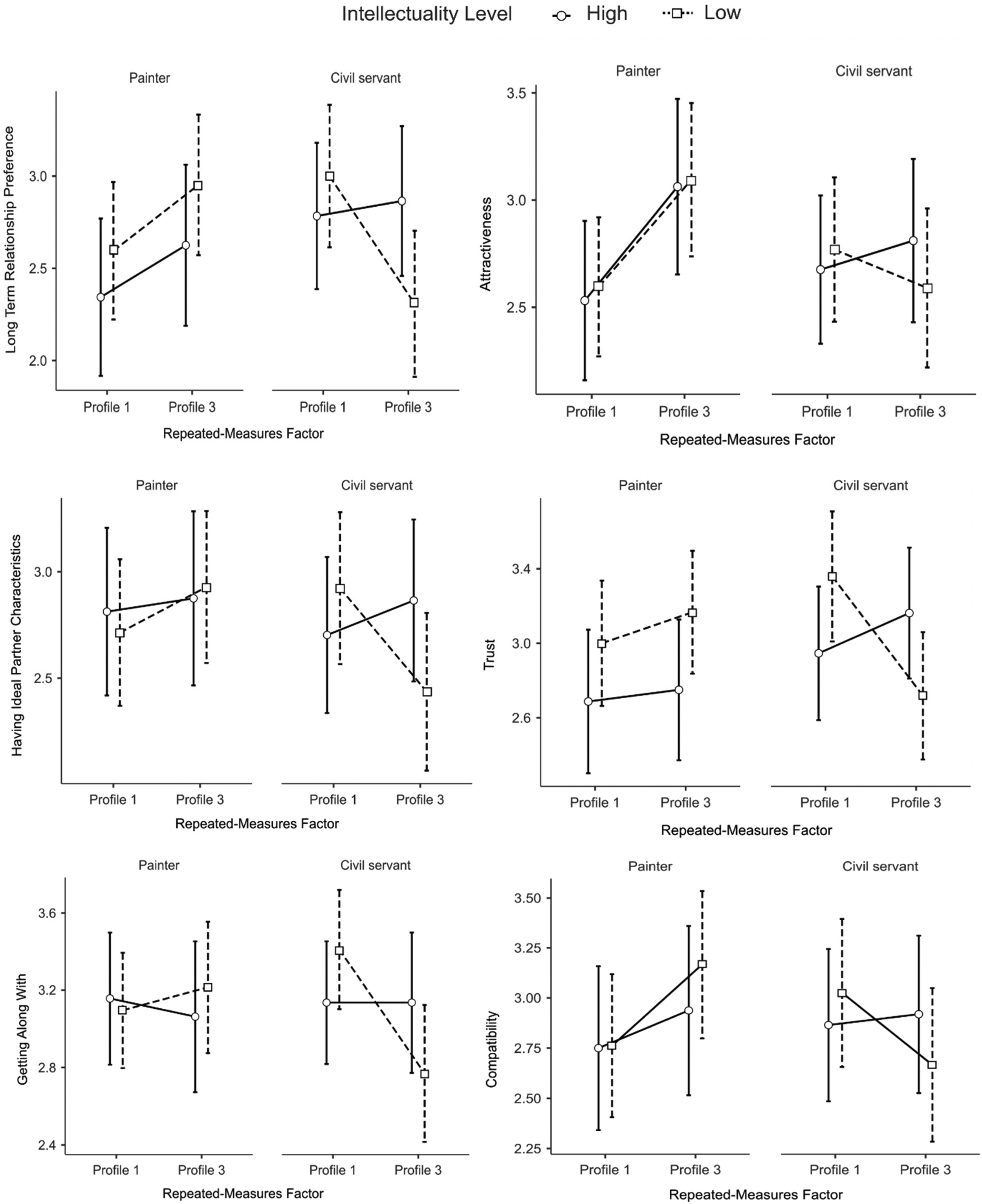
Means and 95%CIs for dependent variables across experimental conditions.
Long Term Relationship Preference
The interaction effect of RMF and profession was significant, F (1,146) = 8.23, p = .005, η²p = .05. The interaction effect of RMF, intellectuality, and profession were also significant, F (1,146) = 3.80, p = .05, η²p = .03. The other main and interaction effects were not significant.
The groups with higher preferability scores for long-term relationships were the low intellectual–painter (X̄ = 2.95, SD = 1.29, 95%CI = 2.55–3.35), high intellectual–civil servant (X̄ = 2.86, SD = 1.34, 95%CI = 2.42–3.31) and high intellectual–painter (X̄ = 2.63, SD = 1.13, 95%CI = 2.22–3.03) groups. The least preferred group for long-term relationships was the low intellectual–civil servant group, X̄ = 2.31, SD = 1.22, 95%CI = 1.91–2.70. Tukey post-hoc tests revealed that preference scores of the low intellectual–civil servant condition were significantly lower than the Profile 1 measurements (low intellectual–banker), t (146) = 3.26, p = .03.
Attractiveness
The interaction of repeated measure factor (RMF) and occupation was significant for attractiveness scores, F (1,146) = 5.67, p = .02, η²p = .04. The other main and interaction effects were not significant. The groups with the highest attractiveness scores were low intellectual–painter (X̄ = 3.10, SD = 1.16, 95%CI = 2.73–3.46), and high intellectual-painter (X̄ = 3.06, SD = 1.16, 95%CI = 2.64–3.48). Groups with low attractiveness scores were high intellectual-civil servant (X̄ = 2.81, SD = 1.15, 95%CI = 2.43–3.19) and low intellectual-civil servant, X̄ = 2.59, SD = 1.21, 95%CI = 2.20–2.98. Tukey's post-hoc test revealed that painters had higher attractiveness scores in level two than in Profile 1 ratings, t (146) = –3.19, p = .01.
Having Ideal Partner Characteristics
The interaction of RMF, occupation, and intellectuality level was significant for ideal partner characteristics, F (1,146) = 3.85, p = .05, η²p = .03. The other main and interaction effects were not significant. The groups with higher ideal partner characteristics scores were the low intellectual-painter (X̄ = 2.93, SD = 1.16, 95%CI = 2.57–3.29), high intellectual-painter (X̄ = 2.88, SD = 1.07, 95%CI = 2.49–3.26) and high intellectual-civil servant (X̄ = 2.86, SD = 1.27, 95%CI = 2.44–3.29) groups. That is, the low intellectual-civil servant group had the lowest score for having ideal partner characteristics, X̄ = 2.44, SD = 1.17, 95%CI = 2.06–2.81.
Trust
The interaction of RMF, occupation and intellectuality level were significant for trust, F (1,146) = 4.88, p = .03, η²p = .03. The other main and interaction effects were not significant. The groups with higher trust scores were the low intellectual-painter (X̄ = 3.17, SD = 0.99, 95%CI = 2.86–3.47), high intellectual-painter (X̄ = 2.75, SD = 1.14, 95%CI = 2.34–3.16) and high intellectual-civil servant (X̄ = 3.16, SD = 1.14, 95%CI = 2.78–3.54) groups. The low intellectual-civil servant group had the lowest score for trust, X̄ = 2.72, SD = 1.07, 95%CI = 2.37–3.07.
Getting Along With
The interaction of RMF, occupation, and intellectuality level was significant for ratings of getting along with, F (1,146) = 3.86, p = .05, η²p = .03. The other main and interaction effects were not significant. Similarly, the groups with higher getting along with ratings were the low intellectual-painter (X̄ = 3.21, SD = 1.07, 95%CI = 2.88–3.55), high intellectual-painter (X̄ = 3.06, SD = 1.16, 95%CI = 2.64–3.48), and high intellectual-civil servant (X̄ = 3.14, SD = 1.08, 95%CI = 2.77–3.50) groups. As can be understood, the low intellectual-civil servant group has the lowest ratings, X̄ = 2.77, SD = 1.16, 95%CI = 2.39–3.14.
Compatibility
The interaction of RMF and occupation was marginally significant for compatibility ratings, F (1,146) = 3.79, p = .053, η²p = .03. The other main and interaction effects were not significant. Consistent with other analyses, the groups with higher compatible scores were the low intellectual-painter (X̄ = 3.17, SD = 1.15, 95%CI = 2.81–3.52), high intellectual-painter (X̄ = 2.94, SD = 1.22, 95%CI = 2.50–3.38) and high intellectual-civil servant (X̄ = 2.92, SD = 1.23, 95%CI = 2.51–3.33) groups. The low intellectual-civil servant group had the lowest compatibility ratings, X̄ = 2.67, SD = 1.24, 95%CI = 2.26–3.07.
Other Dependent Variables
None of the main and interaction effects were significant for “preferability for short term relationship”, “having qualities for short term relationships”, “having qualities for long term relationships” and “liking”.
Discussion
The primary aim of this study was to examine how being a painter and intellectuality interact to influence mate preferences. Therefore, three hypotheses were tested in Study 2. The first hypothesis posited that painter conditions would receive higher mate preference ratings than non-painter conditions. When compared to initial Profile 1 ratings, the ratings of Profile 3 that include painter condition had higher scores than the civil servant condition only in terms of long-term preference and attractiveness. The second hypothesis expected that high intellectuality conditions would result in higher mate preference ratings than low intellectuality conditions. However, this hypothesis was not supported.
This lack of these effects can be attributed to the interaction effects of the two independent variables. As expected from the third hypothesis of this study, an interaction effect between intellectuality and occupation conditions was observed. The results revealed that the low intellectual-civil servant condition received significantly lower ratings than the other conditions. This result indicates that at least one of the features of occupation or intellectuality seems necessary to gain attraction. If a man is a painter but not an intellectual, he may still be perceived as somewhat intellectual. Similarly, if a man is a civil servant, but intellectual, he may be perceived as more attractive than other civil servants. However, if the target male is neither an intellectual nor a painter, he may not be associated with sufficient social or cognitive capacity. The mean scores of the preference ratings did not significantly increase in the high intellectual and painter condition. In other words, providing only one of these information about the person is sufficient, and having both does not further enhance the effect.
The results offer a strong impression that the underlying factor of the mate preference effect of the painter is a social or cognitive factor as intellectuality. The artist label in the social context, specifically the painter in the present study, includes the stereotype of an intellectual, intelligent, and creative person (Wassiliwizky et al., 2023). Therefore, presenting a person as a painter but with low intellectuality may not break this stereotype. Another possibility is that a painter with low intellectuality may still be perceived as intellectual just because of his occupation.
It can be considered that questions showing statistical significance are generally related to long-term relationships, while questions without significant differences are more associated with short-term relationships. Two of the questions without statistical significance addressed short-term relationships and the other focused on liking. Liking may also have been understood in a short-term sense. Perhaps being a painter and intellectuality signal attractiveness in the context of long-term relationships rather than short-term ones. Another point to consider at this point could be the sample. Measuring women's short-term relationship preferences in a non-Western society may be more challenging than anticipated. It should also be considered that many women may not express themselves confidently about short-term affection or have very little experience in this regard, even if the anonymity of their answers was underlined.
General Conclusions
This suggests that intellectuality might be a key factor driving these associations for women. The findings from these two studies indicate that painters’ intellectuality is positively associated with the traits desired in an ideal mate, especially among women.
The results of first study reveal similarities in the top five characteristics valued by both genders for mate selection. Ability attributions, such as intellectuality or creativity, demonstrated numerous correlations with partner characteristics. Gender differences were observed in traits associated with intellectuality: for women, painter's intellectuality correlated with various partner traits (humor, promise, talent), while for men, some associations faded after Holm correction. These findings align with the fitness indicator theory, which suggests that traits like creativity and intellectuality serve as reliable signals of genetic quality and mate value (Miller, 2000, 2001). Correlations between painter traits (e.g., creativity, talent, intellectuality) and partner characteristics supported this theory. These findings are consistent with both Clegg's (2006) finding that male artists have more sexual partners and higher reproductive rates and (Galasinska & Szymkow, 2021) finding that demonstrates a positive correlation between women's probability of conception and their creative originality and flexibility.
The second study, conducted with female participants, examined the effects of manipulated intellectuality and occupational conditions on mate preference. The findings showed that civil servants with low intellectuality were the least preferred. Interestingly, for most dependent variables, high intellectual painter, high intellectual civil servants and low intellectual painters had similar values. This suggests that painters are naturally perceived as intellectual or that civil servants with enhanced intellectuality can reach the same mate value as painters.
These findings demonstrate that being an artist, particularly painters’ assumed intellectuality, plays a significant role in mate selection. These results are consistent with those reported by Buss (1989) and Miller (2000). Buss (1989) highlighted the importance of intellectuality and artistic talent in mate selection, whereas Miller (2000) suggested that artistic production could serve as an indicator of genetic quality. Our study supports both hypotheses. In addition, the results of this study support Miller's view that art is an element that signals other preferred traits (intellectuality in our study) in mate selection rather than being an evolutionary selected trait.
Future studies could examine different age groups and cultural backgrounds to increase the generalizability of the results to a broader demographic group. The participants responded only to the knowledge that the target was a painter. Elements such as other types of art (music and dance) and the quality of the artwork were not considered in this study. Future studies should consider these factors. Also, participants were asked to imagine a painter without any specification of the painter's gender. This might be one of the reasons of observed gender differences in the first study. Future research should explicitly specify and vary the gender of the imagined painter to control for potential gender biases. Third, the effects of intellectuality manipulation were assessed in the short term, which does not provide information about the long-term effects. Future research should investigate the long-term impacts of intellectuality. Lastly, we only manipulated intellectuality as a single factor. Future research could benefit from examining how other closely related attributes, such as creativity, talent, and intelligence, can be independently manipulated. This would allow for a more nuanced understanding of how these individual traits contribute to the formation of perceptions about painters.
In conclusion, this study revealed that art and intellectuality can be significant factors in mate selection from an evolutionary psychology perspective. These findings provide a foundation for future research and open new discussions on the impact of art on human behavior as a signal of other traits or as a selected trait. The relationship between art, intellectuality, and other personal traits can help us better understand the evolutionary origins of the criteria that people consider in mate selection.
Supplemental Material
sj-omv-1-art-10.1177_02762374251314647 - Supplemental material for Artists and Mate Preferences: The Effects of Being a Painter and Intellectuality
Supplemental material, sj-omv-1-art-10.1177_02762374251314647 for Artists and Mate Preferences: The Effects of Being a Painter and Intellectuality by Ahmet Yasin Şenyurt, Bedirhan Gültepe and Elvan Kiremitçi Canıöz in Empirical Studies of the Arts
Supplemental Material
sj-omv-2-art-10.1177_02762374251314647 - Supplemental material for Artists and Mate Preferences: The Effects of Being a Painter and Intellectuality
Supplemental material, sj-omv-2-art-10.1177_02762374251314647 for Artists and Mate Preferences: The Effects of Being a Painter and Intellectuality by Ahmet Yasin Şenyurt, Bedirhan Gültepe and Elvan Kiremitçi Canıöz in Empirical Studies of the Arts
Supplemental Material
sj-docx-3-art-10.1177_02762374251314647 - Supplemental material for Artists and Mate Preferences: The Effects of Being a Painter and Intellectuality
Supplemental material, sj-docx-3-art-10.1177_02762374251314647 for Artists and Mate Preferences: The Effects of Being a Painter and Intellectuality by Ahmet Yasin Şenyurt, Bedirhan Gültepe and Elvan Kiremitçi Canıöz in Empirical Studies of the Arts
Footnotes
Declaration of Conflicting Interests
The authors declared no potential conflicts of interest with respect to the research, authorship, and/or publication of this article.
Funding
The authors disclosed receipt of the following financial support for the research, authorship, and/or publication of this article: This work was supported by the Balikesir Üniversitesi, (grant number 2024/068).

Supplemental Material
Supplemental material for this article is available online.
Author Biographies
References
Supplementary Material
Please find the following supplemental material available below.
For Open Access articles published under a Creative Commons License, all supplemental material carries the same license as the article it is associated with.
For non-Open Access articles published, all supplemental material carries a non-exclusive license, and permission requests for re-use of supplemental material or any part of supplemental material shall be sent directly to the copyright owner as specified in the copyright notice associated with the article.
