




Abstract
Openness to experience is one of the least studied traits in relation to subjective well-being, despite its potential as a resource that enables flourishing. In this study, we therefore focused on this particular trait and examined whether its relation to subjective well-being is explained by receptive (Studies 1 and 2) and participatory arts engagement (Study 2) using data from the GESIS Panel (N = 874) and the Swiss Household Panel (N = 6336). In both studies, results indicated that the link between openness to experience and positive affect was explained in part by receptive arts engagement, whereas Study 2 showed that both receptive and participatory arts engagement served as partial mediators between openness to experience and life satisfaction. It follows, then, that the tendency to engage in the arts can lead to a happier life, which strengthens previous evidence for the potential of the arts as a means of flourishing.
Throughout history, philosophers have been interested in a fundamental question: What is happiness? Attempts to understand and explain happiness, however, presuppose that researchers can precisely define and measure it. In the early 1980s, the term “subjective well-being” (SWB), often referred to as happiness, was further developed by Ed Diener to describe how people evaluate their own lives, both in terms of cognitions and emotions. Accordingly, SWB is usually portrayed as a three-dimensional construct comprising perceived life satisfaction, presence of positive affect, and absence of negative affect (Diener, 1984; Diener, Suh, Lucas & Smith, 1999).
Since then, numerous studies have identified a plethora of factors that contribute to or influence SWB, including life circumstances, demographics, personal dispositions, and intentional behaviors (e.g., Diener et al., 1999; Gutiérrez, Jiménez, Hernández & Pcn, 2005; Kritzler, Krasko & Luhmann, 2020). Among the multiple determinants of SWB, the Big Five traits (openness to experience, conscientiousness, agreeableness, neuroticism, and extraversion; Costa & McCrae, 1992), specifically extraversion and neuroticism, represent the most critical (e.g., Soto, 2015; Vittersø & Nilsen, 2002). Findings from several meta-analyses, however, indicated that the remaining Big Five traits also contribute, albeit to varying degrees, to SWB (e.g., Anglim et al., 2020; Busseri & Erb, 2023; DeNeve & Cooper, 1998; Steel, Schmidt & Shultz, 2008).
Yet, most of the prior research has focused either on neuroticism or on extraversion, and this, as DeNeve & Cooper (1998) demonstrated, may oversimplify the personality–SWB link. Indeed, although the relation of certain Big Five traits to SWB has already been established, the reason accounting for this link remains poorly understood. That is, the present study focused on openness to experience, a previously less well-investigated trait, and its relation to SWB. Specifically, based on theories emphasizing the indirect effects of personality on SWB (Bardi & Ryff, 2007; McCrae & Costa, 1991), we examined the hypothesis that the relation of openness to experience to life satisfaction, positive affect, and negative affect can be explained, at least partially, by receptive—experiencing or viewing art—(Studies 1 and 2) and participatory arts engagement—making art—(Study 2).
The Relation of the Big Five Traits to SWB: Theoretical Linkages
Since 1980, when Costa and McCrae proposed a “model of happiness” and indicated that happiness is related to higher extraversion and lower neuroticism, various theories have been put forward. Temperamental theories of SWB, for instance, hold that certain traits, such as extraversion and neuroticism, represent enduring temperamental dispositions that directly lead to SWB (Gross, Sutton & Ketelaar, 1998; McCrae & Costa, 1991). Instrumental theories, on the contrary, emphasize the indirect importance of personality (Bardi & Ryff, 2007; McCrae & Costa, 1991). Agreeableness, for instance, is considered to have an instrumental effect on SWB by facilitating more positive experiences in social situations, whereas conscientiousness promotes goal achievement, which in turn contributes to SWB (McCrae & Costa, 1991). In three diary studies by Tov, Nai and Lee (2016), it was indeed found that people high in agreeableness, compared with those low in agreeableness, experienced higher SWB when they could form and maintain positive relations with others. Openness to experience, however, seems to amplify the experience of all emotions, that is, it is positively related to both positive and negative affect (McCrae & Costa, 1991). In a study among young adults, for instance, Dong and Ni (2020) found that openness to experience was positively correlated with dispositional awe, an emotional disposition pertaining to people's latent tendency to experience amazement and wonder, which in turn contributed to SWB. Yet, openness to experience is one of the least studied traits in relation to SWB, and thus fundamental aspects of this link remain largely unknown.
Openness to Experience and SWB: Arts Engagement as a Potential Mediator
The past few decades have witnessed a considerable growth of interest in the health and SWB benefits of arts engagement, with previous studies documenting these benefits in a systematic way (e.g., Brown, MacDonald & Mitchell, 2015; Totterdell & Poerio, 2021; Trupp et al., 2023; Wheatley & Bickerton, 2017, 2019). Using data from the Understanding Society Survey, for instance, Wheatley and Bickerton (2017) found that attendance at arts events was positively correlated with life satisfaction and general happiness even when it occurred less than once a week. A study by Weinberg and Joseph (2017), likewise, found that music engagement through dancing or attending musical events was related to higher SWB. Using standardized physiological measures, such as heart rate and blood pressure, other studies have even linked visits to art museums to decreased stress, which in turn might promote SWB (e.g., Mastandrea et al., 2019).
The relation of the Big Five traits to SWB, as stated in instrumental theories (Bardi & Ryff, 2007; McCrae & Costa, 1991), seems to be indirect through intentional activities or other intervening processes. Certain traits might therefore lead people to participate in certain activities, and this participation might account for, to some degree, their increased SWB. Probably, the most consistent finding in empirical esthetics is that people high in openness to experience tend to appreciate both art and beauty, engage in diverse creative activities, and identify more with the arts (e.g., Chamorro-Premuzic et al., 2009; McCrae & Costa, 1997; McManus & Furnham, 2006). McCrae and Costa (1997) further argued that artists epitomize high openness to experience and concluded that they “can be seen as exemplars of openness just as neurotics are exemplars of neuroticism” (p. 825). That said, an obvious question arises: Can the relation between openness to experience and SWB be mediated by arts engagement?
The Present Study
Personality is one of the most consistent predictors—if not the major determinant—of SWB (e.g., Anglim et al., 2020; Busseri & Erb, 2023; Diener et al., 1999; McCrae & Costa, 1991). What remains relatively unknown is the process through which certain traits relate to SWB. Using data from two nationally representative panel studies from Germany and Switzerland, the present study examined whether arts engagement can mediate the relation between openness to experience and SWB components, namely life satisfaction, positive affect, and negative affect. In Study 1, we used data from the GESIS Panel to examine the hypothesis that receptive arts engagement mediates, at least in part, the relation between openness to experience and SWB components, whereas Study 2, based on data from the Swiss Household Panel (SHP), aimed at replicating and extending the results of Study 1 by considering the mediating effects of both receptive and participatory arts engagement on this link.
More so than any other Big Five trait, openness to experience is central to theory and research on aesthetics because at its core is the desire to seek out novel, intellectual, and esthetic experiences (McCrae & Costa, 1997). That is, people high in openness to experience pursue the arts, appreciate esthetic experiences, and live more creative lives (e.g., Chamorro-Premuzic et al., 2009; McCrae & Costa, 1997; McManus & Furnham, 2006). Due to this, we hypothesized that openness to experience and arts engagement are positively correlated. Given the existing links between openness to experience and SWB (e.g., DeNeve & Cooper, 1998; Steel et al., 2008) and given that arts engagement has been linked to a variety of health and SWB benefits (e.g., Mastandrea et al., 2019; Trupp et al., 2023; Wheatley & Bickerton, 2019), we also expected that the relation of openness to experience to SWB would be explained, at least in part, by receptive and participatory arts engagement.
Study 1
Method
Participants and procedure. In Study 1, we used data from four waves of the GESIS Panel: wave “aa” (2013; N = 874), wave “ba” (2014; N = 4304), wave “bb” (2014; N = 4212), and wave “bd” (2014; N = 4035). The GESIS Panel is a large longitudinal representative survey of German-speaking people aged between 18 and 70 years permanently residing in Germany. Fully operational from the beginning of 2014, the GESIS Panel encompasses about 5000 active panelists. About 65% of the respondents participate online and the other participants receive a paper-and-pencil questionnaire together with a postal invitation. In our study, participants with missing values on questions regarding arts engagement were excluded from the analyses. The final sample, thus, consisted of 874 participants (53.9% female, 46.1% male) aged between 18 and 70 years (M = 44.95 and SD = 14.88).
Measures
Receptive arts engagement. Receptive arts engagement was assessed with the following questions in wave “aa”: How many times in the last 12 months have you done or visited the following cultural and recreational activities: (1) cabaret or comedy shows; (2) craft markets; (3) cinemas; (4) theater; (5) ballet, a dance performance, or an opera; (6) art museums; (7) concerts with classical music; (8) concerts with pop, rock, hip-hop or electronic music; or (9) concerts with folk music? The set of possible answers was as follows: 1 = not at all in the past 12 months; 2 = once a year; 3 = several times a year; 4 = at least once a month; and 5 = at least once a week. 1 Items were averaged to obtain a single score for receptive arts engagement; the higher the score, the greater the engagement in receptive arts. 2
Openness to experience. Openness to experience was assessed with the openness to experience subscale of the Big-Five Inventory-10 (BFI-10; Rammstedt & John, 2007), containing two items: “I have few artistic interests (reverse-coded)” and “I have an active imagination.” Responses were given on a 5-point scale ranging from 1 (does not apply at all) to 5 (fully applies) in wave “bd.” 3
SWB. Life satisfaction was assessed with a single question: All things considered, how satisfied are you with your current life? Responses were given on a scale ranging from 0 (extremely unsatisfied) to 10 (extremely satisfied) in wave “ba.” The affective component of SWB was assessed with the Positive and Negative Affect Schedule (PANAS; Watson, Clark & Tellegen, 1988) in wave “bb.” The PANAS contains 20 adjectives, 10 assessing positive affect (e.g., active, interested, stimulated) and 10 assessing negative affect (e.g., upset, irritable, nervous). Participants rated the extent to which they experienced the identified emotion in general on a 5-point scale ranging from 1 (not at all) to 5 (extremely). The positive items and the negative items were separately averaged to obtain separate scores for positive and negative affect.
Control variables. Based on prior research demonstrating the influence of specific socio-demographics on arts engagement and SWB (e.g., Diener et al., 1999; Gutiérrez et al., 2005; Manolika & Baltzis, 2022), the analyses accounted for sex (0 = men; 1 = women), age (in years), educational attainment (0 = no university entrance certification; 1 = university entrance certification) and personal income (15 categories ranging from 1 = under €300 to 15 = €5000 and more).
Data analyses. We first calculated descriptive statistics for all variables of interest, whereas the internal consistency of all scales was assessed using Cronbach's alpha coefficient. Bivariate correlations were then computed to further explicate the relation between openness to experience, receptive arts engagement, and SWB components. Before the main analyses, data were screened for the assumptions of normality, linearity, and multicollinearity; the assumptions were met in all cases. We also assumed that the independent variable does not interact with the mediator (Rohrer et al., 2022), that is, the effect of openness to experience does not change depending on the level of receptive arts engagement. This assumption was examined through three multiple regression models, in which socio-demographics, openness to experience, receptive arts engagement, and the openness to experience × receptive arts engagement interaction term were entered simultaneously in a single step; SWB components served as dependent variables. Since the interaction term did not significantly predict SWB components (see Supplemental Table A1), the assumption was not violated.
To examine the mediating effect of receptive arts engagement on the relation of openness to experience to life satisfaction, positive affect, and negative affect, we used model 4 from the PROCESS macro for SPSS (Hayes, 2013). Using this method, significance is tested by calculating bias-corrected 95% bootstrap confidence intervals (CI) for the direct and indirect effects, and significance is inferred if the resultant interval does not contain zero (Hayes, 2013). We tested three mediation models, one for each component of SWB; openness to experience was entered as the independent variable and SWB components were entered as the dependent variables. To control for any potentially confounding effects of socio-demographics, sex, age, educational attainment, and personal income were included as covariates in all analyses. 4
Results
Preliminary analyses. Descriptive statistics and bivariate correlations among the variables used in Study 1 are provided in Table 1. Results of bivariate correlations showed that openness to experience was significantly and positively correlated with receptive arts engagement, r = .23, p < .001, and positive affect as well, r = .22, p < .001. In addition, receptive arts engagement was significantly and positively correlated with life satisfaction, r = .07, p = .04, and positive affect, r = .16, p < .001. However, the effect sizes of the obtained correlations were small. 5
Descriptive Statistics, Reliabilities, and Correlations of the Examined Variables From Study 1.
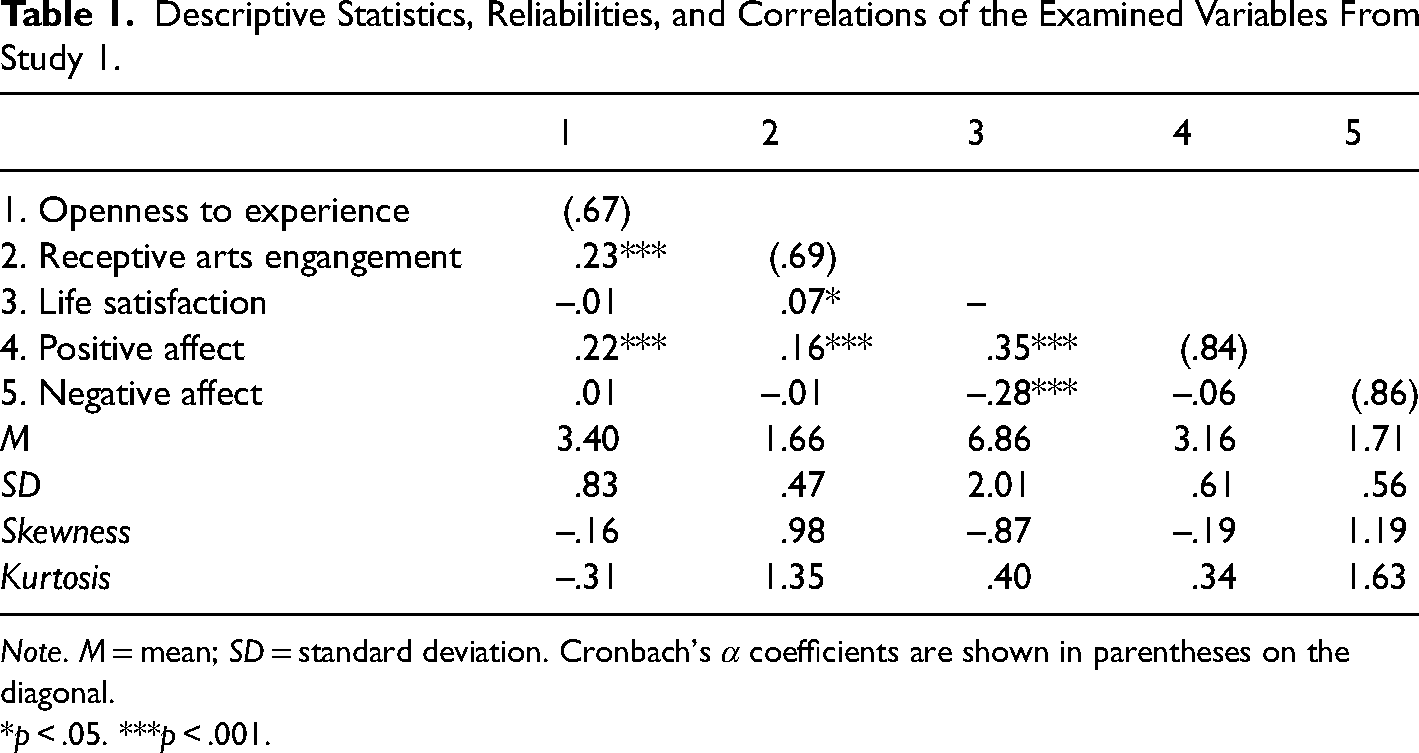
Note. M = mean; SD = standard deviation. Cronbach's α coefficients are shown in parentheses on the diagonal.
*p < .05. ***p < .001.
Receptive arts engagement as a mediator. After controlling for socio-demographics, results of the mediation analyses indicated that openness to experience was neither related to life satisfaction, b = –.03, SE = .09, 95% CI [–.22, .16], nor to negative affect, b = .01, SE = .03, 95% CI [–.04, .06]. However, the results revealed a significant indirect effect of openness to experience on positive affect through receptive arts engagement, b = .02, 95% CI [.01, .03]. As illustrated in Figure 1, the direct effect of openness to experience on positive affect remained significant in the presence of the mediator, b = .17, SE = .03, 95% CI [.12, .22], indicating that receptive arts engagement only partially mediated the openness to experience–positive affect link. It is also worth mentioning that the direct effect of openness to experience on positive affect was much larger than the indirect effect, that is, only a small fraction of the effect of openness to experience was mediated through receptive arts engagement. This model was significant, F(6, 696) = 10.07, p < .001, and accounted for 7.99% of the variance in positive affect.
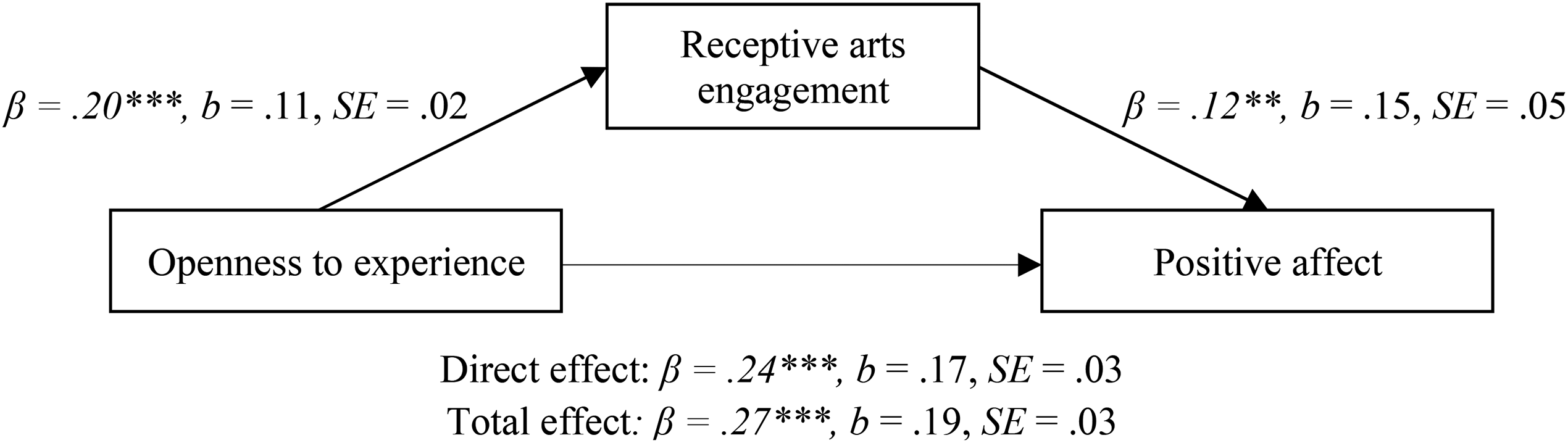
Results of the mediation analyses from Study 1: the effect of openness to experience on positive affect through receptive arts engagement. β corresponds to the standardized coefficients; b corresponds to the unstandardized coefficients; SE corresponds to the standard error for the unstandardized coefficients. **p < .01. ***p < .001.
Discussion
Results of Study 1 showed that openness to experience was significantly and positively correlated with positive affect but not with life satisfaction and negative affect, a finding similar to that observed in the meta-analysis by Steel et al. (2008). Mediation analyses further revealed that this positive link was explained in part by receptive arts engagement, providing partial support for our hypotheses. Thus far, prior research has shown that receptive arts engagement, including, but not limited to, visiting museums, going to the theater/cinema, and attending concerts, can lead to increased positive affect through the pleasurable experience that it provides (e.g., Lomas, 2016; Trupp et al., 2023). Not surprisingly, then, the tendency of people with higher levels of openness to experience to attend the arts can result in increased positive affect, and thus in greater happiness.
Study 2
However, the range of arts-based activities included in Study 1 was quite restricted, and this could be considered a limitation. That is, in Study 2, we aimed to replicate and extend the findings of Study 1 by examining the mediating effects of both receptive and participatory arts engagement on the relation between openness to experience and SWB.
Method
Participants and procedure. In study 2, we used data from two waves of the SHP; wave 15 (2013; Ν = 4879) and wave 17 (2015; Ν = 4596). The SHP is an ongoing, large-scale, longitudinal survey among a representative sample of Swiss households comprised of a single adult or more than one adult. The SHP started in 1999 with 7799 participants aged 14 years and older; all adult members of selected households were asked to participate using computer-assisted phone interviewing. Since its start, the SHP has collected data on close to 8000 households, including a variety of measures. In this study, respondents who did not participate in the data collection in wave 15 were excluded from the analyses, and thus the sample used in Study 2 was composed of 6336 participants (54.7% female, 45.3% male) aged between 14 and 98 years (M = 48.26 and SD = 18.91).
Measures
Receptive arts engagement. Receptive arts engagement was assessed with the following questions in wave 15: How frequently do you: (1) go to the cinema; (2) go to the theater; (3) read books; (4) go to the opera or classical concerts; or (5) visit museums and galleries? The set of possible answers was as follows: 1 = never; 2 = less than once a month; 3 = at least once a month; 4 = at least once a week; and 5 = every day. 1 Items were averaged to obtain a single score for receptive arts engagement; the higher the score, the greater the engagement in receptive arts. 2
Participatory arts engagement. Participatory arts engagement was assessed with three questions in wave 15: How frequently do you: (1) play an instrument or sing; (2) take art photographs; or (3) paint? The set of possible answers was as follows: 1 = never; 2 = less than once a month; 3 = at least once a month; 4 = at least once a week; and 5 = every day. 1 Items were averaged to obtain a single score for participatory arts engagement; the higher the score, the greater the engagement in participatory arts. 2
Openness to experience. Openness to experience was measured with the openness to experience subscale of the Big-Five Inventory-15 (BFI-15; Gerlitz & Schupp, 2005), including three items: “I see myself as someone who is original, comes up with new ideas,” “I see myself as someone who values artistic, aesthetic experiences,” and “I see myself as someone who has an active imagination.” Responses were given on a scale ranging from 0 (disagree strongly) to 10 (agree strongly) in wave 17. 3
SWB. Life satisfaction was assessed with a single question: In general, how satisfied are you with your life? Responses were given on a scale ranging from 0 (not at all satisfied) to 10 (completely satisfied). The affective component of SWB was assessed with the following questions: “Do you often have negative feelings such as having the blues, being desperate, suffering from anxiety or depression?” and “Are you often full of strength, energy and optimism?” Respondents indicated their answers on a scale ranging from 0 (never) to 6 (always). We used data from the same wave in which arts attendance was assessed.
Control variables. As in Study 1, Study 2 had four control variables, namely sex (0 = men; 1 = women), age (in years), educational attainment (0 = no university entrance certification; 1 = university entrance certification), and personal income (in CHF).
Data analyses. Before main analyses, descriptive statistics, reliability coefficients—Cronbach's alpha—, and bivariate correlations were calculated for all study variables. The assumptions of mediation analyses including normality, linearity, and multicollinearity were met. As in Study 1, the assumption that the effect of openness to experience does not change depending on the level of receptive and participatory arts engagement was examined through a series of multiple regressions. Socio-demographics, openness to experience, receptive and participatory arts engagement, as well as the interaction terms between openness to experience and receptive arts engagement and between openness to experience and participatory arts engagement were entered simultaneously in a single step; SWB components served as dependent variables. As shown in Supplemental Table A2, this assumption was met.
To examine whether both receptive and participatory arts engagement can mediate the openness to experience–SWB link, we used Preacher and Hayes’ (2008) bootstrapping method for estimating direct and indirect effects with multiple mediators. In multiple mediation models not only the total direct effect of the independent variable X on the dependent variable Y is assessed, but also the specific indirect effect of each potential mediator (West & Aiken, 1997). Three multiple mediation models were examined, with separate models run for each outcome variable. In each model, openness to experience was the independent variable, while SWB components served as dependent variables. The analyses controlled for socio-demographics, similar to Study 1. 4 A 95% CI was calculated using 5000 bootstrap re-samples.
Results
Preliminary analyses. Descriptive statistics and bivariate correlations for the variables used in study 2 are featured in Table 2. The results indicated a significant positive correlation between openness to experience and both receptive and participatory arts engagement, r = .21, p < .001, and r = .25, p < .001, accordingly. Furthermore, openness to experience was significantly and positively correlated with life satisfaction, r = .06, p < .001, and positive affect as well, r = .12, p < .001. Both receptive and participatory arts engagement were significantly and positively correlated with life satisfaction, r = .06, p < .001 and r = .06, p < .001, accordingly, and positive affect, r = .04, p < .001 and r = .03, p = .01, accordingly. Similarly to Study 1, the effect sizes of the obtained correlations were small. 5
Descriptive Statistics, Reliabilities, and Correlations of the Examined Variables From Study 2.
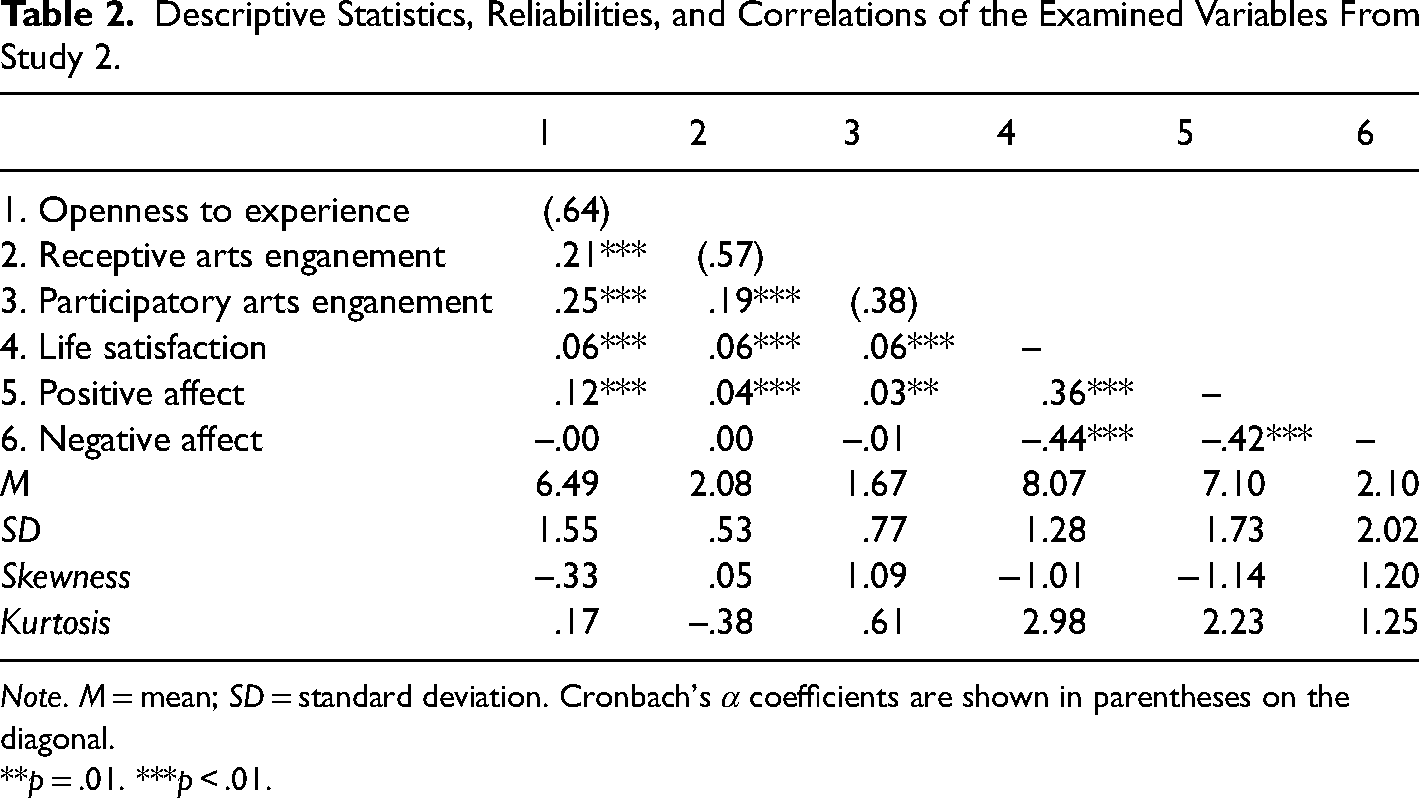
Note. M = mean; SD = standard deviation. Cronbach's α coefficients are shown in parentheses on the diagonal.
**p = .01. ***p < .01.
Receptive and participatory arts engagement as mediators. After controlling for socio-demographics, results of the multiple mediation analyses confirmed the indirect effect of openness to experience on life satisfaction through receptive, b = .01, 95% CI [.00, .01], and participatory arts engagement, b = .01, 95% CI [.00, .02]. 5 Moreover, the direct effect of openness to experience on life satisfaction remained significant, b = .04, SE = .01, 95% CI [.02, .06], indicating that both receptive and participatory arts engagement partially mediated this relation (see Figure 2). The direct effect of openness to experience on life satisfaction, however, was twice as large as the indirect effect. Overall, the model was significant, F(7, 5300) = 9.86, p < .001, and accounted for 1.29% of the total variance. In terms of the affective component of SWB, as can be seen in Figure 2, the results showed that openness to experience affected positive affect indirectly, but only through receptive arts engagement, b = .01, 95% CI [.00, .01]. 6 The direct effect of openness to experience on positive affect remained significant, b = .14, SE = .01, 95% CI [.11, .17], suggesting that receptive arts engagement partially mediated the openness to experience–positive affect link. In fact, only a small fraction of the effect of openness to experience on positive affect was mediated through receptive arts engagement, in that, the direct effect of openness to experience was much larger than the indirect affect. This model was significant, F(7, 5294) = 15.77, p < .001, accounting for 2.04% of the variance in positive affect. However, we did not find any significant mediation effect of arts engagement on the openness to experience–negative affect link, in that, the relation between openness to experience and negative affect was not statistically significant, b = –.01, SE = .02, 95% CI [–.04, .03].
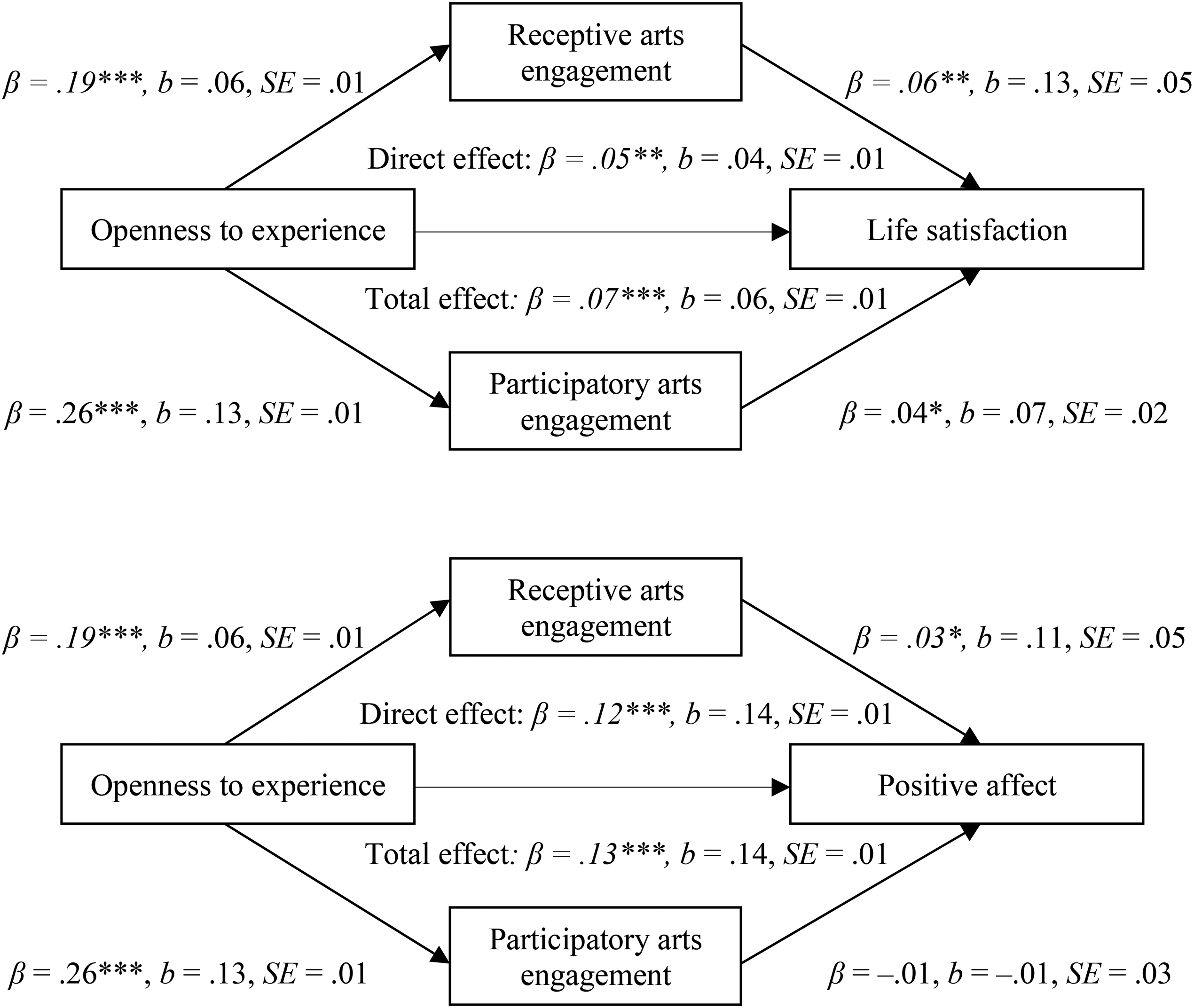
Results of the multiple mediation analyses from Study 2: the effect of openness to experience on SWB components through receptive and participatory arts engagement. β corresponds to the standardized coefficients; b corresponds to the unstandardized coefficients; SE corresponds to the standard error for the unstandardized coefficients. *p < .05. **p < .01. ***p < .001.
Discussion
In Study 2, openness to experience was not only significantly and positively correlated with positive affect but also with life satisfaction, which strengthens the notion that this trait can contribute to a happier and more satisfying life (e.g., Khoo & Simms, 2018; Stephan, 2009). In addition, the results of Study 2 replicated those of Study 1, in that, the openness to experience–positive affect link was partially mediated by receptive arts engagement and extended them by showing that the relation between openness to experience and life satisfaction was partially explained by receptive and participatory arts engagement. It therefore appears that the link between openness to experience and SWB is complex, rather than a simple direct correlation, in that, it can be partially understood in terms of one of the core characteristics of people high in openness to experience: the tendency to pursue the arts.
General Discussion
Although the contribution of extraversion and neuroticism to our own happiness is well documented (e.g., DeNeve & Cooper, 1998; McCrae & Costa, 1991; Soto, 2015), other traits of potential interest have tended to be neglected. For instance, less attention has been devoted to openness to experience, despite its potential as a valuable resource for health and SWB (e.g., Leger, Charles, Turiano & Almeida, 2016; Stephan, 2009). In this study, we therefore focused on openness to experience and examined the hypothesis that its link to SWB can be explained by receptive (Studies 1 and 2) and participatory arts engagement (Study 2) using data from two nationally representative panel studies from Germany and Switzerland. Taken together, the results of both studies revealed a significant positive correlation between openness to experience and SWB components, which, as expected, was explained in part by arts engagement. Openness to experience may therefore constitute a resource for happiness, probably because it lays the foundation for personal growth through engagement in a variety of arts-based activities; an assumption that not only supports instrumental theories of SWB (Bardi & Ryff, 2007; McCrae & Costa, 1991), but also previous evidence for the potential of the arts as a means of flourishing (e.g., Lomas, 2016).
To be specific, across both studies, openness to experience was found to be significantly and positively correlated with positive affect, whereas in Study 2, it was significantly and positively correlated with life satisfaction. These results are consistent with those of previous studies showing the relevance of openness to experience to both health and SWB (e.g., Leger et al., 2016; Steel et al., 2008; Stephan, 2009). In a study among older people, for instance, Stephan (2009) found that openness to ideas and to feelings—two facets of openness to experience—was positively correlated with life satisfaction, whereas openness to actions—another facet of openness to experience—seems to buffer against depression (e.g., Khoo & Simms, 2018). Other relevant studies have further revealed that people high in openness to experience not only exhibit higher life satisfaction and positive affect, but also less stress and more effective ways of coping with interpersonal stress (e.g., Lee-Baggley, Preece & DeLongis, 2005; Leger et al., 2016).
In regard to the proposed mediation hypotheses, the results of both studies showed that the relation of openness to experience to positive affect was partially mediated by receptive arts engagement, whereas in Study 2, both receptive and participatory arts engagement served as partial mediators between openness to experience and life satisfaction. We note, however, that arts engagement mediated only a small fraction of the effect of openness to experience on SWB components. Even so, considered in conjunction, these findings offer some support for instrumental theories of the link between personality and SWB; at least to some extent, the reason why people high in openness to experience enjoy greater life satisfaction and positive affect is because they engage in arts-based activities, which in turn elicit feelings of pleasure, along with potentially life-changing thoughts (e.g., Menninghaus et al., 2019). Indeed, art is particularly powerful at arousing intense emotional responses, that is, people often use it to regulate their emotions. In a study by Shifriss, Bodner, and Palgi (2015), for instance, it was found that people who turn to music when in a bad mood, compared with those who do not, believed that they can influence their emotions through music. In addition to providing a means of emotion regulation, art can also serve as a prism through which negative or difficult life events can be interpreted (Menninghaus et al., 2019), which suggests that there are various pathways through which arts engagement can contribute to our own happiness. In a recent study among young adults in Austria, Trupp et al. (2023) indeed found that pleasurable and meaningful art-viewing experiences were distinctively linked to SWB components.
It is therefore surprising that engagement in participatory arts did not mediate the openness to experience–positive affect link. Although there is much evidence of the health and SWB benefits of participatory arts engagement (e.g., Drake et al., 2024; Lomas, 2016), some studies have observed that these beneficial effects depend on the specific type of arts-based activity involved (e.g., Brown et al., 2015; Wheatley & Bickerton, 2017). In a study using a representative sample of British residents, for instance, Wheatley and Bickerton (2017) found that participation—as opposed to attendance—in arts-based activities was positively correlated with life satisfaction when it occurred frequently, but not with general happiness. Further research is therefore required to compare different types of arts-based activities in relation to their contribution to SWB. It should be pointed out, however, that preferences for specific art forms can be attributed to both genetic and unshared environmental factors (e.g., Jæger & Møllegaard, 2022), a finding that may enhance our ability to draw causal inferences. Given that aesthetic experiences—including not only preferences, but also emotional responses—do reflect underlying genetic dispositions (e.g., Bignardi et al., 2022; Jæger & Møllegaard, 2022) and given the relative influence of genes on SWB (e.g., Bartels, 2015; Lucas & Diener, 2009), controls for genetic confounding are necessary to secure a clear understanding of whether—and to what extent—arts engagement contributes to our happiness. According to Rohrer (2018), however, “an alternative to statistical adjustment is available: control by design” (p. 34) or, to put it another way, future studies can consider the confounding effects of genetic background by including monozygotic twins (Gustavson et al., 2021).
Limitations and Future Research
The present study offered some preliminary insights into how openness to experience might relate to SWB, yet it has a number of limitations that should be considered when interpreting the results. First, the correlational nature of both studies precludes causal claims, that is, experimental longitudinal studies should be designed to further determine the direction of causality. For instance, it seems quite likely that there is a bidirectional relation between arts engagement and happiness; that is, on the one hand, arts engagement can contribute to our happiness, but on the other the happier people are, the more likely they are to engage in the arts. To move beyond current knowledge, it is therefore imperative to compare alternative mediation hypotheses or, in other words, to rule out reverse causality—an assumption that is necessary to interpret results (Rohrer et al., 2022). A further limitation is that data were exclusively collected through self-reports, and this may not provide a complete picture of the SWB construct. And as such, future studies gathering additional information from alternative sources, such as family and peer reports, are needed. In addition to that, openness to experience and some components of SWB were not measured immediately before or after arts engagement. Although there is ample evidence to suggest that personality is relatively stable over time (e.g., Damian, Spengler, Sutu & Roberts, 2019; Forgeard et al., 2022) and that the stability of SWB over time is substantial (Lucas & Diener, 2009), some of our findings may have been influenced by daily events. Even though both studies produced similar results, the findings should be interpreted with caution. It is also possible that contextual variables influence the personality–SWB relation. Indeed, in a cross-cultural study by Schimmack et al. (2002), the relation of personality to life satisfaction was moderated by culture. On that account, it would be enlightening to expand this research to different cultures. Validation studies may also allow us to assess both the magnitude and the effect of measurement error. For instance, specific socio-demographics, such as gender, cannot be precisely measured, and thus their confounding effects may still exist even after controlling for them (Rohrer, 2018). Of notice is also that arts engagement accounted for only a small fraction of the effect of openness to experience on life satisfaction and positive affect, indicating that there are other possible mediators not included in this study. Can, for instance, interest in many and different art forms facilitate the openness to experience–SWB link? Future research could also focus on the often neglected lower-level structure of openness to experience for providing a more fine-grained understanding of the nature of its relation to SWB.
Conclusion
Although more research is needed to clarify the process underlying the personality–SWB link, this study extended prior findings by identifying a possible pathway through which openness to experience is linked to SWB: arts engagement. And even though it explained only a small fraction of the relation of openness to experience to SWB components, such a finding not only strengthens the evidence for the potential of art as a means of flourishing (Lomas, 2016), but also provides a foundation on which to advance current mediation models by examining alternative hypotheses and controlling for a series of potential major confounders including, but not limited to, genetic background, creativity or creative self-efficacy, and stressful life events. In addition to theoretical aspects, our findings might also have useful implications for public health policy and practice. Bearing in mind that both studies showed that people high in openness to experience enjoy greater life satisfaction and positive affect, which is likely due in part to their tendency to pursue the arts, policymakers should consider how vulnerable populations, such as children, adolescents, lower-level employees, and the elderly, can be supported to engage in a variety of arts-based activities. It is also likely that arts engagement may benefit not only the attendees/participants themselves but also the society. Initiatives aimed at increasing adolescent happiness through art could potentially lead to positive social outcomes, such as reduced antisocial behavior and crime. Discerning the conditions under which the health and SWB benefits of arts engagement are most likely to occur may therefore be a fruitful avenue for further research.
Supplemental Material
sj-docx-1-art-10.1177_02762374241267934 - Supplemental material for What Makes People High in Openness to Experience Happy? The Mediating Effect of Arts Engagement
Supplemental material, sj-docx-1-art-10.1177_02762374241267934 for What Makes People High in Openness to Experience Happy? The Mediating Effect of Arts Engagement by Maria Manolika and Thomas Jacobsen in Empirical Studies of the Arts
Supplemental Material
sj-docx-2-art-10.1177_02762374241267934 - Supplemental material for What Makes People High in Openness to Experience Happy? The Mediating Effect of Arts Engagement
Supplemental material, sj-docx-2-art-10.1177_02762374241267934 for What Makes People High in Openness to Experience Happy? The Mediating Effect of Arts Engagement by Maria Manolika and Thomas Jacobsen in Empirical Studies of the Arts
Footnotes
Acknowledgments
The authors would like to thank Valentin Wagner and two anonymous reviewers for their critical comments and suggestions.
Data Availability
Data used in Studies 1 and 2 are freely available from the GESIS Data Archive for the Social Sciences (see https://www.gesis.org/gesispanel) and the Swiss Centre of Expertise in the Social Sciences FORS (see  ), accordingly.
Declaration of Conflicting Interests
The authors declared no potential conflicts of interest with respect to the research, authorship, and/or publication of this article.
Ethics Statement
As we used existing survey data, no approval by an ethic council is required by law or the principles of good scientific practice.
Funding
The authors received no financial support for the research, authorship, and/or publication of this article.
Supplemental Material
Supplemental material for this article is available online.
Notes
Author Biographies
References
Supplementary Material
Please find the following supplemental material available below.
For Open Access articles published under a Creative Commons License, all supplemental material carries the same license as the article it is associated with.
For non-Open Access articles published, all supplemental material carries a non-exclusive license, and permission requests for re-use of supplemental material or any part of supplemental material shall be sent directly to the copyright owner as specified in the copyright notice associated with the article.
