




Abstract
Since 1929, 95 films have been crowned the Best Picture of the Year. Scholars and cinephiles yearly debate their merits and the legitimacy of one winning over the other, and extensive coverage is given by the media to the spectacle itself. But research is generally restricted to prediction models, or correlations with the winners’ demographic variables. There have been few historical studies on the evolution of the concept of Best Picture throughout the ceremonies, measured through the number of nominations and Oscars won in the various categories. Using descriptive statistics and cluster analysis, this article traces that history, showing that such concept has changed with the decades, although it has a relatively cyclic nature. Today, the Best Picture is no longer the most nominated or awarded, and has a diminishing association to Best Director and technical categories. Instead, it is more thematically conscious (Best Screenplay), and favors actresses and supporting players.
Introduction—Academy Awards and the Best Picture
Oscar night—the night when the Academy Awards are attributed to the best films of the year—has enthralled professionals of the cinema industry and movie fans for decades. With almost one hundred years, it is the oldest entertainment award ceremony of the modern age, to which almost all others, such as the Golden Globes or the Emmys, owe their format and style. It is also still one of, if not, the most popular today. Broadcast by radio since 1930, and television since 1953, the Academy Awards are currently seen in over 200 countries, commanding a viewership that has often reached over 40 million in the United States alone, and several million more worldwide (Szalai & Roxborough, 2016). Even though audiences have declined to all-time lows in recent (and pandemic) years, the latest ceremony in March 2023 has still been seen by an estimate 18.7 million people in the United State, according to the New York Times (Koblin & Barnes, 2023).
The Academy of Motion Picture Arts and Sciences 1 was formed in 1927 as a brainchild of movie mogul Louis B. Mayer, along with 35 other illustrious studio-system pioneers, in order to raise the standards and the respectability of the movie industry. It quickly led to the establishment of an annual achievement award ceremony where the best films, and those involved in making them, could be both honored by their excellence and promoted so as to increase their artistic and, of course, box office value. The first ceremony took place on May 16, 1929, in the Hollywood Roosevelt Hotel in Los Angeles, where 12 of the 13-and-a-half inch-tall statuettes designed by art director Cedric Gibbons were awarded to winners that had been known for a few months in advance. Wings (1927) was the Outstanding Picture of the Year, winning another award for Best Engineering Effects, but it was not the most honored (something that would happen many times after), as Frank Borzage's 7th Heaven (1927) and Murnau's Sunrise (1927) won three awards each. In addition, two Special Awards were attributed, celebrating the past and the future; to Charles Chaplin, the leading light of silent film, and to Warner Brothers, for producing the ground breaking talkie The Jaz Singer (1927).
From then on, 94 yearly nights have taken place uninterruptedly, and 94 more films have garnered the most sought after accolade of Hollywood. These have included all-time classics as Casablanca (1942), Ben-Hur (1959), The Sound of Music (1965) and The Godfather (1972), all the way up to Amadeus (1984), Titanic (1997), Gladiator (2000), and Million Dollar Baby (2004), and the recent winners like Argo (2012), Moonlight (2016), and the very latest Everything Everywhere All at Once (2022). To win an Oscar, as the statuette eventually became popularly known, is a recognizable and undeniable indicator of achievement, that generally benefits all involved. As Kaplan (2006) discusses, producers, actors, writers, directors and other technicians that win Oscars, and in particular that are associated with the Best Picture, increase their popularity and market value, being able to ask for higher wages and exert more creative control on future projects. Furthermore, it has been documented that the night's greatest nominees and winners have a significant increase in ticket and later home movie sales (Clark, 2020; Dodds & Holbrook, 1988; Karniouchina, 2011; Nelson et al., 2001), to which now could certainly be added more downloads and streaming views. For that reason, in recent decades, films that producers deem Oscar-worthy (or at least with the greatest potential of being nominated), generally arrive in cinemas or streaming services at the end / beginning of the year, to still be in distribution—or be a novelty in a digital platform—when the nominations are announced and the award ceremony takes place.
However, there has always been the legitimate question of whether the film that wins the top prize—the Best Picture—is really the one that most deserved it; that is, if there is, as Simonton (2004b) puts it, a consensus regarding its cinematic contributions. Film critics and scholars have extensively debated this, not only in terms of the merits of the films themselves, in comparison to others, but also in terms of what makes a movie more prone to win. For example, in the 1980s, a decade when biopics like Ghandi (1982), Amadeus (1984), and The Last Emperor (1987) were hailed Best Picture, Levy (1987) debated that films with higher production values, visual style and epic vision had increased probability of winning. The same criteria could be applied, for example, to justify how in the golden age of the lavish, epic, widescreen and color musicals, five of them won Best Picture in just 10 years (Gigi, 1958; West Side Story, 1961; My Fair Lady, 1964; The Sound of Music, 1965 and Oliver!, 1968). However, Simonton (2004c) uncovered that dramatic components (quality of the director, the actors, and the screenplay) have historically been more associated to wins, than the more visual or technical components of a film.
Two decades after the study of Levy, and with wins of Dances with Wolves (1990), Forest Gump (1994), Braveheart (1995), and A Beautiful Mind (2001) in between, the analysis of Kaplan (2006) showed as well that epic and biographic movies displayed larger association to winning, along with, to a lesser degree, having the most nominations or having won previous prizes as the Golden Globes or Guild Awards. These same two variables, more Oscar nominations and more wins at the Golden Globes, also had higher correlation in the study of Bernard (2005), looking at the previous 20 years. The author calls attention to other interesting variables, like the leading character coming from a Commonwealth country, riding a horse or being a “genius,” that seem to assure a Best Picture win. In contrast, not a single nominated comedy won in the years under analysis but, in another study, Peacock and Hu (2013) did find some association if the nominated film was a musical. Even so, having a high Internet Movie Database (IMDB) score and a considerable opening-weekend box office revenue exerted a higher influence on the probability of winning Best Picture.
There have always been, of course, exceptions to these “Oscar bait” or “sure things”; that is, movies that win despite all probabilities (Pardoe & Simonton, 2008). The very example of comedies can be used. Some that can be categorized as such have actually won Best Picture in the past, although truth be told, none can be considered an all-out comedy. Tom Jones (1963) is an undeniable historical epic, as well as, albeit in a different tone (and in a very different era!), the con-caper The Sting (1973). Frank Capra's It Happened One Night (1934) and You Can't Take It With You (1938) could be screwball/romantic comedies, but they had also pertinent social statements to make in the era of the Great Depression. Not a comedy, but the same could be said of how audiences in the 1970s embraced the underdog story of Rocky (1976). What this may prove is that, besides production values and artistic merits, contextual circumstances associated to social, economic, and even technological changes can also be extremely influential. Would Broadway Melody (1929) have won if it wasn't the first ever all-talking musical, hence a pioneer in its own right? Mrs. Miniver (1942) may still be moving today, but it is well documented how much more moving it was to war-time audiences, and how much it impacted on the war effort (Dinsman, 2018; Macdonald, 2015). In the Heat of the Night (1967) struck a chord at an important time in the civil rights movement. And recently, historical wins of 12 Years a Slave (2013) and Moonlight (2016), movies by African-American directors, South Korea's Parasite (2019), or CODA (2021), a film that gives prominence to deaf characters and actors, have shown the keenness of the Academy to celebrate diversity and strive for representation. This trend has continued in the current year, with the win of Everything Everywhere All at Once, centered on an Asian and Asian-American cast and crew.
At times, the Oscars have been subject to some criticism due to way studios conduct their advertising campaigns and behind the scenes political maneuvers to guarantee accolades (Eagan, 2020). Yet, although they may move by local tastes and studio politics, Simonton (2004b) saw that the Academy Awards provided the best correspondence to explain major awards granted by other Guilds and Societies, meaning that they followed a certain consensus in the industry regarding cinematic creativity and achievement. However, the author also noted that nominations could be a better indicator than the awards themselves. This is justified by how voting works. The Academy is today constituted by almost 10 thousand members across 17 branches of filmmaking, but to become a member, a professional has either to be nominated for an Award, or be sponsored by two Academy members from the respective branch. Only members of a given category can nominate for that category, with the exception of Best Picture for which all members can nominate. But then the entire Academy, regardless of branch, can select from the nominees in all categories.
If such rules have influenced the results all along, particularly regarding the Best Picture, then they may also help understand the trending shifts over the decades and the apparent discrepancies in the actual ceremonies, where the Best Picture sometimes is not the film with most nominations or awards received. Precisely, very recently the Academy has actively sought to integrate new members in order to diversify and increase its ranks, for example by attempting to double the number of woman and people of color. Theoretically, this has provided a new collective vision of what is perceived as the Best Picture. At the same time, the Oscars are a televised ceremony, that in 2021, for example, generated 115.3 million U.S. dollars from advertising alone, with 30 second spots costing up to 2.2 million. 2 Therefore, public opinion—which relates to box office—can also be an influencing factor. Back in 2008, Krauss et al. (2008) saw that the volume of communications in web forums had an association to Oscar-wins. Fifteen years later, with the massive expansion and influence of social media, it certainly seems that this relationship is even more pressing, although little literature is found on this.
Rationale and Hypothesis
Considering the literature, it can be summarized that Oscar wins are the combined result of all these variables; (1) production values and artistic merits of the films themselves, as pieces of art; (2) contextual circumstances, associated to sociopolitical situations and statements that the Academy, as a cinematic community, wishes to publicly make to the world; and (3) public opinion, associated with the films’ or the performers’ popularity and box office. The comprehensive understanding of this complexity often seems intangible, and perhaps that is why, as Heffernan (2014) suggests, the scientific research on the Academy Awards is sporadic and somewhat ignored. The author wryly comments that the study of the Oscars remains “more rooted in sensationalized conspiracy theories designed for fan consumption rather than intellectual advancement” (Heffernan, 2014, p. 3).
Indeed, as shown above, most published studies have approached nominations and awards as a mathematical problem of predicting winners, based on variables such as film genre, running time, budget, awards received in other ceremonies, critic reviews, user scores, and box office or viewing data (Bernard, 2005; Deuchert et al., 2005; Kaplan, 2006; Pardoe & Simonton, 2008; Peacock & Hu, 2013; Simonton, 2004b). Other studies have looked at the winners’ age (Gilberg & Hines, 2000), racial group, in the light of recent controversies (Borum Chattoo, 2018; Gooding Jr, 2020; Sinckler, 2014), and understood how specific groups of winners, such as actresses, or clusters of professionals, relate to the Best Picture (Simonton, 2004a, 2004c). Other still have connected the date when a picture opens with the probability of winning (Zauzmer, 2020). And there are even studies that have analyzed various social or personal factors pertaining to winning an Academy Award—sometimes referred to as “the Oscar-curse”—such as the mortality rate of winners (Redelmeier & Singh, 2022), the probability of divorcing (Stuart et al., 2011, 2018), and the consequences of status shift (Jensen & Kim, 2015).
This article acknowledges the importance of the previous research to understand the variables that can have an influence on a given movie winning the Academy Award for Best Picture, and the consequences of this accolade to studios, cast, and crew. However, it means to present a historical, rather than a predictive study. This is justified by the fact that there does not seem to be any recent research, as far as the author is aware, that synthesizes and explores the 95-year evolution of the Best Picture, in terms of nominations and in terms of wins in the various other categories. The main goal of the paper is to present and understand this historical evolution, in itself, but also to frame it against the changing of the eras and the previous theories put forward by the literature.
As Simonton (2002, 2004b, 2004c) discussed, a film is a collaborative product of many individuals, yet it is rare for any to receive more than a handful of Oscars, as they are awarded in relative independence of each other. Indeed, no picture has won more than 11 Oscars, and this has only happened three times in 95 years: for Ben-Hur (1959), Titanic (1977), and The Lord of the Rings: The Return of the King (2003). The average number of awards received per year by the Best Picture winner is, already counting the 2023 ceremony, actually just 5.03. But interestingly, these categories have also shifted over time. Above cited studies had expectedly noticed correlations between winning Best Picture and, mainly, winning Best Director and Best Screenplay. In fact, over the 95-year history, these are, precisely, the two categories most associated to Best Picture, with Best Director being won in 68 years (71.6% of the time), and Best Screenplay, in its various forms (Original or Adapted), being won 63 times (66.3%). But the next most won category, Best Editing (35 times), although in the past it had a clearer association to Best Picture (Simonton, 2004c), was awarded in the 2023 ceremony to that recipient for the first time in 10 years. A Best Sound category, Best Actor and Best Costume Design, for example, have not been awarded to the Best Picture in more than a decade, and Best Score and Best Production Design have only been awarded once in that period, despite being associated, each, to almost one third of all-time winners.
Concomitantly, some of the Best Picture winners with the lowest tally of Oscars received on the night are from, precisely, this last decade. Spotlight (2015) won just two (Picture and Original Screenplay), something that had not happened since The Greatest Show on Earth in 1952. And Argo (2012), 12 Years a Slave (2013), Moonlight (2016), Green Book (2018), Nomadland (2020), and CODA (2021) have all won three Academy Awards each. This is the lowest average since the first decade of the Oscars, a time when there were no official nominations and less overall categories. Last year, CODA actually made a clean sweep, with three wins out of three nominations, but that made it the lowest nominated Best Picture winner since 1932. This certainly seems to indicate a change over time in how the Best Picture is collectively characterized by the Academy. Such trend may or may not be reversed with this year's somewhat countercurrent seven Oscars out of eleven nominations given to Everything Everywhere All at Once.
Arguing that this characterization of the Best Picture, made through the total number and the type of Oscars won in each ceremony, forms a “concept” that has changed over time, this study puts forward the following hypothesis: (i) the number of Oscars won, and overall nominations, of the Best Picture winner are steadily decreasing with the decades; (ii) the Best Picture winner is not, with time, the film with the most nominations; and (iii) the other Oscars received by the Best Picture winner have changed with the decades, resulting in a new vision of what constitutes the best film of the year. The third section describes the methodology used in the research. The fourth section discusses the results. Lastly, the fifth section discusses the research findings and recommendations.
Methodology
To test the three hypothesis, the research explored solely data from the ceremony itself, namely that concerning Best Picture winners in the entire 95 years of the Academy Awards, using descriptive statistics to trace and summarize the historical evolution, and cluster Two-Step analysis to create distinct groups of films that display similar behavior over time.
The database used was compiled by the author, based on historical information present in the Internet Movie Database (IMDB 3 ) and the Academy's official website. 4 Each Best Picture winner was given an entry for its corresponding year. With few exceptions, the ceremony taking place in a given year (say March 2023), awards prizes for movies of the previous year (say 2022), so the year of the film and not of the ceremony was considered. Each entry contains the total number of nominations and Oscars won, detailed by categories. Although different categories existed in the past, such as Best Title Writing in the first ceremony, or the short-lived Best Assistant Director (from 1933 to 1937), Best Picture winners won Awards in categories that still exist today, in the same form or in an updated version, with the exception of The Great Ziegfeld (1936). One of its three Oscars was for Best Dance Direction, a category which lasted just three ceremonies from 1935 to 1937.
For the sake of simplicity, categories were aggregated if they related to the same skill, even if names changed over time, being that the current name was used in the graphs and tables presented. For example, Best Engineering Effects, Best Special Effects, Best Special Visual Effects or Best Visual Effects were considered the same category for different ceremonies, but only when they were competitive. Categories like Best Visual Effects and Best International Feature Film were the object of several honorary awards before they became official, which were not included. The variations of Best Cinematography and Production Design (Color and Black-and-White, which coexisted until the late 1960s) were also aggregated, as a given picture could not win both. Similarly for Best Screenplay, as a picture wins either one (Original Screenplay) or the other (Adapted Screenplay). Only in one case did a Best Picture recipient win two screenplay awards; in 1944 when Going My Way garnered both Best Screenplay and Best Original Story, a category extinct in 1956. For the total of Oscars and Nominations for Going My Way, both awards were considered; but for the overall results of the screenplay prize over time, only one was used, for the database totals to be consistent and comparable. The same process was used for Best Sound, Best Sound Mixing and Sound Editing, that were often distinct categories but are currently the same (since 2020). In this case, Titanic (1997) and The Hurt Locker (2009) are the only Best Pictures to have won two Sound awards each.
Furthermore, four Best Picture winners have received Honorary Awards: Gone with the Wind (1939), for William Cameron Menzies’ outstanding achievement in the use of color; The Best Years of Our Lives (1946), for Harold Russell's acting (although he ended up also winning Best Supporting Actor); Oliver! (1968), for Onna White's choreography; and it can be said An American in Paris (1951), as Gene Kelly received an Honorary Award that same year. These awards are rarely included in the total number of Oscars won by each picture, as they were noncompetitive, so they were also not included in this study.
Originally, the total number of awards given in each ceremony was considered, in order to proportionally compare the wins over time. For example, Spotlight (2015) won two Oscars in a ceremony that awarded 24 prizes, while the original All Quiet on the Western Front (1930) won two Oscars in a ceremony that awarded just eight. However, such indicator proved little relevant, as the Oscar ceremony has consistently granted between 20 and 27 prizes since 1939, and since 1991 has either given 23 or 24 awards. As well, all existing categories were considered, as a Best Film can be indicated transversally, even to traditionally external categories as Best Animated Feature (the cases of Beauty and the Beast, 1991; Up, 2009; and Toy Story 3, 2010), Best Foreign Language Picture, particularly in recent years (including Life Is Beautiful, 1997; Roma, 2018; and Parasite, 2019, winner of both awards), and even Best Documentary. The recent cases of Flee (2021) and Summer of Soul (2021) have generated active discussion as to whether documentaries could also garner a Best Picture nomination.
Finally, in order to understand the weight of each category over time, it was also taken into account that not all categories have existed throughout the Academy's 95-year history. For example, Best Director, Best Actor/Actress and a form of Best Screenplay have always been awarded. However, Best Song, Best Score and Best Editing were only first introduced for the 1934 ceremony, followed by Best Supporting Actor/Actress in 1936. Best Costume Design only exists since 1948 and Best Makeup (to which recently was added “and Hairstyling”) has only been definite since 1984.
Analysis performed consisted mostly of descriptive statistic techniques, with the support of Excel and SPSS software. Tables and graphs were computed that display the evolution over time of Oscars and nominations, overall and by categories, of the Best Picture winner, thus allowing a comprehensive historical portrait. Additionally, to further understand this evolution, and the relationship between the distinct categories and Best Picture, clustering analysis was conducted. Because most variables are a binary (award received or not received in each category), the Two-Step clustering technique was used, with the support of SPSS, as it allows a combination of categorical and continuous variables. The total number of awards and nominations each film received, as well as the decade it was produced, were initially included in the model, but later removed, because it unequivocally conditioned the creation of clusters. Therefore, films were only aggregated based on having won similar categories, although the posterior characterization of the clusters is made using the remaining variables. This allowed reaching eight distinct groups of winners, with particular characteristics, that are further commented. Results can form the basis to compare with other research dealing with the contexts of particular times and socioeconomic patterns that are associated to artistic creation and enterprise.
Finally, it is mentioned that for a better flow of the paper, film titles used in the text are those in English (either the original title or the translated title).
Results
Academy Awards Won by the Best Picture—Overall Analysis
Table 1 shows the number of Academy Awards won by each of the 95 Best Picture winners. Over half of the recipients (56%), covering all decades, won between three and five Oscars. With the already mentioned exceptions of Spotlight (2015)—the third most awarded film of that year, after Mad Max: Fury Road (six awards) and The Revenant (three awards)—and, 60 years before, The Greatest Show on Earth (1952)—behind The Bad and the Beautiful's five statuettes and High Noon's four—all other seven films that received less than three awards were prior to 1940. As well, the three that received just one Oscar, Best Picture, were all prior to 1935, the last year when wright-in votes were still possible.
Best Motion Pictures of the Year, by Number of Academy Awards Won.
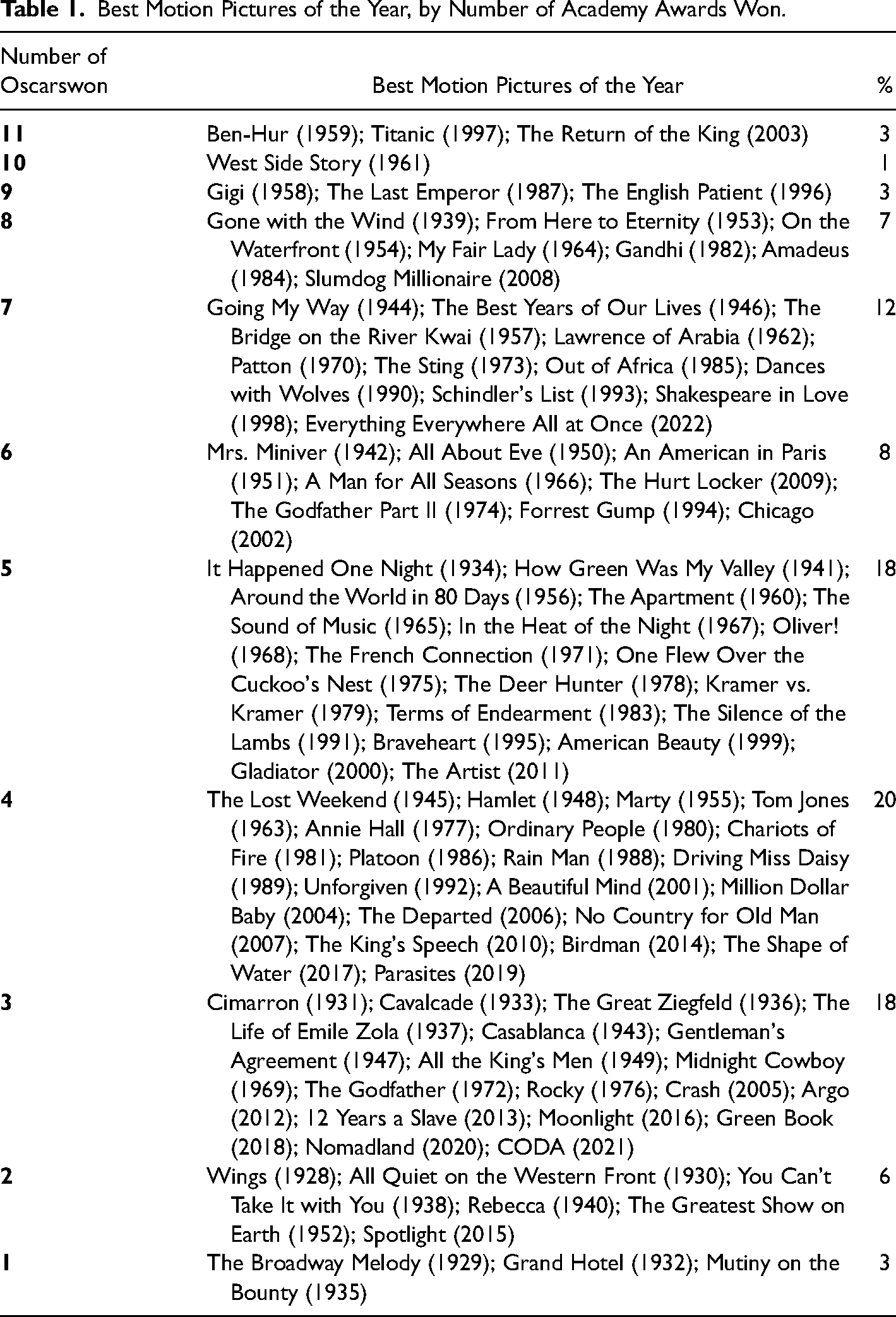
Most of the recent Best Picture winners have won either three or four Academy Awards. In fact, Everything Everywhere All at Once (2022) was the first film to win more than four Oscars in over a decade. The number of awards this film has won, seven, is shared by the highest amount of pictures (12%) that obtained over 5 Oscars, with at least one representative from every decade from the 1940s until the 1990s. Yet only two pictures have won more in almost thirty years: Slumdog Millionaire (2008) (8 awards) and The Return of the King (2003) which made a clean sweep of its 11 nominations. Overall, only seven films have won more than eight Academy Awards, none after 2003, and concentrated in two periods; the late 1950s / early 1960s (1958, 1959, 1961) and at the millennium's turn (1987, 1996, 1997, 2003). Curiously, West Side Story (1961) has been, to this day, the only picture to win the round amount of 10 Oscars.
These tendencies are clearly represented in Figure 1, that displays, over time, the total number of nominations and Academy Awards won by the Best Picture, as well as the averages per decade. The graph actually reveals a somewhat sinusoidal tendency, meaning that the average number of awards received by the Best Picture has increased and decreased at a more or less regular interval of 40 years, even though there are always notable yearly fluctuations. Oscars won steadily increased from the early 1920s ceremonies, averaging 3.1 awards in the 1930s (peaking with Gone with the Wind's 8); 4.4 in the 1940s (peaking at seven for both Going My Way and The Best Years of Our Lives), and 6.6 in the 1950s, with four pictures obtaining over seven awards and culminating in the historic win of 11 Oscars by Ben-Hur.
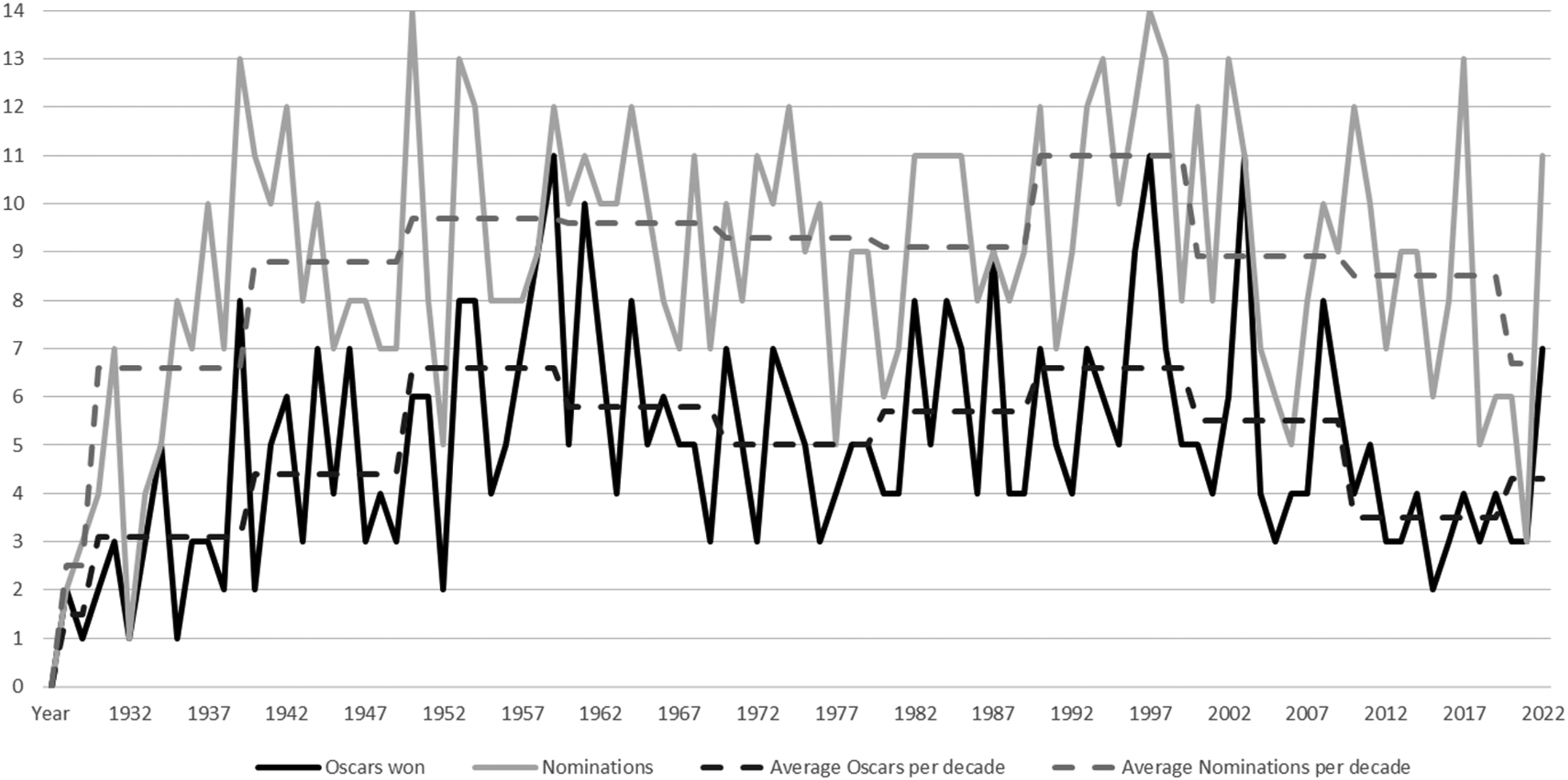
Nominations, Academy Awards won and respective averages per decade of the Best Motion Pictures of the Year.
This was, however, the end of first period of growth that, coincidently or not, corresponded to the major changes the cinema as an industry went through in the 1960s, with the demise of the studio system. The average number of Oscars won by the Best Picture decreased in the 1960s to 5.8, with the numbers being higher at the beginning of the decade (West Side Story's ten and Lawrence of Arabia's seven), than at the end, when Midnight Cowboy (1969) received just three awards, the lowest value in over 15 years. It should be noted that, at the time, this was a controversial release and, until this day, it is the only X-rated film (at the time of release) to win Best Picture, heralding the darker and more social-conscious undertones of 1970s cinema. The decline in the number of Oscars won continued in the 1970s (Rocky's three and Annie Hall's four), further decreasing the average to five, but was reversed in the following decades, curiously with the same cadence. The average number of Oscars received in the 1980s, a decade when consumerism grew, again rose to 5.7 (peaking with The Last Emperor's nine awards), and in the 1990s to 6.6, exactly the same average seen 40 years before in the 1950s.
Then, once more, the average number of Oscars received by the Best Picture deceased to 5.5 in the 2000s, a period when the industry witnessed another major revolution, this time with digitalization, so it is fitting that the decade's biggest winner was the culmination of The Lord of the Rings trilogy. Yet the second decline in average in the 2010s was much higher than the previous decline in the 1970s. Actually, the 2010s average of just 3.5 Academy Awards (the decade's top winner, The Artist, received five), was the lowest since the 1930s. The standard deviation was, excepting the 1920s’ two ceremonies, the smallest ever (0.8 against 1.4–2.4 in all other decades), meaning that the statuettes received were consistently few. Besides The Artist's five Oscars and Spotlight's two, four pictures received three awards and another four received four awards. Such trend has continued in the present decade with Nomadland and CODA winning just three Oscars each, but Everything Everywhere All at Once's seven awards may foresee a new period of growth, if the past trends are to be repeated.
Efficacy in Relation to Overall Wins and Nominations
In 74 ceremonies (78%), the Best Picture winner was the one with most Oscars awarded. Out of the 21 years when this did not occur, seven happened in the first 16 ceremonies (see Figure 2). For the next 68 years, between 1944 and 2011, only eight Best Pictures were not the night's biggest winner; once a decade until the 1960s (All the King's Men, The Greatest Show on Earth, Midnight Cowboy), thrice in the 1970s (The Godfather, Rocky, Annie Hall), Chariots of Fire (1981) and, 23 years later, Million Dollar Baby. Yet, just in the last decade alone, a total of six Best Pictures failed to win the greatest number of Oscars (Argo, 12 Years a Slave, Spotlight, Moonlight, Green Book and CODA), a direct association to exactly the same films, in the same period, that did not win the Academy Award for Best Director (as discussed in the next section).
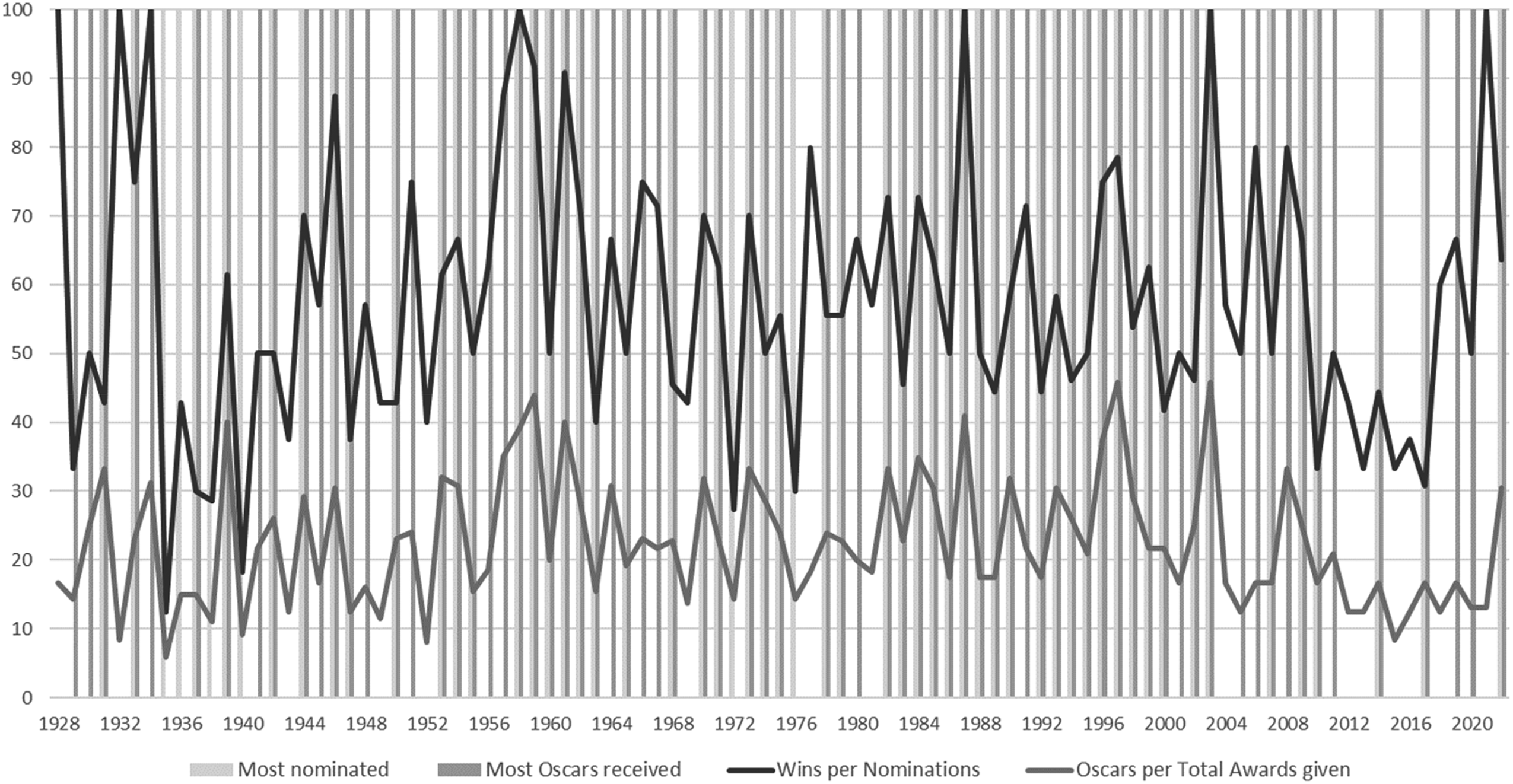
Oscar Efficacy: wins per nominations and awards granted in each ceremony.
The same tendency is seen when analyzing nominations. In the history of the Awards, 59 Best Pictures (62%) were the most nominated in each ceremony, once more with the last decade displaying a considerable reduction. For example, in the 1970s, only one Best Picture (Annie Hall) was not the most nominated. From 1982 to 2000, again only one (The Silence of the Lambs) did not have the most nominations. Yet only half of the Best Pictures in the 2000s were the ones with most nominations, and only three in the 2010s (The King's Speech, Birdman and The Shape of Water). Actually, Everything Everywhere All at Once (2022) was the first Best Picture since The Shape of Water (2017) to be the most nominated.
This evident decline in the 2010s of the Oscar efficacy of the Best Picture winner is clearly noted by averaging the number of wins per nominations. Out of the seven films that gained all awards for which they were nominated, four were prior to 1958 and only two were in the past 20 years; The Return of the King (11 out of 11) and, very surprisingly, CODA (3 out of 3). The Departed (2006) and Slumdog Millionaire (2008) had an 80% ratio of wins per nominations, but in the 10 years between The Hurt Locker (66%) and Green Book (60%), all Best Pictures had less than 50% efficacy. The 95-year average stands at 58%, and all decades between the 1930s and the 2000s have an average between 51% and 68% (respectively, 54%, 51%, 68%, 60%, 55%, 62%, 60%, and 62%). But the average of Oscars won per nominations was just 43% in the 2010s, the lowest in history, including The Shape of Water, The King's Speech, 12 Years a Slave and Spotlight winning just one-third of their respective nominations, and Moonlight 38%.
The percentage of Oscars won per total awards given in each ceremony is, for the 95-years, 22.5%, meaning that the Best Picture wins in average around one-quarter of awards given. Yet this year's Everything Everywhere All at Once (30%) was the first picture since The Hurt Locker (25%) to have a ratio above that average. All the pictures that won three Oscars in the 2010s and 2020s gained just 13% of the awards given in the night, and Spotlight's two Academy Awards corresponded to just 8%, in a ceremony that awarded 24 prizes.
A New Kind of Best Picture—Analysis by Categories
As Figure 3 shows, Best Director and Best Screenplay (in its various forms) are the categories that generally accompany Best Picture of the year. Best Director has been won by 68 of the 95 Best Picture winners (72%), while a form of Best Screenplay has been won by 63 films (66%). The two decades when more Best Film directors did not win an Oscar were the first and this very last (see Annex 1 for a full table). On the first 10 years of the Oscars, only All Quiet on the Western Front, Cavalcade and It Happened One Night won director accolades, but for forty years, from 1957 to 1997, only four Best Pictures did not also win Director; In the Heat of the Night, The Godfather, Chariots of Fire and Driving Miss Daisy, whose director, Bruce Beresford, was not even nominated, the first time this happened since Grand Hotel (1932). From then on, the number of awards given to directors has noticeably decreased and in fact, six Best Pictures of the past 10 years have not won Best Director (Argo, 12 Years a Slave, Spotlight, Moonlight, Green Book and CODA), exactly the films that were not, in the same period, the night's biggest winners. Furthermore, Ben Affleck for Argo, Peter Farrelly for Green Book, and Sian Heder for CODA were not nominated for Best Director, meaning that in just 9 years such an occurrence—winning Best Picture without a director nomination—happened the same number of times as in the previous 86 years of the Awards.
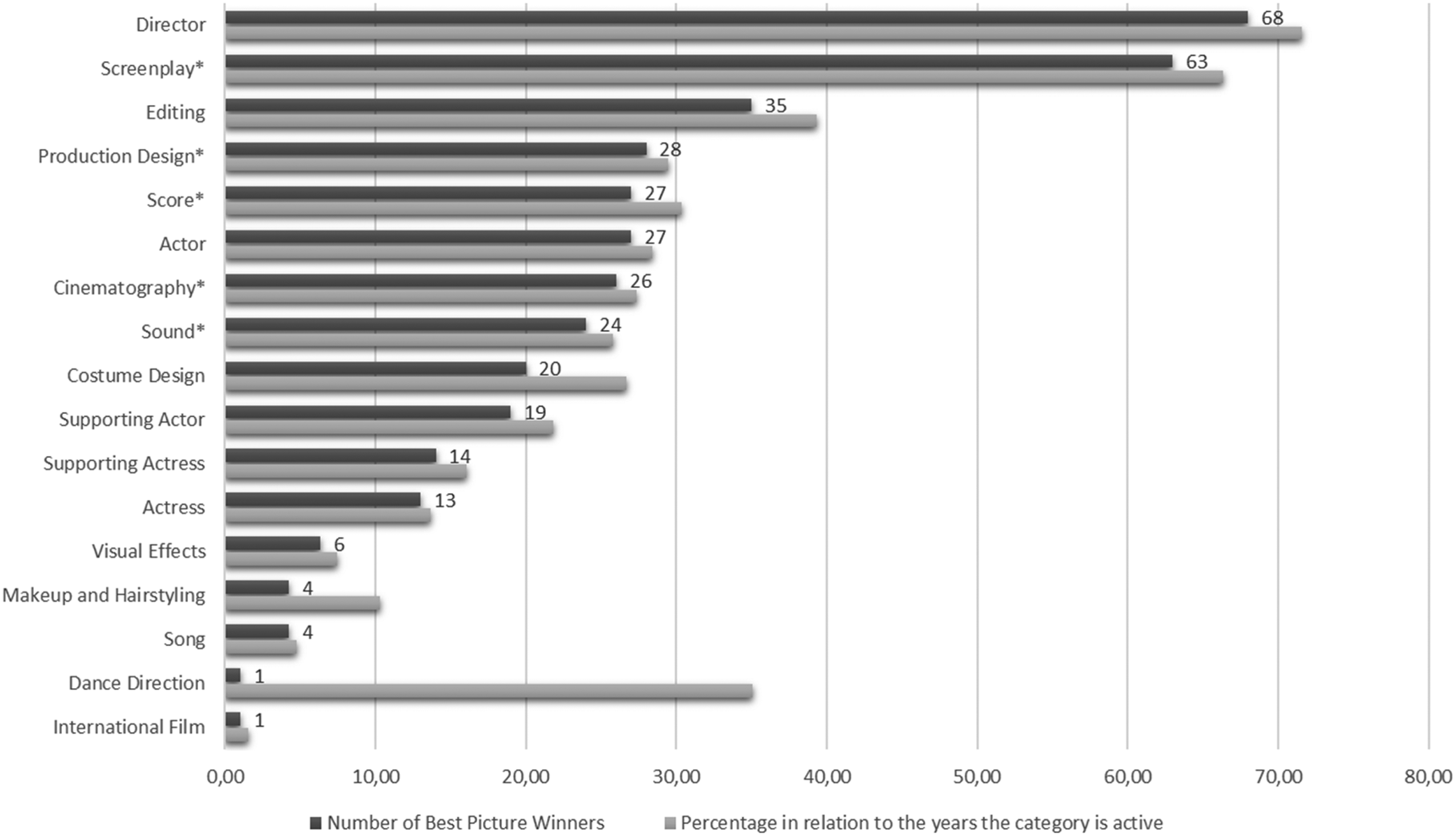
Number of Best Picture winners that won other categories over the 95 years of Academy Award history, and percentage in relation to the years each category is active (* denotes aggregated categories).
In contrast, the Best Screenplay numbers have improved in recent years. If some of the greatest winners in Academy history have surprisingly not won Best Screenplay (like Ben-Hur, West Side Story, Lawrence of Arabia, My Fair Lady, Oliver!, The English Patient and Titanic), in the past 18 years only three films did not garner that prize; The Artist (which lost to Midnight in Paris), The Shape of Water (which lost to Get Out), and Nomadland (which lost to The Father). This seems to indicate that before, the quality of the director and of the production as a whole were more associated to the Best Picture, and now the quality of the story, or the film's overall theme, is more prominent, something that is consistent with the recent discourses of our times. Spotlight only won Best Picture and Screenplay, while CODA, Green Book, Moonlight and 12 Years a Slave only won Picture, Screenplay and one acting award, and Argo won Picture, Screenplay and Editing.
It is precisely Best Editing that appears in third place, being won by 35 Best Picture winners (39% of ceremonies the category existed in), something consistent with the findings of Simonton (2004c), that associated Editing to a creative cluster composed by the Director and the main Actors. Indeed, there are evident concentrations, particularly in the decades of the epic movies. For example, between 1953 and 1962 only one Best Picture, the social drama Marty, did not win Best Editing (it was not even nominated), and both in the 1990s and 2000s, six out of 10 Best Pictures received that prize. However, and once again, this tendency has changed in recent years. Everything Everywhere All at Once was the first film to win Best Editing since Argo, 10 years before.
The same trend can be seen in the other categories. Only around one-fourth of Best Picture winners have won Best Production Design (28 films), Best Score (27), Best Cinematography (26), a Best Sound category (24), and Best Costume Design (20), but these numbers have significantly decreased in the past two decades. Only one Best Film won Best Production Design since The Return of the King (2003); Del Toro's The Shape of Water (2017). This is also the only film to have won Best Score in the past 11 years. Between Ghandi (1982) and American Beauty (1999), nine Best Pictures won Best Cinematography. Since, only two: Slumdog Millionaire and Birdman. In 25 years, between Amadeus (1984) and The Hurt Locker (2009), 13 Best Pictures won a Best Sound related award. Since, not a single one. Finally, after six wins in 8 years (from The English Patient to The Return of the King) only one Best Picture since won best Costume Design: The Artist (2011).
Noticeable as well is that, in the 95-year history, there is clearly a higher association of the Best Picture to male actors—28% of films won Best Actor; 22%, since the category exists, won Best Supporting Actor—than with female actresses; just 14% won Best Actress, and 16% Best Supporting Actress. This confirms the “Best Actress Paradox” previously discussed by Simonton (2004a), which notes that exceptional performances by women are less likely to be associated with the Best Picture than performances by men, and the impact of lead actresses is smaller than that of supporting actor.
Yet, once more, the tendency has changed in recent years. Best Actor is the fifth category most associated to Best Picture, and there have been unequivocal actor-dominated decades. Five Best Pictures in the 1940s won the major actor award (including for Bing Crosby, Frederic March, and Laurence Olivier), and another five in the 1970s (including for Gene Hackman, Jack Nicholson, and Dustin Hoffman); four in the 1950s (including for Marlon Brando and Alec Guinness); and three in the 1960s and the 1980s. Yet only six more Best Pictures since 1990 have also won Best Actor; in the early 1990s (Anthony Hopkins and Tom Hanks), at the turn of the millennium (Kevin Spacey and Russell Crowe), and in 2010 and 2011, with the wins of Colin Firth for The King's Speech and Jean Dujardin for The Artist. No Best Picture has had the Best Actor in more than a decade, but four have had the Best Supporting Actor in the past 7 years alone (twice for Mahershala Ali, and in the past 2 years, Troy Kotsur for CODA and Ke Huy Quan for Everything Everywhere All at Once). This is the greatest concentration of the Best Supporting Actor award for the Best Picture, that initially was given three times a decade (1940s, 1950s) and then once or twice a decade from the 1970s to the 2010s.
Best Actresses, contrary to popular belief, initially headed Best Pictures more times than actors. Between 1934 and 1942, four actresses won the Award in Best Pictures (Claudette Colbert, Luise Rainer, Vivien Leigh and Greer Garson), against only one Actor. Yet for the next 32 years, until 1975 and Louise Fletcher’ win for One Flew Over the Cuckoo's Nest, no Best Picture had the Best Actress. From the 1970s until the 1990s, the Best Actress Award was given to the Best Picture twice a decade, but there was another long hiatus at the millennium's turn. For 20 years, between 1999 and 2019, only one Actress won, Hilary Swank for Million Dollar Baby. Nonetheless, there have been two winners in just the past 3 years, Frances McDormand (her third award) for Nomadland, and Michelle Yeoh for Everything Everywhere All at Once, something that may mean a new turning of attention to woman-centered films. In fact, Everything Everywhere All at Once was not only the first Best Picture since Shakespeare in Love (1998) to win the two awards for the female actresses, it was also the first Best Picture ever to win three awards for acting (the other two triple achievers, A Streetcar Named Desire, 1951, and Network, 1976, did not win Best Picture).
This trend is not seen in the Best Supporting Actress category. In 15 years, between 1939—the historic win of Hattie McDaniel—and 1954, six actresses won the supporting Oscar in a Best Picture, but it took almost 60 years for another six to win. It happened only in 1961, 1979 (Meryl Streep's first Oscar), but then much later at the millennium's turn (1996, 1998, 2001, and 2002), and since, only two more actresses won the supporting award for a Best Picture, Lupita Nyong'o for 12 Years a Slave and this year's win of Jamie Lee Curtis.
All the remaining categories have been won only by a small amount of Best Pictures. Best Visual Effects was only won six times, in the very first ceremony (the Best Engineering Effects of Wings), for the massive spectacle Ben-Hur (1959) and then the rest in the 1990s/ early 2000s, the last age of the (semidigital) epic film: Forrest Gump; Titanic; Gladiator; and Return of the King. Best Song was only won by four Best Pictures; with the exception of Gigi (1958) all between 10 and 20 years ago (Titanic, Return of the King, and Slumdog Millionaire). The same for Best Makeup and/or Hairstyling, again with the concentration being in the 1980s and 1990s (Amadeus, Driving Miss Daisy, Braveheart, and again Return of the King). Finally, only one film won, as previously stated, the short-lived category Dance Direction (The Great Ziegfeld, 1936), and only Parasites won both Best Picture and Best International Picture.
Looking at the percentage in relation to the years each category was active (lower bar of Figure 3), there is actually little difference in the hierarchy of results, with the exception of Dance Direction which obviously has a high ratio of wins (one win out of three ceremonies). Best Score, Best Costume Design and Best Makeup, and Hairstyling, that have existed fewer years than the main categories, only ascend one place in the ranking if instead of considering total wins in the 95 years, it is considered a percentage in relation to active years.
Cluster Analysis
Finally, a Two-Step cluster analysis was conducted. Automatically, the tool produced just two clusters, divided more or less into those that received more and those that received less awards. The first cluster includes also those that received more awards, but practically only in the main categories, while the second cluster includes movies that received several so-called “technical” awards. Further tests were made, increasing the number of clusters. Logical subdivisions, without hindering the explanatory quality of the groups, were experimented and results observed. Groups mostly stabilize over six clusters, showing a consistency in their characterization. Yet using a slightly higher number of clusters allows for a finer characterization. For example, with six clusters, pictures that have generally won Best Director and Best Screenplay, and some Best Editing, are grouped together. Yet with eight clusters, this group is divided because a part has won Best Actor but not Best Cinematography, and another part has won this award. Therefore, a final division in precisely eight groups was considered, which are discussed below and summarized in Table 2.
Two Step Cluster Analysis of the Best Motion Pictures of the Year, Based on Oscars Won by Category.
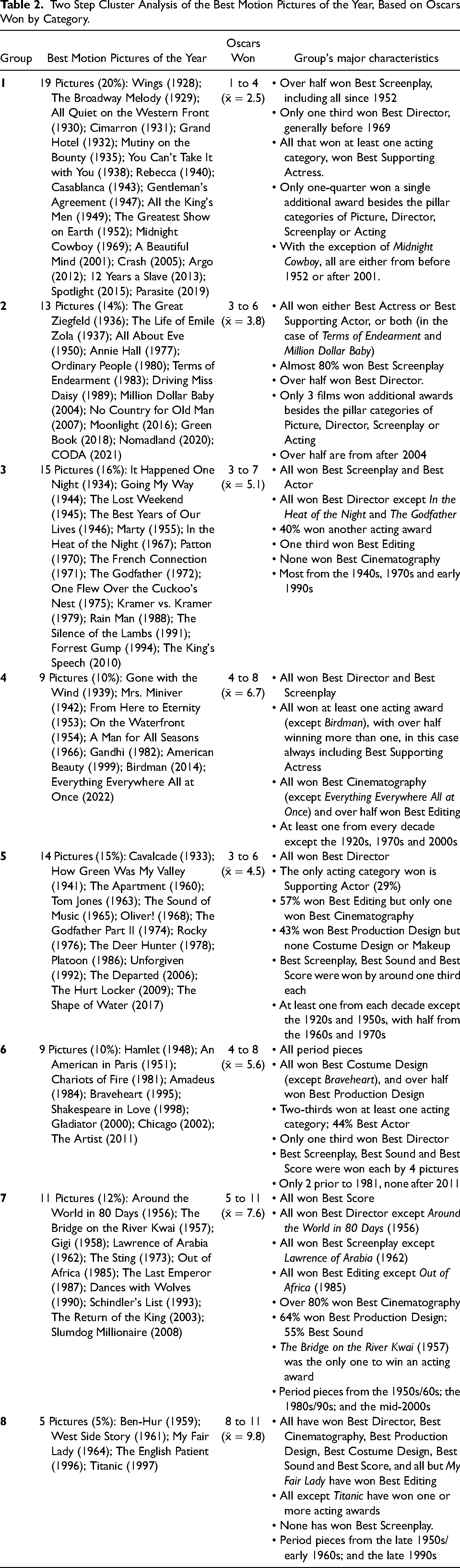
The pictures of this group have won only a small number of Oscars (from just one to a maximum of four; x̄ = 2.5). Despite being Best Pictures, only occasionally do they win Best Director (37%), with five of the seven wins occurring before 1969. Yet, 53% have won Best Screenplay, including all of the films in the 21st century. The four pictures that have won at least one acting category, have won Best Supporting Actress. Only five films (26%) have won a single additional award besides the pillar categories of Picture, Director, Screenplay or Acting. The 19 films in this cluster are, with the exception of Midnight Cowboy (1969), all either from before 1952 or after 2001. They include the first five recipients (1928–1932), a further six films from the 1930s and 1940s, but also four winners of the past 10 years; Argo (2012); 12 Years a Slave (2013); Spotlight (2015), and Parasite (2019), again proving an association between the initial and the current Best Pictures.
The 13 pictures in this group have won a slightly higher number of Oscars than those of the previous (between three and six; x̄ = 3.8). Most of them (around 80%) won Best Screenplay—the exceptions are The Great Ziegfeld (1936), Million Dollar Baby (2004), and Nomadland (2020). Over half (54%) won Best Director, with Nomadland as the only one doing so in the past 10 years. Another distinctive feature of this group is that all of the films have won either a Best Actress or a Best Supporting Actor award, or both, in the case of Terms of Endearment (1983) and Million Dollar Baby. Only three films (23%) have won additional awards besides the pillar categories of Picture, Director, Screenplay, or Acting, with only All About Eve (1950) winning more than one. Following the cyclic model previously discussed, films from this group appear around every 30 years; three are from the classic age, a further four from the late 1970s/1980s, but the remainder are all after 2004, including four from the past 7 years: Moonlight (2016); Green Book (2018); Nomadland (2020); and CODA (2021). This means that eigh of the last 11 winners are in these first two clusters.
This group includes 15 films that have won in average 5.1 Oscars, ranging from four to seven (won by Going My Way, The Best Years of Our Lives, and Patton). The Godfather is the outlier, having won just three Academy Awards, but was included here because all the pictures in this group have won Best Screenplay and Best Actor. All have also won Best Director, with the exception of The Godfather and In the Heat of the Night. However, none of these films have won Best Cinematography. Around 40% have won another acting award besides Best Actor—in fact, this group includes the tree pictures that have won The Big Five (Picture, Director, Screenplay, Actor, and Actress): It Happened One Night (1934); One Flew Over the Cuckoo's Nest (1975); and The Silence of the Lambs (1991), although curiously none of them won another award. One third won Best Editing, and some won other awards as Best Score or Sound (two each). Once again, these films appear to occur rather cyclically. All are from in or around the 1940s; the late 1960s/1970s; and the late 1980s/early 1990s. In fact, after Forrest Gump (1994), only one more film has been included in this group: The King's Speech (2010).
When six clusters and not eight were computed, the pictures in this group were clustered together with those of Group 3. There are things in common between the two groups, as all of these nine pictures have won Best Screenplay and Best Director and at least one acting award, with the single exception of Birdman (2014). Yet, contrary to Group 3, where all pictures won Best Actor, this group is more heterogeneous, including winners from all acting categories, especially Actor and Supporting Actress. In fact, five of these nine movies have won more than one acting award, being one of them always Best Supporting Actress. The most recent winner, Everything Everywhere All at Once (2002), as the only Best Picture to garner three acting awards, is included here although it is the only one of the group not to have won Best Cinematography (another distinctive feature from Group 3, and the reason why Birdman was included here). Over half won Best Editing, and less won Production Design (3), Costume Design (2), and Sound (1). Overall, most pictures in the group won between six and eight Oscars (American Beauty and Birdman won less), averaging 6.7 Awards. These films appear once a decade; there is at least one representative from each except the 1920s, the 1970s, and the 2000s.
Compared to the previous groups, the 14 pictures clustered in Group 5 won less Oscars (between three and six; x̄ = 4.5), but they have all also won Best Director. However, contrary to Group 4, only one film won Best Cinematography (How Green Was My Valley, 1941), and only five (one third) won Best Screenplay. Also, only 29% won an acting category, and it was always the same: Best Supporting Actor. These films are actually more recognized by their Editing (57% won), and Production Design (43% won), but none won Best Costume Design (as those of Group 6) nor Best Makeup and Hairstyling. Other categories as Best Sound and Best Score were won by around one third each. The films in this Group appear at least once a decade (except the 1920s and 1950s) but there is a clear association to the 1960s and 1970s, with seven out of the 14 films. The Shape of Water (2017) is the only film of the past 15 years in this group.
This group clustered just nine pictures, and is very particular of a certain type of film existing from the 1980s until the early 2000s. In fact, seven of the nine films are from the 30-year period between 1981 and 2011, with only two from before (Hamlet, 1948, and An American in Paris, 1951). These Best Pictures have won four to eight Oscars, averaging 5.6, and are all period pieces recognized by their production values. All except Braveheart (1995) have won the Best Costume Design award, and over half (55%) have won Best Production Design. Such awards are more relevant for this group than Best Director, only won by a third; Amadeus (1984); Braveheart (1995), and The Artist (2011). Yet six out of the nine have won at least one acting award, with a tendency toward Best Actor (four pictures). Best Screenplay, Best Sound and Best Score were also won each by four pictures (44%), with Best Cinematography and Best Makeup and Hairstyling being won by two each, and Best Editing and Best Visual Effects by one each. In fact, only Best Supporting Actor and Best Song were not won by any picture in this group.
The 11 pictures clustered in Group 7 include some of the major epics in the history of the Academy Awards, all period pieces (and the fantasy film The Return of the King, 2003), with the exception of Slumdog Millionaire (2008), the most recent winner of this group. These pictures have won between seven and eleven Oscars (x̄ = 7.6), with the exception of Around the World in 80 Days (1956) that has won just five, the outlier that nonetheless shares most of the group's main characteristics. Like Group 4, practically all of the films won Best Director (Around the World in 80 Days is the exception), Best Screenplay (Lawrence of Arabia, 1962, the exception), Best Editing (except Out of Africa, 1985), and Best Cinematography (The Sting, 1973, and The Return of the King the exceptions)—in this case distinguishing it from Group 5. Yet unlike Group 4, all pictures in Group 7 have won Best Score. Furthermore, they have a good performance in practically all other technical categories; 64% won Best Production Design; 55% Best Sound; 36% Costume Design, 27% Best Song. Noteworthy is that the movies in this category have not won any acting awards; the only exception is The Bridge on the River Kwai (1957) that won Best Actor. Also with the single exception of The Sting (1973), all these pictures are associated to particular periods; the late 1950s/early 1960s; the late 1980s/early 1990s; and the mid-2000s.
Finally, Group 8 includes just five pictures: Ben-Hur (1959); West Side Story (1961); My Fair Lady (1964); The English Patient (1996); and Titanic (1997). In a six or seven cluster scenario, these films are aggregated to the ones in Group 7, but with eight clusters an important distinction is made. These are also the period pieces that most Oscars have won in the history of the Academy, from eight (My Fair Lady) to eleven (Ben-Hur and Titanic) (x̄ = 9.8), and they have swept a large number of categories. All have won Best Director, Best Cinematography, Best Production Design, Best Costume Design, Best Sound and Best Score, and all but My Fair Lady have won Best Editing. Yet, contrary to Groups 4 and 7, and also those of Groups 2 and 3, none of the pictures in Group 8 has won Best Screenplay despite the large amount of Oscars received. Another major difference to Group 7 is that all of these films except Titanic have won one or more acting awards, of all types except Best Actress. Of the remaining categories, only Makeup and Hairstyling was not won by any film, but the category did not exist in the 1960s. Two films won Best Visual Effects and one Best Song. These films are from just two periods; the late 1950s/early 1960s; and the late 1990s.
Debate and Conclusions
While presenting a Screenplay award in 1978, three-time Oscar winning writer Paddy Chayefsky commented that “winning an Academy Award is not a pivoting moment in history, it does not require a proclamation.” Of course that he was commenting on the political speech (not usual at the time) that Vanessa Redgrave had just given a few moments before, when receiving the best Supporting Actress award for Julia (1977). Yet these words can be debated in another context, the context of movie history, and particularly of Hollywood history. Winning an Academy Award has always been, indeed, a pivoting moment, even if not in the history of the world, at least in the history of cinema, for everything the ceremony has represented and still, in many ways, represents. Despite changing formats and sometimes critiques, it still has an undeniable influence on the industry's popularity and box office appeal. Millions of people turn yearly to the ceremony, for its glamor, for its spectacle and entertainment value, but also, still, for a barometer of current trends and ultimately for a guideline of what pictures to watch and what stars to follow.
It is given that the Academy has changed. An institution that has almost 100 years of age necessarily has to do so. It is not just the pictures that were different in 1929. Society was also very different. The evolution of one and the other inevitably influences the outcome of any award that has a claim to be based on quality, because quality is a rather subjective concept that changes with society's own perceptions, sensibilities, tastes and the evolution of cultural, political or socioeconomic factors. As the fastest growing art form ever, cinema dominated the 20th century, bridging the gap between entertainment, art, technical innovation, self-expression, and societal intervention. The Academy Awards have always strived to balance all these dimensions, as cinema in general and Hollywood in particular had to learn constantly how to adapt or, in some cases, how to be the driving force of that adaptation, in the aftermath of upheavals as wars, socioeconomic crisis, political scandals, and racial conflicts. More than any other movie industry in the world, Hollywood learned that even if box office often depends on being formulaic and escapist (in many quadrants cinema still is, first and foremost, an entertainment business); artistic creativity, technical excellence, thematic boldness, and the overall influencing power of the final products—seen by millions—lend not just credibility, they leave their indelible mark on society and contemporary generations.
The Academy Award for Best Picture is the pinnacle of the Oscar ceremony, and the most prominent symbol of the message the Academy wishes to present to the world of what cinema is and what is its role in both catering to and shaping society. Best Pictures include, without a doubt, some of the finest motion pictures ever made in the English language, even though, as well without a doubt, innumerous masterpieces—English or otherwise—have been snubbed over the decades. That debate, of the justice of the awards, of the quality of the pictures, of underdogs winning over “sure bets” (Pardoe & Simonton, 2008), of the artists honored and of all those left behind, of the convergence or (more often) the divergence between the Academy's vote and audiences’ commercial preferences, and of all the backstage maneuvering and promoting required, are often made, especially around award season, not just by critics and scholars, but by innumerous publications and web forums associated to popular culture. However, actual scientific empirical analysis of the Oscars is relatively scarce, perhaps because it is rather difficult to define quality objectively. What exactly means to be “the best”? For that reason, research has mostly dealt with creating prognostic models, measuring and estimating box office returns, and analyzing social characteristics of the winners.
This article intended to provide a new perspective for this debate, by condensing knowledge on the Academy Awards. For that, it took an historical standpoint, analyzing the Best Picture category, not based on external subjective factors dealing with merit or the comparison with other pictures, nor based on the themes and technical aspects of each film, but instead based on data from within the Academy itself. That is, by characterizing each Best Picture through the remaining Oscars it gained on Hollywood's biggest night, and by doing so getting a sense of how the Academy's perspective of a Best Picture has evolved over time. The rational came from looking at what has happened in the most recent decade, that in some ways has contradicted the trends uncovered in previous research. Indeed, noticeable changes have been seen, not only in the Academy's ranks (including new policies for integrating members), but also on the type of winner announced at the end of each ceremony. For example, between 1978 and 2011, only twice the Best Picture was not the film with most Oscars won in the ceremony, leading to high degrees of prediction (Pardoe & Simonton, 2008). Yet from 2011 until today, such has already happened six times. This year's winner, Everything Everywhere All at Once (2022) was the first film since 2011 to win more than four Academy Awards. Furthermore, in that same 11-year period, Best Screenplay was received by nine Best Picture winners, but Best Director only by five.
These indicators originated research questions that this study responded to. The first two questions proposed that the Best Picture winners were declining in awards and nominations. Actually, just by plotting the numbers it is perceptible that there is not an overall decline, but a relatively constant fluctuation over the decades. It is true that the Best Picture winners of the last decade had the lowest average of Oscars won since the 1930s, the smallest standard deviation ever, the lowest ever ratio of Oscars won per nominations, as well as the lowest amount of nominations since the 1940s. But lower numbers such as these (albeit not so low) occurred as well around the 1970s. The 1930s, the 1970s, and the 2010s, 40 years apart each, were periods of change in American society but also in cinema. The 1930s were a decade between the wars, ravaged by the Great Depression, that saw the rise and expansion of sound pictures. The 1970s, coming after the Vietnam War, the Watergate scandal, and the Civil Rights movement, was the first major decade of cinema after the announced demise of the studio system. And the 2010s, starting with an economic crisis and ending with a pandemic, saw representation, diversity, and racism issues again on the table, at the same time that cinema became fully digital and super-hero movies became the biggest moneymakers ever. Is it surprising that it is in these decades that the Academy responds, choosing to award the Best Picture to less expansive or spectacular films, more conscientious to current societal changes, therefore winning fewer awards in the night? Perhaps not.
The third research question was if the awards received by the Best Picture had changed over time, resulting in a new vision of what constitutes “the best.” Previous research had been relatively straightforward in associating Best Picture accolades, at the Oscars and elsewhere, to the dramatic aspects of the production (director, actors, screenplay, and also editing), and less to the visual, technical, and music components of films (Simonton, 2004c). And inside the dramatic aspects, actresses, for example, commanded less association than actors. However, what this research reveals is that changes have occurred, particularly in the past 10 years, even though this has not been something that had never been seen before. Again, the behavior reveals its cyclic nature. The cluster analysis divided the 95 Best Pictures into eight groups. Some of them are particular of a given genre and a given time. The epics of Groups 7 and 8, the biggest Oscar winners, are mostly from around the 1960s and around the 1990s; blockbusters with high production values that won a large number of categories. Those in Group 6 received less Oscars, but they were also period pieces mostly from the 1980s to the 2000s, and those in Group 5, although appearing at least once a decade, concentrate in the 1960s and 1970s, while those in Group 3 are mostly from the 1940s, 1970s, and 1990s. Yet only one film of the past 10 years is in any of these five groups: The Shape of Water (2017), with a further two, Birdman (2014), and Everything Everywhere All at Once (2022) being in the once-a-decade Group 4. That means that just Groups 1 and 2 include eight of the last 11 winners. These groups are also strongly associated to films of the classic age, prior to 1950 (Groups 1 and 2) and to the late 1970s/early 1980s (Group 2).
So what can this mean? The evidence points to a “concept” that is fashionable to the times, but that eventually can be repeated. Even so, the most recent years have also shown that new patterns can emerge. Currently, the Best Pictures of the last decade seem to have won because of the message they pass on to the spectators, to the world, and so they are less predictable considering purely cinematic variables. Technical categories, that allowed the great blockbusters of the 1960s and of the 1990s to win a large number of Oscars, have today very little association with the Best Picture. A Sound category or Best Costume Design are not awarded to the Best Picture in more than a decade, and Best Cinematography, Best Score, Best Editing, or Best Production Design have only been awarded once each in that period. Instead, the Best Picture is being generally attributed to the film deemed to have the Best Screenplay. It is always interesting to note that a large slice of the greatest over-achievers in Oscar history (those in Group 8) did not win the Screenplay award. Yet in the last eighteen years, only three Best Films did not win a form of Best Screenplay, less times than Best Director, which seems to indicate a shift in explaining wins.
Indeed, the smaller the number of Oscars a Best Picture receives, the less likely it seems to be that the film will be honored with Best Director. The numbers speak for themselves. The Director category is the one most associated to Best Picture (72%), and for 40 years, between 1957 to 1997, only four Best Pictures did not also win Best Director. Yet only the first decade of the Oscars is comparable to this last decade in terms of Best Film directors failing to win the prize themselves, being that some were not even nominated (Ben Affleck, Peter Farrelly, Sian Heder). Another perceptible change is that the Best Actor category has reduced its association to the Best Picture, despite being the acting award, overall, with a highest percentage (28%). The award was only given twice in the past 20 years, and none in the past 10. Instead, the association is shifting toward Best Actress (two times in just the past 3 years), Supporting Actress (two times in the past 10), and Supporting Actor (four times in the past 7 years). Interestingly, this may change the concepts established in the previous literature on the subject, mainly from the early 2000s.
It can be concluded that production values and technical excellence are, in the 21st Century, much less seen as essential components of a Best Picture than is the Screenplay. As well, epics centered on male characters (characteristics of many Oscar over-achievers) are less prone now to win than subtler stories with a diverse and ensemble cast, suitable to the times. The Best Picture has always favored humane stories that spoke to particular audiences and that delivered particular messages at important times; You Can't Take It with You (1938), Midnight Cowboy (1969), and Rocky (1976). But if recent Best Pictures follow this model, previously seen mostly in the 1930s and 1970s, of winning Picture, Screenplay, one acting award and an occasional additional award, the truth is that there never seems to have been a period when so many films have done so, in continuity, year after year. The pandemic, social upheaval, and even the influence of social media in contemporary society may have ushered such changes, but only time will tell to what extent. Historical analysis suggests that a new period of ascent in terms of Oscars won by the Best Picture may follow, as it did before to culminate in the 1950s and in the 1990s. Certainly the win of seven Awards by Everything Everywhere All at Once may be a return to what has been the most popular conception of a Best Picture in the recent past. However, it is still too early to draw conclusions.
What can be stated at this point is that it is still legitimate to ask if a picture is indeed “the Best” if it does not have the best actors, the best directors or the best technicians, and it only has the best story. Spotlight (2015) is a case in point. Mad Max: Fury Road was acclaimed by its technical brilliance, winning six awards in Editing, Costume and Production Design, Sound Mixing and Editing, and Makeup. At the same time, The Revenant was acclaimed by its artistry, winning three Awards for Directing, Cinematography and lead Actor. Neither one or the other of these movies was nominated for a Screenplay award, which Spotlight won, along with Best Picture. The case of Dune and CODA is relatively similar in 2021. It is understandable that a new collective vision, in troubled times, focuses more on the message, on pushing forward societal change through the power of film, but there are palpable consequences. Namely, it seems that the importance of the director, and even of the producer (that help tie together all technical categories and bring them to life on the screen) becomes less recognized. The fact that there is a greater gap between Best Director and Best Picture than ever before, and that the Irving G. Thalberg award (an honorary award to producers) stopped being given regularly in the past two decades (it was only granted four times since 2000), seems to support this claim. Again, this definitely requires rethinking previously presented models and clusters of achievement and prediction, most of them, precisely, more than a decade old (Bernard, 2005; Deuchert et al., 2005; Kaplan, 2006; Pardoe & Simonton, 2008; Peacock & Hu, 2013; Simonton, 2004b, 2004c).
Actually, such a duality seems to fit into the often-forgotten model that existed solely on the very first ceremony in 1929, when two Best Picture awards were given. Wing received Outstanding Picture (today recognized as the Best Picture of that year), but Sunrise was crowned the Unique and Artistic Picture. At first glance it may seem unlikely that the Academy will revert to such a model today, but it is one more proof of how the structure of the award, and its association to other categories, seems now closer to the origins of the ceremony in the late 1920s than ever before. Does history repeats itself? Regarding the Academy Awards this may well be the case. In 2018, the Academy proposed the creation of a new category, Outstanding Achievement in Popular Film, as a direct attempt to revert the declining television ratings and decrease the perceptible gap with the biggest money-makers—for almost two decades the Best Picture is not in the year's Top 10 earners. Yet this has been met with large skepticism and the award has been continuously postponed.
In the 2022 ceremony, without much hype, and based on a Twitter poll, the Academy appeared to make an attempt at compromise, by announcing the Oscar Fan Favorite. This was the Netflix / Zack Snyder zombie action movie Army of the Dead, a film that also won the other Twitter-based category, Oscars Cheer Moment. This experiment, viewed by some as an effort to introduce popular movies—like those of the Marvel universe—into the telecast, seems to have backfired, as the internet rallied massively around little talked about films, another being Minamata with Johnny Depp. The result was that these awards were not repeated in the most recent 2023 ceremony.
It seems that with the changing times and the membership expansion, the Academy is now a little unsure of how to define a Best Film, but it is understandable that by increasing the number of members in the thousands, an internal consensus becomes harder to achieve. However, it also seems somewhat uncomfortable that the voting is distancing itself from a larger commercial audience. But the Academy has always adjusted and re-invented itself in the past, and it is expected that it will (at least try to) do so again. The best films have always been a delicate balance between art and commercialism, and the Oscars have always deftly navigated that equilibrium. Movie scholars and fans (it is impossible to be a film scholar without also being a massive film buff) will always agree or disagree with the final decision. But that is part of the game, because only with discussion and critique, but also a thorough understanding of the past, can an art form move forward, and cinema is no exception.
Footnotes
Annex 1 – Academy Awards Received by the Year’s Best Picture Winner (*Denotes an Aggregated Category).
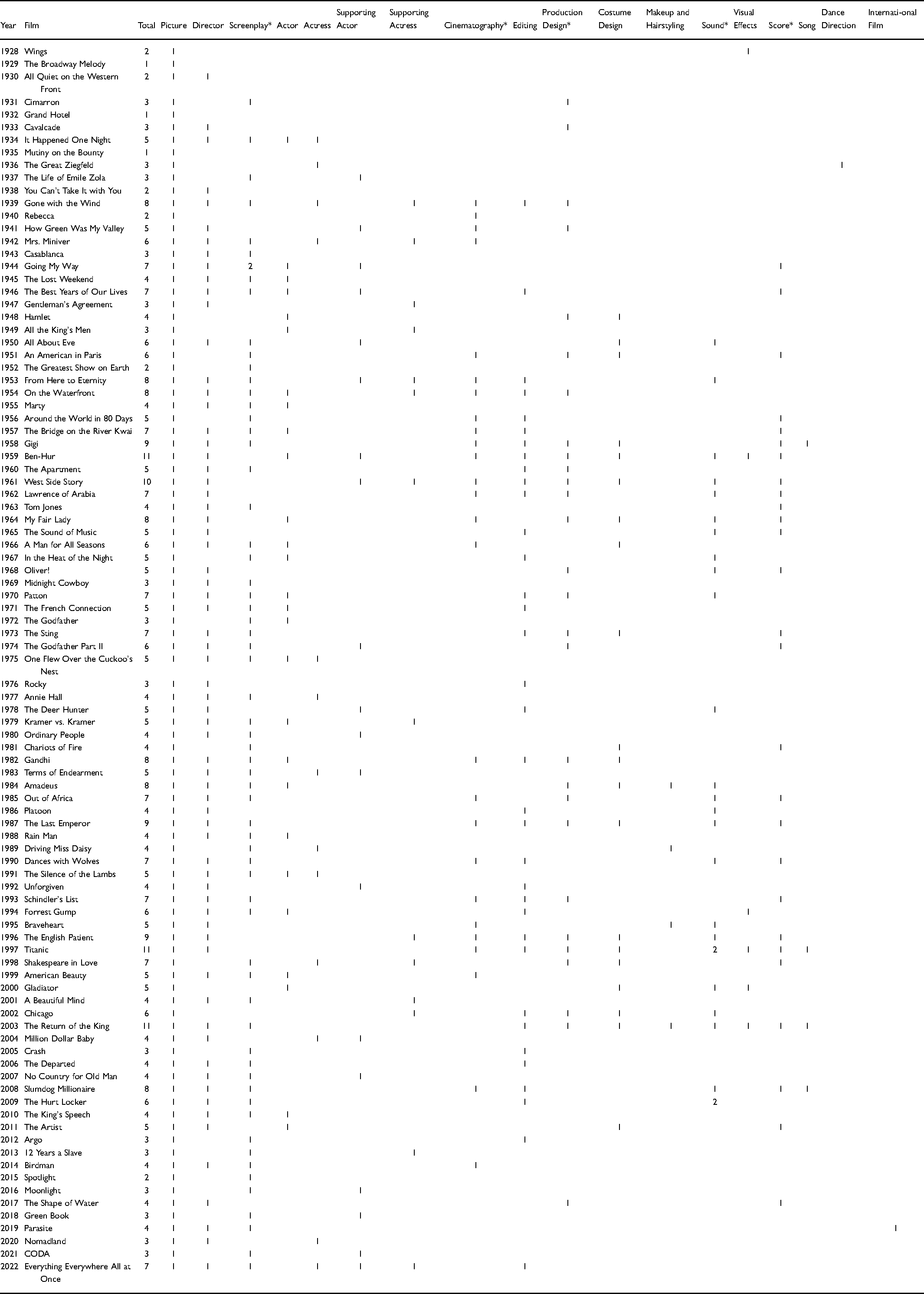
| Year | Film | Total | Picture | Director | Screenplay* | Actor | Actress | Supporting Actor | Supporting Actress | Cinematography* | Editing | Production Design* | Costume Design | Makeup and Hairstyling | Sound* | Visual Effects | Score* | Song | Dance Direction | Internati-onal Film |
|---|---|---|---|---|---|---|---|---|---|---|---|---|---|---|---|---|---|---|---|---|
| 1928 | Wings | 2 | 1 | 1 | ||||||||||||||||
| 1929 | The Broadway Melody | 1 | 1 | |||||||||||||||||
| 1930 | All Quiet on the Western Front | 2 | 1 | 1 | ||||||||||||||||
| 1931 | Cimarron | 3 | 1 | 1 | 1 | |||||||||||||||
| 1932 | Grand Hotel | 1 | 1 | |||||||||||||||||
| 1933 | Cavalcade | 3 | 1 | 1 | 1 | |||||||||||||||
| 1934 | It Happened One Night | 5 | 1 | 1 | 1 | 1 | 1 | |||||||||||||
| 1935 | Mutiny on the Bounty | 1 | 1 | |||||||||||||||||
| 1936 | The Great Ziegfeld | 3 | 1 | 1 | 1 | |||||||||||||||
| 1937 | The Life of Emile Zola | 3 | 1 | 1 | 1 | |||||||||||||||
| 1938 | You Can't Take It with You | 2 | 1 | 1 | ||||||||||||||||
| 1939 | Gone with the Wind | 8 | 1 | 1 | 1 | 1 | 1 | 1 | 1 | 1 | ||||||||||
| 1940 | Rebecca | 2 | 1 | 1 | ||||||||||||||||
| 1941 | How Green Was My Valley | 5 | 1 | 1 | 1 | 1 | 1 | |||||||||||||
| 1942 | Mrs. Miniver | 6 | 1 | 1 | 1 | 1 | 1 | 1 | ||||||||||||
| 1943 | Casablanca | 3 | 1 | 1 | 1 | |||||||||||||||
| 1944 | Going My Way | 7 | 1 | 1 | 2 | 1 | 1 | 1 | ||||||||||||
| 1945 | The Lost Weekend | 4 | 1 | 1 | 1 | 1 | ||||||||||||||
| 1946 | The Best Years of Our Lives | 7 | 1 | 1 | 1 | 1 | 1 | 1 | 1 | |||||||||||
| 1947 | Gentleman's Agreement | 3 | 1 | 1 | 1 | |||||||||||||||
| 1948 | Hamlet | 4 | 1 | 1 | 1 | 1 | ||||||||||||||
| 1949 | All the King's Men | 3 | 1 | 1 | 1 | |||||||||||||||
| 1950 | All About Eve | 6 | 1 | 1 | 1 | 1 | 1 | 1 | ||||||||||||
| 1951 | An American in Paris | 6 | 1 | 1 | 1 | 1 | 1 | 1 | ||||||||||||
| 1952 | The Greatest Show on Earth | 2 | 1 | 1 | ||||||||||||||||
| 1953 | From Here to Eternity | 8 | 1 | 1 | 1 | 1 | 1 | 1 | 1 | 1 | ||||||||||
| 1954 | On the Waterfront | 8 | 1 | 1 | 1 | 1 | 1 | 1 | 1 | 1 | ||||||||||
| 1955 | Marty | 4 | 1 | 1 | 1 | 1 | ||||||||||||||
| 1956 | Around the World in 80 Days | 5 | 1 | 1 | 1 | 1 | 1 | |||||||||||||
| 1957 | The Bridge on the River Kwai | 7 | 1 | 1 | 1 | 1 | 1 | 1 | 1 | |||||||||||
| 1958 | Gigi | 9 | 1 | 1 | 1 | 1 | 1 | 1 | 1 | 1 | 1 | |||||||||
| 1959 | Ben-Hur | 11 | 1 | 1 | 1 | 1 | 1 | 1 | 1 | 1 | 1 | 1 | 1 | |||||||
| 1960 | The Apartment | 5 | 1 | 1 | 1 | 1 | 1 | |||||||||||||
| 1961 | West Side Story | 10 | 1 | 1 | 1 | 1 | 1 | 1 | 1 | 1 | 1 | 1 | ||||||||
| 1962 | Lawrence of Arabia | 7 | 1 | 1 | 1 | 1 | 1 | 1 | 1 | |||||||||||
| 1963 | Tom Jones | 4 | 1 | 1 | 1 | 1 | ||||||||||||||
| 1964 | My Fair Lady | 8 | 1 | 1 | 1 | 1 | 1 | 1 | 1 | 1 | ||||||||||
| 1965 | The Sound of Music | 5 | 1 | 1 | 1 | 1 | 1 | |||||||||||||
| 1966 | A Man for All Seasons | 6 | 1 | 1 | 1 | 1 | 1 | 1 | ||||||||||||
| 1967 | In the Heat of the Night | 5 | 1 | 1 | 1 | 1 | 1 | |||||||||||||
| 1968 | Oliver! | 5 | 1 | 1 | 1 | 1 | 1 | |||||||||||||
| 1969 | Midnight Cowboy | 3 | 1 | 1 | 1 | |||||||||||||||
| 1970 | Patton | 7 | 1 | 1 | 1 | 1 | 1 | 1 | 1 | |||||||||||
| 1971 | The French Connection | 5 | 1 | 1 | 1 | 1 | 1 | |||||||||||||
| 1972 | The Godfather | 3 | 1 | 1 | 1 | |||||||||||||||
| 1973 | The Sting | 7 | 1 | 1 | 1 | 1 | 1 | 1 | 1 | |||||||||||
| 1974 | The Godfather Part II | 6 | 1 | 1 | 1 | 1 | 1 | 1 | ||||||||||||
| 1975 | One Flew Over the Cuckoo's Nest | 5 | 1 | 1 | 1 | 1 | 1 | |||||||||||||
| 1976 | Rocky | 3 | 1 | 1 | 1 | |||||||||||||||
| 1977 | Annie Hall | 4 | 1 | 1 | 1 | 1 | ||||||||||||||
| 1978 | The Deer Hunter | 5 | 1 | 1 | 1 | 1 | 1 | |||||||||||||
| 1979 | Kramer vs. Kramer | 5 | 1 | 1 | 1 | 1 | 1 | |||||||||||||
| 1980 | Ordinary People | 4 | 1 | 1 | 1 | 1 | ||||||||||||||
| 1981 | Chariots of Fire | 4 | 1 | 1 | 1 | 1 | ||||||||||||||
| 1982 | Gandhi | 8 | 1 | 1 | 1 | 1 | 1 | 1 | 1 | 1 | ||||||||||
| 1983 | Terms of Endearment | 5 | 1 | 1 | 1 | 1 | 1 | |||||||||||||
| 1984 | Amadeus | 8 | 1 | 1 | 1 | 1 | 1 | 1 | 1 | 1 | ||||||||||
| 1985 | Out of Africa | 7 | 1 | 1 | 1 | 1 | 1 | 1 | 1 | |||||||||||
| 1986 | Platoon | 4 | 1 | 1 | 1 | 1 | ||||||||||||||
| 1987 | The Last Emperor | 9 | 1 | 1 | 1 | 1 | 1 | 1 | 1 | 1 | 1 | |||||||||
| 1988 | Rain Man | 4 | 1 | 1 | 1 | 1 | ||||||||||||||
| 1989 | Driving Miss Daisy | 4 | 1 | 1 | 1 | 1 | ||||||||||||||
| 1990 | Dances with Wolves | 7 | 1 | 1 | 1 | 1 | 1 | 1 | 1 | |||||||||||
| 1991 | The Silence of the Lambs | 5 | 1 | 1 | 1 | 1 | 1 | |||||||||||||
| 1992 | Unforgiven | 4 | 1 | 1 | 1 | 1 | ||||||||||||||
| 1993 | Schindler's List | 7 | 1 | 1 | 1 | 1 | 1 | 1 | 1 | |||||||||||
| 1994 | Forrest Gump | 6 | 1 | 1 | 1 | 1 | 1 | 1 | ||||||||||||
| 1995 | Braveheart | 5 | 1 | 1 | 1 | 1 | 1 | |||||||||||||
| 1996 | The English Patient | 9 | 1 | 1 | 1 | 1 | 1 | 1 | 1 | 1 | 1 | |||||||||
| 1997 | Titanic | 11 | 1 | 1 | 1 | 1 | 1 | 1 | 2 | 1 | 1 | 1 | ||||||||
| 1998 | Shakespeare in Love | 7 | 1 | 1 | 1 | 1 | 1 | 1 | 1 | |||||||||||
| 1999 | American Beauty | 5 | 1 | 1 | 1 | 1 | 1 | |||||||||||||
| 2000 | Gladiator | 5 | 1 | 1 | 1 | 1 | 1 | |||||||||||||
| 2001 | A Beautiful Mind | 4 | 1 | 1 | 1 | 1 | ||||||||||||||
| 2002 | Chicago | 6 | 1 | 1 | 1 | 1 | 1 | 1 | ||||||||||||
| 2003 | The Return of the King | 11 | 1 | 1 | 1 | 1 | 1 | 1 | 1 | 1 | 1 | 1 | 1 | |||||||
| 2004 | Million Dollar Baby | 4 | 1 | 1 | 1 | 1 | ||||||||||||||
| 2005 | Crash | 3 | 1 | 1 | 1 | |||||||||||||||
| 2006 | The Departed | 4 | 1 | 1 | 1 | 1 | ||||||||||||||
| 2007 | No Country for Old Man | 4 | 1 | 1 | 1 | 1 | ||||||||||||||
| 2008 | Slumdog Millionaire | 8 | 1 | 1 | 1 | 1 | 1 | 1 | 1 | 1 | ||||||||||
| 2009 | The Hurt Locker | 6 | 1 | 1 | 1 | 1 | 2 | |||||||||||||
| 2010 | The King's Speech | 4 | 1 | 1 | 1 | 1 | ||||||||||||||
| 2011 | The Artist | 5 | 1 | 1 | 1 | 1 | 1 | |||||||||||||
| 2012 | Argo | 3 | 1 | 1 | 1 | |||||||||||||||
| 2013 | 12 Years a Slave | 3 | 1 | 1 | 1 | |||||||||||||||
| 2014 | Birdman | 4 | 1 | 1 | 1 | 1 | ||||||||||||||
| 2015 | Spotlight | 2 | 1 | 1 | ||||||||||||||||
| 2016 | Moonlight | 3 | 1 | 1 | 1 | |||||||||||||||
| 2017 | The Shape of Water | 4 | 1 | 1 | 1 | 1 | ||||||||||||||
| 2018 | Green Book | 3 | 1 | 1 | 1 | |||||||||||||||
| 2019 | Parasite | 4 | 1 | 1 | 1 | 1 | ||||||||||||||
| 2020 | Nomadland | 3 | 1 | 1 | 1 | |||||||||||||||
| 2021 | CODA | 3 | 1 | 1 | 1 | |||||||||||||||
| 2022 | Everything Everywhere All at Once | 7 | 1 | 1 | 1 | 1 | 1 | 1 | 1 |
Declaration of Conflicting Interests
The author declared no potential conflicts of interest with respect to the research, authorship, and/or publication of this article.
Funding
The author received no financial support for the research, authorship, and/or publication of this article.
