




Abstract
The overall aim was to study the impact of dance expertise in relation to emotional expressivity and emotional sensitivity, by comparing dance experts and nonexperts. The results are based on a survey answered by 120 individuals, consisting of the Berkeley Emotional Expressivity Questionnaire (BEQ) and the Emotional Sensitivity Questionnaire (ESS). Dance experts in comparison to nonexperts scored higher on ESS, more specifically, other-directed sensitivity, that is, the positive interpersonal sensitivity subscale. No significant differences were obtained on negative egocentric sensitivity, the other subscale of ESS, and neither regarding emotional expressivity. However, it was found that those with more frequent dance habits scored higher on the Impulse Strength subscale of the BEQ. Our findings point out the relationship between dance and our ability to perceive emotions, which could have interesting educational and clinical implications. Lastly, we discuss current and future perspectives on the topic.
Emotional Sensitivity, Emotional Expressivity, and Dance Expertise
A widely accepted view in psychology is that the body and the mind work together as one system. Scientists from various disciplines and in different time periods have underlined the interdependence of the body–mind system. One of the robust findings in emotion psychology is the large amount of empirical evidence that highlights the role of the body in expressing emotions, but also about human's ability to perceive emotions through bodily expressions. An increasing number of behavioral studies have found that people are able to decode emotional states through bodily expressions and that bodily movements can activate emotional experiences (Christensen, Gomila, Gaigg, Sivarajah, & Calvo-Merino, 2016; Niedenthal, Barsalou, Winkielman, Krauth-Gruber, & Ric, 2005; Strack, Martin, & Stepper, 1988). Although bodily expressions have been studied in the past in various domains, fewer studies have examined how dance expertise impacts one's ability to perceive and express emotions. In this respect, it seems important to study the impact of dance expertise as a factor that could enhance the capacity to detect emotional changes (emotional sensitivity) and the capacity to convey information about our own emotions (emotion expressivity).
Traditionally, emotional sensitivity, or lability, has been associated with neuroticism, one of the main domains in most personality theoretical models, however, in 2007, Guarino, Roger, and Olason (2007) introduced a new approach focusing on two dimensions: a positive (other-oriented) and a negative (self-centered) emotional sensitivity. This approach intends to overcome the pejorative connotation of neuroticism, often associated with anxiety and depression, but also low self-esteem and dependency. Considering this more positive perspective, emotional sensitivity can be related to our capacity to be attentive to others’ feelings and emotions, as a basic feature of emphatic concern. It seems therefore important to differentiate these two components of emotional sensitivity, the one more centered on our feelings and worries, from the other more focused on our social environment, reading the mind of others.
From a neurobiological perspective, Gallese and Goldman (1998) view mind-reading as being an ability that allows us to represent others’ expectations, beliefs, and goals. It is an ability whose capacity has evolved, from what they call an action execution–observation matching system, a cortical system formed by mirror neurons (Gallese & Goldman, 1998). According to Rizzolatti and Craighero (2004), mirror neurons have been defined as premotor neurons, and it has been observed that they help humans understand others’ intentions. Interestingly, these neurons fire when one is observing an action being performed by someone else. This results in the observer undergoing the same neural event as the one who acts. According to this theory, mirror neurons cause motor facilitation in the same muscle groups of the observer, which justifies the person's ability to match or track others’ mental states (Ammaniti & Gallese, 2014).
A plethora of studies have argued whether emotions arise due to cognitive appraisal or bodily perceptions due to physiological changes (Reimann et al., 2012). Scherer (2005) supports that one of the components of emotion is the motor expression component, which is connected to the somatic nervous system and aims to communicate intentions through expressive behaviors. Other theories postulate that emotions unfold in many embodied ways, such as facial expressions, physiological responses, and involuntary motor movements (Mauss & Robinson, 2009). Emotional expressivity can be defined as these behavioral changes, such as smiling or crying that are present in our emotions. Although not all emotions are related to observed actions, and might be more considered a readiness to act (Frijda, 1988), these behavioral changes are an important component of our emotions, and the way we express, or avoid expressing, our feelings is central in our interaction with others. According to Gross and John (1997), when an internal or external input triggers an emotion, a response tendency is activated. However, this response tendency may be, or not be, expressed in overt behavior. Although the context can determine state differences in this expressivity, there are clear individual differences in emotional expressivity, that is, emotional expressivity can be viewed as a more stable trait.
Emotional expressivity implies the activation of different skeletal and muscular patterns, and on the other way, when we perceive someone expressing a given basic emotion we experience the same emotion (Wicker et al., 2003), this indicates that we are influenced by the motor acts of others, but also that our motor system plays an important role in how we shape our relation to the world (Ammaniti & Gallese, 2014). Gallese (2007, 2008) and Gallese and Cuccio (2015) argue that the motor potentialities of our bodies define our cognitive schemas because they define the space surrounding our body. From this point of view, it could be said that our bodily empathy shapes our experience, or that our perception is influenced by our motor experience (Reimann et al., 2012).
Considering individual differences in the way we are sensitive to the emotions of others and in the way we express our own emotions, it is interesting to study if aesthetic activities involving highly developed motor activity, are related to these capacities. Dance seems an excellent example. In fact, prior research suggests that experts in body movement are individuals who experience daily training in expressing affect through body movement and that dance expertise could enhance sensitivity to the emotions expressed in the movements of others (Sze, Gyurak, Yuan, & Levenson, 2010). Traditionally dance research concentrates on phenomenology and emotion research concentrates on neuropsychology, however, dance research considers the embodiment framework and argues they are intertwined. Parviainen (2006) argues that “when someone sees someone dancing, despite seeing the visual image they also experience the movements in one's body” (pp. 109–113). This statement despite supporting the mirror mechanism theory (Ammaniti & Gallese, 2014), supports conceptualization of mind-reading ability. As well as other studies that have demonstrated that we are able to experience the emotion we perceive being expressed by someone else (Wicker et al., 2003). Likewise, another previous suggestion is that kinesthetic empathy should be understood as being the internalization of other dancers’ movements (Desmond, 1997), which also articulates the same notion that dancing affects one's motor experiences and that these motor experiences determine how the person understands others and the world (Ammaniti & Gallese, 2014). Vision seems to encompass the activation of emotion-related networks as well as the activation of somatosensory and motor networks (Butterfill & Sinigaglia, 2014). From a sociocultural perspective, dance is considered an embodied social practice that constantly informs us about our perceptions (Barrett, 2006). Embodied theories postulate that embodied simulations influence, and inform one's conceptual processing (Montepare, Kodak, Zaitchik, & Albert, 1999). Specifically, the theories of embodied assimilation refer to how one's motor experiences affect one's emotional processing and point out that our perception is shaped by our previous motor experiences (Ammaniti & Gallese, 2014; Gallese, 2007). Similarly, Niedenthal et al. (2005) found that bodily movements activate emotional experiences. In addition, research on bodies supports that people can extract more information about fear and anger expressions through bodily expressions than from facial expressions (Abramson, Marom, Petranker, & Aviezer, 2017; Kret & de Gelder, 2010). Equally, recent observations postulate that long training in dance can result in motor expertise which increases the person's sensitivity to bodily movements but also results in modulations in brain structure specifically in premotor and sensorimotor regions (Hänggi, Koeneke, Bezzola, & Jäncke, 2010). Likewise, Ambarson Petranker, Marom, and Aviezer (2020) postulate that bodily expressions more than facial expressions play a crucial role in emotion recognition. Abramson, Petranker, Marom, and Aviezer (2020), among others, acknowledge the role of bodily expression in perceiving emotions by highlighting that bodily expression functions as valuable contextual information when it comes to understanding the social context and social interactions.
Applying this to the present research topic, it could be so that during dance practice an action observation occurs that requires mirroring others’ emotional intentions. This leads to greater empathic enhancement that can lead to greater empathic response (McGarry & Russo, 2011). Visuomotor expertise acquired from dance expertise has behavioral implications and the findings of a recent study support the same. Twenty-four individuals, 12 experts and 12 nonexperts, were shown 212 pairs of videos of complex whole-body movements, while their event-related potentials were registered. The second video of each pair was either a repetition or a slight variation. Although the participants were engaged in a secondary task, the results indicate a modulation of a larger centro-parietal N400 response in the “different” trials, only in the dance-experts group, which was interpreted by the authors as an indicator that the automatic detection of the subtle difference between the two actions was due to the visuomotor expertise in the dancer's group (Orlandi, Zani, & Proverbio, 2017).
Dance expertise can be conceptualized in different ways, and recently, Rose, Müllensiefen, Lovatt, and Orgs (2022) developed the Goldsmiths Dance Sophistication Index (Gold-DSI) in order to capture different components of dance activity, both dance participation and dance observation. Although this is an interesting and promising instrument, in order to be able to get as many responses as possible, and because we contacted directly music academies, we used a less sophisticated measure in the present study. We asked if the participants had dance education, and about the frequency of their dancing. So, the purpose of our study was to examine if dance expertise can enhance emotional sensitivity and if this sensitivity is expressed through empathic concern or egocentric concern (Gross & John, 1997; Guarino et al., 2007). Our hypothesis is that dance experts will show greater emotional sensitivity and emotional expressivity than nonexperts.
Methods
Participants
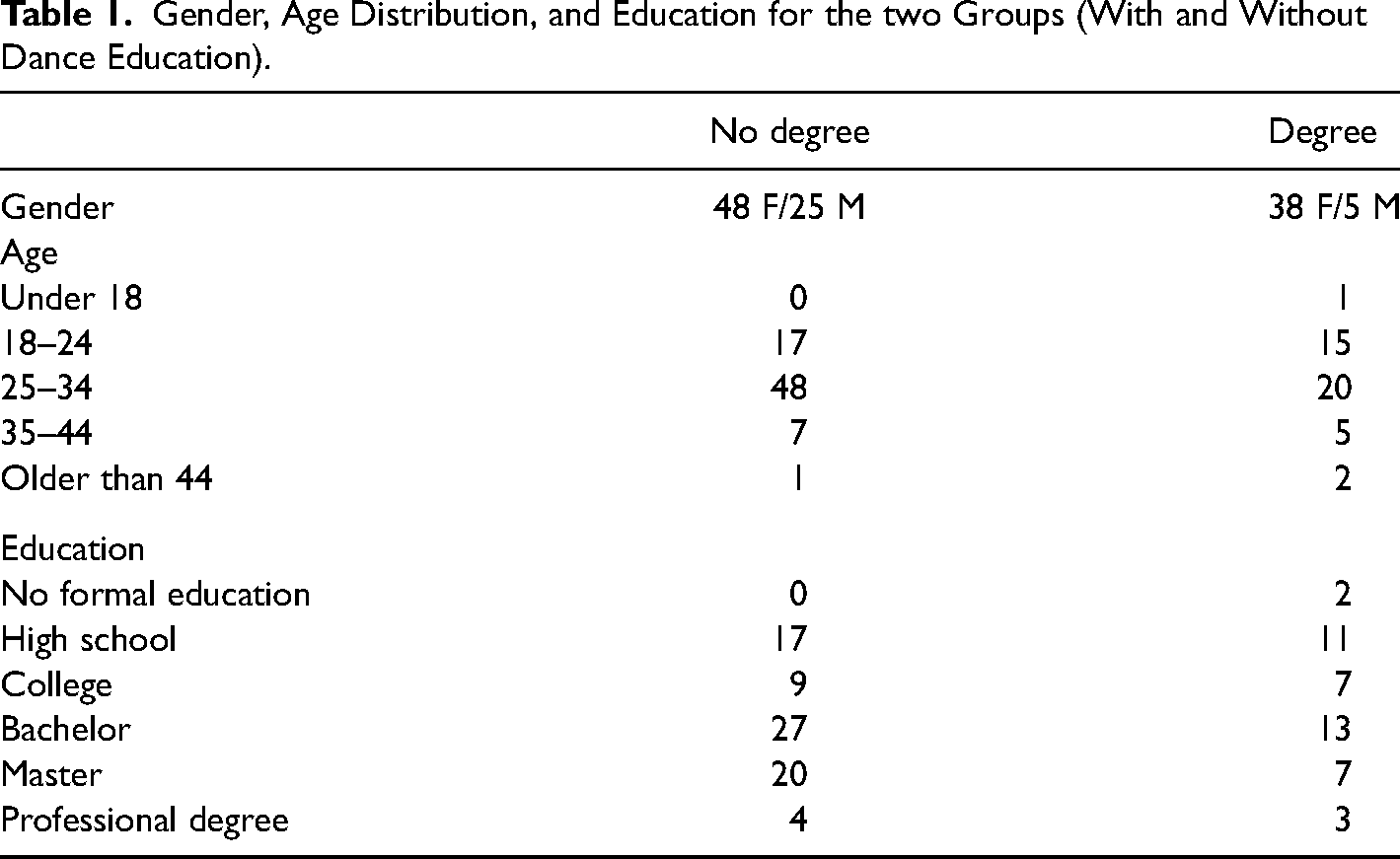
Participants were asked to complete an online survey. Initially, 145 individuals participated but we removed those (N = 25) who failed to complete the survey, specifically the second questionnaire. After exclusions, our analyses focus on the remaining 120 participants who completed the online survey. The sample consisted of 85 women (70.8%), 30 men (25.0%), and five no-answer/other gender (4.2%) participants. Of the 120 respondents, 55% were within the 25–34 age range, 28.3% within the 18–24 age range, 11.5% within the 35–44 age range, and the remaining (2.8%) were 45 years old and above. The survey included questions regarding their educational background, where they settled (city/country), and how often they dance (see Table 1).
Gender, Age Distribution, and Education for the two Groups (With and Without Dance Education).
Measures
Demographic Questions and Dance Experience
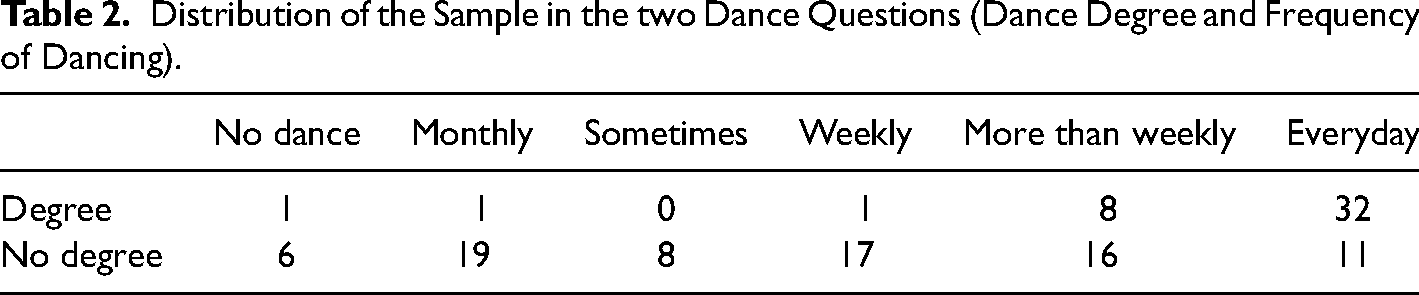
Questions regarding demographic data, namely gender, age, education, and location were asked first, followed by two questions related to dance experience. A yes/no question about dance education, “do you hold a dance degree?” and a question about the frequency of their dance habits, “how often do you dance?” to be answered on a six-point scale (not at all; every now and then; once a month; once a week; several times a week; almost everyday; see Table 2).
Distribution of the Sample in the two Dance Questions (Dance Degree and Frequency of Dancing).
The Berkeley Expressivity Questionnaire
Emotional expressivity has been defined as the observable behaviors that cause the person to manifest emotional impulses behaviorally (Gross & John, 1997). According to Gross and colleagues, emotional expressivity could be conceptualized as a trait and as a dimension that includes both negative and positive emotions (Gross, 2000). The Berkeley Expressivity Questionnaire (BEQ) is composed of three subscales: positive expressivity, negative expressivity, and impulse strength, which together make a total score. Positive expressivity is defined by four items concerning the expression of positive emotions, such as amusement and happiness. Negative expressivity is defined by six items concerning the expression of negative emotions, such as fear, anger, and nervousness. The impulse strength facet is defined by six items concerning strong positive emotional reactions that are accompanied by behavioral and emotional changes. Thus, the scale includes items representing overt expressivity (e.g., “When I’m happy my emotions show”) and items that aim to assess the expression of discrete emotion (e.g., it is difficult for me to hide my fear). In addition, the scale includes items that represent the strength of the emotional impulse (e.g., “I have strong emotions”) and two items that are considered to be general markers of negative and positive expressivity (e.g., “Whenever I feel negative emotions, people can easily see exactly what I am feeling”). Regarding the scoring procedure, three of the items on the scale were reversed before starting the calculations. One can either view the facets as separate scores or an overall emotional expressivity score to combine them all together. The instruction was the following: “For each statement below, please indicate your agreement or disagreement. Do so by filling in the blank in front of each item with the appropriate number from the following rating scale,” which ranged from 1 (strongly disagree) to 7 (strongly agree; Gross & John, 1997).
Emotional Sensitivity Questionnaire
The Emotional Sensitivity Questionnaire (ESS) is composed of the independent factors: positive interpersonal sensitivity (PIPS) and negative egocentric sensitivity (NES). PIPS is best described as other-oriented emotional sensitivity (e.g., “I find it easy to understand others’ feelings when they are distressed”), and NES is described by personal distress (e.g., “When I feel miserable, the worst thing is to hear other people laughing and having fun”). The questionnaire is composed of 43 items. The validity of the scale was assessed by comparison with other scales such as the Interpersonal Reactivity Index—Davis, (1980, as referred in Guarino et al., 2007), which is a multidimensional measure of empathy, the Questionnaire Measure of Emotional Empathy (Mehrabian & Epstein, 1972, referred in Guarino et al., 2007), a composite index of empathy, and the Eysenck Personality Inventory Neuroticism scale (Eysenck & Eysenck, 1964; Guarino et al., 2007). Regarding the scoring procedure, out of the 43 items, seven had to be reversed, two from the PIPS factor and five from NES. The PIPS comprises 15 items while the NES 28 items. The instruction given to participants was the following: This scale consists of a number of statements. Read each statement carefully and choose the one alternative that is most like you. There are no correct or incorrect answers. Each question was answered by yes/no.
Procedure
After getting permission for the two self-administered scales, questionnaires were administered using Qualtrics software. The estimated time of the survey was approximately 10–15 min. Following the provision of informed consent, participants were allowed to complete the online survey. Before starting, participants were informed that the questions were related to dancing habits and how one reacts in different situations. First, participants completed the demographic questions, then the two questions related to dance experience, followed by the BEQ and ESS questionnaires. Data from noncompleters were not analyzed. Participants were assured that their responses would be kept confidential and that the data would be analyzed at a group level and not at an individual level.
Ethics
Despite the provision of informed consent other ethical considerations were taken into account. Following the ethical guidelines granted by the Department of Psychology and Social Work and the general guidelines of the Declaration of Helsinki, Qualtrics Software was recommended for this type of methodological procedure. Participants had the right to withdraw at any time, as the software allowed them to continue or withdraw from the online survey. Participants were provided with the researcher's personal email, for contacting at any time, in case questions arise. Regarding confidentiality, the use of Qualtrics Software guarantees that the data is protected, and the data was exported to an anonymized Excel file for further analysis.
Results
Comparison Between Participants With and Without a Dance Degree
First, in order to test our hypothesis, we used the answer to the question regarding dance education to compare the two groups. Independent t-test analysis, with Welch’s correction, was performed, for the two dimensions of emotional sensitivity (positive and negative), and emotional expressiveness (both total BEQ and the three subscales).
Regarding emotional sensitivity, independent sample t-tests revealed significant mean differences between the two groups on the PIPS subscale, with dance experts scoring higher on emotional sensitivity than nonexperts, t(118) = 2.21; p = .03, Cohen's d estimated at 0.41. However, no differences were observed for the NES subscale, t(118) = 0.243 (see Table 4). A negative correlation between age and negative sensitivity was obtained (r = −.33), however, without affecting the lack of significant differences between the two expert groups (see Tables 3–5).
Descriptive Data in the two Subscales of ESS (PIPS and NES), three Subscales of BEQ (NE, PE, and IS), and the Total Score, for the two Groups (Group 1—With Dance Degree and Group 2—Without Dance Degree).
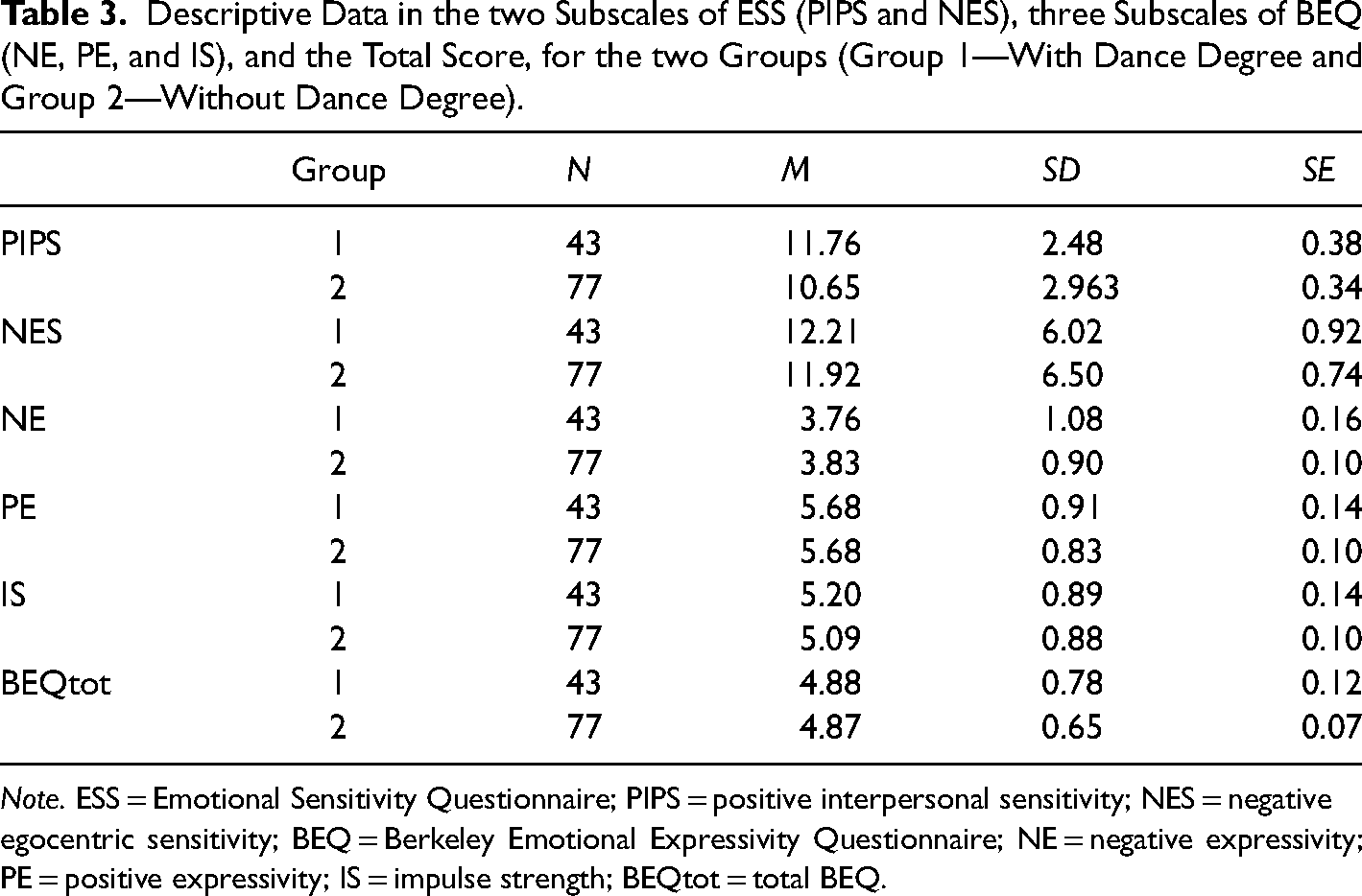
Note. ESS = Emotional Sensitivity Questionnaire; PIPS = positive interpersonal sensitivity; NES = negative egocentric sensitivity; BEQ = Berkeley Emotional Expressivity Questionnaire; NE = negative expressivity; PE = positive expressivity; IS = impulse strength; BEQtot = total BEQ.
Results from the t-tests in the Comparison Between the Group With and Without Dance Degree.
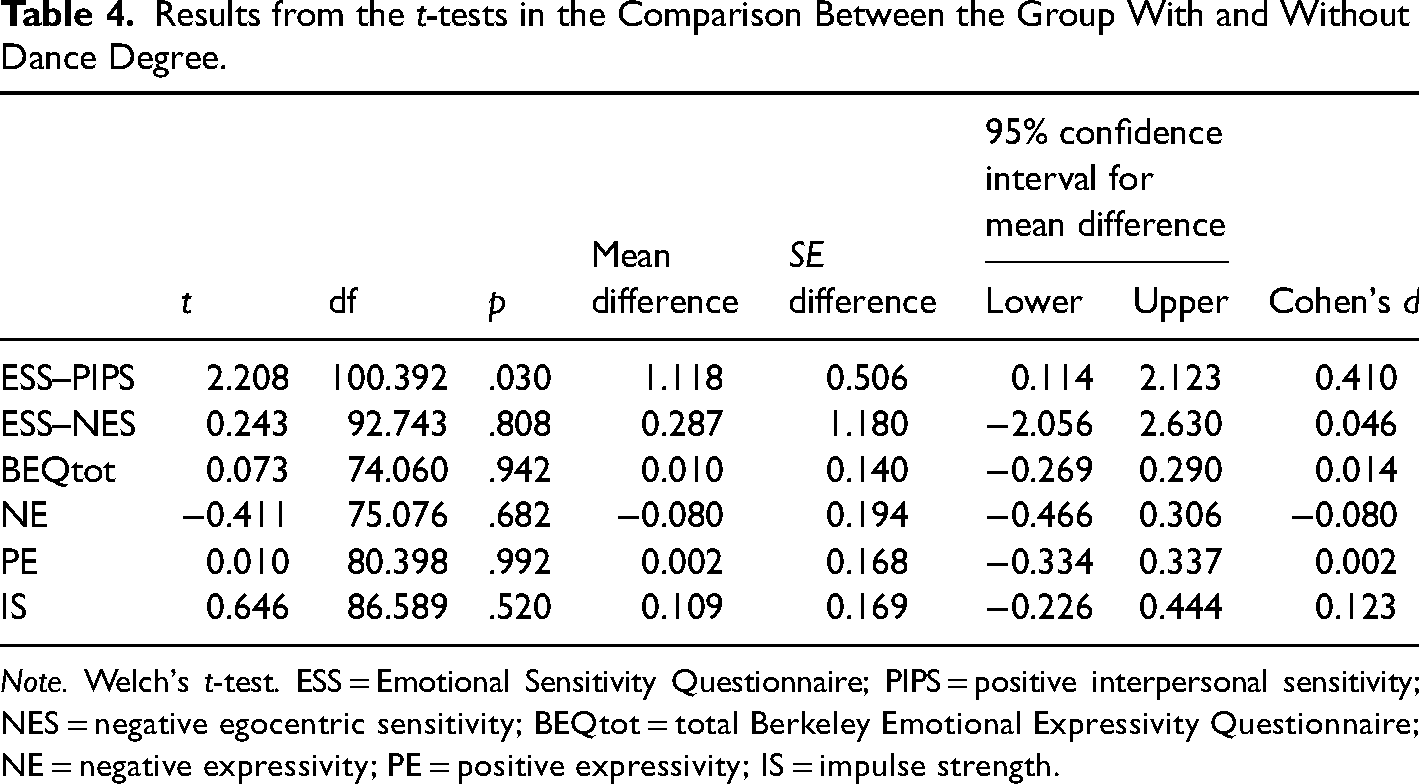
Note. Welch's t-test. ESS = Emotional Sensitivity Questionnaire; PIPS = positive interpersonal sensitivity; NES = negative egocentric sensitivity; BEQtot = total Berkeley Emotional Expressivity Questionnaire; NE = negative expressivity; PE = positive expressivity; IS = impulse strength.
Results From the t-tests in the Comparison Between the Groups With More or Less Dance Habits.
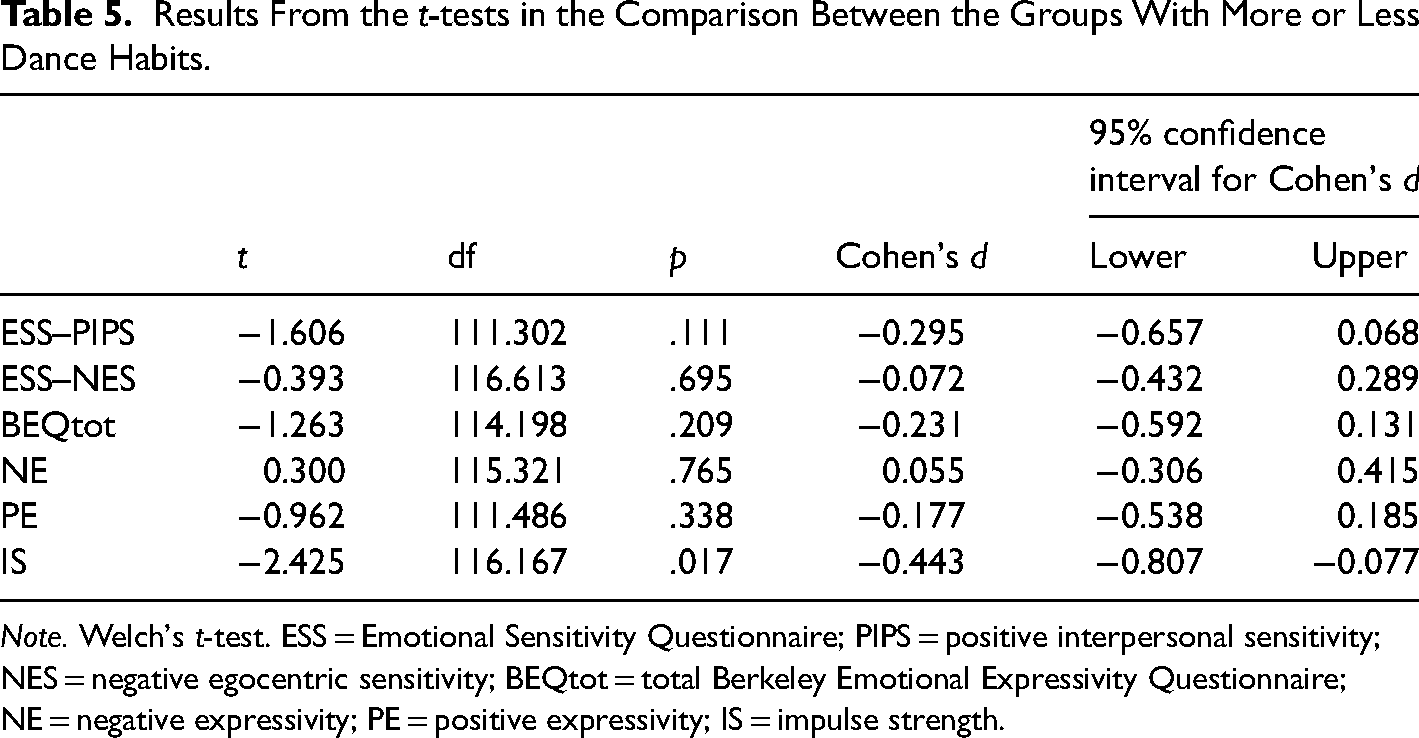
Note. Welch's t-test. ESS = Emotional Sensitivity Questionnaire; PIPS = positive interpersonal sensitivity; NES = negative egocentric sensitivity; BEQtot = total Berkeley Emotional Expressivity Questionnaire; NE = negative expressivity; PE = positive expressivity; IS = impulse strength.
The t-tests were performed for the BEQ subscales and the total score, and the results revealed no significant statistical differences between the two groups. The means are presented in Table 4.
Comparison Between Participants Based on Their Dance Habits
We compared those with more frequent dancing habits (several times a week or almost everyday) to those with less frequent dancing. Interestingly, the only significant difference was in the Impulse Strength subscale of the BEQ, t(118) = 2.39; p < .05, Cohen's d estimated to be 0.44. The group with more frequent dance habits presented higher values than the group with less frequent dancing (means 5.30 and 4.92, respectively).
Correlation Between Emotional Expressivity and Emotional Expressivity
In order to test possible moderations in the relationship between sensitivity and expressivity, correlations were calculated between the BEQ scores and both sensitivity scales. No correlation was obtained (r = .07 and −.01, with PIPS and NES, respectively). Statistical software JASP 0.3.1 was used in all analyses.
Discussion
According to the answers given in the questionnaire regarding dance education, two groups were formed. Dance experts in comparison to nonexperts seem to be individuals with greater emotional sensitivity, more specifically, other-directed positive sensitivity (PIPS). These findings add to a growing literature suggesting that daily training in expressing effect through body movement could enhance sensitivity (Christensen et al., 2016; Sze et al., 2010).
PIPS is viewed as a measure of empathic concern. Our results showed that dance experts scored higher on PIPS than nonexperts and supported previous positions about the impact of dance training on human behavior. This finding can be consistent with the relationship observed previously that during dance practice an action observation occurs, that requires mirroring others’ emotional intentions (McGarry & Russo, 2011). This leads to greater empathic enhancement that can lead to greater empathic response. The idea that there is a relationship between recognizing emotion and empathy has been previously assessed, such as being able to discriminate the emotions expressed in dance. Our data definitely speak to embodiment accounts that have shown how dance training links to the psychophysiological responses of emotion, resulting in a higher embodiment (Goldman & Sripada, 2005) that makes dance experts identify and understand the affective experiences expressed by others (Blakemore & Decety, 2001; Christensen et al., 2016; Gallese, 2003; Jacob & Jeannerod, 2005). The current findings support other observations and also suggest that dance could be beneficial for disorders that are characterized by socio-emotional impairments, for example, autism spectrum disorder, by increasing patients’ individual sensitivity (Scharoun, Reinders, Bryden, & Fletcher, 2014).
The lack of group differences found between dance experts and not experts on BEQ could be interpreted as dance expertise not impacting one's expressivity. In other words, one's ability to express emotion is not determined by one's dance education. Interestingly there was a difference in the impulse strength subscale of the BEQ, which should be further investigated. Our results show that participants with more frequent dance habits score higher on impulse strength. That could be related to negative expressivity. In fact, according to Guarino et al. (2007), the impulse strength subscale includes primarily impulses that one experiences as negative and difficult to control. Interestingly, there is an argument for the association of impulse strength with negative emotionality and somatic complaints. According to Guarino et al. (2007), previous findings have shown that health complaints have been related to impulse strength and secondly to negative expressivity. A possible interpretation of the experience of high impulses could be the one proposed by Watson and Pennebaker (1989). They argue that the person experiencing high impulses struggles to control them and expresses them in the form of somatic complaints (Watson & Pennebaker, 1989). In addition, if strong impulses affect one's ability to control actions and thoughts (Guarino et al., 2007) this could explain the personal distress that dancers might often seem to experience. One could hypothesize based on these results that dance experts in comparison to nonexperts habitually engage more in coping mechanisms to deal with overwhelming impulses.
From a therapeutic perspective, our findings could be taken into consideration. Dance experts are a group of people who often experience bodily injuries related to their training. Hence, in therapeutic interventions, it matters to acknowledge that expertise in dance can enhance sensitivity, especially within the context of pain and emotion. The significant difference found in the impulse strength subscale of the BEQ could be connected to what has been referred to as interpersonal bias, that is, people sometimes interpret sensory information or unpleasant experiences as pain. The transdiagnostic approach, regarding the relationship between emotion and pain, suggests that it is important to understand the underlying mechanisms of this relationship. However, the challenge is to separate the primary and secondary mechanisms, because they seem to affect both pain and emotion (Linton, 2013). For instance, strategies such as withdrawal, distraction, and cognitive reappraisal, are present both in pain and emotion. Experiencing anxiety sensitivity and distress tolerance can lead to repetitive negative thinking that is expressed through catastrophizing and worry. These negative emotions seem to increase the intensity of pain (Cacioppo, 2009). In short, in psychotherapy, dance expertise should be considered as a determining factor as it might influence one's coping strategies.
Another interpretation of the results is that dance experts may pay more attention to others’ bodily movements because of the bodily expressions being an effective stimulus for dancers. The impact of dance training increases the arousal toward bodily movements, expressed by strong affective reactions. That these affective reactions do have short-term effects and long-lasting effects on behavior and cognition (De Houwer & Hermans, 2010), could explain why dance experts scored higher on the positive subscale of the ESS. The theory of automatic affective processing seems to be in line with our results. The theory highlights the role of effective properties of a stimulus and supports that the strength of affective reactions is determined by the degree of how many times the stimuli have been influenced or accessed in various ways in the past. Applying this to our topic, dance experts have stronger affective reactions toward bodily expressions because their training gives them the opportunity to observe and work with reference to bodily expressions of themselves and others cognitively, emotionally, and behaviorally on a regular basis.
Limitations
The results of this study should be interpreted with caution because other reasons could have played a certain role here. The study took place in the summer of 2020. In 2020, especially in the art field, the circumstances were unpleasant as many had been deprived of implementing art projects, working routines, and planned performances. Not being able to follow usual working routines could trigger experiences related to personal distress. These external factors should be considered when interpreting the results.
Another important aspect of the online survey was the used language, which can be assumed to have impacted respondents’ performance. Both questionnaires, the BEQ and the ESS, were in English, and both focused on emotional content. Based on psycholinguistic studies, and given that the majority of participants were not native English speakers, it is reasonable to believe possible language effects on our data.
Future Considerations
It was expected that dance experts would score higher on ESS as well as on BEQ. Regarding the lack of correlation between ESS and BEQ, perhaps the use of psychophysiological measures, could be a great complement to self-reports and shed some light on these results. According to the three-system approach to emotion, psychophysiological measures are an important source of information in order to better study the emotion system (Watson & Pennebaker, 1989). The integration of psychophysiological measures in a situation where participants would be exposed to emotional stimuli, could possibly provide some input on the relations of emotional expressivity and emotional sensitivity and help future understanding of the symptom-perception hypothesis that was made about the group differences on impulse strength expressivity (Mauss & Robinson, 2009).
For future research, the use of Gold-DSI could give us more insight into dance expertise. The Gold-DSI is a new tool that focuses on four components linked to dance expertise. The Gold-DSI includes items measuring ones, urge to dance, social dancing, ability to make choreography as well as one's body awareness. Therefore, we suggest the Gold-DSI as it seems to measure, despite dance frequency, individual differences such as how interested is someone in dance, in dance practice, and choreography making (Rose et al., 2020).
Furthermore, it would be interesting to investigate cultural differences among experts and non-experts. For instance, to administer the same online survey to experts and nonexperts of two different ethnic groups could shed some light on this question. Are there age-related differences in the ability to recognize emotions through bodily postures? And how does this relate to empathic concern? Age is a term associated with changes in psychological behavioral and physiological processes and not surprisingly the question has been examined by Montepare who found that adults in comparison make more errors, particularly for negative emotions (Montepare et al., 1999).
The present study also raises questions about the meaning of expertise in bodily movements. It would be interesting to expand our knowledge by assessing other specialist groups and experts who work with the bodily expression of emotion. For example, to implement the same study with actors (graduates) and nonactors (see, e.g., Christensein et al., 2016).
Another future recommendation is conducting the same study but simultaneously measuring the ability of experts to recognize subtle differences in bodily movements. Do movements as emotional stimuli get prioritized in perception of dancers and to what degree does their dance expertise make them emotional? Inspired by Christensen et al. (2016) examining dancers’ emotional expressivity longitudinally, as they become experts could be a future proposition.
Moreover, based on these findings it would be interesting to investigate the effects of the growth of digital culture that is based on observations of bodily movement through the screen and the possible impact it could have on one's sensitivity. This speedy development could also stimulate the ability of social bodies to observe and understand the experience of others (Eihenberg, as referred in Desmond, 1997) through bodily movements and result in enhanced sensitivity (Christensen et al., 2016; Sze et al., 2010). In addition, assessing individual differences as one possibility could also show if dance experts express differences in emotional regulation strategies and understanding of health-related outcomes on dance experts. Overall these study proposals can lead to fruitful discoveries.
Our findings can be viewed as complementary to the research that investigates e-learning of complex motor movement. From a cognitive perspective, dance expertise is a type of training that requires restudy and retrieval practice. Agreeing with Tempel, Loran, and Frings (2015), this should be taken into consideration as they have contrary consequences in regard to teaching complex motor movement.
The present findings together with previous research could expand our knowledge on how human motor memory is shaped through dance. It is thus of great importance to understand and examine further the effects of dance expertise. From an educational perspective, this would help us understand the socio-emotional development of dance students as well as how dance education could be better framed if dance expertise relates to perceptual-cognitive skills that have an emotional impact (Tempel et al., 2015). In a society where online communication is replacing social interactions in real life, with some negative consequences regarding social isolation and individualism, could dance training be a good antidote, promoting emphatic concern in children and adolescents.
Interestingly previous research in nonexpert groups suggests that we make affective judgments about others based on our own movement kinematics and that possibly there is an association to our social interactions (Edey, Yon, Cook, Dumontheil, & Press, 2017). Consistent with these findings, further research could help us comprehend affect perception.
Conclusion
Our paper is calling attention to the importance of studying the positive effects of dancing, regarding an increase in emotional sensitivity that could be related to empathy and concern for others. Furthermore, and considering the relationship between physical and mental processes, this positive effect of dancing could have clinical implications, contributing to a general better health balance.
Specifically, the results contribute to ongoing debate regarding whether or not dance expertise can provide positive mental health effects. The findings of this study show that it is important to examine further bodily movement from a cognitive, social, and neurobiological perspective, and to acknowledge the possible impact of dance on one's ability to perceive and express emotions. The results support contemporary views on embodiment as well as James’s (1894) physiological approach.
Footnotes
Declaration of Conflicting Interests
The authors declared no potential conflicts of interest with respect to the research, authorship, and/or publication of this article.
Funding
The authors received no financial support for the research, authorship, and/or publication of this article.
