




Abstract
Understanding an artwork is essential for aesthetic experiences. But how does one form an understanding of art? To investigate this still poorly addressed process, we hypothesized that the easier a stimulus is processed (i.e., higher fluency), the easier it should be understood. We focused on artwork inherent features (i.e., style and content) and their interactions affect processing. Making use of the brightness–positivity association, the overall brightness of paintings (i.e., as stylistic feature) was manipulated to match their content (positive vs. negative). We hypothesized that a congruency of style and content would facilitate the processing of paintings resulting in a better understanding, but also, greater liking, and (exploratively) higher artistic value. Our data indicated no congruency effects between brightness and content, but that content alone was a strong predictor for art processing and—in an exploratory approach—highlighted the importance of individual differences in terms of art interest and knowledge in our sample.
“All in all, the creative act is not performed by the artist alone; the spectator brings the work in contact with the external world by deciphering and interpreting its inner qualifications and thus adds his contribution to the creative act. This becomes even more obvious when posterity gives a final verdict and sometimes rehabilitates forgotten artists” (Duchamp, 1975, p. 3).
The aesthetic value of art is not necessarily derived from perceptual features alone. As Duchamp's statement underlines: aesthetic experiences are affected by our active interaction with artworks. Deciphering and interpreting the inner qualifications of art can be described as an attempt to derive meaning to understand a work of art, reflecting a general need for understanding that is considered a fundamental drive of human behavior (Sarasso et al., 2020). Within predictive coding accounts of aesthetic experience (Sarasso et al., 2020; Van de Cruys & Wagemans, 2011), the success of understanding artworks is a central feature of aesthetic experience. This process of deriving meaning can be conceptualized as cognitive mastering (Belke, 2020; Leder et al., 2004) and is influenced by, among others, personal factors such as art expertise, experience, or the current affective state. Within the model of aesthetic appreciation by Leder et al. (2004), a positive aesthetic experience even relies on success in cognitively mastering an artwork. Furthermore, within the Vienna Integrated Model of Art Perception (VIMAP) model of art perception (Pelowski et al., 2017), the failure to understand an artwork can elicit negative feelings or can even be experienced as threatening in situations of high self-relevance.
However, the process of how meaning is formed in the context of art is still poorly understood (Dolese & Kozbelt, 2020), thus calling for research to identify and research factors that alter the way art is understood. While some factors might seem obvious like experience or art expertise (Commare et al., 2018), others such as the role of artwork inherent features (e.g., style and content) have been studied less in this regard. Given that style and content represent two central dimensions in art processing (Augustin et al., 2008; Leder et al., 2004), their role with respect to understanding should be a matter of investigation. The current paper aims to address this issue asking the question: How do we understand artworks, and what is the role of congruency between style and content in this process?
The importance of understanding in art can be illustrated by artworks that were not understood in their time but are considered masterpieces now. For example, when Édouard Manet's Le Déjeuner sur l’herbe (“the luncheon on the grass,” 1862–1863) was first exhibited, it was poorly understood by critics—some even found it impossible to derive any meaning from the painting (Læssøe, 2005). This lack of understanding might have been partly responsible for the fact that it was rejected for the Salon de Paris and instead was exhibited in the Salon des refusés. Not only was the painting criticized for being difficult to understand—likely referring to the depicted content of a naked ordinary woman sitting aside two fully dressed contemporary men—but also for the way it was painted: Manet’s style of using rather dull colors combined with impressionistic elements (Orsay Museum, 2021). As both style and content were criticized, one can ask whether the combination of both or rather one aspect alone contributed more to its incomprehensibility.
Though not focusing on the involvement in the formation of understanding specifically, the roles of style and content have been investigated empirically. For example, Augustin et al. (2008) concluded that style gains relevance for aesthetic judgment, in a comparison of paintings depicting similar content indicating an “interactive processing of both dimensions” (p. 135). Furthermore, a recent review (Sarasso et al., 2020, in line with Marković, 2012) argued that the aesthetic experience is characterized by an attentional shift towards the perceptual features of an object and is paired with an inhibition of an object-identification “habit” (p. 11). This would insinuate a primacy of style (i.e., “perceptual features”) over content (i.e., “object-identification”). Hence, both style and content might be able to influence how understanding is formed in art experiences.
To investigate how artworks are understood we will, in the following, address the question of if and how interactions of style and content might hinder or support understanding artworks. We will first review the literature on relevant concepts of information processing including predictive coding, ambiguity, fluency, and congruency effects, specifically within the context of art perception. Afterwards, we outline our present study for investigating the interaction of style and content in art perception and how it affects the processing, understanding, and appreciation of art.
Theoretical Background
In visual perception recognizing and understanding what one sees is fundamental for generating adequate and efficient responses to one's environment. It is commonly accepted (Bastos et al., 2012) that this is achieved by predictive coding (e.g., Rao & Ballard, 1999) where the brain—based on prior experiences—generates predictions about what perceptual input to expect next. These predictions are then consistently compared against new incoming perceptual information. If predictions are met, further processing is not required, and probably suppressed, allowing people to save and relocate processing capacities to prediction errors (Van de Cruys & Wagemans, 2011).
In this case, processing is also easy—or, fluent—as we found the world as we expected it to be. Within experimental aesthetics, fluency theory proposes that fluent stimuli are experienced as affectively positive and are preferred over less fluent stimuli (Reber et al., 1998, 2004). Such fluency effects can be found in various domains and are believed to generally play an important role in cognition (Alter & Oppenheimer, 2009). With respect to aesthetic experiences, it is proposed that the easier one can process an object the more positive an aesthetic outcome would be (Reber et al., 2004).
But what happens when our predictions are incorrect? Such prediction errors are argued to be experienced as negative at first (Huron, 2006) potentially requiring further processing to resolve ambiguous information. However, in art perception ambiguity itself plays an ambiguous role as in the arts it is a common artistic mean (e.g., surrealism) and ambiguity has been described as a source of aesthetic value (Jakesch et al., 2013, 2017; Leder et al., 2004; Van de Cruys & Wagemans, 2011; Zeki, 2004). For example, Jakesch et al. (2013) compared original (i.e., ambiguous) Magritte paintings to similar, non-ambiguous versions and found that ambiguity of content made artworks aesthetically more interesting.
In sum, these two opposing effects indicate that within art perception one may expect both a negative as well as a positive effect of ambiguity (for an attempt to integrate these opposing effects into art perception see Van de Cruys & Wagemans, 2011; or Sammartino & Palmer, 2012).
In addition, these opposing effects illustrate a potential need for more differentiation of aesthetic outcomes, specifically between liking (influenced by fluency) and interest (influenced by ambiguity). In line with this thought, Graf and Landwehr (2015) proposed the pleasure–interest model of aesthetic liking (PIA), which states that pleasure (or liking) and interest represent two separate outcomes for aesthetic preference depending on different modes of processing. While aesthetic interest might result from disfluency reduction through elaborate perceiver-driven processing (i.e., active interaction with the artwork), aesthetic pleasure relies more on a stimulus-driven processing mode where ease of processing (e.g., perceptual fluency) plays a more pronounced role in the absence of motivation to elaborate upon a stimulus (Graf & Landwehr, 2015).
This seems to be in line with the finding that though Magritte’paintings were evaluated as more interesting, they were also rated as less fluent (Jakesch et al., 2013). Similarly, with regard to the predictions of the PIA model for pleasure, research has shown that fluency can lead to more liking. For example, Forster et al. (2013) found that subjective fluency (or felt fluency, which is the subjective experience of how fluent a stimulus was processed) affected liking ratings of images even more than objective fluency (i.e., objective qualities of a stimulus such as blurriness or complexity). Furthermore, an increase in perceptual fluency—achieved by presenting primes that match the motoric actions used for creating the depicted style of art (e.g., hand holding a paintbrush with a “precision grip” for pointillistic art) compared to non-matching motoric movements—was found to enhance appreciation for paintings (Leder et al., 2012; Ticini et al., 2014). Finally, an increase in conceptual fluency—achieved by presenting paintings with semantically congruent compared to incongruent bogus titles—was found to enhance appreciation for abstract artworks (Belke et al., 2010).
Similarly to conceptual fluency, the concept of representational fit proposes that people prefer images or artworks where (spatial) depiction of content optimally and transparently matches the intended or inferred meaning (Sammartino & Palmer, 2012); this was empirically tested by providing different titles for objects depicted in various spatial positions/views where participants preferred neutral describing titles for “standard” depictions of objects whereas in “non-standard” conditions (e.g., rearview of a plane) titles compatible with the spatially implicated meaning (“departing”) compared to neutral or non-matching ones (e.g., “landing”; Sammartino & Palmer, 2012). It was argued that representational fit is compatible with fluency theory and independent from perceptual fluency, e.g., ambiguity in the arts would be recognized as an intentional artistic vehicle to deliver a message and thus still be preferred (Sammartino & Palmer, 2012).
These examples show that providing an external matching feature—either perceptual or conceptual—can alter the processing of artworks or images and influence their appreciation. However, as artworks mostly do not only consist of one feature alone that can be matched (or contrasted) by an external stimulus this approach might be insufficient to account for the whole nature of fluency effects in the arts. Instead, most artworks represent complex compositions of multiple features that are perceived and processed all together. Cupchik (1992) described artworks as multilayered aesthetic objects with each layer having its own distinct principle of organization and further argued that these qualitatively different layers or domains can interact with each other to produce coherent meanings. In visual perception, there are various candidates representing such feature layers, e.g., brightness, color, symmetry, or complexity. Research regarding these features showed that brightness differences of unpleasant affective pictures were found to alter neuronal oscillatory responses (Kurt et al., 2017); color differences affected the arousal ratings of negative scenes (Bekhtereva & Müller, 2017); or features like color, symmetry, or complexity are explained between 6% and 20% of the variance of affective ratings for affective images (Redies et al., 2020). Furthermore, there is a growing body of literature investigating image properties (lower and higher order) on a statistical level where, for example, it was shown that artworks and complex natural scenes share similar statistical image properties indicating that artworks are similarly processed as natural scenes (e.g., Redies et al., 2008) or that depending on artwork type (abstract vs. representational), objective image properties (e.g., hue, brightness, entropy, or symmetry) could be used to predict liking or beauty ratings. However, it was also found that subjective predictors—ratings obtained by participants for perceived meaningfulness or emotionality—could explain two to three times more variance than objective ones (Sidhu et al., 2018).
Nonetheless, these approaches treated such image properties rather as independent contributors and how each affected the processing and rating of artworks or images, not considering possible interactions of the different feature layers themselves. However, this concept of multiple feature layers affords the possibility to investigate (in)congruencies (i.e., interactions) between these layers and to test for potential effects of such as an inherent feature of the processed stimulus.
In visual arts, this interplay of style and content as an arrangement of different layers and their (in)congruency is likely to influence how art is processed. Both style and content are well-researched aspects of empirical aesthetics. For example, it was shown that content is processed temporally earlier than style using electroencephalogram (EEG) (Augustin et al., 2008); that the importance of what is depicted (i.e., content) is relatively more important for the novice or unexperienced art viewers compared to experienced art viewers (Augustin & Leder, 2006; Hekkert & Van Wieringen, 1996); and that providing style-related information affects aesthetic appreciation of abstract artworks (Belke et al., 2006).
In sum, both style and content have been investigated and shown to be relevant to aesthetic experiences. Furthermore, they have been considered in conjunction in terms of timing and hypothesized relevance. However, the interplay of style and content has not yet been a topic for investigation: Do they interact? And could this interaction cause less or more congruency within artworks and hence alter the way we experience, and particularly understand art?
Present Study
The aim of the present study was to address these questions by investigating how the interplay of style and content affects the processing of art. Specifically, we were interested in whether an (in)congruence of style and content affects (subjective) processing fluency and whether it consequently also affects how artworks are understood. Our experiments thereby focused on the balance between positive and negative content as the main variation of content and overall brightness of the artwork as a general style manipulation. Therefore, artworks that are positive and bright (or negative and dark) can be considered as congruent stimuli whereas artworks that are positive and dark (or negative and bright) can be considered as incongruent stimuli.
We hypothesized that congruent artworks would have a higher (subjective) fluency than incongruent artworks and that, therefore, congruent artworks would also be better understood as probably prediction errors are reduced in congruent conditions. We further hypothesized that a higher (subjective) fluency in congruent conditions would also lead to greater liking of artworks compared to incongruent conditions, which previously was shown many times (e.g., Reber et al., 1998, 2004).
To test our hypotheses in the present study, we assessed fluency by using ratings of participant's subjective ease of processing as this was found to correspond to objective measures of fluency (Forster et al., 2013); for aesthetic appreciation, we measured liking and judgment of artistic value of the artworks (in the following also referred simply as “value”) as additional dependent variables. The latter was added in an exploratory fashion, as we are not aware of studies having assessed this specific variable directly but consider it as a relevant aspect of aesthetic experiences in need of further investigation. Based upon the findings by Jakesch et al. (2013) that showed that in an aesthetic context we may be interested in things we do not understand and the proposed differentiation between aesthetic pleasure and interest (Graf & Landwehr, 2015), we speculated that there might be a differentiation between liking and artistic value attributed to the artworks. In line with fluency theory and similar to pleasure in the PIA model, we assumed that liking might be more dependent on fluency/congruency whereas attributed value might be independent.
The study involved two different approaches: Study 1 investigated this in a between-subject design whereas Study 2 used a within-subject design to rule out moderating effects of individual differences and to gain a broader understanding of the possible effects.
Content was operationalized as either being positive or negative in valence, which, of course, is a simplification of the wide variety of content depicted in artworks but offers a generalization that can (easily) be applied to most artworks.
Style was operationalized as the overall brightness of paintings as it represents a general and important source of information (e.g., contrasts) in visual perception. And, important for our current aims, there is a connection between brightness and valence: Brightness was found to be associated with positivity or goodness whereas darkness is associated with evil or negativity (Lakens et al., 2012, 2013; Meier et al., 2004). Furthermore, research has shown the implicit/automatic and universal nature of this association (Specker & Leder, 2018; Specker et al., 2018). Though most research in this direction used simple stimuli (e.g., color patches), it was shown that these effects could be generalized to complex stimuli (specifically photographs; Lakens et al., 2013) and in a pre-study reported elsewhere (Specker et al., 2021), we have already shown that the effects also translate to (abstract) artworks where brighter artworks were perceived more positive and darker artworks as more negative.
As our research interest aims to specifically address how artworks are understood, it is important to consider the possible effects of art expertise as this can influence art processing (Augustin & Leder, 2006; Chirumbolo et al., 2014; Leder et al., 2004; Specker et al., 2020). Specker et al. (2020, p. 1) noted that the term “expertise” is vague and argued that art interest and art knowledge represent the “foremost dimensions of art expertise.” In line with this, we focused on these two dimensions in the current paper. Though our investigation in this direction should be considered exploratory, based on the literature we hypothesized that higher levels of each would help to understand artworks better, process artworks easier, and like artworks more.
Study 1
Method
A between-subject design was employed to avoid the possibility of training effects—in our case, these would be seeing and rating an artwork twice, thus possibly biasing the results, e.g., due to mere exposure effects (Zajonc, 1968) or if the manipulation would become salient through repetition, i.e., demand characteristics (Orne, 1962); hence, participants either rated the same set of artworks but all either being brighter or darker versions of the originals (see below).
Participants
A total of 85 students (63 females, 22 males) with a mean age of 20.64 years (SD = 2.32) from the University of Vienna were recruited using the recruitment system of the psychological faculty and received course credit for participation.
Materials
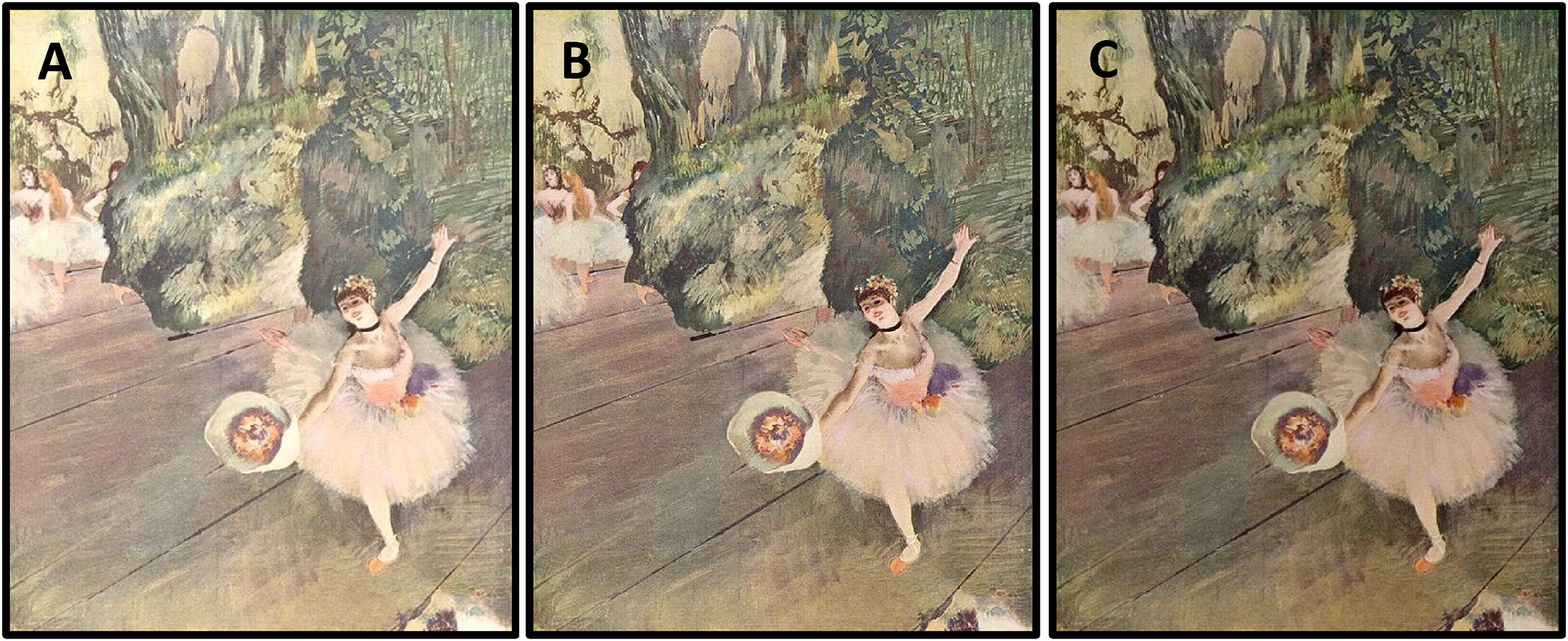
Example of the experimental manipulation of a positive artwork.
Procedure
The experiment was conducted in November 2017 in the laboratories of the Faculty of Psychology at the University of Vienna. Upon arrival, the participants read a consent form, and it was emphasized to ask questions at any time, after signing the consent form the experiment started. The participants were instructed that they would see artworks which they were asked to rate using the scales presented; to clarify the scale for understanding, a description saying that the scale is about whether one can find a personal plausible interpretation and/or whether one has understood the artist's intention was provided.
After the experiment, the participants reported demographic data and completed the VAIAK. The experimental task was conducted using Open Sesame (v 3.1.9; https://osdoc.cogsci.nl/), while demographics and the VAIAK were presented via browser using Qualtrics (https://www.qualtrics.com/uk/).
Analyses
All analyses were carried out with R (v 4.1.2; https://www.r-project.org/); the following packages were used: “lme4” (v 1.1-28) for performing linear mixed effects models (LMEM); “jtools” (v 2.1.4) for obtaining p-values; “lmerTest” (v 3.1-3) for running backward eliminations; “effectsize” (v 0.6.0.1) for calculating effect sizes; “stats” (v 4.1.0) for adjusting p-values; “emmeans” (v 1.7.2) for estimating marginal means.
Confirmatory Analyses
LMEMs were employed to analyze possible effects of content and brightness regarding our four dependent variables: understanding, ease of processing, liking, and artistic value of artworks. This analytical approach was chosen because LMEMs allow to control simultaneously for variability within and across participants as well as for the items, are capable of handling missing data, and are considered robust, even if statistical assumptions are violated (Brown, 2021; Schielzeth et al., 2020). In addition, partial eta-squared (η2) as a measure for effect size was approximated from equivalent ANOVAs based on equivalent models but with a simplified random effect structure. Also, reported p-values were adjusted controlling for the false-discovery rate based on Benjamini and Hochberg (1995).
Hence, for each dependent variable (DV), a LMEM was specified, using maximum likelihood estimation and degrees of freedom approximation based on Satterthwaite (1946), with content and brightness as main and—interacting—fixed effects. Random effects were conceptualized based on Barr (2013) and Barr et al. (2013) and included subjects with correlated random intercepts and slopes for content and artworks with correlated random intercepts and slopes for brightness. Sum contrasts were used where factors of content and brightness were recoded to −0.5 and 0.5; thus, estimate values refer to a change in one unit, in our case from bright to dark and negative to positive. Initially, LMEMs were conceptualized using the formula: y ∼ content × brightness + (content | subject) + (brightness | artwork). Note that due to convergence and singular fit warnings, actual random effect structures might vary between models and conceptualized ones; adjustments will be reported in the “Results” section.
Exploratory Analyses
In a second step, we explored the role of art interest and knowledge and therefore added these two variables as mean-centered covariates to the models. In addition, we wanted to find the most parsimonious model based on the data itself: therefore, backward elimination (BE) was conducted including random effects.
Below, we will first describe the results from the confirmatory analysis followed by describing results from the exploratory analysis and then describing how BE affected these models. In the following, we will refer to “confirmatory models” for models that only include our main variables content and brightness and to “exploratory models” for models that also include art interest and knowledge. Exploratory LMEMs were conceptualized using the formula: y ∼ content × brightness × art interest × art knowledge + (content | subject) + (brightness | artwork).
Results
Confirmatory Analyses
All analysis results are visualized in Figure 2, and detailed statistics can be found in Table 1. Due to singular fit warnings, brightness (random intercept + slope) was removed from all confirmatory models. No evidence in favor of our hypothesis was found as no significant interaction of content and brightness was found for any of the four dependent variables. However, two unexpected main effects of content with respect to understanding and ease of processing were found. In both cases, positive artworks received higher ratings than negative artworks meaning that positive artworks were better understood and easier processed.
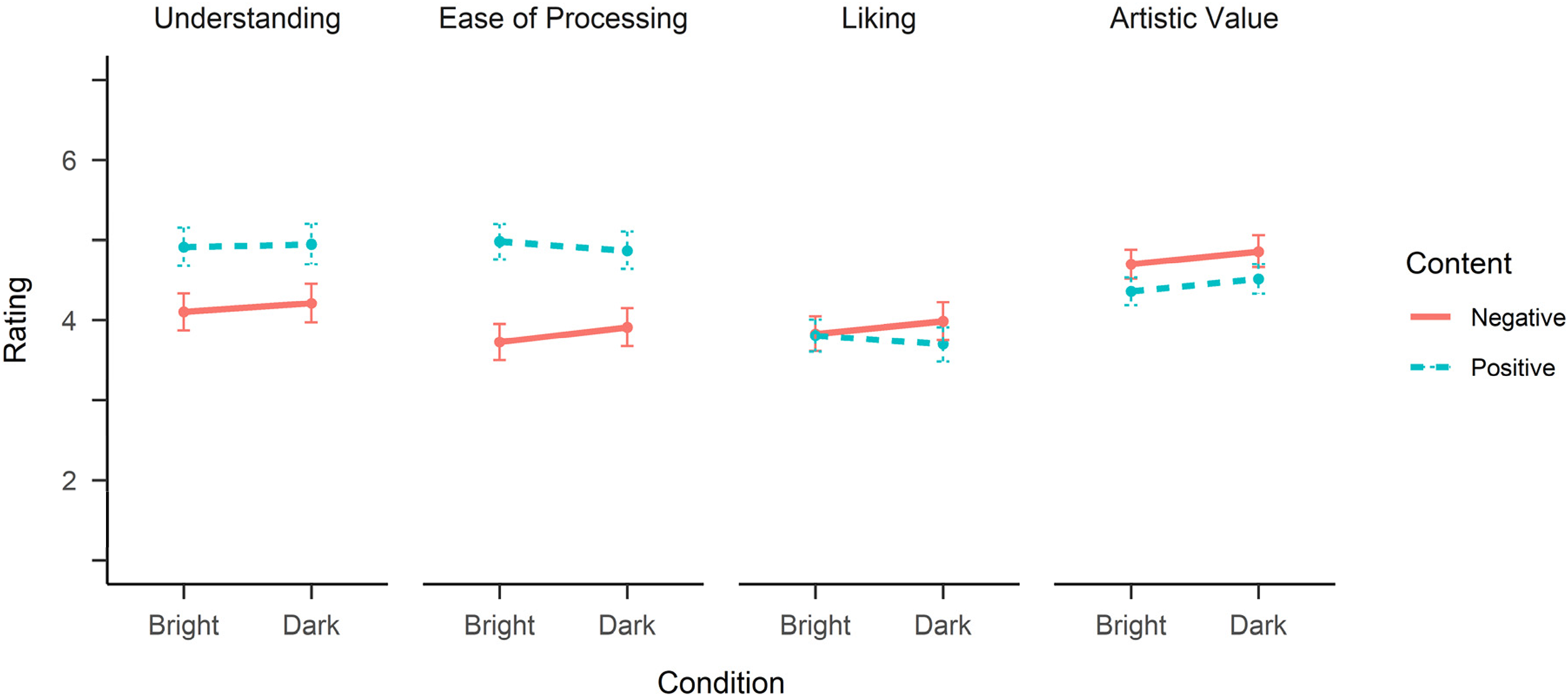
Estimated marginal means of confirmatory LMEMs of Study 1.
Results of Confirmatory LMEMs of Study 1.
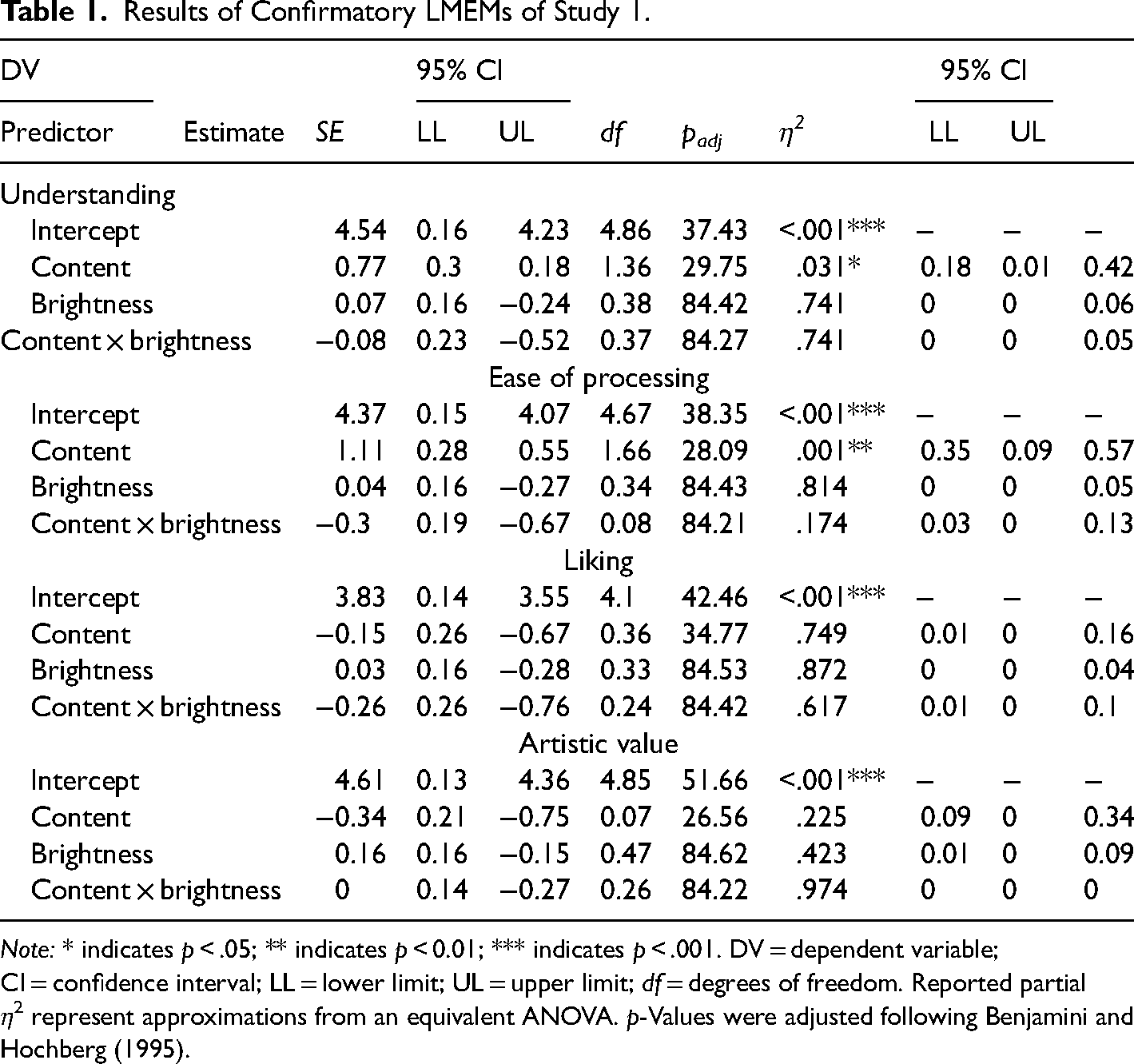
Note: * indicates p < .05; ** indicates p < 0.01; *** indicates p < .001. DV = dependent variable; CI = confidence interval; LL = lower limit; UL = upper limit; df = degrees of freedom. Reported partial η2 represent approximations from an equivalent ANOVA. p-Values were adjusted following Benjamini and Hochberg (1995).
Exploratory LMEMs (Including Art Interest and Knowledge)
Detailed results for exploratory and BE models can be found in Supplemental Tables S3 and S4, respectively. Due to singular fit or non-convergence warnings, brightness was removed from random effects in all exploratory models including the BE models. In the following, we will—for each DV—first report the exploratory model where we only discuss results for the hypothesized interaction of content and brightness and (other) effects reported as significant followed by reporting changes to these models after BE. For clarity and transparency, statistical details for these effects are provided in the running text as well.
BE yielded a model without brightness and art knowledge. An effect of content was found indicating that positive artworks were understood better (b = 0.78, t(29.1) = 2.6, p = .019, η2 = 0.19, 95% CI [0.01, 0.43]), and an effect of art interest was found indicating that participants with higher interest generally understood artworks better (b = 0.02, t(84.4) = 2.94, p = .009, η2 = 0.09, 95% CI [0.01, 0.22]). In addition, a content × art interest interaction was found, indicating that participants with higher interest understood artworks better which was more pronounced for negative content (b = –0.02, t(84.3) = –2.06, p = .043, η2 = 0.05, 95% CI [0, 0.16]), which is depicted in Figure 3 (left panel).
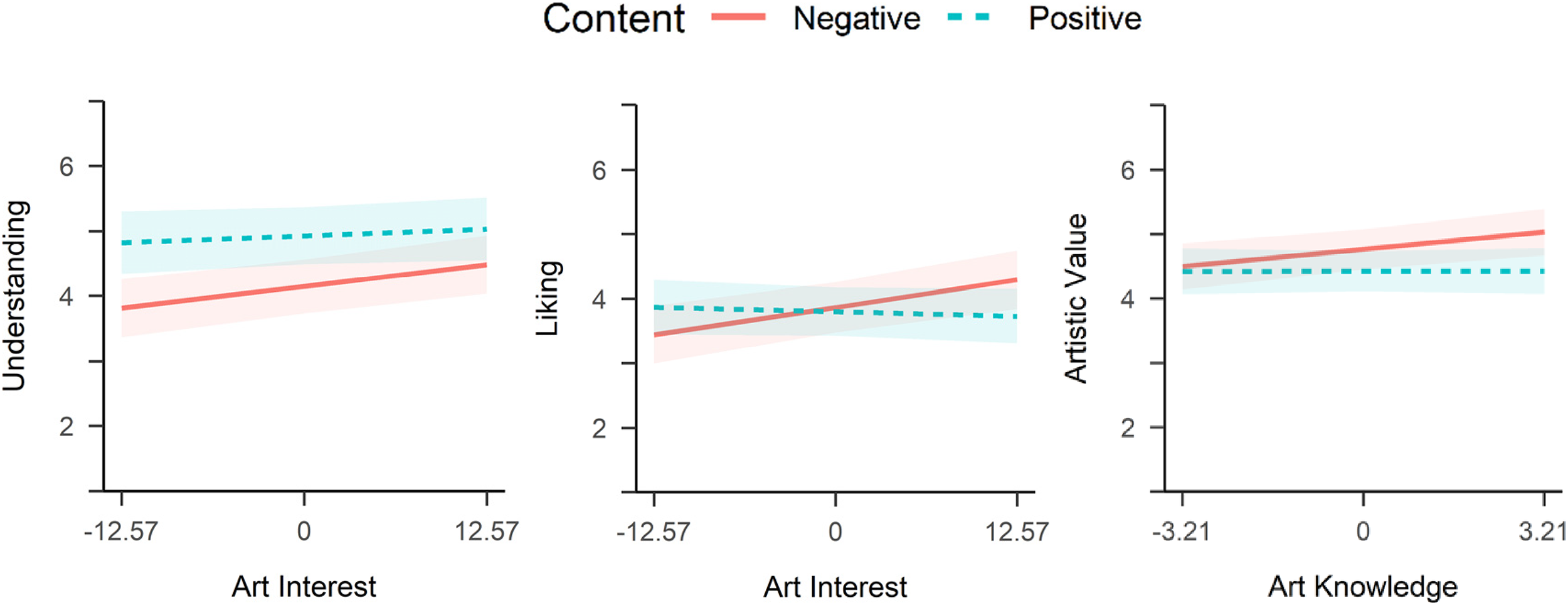
Predicted understanding (left panel), liking (middle panel), and value (right panel) with respect to content, art interest, and knowledge of Study 1.
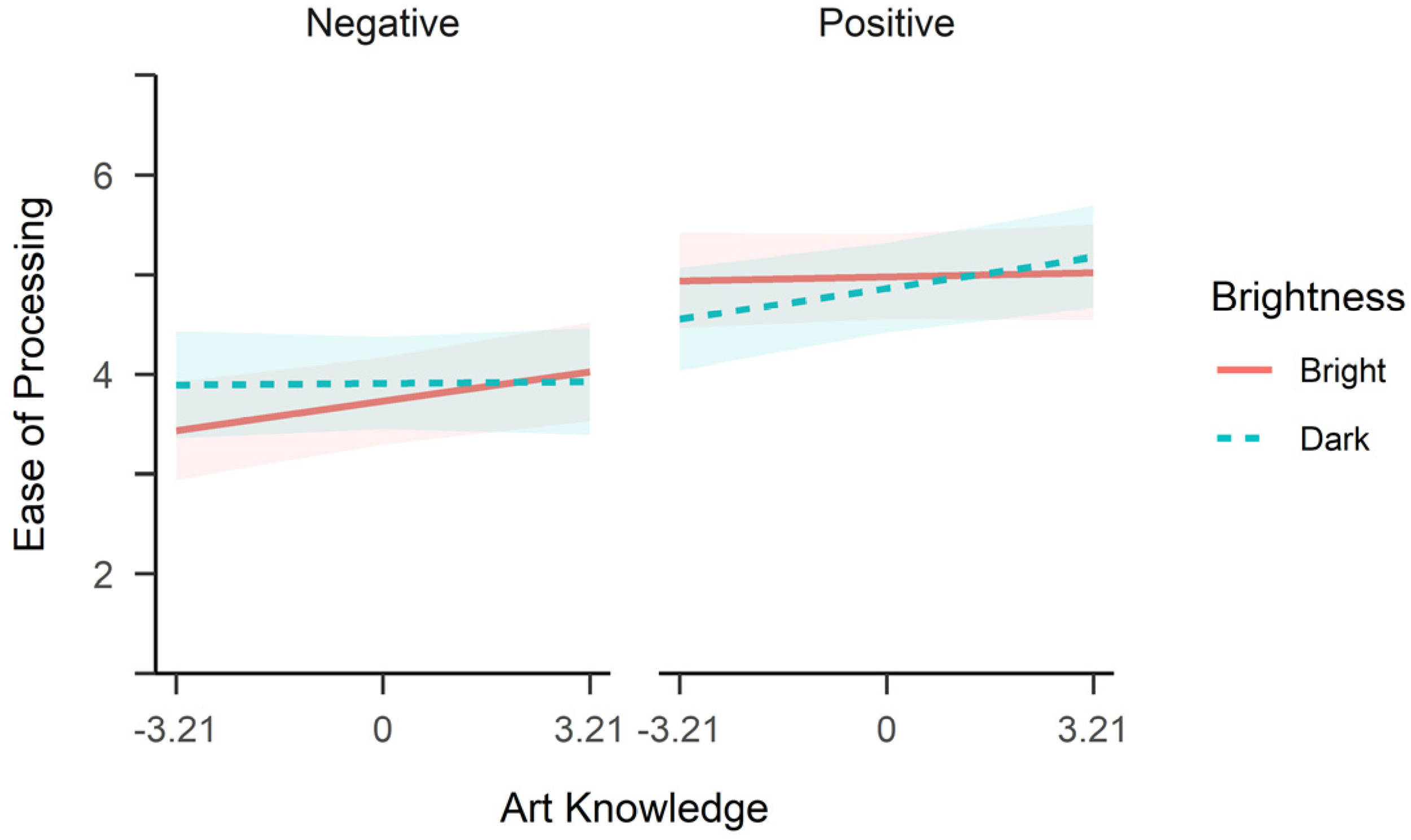
Predicted ease of processing with respect to brightness and art knowledge of study.
Confirmatory vs. Exploratory LMEMs
Using Chi-squared (χ2) tests, it was tested whether the inclusion of the VAIAK (i.e., art interest and knowledge) improved the models compared to the confirmatory LMEMs. Model comparison results and model fits can be found in Supplemental Table S5. Except for ease of processing, all models were improved by including both VAIAK scales. However, a separate comparison using the BE model for ease of processing without art interest led to an improvement of the model. Thus, it can be concluded that the inclusion of the VAIAK improved the statistical models.
Discussion
Our main hypothesis that an interaction of content and brightness would affect how artworks are processed was not supported as neither confirmatory nor exploratory analyses yielded a statistically significant interaction of content and brightness with respect to our four dependent variables. However, an interaction of content, brightness, and art knowledge was found indicating that participants with lower knowledge have processed stimuli according to our hypothesis, i.e., congruent artworks more easily than incongruent ones.
Also, an unexpected effect of content was found—both in confirmatory and exploratory analysis—indicating that positive artworks were better understood (BE model only) and easier processed than negative ones. Furthermore, the exploratory inclusion of the VAIAK overall improved statistical models and revealed several effects. The full discussion of these (unexpected) findings is provided in the Discussion of Study 2.
The overall lack of evidence found for an interaction of style and content may be grounded in our manipulation of brightness, which probably was not salient enough as participants only saw bright or dark artworks and eventually adapted to “their” level of brightness. This limits the sensitivity of a between-subject design to detect such subtle differences. The rather insignificant role of brightness also was emphasized by the fact that brightness was removed from the random effects of artworks and as a fixed effect for understanding and artistic value after BE explaining relatively little variance.
While previous research had indeed indicated that brightness effects might be rather weak in a highly affective context (Lakens et al., 2013; Schettino et al., 2016), a more recent pre-study using (non-affective) abstract artworks but otherwise the exact same brightness manipulation as the present study (+/– 30% brightness, presented via screen in the same laboratories as the current study) reported large effect sizes of implicit and explicit brightness–positivity associations indicating a good generalizability of brightness effects to artworks as a class of visual stimuli (Specker et al., 2021).
Thus, with these seemingly contrary findings in mind (i.e., the subtle nature of brightness effects in affective context vs. strong effect sizes of brightness–positivity association found for artworks), it was decided to address possible limitations of a between-subject design for detecting subtle brightness differences to provide a deeper insight into the nature of brightness in highly affective artworks. Hence, a second study was conducted that featured a within-subject design minimizing possible adaptation effects and between-group differences. We aimed to minimize the previously discussed possible effects of mere exposure or demand characteristics—but these could not be ruled out completely—by presenting artworks in randomized order. Furthermore, in addition to the good general capability of LMEMs to handle especially within-subject data, we also aimed to account for such confounding effects by adapting the random effect structure, specifically, by adding an additional random effect of individual subjects, with artworks nested within where intercepts for individual artworks were calculated, representing the mean value of both ratings per subject.
Study 2
Participants
A total of 98 students (66 female, 32 males) with a mean age of 21.11 years (SDage = 3.25) from the University of Vienna were recruited using the recruitment system of the Faculty of Psychology and received course credit for participation.
Materials and Procedure
The experiment was conducted in February and March 2018 in the laboratories of the Faculty of Psychology at the University of Vienna. The procedure and materials were identical to Study 1, except that participants now saw and rated artworks twice—in overall randomized order—once in each condition (bright vs. dark).
Analyses
The analyses were identical to Study 1 except for adjustments to the random effect structure necessary to account for the within-subject design: Subjects were now specified with correlated random intercepts and slopes for content and brightness as both represent within-unit factors; artworks with correlated random intercepts and slopes for brightness; and a random effect for artworks nested within each subject, where intercepts vary among subjects and for artworks within each subject. The VAIAK again was included in a separate exploratory analysis as interacting mean-centered covariates. Initially, exploratory LMEMs were calculated using the formula: y ∼ content × brightness × art interest × art knowledge + (content + brightness | subject) + (brightness | artwork) + (1 | subject: artwork). Note that due to convergence and singular fit warnings, actual random effect structures might vary between models and conceptualized ones; adjustments will be reported in the Results section.
Results
Confirmatory Analysis
All analysis results are visualized in Figure 5, and details are provided in Table 2. Due to singular fit warnings, the random slope and intercept of brightness were removed from subjects in the understanding and liking model and from the artworks in the ease of processing model. The results were similar to those in Study 1. No evidence in favor of our hypothesis was found as no significant interactions of content and brightness were found. The main effects of content were found for understanding and ease of processing where again positive artworks received higher ratings than negative artworks. In addition, an effect of brightness for ease of processing was found indicating that participants processed bright artworks more easily. Finally, an effect of content on artistic value was found indicating that participants attributed more value to negative artworks.
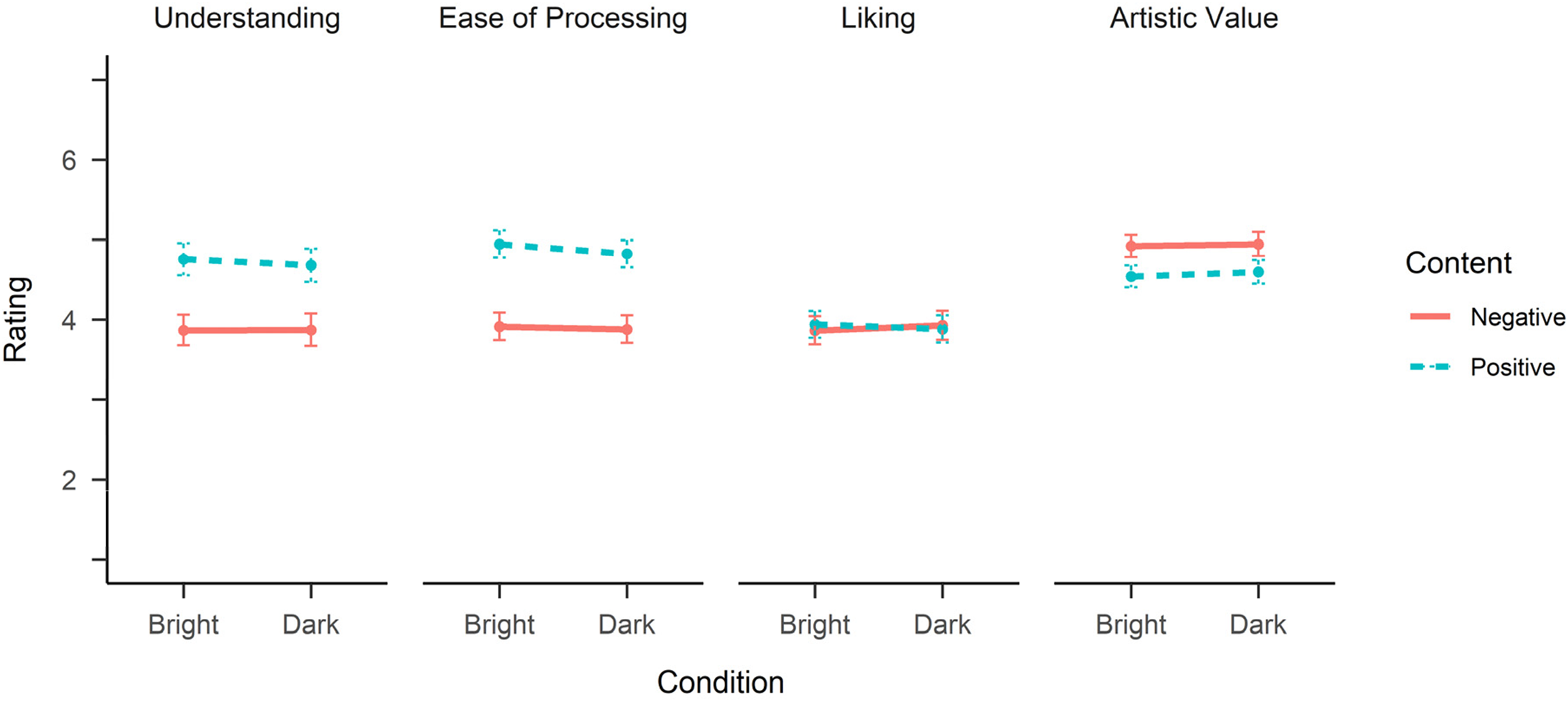
Estimated marginal means of confirmatory LMEMs of Study 2.
Results of Confirmatory LMEMs of Study 2.
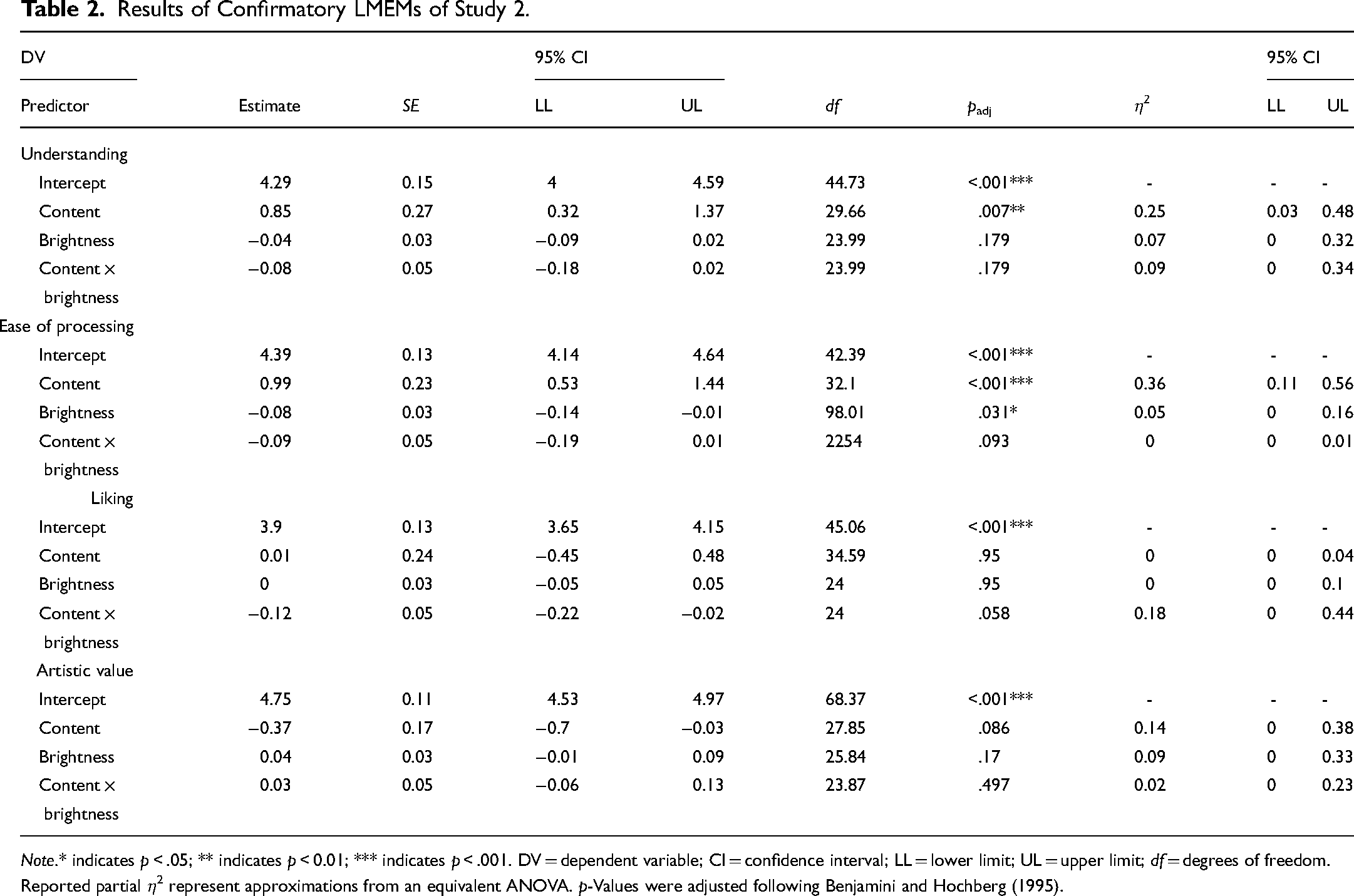
Note.* indicates p < .05; ** indicates p < 0.01; *** indicates p < .001. DV = dependent variable; CI = confidence interval; LL = lower limit; UL = upper limit; df = degrees of freedom. Reported partial η2 represent approximations from an equivalent ANOVA. p-Values were adjusted following Benjamini and Hochberg (1995).
Exploratory Analysis
Detailed results for exploratory and BE models can be found in Supplemental Tables S6 and S7, respectively. Due to singular fit and/or non-convergence warnings, brightness (random intercept + slope) was removed—both confirmatory and BE models—from subjects in the understanding model and from artworks in the ease of processing model. Again, only the results for the hypothesized interaction of content and brightness and (other) effects were reported as significant followed by reporting changes to these models after BE. For clarity and transparency, statistical details for these effects are provided in the running text as well.
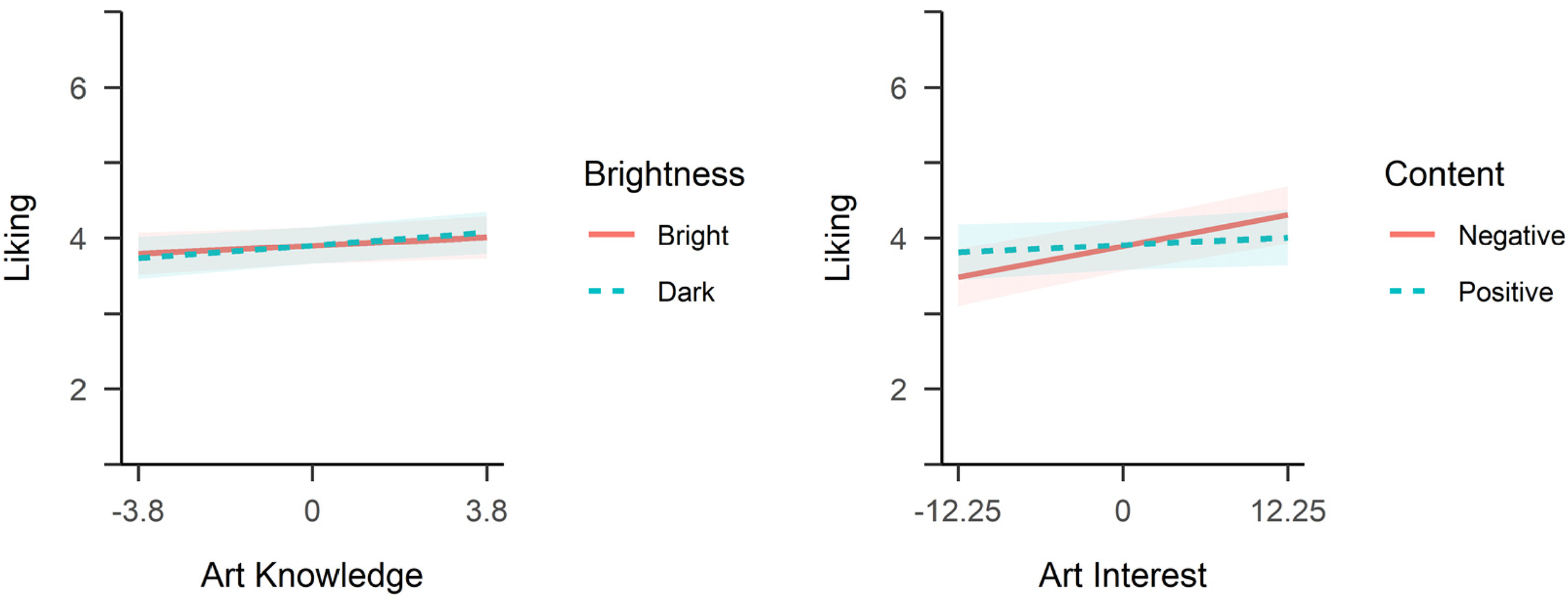
Predicted liking with respect to brightness and art knowledge (left panel) and content and art interest (right panel) of Study 2.
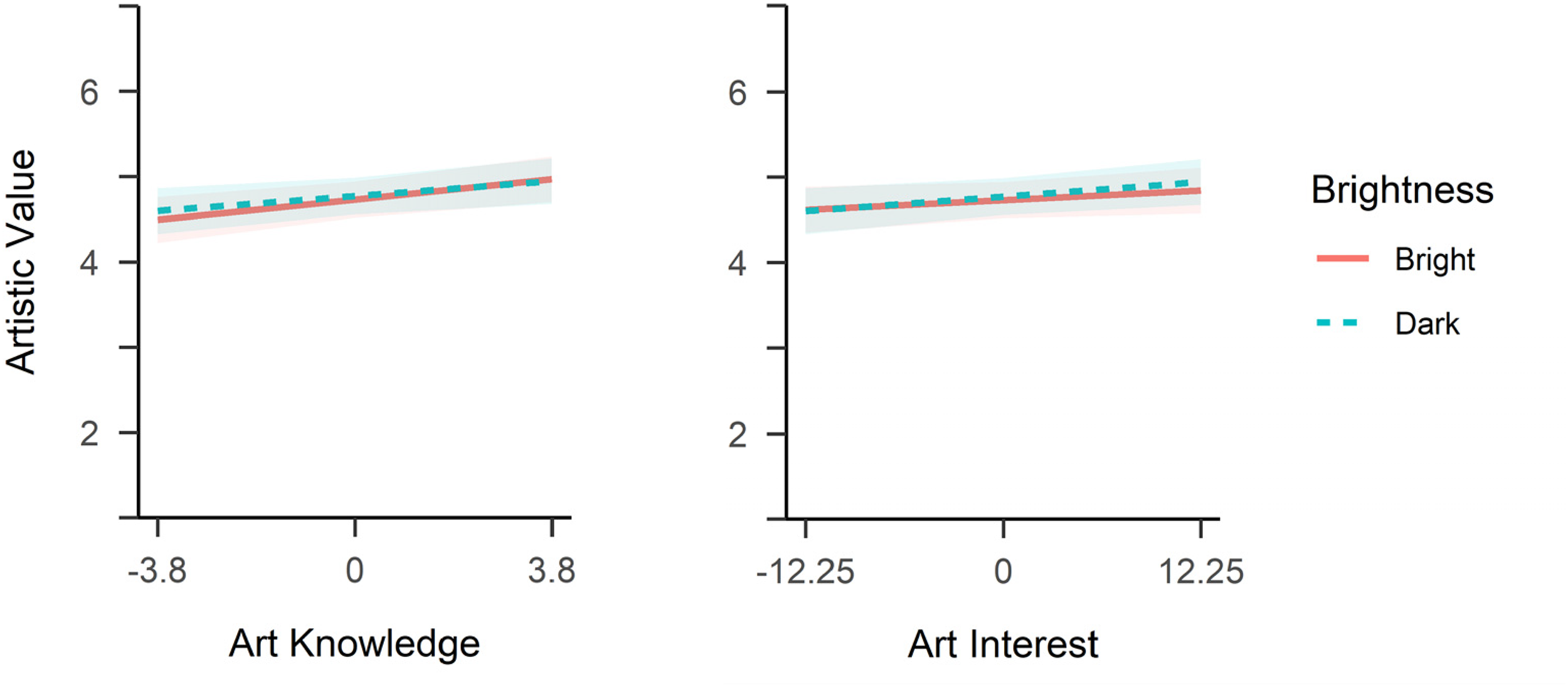
Predicted attribution of artistic value with respect to brightness and art knowledge (left panel) and interest (right panel).
Confirmatory vs. Exploratory LMEMs
Again, using Chi-squared (χ2), it was tested whether the inclusion of the VAIAK (i.e., art interest and art knowledge) improved the models compared to the confirmatory LMEMs without this factor. Model comparison results and model fits can be found in Supplemental Table S8. Except for ease of processing, models were improved by including both VAIAK scales. A separate comparison using the BE model for ease of processing did not lead to an improvement of the model. Thus, it can be concluded that—except for ease of processing—the inclusion of the VAIAK improved the statistical models.
Discussion
No evidence in line with our hypothesis that a congruency of style and content would facilitate the processing of artworks, which, in turn, would affect how well artworks are understood, liked, and artistically appreciated was found. Though exploratory analysis found such an interaction showing that incongruent artworks were liked less, we would not interpret this as evidence as no such effect was found for fluency. This is particularly salient as at least according to fluency theory, liking should be increased because fluency increased.
As in Study 1, a main effect of content was found for understanding and ease of processing, consistent in both confirmatory and exploratory analyses.
Exploratory analyses including art interest and knowledge revealed several effects that only partially replicated the findings of Study 1. With respect to understanding and liking, we found effects that seem consistent across both experiments. In contrast, effects for ease of processing and artistic value showed no clear consistency and thus probably do not allow for generalization. In addition, brightness again was removed from random effects in each model—except subjects’ random effect for ease of processing—probably indicating that brightness was not salient in our experiments.
In the following, we will briefly discuss all effects found in both experiments, which are summarized in Table 3. Note that several effects found seem to be rather small, and therefore caution is required in interpreting them; however, as this was an exploratory approach, we see the following section as a basis for future research to confirm or refute these findings.
Effects Found in Both Studies.
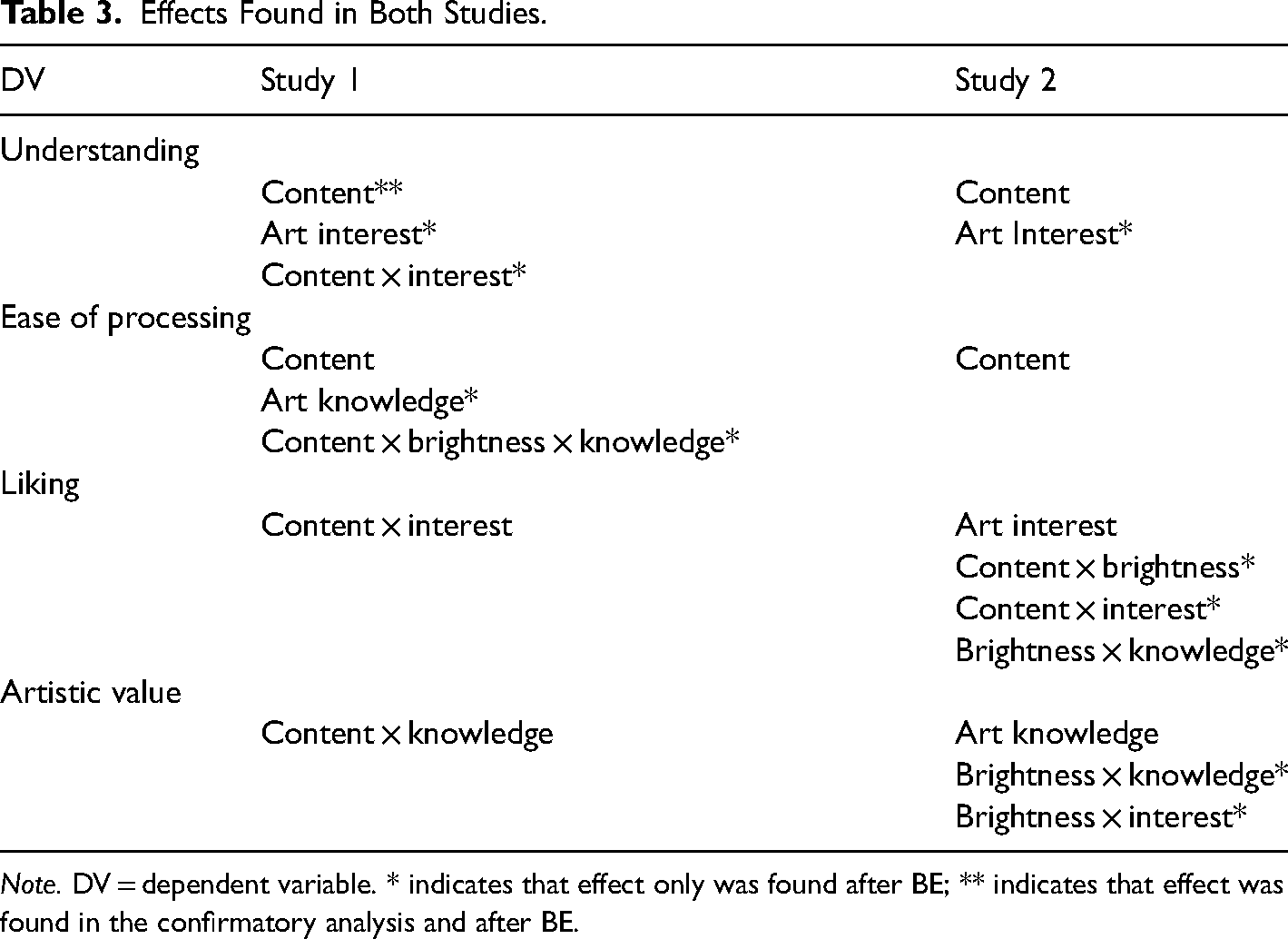
Note. DV = dependent variable. * indicates that effect only was found after BE; ** indicates that effect was found in the confirmatory analysis and after BE.
Understanding
Our results showed a consistent role of art interest in both studies after BE, which can be described as overall aiding to understand artworks, which in Study 1 especially was found for negative artworks. We assume that generally having more interest could bring a greater openness and intrinsic motivation to confront oneself with more difficult artworks and try to understand them. In the case of negative content, the participants with little interest might engage in measures of self-defense when confronted with a potential threat to their self-image (Pelowski, 2015; Pelowski et al., 2017).
In contrast, art knowledge did not affect how artworks were understood and was excluded as a factor in both studies after BE. This may be due to a higher variance in interest than in knowledge for novice samples (Specker et al., 2020). If art knowledge is relatively similar between people, it cannot explain differences between people.
Ease of Processing
Our results showed that art interest did not play an important role in subjective ease of processing. The effects of art knowledge were only found in Study 1, where participants with higher knowledge processed artworks generally and particularly incongruent ones more easily. We assume that potentially having more knowledge about art may facilitate the processing of incongruent artworks. Thus, people with less knowledge probably need to invest more processing capacity to interpret these ambiguous messages, whereas people with more knowledge may be better able to “decode” the stimulus, probably recognizing such incongruities as an explicit feature of the artwork. However, as the effect of knowledge (and its interaction with content and brightness) was not replicated in Study 2, its interpretation might not allow for generalization and probably should be a matter of future research.
Liking
Our results showed that art interest did play a consistent role in liking. Both our studies showed that while positive artwork's ratings were unaffected by art interest, negative artworks were relatively liked better with more but lesser with less interest. As discussed before this might relate to the two distinct fluency-based processes proposed in the PIA Model, namely, the more bottom-up related initial evaluation of pleasure (probably reflected in the relatively lower ratings of negative art compared to positive in participants with less interest) that eventually is followed by more top-down driven aesthetic evaluations in case of higher motivation, i.e., interest (Graf & Landwehr, 2015). This higher motivation/interest then might have resulted in better understanding (in line with our findings) and consequently better liking due to a relatively larger effort to understand more difficult and harder-to-process negative artworks compared to positive ones (e.g., Leder et al., 2014; Russell, 2003).
Our results showed that art knowledge did not play an important role in liking as knowledge only was involved in an interaction with brightness in Study 2.
Artistic Value
Our results showed that art interest did not play a consistent role in attributed artistic value as effects of interest only were found in Study 2 after BE where participants with higher interest attributed higher value to dark artworks. Thus, these effects of Study 2 can be interpreted as indicating a differentiation between liking and attributed artistic value as people with higher knowledge liked bright artworks less while at the same time attributing more artistic value to them. However, in sum and as the two opposing effects are rather small, our results do not allow us to draw conclusions on this matter as no meaningful or consistent differences between liking and attributed artistic value were found.
The effects of art knowledge were found in both studies but also not in a consistent way: While participants with more knowledge attributed higher value specifically to negative artworks in Study 1, this was true for artworks in general and specifically for bright artworks in Study 2.
General Discussion
The purpose of this study was to examine the congruency effects of artwork inherent features, specifically style and content, and focused on the formation of understanding in art. With respect to our main research question, “How do we understand artworks?,” we conclude that congruency (between content and brightness) was not a relevant factor in our experiment. Though our results provide evidence against our hypothesis, one limitation to the strength of this evidence lies in our operationalization of style as overall brightness (discussed in more detail below).
However, our results suggested a pronounced role of content along a positive–negative dichotomy affecting the processing of art for our sample of art novices—which is in line with previous findings (Augustin & Leder, 2006; Hekkert & Van Wieringen, 1996). In addition, our results also highlighted the importance of individual differences in terms of art interest and knowledge in our sample.
Limitation of Brightness
Even though brightness manipulations previously were reported to successfully affect experimental outcomes (Lakens et al., 2013; Schettino et al., 2016; Specker & Leder, 2018; Specker et al., 2018) and most importantly also for artworks (Specker et al., 2021), the results of the present study indicate potential limitations and consequently the necessity of certain implementations (e.g., manipulation checks) for future studies using overall brightness as experimental manipulation.
Importantly, most previous work addressed brightness in a close relation to positivity, which was not the case in the present study. However, our rationale assumed (building on the work cited above) that overall brightness would be related to positivity and aimed to study whether and how this association might interact with positive content, thus addressing the brightness–positivity association rather indirectly. Also, as previous work only looked at abstract art (Specker et al., 2021), it could be the case that this effect cannot be found with artworks that have a stronger semantic content. This would fit with previous findings that indicated/suggested no effects of brightness for stimuli with highly affective content (Lakens et al., 2013; Schettino et al., 2016). But, there is also evidence that incongruency between brightness and affective images (i.e., bright unpleasant images, compared to originals) indeed affected the participant's neurophysiological activity while behavioral data only in part reflected this effect (Kurt et al., 2017). However, our intended operationalization of style—as overall brightness—likely failed to produce detectable effects either due to DVs being too “distant” to a brightness–positivity association; deceived by too affective content; or also even because our underlying assumption being wrong (i.e., overall brightness was not related to positivity in representational art). In addition, we recommend that future studies addressing brightness in complex stimuli should consider pre-existing differences in image properties of stimuli (e.g., brightness, complexity, or contrasts) and consider how manipulations of brightness might affect such properties (e.g., see Kurt et al., 2017; Schettino et al., 2016). As the current study did not involve such measures, it cannot be ruled out that such differences (e.g., complexity or contrast) might have affected our results.
However, the effects found in the present study can provide valuable orientation for future research in this area, which could explicitly compare abstract art (without a specific semantic content) to representational art (with a specific semantic content) to address the above reasoning or potential variations in the strength of content as we only included art that could clearly be categorized as positive or negative, and potentially the strength of the affective content would play a role (at least in combination with brightness, again see above). Furthermore, brightness was mostly found to play a role in relation to art knowledge. Specifically, the effect of brightness was larger for people with low art knowledge; this suggests that these participants were more sensitive to subtle brightness differences, which, speculatively, might be explained by less top-down influence and rather relying on bottom-up processing.
Also, as content is processed temporarily earlier than style (Augustin et al., 2008), possible effects of brightness might already be biased under the influence of content or even suppressed (Sanocki, 1993; or see Leder et al., 2006, for an example of object valence and positivity of curvature). Thus, future research could specifically focus on time-sensitive measures either behaviorally or using neuroscientific methods such as EEG, which was already employed in the context of brightness. For example, bright unpleasant compared to pleasant and neutral pictures resulted in a decrease in the average power of brain response (Eroğlu et al., 2020; see also Kurt et al., 2017). In addition, there are indications that EEG is especially suited for measuring the capability of the brain to detect even small and unexpected visual changes, i.e., visual mismatch negativity (Stefanics et al., 2014).
The Role of Content
The consistent and pronounced role of content found in our studies may be explained by our sample consisting of art novices, which, in contrast to art experts, rather rely on describing content than trying to find a deeper or abstract level of meaning (Bauer & Schwan, 2018). Similarly, Augustin and Leder (2006) found that art novices—compared to experts—more often used labels that can be subsumed in a positive–negative dichotomy to categorize artworks (e.g., threatening vs. not threatening), thus probably referring to personal feelings (p. 151). Our results are in line with these findings suggesting a pronounced role of content in art processing for art novices.
Positivity vs. Negativity in Art Processing
Our results showed that positive content in art generally was better understood and subjectively processed more easily than negative content by art novices. This is in line with general findings suggesting that negative stimuli elicit more cognitive workload and lead to more complex cognitive representations (e.g., Peeters & Czapinski, 1990) and that cognition might generally be more complex and elaborated when it comes to negative compared to positive qualia (Rozin & Royzman, 2001). Tolstoy's opening sentence in Anna Karenina, “all happy families are alike; each unhappy family is unhappy in its own way” (Tolstoy, 2016, p. 3), may illustrate why negative content requires more effort to process and hence is harder to understand.
Interestingly, although not significant, negative artworks in both studies were considered artistically more valuable. Indeed, negative emotions in the arts have been discussed as playing a central role as they are particularly powerful in gaining viewers’ attention and engaging them emotionally, resulting in high memorability (Menninghaus et al., 2017). In line with this, previous work has shown that especially negativity in various art forms was related to higher appreciation or evaluation (e.g., Eerola et al., 2018; Gerger et al., 2014; Kraxenberger & Menninghaus, 2017; Menninghaus et al., 2015; Wassiliwizky et al., 2015). According to the distancing-embracing model (Menninghaus et al., 2017), negativity in the arts can be enjoyed because of two mechanisms: distancing, i.e., the ability to distance oneself from the experienced negativity, and embracing, the ability to allow yourself to enjoy arts’ attention-drawing and emotionally intensifying effect. Interestingly, Menninghaus et al. (2017) also include meaning-making as part of the embracing mechanism, hypothesizing a redeeming effect of meaning-making via (re)appraisal of negative emotions in a more positive light (Menninghaus et al., 2017, p. 14). However, the present study did not find robust evidence that negativity was valued more in visual art (except for liking in relation to art interest); although such an effect was found for participants with more art knowledge in Study 1, it did not survive the p-value correction in Study 2. Nonetheless, our results might add to the overall understanding of negativity in the arts by showing that understanding negative art is generally harder and more effortful—at least for art novices—and should be considered in future work.
Art Interest and Art Knowledge
As the reviewed literature underlined, art is processed differently between art experts and nonexperts (e.g., Augustin & Leder, 2006; Hekkert & Van Wieringen, 1996; Leder et al., 2012). However, our results showed that even in a relatively homogeneous group of art novices (as our sample represented), such differences can be observed. In an exploratory approach, several effects across both experiments were found, and though many observed effects were (very) small, it seems likely that these effects would be more pronounced in a more heterogenous sample. Even though most effects found—in addition to being rather small—were not exactly replicated between both experiments some conclusions can be drawn:
First, the role of art interest overall was more pronounced than knowledge. However, the found effects of interest seem reasonable as we argue that higher interest motivated people to engage deeper with artworks (e.g., Graf & Landwehr, 2015), which positively affected how artworks were understood and liked.
Second, art knowledge did not play a noteworthy role, which seems counterintuitive but may be explained due to more variance in interest than in knowledge for novice samples (Specker et al., 2020). However, the effects of knowledge in Study 2 (see Table 3) only were found in the context of an interaction with brightness, for which we do not have an intuitive explanation.
Simply put, our results indicated that art interest played a more pronounced role in understanding and liking, whereas art knowledge was more pronounced with respect to ease of processing and attributed artistic value.
Conclusion
In conclusion, our study found no evidence that a matching of content and overall brightness in artworks affected art processing, measured through art evaluation. In our study, content along a positive–negative dichotomy rather than congruency was found to have influenced ratings the most suggesting that—at least for art novices in art processing—affective positive content is processed and understood better than negative content. In addition, exploratory analyses showed that individual differences in art interest and knowledge even in a homogeneous group of art novices can influence the processing of art. Our findings highlight the fact that future empirical (aesthetic) research using affective stimuli should take the found processing differences into account.
Supplemental Material
sj-docx-1-art-10.1177_02762374231201074 - Supplemental material for How Do We Understand Artworks? Exploring the Role of Artwork Inherent Features in Art Processing
Supplemental material, sj-docx-1-art-10.1177_02762374231201074 for How Do We Understand Artworks? Exploring the Role of Artwork Inherent Features in Art Processing by Eva Specker, Maximilian Douda, and Helmut Leder in Empirical Studies of the Arts
Footnotes
Declaration of Conflicting Interests
The authors declared no potential conflicts of interest with respect to the research, authorship, and/or publication of this article.
Funding
The authors received no financial support for the research, authorship, and/or publication of this article.

Data Availability Statement
The data that support the findings of this study are available on request from the (corresponding) author(s). The data are not publicly available as participants did not give explicit informed consent to do so.
Supplemental Material
Supplemental material for this article is available online.
References
Supplementary Material
Please find the following supplemental material available below.
For Open Access articles published under a Creative Commons License, all supplemental material carries the same license as the article it is associated with.
For non-Open Access articles published, all supplemental material carries a non-exclusive license, and permission requests for re-use of supplemental material or any part of supplemental material shall be sent directly to the copyright owner as specified in the copyright notice associated with the article.
