




Abstract
The Brazilian film market consists mainly of American films; most of these films are released after their release in the United States, while a few are released before or simultaneously. The recent rapid developments in information and communication technology (ICT) changed film-showing technology to a digital model, improving the possibility of simultaneous worldwide releases. ICT evolution also allowed Brazilian moviegoers to access American critic reviews in real time. We explore this scenario to study whether American critic reviews influence film consumption at theaters in Brazil. We employ regression analysis using data from 1,600 films exhibited in the country between 2007 and 2018 collected from Box Office Mojo and Rotten Tomatoes websites. Controlling for endogeneity problems, we documented a prediction effect of expert reviews on gapped film releases but not an influence effect on simultaneous releases, which correspond to the wide film releases in the United States.
Introduction
We investigate the effects of expert opinions on consumers’ decisions (Ginsburgh, 2003), but we innovate by studying whether expert reviews can influence film consumption abroad.
A film review, similar to a film, is an “information good,” 1 a good that can be digitalized—thus, it can be stored, copied, shared, and transferred, and their consumption does not lead to their extinction—and have a high cost of production of the first unit but a negligible cost of reproduction (Shapiro & Varian, 1999; Varian, 2000). According to Waldfogel (2017), these goods have been dramatically affected by the recent evolution of information and communication technology (ICT), allowing access to critical reviews of a country available worldwide and simultaneous worldwide film releases, for instance.
A film is also an “experience good,” whose quality is only known after its consumption, and experts’ reviews are an important channel to signal its quality and support the consumption decision, despite the great expenditures in propaganda and marketing of a film (Reinstein & Snyder, 2005).
Film producers and distributors usually consider expert reviews as a relevant factor in driving film consumption. However, some authors assess the “endogeneity” problems in the movie market and suggest that there are effects of expert reviews on the limited opening films, while these effects are absent or infrequent in widely released films (Eliashberg & Shugan, 1997; Reinstein & Snyder, 2005, Souza et al., 2019). These results can be related to the fact that, traditionally, moviegoers expect big-budget films to have good quality (Brown et al., 2012; Legoux et al., 2016) and view widely released films as a good-quality signal for family and friend outings (Thrane, 2018).
According to Eliashberg and Shugan (1997), the endogeneity is connected to the fact that a reviewer, after consuming a film, knows its quality and he/she can predict if the film will succeed or not. This prediction cannot be read as an influence effect since it is a long-term effect, while influence is a short-term effect. Thus, to obtain the net effect of influence, it is necessary to control for the time the effects take place. In addition, not controlling for the prediction effect, due to the absence of the film quality information, could lead to a misleading conclusion of the influence effect (Reinstein & Snyder, 2005).
Brazil has a long history of showing American films in theaters, where Hollywood films have been established since the First World War (1914–1918). The Brazilian box office revenues consist mainly of American film tickets; many of these films are released in Brazil with a delay in comparison to their release in the United States (or with a gap release), while a few are released before or simultaneously, as is the case of the big-budget movies, which are widely released.
The recent improvement in ICT that allowed an increase in the simultaneous worldwide releases (Eliashberg et al., 2006; Husak, 2004) also boosted access to American critic reviews in real time, available on the Internet as soon as the film is released in the United States. The prompt availability of online American expert reviews and the fact that Brazilian film consumers are the most educated, wealthy, and youthful individuals with Internet access (Nishijima et al., 2019) make the country's movie market an ideal opportunity to study whether the American expert reviewers affect the consumption of films at theaters in Brazil.
To address this subject, we perform regression analyses using a sample of 1,600 films from Box Office Mojo and Rotten Tomatoes sites released between 2007 and 2018. The dataset is split between films with simultaneous releases and films released with a gap, that is, films that had their Brazilian release delayed in comparison to the North American release, to explore both prediction and influence effects. We also conducted other additional strategies to address the endogeneity problem following related studies.
Knowing whether there is an immediate impact of information worldwide is essential to uncover the dynamics of real-time disclosing information on the Internet and online social media in a globalized world. To our knowledge, no other study investigated the effect of critic reviewers outside the borders, so our study can bring some light to the international cultural consumption influence and dissemination of information promoted by the ICT evolution.
Besides this introduction, the paper has four parts. The second section discusses the main characteristics of the Brazilian movie market and briefly summarizes related studies. The third section presents our data and methodological strategy, followed by a section with results and discussion. The final section outlines our main findings.
Background
Films, Critic Reviews, and Films Released With a Gap
There is an asymmetry of information between film producers and consumers regarding the quality of films; while a producer knows the quality of its product, a consumer will know it only at the time of consumption, making a film an experience good (Reinstein & Snyder, 2005). Therefore, critic reviews represent a significant source of information about film quality besides other signals like budget, stars, and directors.
A number of studies investigate the relationship between experts’ critic reviews and box office revenues. Most of these studies are explanatory, investigating factors and their relations with movie box office performance through regression analysis; see Eliashberg et al. (2006), McKenzie (2012), Cameron (2020), and McKenzie (2023) for complete surveys in related research. In general, these studies suggest different positive effects of expert reviews across different film genres.
Some studies have addressed the endogeneity problems and find, in contrast, minor or no effects of experts’ reviews on widely released films, such as sequels of former blockbusters and promises of blockbusters (Eliashberg & Shugan, 1997; Gemser et al., 2007; Reinstein & Snyder, 2005; Souza et al., 2019; Thrane, 2018). An exception is Basuroy et al.’s (2020) study, which finds an expert's influence effect only for widely released films.
Critical reviews are information goods, and the digitization revolution that facilitated the dissemination of professional critical reviews has also boosted online places where consumers can share their opinions. Thus, reviews of consumers/users have become largely available and a relevant source of film quality information—along with experts’ critical reviews—due to Internet availability (Vujić & Zhang, 2018). Consumers utilize open online forums to share their opinions about films (Basuroy et al., 2020; Moretti, 2011; Souza et al., 2019), and these reviews can be seen as a proxy for word-of-mouth (WOM) (Dalton & Leung, 2017). In addition, with the recent evolution of social media, some users are also “influencers” that are supposed to guide consumption and other behaviors.
While this paper focuses on evaluating the effect of professional film reviews on consumption, we use consumer reviews as control variables to address the issue of endogeneity between review ratings and film quality. The problem of the potential endogeneity of critic reviews, whether they affect a film's success (a short-run influence effect) or reflect the film's quality (a long-run prediction effect), has been explored by some authors (Eliashberg & Shugan, 1997; Reinstein & Snyder, 2005; Souza et al., 2019). According to Reinstein and Snyder (2005), the absence of film quality information is one of the main causes of endogeneity problems, and using consumers’ critical reviews as a measure of film quality can help to address this problem.
Studies that consider the gap (lag) between the releases in the country of origin and abroad are scarce 2 and focused on explaining the rationale for the gap's persistence—even after the great technological evolution of ICT and the Internet—or uncovering the gap's determinants. Elberse and Eliashberg (2003) point to a trend to reduce the gap for strategic reasons, such as avoiding piracy, taking opportunities to save interest on investments, and capitalizing on the buzz. On the other hand, reasons that push for film release with a gap are practical considerations, such as subtitling the movie, making additional prints, learning from the U.S. market performance, and adjusting marketing strategies for releases abroad. The authors find a higher correlation between financial success in the United States and other countries when the release gap is short. They also find a short-term WOM effect, where the more significant the gap in the openings, the lower the effect on film success in foreign markets. Dalton and Leung (2017) evaluate the impact of piracy, WOM, and competition (to avoid blockbuster releases) on release gaps in 18 countries, including Brazil. While they find a more significant reduction of revenues related to longer release gaps due to piracy, they also find that the WOM effect incentivizes a longer interval. According to the authors, a more extended release gap allows film consumers to accumulate information about its quality.
Conversely, McKenzie and Walls (2016) argue that film revenues in places with release lags incentivize piracy. Nelson et al. (2007) suggest optimal strategies to improve earnings, like reducing the gap by 1 month between 1998 and 2005. This is because there is a sequence of film releases in different media after the movie theater release, according to their financial feedback, i.e., DVDs, pay-per-view, cable TV, and finally paid TV.
Waldfogel (2017) observes that a film is both an experience good and an information good, similar to a film review made by an expert, and it provides value to consumers as a result of the information it contains (Vafopoulos, 2012). Thus, both films and reviews had reduced costs with the ICT revolution. In this sense, ICT development increased domestic and worldwide information access on the Internet (critic reviews) and the social network of an individual's influence among his peers (Moretti, 2011).
The advance in ICT decreased a film's fixed cost of production due to a significant reduction in equipment costs and technological convergence (Waldfogel, 2017). Also, the technological shift from physical to electronic digital media has resulted in a significant cost reduction in reproduction and distribution for the film industry (Husak, 2004). In addition, the change allowed the simultaneous release of films worldwide, access to content in homes, multiple digital versions with alternate endings, director cuts, multiple subtitles in different languages, and multisensors that can be used to prevent piracy, as discussed by Elberse and Eliashberg (2003) and Eliashberg et al. (2006).
Husak (2004) sheds light on the fact that technological changes have facilitated piracy of information goods industries—such as films, books, games, etc.—making it difficult for commercial sellers to continue generating the same revenue levels for bringing products to market in traditional ways. On the other hand, more recent studies show that streaming services brought a new model of managing a business in the music and movie markets. In particular, music streaming management reduces music piracy because streaming services, similar to piracy, have low costs compared with more traditional media—like CDs, DVDs, cable TV, and movie theaters—and the consumer pays a monthly fixed price to access products. In addition, these goods can be consumed at any time on different devices (Aguiar & Waldfogel, 2018).
Regarding films, Hilderbrand (2010) points to a complete replacement of the DVD market by streaming videos in the United States. Furthermore, Waldfogel (2017) asserts that the disruptive evolution of digitization of information goods—films, music, books, and others, as they can be digitized and largely distributed—has generated a new era of great success for these goods and many new alternative/substitute goods like streaming videos.
Brazil's Movie Market
Considering the technical characteristics discussed above, Brazil is a representative country for American film consumption abroad. However, it is essential to mention that despite technological changes in the movie market, as reported by Husak (2004) and Waldfogel (2017), movie theaters in the country still have a significant part of their film releases lagging behind those in the United States (Figure 1).
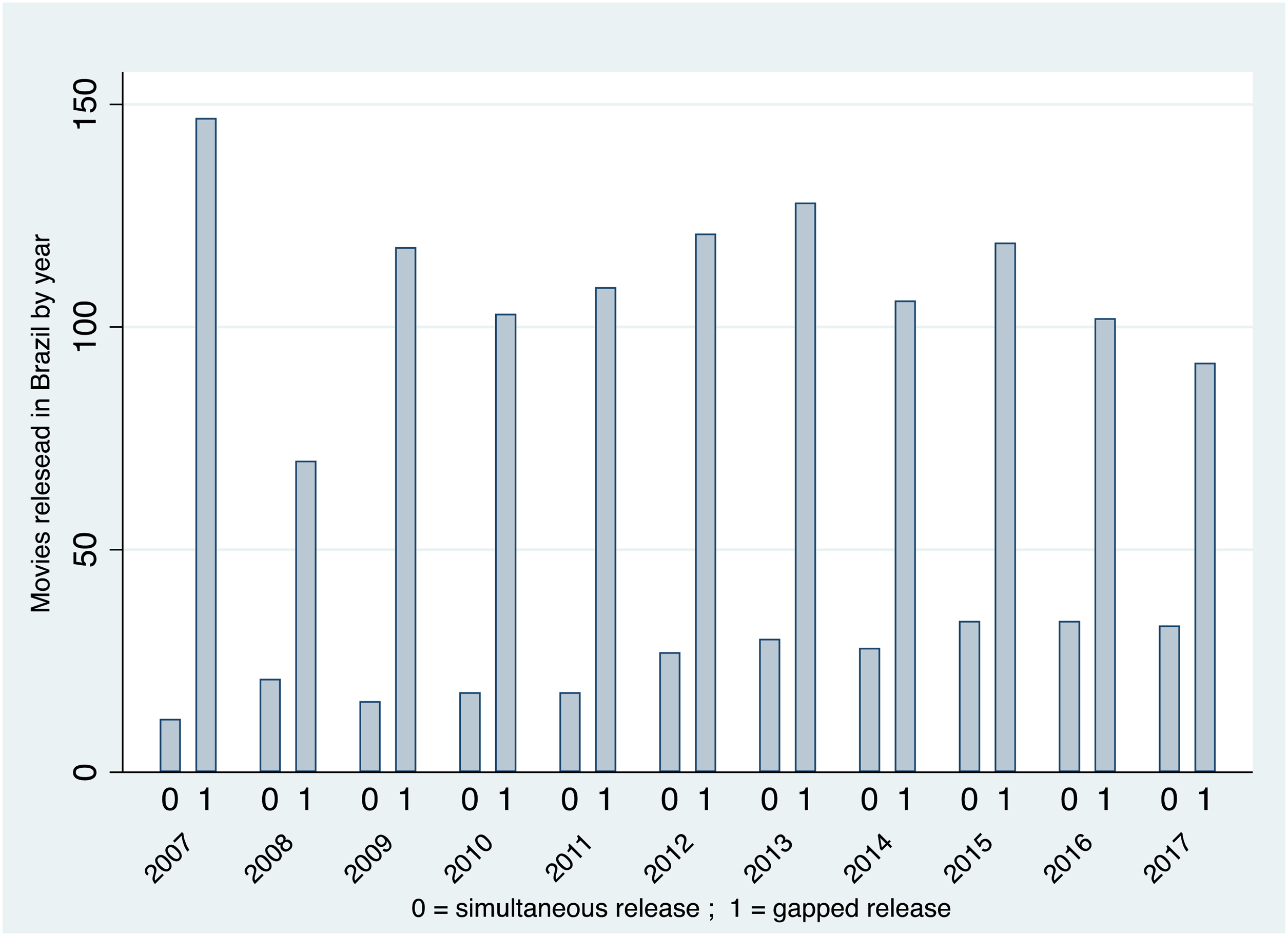
Film releases in Brazil according to timing of the U.S. releases. Source: elaborated by the authors using data on the Box Office Mojo and the Brazilian National Film Agency (ANCINE).
The Brazilian film industry produces many films; however, Brazilians prefer consuming imported films, mainly from the United States. This is a consumption pattern similar to the major countries (Park, 2015). Figure 2 shows the films released domestically by country producers between 2009 and 2019 in the left panel, while the right panel shows the box office revenues by the country producer for the same period. Despite the great number of films produced in Brazil and imported from Europe, their revenues are small, showing low attendance of Brazilians to these films at theaters. The Brazilians’ film consumption of national production was 8.5%–18.6% between 2013 and 2017 (The Brazilian National Film Agency [ANCINE]) of the total films domestically consumed.
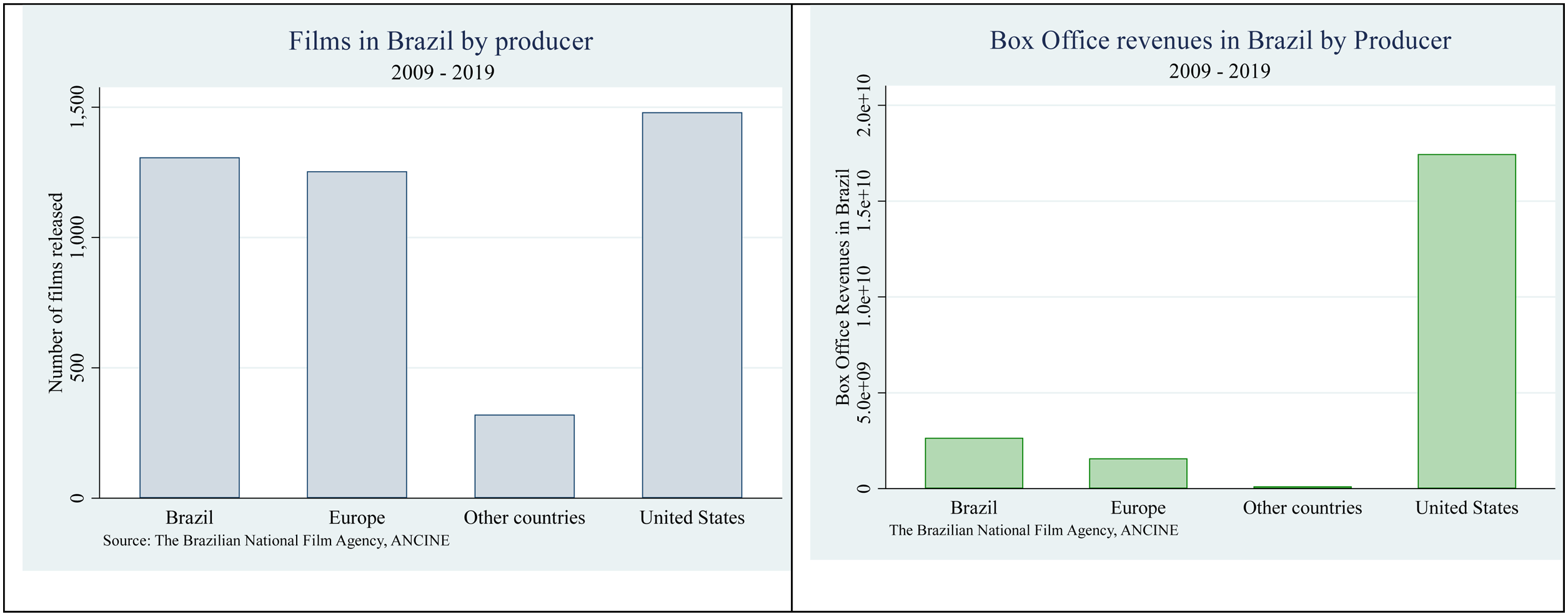
Number of films and film revenues by the country producer (2009–2019). Source: authors using data from the Brazilian National Film Agency (ANCINE).
On the other hand, regarding films from Hollywood, the number of films and the attendance at the theaters are both high, suggesting that Brazilians have an apparent preference for Hollywood films. As Sen (1993, p. 2013) explains, the United States is very good at spreading its culture and Hollywood is an important instrument in this propagation, which leads to cultural consumption by other countries.
As shown in Figure 1, the theaters have released most of their films with a delay for several reasons, such as the Brazilian shortage of exhibition technology (infrastructure) compared with the United States and different timing for vacations and holidays (summer vacation occurs in December to February in Brazil), among others. However, the delay of film releases between the United States and Brazil has been reduced 3 due to Brazilian theaters’ adoption of digital technology for film showing or the reasons discussed above (André, 2017).
Also, Brazil is a large democratic developing country with an unequal pattern of income distribution and social access to cultural goods. The Brazilian movie consumers are young, have the highest number of schooling years, have high incomes, and live in metropolitan areas. In 2009, only 2% of a representative sample of 400,000 individuals of the nation's population went to the movie theaters in the past 3 months they were surveyed (Nishijima et al., 2019). Given these characteristics, they are likely to access the Internet and any other information sources from the United States.
Besides the very unequal pattern of income distribution and a huge divide in cultural goods access, Brazil has several other inequalities, including regional ones. There were 5,650 municipalities in Brazil in 2018, but only 418 (or 7.5% of the municipalities, which includes 57% of the Brazilian population, according to ANCINE) had movie theaters. Despite the increasing number of movie theaters recently—Figure 3 shows the trend of the country's number of movie theaters and tickets—they are concentrated in rich urban areas.
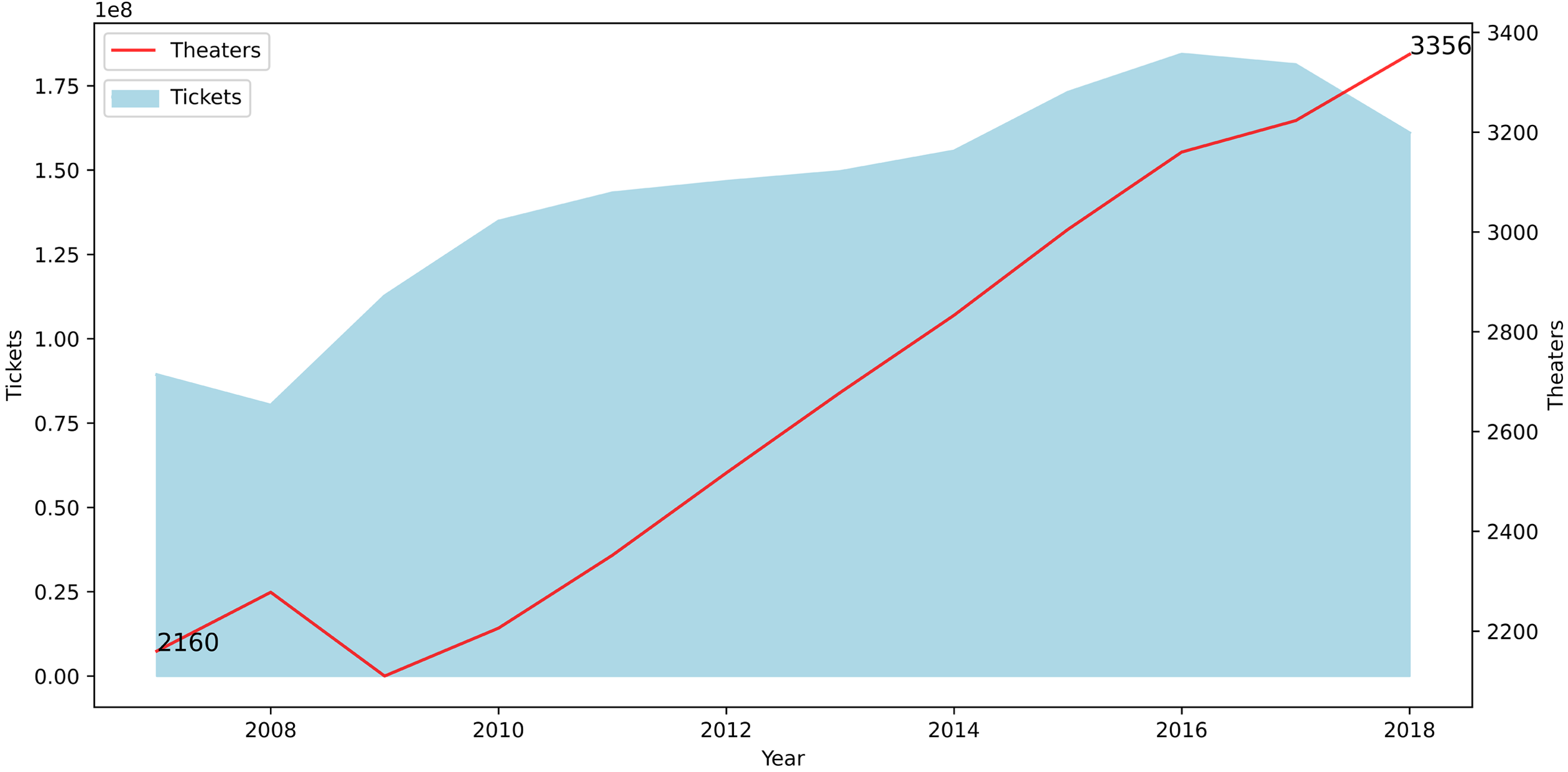
Evolution of tickets and movie theaters in Brazil (2007–2018). Source: authors using data from the Brazilian National Film Agency (ANCINE).
We follow Elberse and Eliashberg (2003) to assume that online critic reviews available very early incentivize the search for more quality information about the film, thus influencing consumer decisions. These authors also argue that U.S. releases can be understood as a filter for selecting more successful movies to be released abroad. Thus, we hypothesize that American reviews of experts can affect the consumption of films in Brazil at movie theaters. Also, we suppose Brazilian experts and consumer reviews use American reviews as their priors; thus, their information is included in American reviews.
Since streaming videos was a great innovation in the Brazilian market during our sample period (2007–2018), we control our estimates for Netflix's entrance as our proxy for video streaming. The company is the first and major streaming video company in the country and started its operations in Brazil in 2011, 4 as a video-on-demand (VOD) streaming service delivered by the Internet, not as a download exclusively, which takes a significant time for the video to be available (Waldfogel, 2017). In this sense, we control the estimates for Netflix's launch of streaming video services since it can be understood as a new substitute good for the film consumed at theaters or a different good (Aylsworth et al., 2013).
Data and Methods
Data
All information about films released in Brazil has been collected from the Box Office Mojo and Rotten Tomatoes websites for 2007–2018 using a Python scraping script 5 . We ended up with around 1,600 films in our sample. In this period, wealthy Brazilians already had broadband access to the Internet, which allowed more homogeneous access throughout the investigated time.
We deflated the monetary values using the U.S. monthly consumer price index (CPI) from the International Monetary Fund (IMF) statistics.
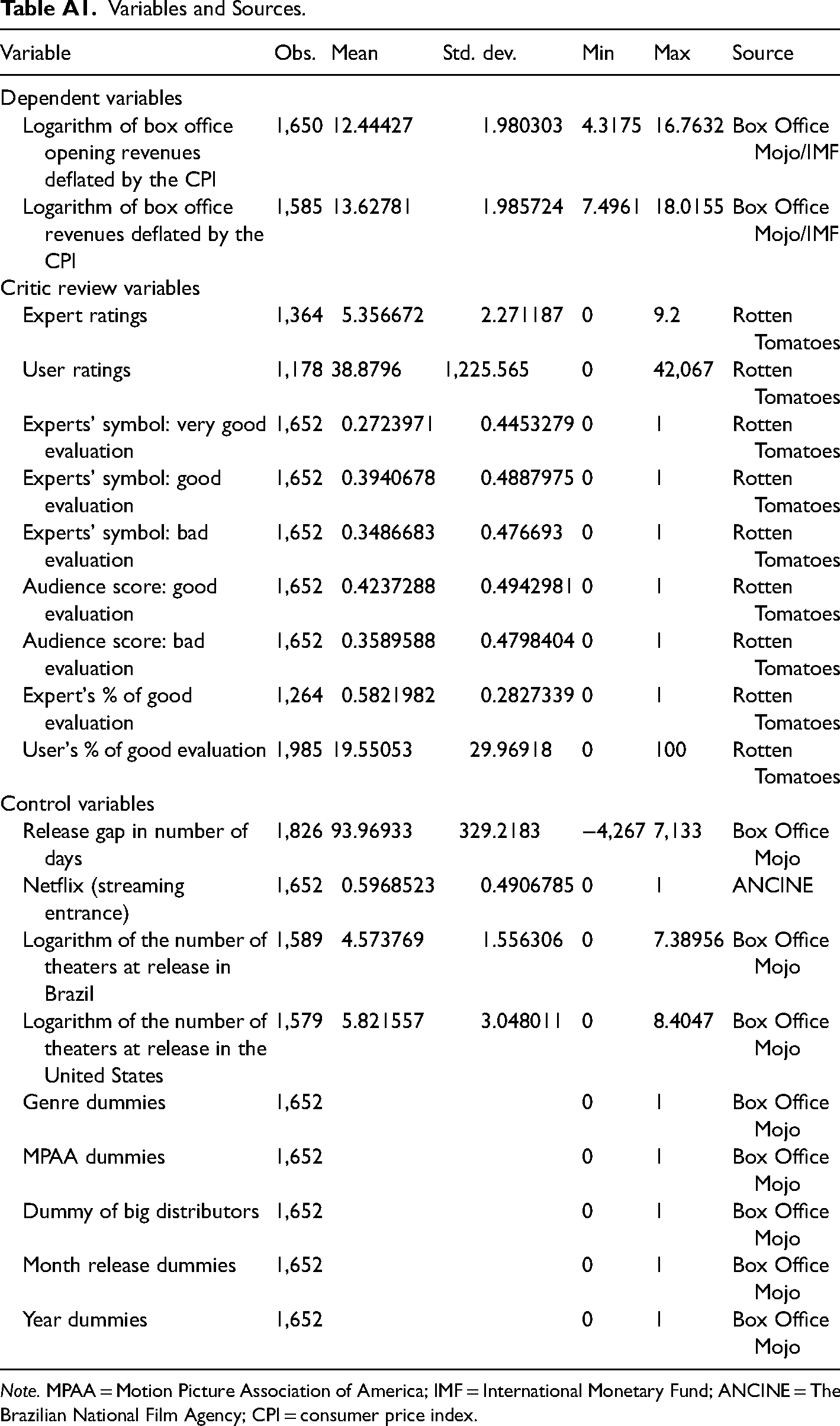
Our sample includes all film genres, except IMAX films. Details and data sources are available in Table A1 in Appendix A. We use critic reviews from Rotten Tomatoes, one of the most famous review aggregators, which accounts for reviews of professionals and users/consumers. To measure the effects of experts’ reviews—a proxy for professional opinions and our interest variables—on film consumption, we control for endogeneity problems by including consumers’ reviews as covariates. The covariates work as proxies for film quality information.
In Brazilian movie theaters, it is common to have one weekend of the premiere with a few seats before the official release of a film to learn its potential demand. In addition, once a film exhibition is over, the owners bring it back many weeks later to capture some additional late demand. We eliminate the premieres and the last weeks from the sample to deal with this difference. This happens especially for narrow national releases of foreign films not from the United States.
Lastly, as mentioned earlier, to avoid biases due to new substitute products of films at theaters introduced in the digital era (Waldfogel, 2017) and the effects of technological innovations, we control for the entrance of Netflix in Brazil, the first and major streaming video company in the country.
Methods
We split our sample between films with and without gaps in release, namely, a gap being when a film is released in Brazil later than in the United States (83%) and a simultaneous film when it is released in Brazil and the United States at the same time (12%), to identify the influence of American expert and consumer critic reviews on the Brazilian consumption of movies at theaters. We disregarded the films released in Brazil before they were released in the United States since the sample is tiny.
Besides exploring the dataset split between films with simultaneous releases and films released with a gap in Brazil, we use three main strategies to deal with endogeneity problems. First, we follow Eliashberg and Shugan (1997) and Reinstein and Snyder (2005) to assume that endogeneity is derived from two simultaneous effects: the influence of reviews as a short-run effect and prediction as a long-run effect connected to the disclosure of film quality. The short run and long run were the cutouts chosen because they explicitly refer to the period in which the film was in theaters, where the short run is the first week of the exhibition, including the opening weekend, and the long run is the remaining time of the exhibition, not exceeding the usual 8 weeks (Souza et al., 2019). Therefore, we use the first week's revenues to study the short-run effects and the total box office revenues to investigate the long-run effect. In this sense, a film released with a gap in Brazil, related to its release in the United States, is evaluated as having only long-run (prediction) effects of American reviews since the review information was available at least 1 week before the film release in Brazil.
Second, we follow Souza et al.’s (2019) strategy to address the endogeneity problem of information absence. Thus, we include both American expert reviews, our interest variables, and user reviews at the time of the movie's release (in different and alternative indicators) to control for the film quality information. However, experts’ reviews are also a measure of film quality; thus, as regressors, experts’ and consumers’ reviews control mutually for the quality information of the films. It is important to note that user reviews can also be viewed as a proxy for WOM (Dalton & Leung, 2017).
Third, we included, as additional covariates, only information about the Brazilian market available at the time of film releases in the country to avoid prediction biases included with variables available after the film release.
We estimate ordinary least squares (OLS) regressions using the following equation (we omitted the indicators of film and year to simplify):

We have three different specifications for a sign of experts’ and users’ quality due to the great number of indicators available and explored in previous studies: (1) the basic evaluation of Rotten Tomatoes labels, 6 (2) a rating average, and (3) the percentage of good evaluations.
Matrix
Results and Discussion
Table 1 shows the effects of the rating symbols’ information on quality from the Rotten Tomatoes website on box office films’ opening and total revenues. We report unstandardized partial regression coefficients to focus on our particular interest: the effects of professional critical reviews on film consumption.
Estimates for the Logarithm of Box Office Revenues According to the Icons of Quality on the Rotten Tomatoes Website of Experts and Users (Specification 1).
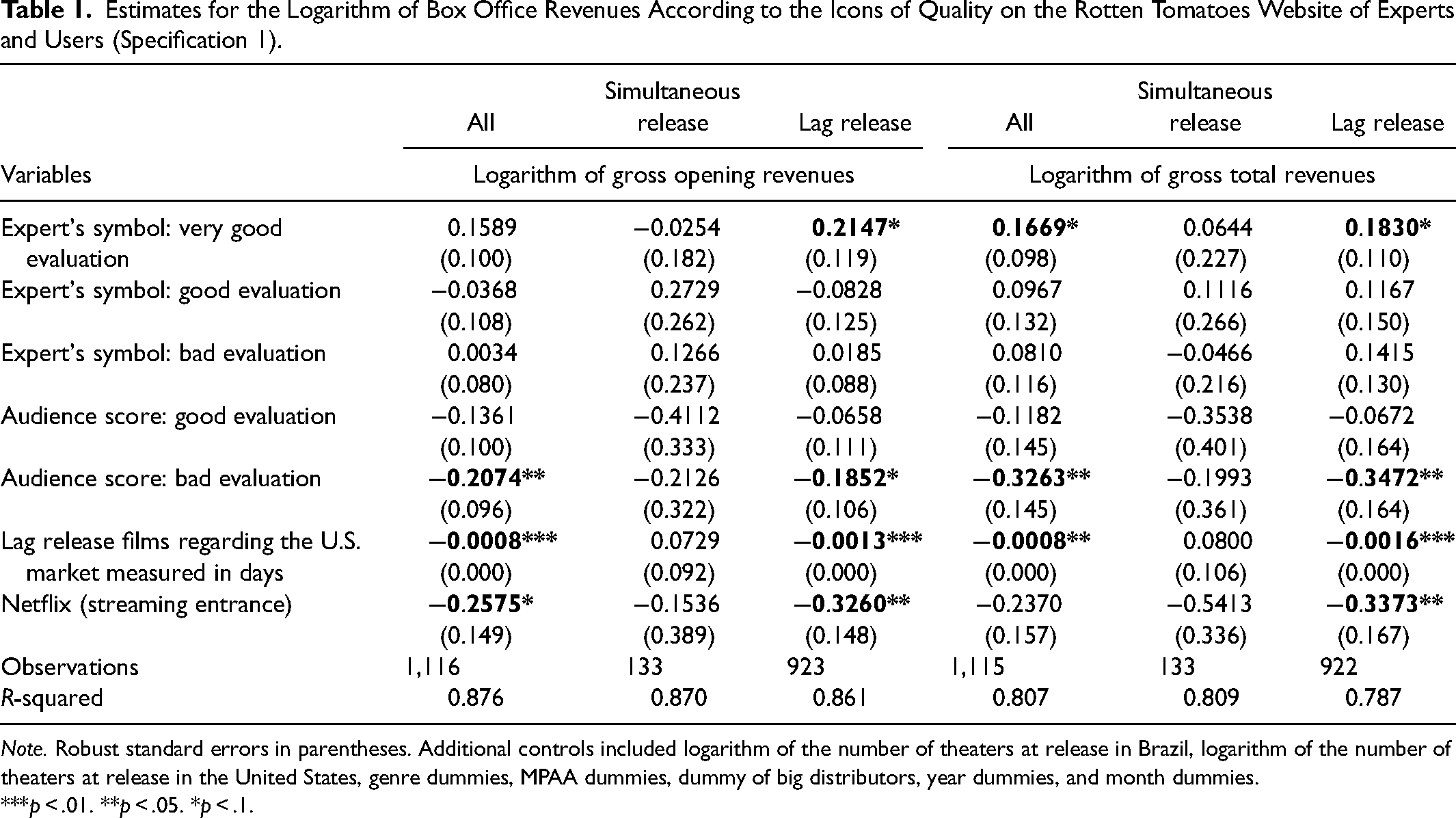
Note. Robust standard errors in parentheses. Additional controls included logarithm of the number of theaters at release in Brazil, logarithm of the number of theaters at release in the United States, genre dummies, MPAA dummies, dummy of big distributors, year dummies, and month dummies.
***p < .01. **p < .05. *p < .1.
The results show that for opening revenues (short-run measure) and total revenues (long-run measure), only films with a gap release (long run) are affected by expert reviewers—where an expert's very good evaluation increases the revenues—while no effect is found for films with simultaneous releases. The results are connected to prediction effects since they are related to lagged films, thus a long-run effect as posted by Eliashberg and Shugan (1997); the lagged film had a prediction effect due to the previous American film releases and previous expert reviews. Results using box office revenues (the last three columns of Table 1) confirm the prediction effect. The results of user reviews are coherent with Dalton and Leung (2017) and McKenzie and Walls (2016) regarding film information accumulation. Along with the experts’ reviews effect, Table 1 also shows significant consumers’ review effects but in the opposite direction; bad reviews affect negatively the films with gaps. This result agrees with the authors Duan et al. (2008), Chintagunta et al. (2010), and Lee and Choeh (2018), who argue that consumer criticism (or the WOM generated by it) has a great effect on box office performance.
Table 2 illustrates an alternative specification: the effects of the rating average of both expert and user reviewer grades for the same dependent variables, namely, the logarithm of opening revenues at the box office and the logarithm of box office revenues of films. Like the previous specification, the effect of expert ratings for the total sample is driven by the subsample of the release gap. In contrast, the total sample users’ rating is driven by the subsample that includes only simultaneous releases.
Estimates for the Logarithm of Box Office Revenues by the Rating Average of Both Experts and User Reviewers (Specification 2).
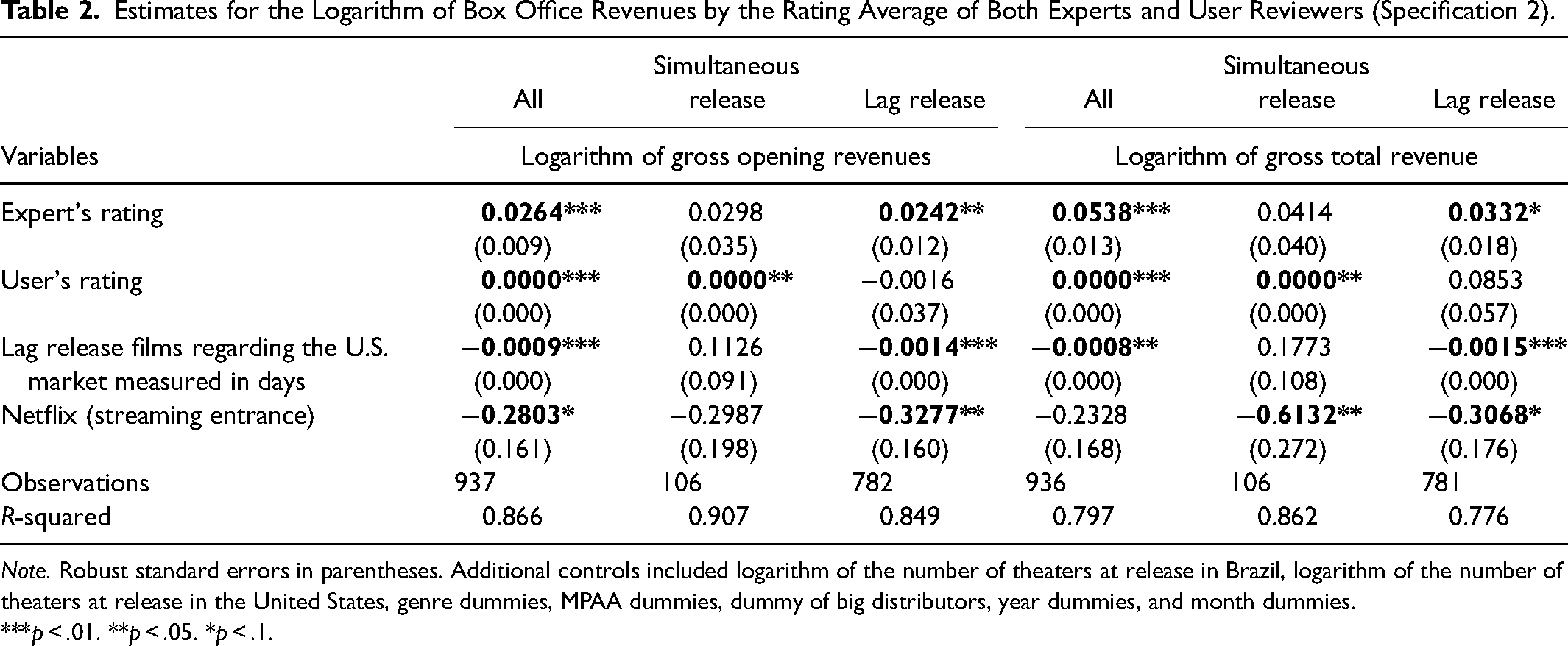
Note. Robust standard errors in parentheses. Additional controls included logarithm of the number of theaters at release in Brazil, logarithm of the number of theaters at release in the United States, genre dummies, MPAA dummies, dummy of big distributors, year dummies, and month dummies.
***p < .01. **p < .05. *p < .1.
Finally, Table 3 shows the estimates for review indices measured by the percentage of good evaluations in the total number of evaluations on the logarithm of opening revenues at the box office and the logarithm of the film revenues. In this case, again, the review effect, from consumer reviews, is driven by the films released with a gap, and it is stronger than the rating symbol provided by Rotten Tomatoes; the greater the percentage of users’ positive evaluations, the greater the positive effect on the financial performance of films with gaps in both the short run and the long run.
Estimates for the Logarithm of Box Office Revenues According to the Percentage of Good Evaluations in the Total of Evaluations of Experts and Users (Specification 3).
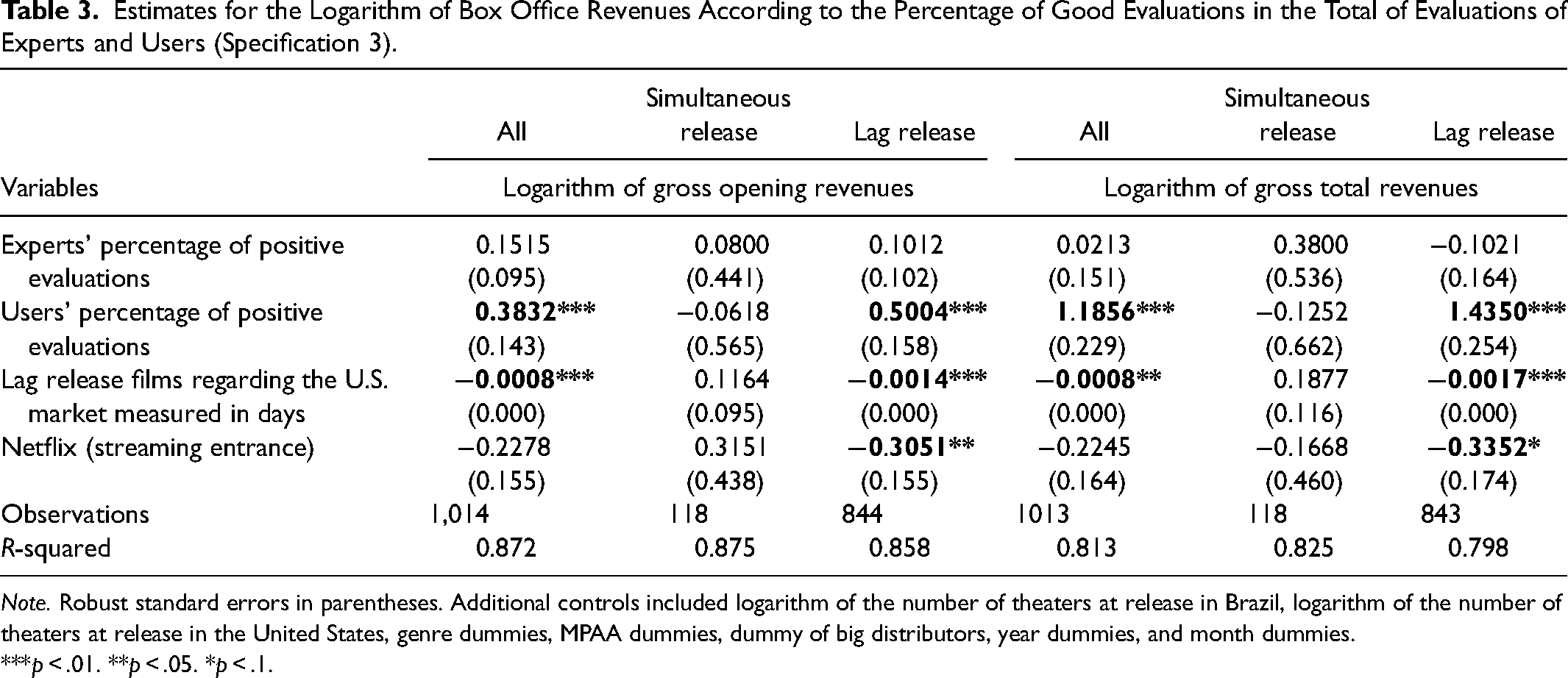
Note. Robust standard errors in parentheses. Additional controls included logarithm of the number of theaters at release in Brazil, logarithm of the number of theaters at release in the United States, genre dummies, MPAA dummies, dummy of big distributors, year dummies, and month dummies.
***p < .01. **p < .05. *p < .1.
Overall, our main results suggest a positive prediction effect (or a long-run effect) of the American experts, while no influence effect (short run) was documented. This result suggests that American experts’ preferences do not influence Brazil's consumption of widely released films, mostly exhibited in a simultaneous release.
The resulting prediction effect of experts just on the films with a gap release is connected to the fact that simultaneous film releases in Brazil are performed for wide openings in the United States. In this sense, our results for widely released films are similar to the findings of Reinstein and Snyder (2005), Gemser et al. (2007), and Souza et al. (2019). The authors find different effects of expert reviewers according to the film genre when a lower or null effect is associated with wide openings. On the other hand, we cannot study the influence effect for genres of limited releases in Brazil because these are exhibited in the country with lags, and in this case, we can learn only long-run effects.
Regarding the American WOM effect on the Brazilian film market, similar to Dalton and Leung (2017), we documented significance for both types of releases, simultaneous or gapped, suggesting both effects: the influence in wide/simultaneous releases and prediction in narrow/gapped releases.
Our analysis's very compelling marginal result is the one regarding how video streaming (Netflix) affects film consumption under the release gap in all of our specifications, where a robust negative effect is kept. For a simultaneous release, however, no effect is found, which suggests that a film release gap can cause film consumption reduction due to video streaming substitution. Netflix has been seen as a major rival of Hollywood productions, as shown by the recent buzz regarding the Oscars, for instance, with the film Roma in 2018 or 2019 Netflix productions nominees. In addition, many other streaming services have become available in the country. This result, added to a negative and significant estimate of the number of days of lag release on box office revenues, suggests that the gap reduction could mean an increase in film revenues.
Final Remarks
We study the effect of critic reviews of American experts on Brazilian consumption of films at theaters. Brazilians mainly consume films imported from the United States. Despite the recent change in the country's film-showing technology to digital, allowing more widespread worldwide simultaneous releases, release gaps are still a major part of Brazil's film releases. Thus, we considered this heterogeneity in the estimates, where a great part of films released in the country lags behind the U.S. releases by at least 1 week.
While in the United States the reviews are simultaneous to the films' releases, most of these films arrive later in Brazilian theaters, thus after the American reviews—except for the simultaneous film releases. In this sense, we could only relate the influence effect (short run) to the simultaneous film releases.
Our main result points to a positive effect of expert reviews on lagged film releases in Brazil, which means a prediction effect and not an influence effect since the last occurs only in the short run (Eliashberg & Shugan, 1997). When a film has a gapped release in Brazil, the consumers are incentivized to search for its quality information online—because it is already available in the American market—to help decide whether to go to the movies or not based on these reviews’ information. Dalton and Leung (2017) observe this search is a regular film consumer behavior. However, consumers are not necessarily influenced by reviews, as the reviews may only reflect the quality of the film if the consumption occurs more than a week after the information was disclosed, which is the case of films released with a gap in Brazil.
We did not get significant effects of American expert reviews on simultaneous film releases in Brazil, which are affected only by users’ ratings or not affected at all. These findings reflect that the films in simultaneous releases in Brazil, being the same as the wide releases in the United States, are not or hardly influenced by expert reviews (Eliashberg & Shugan, 1997; Reinstein & Snyder, 2005; Souza et al., 2019).
Note that because the films with a gap release in Brazil are almost the same films that are narrowly (or limited) released in the United States and the ones on simultaneous releases in Brazil are the same films in the wide releases in the American market, we can discuss our results as narrow and wide releases instead of gapped and simultaneous releases, respectively, regarding previous similar studies.
As discussed earlier, the widely released film (or a simultaneous release in Brazil) brings more information about its quality than the limited openings, such as high budget, famous stars, renowned directors, etc., that people know by tradition the good quality of this kind of film. Regarding narrowly released films, however, the method does not allow us to study the influence effect since these films are the gapped release films in Brazil, which means the American reviews are late relative to the country's openings in this case.
Regarding the user/consumer reviews, we find a predominantly positive effect on films released with a gap in line with Dalton and Leung (2017), who observe that WOM incentivizes a more prolonged gap release because it accumulates information about film quality. This prediction effect suggests that narrowly released films of good quality can take advantage of the consumer reviews (and of the expert reviews as well) to generate WOM (and publicity) as a good marketing strategy, making the film's quality known before its consumption. Furthermore, we also get a minimal positive consumer effect for short-run models (using opening revenues and simultaneous releases) or an influence effect, which is coherent with the evolution of ICT and WOM dissemination (Vujić & Zhang, 2018). Thus, we conclude that the American user reviews of films suggest a positive but limited influence on consumers abroad due to the real-time capacity to disseminate information throughout the Internet.
Finally, as a marginal result, the estimates indicate that the competition between films at theaters and films streamed operates just for films released with a gap. This result suggests that a film with a worldwide release is a different good compared with streaming videos, while a film released with a gap is a substitute good for it. Then, avoiding lag releases could increase the box office revenues of a film. In addition, the estimates for the number of days a film is a lag release in the USA suggest that the gap reduction tends to improve Brazil's box office revenues and reduce streaming audience. However, considering Brazilians’ very unequal spatial and economic access to films at theaters, streaming videos can represent an interesting alternative to broadening film access.
Footnotes
Appendix A
Variables and Sources.
| Variable | Obs. | Mean | Std. dev. | Min | Max | Source |
|---|---|---|---|---|---|---|
| Dependent variables | ||||||
| Logarithm of box office opening revenues deflated by the CPI | 1,650 | 12.44427 | 1.980303 | 4.3175 | 16.7632 | Box Office Mojo/IMF |
| Logarithm of box office revenues deflated by the CPI | 1,585 | 13.62781 | 1.985724 | 7.4961 | 18.0155 | Box Office Mojo/IMF |
| Critic review variables | ||||||
| Expert ratings | 1,364 | 5.356672 | 2.271187 | 0 | 9.2 | Rotten Tomatoes |
| User ratings | 1,178 | 38.8796 | 1,225.565 | 0 | 42,067 | Rotten Tomatoes |
| Experts’ symbol: very good evaluation | 1,652 | 0.2723971 | 0.4453279 | 0 | 1 | Rotten Tomatoes |
| Experts’ symbol: good evaluation | 1,652 | 0.3940678 | 0.4887975 | 0 | 1 | Rotten Tomatoes |
| Experts’ symbol: bad evaluation | 1,652 | 0.3486683 | 0.476693 | 0 | 1 | Rotten Tomatoes |
| Audience score: good evaluation | 1,652 | 0.4237288 | 0.4942981 | 0 | 1 | Rotten Tomatoes |
| Audience score: bad evaluation | 1,652 | 0.3589588 | 0.4798404 | 0 | 1 | Rotten Tomatoes |
| Expert's % of good evaluation | 1,264 | 0.5821982 | 0.2827339 | 0 | 1 | Rotten Tomatoes |
| User's % of good evaluation | 1,985 | 19.55053 | 29.96918 | 0 | 100 | Rotten Tomatoes |
| Control variables | ||||||
| Release gap in number of days | 1,826 | 93.96933 | 329.2183 | −4,267 | 7,133 | Box Office Mojo |
| Netflix (streaming entrance) | 1,652 | 0.5968523 | 0.4906785 | 0 | 1 | ANCINE |
| Logarithm of the number of theaters at release in Brazil | 1,589 | 4.573769 | 1.556306 | 0 | 7.38956 | Box Office Mojo |
| Logarithm of the number of theaters at release in the United States | 1,579 | 5.821557 | 3.048011 | 0 | 8.4047 | Box Office Mojo |
| Genre dummies | 1,652 | 0 | 1 | Box Office Mojo | ||
| MPAA dummies | 1,652 | 0 | 1 | Box Office Mojo | ||
| Dummy of big distributors | 1,652 | 0 | 1 | Box Office Mojo | ||
| Month release dummies | 1,652 | 0 | 1 | Box Office Mojo | ||
| Year dummies | 1,652 | 0 | 1 | Box Office Mojo | ||
Note. MPAA = Motion Picture Association of America; IMF = International Monetary Fund; ANCINE = The Brazilian National Film Agency; CPI = consumer price index.
Declaration of Conflicting Interests
The authors declared no potential conflicts of interest with respect to the research, authorship, and/or publication of this article.
Funding
The authors disclosed receipt of the following financial support for the research, authorship, and/or publication of this article: This work was supported by the Fundação de Amparo à Pesquisa do Estado de São Paulo (grant number 2018/02272-1), Conselho Nacional de Desenvolvimento Científico e Tecnológico Scholarship, and Coordenação de Aperfeiçoamento de Pessoal de Nível Superior Scholarship.
