



Abstract
Everyday objects have often been used in contemporary art since Marcel Duchamp introduced the concept of the ready-made. However, it is not clear how everyday objects are perceived in art contexts in comparison to everyday contexts. We investigated how individuals interpret pairings of images of everyday objects as artworks and as objects in everyday life. In Study 1, we found that participants evaluated pairings of unrelated images of objects as fitting together more under the art condition compared to the everyday condition. In Study 2, using the thought-listing technique, we found that participants ascribed symbolic meanings to everyday objects more often under the art condition. In Study 3, we found that associating unrelated images of objects under the art condition primes cognitive access to symbolic meanings of visual scenes. Overall, the studies show that everyday objects are interpreted differently in an art context as compared to an everyday context.
Introduction
In 2016, a teenager left a pair of glasses on the floor of San Francisco's Museum of Modern Art. Gallery visitors mistook them for an artwork: they gathered around, took photographs, and discussed the “artwork” (Moreno, 2016). Although this story is presented as a prank, it raises an interesting question: would people process everyday objects differently if they believed that the objects were artworks? How do we perceive a pair of glasses lying on the table in the living room as compared to perceiving the same pair of glasses lying on the floor of an art gallery, ostensibly as an exhibit?
Indeed, contemporary artworks sometimes cannot be easily distinguished from everyday objects. Many contemporary artists use everyday objects in their artworks. This feature of contemporary art is closely related to the concept of the ready-made, introduced by Marcel Duchamp. Duchamp believed that this concept is one of the most important ideas in his work (Daniels, 2019). A ready-made is an “unaesthetic object” (e.g., a chair, a banana) displayed as a work of art (Davies, 2015). As Duchamp explained: “An ordinary object [could be] elevated to the dignity of a work of art by the mere choice of an artist” (Breton & Duchamp, 1947).
The ready-made changed the way art was defined and is one of the most significant forms of contemporary art (Davies, 2015). Artists often use, modify, or combine everyday objects in their artworks (e.g., the works of Damien Hirst, Michael Landy, Tracey Emin, Man Ray, Robert Rauschenberg, Jeff Koons, Mark Dion). This may signify that presenting an everyday object as an artwork may change the way this object is interpreted. Nevertheless, there are few psychological studies investigating how everyday objects are processed as artworks.
Researchers who develop cognitive art-processing models suggest that art perception involves interaction between bottom-up and top-down processes (Leder, Belke, Oeberst, & Augustin, 2004; Pelowski, Markey, Forster, Gerger, & Leder, 2017). Bottom-up processes involve the processing of object properties (e.g., colors, lines, scenes), whereas top-down processing includes the impact of personality traits, knowledge, and context. Previous research investigated the role of context—namely, framing effects—in the perception of the artworks. Researchers suggest that art context (categorizing an object as an artwork) activates the art schema. The art schema is defined as a mental representation of what art is (Wagner, Menninghaus, Hanich, & Jacobsen, 2014). Researchers theorize that it impacts perceptual, cognitive, and emotional processing of artworks (Carroll, 2010). The art schema may affect how we perceive everyday objects and their characteristics, because it involves certain expectations about the artworks. These expectations involve focusing on formal aspects of the object, diverting one's attention from pragmatic meaning of an object, and expecting to experience aesthetic pleasure (Cacioppo, Larsen, Smith, & Berntson, 2004; Cupchik, Vartanian, Crawley, & Mikulis, 2009; Leder et al., 2004).
There is a growing interest in how the expectations of the viewer and the context of perception affect our engagement with art. Firstly, studies have found that labeling an artwork in a certain way (e.g., with titles suggesting a possible interpretation or explanation of the artwork; labeling an artwork as being from a prestigious museum; labeling a painting as human art vs as generated by a robot) can increase perceived meaningfulness and aesthetic appreciation (Cupchik, Shereck, & Spiegel, 1994; Kirk, Skov, Hulme, Christensen, & Zeki, 2009; Leder, Carbon, & Ripsas, 2006; Russell, 2003; Silveira, Fehse, Vedder, Elvers, & Hennig-Fast, 2015). Moreover, labeling images of repulsive objects as artworks also increases positive emotional experience of these images (Wagner et al., 2014).
Secondly, studies have found that museum vs laboratory context also affects engagement with art: photographs, sculptures and paintings displayed at the exhibition/museum are liked more compared to artworks presented in the laboratory (Brieber, Nadal, & Leder, 2015; Brieber, Nadal, Leder, & Rosenberg, 2014; Specker, Tinio, & van Elk, 2017). Emotional reactions to art are also more intense in museum context vs laboratory context (Specker et al., 2017).
In the majority of studies described above, actual artworks (e.g., paintings, sculpture) were used as stimuli. Even when presented as made by non-professional artists or robots, paintings, and sculptures are not everyday objects. In the present study, by contrast, we aim to use everyday objects as stimuli. Moreover, since the art schema affects not only how we feel about objects, but the way how we perceive and interpret them, we aim to understand how interpretation of everyday objects differs when they are labeled as artworks.
How might perception of an everyday object differ when it is labeled as an artwork? As mentioned above, the expectations related to art schema involve diverting one's attention from pragmatic qualities of an object. Possibly, figurative interpretations of objects in art context are more readily accessible as opposed to functional interpretations. Functional interpretations are interpretations related to the pragmatic functions of an object (e.g., a watch provides the time of day). They are “first-order” interpretations in the sense of engaging an object according to its immediate use, what Heidegger called its “readiness-to-hand” (Heidegger, 1962). Figurative interpretations are interpretations related to the symbolical or metaphorical resonances of an object (e.g., a watch symbolizes the passing of life). They are “second-order” interpretations in the sense of abstracting from an object's immediate use and placing that use in a wider network of associations, often one that links functional, emotional, and metaphysical spheres (e.g., a broken mirror evoking a shattering of self-knowledge).
There are many accounts of both “symbol” and “metaphor” in the psychological and philosophical literature (see e.g., Forceville, 2008; Lakoff & Johnson, 1980, 1999; Ortony, 1975). This paper deliberately refrains from adopting a particular theoretical approach to these terms (whether psychoanalytic, structuralist, or other), but treats them in more open-ended ways consonant with empirical research. Further conceptual work in this area emerges as a desideratum from our studies.
A figurative as opposed to functional interpretation of everyday objects in an art context can be illustrated with the following example. Imagine that you are watching David Lynch's television drama series Twin Peaks. You notice that on multiple occasions red curtains appear. You might ask yourself whether these curtains were included intentionally and, further, what their intention may have been. For example, you might think that the curtains are a symbol of the border between dream and reality, as similar curtains often appear in theatres. Now, imagine that you see similar red curtains in your friend's flat. It is unlikely that you would perceive the curtains as a symbol or metaphor.
One earlier study investigated the role of framing effects on artwork interpretation and found that viewers use metaphors when describing artworks, for example, “This creature represents the good in all mankind because the wings appear to be symbolic of an angel” (Cupchik et al., 1994). However, that study used actual artworks, not everyday objects, whereas in this study we are interested in the interpretation of everyday objects. We expect that in an art context, even everyday objects will be interpreted as bearing figurative meaning.
Various existing theories may help to explain or at least articulate the readier accessibility of figurative as opposed to functional interpretations in an art vs an everyday context. Philosopher Maria Brinker introduced the term “aesthetic affordances” (Brincker, 2015). In Brinker's theory, aesthetic affordances are affordances that do not imply action: it is not possible to eat a banana in a painting. Moreover, a real banana appearing in an artwork, e.g., Maurizio Cattelan's Comedian (2019), also usually does not afford grasping and eating. Instead, aesthetic affordances allow a perceiver to behold (to observe or photograph).
Although this theory is intriguing, it is unclear how this disengagement from action affects our perception of everyday objects. Differential salience of these objects’ characteristics or functions is one possible explanation. That is, characteristics of objects which are less salient in everyday life may become more salient in an art context. Everyday objects have many characteristics and functions, but some of them are more salient to us than others. For example, the main characteristic of a book is that it contains text we can read. If we encounter a book in everyday life, this characteristic will generally be the most salient. However, a book has other characteristics as well. It can be used, for example, as a paperweight or to hit someone. These characteristics can become more salient, but only in particular situations, for example, when you need to keep a stack of papers from blowing on the floor in a draughty room, or hear suspicious sounds in the middle of the night and want to protect yourself from intruders.
It is thus possible that placement in an art context may change the salience of everyday objects’ characteristics. Characteristics that are less salient in everyday life can become more salient in an art context. Studies have found that priming creativity (e.g., via mindset manipulation: describing situations where one has behaved creatively) increases remote associations between objects (the word “sea” is more likely to activate “quiet,” “window” is more likely to activate “bright”) and decreases close associations (“silence” is less likely to activate “quiet”; “light” is less likely to activate “bright” (Sassenberg, Moskowitz, Fetterman, & Kessler, 2017). It is possible that within an art context (e.g., a gallery or museum), people would be more inclined to detect less salient characteristics of everyday objects and to expect them more. When observing a banana in an art gallery, we do not pay attention to its affordance of being grasped and eaten. Instead, we might detect other affordances which are hidden from us when we perceive that same object in everyday life. Earlier research found that, unlike with everyday objects, evaluation and preference of art objects are related to higher ambiguity, originality, and lower understanding (Haertel & Carbon, 2014).
However, if differential salience forms part of an explanation of the different ways in which we interpret everyday objects in an everyday and an art context, it must take into account that most figurative interpretations rely on precisely those object characteristics which tend to be most salient in everyday contexts. Art contexts therefore differ from other contexts in which creativity is at play, such as an inventor's workshop or a scene of conflict. For example, to an inventor or someone defending themselves from intruders, the fabric or weight of a book, which is less relevant to its ordinary affordance of reading, may become salient. By contrast, an artwork such as Jorge Mendez Blake's The Castle (2007), which shows a book embedded in a brick wall, makes use of both ordinarily non-salient characteristics such as bulk and ordinary affordances such as reading. The artwork shows a book bricked into the base of the wall, thus causing a disruption of the wall's foundation. In this case, the book can be interpreted as a symbol of free thought. This affordance of reading, although not ready-to-hand, is nevertheless key to the artist's figurative use of the object. Similarly, as Heidegger's famous reading of Vincent van Gogh's peasant boots shows, art often intends precisely to recall us to, or intensify, the common salience of an object (Heidegger, 2008).
Previous research showed that engagement with art affects cognition in everyday life. Engaging with literature and cinema enhances our theory of mind (Castano, 2021; Dodell-Feder & Tamir, 2018; Kidd & Castano, 2013). If placement within an art context affects the way we perceive everyday objects (activates remote associations between objects and increases the salience of their symbolic meanings), this placement may prime the tendency to interpret real life visual scenes in a certain way. In this study, we expect that engaging with everyday objects in an art context will prime the tendency to interpret visual scenes symbolically rather than literally.
Interpretation of everyday objects in an art context can also be affected by individual differences. In this paper, we investigate the role of individual differences in need for cognition, need for affect, and attitudes toward contemporary art. Need for cognition is an individual's tendency to engage in and enjoy complex tasks (Cacioppo & Petty, 1982). Since need for cognition has been shown to be positively related to cognitive innovativeness, metacognitive processing, and creative problem solving, it is possible that it moderates the effect of context (art vs everyday) in the perception of everyday objects (Cacioppo, Petty, Feinstein, & Jarvis, 1996; Petty, Brinõl, Loersch, & McCaslin, 2009; Watts, Steele, & Song, 2017). Individuals with high need for cognition might detect more characteristics of everyday objects, including their figurative meaning. Need for affect is a personality trait related to a strong disposition to approach or avoid emotion-inducing situations (Maio & Esses, 2001). It correlates positively with need for cognition and openness to experience (Maio & Esses, 2001). Moreover, it facilitates engagement with art fiction (transportation experience while reading a fictional narrative; Appel & Richter, 2010). Individuals with high need for affect might detect more characteristics of everyday objects compared to individuals with low need for affect. Finally, attitudes toward contemporary art might also moderate the effect of context (art vs everyday) in the interpretation of everyday objects. Individuals who enjoy contemporary art (which often involves ready-made objects) might detect more characteristics of everyday objects, including their symbolic meaning, compared to individuals with negative attitudes toward contemporary art.
To investigate how people perceive characteristics of objects in art and non-art (everyday) contexts, in these studies we presented different objects in related and unrelated pairs. Related pairs consist of two objects that are functionally related, i.e., share pragmatic affordances. For example, images of a toothbrush and of toothpaste form a closely related pair, because they both afford cleaning teeth and serve the function of dental hygiene. Unrelated pairs of images consist of two objects which are not functionally related, i.e., do not share pragmatic affordances. For example, images of ballet shoes and of tools form an unrelated pair. When viewing unrelated images as artworks, people may evaluate them as fitting together more because some characteristics of these objects will be more salient in an art condition compared to a non-art (everyday) condition.
Finally, we investigated how placement within an art context primes the tendency to interpret visual scenes symbolically rather than literally. Participants were first asked to associate unrelated pairs of images in art and everyday contexts and then to describe the meaning of short visual scenes presented to them. We expected that the symbolical meanings of visual scenes could be more accessible in the art condition as compared to the everyday condition.
Study 1
Study 1 investigated associations between images depicting different objects in art and non-art (everyday) perceptual contexts. Participants were randomly assigned to two groups: the art group were told they would see artworks; the everyday group were told they would see images of everyday objects. In both groups, participants were asked to evaluate how strongly the images were associated with each other. We hypothesized that in an art context participants would perceive unrelated pairings of images as more strongly associated with each other compared to the participants viewing them in an everyday context. To investigate the role of individual differences which might moderate this effect, we tested the moderating role of need for affect, need for cognition, and attitudes toward contemporary art.
Participants
Prior to the main study, we ran a pilot study to determine the effect size. Fifteen participants were randomly assigned to the art condition, and 15 participants to the everyday condition. Unrelated images were evaluated as fitting together more in the art condition compared to the everyday condition, t(28) = 2.72, p = .011, Cohen's d = 1.00. No differences were found in related images between conditions, t(28) = 1.47, p = .152, d = .054. Power analysis, conducted in line with Westfall, Kenny, and Judd (2014) recommendations for mixed models, indicated the required sample size was at least 109 participants for a linear mixed model with participants-within-condition design, a medium effect d = 0.51, a power of .85, and a total number of stimuli = 24.
One hundred eighty participants were recruited on Prolific, a platform for online research. They received compensation (2£) for their participation. The following strategy was used to ensure high data quality. Participants who completed the study too fast (less than 3 min or < -1SD) were excluded (1 participant), as were participants who completed the study too slowly (more than 30 min or >+2SD; 3 participants). Two participants were excluded for less reliable random answering behavior (they misinterpreted the instruction and evaluated unrelated images as associated more than closely related images). The final sample included 175 participants from 18 to 71 years old (Mage = 34.72, SD = 12.38, 112 females, 59 males, 4 non-binary, 1 did not report gender). Eighty-four participants were randomly assigned to the art condition. Ninety-one participants were randomly assigned to the everyday condition.
Procedure
The study was conducted on the survey platform Qualtrics (Qualtrics, 2019). The average completion time was 10 min. Participants were asked to evaluate how well each of 24 pairs of images fit together on a scale from 1 (not at all) to 10 (very much). Participants were randomly assigned to two groups. In the art condition, they received the following instructions: You will see a set of images made by a professional artist. They were exhibited in a contemporary art gallery several years ago during the exhibition “The Art of the Everyday: Objects from Daily Life.” You are going to see these images in pairs: two images at the same time on the screen. Please look attentively and evaluate how much these images fit together.
Participants randomly assigned to the everyday condition received the following instructions: You will see a set of images made by people who wish to sell used items online. They photographed the items and uploaded the images on a website. You are going to see these images in pairs: two images at the same time on the screen. Please look attentively and evaluate how much these images fit together.
Twelve closely related and 12 unrelated pairs of images (e.g., see Figure 1) were presented in a random order. Initially, 84 images of different objects were selected on the website https://www.avito.ru, a popular classifieds website where people buy and sell general goods. To ensure that the images could be believably presented both as artworks and as photographs made by people who wish to sell items online, we conducted a pilot study. Forty participants who did not take part in the main study were recruited on Prolific to evaluate these images. They were asked “Is this image exhibited in a contemporary art gallery?” and replied on a scale from 1 (definitely not) to 4 (definitely yes). Another 40 participants were asked “Is this image realistic?” and replied on a scale from 1 (definitely not) to 4 (definitely yes). All images were evaluated as realistic (>2, M = 3.02, SD = 0.31). Twenty images were evaluated as not being exhibited in a contemporary art gallery (<2, M = 1.79, SD = 0.17). Sixty-three images were included in the main task (>2, M = 2.31, SD = 0.29).
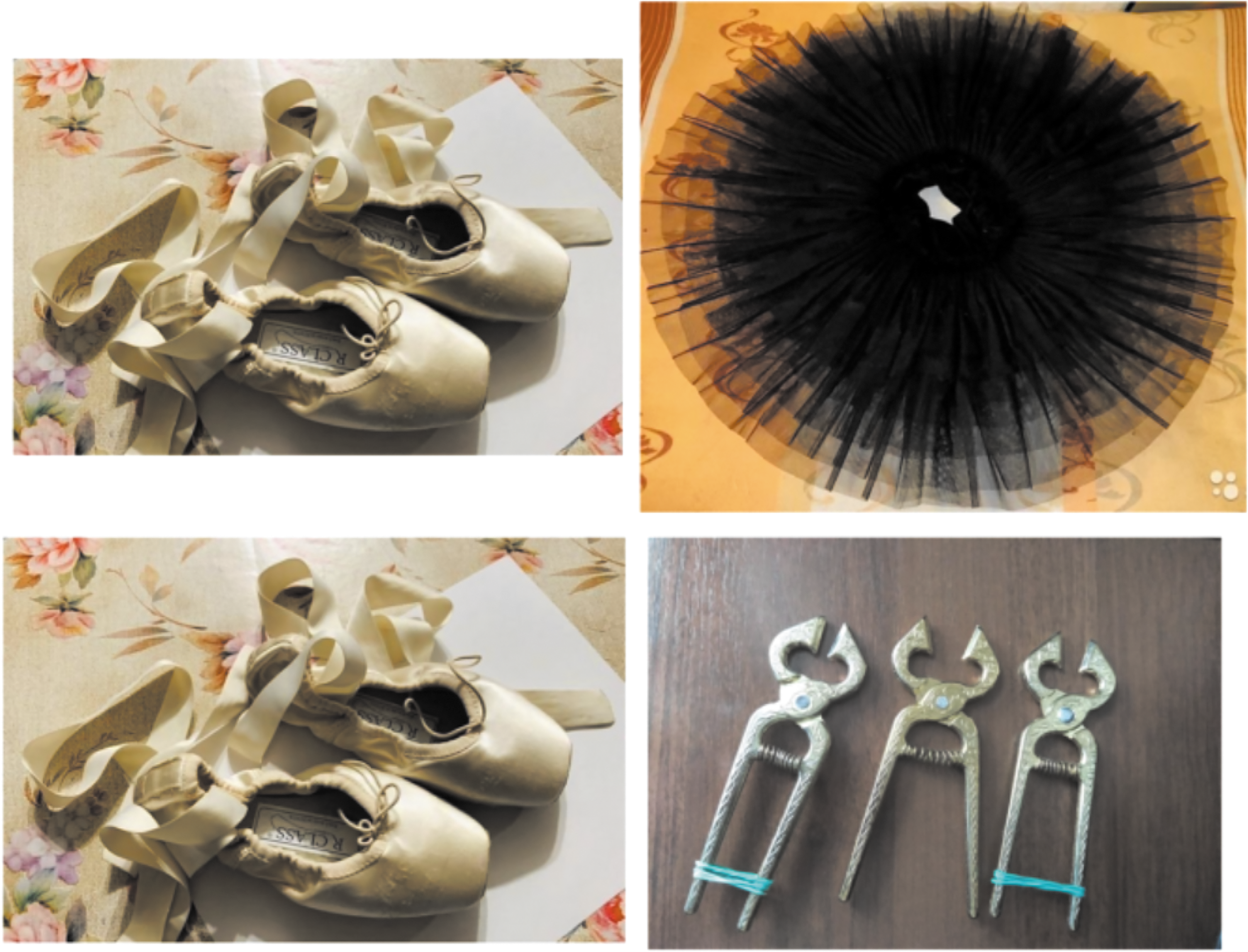
Closely related pair of images (top, ballet shoes and a ballet tutu/skirt) and unrelated pair of images (bottom, ballet shoes and a set of pliers).
For the main task we created 24 pairs of closely related images, i.e., images semantically related to each other (e.g., a cup and a plate, a key and a lock), and 24 pairs of unrelated images, i.e., unrelated or remotely related images (e.g., a frame and a TV, pencils and needles; see Figure 1). Each image was presented once, either in a closely related or in an unrelated pair. Half of the participants evaluated 12 closely related and 12 unrelated pairs, the other half the remaining 12 closely related and 12 unrelated pairs (see Appendix). Participants in both conditions evaluated the same images.
After completing the main task, participants completed the need for affect and need for cognition questionnaires. The six-item need for cognition scale was used to measure individual differences in need for cognition (NCS-6, Lins De Holanda Coelho, Hanel, & Wolf, 2020). Participants evaluated six items (e.g., “I would prefer complex to simple problems”) on a scale from 1 (extremely uncharacteristic of me) to 4 (extremely characteristic of me), Cronbach's alpha = .85. Participants completed a short measure of the need for affect (NFA, Appel, Gnambs, & Maio, 2012). They evaluated 10 items (e.g., “I feel I need to experience strong emotions regularly”) on a scale from −3 (strongly disagree) to 3 (strongly agree), Cronbach's alpha = .84. Finally, participants were asked whether they liked contemporary art, whether they understood contemporary art, and whether they went to contemporary art exhibitions. All three statements were evaluated on a 7-point scale (1-not at all, 7-very much). The three items were collapsed into one index of attitudes toward contemporary art (Cronbach's alpha = .82).
Results
Mixed effects modeling was used for analysis because it enables to estimate between-participant (art vs everyday condition) and within-participant (closely related vs unrelated images) main effects while taking into account the random variance associated with differences between participants and items (Baayen, Davidson, & Bates, 2008). The model was calculated using the lme4 package for Linear Mixed Effects (Bates, Mächler, Bolker, & Walker, 2015) in R (R Core Development Team, 2021).
In our model, we had two fixed effects: condition (art vs everyday) and image congruency (closely related vs unrelated pairs of images). We included condition and image congruency as fixed effects, as well as their interactions. These factors were contrast-coded according to West, Aiken, and Krull (1996) to ensure the interpretability of the estimates as differences between the group means. Participants in the art condition received a value of +0.5, participants in the everyday condition received a value of −0.5. Closely related images received a value of +0.5, unrelated images received a value of −0.5. Random effects in our model were associated with differences between the participants and the images.
To determine a model with best fit, we calculated the Bayesian Information Criterion (BIC) and the Akaike Information Criterion (AIC) for each model described below. The first version of the model included random effects of participants and images only on the intercept. The second version of the model included random effects of participants on both intercept and slopes (by image congruency), but random effects of images only on the intercept. The third version of the model included random effects of images on both intercept and slopes (by condition), but random effects of participants only on the intercept. Finally, the fourth version of the model included random effects of images on both intercept and slopes (by condition) and random effects of participants on both intercept and slopes (by image congruency). All models included the fixed effects of condition, image congruency and their interaction. BIC and AIC were smaller for the second version of the model, indicating a better model fit (see Table 1).
Association Strength as a Function of Condition and Image Congruency in Study 1.
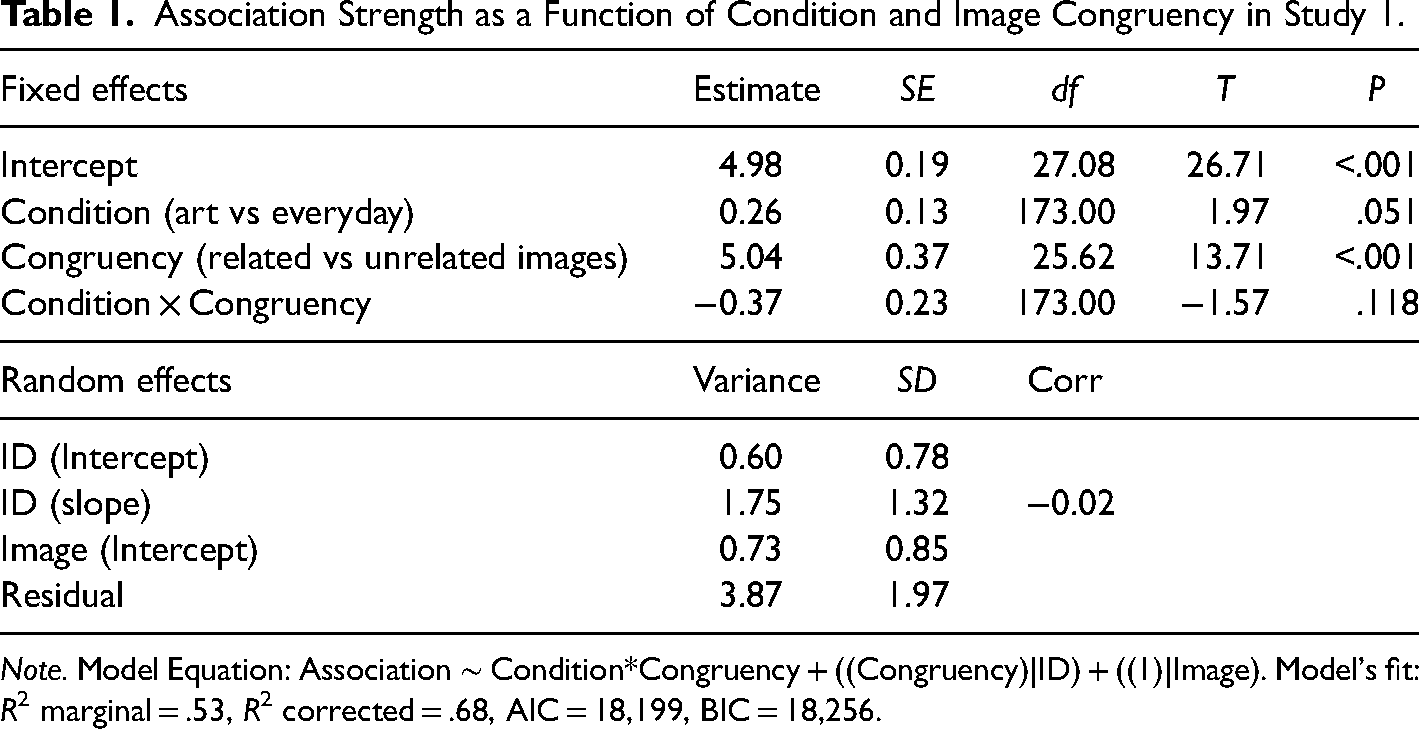
Note. Model Equation: Association ∼ Condition*Congruency + ((Congruency)|ID) + ((1)|Image). Model's fit: R2 marginal = .53, R2 corrected = .68, AIC = 18,199, BIC = 18,256.
Image congruency increased evaluation of images as fitting together more (see Table 1). Art (vs everyday) condition increased evaluation of images as fitting together more, although marginally. Since we were particularly interested in evaluation of unrelated images, we conducted planned comparisons between conditions (art vs everyday) and found that unrelated images were evaluated as fitting together more in the art condition compared to the everyday condition, estimate = 0.22, SE = 0.09, df = 2.50, p = 0.013 (see Table 2 for descriptive statistics). Among related images, no such effect was found between conditions, p = .661.
Descriptive Statistics in Study 1.
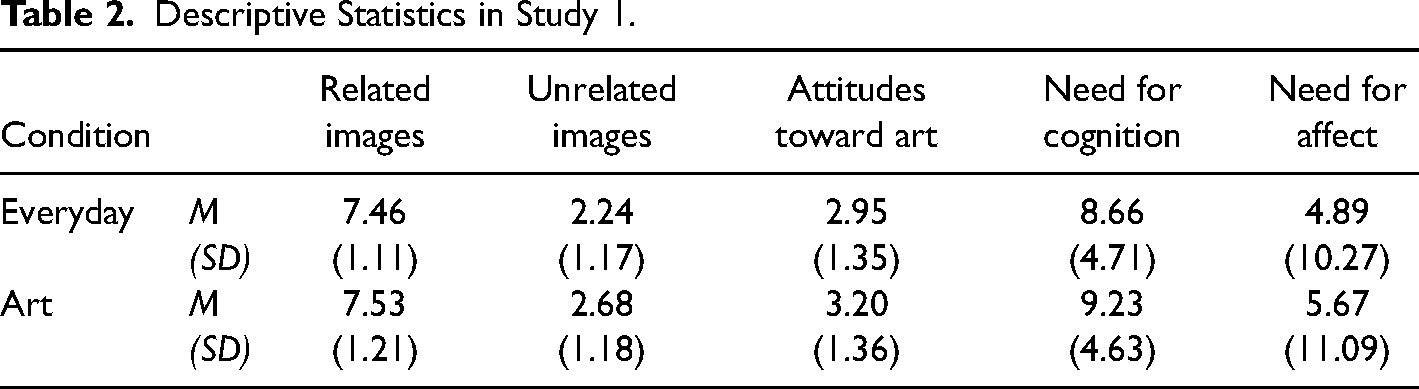
We also tested how attitudes toward contemporary art, need for affect, and need for cognition moderate the above-described effects, using mixed model analysis in lme4 package (Bates et al., 2015). No significant moderation effects were found, ps > .254.
Discussion
Study 1 was conducted to investigate associations between images depicting different objects in art and everyday perceptual contexts. As expected, participants evaluated unrelated images as associated with each other more strongly in the art context compared to the everyday context. This suggests that remote associations between objects (e.g., an empty picture frame and a pair of glasses; a pram and a lamp) are stronger in art contexts compared to everyday contexts. Interestingly, this effect was not moderated by individual differences in need for affect, need for cognition, and attitudes toward contemporary art. This might signify that the effect is universal and independent of these individual differences.
It is important to understand the mechanism which underlies the effect we described. It is possible that the number of associations between unrelated objects is larger in an art context. For instance, if we had asked participants in the art condition to write down reasons why unrelated images might fit together well, they might have given more reasons for unrelated pairs fitting together than would participants in the everyday condition. However, it is also possible that not the quantity of associations, but their quality is responsible for this effect.
Study 2
Study 2 was conducted to investigate why unrelated images are associated more strongly in an art context as compared to an everyday context. The aim of the study was to test the hypothesis that symbolic meanings of objects are more salient in an art context compared to an everyday context. Because need for cognition and positive attitudes toward art can increase the cognitive accessibility of metaphors, we included these as moderators.
Participants
Power analysis, conducted in G*Power (Faul, Erdfelder, Lang, & Buchner, 2007), indicated that a minimal sample size of 80 people was necessary to investigate differences between two independent groups with a repeated measures ANOVA with a medium effect size and power = 0.85. One hundred and sixty-five participants were recruited on Prolific. They received compensation (2.5£) for their participation. Nine participants were excluded because they did not complete the task. One participant was excluded for misinterpreting the instructions. The final sample included 155 participants from 18 to 74 years old (Mage = 31.75, SD = 12.73, 121 females, 32 males, 2 non-binary). Seventy-five participants were randomly assigned to the everyday condition, and 80 participants to the art condition.
Procedure
The study was conducted on the survey platform Qualtrics (Qualtrics, 2019). The average completion time was 20 min. Participants were randomly assigned to the art and everyday conditions. In both conditions, participants were asked to view 14 unrelated pairs of images (randomly selected from Study 1 materials) and describe them. Participants in the art condition received the following instructions: You are going to see a set of images, made by a professional artist. They were exhibited in a contemporary art museum during the exhibition “The Art of the Everyday: Objects from Daily Life.” You are going to see these images in pairs: two images at the same time on the screen.
Participants in the everyday condition received the following instructions: You are going to see a set of images, made by people who wish to sell used items online. They photograph the items and upload the images on a website. You are going to see these images in pairs: two images at the same time on the screen.
Participants were asked to describe these images. We used the thought-listing technique (Cacioppo, von Hippel, & Ernst, 1997) with the following instructions for this task: Your task is to describe how these images fit together. Please list your ideas whether they were positive, neutral, and/or negative. Any case is fine. Ignore spelling, grammar, and punctuation. We have deliberately provided more space than we think people will need, to ensure that everyone would have plenty of room. Please be completely honest. Your responses will be anonymous. Simply write down the first thought you had in the first box, the second in the second box, etc. Please put only one idea or thought in a box.
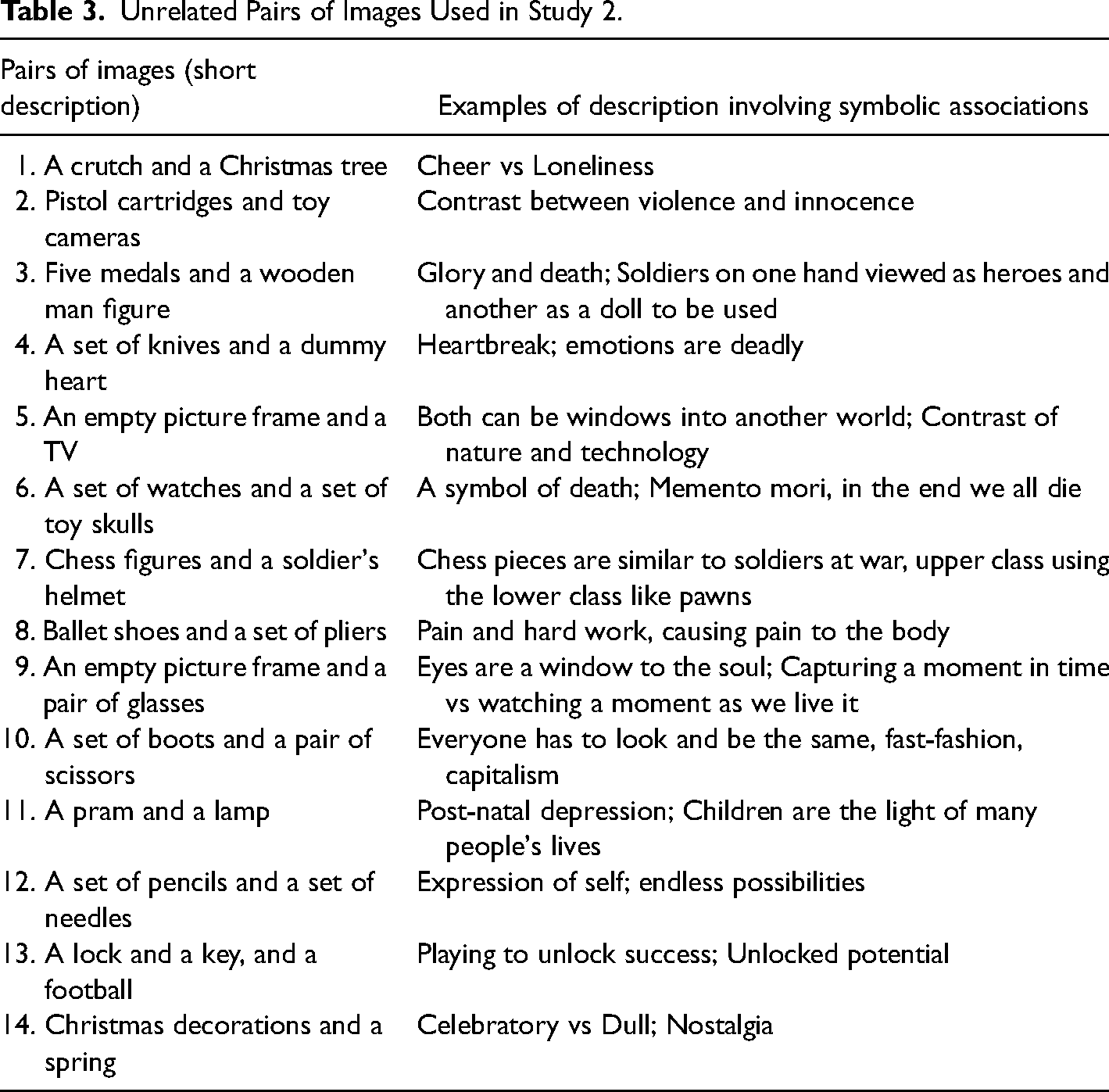
We calculated the number of thoughts, listed by participants in both groups. We also calculated the number of symbolic associations (associating objects with figurative meanings instead of describing objects’ functional meanings) used by participants when describing the images. The minimum number of symbolic associations per participant per image was 0, while the maximum was 10. One coder (a psychologist), blind to the participant's condition, evaluated each listed thought as containing a symbolic meaning (1) or not (0); see Table 3 for examples.
Unrelated Pairs of Images Used in Study 2.
The time for each trial was not limited. The pairs of images were presented in a randomized order between participants. After this task, participants were asked to complete the need for cognition and attitudes toward art scales. The six-item need for cognition scale was used to measure individual differences in need for cognition (NCS-6, Lins de Holanda Coelho et al., 2020). Participants evaluated six items (e.g., “I would prefer complex to simple problems”) on a scale from 1 (extremely uncharacteristic of me) to 5 (extremely characteristic of me), Cronbach's alpha = .84. To measure attitudes toward art, participants were asked whether they liked contemporary art (1-not at all, 7-very much), whether they understood contemporary art, and whether they went to contemporary art exhibitions. These three items were collapsed into one index of attitudes toward contemporary art (Cronbach's alpha = .88).
Results
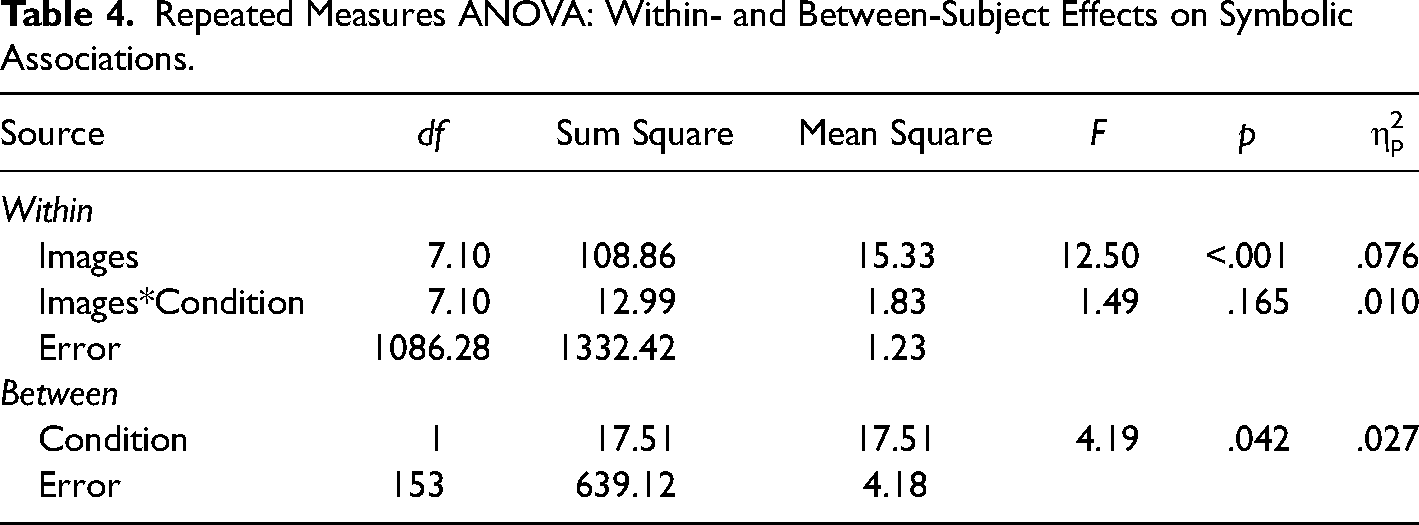
A repeated measures ANOVA with Greenhouse-Geisser correction was conducted to investigate symbolic associations in the art vs everyday conditions 1 . Images were entered as a within-participants factor with 14 levels, condition (art vs everyday) was entered as a between-participants factor. Condition was contrast-coded: participants in the art condition received a value of +0.5, participants in the everyday condition received a value of −0.5. As seen in Table 4, condition significantly increased the total number of symbolic associations. That is, participants in the art condition reported more symbolic associations than participants in the everyday condition (see Table 5 for descriptive statistics).
Repeated Measures ANOVA: Within- and Between-Subject Effects on Symbolic Associations.
Descriptive Statistics in Study 2.
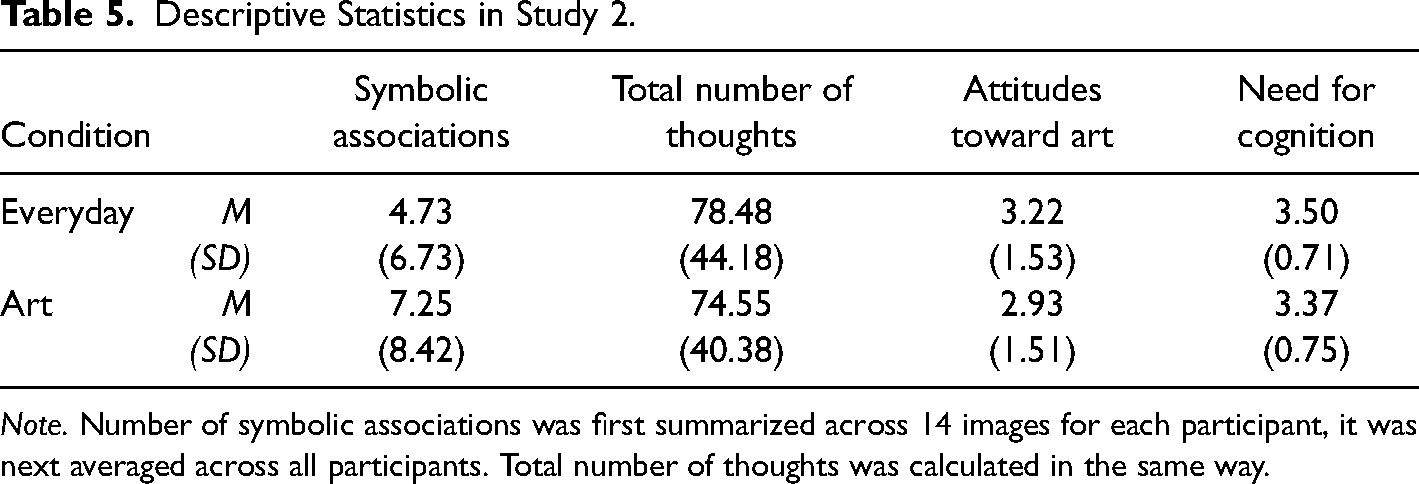
Note. Number of symbolic associations was first summarized across 14 images for each participant, it was next averaged across all participants. Total number of thoughts was calculated in the same way.
A similar repeated measures ANOVA model was built to compare the total number of thoughts listed by participants in the art vs everyday conditions. No significant difference was found in the total number of thoughts between conditions, p = .564.
We next tested how attitudes toward contemporary art and need for cognition moderate the above-described effect, using PROCESS software for SPSS (Model 1; Hayes, 2012). No significant moderation effects of attitudes and need for cognition on links between condition and number of symbolic associations were found, ps > .486. The moderation effects of attitudes and need for cognition on links between condition and number of thoughts were not significant either, ps > .259.
Discussion
Study 2 was conducted to test the hypothesis that individuals would use more symbols when interpreting unrelated pairings of objects in an art context than in an everyday context. It was found that symbolic meanings are used more often when describing unrelated pairings of images in an art context than in an everyday context. This finding can partly explain why, in Study 1, participants in the art condition evaluated unrelated pairings as associated more strongly compared to participants in the everyday condition. If symbolic meanings of objects are more cognitively accessible for individuals in an art context, this might increase the perceived links between these objects. This, however, does not mean that other factors are not responsible for this effect.
In line with Study 1, the observed effect in Study 2 was not moderated by individual differences in need for cognition and attitudes toward contemporary art. Possibly, the use of symbols in art vs everyday contexts is relatively universal among different people or moderated by other personality traits.
Study 3
Study 2 investigated how associating unrelated pairs of images in art and everyday contexts primes cognitive accessibility of symbolic meanings of objects. Study 3 tested the hypothesis that in an art context unrelated images prime the salience of symbolic meanings of visual scenes that are not specified as either art or everyday scenes.
Participants
Power analysis, conducted in G*Power (Faul et al., 2007), indicated that a minimal sample size of 80 people was necessary to investigate differences between two independent groups with a repeated measures ANOVA with a medium effect size and power = 0.85. One hundred ninety-one participants took part in this study. The study was conducted online on Prolific. Participants were compensated (2.5£). Participants were randomly assigned to art and everyday conditions. Twelve participants were excluded because they did not complete the study. The final sample included 179 participants from 18 to 68 years old (Mage = 33.77, SD = 13.06, 80 females, 97 males, 2 non-binary). Ninety-one participants were randomly assigned to the art condition, and 88 participants were randomly assigned to the everyday condition.
Materials
In the manipulation task, participants were asked to evaluate the strength of association for each of 14 pairs of images. These images included only unrelated pairs of images from previous studies (Studies 1 and 2). Participants were asked to evaluate how well the images fit together on a scale from 1 (not at all) to 10 (very much).
Participants in the art condition received the following instructions: You are going to see a set of images, made by a professional artist. They were exhibited in a contemporary art museum during the exhibition “The Art of the Everyday: Objects from Daily Life.” You are going to see these images in pairs: two images at the same time on the screen. Please look attentively and evaluate how much these images fit together. There are 14 pairs of images.
Participants in the everyday condition received the following instructions: You are going to see a set of images, made by people who wish to sell used items online. They photograph the items and upload the images on a website. You are going to see these images in pairs: two images at the same time on the screen. Please look attentively and evaluate how much these images fit together. There are 14 pairs of images.
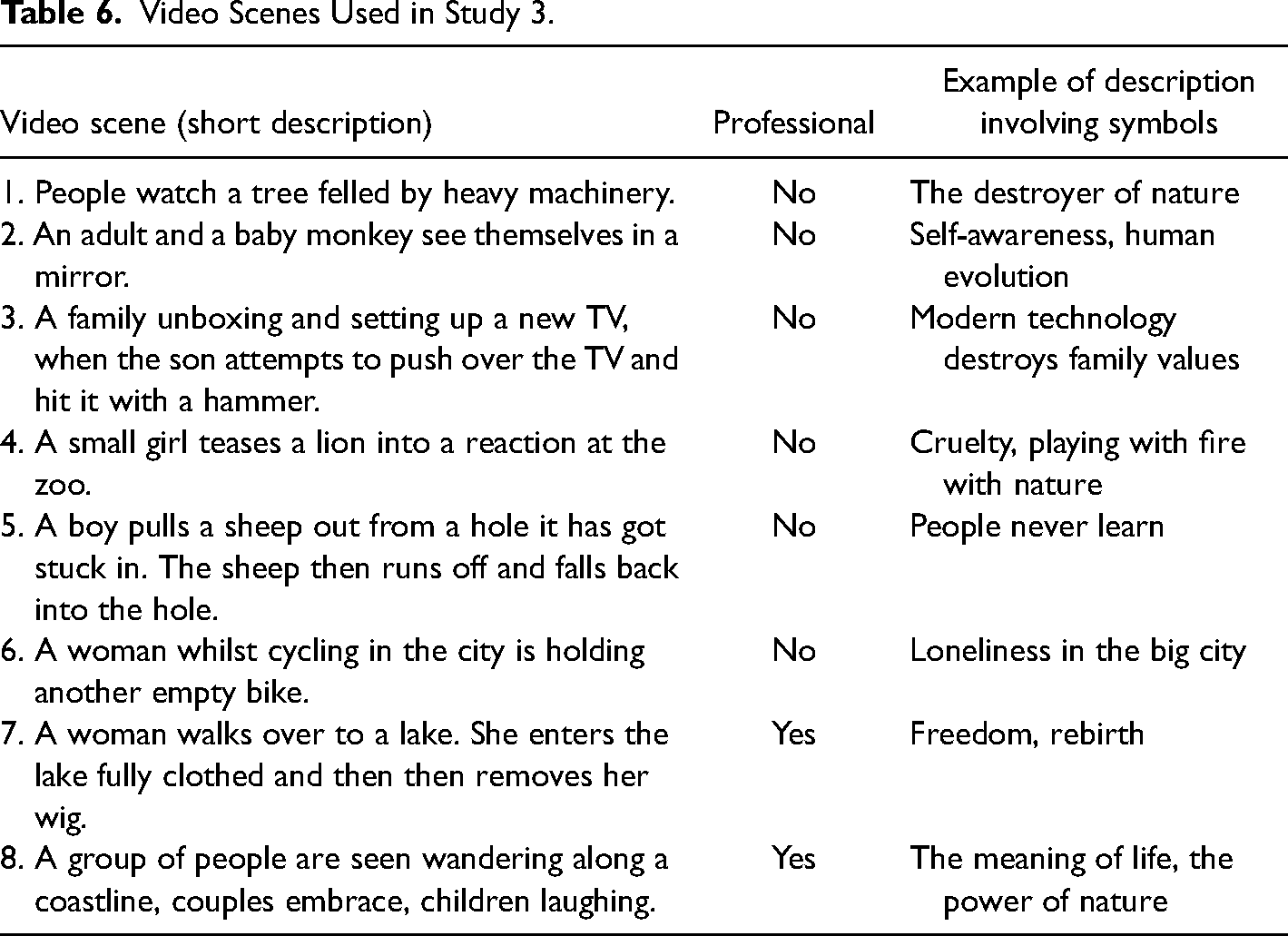
After this manipulation, we measured the cognitive accessibility of symbols in visual scenes. We selected six short videos (<1 min) on YouTube (see Table 6). These videos were made by non-professionals and were not artworks. They were selected because they could be perceived either literally or symbolically. A pilot study was conducted with a separate group of participants (N = 80) to ensure that these videos could be perceived both literally and symbolically. We also included two movie scenes made by professional artists: Terrence Malick's The Tree of Life (2011) and Maria Schrader's Unorthodox (2020) 2 . These scenes were selected because they can be perceived literally as well as symbolically, but also because they use artistic techniques which may increase the cognitive accessibility of symbols (e.g., music, sequencing of shots). Participants in the pilot study were asked to briefly describe the videos. For each video, at least one symbolic meaning was evoked in the pilot study.
Video Scenes Used in Study 3.
In the main study, participants in both conditions received the following instructions: “In the next task you will see 8 short videos (approx. 1 min each). You will be asked to title each video and briefly describe it. Please, turn on your audio.”
Participants watched each video and were asked to suggest a title for the video and to briefly describe it. Since Study 2 showed no differences in the number of associations, we were not interested in the number of symbolic meanings per video. Instead, we were interested in how many videos would be interpreted symbolically, regardless of the number of perceived symbols per video. Each video was coded either 0 points (no symbols were used in the description of the video) or 1 point (at least one symbol was used in the description of the video). Each participant's score varied from 0 points (no videos described using symbols) to 8 points (8 videos described using symbols).
Finally, we also measured attitudes toward contemporary art, since this can moderate the effect of manipulation on cognitive accessibility of symbols. Participants were asked to evaluate three items (“I like contemporary art,” “I understand contemporary art,” “Usually I often go to contemporary art exhibitions”) on a scale from 1 (not at all) to 7 (very much). These items were collapsed into one index for further analysis (Cronbach's alpha = 0.86).
Procedure
The study was conducted on the survey platform Qualtrics (Qualtrics, 2019). The average completion time was 20 min. All participants completed the manipulation task, including 14 trials. The order of trials was counter-balanced between participants. Next, participants were informed that they had completed the task and that next they would complete a separate task involving the evaluation of videos. Eight videos were displayed. Six videos collected from YouTube were presented first and were counter-balanced between participants. Next, the two remaining videos—film scenes—were also shown in a randomized order between participants. This randomized ordering allowed us to show both non-professional and professional videos (film scenes) and avoid priming participants with professional film clips. Finally, participants reported their attitudes toward contemporary art.
Results
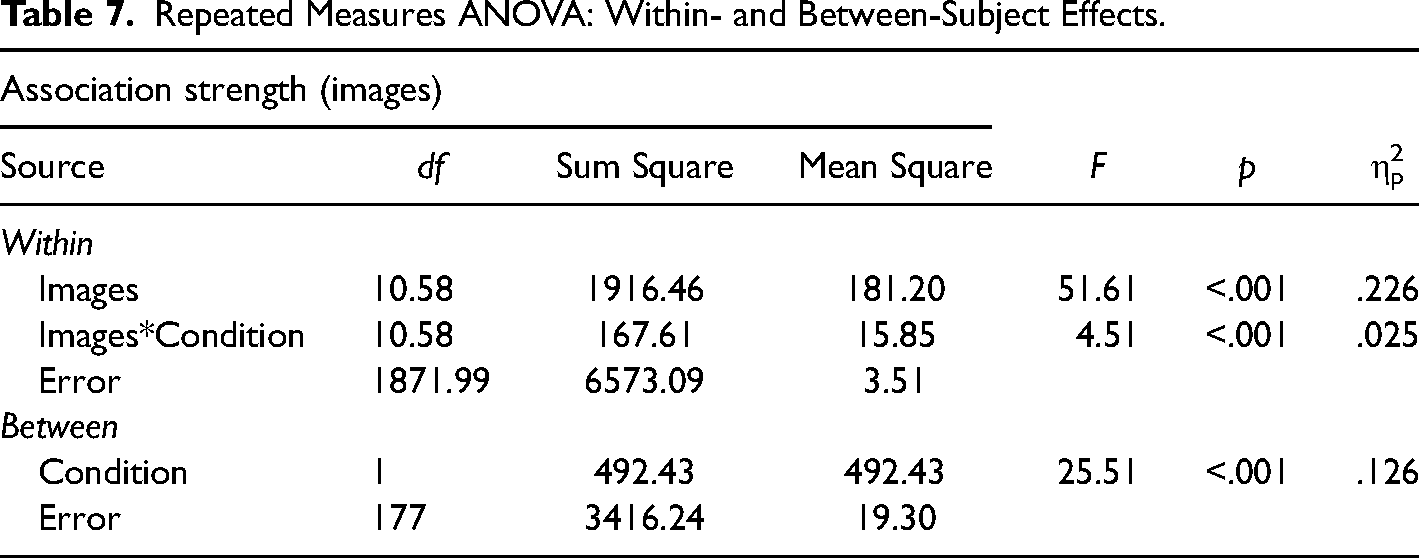
First, we analyzed the manipulation task and compared the strength of associations between unrelated images in the art and everyday conditions. A repeated measures ANOVA with Greenhouse-Geisser correction was conducted to compare the strength of associations in the art vs everyday conditions 3 . Images were entered as a within-participants factor with 14 levels, condition (art vs everyday) was entered as a between-participants factor. Condition was contrast-coded: participants in the art condition received a value of +0.5, participants in the everyday condition received a value of −0.5. As seen in Table 7 (Model 1), condition significantly increased the strength of associations between images. That is, associations between unrelated images were stronger among participants in the art condition compared to participants in the everyday condition (see Table 8 for descriptive statistics).
Repeated Measures ANOVA: Within- and Between-Subject Effects.
Descriptive Statistics in Study 3.
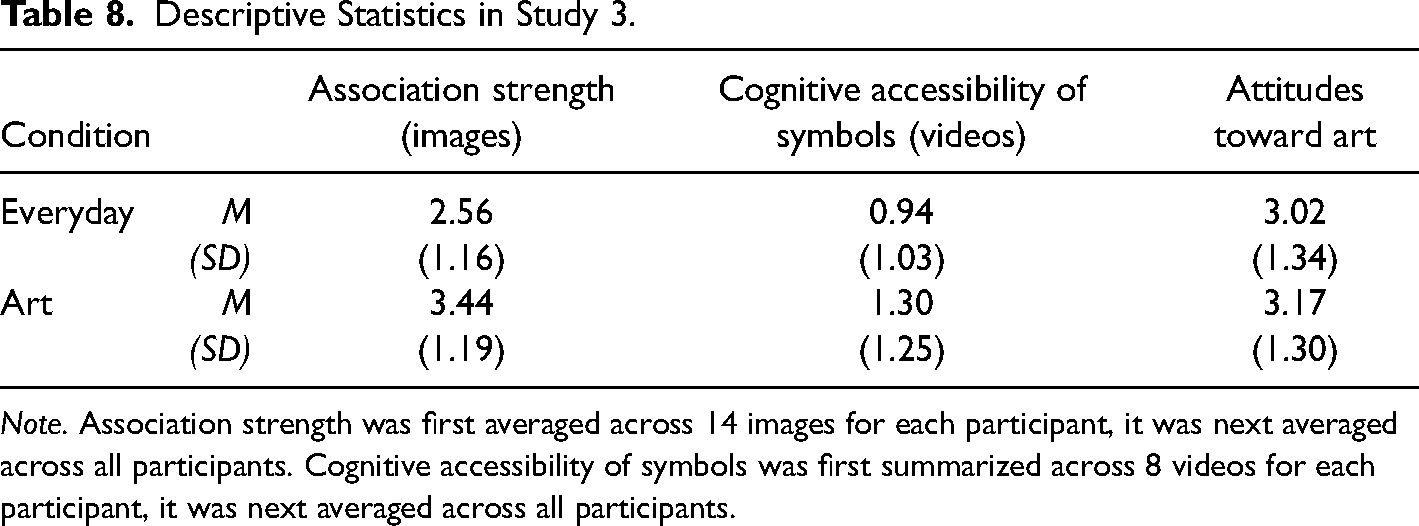
Note. Association strength was first averaged across 14 images for each participant, it was next averaged across all participants. Cognitive accessibility of symbols was first summarized across 8 videos for each participant, it was next averaged across all participants.
Second, we analyzed the cognitive accessibility of symbols while viewing videos in each condition. A one-way ANOVA was conducted to compare the cognitive accessibility of symbols (sum scores across all 8 videos) in the art vs everyday conditions. Condition significantly increased cognitive accessibility of symbols, F(1,178) = 4.23, p = .041, ηp2 = .023. That is, cognitive accessibility of symbols was higher among participants in the art condition compared to participants in the everyday condition.
Discussion
Study 3 tested the hypothesis that associating unrelated pairings of images in an art context primes cognitive accessibility of symbols when interpreting visual scenes that are not specified as either art or everyday scenes. Participants in an art context used more symbols when interpreting videos compared to participants in a non-art context. This finding indicates that art contextualization might affect the way people interpret visual scenes, even if the scenes are not related to art (6 of the 8 videos depicted everyday scenes and were filmed by non-professionals). It should be mentioned that since we did not assess whether participants believed that the two tasks are not related to each other, an alternative explanation of the results is possible: participants in the art condition might have thought that the videos, similarly to the images, were artworks. If this is the case, the effect we observed is related to framing rather than priming.
Study 3 also replicated the finding of Study 1: participants in an art context evaluated unrelated images of objects as associated more strongly with each other compared to participants in an everyday context. Finally, in line with Studies 1 and 2, the observed effect was not moderated by individual differences in attitudes toward art.
General Discussion
In this paper, we investigated how everyday objects are interpreted in an art context compared to an everyday context. Participants evaluated associations between related and unrelated objects, observing them in art context (in the first condition) or everyday life context (in the second condition). In studies 1 and 3, we found that remotely associated objects were evaluated as fitting together more in an art context. That is, when perceiving remotely related objects in an art context, participants detected stronger associations between the objects. This suggests that some qualities of these objects, less salient in an everyday context, become more salient in an art context.
We further investigated how participants associate unrelated objects in art vs everyday contexts in Study 2. We found that remotely associated objects were evaluated as fitting together more in an art context not because participants detected a larger number of associations between them but because of the nature of these associations. In an art context, participants used more symbols when explaining how the objects fit together. Symbolic meaning activation could partly explain how everyday objects are perceived in art vs everyday contexts.
Symbol activation might partly explain how people think about everyday objects in an art context: they perceive different qualities of these objects, including ones which symbolize or express a certain symbolic meaning. For example, a lock may signify a secret, a heart may signify love, a watch may signify mutability or transience. Thus, art contextualization may shift our perception of everyday objects from more pragmatic, everyday functions (a pencil is used to write or draw something) to more figurative, communicative functions (a pencil symbolizes creativity).
The symbolic meanings of objects mentioned by our participants included metaphors. The creation of metaphors involves linking qualities of two different things (Parsons, 2015). Consider the metaphor “words cut deeper than a knife.” This metaphor links two things, words and a knife. To link these two through metaphor, we draw upon qualities of both. Although each has many different qualities (e.g., a word can be written, a knife can cut bread), only some of these are used in forming a metaphor. For example, a knife can hurt someone, and words also can be very hurtful. Linking these two qualities creates a new meaning: words cut deeper than a knife. Indeed, metaphors involve seeing resemblances between objects to make a point: “The greatest thing by far is to have a command of metaphor.… For to make good metaphors implies an eye for resemblances” (Aristotle, Poetics, cited in Richards, 1965, p. 89). Interestingly, earlier researchers suggested that unlikeness of objects or concepts is particularly important for metaphor generation: “As the two things put together are more remote, the tension created is, of course, greater” (Richards, 1965, p. 125). Generating a metaphor helps to resolve that tension by integrating two similarly unrelated objects into a larger whole (Cupchik, 2016). The symbolic meaning exists only within this larger whole and is not present separately in each image. For example, a dummy heart and a set of knives together (but not separately) can be interpreted as heartbreak. In our study, participants generated metaphors based on two remotely associated objects (e.g., a set of knives and a dummy heart). They also perceived these remotely associated objects as associated more strongly in an art context. Interestingly, no differences occurred in the evaluation of closely associated objects (e.g., toothpaste and a toothbrush) between art and everyday contexts. This might signify that the effects of art contextualization on object interpretation are stronger in relation to unrelated or remotely related objects. It is possible that the pragmatic interpretations are so much more readily accessible that the more distal, figurative one does not come into play. Contemporary art is displayed not only in galleries or museums but also in public spaces (for example, Heather Phillipson's The End monument in Trafalgar Square in London). Our findings suggest that its interpretation can differ as a result of display mode.
Earlier empirical studies showed that in observing works of art, people use metaphors to interpret them (Cupchik et al., 1994). However, this study has shown that people detect symbols and metaphors even in everyday objects when they are framed or contextualized as art. This finding is line with reasoning that art context involves seeking a deeper meaning in ordinary things or events (Danto, 1974). We found that the activation of symbolic meaning is partly based on the viewer's expectations and creative activity and not only on the artwork itself (as the items presented in this study are not actual artworks). Nevertheless, understanding how actual artworks affect the activation of symbolic meaning attribution is also important. Artists may use specific techniques to facilitate symbol or metaphor activation in viewers—e.g., musical selections or shot sequences in cinema. Future studies might want to investigate how both the expectations of the viewer and the techniques used by the artist facilitate symbol and metaphor activation in the visual arts.
An important finding of this paper is that engaging in image interpretation in an art context affects the activation of symbolic meanings in subsequent video viewing. Previous research showed that, in comparison to engaging with non-art, engaging with art (literary fiction, cinema) affects the way individuals think about social situations, understand others, and empathize in non-art context (Barnes, 2018; Black & Barnes, 2015; Castano, 2021; Dodell-Feder & Tamir, 2018; Hakemulder, 2000; Johnson, Huffman, & Jasper, 2014; Kidd & Castano, 2013). Although the mechanisms underlying these affects can be different, these findings suggest that the thinking we do while engaged with art affects the way we think in everyday life. While previous research has focused on the role of artworks, this study did not use actual artworks, which suggests that the effects of art on cognition could be based not only on the art itself (e.g., the techniques used by artists) but also on the expectations and activity of the beholder.
If the interpretation of an everyday object depends on its display context, it is possible that aesthetic appreciation of these objects is also related to context. Previous research found that framing effects (e.g., framing a painting as an artwork displayed in a prestigious museum) increase aesthetic appreciation of artworks (Kirk et al., 2009). Future research might investigate whether the evaluation of everyday objects is affected by display context.
All studies indicated that individual differences in need for cognition, need for affect, and attitudes toward contemporary art do not moderate the observed effects of context. It is thus possible that the effect of placement within an art context on the perception of everyday objects is universal or relatively independent from individual differences. However, it is also possible that other factors moderate it: for example, education and expertise in contemporary art. Earlier research indicated that expertise in art affects the way individuals perceive art, including differential behavioral, neural, and eye gaze patterns (Francuz, Zaniewski, Augustynowicz, Kopiś, & Jankowski, 2018; Mullennix & Robinet, 2018; Pang, Nadal, Müller-Paul, Rosenberg, & Klein, 2013)
This paper has several important limitations. First, the effects of context on object interpretation that we observed could be related to different factors: not only the difference between an artwork and an everyday object but also differences in who created the objects (artist vs ordinary people) and differences in display format (in a gallery/museum vs on a website). Future research should take this potential conflation of variables into account. Second, the fact that associating unrelated objects in an art context is related to symbol use does not mean that the activation of symbol use is the only factor affecting the perception of objects in an art context. Finally, although we pretested the images of the objects used in order to ensure that they could be perceived both as artworks and as realistic images, we did not confirm that our manipulation was successful: i.e., we did not ask our participants to indicate whether they believed that the images were actual artworks.
Overall, this paper has shown that everyday objects are interpreted differently in an art context as compared to an everyday context. More specifically, remotely associated objects are perceived as fitting together more in an art context. Finally, more symbolic meanings of objects are more salient in an art context than in an everyday context. Framing an everyday object as an artwork activates a symbolic interpretation which has a near transfer effect, increasing the tendency to interpret visual scenes symbolically rather than literally. These findings contribute to our understanding of the top-down mechanisms of art processing and suggest that cognitive engagement with art involves a looping relationship between top-down and bottom-up processes. Future studies might investigate how art vs everyday context affects eye gaze patterns in the observation of everyday objects.
Supplemental Material
sj-docx-1-art-10.1177_02762374231170259 - Supplemental material for Everyday Life vs Art: Effects of Framing on the Mode of Object Interpretation
Supplemental material, sj-docx-1-art-10.1177_02762374231170259 for Everyday Life vs Art: Effects of Framing on the Mode of Object Interpretation by Marina Iosifyan and Judith Wolfe in Empirical Studies of the Arts
Footnotes
Acknowledgments
We thank David Perrett, Nicole Ruta, and Dhanraj Vishwanath for their valuable advice. We thank Derek Keefe for his valuable comments on this manuscript.
Data Accessibility Statement

Declaration of Conflicting Interests
The author(s) declared no potential conflicts of interest with respect to the research, authorship, and/or publication of this article.
Ethics Statement
All studies described in this paper were approved by the University of St Andrews School of Psychology & Neuroscience Ethics Committee, approval code PS15315.
Funding
The author(s) disclosed receipt of the following financial support for the research, authorship, and/or publication of this article: This work was supported by the Templeton Religion Trust, TRT0354.
Supplemental Material
Supplemental material for this article is available online.
Notes
Author Biographies
References
Supplementary Material
Please find the following supplemental material available below.
For Open Access articles published under a Creative Commons License, all supplemental material carries the same license as the article it is associated with.
For non-Open Access articles published, all supplemental material carries a non-exclusive license, and permission requests for re-use of supplemental material or any part of supplemental material shall be sent directly to the copyright owner as specified in the copyright notice associated with the article.
