



Abstract
Aesthetic disposition has been defined as the propensity to prioritize form over function and to approach any object as potentially valuable from an aesthetic standpoint. In this study, we examined whether and how aesthetic disposition was predicted by educational capital, personality trait openness, and sex. In addition, we investigated the association of educational capital and sex with openness. We compared students from a general high school (“high” educational-capital group) with students from a vocational high school (“low” educational-capital group). We found that (a) aesthetic disposition was positively associated with educational capital and, to a lesser extent, with openness, (b) sex was of minor importance in the distribution of aesthetic disposition, and (c) openness was positively linked to educational capital and unrelated to sex. Our findings support the view that educational capital plays an important role in the social distribution of aesthetic disposition and highlight a link between education and openness.
Introduction
In their investigation of the determinants of aesthetic preferences, psychology researchers have largely focused on the role of intrinsic properties of visual (art) objects (e.g., color, style, symmetry) and of personality traits (Jacobsen, 2010; Swami & Furnham, 2014). Psychology researchers have notably identified a link between personality trait openness and aesthetic preferences: the greater the openness, the higher the appreciation of visual arts in general, and of unconventional styles in particular (Chamorro-Premuzic, Reimer, Hsu, & Ahmetoglu, 2009; Feist & Brady, 2004; Furnham & Walker, 2001a; 2001b; Rawlings, 2000). However, Swami and Furnham (2014) noted that this link may mask more specific associations involving creativity (Rawlings, Twomey, Burns, & Morris, 1998), tolerance to ambiguity (Swami, Stieger, Pietschnig, & Voracek, 2010) and unconventionality (Chamorro-Premuzic, Burke, Hsu, & Swami, 2010). Importantly, Swami and Furnham (2014) also indicated that research on aesthetic preferences may benefit from a closer examination of the interrelations between personality traits (especially openness), socio-demographics, and cultural practices.
The present study aimed to assess whether and how educational capital―a social factor―and personality trait openness―a psychological factor―were associated with aesthetic disposition, taking into account a possible role of sex. Conceptualized by Bourdieu (1971; 1990 [1965]), aesthetic disposition refers to the propensity to (a) prioritize form over function and (b) aestheticize objects or topics that are commonly considered trivial (e.g., a rope) or are negatively connoted (e.g., a car crash). Participants to Bourdieu's surveys were asked to indicate whether, “with [different] subjects, a photographer [is] more likely to produce a beautiful, interesting, meaningless or ugly photo” (Bourdieu, 1984, p. 517). Bourdieu (1984, pp. 35–41) found aesthetic disposition to vary as a function of educational capital, with people endowed with high educational capital tending to attribute a lower aesthetic value to the “corny,” “easy,” and “clichéd” themes (e.g., sunset) and to aesthetically prize the themes that members of the working class judged meaningless (e.g., tree bark). Reversely, people endowed with low educational capital appeared to value the “clichéd” themes. In addition, Bourdieu found that women were prone to reject as ugly the so-called “repugnant, horrible or distasteful” themes more strongly than men (1984, p. 39).
To date, empirical studies have echoed Bourdieu's findings regarding the predominance of form over function in people exhibiting higher levels of educational capital (e.g., Holt, 1998; Jarness, 2015). Contrariwise, the propensity to assign a positive aesthetic value to virtually any object or topic has received limited sociological attention—despite the recognition of its relevance to sociological theories of cultural consumption, in particular those based on eclecticism (Lizardo & Skiles, 2008; 2012). This state of affairs might notably be due to two factors. First, the diversity of the conceptualizations and operationalizations of aesthetic disposition used in sociological research (e.g., Csikszentmihalyi & Robinson, 1990; Daenekindt, 2017; Roose, 2008). For instance, Daenekindt and Roose (2013) applied a general definition of aesthetic disposition to the cinematographic domain. According to these authors, aesthetic disposition refers to “the deep underlying expectations people gave about the arts” (p. 49), and to the “ways in which individuals appropriate works of art, to the relative importance of certain aspects of the aesthetic judgement over other aspects.” Daenekindt and Roose (2013) operationalized aesthetic disposition as the importance attached to, inter alia, the presence in a movie of “action and adventure” or of “characters [one] can relate to” (p. 53). Such indicators relate only indirectly to the capacity and propensity to aestheticize. Second, the pervasiveness of the “what” (e.g., which cultural goods are consumed or liked) and the concomitant neglect of the “how” and the “why” (e.g., how and why cultural goods are consumed or liked) in research on the stratification of tastes and cultural practices (Hanquinet, Roose, & Savage, 2014; Jarness, 2015).
While sociologists have conducted little research on the propensity to aestheticize common or negatively connoted objects, psychologists have addressed issues that are closely related to it. As an illustration, Zaleski (1984) and Rawlings (2003) showed that, compared to men, women assigned a lower aesthetic value to unpleasant and violent visual stimuli. These findings are consistent with Bourdieu's. It should be noted that the research literature focusing on the role of openness in aesthetic preferences may be consistent with Bourdieu's findings as well. Owing to the links between openness and educational performance (Poropat, 2009), this literature may incidentally support Bourdieu's view of the social stratification of aesthetic disposition. However, integrative studies would be needed to clarify this point. Psychologists have not frequently included sociological variables in their studies of aesthetic preferences (Swami & Furnham, 2014), with the notable exception of the research on the role of expertise in aesthetic judgment (e.g., Hekkert & van Wieringen, 1996; Jankowski, Francuz, Oleś, & Chmielnicka-Kuter, 2020). In parallel, variables examined in psychology of aesthetics and cultural preferences have seldom been investigated by sociologists involved in the study of cultural tastes and practices (Brisson, 2019). Unfortunately, this state of affairs hinders the development of comprehensive theories in which aesthetic experience and cultural consumption could be approached at various levels of observation simultaneously.
Because Bourdieu's conception of aesthetic disposition as an ability to aestheticize creates a bridge between the psychology and sociology of aesthetics, we conducted our study within Bourdieu's framework. Within Bourdieu's framework, educational capital represents a key feature of cultural capital, defined as the skills, knowledge, and cultural resources that an individual owns (Bourdieu, 1984; 1986). More specifically, Bourdieu (1986) distinguished between embodied (e.g., the scope of one's lexicon, the command of multiple programming languages), objectified (e.g., owning encyclopedias, software packages), and institutionalized (e.g., diplomas, certificates) forms of cultural capital. Importantly, Bourdieu (1984) used this latter form as an indicator of cultural capital in his investigations of the determinants of aesthetic disposition (see also Bourdieu & Darbel, 1990).
We relied on educational capital in this study because of a lack of reliable and valid measures of the embodied and objectified forms of cultural capital. Over the past decades, the construct of cultural capital has been subject to a variety of ad hoc operationalizations (Draelants & Ballatore, 2014; Sieben & Lechner, 2019; Vryonides, 2007). Only a few researchers have created instruments assessing cultural capital (e.g., see Gossmann, 2018). However, the tools and ad hoc operationalizations available (e.g., see DiMaggio, 1982; Dumais, 2002; Kraaykamp & van Eijck, 2010) are problematic for at least three reasons. First, they circumscribe cultural capital to “highbrow” artistic domains (e.g., attending an opera). Second, they rely on either misleading or speculative delineations of cultural hierarchy (see Brisson, 2019, p. 11). Third, they operationalize embodied cultural capital in terms of cultural participation or taste rather than in terms of general and specific knowledge. It should be recalled, however, that embodied cultural capital comprises, for instance, the “knowledge of Greek or of integral calculus” (Bourdieu & Wacquant, 1992, p. 98). Unfortunately, the neglect of domains unrelated to “classic culture” and to the so-called fine arts prevents these operationalizations from capturing the core of Bourdieu's construct of cultural capital. It is of note, moreover, that the existing measures of the objectified form of cultural capital (Gossmann, 2018; Sieben & Lechner, 2019) do not take into account the digitalization of the media industry (press, music, motion picture, etc.). Owing to the development of over-the-top platforms and to the availability of free online products and services (e.g., dictionaries, software packages, tutorials, etc.), an increasing number of cultural goods and resources are consumed without being owned by consumers (INSEE, 2020). Such (relatively) recent dynamics in the field of cultural production and consumption may erode current measurement of objectified cultural capital.
In this study, we assessed the respective influence of educational capital, openness, and sex on aesthetic disposition in French high-school students. We also compared the predictive power of educational capital and openness in terms of aesthetic disposition and examined the link between these two predictors. The scarcity of studies on aesthetic disposition and cultural dispositions involving psychological and social factors makes it difficult to formulate specific hypotheses regarding the joint influence of the examined predictors on aesthetic disposition. As a result, our study is partly exploratory.
Method
Study Samples
The present study involved two convenience samples. The first sample comprised 119 students from a general secondary school (MAGE = 16.46, SDAGE = 0.65; 69% female). We recruited these participants from the three streams that French general high schools provide, namely, the “economics and social sciences,” “humanities,” and “natural science” streams. The higher prevalence of girls within this sample is consistent with the over-representation of girls within the streams “economics and social sciences” and “humanities” (Ministère de l’Éducation nationale, 2017). The second sample comprised 185 students from a vocational secondary school that provides sales and customer services trainings (MAGE = 17.20, SDAGE = 1.01; 59% female). Both high schools were located in medium-sized towns in the East of France. We surveyed only 11th- and 12th-graders.
Educational Capital, Openness, and sex (Independent Variables)
Differences in educational capital were reflected in the samples themselves. We contrasted students from a general high school (sample 1; higher educational capital) with students from a vocational high school (sample 2; lower educational capital). In France, vocational high schools are perceived, and often operate, as instruments of social relegation (Palheta, 2012; Caille, 2014; Organization for Economic Co-operation & Development [OECD], 2016a). A large proportion of students attending vocational high schools exhibit lower learning abilities, difficulties in basic mathematics, and deficits in the comprehension of both oral and written contents since primary school (Caille, 2014). Absenteeism and dropouts are more prevalent in vocational high schools than in general high schools (OECD, 2016b; 2016c). France is one of the OECD countries in which differences in PISA scientific-performance measures between general and vocational high-school students are the strongest (OECD, 2016b). Considered together, these points suggest that the distinction between general and vocational high schools is highly relevant to educational capital. Although our data included information about social origin (as indexed by parents’ educational level and occupation), we did not create independent variables based on such information because of the under-representation of students from the upper classes in our study samples. It is of note, however, that about 50% of the parents of vocational high-school students had no diploma at all, and 93% possessed a relatively low educational capital (i.e. ≤ “baccalauréat,” the French high school diploma). Among general high-school students, these rates were about 19% and 50%, respectively. These discrepancies are in line with those reported in national studies (e.g., Caille, 2014).
Openness was assessed with the NEO Five-Factor Inventory (NEO-FFI; McCrae and Costa, 2004; Rolland et al., 1998). The NEO-FFI measures openness with a 12-item subscale (sample item: “I have a lot of intellectual curiosity.”). Participants responded using a 5-point scale (from 0 for “strongly disagree” to 4 for “strongly agree”). Cronbach's alpha was .79 (composite reliability = .82).
Because Bourdieu (1984) found sex differences in the distribution of aesthetic disposition, we performed additional analyses with sex as an independent variable.
Measurement of Aesthetic Disposition (Dependent variable)
Bourdieu's original questionnaire asked respondents to indicate whether, “with [different] subjects, a photographer [is] more likely to produce a beautiful, interesting, meaningless or ugly photo” (Bourdieu, 1984, p. 517). Unlike Bourdieu, we did not use forced-choice questions involving an alternative between beauty and interest. In our estimation, such questions are problematic because they treat beauty and interest as mutually exclusive factors. Relatedly, such measures prevent the investigator from assessing the link between beauty and interest. In this context, we initially aimed to use two distinct rating scales related to beauty and to interest. However, a pilot study involving 15 adolescents revealed that the expression “an interesting photograph” was equivocal for about 50% of the respondents. We therefore focused only on the assessment of beauty. We asked participants to indicate on a five-point rating scale whether, “with the following themes, a photographer is more likely to take a (1) very ugly, (2) ugly, (3) neither ugly nor beautiful, (4) beautiful, or (5) a very beautiful photograph.”
We relied on 20 themes, seven of which were used in Bourdieu's inventory (1984, p. 604). Those seven items are: bark of a tree, breast-feeding woman, car crash, famous monument, metal frame, quarreling tramps, and sunset. We excluded the other items used in Distinction because of their “sophistication” and/or vagueness. Pretests involving 15 adolescents selected based on the educational level of their parents (i.e., no diploma or secondary-school degree; Bachelor degree; Master degree) revealed, for instance, that most participants whose parents had a low educational capital did not know the meaning of “still life;” the item “landscape” elicited reactions such as “It depends on the kind of landscape” from a majority of participants; most pre-testers expressed difficulties understanding the item “a weaver at his loom.” Based on (a) discussions with three sociologists specialized in the domain of culture and art and (b) the abovementioned pretests, we added the following 13 items: an abandoned cat, a beetle, a deserted street at night, a luxury car, a naked old man, a pile of banknotes, a prison cell, religious people praying, a sad child, a starry sky, a surgical operation, a vegetable stall, and a wedding couple. Our selection process was guided by the objective of including items that were positively (e.g., “starry sky”) and negatively (e.g., “surgical operation”) connoted as well as items having more “neutral” contents (e.g., “vegetable stall”). These features are in line with Bourdieu's method of item selection (1984). We additionally note that a number of psychological studies of aesthetic preferences relied on unpleasant and unconventional items (for an overview, see Swami & Furnham, 2014). The reliability of our aesthetic disposition inventory, as indexed by Cronbach's alpha, was .83 (composite reliability = .89). We used the 20 items of this inventory as dependent variables.
In addition, we created for each participant two general scores: first, an aesthetic disposition mean score; second, a score indicating how many themes were considered likely to produce a beautiful photograph (dichotomized score). This latter score was computed via data recoding. The option responses “very ugly,” “ugly,” and “neither ugly nor beautiful” were recoded 0. The option responses “beautiful” and “very beautiful” were recoded 1. Both scores were used as additional dependent variables.
Data Analyses
We relied on the Mann-Whitney U-test to compare our groups of students and investigate possible sex differences. We also computed, for each comparison, the corresponding Cohen's d and η². We distinguished between small, medium, and large effects based on the following benchmark values: 0.2, 0.5, and 0.8 for Cohen's d and .01, .06, and .14 for η² (Cohen, 1988, 1992; Fritz, Morris, & Richler, 2012). We used a general linear model, t-tests, and correlational analyses to estimate the associations of educational capital, openness, and sex with aesthetic disposition. The link between openness and aesthetic disposition was assessed based on two types of analyses. First, we computed Kendall and Spearman correlations, the results of which are reported in the present manuscript. Second, we conducted Mann-Whitney U-tests, the results of which are displayed in Supplementary Material. We performed Mann-Whitney U-tests to harmonize the measures of effect size linked to the impact of our three predictors on aesthetic disposition. This required us to distinguish, based on the central point of the openness scale (i.e., a score of 2), between students with higher openness (i.e., ≥ 2; n = 210) and students with lower openness (i.e., < 2; n = 94). We re-ran the analysis based on a median split (median for openness = 2.25) in order to further examine the consistency and robustness of our findings.
Results and Discussion
We found that aesthetic disposition was positively associated with educational capital. As shown in Table 1, general high-school students exhibited a higher aesthetic mean score (3.52, SD = 0.54) than vocational high-school students (2.95, SD = 0.48), p < 0.001. The effect size was large (d = 0.99). Educational capital accounted for about 24% of the variance in aesthetic disposition in this scale-level analysis. Moreover, general high-school students indicated, on average, that 11 of the 20 items under examination were likely to produce a beautiful photograph, against 8 in vocational high-school students, p < 0.001. Again, the effect size was large (d = 0.85). Educational capital accounted for about 19% of the variance in aesthetic disposition in this item-level analysis. Although general high-school students did not appear to be “pure aesthetes,” they attributed a positive aesthetic value (score > 3) to 15 of the 20 items included in our study. In comparison, vocational high-school students ascribed a positive aesthetic value to only 9 of the 20 items. It is of note that the relative distance to “pure aesthetic” that we found in both samples might be partly due to the survey question itself. The phrasing of the survey question may have attenuated (or restrained) the manifestation of (“pure”) aesthetic disposition. Asking whether a photographer is more likely to take a more or less beautiful photograph as a function of the themes of interest may have implicitly led our participants to suppose that some of these themes were likely to produce ugly (or neither beautiful, nor ugly) photographs. Respondents may have considered that, if all themes were equally prone to produce a beautiful photograph, we would not have asked them to answer such a question.
Aesthetic Disposition and Educational Capital.
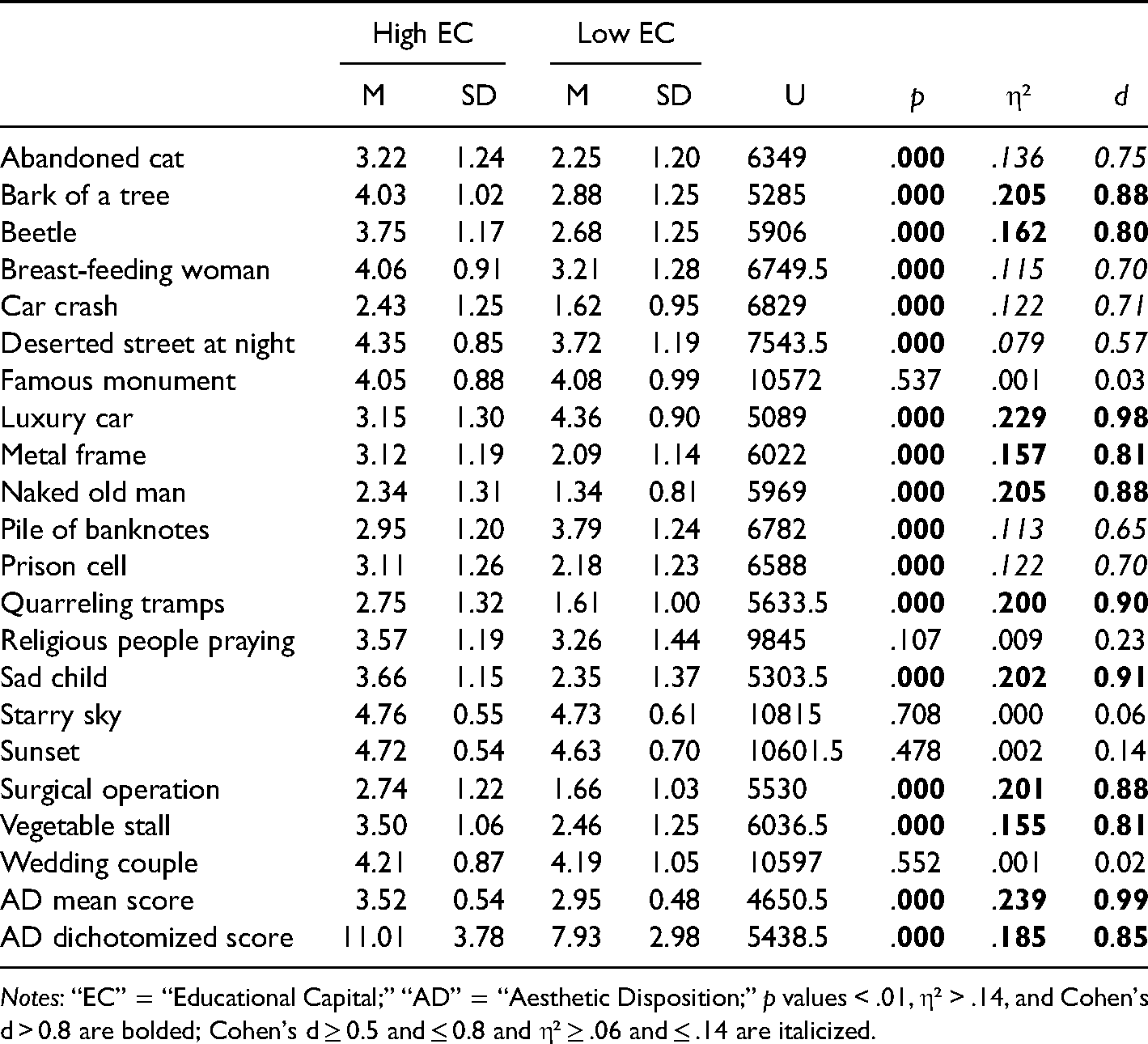
Notes: “EC” = “Educational Capital;” “AD” = “Aesthetic Disposition;” p values < .01, η² > .14, and Cohen's d > 0.8 are bolded; Cohen's d ≥ 0.5 and ≤ 0.8 and η² ≥ .06 and ≤ .14 are italicized.
Consistent with these general findings, we found that a large majority of the item-per-item differences between general high-school students and vocational high-school students were statistically significant (Table 1). Cohen's d's mainly signaled medium to large effects, with educational capital accounting on average for about 13% of the variance in aesthetic disposition. General high-school students assigned a higher aesthetic value than their counterparts to 17 of the 20 items under examination; 13 of these 17 cases involved a significant difference, ps < .001. Remarkably, vocational high-school students ascribed a significantly higher aesthetic value than general high-school students only to the items “luxury car” and “pile of banknotes” (see Table 1), two items that can be viewed as emblematic of economic success. This result may illustrate one of the major characteristics of the “popular taste,” namely, the tendency to deduce the aesthetic value of an object or a subject from its social utility or social function (Bourdieu, 1984).
Interestingly, the five non-significant differences displayed in Table 1 involve four positively-connoted, clichéd items: “famous monument;” “starry sky;” “sunset;” and “wedding couple.” Unlike Bourdieu, we did not find such items to be less aesthetically valued by participants endowed with higher educational capital. However, only a finer examination of the characteristics of a larger sample, especially in terms of social origin and school achievement, would allow us to clarify this point. In any case, the observed between-sample differences primarily relate to the negatively connoted and to the “neutral” items. Thus, our findings partially reflect the detachment, mentioned by Bourdieu (1984, p. 34), “vis-à-vis ‘first-degree’ perception [that consists in] displacing the interest from the ‘content’, characters, plot etc., to the form, to the specifically artistic effects.”
The ability to distance oneself from “first-degree perception,” immediate emotional insight, seriousness, univocity, or literal interpretation is involved in socio-cognitive domains such as (dark) humor, irony, and metaphor, which have been suggested to be linked to socioeconomic status (Beaty & Silvia, 2013; Blasko, 1999; Chiappe & Chiappe, 2007; Friedman, 2011; Friedman & Kuipers, 2013; Hackman, Gallop, Evans, & Farah, 2015; Kuipers, 2006; Zaboski, Kranzler, & Gage, 2018). Because educational capital entails linguistic and, more generally, cognitive resources and structures (Bourdieu & Passeron, 1977; Bourdieu, 1990 [1980]), and given the links between cognitive skills and social background (Bradley & Corwin, 2002; Hackman & Farah, 2009; Noble, McCandliss, & Farah, 2007; Pakulak & Neville, 2010), our results may partly reflect differences in cognitive styles and abilities (e.g., divergent thinking). However, other factors, such as exposure to and interest in visual arts, may account for the observed between-sample differences. Further research on aesthetic disposition would certainly benefit from the mobilization of (a) indicators of exposure to visual arts, (b) respondents committed in photographic activities and endowed with different levels of educational capital, and (c) socio-cognitive measures (e.g., divergent thinking, creativity).
On a different note, our results may partly reflect differences in terms of norm conformity and social desirability. The perception of socially desirable responses may differ at both between- and within-sample levels, because of a different understanding of the nature of the exercise in participants (e.g., curricular vs. extracurricular; “serious” vs. “entertaining”) or of the status of the sociologist (e.g., “a cultured person” vs. “just a guy”). For instance, the fact of considering the social scientist a cultured person, coupled with the administration of the questionnaire in the classroom, might have strengthened the manifestation of “cultural goodwill” (Bourdieu, 1984, pp. 318–319). Moreover, owing to the use of five-point rating scales in the present study, we cannot rule out a potential extreme response style effect (Berg, 1953; Greenleaf, 1992; Meisenberg & Williams, 2008). Indeed, on average, general high-school students selected 8.00 extreme response options, against 10.58 in vocational high-school students. While our dichotomized scores suggest that the effect of extreme response style is modest, future studies could attempt to better control this variable.
Our results were not suggestive of a marked link between aesthetic disposition and sex. As shown in Table 2, mean aesthetic disposition scores did not significantly vary as a function of sex. Although the difference between boys and girls regarding the number of items considered likely to generate a beautiful photograph was statistically significant, the corresponding Cohen's d was small (0.22), and the explained variance relatively limited (1.5%). Within-sample analyses revealed that sex did not significantly affect the number of items aesthetically valued. In sum, sex effects appeared to be of relatively weak importance in this study.
Aesthetic Disposition and sex.
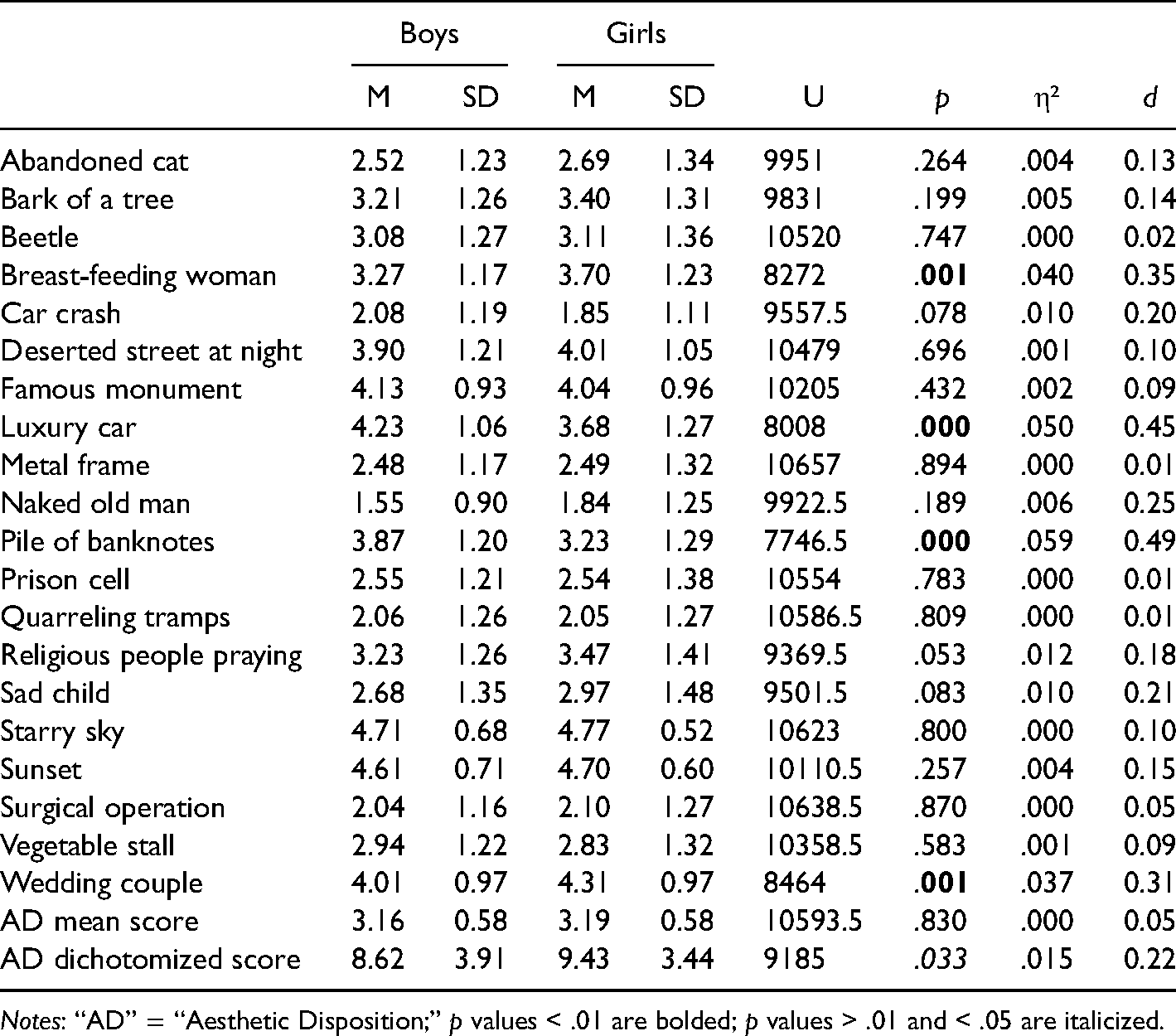
Notes: “AD” = “Aesthetic Disposition;” p values < .01 are bolded; p values > .01 and < .05 are italicized.
Only four item-per-item comparisons between boys and girls were statistically significant (Table 2). Globally, effect sizes were small. Girls valued the items “breast-feeding woman” and “wedding couple” more compared to boys. Boys valued the items “luxury car” and “pile of banknotes” more compared to girls. Within-sample associations were rather inconsistent with the above-reported associations. We found only two significant differences in general high-school students (“breast-feeding woman” and “naked old man”), against six in vocational high-school students (“car crash,” “luxury car,” “pile of banknotes,” “prison cell,” “quarreling tramps,” and “wedding couple”). However, because the corresponding effect sizes turned out to be very small, these significant differences can be considered of minor importance. Overall, our findings regarding sex partly corroborate Bourdieu's: both studies indeed highlighted a minor sex effect. However, our results differ from those obtained by Bourdieu (1984), Zaleski (1984), and Rawlings (2003) in that we did not find girls to reject negatively connoted items as ugly more strongly than boys. Future studies may further investigate the role of sex in the aesthetic judgment of negatively-connoted items.
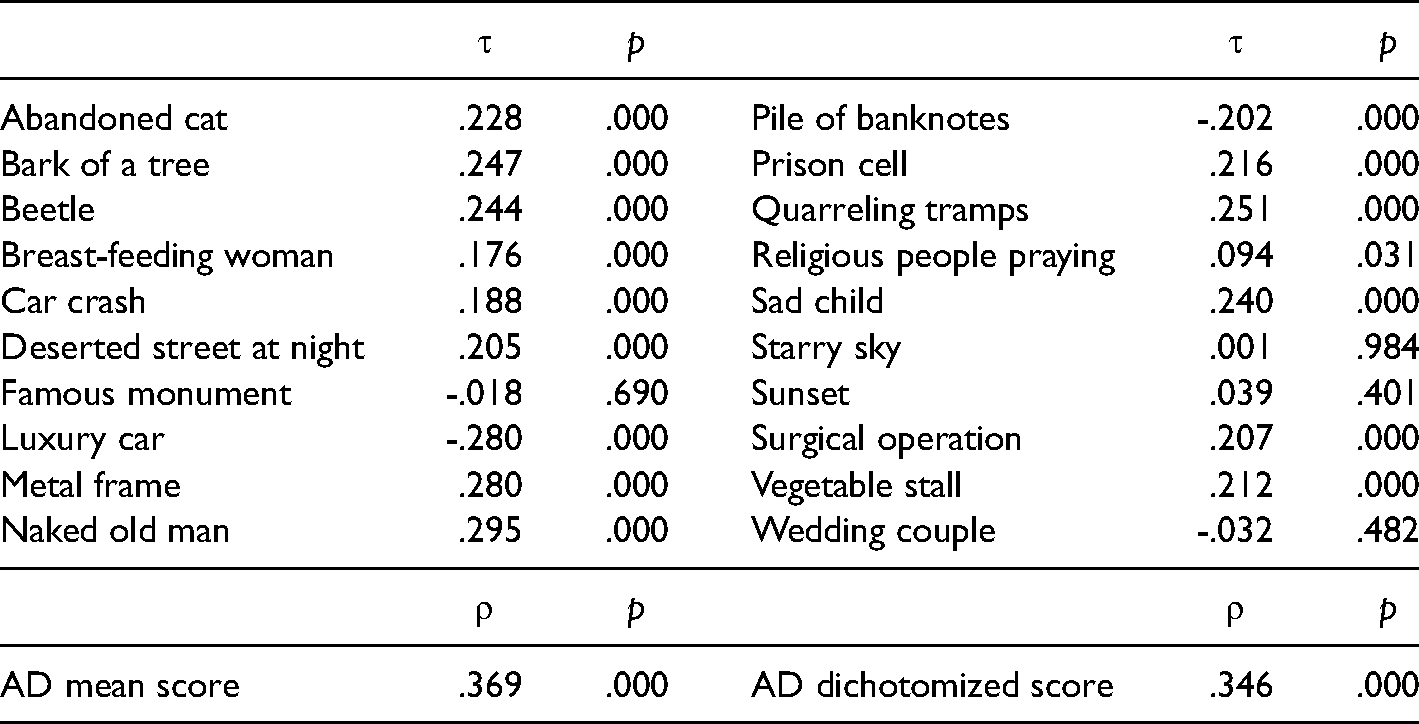
Finally, personality trait openness was found to influence aesthetic disposition, but to a lesser extent than educational capital (Table 3). The results of our item-per-item comparisons (Table 4; Supplementary Material) were consistent with this trend. They also revealed that the impact of educational capital and openness involved similar patterns of aesthetic evaluation. General high-school students as well as students with higher scores of openness assigned a higher aesthetic value to the “neutral” and negatively connoted items, compared to their counterparts. Moreover, neither educational capital nor openness influenced the evaluation of clichéd items. Importantly, openness was linked to educational capital: general high-school students (M = 32.62; SD = 6.99) were more open than vocational high-school students (M = 24.02; SD = 7.20). The effect of educational capital on openness was large (t = 10.35; p < .001; d = 1.04; η² = .259). A partial correlation showed that, when controlling for educational capital, openness correlated weakly with aesthetic disposition mean score (partial r = .174 vs. r = .369). Although girls (M = 28.06; SD = 7.95) were more open than boys (M = 26.22; SD = 8.69), a t-test revealed that the difference in question was only marginally significant (t = 1.88; p = .061).
Influence of Educational Capital, Openness, and sex on Aesthetic Disposition Mean Score (General Linear Model).
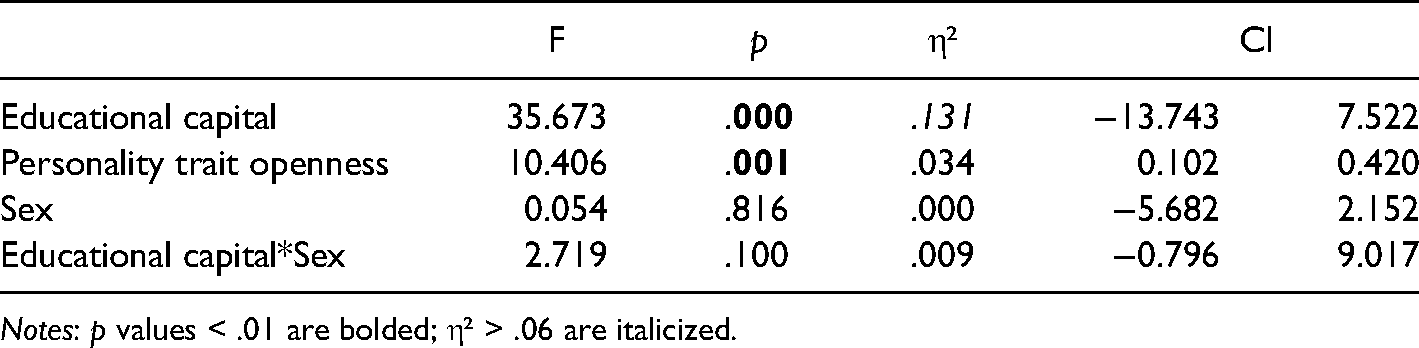
Notes: p values < .01 are bolded; η² > .06 are italicized.
Aesthetic Disposition and Openness: Correlational Analyses (Kendall's τ and Spearman's ρ).
Our findings pertaining to the links between aesthetic disposition, educational capital, and openness are of interest for at least two reasons. First, they underline the relevance of using both sociological and psychological variables in research on aesthetic disposition and aesthetic experience. The conducted analyses indeed captured the unique contribution of educational capital and openness in accounting for aesthetic disposition. Future research on aesthetic disposition may involve a larger array of personality traits, including those pertaining to the so-called “dark triad” (i.e., Machiavellianism, psychopathy, and narcissism; Paulhus & Williams, 2002). This may allow us to better understand the links between ethics and aesthetics. Second, the relationship between openness and educational capital questions the basis of personality traits and, more specifically, of the interactions between genetic and environmental factors (Briley & Tucker-Drob, 2014; Sanchez-Roige, Gray, MacKillop, Chen, & Palmer, 2018). Social background and socioeconomic status may substantially contribute to shaping openness. Further research on the genesis and development of personality traits may benefit from a more systematic inclusion of sociological variables.
Conclusion
This study addressed the issue of whether and how aesthetic disposition varied as a function of educational capital, openness, and sex in French high-school students. Our findings support Bourdieu's view that aesthetic disposition is dependent on educational capital. By contrast with Bourdieu, however, we found that the appreciation of clichéd items was relatively immune to differences in educational capital. Moreover, we did not observe the sex effect pertaining to negatively-connoted items documented in past research. Our results suggest that openness and educational capital both contribute to explaining variance in aesthetic disposition, although the impact of educational capital appears to be stronger. All in all, our study suggests that educational capital and openness are both important for understanding differences in aesthetic disposition.
Supplemental Material
sj-docx-1-art-10.1177_02762374211047973 - Supplemental material for Aesthetic Disposition, Educational Capital, Personality Trait Openness, and Sex: A Study of French High-School Students
Supplemental material, sj-docx-1-art-10.1177_02762374211047973 for Aesthetic Disposition, Educational Capital, Personality Trait Openness, and Sex: A Study of French High-School Students by Romain Brisson and Renzo Bianchi in Empirical Studies of the Arts
Footnotes
Declaration of Conflicting Interests
The author(s) declared no potential conflicts of interest with respect to the research, authorship, and/or publication of this article.
Funding
The author(s) received no financial support for the research, authorship and/or publication of this article.

Supplemental Material
Supplemental material for this article is available online.
References
Supplementary Material
Please find the following supplemental material available below.
For Open Access articles published under a Creative Commons License, all supplemental material carries the same license as the article it is associated with.
For non-Open Access articles published, all supplemental material carries a non-exclusive license, and permission requests for re-use of supplemental material or any part of supplemental material shall be sent directly to the copyright owner as specified in the copyright notice associated with the article.
