



Abstract
Previous research has shown that artists employ flexible attentional strategies during offline perceptual tasks. The current study explored visual processing online, by tracking the eye movements of artists and non-artists (n=65) while they produced representational drawings of photographic stimuli. The findings revealed that it is possible to differentiate artists from non-artists on the basis of the relative amount of global-to-local saccadic eye movements they make when looking at the target stimulus while drawing, but not in a preparatory free viewing phase. Results indicated that these differences in eye movements are not specifically related to representational drawing ability, and may be a feature of artistic ability more broadly. This eye movement analysis technique may be used in future research to characterise the dynamics of attentional shifts in eye movements while artists are carrying out a range of artistic tasks.
Keywords
Introduction
Whether artists see the world differently and how such a difference relates to aspects of artistic expertise, such as drawing ability, has been a subject of debate for some time (Chamberlain et al., 2019; Kozbelt, 2001; Lou, 2018; Ostrofsky et al., 2015; Ruskin, 1856). Researchers have investigated different aspects of artists’ perceptual expertise including: bottom-up visual processing such as overcoming shape and size constancy (Cohen & Jones, 2008; Ostrofsky et al., 2012) and visual illusions (Ostrofsky et al., 2015), and top-down visual processing such as shifting between local and global attentional modes (Chamberlain et al., 2018; Chamberlain & Wagemans, 2015) and enhanced visual encoding (Perdreau & Cavanagh, 2014, 2015). Furthermore, the latter top-down processing advantages have been consistently found to predict independent measures of drawing ability (Chamberlain & Wagemans, 2016; Drake & Winner, 2011; Glazek, 2012; Kozbelt et al., 2010; Tchalenko et al., 2014). For example, Chamberlain and Wagemans (2015) investigated how visual arts training impacts the flexibility of visual attentional processing of local and global levels of visual stimuli. Perceptual tasks designed to measure both local and global visual processing and observational drawing tasks were administered to a sample of art students and non-art students. It was found that efficient shifting between local and global levels of visual stimuli was a predictor of both drawing ability and artistic group membership (Chamberlain & Wagemans, 2015).
In addition to the aforementioned studies which employ offline tasks to explore perceptual processing of artists, researchers have also addressed this research question by exploring artists’ and novices’ eye movements while they complete drawing tasks (Cohen, 2005; Glazek, 2012; Miall & Tchalenko, 2001; Tchalenko, 2009; Tchalenko et al., 2014). Eye movement recording can be especially beneficial for the investigation of perceptual processes that underlie artistic expertise since it provides direct mappings of implicit perceptual decision making through parameters such as fixation duration and frequency (Locher, 2006). In an early study of this kind, Miall and Tchalenko (2001) recorded both the hand and eye movement patterns of portrait artist Humphrey Ocean while he created portrait drawings. They found that Ocean’s fixations were precisely targeted toward specific aspects of the page or the stimulus when drawing, but not when free viewing. When the artist’s data was compared to a group of novices, it was found that the novice group showed little difference in viewing behaviour when drawing and free-viewing. The authors postulated that Ocean captured the visual information in the stimulus ‘detail by detail, rather than in a more holistic manner’ (p.38) suggesting a locally oriented eye movement strategy. A later study by Cohen (2005) found that the rate at which artists and novice participants glance between their drawing and the stimulus (gaze frequency) predicted drawing accuracy. Cohen concluded that gaze frequency influences drawing ability by increasing the efficiency of working memory, and reducing memory distortion and context effects through inattentional blindness. Furthermore, Tchalenko et al. (2014) observed that art student participants, in contrast to novices, drew almost continuously in a drawing task, exhibiting a blind drawing strategy in which they locked their gaze on the object while drawing on the paper. Again, this result is interpreted as demonstrating that artists develop strategies for reducing their dependence on working memory resources. Finally, a study simultaneously recording artists’ hand and eye movements found that they produced significantly more motor output per unit of visual encoding than novices (Glazek, 2012). These studies create a picture of artists’ perceptual advantages as relating to enhanced visual encoding, enhanced perceptual decision making, and enhanced use of strategies to reduce memory load.
Insight into the perceptual processing of artists can also be gained by looking at how artists look at artworks. In an early study, Vogt (1999) found that eye-movement patterns of painters differed from those of laymen when looking at paintings. Fixations of laymen clustered mostly around human features and other recognisable objects whereas the fixations of artists clustered around structural, abstract or non-object related features. Vogt (1999) concluded that artists acquire different viewing strategies as a function of their expertise, specifically toward precise interpretation of physical properties of objects and scenes. Focus on structural elements of artworks rather than categorizable objects within them may explain why professional art viewers were found to rely more on a global scanpath strategy when viewing visual art, particularly for abstract images (Nodine et al., 1993; Pihko et al., 2011; Zangemeister et al., 1995). In a later study, Vogt and Magnussen (2007) compared viewing strategies of artists and novices when viewing abstract and representational paintings during free-viewing or when instructed to memorise the images. The authors found that artists changed viewing strategy from free-viewing to memorising by focusing more on objects in the latter condition. Artists also remembered significantly more pictorial features of artworks and showed a higher proportion of global-to-local saccades on repeated viewing of stimuli, compared with novices.
Researchers have also investigated artists’ eye movement patterns while they complete offline perceptual tasks. Perdreau and Cavanagh (2013) used a gaze-contingent display to control the amount of the visual scene artists and novices could see and asked them to categorise line drawings of possible and impossible objects. It was found that artists with better drawing ability and training were also more skilled at identifying impossible figures when aspects of the scene were masked, demonstrating that they were better able to integrate object features into a coherent whole across multiple eye movements. The researchers also found that artists were faster at encoding an object’s structure and had better access to object details (Perdreau & Cavanagh, 2014). In summary, studies of artists’ viewing strategies when looking at paintings and line drawings suggest a more globally-oriented attentional style, that is less driven by specific objects or object features and is specific to art viewing, along with an enhanced ability to integrate parts of the visual scene into a holistic interpretation.
Research on offline perceptual processing tasks suggests that artists show enhanced local and global visual processing, and the ability to flexibly switch between these two modes (Chamberlain et al., 2019; Chamberlain & Wagemans, 2015). The existing literature on artists’ eye movements findings suggest that when drawing artists use a targeted viewing style with more frequent switching between the drawing and the stimulus (Cohen, 2005; Miall & Tchalenko, 2001). When viewing paintings, artists predominantly show a more global processing style with enhanced focus on pictorial relationships and an enhanced ability to integrate local details into a coherent whole with fewer and shorter fixations (Vogt & Magnussen, 2007; Zangemeister et al., 1995). Across both drawing and art viewing studies it has been shown that artists change their viewing strategy flexibly dependent on task, while novices tend to exhibit the same eye movement patterns regardless of the task (Perdreau & Cavanagh, 2013; Vogt & Magnussen, 2007).
The aim of the current research was to explore the characteristics of artists’ perceptual processing during a drawing task, generalising across stimulus types and in a diverse sample of artists with potentially different approaches to drawing. Specifically, we aimed to address whether the more global approach to viewing paintings exhibited by artists was reflective of a similar gaze behaviour while drawing. We contrasted the viewing patterns of artists and novices while drawing and while undertaking a preparatory free-viewing phase to assess the domain specificity of artists’ eye movement patterns. On the basis of previous research we hypothesised that compared with a novice group with little drawing experience, an artist group would show relatively more global distribution of eye movements (lower fixation durations coupled with higher saccade amplitudes) during a drawing phase but not in a free-viewing phase, across a range of visual stimuli. We also hypothesised that the proportion of global eye movements made by participants during the drawing task would predict their representational drawing accuracy score.
Method
Participants
65 participants (43 women; Mage = 27.68; SD = 6.3) took part in the study in exchange for a payment. All had normal or corrected-to-normal vision.
Artist Group
33 art students (23 women; Mage = 29.00; SD = 7.58), who had received 4+ years of higher education in art and design education participated. The sample of artists varied in their main medium: painting or drawing (n = 14), photography or video (n = 5), sculpture (n = 4), installation (n = 3), performance (n = 1), applied art or design (n = 6). The number of years of higher art education also varied from 4–6 years (n = 25), 7–9 years (n = 5) and 10+ years (n =3). The majority of the artists (n = 22) reported drawing at least once per week for the past two years.
Control Group
32 control participants (20 women; Mage = 26.31; SD = 4.33) who did not have any art education at all (n = 31) or had one year of undergraduate art training (n = 1) were recruited. Control participants varied in their profession and did not differ significantly in age to the artist sample, t (51) = 1.76, p = .084.
Materials
Participants were tested individually in an eye-tracking lab at Goldsmiths, University of London, within a 1-hr testing session. Stimuli were presented on a colour desktop PC (1920 × 1080) which was 60cm apart from the position of each participant. Eye movements of the right eye were recorded using an EyeLink 1000 eye tracking system with a sampling rate of 1000 Hz and a centroid model to fit the pupil image and set the pupil position. Participants were asked to place their heads on a chinrest in a set position and stay still as possible throughout the study. A 9-point calibration was performed at the beginning of the experiment and was maintained for each trial using a drift correct procedure between each trial that corrected fixation errors due to small movements in camera alignment (e.g. caused by head band slippage). The experiment was written and ran on Experiment Builder of SR Research Ltd.
Procedure
Questionnaire
Participants first filled out a demographic questionnaire including: date of birth, gender, nationality and highest level of education. They also answered specific questions on whether they had received an art education, and if so for how many years. They then reported how much time they had spent drawing during the last two years, and rated their own ability on a range of artistic skills (see Chamberlain et al., 2015, for self-rated artistic ability and drawing frequency questionnaire).
Drawing Tasks
Prior to the experimental trials, participants completed a short test trial in which they were asked to observe (30s) and then draw (1 minute) a simple geometric figure displayed onscreen. Participants were then asked to produce a series of three representational drawings, an accurate figural copy, of photographs of a face, a still-life arrangement, and a hand (Figure 1). The order of stimuli presented during the experimental session was still life, hand, portrait for all participants. Each trial began with the presentation of a black fixation cross on a white background (Figure 2). This was followed by a free-viewing phase in which participants were instructed to simply observe the image displayed on the screen for 30 seconds. The free-viewing phase was then followed by a white screen with the instruction to begin the drawing phase. In the drawing phase, participants were instructed to produce a representational drawing of the image shown on a A4 (297 × 210 mm) paper with sharpened 4B pencils and erasers. The instruction given to the participants for the drawing was simply to ‘produce a representational drawing’, without any limitation on method of depiction or techniques used. Participants were given 10 minutes per stimulus to complete the drawing but were also permitted to move to the next trial before the 10-minute trial limit had elapsed. The time at which each participant finished drawing in each trial was recorded.
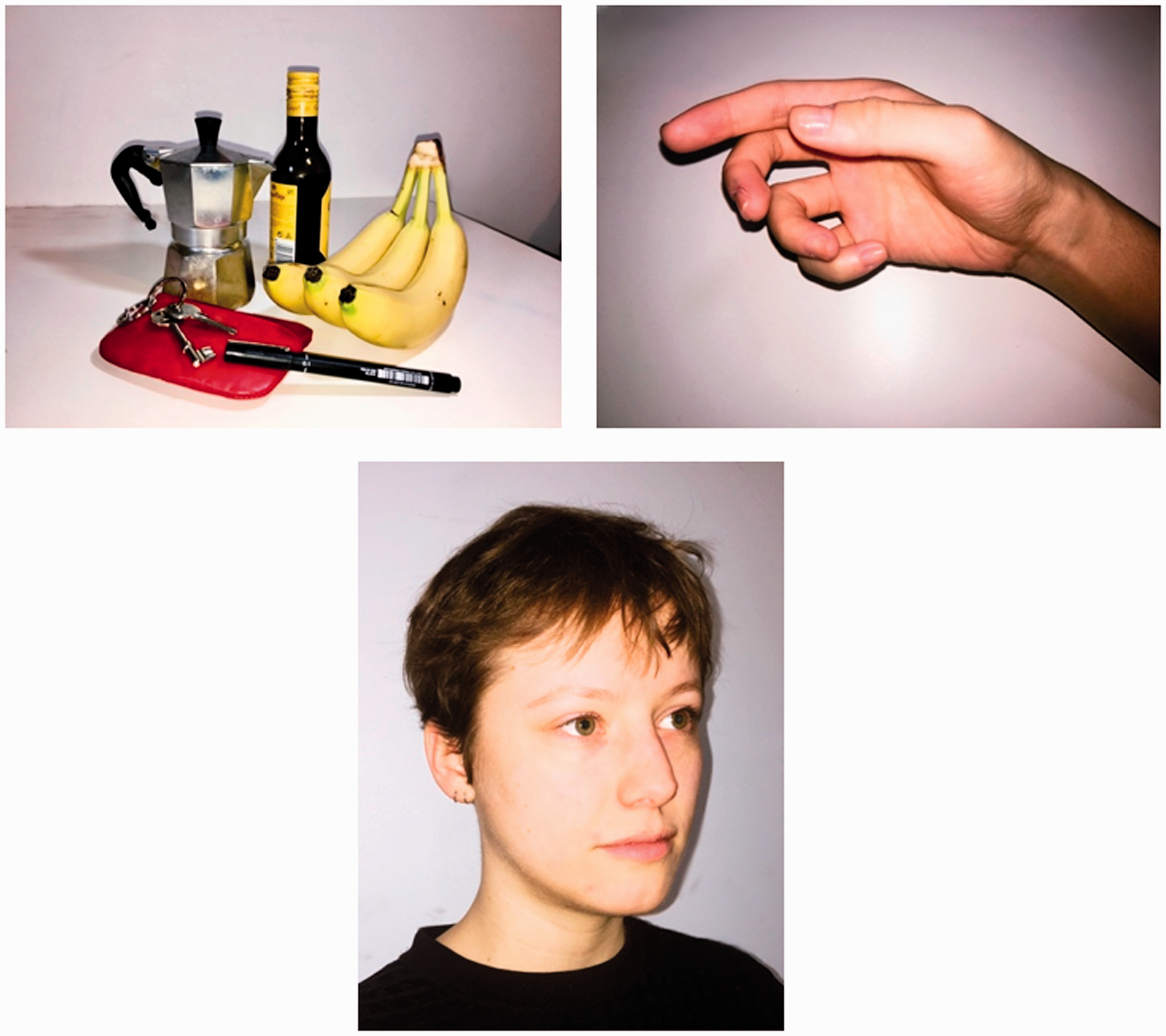
Stimuli of Representational Drawing Task Trials Produced by the Researcher. (Top left: still life photograph of everyday objects (752 × 564 mm), top bottom: photograph of a hand (752 × 564 mm), right: portrait (556 × 742 mm)).
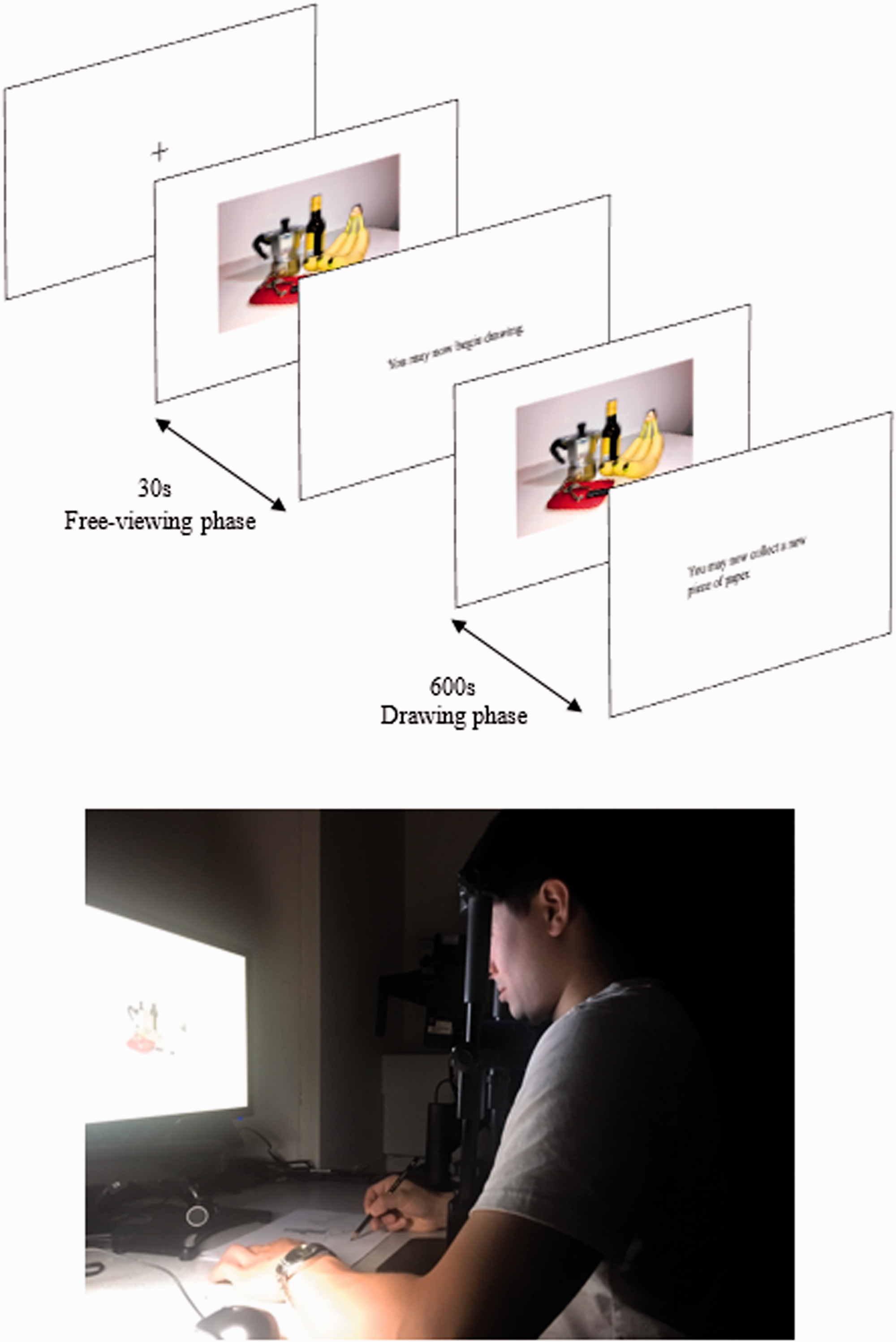
Experimental Flowchart of the Representational Drawing Task Trial 1 (Top) and the Experimental Set-Up (Bottom).
Ethics
The study was approved by the Ethics Committee of the Department of Psychology, Goldsmiths, University of London.
Results
Drawing Rating Data Preparation
The drawings were digitally scanned and were displayed digitally to two expert (tutors in Goldsmiths Art Department) and two non-expert (tutors in Goldsmiths Psychology Department) judges. The rationale behind including both expert and non-expert judges is to account for the different aspects of drawing quality contributing to judges’ ratings of accuracy (see Supplementary Analysis in Chamberlain et al., 2019). Each judge was asked to rate the drawings for accuracy from best to worst (7 = best, 1 = worst). Inter-rater reliability across the four judges was good for both still-life and hand drawings with Cronbach’s alpha of .80 and .84 and moderately good for face drawings with alpha reliability of .77. The ratings for the participants’ drawings of each stimulus were averaged across the four judges for further analysis. Ratings for the still-life, hand and face drawings were highly positively correlated with each other; still-life and face, r(65) = .68, p = .001; hand and face, r(65) = .90, p = .001; face and still-life, r(65) = .71, p = .001; thus, a compound rating was produced by averaging the ratings of the three individual drawings for each participant. Drawing ratings were significantly correlated with self-assessed drawing ability of each participant, r(65) = .52, p = .001 (Figure 3).
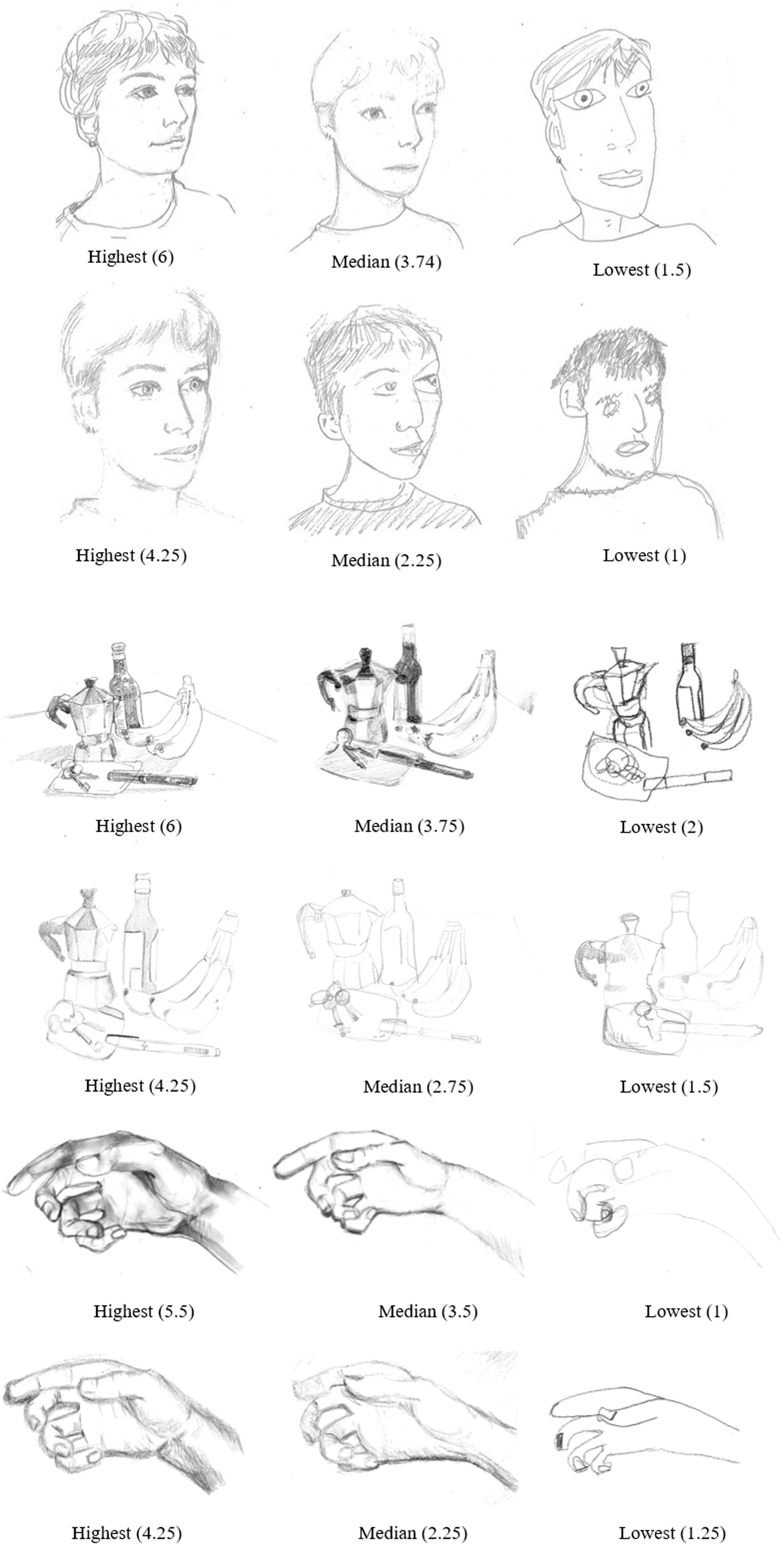
Drawings of Highest, Median and Lowest Accuracy ratings of Artists (Top) and Novices (Bottom).
Eye-Tracking Data Preparation
Saccades associated with previous or subsequent fixations that were located outside of the region of the computer screen (eye movements that went down to the paper while participants looked at their own drawing) were removed, along with the associated fixations. Fixations lasting less than 80ms or longer than 2s in duration were also removed following previous research (Follet et al., 2011). Consequently, 29.25% of the raw data was removed.
To characterise eye movements as either representing more global or local perceptual processing, we computed coefficient K: the mean difference between each standardized fixation duration and the standardised amplitude of its subsequent saccade (Krejtz et al., 2016). Negative values of coefficient K indicate short fixation durations followed by comparably longer saccade amplitudes, signifying global or ambient visual processing. Positive values of coefficient K indicate long fixation durations followed by comparably shorter saccade amplitudes, suggesting local or focal visual processing. For example, Ki = 1 refers to a situation where the fixation duration is more than 1 Standard Deviation (SD) longer than the following saccade amplitude, whereas Ki = –1 would refer to the situation where the saccade amplitude is more than 1SD longer than the prior fixation duration. The eye-movement data yielded a series of dependent variables for subsequent analysis: Fixations per Minute, Fixation Duration, Saccade Amplitude, and Coefficient K.
Free-Viewing Phase
The eye movement data for the 30s free-viewing phase for each stimulus (still life, hand, face) and for each participant group are presented in Table 1.
Eye Movement Patterns of Artists and Controls in the Free-Viewing Phase.
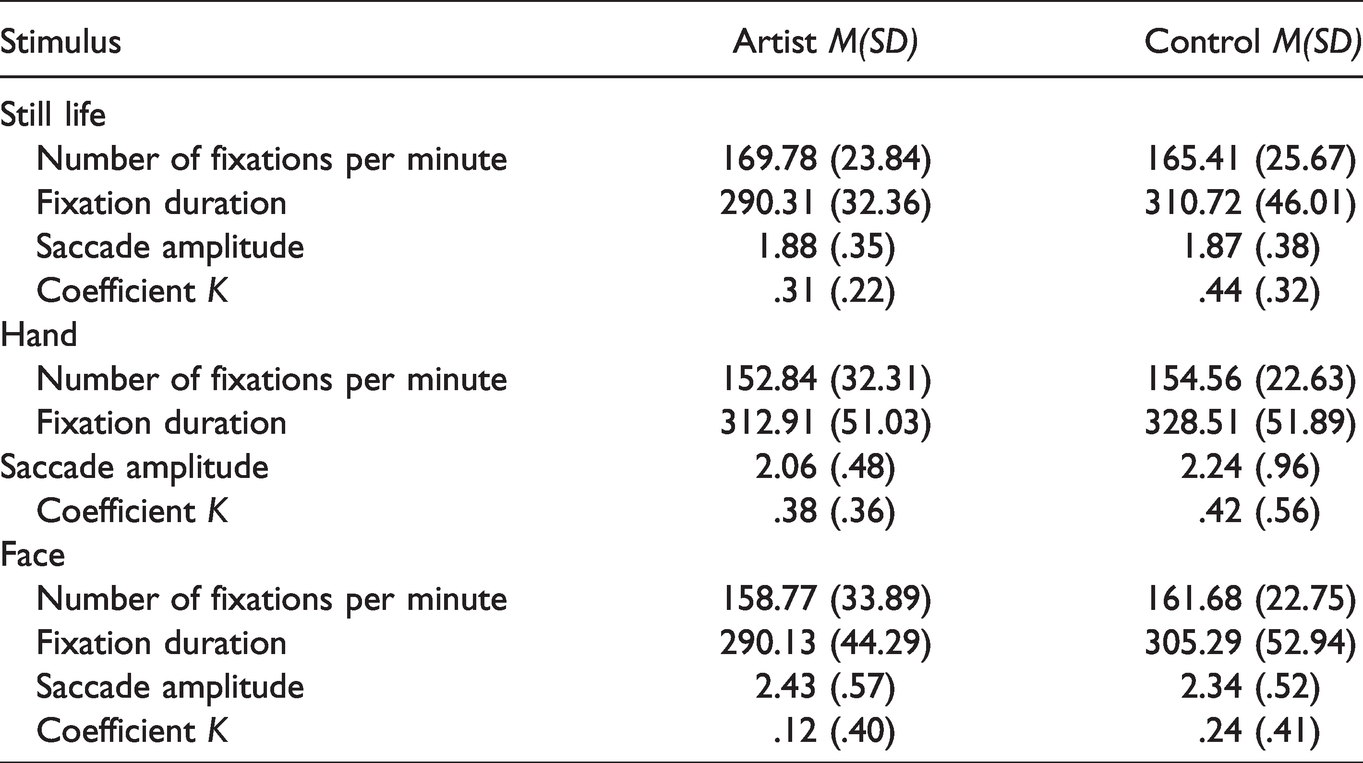
We conducted a series of mixed-model ANOVAs with stimulus (still-life/hand/face) as a within-subjects factor, and artistic group as a between-subjects factor, on each dependent eye movement variable (fixations per minute/fixation duration/saccade amplitude/coefficient K).
Fixations per Minute
There was a significant main effect of stimulus on fixations per minute, F (2, 126) = 7.74, p = .001, ηp2 = 0.11, but no significant main effect of group, F (1, 63) < 0.001, p = .99, ηp2 < .001. Post-hoc t-tests on the marginal means for each stimulus type revealed that participants made more fixations per minute when viewing the still-life compared with the hand (p < .001), however no other comparisons were significant after correction for multiple comparisons. Furthermore, there was no significant interaction between group and stimulus, F (2, 126) = 0.61, p = .55, ηp2 = .01.
Fixation Duration
There was a significant main effect of stimulus on fixation duration, F (2, 126) = 9.30, p < .001, ηp2 = 0.13, but no significant main effect of group, F (1, 63) = 3.23, p = .08, ηp2 = .05. Post-hoc t-tests on the marginal means for each stimulus type revealed that participants had longer fixation durations when viewing the hand compared with the still-life (p = .002) and compared with the face (p < .001), but there was no significant difference in fixation duration for the still-life and the face. Furthermore, there was no significant interaction between group and stimulus, F (2, 126) = 0.13, p = .88, ηp2 = .002.
Saccade Amplitude
There was a significant main effect of stimulus on saccade amplitude, F (2, 126) = 22.18, p < .001, ηp2 = 0.26, but no significant main effect of group, F (1, 63) = 0.06, p = .81, ηp2 = .001. Post-hoc t-tests on the marginal means for each stimulus type revealed that participants displayed significantly larger saccade amplitudes when viewing the face compared with the still-life (p < .001) and the hand (p < .001), and significantly larger saccade amplitudes when viewing the hand compared with the still-life (p = .011). Furthermore, there was no significant interaction between group and stimulus, F (2, 126) = 1.56, p = .21, ηp2 = .02.
Coefficient K
There was a significant main effect of stimulus on coefficient K values, F (2, 126) = 11.03, p < .001, ηp2 = 0.15, and no significant main effect of group, F (1, 63) = 1.39, p = .24, ηp2 = .02. Post-hoc t-tests on the marginal means for each stimulus type revealed that coefficient K was significantly lower (more global eye movements) when participants viewed the face compared with the hand (p < .001) and the still-life (p < .001), but there was no significant difference between the still-life and the hand.
Drawing Phase
The eye movement data for the 10 minute drawing phase for each stimulus (still life, hand, face) and for each group are presented in Table 2.
Eye Movement Patters of Artists and Controls in the Drawing Phase.
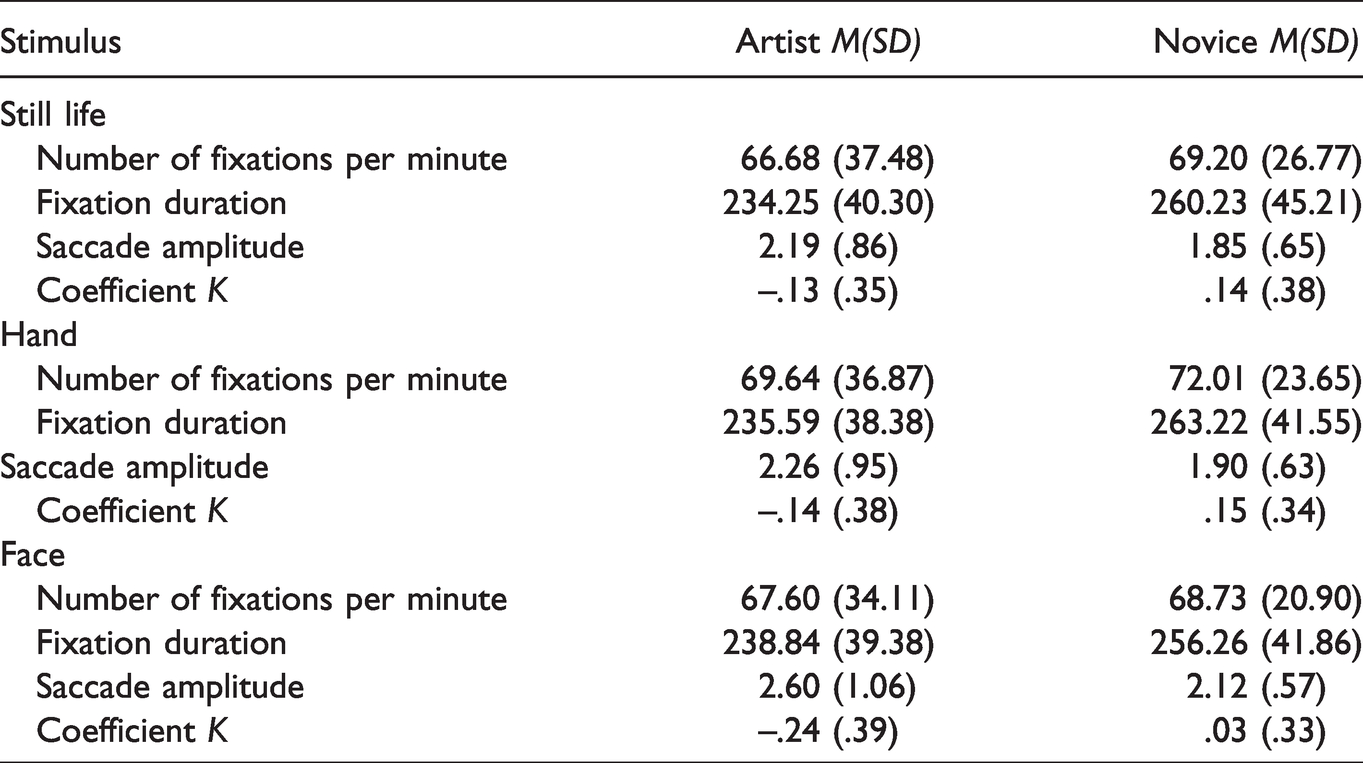
In the same manner as for the free-viewing phase, we conducted a series of mixed-model ANOVAs with stimulus (still-life/hand/face) as a within-subjects factor, and artistic group as a between-subjects factor, on each dependent eye movement variable (fixations per minute/fixation duration/saccade amplitude/coefficient K) in the drawing phase.
Fixations per Minute
There was no significant main effect of stimulus, F (2, 126) = 1.59, p = .21, ηp2 = 0.11, or group, F (1, 63) = 0.08, p = .79, ηp2 = .001, on fixations per minute in the drawing phase. Furthermore, there was no significant interaction between group and stimulus, F (2, 126) = 0.09, p = .91, ηp2 = .001.
Fixation Duration
There was no significant main effect of stimulus, F (2, 126) = 0.33, p = .72, ηp2 = 0.005, but a significant main effect of group, F (1, 63) = 6.02, p = .02, ηp2 = .09, on fixation duration in the drawing phase. Art students made shorter fixation durations compared with non-art students. Furthermore, there was no significant interaction between group and stimulus, F (2, 126) = 1.81, p = .17, ηp2 = .17.
Saccade Amplitude
There was a significant main effect of stimulus, F (2, 126) = 16.21, p < .001, ηp2 = 0.21, and a significant main effect of group, F (1, 63) = 4.36, p = .04, ηp2 = .07, on saccade amplitude in the drawing phase. Art students made larger saccades compared with non-art students. Post-hoc t-tests on the marginal means for each stimulus type revealed that saccade amplitudes were significantly larger in the face compared with the hand (p < .001), and the still-life (p < .001), but there was no significant difference in saccade amplitude between the still-life and the hand. Furthermore, there was no significant interaction between group and stimulus, F (2, 126) = 0.79, p = .46, ηp2 = .01.
Coefficient K
There was a significant main effect of stimulus, F (2, 126) = 8.71, p < .001, ηp2 = 0.12, and group, F (1, 63) = 11.22, p = .001, ηp2 = .15, on coefficient K values. Art students displayed significantly more negative coefficient K values (more global processing). Post-hoc t-tests on the marginal means for each stimulus type revealed that coefficient K values were significantly lower (more global processing) for the face stimulus compared with the hand (p < .001), and the still-life (p = .002), but there was no significant difference between the still-life and the hand. Furthermore, there was no significant interaction between group and stimulus, F (2, 126) = 0.06, p = .94, ηp2 = .001.
Representational Drawing Ratings
Descriptive statistics for drawing ratings for art-students and controls are shown in Table 3.
Drawing Ratings of Artists and Controls.
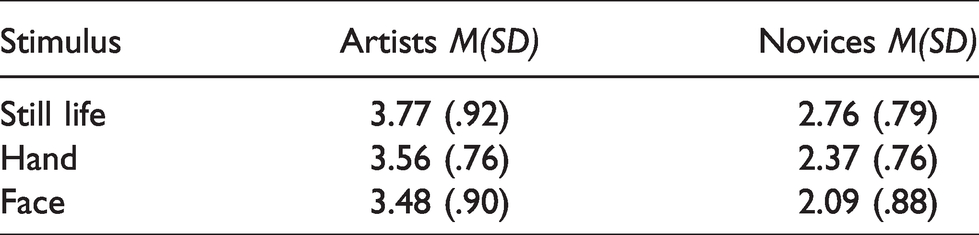
In order to examine the relationship between representational drawing ability and patterns of eye movements, we ran a mixed ANOVA with stimulus (still-life/hand/face) as a within-subjects factor, and artistic group as a between-subjects factor, on drawing accuracy ratings. There was a significant main effect of stimulus, F (2, 126) = 9.44, p < .001, ηp2 = .13 and of group, F (2, 126) = 43.19, p < .001, ηp2 = .41, but no interaction between stimulus and group, F (2, 126) = 1.36, p = .26, ηp2 = .02. Post-hoc t-tests on the marginal means for each stimulus type revealed that drawing ratings were significantly higher for the still-life compared with the hand (p < .001), and the face (p = .006), but there was no significant difference in drawing ratings between the hand and the face.
It was found that coefficient K was negatively correlated with the drawing ratings for the still life (r (63) = –.29, p = .02), hand (r (63) = –.26, p = .04) and face (r (63) = –.20, p = .11) stimuli, however these correlations did not survive correction for multiple comparisons (p = 0.017).
Discussion
The aim of current study was to investigate the impact of artistic expertise on visual attentional processing during free-viewing and drawing. In summary, both artists and controls exhibited small differences in eye movements based on stimulus type; participants made more global eye-movements (larger saccade amplitude and lower coefficient K) when drawing a face stimulus compared with a still-life and hand stimulus. Furthermore, there were no significant differences in eye movements between the two participant groups during the free-viewing phase, however artists showed significantly more global eye movements when drawing compared with controls. While there was no difference in the number of fixations per minute made by the two participant groups, the art-student group had shorter fixation durations, larger saccade amplitudes, and lower coefficient K values. This difference in eye movements was apparent across all three stimulus types. The proportion of global eye movements participants made was also consistently but weakly associated with representational drawing ability.
Artists take a more global scan path strategy when engaged in a task related to art expertise but not everyday viewing compared with controls. Notably, artists’ coefficient K shifted toward negative values (short fixation durations followed by comparably longer saccade amplitudes) when drawing a stimulus whereas coefficient K remained positive for control participants throughout the experiment. This coheres with a recent theoretical account which posits that artists employ an innocent eye; an extended mode of proximal vision which entails enhanced focused attention on pictorial relationships in a visual stimulus (Lou, 2018). Furthermore, our results align with previous work suggesting that artists are more inclined to change their viewing strategy than controls when engaged in an artistically relevant task (Vogt & Magnussen, 2007; Zangemeister et al., 1995). However, other studies have found that artists’ viewing strategies adapt to the demands of offline tasks even when they are not creating or viewing an artwork (Perdreau & Cavanagh, 2013, 2014). This apparent contradiction can be remedied if we consider free-viewing as task-neutral, in which the artists do not need to adapt their attentional strategy to meet specific cognitive or perceptual demands. In support, previous studies that have shown differing viewing styles according to task demands have often required participants to either perceptually analyse or encode visual stimuli. Perceptual analysis and encoding is arguably a key facet of most artistic activities, particularly in the case of drawing. Therefore, it can be suggested that artists show enhanced attentional processing on those tasks that recreate some of the demands of a drawing task.
Coefficient K was not significantly correlated with drawing ability in the current study, suggesting that the different eye movement patterns of artists in the study cannot be exclusively attributed to their superior drawing skill. These results may explain why our findings do not resemble those of Miall and Tchalenko (2001), who focused on a single case study with Humphrey Ocean, an artist with specific expertise in portrait drawing and painting, and showed a targeted or local approach to visual analysis. In our study, participants had prior experience from a range of artistic backgrounds, including sculpture, photography and new media (although two thirds of artist participants reported drawing regularly in the past two years). Whilst the current study focused on measuring observational drawing, the ability to focus on different visual features and shift between numerous interpretations of the same visual input might not be limited to drawing but could also be related to different domains of aesthetic production (Chamberlain & Wagemans, 2016). Future research should seek to investigate domain-specific differences in eye movement strategy to augment the current results. For example, artists’ eye movements could be assessed while completing a photographic manipulation task (McManus et al., 2011).
The results of the current study give an overall picture of artists’ eye movement strategies over the course of several minutes of drawing. Future paradigms measuring shifts in global/local perceptual processing will be beneficial to provide a more nuanced picture of the differences in perceptual processing between artists and novices expressed over the course of creation of a drawing. Recent research suggests that artists tend to draw global details of an image first, and that this is correlated with drawing accuracy (Drake et al. under review). Investigating the dynamics of both visual attention and drawing strategies as an artwork emerges will provide additional insights on artists’ expertise. Crucially, eye movement strategies should be linked to behavioural advantages in local and global processing, so that they are grounded in an understanding of how they benefit perceptual decision making (Benear et al., 2019).
Footnotes
Declaration of Conflicting Interests
The authors declared no potential conflicts of interest with respect to the research, authorship, and/or publication of this article.
Funding
The authors received no financial support for the research, authorship, and/or publication of this article.
