



Abstract
Dissociation has been proposed to disrupt memory processing, including source monitoring. Conceptualized by some as a defense mechanism, dissociation may impair memory particularly for negative stimuli. The present study tested whether trait dissociation is associated with reduced source monitoring performance, and whether this association is stronger for negatively valenced stimuli. A self-other source monitoring paradigm was administered to 197 students. During encoding, participants read aloud positive, neutral, or negative sentences that were either experimenter-generated or self-completed. One week later, they classified previously presented and new sentences as self-generated, other-generated, or new. Trait dissociation was assessed using the Curious Experiences Survey. Dissociation was not associated with source monitoring performance for negative stimuli, nor for positive stimuli. These findings do not support a selective link between dissociation and impaired source monitoring for negative information. Dissociation-related deficits may emerge only under conditions involving greater emotional intensity, higher cognitive demands, or more ecologically valid stimuli, or they may not be a defining feature of high dissociators.
Introduction
Dissociative experiences are substantially prevalent in the general population (Sar, 2011; Seedat et al., 2003; Waller & Ross, 1997) and occur across individuals with various mental disorders (Lyssenko et al., 2018; Renard et al., 2017). They can vary from mild to severe and can be divided into different types: absorption (the tendency to become fully engaged in activities such as reading), derealization (a sense that the world feels unreal), depersonalization (a sense that the self feels unreal), amnesia (reported difficulty recalling important personal information), and identity confusion and alteration (disruptions in one's sense of identity). Some theories propose a link between dissociation and adverse events, such as emotional, physical, and sexual abuse. In particular, the defense mechanism hypothesis suggests that dissociation functions as a coping response to mitigate emotional distress both during such events and when confronted with reminders at a later time. Consequently, dissociative experiences are implied to impact memory functioning, particularly for negative events (Dalenberg et al., 2012; Holmes et al., 2005).
One memory process possibly affected in high dissociators is source monitoring, which involves determining the origins of memories, knowledge, or beliefs (Johnson et al., 1993). This process is needed for distinguishing between internal and external experiences, essential for maintaining a coherent sense of self. Dissociative experiences are associated with a blurred boundary between the self and the environment and may thus be linked to an individual's capacity to accurately attribute the source of information as internal or external.
According to the source monitoring framework, accurate source memory relies on various types of information including perceptual details, contextual details (spatial and temporal), semantic content, affective information, and underlying cognitive operations (e.g., organizing, elaborating; Johnson et al., 1993). Failures in source monitoring can result in a range of errors, from mild inaccuracies to severe distortions that can result in delusions (Damiani et al., 2022), confabulations (Johnson & Raye, 2000), or false memories (Gallo, 2010). For instance, during therapy, an individual may develop false memories of events that never occurred, because of imagination building on suggestion by others. Source monitoring errors in distinguishing between imagined and actual experiences may then make these imagined events feel real (e.g., see Wade et al., 2002).
There has been some research investigating the relationship between dissociation and source attribution in the form of false memory studies typically employing the Deese-Roediger-McDermott paradigm (DRM; McDermott, 1996). In this paradigm, participants are presented with word lists of stimuli (e.g., “bed,” “rest,” “dream”) that are semantically related to an unpresented lure (e.g., “sleep”) and are subsequently asked to recognize or recall the presented words. Studies using the DRM paradigm have found weak to moderate associations between dissociation and the misattribution of the source of the lure, suggesting that dissociative tendencies may play a modest role in false memory susceptibility (for an overview, see Dalenberg et al., 2012; but also see Lynn et al., 2014). However, paradigms explicitly designed to test source monitoring remain scarce, with only a limited number of studies employing specific tasks for this purpose.
Pionke-Ubych and colleagues (2021) investigated so-called self-disturbances, which included dissociative experiences, and cognitive biases including source monitoring in a sample of 193 young adults from the general population. The authors assessed source monitoring performance using an Action Memory Task where participants performed or imagined actions and later identified whether they had previously performed or only imagined them during a recognition phase. However, their results revealed no significant relationships between self-disturbances (including dissociation) and cognitive biases (including source monitoring deficits).
Building upon this work, Somma and colleagues (2024) focused more specifically on dissociative experiences using the Brief Dissociative Experiences Scale (DES-B; Dalenberg & Carlson, 2010) in a large sample of 308 adults from the general population. They used an online source monitoring task where participants were presented with scenes (e.g., a desk, a garage) containing various items such as a paperclip, or a highlighter. After each scene, participants would watch a video of another participant (i.e., a research assistant) describing items they had seen in their scene. After a 60-s distractor task they had to determine by whom each item was seen; themselves, the assistant, both, or neither. Results revealed a moderate negative association between dissociative experiences and source monitoring performance, suggesting that individuals characterized by higher levels of dissociative experiences experienced greater difficulty in accurately identifying the source of information.
Finally, Chiu et al. (2016) tested a mixed sample of psychiatric inpatients using a self-other source monitoring paradigm originally used in Mitchell and colleagues (1986) and adapted for Chinese characters. In the study phase, participants either read aloud complete sentences provided by the experimenter or completed sentences themselves based on prompts indicating the number of omitted characters. In the recognition phase, participants first indicated whether they recognized each sentence and then identified its source as either self-generated (internal) or provided by the experimenter (external). Results showed that the absorption and reported amnesia, but not derealization and depersonalization, were negatively associated with source monitoring performance.
Previous studies thus showed mixed results regarding the relationship between source monitoring deficits and dissociative experiences where in the task assessing imagined versus performed actions, no association was found, although evidence emerged in tasks measuring self- versus other-generated actions or self- versus other-seen actions. It is important to note that these studies all used neutral stimuli in their source monitoring tasks. However, following the defense mechanism hypothesis, specifically aberrant processing of negative stimuli would be expected in those having notable dissociative experiences (Holmes et al., 2005; Schauer & Elbert, 2010; van der Kolk & McFarlane, 1996). It can thus be hypothesized that source monitoring deficits may be specifically exacerbated in response to negative information. Incorporating negative stimuli into the source monitoring paradigm would allow to test whether this theoretical prediction holds true. Therefore, building on previous research, the present study aims to test whether there is empirical support for the proposed theoretical association between dissociative experiences and impaired source monitoring for negative stimuli.
Important in considering the study hypothesis, it should be noted that for the general population, previous studies have indicated enhanced rather than reduced accuracy in source monitoring for negative stimuli. For example, Kensinger and Schacter (2005) found that reality-monitoring (i.e., the ability to distinguish internally generated information from externally presented information) was better for negative items compared to neutral items, an effect they replicated across four experiments (Kensinger & Schacter, 2006). They suggested the improved source attribution occurred because participants recall negative stimuli with more contextual details, making memory retrieval of negative stimuli less susceptible to distortion. Subsequent research by Kensinger and colleagues (2007) further demonstrated that this effect was unique to negative stimuli, as positive items did not show the same reduction in reality-monitoring errors. In contrast, the defense mechanism hypothesis would predict high dissociators to successfully avoid the retrieval of contextual or other types of details of negative stimuli necessary to determine the source of a memory, resulting in diminished source monitoring performance for negative stimuli.
As such the objective of the present study was to examine whether individual differences in trait dissociation are associated with source monitoring performance, and whether this association is specifically modulated by the emotional valence of the stimuli.
Based on theories conceptualizing dissociation as a defensive mechanism, it was hypothesized that higher levels of trait dissociation would be associated with poorer source monitoring performance for negatively valenced stimuli, but not for neutral or positive stimuli.
The independent variables were stimulus valence (positive, neutral, negative) and dissociative experiences as measured by the Curious Experiences Survey (CES). The dependent variables were item recognition performance (signal detection indices d′ and c) and source monitoring accuracy (percentage correct conditional on item recognition).
Method
Participants
The sample consisted of 197 first year psychology students (mean age = 19.9 years, SD = 2.0, range = 18–35), of whom 74% were female, who consented to participate in this experiment as part of their research credit requirement. There were no specific exclusion criteria.
Instruments
Curious Experience Survey
The Curious Experience Survey (CES; Goldberg, 1999) is an extension of the original Dissociative Experience Scale (DES; Bernstein & Putnam, 1986) featuring 31 statements aiming to capture a variety of dissociative experiences through self-report in non-clinical populations. The scale encompasses items such as “Found like I became so involved in a fantasy or daydream that it felt like it was really happening to me” or “Felt as though I was looking through a fog so that people or objects appeared far away or unclear”. In contrast to the DES, item endorsement does not reflect experiencing these events for a certain percentage of the day. Instead, participants indicate their agreement on a 5-point Likert scale ranging from “never” (1) to “almost always” (5). The scale features three subscales: 1) depersonalization/derealization, 2) absorption, and 3) amnesia. The CES has satisfactory reliability and construct validity (Cann & Harris, 2003; Goldberg, 1999). Internal consistency in this sample was high as indicated by a Cronbach's alpha of .91. However, the subscales featured lower alpha's: amnesia (Cronbach's α = .61), depersonalization/derealization (α = .87), absorption (α = .75).
Life Event Checklist 5
Given that the defense mechanism hypothesis assumes an association between trauma history and dissociative experiences, we included a measure of trauma history. The Life Events Checklist for the DSM-5 (LEC-5; Weathers et al., 2013) is a self-report measure of adverse past experiences. The checklist features 17 categories of events spanning from natural disasters to combat exposure as well as interpersonal events such as sexual or physical abuse. For each item individuals are asked to indicate whether (1) they have been a witness to the event or (2) experienced it first hand, and further at which age the event occurred. For the purpose of the present study, we specifically focused on the self-experienced adverse events.
While many studies have examined the factor structure of the LEC-5, a range of factor solutions has been proposed for different populations (Bae et al., 2008; Kwobah et al., 2022; Stevenson et al., 2023). Interpersonal types of adverse experiences, such as sexual or physical abuse, are held to have the strongest association with dissociative symptoms (Dalenberg et al., 2012) and measures of post-traumatic stress disorder (Chivers-Wilson, 2006; Resnick et al., 1993; Santiago et al., 2013). Therefore, we chose an interpersonal subscale that includes events capturing instances of physical and sexual violence (items 6–9, 14, 16). Additionally, accidents and natural disasters were grouped together due to their impersonal, non-targeted characteristics (items 1–4). Lastly, more general adverse experiences, such as serious illness or the death of a loved one, were categorized in a general subscale (items 5, 10–13, 15, 17). For items 14 and 15 which refer to sudden violent and accidental death answers in the witness scale were counted as responses in the self-scale.
Materials
For the design we adopted a self vs. other source monitoring paradigm used in previous studies (Chiu et al., 2016; Mitchell et al., 1986; Vinogradov et al., 1997). The experimental task consisted of two phases: an encoding phase and a recognition phase. Sentences were designed to represent three valence categories: positive, neutral, and negative (e.g., “The musician sung a beautiful ____”, “The gardener watered the ___”and “The child was molested by the ____”). Emotional valence of the critical words was determined using established lexical norms, primarily the valence, arousal, and dominance norms for 13,915 English lemmas (Warriner et al., 2013). However, the responses that individuals gave to complete the gap sentences could potentially impact the valence of the then completed sentences used in the second phase of the experiment. For instance, a stimulus such as “The child held a ___” could be neutral, positive, or negative depending on the completion (e.g., “fruit,” “toy,” “knife”). To avoid ambiguity, the sentences featuring gaps that participants needed to complete were designed to prime responses without changing the sentence's valence (e.g., “The cancer led to a painful ___”). More specifically, after running an initial pilot, sentences that elicited a large variety of responses with varying valences were replaced with ones that led to consistent responses from the majority of participants. Furthermore, sentence structure was kept consistent across conditions, and references to male and female agents were balanced across items to avoid unintended contextual biases.
For each valence category, half of the sentences (7 items) were presented as gap sentences, requiring participants to fill in a missing word, while the other half were completed sentences provided by the experimenter. This resulted in a total of 42 sentences (14 positive, 14 neutral, 14 negative). An additional set of 21 new sentences (7 items per valence category) served as distractors in the recognition phase.
Procedure
To prevent intentional encoding of the task stimuli and not to give away the goal of the study, participants were informed that the experiment aimed to investigate how life experiences might influence pronunciation (prosody). They were told that the study sought to understand whether individuals pronounce words or sentences differently depending on their past experiences. Participants were tested individually.
Encoding Phase
See Figure 1 for an overview of the experimental procedure. In the encoding phase participants were instructed to read aloud sentences displayed on a screen, emphasizing an underlined word. First, two example sentences were provided: one experimenter-generated sentence and one gap sentence requiring completion. Participants then read all sentences aloud with responses to the gap sentences recorded for later use in the recognition phase. If a participant failed to fill in a gap sentence during the encoding phase, that specific stimulus was excluded from recognition phase, as there was no participant-generated completion to present.
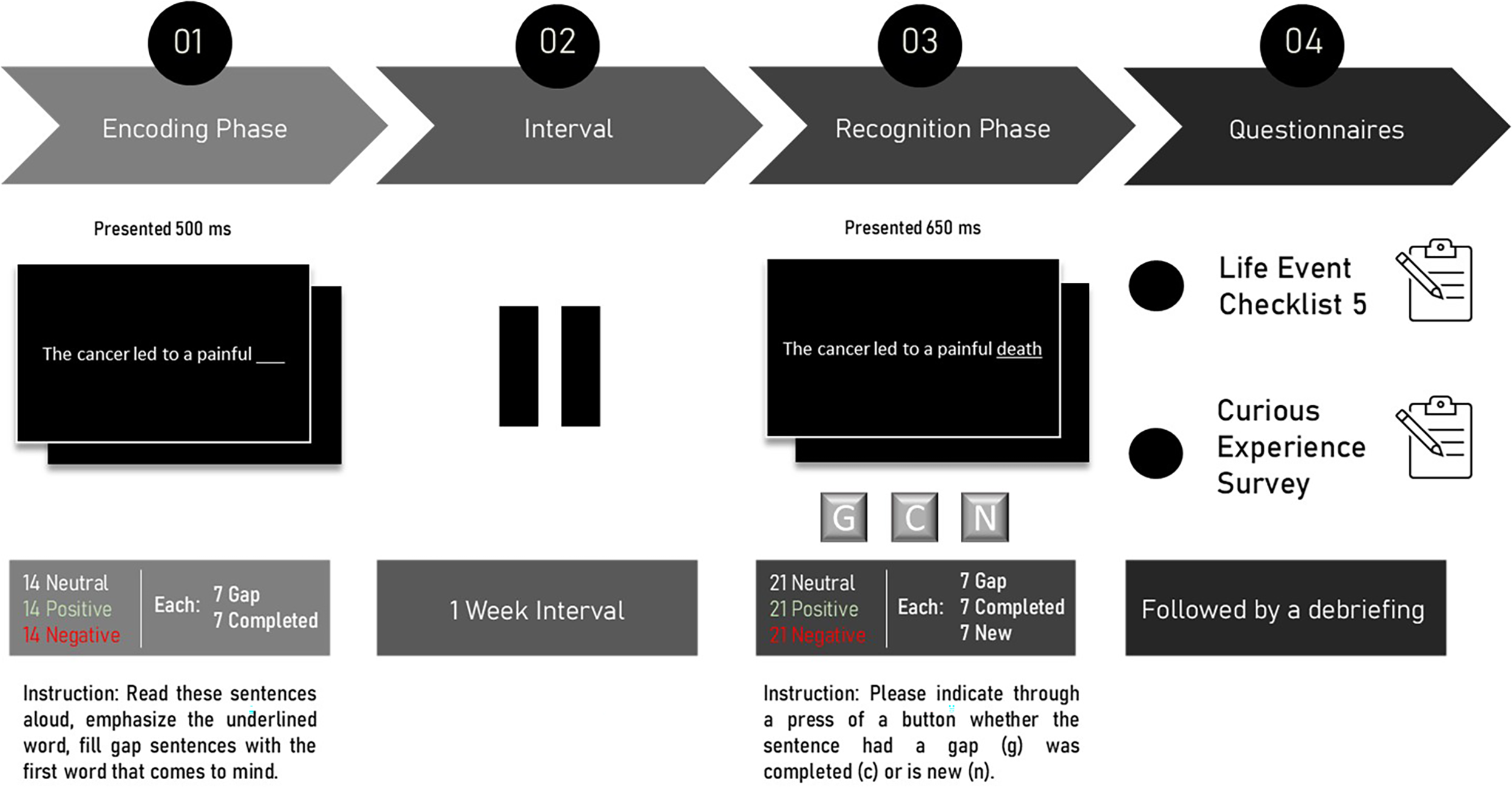
Experimental procedure.
Recognition Phase
After a one-week interval, participants returned for the recognition phase of the experiment. The external (completed) and internally (self-generated (gap)) sentences were displayed in the same format as in the encoding phase, except that the internally generated sentences now featured participants’ responses from the previous session (e.g., “The child was molested by the father”). These sentences were mixed with the new distractor sentences in a fixed random order where there was a maximum of three sentences from any source (i.e., internal, external, distractor) in a row and any valence type (positive, negative, neutral) never presented more than three times in sequence. Participants were asked to classify each sentence as either internal, external or new (distractor). Non-responses for sentences previously encountered during the encoding phase (i.e., internal or external) were coded as a miss, reflecting a failure to recognize a familiar stimulus. For new sentences not seen before, a non-response was coded as a miss too. This approach assumes that the absence of a response corresponds to an absence of recognition, whether for previously seen or new stimuli.
After completing the source monitoring task, participants first filled out the CES and then the adapted LEC-5. These questionnaires were administered in a fixed order to minimize the potential influence of trauma-related questions on item endorsement on the dissociative experience scale. Finally, participants were debriefed, and the “true” objective was revealed (i.e., to determine the association between dissociative experiences and source monitoring).
Participants were recruited and provided informed consent prior to participation. The study was approved by the Research Ethics Committee of the University of Groningen and conducted in accordance with the ethical standards of the 2013 Declaration of Helsinki.
Data Analysis
As the experimental task required participants to choose between one of either internal (gap), external (completed) and new (distractor) for each stimulus, recognition (old/new) and source judgment were contained in a single response. For the analyses, however, separate measures for recognition performance and source monitoring were determined. Signal detection measures for recognition (d′ and c-criterion) were calculated separately for each valence category. Hits were defined as correctly identifying an item as “old” (i.e., internally or externally generated), where either an internally or externally generated item was presented. Conversely, a miss occurred if a participant incorrectly rated these items as “new”. Where entirely new items were presented, correct rejections were marked when participants correctly identified the distractor as “new,” and false alarms were recorded when new items were mistakenly categorized as “old” (i.e., internally or externally generated). To account for extreme values (i.e., hit rates or false alarm rates of 0 or 1), continuity corrections following the loglinear approach recommended by Stanislaw and Todorov (1999) were applied.
Source monitoring performance (internal vs. external) was analyzed only for items that were correctly identified as “old” items that is, as either internally or externally generated. Performance was then calculated by determining the percentage of correct answers, that is, the total number of presented internal and external stimuli divided by the number of hits. This analysis was conducted separately for each valence category. Differences in source monitoring performance across valence categories were examined using a repeated-measures ANOVA, with stimulus valence (positive, neutral, negative) as a within-subject factor. Pairwise comparisons were conducted between all valence category pairs. Finally, source monitoring performance for each valence category was correlated with the three subscales of the CES and the overall average CES score.
Results
Demographics
After excluding two participants who did not follow task instructions (i.e., only providing one type of answer such as “gap” in the recognition task), two who did not complete the questionnaires, and data of two participants who were not recorded due to a technical issue, the final sample size amounted to 191. Table 1 summarizes descriptives and sample characteristics of this sample. In the remaining sample, missing responses were minimal: Participants did not respond to 3.3% of gap sentence trials during the encoding phase and 0.5% of trials during the recognition task.
Descriptive Statistics.
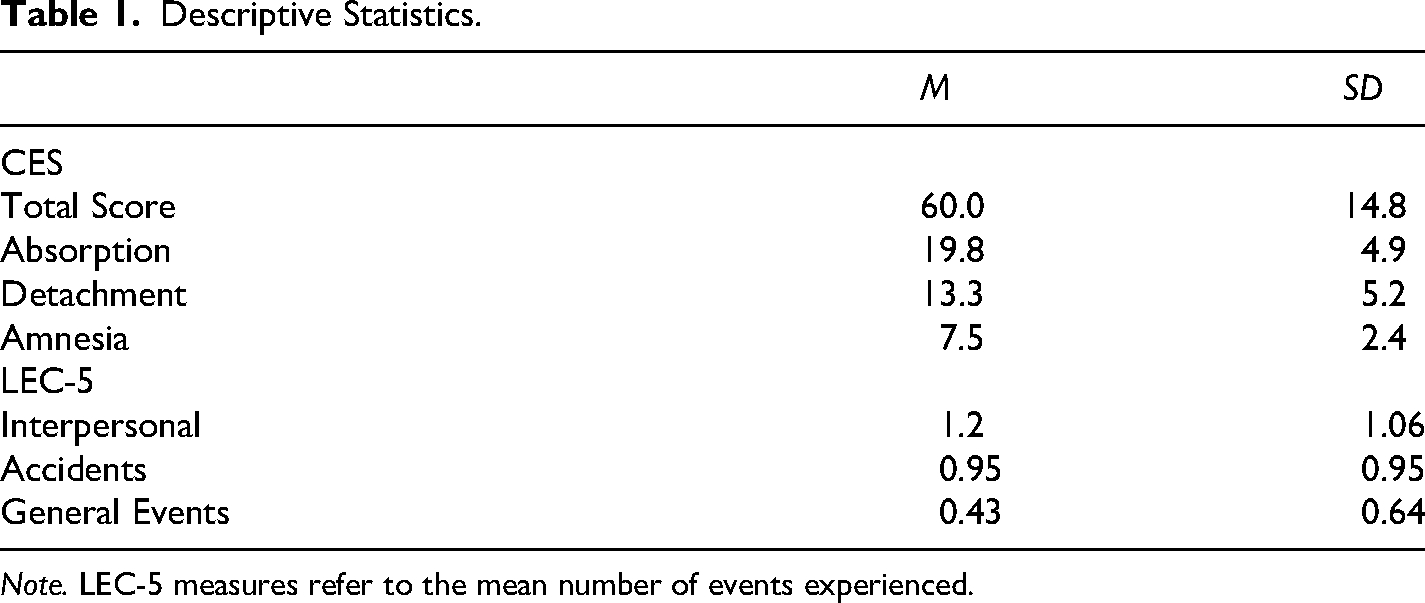
Note. LEC-5 measures refer to the mean number of events experienced.
Interpersonal adverse experiences were the most common among participants, with 135 (71%) reporting at least one such event. In comparison, accidents and natural disasters were reported by 119 (62%) individuals, and 68 (36%) experienced at least one other adverse event. Using Spearman-rank correlations we found a significant relationship of the CES score to interpersonal events rs = .36, p < .001, and other general adverse experiences rs = .19, p = .01, but not accidents and natural disaster related events rs = .01, p = .876.
Recognition Performance
Table 2 summarizes task performance. Mean hit rates were .68 for positive stimuli, .83 for negative stimuli, and .78 for neutral stimuli, with corresponding d′ values of 1.00, 1.28, and 1.66, respectively. These results indicate lower sensitivity in discriminating old from new (distractor) items with the greatest sensitivity for neutral stimuli. For positive and neutral items, there was no response bias (c ≈ 0), whereas for negative stimuli there was a slight liberal bias (c = –.39), suggesting that when unsure, participants were more inclined to respond “old” (i.e., “internal” or “external”) rather than “new.”
Mean Recognition and Source Monitoring Task Performance per Valence Category.
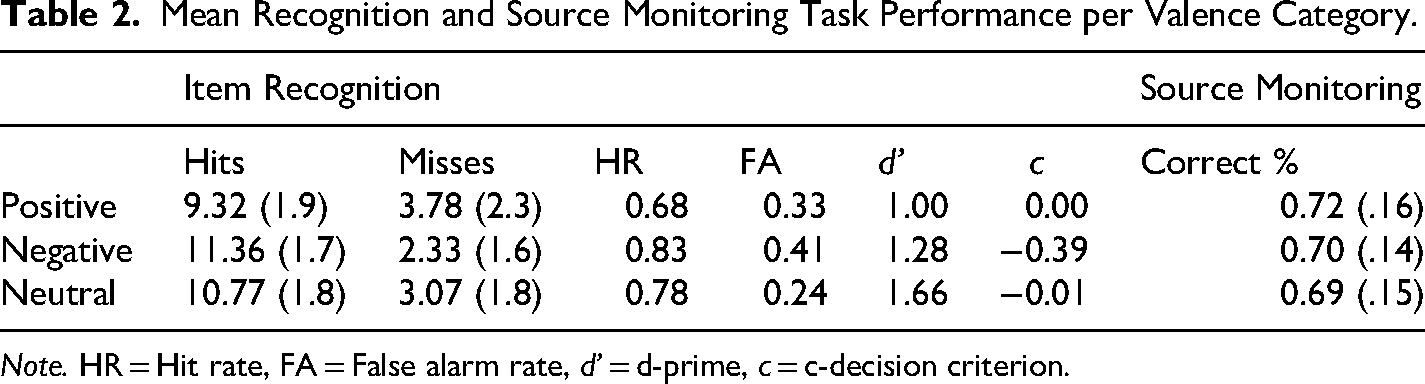
Note. HR = Hit rate, FA = False alarm rate, d’ = d-prime, c = c-decision criterion.
Source Monitoring Performance
Mean source monitoring performance was comparable across valence categories, with source attribution rates of 72% for positive stimuli, 70% for negative stimuli, and 69% for neutral stimuli. A repeated-measures ANOVA revealed no significant main effect of valence on source monitoring performance, F(2, 380) = 2.669, p = .071, ηp2 = .014. Pairwise comparisons using Fisher's least significant difference procedure indicated that performance for positive stimuli was significantly higher than for neutral stimuli (p = .032), whereas no other pairwise comparisons reached significance.
Correlations between item recognition (i.e., d’ and c-criterion) and source monitoring performance for each valence category and measures of trait dissociation are presented in Table 3. There was a small negative correlation between d’ for positive stimuli and dissociation subscales, suggesting that individuals with higher dissociation scores had poorer discrimination between old and new stimuli. Similarly, a modest negative correlation was observed between the c-criterion and dissociation subscales for negative stimuli, indicating that individuals with greater dissociation levels exhibited more false positives for negative items. However, neither correlation remained significant after correction for multiple testing. Contrary to our hypothesis, source monitoring performance for negative stimuli was not associated with scores on the CES or any of its subscales, nor was there a relationship with positive stimuli. While small positive correlations emerged between source monitoring performance for neutral stimuli and two CES subscales (detachment and reported amnesia), these associations did not remain significant after Bonferroni correction. We identified several multivariate statistical outliers. However, repeating the analyses with the removal of these outliers, resulted in comparable findings. In summary, the data do not demonstrate an association between trait dissociation and source monitoring performance, nor do they suggest that this relationship is more pronounced for negative stimuli.
Correlations Between Dissociation, Item Recognition, and Source Monitoring per Valence Category.
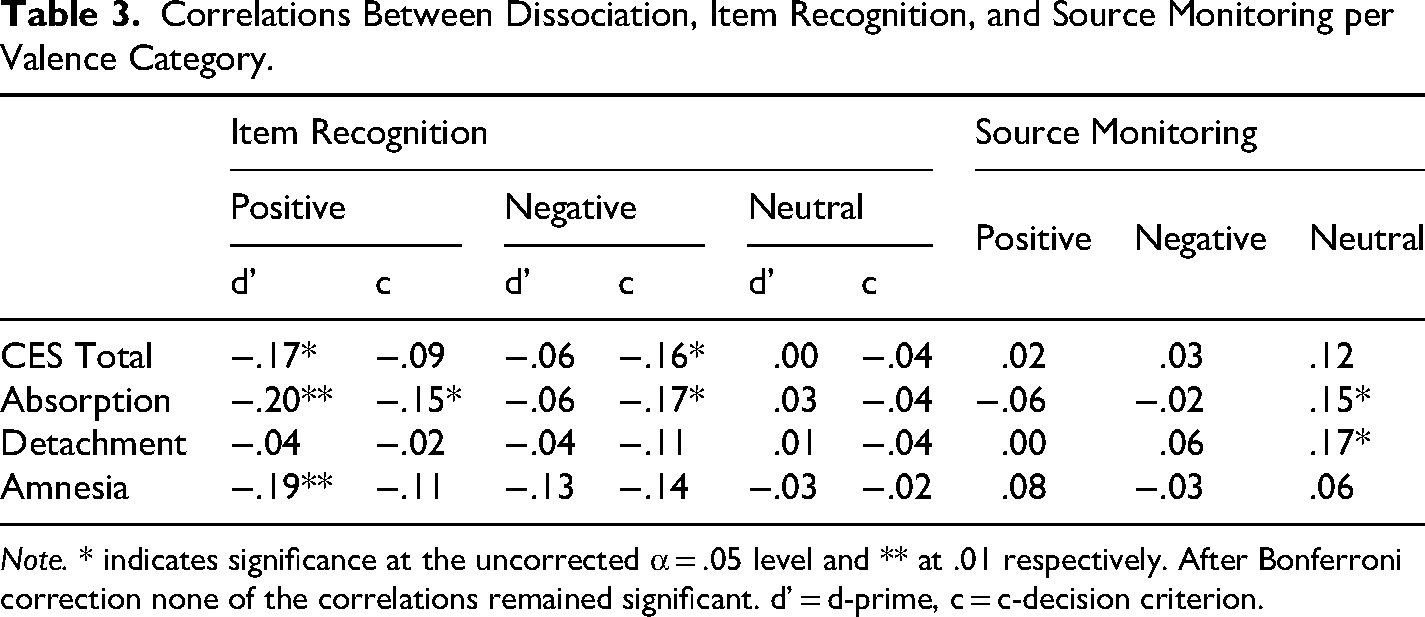
Note. * indicates significance at the uncorrected α = .05 level and ** at .01 respectively. After Bonferroni correction none of the correlations remained significant. d’ = d-prime, c = c-decision criterion.
Discussion
The aim of this study was to expand on previous research investigating the relationship of source monitoring ability and dissociative experiences by introducing emotionally valenced stimuli (i.e., positive, negative) in addition to neutral stimuli to a source monitoring paradigm. Following theories conceptualizing the experience of dissociation as a defense mechanism to avoid or mitigate the impact of negative information, it was hypothesized that source monitoring deficits would be specifically exacerbated for negative stimuli. However, our findings in an analogue student sample do not support this prediction. While there was a significant relationship between measures of trait dissociation and participant's reported history of adverse experiences, source monitoring performance was not related to trait dissociation, nor was there a specific relationship to source monitoring of negative stimuli.
Our results do not align with the prediction that source monitoring is generally facilitated for negative stimuli (Kensinger et al., 2007), nor with the idea that this effect is reversed in individuals with high trait dissociation, as would be expected based on the notion of dissociation as a defense mechanism. Although we observed slightly better recognition memory for negative stimuli, a pattern that could reflect the heightened salience of negative information, this advantage did not extend to the source monitoring performance.
One plausible explanation for the absence of the hypothesized differential source monitoring effect for negative information may be rooted in the types of stimuli used in the present study. Kensinger and colleagues (2007) employed a picture-based paradigm wherein participants were shown words for which they either formed mental images (imagined condition) or viewed actual pictures (seen condition). Later, they had to determine whether a previously presented word had been accompanied by an image or whether the imagery had been generated by themselves. These visual stimuli may have elicited stronger emotional and contextual responses than the comparatively “weaker” verbal stimuli used in our study. By extension, the lack of a dissociation-related deficit in source monitoring for negative stimuli could similarly be attributed to the relatively lower potency of verbal stimuli. In fact, proponents of theories conceptualizing dissociation as a defensive mechanism may argue how this effect might only surface under more arousal-inducing conditions, such as highly vivid, negative, personally salient cues, which stand in contrast to the word-based stimuli employed here.
The absence of an association between source monitoring performance and trait dissociation regardless of stimulus valence in this study is consistent with some (Pionke-Ubych et al., 2021), and inconsistent with other (Chiu et al., 2016; Somma et al., 2024) previous findings. One possible reason for our results not reaching statistical significance could be a restriction of range due to relatively low dissociation scores in student samples such as these. This may explain the difference between our results and those obtained by Chiu and colleagues (2016) whose mixed clinical sample featured higher levels of dissociation compared to our analogue student sample, thus allowing for more variance in scores and as a result increased detectability of the association. Importantly, the levels of reported adverse experiences in our sample were comparable to those observed in student and general population samples, making it unlikely that these factors explain the discrepancy between our findings and previous research (Boals et al., 2020; Goldstein et al., 2016).
With respect to the results of Somma and colleagues (2024) relatively low levels of trait dissociation may not explain the difference in findings, as their sample from the general population was characterized by similar levels of dissociation. Instead, the discrepancy between our findings and those of Somma et al. (2024) may be attributed to differences in task design, particularly regarding sensory modalities and social interaction. In their study, participants were presented with stimuli through multiple sensory channels which required participants to integrate visual and auditory information and distinguish between self-generated and other-generated sources with information from a partner. In contrast, our study involved participants completing sentences to generate the internal stimuli whereas the external stimuli did not require elaboration as they were presented as completed already. The additional complexity and cognitive load associated with multisensory integration and a social component in Somma and colleagues (2024) task may have heightened the visibility of dissociation-related deficits. This is in line with dissociation characterized by disruptions in the normal integration of consciousness, perception and memory (American Psychiatric Association, 2022). Tasks that challenge these integrative processes by requiring participants to process and reconcile information from different sensory modalities and a partner, may be more sensitive in detecting source monitoring deficits associated with trait dissociation. Thus, comparatively our unimodal task may not have sufficiently engaged the disrupted cognitive functions to reveal significant effects.
An additional methodological consideration concerns the operationalization of source monitoring performance. In the present study, source accuracy was indexed as proportion correct conditional on correct item recognition. Although this approach reduces confounding between item recognition and source attribution, it does not fully disentangle source memory from potential response biases. Reality-monitoring paradigms may elicit systematic response tendencies, such as preferential self-attributions, which could influence overall accuracy estimates (e.g., Bayen et al., 1996; Murnane & Bayen, 1996). Because source decisions were not decomposed into separate memory and bias parameters, subtle bias-related processes cannot be entirely ruled out. Importantly, however, the present study primarily examined associations between trait dissociation and source monitoring across valence categories. In the absence of any valence-specific effects and given the lack of associations between dissociation and source monitoring performance overall, there is no clear theoretical basis to expect that response bias would systematically vary as a function of trait dissociation in a way that would obscure a meaningful relationship. Nonetheless, future research may benefit from applying multinomial processing tree models or source-level signal detection approaches to estimate source memory and response bias parameters independently.
Finally, the absence of an observed association between dissociation and source monitoring performance may indicate that dissociation does not directly cause measurable memory deficits. While some scholars have proposed a link between dissociative tendencies and memory impairments, particularly in individuals with a history of trauma (Dalenberg et al., 2012), others argue that dissociation-related memory impairments may be subjectively experienced rather than objectively measurable. For instance, research by Huntjens and colleagues (2023) and van der Linde and colleagues (2023) suggests that high dissociators hold erroneous meta-memory beliefs like the belief that it is better to avoid retrieving trauma memories as recall would cause overwhelming emotional pain. This avoidance could create a sense of subjective amnesia, even when objective memory performance remains intact. This underscores the importance of distinguishing between perceived and actual cognitive impairments in dissociative experiences.
Future Studies
First, future studies investigating the relationship between source monitoring and dissociative experience may benefit from inducing state dissociation more directly instead of relying on trait dissociation. That is, if indeed, an individual's ability to discriminate between internal and external sources of information is impaired as a result of dissociative experiences, an experimental design explicitly inducing this experience may be sensible. Previous studies have used various paradigms to successfully induce state dissociation (Danböck et al., 2023; Leonard et al., 1999).
Secondly, future investigations should consider employing more emotionally evocative and contextually rich stimuli. For instance, integrating trauma film paradigms or highly arousing visual materials could better approximate the conditions under which a “defense mechanism” might be triggered. Such an approach may clarify whether more potent negative cues are essential to detect dissociation-related impairments in source monitoring performance, balancing the increased ecological validity of emotionally taxing stimuli with the controlled conditions necessary for experimental testing.
Lastly, research on dissociative experiences and memory impairment could benefit from complementing objective assessments of memory performance with subjective evaluations of perceived memory impairments. This approach could leverage newly developed tools, such as the Dissociation-Related Beliefs About Memory Questionnaire (DBMQ; Huntjens et al., 2023), to provide a more comprehensive understanding of memory impairment perceived by high dissociators.
Conclusion
The findings of the present study did not replicate the general association between dissociation and source monitoring deficits reported in previous research, nor did they provide evidence for a specific link between dissociation and source monitoring for negative stimuli. Given the lack of a general effect, it is challenging to draw definitive conclusions about the more specific hypothesis. Future research should carefully consider methodological factors such as the intensity as well as modality of the negative stimuli provided as well as induction of state dissociation.
Footnotes

Ethical Approval and Informed Consent Statements
Ethical approval was obtained by the local ethics review board (University of Groningen). Written informed consent was obtained from all participants prior to data collection.
Author Contribution Statement
Funding
The authors received no financial support for the research, authorship, and/or publication of this article.
Declaration of Conflicting Interests
The authors declared no potential conflicts of interest with respect to the research, authorship, and/or publication of this article.
Data Availability Statement
Data can be made available upon request.