



Abstract
Fantasy is often looked at through a psychopathological lens and is often associated with psychopathological disorders. In the current research study, fantasy is conceptualised as two distinct personality constructs instead, imaginative and creative fantasy. Imaginative fantasy refers to individual imaginative propensity while creative fantasy determines extent of engagement in creative production. Imagery vividness during reading (IVDR) can be understood as the ability to conjure mental picturizations of a narrative text's contents. Fantasy and imagery vividness are said to have an impact on empathy, yet these variables have not been investigated in conjunction. The results from a sample of 119 undergraduate students residing in the United Arab Emirates (UAE) revealed that the constructs of fantasy, IVDR and empathy are all significantly positively associated with one another and that IVDR is a full mediator between each construct of fantasy and empathy. The findings demonstrate and propose an initial framework depicting how fantasy personalities that exhibit high levels of IVDR use this variable as a channel to access and understand empathy.
Introduction
Fantasy is the process of using imagination to create alternative realities that play out in the mind as sequential mental images akin to a motion-picture (Weibel et al., 2018). Since “alternative realities” seems to suggest a detachment from the real world, literature on the topic regards the trait of fantasy to be of negative connotation (Weibel et al., 2018). This has led the majority of research to focus solely on psychopathology, conceptualising fantasy as a precursor to hallucinations, schizotypy and dissociation (Merckelbach et al., 2005, 2022; West & Somer, 2020; Zelin et al., 1983). As such, this narrowed focus has led to a lapse in broadening conceptual frameworks and has instead developed restricted experimentation using rudimentary and primitive means of assessing for fantasy levels in individuals. This is evident especially within literature exploring fantasy in relation to empathy. The Interpersonal Reactivity Index treats fantasy as a subscale (Monzel et al., 2023; Namba et al., 2021) and the NEO-PI takes it to be a mere component of the “openness to experience” trait (Costa & McCrae, 1992; Kearns et al., 2021). Even if the scales were to be controlled for, much of the current research on the topic primarily involves children as participants (Bunce & Woolley, 2021; MacKeith, 1983). Weibel et al. (2018) propose an alternate outlook and conceptualise fantasy as a more multidimensional and nuanced aspect of personality that can have a positive impact on individuals’ lives, even as they age.
One of the most impactful ways that fantasy can serve as a positive asset to an individual is through its influence on empathy. The aspect of fantasy most often explored in relation to empathy is daydreaming and mental imagery. A study conducted by Kearns et al. (2021) showed that prosocial daydreaming may have a positive effect on the strengthening of prosocial disposition. Specifically, when individuals engage in daydreaming around positive goal pursuits, they are increasing the likelihood of engaging in corresponding behaviors to achieve those goals. For instance, if an individual daydreams about being praised in society for being a socially aware and a socially considerate person, this individual may be more inclined to donate to charity (Cameron et al., 2022). The will for prosocial behaviors can then be facilitated when an individual engages in the imaginings of helping behavior (Gaesser et al., 2018). In line with this research, Wilson et al. (2018) propose that individuals who inherit the ability to generate mental imagery would be able to produce positive outlooks to oneself (i.e., self-compassion and positive criticism) as well as to others when exposed to positive stimuli. In Kearns et al.'s (2021) online survey study on 80 participants in the US, findings depicted that daydreaming was most consistently and positively associated with empathic concern. These findings highlight the importance of further exploring fantasy's role in personality, prompting a more refined approach to its measurement.
To gain a deeper understanding and more precise measurement of the complexity of fantasy as a dimension of personality, Weibel et al. (2018) have divided fantasy into two components: imaginative and creative fantasy. Their instrument is designed to avoid overgeneralization that could lead to misleading results (Lynn & Rue, 1988).
Creativity is understood as the mental process involved in a goal-oriented, novel, and practical activity (Cropley & Cropley, 2011), such as an invention (Weibel et al., 2018). Creative fantasy, on the other hand, is not bound by a specific goal and is spontaneous in nature, with creativity being its manifested by-product (Weibel et al., 2018; Lynn & Rue, 1988). Given these conceptualizations, fantasy can be viewed as a creative tool that allows the imagination to integrate one's inner and outer worlds.
Daydreaming is known to be an automatic form of mind-wandering activated when the mind is at rest (Klinger et al., 2009), through self-generated thoughts, fantasies, and rumination (Shimoni & Axelrod, 2024). Imagination refers to the sensory and immaterial re-creation of an individual's experiences and events in the mind (Lifshitz et al., 2019; Barrett, 2010). Paracosms are conceptualized as imaginative worlds created by individuals that are alternative to reality (Sánchez-Bernardos et al., 2015). Imaginative fantasy is the amalgamation of daydreams, imagination, and absorption in paracosms (Weibel et al., 2018).
A part of imagination is being able to accurately conjure imagery in the mind (Marks, 1973; Weibel et al., 2018). This ability can be elicited while reading fictional texts (Green, 2021; Green & Brock, 2003) and foster the propensity to imagine holistic social or fictional settings (Felisberti & Cropper, 2023; Green, 2021). This immersion into narrative fiction can prompt an individual to paint a mental landscape, envision a character with nuanced personality traits and imagine the various objects in the literary world built by the writer (Johnson et al., 2013). While these experiences are termed as “transportation” in existing research, the current study will define this as IVDR.
Current literature suggests that IVDR increases empathy levels as well as prosocial behaviours in individuals (Johnson et al., 2013). The act of IVDR can produce the cognitive engagement and emotional involvement that can simulate real-world empathy (Green, 2021; Green & Brock, 2003; Mazzocco et al., 2010) and evoke greater social pain when exposed to real-life social adversities (Schwarz et al., 2021). This simulation can even occur with emotional and cognitive real-time social experiences that take place on a daily basis, as well as self-related control beliefs, which may be vital for perspective-taking (Isberner et al., 2019). Fantasy as a genre of stories can spark active imagination in students to strengthen values that fictional characters portray in prose including empathy and creativity (Nuryanti et al., 2020) – a strength further enhanced by higher IVDR, allowing them to empathise with others the way they may empathise with fictional characters (Namba et al., 2021). This experience with the emotional states of fictional characters becomes a part of an individual's schema for external social experiences that can allow them to anticipate and hold certain expectations of interactional outcomes with others in the social realm (Alderson-Day et al., 2017). Measures of lifetime reading yield a significant positive correlation with empathy with the largest correlation being with the fantasy dimension of empathy (Lenhart et al., 2020). This suggests that IVDR may act as a mediator between reading habits and empathy. Bal and Veltkamp (2013) found that there is a positive correlation between empathy and IVDR, which was evident among fiction readers but not non-readers. Individuals with low IVDR became less empathic overtime, while those with higher IVDR showed a more positive long-term trajectory.
While these findings may suggest that IVDR is an inherent ability predisposing an individual to achieve certain levels of empathy, there is also evidence to show that IVDR can be enhanced through exposure to additional fictional narratives, which can boost empathic concern over time.
Overall, evidence points to a link between fantasy, imagery vividness during reading and empathy. Specifically that individual levels of fantasy indicate higher IVDR which can influence empathy levels. Ergo, the aim of the present research is to explore the relationship between fantasy, IVDR (the mediator), and their effects on empathy levels in undergraduate students residing in the United Arab Emirates.
This study will provide an initial framework for assessing empathy through imagery vividness, which may relate to individual differences in fantasy. It will also promote further research on incorporating fiction and developing imagery vividness within and outside of academic settings, ultimately fostering greater empathy among undergraduate students.
Aim and Hypotheses
The present research aims to explore the effects of fantasy on empathy through imagery vividness during reading and contributes to the current understanding of empathy by providing a framework on the possible pathway for individuals with high levels of fantasy to access empathy. The hypotheses of the study are as follows:
1. a. There will be a significant positive correlation between creative fantasy scores and empathy among undergraduate students. b. There will be a significantly positive correlation between imaginative fantasy scores and empathy among undergraduate students. 2. Imagery vividness during reading would mediate the relationship between creative and imaginative fantasy and empathy. 3. There will be a significantly positive correlation between imagery vividness during reading and imaginative fantasy among undergraduate students.
Methods
Participants
Out of 152 total participants, a sample of 119 undergraduate students were included in the statistical analyses. A large proportion of the sample consisted of females (n = 95). Mean age of participants was 19.56 years old (SD = 1.587) with age range being 18–27. 22 participants were male, 95 were female and 2 were non-binary. The sample consisted of 4 students of Architecture, 73 Psychology students, 6 from Business and Finance, 8 studying computers, 5 studying medicine, 17 in Engineering, 1 in Aviation, Education, Interior Design, Data Science, Infomatics, Human Resources and Visual Communication each. The survey was disseminated and participants were recruited through social media platforms, WhatsApp, Reddit (on online forums on the topic of undergraduate research and the United Arab Emirates) and Instagram. Psychology students were also recruited from the university's Student Research Participation (STReP) with the reward of credits.
Instruments
The Fantasy Questionnaire (Weibel et al., 2018) is a self-report measure that assesses individual propensity of fantasy. It is novel and scarcely used in studies. High internal reliability was yielded supporting previous reliability results (Liebers & Straub, 2020). It contains two subscales: imaginative fantasy and creative fantasy. Imaginative fantasy measures individual propensity for active imagination and the ease with which the individual becomes absorbed into the daydreams and visual mental images that stem from their imagination. Creative fantasy assesses the individual use of imagination for creative products. The first 16 items of this questionnaire are a part of the imaginative fantasy component (e.g., “I am never bored because I start fantasizing when things get boring”). The latter 11 items are a part of the creative fantasy component (e.g., “Products of my fantasy such as texts and drawings generate themselves almost automatically”). All items were 5-point Likert scales ranging from 1 (Strongly disagree) to 5 (Strongly agree). The score for each component was calculated by adding the scores for their respective questions and reverse scoring for the item in imaginative fantasy, “I don’t like to waste my time daydreaming”.
The Literary Response Questionnaire (Miall & Kuiken, 1995) is a self-report measure that has been used in educational settings (Calafato & Simmonds, 2022; Chiang et al., 2020; Grandits, 2020) to measure individual differences in cognitive response to literary text. The imagery vividness scale of the LRQ is used to measure individual extents and intensity of imagery vividness conjured during reading fiction. It contains 9 likert scale items ranging from 1 (Not at all true) to 5 (Extremely true). There was good test-retest reliability (stability across time) as well as internal consistency in the original construction of the scale as well as across other studies in the literature (Calafato & Simmonds, 2022; Grandits, 2020; Haddock et al., 2020). A total score was derived from the sum of its questions.
The Toronto Empathy Questionnaire (TEQ) (Spreng et al., 2009) is a self-report instrument that is used to assess individual differences in empathy in terms of emotional ability. The TEQ consists of 16 items that are Likert scale ranging from 1 (Never) to 5 (Always). A total score was calculated by the sum of all questions.
Procedure
The Qualtrics survey administered to participants online included three questionnaires (TFQ, TEQ, imagery vividness subscale of the LRQ). Participants were first shown the information sheet and were asked to fill out a consent form, after which they were to create a unique code for pseudonymisation of data. All questionnaires were delivered in English. Before the questionnaires were displayed, participants were asked to type in their gender (open-ended), age, and the undergraduate degree they were studying at the time. They were then shown the first scale of the Fantasy Questionnaire, Imaginative Fantasy, wherein they were asked to rate level of engagement in daydreams and imagination as well as ease of absorption into these engagements. The second scale of TFQ, Creative Fantasy, was then displayed wherein participants were asked to rate extent of their engagement in creative production using imagination. The second questionnaire's (LRQ) subscale of imagery vividness was then given in which participants were asked to rate how vividly and clearly they could imagine, visualise, and feel descriptions provided in literary text. The third and final questionnaire, the TEQ, implored participants to explore their levels of empathy through various examples and simulations of social interaction and situations. Upon completion of the survey, participants were shown the debrief sheet that displayed the main aims, a brief introduction, and the procedure of the study. Data was collected on Qualtrics and downloaded and stored in a password protected folder and anonymised during statistical analysis (codes were deleted).
Ethics
The current study received ethics approval from the University Ethics Committee (reference number: 2022-3119-7074). A consent form was administered to all participants within the information sheet wherein the participants’ rights are listed. It is included fthat participants have the right to withdraw, opt out of the study at any time without explanation and omit or refuse to answer questions. Participants are informed of the procedure of the study and the anonymity of their data that would take place after analysis. At the end of the survey, participants are shown a debrief sheet that including background information and the aim of the study as well as the reiteration of privacy and confidentiality of data collected.
Data Analysis
The study adopted a repeated measures design. Demographic data was analysed and compiled to produce descriptive statistics using IBM's statistical software, SPSS 26. Data was cleaned using the exclusion criteria of incomplete responses (29 responses) and standardised values above 2.5 or below −2.5 (4 responses) as recommended by Leys et al. (2013). Associations between creative fantasy, imaginative fantasy empathy and imagery vividness during reading were analysed using Spearman's correlations as the data was not normal. The mediation analyses were carried out using PROCESS Macro (Hayes, 2018) with each fantasy construct as the predictor variable, imagery vividness as the mediator variable, and empathy as the outcome variable.
Results
The aims of this study were to investigate (1) whether creative and imaginative fantasy would have an impact on empathy, (2) the role of imagery vividness during reading as a mediator for the relationship between constructs of fantasy and empathy and (3) whether imaginative fantasy would be correlated with imagery vividness among a sample of undergraduate students living in the UAE.
Descriptive Statistics
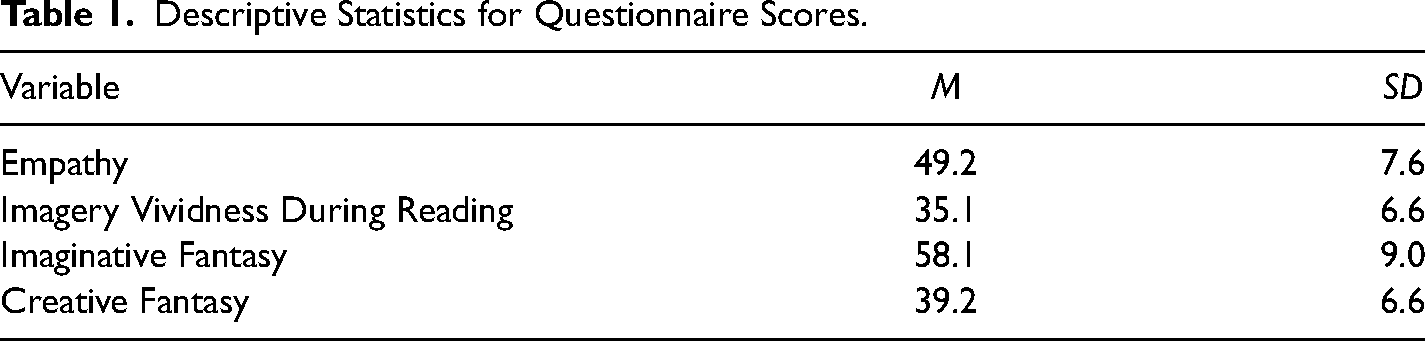
As displayed in Table 1, the lower standard deviations of scores for all variables other than overall fantasy scores reflect data clustered around the mean.
Descriptive Statistics for Questionnaire Scores.
Reliability Statistics
Cronbach Alpha scores from original research papers were compared with current scores for internal reliability comparison. Results express higher original Cronbach Alpha scores for all scales and subscales with the exception of the Imagery Vividness subscale of the Literary Response Questionnaire. The Current Alpha α scores for imaginative and creative fantasy were .79 and .78, respectively. The Toronto Empathy Questionnaire achieved a score of .82 and the Imagery Vividness subscale of the Literary Response Questionnaire attained .88 for Current Alpha α. Nevertheless, all scales maintain and exceed the threshold for acceptable internal reliability which is 0.7 (Taber, 2018).
Correlations
In order to tests hypotheses 1 (a), (b) and 3, correlations were carried out on SPSS using Spearman's non-parametric correlations with interpretations for effect sizes based on Cohen's (2013) guidelines. Results yielded positive result in support of all 3 hypotheses.
The first and second correlational analyses were carried out to explore the association between creative fantasy and empathy scores and imaginative fantasy and empathy scores respectively to investigate hypotheses 1 (a) and (b).
The statistical analyses yielded significant, positive, weak correlations between creative fantasy (see Figure 1) and empathy (r (117) = .24, p = .008) (.10, indicating small effect size) and imaginative fantasy and empathy (r (117) = .25, p = .006) (.30, indicating medium effect size) in support of hypotheses 1 (a) and (b). This suggests that both imaginative fantasy and creative fantasy have a significant yet relatively small impact on empathy levels in undergraduate students. Analysis also revealed a significant positive, yet large, correlation between imagery vividness during reading and imaginative fantasy (r (117) = .53, p < .001) (.50, indicating large effect size) in support of hypothesis 3, suggesting that imagery vividness during reading has a strong association with the imaginative construct of fantasy. These analyses were carried out in order to understand how much of an impact each variable of the study has on empathy before a mediator is taken into account. Correlation is significant at the 0.01 level (2-tailed). Descriptive statistics (means and standard deviations) for each questionnaire are provided in Table 1.
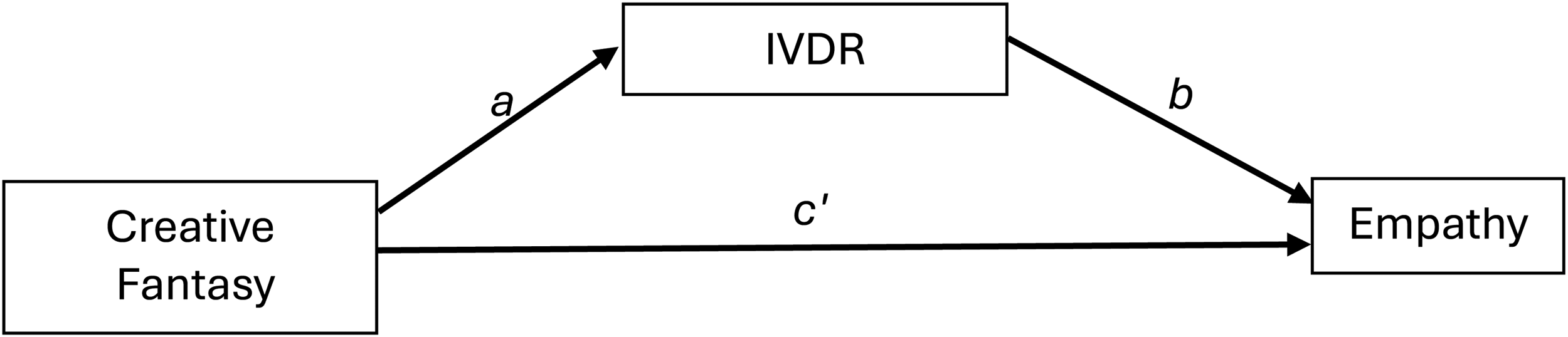
Mediation Analysis Model for Creative Fantasy, Imagery Vividness During Reading, and Empathy.
Mediation Analyses
In order to test hypothesis 2, the first mediation analysis was carried out with creative fantasy using PROCESS. This mediation analysis has 4 paths (see Figure 1). The first is the direct effect of creative fantasy on imagery vividness (a), the second is the direct effect of imagery vividness on empathy (b) the third is the direct effect of creative fantasy on empathy (c’) and the last is the total effect of creative fantasy on empathy through imagery vividness (c).
Results indicated a non-significant direct effect of creative fantasy on empathy, yet a significant indirect effect through imagery vividness during reading (R2 = .10) with the model accounting for 10% of variance in empathy. A significant direct effect of creative fantasy on imagery vividness during reading was found (R2 = .17) with the model accounting for 17% variance in imagery vividness during reading. Results further revealed a significant total effect of creative fantasy on empathy (R2 = .06) with the model accounting for 6% of variance in empathy (see Table 2). This indicates that imagery vividness during reading completely mediates the relationship between creative fantasy and empathy.
Mediation Analysis: Constructs of Fantasy Effects on Empathy.

Note. total N = 119, *p < .05, **p < .001, CI = confidence interval; LL = lower limit; UL; upper limit.
For further analysis, a second mediation analysis was carried out with imaginative fantasy using PROCESS. The pathway for this analysis followed (a) the direct effect of imaginative fantasy on imagery vividness (a), the direct effect of imagery vividness on empathy (b) the direct effect of imaginative fantasy on empathy (c’) and the total effect of imaginative fantasy on empathy through imagery vividness (c) (see Figure 2).

Mediation Analysis Model for Imaginative Fantasy, Imagery Vividness During Reading, and Empathy.
Results indicated a non-significant direct effect of imaginative fantasy on empathy, yet a significant indirect effect through imagery vividness during reading (R2 = .09) with the model accounting for 9% of variance in empathy. A significant direct effect of imaginative fantasy on imagery vividness during reading was found (R2 = .31) with the model accounting for 31% of variance on imagery vividness during reading. Results also revealed a significant total effect of imaginative fantasy on empathy (R2 = .54) with the model accounting for 54% of the variance in empathy (see Table 2). This indicates that imagery vividness during reading completely mediates the relationship between imaginative fantasy and empathy.
Discussion
The first aim of the study was to explore the relationship between imagery vividness during reading (IVDR), the two constructs of fantasy (creative and imaginative fantasy), and empathy levels among undergraduate students residing in the UAE. The second aim was to assess the impact of IVDR as a mediator in the relationship between the fantasy constructs and empathy. The third was to measure the correlation between imaginative fantasy and IVDR.
Creative Fantasy and Empathy
The first hypothesis being supported by the findings aligns it with previous literature and empirical evidence (Weibel et al., 2018; Meyer et al., 2019; Blix, 2019; Maslej et al., 2017). This shows that, indeed, creative fantasy can enhance the ability to mentally simulate social interactions with increased vividness, allowing individuals to exhibit higher levels of empathy than those with lower creative fantasy (Blix, 2019; Meyer et al., 2019; Maslej et al., 2017). This can be explained by the ability to develop higher emotional sensitivity and emotional connection towards fictional characters associated with creative production that may simulate real life (Maslej et al., 2017; West & Somer, 2020). This advantage associated with creative production can be seen among medical students (Chen & Forbes, 2014) and those in performing arts (Kou et al., 2020). Thus, the difference in empathy is seen through increased prosocial behaviour, perspective taking, and empathic concern (Kou et al., 2020).
Imaginative Fantasy and Empathy
Hypothesis 1 (b) speculated that there would be a significantly positive association between imaginative fantasy and empathy, which was supported by the results. These findings align with previous qualitative and quantitative research (Kearns et al., 2021; Taylor et al., 2004). For instance, Tan et al. (2021) found through qualitative interviews that, for healthcare workers, imagination is a requirement for empathy, as it prompts an individual to envision another's point of view by extrapolating personal life events to better understand their experiences.
Creative and Imaginative Fantasy, Imagery Vividness During Reading and Empathy
The second hypothesis theorised that imagery vividness during reading would mediate the relationship between each construct of fantasy. The findings revealed that for each construct of fantasy, imagery vividness is required for it to predict empathy. However, the mediation model for the total effect of imaginative fantasy on empathy accounted for a significantly larger amount of variance than creative fantasy. This may suggest that individuals who score high on creative fantasy and low on imagery vividness may have a different mediator affecting their empathy levels, which may account for the remaining variance. Previous literature does indeed posit that IVDR has a significant impact on empathy, more so for individuals with the propensity to daydream (Cameron et al., 2022), engage in the consumption of fiction (Kearns et al., 2021), and increasingly engage with their imagination (Gaesser et al., 2018), all of which are part of imaginative fantasy (Weibel et al., 2018).
Imaginative Fantasy and Imagery Vividness During Reading
The purpose of the third hypothesis was to measure the strength of the correlation between imaginative fantasy and IVDR to see if this relationship would explain a weaker correlation between imaginative fantasy and empathy. If imaginative fantasy and IVDR do indeed have a stronger relationship than imaginative fantasy and empathy (as is the case in the current study), as shown in previous research (Engisch & Langkau, 2022), this would suggest that IVDR may serve as a moderator, as that is statistically possible (Judd et al., 2001).
Limitations
The sample was mostly composed of psychology students, so the results may not be fully representative of students from different undergraduate degrees. It could be that students from different disciplines rely more on certain constructs to exhibit imagery vividness and empathy (i.e., engineering students may possess higher creative fantasy than students studying visual communication, who may rely more on imaginative fantasy). The large group of psychology students included may explain the results of the mediation model showing that imaginative fantasy accounts for 54% of variance, as they may be channeling empathy through imagery vividness that is more strongly incited by imaginative fantasy than creative fantasy.
Another limitation is that creative fantasy was not tested for temporal validity, which may explain the weak association between creative fantasy and empathy levels. Creative fantasy's impact on empathy may vary over time, as demonstrated in Kou et al.'s (2020) study after a follow-up of seven years.
Furthermore, as the current study does not differentiate between affective and cognitive empathy, no conclusion can be drawn as to which component imaginative fantasy is most associated with. Its weak correlation with empathy may be explained by a stronger link to affective empathy and no significant link to cognitive empathy, though this is mere speculation. Cognitive empathy, known as the ability to understand another's perspective and place oneself in their emotional position (Smith, 2006), may require more than just imagination and daydreaming. This idea is further supported by the mediation analyses, suggesting that IVDR may be the variable to account for cognitive empathy, which imaginative fantasy alone may not tap into. This means that individuals with imaginative empathy may also need vivid imaginings, incited through narrative literature, to engage in perspective-taking, as that is what narrative fiction prompts its readers to do with its characters (West & Somer, 2020).
Future Studies and Implications
Future studies can adopt a similar framework, replacing IVDR with imagery vividness, which may be incited through different mediums (e.g., auditory modality) to determine whether the effects of the current model apply to non-visual stimuli, using Monzel et al.'s (2023) study as a starting point. Studies can also use the framework to explore differences in empathy pathways between aphantasics and hyperphantasics. This can be done through qualitative research, providing a basis for further investigation with more focused and structured information. Triangulation may also be used to examine how and whether students from different disciplines utilize different constructs of fantasy to channel empathy, as well as identify other mediators that may be at play.
Conclusion
The current research provides a unique framework that offers an initial explanation of how imagery vividness during reading mediates the predictive relationship between the fantasy aspect of personality and empathy levels among individuals. Using mediation analyses, it was found that without IVDR, differences in creative and imaginative fantasy personalities have no significant predictive effect on empathy levels. This study draws attention to how individuals with the two constructs of fantasy and imagery vividness during reading harness their imagination, creativity, and capacity for mental visualization, possibly engaging in empathy. This overlooked channel to empathy may benefit psychological researchers who explore personality and empathy, professors and teachers who implement empathy education within curricula and academic environments, as well as social and healthcare practitioners who benefit from empathy themselves and whose clients also benefit from the same.
Footnotes
Acknowledgements
Dr. Hajar Yekani (Department of Psychology, Heriot-Watt), Dr. Jonathan Smallwood (Department of Psychology, Queen's University).
Declaration of Conflicting Interests
The authors declared no potential conflicts of interest with respect to the research, authorship, and/or publication of this article.
Funding
The authors received no financial support for the research, authorship, and/or publication of this article.
