



Abstract
It is often challenging to fully justify why it is preferable to think and conduct research about consciousness following a particular theory as opposed to another. This may be especially true in disciplines within Psychology, Cognitive Science, and Neuroscience which may be pressured to follow radical reductionism to physics or chemistry. The present approach was developed through teaching a cohort of approximately 2000 undergraduate and graduate students for over fifteen years. It involves a pragmatic tutorial of the major traditions in philosophical thinking, dissecting the explanatory power of each theory and logically resolving their differences in a unitary novel framework called functionalist emergentist materialism (FEM). This proposed epistemic approach dissolves many theoretical issues. Notably, it becomes possible to make sense of the “hard problem” as an evolutionary solution. We apply and integrate this approach with one of the most comprehensive neuroscientific theories, Damasio's tripartite of consciousness, and extract a pragmatic test for recognizing conditions in which an organism is conscious. FEM aligns with contemporary evolutionary thinking and current scientific standards.
Keywords
Theoretical Background
The study of consciousness has evolved from a philosophical inquiry into the mind-body problem to an interdisciplinary field, gaining prominence with psychology and then extending to various scientific disciplines, including neuroscience. The lack of a consistent definition has led to the interchangeable use of terms like consciousness, mind, thoughts, and feelings within earlier literature (Velmans, 1991). The intersections between these terms attempted to capture the lay man everyday understanding of ‘consciousness’ encompassing the important aspects of the human condition: knowledge, experience and awareness. This intuitive conceptualization also represents the extent to which scientists can agree on a universal definition of consciousness. The absence of a common scientific framework or methodology for studying consciousness has resulted in a lack of agreement on progress and approaches that are further complicated by diverse epistemic perspectives (Chalmers, 1996). There are now over 50 contemporary definitions or theories of consciousness (Sattin et al., 2021) along with signs suggesting this field is moving away from consensus (Francken et al., 2022; Yaron et al., 2022). Prompting some scholars to resort to ‘mysterianism,’ accepting that a scientific understanding of consciousness will always elude humanity and its upper limit of cognitive capabilities (McGinn, 1989). Regardless, the journey of studying consciousness demands a dive into the unknown, embracing curiosity, uncertainty, and open mindedness.
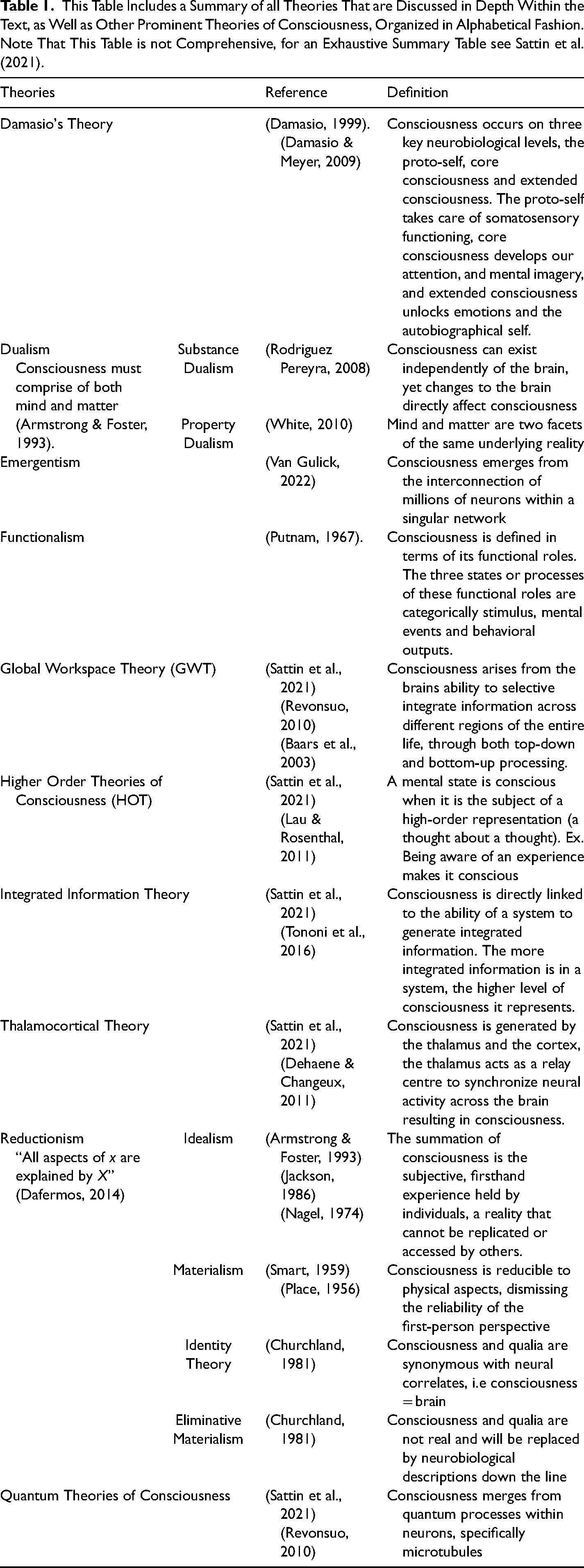
Table 1 highlights various key definitions of consciousness. This table demonstrates that there already is a general intuitive and informal agreement on what consciousness is and how it functions and that it is possible to entertain scientific investigation of the topic. We will similarly proceed from this very general and preliminary working understanding without committing to one specific view up front (for a notable precedent, similar to our tactic, see Crick & Koch, 1990). Our objective is to flesh out, via reasoning, the theoretical specifics supporting the general consensual view.
This Table Includes a Summary of all Theories That are Discussed in Depth Within the Text, as Well as Other Prominent Theories of Consciousness, Organized in Alphabetical Fashion. Note That This Table is not Comprehensive, for an Exhaustive Summary Table see Sattin et al. (2021).
In this paper, we propose a theoretical synthesis which became solidified through classroom discussions that span the inclusion of over 2,000 undergraduate and graduate students in Neuroscience, Biology, Psychology, Cognitive Science, and allied disciplines in Health, Humanities and Social Sciences. These discussions encourage the exploration and interrogation of complex ideas, allowing students and educators alike to challenge existing paradigms and innovate new ones. It follows a model which may be defined as a “self-reflective tutorial”. Unlike traditional empirical methods relying on observable data and experimentation, classroom discussions rely on the varying backgrounds, beliefs, and experiences of students actively engaging in the study of consciousness and it involves the so-called first-person perspective. This form of scientific inquiry facilitates continuous advancement, as evidenced by the ongoing evolution of collective understanding. With each presentation of new evidence, debates over counter arguments, and consideration of alternative perspectives, the conceptualization of consciousness becomes increasingly refined. The progression of ideas is not just based on accumulation of various notions but on the reasoning and self-reflection of all aspects of the assumptions behind theoretical positions. This iterative process enhances clarity and precision while highlighting the difficulty in dismissing aspects of consciousness that individuals intuitively rely upon, and thus we cannot ultimately dismiss. The assumption is that the researcher's empirical pursuit must be coherent to his/her own subjective intuitive belief about consciousness. Most of the time this underlying coherence is part of tacit knowledge, but at other times there is no concern or attempt for explicit elaboration. FEM is a tool to elaborate step by step what is the deeply rooted credo that pushes someone to investigate neuroscientific phenomena surrounding consciousness following a particular direction. The hope is that as an underlying coherence is reached and is explicitly formulated it can then lead to improvement in research, for example, by formulating clearer and more relevant questions, approaches and empirical pursuits.
Before getting to the point, we need to put at the forefront a fundamental tacit assumption which permeates the entire paper and framework proposed therein. Due to all the different epistemic perspectives (i.e., views on the nature of our knowledge of) on consciousness (which we will cover shortly), there is no common scientific framework or methodology to go about studying consciousness. Without this common idea, no one can be sure on what “progress” is and how to bring it about. We assume that biology can provide the unifying upper-level multidisciplinary discipline which subsumes psychology, neuroscience, cognitive science and all the fields including humanities and social sciences that coalesce in the study of consciousness. Therefore, the language and the perspective stem from the vantage point of biology (broadly construed) to provide a coherent way of expressing the key that opens all doors in the vast multidisciplinary complex arena of the topic on focus here.
A Crash Tutorial on Epistemology of Consciousness, from Philosophy to Scientific Theory
We begin by exploring a few core definitions essential for navigating the theoretical landscape of consciousness. To be clear, this exploration is not exhaustive, by no means we can make justice to the last ions of years of human reflection on the subject, it rather is “essential” and selective, following a heuristic based on few influential textbooks at various level of undergraduate and lower-level graduate studies in consciousness (Baars & Gage, 2010, Blackmore & Troscianko, 2018, Dehaene, 2014; Dietrich, 2007; Laureys et al., 2016; Revonsuo, 2010). It is widely acknowledged that we can discern between conscious and unconscious human states; this can be referred to as
Epistemology, i.e., the philosophical discipline dealing with knowledge, plays a pivotal role in understanding the origins and nature of knowledge within the study of consciousness, unveiling the underlying philosophical agenda in scientific theories and emphasizing the significance of considering experimenter beliefs (Pernecky, 2016). The philosophical study of consciousness is built on a history of questions. Questions like “how do you know you are not dreaming right now?” “Are you actually conscious right now?” “How do you know that you exist right now?” Answers to these questions have created epistemologies and frameworks which have laid the groundwork for scientific approaches to consciousness. However, differing answers have led to varied and inconsistent approaches. The theoretical spectrum of consciousness ranges from idealism, materialism, dualism, emergentism, and functionalism. Understanding each of these concepts is important to move forward in shaping an individual researcher's approach to consciousness.
(i)
Identity theory claims that consciousness and qualia have neural correlates, suggesting that brain and consciousness are synonymous. The statement in (i) does not posit causality, it does not state that the brain causes consciousness or vice versa but rather that consciousness is so intrinsic to the brain that they are not functionally distinct or different. To illustrate the point, let's use a strategy favoured by materialists, using analogies from other disciplines like physics. Saying that molecular kinetic energy causes heat is wrong because molecular kinetic energy is heat (temperature) (Sullivan & Spencer, 2022). Similarly, light is not caused by electromagnetic radiation; by definition, that's what light is (Sliney, 2016). In contrast, eliminative materialism goes further, arguing that qualia and consciousness are not real and will be replaced by neurobiological descriptions (Churchland, 1981). This position suggests that the folk terminology and knowledge will be eliminated and replaced by new, more precise, and appropriate knowledge, in turn changing our perception of consciousness. We will not talk about qualia anymore because these will be understood in a totally different way; our own experience of consciousness will be changed by the removal of inappropriate concepts and terms.
Both
Two useful concepts that describe the two “moments” in the fundamental contrast between the emphasis on third-person versus emphasis on first person are
Materialism bypasses the first-person perspective by claiming Occam's Razor, and eliminating the complex ontological commitments and theoretical constructs that arise with idealism (Smart, 1959). Thus, this position seems to give rise to realistic research programs capitalizing on overwhelming evidence of neural connectivity and dependency while respecting evolutionary principles making its philosophical position attractive to many neuroscientists (Tononi & Koch, 2015). However, materialism confronts its own logical and methodological hurdles. Consider the example of visual mental imagery, conjure an image of a loved one as vividly as possible (whereby, mental image or imagery is intuitively defined by reference to the type of contents most people experience when dreaming). If we formulate this process in accordance with the statements below (i)
(ii)
this hypothesis aims to link mental experiences with physical brain states directly, and that the image you have thought of is nothing abstract. However, accepting this hypothesis means that one must prove that either the brain state/process X causes the mental image X (causation) or the two occur together in a consistent pattern (correlation) (Kosslyn, 1996). Over time, researchers hope to strengthen this link to the point where they can confidently claim that the mental image and the co-occurring brain state are essentially the same thing. However, in the assertion of the following statement (iii)
one suggests a perfect identity between the mental image and the brain state thus adhering to Leibniz's law. This law posits that for two things to be identical, they must share the exact same properties (Kripke, 1980; Van Gulick, 2022). If the mental image of X is truly identical to the brain state X, then every characteristic of the mental image must also describe the brain state, and vice versa. To reflect on what exactly this claim corresponds to, the most literal interpretation of the identity is for example that if having a mental image corresponds to a certain pattern or sequence of action potentials, the person who is experiencing the image should be able to experience it as that pattern or sequence of action potentials. It is this type of interpretation that ultimately the identity theory must be able to support, the complete interchangeability between a subjective set and a neurophysiological and neurobiological set.
An important position that might be interpreted as a variant of property dualism is

The Kanizsa Triangle, Figure 11 in Gaetano Kanizsa, ‘Margini quasi-percettivi in campi con stimolazione omogenea’, Rivista di Psicologia, vol. 49, no. 1 (1955), 7-30. The Kanizsa triangle, is an example of how emergentism functions within theories of consciousness. The centre triangle is not defined by any line and is only made up of the surrounding shapes, standing as an illusion (Nieder, 2002), many observers describe the illusory triangle as “more vivid” than any other part of the entire figure-stimulus including the furthest white background.
Similarly, consciousness emerges from the interconnections of the millions of neurons in a network. This concept challenges the conventional view of causality, particularly regarding the brain's role in generating consciousness, and raises concerns about epiphenomenalism and dualism.
Consider the process within Figure 2, relating to the human condition of hunger and its corresponding output. This process becomes complicated by the fourth mental state of consciousness. The mental state of hunger within (2) refers to the basic neural systems of AgRP/NPY and POMc neurons within the arcuate nucleus signalling behaviour for our biological needs, and increasing motivation for certain actions like eating (Horvath, 2005). However, the fourth mental state of consciousness can affect how much we ‘feel’ this hunger regardless of biological signalling, and thus affect the behavioral output. For example, somebody with anorexia nervosa will biologically feel the cues of being hungry however, their own consciousness will supersede this signaling to eat. This can be contrasted to ideologies involving radical behaviorism, where observable behavior is explained in terms of conditioning without regarding thoughts or feelings (Skinner, 1976). A behaviorist will supersede the mental state of (2) and (4), as the sensation of feeling hunger is epiphenomenal: it can not be observed and does not cause eating (Beck & Grayot, 2021).
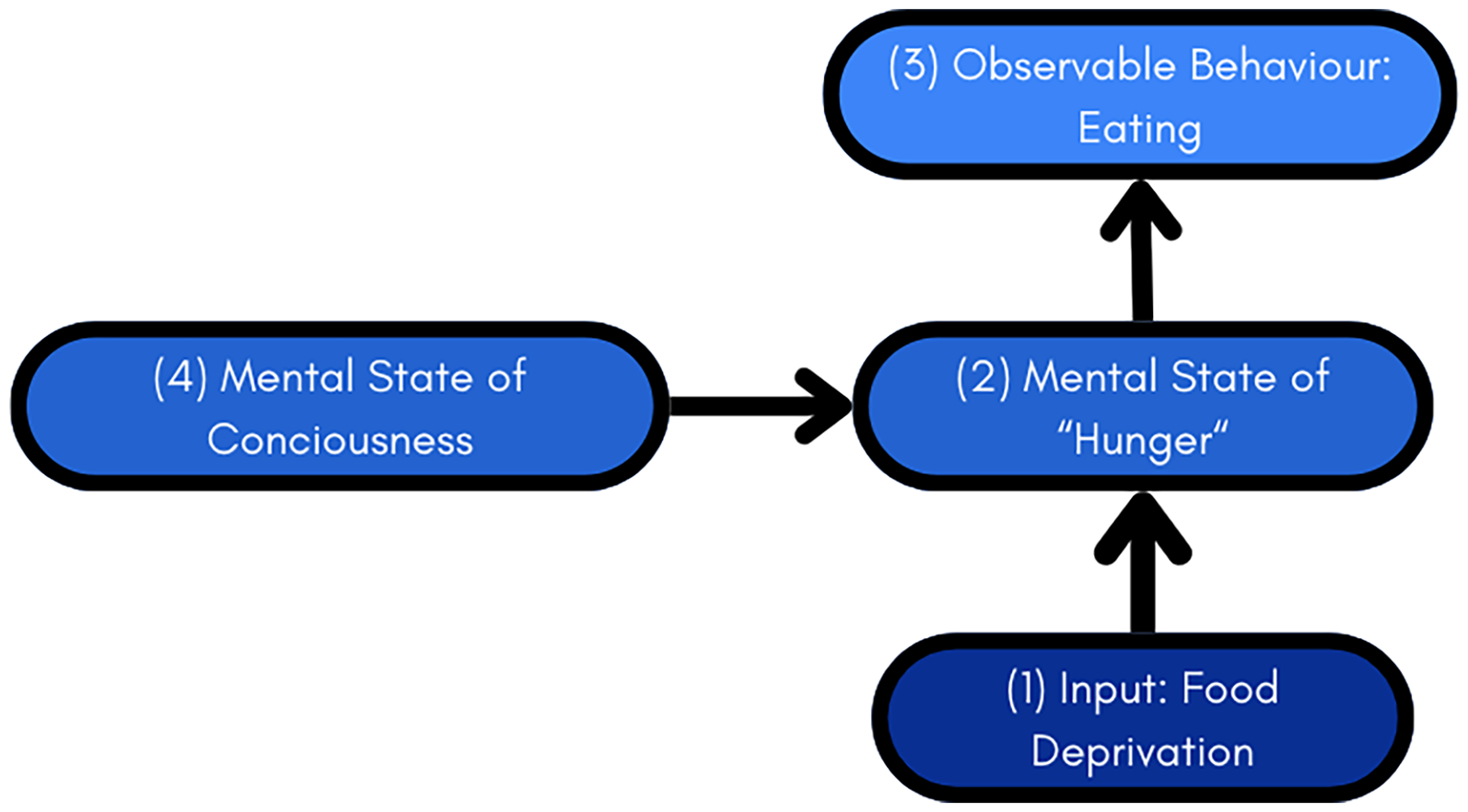
Illustrates the condition of hunger and its corresponding outputs. Visual aid helps to explain how different mental states interact within the framework of functionalism.
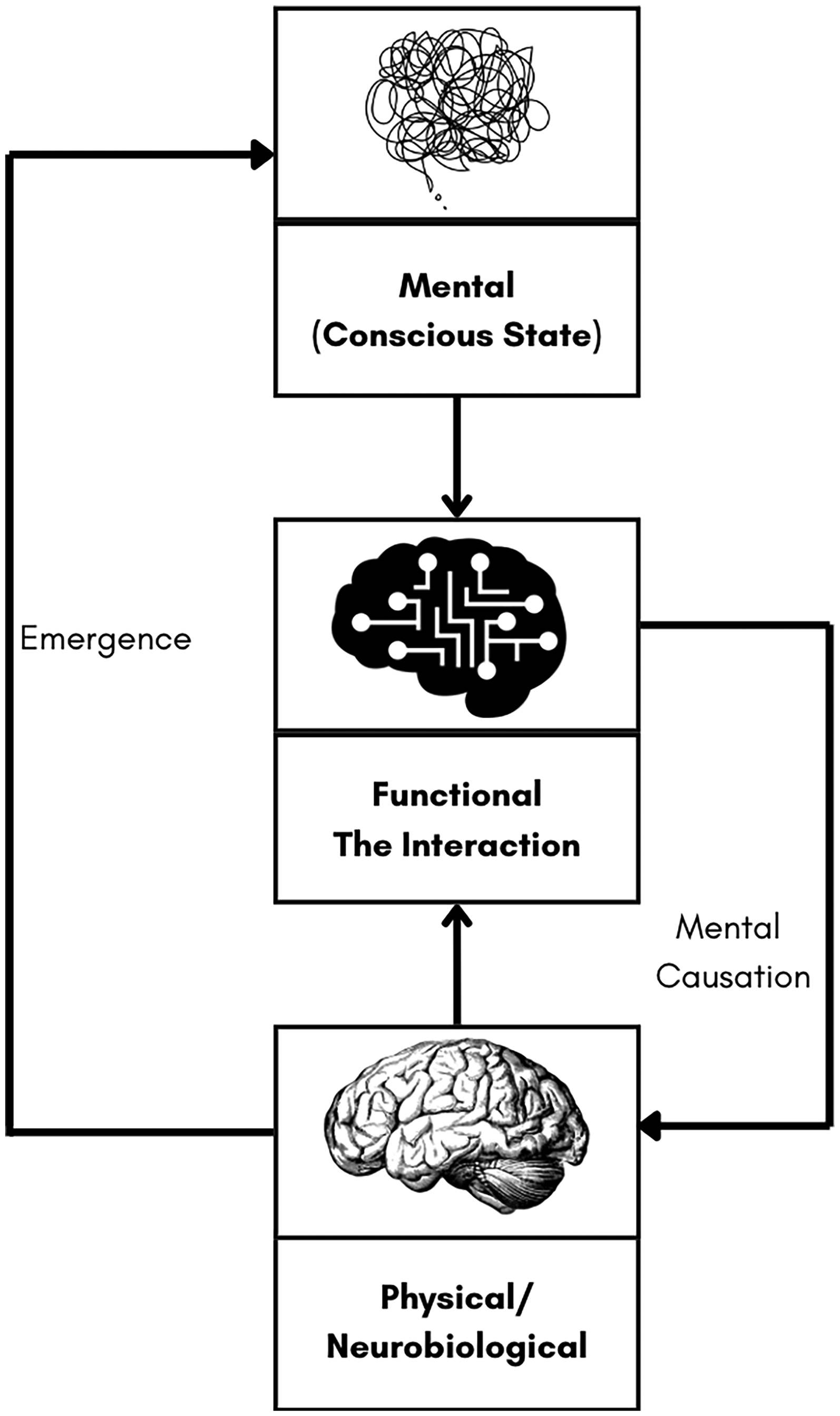
Functional Emergentist Materialism.
Functionalism blurs the lines between traditional philosophies of dualism and monism and thus can not be categorized as either. Functionalism could be seen as a form of monism if the framework focuses on the assertion that any physical system with the right functional organization could theoretically support a mind, thus suggesting a universal type of ‘mental software’ that doesn't depend on a specific physical substrate (Block, 1978). However, functionalism touches on dualist themes by treating mental processes as distinct from the physical processes that implement them, much like software being distinct from the hardware it runs on (Fodor, 1974).
Functionalism faces criticism on many fronts. Since functionalism posits that a specific material substance is not crucial for having a mind, in theory, an advanced computer mimicking the functional organization of the human brain could be considered to possess a mind (Searle, 1992, 2000). This outlines the distinction between role and occupant, which can be seen as software and hardware, with the human consciousness being the software that runs on the physical substrate of the brain. However, this point of functional organization falls moot as engineers have demonstrated that the physical medium used in creation limits how and which operations can be carried (Brooks, 1991). The neural structure has some complexities that cannot be replicated by using another physical substrate (Brooks, 1991). Functionalism also endorses sentient computers, which is the hypothesis that computers or machines could develop minds or consciousness and which has not been empirically validated (Searle, 1992). The third criticism is that functionalism leans towards epiphenomenalism, where mental states are seen as mere byproducts of brain activity without real influence (Ludlow et al., 2004). Additionally, some functionalists may adopt eliminativism, denying the existence of certain mental phenomena such as qualia—the subjective, qualitative aspects of experiences and bypass epiphenomenalism (Churchland, 1981). However, this stance overlooks the reality of subjective experiences and can be challenged both logically and empirically, as qualia play a critical role in our understanding and reporting of consciousness (Nagel, 1974).
Functionalist Emergentist Materialism
There is yet another possible epistemological alternative view. It is based on two elements. The first is the view of scientific pluralism, according to which in order to get at aspects of reality we cannot use one single view or representation of knowledge or methods, we need multiple ideas and tools. The logical consequence is that there can be many, multiple “truths” at the same time and they are equally valid. This perspective is very popular for some physicists who work following the many-worlds interpretation of quantum reality (see Pernecky, 2016). Translating this idea to the study of consciousness, we might say that there are no insurmountable disagreements between the epistemologies of consciousness. Rather, they focus on the importance of a single “real” different aspect of consciousness at the time, but they ignore others which happen at the same or different time frames. Strict causality or determination from the neuron-level to the behavior-level may occur within a different time scale, perhaps faster, than causality and determination at the opposite direction or mental causation, from thought-level to behavior- and neuron-level. However, this difference in time scale does not imply that the latter is epiphenomenal. If we are careful by synthesizing the differently pieces of puzzle together the apparent inconsistencies vanish.
In support of the first element, we can base claims of correspondence between consciousness and the brain by replacing identity with another principle: supervenience. Supervenience is the idea according to which a reality at one level (call it L2) depends on another (call it L1) which evolved first and is primary. L2 exists because of L1 since it evolved from L1. However, L2 evolved in something different which cannot be any longer completely explained by L1.
To explain consciousness, we could postulate two different forms of supervenience which combine in the same system or set of relationships. According to one type of supervenience, emergentist materialism (see Revonsuo, 2010; Searle, 1997, 2000), basic neural structures are primary and exist without consciousness, they are sufficient for physical functions. In addition, they are necessary for the existence of conscious structures, but the neural structures are only sufficient to explain that consciousness structures exist, they cannot explain how they work.
To explain how conscious structures might work we can introduce another form of supervenience, functional emergentism (also known as weak emergentism, see Wilson, 2021) according to which consciousness structures, once they exist, due to evolution, by dependence of neural structures have the ability to create functions that can be imposed to organize neural structures and can interact with their physical functions at a middle level, that is, behavior. So, the consciousness structures are primary and sufficient for mental functions such as organizing the sequence of the thought to move an arm, or any other behavior, and once that thought has been generated at the same time it creates a function that has mental causation, that is, interacts with physical structure by organizing physical function in the brain and the body through organization and reorganization of behavior.
We call this perspective (represented in Figure 3) Functionalist Emergentist Materialism (FEM). This is a form of materialist epistemology which bypasses many of the issues posed by dualism but at the same time combines the antireductionist advantages of dualism with those of functionalism.
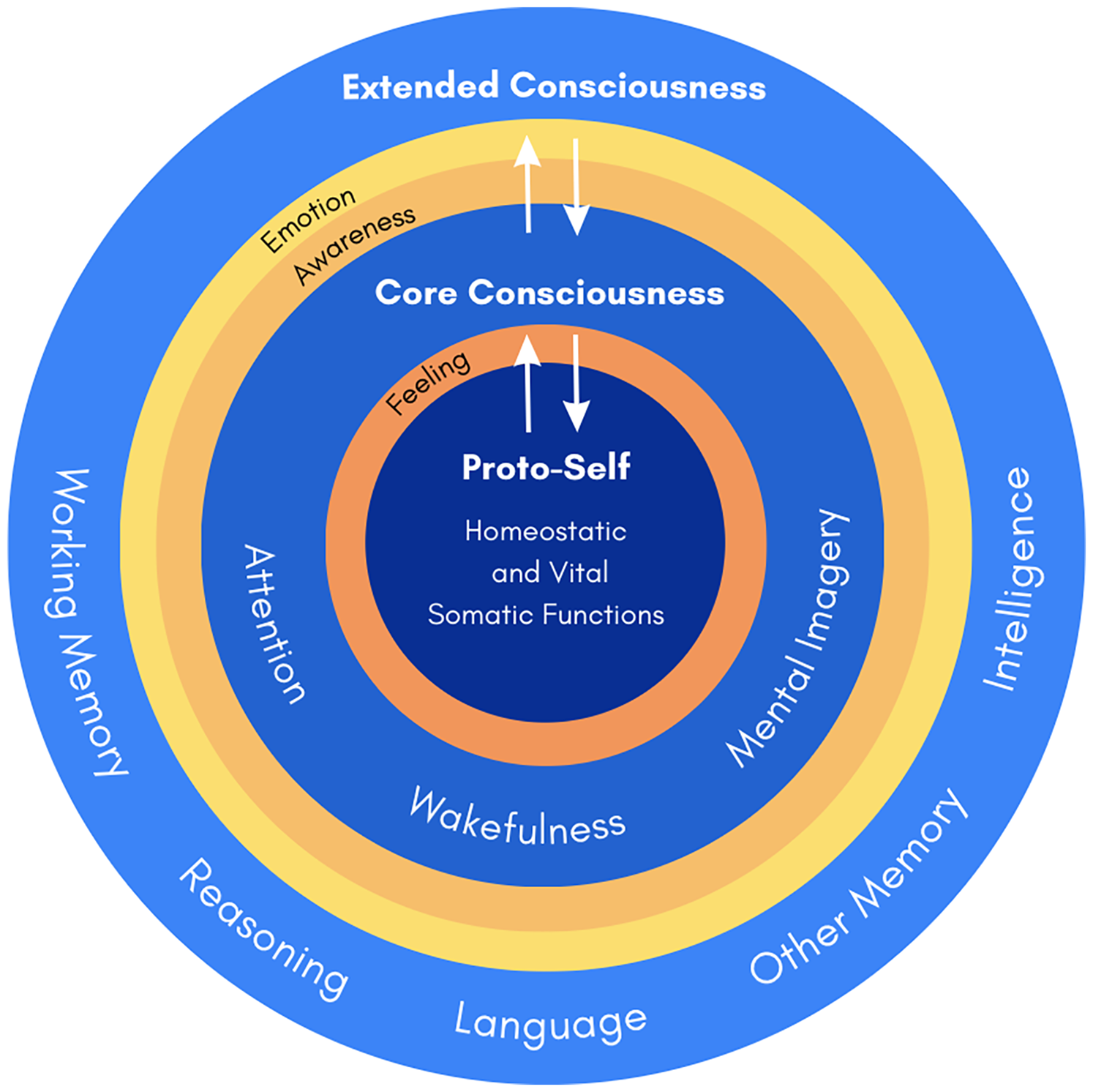
A depiction of Damasio's tripartite consciousness, the core of the diagram represents the fundamental layers related to our basic somatic functions, while the arrows represent the trajectory of emergence for higher levels of consciousness. Concentric circles indicated nested levels.
Although it is appropriate to consider FEM as a framework which is still reductionist at some level, its defining feature is a weaker form of reductionism which sets up a framework where complex structures or behaviours are seen as emergent from simpler, underlying processes (see Wilson, 2021). In the specific context of consciousness, FEM can be further developed espousing the epistemic stance of complex reductionism (Prigogine & Stengers, 2017). In particular, according to Deacon (2013) teleodynamics introduces a paradigm where consciousness emerges from self-organising processes, highlighting autonomy and finality in biological systems or autopoiesis (Maturana & Varela, 1980). This autonomy is crucial for higher-order functions like consciousness, which integrates experiences and responses in a purposeful way. Synthesizing the FEM framework with teleodynamics offers a cohesive understanding, challenging traditional supervenience, as consciousness is not simply a by-product of physical processes but has evolved to achieve specific goals. This purposiveness implies a kind of downward causation, where higher-order goals and functions can influence lower-level processes, which traditional supervenience tends to deny or overlook in favour of a one-way dependency. In neuroscience, bottom-up processing refers to the way sensory information is built up from smaller pieces of sensory data, while top-down processing refers to processing driven by cognition, as your brain applies what it knows and expects to perceive to fill in the blanks (Auletta et al., 2013).
Throwing into the mix another construct born out of general entropy theory, the free-energy principle adds to top-down processing by positing that biological systems, including the brain, minimize a variational bound on free energy, or surprise, to resist a tendency to disorder (Friston, 2009). This principle reveals that the brain's attempt to minimize free energy aligns with the goal-directed processes observed in teleodynamics, providing a quantitative basis for understanding how biological systems, especially the brain, maintain order and avoid disorder over time. All these conceptualizations can be also translated in terms of energy and work (Deacon, 2013), and for consciousness and cognition the respective concept of mental effort.
When integrating these ideas, one can argue that while bottom-up processing allows for sensory engagement, top-down processing introduces a level of autonomy and purposiveness. In a way, this is like postulating two intervening forms of coordinated superveniences: a bottom-up and a top-down supervenience. If human cognition were driven solely by bottom-up processes, individuals would be reduced to lifeless mechanical assemblies for reactions to external stimuli and essentially be enslaved to the environment (Auletta, 2011). This view also calls into question the free will exhibited by humans, where choices and actions are not only reactions but are influenced by an organism's complex internal state and goal-oriented behaviour dictated by the fact that they are alive and embodied (Feinberg & Mallatt, 2018). Top-down processing incorporates the free energy principle and aims to minimize surprise, and maintain equilibrium through both top-down and bottom-up processing (Friston, 2009).
FEM's emphasis on emergent materialism and functional emergentism posits consciousness as a product of evolved neural structures that interact dynamically, transcending one-way physical determinism, the classical Aristotelian efficient cause. FEM thus offers a nuanced reconciliation of dualism and functionalism and operates on a broader framework of general determinism instead of strict causality (Bunge, 2017). Advocating for an understanding of consciousness that emphasizes change, emergence, and organization over static relationships enriches the discourse on the relationship between mental states and brain functions.
Importantly, FEM is consistent with and can be applied to Damasio's tripartite model of consciousness (see Figure 4), which pioneered among others (i.e, see Varela, 1999) the approach to combining neurobiology with the phenomenological aspects of consciousness as a detailed and science-backed framework (Damasio, 1999). The Proto-self, Core Consciousness, and Extended Consciousness are three distinct but interconnected layers that contribute in different manners to humanity's experience of consciousness (Damasio, 1999). The Proto-Self represents a rudimentary, unconscious sense of self-based on basic bodily functions, while Core Consciousness involves present-focused awareness independent of memory or language (Damasio, 1999). Extended Consciousness is a biologically complex sense of self, including memory of past events and anticipation of the future (Damasio, 1999).
Incorporating an evolutionary perspective to Damasio's tripartite model suggests that the dependence and layering of consciousness can be understood through changes that occurred in ancestral vertebrates. Early embodied organisms, such as a worm, will reflexively interact with its environment to carry out goal-directed survival processes. Eventually, the subsequent addition of elaborate and non-reflexive neural hierarchies leads to complex and context dependent behaviors. These primitive reflexes establish the fundamental distinctions between an organism and the environment of which they operate in, evaluating internal and external conditions which lays the groundwork for the development of mental images. The evolution of isomorphic maps and sensory mental imagery contributed to the foundational aspects of the proto-self, and form sentience, which is fundamentally about feeling and perceiving, without the intricate self-awareness or reflective capacities that define advanced stages of consciousness (Feinberg & Mallatt, 2016, 2018, 2020).
Isomorphic maps are neural representations of the world organized spatially dependent on different points of sensory stimuli. These include spatially oriented maps, such as retinotopic, somatotopic and nociceptive maps, as well as non-spatially organized, chemotopically-mapped representations of olfaction and gustation. The isomorphic maps were originally part of the optic tectum, a brain region where the origins of multi-sensory consciousness evolved within fish and amphibians. These centers for processing sensory information communicate heavily with each other, sending information back and forth through hierarchical levels to enhance information processing. Isomorphic maps allowed for mental images that are tightly linked to sensory consciousness, remembering key aspects of sensory experiences. The brain's newly mapped images of the environment guided behavioral actions to precise locations while newly evolved affective feelings motivated and directed behaviors towards or away from positive and negative stimuli. Isomorphic maps allowed for mental images that are tightly linked to sensory consciousness, remembering key aspects of sensory experiences. Arguably then, this evolutionary process might date back to the Cambrian period, around 580 million years ago, involving the development of genetically programmed neural crests and placodes that are associated with having a spinal cord (Feinberg & Mallatt, 2020). These maps contribute to the make up the physical substrates delineated by the primary level of FEM before being passed onto higher levels where different cognitive processes can supersede and process such information differently.
As our understanding of the brain's evolutionary trajectory advances, we begin to uncover the gradual progression from rudimentary forms of consciousness like the proto-self to more complex neural structures reflecting core consciousness. The progression begins through complex and extensive connections involving the hippocampus, the reticular activating system, and the basal forebrain (Feinberg & Mallatt, 2016). The hippocampus plays a pivotal role in memory retention and the ability to manipulate mental imagery through its extensive linkage to the forebrain. Notably, the presence of the hippocampus is a common feature among jawed vertebrates, as lampreys lack specific developmental genes, this highlights an evolutionary pathway in consciousness (Feinberg & Mallatt, 2018). Additionally, the basal forebrain and reticular activating system are crucial for arousal and focusing attention on relevant stimuli, marking the significant milestone of arousal within the evolution of consciousness (Feinberg & Mallatt, 2016, 2018). However, full consciousness is thought to be exclusive to mammals and birds (Feinberg & Mallatt, 2018). This represents a case of convergent evolution where these species have evolved a significantly enlarged and intricately connected cerebrum, reflecting a heightened capacity for processing information (Feinberg & Mallatt, 2016). This complexity likely evolved to meet the demands of the unique habitats and challenges these animals face, necessitating advanced neural computations. With the development of the hippocampus and amygdala, we introduce a level of subjectivity for experiencing the world. The evolved subjectivity then interacts with the physical sensations that occur within the physical substrates and can impact our decision making as seen in the FEM model. In other terms, functional emergentism or mental causation reflects the auto-ontological initial moment whereas emergentist materialism corresponds to the following allo-ontological moment of consciousness process.
It should not be assumed that temporally the connection between these two phases or moments is synchronous or follows a forward cause-effect order, one could be delayed relatively to the other, and the connection between the two could follow the law of the effect or Darwin's evolutionary logic or Piaget's circular reaction, in which the outcome (i.e., success or failure) of an emitted behavior or neural activity fixes the selection of that particular causal action. Importantly, as noted by Auletta et al. (2013) planned inhibition/delay of behavior should be considered behavior itself or action, more in general. The latter comment is important to deter simplistic criticisms that consciousness does not necessarily involve overt behavior, as in the dramatic example of the Locked-in syndrome. This criticism should be more appropriately framed in a different way. That is, it is not a particular behavior which is a necessary condition to be able to talk about consciousness, but rather a general class of equivalence of transformations and transitions which must be physically present as properties of the organization of actions, which can then be realized in a particular behavior. For example, you can pick up the cup in front of you, with your hands, your mouth, your feet, two body parts, etc., consciousness is not at the level of which set of muscles or body effectors you end up using but rather at the level of entertaining a general schema of plan of action which has several core characteristics and is multiply realizable. The plan associated with a particular behavior used can simply be some memory of a response that was previously learned by conditioning. The general class of equivalence, through which the organizational structure of the action is transferred across modalities and domains of the individual's knowledge, is presumably constructed inferentially during ontogenetic development (Piaget et al., 2013).
Having established the development of the proto-self and core consciousness, we transition to exploring the components of extended consciousness. This phase embodies the autobiographical self; a culmination of emotions that become integrated with memories and expectations facilitated by developed limbic systems and prefrontal cortex (Feinberg & Mallatt, 2016). These elements form and contribute to a continuous and evolving sense of identity, and consequently profoundly influence behavior and decision-making. The basis of emotion becomes the affective state, the underlying condition that influences the person's view of the world, and is made up of four aspects; intensity, duration, valence (whether the emotion is positive or negative), and reactivity (how quickly, and with which intensity somebody interacts with something (Feinberg & Mallatt, 2017). Affective states for interoceptive information such as hunger, thirst, and fatigue, are experienced body-wide instead of pinpointing a specific isomorphically mapped location (Feinberg & Mallatt, 2016). The affective state differs from sentience as it encompasses a continuous interaction between past memories, current experiences, and future anticipations reaching beyond immediate reaction to stimuli.
In terms of studying consciousness from a neuroscientific view, patients who can not express emotions through expression or vocalization have an impaired core consciousness, which has implications for their extended consciousness. Patients with a normal core consciousness and an impaired extended consciousness will still exhibit normal emotions, suggesting colocalization of neural structures between emotion and Core consciousness (Damasio & Meyer 2009). This colocalization probably arises from the emergence of consciousness from the neural networks making up emotions.
The framework of FEM, along with Damasio's tripartite model of consciousness, showcases a dynamic view of consciousness that current neuroimaging techniques, such as fMRI, struggle to capture fully. While fMRI is useful for assessing the functional anatomy of the brain, it struggles with temporal and spatial resolution, making it difficult to capture the rapid and complex neural interactions fundamental to emergent properties of consciousness as outlined by FEM (Lundervold, 2010). This is further supported by Rafii and Brewer (2010), who note that fMRI's inability to distinguish between correlation and causation poses a challenge, as consciousness likely emerges from nonlinear interactions across various brain networks—interactions that cannot be easily mapped onto static brain images.
Integration of Deacon's (2013) emphasis on the goal-directed process of teleodynamics further complicates the interpretation of fMRI data within the FEM framework, as fMRI traditionally views brain activity as predominantly reactive. Yet FEM, along with Damasio's tripartite model, suggests a complex feedback loop among the various levels of consciousness, thus necessitating the integration of various methods that can capture this dynamic. Combining neuroimaging with electrophysiological techniques and computational models could fully capture neural underpinnings of consciousness's non-linear and emergent nature with clinical implications. This is also substantiated by Deco et al. (2011), in the study of resting-state networks, fMRI captured slow measures of neuronal activity, but large-scale resting-states networks correlate with neuronal rhythms that occur at faster frequencies. This suggests the integration of various techniques to understand how microscopic neural interactions lead to the emergence of macroscopic brain states. Developing a comprehensive model of consciousness requires an approach that considers both the structural connectivity of the brain and the dynamic patterns of neural activity that unfold over time, reflecting the integrated models of consciousness from FEM and Damasio.
A key feature that can be incorporated in FEM with its application to Damasio's theory is that consciousness levels can be systematically mapped to progressively nested levels of dynamic relationships between neural structures and functions. This is graphically represented in Figure 5 as unfolding in hierarchy of emergent levels.
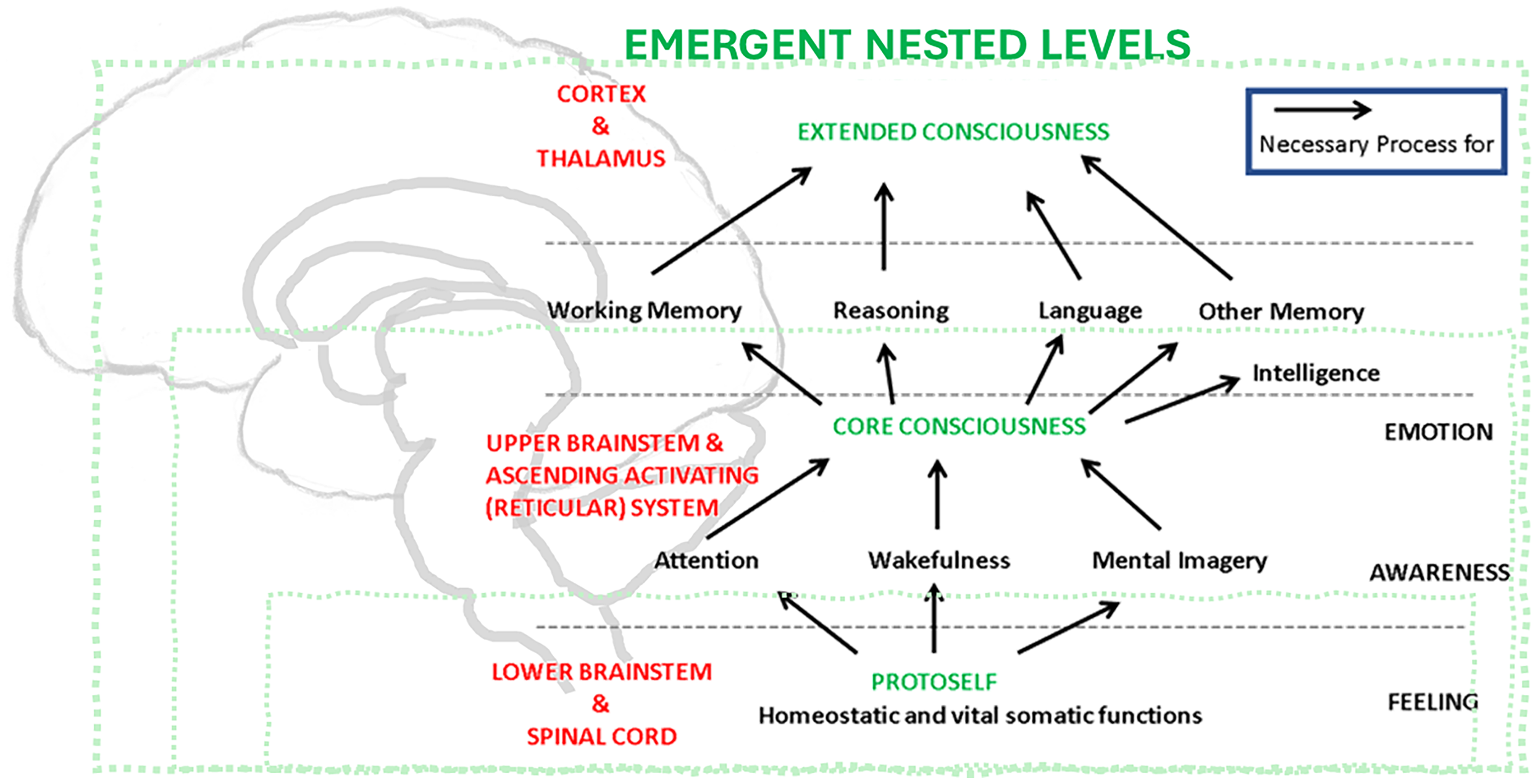
Representation of integrated FEM-Damasio's theoretical model.
Damasio and Meyer (2009) offered a systematization of the neuroanatomical mapping of consciousness in clinical terms, showing that conversely neuropathology demonstrates nested and supervenient neural structural levels. In their schema wakefulness depends on Brainstem: reticular formation, Ascending feed-forward pathways projecting to the cortex via thalamus, basal ganglia, forebrain or directly; Core Consciousness depends on Posteromedial cortex, PMC (in Parietal cortex) connected to most cortical regions and the thalamus; cortico-cortical & thalamo-cortical loops (re-entrant pathways). Finally, Extended Consciousness depends on Default networks & most of the cortex is activated in parallel and across. Consequently, all impairment of consciousness can be categorized in three main classes of syndromes: 1) Impaired Wakefulness & Impaired Core Consciousness, 2) Persistent Wakefulness & Impaired Core Consciousness; 3) Persistent Wakefulness & Persistent Core Consciousness & Impaired Extended Consciousness. Impaired Wakefulness & Impaired Core Consciousness result in states such as Coma, general anesthesia, and slow wave sleep (where the Brainstem tegmentum in the upper pons-thalamus tract is the main structure involved). Persistent Wakefulness & Impaired Core Consciousness result in states such as Vegetative states, akinetic mutism, certain epileptic seizures (Midline structures: Posteromedial Cortex, medial prefrontal cortex, anterior cingulate cortex, thalamus). Finally, the Persistent Wakefulness & Persistent Core Consciousness & Impaired Extended Consciousness show no distinctive neuropathology, but rather complex neuropsychological syndromes like for example some forms in Transient Global Amnesia, Alzheimer's (involving some of the same Midline Structures as in Impaired Core Consciousness).
FEM Contributions
Neurophenomenological Mapping of Consciousness
One important contribution of FEM is providing clarity on the implications of testing for consciousness, and thus establishing the minimal sufficient and necessary conditions according to which we can say with little margin of error that a human being is conscious: I will call these the phenomenological C-conditions. For the purpose of ostensive demonstration, the presentation in this section will switch to involve the reader as a direct participant of the test for C-conditions and will therefore involve more directly the second person, “you”, voice.
One main necessary condition to say that you are conscious right now is that you are awake, as in not sleeping. For example, right now you are reading words that are set before you. Would that be sufficient to define all consciousness? Sometimes we might surprise ourselves, especially when bored, staring at words, but not really reading or being aware of them. Does that happen to you? If it does, then you know that being simply awake or not sleeping is not a sufficient c-condition. Okay, let us back up a little. Why would wakefulness be a necessary c-condition though? Well, if you were in dreamless sleep right now, you would not see the words or ink in the page or pixels in the screen. Indeed, you would see nothing at all! Thus, there must be a switch-on state, and we can safely assume that condition corresponds to being awake.
Still, that is not sufficient for you and a person observing you to say that you are conscious. A second main c-condition that can be behaviorally observed from the third-person perspective are background emotions, that is, continuous preverbal emotional signals (body movements, face expression) that show fatigue/boredom/energy, discouragement/enthusiasm, malaise or well-being, anxiety/relaxation; these allow others to presume the subject's state of mind. For example, if I were looking at you and you were slouching on the chair, sighing and holding your head from falling on the table, your eyes rolling, I may presume that what you are reading is making you bored. A third related c-condition is sustained attention: being focused for minutes on situation-appropriate object/event, for example, trying to understand what the words you are reading mean. Finally, a fourth c-condition is purpose, the fact that you have a plan in mind to do something (action), and you are following that plan, for example, finishing reading this chapter to see which are the key concepts you need to learn and memorize for passing the test.
All these conditions are indeed necessary for saying that someone is conscious. However, these alone are not sufficient. Only you can say how it is to be like you while reading. It is here that the first-person perspective comes into play. The third person observing you, would need you to communicate in some way that you are conscious, indeed confirming you are in the observable c-conditions that I have introduced. Your communication, however expressed, is your subjective report of your phenomenal awareness of: 1) aspects of the external environment: stimuli, objects, events, and scenes; 2) changes of the organism in response to the environmental input. You have direct access to both environmental and somatic input through mental images, or 1st-order maps: these are neural patterns standing in for (representing) objects/events and standing in for (representing) changes of the organism or proto-self (Damasio, 2000). These images are modality-specific sensorimotor (visual, auditory, somatic, proprioceptive, kinetic, you name it). They are also multiple and associated in an integrated system (associative memory). Although they are reported subjectively, they can be objectifiable or made observable by proxy, that is, they can be identified by a behavioral or a response correlate that occurs with having them.
The next step in conscious awareness is that you have a Self. This aspect of consciousness is achieved through the generation of sensorimotor neural and self-neural patterns describing the relationship between objects and the organism's changes to those objects. These higher order descriptions are 2nd-order neural patterns (2nd-order maps) representing the knowledge that mental images of objects and mental images of organism's changes are OWNED by you, yourself, as again proposed by Damasio (1999).
C-conditions are relatable to the levels of neural structures represented in Figure 5. Thus, it is further possible to rejoin the loop that links phenomenology to behavior to neural structures.
Hard Problem as Evolutionary Solution
As introduced earlier, the auto-ontological irreducibility points to the fact that the brain never refers experience to the neural substrate of the brain that creates it.
Starting with an embodied organism (worm) that reflexively interacted with its environment to carry out its goal-directed survival processes, the subsequent addition of elaborate, non-reflexive, neural hierarchies led to complex and context-dependent behaviors (Feinburg & Mallatt, 2020). Presumably, the latter sequence of events occurred because the brain's new, mapped, images of the environment guided the behavioral actions to the ‘right’ location and because the newly evolved affective feelings motivated and directed the behaviors toward ‘positive’ and away from ‘negative’ stimuli. The introduction of subjectivity creates a ‘gap’ from the physical sensations they are connected to, however the subjectivity cannot be ignored since the assertion of feelings or in this case subjectively positive or negative stimuli alter the outcome of survival. In these scenarios the physical sensations only built a subjectivity around them to which were useful, thus increasing the need to look at consciousness through the functional lens. The brain, and our consciousness uses the functional filter consistently impeding the search for physical correlates directly leading to subjective correlates. This transition opened a seeming ‘gap’ between subjective experience and emotional drive, on the one hand, and the objective world that was affected by the behaviors, on the other. However, there is nothing ‘‘mysterious” about this process when viewed within the evolutionary context and FEM.
The general feature of adaptation is paramount for explaining qualia because qualia act to distinguish among a wide range of sensory stimuli, as is needed for survival. The first, simple qualia probably evolved into millions of subtly differentiated qualia. The increasingly refined sensory discriminations provided survival benefits for finding food items and mates, avoiding predators, detecting dangers, and these benefits would apply in many different habitats and adaptive situations.
As Feinberg and Mallatt (2018) have cogently argued, there is no adaptive advantage for one's conscious pathways to attend to themselves or to any other part of one's brain. The physical infrastructure of these developments – the nervous system and neurons – have operated efficiently like this since the pre-conscious, reflexive stage. For example, phylogenetic analysis indicates the ancestors of vertebrates, of arthropods, and of mollusks all had glial cells, which look after optimal health and functioning of neurons (Feinberg & Mallatt, 2018). Besides being redundant, any conscious attention to neuronal maintenance would distract from the other important purposes of consciousness highlighting the need for the functional filter outlined in FEM. Inefficiency and waste of effort are selected against by natural selection, so no ‘‘objective” experiencing of the brain's own neuronal signals ever evolved. In addition, an organism's survival depends on its attention being directed to the outer world and to its body, if sensory neural networks evolved to attend consciously to their own neurons and neuronal pathways, not only this would be functionally and energetically wasteful and redundant, but also it would interfere with the coordination of top down and bottom-up processes. Mental causation or constructing a unitary image of incoming sensory inputs would be constantly undermined by feelings of concurrent underlying activity associated with neural firing.
This highlights auto-ontological barrier may have been present ever since the dawn of consciousness as a solution provided by natural selection. In other words, the gap between subjective/1st person (auto-ontological) and objective/3rd-person (allo-ontological) is a solution (not a problem) derived by evolution. It is precisely the feature of top-down emergentist functional pathways not being directly connected with the bottom up neuronal physical pathways which gives qualia the evolutionary advantage they evolved for. This might further support the hypothesis that evolutionarily the allo-ontological neurobiological substrate versus the auto-ontological subjective substrate of qualia might have evolved distinctly differently from the initial original nucleus of embodiement in living cells (see Feinberg & Mallatt, 2018). As a result of these differential (and also biodiverse) evolutionary trajectories, they may only be weakly explained by the same single set of direct strictly causal connections, rather than correlational derivative complex interactive dynamics, such as, for example, morphodynamics (Petitot, 2011).
FEM as delineated here redescribes in new neuroscientific terms another principle developed in both idealist (i.e., Hegel) and materialist (i.e., Marx) traditions, which bypasses the hard problem: dialectics (Sayer, 1983). Indeed, we postulated two forms of coordinated but different emergences, a bottom-up and top-down emergence. According to FEM, the mental and the material, phenomenology and neurons, can be considered as opposite processes which exist in unity. This is a clear alternative to the ‘metaphysical either/or’ exemplified in the traditional dualism and reductionism. In equivalent dialectical terms, the relation between these opposite processes “is neither a mere identity nor a mere difference: rather […] thought and matter, the subjective and the objective, are both opposed (different) and also united (identical): they are opposites which exist in unity” (Sayer, 1983, p. 19). Therefore, consciousness can be conceived as the relational dynamic process through which the unity of these opposites is realized, or transformed for-us, in knowledge.
Towards Accountable Consciouness Theory
FEM strategy is to use what we learned from logical points of philosophical debates and other disciplines to construct the best possible framework. We propose that such framework is parsimonious in making only the minimum necessary
Last but not least, FEM adheres to a

Blind positivism. “A near total faith in the inevitability of scientific progress. Western science worships the God of causality and materialists fall prey to the overly optimistic hope that there are no limits to this endeavor; that eventually the phenomena of consciousness will succumb to the omnipotent methods of empirical research and be admitted into the enlightened kingdom of science.” (Dietrich, 2007, p. 57).
In addressing most of the abovementioned fundamental issues with a practical approach, FEM aligns with contemporary evolutionary thinking and is scientifically and ethically consistent with current research accountability standards, including the traditional philosophical pillars of modern science: commensurability, falsification, and parsimony.
Conclusions
The framework of Functional Emergent Materialism proposed in this paper offers a comprehensive approach for addressing the complexities and theoretical discrepancies within the field of consciousness. By dissecting and integrating various philosophical traditions, FEM provides a conceptual tool for understanding which assumptions are made in the study of consciousness. Not only this model aligns with contemporary evolutionary theory, but also addresses issues such as the ‘hard problem’ of consciousness more effectively. Continuous refinement and application of FEM principles might allow for the potential of groundbreaking discoveries and advancements in the field of neuroscience including addressing the limitations of current neuroscientific approaches. Embracing a model that accounts for the emergent and dynamic nature of consciousness requires the combination of epistemological understanding as well as empirical approaches such as neuroimaging. These advancements may help researchers and clinicians to better understand “where they stand”, and in turn address the complexities of the human mind with a deeper understanding of the human condition. FEM is ideologically agnostic in that it does not really matter whether you as researcher subscribe to idealism or materialism, its point is in explicitly recognizing what perspective one is endorsing before going to, or continuing using the questionnaire, the microscope or/and the electrode, being fully “self-conscious” of what are the pros and the cons, the challenges and the potential pitfalls of embracing one type of consciousness theory rather than another.
Footnotes
List of Abbreviations
Author Note
We thank all cohorts of students enrolled in Carleton University's Neuroscience of Consciousness (NEUR3303A) who have contributed to the discussion of ideas presented in this paper, importantly, the second author was one of them.
Data Sharing Statement
No data were used for this manuscript.
Declaration of Conflicting Interests
The authors declared no potential conflicts of interest with respect to the research, authorship, and/or publication of this article.
Funding
The authors received no financial support for the research, authorship, and/or publication of this article.
