



Abstract
DR experiences a rare form of synesthesia in which the sight of people simultaneously induces colors. We evaluated her conviction that her synesthetic ‘people-colors’ are stable and associated with personality. In Study 1, DR briefly viewed each of 10 strangers through a half-silvered mirror, in silence, over two sessions. In Study 2, DR could both see and talk briefly to each of 12 new strangers, over three sessions. For each stranger, DR described her synesthetic colors and filled out a ten-item personality inventory (TIPI) based upon them. She provided consistent synesthetic colors/personality ratings across sessions. Still, her initial person-colors did change with further exposure, for the dimension of personality that she identified most accurately, namely, Extraversion. The correlations of DR's colors with the subjects’ Extraversion (as coded from the TIPI self-reports) rose from low-moderate in Study 1 to r = .74 in Study 2, but were weak (r < .03) for the remaining four personality dimensions. We conclude that experiential learning can affect synesthesia, not only for color-word associations, but also for person-colors.
Introduction
Synesthesia occurs when the stimulation of a sensory modality (e.g., vision) consistently elicits an involuntary concurrent perceptual experience in the same or another modality. There are many documented types of synesthesia, perhaps as many as 152 (Ramachandran et al., 2004; also see https://www.thesynesthesiatree.com/). Some forms are relatively common, while others are rare and idiosyncratic: e.g., Craver-Lemley and Reeves (2019) reported on a synesthete for whom the color brown (the “inducer’) reliably elicits the taste and feel of heavy whipped cream (the “concurrent”, is the terminology of Grossenbacher & Lovelace, 2001). The present report concerns the person-color synesthesia of our case, DR (Figure 1). We have reported on other aspects of her multi-faceted synesthesia before (Craver-Lemley & Reeves, 2013), and touch on these only briefly in the present context.
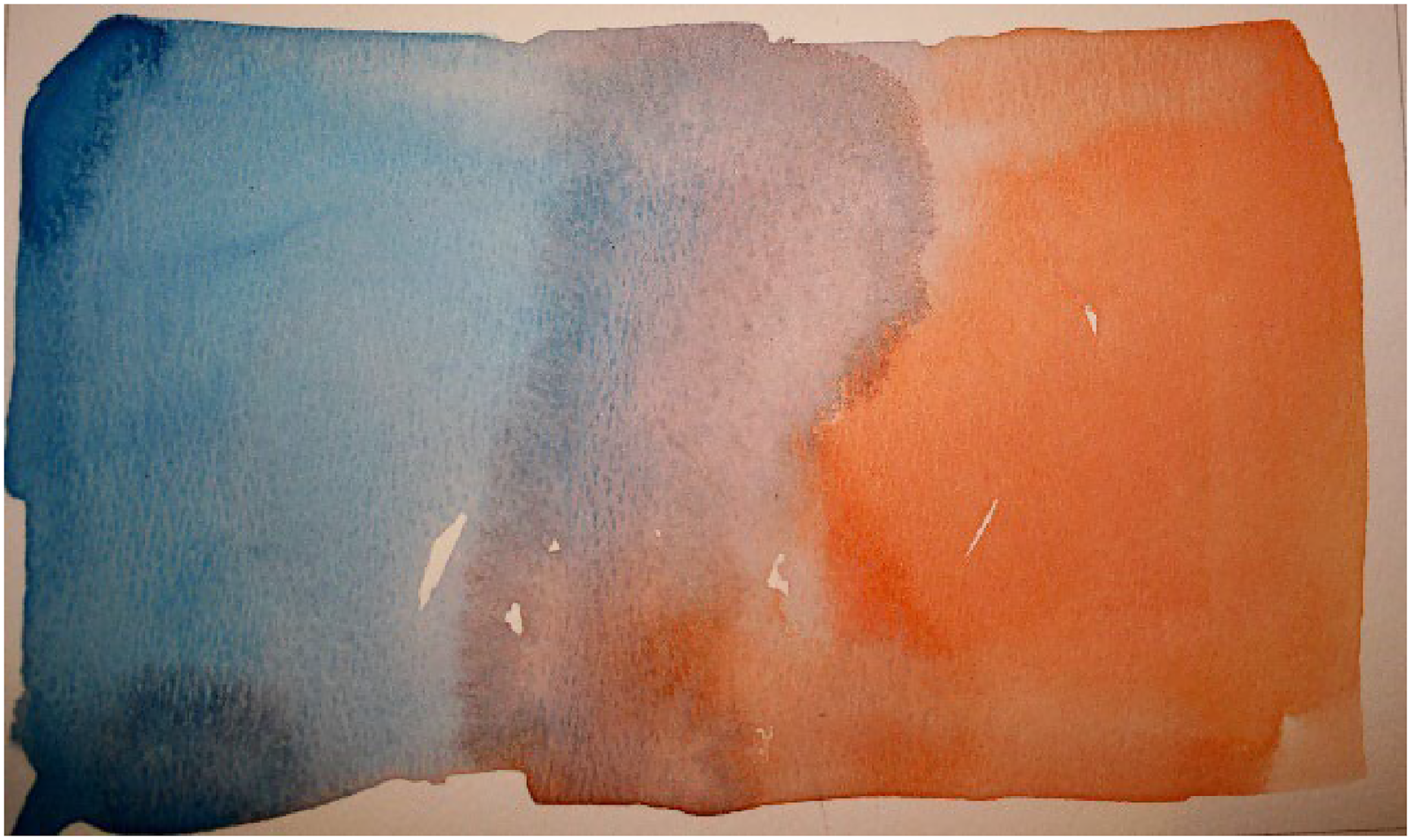
Artist Laura Bach's depiction of DR's synesthetic experience when DR viewed a person unknown to DR. DR described the colors triggered by this individual while Bach painted. Bach modified her painting until DR was satisfied that it was as close of a representation of her concurrent as possible. DR reports that the synesthetic colors are projected in space in front of her and do not adhere to or even surround the individual that triggers this experience.
Not surprisingly, much of the empirical literature to date has been conducted with individuals who have one of the most frequently occurring forms of synesthesia: Grapheme-color synesthesia, which occurs when written letters, numerals, or words each consistently elicit certain colors. For example, whenever DR views the letter “H”, she sees a blue transparent color overlaying the H; other grapheme-color synesthetes typically report different color-letter associations, although there are some commonalities (Witthoft & Winawer, 2013). DR reports her grapheme-colors to be experienced externally, as an “overlay” projected over the graphemes. Her other synesthetic colors are either experienced as overlays or as streams of colors before her eyes, so she appears to us to be a classic projector. Dixon et al. (2004) termed synesthetes who see their synesthetic colors externally as “projectors”, those who internalize the synesthetic colors being “associators”. The differences in performance are typically minor, but interestingly, Domingo et al. (2011) found that their seven projectors, but not their associators, were considerably more fluent, more original, and more flexible than the non-synesthete controls in thinking of uses for a brick, a doorknob, and a sock, and concluded that the projectors were generally more creative, at least on these essentially concrete tasks.
Researchers have also distinguished between synesthetes based upon whether or not the synesthetic experience is evoked early in perceptual processing or in a top-down manner. Ramachandran and Hubbard (2001) suggest that synesthetes whose concurrents are brought about by sensory stimuli could be categorized as “lower” synesthetes, while concurrents induced by conceptual representations occur in “higher” synesthetes. For instance, DR also experiences sound-color synesthesia for music and for voices; these synesthetic colors are primarily induced by timbre, so this could be considered a lower form, in contrast to a higher synesthete who might experience synesthetic colors in response to spoken word meaning. In addition to grapheme-color and sound-color synesthesia, DR also reports smell-color synesthesia (Craver-Lemley & Reeves, 2013), and voice-color synesthesias, both ‘lower’ forms. In her ‘person-color’ synesthesia, viewing people causes DR to see unique colors based on their personalities, which we take to be a ‘higher’ form. DR reports that these different forms of synesthesia do not combine with one another and that she can keep them “compartmentalized”, for example because the sound and scent evoked colors move while the personality-evoked ones are static (Figure 2). In the current study, DR only attended to and reported on her person-color synesthesia. We asked two fundamental questions; namely, whether the person-colors were reliable (i.e., stable over exposures), and whether they were valid (i.e., related to people's actual personalities.)
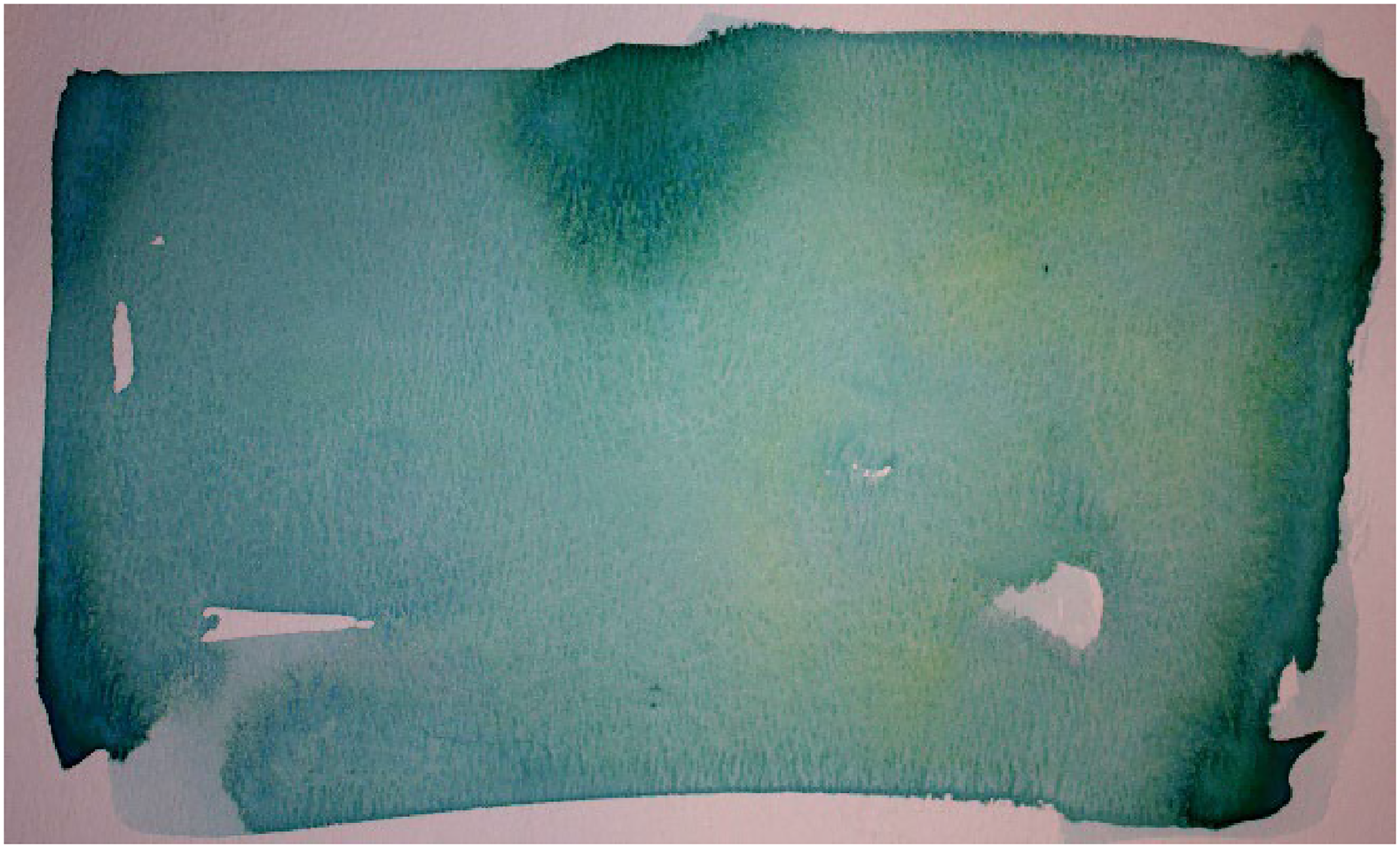
Artist Laura Bach's depiction of DR's synesthesia when DR heard the voice of the same individual triggering her person-color synesthesia in Figure 1. Note that the synesthetic experiences for DR's person-color and sound-color synesthesia typically differ. Not only do these inducers elicit different colors, DR's sound-color concurrent involves 3 dimensional colored shapes moving in space.
The literature regarding person-color synesthesia already includes references to emotion-color synesthesia (Collins, 1929; Cytowic, 2002; Milán et al., 2012; Ramachandran et al., 2012; Riggs & Karwoski, 1934; Ward, 2004). For example, as quoted by Ward (2004), Cutsforth's (1925) synesthete “read of the death of a near neighbor; the newspaper suddenly turned green and took on a swirling motion; as I read the details the colour faded somewhat but for several hours my imagery took on a greenish cast. Later in the day I picked up the American Magazine and discovered a reference to an old acquaintance. The green cast changed to colours characteristic of happier moods—rose, orchid and cream-yellow” (p. 539). However, none of these emotion-color synesthetes reported color-personality associations independent of the feeling tone, so, as far as we know, DR's case is unique in the literature.
When viewing a person, DR sees multiple colors projected in the space directly in front of her forehead (see Figure 1 for an illustration), with different colors revealing specific aspects of an individual's disposition. For example, DR remarked the following regarding the illustration in Figure 1 which depicts her descriptions of the colors that were immediately present upon viewing a stranger: “The peach tone reflects people who are introspective, thoughtful, academically inclined, willing to question the status quo in a positive way, i.e., for the betterment of society. This blue shows someone is stable, friendly, possibly rigid and/or creature of habit, willing to engage in conversation—has a sense of humor. The blue gray would be someone who thinks across disciplines, is wise, and/or searching for wisdom.” When discussing her people-color synesthesia with us, DR also noted that: “Certain shades of pale blue and pale yellow are associated with internal chaos that makes it difficult for a person to function successfully. A .pale yellow’ person might get fired from multiple jobs for repeated tardiness, make and break coffee plans four times, request unreasonable favors from friends, have no control over spending habits, have poor interpersonal boundaries, etc. – the sum of traits makes it stressful or frustrating to be around a pale yellow or pale blue person.” Notably, it was not until adulthood that DR recognized that her person-colors reflected specific character traits. DR disclosed that she does not usually discuss this synesthetic response with others because people often confuse her person-color synesthesia with a psychic ability to read “auras” (subtle fields of energy seeming to surround a person.) Indeed, Milán et al. (2012, p. 259) concluded that synesthesia and aura reading are distinct phenomena.
While individuals with the same form of synesthesia show better than chance agreement regarding their concurrents, there are enough individual differences that single case studies are often more informative than group averages (See Ward, 2013, for review.) For example, Collins (1929) exhaustively described the case of S who experienced many forms of synesthesia including people-color. For S, individuals have their own color and may also be associated with a scent and with flowers. S reported that her people-colors were likely to change as she got to know the person better and that those that she did not know well, or that possessed an “unimpressive personality” did not induce synesthetic colors (p. 13). One of Collins’ main conclusions was that synesthetic colors can change with experience. S may have associated particular colors with specific personality traits, not just with particular people, but this was not reported by Collins. Riggs and Karwoski (1934) highlighted the case of M, an intelligent 7 ½ year old. M stated that her people-induced colors were “…blended with the natural colour of the face and formed a part of the features” (p. 31). Like S, she reported that people changed colors as she became acquainted with them. For M, people unknown to her are bright orange with a black outline and those that she does not “know so well are bright colored, sort of sharp. When I know people well they stop changing colours; they are the colour.” (p. 32). Critically, head shape influenced M's colors. When the authors directly asked M, “Why do you see human beings in different colours?” M replied, “…The shape of their features give me the idea. K is grey, sort of silverish. A square would be greyish white or silverish; a circle would be gold. Sometimes shapes of objects give colours but mostly living people. K is silverish, because his head is sort of square. E is purplish blue, dark orchid, her head is sort of plump and bobbed haired. My mother is medium purple–sort of plump, her hair goes behind and it makes her look that colour to me. S is white, whitish brown, due to the shape of his face. P is orange, due to the sharpness of his nose.” (p. 32). M's colors were elicited only by living persons, not by plaster casts or geometric shapes, but were nevertheless more associated with head shape than with perceived personality, even for her mother, and may therefore exemplify a ‘lower’ form of synesthesia in Ramachandran and Hubbard (2005)'s terms.
Ramachandran et al. (2012) reported a case of a synesthete, TK, who sees colored halos around individuals. For TK, a person's colors reflect his emotional outlook concerning that specific person. Apparently during childhood TK learned to associate colors with emotions and the emotions he felt toward people appeared as colored halos. When TK initially meets someone, the halo will be blue, but then as he becomes familiar with the person a new color develops. Thus, TK's halos can be modified through experience. Similarly, person-color changes were reported in Milán et al. (2012). One of their subjects, F, reported colors that would “sometimes be transformed when the nature of F's relationship with the person is altered” (p. 263), although another person-color synesthete, R's, color responses to people never changed. Ward (2004) described several synesthesias induced by emotional stimuli, including the cases of M and S, and reported in detail on GW, whose synesthetic person-colors are induced by emotional stimuli but are not associated with perceived personality traits.
That S, M, GW, TK and F reported associated changes in their synesthetic percepts as they learn more about a person is not surprising, given the evidence that learning can influence the development of synesthesia (e.g., Chromý et al., 2019; Marks & Odgaard, 2005; Mroczko-Wąsowicz & Nikolić, 2014; Witthoft & Winawer, 2006). Marks and Odgaard (2005) proposed that learning should be considered in any theory of synesthesia since many “cultural artifacts” such as graphemes elicit synesthetic experiences. The authors also suggested that synesthesia may develop slowly as a child learns such cultural artifacts. For example, grapheme-color synesthesia may stem from colored-letter fridge magnets or colored schoolroom alphanumeric charts (see Blake et al., 2005; Craver-Lemley & Reeves, 2013; Witthoft & Winawer, 2006, 2013). Witthoft and Winawer (2013) concluded that external stimuli, while insufficient to produce synesthesia, may influence its development.
Adult synesthetes, not just children, may also acquire novel inducing stimuli (including Gendle, 2007; Mills et al., 2002; Ward et al., 2006). Studies with bilingual synesthetes revealed that synesthetic responses for the more recently obtained language depended upon similarity to the primary language (Mills et al., 2002, 2009; Mroczko et al., 2009; Rich et al., 2005; Witthoft & Winawer, 2006; also see Barnett et al., 2009 for review). Importantly, new grapheme-color associations can become highly consistent through repetition, even in adulthood (Ovalle-Fresa & Rothen, 2019). For example, Uno et al. (2021) reported that as their adult subjects became increasingly familiar with rare Japanese characters over periods of 5 to 8 years, their grapheme-color synesthetic associations become more stable.
When DR was learning Greek in college, she noticed that letters which were like her primary language, English, acquired matching synesthetic colors, while other Greek letters initially did not elicit colors. However, once she learned the meaning of a Greek word, it induced the color of its English counterpart. Mroczko et al. (2009) demonstrated that such transfer of already-learnt associations can occur very rapidly, as quickly as within 10 min in the adult. These results support Marks and Odgaard's (2005) conclusion that learning cannot be overlooked in explanations of synesthesia. However, how ‘learning’ takes place may be hard to ascertain in the case of person-color synesthesia, the inducer being so complex. Exposure over time may elicit more colors when more personal traits (whose colors are fixed) are perceived, or the colors may develop even when the perceived traits do not, or some combination of new and developing colors. Indeed, a form of feedback may exist, in which the initially-evoked colors aid learning about the person (Watson et al., 2014).
Given that DR learnt new synesthetic grapheme-color associations as an adult, we asked whether her person-colors might also change as she learned more about an individual. Unlike most of the reported cases of person-color synesthesia, DR stated that her concurrents appear immediately when she first sees someone, prior to having any familiarity with that person. On the initial, “zero acquaintance” encounter, sight alone of an individual will automatically trigger colors, which DR then attributes to personality traits. As in the previously noted case of R (Milán et al., 2012), DR reports that she is unaware of her person-colors changing; rather the basic color pattern she sees on the first encounter remains fixed. If so, her synesthetic experience and associated personality evaluations should not change with repeated exposures to an individual. Alternatively, DR's synesthetic percepts might become modified as she becomes better acquainted with someone, if she was unaware of this happening.
We first investigated DRs contention that there was a consistent pattern between her synesthetic colors and judged personality traits, rather than being random. Establishing reliability of the inducer-concurrent relationship has become a touchstone of research in synesthesia (e.g., Ramachandran et al., 2012). Reliability is logically necessary for establishing validity, here, whether DR's synesthetic colors predict individuals’ self-reported personality attributes (Study 1 and 2) or not. Study 2 also asked whether her concurrents would be altered by learning more about individuals through engaging in further, very moderate, interactions with them.
Study 1
Study 1 investigates the consistency of DR's concurrents and the associated personality ratings across two sessions occurring two weeks apart. We also compared DR's personality ratings of the individuals with their self-ratings to determine whether or not DR's synesthetic responses to people were indeed indicative of their personality traits. Finally, the individual self-ratings were assessed for consistency across the two sessions as well. Ratings by both DR and by the individual participants were based on a standard ten-item personality inventory (TIPI), the short form of the Big Five inventory.
We asked undergraduate volunteers, unknown to DR, to individually walk past her without speaking, and then be seated at a nearby table. DR then recorded the concurrent that each person elicited, and rated each person on the TIPI. The purpose of this viewing arrangement was for DR to experience initial synesthetic colors for each person, and judge their personality, uninfluenced by knowledge about them. We reasoned that if DR's synesthetic colors are in fact related to individuals’ personalities, then her TIPI ratings should correlate with the self-ratings provided by the participants (i.e., be ‘valid’). An unanticipated follow-up session with the same participants was used to test for reliability; i.e., whether or not DR's synesthetic responses and personality assessments remained consistent over time.
Method
Participants and Materials
DR was 27 years old when this research was conducted. She is a right-handed female showing multiple forms of synesthesia, both cross-modal synesthesia (sound-color and olfactory-color) and intramodal synesthesia (grapheme-color, spatial forms, and person-color). DR has previously participated in several studies with the first author (see Craver-Lemley & Reeves, 2013). DR reports that she has experienced synesthesia as far back as she can recall (early childhood). When describing her person-color synesthesia, she clarifies that the colors induced by people do not appear as halos or auras surrounding the person, rather she sees a semi-transluscent color that is projected in front of her eyes and forehead (see Figure 1). In contrast to person-color synesthetes in Milán et al.'s study, pictures or videos of people will not stimulate DR's synesthesia; only live people in her prescence will do so. Additionally, non-human animals and inanimate objects will not trigger her synesthesia. DR participated for two sessions that occurred two weeks apart; each session lasted approximately two-hours. DR received $10 per hour for her participation.
Ten Elizabethtown College undergraduate students (18–21 years; 8 females) unknown to DR participated for two 10-min sessions, two weeks apart, and were either paid $5 per session or received course credit in an introductory psychology course for their participation. (An eleventh student only completed session 1). The student's participation was unusual in that they also served as the experimental stimuli.
Ten Item Personality Inventory (TIPI) Ratings
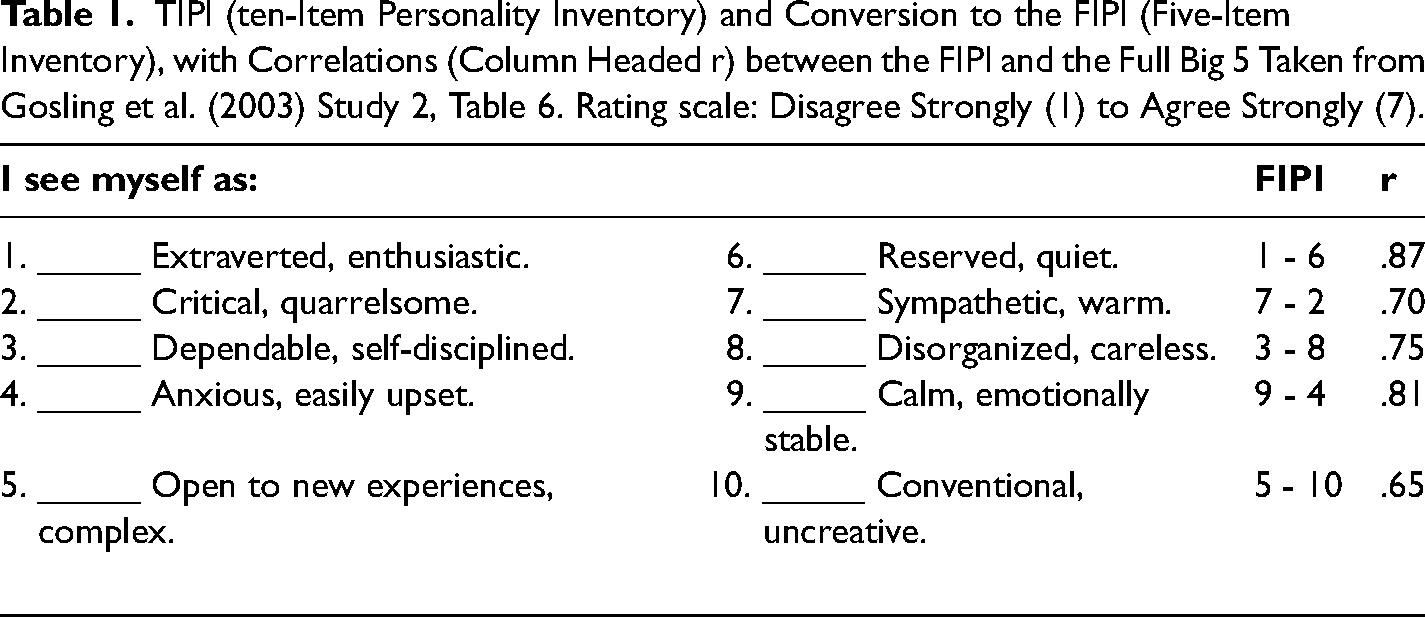
The students each completed the Ten Item Personality Inventory (TIPI) self-ratings (Table 1). The TIPI provides a quick measure of the Big Five dimensions, each assessed by two items in the inventory (Gosling et al., 2003). DR also filled out the TIPI for each of the students, based upon the synesthetic colors they elicited in her.
TIPI (ten-Item Personality Inventory) and Conversion to the FIPI (Five-Item Inventory), with Correlations (Column Headed r) between the FIPI and the Full Big 5 Taken from Gosling et al. (2003) Study 2, Table 6. Rating scale: Disagree Strongly (1) to Agree Strongly (7).
An assistant contacted the students prior to the first experimental session and notified them that they would be observed by a person with synesthesia while they individually filled out a personality inventory. The assistant instructed them to wear neutral clothing (e.g., solid black or grey shirts, no logos) to the experimental sessions so that their fashion selection would not provide any clues that might indicate personality traits. Student participants were also told that they were not to speak during the study. This was to ensure that DR would only be using her synesthetic colors to guide her personality ratings instead of obvious behavioral cues (e.g., boisterous voice, clothing selection). The students were identified by an assigned number; the participation order was randomized on both occasions.
Coding of Synesthetic Colors
To evaluate the colors reported in DR's written descriptions of her synesthetic colors, we identified color categories corresponding to her descriptions. Fifteen categories were selected to represent black, grey, white and 12 primary, secondary, and tertiary hues from a color wheel (https://nhsdesigns.com/graphic/color/color-wheel.php). Two naïve judges independently evaluated DR's descriptions for each of the 15 categories and agreed with each other 93% of the time. This indicated that the color categories could be reliably used to rate DR's concurrents. A more detailed representation of the synesthetic experience, including texture and depth as well as color, may be captured with Virtual Reality (Taylor et al., 2023), but we note that DR was satified with the color-wheel categorical descriptions.
Procedure
Each participating student was greeted by an assistant upon arrival and instructed to sit silently at a table on which there was a copy of the TIPI and a pencil. Each student was told to place the pencil down upon completing the TIPI and to wait quietly for the assistant to return. He or she was aware that DR was observing them from behind a one-way mirror while they filled out the TIPI. After 5 min the participant was led out of the room, deposited the TIPI inventory in a lock box, and was escorted from the research area by the assistant, paid and dismissed.
Immediately upon viewing each student for the 5 min, DR recorded her synesthetic colors. For example, for one she wrote “yellow, powder blue, tannish, grey-blue”. After writing down the colors, DR filled out the TIPI based upon them. DR did not have access to her ratings and synesthetic color descriptions after completing them.
This procedure was repeated after two weeks. As DR was participating in other research projects, it was possible to schedule her without informing her in advance about the second session. Thus, she remained unaware of the follow-up session until she read her informed consent form just prior to the second session. DR did not report seeing any of the student participants during the interval between the two sessions. One student did not return, so there were 10 completed students for DR to observe.
Results
As this study is of a single synesthete, DR, the statistics given below refer to the generalizability of sample of data taken from her, not to other people. Indeed, finding sufficient individuals with color-personality synesthesia to permit inferences at the population level would be well beyond our capability. Significance was determined by t-tests comparing each correlation to r = 0, assuming independence. Again, tests of significance were run to determine whether sufficient numbers of observations were taken to ensure that DR's sample data are meaningful, not to generalize to other color-personality synesthetes. The TIPI self-ratings of the 10 completed students in Study 1 (12 in Study 2) were analyzed for reliability in the same manner as DR's, that is, as a set of 100 (or 120) ratings. Individual differences among the students were ignored in this overall analysis.
Reliability. DR's 100 TIPI ratings (i.e., 10 ratings of the 10 completed students) from the first meeting correlated significantly (r = +.60; t98 = 7.4, p < .01) with those from the second meeting, indicating moderate reliability (see Table 2, top left: reliability). DR's 15 synesthetic color categories varied little across the two sessions: reliability coefficients ranged across the 10 participants from r=+.53 to +.93, with a mean taken over the 150 observations of r = +.83 (t148 = 17.9; p < .01.) The students’ TIPI self-ratings from the two meetings correlated moderate-strongly (r = +.83; t98 = 7.4; p < .01) (Table 2, top left). Further anlysis of her colors required special coding and is explained after Expt 2 in the section Photism-personality relationships.
Reliability and Validity of ratings.
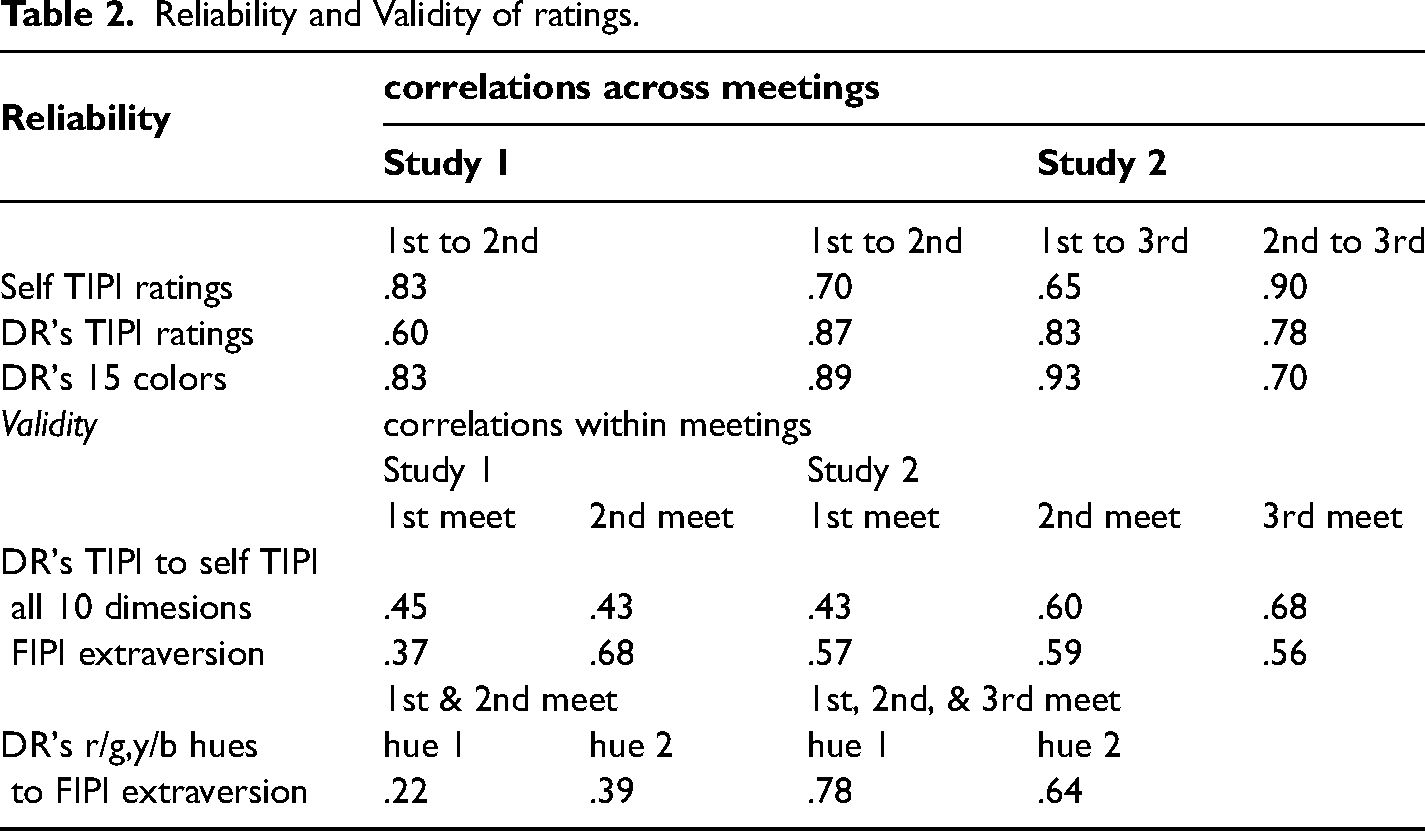
Validity. Given these reliabilities, the correlation between the 100 TIPI ratings from DR and the 100 participants’ TIPI ratings obtained at each meeting, which is an estimate of the validity of her concurrents, was expected to be less than √(.60)(.83) = .70, uncorrected for attenuation. In fact, it was low-moderate, both in the first meeting (r = +.45, t98 = 4.9, p < .01) and in the second meeting (r = +.43, t98 = 4.6, p < .01); see Table 2, center left columns.
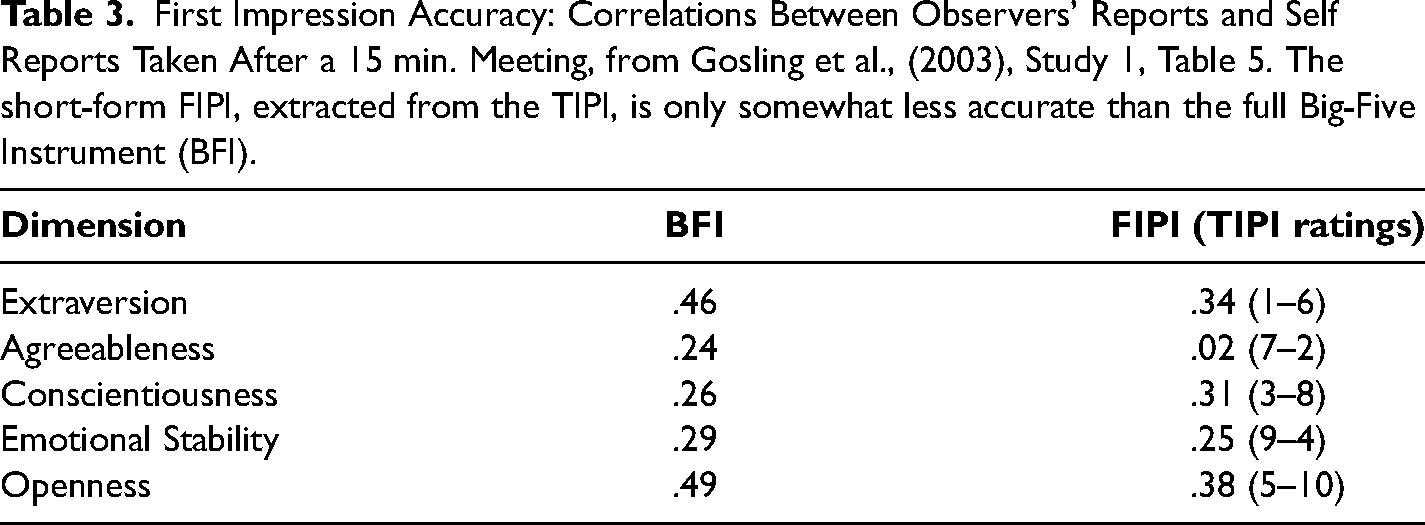
Extracting the Big Five from the ten TIPI ratings, Q1 to Q10 (see Appendix), Extraversion was coded as [Q1 + (7-Q6)]/2, Agreeableness as [(7-Q2) + Q7]/2, Conscientiousness as [Q3 + (7-Q8)]/2, Emotional stability as [(7-Q4) + Q9]/2, and Openness to Experience as [Q5 + (7-Q10)]/2, using reverse coding for the opposite qualities (Introversion, etc.) These five dimensions, as extracted from the TIPI, are known as the ‘FIPI’ (five-item personality inventory; Gosling et al., 2003). Importantly for the present study, observer's FIPI ratings obtained after a brief initial meeting are known to correlate with the participant's self ratings almost as well as does the full Big Five inventory (BFI) (see Table 3). Critically, the Big 5 not only reflect independent aspects of personality, but are sufficiently complete that an individual's personality can be indexed to a first approximation by a point in its 5-D space. Although a more subtle or holistic description of personality might be preferred on deeper acquaintainship, the Big 5 capture first impressions well (Carney et al., 2007).
First Impression Accuracy: Correlations Between Observers’ Reports and Self Reports Taken After a 15 min. Meeting, from Gosling et al., (2003), Study 1, Table 5. The short-form FIPI, extracted from the TIPI, is only somewhat less accurate than the full Big-Five Instrument (BFI).
We tested the agreement between DR's and the subjects’ FIPI ratings both within subject (across the dimensions) and within dimension (across subjects). The within-subject correlations were low: mean r = .33 in session 1 and .17 in session 2, as were the within-dimension correlations, averaging r = .15 in session 1 and .14 in session 2. These averages hide large variations. For example, DR was able to correctly characterize Subject 3's FIPI personality self-ratings in both session 1 (r = .74) and session 2 (r = .89), whereas she was unable to characterize Subject 11 at all (r = .00 in session 1 and −.04 in session 2). Such variation in how much individuals express their personalities to others in brief encounters is well known (Carney et al., 2007), so this is not suprising.
Critically, DR was able to estimate the subject's self-reported Extraversion fairly well (averaged over subjects, mean r = +.37 in session 1 and r = +.68 in session 2), but this was not so for the remaining dimensions. Averaged over both sessions, correlations were Extraversion, r = +.53; Agreeableness, r = −.29; Conscientiousness, r = +.21; Emotional stability, r = −.08; and Openness to Experience, r = +.27. Validity is limited by reliabality, but all 5 FIPI dimesnions have test-retest correlations over r = .66 (Gnambs, 2014, Table 3), so the low validities for the other four dimensions are unlikely to be due to poor psychometric properties. Indeed, low-moderate validities based on first impressions are typical for a student in Psychology like DR (Colvin, 2022). For example, the mean of such self-versus-judged correlations in a study of the Big Five by Carney et al. (2007) was r = .34 after a five minute observation, half the time given to DR. Interestingly, the highest correlation in that study and in Gosling et al. (2003) was for Extraversion and the lowest was for Agreeableness, as was also the case for DR.
Discussion
Study 1 investigated whether or not there was a relationship between DR's synesthetic colors and personality when she viewed strangers briefly, in silence, through a half-silvered mirror to prevent interaction. The results revealed that DR was fairly consistent in terms of reporting her synesthetic colors, which was expected as consistency is one of the hallmarks of synesthesia. She was also consistent in her evaluations of personality between sessions. However, the correlation between DR's FIPI ratings and the volunteers’ self-ratings was only low-moderate in the case of extraversion and nugatory in the case of the other four personality dimensions, suggesting that she was no better at determining their personality traits than other, non-synesthetic, psychology students. So, while strangers might trigger similar colors on the first two meetings, the colors do not correlate especially highly with the self-reports; DR is not remarkable in this respect.
Study 2
Study 1 allowed us to investigate DR's contention that her synesthetic colors were directly related to personality traits and to determine whether or not there was consistency between DR's synesthetic percepts and personality ratings for the two sessions. While DR's TIPI ratings only correlated low-moderate (r = +.45) with the participants’ TIPI self-ratings, both her synesthetic colors (r = +.83) and her TIPI ratings (r = +.60) were consistent across the two sessions. The aim of Study 2 was to discover whether experience, in the form of becoming more familiar with individuals, would modify DR's synesthesia. Although DR reported that her person-colors were set at first sight, it seemed possible that her person-color synesthesia might evolve without her awareness. DR mentioned that she did not usually pay attention to her various synesthetic experiences unless asked to describe them. Moreover, she said that she made it a point to ignore her person-colors so that she would not treat people prejudicially based upon their colors or presumed traits. So, there was the possibility that there could be shifts in her synesthetic experiences of which she was unaware. Therefore, in Study 2 we sought to determine if DR's synesthetic colors and personality judgements would change as she became somewhat more familiar with people. We tested the consistency of DR's synesthetic colors over time, by repeating the procedure after two weeks, as in Study 1, and again after six months. Study 2 was like Study 1, except that DR held brief discussions with the participants and became better acquainted with them across the three sessions, with a six-month hiatus between the second and third sessions.
Method
Participants
DR received the same compensation as in Study 1. Twelve Elizabethtown College undergraduates (19–22 years; 8 females) previously unknown to DR, participated and were paid $5 per session. They had not participated in Study 1.
Materials and Procedure
The materials and procedure were similar to Study 1. However, in Study 2, undergraduate participants each filled out the TIPI and then placed it in a lock box. Next, the undergraduates were escorted by an assistant to a campus office to meet individually with DR. Participants were instructed not to ask DR any questions, but they may briefly answer any questions that she might pose. Again, the students were identified by an assigned number and the participation order was randomized for the three sessions.
DR was seated in the office when the participant arrived. The assistant offered the participant a chair facing DR. During the session, DR asked participants the following two questions: “Do you have an academic major?” and “Where are you from?” DR was permitted to speak briefly with participants based upon their responses to these questions. However, she was instructed to refrain from asking any other questions to keep the protocol as similar as possible for each participant. An Experimenter was present during each of the exchanges between DR and the participants. After approximately 5 min. of conversation, each participant was dismissed.
Immediately after meeting with each participant, DR recorded her synesthetic colors elicited from viewing the participant and filled out the TIPI based upon her synesthetic response. DR did not have access to her ratings and synesthetic colors descriptions after completing them. This procedure was repeated after two weeks and then again six months following the second session. During these sessions, DR asked the students “how have you been?” to initiate a 5 min discussion. As before, DR did not see any of the participants between sessions or have any forewarning that there would be any additional sessions. The first author also contacted DR after final data collection and requested that DR report which of her synesthetic colors, if any, went along with the Big 5 personality traits. DR's responses are given in the Appendix.
Results
Analysis of the 120 TIPI scores (ten for each of 12 students) indicated that the personality ratings were reliable for both DR (first to second session: r = +.70; first to third: r = +.65; second to the third session: r = +.90) and for the students (corresponding r's: .87, .83, .78) (Table 2, top right). DRs colors were also reliable (first to second, .89; second to third, .93; first to third, .70.) For validity, the correlation between DR's TIPI ratings and the students’ TIPI self-reports strengthened from the first session (r = + .43, t118 = 5.2, p < .001) to the second one (r = + .60, t118 = 8.2, p < .001), and again to the third session at 6 months (r = + .68; t118 = 10.0, p < .001) (Table 2, middle right). The increase from the first to the third session of .25 was significant (t118 = 2.70, p < .01), though not the increase from the first to the second session. Not surprisingly, further experience improved her sense of the students’ personalities.
The Big 5 dimensions (the ‘FIPI’) were again extracted from the TIPI as described in Study 1. Study 2 essentially replicated Study 1, in that the self-judged FIPI correlations were again low in session 1, averaging r = +.29 across subjects and r = +.26 across dimensions, and hardly better (.34 and .38) in session 2. Again, some subjects were easy for DR to evaluate (the three highest r's in session 1 being .79, .73, and .90), whereas others were not (the three lowest being .24, −.18 and −.91, the latter arising principally because DR evaluated the subject as 2.5, i.e., introverted, whereas the subject reported themselves as 6, highly extroverted.) Averaged over the 3 sessions, mean FIPI correlations across subjects were Extraversion, r = +.58; Agreeableness, r = + .20; Conscientiousness, r = +.07; Emotional stability, r = + .33; and Openness to Experience, r = +.38, the latter four all being low and Extraversion being moderate, as in Study 1. The correlations with extraversion were, probably accidentally, steady across sessions (r = .57, .59, and .56 for sessions 1, 2, and 3) (Table 2, middle right).
Discussion
Photism-Personality Relationships
We listed DR's descriptions of her photism colors for each of the 12 subjects here and 10 in Study 1. The colors were complex and blended (see Figure 1) and characterizing them is not easy. To our eyes, only Extraversion seemed to be systematically related to the colors, as the other four personality dimensions each attracted idiosyncratic colors for each subject. (In this respect her colors followed her TIPI ratings.) We therefore concentrated analysis on Extraversion. As an example of a subject rated as highly extroverted (7), photisms in session 1 were described as gold, yellow, some greenish blue, but mostly gold/warmer bronze; in session 2, as tan and brown; and in session 3, as tan, some golden yellow, medium to dark blue, olive green. The most prevalent hue elicited by this subject is yellow, the next most prevalent is tan. In contrast, a rather introverted subject (rated 3) elicited photisms in session 1 described as stranger green tones flecked with softer neutrals, pale blue, cooler colors, light neutral gray; in session 2, as gray, pale blue, some tan; and in session 3, as pale blue, tan, some brown. Here the most prevalent hue is pale blue and the second most is tan. We did not score less prevalent colors as these were highly variable and not always present.
Colors are commonly designated by hue, saturation, and brightness (H, S, B). DR rarely distinguished brightness, so this went unscored. The hues in each photism were scored by one of us (AR) on the opponent axes of color space as H = (a, b), where a refers to the red-green axis (−1 for red; +1 for green) and b to the yellow-blue axis (−1 for blue, +1 for yellow). Achromatic or neutral colors (black, white and grey) are scored at the origin (0, 0). Thus yellow is (0, 1); red is (−1, 0), and so on. Colors that project onto both axes are scored with fractions; for example, orange, being half-way between red and yellow, is (−1/2, +1/2). Intermediates like orangey-yellow were coded as red/green = sign[sin(α)].sin2(α) and yellow/blue = sign[cos(α)].cos2(α), where α is the clockwise hue anglefrom yellow = 0, so green = 90o, etc. Saturation was reported only intermittently, so this was not distinguished; thus, pink and red, for example, were both scored (−1, 0). DR's Extraversion ratings were correlated with a linear combination of her photism hues, namely, H = k1 a + k2 b, where the k's weight the red/green (a) and yellow/blue (b) axes. Extraversion ratings and hue scores were averaged over all the observations made over all the sessions, separately for each subject. Extraversion correlated best with the H scores for the most prevalent colors (r = .22 in Expt. 1, rising to r = .78 in Expt. 2) with k1 = + .2 and k2 = −1.0, and for the next most prevalent color (r = .39 in Expt. 1 and r = .64 in Expt. 2) with k1 = −1.0 and k2 = +.5 (Table 2, bottom row). Thus the most prevalent synesthetic colors were dominated by the yellow/blue axis, and the next most prevalent colors, by the red/green axis. Recognizing again that only hue was scored, not brightness and saturation, and that a more sophisticated treatment might have uncovered further relationships, we conclude that the photism color - extraversion relationship is remarkably strong, even given brief interactions. Critically, the most prevalent color exhibits the classical association of extraversion with yellow and introversion with blue (e.g., Hartmann et al., 2023), as in the examples given above, while the next most prevalent color indicates that extraversion is further associated with red and introversion with green.
General Discussion
DR's people-colors for strangers in Study 1 were consistent over the two weeks between viewing sessions, and the TIPI ratings that she provided for these individuals based upon their colors were also consistent across the viewings. But are DR's synesthetic colors usefully related to her judgement of personality, given that she has developed a unique taxonomic system relating specific colors to specific personality traits? Given her limited observation of the individuals she rated in Study 1, who were silent, the low-moderate correlations of her TIPI ratings with the self-ratings indicates that they are. She is similar to non-synesthetes whose personality assessments of strangers correlate at this level (Alper et al., 2021; Beer & Watson, 2008; Carney et al., 2007).
Study 2 revealed that even slight interactions with unfamiliar people resulted in changes for DR's synesthetic colors and personality evaluations. This finding fits well with Craver-Lemley et al.'s (2009) report that symbols that initially held no meaning for DR did not elicit her synesthesia, but once these same symbols acquired meaning, synesthetic colors emerged. The correlation of photism color with extraversion rose to r = .78 in Expt. 2, primarily due to the yellow-blue variation in color space. Existing triggers can develop new synesthetic responses, supporting Uno et al.'s (2021) claim that synesthetic learning is possible, even in adulthood.
As far as we know, this is the first time that a personality-based dimension has been linked to synesthetic color in the literature. Our study is complementary to previous work showing that the actual personalities of synesthetes are normal for four of the Big 5 dimensions but higher in Openness (Hossain et al., 2018), which was also characteristic of DR, whose FIPI self-ratings for openness were 6; extraversion, 4; agreeableness, 5; conscientiousness, 5; and emotional stability, 2. The question arises, whether DR's personality-based colors stem from emotion-induced synesthesia (Ward, 2013). That extraversion is associated with yellow, taken to be happy in North America, and introversion with blue, taken to be sad, supports this possibility. However, DR claimed that the strangers she evaluated did not evoke emotional responses in her. Of course, an unconscious connection may exist, but at the level of self-report, this was not the case for DR.
Authors’ Statements
Catherine Craver-Lemley conceived the research and wrote the paper, Caroline Dillon, Amanda McGraw, and Jennifer Heimbach carried out the research and collected the data, and Adam Reeves contributed analysis and edited the paper.
The research was not supported by funding.
Footnotes
Declaration of Conflicting Interests
The authors declared no potential conflicts of interest with respect to the research, authorship, and/or publication of this article.
Funding
The authors received no financial support for the research, authorship, and/or publication of this article.
Author Notes
We are grateful to DR for her participation in this research. A portion of the findings from Study 1 & 2 were presented at the Annual Meeting of the Association for Psychological Science in 2012 & 2013, and the Annual Meeting of the Eastern Psychological Association in 2012. We thank Jennifer Heimbach for assistance with data collection.
