



Abstract
Imagining music in the mind's ear is common in everyday life and is characterised by individual differences in who is likely to experience involuntary musical imagery. Research has explored the relationship between musical imagery and mental health (e.g., obsessive compulsive disorder); however, little is known about the relationship between anxiety and musical imagery. The current study investigated the associations between these two variables. 432 participants completed a cross-sectional, online survey, measuring trait anxiety, depression, musical imagery experience, the controllability of unwanted thoughts, and aspects of sleep. Positive associations were found between trait anxiety and the frequency, negative valence and perceived helpfulness of involuntary musical imagery, and the amount of music imagined whilst trying to sleep. Trait anxiety did not correlate with the controllability of auditory imagery. These findings provide a clearer understanding of musical imagery's relationship with anxiety and have implications for using voluntary musical imagery to reduce anxiety.
Introduction
Musical imagery involves ‘hearing’ music in the mind (Halpern, 2001) and can either be voluntary (voluntary musical imagery) or unintentional, known as involuntary musical imagery. The latter, a form of spontaneous cognition, occurs when individuals imagine music with no conscious effort (Floridou et al., 2015). Liikkanen and Jakubowski’s (2020) review of empirical studies of involuntary musical imagery highlights key findings relating to the dynamics, phenomenology, individual differences, and musical features of involuntary musical imagery. For instance, the duration of involuntary musical imagery episodes can vary between 44 s (Moeck et al., 2018) and a few hours (Hyman et al., 2015), and music that people are familiar with is more likely to occur in involuntary musical imagery (e.g., Beaman & Williams, 2010; Halpern & Bartlett, 2011). Voluntary musical imagery, on the other hand, involves the conscious and deliberate imagination of music, such as musicians voluntarily imagining music when mentally rehearsing for a performance (Fine et al., 2015). Research in this area has shown that musical features can be preserved in voluntary musical imagery, like tempo (Jakubowski et al., 2016) or dynamics (Bailes et al., 2012), and that individual differences based on musical training exist in the involuntary musical imagery experience, such as musicians having more clear and vivid musical imagery compared to non-musicians (Campos & Fuentes, 2016).
Individual differences characterise many forms of mental imagery experience. Some relate to psychological disorders, with several authors considering differences with respect to anxiety and depression. In anxiety, individual differences in relation to mental imagery range from how imagery can serve to maintain the problem, to how unwanted involuntary mental imagery is a common symptom in anxiety disorders (Hirsch & Holmes, 2007). For example, people with generalised anxiety disorder experience more prospective mental imagery that is negative and intrusive (Tallon et al., 2020), whereas negative self-images play an important role in the maintenance of social anxiety (Makkar & Grisham, 2011; Schreiber & Steil, 2013). For depression, researchers have found associations with mental imagery dysfunction, including depressive individuals having elevated levels of intrusive negative mental imagery (Holmes et al., 2016), generating fewer episodes of positive mental imagery (Weßlau et al., 2015), and having problems with the formation and modification of deliberate mental imagery (Chen et al., 2013; Holmes et al., 2016).
Previous research has also demonstrated that auditory imagery, including musical imagery, can either maintain mental health problems or be symptoms of these experiences. For instance, Çili and Stopa (2015) explored the occurrence of intrusive images in psychological disorders and how they may contribute to the maintenance of these problems. Involuntary musical imagery has been researched in obsessive compulsive disorder, showing that people with this problem have a higher chance of reporting severe cases of involuntary musical imagery (Taylor et al., 2014), here referred to as musical obsessions, and this is evident in case reports of individuals with obsessive compulsive disorder who experience musical obsessions (Naskar et al., 2017). However, more broadly, little or no research has explored individual differences in musical imagery experience in relation to anxiety, yet studies looking at multisensory mental imagery experiences and anxiety (Schwarz et al., 2020; Tallon et al., 2020) suggest that musical imagery experiences and anxiety may be related. For instance, high levels of anxiety may be positively related to the frequency of involuntary musical imagery. It is therefore worthwhile investigating whether these relationships exist in order to help clarify the theoretical understanding of these phenomena, and to potentially elucidate the shared mechanisms that may account for the relationship between anxiety and musical imagery, such as thought control.
Two variables that have been found to be associated with anxiety and musical imagery independently are thought control and sleep. For example, Wells and Davies (1994) found associations between anxiety and a lack of thought control, showing that more severe experiences of anxiety are related to poorer control of unwanted thoughts. Additionally, anxiety is said to share a bi-directional relationship with sleep, as having anxiety can lead to poor sleep quality and problems with sleep can result in increased anxiety (Gray & Lemke, 2017; Norbury & Evans, 2019). For musical imagery, Hyman et al. (2015) concluded that involuntary musical imagery can be a form of intrusive thought, which is a common aspect of anxiety (Wells & Davies, 1994), and so this suggests that it could be likely for people with anxiety to experience more involuntary musical imagery when trying to sleep, compared to individuals who are less anxious. This would in turn negatively impact one's quality of sleep (see Scullin et al., 2021), as Nelson and Harvey (2003) found that people with insomnia report more distressing mental images during their pre-sleep period compared to individuals who do not experience problems with sleep. Given the gaps in existing knowledge, the current study sought to establish and clarify the associations between thought control, sleep, and anxiety in relation to musical imagery.
The relationship between anxiety and musical imagery was thus investigated in an online survey, whilst also studying potential associations with secondary variables including sleep and thought control. The aim of this survey was therefore to investigate whether there is a relationship between musical imagery experience (assessed through the frequency, valence, and perceived usefulness of involuntary musical imagery, as well as the vividness and controllability of auditory imagery) and anxiety. Exploratory analyses were also conducted to study potential associations between depression and musical imagery experience. It was predicted that trait anxiety would be positively correlated with more frequent and negatively evaluated involuntary musical imagery, as people with anxiety are more likely to experience frequent negative mental imagery (Stöber, 2000). With anxious individuals having intrusive thoughts whilst attempting to sleep (Wicklow & Espie, 2000) and with poorer control over mental activity, it was also hypothesised that trait anxiety would have a positive correlation with the frequency of music imagined whilst trying to sleep, but a negative relationship with the self-reported controllability of auditory imagery. Finally, due to the role of thought controllability in anxiety (Wells & Davies, 1994), and mental control in musical imagery (Cotter, 2019), it was predicted that thought control would moderate the relationship between trait anxiety and involuntary musical imagery, and affect the relationship between trait anxiety and the self-reported ability to control auditory imagery.
Method and Procedure
Participants and Design
The study used a correlational design, with 432 participants (323 women, 101 men and 8 not disclosed) between the ages of 18 and 68 (Mdn = 20) completing the online survey. Responses from 10 participants were excluded as they reported experiences of hearing loss (see below). The number of participants included in the final set of data analyses varied between 410 and 421, due to missing data. Participants resided in Africa (n = 2), Australia (n = 2), Europe (n = 404), North America (n = 19) and South America (n = 1).
Participants were mainly recruited online via university mailing lists and social media, using volunteer and snowball sampling methods. Additional recruitment methods included the undergraduate student participation pool in the School of Psychology and the use of a participant recruitment website (www.prolific.co). Participants below the age of 16 were excluded (due to there only being interest in an adult population), as were individuals reporting hearing loss (hearing loss is expected to affect how individuals would respond to the questions that focus on music, specifically musical engagement and imagery). As a reward for participating, psychology undergraduate students received course credits, while those who completed the survey via Prolific received £2.50. Participants who were recruited through other methods had the option of being entered into a prize draw to win a £10 gift voucher. This survey received ethical approval from the Faculty of Arts, Humanities and Cultures Research Ethics Committee at the University of Leeds (Ethical approval code: PVAR 17-116) on 11th June 2018.
Measures
Online Surveys (an online survey tool - www.onlinesurveys.ac.uk) was used to administer the survey and there were three versions that varied in relation to the order of the questions, to overcome order effects. Scale items were grouped under five areas: (1) musical engagement (Goldsmiths Musical Sophistication Index [Gold-MSI]; Müllensiefen et al., 2014), (2) musical imagery (Involuntary Musical Imagery Scale [IMIS]; Floridou et al., 2015, and the Bucknell Auditory Imagery Scale [BAIS]; Halpern, 2015, including the vividness [BAIS-V] and control [BAIS-C] scales), (3) hearing loss, (4) well-being (State-Trait Anxiety Inventory-Trait Scale [STAI-T]; Spielberger et al., 1983, Centre for Epidemiological Studies Depression Scale [CES-D]; Radloff, 1977, clinical anxiety, clinical depression and sleep questions), and (5) thought control (Thought Control Questionnaire [TCQ]; Wells & Davies, 1994). Help links were also provided to signpost participants to mental health support before, during and after the completion of the survey: www.mind.org.uk, www.rethink.org and www.youngminds.org.uk. The three survey orders were as follows:
State-Trait Anxiety Inventory-Trait Scale (STAI-T; Spielberger et al., 1983)
The STAI-T is a self-report questionnaire used to assess trait anxiety. Twenty items are included in the form of a Likert scale focusing on worry, nervousness, apprehension, and tension. Participants are asked to rate how they generally feel in response to those items, such as ‘I feel pleasant,’ on a scale from 1 (Almost never) to 4 (Almost always). Trait anxiety scores range between 20 (lowest) and 80 (highest). This questionnaire has been used frequently in mental health research to assess trait anxiety (Hallit et al., 2019; Nordahl et al., 2019; Weeks et al., 2019), due to good levels of convergent validity and internal consistency (Vitasari et al., 2011), and the level of internal consistency for this sample was high, α = .93. In addition to this measure, two extra questions were used to ascertain whether the participants had an anxiety disorder, as well as the type of disorder: “Have you ever been diagnosed with an anxiety disorder?” and “If the answer to the previous question is yes, please state the type of anxiety disorder.”
The Centre for Epidemiological Studies Depression Scale (CES-D; Radloff, 1977)
The CES-D is a 20-item self-report questionnaire that measures the severity of depressive symptoms over the past week. Each item on the questionnaire includes four possible response options: (1) Rarely or none of the time (Less than 1 day), (2) Some or a little of the time (1–2 days), (3) Occasionally or a moderate amount of time (3–4 days) and (4) Most or all of the time (5–7 days). Here are some examples of questions: ‘I felt I was just as good as other people,’ ‘I had trouble keeping my mind on what I was doing’ and ‘I felt depressed.’ Scores range between 0 and 60, with higher scores representing more severe depressive symptoms. This questionnaire had a good level of internal consistency in this sample (α = .75) and has a moderate test-retest reliability (.45 - .70; Radloff, 1977).
Sleep Questions
A subset of questions was taken from the Pittsburgh Sleep Quality Index (PSQI; Buysse et al., 1989) and adapted to relate to anxiety and musical imagery. These questions were used as this questionnaire is frequently adopted in research that studies sleep and anxiety simultaneously (Choueiry et al., 2016; El-Tantawy et al., 2014; Teker & Luleci, 2018), and have good levels of internal consistency in different populations (Popević et al., 2018; Spira et al., 2012), as well as good validity (Backhaus et al., 2002). The chosen items focus on sleep quality (SQ), sleep difficulty due to anxiety (S-A) and musical imagery frequency whilst trying to sleep (S-MI). The PSQI was modified by relating the questions specifically to anxiety and musical imagery and has good face validity. The new questions developed were:
During the past month, how would you rate your overall sleep quality? (a) Very bad, (b) Fairly bad, (c) Fairly good, (d) Very good In the past month, how likely is it that you’ve had difficulty getting to sleep due to anxiety? 1 (Not very likely) to 9 (Extremely likely) In the past month, how often have you imagined music whilst trying to get to sleep? 1 (Not very often) to 9 (Extremely often)
The Involuntary Musical Imagery Scale (IMIS; Floridou et al., 2015)
The IMIS is a self-report questionnaire that collects information regarding the experience of involuntary musical imagery. The questionnaire consists of 15 Likert scale items, rated on a scale from 1 (Never) to 5 (Always), that measure four aspects of involuntary musical imagery episodes: negative valence (INMI-NV), movement (INMI-M), personal reflections (INMI-PR) and help (INMI-H). The perceived negative valence of involuntary musical imagery relates to an individual's subjective evaluation of their involuntary musical imagery episodes, with an example from the IMIS being ‘It worries me when I have an earworm stuck in my head.’ An individual's embodied responses to their involuntary musical imagery are reflected through the movement aspect, such as ‘When I get an earworm I move to the beat of the imagined music.’ The personal reflections aspect of involuntary musical imagery concern personal qualities that are related to these experiences, such as ‘Personal issues trigger my earworms.’ ‘Help’ focuses on how beneficial and constructive the involuntary musical imagery experience can be for people. An example from the questionnaire is ‘Earworms help me when I’m trying to get things done.’ Two further items enquire about the frequency of involuntary musical imagery (INMI-F) and the duration of these experiences. This questionnaire was used as it is the most comprehensive, validated measure of the involuntary experience of musical imagery. For this sample, the questionnaire had a good level of internal consistency, α = .80.
The Bucknell Auditory Imagery Scale (BAIS; Halpern, 2015)
The BAIS surveys individuals’ experiences of voluntarily imagining sound by measuring the vividness and controllability of auditory imagery through two 14-item subscales, the BAIS-V and the BAIS-C. For each item, a scenario is presented along with a description of a specific sound. For the BAIS-V, respondents are required to form a mental image of that particular sound then use the vividness subscale to rate the vividness of that image from 1 (No image is present) to 7 (The image is as vivid as the actual sound). An example item from the BAIS-V is: ‘1. For the first item, consider the beginning of the song “Happy Birthday.” Rate the vividness of the sound of a trumpet beginning the piece.’ For the BAIS-C, the participants are given a scenario then asked to rate how easy it is to change the image of one sound to the image of another from 1 (No image is present) to 7 (Extremely easy to change the image). For example, ‘Consider attending a choir rehearsal. Rate the ease of change from a. The sound of an all-children's choir singing the first verse of a song, to b. An all-adults’ choir now sings the second verse of the song.’ Both scales in this questionnaire had high levels of internal consistency in the current sample, BAIS-V, α = .90 and BAIS-C, α = .88.
The Goldsmiths Musical Sophistication Index (Gold-MSI; Müllensiefen et al., 2014)
The Gold-MSI is a self-report questionnaire that assesses individual differences in musical sophistication by measuring musical engagement and behaviour. Thirty-one of the items are presented in the form of a 7-point Likert scale, where participants rate their level of agreement with each item statement from 1 (Completely disagree) to 7 (Completely agree), e.g. ‘I spend a lot of my free time doing music-related activities.’ The remaining items are delivered in a multiple-choice format and use an ordinal scale to assess musical behaviour such as practising a musical instrument. The Gold-MSI is a favourable psychometric measure for the assessment of musical sophistication, as the questionnaire has good internal consistency and test-retest reliability (Lima et al., 2018).
The Thought Control Questionnaire (TCQ; Wells & Davies, 1994)
This 30-item questionnaire assesses the ability to control unwanted thoughts, including the effectiveness of the individual strategies that are often applied to control these thoughts. Five sub-scales measure different types of thought control strategies used for unwanted thoughts. These sub-scales are distraction (TCA-D), worry (TCA-W), punishment (TCA-P), social control (TCA-SC) and re-appraisal (TCA-RA). Wells and Davies (1994) state that the subscales have good internal consistency, ranging from .64 to .79, and the total test-retest reliability score is .83, indicating that this questionnaire is a stable measure. Additionally, there was a high level of internal consistency, α = .81, for this participant sample.
The online survey was advertised from 2nd July 2018 to 26th February 2019 and took approximately 30 min to complete.
Data Analysis
The main study variables were visually inspected using histograms and were found to be normally distributed, so Pearson Product-Moment Correlations and multiple regressions were used. Standard multiple regression analysis was used to examine which thought control strategy variables predicted variance in musical imagery experience (Field, 2009), as there was interest in seeing how each thought control strategy variable explained variability in musical imagery experience. Moderated multiple regression analyses were also performed to test the moderating effects of thought control ability (TCA) on the relationship between musical imagery and anxiety.
Results
Descriptive Statistics
The descriptive statistics for the study variables included in the main survey analyses are presented in Table 1, whilst Table 2 contains the correlations for the Pearson Product-Moment Correlation analyses.
Descriptive Statistics for the Main Study Variables (N = 410 – 421).
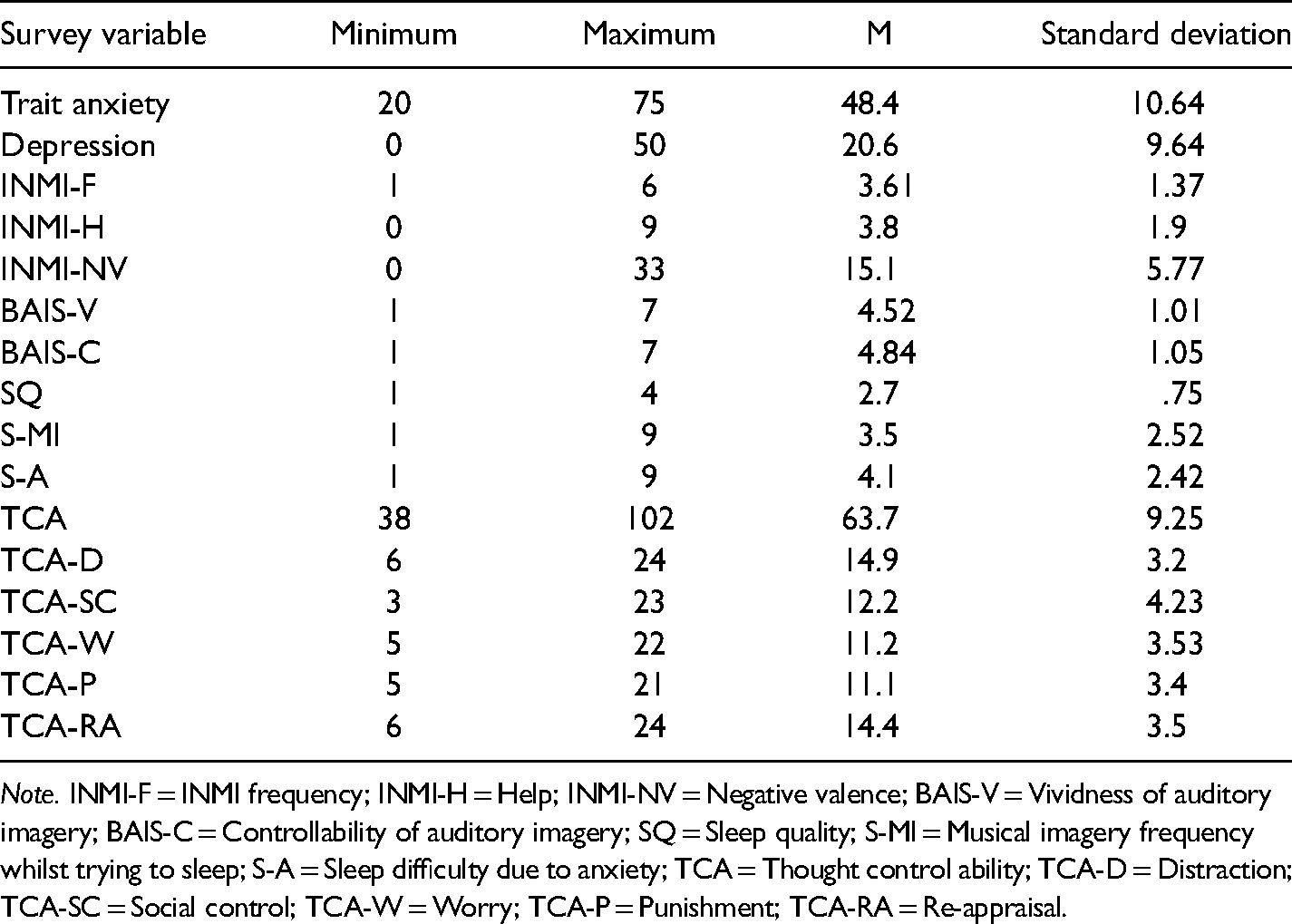
Note. INMI-F = INMI frequency; INMI-H = Help; INMI-NV = Negative valence; BAIS-V = Vividness of auditory imagery; BAIS-C = Controllability of auditory imagery; SQ = Sleep quality; S-MI = Musical imagery frequency whilst trying to sleep; S-A = Sleep difficulty due to anxiety; TCA = Thought control ability; TCA-D = Distraction; TCA-SC = Social control; TCA-W = Worry; TCA-P = Punishment; TCA-RA = Re-appraisal.
A Pearson Product-Moment Coefficient Correlation Matrix Displaying the Outcome Variables (N = 410 – 421).
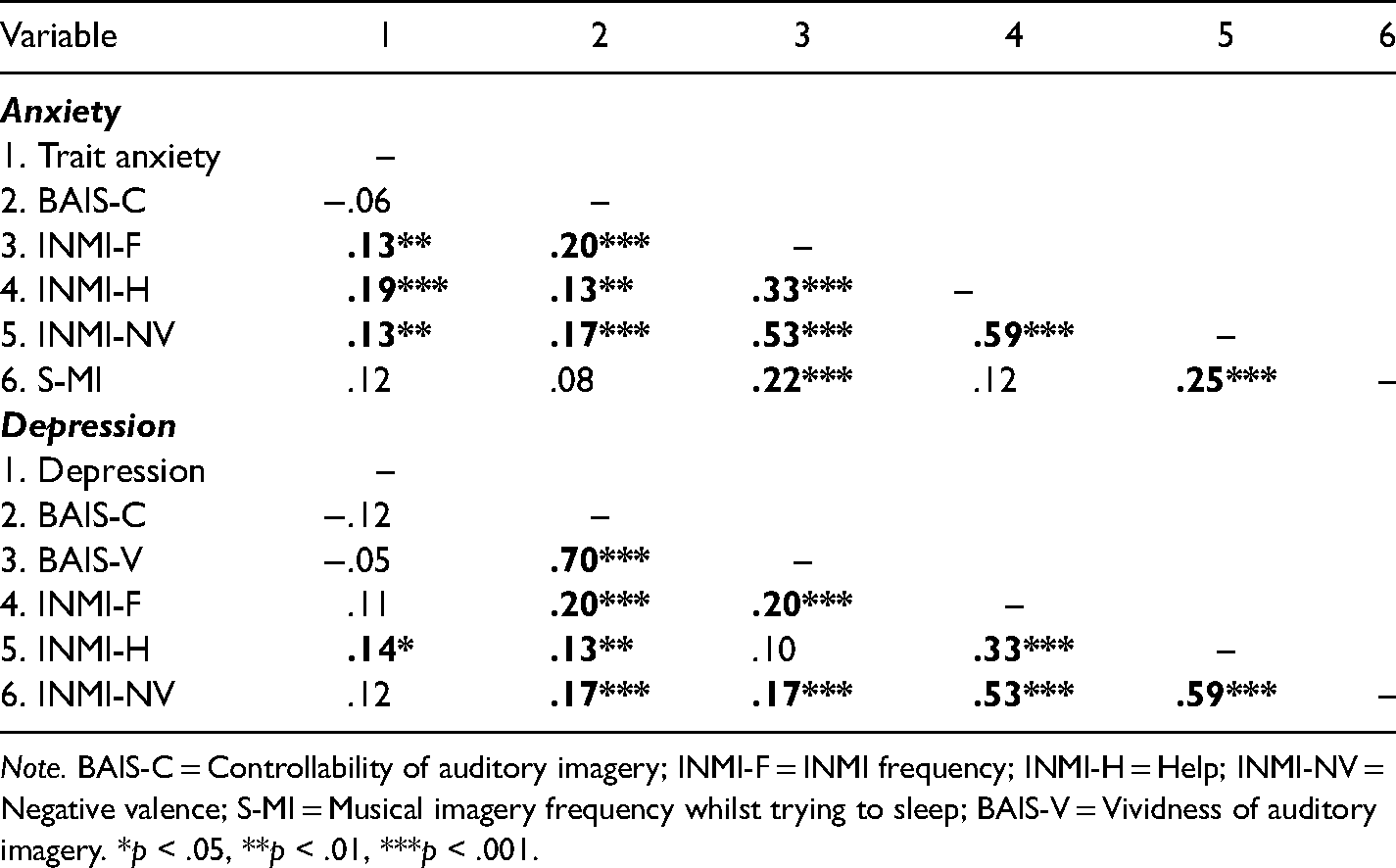
Note. BAIS-C = Controllability of auditory imagery; INMI-F = INMI frequency; INMI-H = Help; INMI-NV = Negative valence; S-MI = Musical imagery frequency whilst trying to sleep; BAIS-V = Vividness of auditory imagery. *p < .05, **p < .01, ***p < .001.
Anxiety and Musical Imagery Experience
The primary research question concerns the relationship between trait anxiety and musical imagery experience (measured through INMI-F and BAIS-C). Pearson Product-Moment Correlation analyses showed a significant positive relationship between trait anxiety and INMI-F, r(417) = .13, p = .007 but not between trait anxiety and BAIS-C, r(420) = -.06, p = .20 (see Table 2). There was further interest in potential correlations between trait anxiety and specific characteristics of the involuntary musical imagery experience; the subjective evaluation (negative valence) of involuntary musical imagery and the beneficial and constructive (help) aspects of this type of imagery. Two Pearson Product-Moment Correlations showed that individuals with high trait anxiety evaluated involuntary musical imagery episodes as more negative, r(421) = .13, p = .006, and more helpful, r(421) = .19, p < .001.
Sleep
A Pearson Product-Moment Correlation analysis was used to assess the hypothesised positive relationship between the frequency of musical imagery whilst trying to sleep and one's experience of anxiety. As predicted, a positive relationship was observed between trait anxiety and the amount of music imagined whilst trying to sleep, r(420) = .12, p = .01.
Exploratory Correlation Analyses
Some additional exploratory analyses were conducted relating to depression, including Pearson Product-Moment Correlations investigating relationships between depression and musical imagery experience. The variables included in the analyses were depression, INMI-F, the BAIS-V and BAIS-C. An increase in the symptoms of depression was correlated with more frequent involuntary musical imagery (r(417) = .11, p = .03) and poorer control over auditory imagery, r(420) = -.12, p = .01, but there was no significant relationship between depression and BAIS-V (r(421) = -.05, p = .31). More Pearson Product-Moment Correlation analyses were also conducted to see if depression shared any associations with the help and negative valence characteristics of involuntary musical imagery. The analyses showed that higher levels of depression positively correlated with involuntary musical imagery episodes being deemed as more helpful, r(421) = .14, p = .003, and more negative, r(421) = .12, p = .02.
Multiple Regression Analyses
Thought Control
Three multiple regression analyses were conducted to model the role of thought control strategies as predictors of various measures of the musical imagery experience (formed of three variables: INMI-F, BAIS-V and BAIS-C), with the thought control strategies being distraction (TCA-D), social control (TCA-SC), worry (TCA-W), punishment (TCA-P), and re-appraisal (TCA-RA). Significant regression models were found for BAIS-V, F(5, 414) = 4.31, p = .001, r2 = .05, and BAIS-C, F(5, 413) = 2.46, p = .03, r2 = .03, but there was no significant regression model for INMI-F, F(5, 410) = .67, p = .65, r2 = .01. Individually, TCA-RA (re-appraisal thought control strategy) significantly predicted variance in BAIS-V (β = .06, p < .001) and BAIS-C (β = .05, p = .003), as seen in Table 3, indicating that people who score higher on the re-appraisal thought strategy to control unwanted thoughts report more vivid and controllable auditory imagery episodes.
Coefficients for the Multiple Regression Analyses Regarding Musical Imagery Experience and the Controllability of Thoughts.
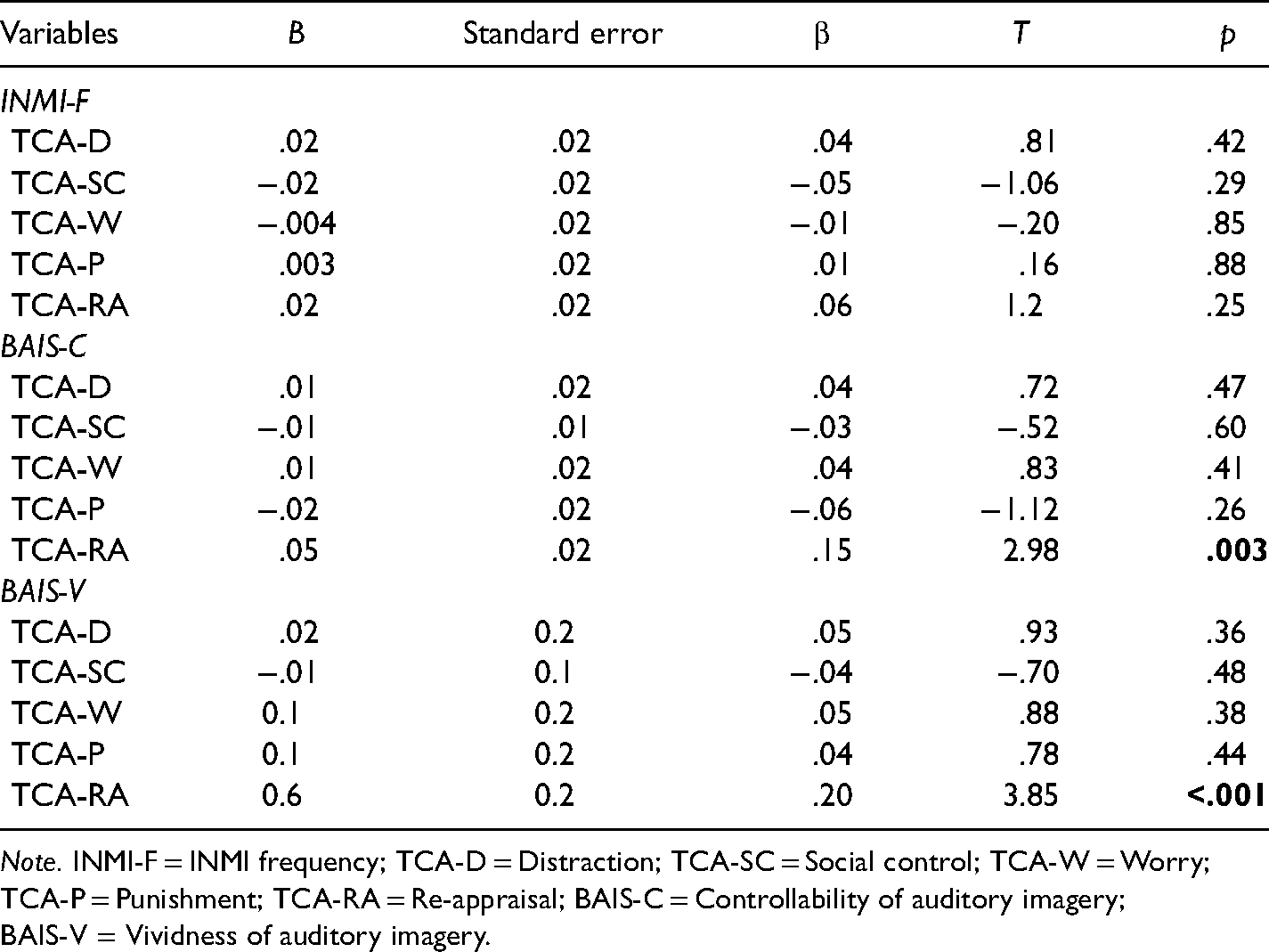
Note. INMI-F = INMI frequency; TCA-D = Distraction; TCA-SC = Social control; TCA-W = Worry; TCA-P = Punishment; TCA-RA = Re-appraisal; BAIS-C = Controllability of auditory imagery; BAIS-V = Vividness of auditory imagery.
Further to that, two hierarchical multiple regression analyses were conducted to assess the predicted moderating effects of thought control on the relationship between trait anxiety and musical imagery experience (see Table 4). Trait anxiety and TCA were first mean centred, then these predictor variables (including an interaction variable between both variables) were entered in the following order: trait anxiety (mean centred), followed by TCA (mean centred), then trait anxiety × TCA to see if there were any interaction effects. The first variable predicting INMI-F was trait anxiety (R2 change = .02, F(1, 415) = 7.34, p = .01), whilst TCA was not a significant predictor (R2 change = .001, F(1, 414) = .25, p = .62). Moreover, the trait anxiety × TCA interaction was not significant (R2 change = .004, F(1, 413) = 1.75, p = .19), indicating that TCA did not moderate the relationship between trait anxiety and INMI-F. For BAIS-C, there was no significant main effect of trait anxiety (R2 change = .004, F(1, 418) = 1.65, p = .20), or TCA (R2 change = .01, F(1, 417) = 3.37, p = .07), nor was the trait anxiety × TCA interaction significant (R2 change = .001. F(1, 416) = .34, p = .56).
Coefficients for the Hierarchical Multiple Regression Analyses Examining the Moderating Effect of TCA on the Relationship Between Anxiety and Musical Imagery.
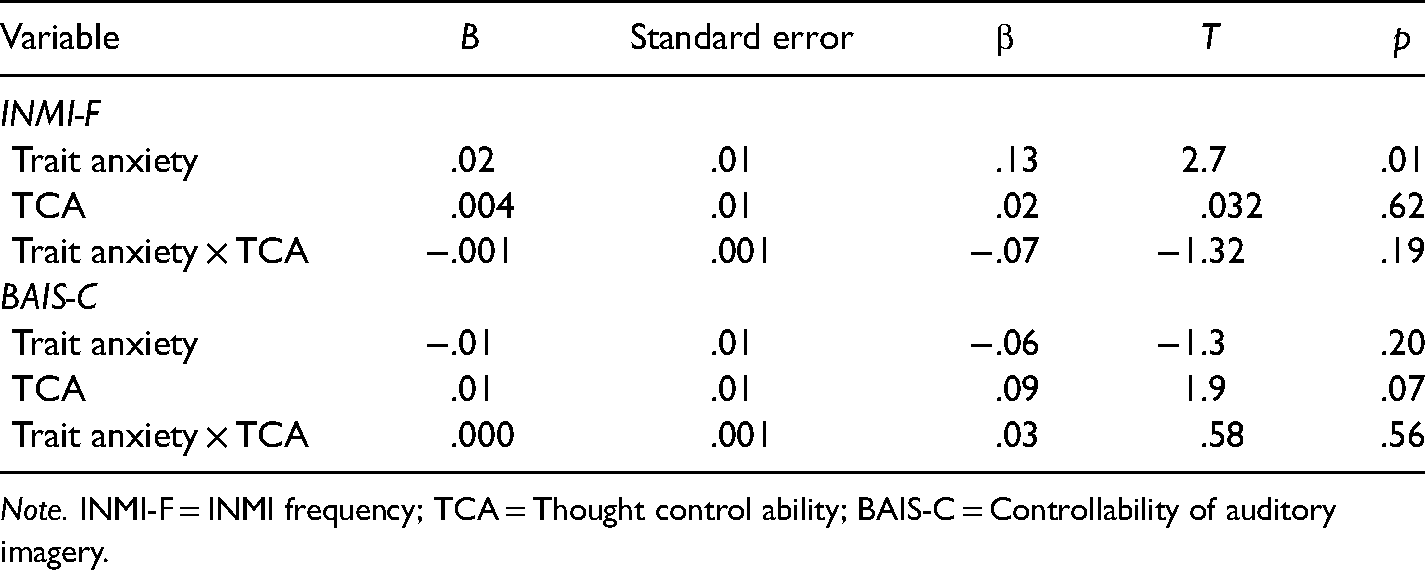
Note. INMI-F = INMI frequency; TCA = Thought control ability; BAIS-C = Controllability of auditory imagery.
Discussion
Motivation for the current study stemmed from a lack of research investigating individual differences in musical imagery experience in relation to anxiety. This survey therefore acts as the first to reveal associations between experiences of anxiety and musical imagery. Individuals with high trait anxiety were more likely to report experiences of involuntary musical imagery, perceive these episodes as both negative and helpful, and they were more likely to imagine music whilst trying to sleep. Contrary to our expectations, people with high trait anxiety did not report poorer control over their deliberate auditory imagery. When including thought control within the analyses, re-appraisal was the only thought control dimension to predict variance in the vividness and controllability of auditory imagery, and thought control ability did not moderate the relationship between trait anxiety and the frequency of involuntary musical imagery, or between trait anxiety and the controllability of auditory imagery.
Our findings that respondents with high trait anxiety report more frequent and negative involuntary musical imagery episodes compare to the results of Homer and Deeprose (2017), who found that individuals with social anxiety are more likely to experience intrusive (involuntary) imagery that is negative. These associations between the frequency of involuntary musical imagery, negative imagery and anxiety can be framed through the consideration of involuntary musical imagery as a form of intrusive thought (Hyman et al., 2015), as well as the way in which people with high trait anxiety perceive this experience. Intrusive thoughts are negative and a common characteristic of anxiety (Wells & Davies, 1994), so as research suggests that involuntary musical imagery can be a type of intrusive thought (Hyman et al., 2015), this could explain why those with higher levels of trait anxiety are more prone to experiencing involuntary musical imagery, and regard these episodes as negative. Despite people with higher levels of trait anxiety perceiving their involuntary musical imagery as more negative, potentially due to the intrusive nature of this type of imagery, they also reported their involuntary musical imagery as being helpful, such as helping them focus on tasks they were completing. It can be speculated that although anxious individuals might not intend to initiate their involuntary musical imagery, once experienced it may at times serve to help them to focus their attention on other activities and away from potential negative thoughts that might be maintaining their anxiety.
Another finding regarding anxiety and musical imagery was the link between high trait anxiety and the frequency of music imagined whilst trying to sleep. This may be explained by the association of poor sleep quality with high levels of anxiety (Gray & Lemke, 2017; Norbury & Evans, 2019) contributing towards hyperarousal (Dickson & Schubert, 2020) and musical imagery. Additionally, Scullin et al. (2021) provide evidence from questionnaire data showing that involuntary musical imagery experienced during the sleeping period is more likely to result in poor sleep quality. These findings are in line with the metacognitive model of insomnia (Ong et al., 2012), which describes two levels of arousal during sleep, primary and secondary, of which the former refers to cognitive activities that inhibit people from sleeping. One of the elements of primary arousal is ‘increased mental activity in bed,’ and imagining music whilst trying to sleep is an example of this. If imagining music when trying to sleep further contributes towards people experiencing problems with their sleep, anxiety levels are likely to increase, and the link between high trait anxiety and poor sleep quality has been established (Norbury & Evans, 2019).
Further to our predictions relating trait anxiety to musical imagery and aspects of sleep, we sought to explore the role of thought control in relation to trait anxiety and musical imagery experiences. The current findings showed that thought control ability significantly explained variance in the vividness and controllability of auditory imagery, and the overlap in the use of working memory in the control of unwanted thoughts and auditory imagery may account for this finding. Working memory is used when individuals attempt to control their intrusive thoughts (Brewin & Smart, 2005) and imagine vivid auditory imagery (Baddeley & Andrade, 2000). Working memory also plays a key role in the controllability of auditory imagery (Bailes et al., 2012). Considering the individual dimensions that comprise our chosen measure of thought control (Wells & Davies, 1994), re-appraisal was the only thought control strategy to significantly relate to the reported vividness and controllability of auditory imagery. This finding suggests that the more individuals use the re-appraisal thought strategy to control thoughts, the greater the likelihood of their auditory imagery being more vivid and controllable. The association re-appraisal has with imagery ability may account for this relationship. While investigating the connections between re-appraisal and suppression strategies and imagery ability in sports, Anuar et al. (2017) demonstrated that people who use the re-appraisal strategy more frequently are more likely to display higher levels of imagery ability. Similar principles may pertain to the present survey. Hayes et al. (2010) previously suggested that re-appraisal can boost memory function and with memory being one of the fundamental elements of mental imagery (Kalakoski, 2001; Logie & Edworthy, 1986), the use of the re-appraisal thought control strategy may contribute towards vivid and controllable mental imagery episodes. Additionally, as there were no significant relationships between thought control and trait anxiety, or thought control and involuntary musical imagery, this could have reduced the chances of thought control ability being likely to moderate the relationship between trait anxiety and involuntary musical imagery.
We found that people with a higher number of depressive symptoms were more likely to experience involuntary musical imagery and perceive this as negative, as well as helpful, and report having poorer control over their auditory imagery. Depressed individuals are known to experience more negative mental imagery (Weßlau et al., 2015) and less positive imagery (Stöber, 2000), perhaps due to depression being characterised by a negative interpretation bias for cognitive information (Richards, 2004; Richards & French, 1992). Previous research has also demonstrated that depressed individuals find it difficult to deliberately generate (Cocude et al., 1997) and manipulate (Chen et al., 2013) mental imagery, and it seems as though this difficulty may extend to deliberately imagining sounds.
To our knowledge, the findings obtained from this study are the first to provide evidence of specific associations between musical imagery and anxiety. Those with naturally higher levels of trait anxiety appear to experience more frequent involuntary musical imagery episodes that are negative, yet helpful, and are more likely to imagine music while trying to sleep. The study also delved into the potential moderating effects of thought control ability on this relationship, as well as individual differences in musical imagery experience based on thought control. There was no evidence of a moderating effect of thought control on the correlation between musical imagery and anxiety, but the specific thought control strategy of re-appraisal could account for variance in the controllability and vividness of auditory imagery. This research furthers our understanding of the everyday mental imagery experiences of those with elevated levels of anxiety. Additionally, the ability of anxious individuals to control their auditory imagery, combined with the perceived helpfulness of imagining music in everyday life, suggest the potential for musical imagery-based interventions to be used as a voluntary means to reduce anxiety. Imagery-based interventions have already been used to treat anxiety (Grammatica, 2018; Nguyen & Brymer, 2018), however the deliberate use of voluntarily imagining music to alleviate anxiety and/or to reduce physiological responses stress (O’Connor et al., 2021) has not received empirical attention. Moreover, the current findings suggest that people who suffer from anxiety might not find it difficult to deliberately imagine music when this activity is being used in an intervention-like manner.
In conclusion, the current study found small but positive associations between trait anxiety and the frequency of involuntary musical imagery, how negatively valenced it is, the perceived helpfulness of involuntary musical imagery, and the amount of music imagined whilst trying to sleep. Taken together, these findings provide a clearer understanding of musical imagery's relationship with anxiety and have implications for using voluntary musical imagery to reduce anxiety.
Footnotes
Declaration of Conflicting Interests
The author(s) declared no potential conflicts of interest with respect to the research, authorship, and/or publication of this article.
Funding
The author(s) received no financial support for the research, authorship, and/or publication of this article.
