



Abstract
This study focuses on mundane consumption behavior from a practice theoretical perspective, and in particular, on household cleaning. Cleaning is an unquestioned part of everyday domestic life, usually carried out unreflexively. Over time, cleaning practices have become increasingly resource-intensive, contributing to overconsumption of water, and pollution through damaging chemicals. A critical ethnography of 10 Malaysian Chinese families unpacks the pre-formation, formation and lock-in of damaging cleaning practices, enriching understanding of how problematic practices are shaped by consumer culture and market forces. Three practice evolution drivers were identified: Diseases and paranoia (meanings), socio-cultural modernization (competencies), and technology modernization (materials). In response to perceptions of existential threat and aspirations to modernity, consumers both resisted and submitted to market forces; becoming locked in to repeating cycles of recontamination, resetting, and reinforcement. Reflecting wider social tensions, cleaning practices both co-constituted and challenged a toxic system, as the households continuously negotiated imagined boundaries of ‘safe’ and ‘dangerous’ inside and outside the home. Based on these insights, the study challenges accepted logics of policy intervention, calling for more ethical and situated responses to wicked problems.
Keywords
Introduction
I felt guilty when my bare feet stepped on Julia's (60 s) gleaming, smooth-like-a-skating-rink kitchen floor. On today's dinner menu was leng ngau tong (Cantonese: lotus root soup)—her granddaughter's favorite. Julia cleaned the chunks of lotus roots and carrots under running water. After that, she chopped them into bite-size pieces, and brought the freshly washed, peeled, and cut pieces under running tap water to give them a second rinse. I asked for her explanation, like an innocent child eager to learn the tricks of this cleaning trade: “Yea, I will wash again [the peeled vegetables].” I was screaming in my head! Not because I was surprised (I have seen it a thousand times before), but because to me, from a younger, educated, more environmentally aware generation, cleaning already clean things was unnecessary and wasteful. (Fieldnotes for Cheah family, 5 July 2018)
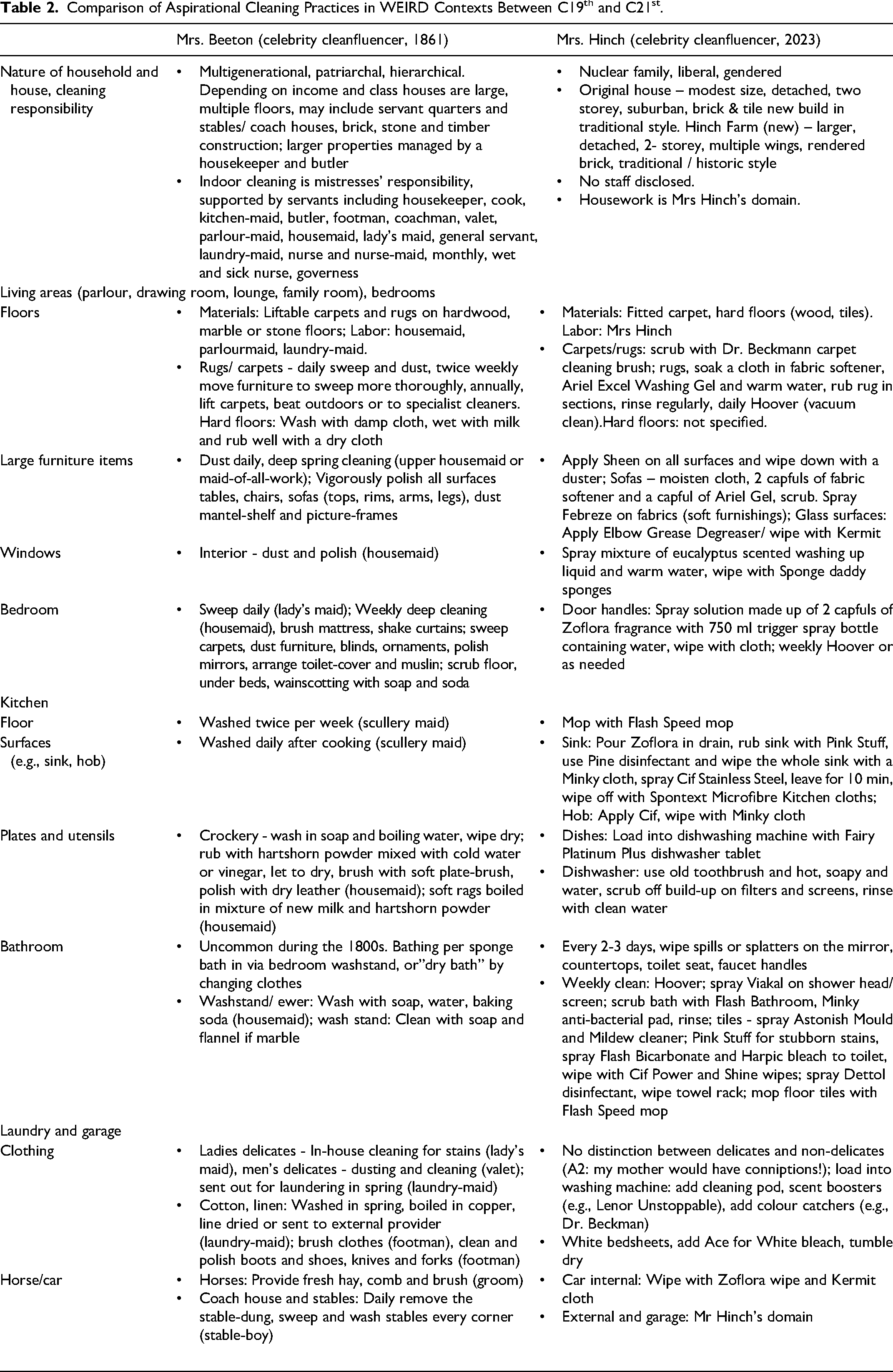
Specifically, we focus on household cleaning; tedious, tiresome, repetitive, and arguably doubly ignored as it is seen as ‘women's work’ in a world dominated by the concerns of men (Perez 2019). While cleaning is unglamorous, it is essential to maintaining hygienic and orderly home. However, accepted practices have changed. In the past, cleaning was a relatively simple (albeit labor intensive) activity, now, more marketized forms require ever greater water, equipment and chemical resources (see Table 2). More intensive cleaning contributes to overconsumption and pollution, and thus to the grand challenges of climate change, water scarcity and biodiversity loss. The question of how much cleaning is too much, however is problematic. Cleaning practices are culturally relative and socially situated. One person's normal is another's excess or insufficiency, even in the same household. To address that issue, we define intensive cleaning as: Unreflexive household maintenance practices incommensurate with the level of threat to health and hygiene in a particular context; resulting in excessive consumption of resources including fresh water, labor (time and energy) and technologies (chemicals and equipment). As we will show, cleaning has evolved from a relatively benign and labor-intensive activity to a damaging, technology-intensive undertaking replete with entrenched routines that are resistant to change despite damage to both people and planet.
Comparison of Aspirational Cleaning Practices in WEIRD Contexts Between C19th and C21st.
In addition to drawing attention to a relatively under-appreciated topic, this research also contributes perspectives from outside the mainstream. In doing so we support critiques of damaging intersectional epistemological hegemonies, including neoliberalism (e.g., Dholakia, Ozgun, and Atik 2020; Huston, Cruz, and Zoppos 2023; Sandıkcı et al. 2016), patriarchy (e.g., Kravets, Preece, and Maclaran 2020; Perez 2019), and Western-centrism (e.g., Jafari 2022; Santos 2018). Despite representing a minority of the world's peoples, Western, Educated, Industrialized, Rich and Democratic (WEIRD) perspectives dominate, perpetuating damaging global power structures (Henrich, Heine, and Norenzayan 2010; Little, Ho and Eti-Tofinga 2023; Wooliscroft and Ko 2023). Such perspectives present unquestioned market-based, neoliberal economic logics, usually derived from extractive, arms-length approaches to data collection - even when seeking to counter damage caused by activities based on those same logics. Policy derived from WEIRD rationalist and objectivist approaches is arguably appropriate or ethical, particularly in non-WEIRD contexts (Domegan et al. 2016; Kennedy and Smith 2022; Moloney and Strengers 2014). For global system stakeholders the danger is twofold. First, damaging but taken-for-granted logics are overlooked when formulating policy decisions, perpetuating current unsustainable social and economic trajectories. Second, policy initiatives drawing on objectivist WEIRD-derived research are likely to be ineffective, particularly in non-WEIRD contexts.
The purpose of this study is therefore to address the ethical, theoretical, practical, and empirical shortcomings of current understandings. We ask: “How do damaging mundane practices form, and how are they perpetuated?” We extend previous macromarketing work on mundane overconsumption behaviors (e.g., Little, et al. 2023; Martin et al. 2019; Westberg, Beverland, and Thomas 2017), by applying a social practice (SPT) lens. In SPT, the practice is the unit of analysis. Individuals are assumed to be unreflexive carriers of social practices; drawing on materials, competencies, and meanings to perform interconnected sets of routines, behaviors, and actions (Reckwitz 2002; Schatzki 2013; Warde 2005). These assumptions explain why practices can be difficult to challenge with simple interventions, as they are deeply embedded in daily routines, and impervious to rational appeals. To provide deeper insight into the nature and conduct of mundane practices in a non-WEIRD context, we conducted a 20-month, critical ethnography in 10 middle-class Malaysian-Chinese households. Building on organization-focused SPT work (e.g., Hargreaves 2011; Weinberger and Lusch 2023), we contribute a consumer and longitudinal dimension. By considering historical approaches to health and hygiene and by drawing on rich, non-WEIRD empirical resources, we contribute a new theorization of overconsumption resistance processes and lock-in mechanisms (Figure 9), highlighting the value of socially situated understandings of problem behaviors. We join a growing number of scholars (e.g., Brennan and Parker 2014; Kennedy and Smith 2022; Rundle-Thiele et al. 2019), calling for situated, pragmatic and ethical research to guide better policy.
The paper continues by considering current perspectives of behavior change, arguing for SPT as a ‘practicable’ means of supporting more ethical and effective policy. Next, we trace the evolution of cleaning practices, to provide historical context. After discussing our methodology, we present our findings according to SPT elements of meanings, competences, and materials; concluding with the native ethnographer's interpretation of these cleaning practices as overconsumption. The discussion considers the findings with respect to current knowledge, prior to considering the implications for theory, for policy and future research.
Challenging Damaging Behaviors: A View of Social Practice Theory
The macro-social and social marketing literatures offer valuable perspectives on damaging behaviors. Behaviors can damage both consumers through for example cigarette smoking (Almestahiri et al. 2017) and unhealthy lifestyles (Conroy, Smith, and Frethey-Bentham 2018), and the environment through for example plastic bag pollution (Little, Lee, and Nair 2019), and fire setting (Peattie, Peattie, and Newcombe 2016)). Historically, policy decisions have been based on studies assuming rationalist, individualist logic (Brennan and Parker 2014; Kennedy and Smith 2022; Rundle-Thiele et al. 2019). However, humans are far from rational, utility-maximizing homo economici, hyperaware of our actions and independent of our social milieus. Rather, we are socialized into deeply ingrained patterns of behavior which soothe and reassure, providing a sense of ontological security (Phipps and Ozanne 2017; Wood, Quinn, and Kashy 2002). We unconsciously and unreflexively reproduce consumption acts, meaning our daily routines are deeply embedded and dearly held, resisting ‘quick fix’ interventions (Hastings 2003; Warde 2005; Welch 2016). Thus, far from free agents, consumers are captive in a socio-technical web; complicit in enacting and co-constituting institutions and structures. Among other things, interventions must interrupt states of “absorbed coping”, jolting actors from unconscious immersion in daily life (Sandberg and Tsoukas 2011). We should therefore not be surprised that policy interventions based on individualist, rationalist logic have had limited impact, and that macromarketing scholars are calling for socially situated behavior change research (Domegan et al. 2016; Kennedy 2016; Moloney and Strengers 2014).
To calibrate the potential contribution of the SPT perspective, we compare and contrast it with rationalist-individualist and marketing systems approaches (Table 1).
Dominant Approaches to Understanding Behavior Change.
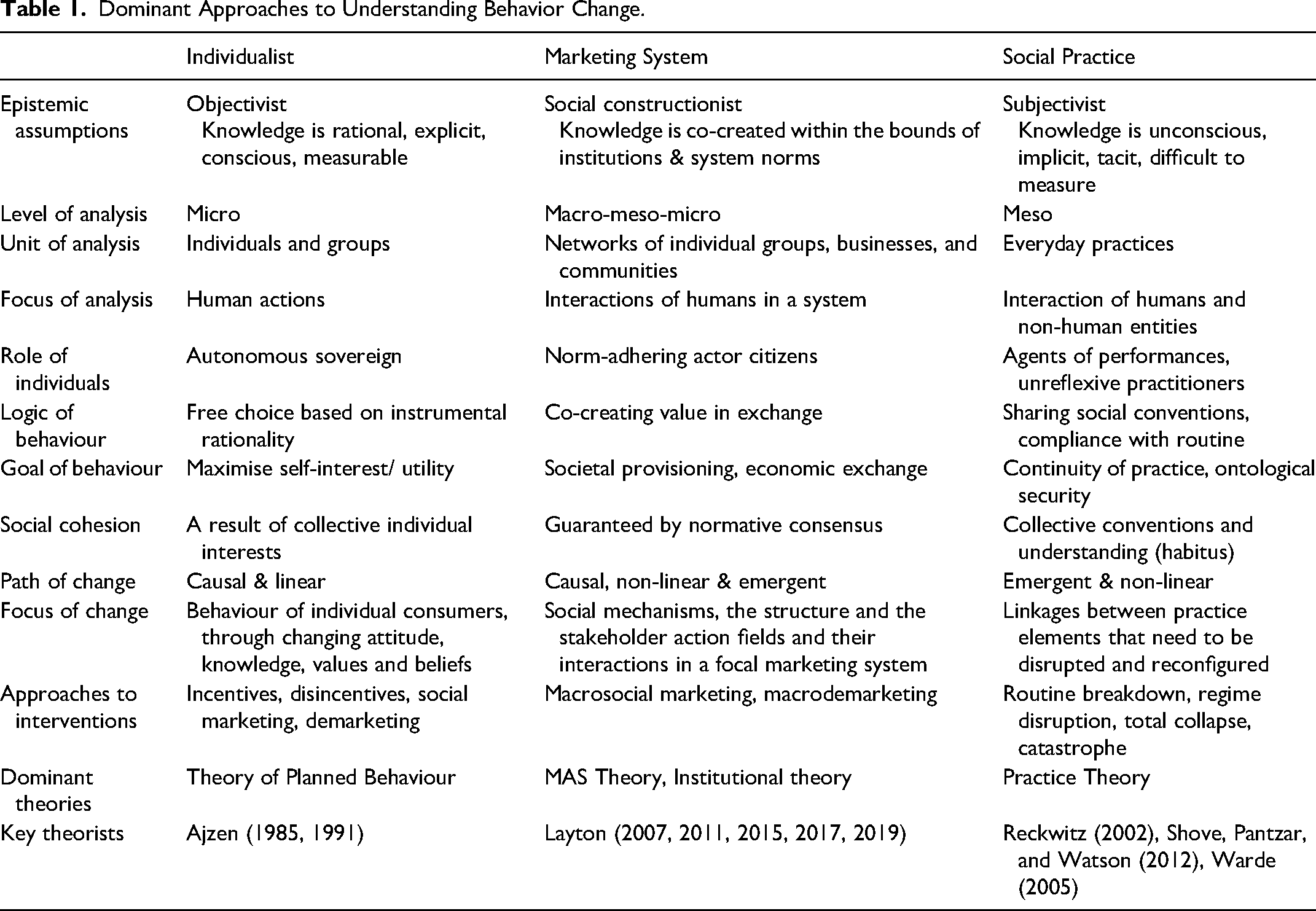
SPT's roots in sociology rest on the notion of emergence, holding that complex social orders and patterns form organically; evolving in messy arrangements that can defy causal logic and thus rationalist explanations of behavior change (Sawyer 2005). Like marketing systems approaches, SPT takes a broad problem focus, emphasizing system entities and their relationships (Reckwitz 2002; Schatzki 2013; Spaargaren 2011; Warde 2005). However, the unit of analysis is practices, rather than the wider system or particular system actors. STP also explicitly encompasses both human and non-human actors (e.g., bacteria and viruses) as well as contextual and temporal factors (e.g., collective conventions, weather and historical incidents). SPT therefore offers a nuanced perspective commensurate with wicked problems such as overconsumption, and hence the potential to support development of remedies to damaging behaviors. However, while well-established in innovation and sociology, SPT has not yet permeated the traditional marketing literature. In macromarketing, with a few exceptions (Little, Lee, and Nair 2019; Martin et al. 2019; Westberg, Beverland, and Thomas 2017), practice perspectives have not been applied to behavioral change, perhaps because it is viewed as ‘impracticable’ (Sahakian and Wilhite 2014; Welch 2016). In this study we challenge the idea of ‘impracticability’; we unpack practice elements, and consider how policy makers might use those insights to inform pro-social change.
Three practice elements require unpacking to appreciate their nature and interaction: Materials, competences, and meanings (Shove, Pantzar, and Watson 2012). The elements are interlinked, and break, form and re-form as behaviors or neighboring practices change, usually in more resource-intensive directions (Moloney and Strengers 2014; Shove 2003; Warde 2005). In a context of increasing affluence consumers will not compromise on norms of comfort, convenience and cleanliness (Hollander and Einwohner 2004; Shove 2003). Therefore, left unchecked, overconsumption ratchets up. With respect to cleaning, for example, maintaining kitchen hygiene requires practitioners to integrate equipment and chemicals (materials), domestic skills (competences), and socially constructed cleanliness norms (meanings). All three elements are exogenously influenced by institutions: socio-cognitive (a clean kitchen connotes control (Douglas 1966); regulatory (the markets and technological innovation behind cleaning products) and normative (what ‘clean’ looks like, who should clean, and how intensely (Casey and Littler 2022)) (see Table 2). While institutional approaches emphasize norms and rules, SPT emphasizes norms and facilitating resources (material and skills-based) of unreflexive and habitual behaviors. A SPT view assumes humans are embedded in a socio-technical web, unreflexively enacting and co-constituting institutions and structures, and spontaneously adapting to developing situations (Sandberg and Tsoukas 2011; Shove 2003). To interrupt damaging practices such as those driving overconsumption, accepted routines and states of absorbed coping must be disrupted, a non-trivial and likely unwelcome undertaking, discussed next.
In addition to ratcheting up, consumption practices are locked in through taken-for-granted daily routines, and embeddedness in the invisible strands of the socio-technical web. Therefore, rational, objectivist interventions are unlikely to be unsuccessful (Gonzalez-Arcos et al. 2021; Hollander and Einwohner 2004). Consumers deploy two forms of pushback against systems interventions: resistance and reactance. Resistance is systemic, organized, anti-establishment and ideological (Gonzalez-Arcos et al. 2021; Little, Lee, and Nair 2019; Roux and Izberk-Bilgin 2018); e.g., the anti-vax movement, or climate change denial. Reactance, on the other hand, is manifested in acts and protests against perceived affronts to individual agency (Brehm and Brehm 2013) e.g., vaccine hesitance, refusal to relinquish plastic bags. Both undermine sustainability interventions through conscious or unconscious preference for ontological security over community wellbeing, rejection of personal responsibility and aversion to perceived loss (Little, Lee, and Nair 2019). Both resistance and reactance can damage both individuals and society (Roux and Izberk-Bilgin 2018). Therefore, the potential for pushback should be incorporated into policy design for interventions aimed at behavior change. To illustrate how practices ratchet up and become locked in, and to provide context for this study, we discuss how cleaning practices have evolved across time.
A Brief History of Cleaning
Notions of ‘dirty’, ‘clean’, and the practices that accompany them, are socially situated and culturally relative; with meanings and aspirations evolving across time, culture, class, and individuals. While Ancient Greeks and Romans associated cleanliness with well-being, later Christian asceticism deemed body care spiritually harmful (Smith 2007). In Medieval Europe, hygiene was for elites, until germ theory emerged in the 1880s. Urbanization and modern infrastructure made cleanliness more achievable post-1900, connoting modernity, respect, and social mobility (Berner 1998). In Asia, cleanliness and contamination has long been associated with social class, e.g., Indian castes (Rachman 2004). More recently, global generational differences are emerging. Elders economize, while the young are more liberal with water and chemicals, or outsource cleaning services (Berner 1998; Ger et al. 1999). To illustrate the ways in which these temporal and cultural changes are reflected in cleaning practices, we compare and contrast two British ‘cleanfluencers’ Mrs. Beeton (Beeton 1888) and Mrs. Hinch (Casey and Littler 2022) (Table 2).
The two examples highlight the influence of class and culture (i.e., meanings). In pre-modernity, Mrs. Beeton's advice was directed to wealthy members of the middle and upper classes, mistresses of large estates, and contained in a weighty text. In modern times, Mrs. Hinch, a charismatic ex-hairdresser from Essex, beams working class sensibilities and neoliberal upward mobility to nearly five million (mostly) women followers in nuclear households via social media (Casey and Littler 2022). Both women offer a window into state-of-the-art cleaning practices relevant to their eras.
Drawing on this example, cleaning trajectories can be mapped over time and across the three social practice elements (Figure 1).
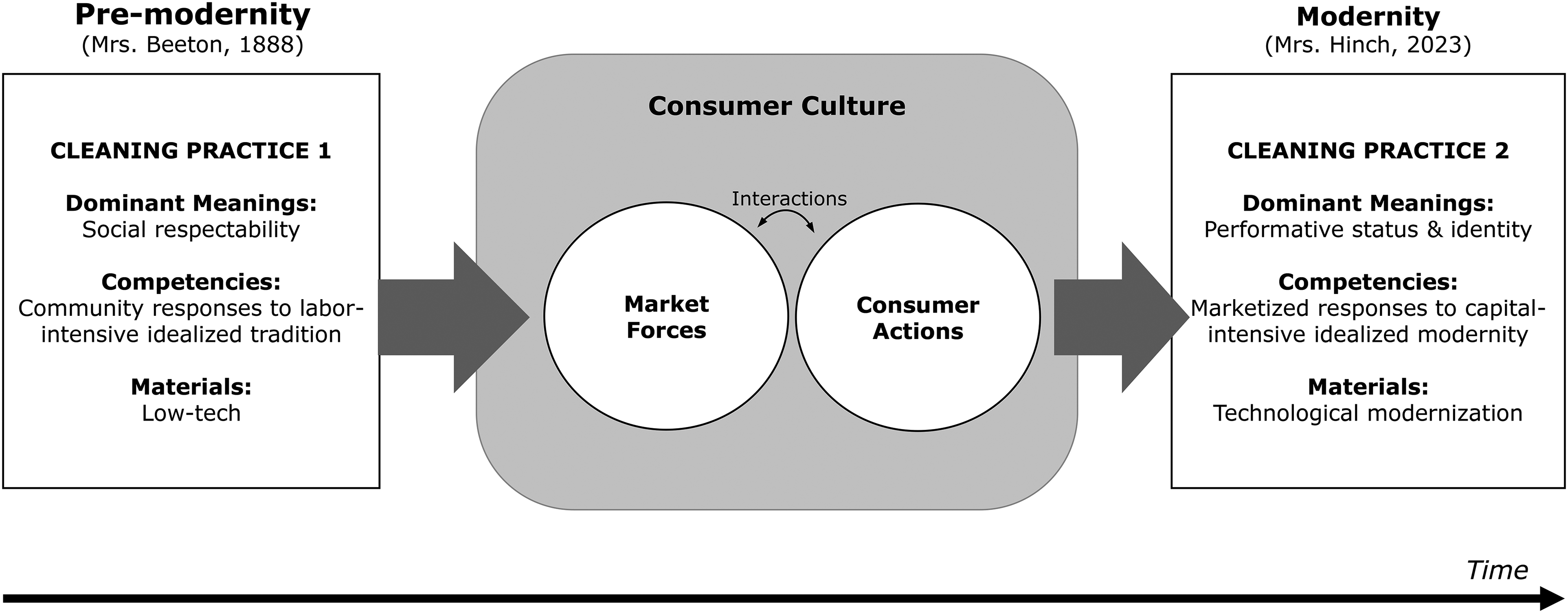
Evolving practices in WEIRD contexts – effects of cultural discourses and consumer actions.
Practice elements have changed appreciably. Meanings have transformed, from a collective focus on community acceptance, to a narrower focus on individual identity, linked to performative entrepreneurialism (Casey and Littler 2022). Technologies (cleaning products and machines) have substituted for labor (household servants). The locus of attention has changed – public gathering spaces for Mrs. Beeton (drawing room), and private family spaces (bathroom and kitchen) for Mrs. Hinch. While the women are separated by class and time, some things have not changed e.g., gendered separation of labor with men in the stables or garage, and women in the house. However, profound change is reflected in women's relative economic and cultural freedom, and the intrusion of capital into domestic spaces. The public is invited into Mrs. Hinch's kitchen and bathroom, enabling her to monetize her advice through sponsorship and viewership payments (Casey and Littler 2022). Mrs. Beeton would be appalled. Similarly, we see the effects of rising standards of living and widespread communication technologies in changing consumer ideals (Shove 2003). Overall, meanings, competencies, and technologies have evolved across time, co-constituted by market discourses, consumer norms, and action. To explore those ideas further, we proceed with an account of cleaning practices in Malaysia.
Method
Critical Ethnography and Confessional Writing
Mundane practices such as cleaning are dynamic, socially situated, habitual, and unreflexive. Therefore, they are likely to be difficult for practitioners to articulate, and potentially sensitive. Recognizing these attributes, we adopted a critical ethnographic design. Ethnography supported us in decoding complex social conventions, worldviews, and culture; in situ (Southerton, Warde, and Hand 2004). We could observe actual behaviors over time, mitigating social desirability effects (Burgess, Limb, and Harrison 1988; Soon et al. 2013). Additionally, we could focus on cleaning practices as the unit of analysis, allowing us to capture the nuances of a complex, situated process with multiple participants (Shove 2003; Southerton, Warde, and Hand 2004). Finally, we could visit and revisit the field over time, enabling us to capture dynamic change in both practitioners and context (Rundle-Thiele et al. 2019).
The research adopted a poststructuralist confessional approach, through a native ethnographer. Ethnography allows for authentic representation of practitioner and researcher voices, acknowledging that practitioners may not be able to articulate (or recognize, in the case of routine behaviors) their actions (Clifford and Marcus 1986; Schultze 2000; Van Maanen 2011). As a native ethnographer, the first author (the narrative eye/“I”) undertook reflexive, prolonged immersion to grasp subtle patterns, unwritten rules, and taken-for-granted assumptions (Atkinson and Hammersley 1994; Grills 1998; Myers 2013). Her actions, feelings, and experiences contributed to sense-making, as a cultural insider engaging in co-constructing meaning with informants. The fieldwork drew on three logics: Syncretic introspection (Bochner and Ellis 2016; Holbrook 2005; McGouran and Prothero 2016), embodied experiences (Canniford, Riach, and Hill 2018; Pink 2009), and on creativity, authenticity, and criticality in “dangerous writing” (Badley 2020; Sword 2011; Yoo 2019); bringing a (young) female and non-WEIRD voice that is under-represented in the sustainability discourse. The account proceeds in the first person, reflecting that positionality.
The reader should know that “I” am a well-educated, middle-class Malaysian Chinese female in my 30 s, and an intensive (perhaps even obsessive) cleaner. I grew up in a culturally diverse metropolis and completed my higher degrees in English. I speak English (and several Chinese dialects as well as Malay) fluently, and I consume popular Western culture. I acknowledge my initial “prejudice” (Arnold and Fischer 1994): I wanted to change Malaysian Chinese household cleaning practices in favor of more sustainable forms (and to use less water in particular). I gained acceptance in those households by leveraging my cultural insider identity (Riemer 1977; Wallendorf and Brucks 1993). Leveraging bei fen (辈分, Mandarin: social seniority through family ties) in building relationships, I assumed the role of niece/apprentice learning from experts (“aunties”). I invited an Ang Mo (Hokkien: white people), the second author, who knows Malaysia intimately, to culturally bridge between East and WEIRD West. This study therefore is informed by, but not bound to Western-centric consumer theory (Wooliscroft 2021).
Field Selection
Field selection was motivated by my mom's (apologies, ma!) overuse of then-rationed water in our home in Kuala Lumpur (KL), Malaysia. KL is home to seven of a total 32 million people (Department of Statistics 2022). Rapid economic development has produced growing middle classes, straining urban infrastructure and natural resources (Kahn 2013). Malaysia is multicultural and Westernized. Malaysian Chinese, at 23% the largest minority, originated in China's southern coastal provinces (Department of Statistics 2022). Chinese dialects and Confucian household values such as filial piety and thrift remain integral to the culture (Lee and Tan 2000; Wang 1994). In cleaning alone, Malaysians consume 333,000 tonnes annually of bleach, dishwashing, laundry care, and toilet care products (Euromonitor International 2020). Malaysians are also prodigious users of water, drinking, sluicing and rinsing with 245 liters of water per capita per day, nearly twice the recommended amount of 165 liters (United Nations 2020).
Fieldwork and Data Collection
Fieldwork was conducted from October 2017—June 2019. I selected multi-generational families (common in Malaysia) with at least two adult generations either residing or visiting weekly so that I could trace longitudinal practice trajectories. I recruited 10 such families (Table 3) in Greater Kuala Lumpur.
Demographic Details of Families and Fieldwork Details.
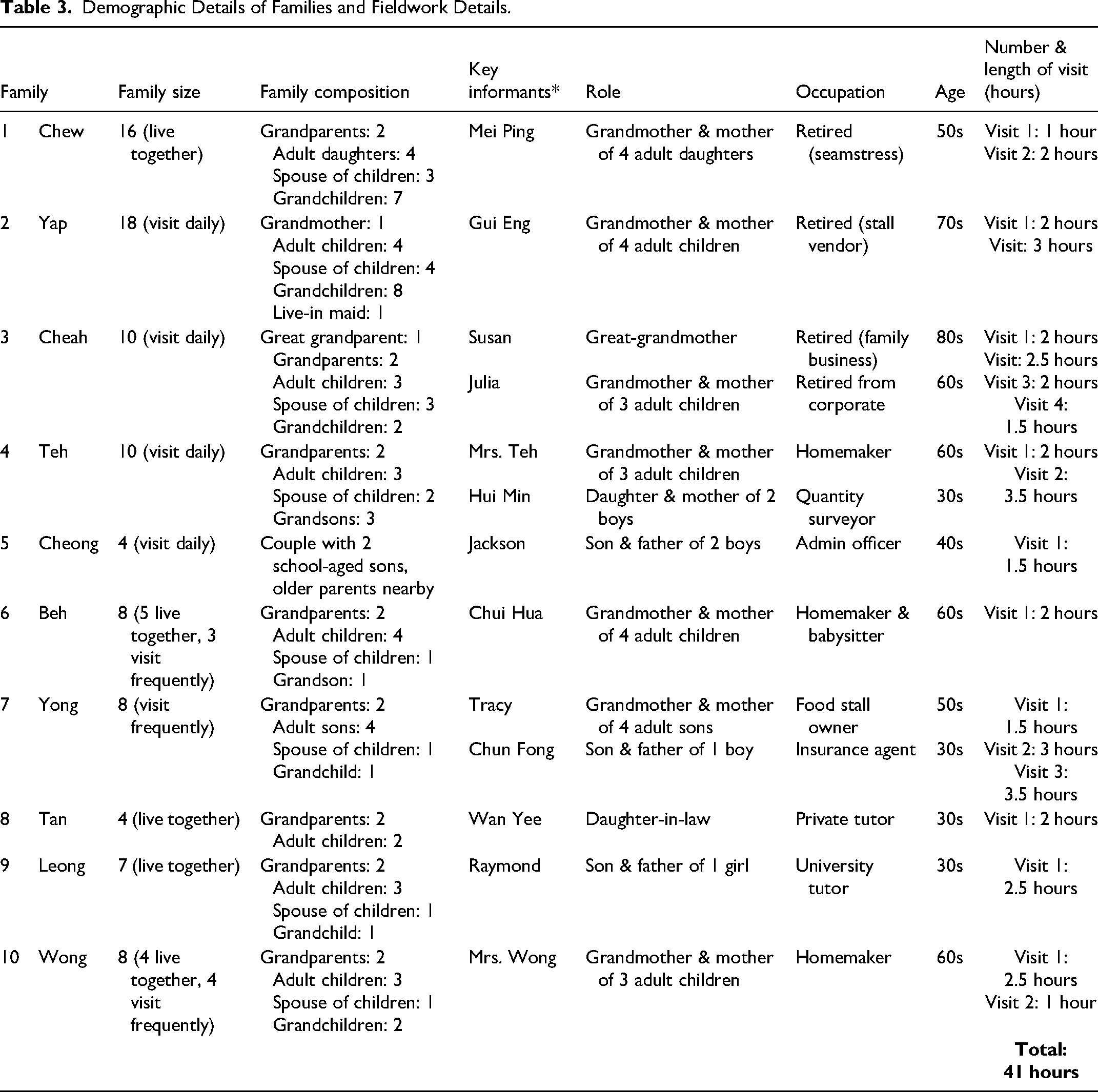
Each family had at least one key informant (13 total, 10 females and 3 males), typically mothers or grandmothers. All the female informants except Hui Min and Wan Yee were retired or full-time homemakers. I spent weeks with one or two families at a time, writing extensive field diaries, memos, and transcribing reflections.
I visited most of the families at least twice (see Figure 2). My own family (Figure 2 - flag #1) influenced my perspectives and interpretations, as it is where I learned cleaning skills and was socialized.
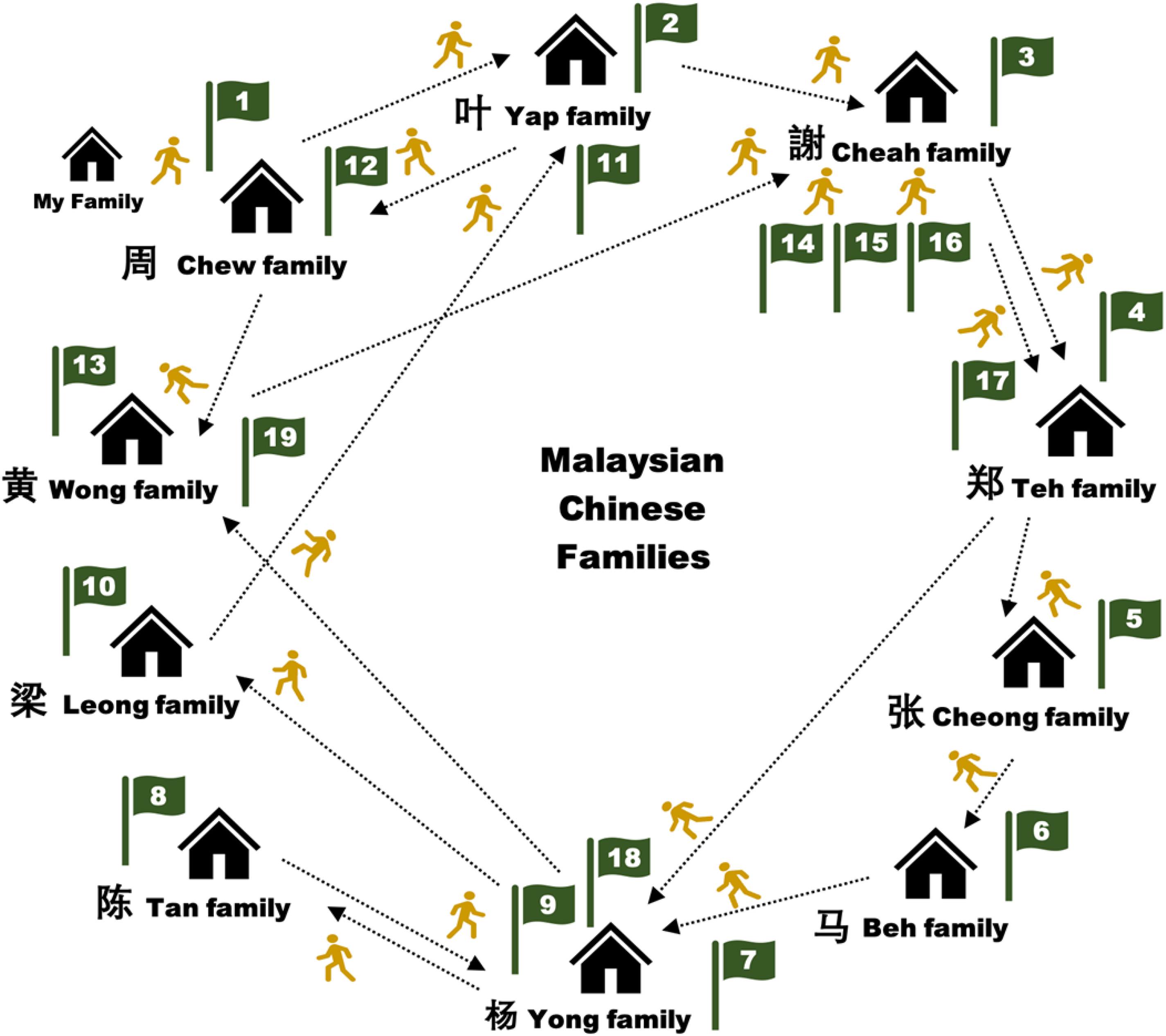
Fieldwork in Malaysia Chinese families.
Initial interviews with key informants provided background, family details, and household routines. House tours provided insights into layouts and equipment usage. I noted sensory experiences—lighting, airflow, temperature, smell—to fully immerse in their daily life (Canniford, Riach, and Hill 2018; Valtonen, Markuksela, and Moisander 2010). Subsequent visits included me in preparations for family gatherings; firsthand learning and deeper sharing. I shadowed, observed, clarified; and occasionally passed the salt. My voice recorder captured conversations. Photographs became visual aids for writing. The ethnographic database totals 6GB, excluding handwritten notes (Table 4).
Details of Data Collected.
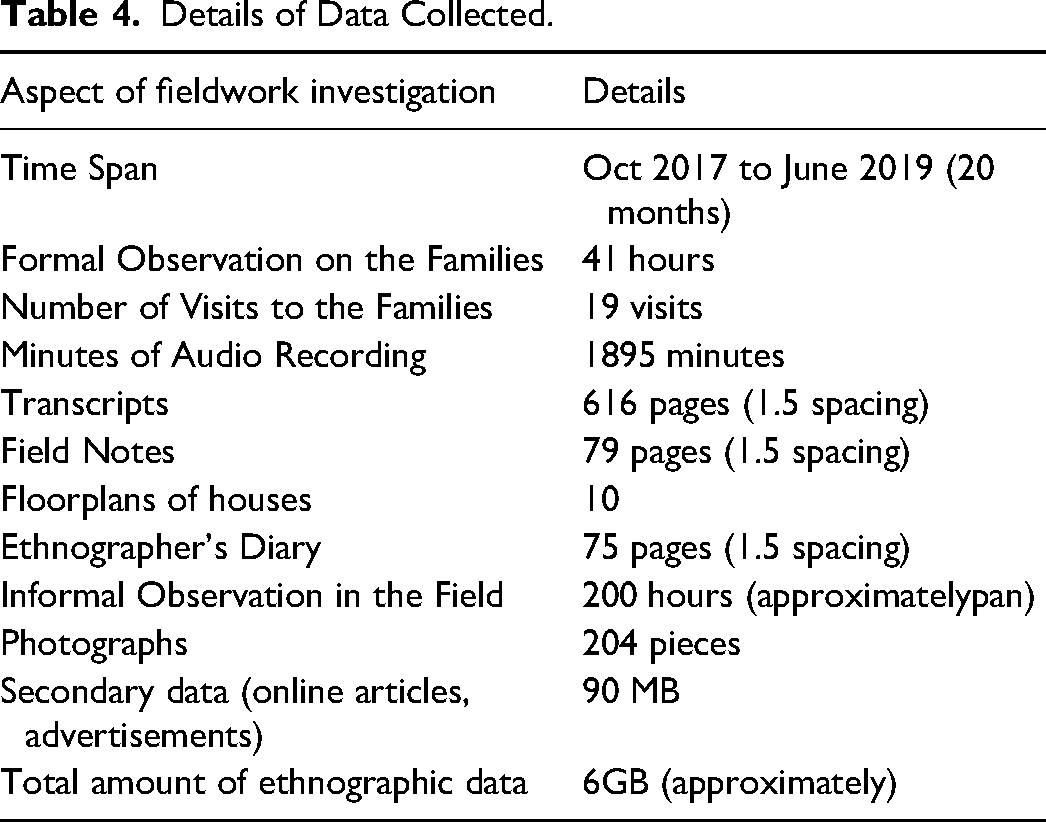
At first, I naïvely planned to clean alongside the families so that I could observe first hand, and ask questions as the action proceeded (Arnould and Wallendorf 1994; Atkinson and Hammersley 1994). However, I remembered my mother redoing others’ cleaning and realized that as a guest, I could not interfere. Therefore, I deepened my observation and reflexive introspection. Fieldwork ended when I reached data and theoretical saturation after 41 h of direct contact and 300 h of informal observation. Curiosity had decreased, conversations grew repetitive (O’Reilly and Parker 2013) and additional contact was unlikely to alter my interpretation (Esterberg 2002; Myers 2013).
Making Sense of the Data: Hermeneutics, Stages of Interpretation
Sensemaking was a major challenge. My native ethnographer positionality was compounded by cleaning's mundanity; everything I heard and observed seemed deeply unremarkable. Constant emic/etic perspective shifts were needed. I therefore reevaluated the location of meanings and adopted an iterative hermeneutic approach (Moisander and Valtonen 2006). Crucially for SPT, hermeneutic interpretation replaces individual meaning-making to focus on language and discourses, as shaping experience (Gadamer 2004). Adopting a logic of text production, my analysis explored meanings informants attributed to their actions, experiences, contested ideas, and taken-for-granted beliefs (Arnold and Fischer 1994; Thompson, Pollio, and Locander 1994).
I interpreted data part-to-whole in two stages. First, I open-coded the 616 pages of interview transcripts to form provisional understandings. My “funneling” (Hammersley and Atkinson 2007) identified topics for follow-up visits. However, the data was fragmented and lacked context. Moreover, informants struggled to articulate their thoughts. I therefore broadened my interpretive frame to secondary sources. I analyzed newspaper articles and wording, tones, colors, and content of advertisements. Additionally, I heightened my observations in public spaces including restaurants and malls. My memos triangulated informant insights, background information and my own socio-cultural understanding, continuously comparing and refining (Saldaña 2016). In the second stage, I revisited the transcripts, created detailed coding mind maps for the families (see Appendix 2), and refined emerging frameworks by comparing within and between families (the parts) and the full textual data (the whole) until I had exhausted potential modifications.
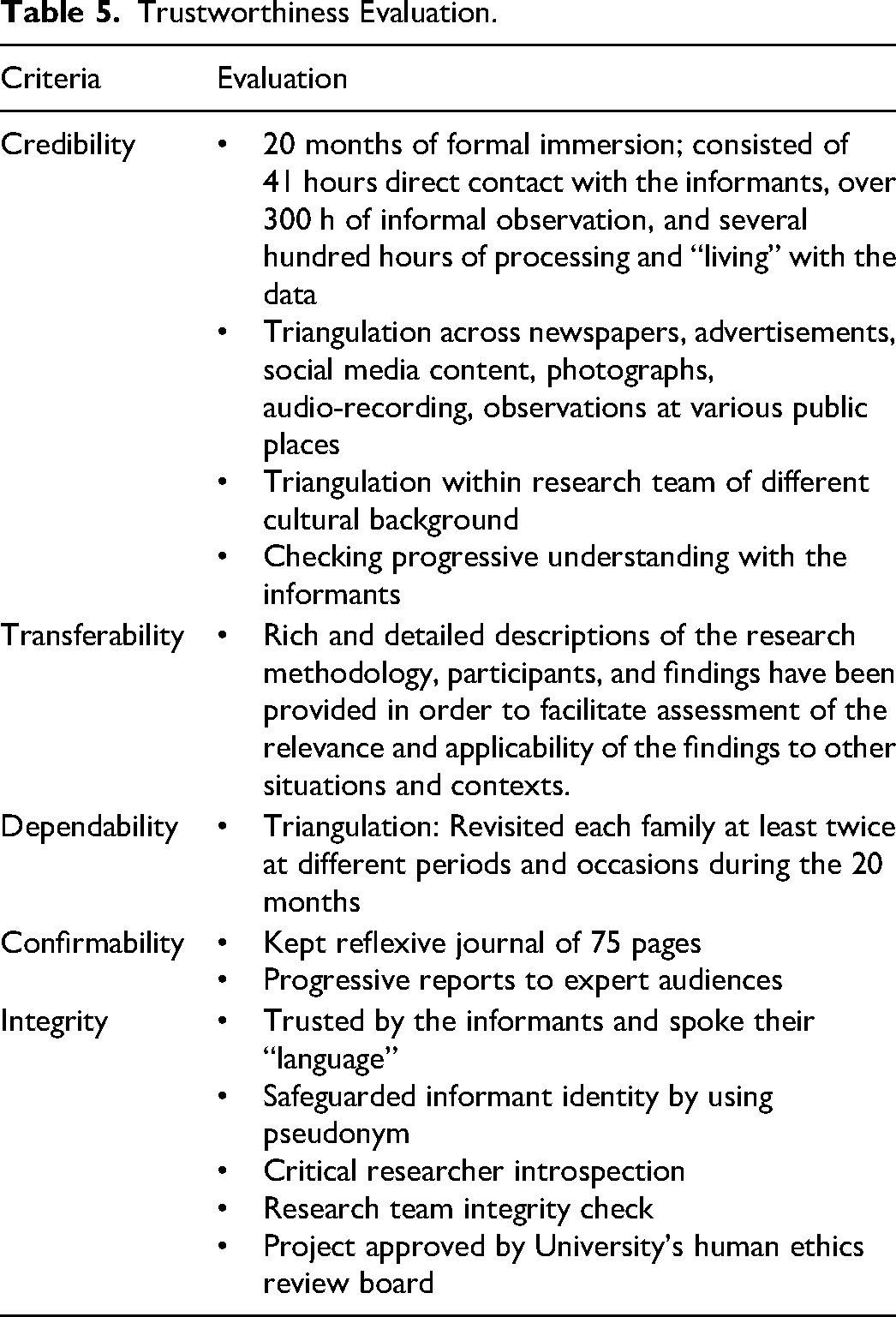
In Table 5, I assess this project against the Wallendorf and Belk 1989 trustworthiness criteria.
Trustworthiness Evaluation.
Findings
Evolving Practices in a Dangerous World
Welcome to the world of intensive cleaning! Most families, or their designated family members, spent hours cleaning weekly or even daily (Table 6).
Cleaning Routines by Location, Type, and Frequency.
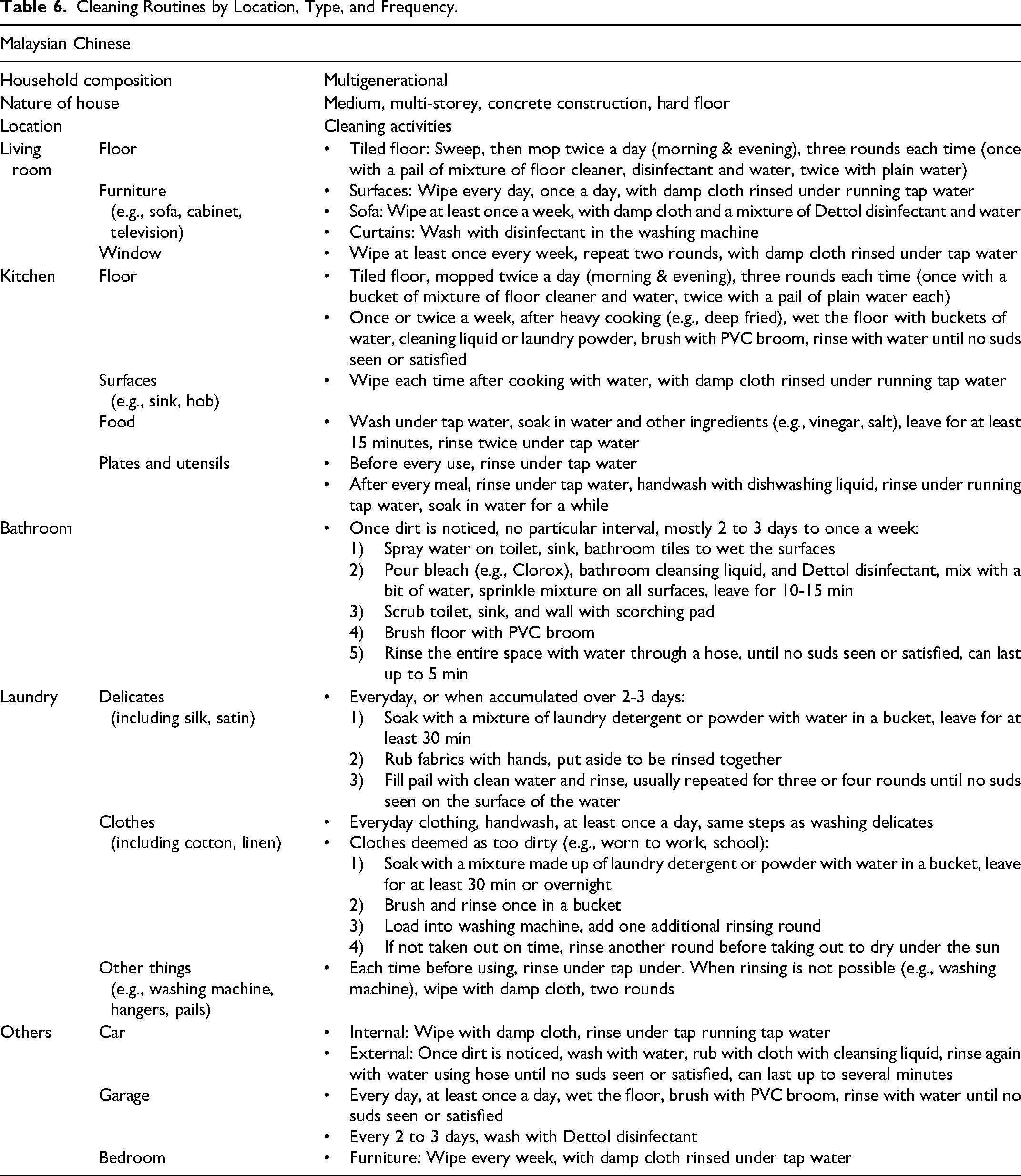
While no one family practiced all the routine elements all the time, and likewise, no one routine was practiced with the same frequency by all the families; all families engaged in most routines to about the same extent. For most families, a typical day featured sweeping, wiping, washing, rinsing, and scrubbing; beginning and ending by mopping the floor, once with detergent, then two rinses (details in Appendix 3). Cooking was similarly intensive (see opening vignette). Julia's (Cheah family) efforts to keep her family safe resulted in prodigious efforts (see Figure 3):
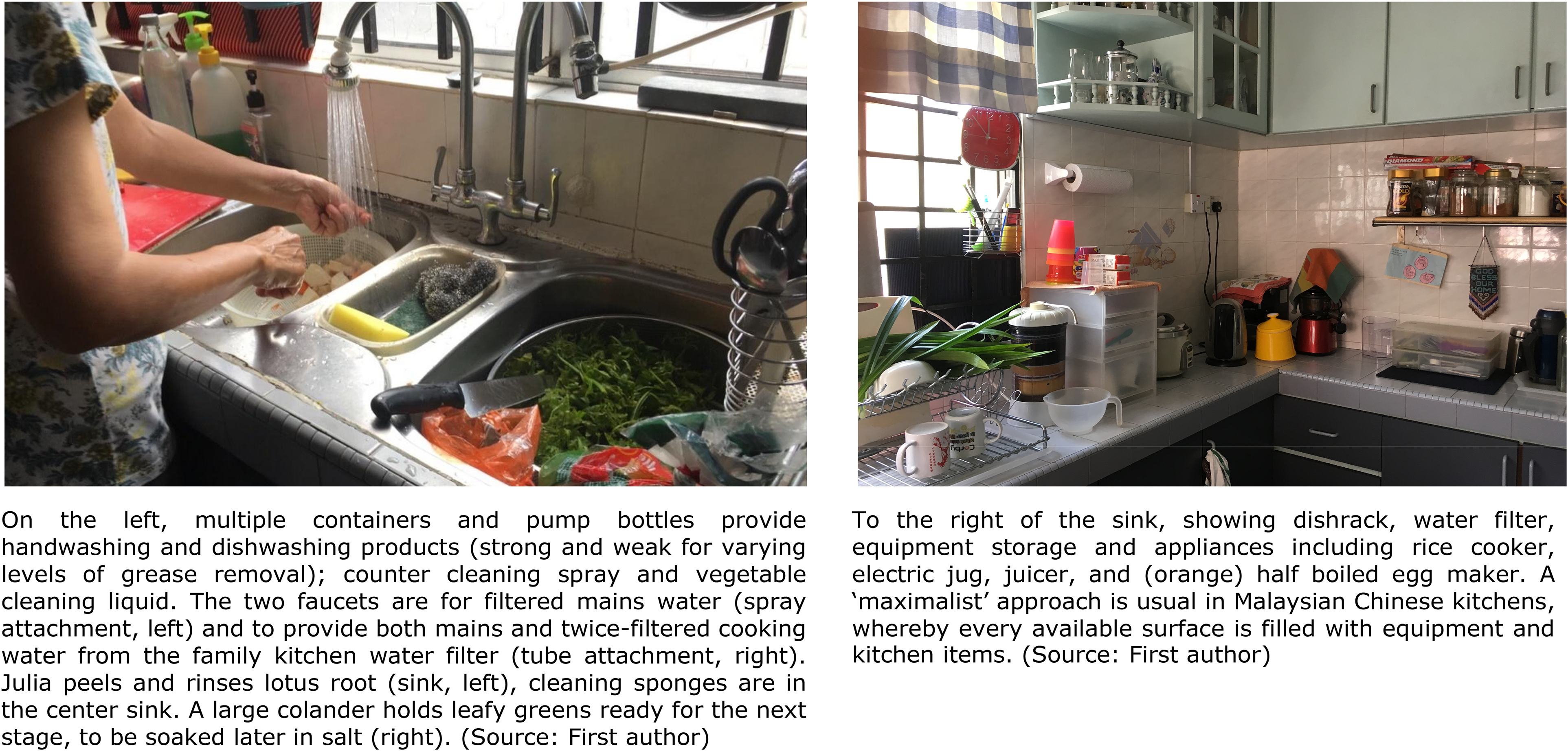
In Julia's kitchen.
I was curious, “why do people clean so much?” In her kitchen, Julia recounted childhood experiences doing the family wash with her mother in an abandoned tin mining pool, heedless of toxins “…we just washed there and took back. Whether we wash [again] with the well water once more, I don’t think so.” Yet, when pressed, she changed stance: “don’t you think [everything is] very polluted these days? Last time water cleaner than now…mining pool water was very clean you know.” Her views were echoed by Gui Eng (70 s, Yap family) and Mrs. Wong (60 s, Wong family). They were nostalgic for a safer past, and feeling threatened by modern city life.
Three intersecting, sometimes contradicting themes emerged from the conversations, observations, secondary data, and from my own memories and reflections. The three correspond broadly to the elements of SPT: prolonged disease outbreaks (meanings), social modernization (competences), and infrastructure modernization (materials).
Prolonged Disease Outbreaks: Death and Fear (Meanings)
Intensive cleaning was driven more by fear of disease (external threats), and less by social aspirations. Their motivations could be explained through examination of Malaysia's public health record (Figure 4).
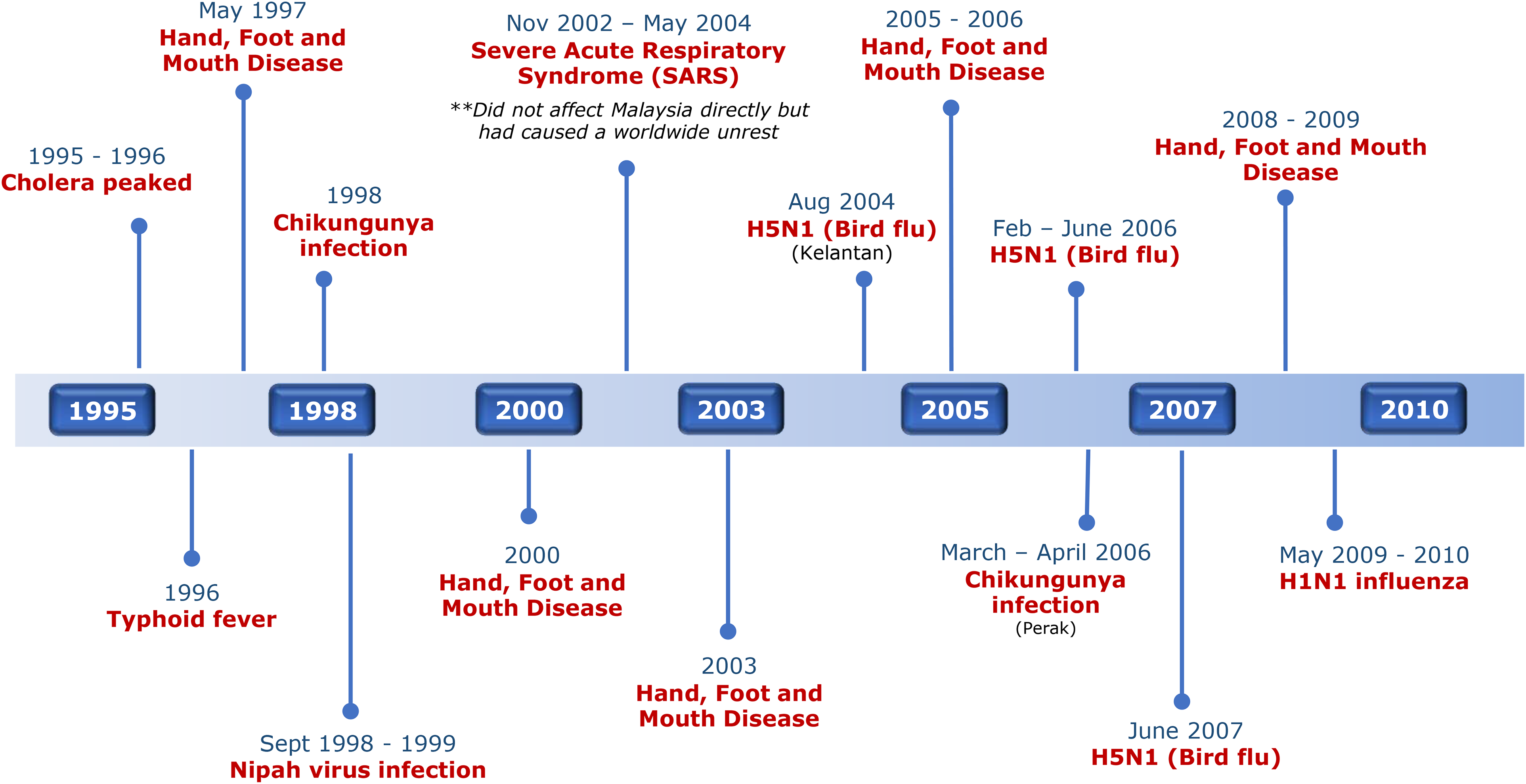
Major disease outbreaks in Malaysia from 1995 to 2010.
The region has a turbulent history of disease and violent racism (e.g., the 1969 KL race riots and 1998 Indonesian riots), feeding underlying unease and cultural tropes of kiasi (Hokkien: afraid of dying) and kiasu (afraid of losing) in the Malaysian Chinese community. Deadly diseases are in living memory, and shared through stories by parents and grandparents. In British Malaya, colonists battled tropical diseases, including malaria, dengue, hookworm, venereal disease, tuberculosis, beriberi and cholera (Parmer 1989). In the late C20th, health awareness was integral to school curriculums. Visiting nurses taught children about personal hygiene and disease prevention. Even today, tuberculosis, typhoid, and cholera still occur (Ministry of Health Malaysia 2016). 1995—2010 when I was growing up was particularly perilous, with cholera, typhoid, hand, foot and mouth disease (HFMD), Japanese Encephalitis (JE), Chikungunya virus, Severe Acute Respiratory Syndrome (SARS); H5N1 (“bird flu”) and H1N1 (“swine flu”). I vividly recall not being allowed to play with other children, and painful vaccinations. People were dying, and daily life was severely disrupted. H5N1 necessitated culling of tens of thousands of birds, a national health emergency, and closure of schools (Disease Control Division 2013). Every day, news headlines reminded us of life-threatening danger, to wear masks, wash thoroughly, and not drink tap water (The Star 2009; United Press International 1996; Wong and Loh 2003). Those were dark days. However, after 2010, improved sanitation practices and public health initiatives rendered outbreaks infrequent and relatively minor. Until Covid-19 in 2020, after this study.
Like droughts (Phipps and Ozanne 2017) and war (Stigzelius et al. 2018), serial disease outbreaks threaten our sense of ontological security. For the families, cleanliness meant survival, and protection from invisible enemies.
Gui Eng is referencing the problems arising from modern, industrial food production. The families decontaminated their fruit and vegetables by using home-made remedies (salt, white vinegar, charcoal cubes, home-made enzymes), and commercial products (e.g., Safeguard and Bacoff) (Figure 5).
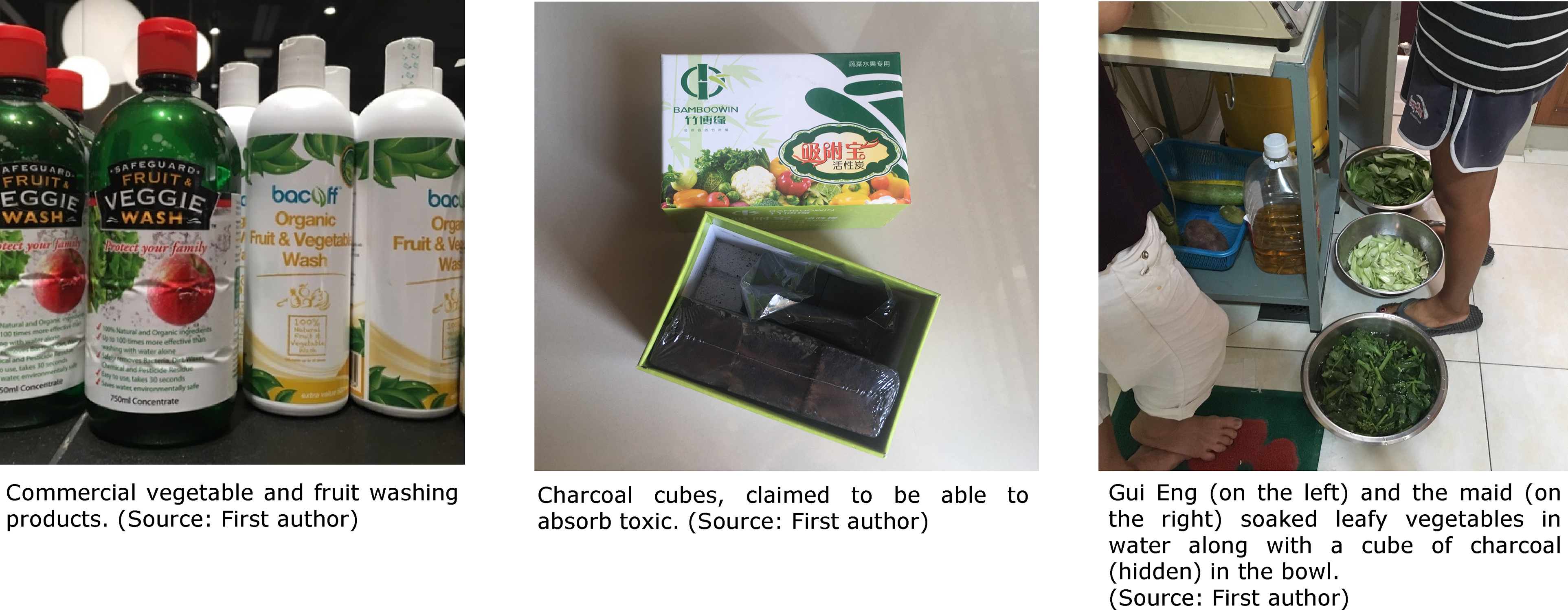
Cleaning ingredients for food.
The families soaked their vegetables in these solutions. For Gui Eng, the danger was omnipresent. She warned me, “the air these days can never be the same as the past. The dust is so toxic…High chances germs will be flying in the air”. Modern toxins imperiled her family through air, food, water, pets and people. Her only defense was thorough cleaning. For the families, in their lifetimes, meanings ascribed to modern “progress” changed. In Gui Eng's childhood, kampung (Malay: village) life was objectively less clean. Chickens and goats roamed freely. They drew water from wells or tin mine lakes, with a strong likelihood of contamination. While the young recognized the dangers of the past and felt the present was safer, the old were nostalgic for simpler times and fearful of new, unknown menaces.
Social Modernization (Doings)
This second overarching force has indirect bearing on consumer skills and competencies. The Malaysian government aims for economic development on par with the West, albeit with less focus on democracy. Wawasan 2020 (Malay: Vision 2020), announced a series of social and economic strategies designed to achieve aspirational standards of living (Prime Minister's Office of Malaysia 1991). Not surprisingly, in Malaysia's tightly controlled media, reportage focuses on advanced living standards, modern medicine, and infrastructure investments. Such reports implicitly signal “Malaysians are competent, skilled and successful: we deserve respect in the modern world”. However, Malaysia continues to struggle with the historical weight of poverty, political instability, low skills, and tropical disease burden. Well before COVID-19, messages about aspirational modernity were juxtaposed with repetitive and graphic public health fear appeals linking viruses and bacteria to everyday activities. Common tropes featured ferocious-looking germs in neon colors; foot soldiers in military-style home invasions of laundries, kitchens, and bathrooms. Weaponized branded products would help us (and particularly women) to fight back. Cleaning products have proliferated as marketers target perceptions as well as reality in the struggle to appear modern. Gui Eng (70 s, Yap family) named her favorite cleaning products with no hesitation: Clorox bleach, Ajax anti-bacterial floor cleaner, and Dettol disinfectant (Figure 6).
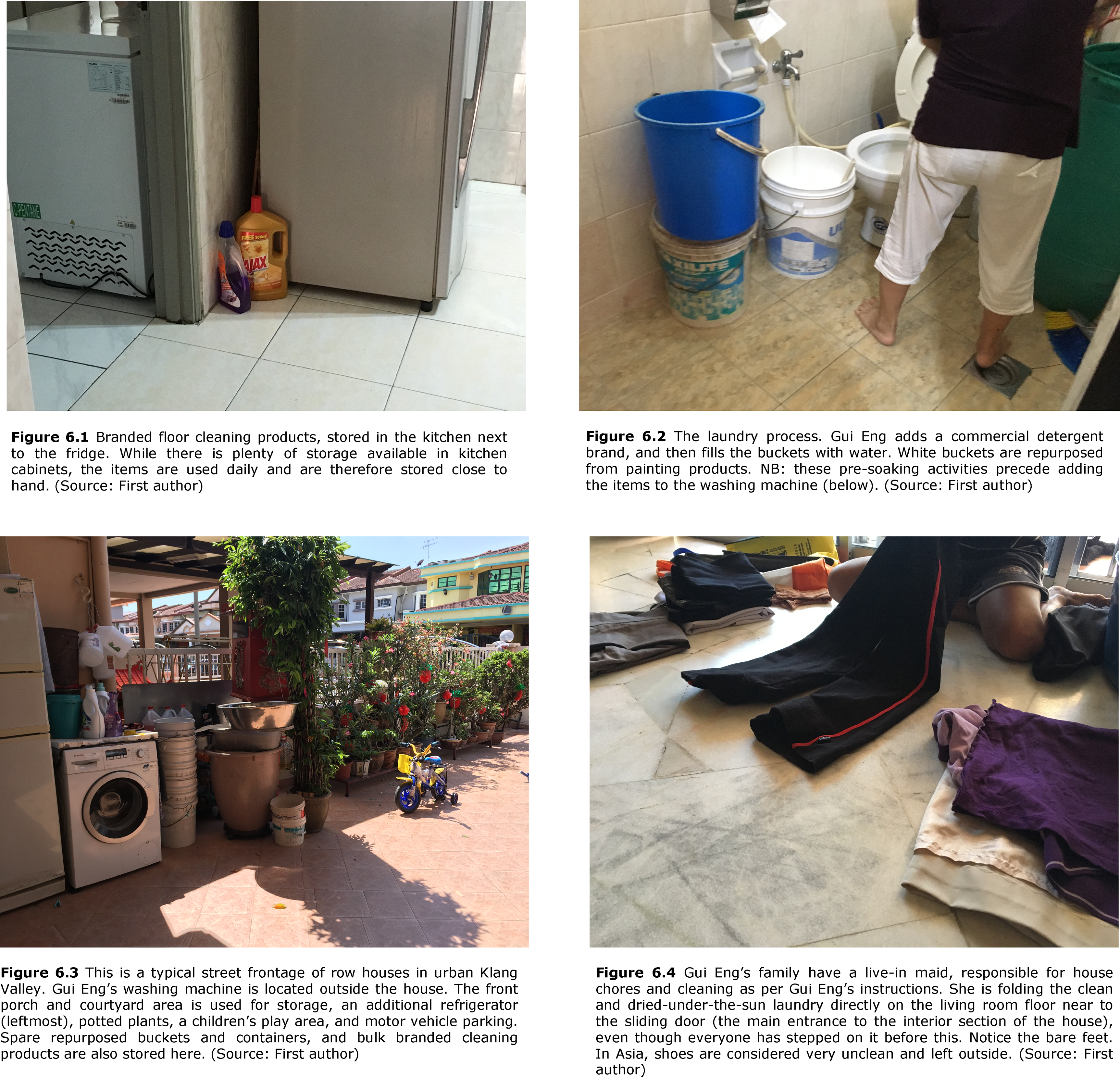
Gui Eng's laundry routines, and location of her detergents and cleaning tools.
As a grandmother of eight, Gui Eng was determined to protect her family. The shared multi-generational family home (children, parents, grandparents) features the ceramic tile surfaces typical of the Malaysian Chinese middle classes. In Malaysia's tropical climate, soft surfaces are rare even in bedroom areas. Rugs are few, small, and frequently washed.
In terms of skills and capabilities, I expected a bias toward seniors and women, in accordance with key informants’ demographics (Table 4). However, even young people and men cleaned enthusiastically. For example, Raymond (30 s, Leong family), could not rest (even after a night out drinking) until he had cleaned the bathroom: “… I wanted to sleep so badly … Then I [turned] on the light and realized, “Oh my God! [with exaggeration] My toilet needs a cleaning.” I would need to settle it, if not I could not sleep … So sleepy, but at the same time, you cannot ‘tahan’ (Malay, withstand). So, you need to start cleaning [and after cleaning] very happy.” (Raymond, 30 s, Leong family) “My husband will scold me. Sometimes if he finds the floor sticky when he gets home, he will question me (sarcastically), “Don’t you need to mop the floor today?” (Chui Hua, 60 s, Beh family)
Technological Modernization: Water, Appliances, and Cleaning Products (Materials)
Water infrastructure, critical to cleaning routines, has evolved dramatically. As in the West, piped water is now a taken-for-granted modern amenity (Chan 2007). It was not always so. While the urban West has long enjoyed internal plumbing, until 1940, most Malaysians used well water (Figure 7), providing a vector for water borne diseases such as diarrhea, dysentery, and typhoid fever (Kin 2007).
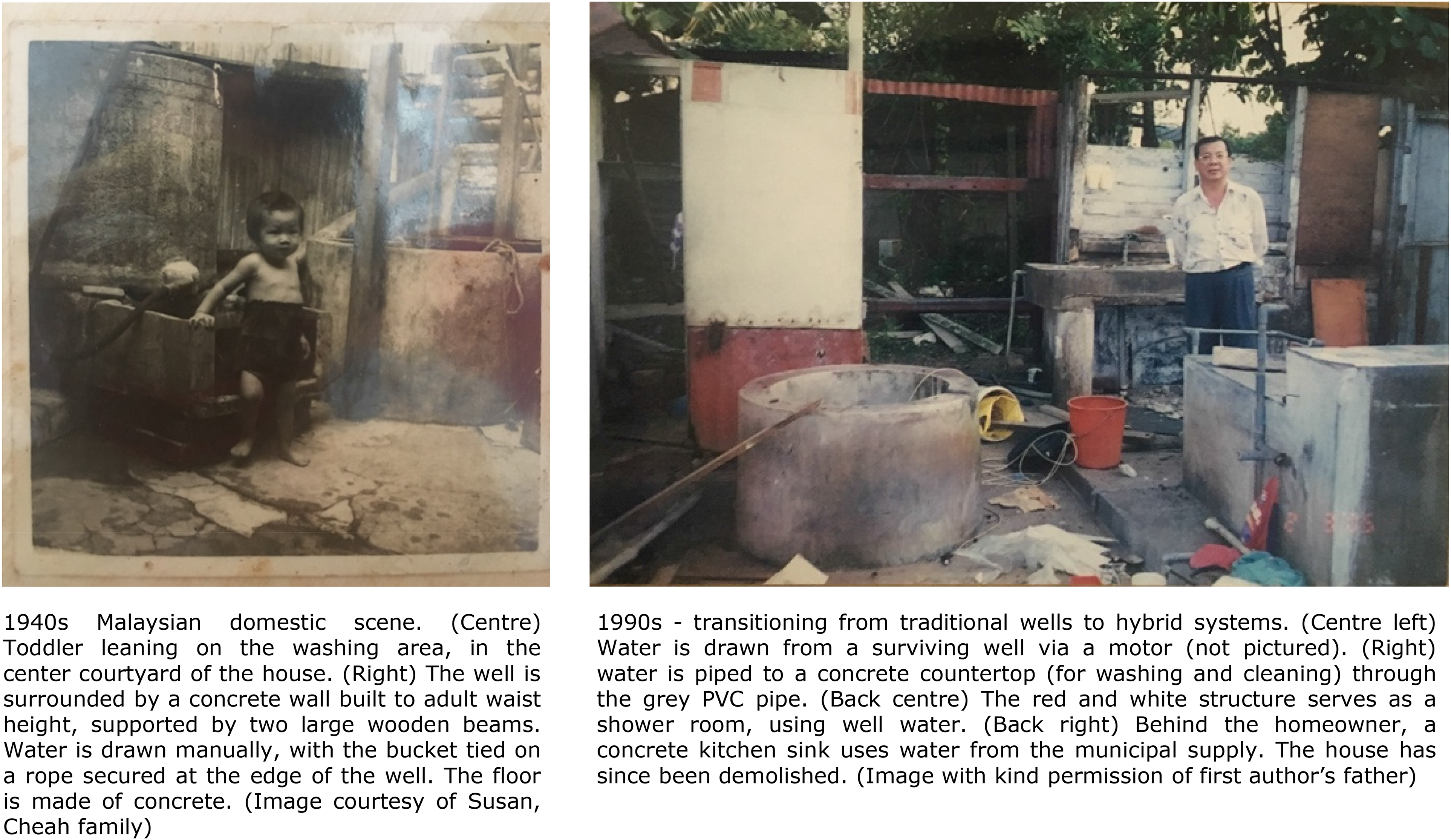
Household wells in Malaysia.
Mrs. Wong (60 s, Wong family) recalled handwashing in the 1980s, using water she had drawn from the family well. Her family also drank and cooked with the untreated well water: “It won’t be dirty. Our well water was very clear…[tastes] a little salty too [smile].” Today, she shows off her sophisticated new water filter because she finds reticulation a mixed blessing: “Yea [I am worried], [tap water] very dirty, don’t you know?”
Widespread water reticulation and low prices contribute to a culture of lavish water-use, compared to the forced conservation of exhaustingly hand-drawn water. Water is a key resource. ‘More’ equates to ‘cleaner’: “… it's so convenient now. You turn on the tap and start washing. There was no such thing in the past. If you wash more, you would be scolded…if you use a lot of water!” (Gui Eng, 70 s, Yap family) “…tsk [disgusted] some use only half bucket of water. I won’t do that. I use a lot, a lot of water to mop…I am used to it. If I use half bucket of water, ahyooo [terrified], my whole body will feel not “on lok” (Cantonese: peaceful).” (Mrs. Wong, 60 s, Wong family).
Water filters deserve special mention, as they arouse strong passions in Malaysia. Tap water is not considered potable. As a teenager I remember joining heated arguments about the merits of various water filter brands, and I willingly attended a water quality seminar. For Chun Fong (30 s, #1 son in Yong family), the family water filter was the first topic in his photo diary (Figure 8).
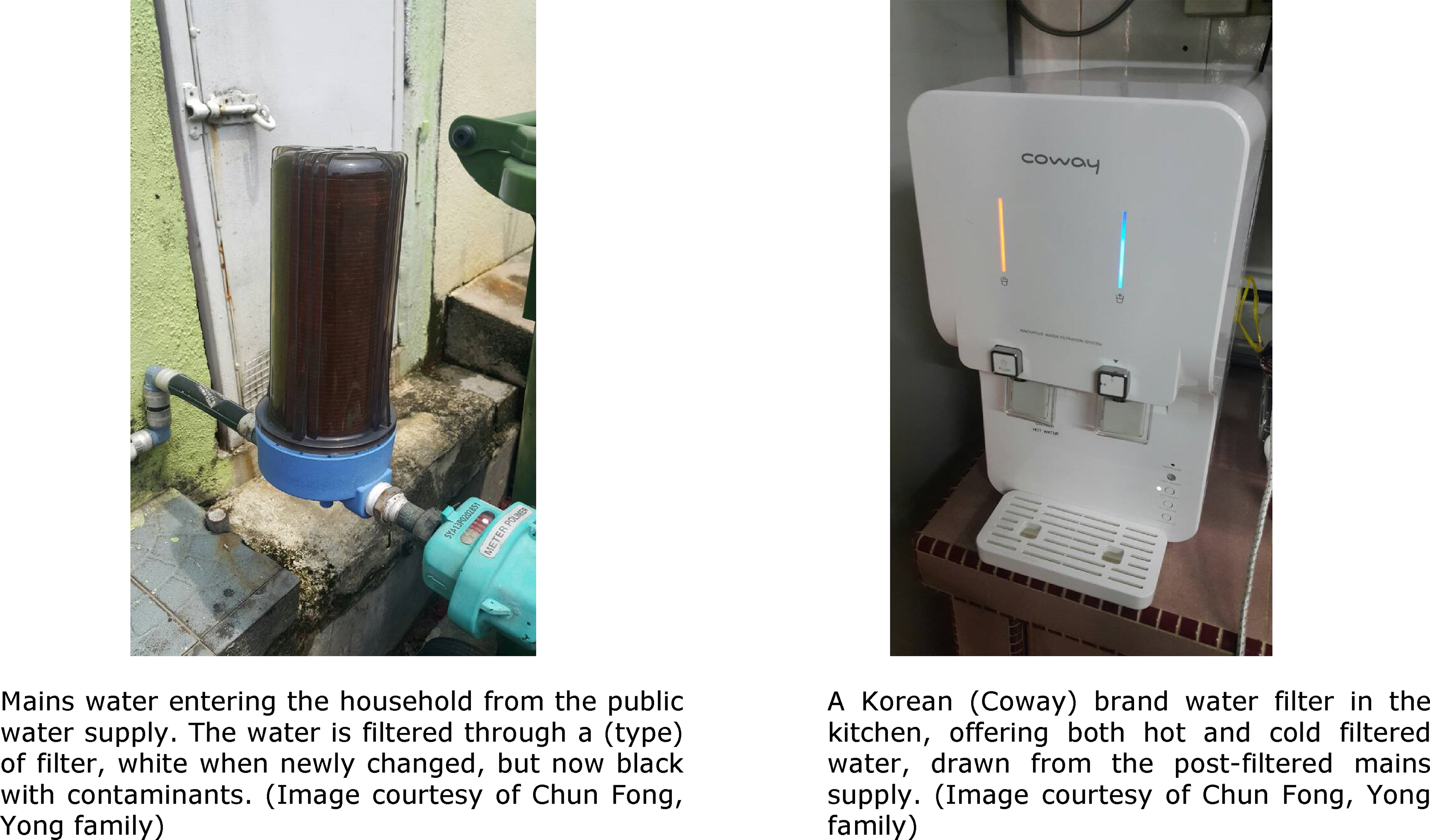
Chun Fong's photo diary featuring external water filter, kitchen water filter and plumbing.
Like most Malaysian Chinese households, including my own, Chun Fong's had two water filters: An external filter for gross soil, and a kitchen filter that purifies further for drinking and cooking. Like most people in my world, Chun Fong was hyper aware of impurities: “Of course, we need [two filters] …Our water by default is very dirty. [Points to water filter core] It is all black … Imagine if you don’t have this filter, we will be drinking all this [disgusting] stuff … No matter how we boil it, it will not go away. The core of the water filter will turn dark one day after washing … our water is so dirty. One is not enough…If you drink directly from here, you will still get ‘virus attack’.” (Chun Fong, 30 s, Yong family)
In summary, the findings in identified three underlying drivers of cleaning practices: Death, disease, and paranoia (meanings), market-supported skills (competencies) and infrastructure and technological innovation (materials). While these findings are similar to previous (WEIRD) studies (Figure 1), meanings are very different owing to a recent existential threat. For the families, safety and security, rather than status and identity was paramount.
Resistance and lock ins: Cycles of recontamination, resetting, and reinforcement.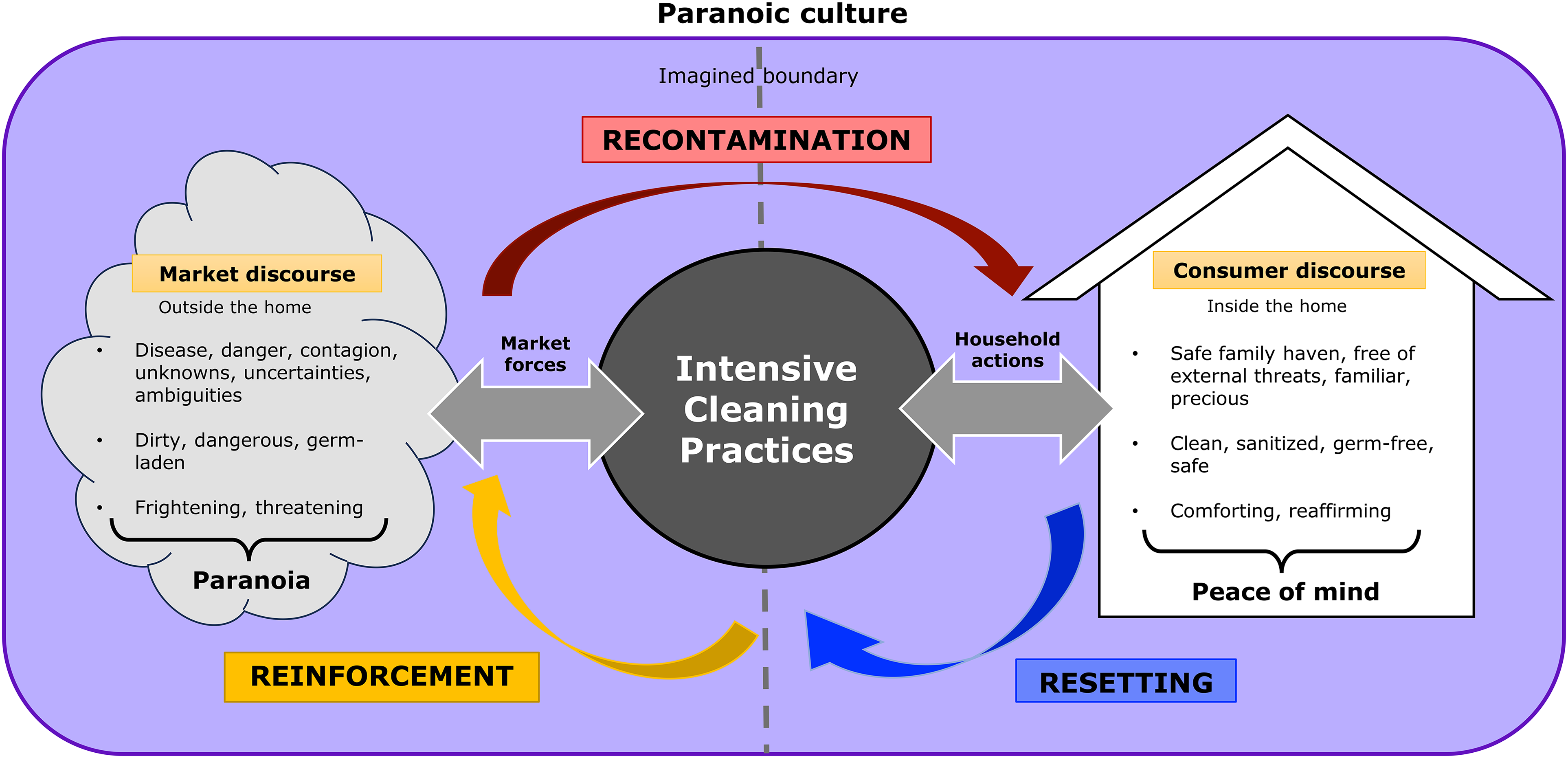
Contending with a Dangerous World: Intensive Cleaning
I was initially judgmental, seeing the families’ ways of cleaning as unnecessary and wasteful. They were damaging the environment by overusing water and toxic chemicals. It was overkill, incommensurate with the level of threat. However, gradually I began to empathize. My first contact in the field, Julia, rinsed and re-rinsed her peeled vegetables (“I don’t know [why]. It's just a habit.”). At the time it seemed ridiculous (initial vignette), although I was doing my best not to judge: “It is normal to [….] wash the peeled carrots and onions again, as she wants to keep her family safe” (Fieldnotes, 24th April 2018). Later on, reading about ‘forever chemicals’ (e.g., Brunn et al. 2023), I could not disagree. I noticed myself starting to wash and rewash my carrots! I became more sensitive to dust and dirt, like Mei Ping (50 s, Chew family), who told me “[When I see dust], there is only one thought. I am afraid that the kids will inhale into their body because they are very tiny, very light thing.” I started to feel uneasy if I did not rinse my bowl before use, heeding Mrs. Wong's (60 s, Wong family) warning: “You’d never know what had crawled on it”. That my own sensibilities were starting to morph suggested the infectiousness of social practices and especially (perhaps for evolutionary reasons) those based on fear.
While all cleaning is short-lived (“a woman's work is never done”), the cycle into which the families have locked themselves was disproportionate to the threats. The people served the routine, not vice versa. I speculated that these behaviors were deviant, and could be diagnosed as a psychopathology, obsessive-compulsive disorder, or paranoia; especially when deriving from a victimized subculture. Perhaps that is why I continue to ponder Julia's carrots and Raymond's toilet. It's a pattern. Are we collectively insane? We proceed by considering the findings with respect to our research question.
Discussion
This study asks the question: ““How do damaging mundane practices form, and how are they perpetuated?” Through a SPT theoretical lens, the findings highlighted the complexity, and meaningfulness, of mundane practices. Our findings support Shove and Pantzar (2005) and Sahakian and Wilhite (2014): practice evolution emerges from multiple environmental forces, with social, cultural, and situational factors outweighing rational, economic factors. Instead, practices change due to emotions and experiences (Magaudda 2011). The families were in a state of fear, regarding the outside world as hostile, dirty, and dangerous. Intensive cleaning defended their homes, maintained boundaries, and restored control; rectifying pollution from movements of people and materials between the inside and outside worlds (Douglas 1966). The findings suggest that actions such as mopping floors perform alchemy on market meanings, transforming modernist products of profit to expressions of love; from military grade weapons to harmless home help. In the face of the fear and anxiety of contemporary capitalism (Klein 2007), cleaning serves to establish a closer-to-heaven domestic refuge (Ger and Yenicioglu 2004; Martens and Scott 2006). For Raymond, the need to clean trumped his need to sleep. For Julia, repetitive rinsing kept her family safe. Cleaning took away the unseen, unknown, and uncertain. Cleaning conferred peace. Our findings supported Casey and Littler's (2022) contention that housework is “…a means of coping with different kinds of difficulty and trauma in an often-threatening world … [‘cleaning away’] the instabilities and anxious effects of neoliberal culture, even whilst so many of its solutions are temporary, and continue to exacerbate the problems”. (p. 502). Rather than neoliberal culture, however, these families were responding to very real threats of death and disease.
For all the families, the only solution to keeping invisible and omnipresent threats at bay was maintaining a safe perimeter. In their daily cleaning routines, the families engaged in an iterative process of contamination, decontamination, then recontamination, and re-decontamination; requiring continuous resetting and reinforcement of household boundaries (Figure 9).
Intensive cleaning practices were locked in by three cyclical mechanisms, co-constituted by market forces and household actions scripted by paranoic culture. Recontamination refers to the effects of recurring pollution that occurs at the boundary between a dirty, dangerous outside world and the front gate of their homes, deriving from dirt and dust, and the intrusion of market offerings. Everyday movement of people and things —when the families return home from outside and when food is brought inside - constantly pollutes the inside world. Resetting refers to cleaning activities deployed to defend household boundaries, in pursuit of desired levels of safety, security, and a sense of order. Intensifying cleaning practices integrated market, family, and individual norms (meanings), skills and capabilities (doings), and a wide range of homecare products, tools and equipment (materials). Water was a key element, used frequently and in large quantities. While scrubbing and scouring relieved immediate existential discomfort, the underlying fear remained as the threats are insurmountable and endless. Related to the threats, reinforcement describes the process by which the market maintained a discourse of paranoia, capitalizing on anxiety to promote new product solutions. Advertising fear appeals stressed the risks of viruses and bacteria repeatedly and graphically over time. In response, the families focused on the dangers of contamination in the liminal zone between the dirty, dangerous external world and the comfort and safety of home. Branded cleaning products and prodigious effort were deployed in repeating sub-cycles of contamination, decontamination, recontamination and re-decontamination. Household boundaries and cleanliness standards were subject to continuous resetting in response to fluctuating levels of danger and effort over time (ratcheting ever upwards); in response to the market discourse, and in search of peace of mind.
A pervasive sense of paranoia (Figure 9) captured the essence of the research. Existential threat and suspicion, reinforced by media messaging, resulted in overcleaning as a dominant cultural script; a form of modernist madness. Aggressive marketing of consumer cleaning goods and public health campaigns focusing on illness prevention resonated with cultural norms of kiasi-ism (Hokkien: afraid to die). Middle-class Malaysian Chinese families fear dust and dirt more than more likely events such as street violence, floods or car accidents. The families did not waste intentionally; intensive cleaning was a more-or-less rational response to a dangerous world. The (less safe) past was viewed through rose-tinted lenses, while the present was colored by existential threat. Fear acted as a multiplier. The recontamination-reinforcement-resetting cycle compounded lock-ins; the soothing routines of cleaning acting as a self-reinforcing mechanism. Cleaning practices evolved toward greater resource-intensiveness in response to increasing cleanliness norms (see Hollander and Einwohner 2004; Shove 2003).
Even in WEIRD neoliberal contexts of peace and plenty, the anxieties of modernity continue to shape social practices, particularly those related to health and safety (Thompson 2005; Tulloch and Lupton 2002; Wong and King 2007). However, in Malaysia, the historical and cultural context has exacerbated overconsumption. While fear is evolutionarily useful in avoiding hazards that might cause damage, illness or injury (Beck 1992; Furedi 2006; Glassner 1999; Tudor 2003), irrational fears that exaggerate risk, i.e., paranoia, are not (Freeman and Freeman 2008). This finding highlights the dangers of assuming work from the global North can inform policy in the global South.
Implications for Policy Intervention
Clearly, the dangers of overconsumption require urgent behavior change. Conventional approaches call for paternalistic, top-down interventions. However, in a complex world, such interventions are simplistic. As our findings showed, mundane everyday routines, particularly those carrying symbolic safety value, are likely to be impervious to all but the most drastic disruptions (Phipps and Ozanne 2017; Tapp and Spotswood 2013). Drastic disruptions are unpopular with electorates, explaining why wicked problems are proving difficult to address. At least three contemporaneous conditions are needed for practice change to happen. First, a set of complementary disruptors must occur contemporaneously, one is not enough (Phipps and Ozanne 2017; Shove and Pantzar 2005; Stigzelius et al. 2018). Particular disruptors (e.g., a new law), may fail to cause change; as disturbing the internal stability of a practice arrangement does not necessarily break links between elements (Shove, Pantzar, and Watson 2012). Second, markets must provide comparable replacement value. When the links between practice elements are broken, acceptable substitute elements in the bundle arrangement are required to fill the void, i.e., new skills, understandings, meanings, and ideas. Finally, there must be sufficient threat to cut through the clutter, and both fundamentally and meaningfully disrupt the market, otherwise ‘stickier’ practices will prevail. To illustrate these points, the Covid-19 pandemic offered complementary and sufficiently threatening disruptors to cause change in our daily routines (e.g., work from home, on-line meetings, on-line shopping). Post-Covid, we observe that only routines offering superior value have been adopted (e.g., more on-line meetings). Consequently, the new normal looks a lot like the old.
Supporting Layton and Duffy (2018), our findings suggest that effective interventions must both change systems and address resistance to change. We must simultaneously recalibrate collective understandings, visibly change the material environment, meaningfully incentivize desired behaviors and disincentivize that which is not. However, Shove, Pantzar, and Watson’s (2012) idea of re-crafting problematic practices by removing or substituting elements is arguably feasible, as in some practices, elements can be inseparable. For example, commuters can substitute an e-bike for an SUV. However, water-conserving and non-polluting cleaning practices require completely new bundles of meanings, doings, and materials e.g., return to traditional products, time and elbow grease (Beeton 1888); radical technological innovations such as UV emitting drones (AviatonPro 2020); a paradigm shift in what is and is not respectable and acceptable; or all three. Care should be taken with respect to unintended consequences. For example, excessive cleanliness can lead to more illnesses (Eric 2014; Okada et al. 2010). As that example, and this research shows, simple cause and effect perspectives of difficult, deeply embedded problems can lead to undesirable consequences.
Thus, with respect to mundane practices, we must simultaneously recalibrate collective understandings, visibly change the material environment, meaningfully incentivize desired behaviors and disincentivize that which is not in consultation with communities. Achieving any of these things is contingent on three conditions. First, we must establish trust in governing bodies and a collective sense of safety, a non-trivial and increasingly concerning issue. With the financialization of politics and marketization of education, trust in governments and social cohesion has eroded, along with democratic institutions (Varey 2012). However, if policy does not originate from a trusted government, it will encounter citizen resistance (Convery, McDonnell, and Ferreira 2007; Little, Lee, and Nair 2019), particularly in fractured, fractious societies. Therefore, a new mindset around public consultation is suggested: solution co-creation rather than top-down intervention. Large scale public participation, going beyond consultation should include co-creative problem and issues diagnosis, planning, decision making, co-design, co-delivery, and co-assessment of interventions (Kennedy 2016; Kennedy and Smith 2022; Lefebvre 2012). Citizens must be engaged in codesigning reassuring and equally valuable daily routines to replace those that are problematic. Second, public service messaging must ‘out shout’ dominant market narratives. Trust cannot be built if consumer fear is amplified by market discourses and social media misinformation. Public safety narratives must therefore have greater cut through and share of voice than transnational brands and key opinion leaders. Effective messaging will require a trusted source, creative ingenuity, deep pockets, and forced or voluntary industry cooperation; and messaging must be at least as clever, creative and consistent as that of FMCG brands (assuming those messages could not be moderated via regulation). Such a program will not be fast, easy or cheap; requiring programmatic, multiple, coordinated and consistent macro-social marketing interventions; and legislation to combat the anti-social influences of social media and the tech giants. Finally, visible and substantial investment in public health and infrastructure to ensure zero headlines about communicable disease, and safe, potable tap water. Zero tolerance for pollution must be backed with Singapore style enforcement of environmental standards, with substantial and visible penalties for transgressors.
Reflecting on the findings, we speculate that mundane practices may present a special case for intervention. How can we ethically challenge deeply embedded behaviors that support a sense of safety in the world? We need to be mindful of distributive justice (Domegan et al. 2020; Layton 2011), and avoid top-down and paternalistic solutions that are coercive, harmful, or damaging to vulnerable groups (Kennedy and Smith 2022; Lefebvre 2011). As habits and routines confer a sense of ontological security, interventions risk traumatizing citizens by inducing existential crisis, or provoking heroic and even irrational levels of resistance, for example, refusing life-saving vaccinations during a pandemic; or attacking scientists communicating the need for such vaccinations (e.g., Earley 2023).
Limitations and Future Research
Several potential limitations arise, suggesting avenues for future research. First, we studied only one ethnic community, Malaysian Chinese, in multi-racial society. Future research could focus on other ethnic groups (e.g., Malays and Indians). Most studies of practice evolution are taken from a culturally uniform (WEIRD) context, or assume uniformity across practitioners in the community (see for example Hargreaves 2011; Rinkinen, Shove, and Smits 2017). Future research could focus on different groups of practitioners within the same society; or extend the research to practitioners in other societies and other practices to probe transferability. Second, we included only multi-generational families. With decreasing family size and changing family composition, future research that investigates nuclear families dwellings will be required. Lastly, we did not gather actual water or chemical consumption data to quantify the magnitude of intensive. Future, quantitative research would be helpful in this respect; perhaps life cycle analysis of particular cleaning practices, or detailed measurement of materials consumed.
Finally, future research needs to embrace nuanced views of behavioral change, consistent with macrosocial marketing theory. Supporting Hastings (2003); Kennedy and Smith (2022); Rundle-Thiele et al. (2019), we argue for theories acknowledging complexity, chaos and uncertainty. Research should embrace the interrelatedness between human and non-human entities; realist and relativist ontologies; across time and three-dimensional conceptual space; i.e., an emergent and ethical conception of behavior change.
Conclusions
This study addressed gaps in macromarketing by examining the relatively invisible bulk of the overconsumption iceberg. Overall, we contributed to macromarketing in three ways. First, we focus on mundane consumption, currently under-researched. Second, by applying a SPT lens, we provide insight into the underlying drivers of harmful consumption trajectories; and how lock-ins might be ‘unpicked’ through ethical interventions that address inevitable resistance and reactance. Our SPT lens and longitudinal ethnography responded to calls for behavior change research that goes deeper into root causes (Spotswood et al. 2012), broader across socio-cultural meanings (Truong 2017), with longer time frames (Rundle-Thiele et al. 2019); that uses more diverse methodological approaches (Spotswood and Marsh 2016; Truong, Saunders, and Dong 2019); and that moves the macromarketing field forward harmoniously (Kennedy 2017). Finally, we make an empirical contribution by adopting a ‘slow’ research approach, increasingly rare. We offer insights from a critical, native ethnography; providing a non-WEIRD and yet WEIRD-literate, perspective. This critical, native ethnography is a path rarely taken in marketing generally and particularly in Asia (Eckhardt and Dholakia 2013). Our sensemaking addressed the “real chaos” of macromarketing – people interacting noisily and randomly. The degree of context, complexity and holism tried to honor Churchman's moral injunction against reductionism, to tame “the whole” of a wicked problem (Churchman 1969 in Wooliscroft 2016, p. 9). Our participants were ‘crazy like a fox’ – their seemingly irrational behavior had strong internal logic. We hope others are ‘crazy’ enough to think about and do behavior change differently: “I alone cannot change the world, but I can cast a stone across the waters to create many ripples.” — Mother Teresa
Supplemental Material
sj-pptx-1-jmk-10.1177_02761467241274309 - Supplemental material for Cleaning Like Crazy: How Resistance Processes Lock in Problematic Practices and Damaging Overconsumption
Supplemental material, sj-pptx-1-jmk-10.1177_02761467241274309 for Cleaning Like Crazy: How Resistance Processes Lock in Problematic Practices and Damaging Overconsumption by Lay Tyng Chan and Vicki Janine Little in Journal of Macromarketing
Supplemental Material
sj-pptx-2-jmk-10.1177_02761467241274309 - Supplemental material for Cleaning Like Crazy: How Resistance Processes Lock in Problematic Practices and Damaging Overconsumption
Supplemental material, sj-pptx-2-jmk-10.1177_02761467241274309 for Cleaning Like Crazy: How Resistance Processes Lock in Problematic Practices and Damaging Overconsumption by Lay Tyng Chan and Vicki Janine Little in Journal of Macromarketing
Supplemental Material
sj-pptx-3-jmk-10.1177_02761467241274309 - Supplemental material for Cleaning Like Crazy: How Resistance Processes Lock in Problematic Practices and Damaging Overconsumption
Supplemental material, sj-pptx-3-jmk-10.1177_02761467241274309 for Cleaning Like Crazy: How Resistance Processes Lock in Problematic Practices and Damaging Overconsumption by Lay Tyng Chan and Vicki Janine Little in Journal of Macromarketing
Footnotes
Acknowledgement
We extend our heartfelt gratitude to our families and friends, whose fastidious cleaning habits have inspired this research. Their unwavering support and patience, especially during our manic discussions about dust-busting and grime-fighting, have been invaluable. We are also deeply grateful to the study participants, who generously allowed a cleaning-obsessed stranger to dive into their everyday lives. Their candor in revealing both their sparkling plates and their dusty corners has been instrumental in unveiling the intricacies of household cleaning practices.
Associate Editor
Pierre McDonagh and M. Joseph Sirgy
Declaration of Conflicting Interests
The authors declared no potential conflicts of interest with respect to the research, authorship, and/or publication of this article.
Funding
The author(s) disclosed receipt of the following financial support for the research, authorship, and/or publication of this article: The authors thank the Monash University Malaysia Merit Scholarship for financial support to complete this research.

Supplemental Material
Supplemental material for this article is available online.
Author Biographies
References
Supplementary Material
Please find the following supplemental material available below.
For Open Access articles published under a Creative Commons License, all supplemental material carries the same license as the article it is associated with.
For non-Open Access articles published, all supplemental material carries a non-exclusive license, and permission requests for re-use of supplemental material or any part of supplemental material shall be sent directly to the copyright owner as specified in the copyright notice associated with the article.
