



Abstract
Pressing global problems place demands on scientific communities in terms of responsibility and accountability that require a discipline to make use of its capacity to act and the policies that can be developed on the basis of scientific knowledge. With a particular focus on values, the paper examines four areas or dimensions that determine the scope for action in the scientific context and thus influence the way in which scientific communities can assume responsibility. The analysis is based on a model rooted in the values-in-science literature, which specifies steering, doing, using, and managing science as the main scientific processes in which values can relate to science. Using the example of the intra-disciplinary division between macromarketing and micromarketing, the paper compares scientific processes in a world given by the nexus of knowledge, action, and values with a world in which values are primarily seen as a threat to science. Against this background, the preconditions for a proper positioning of the marketing discipline and marketing policy are explained.
Keywords
Introduction
Pressing global problems or “politically relevant science related issues” (Montuschi and Bedessem 2023, p. 5) such as climate change, migration, pandemics, the loss of biodiversity, and the overconsumption of resources are gaining importance in marketing theory and practice. When scientific disciplines seek to position themselves with respect to their role in addressing wicked problems, their value orientations or “worldview models” (Biddle and Schafft 2015, p. 326; Wooliscroft 2021) come into focus. Value orientations refer to values, ideas, or beliefs that may be shared across scientific communities or fields (Ferell 2021; Hyman and Kostyk 2019; Peterson and Park 2021; Shultz and Wilkie 2021). They include epistemic, social, ethical, political, or discipline-specific values. Rigor, relevance, and inclusivity, for example, are values aimed at scientific standards, the relationship between science and society, and the relationship between disciplines, respectively (Kohli and Haenlein 2021; Mende and Scott 2021). Value orientations influence the steering and management of scientific processes, the generation of knowledge, and thus the policies that can be based on this knowledge in the marketing discipline.
Theoretically, the paper builds on the values-in-science (VIS) literature, which, unlike earlier approaches in the philosophy of science, links knowledge, action, and values, raising the question of the accountability or responsibility of epistemic subjects, such as individuals and scientific communities (e.g., Douglas 2017; Elliott 2022; Wilholt 2016). At the interface between science and society, four areas or dimensions determine the scope for action in the scientific context and thus influence the way in which scientific communities can assume responsibility: (D1) a theoretical and knowledge-related dimension that determines which questions a discipline deals with; (D2) a methodological dimension that reflects how a scientific community conducts research; (D3) a policy-related dimension that shows the relationship between knowledge and action; and (D4) a communicative dimension that expresses the commitment of a scientific community to the public (interest). While values permeate all four dimensions, the second dimension has been at the center of the VIS literature.
The pressing global issues raise questions about what the discipline of marketing is researching, how it is researching it, and who is receiving the knowledge it is producing: private clients or the public. But these issues are fundamental; they can be asked independently of pressing global problems. Nevertheless, the pressing global problems set the context of this paper. They are affecting scholarly choices of theories and motivate interest in theory development in the marketing discipline (Kohli and Haenlein 2021). Moreover, they cast a beam on issues, topics and problem areas that played a more subordinate role in past decades (Achrol and Kotler 2012) such as “marketing as a force for good” (Mende and Scott 2021, p. 116; also see Grinstein, Hewett, and Riefler 2022, p. 1), “sustainable service ecosystems” (Field et al. 2021, p. 462) or the “general welfare of society” (Stewart 2017, p. 193), “better marketing for a better world” (Chandy et al. 2021, p. 1), “responsible research in marketing” (Haenlein et al. 2022, p. 8), “responsible marketing for a better society and world” (Laczniak and Shultz 2021, p. 201), and “longer-term benefits to other people and the natural world” (White, Habib, and Hardisty 2019, p. 24).
Addressing these issues in science is an expression of value orientation. Because of the value-free ideal, there is still some confusion about the role that values and value orientation play or should be allowed to play in scientific research. The VIS literature does not dispute that values play a role in science (Elliott 2022; Schroeder 2022); rather, it argues that science takes place in a VIS world. In this world, the question is which and whose values do and should play a role in scientific processes. The relationship between science and society also comes into view. This relationship has been the subject of study in various fields, among which is democratic science (Encabo and Martin 2007), democratic theory (van Bouwel 2015; Crick 2002; Christiano and Bajaj 2022), or political philosophy of science (Marcos 2018; Schroeder 2021a). Schroeder (2022, p. 246; italics in original) called attention to the “two very different perspectives from which scientists can make value judgments, or from which we can evaluate the value judgments scientists make: approaches grounded in ethics and approaches grounded in political philosophy.” This brings major value categories and their relationships into focus. For example, reflecting on the nexus of science, policy, and values, Douglas (2016, p. 480) points to “the need for policies that reflect democratic norms as well as traditional scientific norms.”
Elliott (2022, p. 8, Figure 1) identifies four “major ways in which values can relate to science”: steering, doing, using, and managing science. New insights in this area can be gained by studying concrete cases in which values are applied. For this reason, I refer to Elliott's model (Figure 1) as a schema against which to analyze an intra-disciplinary division that occurred in marketing in the 1970s and 1980s when macromarketing emerged as an explicit discipline and academic community. The paper's main questions are: What are the consequences of being in a VIS world for a discipline's ability to address problems, especially pressing global problems? Or, in more general terms, how is the relationship between knowledge and action conceived in a VIS world as opposed to a non-VIS world? And how does this difference affect the problem-solving capacity of a scientific discipline?
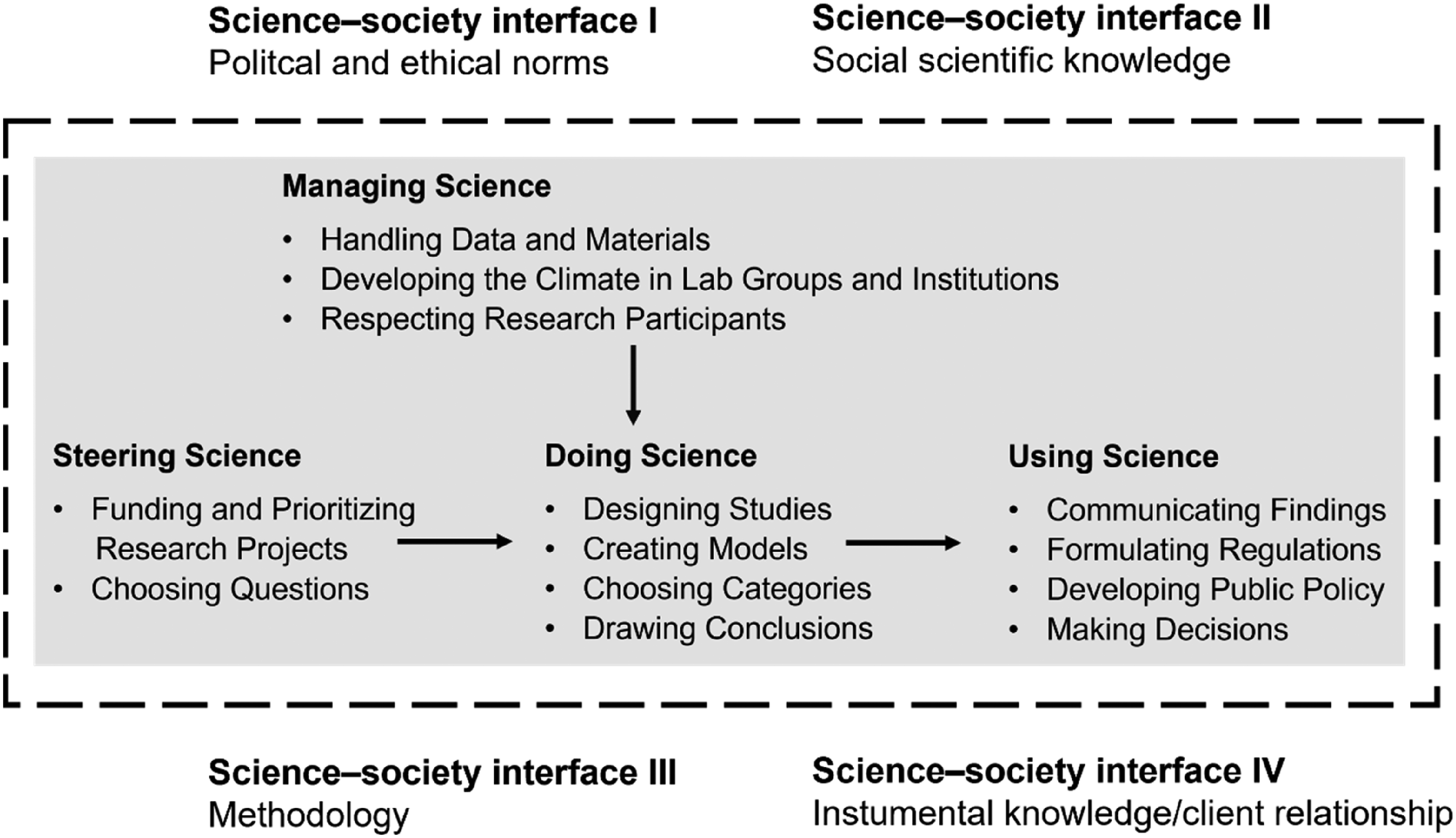
Elliott's Model of Scientific Processes in Adapted Form.
Three contributions to the marketing and VIS literature are made in this paper: First, the extension of Elliott's model and its application to the study of intra-disciplinary processes or conflicts, using the example of the intra-disciplinary division between macro- and micro-marketing. Second, with respect to the theme of this special issue, the paper demonstrates the relevance of the VIS perspective for understanding the link between scientific knowledge and action, i.e., for the emergence of policies as well as for the positioning of scientific disciplines vis-à-vis pressing global problems. Third, as a source of value judgments that has received less attention in the VIS literature, the paper points to the inherent normativity of the theories that scientific communities deal with. While social scientific theories have normative foundations that link them to the ethical or political values or principles addressed in the VIS literature, they also embrace discipline-specific values such as economic or marketing values. Efficiency or effectiveness are familiar examples of disciplinary values in economics, marketing, or management. Therefore, the value categories mentioned in this process and listed in the philosophical literature need to be supplemented by discipline-specific values.
The remaining sections are organized as follows: In the second section, I present Elliott's (2022, p. 8, Figure 1) model, which emerged from his analysis of the debate between the respective proponents of the value-free ideal and the value-laden thesis (for an overview, see Elliott 2022; González 2013). While the proponents of the value-free ideal emphasize the problems associated with values in science rather than their potential positive influence (Holman and Wilholt 2022), representatives of both perspectives share the view that science cannot be value-free. Relying on the four dimensions (D1-D4) mentioned above, I extend the model to include of the interfaces between science and society in the analysis (Figure 1).
In the third section, I use Elliott's model to illustrate the intra-disciplinary division between macromarketing and micromarketing. Based on this model, I analyze the particular importance of value orientations for this division. Value orientations are also expressed in the methodologies shared by groups of scholars. To address the methodological value orientations, I refer to the three dichotomies model (Hunt 1976). Hunt's role as a change agent and the attention the three dichotomies model has received in marketing justify the reference to this model. Another reason, related to the methodological value orientations, is that the three dichotomies model is closer to earlier approaches in philosophy of science than to a VIS world, which allows it to be used to compare the methodological beliefs associated with a VIS and a non-VIS world.
Referring again to D1-D4, the fourth section explains essential features of the VIS world. The positioning of scientific communities and their capacity to act in this world is determined by the reflection on values and the difference between, in Burawoy's (2005) words, public marketing and the client relationship; the understanding of the normative in connection with disciplinary values; and the extension of the relationship between knowledge and action by values. The conclusions are provided in the final section.
The Values-In-Science World
Scholars advocating the value-free ideal and those advocating the value-laden thesis agree that values play an important role in science. For this reason, it is justified to speak of the “decline of the value-free ideal” (Holman and Wilholt 2022, p. 212). This is not to say that there were (and still are) no serious reasons for the emergence of this ideal (see Holman and Wilholt 2022). Indeed, the VIS debate revealed several research gaps. First, the process of knowledge generation, its steering and management, and the communication and application of knowledge came into focus. Second, the fact that values matter does not mean that they are unconstrained or that “anything goes” (Holman and Wilholt 2022, p. 211). The establishment of rules, the institutional work for new rules or conventions, can be conducive to maintaining trust in science and the legitimacy of scientific activities. For example, the VIS literature gives special attention to scientific reasoning, i.e., what Elliott (2022, p. 16) refers to as “doing science.” “Doing science” means that scholars have to make values-based decisions when performing scientific tasks such as classifying information (Reydon and Ereshefsky 2022) or testing hypotheses by determining significance levels or inductive risks (e.g., Douglas 2009; Elliott 2022; Hempel 1960; Rudner 1953; Wilholt 2016). When it comes to epistemic valuation, nonepistemic values should not replace epistemic ones (e.g., Agazzi 2018; Lacey 2016; Ward 2021). Neither “doing good science” (Schroeder 2022, p. 246) means agreeing with the value-free ideal, nor accepting values without considering their legitimacy or appropriateness (Elliott 2022; Holman and Wilholt 2022; Resnik and Elliott 2023; Schroeder 2021a; Wilholt 2016).
Epistemic values are defined as all values related to the main cognitive goal of science, the establishment of truth. Epistemic values “are presumed to promote the truth-like character of science, its character as the most secure knowledge available to us of the world we seek to understand. An epistemic value is one we have reason to believe will, if pursued, help toward the attainment of such knowledge” (McMullin 1982, p. 18). McMullin (1982) counted the so-called desiderata of science (e.g., accuracy, simplicity, fruitfulness) among the epistemic values. The distinction between value categories, however, has been refined and their number expanded (see Douglas 2013; Douglas 2017; Hoyningen-Huene 2023). Table 1 summarizes the value categories originating from the VIS literature and addressed in this paper:
Classification of Values.
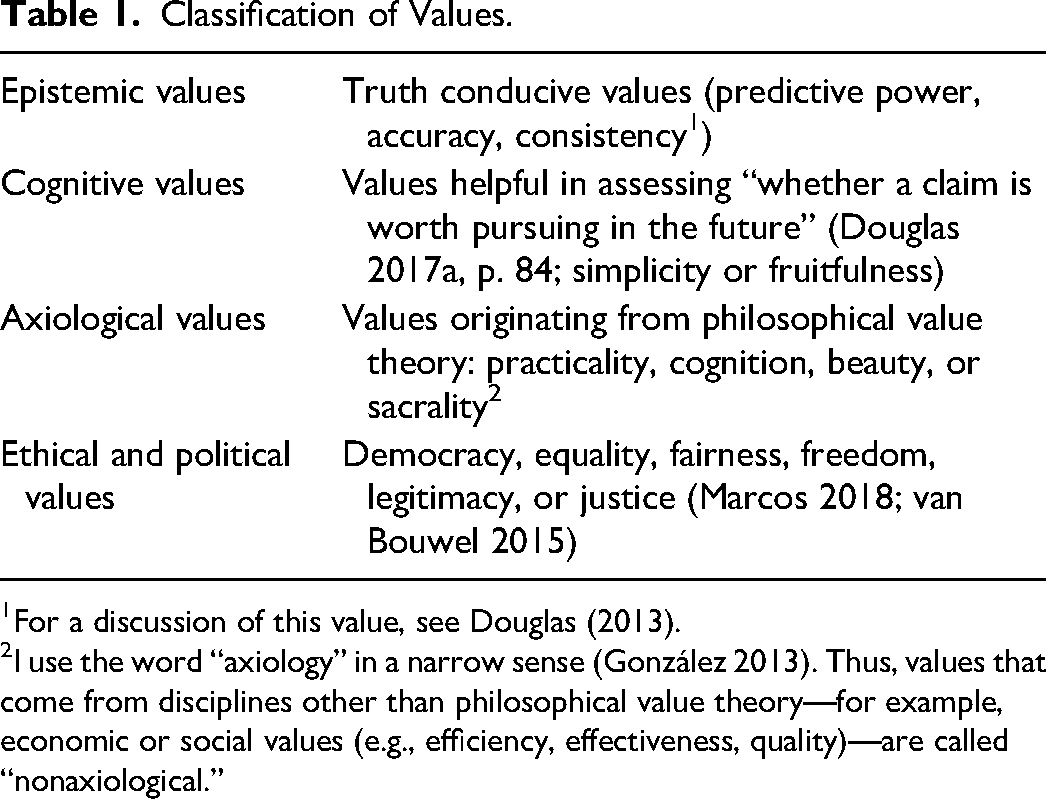
For a discussion of this value, see Douglas (2013).
I use the word “axiology” in a narrow sense (González 2013). Thus, values that come from disciplines other than philosophical value theory—for example, economic or social values (e.g., efficiency, effectiveness, quality)—are called “nonaxiological.”
Elliott's (2022, p. 8, Figure 1) model distinguishes between doing science, which denotes a core area in which particular attention is paid to the relationship between epistemic and non-epistemic values (“the design of studies, the analysis of data, and the interpretation of results,” Elliott 2022, p. 9); steering science, which refers to strategic decisions at both the individual and institutional levels (the choice of research questions or theories; the acquisition of the resources needed for scientific research); managing science (“managing how research is performed,” Elliott 2022, p. 13), which refers to activities, practices, and relationships in science that require organization and management; and using science, which refers to the communication and application of scientific knowledge.
Figure 1 includes Elliott's model in the grey area. The fields labeled “science‒society interface” represent the social embeddedness of science (Encabo and Martin 2007), which from the beginning has influenced the debate in philosophy of science about the role of values (Hempel 1960; Rudner 1953). To avoid confusion with multiple intersecting arrows in Figure 1, I use the dotted line to indicate the mutual influences between science and society. These range from individual researchers making decisions about significance levels in hypothesis testing in the context of methodological conventions and risk assessment, to scientific communities making decisions about promoting or rejecting areas of research, or addressing the potential consequences for trust in science related to the appropriate or legitimate use of values (Holman and Wilholt 2022; Schroeder 2021a; Wilholt 2016).
SSI-I is related to political and ethical norms. Schroeder (2022) endorses the view that the societal norms addressed in the VIS literature are either political or ethical and that “doing good science requires making non-epistemic value judgments” (Schroeder 2022, p. 246). This is in line with Encabo and Martin (2007), who argue that democratic norms should be applied to the pursuit of knowledge generation processes—science should be conducted in a democratically legitimate manner. Such a view has an impact on the decisions that are made in the context of “doing science,” but also on the management of processes (managing science). When science is part of democratic societies, it is expected to uphold democratic values and not base its judgments—whether in classifications, choice of theory, choice of policy, or recruitment of scientific offspring—on racism or sexism. Furthermore, power should not be abused and scientific processes should be managed according to ethics.
SSI-II: Scientific practice is a social practice, and analyzing how to manage it requires applying social scientific knowledge, especially organizational and management knowledge. In addition, D1 could be assigned here—the theoretical-epistemic dimension of scientific activities.
SSI-III refers to methodological soundness and justification. As Putnam (2002, p. 30) put it, “science might presuppose values as well as experience and conventions” (on the “irreducibly social” character of the conventional, see Wilholt 2016, p. 233). Society has an impact on science through the social aspects involved in the emergence, development, or implementation of methodological rules, standards, and conventions as social institutions in science. From a sociological perspective, these social institutions can be seen as orders of worth (Boltanski and Thévenot 2006 [1991]). Conventions are present even in those parts of science that are thought to be rooted in the nonempirical or in logics (Goodman 1955). Quine (1960, p. 351) points to “the linguistic doctrine of logical truth”—that is, conventionalism in the determination of logical norms (Weber 1958; von Wright 1963).
SSI-IV: The interfaces between science and society concern the cognitive and other goals of science, but also the problem-solving capacity of scientific knowledge. It is not just about doing in the processes listed in Figure 1, but doing right or doing well. The social embeddedness of science is a source of conflict between values associated with different value categories. For example, the autonomy of science can be threatened when science does not decide on research topics itself, but enters into what Burawoy (2005) calls a “client relationship.” Burawoy (2005) identifies four dimensions of professional scientific community development with regard to knowledge: the production of basic knowledge and instrumental knowledge, the critical reflection on knowledge and its sources, and the development and maintenance of what he calls the “public face” of a community. Instrumental knowledge is the basis for any type of policy. The client, whether private or governmental, decides how to use scientific knowledge—a decision that may not align with the values of the individual researcher or research group (Schroeder 2021a). In a sense, the client stands between knowledge and action. Scientific communities lose control over the knowledge they impart to the client when they enter into a client relationship.
The next section refers to a major intra-disciplinary division that occurred in the marketing discipline with the emergence of macromarketing in the 1970s. The main differences between doing science in a non-VIS world (micromarketing) and the emerging subdiscipline of macromarketing lie in the steering and use of science, as explained in the following section.
The Intra-Disciplinary Division into Micro- and Macromarketing
The participants in the Macromarketing Seminars that took place from the mid-1970s onward, as well as the founders of the Journal of Macromarketing, can be considered change agents within the marketing discipline. Referring to the flagship journal of micromarketing, I first address differences in the determination of the research subjects in the marketing discipline.
Research Subjects in the Marketing Discipline
Kerin's (1996) review of the first 60 years of Journal of Marketing shows the limited scope of research subjects published in this journal during these decades. It is striking that marketing in these six decades, as documented in the Journal of Marketing, has been mainly concerned with (micro) management issues. The list of prominent topics that dominated the Journal of Marketing from 1936 to 1996 (Kerin 1996, p. 4, Table 1) shows that a perspective of marketing on society or on ecosystems (and vice versa) is rather absent in these decades.
By the early 1980s, a core network of macromarketing scholars had formed that sought not only to explore or advance marketing as “science and practice” (Kerin 1996, p. 1), but also to understand the relationship (interactions) of marketing (in theory and practice) and society. Macromarketing scholars criticized what they considered a narrow perspective in marketing, a criticism shared by representatives of, among others, B2B marketing and relationship marketing approaches (Ballantyne 2009). Indeed, network analysis and the systemic perspective had been introduced into B2B marketing to broaden the narrow research focus from dyadic B2B relationships or transactional exchanges (Gummesson and Polese 2009; Hajikhani and LaPlaca 2012; Slater 1997).
Definitions of the concept of marketing reflect the changes that the understanding of marketing has undergone over the decades. The goals or values associated with the community as a research subject in macromarketing are the well-being or flourishing of communities (Shultz, Rahtz, and Joseph Sirgy 2017). Given the interest in marketing‒society interactions in macromarketing, it is no coincidence that Layton's (2016, p. 3) definition of “marketing” (D(Layton)) captures the marketing environment not in terms of networks as in Gummesson and Polese (2009), but in terms of community: D(Layton): Marketing is the study of value cocreation through voluntary economic choice made in exchanges among individuals and entities in and between human communities.
The network approach advocated by Gummesson and Polese and the marketing systems approach advocated and further developed by Layton (Layton 2019; see Shultz 2012) are two versions of the attempt to conceptualize the “marketing environment” (Gummesson and Polese 2009); both examine marketing as social phenomenon, as “part of society's existence” (Hajikhani and LaPlaca 2012, p. 12). However, macromarketing was unique in that it was concerned with not only marketing methods and research subjects, but also ethical or social values (Laczniak, Lusch, and Strang 1981). Macromarketing scholars also wanted to address the interest of society or the common good, with its implications for those activities or processes that Elliott (2022) called “steering.” Drawing on the discussions published in the first volume of the Journal of Macromarketing, the next subsection addresses how the value orientations and motifs of marketing scholars have influenced the process called “steering science.”
Steering Science
a) Managerial and nonmanagerial marketing
From the beginning, the contributions to the Macromarketing Seminars, published in the first two issues of the Journal of Macromarketing in 1981, linked definitional, motivational, and domain-specific aspects. That the particular view of macromarketing differs from the “micromarketing viewpoint” (Tucker 1974) is evident in research strategic decisions. Some scholars felt that they were involved in creating a “new discipline” or bringing about a “paradigm shift” in marketing research (Chaganti and Heede 1981, p. 56). Definitional questions emerged to answer the question “What is macromarketing?” (Hunt et al. 1981, p. 7). Motifs were in play to answer the question Why do we need to form a specific group? And the domain is related to answering the question What are the research fields that are not addressed by managerial (micro-)marketing, but are relevant to us? In other words: “What should macromarketing include?” (Chaganti and Heede 1981, p. 56). Building on Hunt's personal recollections (Hunt 2011, 2020) and a close reading of the papers published in the first two issues of the Journal of Macromarketing in 1981, the group members’ motifs for attending the macromarketing seminars can be summarized as follows: (1) dissatisfaction with the research focus prevalent in managerial (micro-)marketing, (2) interest in the societal impact on markets and marketing (and vice versa), and (3) interest in the ethical dimensions of marketing.
The common motive of the aforementioned group of scholars was that they did not want to make problems limited to the creation of the private good the problems of their discipline. Key economic theories (e.g., new social welfare theory; Roth 1999) assume that actors pursuing their private interests serve society uno actu. In this case, specific marketing strategies aimed at achieving social or nonprivate welfare could be considered redundant (for a discussion, see Nill and Schibrowski 2007), as they were included in the strategies aimed at serving the private good. In a world, in which the invisible hand 1 guides, apart from negative externalities, actors who are only concerned with their own advantage serve society uno actu. In a world, in which the visible hand guides, the “market mechanism is only one of many instruments for raising standards of living, promoting economic stability, providing sources of income, and improving the ‘quality of life’” (Fisk 1981, p. 3). Although the possibility of positively valued unintended consequences of action (positive externalities) need not be denied, to achieve private and nonprivate goals or values, actors must explicitly “provide” for themselves and for society. In this sense, the market mechanism is thus not just one among many; it further requires reinterpretation.
The social-theoretical model of a market society based only on self-interested individuals is incompatible with value orientations in macromarketing. As Fisk (1981, p. 3) puts it, “We seek knowledge to improve marketing strategies and policies that affect social welfare”—that is, knowledge suitable for improving the management of resources “in private and public organizations to serve society's interest” (Fisk 1981, p. 3). Here we find the extension of the “nature” and “scope of marketing” to nonprofits proposed by Kotler and Levy (1969) and the normative approach to macromarketing. In this way, Fisk explicitly contradicts positivist American political science as espoused by the Bentlian School.
2
This school rejects the idea that politics should be oriented toward the common good or public interest, instead promoting the “irrelevance not only of the concepts of community and society, but also of ideals, ideas, and values” (Chochran 1974, p. 332; Jørgensen and Bozeman 2007). Society is equated with the groups that compose it, and “rules of the game” replace the “social whole.”
b) The micro-macro dichotomy and Hunt's definition of “macromarketing”
Hunt (1976) organized the topics, characteristics, and levels of analysis of marketing studies using three distinctions, referring to these distinctions as dichotomies: positive-normative, for-profit–nonprofit, and micro-macro. To illustrate the impact of Hunt's three dichotomies model on the emerging field of macromarketing, I refer to the first editor of the Journal of Macromarketing, George Fisk (1981, p. 4) who wrote: “To use Shelby Hunt's terms, macromarketing is both ‘positive’ and ‘normative,’ ‘profit’ and ‘nonprofit’ but excludes the micromarketing phenomena of decision making to produce an intended result for an individual household, business, or public organization. Our focus is squarely on what Tucker's award winning article terms the ‘well being of society’ (1974, p. 35).”
Micro and macro perspectives can be aligned with both for-profit and nonprofit organizations, and each can be positive as well as normative in nature. Hunt (1976, p. 20) proposes that “micro refers to the marketing activities of individual units, normally individual organizations (firms) and consumers or households. Macro suggests a higher level of aggregation, usually marketing systems or groups of consumers.” The inaugural Macromarketing Seminar in 1976 at the University of Colorado in Boulder had already critically discussed the idea that a clear specification of the field of macromarketing studies may result from the “aggregation” of micro-level entities (Hunt 2011, 2020): For Shawver and Nickels (1981, p. 10), “the dividing line between micromarketing and macromarketing is the perspective of the researcher and the objectives of the units under investigation—not the number of units being investigated or the level of aggregation.” Depending on the level of analysis to which a researcher refers, the same unit (e.g., a company) may be considered at the micro, meso, or macro level (note that Hunt [1976] does not refer to the meso level). 3
The importance of the distinction between managerial and nonmanagerial marketing for macromarketing research strategies has been contested from the beginning, even among macromarketing scholars (Shapiro 2022). While the distinction between private and nonprivate value is essential to the conceptualization of the social good, using the distinction between managerial and nonmanagerial marketing with the aim of defining “macromarketing” does not take the researcher very far: “If the research focus is on meeting the narrow objectives of a firm or an organization or an individual household through exchange, the perspective is micro. But if the same transaction is analyzed for its effects on society or for society's effects on the participants, the perspective is macro” (Shawver and Nickels 1981, p. 10). Note, however, the importance attached to instrumental knowledge, that is, knowledge that is useful but not for private gain.
Hunt (1981, p. 8) revised the definition of macromarketing as follows: D(Hunt): Macromarketing refers to the study of (1) marketing systems, (2) the effects and consequences of marketing systems on society, and (3) the effects and consequences of society on marketing systems.
The problems with this definition were quickly pointed out by Shawver and Nickels. As they (1981, p. 10) note, the “(perhaps) … most widely used definition of macromarketing” has shortcomings (cf. Benton 2021; Layton 2016; Meade and Nason 1991). The reason is that nominal definitions are a means of transferring meaning from definiens (that which defines) to definiendum (that which is to be defined). Shawver and Nickels's (1981, p. 10) observation holds true: “Hunt's definition might have provided an excellent foundation of macromarketing thought if the meaning of words such as ‘society’ and ‘marketing systems’ have been clear.” 4
It is not surprising that several terms in these early definitions of the concept of macromarketing were unclear. Weber (1949) states that intellectual concepts underlie the determination of the objects of research in the sciences; for example, various attempts to define economics reflect the perspective of different theories (Coase 2000; Robbins 1932; von Hayek 1945). At this point, it becomes apparent that a definition in line with Weberian requirements presupposes something that had not yet been developed in the 1970s and 1980s—namely, macromarketing theory (cf. Hyman and Kostyk 2019). When, as Hunt (1981, p. 7) notes, a group of scholars came together “to search for meaning and structure in an ill-defined and relatively unknown field,” there was no marketing systems theory or no clear commitment to such a theory as macromarketing theory. 5
Doing science brings the methodological orientations into the focus of attention. In this part of the analysis, I will refer to the three dichotomies model, which is closer to the non-VIS world than to the VIS world. The analysis of “doing science” in terms of this model takes us back to early approaches to the philosophy of science that in part shaped the conceptual distinctions depicted in the three dichotomies model.
c) A non-VIS world view
This subsection explains the methodological orientation associated with the positive-normative dichotomy, which has influenced the development of the discipline of marketing for decades; it is also one of the foundations of the three dichotomies model. Once again, I refer you to Kerin's (1996) review of the first 60 years of the Journal of Marketing.
Kerin (1996) argues that marketing, as he traces its evolution over six decades, had reached a state of development that he calls “modern.” He (1996, p. 5) equates the normative with “intuition and judgment” and the positive with “the scientific method”; moreover, he associates this view with the development of marketing as a positive science that has left the normative behind. This position is close to the early philosophy of science of logical positivism (see, e.g., Hunt 2003; Putnam 2002; Reichenbach 1951; Walsh 2016 [1987]) characterized by Stark (1943, p. 209) as the association of “purely positivistic” with “purely scientific” and “modern.” 6
Hunt's (1976) three dichotomies model contributes to a decades-long discussion in marketing about the research subjects of marketing (scope) and its scientific nature.
Intended not as a science model for macromarketing, but for marketing, the model sparked a controversial debate that lasted for decades (Hunt 1978, 1981, 2011; Hunt and Burnett 1982; Hyman, Skipper, and Tansey 1991). In a sense, by expressing specific methodological-philosophical beliefs (value orientations) in marketing, Hunt expanded the possibilities of marketing reasoning in a way that seems to be consistent with the beliefs reiterated by Kerin (1996) twenty years later as documented in the previous paragraph: The positive/normative dichotomy provides categories based on whether the analysis is primarily descriptive or prescriptive. Positive marketing adopts the perspective of attempting to describe, explain, predict, and understand the marketing activities, processes, and phenomena that actually exist. This perspective examines what is. In contrast, normative marketing adopts the perspective to prescribe what marketing organizations or individuals ought to do or what kind of marketing systems a society ought to have. That is, this perspective examines what ought to be or what marketing organizations or individuals ought to do (Hunt 2020, p. 20; italics in original).
Hunt (1976) included public policy and the social sphere in the scope of marketing (indicated by the term “macro”) and he referred to Kotler and Levy's (1969, p. 15) proposal to also include nonbusiness organizations (“no organization can avoid marketing”). In this way, the three dichotomies model appealed to marketing scholars because it broadened the scope of marketing and thus increased its relevance; and it maintained (or at least did not contradict) the methodological approach prevalent in some marketing studies based on a “worldview model” (Biddle and Schafft 2015, p. 326) associated with philosophical views that advocated the positive-normative dichotomy. Furthermore, the model assumed that the normative can be contained by avoiding value words (Goldthwait 2005) or by limiting it to management recommendations, thus neglecting that the normative, once introduced through language, choice of theory, or convention, is always present.
Hunt (1978, p. 109) is right that the positive-normative distinction “is a powerful stimulus to clear thinking and analysis in marketing.” However, one should not underestimate the complexity associated with (degrees of) concrete positive-normative distinctions (Skipper and Hyman 1995), even though positive and normative aspects can be distinguished on the basis of “careful thinking” (Hyman, Skipper, and Tansey 1991, p. 421).
The next subsection discusses how the client relationship affects the knowledge-action nexus. This part of the analysis also shows that while Hunt was a proponent of the view that marketing is a science, he rejected the micro-normative policy focus of marketing.
d) The client relationship
Burawoy (2005, p. 9) framed the relationship between the producer and the user of scientific knowledge as a client relationship. Referring to sociology, he pointed out, “Policy sociology is sociology in the service of a goal defined by a client.” This contrasts with basic “research conducted within research programs that define assumptions, theories, concepts, questions, and puzzles” (Burawoy 2005, p. 12, Table 2). Basic research, however, is a prerequisite for instrumental knowledge and applied science (Burawoy 2005; Wilkinson and Young 2005). Like other disciplines that fall under the umbrella of business administration, marketing is often viewed as an applied science or technology that is not concerned with the creation of basic knowledge. Such a discipline may be able to make recommendations on the basis of borrowed theories or approaches (Mittelstaedt 2016).
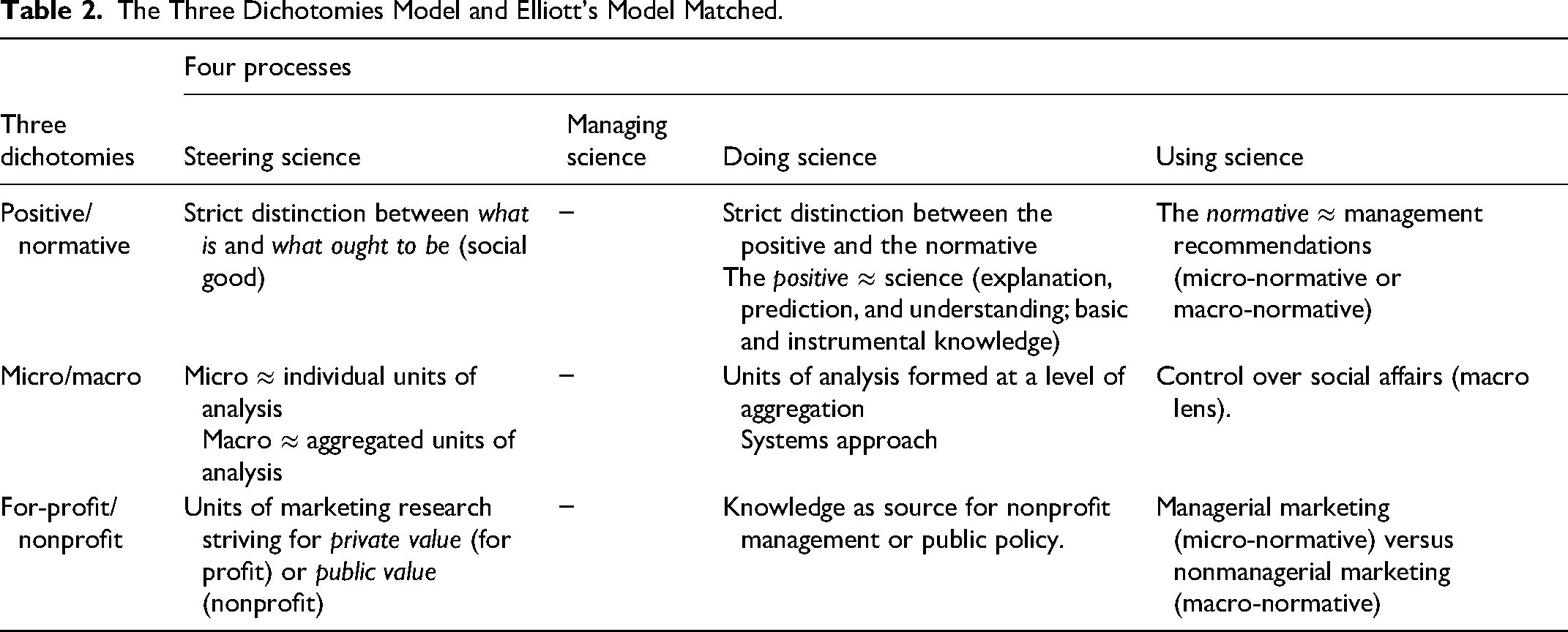
The Three Dichotomies Model and Elliott's Model Matched.
Hunt (1976) wants to express his belief that marketing is a science with the three dichotomies model. 7 As he (1978, p. 109) puts it, “The prime directive for scholarly research in marketing is the same as for all sciences: to seek knowledge.” The cognitive goals of science are thus at the top of a hierarchy of goals for scientific knowledge production. Implicit in this setting is the existence of other goals. Therefore, Hunt also comments on the issue of management recommendations, expressing the view “that the entire discipline of marketing does not exist solely and exclusively to serve the needs of the marketing manager” (Hunt 1978, p. 109). While this statement is correct, it could be broadened and sharpened: why should the discipline of marketing serve managers at all? There are (at least) four aspects to this question. First, marketing scholars, like all scholars, must justify the resources they gain from public sources (Polanyi 2016) 8 ; however, this justification does not include serving managers. Like all actors, managers are free to use scientific knowledge produced with public funds.
Second, if “public decision makers” (see Hyman, Kostyk, and Shabbir 2021) are also “public managers,” the issue here is not management per se (as social technology, practice, etc.) but whether marketing scholars aim to serve the needs or solve the problems of private or nonprivate actors or entities. That the primary goal of marketing scholars is society's interest or social welfare does not preclude them from informing life-world actors about possible contributions, actions, or policies relevant to their intentions to act. This includes the respective expected welfare-reducing or welfare-enhancing effects of these measures. The crucial question is therefore not whether managers benefit from marketing knowledge, but whether this knowledge is in the public interest or serves the common good (Radder 2017).
Third, in various spheres of higher education, marketing scholars are involved in the education of market actors (Shapiro et al. 2021). It is important that private value does not dominate in the context of this education, but that marketing education shows how both private value and nonprivate value can be cocreated through market-oriented action. Fourth, identifying patterns or specifying social mechanisms through which policy makers can implement social control or policies requires the generation of specific knowledge, such as knowledge based on multilevel analysis.
Recall that the scientific knowledge that is used as a basis for the formulation of policy proposals is the result of values-based strategic intra-disciplinary decisions. By matching Elliott's model with the three dichotomies model, the following subsection explains the differences between the non-VIS and VIS worlds’ perspectives on the relationship between knowledge and action.
e) Two models matched
Referring to Elliot's model of scientific processes (Elliott 2022, p. 8, Figure 1), I used the emergence of macromarketing to illustrate the influence of values and value orientations on scientific processes. This subsection analyzes the commonalities and the differences between macro- and micromarketing by comparing the three dichotomies model with Elliott's model. The main differences we find are in the steering/macro and steering/nonprofit intersections, in the doing science/macro and doing science/nonprofit intersections, and in the using science/macro and using science/nonprofit intersections:
As “theory appraisal is a sophisticated form of value judgement” (McMullin 1982, p. 17), the choice of theory is a main entry for value judgments in science. For two reasons, this did not come into play in the marketing discipline at the time when macromarketing emerged. First, the three dichotomies model did not reject micromarketing and its underlying marketing concept. Second, the marketing concept can hardly be considered a marketing theory. Nor were possible differences in methodological orientation or interpretation of the positive-normative dichotomy the most important factors for the intra-disciplinary division. Rather, it was value orientations in relation to social, political, or ethical values that made the difference. It is also these values that link the processes that Elliott called “steering” and “using science.” The focus on the social good combined with the rejection of the invisible hand approach embodied in economics does not follow from the three dichotomies model, but from the different value orientations of macromarketing scholars and micromarketing scholars. This is consistent with Montuschi and Bedessem's (2023) view that intra-disciplinary disagreements “most often … reflect, and are fueled by, divergences of values.”
Table 2 depicts the strong link between knowledge and action, displayed in the close connection between steering and using science. Recognizing what is is the prerequisite for what can be—“can be” in the sense of “included in the range of options for action.” For example, it may be possible to stop the decline of species, but not to bring back extinct species. Using science is based on what is possible according to the cognition embodied in scientific knowledge. Against the backdrop of connection of the three dichotomies model and Elliott's model, what should be enters scientific processes through steering. In contrast, in a non-VIS world, what lies between can be and should be it is not considered in methodology but excluded from scientific rationality.
The fact that the “Managing science” box is empty indicates that the marketing discipline, at least at the time of the disciplinary division, was less interested in the organization and management of research processes. In the context of action research, the participation of nonscientists in scientific research, or the organization of inter- or transdisciplinary research, this topic has gained importance in recent years (Bulkeley, Lecavalier, and Basta 2023; Howell 2016).
Contemporary debates in the VIS literature take place in a different context than when macromarketing emerged. In response to the pressing global problems facing humanity, scientific disciplines are being called upon to position themselves. The final section provides a synthesis of the prerequisites for the positioning of a scientific discipline in the face of pressing global problems with the results of the analysis of the differences between scientific processes in a VIS and a non-VIS world.
Positioning in a Values-In-Science World
Areas of Reflection
A wide range of values that play a role in all scientific processes have been identified in the VIS literature. In addition to the value categories (epistemic, cognitive, ethical, social, political, etc.) mentioned in this literature, the study of values in science must also take into account the discipline-specific values embodied in scientific theories and reflected in scholarly value orientations or worldview models. As the juxtaposition of public interest and private interests has shown, in the context of pressing global problems, positioning is related to the adoption of a fundamental perspective pro or contra the invisible hand metaphor. Because of its connection to the choice of theory, steering science in particular is influenced by ethical and political values on the one hand, and disciplinary values on the other.
All of the scientific processes shown in Figure 1 should not be seen as separate in silos; they interact and influence each other. Doing science is the process by which knowledge is generated in conjunction with epistemic values. The category of epistemic values, though not the only category in the field, is not replaceable. Although epistemic values are at the top of the hierarchy of values in the processes that are called doing science, this order is not fixed. In a policy context, value conflicts may arise, for example, when a scientist is faced with a choice between a model M1 that is difficult to use but has strong external consistency and a model M2 that has a similar level of external consistency to M1 and is easy to use relative to M1 but is less convincing in terms of epistemic values. Thus, as Wilholt (2016, p. 233) has put it: “A purely epistemic perspective on methodology is always incomplete.”
Doing science is a necessary condition for using science, and the prerequisites for doing science are created through the activities subsumed under steering science (choosing questions and finding research projects). The emergence of macromarketing is a case in point. Both macro- and micromarketing are committed to the creation of knowledge. An important question, however, is What knowledge? For whom? This leads us back to the client relationship. For the marketing discipline, positioning means dealing with the following questions: Are the goals of the marketing discipline's clients, such as private companies, appropriate in terms of the discipline's policies and values? Do the clients seek to promote social welfare or contribute to solving the pressing global problems mentioned in the introduction? Private clients may rely on their private interests, neglecting or obscuring possible negative externalities. In the face of wicked problems, marketing scholars need to think critically about the potential alignment of the client's goals and values with their own. 9
Because scientific communities can engage in direct communication with the public to deliberate on the public interest (Radder 2017), the client relationship is not the only way in which steering science and doing science can be linked. As Burawoy explained, a scientific community can communicate with its clients and with the public. A scientific community that wishes to make the public interest (or one of its many manifestations) a factor in its research decisions can, for this reason, engage in public communication. The public, to which the title of Burawoy's 2004 presidential address—For Public Sociology—refers, is not a client of science, but can be involved in mutual communication with science: “Public sociology brings sociology into a conversation with publics, understood as people who are themselves involved in conversation. It entails, therefore, a double conversation” (Burawoy 2005, p. 7).
Scholars engaged in public communication encounter multiple values from multiple sources: scientific communities or groups, individual researchers, opinion research, government agencies, public intellectuals, think tanks, political parties, etc. Scientific communities may seek to engage the public in debates about their research and the values that have influenced their choice of theory. Therefore, it is important that scientific disciplines critically reflect on the values involved in all scientific processes. Critical reflection can lead to reflexive knowledge because it is concerned with a dialogue about ends, whether the dialogue takes place within the academic community about the foundations of its research programs or between academics and various publics about the direction of society. Reflexive knowledge interrogates the value premises of society as well as our profession (Burawoy 2005, p. 269).
Disciplinary Values and the Normative
The three dichotomies model exemplifies that marketing scholars hold methodological belief systems that vary in proximity to philosophical approaches (for examples, see Leong 1985). This paper has drawn attention to the intermingling of beliefs about the nature of marketing knowledge with beliefs about the positive-normative dichotomy. This has a bearing on the understanding of marketing science. Drawing on the positive-normative dichotomy, Kerin (1996) associates science with the nonnormative; and he claims that science excludes the normative (which he endorses). The exclusion of values from “positive science” and the misinterpretation of the normative has served to legitimize research strategies that focus on the supposedly “positive.” This understanding clashes with the importance of values and value orientations in all scientific processes. It conflicts not only with insights from the VIS literature, but also with perspectives in marketing that claim that marketing is fundamentally normative (e.g., Skipper and Hyman 1995; Waguespack and Hyman 1993). Hunt, however, held the view that marketing can be both positive and normative—but not with respect to one and the same linguistic entity. Fisk (1981, p. 4), referring to Hunt's three dichotomies model, seems to have shared this view when he writes that “macromarketing is both ‘positive’ and ‘normative’.”
According to Hunt (1976), normative decision rules or normative models may be grounded in science; however, they are not science even if it is scientists rather than practitioners who are making managerial or policy recommendations. Hunt (1978) sees a clear answer to the question of whether a clear distinction can be made between the positive and the normative. In the first issue of the Journal of Macromarketing (1981), Hunt et al. (1981, p. 7) distinguish between “positive papers” and “normative papers”; however, the normative contributions were not eliminated or embedded in “positive-scientific” parts. Hunt et al. (1981) may have assumed that the descriptive papers are purely descriptive, while the normative papers contain value expressions such as should that allow identification of the normative. This attempt to clearly separate two classes of papers is questionable because, although the positive can be distinguished from the normative, both aspects may well be present in a paper, a sentence, or a word.
A linguistically relevant factor is the combination of descriptive and evaluative aspects in “thick ethical concepts” (Putnam 2002; Väyrynen 2021; Williams 1985), or primarily and secondarily evaluative words (Hare 1952). Thick ethical concepts such as cruelty or bravery “simultaneously describe and evaluate” (Putnam 2003, p. 397), in contrast to thin ethical concepts or abstract ethical concepts such as right or wrong, or value-theoretical concepts such as good or bad (Schroeder 2021b). Putnam (1992, p. 88) approvingly refers to Williams’s (1985) belief “that a thick ethical concept like ‘chaste’ can function as both a description and a value judgment, and it is a fallacy of division to suppose that the whole speech act must be divisible into a descriptive claim (which could, in principle, be expressed in value-neutral language) and a value judgment (which could, in principle, be expressed using thin ethical concepts).”
The elimination of the normative presupposes that it can be identified, which requires an orientation to markers or the knowledge of procedures that lead to this goal. Value words have been considered as such markers (e.g., ethical, political, aesthetic, or epistemic value words) “whose presence … is sign of value judgements, and by them various kinds of value judgments may be distinguished” (Goldthwait 2005, p. 105; cf. Skipper and Hyman 1995). Hunt's line of argumentation is in accord with this procedure; however, value orientations and previous value judgments regarding theory choice or theory development are not covered by this approach.
A closer look at the discussion of an example sentence S may reveal the limitations of an analysis that assumes that the use of the words is and ought is sufficient to indicate the status of a sentence as positive or normative. S reads: “Long-run profit maximization is the primary objective of the organization” (Hunt 1978, p. 108). In his discussion of this example, a reconstruction of an explanatory argument, Hunt refers to the distinction between is and ought—and clearly, nowhere in the sentence is there an ought. Thus, the normative-positive dichotomy is fulfilled and S can be assigned to the positive side.
What is not considered by this approach is that there must have been a previous decision within the scientific community or a group of scholars that accepted S or the general sentence on which it draws. This acceptance is associated with a values-based choice of a research program that originates in microeconomics. This decision might be defended by appealing to cognitive values indicating “theories that are easier to think with” (Douglas 2017, p. 84) such as fruitfulness, generality, external consistency, or simplicity (Douglas 2013; Douglas 2017) associated or associable with the research program. As another example, Layton (2016) uses terms in the definiens of D(Layton) that express his values or interest in the connection between marketing and economics: exchange, voluntary economic choices, and individualism.
The link between interests and values is particularly interesting in sentences containing “thick ethical concepts” (Putnam 2002; Väyrynen 2021; Williams 1985), where the term “ethical” also stands for other kinds of values, such as aesthetic, epistemic, environmental or social values. For instance, a sentence containing such a value might read “Consumer choices are sustainable.” This sentence is both descriptive and evaluative, and both characteristics apply to the word “sustainable” but also, perhaps less obviously, to the words “consumer” and “choice.” The above example also illustrates a conflict between cognitive values, since the value of highly abstract and idealized microeconomic models (assessed, for example, in terms of fruitfulness) does not lie in their external consistency. The controversies surrounding the profit maximization assumption in economics show that the empirical content of S is questionable (Boland 1981), and so is its status as an observational sentence. 10 In other words, it is evident that some cognitive values need not conform to the arguments that establish empirical support for a proposition.
In the final subsection, the paper acknowledges the historical roots of the relationship between knowledge and action. The idea that human beings can use knowledge to control their environment goes back to the beginnings of the philosophy of (natural) science, but also, perhaps surprisingly, to an early approach to the philosophy of science that incorporates a social scientific perspective.
Knowledge, Action, and Control
The idea that there is a close connection between knowledge and action can already be found in early representatives of the philosophy of science like Francis Bacon (1561–1626) and Auguste Comte (1798–1857). Bacon's view that science is evaluated or legitimized in terms of the possibilities for action associated with it is widely known and recognized: “Knowledge and human power are synonymous” (Bacon 1902 [1620], p. 11). Comte was “the founder and prophet of a new science of society which he called ‘sociology’” (Grundmann and Stehr 2009, p. 7) or (earlier) “social physics” (Bourdeau 2022). 11 Comte's positivism 12 was not only a philosophy of science; it was a theorization of the relationship between science and society. He advocated the idea that, like nature, humans can control society through processes of design and management. Comte believed that a science of the social that corresponded to his conception of the lawlike nature of physics was possible. This science was not conceived as an imitation of the natural sciences, especially physics, but rather as the culmination of the development of science.
Comte's ideas continue to influence all sciences to this day. An example of the influence of Comtean thinking in marketing is Wroe Alderson's (1898–1965) methodological approach. Some thirty years before the Macromarketing Colloquium was initiated, Alderson developed functionalist marketing theory during the heyday of functionalism and against the backdrop of the prevailing disinterest in theorizing since the beginnings of “marketing research, the systematic collection of facts about markets” (Alderson 1965, p. 1). Alderson (1957, p. 9) enumerates three “goals of science” (explanation, prediction, and control; see Robin 1970) and considers the possibility of control “the basis for controlling or redirecting the course of events so as to produce results of human value.”
While the pursuit of knowledge is associated with epistemic values, control is associated with nonepistemic values, manifested, for example, in “public policy interests” (Rust 2006, p. 1), “societal purpose” (Laczniak and Shultz 2021, p. 212), and practical problem solving (e.g., Wiener, Ellen, and Burton 2018). The issues at hand concern society, politics, and management at all analytical levels. The historical preconditions of the role of control as a result of the relationship between knowledge and action are important to be aware of. The aim of methodology in a VIS world is not to omit this relationship, but to include values in determining it, or to explore the role they do and can play.
The debates surrounding the emergence of macromarketing raised several issues related to the use of science, such as who should have access to scientific knowledge for purposes of control, i.e., policy or management. Macromarketing scholars argued that marketing should be dedicated to the public interest and critically discussed (micro) management. The intertwining of control with theoretical knowledge on the one hand and the expanded domain of marketing (nonprofit, macro) in Hunt (1976) on the other hand had already become apparent, for example, in the question of whether to stimulate demand for public goods (Hunt 1976, p. 21, Table 1): whether one should do something also depends on whether one can do it (the ought-implies-can principle; Vranas 2007) and what the consequences of doing it are. 13 In other words, before requiring that demand for public goods be stimulated, it is important to know whether that demand can be stimulated. This presupposes that a values-based decision for research in this area has already taken place. As Hunt (1978) has pointed out, such a decision does not imply that scientific disciplines or scholars enter into client relationships.
Comte also recognized the importance of methodology for science. The emphasis he placed on the use of methods rather than doctrines is remarkable: doctrines change, but method-based work (albeit in different forms in the various sciences) remains. This view is in line with the arguments put forward by VIS scholars in favor of the introduction of methodological rules or conventions in the study of VIS worlds.
Conclusions
Recognizing and dealing with the normative is a standard condition in a VIS world. The paper extended the VIS literature by showing that the knowledge underlying a discipline's capacity to act is not only methodological but also disciplinary and reflective. This has implications for the nature of the values to be considered in a VIS world: Addressing the normative foundations of theories requires recognizing the values embodied in theories and generating reflective knowledge about them, their origins, and their proper use. However, it is not only the choice of theory that is the subject of reflection, but the activities in all scientific processes.
In macromarketing, a proper understanding of management as related to the public interest has been present from the beginning. While the shift to the visible hand approach to social good in macromarketing is a significant development, micromarketing still has some way to go to adopt it. Perhaps this is because, in the past, there has been too little discussion in the micromarketing discipline about the nexus of knowledge, action, and values. While an understanding of the link between knowledge and action was certainly present in micromarketing, a positioning of micromarketing that exploits the full range of actions to address pressing global problems has not yet occurred. Macromarketing scholars sought to distinguish themselves from the micromarketing community, which they perceived as dedicated to private value but divorced from consideration of societal concerns or the social good, entering a VIS world. As a result of the analysis in this paper, the value orientations in macromarketing proved to be essential for the emergence of the intra-disciplinary division between macro- and micromarketing.
The VIS world is an actionable world. How a scientific discipline uses the scope for action created beforehand by strategic research decisions or theory choices (steering science), how it uses these opportunities in marketing policy, how it builds or maintains trust in science, how it chooses its clients, and how it engages in public communication is constitutive for the way it assumes responsibility. However, there is a difference between the impact a scientific discipline can have, for example, on conventions or orders of value, and, for example, the values it promotes through its choice of theory. Moreover, not everything that comes from the non-VIS world needs to be rejected. Methodology-driven science is a reason for trust in science. This can be understood as a call to broaden the scope of methods to include values, ethics, or the normative in the realm of methodology.
Macromarketing paved the way for the discipline of marketing. Micromarketing has to catch up. In addition, marketing must take its place in the family of social sciences. The four dimensions identified in the introduction may be useful as a guide for the development of the entire marketing discipline in this direction. The generation of basic marketing knowledge that can also be a source of marketing policy will be crucial, as will the discipline's commitment to the public interest.
Footnotes
Associate Editor
M. Joseph Sirgy
Declaration of Conflicting Interests
The author declared no potential conflicts of interest with respect to the research, authorship, and/or publication of this article.
Funding
The author disclosed receipt of the following financial support for the research, authorship, and/or publication of this article: This work was supported by the Deutsche Forschungsgemeinschaft, (grant number 395401238).
