



Abstract
While consumers frequently seek meaning through their marketplace interactions, a comprehensive understanding of meaningful consumption is conspicuously absent from marketing literature. Such insight would notably benefit macromarketing scholars who aim to evaluate the implications of consumer purchasing decisions on quality of life. Addressing this gap, our study employs 40 in-depth interviews to arrive at the phenomenological essence of meaningful consumption. We discover that meaningful consumption comprises three key themes—rejuvenation, expansion, and consolidation—accompanied by seven related sub-themes: repair and reconnection; intellectual, pragmatic, and relational expansion; and crystallization and contextualization. Our overarching framework enriches macromarketing theory by virtue of its ability to accommodate a large variety of meaningful consumption experiences while simultaneously enhancing existing discourse on the eudaimonic aspects of consumption.
Consumers often make purchase and consumption decisions for reasons that go beyond utilitarian or hedonic concerns (Levy 1959). These can include the desire to seek refuge in nature (Arnould and Price 1993; Canniford and Shankar 2013), the aspiration to improve oneself (Latour and Latour 2010; Rindfleish 2005), the quest for community and belonging (Schouten and McAlexander 1995), or the willingness to embrace challenges (Celsi, Rose, and Leigh 1993; Scott, Cayla, and Cova 2017). These examples also illustrate that consumers are willing to invest time, effort, and money to experience benefits that appear to transcend functionality and pleasure. For instance, while one can associate activities like surfing, biking, or rafting with enjoyment and escape (Arnould and Price 1993; Canniford and Shankar 2013; Schouten and McAlexander 1995), few would link long pilgrimages, strenuous physical tasks, or skydiving (Celsi, Rose, and Leigh 1993; Husemann and Eckhardt 2019a; Scott, Cayla, and Cova 2017) with relaxed enjoyment or sensory pleasure. We contend that these examples and several others undertaken in a similar vein represent experiences of meaningful consumption.
Findings from some recent studies highlight that consumers are increasingly guided by the pursuit of such meaningfulness when making decisions about travel, hobbies, education, and even the brands they wish to purchase (Blot 2022; Lai and McQuivey 2019; Sarkar 2019; Silver et al. 2021). However, what constitutes meaningful consumption remains relatively unexplored within the marketing discipline (Alba and Williams 2013; Gilovich, Kumar, and Jampol 2015a, Gilovich, Kumar, and Jampol 2015b; Schmitt, Brakus, and Zarantonello 2015). While some recent work has started exploring how incorporating meaning into market offerings can impact consumer behavior (Dodds, Jaud, and Melnyk 2021; Mead and Williams 2023; Puente-Diaz and Cavazos-Arroyo 2021), the insights from such research tend to be limited to specific consumption contexts such as gift-giving or advertising. Consequently, marketing discourse continues to lack an overarching framework for understanding meaningful consumption that can accommodate a variety of consumption contexts. To that end, this research focuses on a critical question that remains unanswered: How do consumers experience meaningful consumption?
Answering this question necessitates moving beyond specific consumption contexts and adopting a macromarketing perspective to explore different consumption experiences that people come to associate with meaningfulness. As such experiences are often deeply prized by consumers (Arnould and Price 1993; Canniford and Shankar 2013; Celsi, Rose, and Leigh 1993; Scott, Cayla, and Cova 2017), developing a comprehensive framework for meaningful consumption can also help us better understand how it impacts consumers’ perceived sense of well-being. Given that consumer well-being is considered a foundational goal of marketing from a macromarketing perspective (Sirgy 2021), such an improved understanding can be integral in advancing macromarketing discourse on the link between consumption and quality of life (Layton 2009; Peterson and Malhotra 1997; Sirgy 2021). Essentially, studying meaningful consumption experiences can illustrate how market offerings have the potential to add to consumers’ lives beyond just delivering satisfaction.
The objective of this research, therefore, is to provide a comprehensive thematic understanding of meaningful consumption that can illustrate how a purchase becomes meaningful to a consumer. To do so, we adopt a eudaimonic perspective which transcends the commonly studied utilitarian and hedonic paradigms focused on efficiency and pleasure. Drawn from Aristotelian philosophy, eudaimonia encompasses concepts such as flourishing, self-expressiveness, psychological well-being, and authentic happiness (Lambert, Passmore, and Holder 2015; Ryff 1989; Seligman 2012; Waterman 1993). This perspective, evident in research on consumer spirituality (Fischer et al. 2017; Husemann and Eckhardt 2019a; 2019b; Moal-Ulvoas and Taylor 2014), has been increasingly employed to examine various consumption contexts (Biraghi, Dalli, and Gambetti 2021; Mugel, Gurviez, and Decrop 2019; Sirgy and Uysal 2016). With ongoing calls to integrate eudaimonia into macromarketing (Olsen, Khoi, and Tuu 2022; Sheth and Parvatiyar 2022; Sirgy 2012, 2021), this study adopts the interpretation of eudaimonia as an experience rich in meaning (Steger 2016; Vorderer and Reinecke 2015) to discern what characterizes meaningful consumption.
The present study enriches macromarketing discourse in three ways. First, it provides a thematic understanding of meaningful consumption, illustrating how purchases can enhance consumers’ overall quality of life (Dunn and Weidman 2015; Ekici et al. 2018; Lee et al. 2002) beyond mere customer satisfaction (Layton 2009; Peterson and Malhotra 1997). Second, the eudaimonic focus complements existing macromarketing research that has considered consumer well-being from utilitarian and/or hedonic perspectives (Andrews and Withey 2012; Ekici et al. 2018; Lee et al. 2002; Meadow and Sirgy 2008; Sirgy et al. 2008). Third, it not only adds to recent work on mindful, conscious, and spiritual consumption (Husemann and Eckhardt 2019b; Palakshappa, Dodds, and Bulmer 2022; Roux and Nantel 2009; Sheth, Sethia, and Srinivas 2011), but also illustrates how the idea of meaningful consumption provides a broader framework that can accommodate these consumption experiences along with others that are also perceived as meaningful by consumers.
With this context, we now provide an overview of existing work on consumption and quality of life and discuss how a eudaimonic perspective can advance this discourse. This is followed by an examination of how eudaimonia has been applied in marketing and other disciplines. Finally, we explore how studying meaningful consumption can contribute a unique and valuable eudaimonic viewpoint to consumer experience research.
Literature Review
Consumption and Quality of Life
Macromarketing scholars have persistently explored the relationship between marketing and consumers’ quality of life (Andreasen 1978; Day 1978; Sirgy 2021) by examining how consumption decisions influence perceptions of life satisfaction and overall happiness (Sirgy 2021). Historically, much research in this area has utilized a part-whole framework, where general life satisfaction (the whole) is determined by satisfaction within specific life domains (the parts) such as family life, material possessions, shopping, access to local retail and services, or stages of the consumption life cycle (Andrews and Withey 2012; Ekici et al. 2018; Lee et al. 2002; Leelanuithanit, Day, and Walters 1991; Meadow and Sirgy 2008; Sirgy et al. 2008). The bottom-up spillover theory also reflects this sentiment, suggesting that satisfaction in different life domains influences overall life satisfaction (Sirgy 2021). Studies have shown how quality of healthcare or leisure experiences such as travel or tourism can impact life satisfaction (Neal, Uysal, and Sirgy 2007; Rahtz and Sirgy 2000; Rahtz, Sirgy, and Lee 2004). Overall, this body of work has significantly enhanced our understanding of how marketplace experiences affect consumers’ overall quality of life.
Building on this research trajectory, recent calls encourage macromarketing researchers to apply a eudaimonic perspective to these topics, to better capture experiences of autonomy, relationships, and personal growth that accompany consumption (Sheth and Parvatiyar 2022; Sirgy 2021). We endorse this approach as it can shift macromarketing discussions past the traditional utilitarian and hedonic perspectives that have been implicitly prevalent in prior studies on consumption and quality of life. While consumers typically assess the combined utilitarian and hedonic benefits of market offerings when making decisions (Batra and Ahtola 1991; Chitturi, Raghunathan, and Mahajan 2008; Dhar and Wertenbroch 2000), their choices are also influenced by factors like meaning, purpose, spirituality, and self-expression (Dodds, Jaud, and Melnyk 2021; Moal-Ulvoas and Taylor 2014; Rinallo and Oliver 2019; Rindfleish 2005). Therefore, a eudaimonic viewpoint is arguably more appropriate for examining consumption experiences that extend beyond functionality and pleasure.
Eudaimonia
Originating from the Greek words for “good” (“eu”) and “spirit” (“daimon”), the term “eudaimonia” was introduced by Aristotle in “Nicomachean Ethics” (4th Century B.C.E./1985) to denote a virtuous life in harmony with one's true self. As the scholarly discourse on eudaimonia expanded (Ryan and Deci 2001), it became apparent that the concept was multifaceted and complex, resisting simplistic definitions and measures. Humanistic theories suggest eudaimonia involves leading a life of active creativity aligned with one’s values (Adler 1956), the pursuit of self-actualization (Maslow 1968), striving to become a fully functioning individual (Rogers 1961), or achieving a state of flow through engaging in complex activities (Csikszentmihalyi 1990). Psychological well-being posits eudaimonia as comprising six dimensions: autonomy, environmental mastery, personal growth, positive relationships, purpose, and self-acceptance (Ryff 1989; 2014). Social well-being theories (Keyes 1998) propose that a person's social connections are indicative of the level of eudaimonia they experience. Additionally, concepts such as authentic happiness (Seligman 2002), flourishing (Keyes 2002), personal expressiveness (Waterman 1993), and the pursuit of life meaning (Steger et al. 2006) also fall under the eudaimonic umbrella.
The complexity of eudaimonia (Vittersø 2016) has led to concerns about its conceptual ambiguity and the challenges of measurement, especially in comparison to hedonia, which is often seen as its counterpart (Kashdan, Biswas-Diener, and King 2008; Proctor and Tweed 2016). Hedonia is more consistently defined by high levels of pleasure and positive affect, and/or low levels of pain and negative affect (Alba and Williams 2013; Deci and Ryan 2008; Kahneman, Diener, and Schwarz 1999). Despite its complexity, however, interdisciplinary scholars have embraced a eudaimonic perspective in studying leisure, entertainment, and tourism (Deci and Ryan 2008; Sirgy and Uysal 2016; Stebbins 2016; Vorderer and Reinecke 2015).
The idea of serious leisure (Stebbins 2016), involving a focused pursuit of an activity that is perceived as fulfilling by an amateur or hobbyist, is more conducive to eudaimonia than other hedonic forms of leisure such as casual leisure (a short-lived pleasurable activity requiring no training) or project-based leisure (a short-term but somewhat more complicated undertaking). Similarly, prior work has also drawn distinctions between pleasurable (hedonic) and meaningful (eudaimonic) entertainment (Vorderer and Reinecke 2015). Research illustrates why consumers seek different entertainment options (Oliver and Raney 2011) and how serious media or sad films are perceived as meaningful due to their ability to invoke introspection, reflection, or elevation (Oliver and Bartsch 2011; Oliver, Hartmann, and Woolley 2012; Wirth, Hofer, and Schramm 2012). Additionally, studies on tourism suggest that travel can transcend hedonic enjoyment, offering memorable, self-reflective, and profoundly meaningful experiences (Lengieza, Hunt, and Swim 2019; Sirgy and Uysal 2016). As is shown later, focusing on a thematic understanding of meaningful consumption not only responds to calls for research but also builds upon existing work examining eudaimonic consumption experiences.
Eudaimonia in Consumer Research
For macromarketing to continue transcending consumer satisfaction and to encapsulate the happiness and well-being consumers derive from their choices (Layton 2009; Peterson and Malhotra 1997; Sirgy 2021), incorporating a eudaimonic perspective becomes essential (Sheth and Parvatiyar 2022; Sirgy 2021). This necessity is underscored by the fact that most eudaimonic work on leisure and entertainment has emerged from disciplines other than marketing. Consequently, the burgeoning empirical research within consumer behavior adopting a clear eudaimonic standpoint marks a welcome shift.
Recent studies in this area have examined craft consumption (Zheng, Xia, and Fan 2016), tourism and travel (Knobloch, Robertson, and Aitken 2017; Yang, Zhang, and Wang 2023), food well-being (Mugel, Gurviez, and Decrop 2019), and the dynamics of sharing cooking experiences on social media (Biraghi, Dalli, and Gambetti 2021). These investigations reveal that eudaimonia is linked to increased consumer effort, enduring happiness, and a spectrum of emotions including joy and awe as well as fear and anxiety. Eudaimonic experiences also foster positive relationships and are characterized by their emancipatory, immersive, and liberating nature. Notably, eudaimonia has been incorporated into research in many ways. Eudaimonia has been invoked when looking at experiences that allow consumers to be self-expressive (Zheng, Xia, and Fan 2016) or virtuous (Biraghi, Dalli, and Gambetti 2021), that are considered special or extraordinary (Knobloch, Robertson, and Aitken 2017), or that provide enduring happiness (Yang, Zhang, and Wang 2023) and a sense of holistic enjoyment (Mugel, Gurviez, and Decrop 2019). Such diverse interpretations of eudaimonia highlight its usefulness in gaining novel insights into consumption experiences that extend beyond efficiency and pleasure (Alba and Williams 2013; Schmitt, Brakus, and Zarantonello 2015).
Although these studies have significantly advanced the inclusion of eudaimonia into consumer behavior research, their highly contextual nature has hindered the creation of an overarching framework that can apply a eudaimonic perspective to a wide array of consumption experiences. We posit that investigating meaningful consumption may provide a path forward in this endeavor.
Meaningfulness and Consumption: An Understudied Eudaimonic Intersection
The lack of an integrative framework for meaningful consumption is surprising given the substantial amount of marketing research documenting how consumers attribute varying levels of meaning to their purchases. The significance attached to material possessions (Ahuvia 2005; Belk 1988), brands (Batra, Ahuvia, and Bagozzi 2012; Fournier 1998), and experiences (Arnould and Price 1993; Canniford and Shankar 2013; Husemann and Eckhardt 2019b; Moal-Ulvoas and Taylor 2014) can often be profound for consumers who invest time, effort, and resources to obtain them. Such meaning, moreover, can arise in different ways. Possessions may become integral to a consumer's identity (Belk 1988), symbolizing significant life events and milestones (Ahuvia 2005). Brands can evolve into meaningful entities akin to companions or best friends, embodying intimacy, trust, and love (Fournier 1998). Activities and experiences often gain meaning due to their ability to facilitate personal growth, communal connection, and revitalization (Arnould and Price 1993), self-expression and affiliation (Schau, Gilly, and Wolfinbarger 2009), escapism or reconnection with nature (Canniford and Shankar 2013; Husemann and Eckhardt 2019a) and overcoming challenges (Celsi, Rose, and Leigh 1993; Scott, Cayla, and Cova 2017; Tumbat and Belk 2011). These elements collectively imbue experiences with deep significance, thereby motivating many consumers to vigorously pursue them.
However, as prior research has seldom adopted meaningfulness as its central focus, a holistic, non-contextual understanding of meaningful consumption has remained elusive. As a result, despite promising glimpses, marketing discourse continues to lack an overarching framework that can go beyond functionality or pleasure in accommodating different types of consumption experiences that consumers perceive to be meaningful. Consumers, after all, do not sign up for rafting trips or skydiving for reasons of convenience any more than they opt to endure Tough Mudder races or walking pilgrimages for pleasure. They do so because such experiences add a sense of meaning to their lives. Against this backdrop, delving into meaningful consumption becomes an essential next step in applying a eudaimonic perspective to consumer behavior. To that end, this study embraces a specific interpretation of eudaimonia—as an experience that is profoundly, enduringly, and personally meaningful (Steger 2016; Vorderer and Reinecke 2015)—to investigate a breadth of meaningful consumption experiences resulting from consumer purchases.
Methodology
Data Collection
Adopting a discovery-oriented approach, we employed a phenomenological research approach (Creswell and Poth 2016) to explore the central phenomenon of interest: meaningful consumption. In-depth interviews (McCracken 1988) provided textural and structural insights (the ‘what’ and the ‘how’) into meaningful purchases reported by respondents. This “thick description” (Geertz 1973) was crucial for identifying the themes and sub-themes of meaningful consumption detailed in the subsequent section. Two authors conducted 40 in-depth interviews across a diverse sample (see Table 1), with the first author responsible for 21 interviews and the second for 19. Conducted either face-to-face in neutral settings like cafés and libraries or virtually via Zoom/telephone, the interviews spanned a demographic mix from a large Southeastern city, a Midwestern city, and a Northeastern city in the United States. Initial participants were recruited through personal networks, with further respondents sourced via snowball sampling based on referrals. Recognizing the link between age and happiness perception (e.g., Bhattacharjee and Mogilner 2014; Mogilner, Aaker, and Kamvar 2012), we ensured age diversity: 30% of the sample was over 50 years, 50% was between 21–50, and 20% was under 21. Interviews ranged from 30 to 90 min and were recorded and transcribed verbatim for analysis.
Respondent Details.
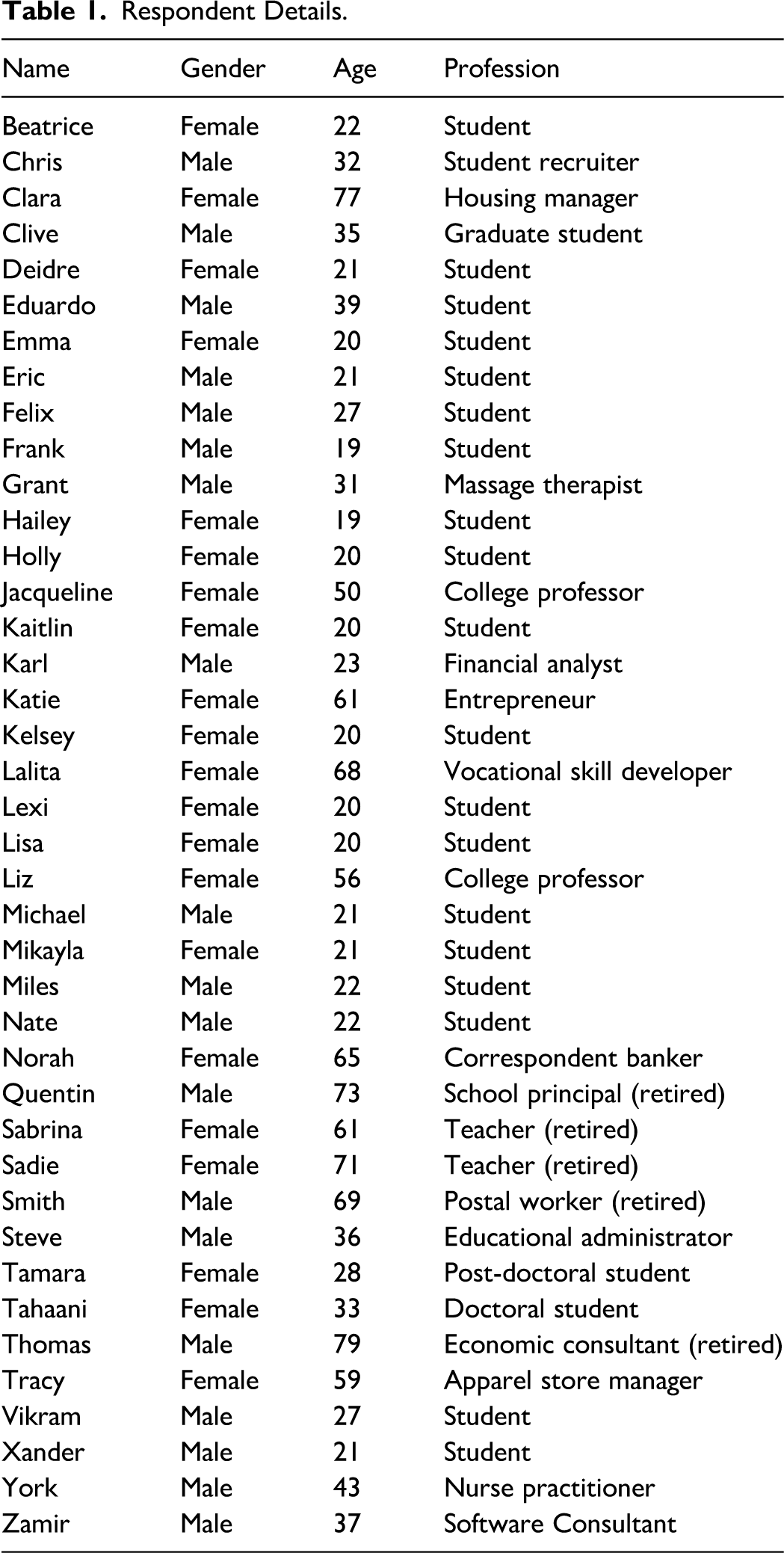
The semi-structured interview protocol (see Appendix A) was designed to extract rich narratives of personal experiences with meaningful consumption to better understand its thematic essence. Open-ended questions prompted participants to recall purchases they deemed personally significant or associated with meaningful happiness. Although respondents largely directed the conversation, probing questions were used to get them to elaborate on their experiences. Examples included asking respondents to describe the motivations, emotions, and memories they associated with a meaningful purchase. We also asked for examples of purchases they considered meaningful but not pleasurable to gather accounts of experiences that were challenging yet ultimately rewarding. This method yielded detailed narratives, enhancing our understanding of shared themes in meaningful consumption (Merriam and Tisdell 2015; Patton 2002). Interviews proceeded until theoretical saturation was achieved, defined as the point where additional data yielded no new insights and existing thematic categories could successfully encompass the data (Charmaz 2003; Creswell and Poth 2016).
Data Analysis
The 40 interviews resulted in 1,530 min of recordings and 580 pages of transcripts, constituting our primary research corpus. Analyses were conducted using the NVivo 12 qualitative software package due to its flexibility in organizing and analyzing data (Sinkovics 2016; Sinkovics and Alfoldi 2012). All authors immersed themselves in the data by repeatedly reading the transcripts. Data analyses involved open coding to assign relevant respondent quotes to initial NVivo codes and axial coding to organize such codes into relevant themes linked to meaningful consumption (Corbin and Strauss 2008; Creswell and Poth 2016), with subsequent renaming and reorganization as necessary (see Appendix B). This iterative process involved regular team discussions to consolidate findings and interpretations. Disagreements were resolved through discussion and the final set of themes and sub-themes presented in the next section represents a consensus between all authors. Our approach mirrored the constant comparative method (Spiggle 1994), oscillating between individual accounts (the parts) and the collective thematic framework (the whole) to refine concepts (Hirschman 1992; Thompson, Locander, and Pollio 1990). This process continued until theoretical saturation was reached at which point the themes and sub-themes could accommodate all accounts of meaningful purchases and no new themes were needed (Charmaz 2003).
Findings
Our analysis reveals three central themes underpinning meaningful consumption: rejuvenation, expansion, and consolidation. All themes are associated with specific sub-themes that depict how consumers typically experience them. Rejuvenation can occur via repair and reconnection, expansion can occur via intellectual, pragmatic, or relational growth, and consolidation can occur via crystallization and contextualization. The critical insight we propose is that while a purchase may become meaningful due to one or more themes or sub-themes, it would be unlikely to become meaningful in the absence of any of these.
Rejuvenation
Rejuvenation is the first theme associated with meaningful consumption experiences. We posit that some purchases become meaningful to consumers due to their restorative impact. They offer consumers a means to heal and recover from the psychological demands of everyday life and reconnect socially with others. This theme is exemplified by consumers who seek restorative experiences that provide a respite from routine stressors. Lalita articulates this sentiment when she describes her family vacations as meaningful, attributing their value to the opportunity they provide for relaxation and renewal: “It's just that [life sometimes] overwhelms you. And [when you’re travelling] you’re not dealing with the daily pressures of work or deadlines and meetings, you are away from all that…It just gives you a feeling that it's worth it. Just to get away.”
Repair
Respondents frequently spoke of how meaningful consumption experiences helped them get a reprieve from their daily routines (and the common stressors embedded therein) and facilitate a sense of repair or healing. Tamara considered her gym membership and fitness classes as meaningful because she could “just let go of everything and relax” as they provided a way for her “to destress, to compartmentalize the stress of the day, shove it aside, and focus on long term health.” In a similar vein, Lalita mentioned a vivid recollection of a family trip undertaken more than a decade ago to Southern India where an effortful climb was rewarded with utmost peace: “We had to climb 300 or 350 steps and it was quite a steep climb. But once we were up there, there was so much peace…with yourself and your surroundings. Outside of the daily drag and the daily rush of life. You just have to take time out and go to these places where you can feel the sanctuary or the peace.”
Reconnection
Purchases that allowed respondents to rekindle important relationships by helping reconnect with close others in their lives and maintain relational ties with family members and friends were often reported to be meaningful. Frank fondly remembered a ticket purchase to a basketball game that allowed him to reconnect with his dad after being away for five years, despite the emotional labor and stress involved in being able to purchase tickets to sit together: “One of the most meaningful purchases I would consider ever in my entire life I just did for Christmas [when] I took my dad to the Kentucky-Louisville basketball game. As a student…I [got an] $11 ticket for myself and his was $130, but to me that was nothing. Typically, you spend $500 or so on a ticket to be as close to the court as we were for that game. So that was extremely meaningful for me…It was awesome to take him to something like that and get to share it with him.”
These accounts help extend the conceptual framework on consumer escapes (Cova, Carù, and Cayla 2018) by delineating which forms of escape can be rejuvenating. Cova, Carù, and Cayla (2018) suggest that consumers often seek to escape from the structural confines of their lives such as urban stressors or high-pressure workplaces. Such escapes might include retreats into nature or experiences in human-made environments offering spectacle, entertainment, pleasure, or even risk (e.g., Arnould and Price 1993; Canniford and Shankar 2013; Husemann and Eckhardt 2019a; Kozinets et al. 2004; Scott, Cayla, and Cova 2017). Our findings mirror this spectrum, with Lalita's nature-centric experiences on one end and Tamara's and Frank's activities in constructed spaces like gyms and sports venues on the other. From a hedonic perspective, the value of these escapes might seem contingent solely on the level of excitement or tranquility they afford. However, our data reveal that their meaning for consumers often lies in the opportunities they present for personal repair and social reconnection. The significance of both extraordinary and mundane experiences emerges here (Bhattacharjee and Mogilner 2014; Caru and Cova 2003), with rejuvenation being as accessible through a simple fitness class (Tamara) as through an elaborate international journey to reunite with a friend (Clara).
Expansion
The second theme linked to meaningful consumption is one we term expansion. We argue that some purchases become meaningful to consumers by providing them with a sense of growth. This growth can take several different forms depending on the aspects of the consumer's life that are impacted by the purchase. Tahaani “felt really good investing money on any kind of book on achieving balance in one's career” because such books served as “self-learning experiences which made [her] learn something.” In contrast, Karl worked on improving physical capability via the time and money he spent on his CrossFit gym membership: “I feel like I actually did something meaningful by going out and making my body better physically, versus sitting on my couch eating chips, you know? It's like knowing I made a better decision with my choices. ‘Cause I know it's better for my body and my mentality in the long run.”
Intellectual Expansion
A common avenue for expansion resulting from a purchase was via an increase in consumers’ knowledge level as they perceived the broadening of intellectual horizons to be meaningful. Such intellectual expansion, moreover, was found to occur either due to direct, first-hand consumer experiences in certain consumption contexts or vicariously via purchases that allowed consumers to add to their knowledge about one or more topics.
An example of direct intellectual expansion was from Quentin's account of a trip he had taken in 1971 to Iran and Syria that he still considered deeply meaningful as it “changed me because I had experiences [that] made me less afraid and gave me a wider viewpoint.” An example of vicarious intellectual expansion, in contrast, came from Tracy who talked about investing in purchases that helped her pursue continual learning and growth: “I have friends who’re perfectly happy to go home every night and sit in front of the TV. Don’t get me wrong! I enjoy watching some shows too! [laughs] But I also would prefer taking that hour a day, and specifically reading [a new book], trying to understand something better, or continuing to grow, versus just leaving my mind stagnant.”
Pragmatic Expansion
This second sub-theme was seen through respondent accounts of purchases that facilitated acquisition and/or refinement of practical skills. Such pragmatic expansion could occur in a focused sense when consumers spent money to pursue a specific skill or in a diffused sense involving a general improvement in multiple interlinked skills.
In addition to Karl's example of trying to become better at CrossFit mentioned earlier, another example of focused pragmatic expansion came from Smith who “spent money on flight books, lessons on learnin’ how to fly, and learnin’ how to do compass” in his eventually successful bid to become a certified pilot. Sabrina, similarly, considered any expenditures on do-it-yourself (DIY) products to be meaningful because of the satisfaction she felt in becoming self-reliant: “Going ‘Oh! I did that! I DID that!’ There's nothing that people wouldn’t be able to fix in their home if they just look into it a little bit. So, it gives you a lot of confidence. You aren’t gonna know it if you don’t try.” “I got to stay there for about a month and a half. After a week or two I just had to…just live my life. Getting groceries, taking the subway…and that was a local thing. I like that that way you get more experience than you do as a tourist, right? And that experience, the different way of living? I felt like one of the locals!”
Relational Expansion
The final sub-theme linked to expansion involved the formation of new relationships or the deepening of existing ones as the result of a purchase. Such relational expansion, moreover, could occur not only with close others (such as family members and friends) but also with comparative strangers whom consumers met during certain consumption episodes. In contrast to reconnection discussed earlier, with its focus on rebuilding relations, relational expansion necessarily involved an aspect of newness, whether in relation to close others or strangers.
Examples of the former were seen through accounts of shared experiences with family and friends, such as Thomas enjoying time spent meeting and bonding with “new nephews and new nieces” during his annual reunions when he got to meet the new additions to the family. Sadie, similarly, enjoyed “the new friendships” she made during meditation retreats she undertook (that required long journeys from the Midwest to upstate New York but which she considered extremely meaningful) because they allowed her to “meet other beings that are on the same path as you, or at least attracted to the same kinds of goals.”
In comparison with forming new relationships, relational expansion was also seen through instances of gift-giving that helped consumers deepen ties with close others, as seen from Tamara's thoughtful present to her niece: “She's studying biology and is particularly interested in flowers and botany. So, I got her a very small edelweiss necklace from Austria. She really enjoyed it and that gave me a lot of happiness because it was meaningful for her…My parents bought me a bracelet when I went to college so I was trying to do something that is memorable for her so that she could have fond memories.” “Because what I was paying for was the connection, that moment of connection with my friend, in a moment where she needed me, or we needed each other. And that experience of being there in that space, that is relevant to me.”
As growth is often integral to meaningfulness (Bauer and McAdams 2010; Bauer, McAdams, and Pals 2008; Dweck 2006; Ryff 1989, 2014), our findings conflate various experiences under the overarching theme of expansion. Similar to rejuvenation, growth can manifest in a personal (intellectual and pragmatic expansion) or social (relational expansion) sense. Our insights on intellectual expansion also add a eudaimonic perspective to past work on consumer search and learning (Bloch, Sherrell, and Ridgway 1986; Latour and Latour 2010). Beyond functional and hedonic gains, consumers find meaning in the pursuit of knowledge on high-involvement topics, as exemplified by Tahaani's and Tracy's perception of books as intellectual investments. Such instances, along with Karl and Smith's accounts, underscore the inherently eudaimonic nature of serious leisure pursuits (Stebbins 2016). Moreover, relational expansion highlights the meaningful possibilities of experiences that allow consumers to deepen their connections with others or to form transient or lasting relationships with people they have never met before. In terms of deepening relationships, our findings are consistent with extant work on gift-giving (Sherry 1983). However, diverging from the notion that experiential gifts are better than material ones (Chan and Mogilner 2017; Puente-Diaz and Cavazos-Arroyo 2021), our findings also demonstrate how both can foster meaningful relational expansion, as seen from Tamara's gift of the necklace and Jacqueline's gift of coffee and companionship.
Consolidation
The third and final theme identified within meaningful consumption was consolidation. We propose that certain purchases become meaningful as they contribute to a nuanced process of synthesis, enriching consumers’ self-understanding because of their consumption experiences. Rather than accruing knowledge on an external subject (as seen with intellectual expansion), consolidation involves profound introspection into one's identity. This insightful understanding can emerge in two possible ways: one involving an internalized understanding of one's true self, and the other involving an externalized understanding of one's place within the broader world. We refer to the former as crystallization and the latter as contextualization.
Crystallization
Respondent accounts revealed how several meaningful purchases were intricately linked to a sense of solidification of a consumer's true self, analogous to how crystals form when atoms or molecules solidify into a structured pattern. Such crystallization could occur because of deliberate purchases made with a clear objective or through serendipitous purchases that resulted in personal epiphanies linked to deeper self-knowledge.
An example of intentional crystallization came from Jacqueline who, in summarizing all her meaningful purchases, mentioned how the purchases we make “tell a story of ourselves, of who we want to be” and how such stories are “necessary for the construction of our living because those narratives are constructed by what we do…and what we consume.” Zamir's account of purchasing mountaineering equipment also reflected a similar sentiment: “When you climb a big mountain, it's so much pain and cold. And throughout the whole thing you’re suffering. But after that achievement…you feel, ‘Oh, I achieved something so big!’ And that's so fulfilling…I have spent more money on [climbing equipment] than I have not spent on other things in life! So, I would consider it meaningful, yes, because…that purchase is just a tool, a commodity, toward a meaningful experience.” “Even when I was building the fence, I was kind of an asshole to my friends. ‘Cause I was just stressed with the work. So, I learned that I don’t handle stress as well as I should. I found out I wasn’t as relaxed as I always thought I was. Which is helpful, you know? Gives you something to work on! So, I should work on maybe not being as cranky (laughs). And the realization is important, helps you deal with your life.”
Contextualization
Beyond crystallization, meaningful consumption can also involve contextualization that allows consumers to gain a deeper appreciation of their place within larger factors in their lives. By providing such a broader perspective, contextualization heightens consumers’ awareness of their present circumstances in relation to more extensive constructs. This understanding typically emerges when a purchase acts as a catalyst for the consumer to reflect on their life's temporal flow, spatial belonging, or cosmic significance.
Temporal contextualization was evident in narratives where purchases prompted consumers to adopt an integrative view of time, transcending the immediate moment. Sometimes, the reference point was proximal; consumers recounted how specific purchases encouraged introspection about the connections between past experiences, present realities, and potential future scenarios in their personal journeys. This was seen in the case of Liz who spoke of acquiring a greater appreciation for her present circumstances after taking her kids on a trip to Europe: “I had always wanted to travel abroad when I was younger, and sort of felt frustrated that I started my career and how that tied me down so that I couldn’t [travel] when I was younger. But then I realized that I got to do that with my own children when they were grown up and so, that was a really meaningful experience for us.”
In other cases, the frame of reference was relatively distal; certain purchases resulted in a more empathetic understanding of people belonging to a different time-period. An example of this came from Katie who took a trip to Butte, a mining town in Montana, and remembered her foray down a mine shaft:
“I mean, it's nowhere near what those men lived through! But it did give you just an inkling of what it was like to be down there. You can read about history, but to actually be put into an experience like that? It gives it a whole different…element of realization.” “Because it's beautiful out there when you fly over a corn field, and the soybean fields, and see the farmers out on the land [who are] cultivating it. It kinda touched my heart. You fly from Lincoln to Grand Island or Pawnee, you see the expanse of this state, and you feel just thankful that you’re alive, you know? And it made me feel a lot better. Because you see the expanse of territory, from one end of the state to another. And how that experience makes you appreciate life.”
Such contextualization was also seen in a more sociocultural sense when certain purchases resulted in a greater sensitization among consumers due to the people they encountered during the consumption experience. Karl, in speaking of his general fondness for spending on travel, mentioned: “I grew up in the Midwest, I’ve seen the southwest, and the west coast, and how people are so different. And it just kinda makes you think about how other people are brought up and how [they] have lived life. And it makes you take [fewer things] for granted. ‘Cause you kinda understand different backgrounds and everything…Kinda helps you understand where other people are coming from.” “We got off the boat and, maybe a quarter mile away, we could see a glacier. And the guide said, ‘The glacier used to come up to where we’re standing.’ And, you know, if you have that kind of experience, it makes climate change real.” “We listen to the teachers who are usually published authors and writers, theologians, and spiritual teachers. So, when I purchase those kinds of things, I feel substantially content, that this is what I’m supposed to do. It kind of aligns with what I feel is my calling. It deepens each and every individual's sense of the spiritual dimension, sense of God, sense of themselves. And you grow in respect for the world as a whole, and the family of man that we’re a part of. It becomes much more universal.”
Crystallization and contextualization both expand upon previous research, albeit in distinct ways. Travel is shown to facilitate consolidation, offering experiences and conditions conducive to enhancing self-awareness and an understanding of one's role in the world. This supports earlier work on the eudaimonic potential of travel (Husemann and Eckhardt 2019a; Moal-Ulvoas and Taylor 2014; Sirgy and Uysal 2016) and delineates specific avenues through which it can engender meaningful experiences.
Our findings on crystallization bridge the concept of the true self—the subjective sense of understanding our genuine identity (Schlegel et al. 2009; 2011)—with meaningful consumption experiences. The development of the true self is construed either as a process of self-creation or self-discovery (Schlegel, Vess, and Arndt 2012). The self-creation view suggests that individuals craft their identity through deliberate choices whereas the self-discovery view posits that the true, inherent self is revealed through various experiences. Hence, purchases that lead to either intentional or unexpected crystallization, exemplified by Zamir's and Clive's experiences, are deemed meaningful to consumers.
Contextualization, on the other hand, brings together and extends insights from several domains, including the interplay between time perception and meaningfulness, consumer wisdom, and experiences of awe. Temporal contextualization aligns with findings on how thinking about time integratively (balancing past events and future considerations with present circumstances) can enhance life meaningfulness (Baumeister et al. 2013). It also builds upon the consumer wisdom literature (Luchs and Mick 2018), connecting retrospection and prospection with a higher quality of life (Luchs, Mick, and Haws 2021; Mick, Bateman, and Lutz 2009), as illustrated by Liz's and Katie's reflections on their past and future in relation to their present. Accounts of the diverse forms of contextualization also resonate with the concept of interbeing (Hanh 1987), wherein certain purchases heighten the recognition of life's interconnectedness, as seen in Smith's and Karl's experiences. Quentin's portrayal of cosmic contextualization, where the awe experienced during his trip to Chile underscored his place amidst grander forces, lends substance to the theory that awe can inspire a revaluation of one's life perspective (Keltner and Haidt 2003; Rudd, Vohs, and Aaker 2012). Consistent with research suggesting that awe engenders a readiness for new experiences (Rudd, Hildebrand, and Vohs 2018), Sadie's narrative also indicates that an awe-inspiring purchase may motivate future awe-seeking behavior.
General Discussion
The objective of this study was to delve into consumers’ experiences of meaningful consumption. By adopting a eudaimonic perspective and utilizing a phenomenological research method, the present research investigated various purchases deemed meaningful. Our analysis identified three primary themes and seven sub-themes within meaningful consumption (see Table 2).
Meaningful Consumption: Central Themes and Sub-Themes.
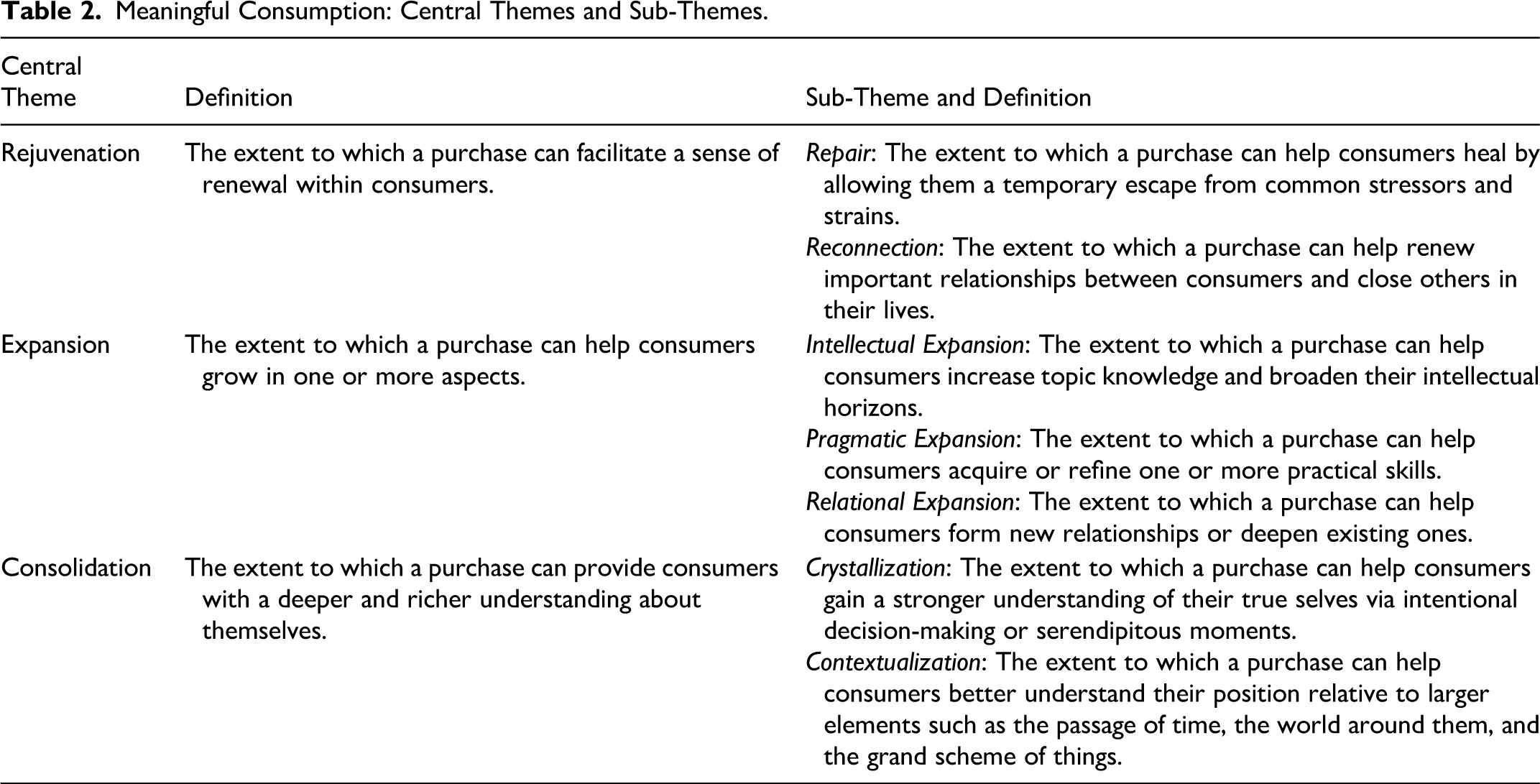
We observe that while a single purchase might not simultaneously connect with all these facets, it is deemed meaningful if it resonates with at least one.
Theoretical Contributions
This research makes three salient contributions to the field of macromarketing. First, it distills the essence of meaningful consumption into an overarching framework of concrete themes and sub-themes, reflecting a wide array of consumer experiences. This is one of the first studies within the discipline to focus explicitly on meaningfulness, thereby integrating and expanding upon previous studies that have considered the value consumers place on possessions, brands, or experiences (Ahuvia 2005; Arnould and Price 1993; Fournier 1998). This enriches the body of work in macromarketing that links consumption to quality of life (Andreasen 1978; Ekici et al. 2018; Lee et al. 2002) and aligns with the tenet of how research should encompass aspects like life satisfaction and overall happiness that go beyond customer satisfaction (Shapiro, Tadajewski, and Shultz 2009; Sirgy 2021; Wilkie and Moore 2006). Our study elucidates how certain purchases contribute to consumers’ quality of life through experiences of rejuvenation, expansion, or consolidation.
Second, by shifting the focus from utility and pleasure to meaningfulness, our study responds to calls withing macromarketing that have encouraged bringing a eudaimonic lens to consumer research (Olsen, Khoi, and Tuu 2022; Sheth and Parvatiyar 2022; Sirgy 2021). While previous research has implicitly or explicitly adopted a eudaimonic stance (Biraghi, Dalli, and Gambetti 2021; Mugel, Gurviez, and Decrop 2019; Sirgy and Uysal 2016), framing eudaimonia as meaningfulness helps provide a novel approach to go beyond traditional utilitarian/hedonic perspectives on consumer well-being (Andrews and Withey 2012; Ekici et al. 2018; Lee et al. 2002; Meadow and Sirgy 2008; Sirgy et al. 2008). As illustrated via our findings, doing so paves the way for an even more nuanced understanding of the role consumption plays in impacting quality of life and well-being. The importance of making a distinction between pleasure (hedonia) and meaning (eudaimonia) is further underscored via purchases that are perceived to be meaningful despite being challenging or effortful to pursue.
Finally, this study adds to current discourse on mindful, conscious, and spiritual consumption by illustrating how the concept of meaningful consumption can tie together such experiences while also being able to accommodate additional experiences that may not quite fit certain criteria (to be labelled mindful, conscious, or spiritual). Mindful consumption is described as a temperance-based approach that considers the consumer's self, community, and environment (Sheth, Sethia, and Srinivas 2011) and often involves a heightened focus during consumption (Bahl et al. 2016). Our findings show that while certain acts of contextualization reflect this broader awareness (as with international travel), others (like a CrossFit class) may not. Similarly, while some instances of meaningful consumption were marked by focused attention (such as climbing a mountain), others unfolding over a longer time (such as a family reunion) were not. Conscious consumption, similarly, is rooted in making intentional ethical choices (Palakshappa, Dodds, and Bulmer 2022; Roux and Nantel 2009), yet we found that moments of serendipity also played a role in meaningfulness as they sparked self-discovery. Furthermore, while spiritual consumption was evident in some instances of crystallization and cosmic contextualization, where purchases provided meaningful encounters with one's inner self or a higher power (Husemann and Eckhardt 2019b), meaningful consumption spans a broader spectrum of experiences not all of which are tied to spirituality. Thus, not only does this study help in integrating previous strands of research on consumption experiences that foster well-being, but it also provides a cohesive framework that can accommodate these along with a diverse array of other meaningful consumption experiences that are valued by consumers because of the rejuvenation, expansion, or consolidation they bring to their lives.
Practical Implications
Our study can provide valuable insights for marketers and policymakers about the significance of market offerings in consumers’ lives, particularly through their connection to meaningful consumption experiences. The delineated themes and sub-themes can guide efforts to promote societally beneficial consumption behaviors like recycling or purchasing sustainably produced goods. Consumers often dismiss their individual impact as inconsequential, which can deter them from participating in such practices. Yet, community leaders might leverage relational expansion by encouraging involvement in local recycling initiatives, or they could stress the contextualization experience of pro-environmental actions, enhancing consumers’ appreciation of their contribution to environmental preservation.
Additionally, the findings offer a guideline for financial decision-making, helping consumers distinguish between transient hedonic purchases and those that, while perhaps challenging in the short term, prove meaningful over time. Consider education-related expenses, such as textbooks or tuition fees; these can strain budgets and might be seen as burdensome from a strictly utilitarian or hedonic view. However, by positioning these expenditures as opportunities for intellectual or pragmatic expansion, marketers could strengthen the perceived value of education, potentially lowering entry barriers for consumer segments who would most benefit from it. Another reassuring takeaway is that meaningful experiences can also stem from modest, low-cost purchases. This suggests that a sense of meaningful happiness is attainable across economic spectrums. Small investments in activities that foster rejuvenation (like a visit to a tranquil café or a massage session) or expansion (through a one-time creative workshop) can enhance consumers’ lives regardless of their disposable income.
Lastly, marketers could highlight the meaningful dimensions of their products or services. For instance, Airbnb markets its Experiences by underscoring the expansion opportunities—whether through learning about a locale, acquiring new skills, or forming friendships—and the potential for consolidation, as travelers may deepen their understanding of different cultures and contexts in relation to their own. Considering research advocating for the inclusion of meaningfulness in advertising to boost well-being (Dodds, Jaud, and Melnyk 2021), such marketing strategies could positively influence customer perceptions. Ultimately, the more avenues that consumers can find to experience rejuvenation, expansion, and consolidation in the marketplace, the more they are likely to view such offerings as meaningful.
Limitations and Future Research
As with any scholarly work, this study is not without its limitations, which arise from its methodological choices and scope. Although our research uncovers various aspects of meaningful consumption experiences, further study into the relative impact of these aspects could enhance our understanding. Quantitative methods could discern if certain purchases are perceived as more meaningful due to a particular combination of themes and sub-themes. Additionally, a comparative analysis of material versus experiential purchases could provide valuable insights, especially considering existing research on their divergent connections to meaningfulness (Kumar and Gilovich 2015; Van Boven and Gilovich 2003). While experiential purchases are often linked to greater meaningfulness (Weingarten and Goodman 2021), material purchases may also serve as symbolic commemorations of significant life events (Goodman, Malkoc, and Stephenson 2016). Delving into how these two purchase types contribute to rejuvenation, expansion, and consolidation could refine our comprehension of their distinct roles in consumers’ lives.
Examining meaningful consumption across diverse cultural contexts and among vulnerable populations (Baker, Gentry, and Rittenburg 2005) could illuminate how different societal and economic factors influence the pursuit of meaningful happiness. Moreover, questions such as the cultural shaping of meaningfulness and the intentionality of consumers under resource constraints also warrant exploration. Further qualitative research could also examine whether the themes identified here are universal or if new themes emerge as more central to meaningful consumption in varied consumer groups.
Investigations into individual differences, such as personality traits, regulatory focus, or mindset, could shed light on their influence on planned versus serendipitous meaningful consumption experiences. Furthermore, the impact of meaningful consumption on future purchasing decisions poses intriguing questions: Do certain meaningful experiences prompt repeated behaviors or encourage diversification in consumers’ buying patterns? Does a focus on meaningful consumption lead to more sustainable consumer behavior? And how does meaningful consumption contribute to overall well-being or life satisfaction?
These questions, among others, beckon future researchers to further explore the emergent domain of eudaimonic perspectives on consumer behavior. By establishing a foundational understanding of the experience of meaning in consumption, we aim to propel ongoing inquiries into how our purchases can help us craft a rich, fulfilling, and memorable life.
Footnotes
Associate Editor
Alexandra Ganglmair-Wooliscroft
Declaration of Conflicting Interests
The author(s) declared no potential conflicts of interest with respect to the research, authorship, and/or publication of this article.
Funding
This manuscript is based in part on findings from the first author’s dissertation which was completed during the doctoral program at the University of Nebraska-Lincoln. The authors would like to gratefully acknowledge the financial support they received from the Marketing departments of the College of Business at the University of Nebraska-Lincoln and the College of Business and Economics at the University of Kentucky for conducting this research.

Author Biographies
Appendix A: Interview Protocol
Thank you for agreeing for this interview. I appreciate you taking the time to help me in my research and I’m looking forward to hearing your thoughts. Before we begin, let me reassure you that our discussion will remain completely confidential. If you have no objection, I will record our interview so that I can transcribe it later. I won’t disclose your personal identity to anyone as I will use a pseudonym instead of your real name. So, please feel comfortable in speaking freely, especially as there are no wrong answers to any of the questions.
As part of my research, I’m trying to understand how people think about the ways they spend their money and I wanted to hear your perspective on this topic.
I’d like to start by asking you about some examples from your own life when you spent money on something that you consider to be meaningful.
What made it meaningful to you?
What all did you enjoy about that purchase? Are there any other things/elements that added to the meaningfulness? Are there any emotions or memories in particular that you associate with this purchase? Anything that stands out? What was the process of making that purchase? Was it planned or spontaneous? What were the stages involved? Were there any other motivations for making that purchase? Was there anything that you did not enjoy about that purchase? What other examples of such purchases can you think of which stand out in your memory for being meaningful?
(Same probes as the previous question) Now, shifting gears a bit, I’d like to ask you for some examples of purchases when you spent money on something that you consider to be more fun or pleasurable, but not that meaningful.
What made it pleasurable to you?
What all did you enjoy about that purchase? Was there anything that you did not enjoy about that purchase? What are some factors that lie behind you not considering it meaningful? Do you think there have been any meaningful purchases that were (Same probes as those for the initial question) Would you like to share any final thoughts on meaningful purchases?
Thank you, this was very helpful. I really appreciate you taking the time to help me with my research!
Appendix B: Using NVivo for Analyses
First, transcripts are imported from Microsoft Word into NVivo such that each transcript becomes a file (the NVivo term for a data record to be analyzed). Analysis then proceeds through a process of assigning, organizing, and reorganizing codes based on the researcher's reading of each file. A code is essentially a descriptive label created by the researcher to which they assign portions of text from each file (respondent quotes in this case) which fit with that label. As a researcher goes through each file and assigns various quotes to relevant labels, the software also provides a numeric tally of the number of references (the number of quotes) aggregating within a label and the number of files they are drawn from. This provides a quick way for researchers to assess how often a topic comes up within the data and how many respondents discuss it. Finally, NVivo also allows a hierarchical ‘tree structure’ to be created such that certain codes can be nested within other codes, a useful feature when conceptualizing themes and sub-themes. When required, researchers can also rename codes and reorganize data by dragging-and-dropping codes into and out of any given level within the tree structure.
As an example, as mentions of social relationships (such as those with family members, friends, or new acquaintances) were frequently seen in respondent accounts of meaningful purchases, we first collected all such references under an open code named ‘Relatedness’. Then all quotes under this open code were re-read with a focus on spotting similarities and differences between them. One such key difference was seen in terms of how some respondents considered a purchase meaningful because it allowed consumers to reconnect with their loved ones while some considered a purchase meaningful because it helped them make new social relationships. All relevant quotes associated with the first experience were then assigned to a new open code named ‘Old Relationships’ while those associated with the second experience were assigned to one named ‘New Relationships.’ During axial coding, which involved organizing and reorganizing the open codes to arrive at the overarching central themes and nested sub-themes, we saw that ‘Old Relationships’ belonged as a sub-theme under a larger theme we named ‘Rejuvenation’ (referring to the experience of renewal or regeneration that respondents linked to instances of meaningful consumption). The examples we had collected under ‘Old Relationships’ reflected that consumers cherished certain purchases because it allowed them to renew social bonds of family or friendship. Consequently, ‘Old Relationships’ was renamed ‘Reconnection’ and nested as a sub-theme under the main theme of ‘Rejuvenation.’ Similarly, ‘New Relationships’ was eventually nested as a sub-theme under the main theme of ‘Expansion’ and eventually renamed ‘Relational Expansion’ due to its focus on forming new social bonds and expanding the relational circle of a consumer.