



Abstract
Marketing systems, while being pivotal to contemporary progress, have been linked to multifaceted global challenges, notably increasing inequalities and accelerated climate change repercussions. These challenges are not natural phenomena, but rather, human-induced crises, emerging predominantly from flawed systems of perception and action. Unfortunately, these flawed perspectives are also embedded within research and theoretical practices, leading to overly simplistic and disjointed results. This paper champions the introduction and application of corrective metatheories, specifically targeting these tendencies of reductionism, to bring coherence to the various domains of existence – be they subjective, intersubjective, interobjective, or objective. Using Roy Bhaskar's philosophy of critical realism, this paper elucidates how this particular metatheoretical approach can address the complexities inherent to marketing systems. Through Critical Realism, the paper aims to challenge reductionist narratives, critique societal shortcomings, and promotes both individual and collective potentials to support overall flourishing.
Introduction
Our world is replete with untapped potential, manifesting as a paradox of abundance amidst deprivation. This contrast is evident in the global system's capacity to meet universal needs, yet significant disparities in resource allocation and access to opportunities mar it. The recent public health crisis has laid bare the intricate connections within our global society, bringing into sharp focus the escalating gaps in inequality. Concurrently, the unrelenting pursuit of economic growth casts a shadow over our environment, effectively compromising the wellbeing of future generations for the present affluence of a select few and the consumption of the many. These pressing economic and ecological issues underscore our collective failure to effectively manage the unintended consequences of our intricate economic and social systems.
Macromarketing is positioned at the intersection of these challenges, pursuing the imperative of a sustainable balance among individuals, societies, markets, and the environment (Shultz 2016; Varey 2012) and championing an emancipatory outlook. By embracing systems-oriented perspectives and advocating for marketing as a social science, macromarketing critiques dominant paradigms and addresses broad concerns ranging from poverty to environmental exploitation (DeQuero-Navarro, Stanton, and Klein 2021; Layton 2016; Löbler 2016; Shultz 2016). Despite its progressive stance and the clarity provided by frameworks like Layton's Marketing Systems (Layton 2015), macromarketing is limited by the absence of a cohesive metatheory to guide its discourse and practice (Akaka et al., 2023). The recent resurgence in the call for robust conceptions and explicit attention to metatheory in marketing research (Lucarelli and Giovanardi 2019; Möller and Halinen 2022; Pedeliento et al. 2023; Thomas 2018) is timely. While previously much more prominent in marketing theory (Bartels 1970; Zaltman, Pinson, and Angelmar 1972), discussion of metatheory has been subsumed by the fragmentation of knowledge and research, methodological focus and the bifurcation of paradigmatic assumptions (Hunt, Madhavaram, and Hatfield 2022).
A coherent metatheory establishes the explicit commitments to the sociological and philosophical bases that shape our worldview and the positions we are prepared to adopt. Thus, metatheory plays a ‘discourse regulative function’ and can counteract tendencies that reduce, fragment, obfuscate, or even perpetuate the causes of crises (Edwards 2016; Hedlund-de Witt 2013). This paper argues that a solid metatheoretical foundation is critical for advancing macromarketing and addressing the complex nature of crises, particularly those that are self-inflicted as a result of human actions and decisions influenced by inadequate “overarching systems of meaning-making” (Bohm 2005; Hedlund-de Witt 2013, p. 133).
This paper proposes a metatheory informed by Critical Realism aimed at overcoming the constraints of fragmented and narrow perspectives and addressing the complex nature of current global crises. It introduces the MELD framework, which offers a nuanced understanding of causality and being, highlighting the dynamic interplay between structure, process, emergence, and human agency in our social world. The paper posits that this framework can effectively serve as a ‘discourse regulative function’ by harmonizing diverse perspectives across disciplines, championing epistemological diversity, and equipping for insightful social critique. It addresses the intricacies of interconnected systems, thereby addressing crises and promoting both individual and collective prosperity.
Thus, this paper extends upon Grönroos’ (2023) advocacy for reflexivity, calling for a critical examination of underlying theoretical assumptions and encouraging formulating alternative perspectives that offer fresh insights. Following Roger Layton's transformative approach in macromarketing, this paper sets out to a) underscore the need for a comprehensive metatheoretical framework, b) propose a metatheory influenced by Bhaskar's philosophy, and c) demonstrate how this approach can significantly enhance macromarketing research and knowledge production. The paper positions itself within macromarketing's quest for emancipatory objectives of Marketing as a Social Science (MASS), analysing and offering insights into market, economic, and ideological developments through systemic macromarketing perspectives (Ekici, Genc, and Celik 2020; Tadajewski et al. 2014).
In the following sections, the paper delves into the issues of narrow, reductionist, and fragmentary worldviews and their prevalence in research, discourse, and praxis. It illustrates these issues through economistic logic and consumption discourses and discusses how they are perpetuated by deficiencies in paradigmatic metatheory, leading to reductionist and fragmentary perspectives. In response, the paper champions a corrective metatheory grounded in Critical Realism, advocating its value in advancing macromarketing thought.
Crisis, Metatheory and Marketing
The twenty-first century is characterised by intertwined ecological, economic, political, societal, and existential crises (Shim and Bellomy 2018). These crises stem from intensely relying on flawed ideologies, goals, and practices in our societal and economic frameworks and their (re)production in our inter-subjective and subjective relationships and experiences. Dominant system narratives like neoliberalism, capitalism, and consumerism have drawn the ire of critics (Harvey 2014; Jackson 2009; Moore 2015; Roberts 2013; Speth 2008), who argue that such systems provide limited, splintered lenses that shape our collective understanding and co-creation of social reality.
Academic discourse is not immune to this fragmentation. Specialized, narrow focuses in academia are criticized for their limited scope, failing to address broader realities. Morin and Kern (1999) suggest that our reductionism and fragmentation have become “less of a solution than the problem itself” (p. 128). The increasing call for interdisciplinary science underscores this concern (Hulme and Toye 2006). Many of these divisions lie in the tendency to prioritize epistemology over ontology (Bhaskar 1994), emphasizing how we gain valid knowledge, over the reality that underpins it. As a result, we have veered either toward the hyper-analytic, hyper-specialized, fragmented gaze of late modernity or the sliding scale of postmodern relativism and its antipathy to integrated knowledge and obsession with texts, discourses, and social practice (Stein 2016). These divisions have prevented the types of integrative frameworks that can address the complexity of our crises.
The emphasis on methods of generating knowledge has often overshadowed the vital, reflexive, and integrative considerations of metatheory. Metatheory provides the foundation for how research addresses social functioning and serves as a holistic representation of the world, forming the basis for theory (Edwards 2016; Hedlund-de Witt 2013). As Fleetwood (2005, p. 197) aptly states, “The way we perceive the world influences what we believe can be known about it; how we believe it can be investigated; the type of theories we think can be formulated about it; and the positions we are willing to adopt.”
The marketing field has experienced an evolutionary trajectory similar to other academic disciplines. Metatheory emerged as a cornerstone as it grappled with defining its academic foundations, parameters and contributions. These developments were particularly evident during the movement toward establishing a general theory of marketing, as advocated by seminal thinkers like Hunt (1971) and El-Ansery (1979). Bartels (1970) played a crucial role in highlighting the significance of metatheory for integrating diverse theories within marketing. Similarly, Zaltman, Pinson, and Angelmar (1972) emphasized the role of metatheory in enabling researchers to explore the foundational assumptions and guiding principles underlying their research.
However, developments along these lines quickly reorientated the discussion of metatheory to epistemic and methodological paradigms (see, for example, Deshpande 1983 and Leong 1985), as marketing questioned, fought for, and rebuked its status as a scientific discipline (Hunt 2014). The result of this has been a reproduction of a similar trajectory to other disciplines, oscillating between the analytical ‘logical positivists or empiricists’ and the humanist interpretivists, social constructionists, and postmodernists (Arndt 1985; Hirschman and Holbrook 1992; Hunt 2014; Tadajewski 2004). The outcomes of this have been siloed speciality domains and conversations and an abstracting volitional and instrumental approach in which researchers are free to address those issues that they believe are most interesting or pressing while ignoring others and the greater integration of their knowledge into the Aggregate Market System.
It has only been recently with the return to developing sweeping analytical frameworks aiming to understand the complexity of aggregate market systems, like Layton's Marketing Systems Framework (2015; 2017) or service-dominant logic (Akaka et al., 2023), that the underlying issue of metatheory has been again prominently raised outside of paradigmatic bifurcations or critical studies. This also comes when the discipline again reflects on its fundamental nature and foundational assumptions (Grönroos 2023). In Layton's framework and macromarketing, more generally, there is a lack of a foundational metatheory (Akaka et al., 2023). Without a unifying metatheory to serve a ‘discourse regulative function’, the intellectual scaffolding of the discipline is weakened without explicit commitments to the sociological and philosophical grounds, foundational assumptions upon which we see the world and the stances we are prepared to take. This paper posits that a holistic metatheoretical framework is essential to address the multifaceted nature of our socio-ecological systems and avoid oversimplifications.
Illustrative Crisis and Inadequate Apprehensions and Enactments of the World
Macromarketing has emphasized broader societal interactions, addressing crucial issues like poverty and sustainability (DeQuero-Navarro, Stanton, and Klein 2021; Eckhardt, Dholakia, and Varman 2013; Fırat 2013; Mele and Spena 2021; Shultz 2016; Varey 2012). Moreover, macromarketing has acknowledged that many current manifestations of crisis are intimately tied to marketing (Löbler 2016; Nenonen 2022; Voola et al. 2022; Wooliscroft and Ganglmair-Wooliscroft 2018). However, as Kindermann et al. (2023) and others have noted, much of the mainstream of the discipline has long faced critiques, such as;
- a reductive concern with micro issues and short-term pragmatic problems, leading to a lack of theory development and contribution to domains outside of marketing research (Clark et al. 2014); - rhetoric of value trapped in selfishly motivated consumers, a disregard for inequality and the stratification of social groups, and a false sense of individual choice and freedom (Saren et al. 2007); - part of a relatively ‘uncritical’ business school agenda abandoning social, intellectual and ethical values in favour of uncritical managerialism (Dholakia and Firat 2017; Witkowski 2005), and; - a pseudo-conflict between quantitative and qualitative approaches (Gummesson 2003).
The following sections demonstrate how reductionism and centrism influence perceptions and actions in both dominant societal narratives and paradigmatic research approaches. Reductionism, the tendency to oversimplify complex systems by reducing them to their individual components, and centrism, the practice of focusing predominantly on a single aspect or viewpoint to the exclusion of others, significantly shape how we understand and interact with the world (Hartwig 2011). These tendencies lie at the heart of societal narratives, which often prioritize specific central themes or perspectives, and research approaches that may simplify complex phenomena into more manageable parts.
Institutional Disparities and Dominant Actor Hegemony
Reductionism manifests conspicuously in the ‘economistic fallacy’ (Harvey 2014; Hein and Mundt 2013), which elevates and codifies the economic system into an operational monolith, most palpable in the insular dialogue of economic analysis. In socio-economic systems, aspects such as human wellbeing, life quality, and environmental health have been superseded and conflated by the functions of debt-based financial systems and GDP as a progress indicator (Buchs and Koch 2017; Laczniak and Santos 2018; Stiglitz, Sen, and Fitoussi 2011). Environmental (climate change), social (e.g., income inequality), and human (e.g., mental and psychological health) costs have exceeded the perceived benefits (such as increased purchasing power to consume more products) of economic growth (Bonaiuti 2012; Buchs and Koch 2017; Hamilton 2003; Jackson 2009; Roberts 2013). Moore (2015) explains this as a byproduct of capital growth's reliance on inexpensive labour, energy, and raw materials. On a narrower level, the economic system's operational closure manifests through financialization—a pattern of accumulation where profits primarily accrue via financial channels, agents, and markets (Krippner 2005, p. 174). The financial crisis starkly exposed the perils of an overly abstracted, speculative, financialized economy. As the system amplifies its internal complexity, it paradoxically grows increasingly oblivious to the entropy it exports to its environment (Helland and Lindgren 2016; McNally 2009; Willke, Becker, and Rostásy 2013).
The same economistic logic encourages the commodification and economic valuation of ecosystem services and social, individual, or communal wellbeing. Natural systems are often perceived as non-dynamic capital resources, promoting a false dichotomy between social and ecological domains. However, not just the reductive exchange value proves problematic, but also the discourse on individualistic and experiential value creation. This discourse contributes to ‘supermaterialisation’, where costs are invisible through spatial or temporal displacement (Campbell, O'Driscoll, and Saren 2013; Hietanen, Andéhn, and Bradshaw 2018; Roberts 2013). In Harvey's (2014) words, “we do not notice that we have no idea where most of the items come from, how they are produced, by whom and under what conditions” (p. 6).
The Discourse of Consumption and Individuals
Undoubtedly, consumption issues are interlinked with debt and waste (Stockhammer 2015). Still, a substantial body of marketing literature posits consumption as a route to identity construction and freedom, compensating for modernity's repressive nature (Bauman 1988; Firat and Venkatesh 1995; Fiske 2000). However, this positive aspect of consumption stands contrasted against numerous problems. Firstly, there is the criticism of the freedom attributed to consumption (e.g., Schwarzkopf 2011). This critique recognizes the role of corporate media programming, market research and cultural institutions in conditioning us, privileging a range of meanings, and suppressing others (Firat 2005; 2013). Hietanen, Andéhn, and Bradshaw (2018) argue that freedom of choice in consumer culture is primarily freedom to make choices for acceptance or status acquisition within narrow meanings. The narrative of a free and developing consumer absolves marketing, corporations and our social structures from charges of seduction, coercion, and manipulation (Hietanen, Andéhn, and Bradshaw 2018; Ritzer 1999). The illusion of the autonomous subject masks embedding and constitutive relations, disenchanting the world and leaving consumerism and the self as the source of all awareness and value, promoting individualism, materialism and egoism (Adorno 2000; Baudrillard 1969; Hartwig 2011).
This perspective reduces individual freedom to the internalization and reproduction of the consumption/growth paradigm, gradually substituting the complexity of human motivation with addictive consumer behaviours (Buchs and Koch 2017; Nanda, Banerji, and Singh 2023). As a result, research links individualistic consumption and materialism to the dissolution of ethical attitudes, higher rates of physical and mental illness, including obesity and addiction, and antisocial traits (Chowdhury and Fernando 2013; Kasser 2003; Mullainathan and Shafir 2013; Reith 2004).
Inadequate Metatheory
These select examples reveal various hallmarks of the dominant social paradigm that are concurrently subjects of modern discourse and critique. These hallmarks include egoism, individualism, anthropocentrism, contempocentrism, and fetishism. Each symbolizes a form of reductionism and centrism found in the ‘overarching systems of meaning-making that substantially inform how humans interpret, enact, and co-create reality’ (Hedlund-de Witt 2013, p. 133).
This paper posits that these deficiencies are mirrored in, and ultimately perpetuated by, the shortcomings of prevailing metatheoretical frameworks and the systems of meaning-making in research that guide our conceptualization of the world, our methods of investigating it, and the perspectives we adopt.
Positivistic and Substantialist Reductionism
Consider, for instance, the metatheoretical stance of positivism, which endorses empirical realism based on observable, measurable, and quantifiable phenomena. Positivism prioritizes direct and largely theory-neutral engagement with the world, relying on scientific methodologies to establish nomothetic correlations of events (Caldwell 2015). This perspective can exacerbate knowledge production tied to previously mentioned societal problems. For example, its reductionist approach, grounded in measurement and quantification, aligns with the over-reliance on economic indicators (e.g., GDP, per capita income, corporate profit) as proxies for human welfare, thereby neglecting the qualitative and multifaceted essence of wellbeing. Likewise, the self-contained nature of the economic system and the monetization of natural and social systems underline the variable-oriented reductionism inherent in the positivist paradigm and the simplification of multidimensional complexity into self-referential operations (i.e., monetary valuation) (Hessling and Pahl 2006; Valentinov 2015).
Similarly, because causality under positivism is established through empirical patterns among observable variables, a substantialist lens is necessary, by which analysis must create divisible and separate entities that act on each other, abstracted away from their constitutive relations (Emirbayer 1997). This methodology tends toward linear and deterministic approaches, thereby inviting reductionist tendencies, overlooking the potential for unintended consequences from disregarding an entity's historical trajectory or relationship with its surroundings. For example, the focus on technological solutions such as fuel substitution and biofuel development for achieving CO2 reduction - a sustainability cornerstone- represents a reductionist view (Naess 2010). This view overlooks the fact that biofuels may inadvertently increase emissions of other greenhouse gases through their production methods (e.g., artificial fertilizers and land use changes), induce pressure to convert natural forests into energy crop plantations, and potentially impact food production areas - leading to higher food prices or threatening food security and livelihoods (Lacey 2015; Searchinger et al. 2008).
Positivist reductionism plagues research on sustainable consumption and the allocation of responsibility to consumers’ psychology, manifesting in behaviourist approaches and methodological individualism (the assumption that individual motivations primarily explain social phenomena) (Davies et al. 2020; Simmonds and Gazley 2018). These studies’ shortcomings can be partially attributed to reductionism and atomism, portraying human nature as static and detached from context. This approach neglects the influential social-structural contexts within which behaviours occur and how these social-structural relationships shape our actions, dispositions, lifestyles, and identities (Davies et al. 2020; Thomas 2018).
Elsewhere, the positivist emphasis on nomothetic explanation and deductive predictability engenders linear and actualist thinking (reducing the realm of possibilities to current realities). This perspective is detrimental when addressing contexts such as the ‘bottom of the pyramid,’ the marketization of poverty, and alternative economies, as it promotes fundamentalism and the assumption of the absence of alternatives. This line of thought is reflected in research that takes the economic models of developed countries—with their focus on financial capitalism, debt-driven consumption, and over-exploitation of nature—as templates for addressing challenges and promoting development (Figueiredo et al. 2015; McNally 2009).
Constructivist and Processual Reductionism
The emergence of constructivism, poststructuralism, and postmodernism can be seen as a reaction to the positivist traditions’ universalizing and static propensities (Agger 1991; Fleetwood 2014). These approaches sought to re-emphasize the role of identity and difference, highlighting the pivotal role of discourse in constructing our reality. In contrast to the nomothetic explanations provided by positivism, constructivist positions aim to attain idiographic knowledge through a hermeneutic understanding of the social world. The social world is perceived as a construct shaped by subjective perceptions and interactive exchanges within specific social contexts and cultures.
Unfortunately, the quest to delineate identity and difference often overshadows entities’ inherent interconnectedness and unity. Incorporating constructivism into marketing research has aimed to understand actors’ perceptions of their social world and their respective roles within it. The primary focus often lies on affluent consumers or influential corporate actors, thereby bypassing much of the complex realities that demand elucidation, instead favouring the immediacy of selected actors and interactions. Tadajewski et al. (2014) posited that the emphasis on consumer agency and their worldviews has supplanted critical reflection on the performative effects of deeper structures and power relations that shape or pattern experienced reality. Analogously, critiques of consumer-focused research have decried the hyper-individualizing, overly agentic, and ahistorical, ideologically and sociologically impoverished analysis of marketing and consumption (Fitchett, Patsiaouras, and Davies 2014; Moisander, Peñaloza, and Valtonen 2009). The associated discourse, exemplified by the phenomenological and idiosyncratic value-in-use, has been critiqued for reducing all meaning and value to the individual (Hietanen, Andéhn, and Bradshaw 2018; Simmonds and Gazley 2021). Tadajewski and Brownlie (2008, p. 5) succinctly captured this problem: “We are not faced with the child slave labour that has produced our highly-priced, expensively-marketed sports shoe. Nor do we witness the environmental waste discharged into a river as a result of the manufacturing process”.
Despite envisioning a multi-layered reality, the social constructivist foundation of market practice studies has been challenged for its metatheoretical resistance to it (Simmonds 2018). As Schatzki (2001, p. 3), a renowned practice theorist, asserts, “individuals, (inter)actions, language, signifying systems, the lifeworld, institutions/roles, structures, or systems… can only be analyzed via the field of practices”. This focus on specific behaviours, objects, and symbolic expressions hinders our ability to transcend immediate social situations and daily interactive orders (Reed 2000). The resulting narrative tends toward voluntarism, overlooking the influence of the past and the broader conditioning of socio-historical totality on the construction of the present context (Pedeliento et al. 2023; Simmonds, Gazley, and Daellenbach 2018). This issue parallels the insufficient consideration of the web of social, cultural, and historical contexts that constitute consumers’ roles and the capitalist logic of escalating resource throughput.
For instance, consider the analysis of Wall Street practices implicated in the Financial Crisis. While critiquing these practices is important, an overly narrow focus may overlook the market ideologies that emerged in the 1970s, setting the stage for the deregulation of the financial services industry, the elimination of banking restrictions in the 1990s, or the systemic imbalance between labour and capital earnings necessitating financial institutions and innovations to fulfil reinvestment demands (Homeland Security Permanent Subcommittee on Investigations 2011; Lawson 2009; Mah-Hui and Ee 2011). An overemphasis on contingent opportunities for interaction, at the expense of historical conditioning, leads to presentism that overlooks enduring causes of action, structures, and deeper power relations (Archer 1995; Delbridge and Edwards 2013). While it is crucial to scrutinize banks, lenders, and credit rating agencies’ practices and transparency, it is also imperative to question the developments that created the conditions for the crisis.
The Need for Alternative Metatheory
The preceding sections discuss the predominant ways society views and interacts with the world, highlighting issues like anthropocentrism (placing humans at the centre), fetishism (of the economic system), and egoism (an undue focus on individual interests), simplify and therefore create, mask or ignore unintended consequences, hidden costs or externalities.
While the previous discussions have illustrated the various dimensions and manifestations of reductionist tendencies in our societal and academic discourses, it becomes apparent that there is an underlying commonality in these diverse forms of simplification and oversight. This commonality can be identified in the adoption and reinforcement of certain metatheoretical positions within both our societal worldview and academic research.
This paper argues that these reductionist tendencies are reproduced by how we overlay our worldviews as both people and researchers. The issue for research does not reside in researchers tenaciously defending the polarised assumptions of paradigms, but rather, both overt and tacit adoption of paradigmatic foundations leading research to establish objectives, contributions, and implications that reproduce embedded structures and ideological positions (Grönroos 2023). As Overton (2007, p. 154) observes, metatheories “often reside quietly and unrecognized in the background of our day-to-day empirical science”. This can be seen in how neoclassical economic methodologies might serve as an ideological shield for complex capitalist tendencies in society (Kadirov, Varey, and Wolfenden 2016; Lawson 2015) or how discourses of phenomenological value and co-creation can be used to endorse discourses of agency for the perpetuation of the existing market order (Hietanen, Andéhn, and Bradshaw 2018; Tadajewski and Jones 2020).
The discussed metatheoretical positions, though seemingly antithetical, both manifest a similar epistemic fallacy. This fallacy, as Bhaskar (1989) points out, involves attempting to reduce the nature of reality (ontology) to our ways of knowing and understanding (epistemology). In essence, this results in oversimplified views of complex socio-ecological realities captured within specific categories, theories, and frameworks. The positivist approach reduces the world to quantifiable observations, while constructivism constrains the world to our interactions and phenomenological experiences. Each, in its own way, tends to oversimplify complex, multi-causal problems and fails to capture the intricate totality they form part of, limiting our ability to respond to or critique the structures of crisis effectively. This discussion of crisis presented to this point illustrates the multifaceted nature of the problems, existing in objective manifestations, such as those of a changing climate, but also in the inter and intrasubjective context of meaning-making, conflicting interests, worldviews and subsequent responses, e.g., material consumption as a measure of wellbeing. This paper suggests a shift to an integrative metatheory that acknowledges the multifaceted nature of reality, including the subjective, social, and natural domains and offers a means to deal with the escalating complexity of our systems and critique pathologies entrenched in our systems. This paper argues that Critical Realism should be taken seriously as a foundation for this needed metatheory.
Toward an Alternative, Corrective Metatheory
Critical Realism is associated with Roy Bhaskar. The core of Critical Realism (CR) is the central question in the philosophy of social science: ‘What properties do societies and people possess that might make them possible objects for knowledge?’ (Bhaskar 1978, p. 13). Here, primacy is given to ontology– not the epistemological question of how knowledge is possible. Ontology must be given primacy as it is ultimately the nature of being that will dictate ‘what it means to ‘describe’, ‘understand’, and ‘explain’ (Reed 2000, p. 433).
CR differs from pure empiricism and critical theory by endorsing realism, which upholds an external reality and ascribes causality to the world rather than human understanding (Archer et al. 1998; Collier 1994). It also incorporates a critical aspect, acknowledging the role language, structure, and experience play in mediating knowledge (Gorski 2013). These principles distinguish CR from other metatheories, positioning Bhaskar's philosophy within a depth realist and emergentist ontology. This paper explores these commitments further through the MELD framework. 1
The MELD Framework
Critical Realism (CR) postulates that our world is structured, differentiated and stratified. In responding to the question, ‘What properties do societies and people possess that might make them possible objects for knowledge?’ Critical Realism (CR) suggests our world is multi-layered, filled with evolving entities, relations, and processes. CR introduces a three-tiered depth ontology:
Empirical: Events we perceive or experience. Actual: Events that occur, whether observed or not. Real: Underlying causes of events.
The ‘real’ domain houses relations and structures with causal powers that trigger events . The ‘actual’ comprises of the actualised eventss from the interaction of these relations and structures, and the ‘empirical’ includes observed events. By implying that entities exist beyond our knowledge, CR acknowledges a causal criterion, suggesting unobservable entities can exist based on their effects. Further, by suggesting events are separate from their causes, the world is seen to operate in complex interactions and is non-reducible to our experience or observable events. These propositions lay the groundwork for considering many things to have causal efficacy or exist in different forms (e.g., physical objects are materially real - discourse, language, symbols, and meanings are ideally real, while organizations and communities are socially real), and consequently, events and experience emerging from their interplay.
This ontological depth is sustained by an emergentist perspective that views the world as layered, constituted of structured nexuses of relations, each layer possessing its unique, irreducible mechanisms and emergent powers due to the structure of these relations (Collier 1994). These mechanisms and powers include tendencies, counter-tendencies, capacities, affordances, liabilities, and vulnerabilities. For instance, market structures arise from the need for societal exchange, potentially resulting in power imbalances, which may require countermeasures like government regulations.
Everything from individuals to overarching economic, cultural, and social structures can be understood this way. Individuals can be understood as a structure of relations between physiological and socio-experiential properties, socially positioned and culturally permeated. Broader structural properties, like institutions, are understood as relational structures formed between a complex of positions, roles, norms, and values (Gorski 2013). Unlike conventional views, CR contends that both natural and social objects have real, underlying structures causing events. This framework considers the interplay of different structural levels that produce empirically observable outcomes. The idea of emergent stratification aligns with the understanding of marketing systems, and we can attribute causal efficacy to the power of sense-making to shape relationships and networks, strategic action to shape the institutional environment, network relationships to determine opportunities for individuals and to shape perceptions; institutions to shape relationships and determine self-perception and behaviour, and; cultural and social trends to direct new markets, industries, and social groupings (Simmonds 2018).
Bhaskar's second dimension (2E) emphasizes the dynamic nature of being as a process and change. This perspective acknowledges that structures are not static entities; instead, they are products of historical development and are continually shaped by ongoing processes characterized by the term ‘diachronically emergent’. This view challenges the notion of a static world, proposing that structures are inherently tied to the processes, interactions, and relationships that form, maintain, or destabilize them. They exist within a dynamic of tendencies and countertendencies, defined by their interactions with other structures at specific points in time. This approach aligns with the understanding of marketing systems. It suggests that marketing systems and their actors are shaped by a prolonged process of influence from historical factors, leading to path dependencies that are influential but not determinative, as discussed by Layton and Duffy (2018).
When emergence is considered alongside layered stratification, it presents a view of the world as both structured and evolving. This perspective encompasses intersecting processes that are not limited to the present. The role of institutions, for example, is shaped by time and space in their actualization (Byrne and Callaghan 2013). However, the foundational elements and relationships of these institutions – the reasons for their existence and continuous organization – extend beyond immediate moments.
The integration of Bhaskar's first two dimensions leads to the concept of being as a unified whole, identified as 3L. This perspective envisions the world as a complex network of interdependent relations where each component interacts both individually and collectively. It is crucial to understand the reciprocal influence between the overarching system and its individual elements. In this framework, causes are not isolated but are interwoven, manifesting through dynamic interactions among various entities across multiple layers. This interconnectedness of causation supports the idea of multi-causality and the contingency of events. It recognizes that lower-level structures can influence higher-level systems, and conversely, higher-level structures can impact lower-level elements (Bhaskar 1989). Consequently, the world is seen as dialectically structured, characterized by various modes of unity-in-difference. In this structure, the interplay of processes and structures generates both complementary and tensional relationships.
The inherent stratification of being and its different modes of unity-in-difference are further embodied in the four-planar model of social being (Bhaskar 2008). Bhaskar asserts that social being is constituted by four dialectically interdependent planes: material transactions with nature, intersubjective relations, social structures, and intra-subjectivity’. More specifically;
The plane of material transactions with nature– not only is nature necessary for our existence, but we shape it – is the domain of the objective material world. The plane of intersubjective relations- interactions between people – is the domain of shared meanings, communication and exchange. The plane of social structure – this is the domain of the interobjective organization of the social world systems and positional systems of institutional roles and incumbents of practices. The plane of the stratification of the embodied personality - Individuals are stratified and relational entities, ‘existentially constituted by their history and the totality of their physiological and socio-experiential relations. This is the domain of subjectivity.
Bhaskar et al. argue that every social happening or event involves the interaction of these four planes in a complex configuration of the physical embodiment, social and relational situatedness, cultural constructions and subjective identities (Bhaskar et al. 2010). This model challenges the artificial divide between micro and macro, subjective and objective, individual and social, or material and ideal that is often found in many approaches. Events do not ontologically and epistemologically belong to any category, such as the social, the ecological, the cultural, and the aesthetic, and neither do they distribute subject and object roles. Events are constituted by many processes, bringing together all different realms, subjective experiences, social phenomena and ecological dynamics.
The final dimension of the MELD framework recognizes being as incorporating transformative practice (4D). This dimension underscores the significance of individual agency, reflexivity, and discourse in moulding social structures. Subsequently, attention is directed to both the dependence of structures on their actualization and reproduction by actors in their interactions (the exchange-change process that characterizes marketing systems (Löbler 2016)) and their ability to modify these, maintaining the open and indeterminate nature of systems.
To synthesize, the MELD paradigm put forth by critical realism provides a robust, ontologically dense and deeply layered conceptual framework that views the world as a differentiated, stratified, and emergent entity. It perceives being as a process, a complex of processes happening in the flow of time and space. It views the world as an interactive whole where the parts and the whole are mutually conditioning. It captures the dialectical interdependence between individuals, society, nature, and subjectivity. It provides a theoretical apparatus that can deal with complexity, multi-causality, and contingency while also addressing the emergent, processual, and dialectically structured nature of the world.
Table 1 summarises these dimensions, their conditions, guiding orientation for research and the issues and tendential errors in worldviews and metatheory each responds to (Table 1).
A Summary of the MELD Framework.
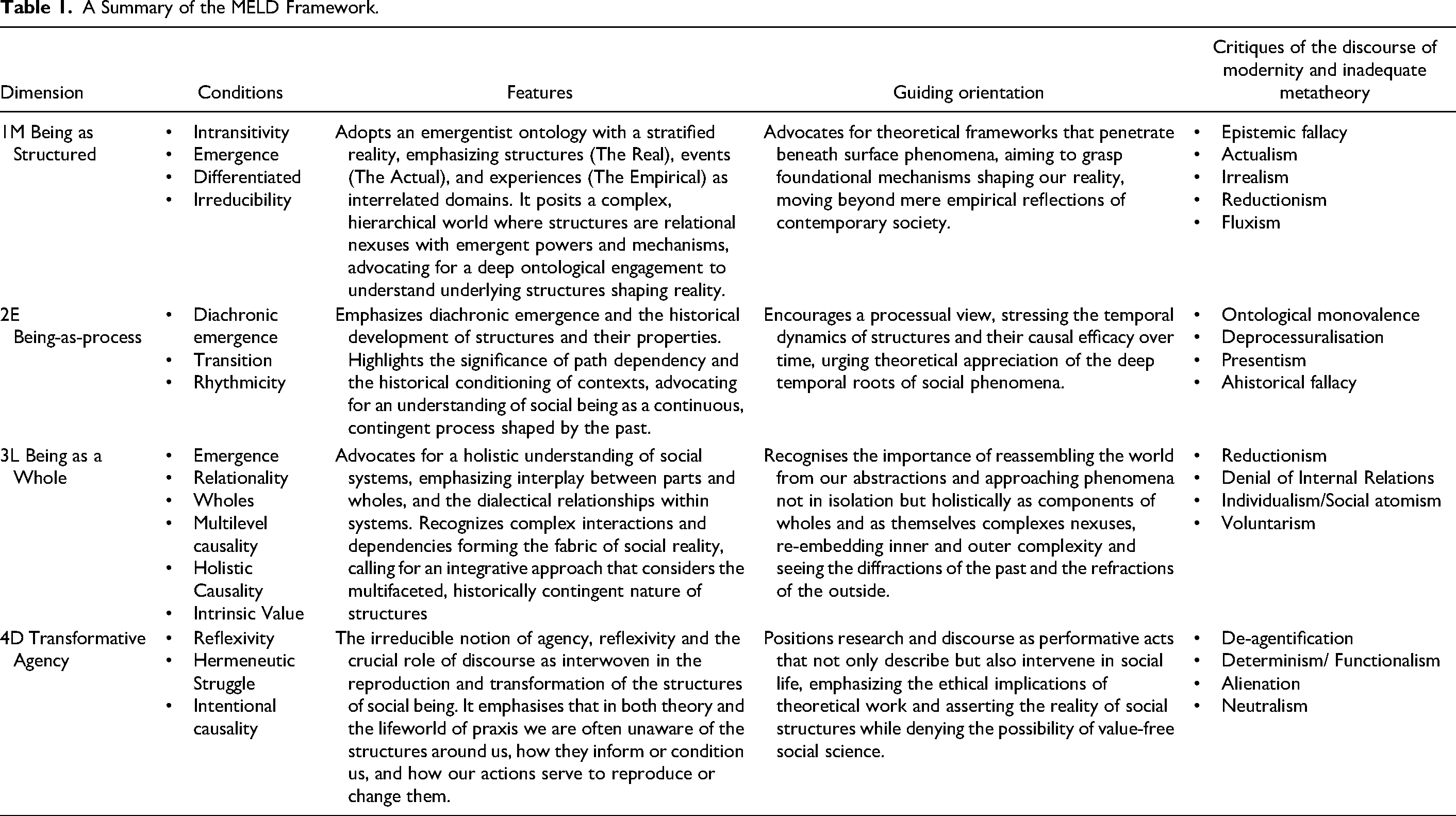
The resulting ontological-axiological chain serves as an epistemic foundation that enables us to both critique and reshape discourse, practices, and organizational structures.
Integrating the MELD Framework into a Metatheory of Marketing Systems and Crisis
The framework begins to illustrate the errors and tendential reductionisms, such as the denial of emergence, the deprocessualising reality, and the reifying and fetishizing structures. This model offers an ontological foundation centred on the intricate relationships between subjective, intersubjective, interobjective, and objective dimensions in a constantly evolving systemic world. The paper asserts that this comprehensive metatheoretical standpoint can provide an insightful perspective for marketing and marketing systems research, furnishing a foundation for understanding, addressing, and mitigating the complexities and repercussions of the crises we confront.
Firstly, the MELD framework aligns with Löbler's (2016) view of marketing as a social science, emphasizing the influence of institutions, cultures, and values on the exchange processes. Additionally, the framework promotes a systemic approach, ensuring consistent integration across different scales (micro, meso, macro) while recognizing each scale's distinctiveness (Layton 2008).
The framework lays a foundation for an encompassing approach to analyze and promote sustainable marketing systems. It offers a unified reference structure that permits us to view social, material, and natural systems as interconnected entities within a holistic ontological framework, enabling agents to interact with multi-level mechanisms. We are able to focus on the modes of coexistence that determine the structure and subsequent actualization of powers and possibilities that constitute the process and outcomes of our systems. As Nechansky's (2017) work suggests, relations in systems coexist within modes: conflict – (force, resistance and divergence), hierarchy – (submission, acquiescence, provision for)-, niche – (fulfilling a role, unity-in-diversity), and cooperation – (synergism, mutuality). These modes give us a basis to understand the processes of systems and the potentials and tendencies of the containing structures and totalities that produce the systems of crisis.
For instance, there's an imbalanced relationship between our economic actions and nature. This positioning results in a tense balance between the benefits we derive from ecosystems and our escalating rates of resource extraction, production, and consumption. Our elevated position over nature has disconnected us from its intricate web, altering our fundamental relationship with it. Consequently, we've begun to view ourselves as separate from, and even in opposition to, nature. This mindset promotes practices that are wasteful and harmful to the environment, contaminating our soil, air, and water and driving unsustainable resource usage. Such practices, rooted in both individual and collective behaviours, have brought us to an alarming crisis point, a pattern we seem to perpetually reproduce (Hedlund-de Witt 2013). This mindset, viewing nature as subservient, has deeply permeated our thought processes and institutional practices. As a result, we're not just in conflict with nature but paradoxically cooperating to reinforce systems that further amplify these environmental issues.
Another example is provided by the establishment of the individual and the egoistic consumer as the dominant life role (Dholakia 2014; Reith 2004). Possessive individualism leads to conflict as individuals compete for positional goods, whose value is built on the fact that other people are not able to own or consume them (Bonaiuti 2012). This helps create the conditions for inequality and the means through which hierarchical stigmatization and social exclusion structures are constructed (Bauman 2007). Moreover, we can see that individuals are obliged to subjugate aspects of themselves, favouring assimilating social and cultural forms – from which emerges incompleteness and dissatisfaction (Hietanen, Andéhn, and Bradshaw 2018; Reith 2004). Subsequently, we can diagnose the establishment of a hierarchy of the ego and the role of the consumer over other parts of the embodied personality as a cause for social and personal ills, which are then exacerbated by this structure's cooperation with social structures such as the consumer culture.
This process of symptomatology can be used to address and understand the crises and the symptoms and outcomes existing in our marketing systems. Fundamentally, we aim to understand the typical modes of coexistence within the system, their conditions of existence and relative constitution and embedding in a wider social formation. We focus on the reproduction of the relevant relations and the way they may be contradictory, conflictual or antagonistic to our potential to enhance and sustain societal wellbeing and individual quality of life. This approach requires looking for causes (agential, structural, discursive and technical) at different scales and mechanisms over different time horizons, in different fields of social practice and for powers actualized within individual's, networks, institutional arrangements and the conditions that have shaped them.
Advancing Current Macromarketing Thinking
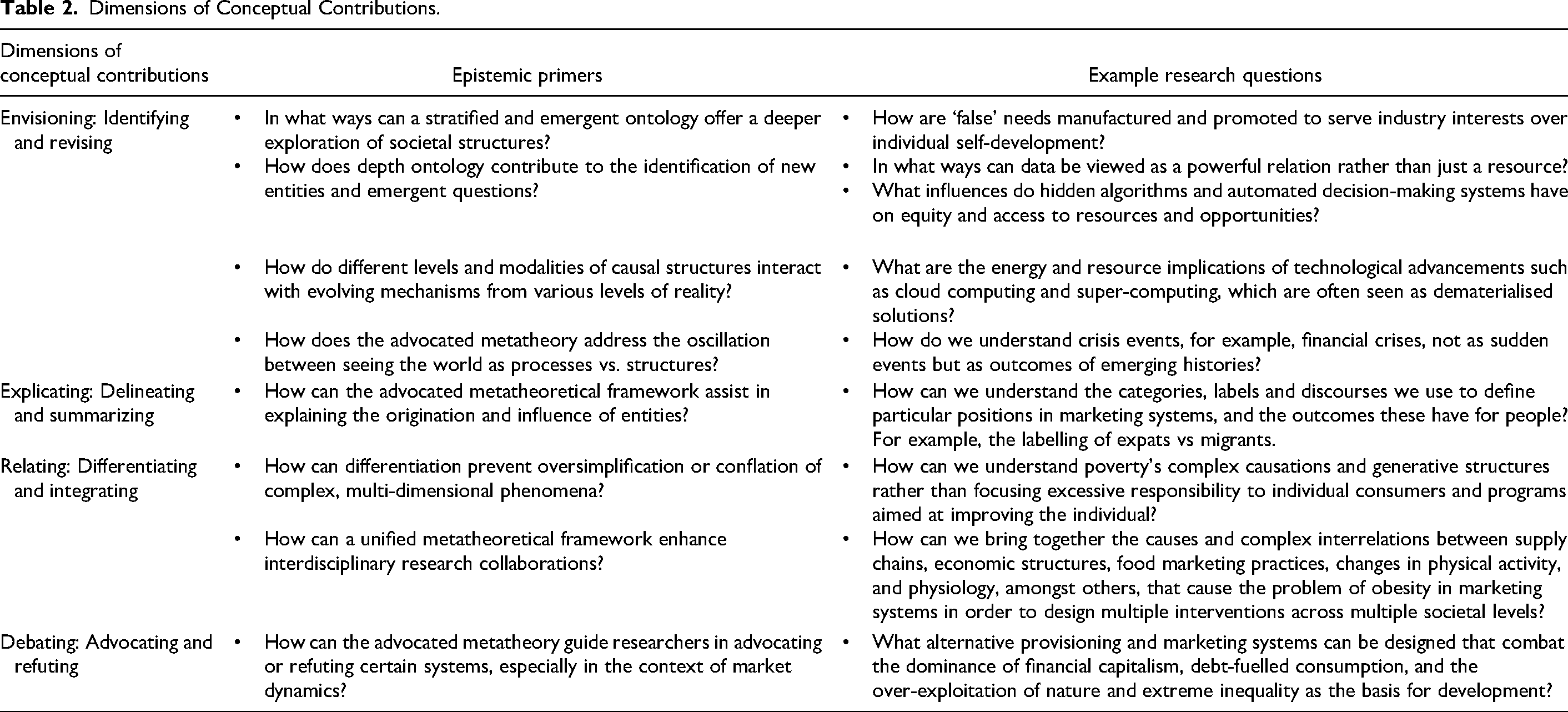
Good meta-theory plays a number of roles in knowledge production. It should provide a framework for developing overarching perspectives, facilitate theory development through guiding assumptions or propositions and deepen the understanding of theory (Ritzer 1992). MacInnis’s (2011) framework for conceptual contributions provides a useful structure to address how the metatheoretical framework presented in this paper can help advance current macromarketing thinking. Table two reflects on the epistemic primers that derive from the framework presented within these different conceptual contributions and offers illustrative research questions for marketing systems which emerge from these considerations.
(Table 2).
Dimensions of Conceptual Contributions.
Envisioning: Identifying and Revising
The advocated metatheory, through depth ontology and mechanism-based explanation, aids in revealing new entities and questions. It requires delving into the structures and conditions behind objects and events, guided by a stratified and emergent ontology. This approach mandates the deconstruction and reinterpretation of structures and ideas often overlooked. This approach has a key role, for example, in addressing issues of wellbeing by highlighting socio-cultural and situational structures and contingencies of markets that reproduce inequalities and poor quality of life. For example, we may reconsider the emphasis on materialism in measures of consumer wellbeing and examine whether the resulting concept or measure reflects a structural reproduction of society, whereby particular ‘false’ needs are promoted that serve the interests of industry, not the self-development of the individual (Fromm 2006).
This metatheoretical grounding also directs research to explore the roles of powers, properties, and relations in phenomena often oversimplified. Consider the rapid advances in digitization and data production. The metatheory urges us to view data beyond a mere resource, recognizing its role in structural configurations and the potential affordances it provides businesses and governments, leading to potential inequities, extraction, exploitation and the instrumentation of power (Zuboff 2019). Social media platforms hide participatory exploitation in which behaviours and systems are strategically induced to exploit individuals for financial benefit or political power. The recent Cambridge Analytica-Facebook scandal demonstrates the complexity of governing how data is used, distributed, collected and profited from (Simmonds and Gazley 2021). Similarly, hidden algorithms and automated decision-making systems are increasingly enabling actions and structures that deny poor housing, jobs, and basic services (Eubanks 2018).
The advocated metatheory also directs research to pose necessary questions about different levels and modalities of causal structures and incorporate complexity as regulated and transformed by various evolving mechanisms emerging from physical, mental, material, and social levels of reality. For example, the environmental impact of technology advancements like cloud computing through energy and water resource consumption (Schwartz et al. 2020). Similarly, the metatheoretical structure revises reductionist views of time and space, treating them as relational properties with causal power. This perspective allows for both objective and subjective interpretations of time, from natural linear progression to cognitive experiences. Similarly, space is understood in various forms, from physical distances to institutional and cognitive frameworks influencing activities. Recognizing time and space as structural elements highlights their diverse roles in shaping events and interactions.
Furthermore, the metatheory helps revise problematic aspects in marketing systems research. It embraces the world as both structured and processual, avoiding the dichotomy of viewing it merely as processes or static structures (Lowe and Rod 2018). It encourages looking beyond isolated market failures to understand their interrelated and cumulative nature (Redmond 2018). This perspective is crucial for diagnosing the conditioning associated with the financial crisis, as discussed, and encourages looking at crises not as sudden ruptures but as emerging histories and conditions of events (Hyman, Kostyk, and Shabbir 2021).
Explicating: Delineating and Summarising
The metatheoretical framework sets a basis for delineation by necessitating both the problematic of origins (explanations of how things come to be the way they are) and the problematic of causal power (explanations of how things can influence the world) as essential features of explanation. This process requires identifying structures and relationships that constitute these entities and their emergent properties. We need to explain the mechanisms by which these structures come into existence and the causes that sustain their existence. Take, for example, the discourse around migration. Expats are viewed as beneficial for development and are granted privileges, while migrants face restricted rights (McNevin 2022). This categorization sometimes labels individuals as potential problems even before they migrate, such as visa applicants from specific countries being seen as flight risks (McNevin 2022).
Summarizing within this framework helps develop typologies of entities and mechanisms in a given explanatory field. Mechanism-based explanations show how entities in structures, with their properties, actions, and relationships, produce certain effects. This approach aims not just to describe empirical events but to theorize the “ways of acting” of structures (Bhaskar 1998, p. 38), promoting theoretical generalization. This forms the basis for theory development, especially where similar relations, structures, and causal powers are present.
Relating: Differentiating and Integrating
Differentiation, as upheld by critical realists, is vital in steering away from reductionist perspectives. As noted, other metatheoretical positions display a tendency to collapse or conflate the complexity of a multidimensional and multileveled world. Over-riding ontology with epistemology, for example, in practice-theoretical constructivism, creates a logic of immediacy and a form of essentialism in which practices, to which phenomena directly conform, supplant the need to provide a conception and understanding of which causal factors are present. We are left with a lack of analytical clarity, conceptual overreach and a lack of causal sensitivity in which the study of practices becomes diverging lists of numerous, undifferentiated activities under the guise of ‘catch-all’ terms seeming to be everything and nothing. Critical realism addresses the nuanced complexity of entities and their roles by recognizing the importance of multi-planar events and the irreducibility of emergent, multidimensional structures. This approach acknowledges the multifaceted nature of causality, allowing for the multi-causality, multiple realisability and contingency associated with the dynamic interplay of stratified and differentiated structures.
The foundation of differentiation in critical realism facilitates an integrative approach, recognizing the interconnectedness of entities within a unified whole. This emergentist position, rooted in a shared ontological basis, is instrumental in providing metatheoretical unity and enabling theoretical pluralism. This unity is key to integrating various concepts and ideas, encompassing subjective, intersubjective, material, and symbolic dimensions at multiple levels of research, including micro, meso, and macro.
This ontological underpinning encourages moving beyond narrow, one-dimensional approaches that limit explanations to specific concepts or frameworks. Instead, it emphasizes the diverse, interconnected nature of reality, focusing on the ‘unity-in-difference.’ This shift is crucial for transcending the fragmentation often seen in specific theoretical frameworks, such as practice or institutional theories. These frameworks offer valuable insights into the structures, properties, and powers of entities, but they cannot encapsulate the full complexity of phenomena. For instance, current perspectives on poverty demonstrate this need for a more nuanced approach. Traditional policy and research often focus on income metrics and definitions, leading to generalized welfare and training programs. However, as Hutton et al. (2022) point out, poverty's causes are not uniform but structural and diverse, varying significantly even within the same community. This insight underscores the importance of critical realism's integrative approach, which accommodates the structural variations and complexities inherent in social issues like poverty rather than relying on oversimplified, one-size-fits-all solutions.
Importantly, this unity-in-difference enables the necessary integration of, and dialogue with, other disciplines and the theoretical ideas and frameworks that are contained within economics, ecology, anthropology and sociology for the study of marketing systems (Layton 2019). For example, Kemper and Ballantine (2017) argue that macromarketing can contribute to public health and nutritional research on food systems by addressing the socio-cultural environment and eating practices. How do we understand and reconcile food marketing practices, reductions in physical activity, medical research on obesity and related interventions, supply chains, resource scarcity, and population demographics, amongst other forces that contribute to obesity. To do so, we must not be locked in their separate language games in constructivist positions or rely on specific behavioural theories or measurements meant to create a closed system around an isolated view of the consumer. The emergentist position within critical realism, with its focus on ontological comprehensiveness, facilitates the inclusion of all relevant dimensions, planes, and domains of reality. This approach embraces theoretical and epistemological pluralism, valuing the use of diverse methodologies and theoretical frameworks to capture the asymmetrically stratified, differentiated, and dynamic nature of reality. Such a perspective is not just beneficial but essential for grasping the interconnectedness and multifaceted nature of the subjects studied within marketing systems and beyond.
Debating: Advocating and Refuting
The critical realist perspective integrates critique as a fundamental element in research. This approach acknowledges that research subjects extend beyond mere propositions about phenomena, requiring the identification of underlying structures and forces responsible for their manifestation. Emphasizing the importance of ontology, it adheres to the principle of ‘judgmental rationality’ and the view that it is possible to evaluate different positions and explanations as being better or worse, challenging the notion of incommensurability inherent in paradigmatic relativism. Recognizing the potential fallibility of knowledge, it is imperative to critically assess and substantiate transitive descriptions, ensuring they accurately reflect the intransitive structures they represent. This approach avoids the pitfalls of judgmental relativism and the internalization of knowledge that can lead to dogmatism and reductionism.
Additionally, this framework assigns a proactive role to theory and research, moving beyond the concept of value-neutrality. It acknowledges that the state of ‘being’ thrives under certain conditions and deteriorates under others. Therefore, the metatheory contends that research should actively evaluate and assert the validity of systems in identifying specific structures and causative mechanisms. Following the advocacy of critical marketing scholars, it's crucial to be discerning about the assumptions made concerning human behaviour and desires in market contexts, aiming to enhance the conditions of existence (Figueiredo et al. 2015; Tadajewski 2014). This approach necessitates a critical examination of fundamentalism, whether it manifests as market-centric or other forms of foundationalism, which claim unquestionable knowledge based on purportedly indisputable principles. Olvitt (2017) suggests bridging ontology with axiology, transitioning from understanding what exists to exploring what might, ought, and can exist.
Conclusions
This paper endeavours to underscore the importance of integrative metatheoretical work and delineate the prevailing crises in the realm of marketing systems. Introducing the MELD framework provides a holistic, systemic ontology that seamlessly integrates both worldview and metatheory. The metatheoretical stance advocated here seeks to address imbalances, champion integrative research methodologies, and harmonize diverse theoretical and methodological approaches across a spectrum of knowledge domains. This stance remains introspective, embracing both self-reflection and self-criticism while simultaneously analyzing and shaping real-world issues and societal norms.
Given the growing emphasis on systems, particularly marketing systems, and the evolving role of marketing as a social science, there is an undeniable need for a more reflexive discourse that delves into the sociological and philosophical foundations of our research and theory development. While this paper draws inspiration from Roy Bhaskar's work on critical realism, it also envisions a more encompassing role for metatheory, echoing Stein's (2016) concept of it as a “discourse regulative function”. The metatheory proposed here establishes a foundational framework and underlying commitments that are essential for achieving several critical objectives:
Foundation for Integrating Perspectives: It sets a foundation for combining and integrating various perspectives and disciplines, providing a comprehensive metaperspective. This foundational approach facilitates the synthesis of insights from sociology, economics, ecology, and more, creating a multifaceted understanding of marketing systems. Underlying Commitment to Epistemological Diversity: The metatheory demonstrates a commitment to supporting epistemological diversity, advocating for the application of appropriate epistemologies and methodologies across different disciplines and domains. This commitment ensures a thorough and nuanced exploration of marketing phenomena. Addressing System Complexity: By establishing a foundation that recognizes the complexity of scientific, social, global, and ecological systems, the metatheory equips researchers to understand and navigate the intricacies of interconnected marketing systems. Counteracting Reductionism and Oversimplification: The metatheory's foundational principles actively counter common tendencies toward oversimplification and reductionism. It emphasizes a deeper analysis of marketing systems, moving beyond surface-level observations to understand underlying structures and mechanisms. Tools for Social and Political Critique: Through its foundational stance, the metatheory provides the necessary tools and perspectives for effective social and political critiques. It enables analysts to uncover and address inefficiencies, injustices, and systemic flaws within marketing systems and suggest constructive alternatives. Confronting Global Crises: The metatheory's underlying commitments are geared toward addressing the significant social, global, and ecological crises of our time. It sets a framework for understanding the role of marketing systems in these crises and suggests pathways toward mitigation and transformation. Nurturing Potentials for Flourishing: The metatheory fosters an environment where both individual and collective potentials can be recognized and nurtured. Its foundational principles support the development of marketing practices that contribute to the well-being and prosperity of individuals, society, and the global community.
As a result, the proposed ontological-axiological chain serves as a foundational basis for both critiquing and reshaping discourse practices and organizational structures in the field of (macro)marketing. This framework enables the development of four distinct types of knowledge:
Knowledge of the Existing State and Its Opposites: This involves understanding the power dynamics, absences, structural patterns, and driving mechanisms in the current world. Vision of Potential Alternatives: Building upon an understanding of what currently exists and what does not to envision possible future scenarios or alternatives. Aspiration for a Preferred State: This is about aiming for a world liberated from oppressive relationships, rooted in human emotions, moral imagination, and reasoning. Practical Insights on Attainable Outcomes: This entails amalgamating the previous forms of understanding and tapping into people's capacity to discern actionable steps, all tailored to their unique contexts.
In essence, the foundational proposition of this metatheoretical groundwork is to furnish organizing constructs that resonate with the realities of our systems. The emphasis here is on transcending the compartmentalization of knowledge and reductionist tendencies. The goal is to truly understand the intricate and dynamic systems we perpetuate and depend on, setting the stage for transformative practices that usher in a sustainable era of wellbeing, with marketing systems at its helm.
Footnotes
Associate Editor
Ben Wooliscroft.
Declaration of Conflicting Interests
The author declared no potential conflicts of interest with respect to the research, authorship, and/or publication of this article.
Funding
The author received no financial support for the research, authorship, and/or publication of this article.
