



Abstract
In addition to summarizing the articles included in this Special Issue, this editorial introduction provides a content analysis of 22 years of the Journal of Macromarketing with a focus on quantitative studies. Linking the rich foundation of macromarketing scholarship with novel and purposeful quantitative analysis can provide the evidence needed to help convince policymakers to change the system. Yet macromarketing scholarship has not capitalized in this way on its strengths in explaining marketing and societal connections from a macro perspective. As conceptual models are developed, authors should consider how to support quantitative researchers in extending and testing those models, and all macromarketing scholarship should be purposeful in developing future research agendas that continue their important momentum.
Background
In proposing this special issue of the Journal of Macromarketing, we recognized that macromarketers have, for more than 40 years, explored, modeled and argued for the policy implications of the interplay between marketing and society and the systems in which they operate. That these systems are often tilted in favor of certain subgroups is noted, and corresponding arguments for needed changes are given. At the same time, while individuals – as consumers, voters, professionals and for personal reasons – can seek to improve the world around them, significant systemic change often requires regulatory action. Yet regulators often want “proof”, particularly of how desired policy changes would induce specific changes in outcomes.
Our thought, then, was that we could invigorate the quantitative side of macromarketing research with this special issue. This was not to suggest that no quantitative research had been conducted in macromarketing – more on that below – but instead to see if new quantitative methods could be applied to macromarketing topics. Further, we thought that encouraging younger researchers to lead the effort would potentially lead to an enduring professional vision of the value of quantitative macromarketing research in their careers.
Of course, macromarketing topics provide rather messy contexts for the application of quantitative methods (Wooliscroft 2016). They require the development of metrics of socioeconomic phenomena that are inherently non-quantitative, as well as the modeling of dynamics which are naturally complex. They also require a sensitivity to the diversity of cultural, economic, regulatory and historical contexts around the world. It is challenging to develop metrics and methods to meet these requirements (DeQuero-Navarro, Stanton, and Klein 2021), as well as capture meaningfully defined data to support the research goals (Wooliscroft 2016). This special issue continues the effort called for previously by Fisk (2006), Peterson (2006) and Ekici, Genc, and Celik (2021), along with the purposeful action fostered by Wooliscroft (2016), and illustrates what can be accomplished in macromarketing using quantitative methods. We also see how much ground there still is to cover.
Potential Gains from a Quantitative Approach
The importance of enhancing the quantitative value of macromarketing research cannot be overstated. Nearly any macromarketing topic can be enriched with quantitative understanding of the underlying factors and relationships which explain and shape our reality. One lens for seeing the power in quantifying macromarketing research is offered by the United Nations’ Sustainable Development Goals (UN SDGs). These goals range from poverty and hunger alleviation to addressing individual and broad inequalities to solving global challenges such as climate change. The foundational problems associated with these goals manifest in communities around the world, both developing and developed. They present as multi-level, multi-faceted and multi-stakeholder forces with macro-to-micro implications. They affect our provisioning systems, detract from our ability to secure Quality of Life, and disrupt the patterns of daily life, causing illness, harm, misery and death.
However, without a quantitative and systems view of these issues, scientists, policymakers and communities alike have made relatively limited progress in resolving such wicked challenges. Quantitative and systems knowledge helps us to understand how and how much the parts are connected. We move from individual, fragmented perceptions to a collective, interactive perspective. We can identify the evolutionary dynamics at work and delineate the feedback mechanisms that remain unseen from a linear approach. Macromarketers, with other scientists, can design and implement multi-disciplinary, integrated and sustainable resolutions to benefit and transform communities, provisioning systems and the planet for the betterment of all.
Anchoring quantitative research in the depth and breadth of existing macromarketing research can produce the evidence required by policymakers to make change, and correspondingly, move the field beyond “talking to itself”. Examples of where policy needs this guidance can be found in all the global-to-local UN SDGs efforts. For example, goal #13 on climate action is being addressed in Ireland's Peatlands and People project (https://peatlandsandpeople.ie/) and China's Sponge Cities project (https://turenscape.com/en/home/index.html). For goal #14, life below water, the European Union's projects Sea for Society (https://cordis.europa.eu/project/id/289066) and Sea Change (https://www.seachangeproject.eu/seachange-about-4.html) are dependent on proper performance measurement. For goal #3, good health and well-being, the Seas, Oceans & Public Health in Europe project (https://sophie2020.eu/) offers an example of measurement needs.
Of course, none of these quantitative needs should be misunderstood to mean that qualitative research is unimportant. Quite to the contrary, it is the defining strength of the existing macromarketing literature that it provides and will continue to provide the more complete picture of socioeconomic phenomena in the context of our marketing systems than is found elsewhere in the marketing literature. What we seek is the combination of qualitative and quantitative research that will offer the greater understanding of other connections and outcomes we observe.
Previous Quantitative Work in the Journal of Macromarketing
As any reader of the journal can attest, there is a subset of articles that indeed incorporate a quantitative perspective to the topic covered. In this section, we report on a content analysis of the journal from 2000 to 2021, inclusive, in which we focus on the nature of the research approach. Two of the special issue co-editors coded a total of 464 articles. Coders followed protocols for developing a coding scheme, testing it and carrying out a pilot coding that showed a good inter-coder reliability according to the Holsti Coefficient (CR = 0.85) and Perreault y Leigh Coefficient (I = 0.77) (Muñoz Leiva and Montoro Ríos 2005) before building the full dataset of research papers. Exclusion criteria applied to research articles with less than 5 pages, as well as editorial introductory pieces, book reviews, commentaries, call for papers, communications, guides, and conference abstracts. Below, we offer insight from multiple angles.
Overview of Sample
First, Table 1 reports on the full sample, with figures on (the top 6) primary topic of the article, the nature of conceptual development contained in the article, if/how quantitative analysis was included, and to what extent the article pointed future researchers toward a related quantitative agenda. As background, we coded conceptual development mostly in terms of whether a model was included, and differentiated between models with elements that linked broad ideas (“high-level” diagram) or instead focused on narrowed constructs (“zoomed-in” diagram). The latter would likely lead a quantitative researcher closer to identifying operationalizable metrics given their specificity. Separately, the nature of any quantitative analysis is captured in terms of the type of statistical effort conducted. Finally, the research agenda is coded to capture whether quantitative research is suggested in a very limited way, instead is given some reflective space, or is a focus of the future research agenda. Our goal with the latter is also to suggest that a key value of our strong qualitative research output in macromarketing could be to offer more directed linkages from conceptual and qualitative research to appropriate quantitative research questions. It should also be the case that quantitative studies help to establish a path for researchers to continue to build on their findings.
Overview of Sample.
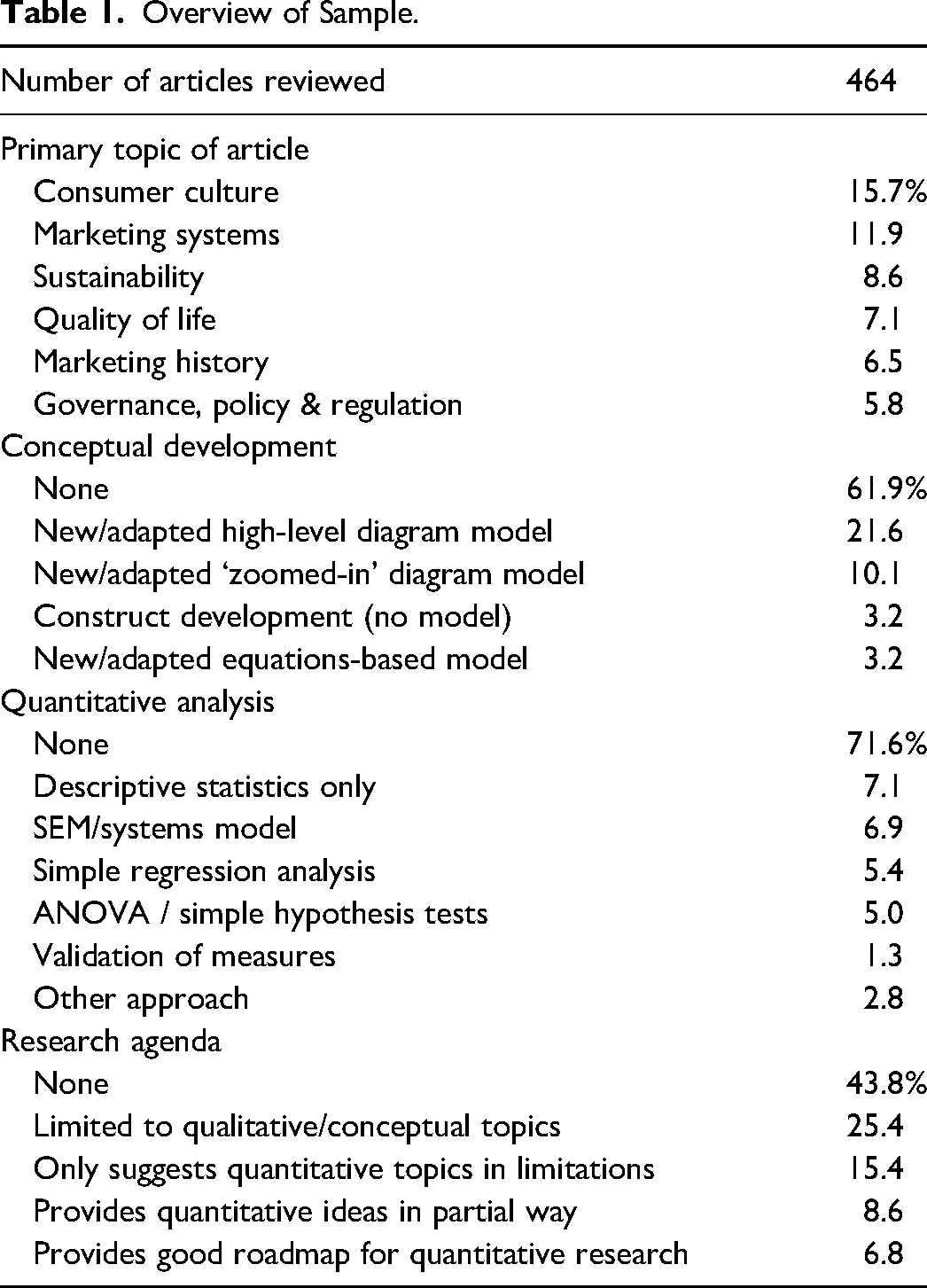
As shown in Table 1, less than 40 percent of articles in the Journal of Macromarketing between 2000 and 2021, inclusive, offer conceptual development of some sort (including construct development, and equations-based models). As this modeling is a basis from which to perceive the path for quantitative analysis, perhaps more attention to modeling is called for. Separately, less than 30 percent of articles include any quantitative analysis. Among them, most rely on descriptive statistics, simple regression analysis and common hypothesis testing methods such as ANOVA. Systems equations modeling (SEM) is used in 6.9 percent of all articles during the period of study. It is important to note that not all papers that provide a conceptual model conduct quantitative analysis, nor do all papers that conduct quantitative analysis frame their approach using a conceptual model.
Finally, only 15.4 percent of the articles step into the quantitative implications of their work in terms of linking it to a future research agenda. Indeed, more than 40 percent do not provide any future research agenda, something that we believe should be corrected moving forward in this journal.
Conceptual Development
Because conceptual modeling of macromarketing phenomena can be the starting point for quantitative analysis, we provide in Table 2 some insight on the 177 articles which include any conceptual development. Note the changed order of the primary focus of the article, with marketing systems, quality of life and sustainability taking the top three positions. The majority of papers provide what we called a high-level diagram model, helpful for understanding macro settings and contexts, but perhaps harder for quantitative research to follow. About a quarter of the articles provided more ‘zoomed-in’ models. Less than 40 percent of articles moved their conceptual modeling into a quantitative realm.
Studies with Conceptual Development.
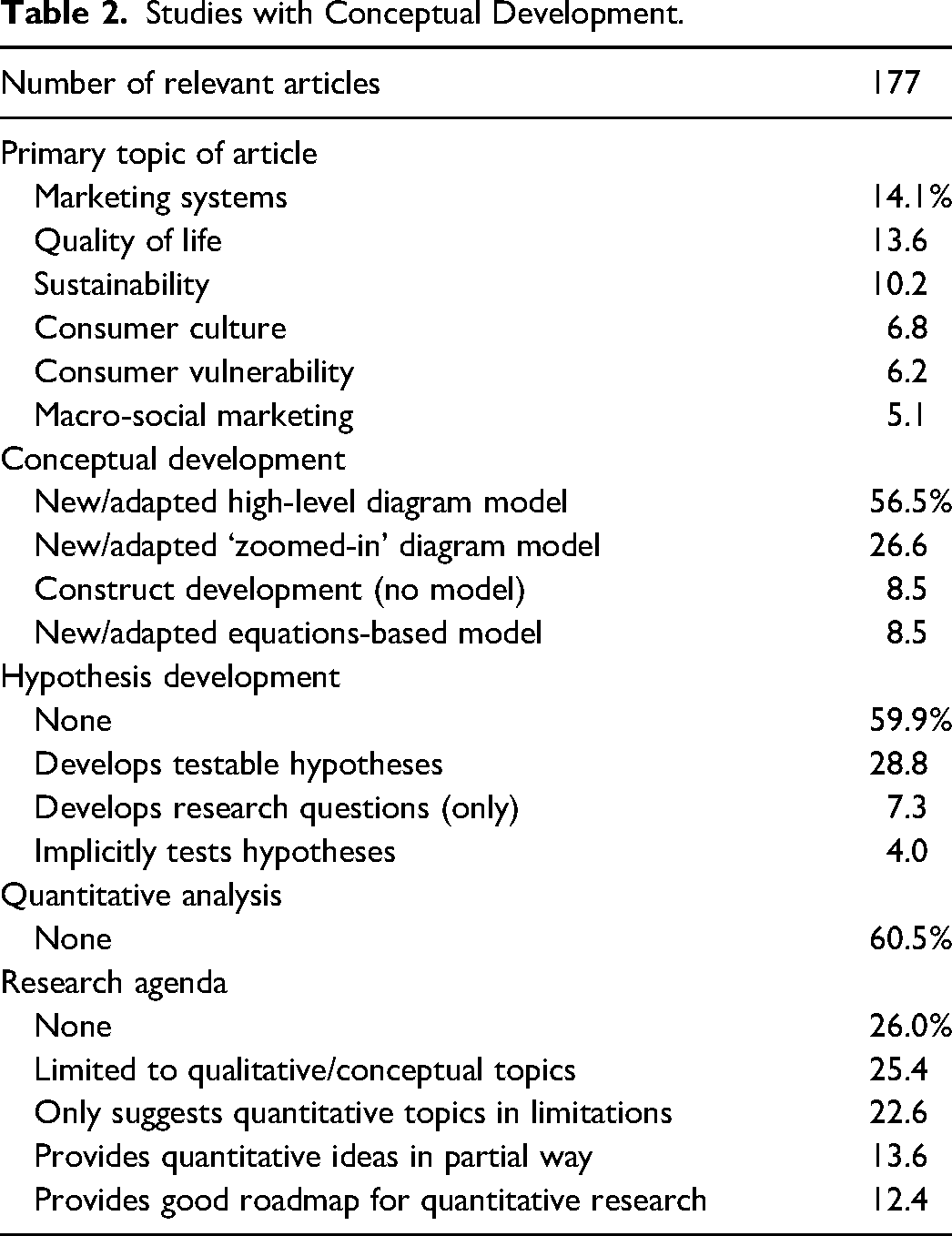
We were also curious how the modeling itself was portrayed in terms of testable implications. Only about 40 percent of these articles presented explicit or implied hypotheses and research questions. In terms of research agendas, an increased portion of articles provide some sort of roadmap or partial guidance for quantitative research (12.4 and 13.6 percent respectively) compared to the full sample of articles, suggesting that the focus on conceptual development does lend itself to guidance for quantitative research.
Quantitative Studies
Looking exclusively at studies which report quantitative analyses, we can see in Table 3 how that type of analysis is conducted. Of the 132 studies, the top three macromarketing subjects are quality of life, sustainability, and consumer culture, accounting for 38.7 percent of all quantitative analyses. Notably, only 53 percent of quantitative studies rely in a direct way on a conceptual model, while 23.5 percent directly link to a new or adapted version of a “zoomed-in” conceptual model. This dichotomy suggests that quantitative analyses may need additional guidance or foundation in macromarketing modeling.
Studies with Quantitative Analyses.
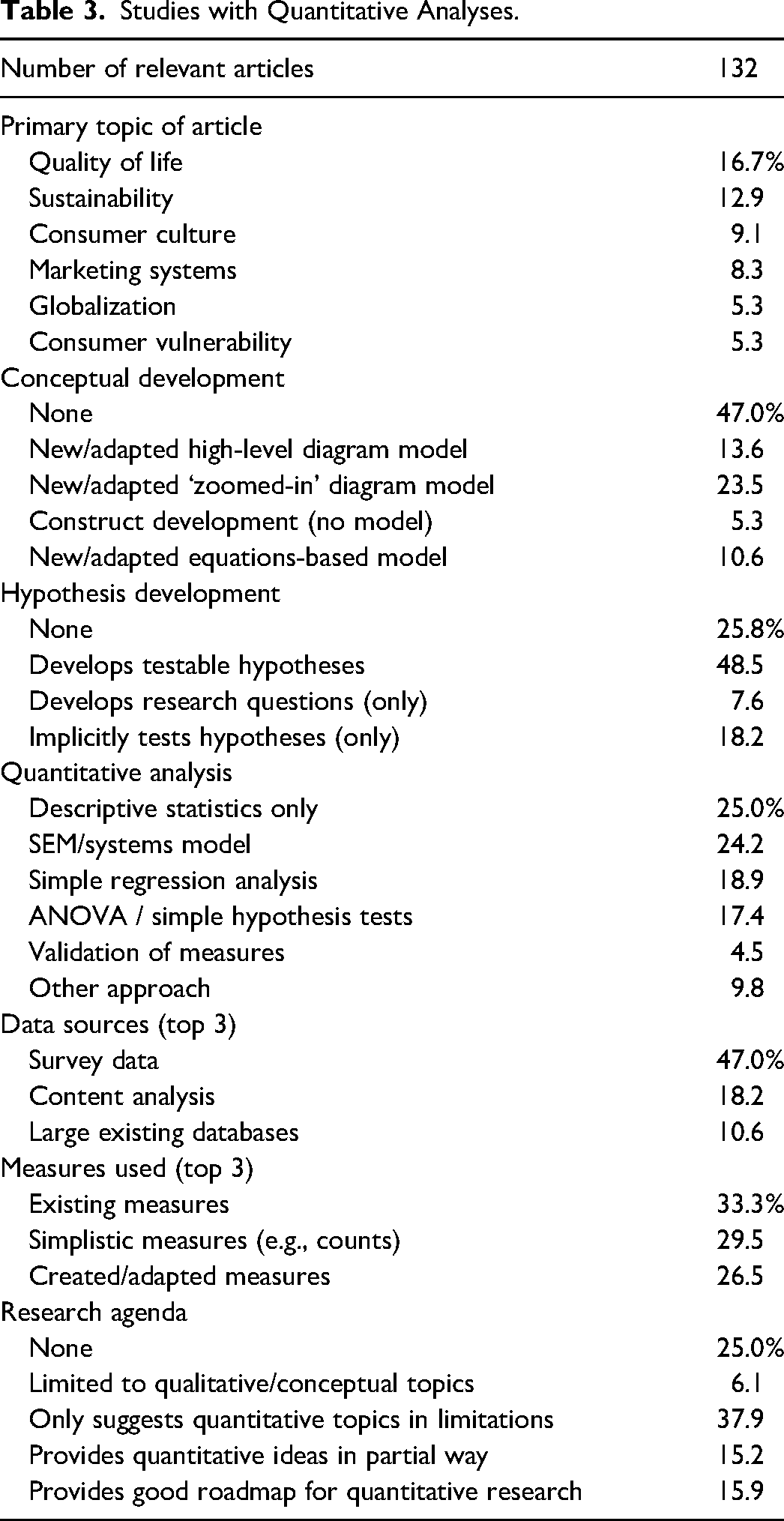
The approach to quantitative analyses also relies on hypotheses or research questions in only three quarters of the studies. About half of the studies do base their quantitative work on testable hypotheses, while another 18.2 percent provide statistical testing that suggests hypotheses were implicit to the work. Statistical methodologies vary considerably with no one method dominating the quantitative research. We view this in a positive way, as there are likely many different methods applicable to macromarketing topics and the same topic should be analyzed and hopefully replicated using different methods (Wooliscroft 2016).
By far, surveys are the preferred approach to gathering data for study, although content analyses along with large databases are also well-represented. Sample sizes ranged considerably (not shown in the table). There were 28 studies with 100 observations or less (average 55.0), 24 studies with samples of 101–200 (average 146.5), 37 studies with samples of 201–500 (average 334.4), 9 studies with samples of 501–1,000 (average 754.7) and 24 studies with samples of over 1,000 observations (average 3,890). Studies on the United States context dominated (34.8 percent of all quantitative studies) and studies of multiple countries were the next most common (22.7 percent).
Regarding measures, 33.3 percent of studies use existing measures borrowed from the literature, while another 26.5 percent create their own or adapt what others have generated in order to satisfy their goals. Interestingly, of the quantitative analyses contained in 22 years of macromarketing scholarship, only 15.9 percent provide a good roadmap for future research related to the paper. Another 15.2 percent give some reflection on future quantitative research. Both creating specific measures for macromarketing phenomena and offering a helpful agenda towards propelling future quantitative studies seem to be among the biggest missed opportunities in the quantitative macromarketing scholarship to date.
Topic-specific Data
Finally, we separated the rather small samples of quantitative research articles for the top two macromarketing topics: quality of life (22 studies) and sustainability (17 studies). Because of these small samples, percentages should be interpreted with caution. For quality of life, the pattern suggests that “zoomed-in” models dominate, with models more frequently adapted from prior literature. Testable hypotheses emerge from the vast majority of studies, but no particular analytical method dominates. Most of these studies use survey data and existing measures, and many authors offer a good roadmap for future quantitative research (Table 4).
Studies with Quantitative Analyses – top 2 Macro Topics.
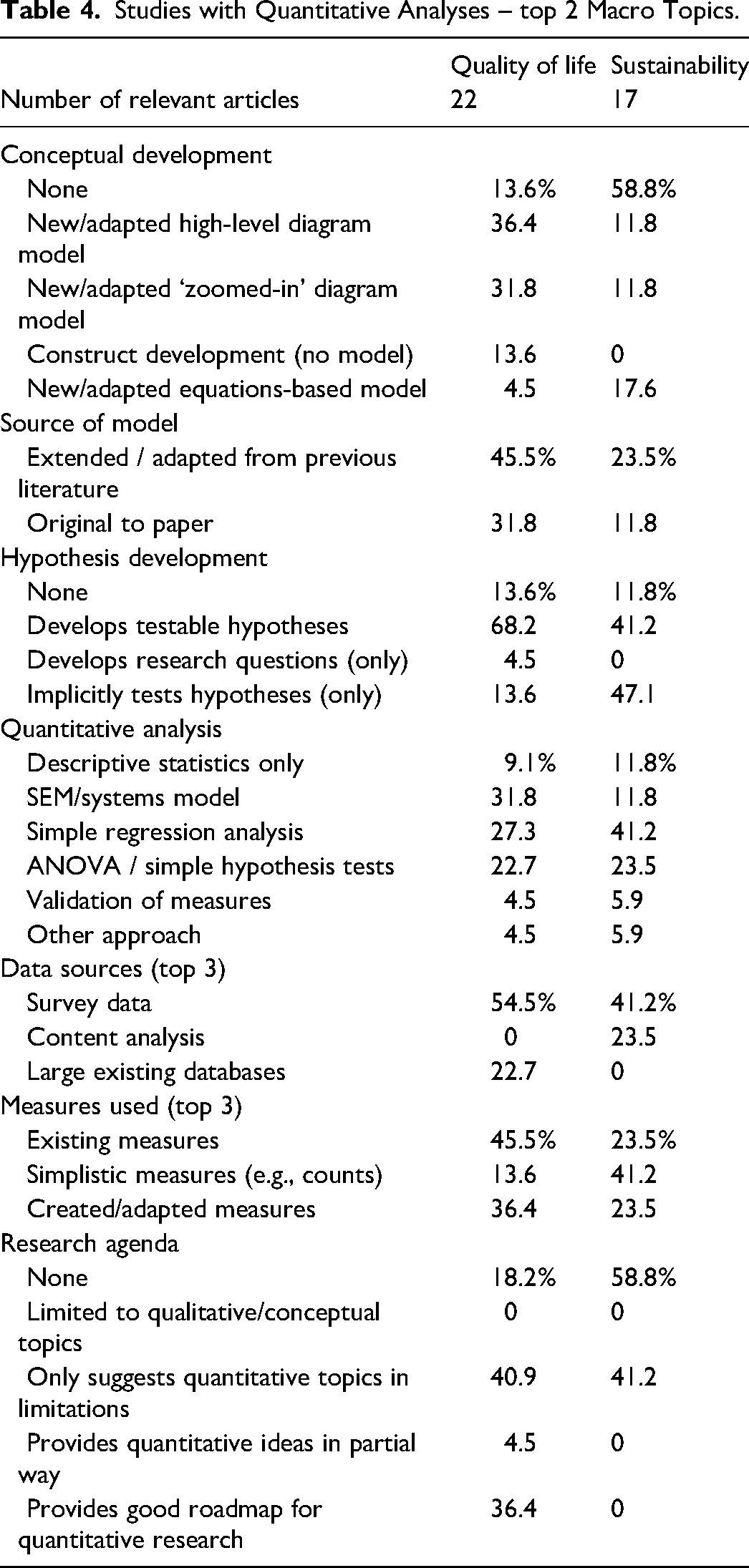
By comparison, the studies of sustainability less often have any conceptual development, with equations-based models emerging as more common than diagrammatic models. When modeling occurs, extensions of existing models is most common, but so are implicit hypotheses (showing only in statistical testing) compared to explicit hypotheses. More attention is given to simple regression analysis than other methods, and both surveys and content analyses are important sources of data. Quantitative studies of sustainability tend to use more simplistic measures (such as counts) than was the case for quality of life studies, and none of the sustainability-oriented studies offered any real reflection of future quantitative research opportunities.
Take-aways
We offer this content analysis of our journal because it allows us to see where macromarketing may want to adjust its strategies if we are to avoid “talking to ourselves”. While there is no particular reason for a study with strong conceptual development to also test its theories with quantitative methods, the latter is more likely to be done by other researchers when the roadmap is better established. We would also hope that the quantitative work being done in macromarketing would largely reflect the wealth of conceptualizations already available so that we further the impact of macromarketing research and contribute meaningfully to policy discussions, among other avenues for change. Unfortunately, it does not seem that conceptually-driven papers generally see their quantitative implications (only 26 percent offer at least some implications) nor does it seem that quantitative research is built strategically on macromarketing conceptual models (47 percent are missing any reference to prior modeling).
Articles Included in this Special Issue
Given the tall order we sent out – seeking macromarketing papers that engage directly in quantitative analysis with first or second author being a current PhD student or recent doctoral graduate – we are pleased to provide three exceptional examples. Indeed, as we hoped, authorship was not derived solely from macromarketers, and included authors from a variety of disciplinary backgrounds including pharmaceutical marketing to engineering and physics.
Padela, Wooliscroft, and Ganglmair-Wooliscroft (2023) propose the Systematic Theory Mapping (STM) method as a way to deal with the complexity of social systems. This systematic approach to qualitative data allows visualizing and grasping the multi-level configuration of variables and topics affecting wicked problems directly and indirectly. Based on grounded theory, this inductively driven methodology helps to uncover causal and non-linear interactions between variables across studies in a systematic literature review. The article guides the reader through the method step by step along an example related to the brand externalities field. Findings are summarized in a causal loop diagram which shows a complex map of hierarchically interconnected topics around brand externalities in the literature. This type of analysis is of special interest because it allows the macromarketing researcher to order causal interactions of the myriad variables within a multifaceted marketing system.
Manis, Cockrell, and Friske (2023) address the role of trust in marketing systems through hierarchical linear modeling, an especially suited method for macromarketing multilevel conceptual frameworks. The authors offer an example of the use of three large databases to analyze trust as a mediator of the relationship between perceptions of government involvement and perceptions of free-market competition. A large sample of 73,000 respondents across 56 countries allows the authors to test a complex marketing system model through a two-level model. Findings demonstrate the power of this hierarchical linear modeling to analyze the effect of larger national economy indicators with citizen-consumers’ attitudes, hence connecting empirically macro and micro levels in marketing systems.
Krasnikov et al. (2023) use meta-analysis to explore the relationships in the QOL and marketing systems literature towards finding fruitful intersections of research. The authors present all steps and procedures of the proposed methodology in a pedagogical effort. A 30-studies sample included cultural and economic macromarketing-relevant variables and effect sizes that yielded a total data sample size of 28,565 pieces of data. Through regression analyses the authors arrive to the conclusion that marketing systems’ outputs, such as assortment of goods, services, information, and values provided in response to consumer demand, positively affect QOL levels. This effect is stronger in studies based on primary/subjectivemeasures of QOL constructs and in samples drawn from the developed economies and moreindulgent, uncertainty-tolerant, and long-term-oriented cultures. These findings shed light onto fertile contexts to study marketing systems and QOL, as well as helps identify key challenges in these areas.
What is Next for Quantitative Research in Macromarketing?
As we look to the future of macromarketing scholarship, our relevance depends on our ability to convey the meaning of our research to the decision-makers at government and enterprise levels. Seeking solutions to poverty, injustice, discrimination, environmental damages, tilted marketing systems and other macro issues will need to involve players at various points of authority and it is imperative that we reach them with the type of evidence they seek.
What does this mean for quantitative research itself? We must continue to utilize and improve upon the conceptual models that our hard-won trove of macromarketing research offers. However, we must also seek sources of modeling that come from outside macromarketing and even outside marketing, including systems models from engineering, meteorology, biology, and other disciplines.
We must work to transform those models into the basis for related and feasible quantitative analysis. This means paying close attention to how broad, “high-level” diagrammatic models can be narrowed into more operationalizable components. It means learning how conceptual models help or hinder quantitative analysis by not specifying elements contained within broad constructs. It means working carefully to develop valid, consistent metrics to reliably capture a model's underlying constructs, and thus provide tools for a variety of related research efforts.
We also must pay very close attention to the quality of data being used within quantitative analysis. Many of the studies we summarized in our content analysis rely on survey data, and nearly all quantitative papers had one single study. Since errors and bias are inherent to the self-reported information typical of surveys, it is imperative that we continue to replicate (and then extend) each other's work, as well as consider multiple-study models for hypothesis testing. Similarly, we have to carefully analyze the cultural, economic, and situational appropriateness of using existing measures – whether from within macromarketing or not – for any context of study, and take note of where that appropriateness is conditional on other factors. Developing tools that can be applied globally requires data from global contexts and careful identification of meaning in individual contexts.
In accomplishing these goals, macromarketing should not lose its core focus on exploring, describing and sharing the complex problems that capture the interrelationship between marketing and society and the system in which they operate. We need to advance the corollary effort to develop more quantitative “proof” so that we can be more persuasive in important contexts. This clearly requires that we take steps toward developing quantitative agendas, even if we do not plan to conduct that quantitative analysis directly. The future research agenda that should be a part of all macromarketing articles can offer qualitative authors a place to support these steps. In doing this, an agenda which also suggests how a conceptual model needs – qualitatively – sharpening or extension for specific contexts can also be helpful.
Our Suggestions for Interested Researchers
As we are clearly in favor of an expansion of the way that the macromarketing literature has approached the quantitative side of its work, we offer here some thoughts on how one might become more engaged in relevant research opportunities.
Begin quantitative research on macromarketing topics with an open mind for the methods that may apply. Consider familiarizing yourself with the work of colleagues in other disciplines who have either/both models of parallel dynamics or advanced quantitative modeling skills that could be applied to macro contexts.
Build a strong macromarketing literature basis for your quantitative work, connecting the conceptualization of messy, wicked problems to your empirical approach. Without this connection, we run the risk that macro problems are boiled down to micro-oriented research questions simply for convenience of the method being used.
Consider how your quantitative work is explained, both in terms of establishing its credibility but also to help fellow macromarketers understand how the methodology works. When there are limitations of the method, they should also be explained, and preferably at the point of sharing that methodology. The more we see where quantitative approaches can accomplish only some portion of what is reflected in a conceptual model, the more we can build better metrics and methods.
Finally, be sure to keep an open mind on how the cultural or economic context of your quantitative research is distinct from the context that led to a particular conceptual model of interest. This mismatch can mean that important factors are omitted or unnecessarily included in your quantitative work.
We hope that readers will not only enjoy the range of quantitative methods presented by the authors in this special issue, but be inspired to continue the effort.
Footnotes
Associate Editor
M. Joseph Sirgy.
Declaration of Conflicting Interests
The author(s) declared no potential conflicts of interest with respect to the research, authorship, and/or publication of this article.
Funding
The author(s) received no financial support for the research, authorship, and/or publication of this article.
