



Abstract
The idea of the armed American woman – a woman in the United States who owns and uses a firearm – appears to have gained legitimacy in recent years. We investigate one aspect of this increased legitimacy by focusing on how she is depicted in gun advertising, which reflects and shapes legitimacy. Using a novel dataset of a sample of gun manufacturers’ advertisements in a publicly available gun magazine from 2001–2020, we conduct a content analysis to identify trends and differences between ads featuring men versus women. Next, focusing on ads in the sample featuring armed women, we identify phases of general framing strategies. Finally, analyzing all ads featuring armed women during the final phase, 2016–2020, which coincides with increased legitimacy, we identify specific frames of the armed American woman: the Serious Student, Capable Carrier, Domestic Defender, and Action Hero. Findings contribute to literature on gun advertising, discourses in American gun culture, and market legitimation.
Introduction
Guns are broadly regarded as powerful symbols of masculinity, power, aggressiveness, and American citizenship, and, accordingly, the idea of the armed American man is widely regarded as legitimate (Carlson 2015b; Melzer 2009; Stroud 2015). In contrast, the idea of the armed American woman – a woman owning and using a firearm – lacks the same degree of cultural legitimacy as her male counterpart (Browder 2006; Stange and Oyster 2000). In the United States, gun ownership, usage, and culture have long been dominated by a masculine ethos, rendering the idea of the contemporary armed woman as at times “invisible” and at others generally out of place (Schwartz 2021). As Browder observed in 2006, women have a long history of gun ownership and activities, but, in spite of concerted efforts by the gun industry in the late twentieth century to encourage women's participation in gun activities, the idea of the armed woman will “continue to confound, arouse, and scare us” (Browder 2006, 232).
However, a noticeable shift has occurred in recent years; American women's gun ownership, which consistently hovered around 16% from 2007 through 2020, jumped to 22% in 2021, while the rate for men stayed steady at around 43% (Brenan 2022). Further, about half of gun purchases by new gun owners from 2019–2021 were made by women (Miller, Zhang, and Azrael 2022; Schwartz 2021). We assert that these recent ownership and purchasing trends indicate that the idea of the armed American woman has attained an increased degree of fit, or legitimacy, within Americans’ existing understanding of women and of personal gun ownership, and raise questions about the factors that contribute to any increase in her legitimacy.
Using institutional theory to conceptualize this change as a positive shift in cultural-cognitive legitimacy – that is, as the idea of the armed American woman becoming more taken-for-granted and better fitting within Americans’ existing cognitive schemas (Humphreys 2010; Scott 2008) – our study investigates one aspect of legitimation: how the armed American woman has been framed in advertising. As systems of shared meaning (Goffman 1986), frames used in advertising reflect and shape culture, both indicating and influencing legitimacy of cultural institutions (Humphreys 2010; Zayer, McGrath, and Castro-González 2020). Guns have existed primarily in the sphere of masculinity since becoming available as consumer products. They have long been advertised to men and boys using media, text, and imagery that center masculine ideals – including protector, heroic soldier, patriot – and American ideals of rugged individualism, self-sufficiency, responsible citizenship, and limited government (Hirschman 2003; Witkowski 2020; Yamane, Yamane, and Ivory 2020). The idea of the armed American man – including being armed with a handgun for personal protection – is culturally legitimate (Carlson 2015b; Stroud 2015); it fits neatly in Americans’ existing cognitive schemas and their taken-for-granted ways of understanding the social world (Scott 2008).
In contrast, the idea of an armed American woman does not enjoy the same degree of legitimacy. Despite over a century of intermittent efforts by gun manufacturers to sell guns to women, most of which have positioned guns as power-equalizers that grant women the capacity to defend against violence by physically stronger men (Haag 2016) or as a tool for hunting food for one's children (Browder 2006), the idea of an armed American woman has not gained the same degree of legitimacy as the armed American man (Schwartz 2021; Stange and Oyster 2000). Rather, she has been sensationalized and vilified in mainstream media (Lapcevich et al. 2022), and is often treated more harshly than men by the justice system when she uses guns defensively (Kelley 2022; Light 2017). Guns’ strong symbolic ties to masculinity (Connell 1995; Melzer 2009; Stroud 2015) combined with America's lack of required gun registration by an individual owner has resulted in a social construction of gun ownership as largely limited to men, or as ambiguous, collective ownership by families traditionally headed by men. Indeed, national polls asked only about household, rather than individual, gun ownership as recently as 2000 (Gallup 2023). However, recent increases in women's gun purchasing and ownership indicate that, as a concept, the legitimacy of an individual woman owning a gun independent of a man – solely for her own use–has increased.
One factor contributing to this increased legitimacy may be intensified efforts by firearms industry and lobbying groups to encourage women to buy, become comfortable with, and use firearms (Carlson 2015a; Schwartz 2021). These efforts have occurred in the context of expansion of constitutional gun rights during the first two decades of the twenty-first century to include individual self-defense, a dramatic increase in sales of pistols, and an increase in the percentage of gun owners reporting that they own at least one gun for personal protection (Gallup 2023; U.S. Department of Justice, 2022)2022. Thus, it is likely that at least some of the increase in women's personal gun ownership involves handguns for personal protection.
Our study examines advertisements by gun manufacturers over the period of 2001 to 2020, during which time the idea of the armed American woman appears to have gained legitimacy, to understand how advertisements frame the armed American woman. We use the colloquial term, “American,” to denote women living in the United States of America. Building on macromarketing literature that examines legitimation and framing strategies at the intersection of markets and society (e.g., Coskuner-Balli, Pehlivan, and Hughes 2021; Humphreys 2014; Koch and Ulver 2022), we analyzed ads in Guns & Ammo magazine, the publicly available gun-focused magazine with the largest circulation in the U.S. Notably, magazines published by the National Rifle Association (NRA), a prominent gun rights lobbying group, claim a larger circulation, but are available only to NRA members.
Our findings trace the evolution of gun manufacturers’ print advertising aimed at increasing gun purchases for and by American women during the first 20 years of the twenty-first century. These findings contribute to previous studies of gun advertising, which focused on advertising targeted to 19th and twentieth century consumers (Blair and Hyatt 1995; Haag 2016; Henning and Witkowski 2013), NRA members (Yamane, Ivory, and Yamane 2019; Yamane, Satterwhite, and Yamane 2021), and men and boys (Jordan, Kalin, and Dabrowski 2020; Saylor, Vittes, and Sorenson 2004; Witkowski 2020). We identify differences between ads featuring men versus women and find that advertisements in the years immediately leading up to the recent increases in women's gun possession and purchasing frame women as serious, capable, responsible, and protective handgun owners. Further, we contribute to scholarship on advertising frames in American gun culture by shedding light on gendered visual discourses (Schroeder and Zwick 2004) aimed at a broad range of American gun owners and potential purchasers beyond NRA members, and by illuminating the changes and nuance in frames related to armed American women that align with an apparent increase in cultural cognitive legitimacy of women's personal gun ownership.
Theoretical Framework
We conceptualize the armed American woman as an institution, drawing on institutional theory and literature on market legitimation to orient our study. Institutional theory conceptualizes institutions as socially constructed entities, constituted by a set of taken-for-granted, accepted, and shared meanings and norms (Deephouse and Suchman 2013; Scott 2008), and guided by patterns of “assumptions, values and beliefs” that shape people's attention, interpretations, and actions (Thornton, Ocasio, and Lounsbury 2012, 2). Institutions are legitimate to the extent that they are regarded as acceptable according to regulations, norms, and people's cultural-cognitive schemas (Deephouse and Suchman 2013). Legitimate institutions shape thoughts, feelings, and behaviors of individuals and social groups (Scott 2008), and, therefore, this theoretical approach is useful for investigating the intersections of markets, marketing, and society.
Marketing literature has employed institutional theory to conceptualize markets and market-based phenomena as institutions, and to examine shifts in legitimacy within markets (Humphreys 2010). This literature has demonstrated that the process of (de)legitimation can be facilitated by a range of actors – including producers, mainstream media, policy-makers and politicians, and consumers – and can pertain to markets (Huff, Humphreys, and Wilner 2021), brands (Giesler 2012), policies (Humphreys 2014), consumer movements or practices (Sandıkcı and Ger 2010) becoming more or less acceptable. Market actors’ work aimed at creating acceptable regulations, meanings, and understandings can enable new phenomena to attain legitimacy (Rosa et al. 1999); can facilitate a shift toward legitimacy for contested phenomena (Scaraboto and Fischer 2013; Wilner and Huff 2017); and/or can facilitate a shift away from legitimacy for existing phenomena (Koch and Ulver 2022). Rather than focusing on the legitimacy of a product or market, our study focuses on the legitimacy of a specific consumer – a woman owning and using a firearm – as an institution.
We focus our attention on cultural-cognitive legitimacy, which is attained when an institution fits with individuals’ existing cognitive schemas and the related cultural processes that create and sustain those schemas (Scott 2008). Attaining this form of legitimacy shifts the institution – in our case, the idea of the armed American woman – toward becoming “deeply taken for granted at a tacit, cognitive level” (Humphreys 2010, 4; Scott 2008). Cultural-cognitive legitimacy is distinct from normative legitimacy, which emerges from conscious consideration of moral obligations and norms, in that it operates preconsciously (Scott 2008). Prior research on market legitimation has demonstrated that shifts in cultural-cognitive legitimacy require shifts in consumer associations of the institution and understandings of its cultural history (Huff, Humphreys, and Wilner 2021; Humphreys 2010).
One mechanism that market actors can use to facilitate shifts in legitimacy is framing. Frames are systems of shared meaning that exist within and are shaped by social interaction (Goffman 1986) and they can affect legitimacy of emerging institutions, enabling people to understand them as more or less acceptable. Market actors can strategically use frames to achieve a desired understanding or response within a specific audience (Benford and Snow 2000). For example, prior macromarketing research showed how a plant-based milk producer used marketing messages to frame the product as wholesome and the company as sustainability-oriented, while framing conventional dairy milk as unhealthy and the producers as profit-oriented in order to shift the existing legitimacy of both categories (Koch and Ulver 2022).
Frames can be communicated through discursive, visual, or practical media (Coskuner-Balli, Pehlivan, and Hughes 2021; Huff, Humphreys, and Wilner 2021; Rosa et al. 1999) in ways that strengthen the legitimacy of an emerging institution by enabling consumers to understand it as a member of an existing, legitimate category (Goffman 1986) that fits within an established schema. Advertising is particularly useful for communicating frames to consumers because it “presents detailed instructions on how to live” and functions as “the family album of society” (Belk and Pollay 1985, 888) by linking broader societal expectations and ideologies with specific consumption practices (Atkinson 2014).
We are interested in how frames communicated in the textual and visual discourse of advertisements (Schroeder and Zwick 2004) by gun manufacturers reflect and contribute to the legitimacy of a specific type of consumer (Atkinson 2014; Zayer, McGrath, and Castro-González 2020) – the armed American woman. To understand the context within which this specific consumer is becoming more legitimate, we first review literature on the enduring legitimacy of the armed American man, and the industry's history of largely unsuccessful attempts to more broadly legitimize the armed American woman.
Literature Review
The Armed American Man
Existing scholarship has laid the footing for our study by elucidating how gun advertising has reflected, fostered, and helped to expand the legitimacy of the armed American man in the United States. Over the past 100 years, gun ads have predominantly been aimed at and featured men. Print ads employed frames of masculinity, self-sufficiency, and heroism, and guns, particularly rifles, were highly symbolic of American frontier myths (Hirschman 2003). This has entrenched and legitimized the idea of the armed American man being a capable hunter, a rugged and heroic individual (Henning and Witkowski 2013; Littlefield and Ozanne 2011; Witkowski 2020), a patriotic defender against government tyranny, and, more recently, a responsible citizen prepared to respond with lethal force if threatened (Carlson 2015b; Lacombe 2021; Stroud 2015). Advertising and other cultural representations, such as news and entertainment media, use common understandings and taken-for-granted frames of reference to depict the armed American man, indicating that he is a legitimate cultural institution (Scott 2008).
Within the context of this enduring legitimacy, surveys and advertising analyses have shown that American gun culture has shifted from a focus on hunting and shooting sports to a focus on self-defense, broadening the variety of firearms and activities deemed acceptable for the armed American man. For example, sampling one issue per year from 1918 through 2017 (1,708 ads) of the NRA's flagship magazine, The American Rifleman, Yamane et al. (2019) found that hunting and recreational themes declined substantially in the second half of the twentieth century and were overtaken by themes involving concealed carry and personal protection in the 2010s. A subsequent paper (Yamane, Yamane, and Ivory 2020) replicated the procedure on a sample of ads in Guns, a general interest magazine, and found similar results. Other scholars have documented this shift over narrower time periods. Squires (2019) found that in the 1980s, gun advertisers began to feature pistols for self-defense and concealed carry; and investigations of advertising during the 1990s found that some ads employed frames of social identity, emotional connection, and American ideology to legitimize this type of gun, setting a trajectory for handguns and armed self-defense to join rifles and hunting as legitimate tools and practices for the armed American man (Melzer 2009; Metzl 2019). The number of ads featuring these types of guns remained small in the early 2000s, such that in 2002 an analysis of gun manufacturers’ ads found that the theme of self-protection was conveyed in less than 4% of the ads (Saylor, Vittes, and Sorenson 2004). Following the aforementioned shift to a predominance of self-protection themes in the 2010s (Yamane et al. 2019, 2020), contemporary American gun culture, which fits within American culture more broadly, now embraces a gun-centric, white, hegemonic masculinity in pursuit of self-defense and protection of constitutional rights (Barnhart, Huff, and Scott 2023; Boine et al. 2020; Busse 2021; Drenten et al. 2023; Filindra 2023; Light 2017), in addition to recreation.
An Armed American Woman
While American women have possessed and used guns throughout the nation's history, the concept of the armed American woman, as a cultural institution, has not attained the same degree of legitimacy as the armed American man. Social scientists have argued that pervasive gender ideologies have discouraged women from participating in contemporary American gun culture to the degree that men do (Carlson 2015a; Schwartz 2021). Gun ownership is not considered a “birthright” for women, as for men (McKellar 1996, 75) and, as noted by Stroud (2015, 80), during the early years of the twenty-first century, there was “no existing cultural frame” for understanding women's defensive gun usage.
As with her male counterpart, one way to understand the legitimacy of the armed American woman is to examine how she is depicted in advertising. Gun manufacturers have advertised to women for more than a century, with most early ads focused on hunting and sport shooting, wherein the armed American woman was framed as responsible, feminine, and seeking to connect with nature (Twine 2013). For example, late 1800s and early 1900s gun ads that featured women “showed guns to be safe tools to be used as equipment for healthy recreation,” but the frequency of these ads slowly declined in the early decades of the 1900s (Browder 2006, 9). Then, in the 1980s, the firearms industry turned its attention to women: “gun manufacturers had rediscovered women as potential firearms consumers and were anxious to redefine the image of the woman with a gun” (Browder 2006, 9). The industry and the NRA emphasized guns as defensive devices that could equalize the power differential between women and male predators, targeting women with new products and advertisements. For example, the industry began running gun advertisements in mainstream magazines such as People and The Ladies Home Journal, and 1989 saw the launch of both the Smith & Wesson LadySmith handgun line and gun-focused magazines such as Women & Guns (Browder 2006; Filindra 2023; Talbot 2005). Ads began to portray the armed American woman as white, empowered, maternal, and rightly fearful of being victimized, and ads emphasized her empowered emotional state but not her proficiency (Stange and Oyster 2000; Twine 2013). Such ads presented handgun ownership as a way for white women to defend themselves and their children against anonymous violence (Blair and Hyatt 1995; Carlson 2015a; Stroud 2015).
Problematically for the gun industry, American society at the time understood women's maternal biology as resulting in their “incapacity for shooting, let alone owning, guns” (Browder 2006, 219), which impeded the armed American woman's ability to attain greater legitimacy (Floyd 2008). In her study of gun advertising to American women, McKellar 1996, 75) argued that, in response to portrayals of the armed American woman as a nurturer and child-bearer, “the majority of American women who are arming themselves for self-defense, are scared, and are doing so reluctantly.” Kelly (2004, 4) made a similar observation in her investigation of women gun owners, noting that many keep their gun ownership a secret because, owing to social norms that situate women as nurturing and conflict-avoidant, “the words women and guns rest uneasily in the same sentence.” This reluctance was perhaps unsurprising given the prevailing attitude toward armed women as the time. Blair and Hyatt (1995, 124), in their study of gun marketing to women, found that men are “more skeptical [than women] of women's ability to use guns effectively for the purpose of self-protection,” and legal scholars Dobray and Waldrop (1991) argued that advertising of guns to women – who, unlike men, lack proficiency and respect for guns – should be highly regulated.
Indeed, the legitimation of the armed American woman and rates of women's personal gun ownership have been inhibited by pervasive cultural understandings of women as non-violent protectors (Stange and Oyster 2000), even as the NRA encouraged white women's participation in shooting sports and defensive gun ownership (Filindra 2023). In the late twentieth century, armed women were encouraged to undertake self-defense training to override their natural femininity, which made them a target for male violence (McCaughey 1997). The burgeoning gun control movement, including the Million Mom March in 2000, framed women as naturally opposed to guns and gun violence that could kill their children, threatening the potential for women to embrace gun ownership (Browder 2006; Twine 2013). The assumption of a lack of knowledge of and interest in guns reflected an understanding of an armed American woman as less responsible and capable than armed men, in spite of observations that “women are far more likely than men to educate themselves about firearms ownership and use; they are far more likely to seek instruction, and every firearms safety instructor will attest that they make better students than men or boys do” (Stange and Oyster 2000, 32–33).
In the late 20th and first few years of the 21st centuries, in addition to appeals to a sense of female empowerment in the face of ever-present predators, gun advertisers employed sex appeals in an apparent attempt to garner the attention of male readers as well as to entice women. Browder 2006, 9) observed that gun ads in the early 1900s did not tend to depict women in a sexualized way, but from the late 1960s to the early 2000s, women in firearms ads “tended to be scantily dressed models with ultra-masculine weapons.” Until the mid-2010s, advertisements depicted women as silly and sexy, or as lacking the necessary gun-related knowledge that men naturally hold. Anemic gun sales to women at the time indicated that ads that framed the armed American woman as overtly sexual did little to increase the legitimacy and desirability of women's gun ownership (Wofford 2018).
In sum, while the armed American man is an enduring, legitimate consumer – a naturalized, taken-for-granted blend of masculinity, capability, responsibility, and self-sufficiency (Carlson 2015b; Stroud 2015) – the armed American woman has not shared this same degree of legitimacy and has only recently become more legitimate, as indicated by increases in women's gun ownership and purchasing. In the decades preceding our study, gun advertisers have attempted to establish the armed American woman as an empowered defender of herself or her family who is either overtly sexual (Browder 2006) or subverts feminine ideals by embracing a powerful symbol of white masculinity and violence (Light 2021; Stange and Oyster 2000; Twine 2013). However, at least until the late 2010s, she was still not taken seriously by men – the “real” gun owners (Browder 2006; Schwartz 2021).
In this paper, our goal is to identify trends in gun advertising from 2001–2020 that can shed light on the increasing cultural-cognitive legitimacy of the armed American woman indicated by recent gun sales and survey data. We approach advertising frames as both reflections and influencers of this form of legitimacy, and we ask: How have gun manufacturers framed the armed American woman in print advertising from 2001–2020? And, what meanings and practices are conveyed in framings that coincide with her increased cultural-cognitive legitimacy?
Methods
The data source for this paper is a collection of print advertisements in Guns & Ammo magazine, which has published monthly issues since 1958, featuring a broad spectrum of firearms and accessories. Print advertisements are appropriate data for our inquiry because they are the primary advertising medium used by gun manufacturers and are a medium in which depictions of armed women commonly appear (Kelly 2004). In 2020, Guns & Ammo reported a circulation of 364,272 and a total audience of 9.9 million readers (Guns & Ammo 2020), giving it the highest readership for a general interest gun magazine that is not published by the NRA. Guns & Ammo readers are 84% male, have an average net worth of $687,000 and a median age of 44.8 years, and own multiple types of firearms: 92% own handguns, 87% own shotguns, and 86% own rifles.
Content Analysis, 2001–2020
We began with an “objective, systematic, and quantitative” content analysis (Kassarjian 1977, 9) of gun manufacturers’ advertisements in Guns & Ammo, spanning the 20 years from 2001 to 2020. We purchased hard copies of the 60 selected issues from eBay and randomly sampled three issues per year using a random number generator. The unit of analysis was the individual print advertisement. In the sampled issues, we included all manufacturer ads that were at least one quarter of a page in size and featured a firearm as a product. We excluded ads featuring only accessories (e.g., holsters, scopes, etc.) and ads placed by retailers. The resulting dataset includes 1,328 ads, with each issue of Guns & Ammo containing between 5 and 41 qualifying ads.
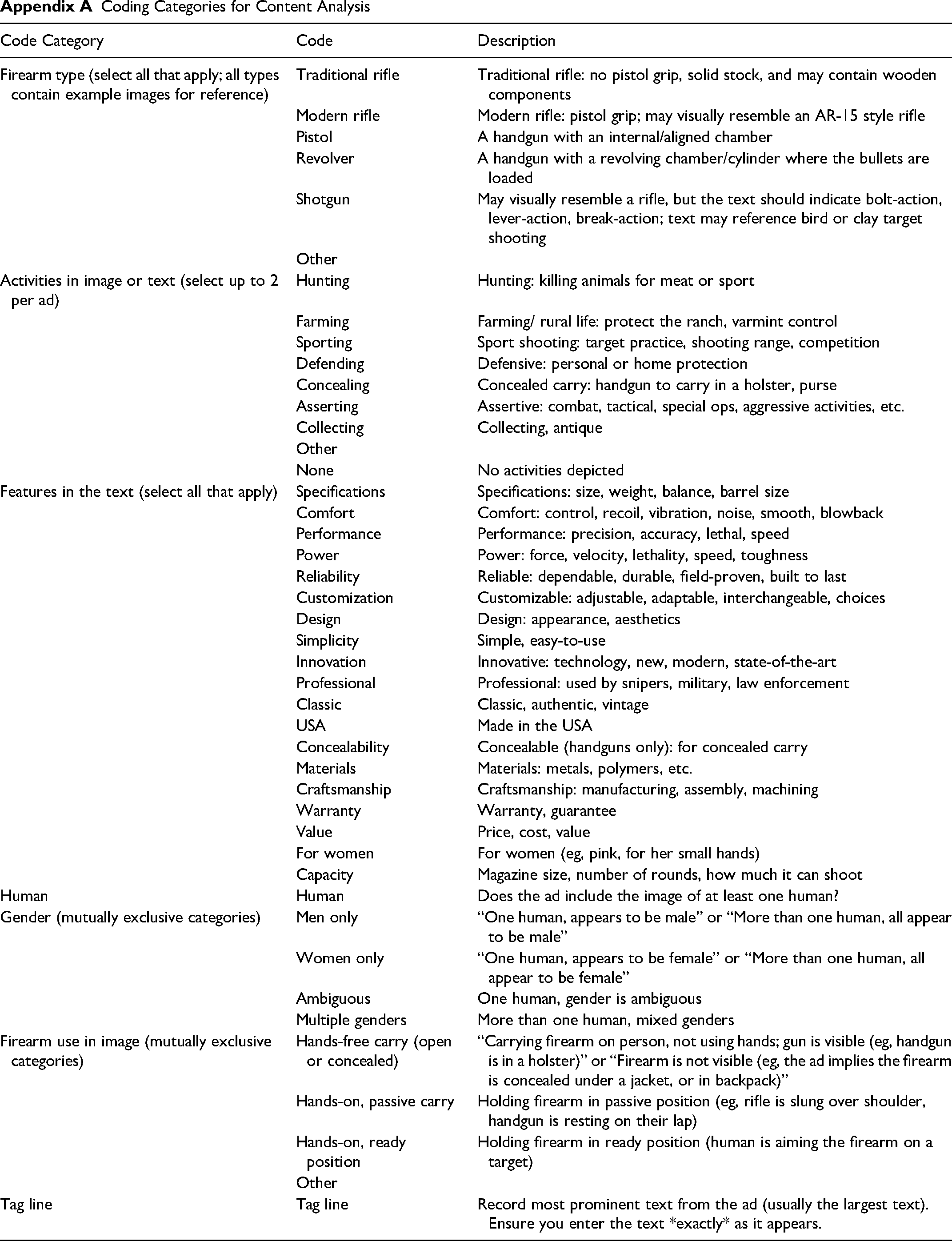
Through a collaborative and iterative process, we developed a codebook to capture various features of each ad (see Appendix A; Rose 2001). After training, two student researchers proceeded to code the corpus of ads using a custom-made data entry form that focused on manifest content. We classified firearm type as modern rifle, traditional rifle, shotgun, pistol, revolver, or other, and allowed for the inclusion of multiple types. Grip type was used to distinguish between rifles, and we coded pistol-grip rifles as modern rifles. We determined whether each ad depicted at least one human. For ads depicting humans, we coded the gender of people depicted, and coded how the person is holding or using the firearm: hands-free carry; hands-on passive carry; hands-on ready position; or other. For all ads, we additionally identified various product features declared in the text of an ad (e.g., performance, reliability, and concealability), as well as activities appearing in image or text (e.g., hunting, defense, farming). We also captured verbatim the text in the tag line.
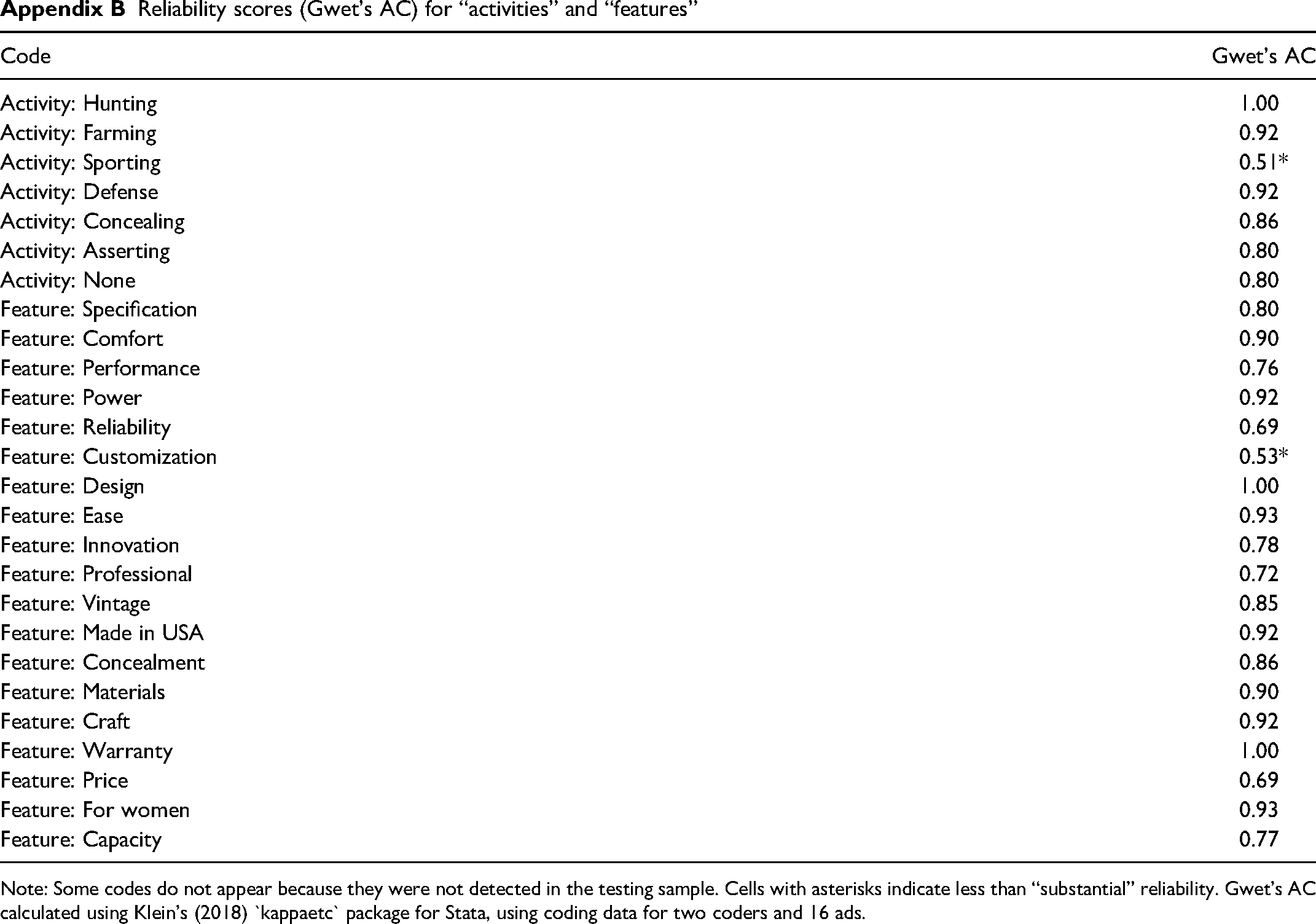
We conducted an inter-coder reliability check on one issue (n = 16 ads), which was coded by each of our two coders. We report Gwet's agreement coefficient (AC) for the “activities” and “features” identified in the ads. Gwet's AC is a stringent measure of inter-coder reliability that accounts for chance agreement and is resistant to known paradoxes that occur in other reliability measures (Gwet 2014; Klein 2018). Gwet's AC scores can generally be interpreted as indicating “almost perfect” (0.8–1.0), “substantial” (0.6–0.8), or poorer levels of agreement. Most codes achieved “substantial” agreement or better, and we note in subsequent discussion of results any codes that failed to meet this threshold. A table of these results can be found in Appendix B.
This quantitative analysis of the content enabled us to produce a series of descriptive statistics, graphs, and text analysis, and to produce bivariate statistics to examine simple relationships.
Visual Analysis, 2001–2020
Next, we conducted a qualitative visual analysis that focused on the set of 45 ads in the content analysis that featured armed women. We began by reviewing the content analysis codes related to the ads’ text and imagery, and then conducted a deeper, qualitative analysis to identify broad framing strategies (Atkinson 2014; Ball and Smith 1992; Belk and Pollay 1985). We approached the images as a form of discourse that produces gendered subjects (Rose 2001; Schroeder and Zwick 2004), in our case, the armed American woman, and we focused on the ad, asking: What is shown in the image? How are the components arranged? What do the components signify? What is excluded from the image, and what does its absence signify (Rose 2001, 189)? This approach enabled us to establish thematic codes on which to categorize the ads (Belk and Pollay 1985) and identify four distinct phases of framing strategies over the 20-year period. The fourth phase, 2016–2020, was of particular interest because it coincides with indicators of increasing legitimacy of the armed American woman.
Visual Analysis, 2016–2020
We then narrowed the temporal focus to the most recent five years of data, 2016–2020, and expanded the dataset to include all ads featuring armed women in all issues within the time period in order to better understand specific framing strategies used, and to triangulate our findings. We digitally scanned all gun manufacturers’ ads ¼ page or larger and depicting armed women during this period in Guns & Ammo. This dataset included 60 ads, or an average of 12 ads per year.
Continuing with our visual analytic approach, we sought to identify and examine frames at a more granular level to understand how these frames support the emerging cultural-cognitive legitimacy, giving particular attention to the meanings and characteristics employed in the frames. We identified two major frames and two minor frames, plus two outlier ads depicting a woman hunting with a man.
Content Analysis Results, 2001–2020
The results of our content analysis provide context for interpreting the subsequent visual analysis. The volume of ads varied during this 20-year period. Figure 1 shows a steady rise in the average number of ads per issue from the early-2000s into the mid-2010s. The number of ads per issue peaked in 2015 and 2016 (at 40 ads) and declined thereafter, a trend seen in other studies of gun magazine ads (Yamane, Yamane, and Ivory 2020).
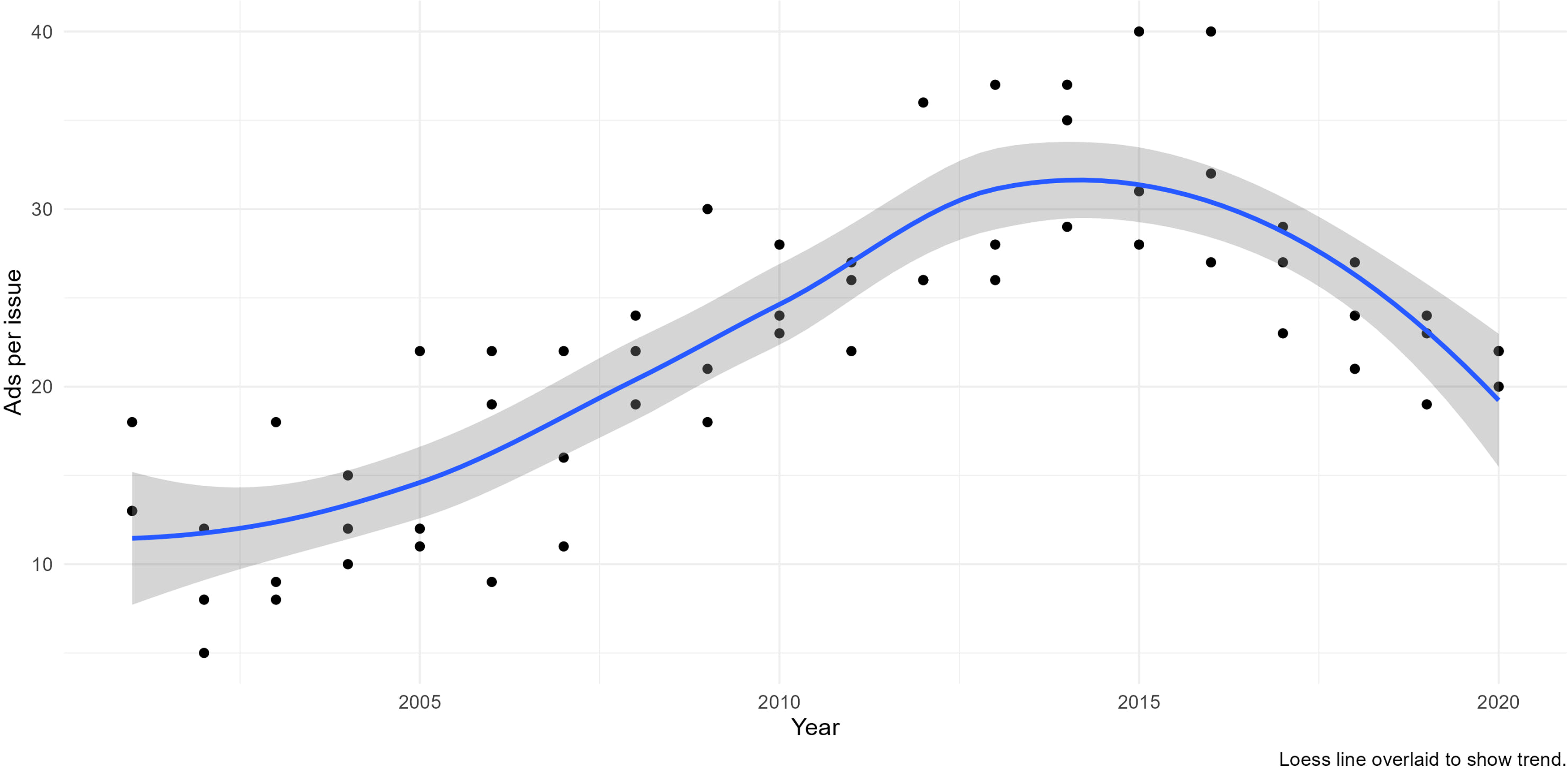
Advertisements per Issue in the Sample.
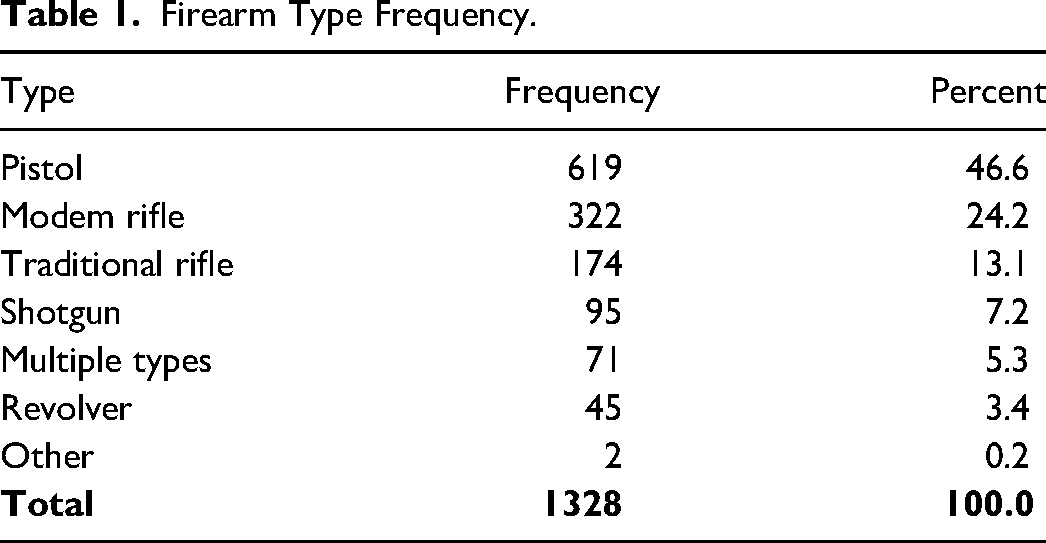
As seen in Table 1, pistols were the most common gun type, appearing in nearly half of all ads, consistent with a reconfiguring of the U.S. gun market toward self-defense during this time (Boine et al. 2020). Modern rifles and traditional rifles were next most common; combined, they appeared in more than one-third of all ads. The remaining 16 percent of ads featured shotguns, revolvers, other types of guns, or multiple types.
Firearm Type Frequency.
People appeared in only 32 percent of the ads in our dataset, though they became more common over time (see Figure 2). By late-2020, people appeared in roughly half of the ads, and of these ads, 77 percent depicted only men (see Table 2). Fewer than 11 percent depicted only women.
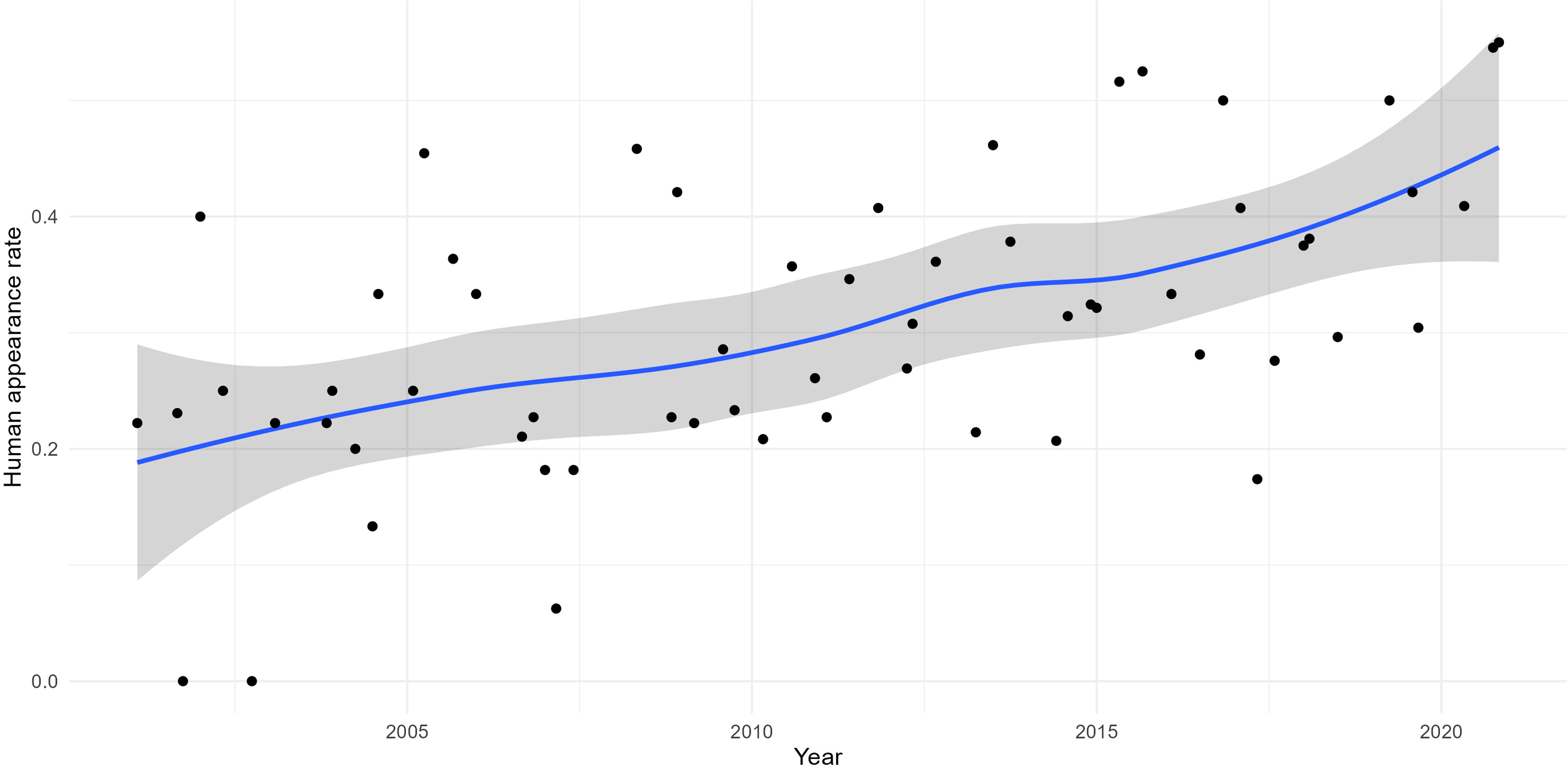
Human Appearance Rate Per Issue Per Ad, Over Ttme.
Gender of People Depleted in Ads.
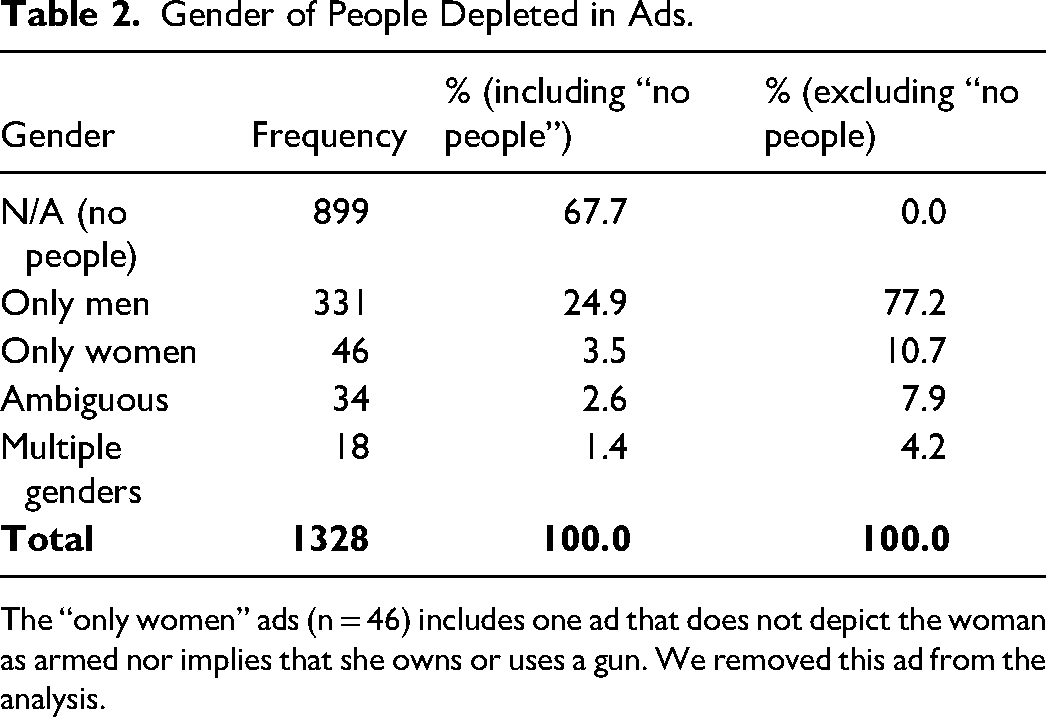
The “only women” ads (n = 46) includes one ad that does not depict the woman as armed nor implies that she owns or uses a gun. We removed this ad from the analysis.
Figure 3 shows the prevalence of different gender depictions in magazine issues over time. The number of ads depicting only men increased. Whereas a typical issue in the early 2000s contained about two men-only ads, a typical issue in the 2020s contained roughly eight. Ads depicting only women were most common in the 2010s, when they averaged less than three per issue. Notably, only one ad in our sample contained exclusively women during the seven years spanning 2001 through 2007.
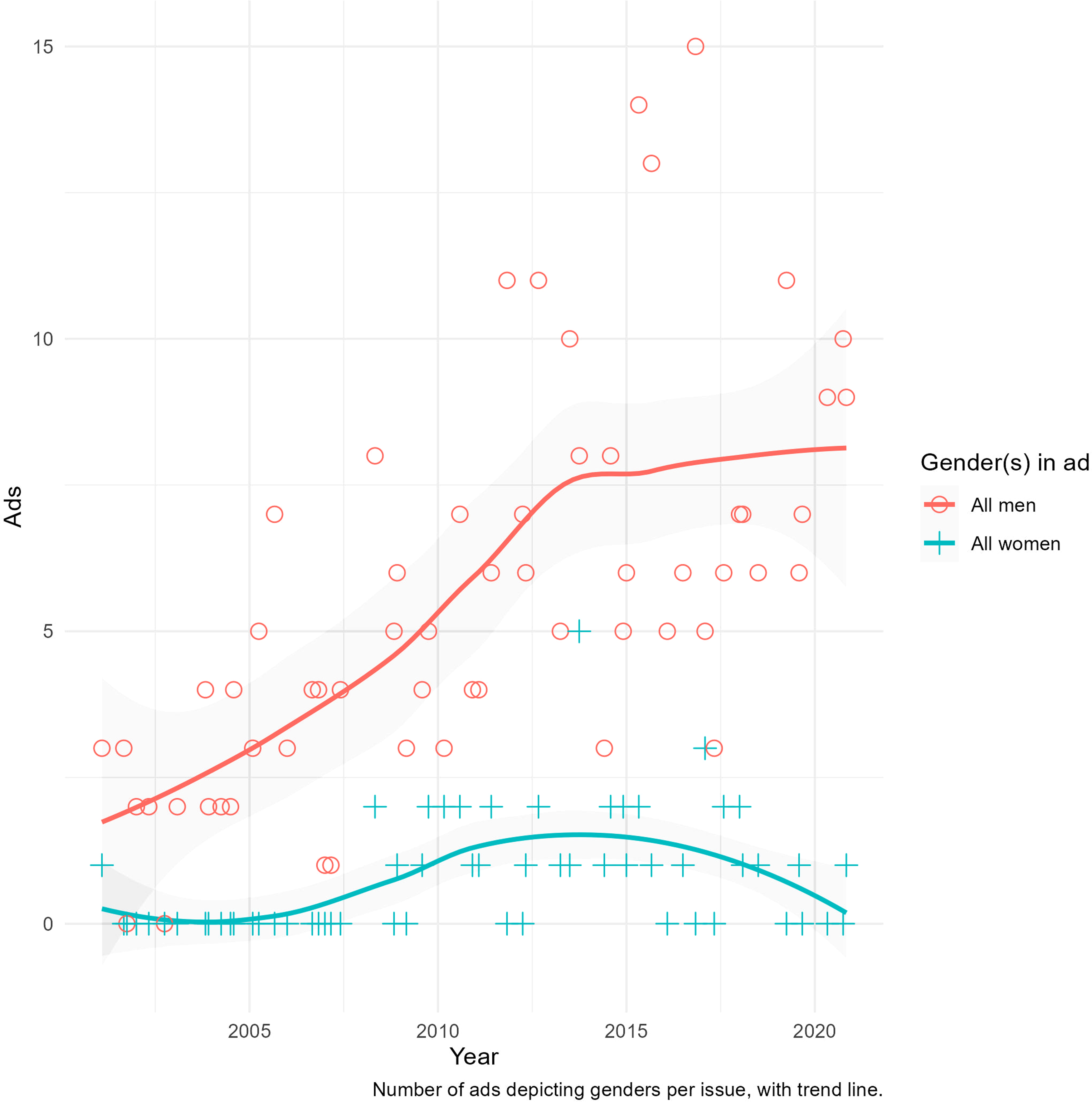
Number of Ads Featuring All Men and All Women, Per Issue.
Ads featuring only women differed on several dimensions relative to ads featuring only men. Table 3 compares the presence of firearm type, features, uses, and activities across ads depicting all men and all women. Numeric values indicate the expected difference in probability that an all-women ad contains a feature as compared to an all-men ad. In general, ads featuring women portrayed defensive firearm use; these ads were significantly more likely to feature a handgun than a rifle or shotgun, and the models’ activities were more likely to show a concealed firearm and to be “defensive,” with defensive defined as reactive, protective, and in response to a specific threat of violent victimization, such as being mugged in a parking lot or attacked by a home-intruder. Ads featuring only women were significantly less likely to depict “assertive” gun use, with assertive defined as proactive, aggressive, and in response to an ambiguous threat or force, than defensive gun use. The armed women in the ads are significantly more likely to be carrying the firearm in a hands-free (either open or concealed) or passive way, and they are less likely to be carrying it in the ready position. Further, ads featuring women were more likely to include product specifications and to emphasize concealability than ads featuring men, but were less likely to make claims about performance, reliability, innovation, professional use (e.g., used by law enforcement), or made in the USA.
Comparing Features of “All Women” Ads Versus “All Men” Ads.
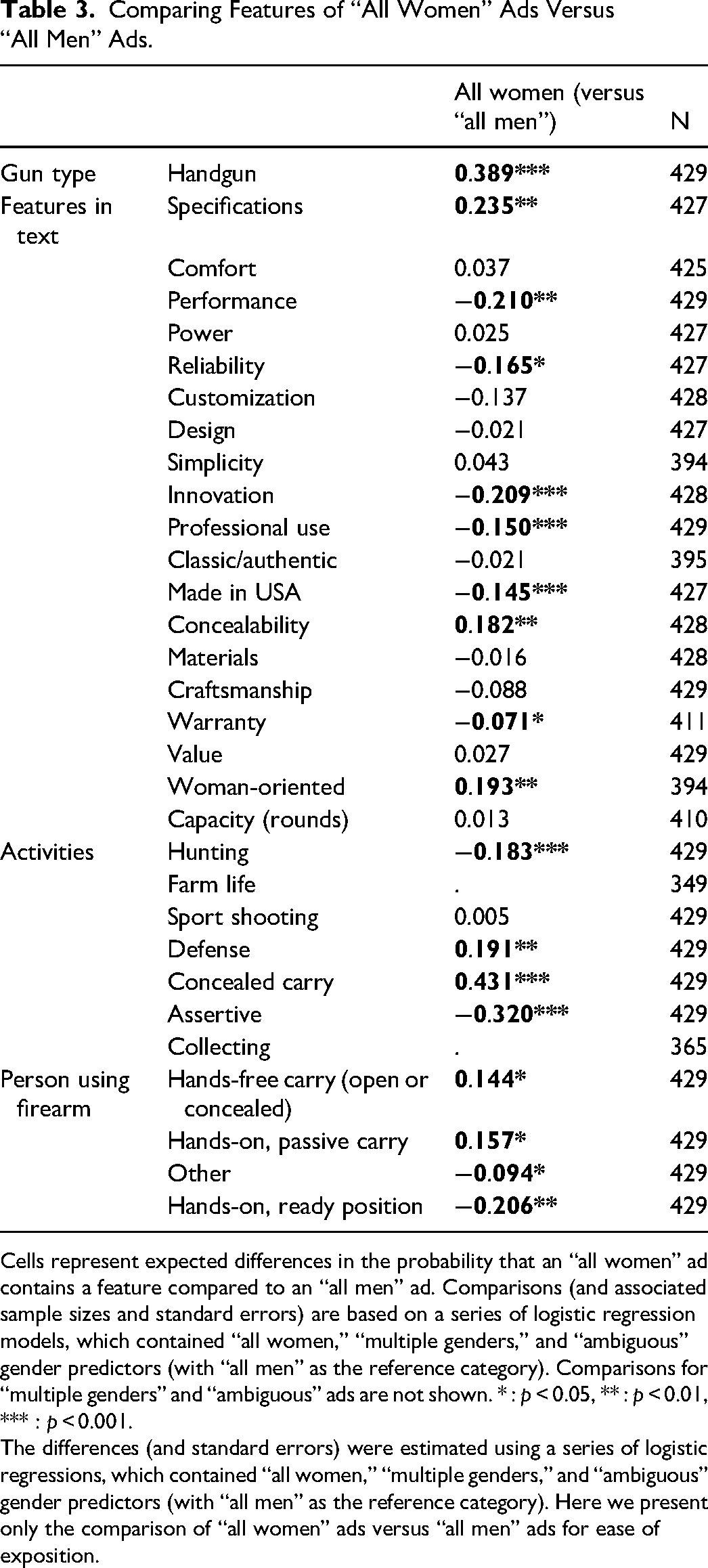
Cells represent expected differences in the probability that an “all women” ad contains a feature compared to an “all men” ad. Comparisons (and associated sample sizes and standard errors) are based on a series of logistic regression models, which contained “all women,” “multiple genders,” and “ambiguous” gender predictors (with “all men” as the reference category). Comparisons for “multiple genders” and “ambiguous” ads are not shown. * : p < 0.05, ** : p < 0.01, *** : p < 0.001.
The differences (and standard errors) were estimated using a series of logistic regressions, which contained “all women,” “multiple genders,” and “ambiguous” gender predictors (with “all men” as the reference category). Here we present only the comparison of “all women” ads versus “all men” ads for ease of exposition.
We then examined the language of the taglines of ads. Figure 4 presents word clouds of the 20 most common words used in taglines of ads featuring men and those featuring women. (The words have been stemmed, which reduces variants of words to their common stem form; e.g., “carry” and “carrying” both become “carri”.) Aside from referencing guns and rifles, ads featuring men touted the accuracy, power, and performance of firearms. In contrast, ads featuring women commonly described firearms (or the practice of using them) as sexy, thin, and compact. Echoing the results above, defensive gun use and concealment are prominent themes, with taglines referencing carrying, handguns, and defense.
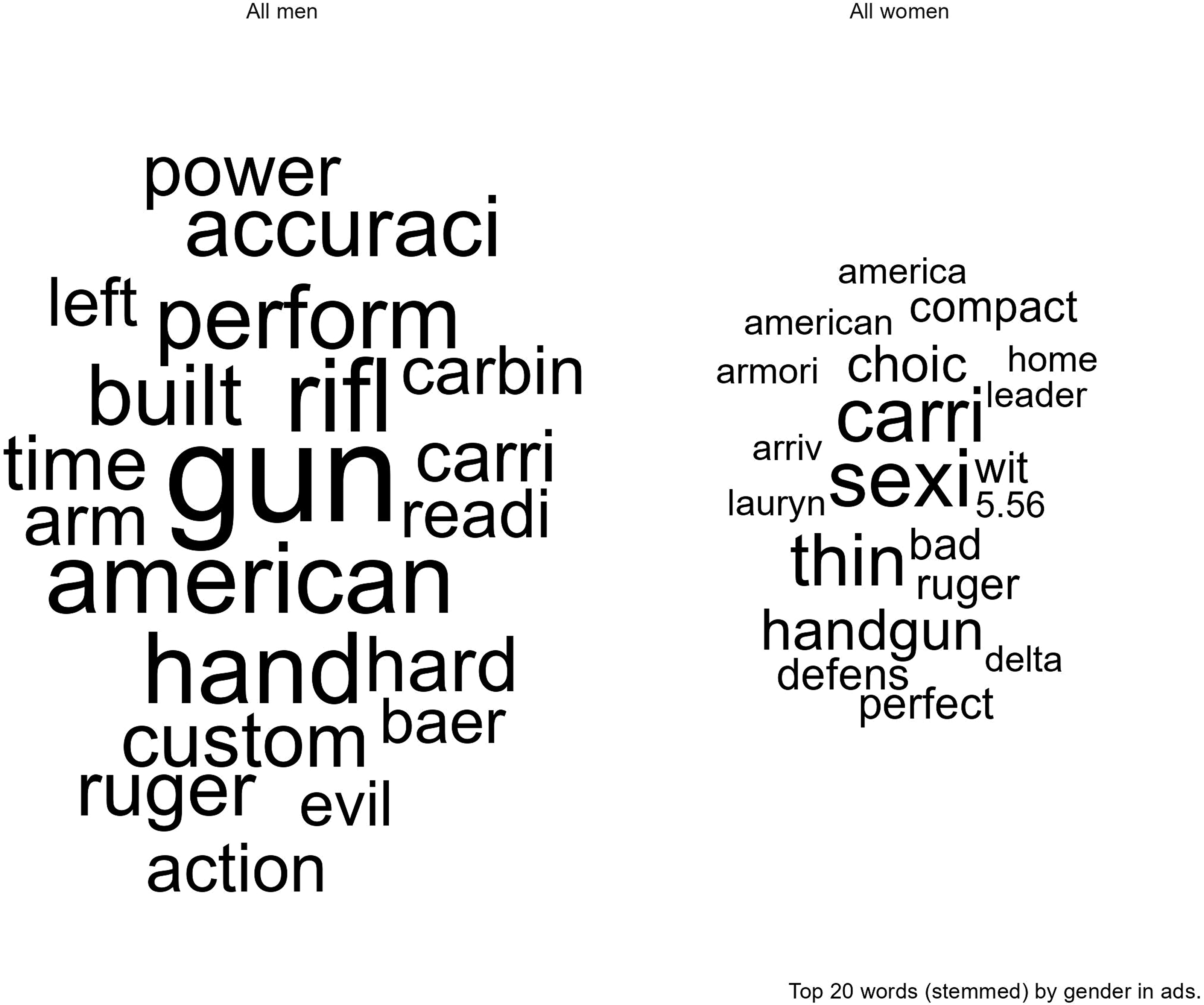
Top Words in Taglines of Ads Featuring All Men and All Women.
Ads Featuring Armed Women, 2001–2020
We now turn our focus to the visual analysis of the subset of ads featuring armed women (n = 45) to gain more nuanced insights into the depictions of women. We separate the data into four analytically meaningful periods: 2001–2007, 2008–2012, 2013–2015, and 2016–2020.
Phase 1: 2001–2007
We found no ads featuring armed women from 2001–2007. In our content analysis, we identified one 2001 ad featuring a woman, but it was not included in this dataset because she was not armed. The ad employs a sex appeal wherein the woman model is dressed as a sexy school teacher, lecturing a presumably male audience on the benefits of a particular gun, and it has a similar aesthetic and visual quality to the ads in Phase 2 (see Figure 5).
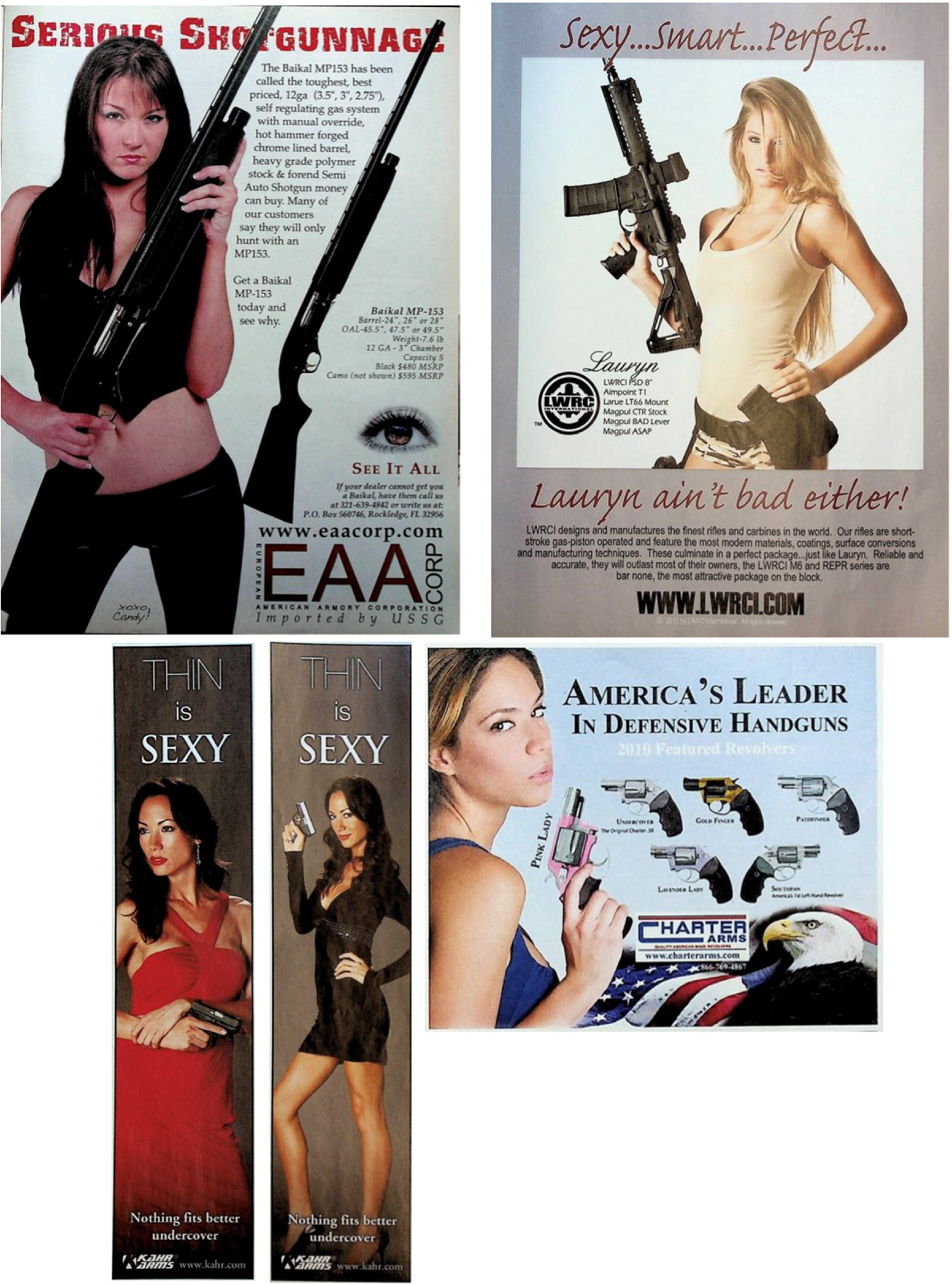
Sample Ads from 2008–2012 (Numbered Clockwise from Top-left).
Phase 2: 2008–2012
Phase 2 began in 2008, and the 18 ads in this phase used sexualized images of women to generally frame women gun owners as sexy. Most ads depicted thin, conventionally beautiful women, with styled hair and make-up, dressed in form-fitting clothing, and posing suggestively with a firearm. Tag lines included “THIN is SEXY,” “Sexy… Smart… Perfect,” and “Shoot. Admire. Repeat.” Eleven of the ads had a tag line that included the word, “sexy,” accounting for the predominance of the word in the word cloud (Figure 4). Consistent with Wofford's (2018) findings about gun ads featuring women in the late twentieth century and early 2000s, we find the aesthetic quality of most ads in phase 2 to be rather silly; they resemble a personal ad or a low-budget movie. For example, two ads in Figure 5 feature the model's “names,” Candy (#1) and Lauryn (#2), in script below her photo. We regard these ads as oriented to the male gaze; they are targeted to men who are presumed to regard women's gun ownership as sexy, and who may purchase guns for their wives or girlfriends (Browder 2006). It seems unlikely that the ads would motivate women readers to seriously consider gun ownership. Blair and Hyatt (1995, 124) found that women were “turned off” by gun advertisements that employed a “fashion-feminine appeal.”
Phase 3: 2013–2015
Phase 3 included 16 ads and coincides with the phase during which we observed the most ads, overall (see Figure 1). In contrast to phase 2, only four ads depict women in a sexualized way (i.e., short skirt, low-cut shirt). The aesthetic quality of some ads resembles that of phase 2, but most ads adopt a conventional, professional aesthetic (see Figure 6).
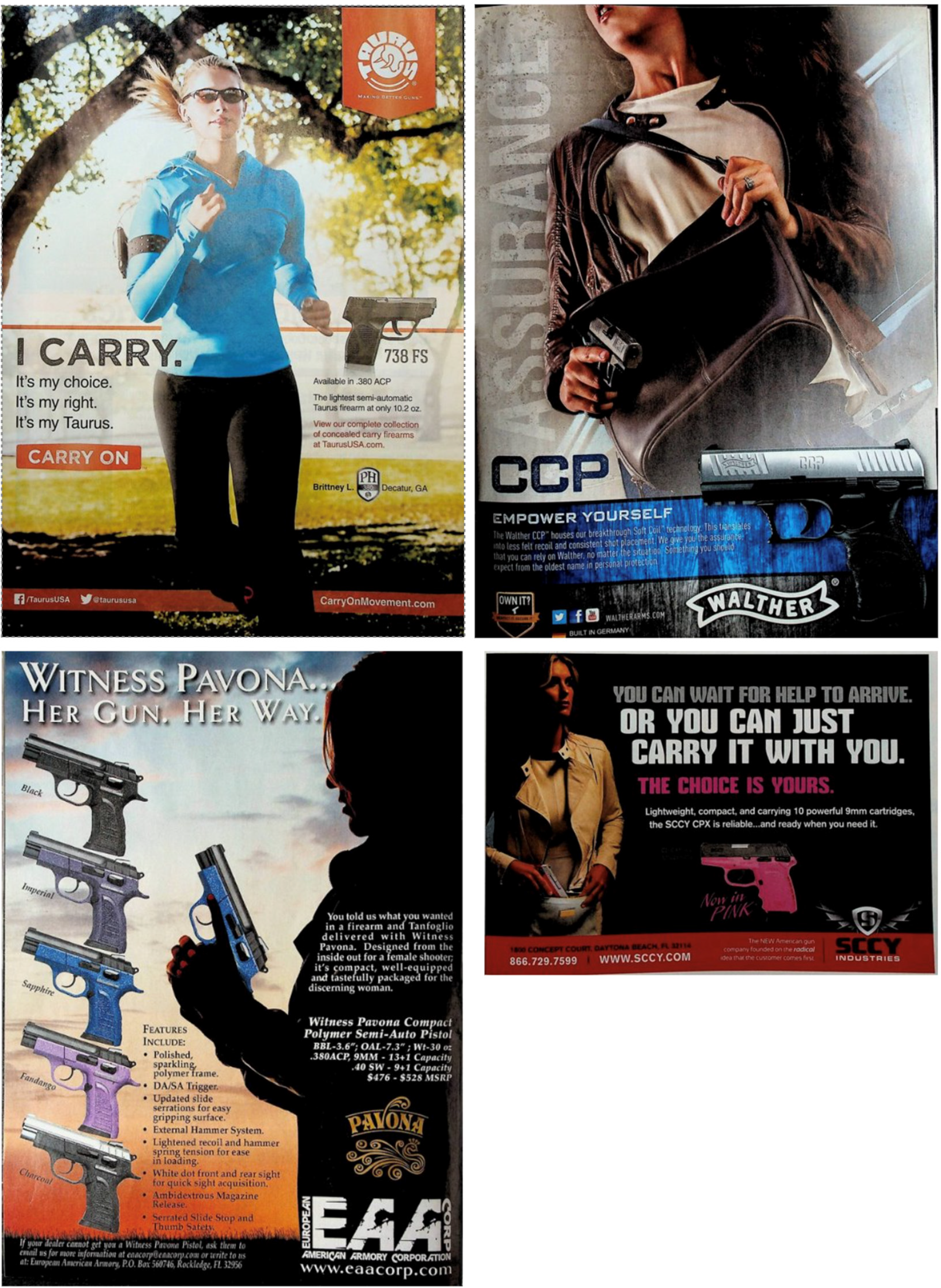
Sample Ads from 2012–2015 (Numbered Clockwise from Top-left).
We observed variation in framing strategies; it appears that manufacturers were experimenting with different approaches to appeal to women. Most ads frame armed women as confident, empowered, and feminine. The images feature thin, conventionally attractive white women, and convey their femininity through body shape, clothing, jewelry, and accessories. The armed women are engaged in various activities – some that require their firearms, such as target shooting, drawing a handgun from a purse, or hunting, and some that do not require firearms, such as jogging while wearing headphones. Tag lines include “I CARRY,” “EMPOWER YOURSELF,” and “You can wait for help to arrive. Or you can just carry it with you.” The ads emphasize the emotional and psychological benefits women can experience when owning a gun, including empowerment, confidence, and choice (Carlson 2015a).
Phase 4: 2016–2020
Phase 4 included 11 ads. In contrast to prior phases, we observed framing strategies that focus on feminine competence – a subtler version of the empowerment discourses observed in phase 3 – and that use tag lines and copy to emphasize the firearms rather than the women who use them. The ads frame the armed American woman using discourses of seriousness and capability and make very subtle references to her femininity (see Figure 7).
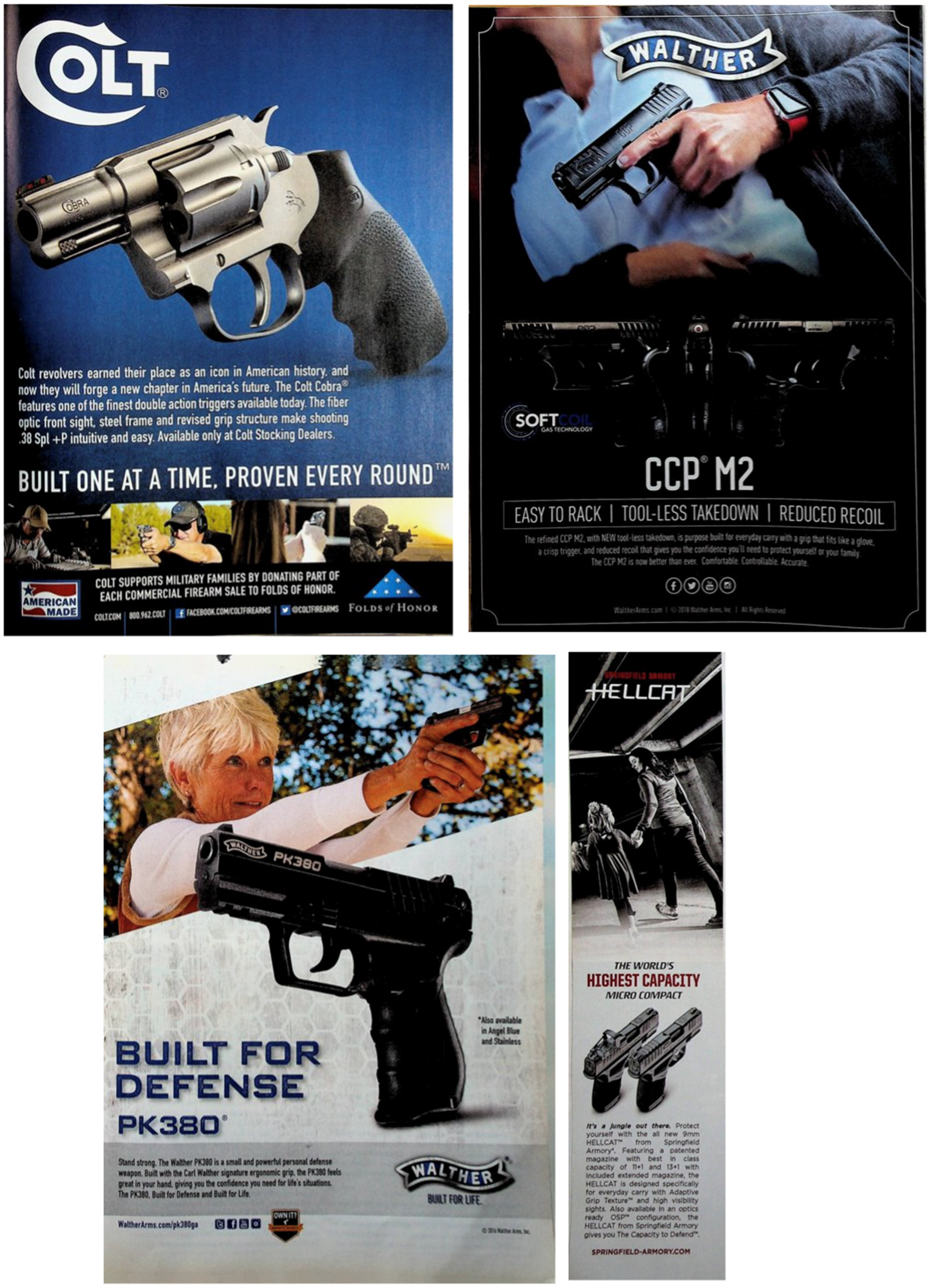
Sample Ads from 2016–2020 (numbered clockwise from Top-left).
The images typically feature thin, conventionally attractive white women, either at the shooting range, or in public with the presence of a concealed handgun implied. Eight ads feature women at a shooting range; the models in these ads are dressed in functional attire, appropriate for a shooting range, and wear eye and ear protection. We also note that this phase is the first to include an ad featuring an older woman with gray hair (see Figure 7, ad #4). Tag lines include “BUILT ONE AT A TIME. PROVEN EVERY ROUND,” “HIGHEST CAPACITY,” and “BUILT FOR DEFENSE.” All ads adopt a conventional, professional aesthetic. We regard these ads as oriented to women readers or to male gift-givers who understand the primary benefits of women's gun ownership as practical, rather than psychological.
In many ads, feminine features of the model are downplayed. Ads depict women wearing functional clothing, with minimal jewelry, make-up, or accessories. The differences from the previous phase are subtle but distinct. The Walther ads provide an example of this shift; in phase 3, the Walther ad features a woman wearing jewelry and carrying a purse, with the tagline “EMPOWER YOURSELF” (Figure 6, ad #2), and later, in phase 4, the Walther ad features a woman with no jewelry or purse, and displaying copy about features and benefits of the gun: “EASY TO RACK. TOOL-LESS TAKEDOWN. REDUCED RECOIL” (Figure 7, ad #2).
The ad copy in phase 4 is primarily focused on attributes and specifications of the gun, rather than characteristics of the armed woman. For example, Colt ran several ads similar to Figure 7, ad #1, which feature a woman at a shooting range alongside photos of men at a range and in combat, with text that focuses on features and benefits of the revolver and the brand.
The ads in phase 4 coincide with increasing self-reported women's gun ownership (Brenan 2022) and increases in the proportion of new gun purchasers who are women (Miller, Zhang, and Azrael 2022), both of which indicate increasing legitimacy of the armed American woman. To better understand the associated meanings and characteristics of this increasingly legitimate institution, we investigated the phase 4 framing strategies, which reflect and influence this legitimacy, more deeply.
Framing of the Armed American Woman, 2016–2020
The second step of our visual analysis encompassed all ads featuring armed women in all monthly issues from Phase 4 of our data (January 2016 through December 2020) (60 issues). We identified four different frames of the armed American woman: Serious Student, Capable Carrier, Domestic Defender, and Action Hero. These four frames accounted for all but two ads, which were two instances of the same ad that feature a woman hunting with a male partner. We considered this hunting ad to be an outlier, in part because it is the only depiction of an armed woman with an adult companion, and his presence helps to legitimize her. Only one other ad in the dataset implicates hunting, although with a more fantastical aesthetic; the lack of depictions of hunting is consistent with evidence that the late 2010s have been dominated by self-defense oriented gun culture (Boine et al. 2020).
Two of these frames – the Serious Student and the Capable Carrier – feature the type of gun (pistol) most commonly purchased during the period. These frames were used more frequently by advertisers during the time period than the others, suggesting that advertisers found them to be effective in encouraging women's gun ownership and purchasing. We conclude that the meanings conveyed in these frames characterize the armed American woman in ways that potential buyers found acceptable within their cultural-cognitive schemas, thus both reflecting her rising legitimacy and reinforcing this legitimacy by increasing her representation in the cultural milieu.
The frames we observe in this time period mark a shift in how the armed American woman is understood; whereas ads in previous phases depict her as sexy or empowered, the ads in this phase depict her as competent and facilitate new cultural understandings of this institution (Benford and Snow 2000). The text in many ads characterizes the gun in ways that might also characterize conventionally attractive women, such as: slender, lightweight, small frame, and smooth. However, in contrast to the preceding phases, the images and text generally do not frame the woman as overly feminine or sexy, with the exception of the Action Hero frame.
Serious Student
In the first frame, observed in 27 ads (about 45% of the ads), the armed American woman is framed as a serious student of firearms. Figure 8 includes examples of the Serious Student frame (see also Figure 7, ad #1). The Serious Student pursues gun expertise through serious, focused training. The seriousness is conveyed through references to masculinity, which is associated with natural expertise in firearms; when women are associated with masculinity, through their clothing or lack of jewelry, they can be understood as serious students of guns. In this frame, armed women are not presented as overly feminine, and some ads convey that the model is a woman in extremely subtle ways. For example, Figure 8, ad #4 signals femininity only through the model's nude thumbnail polish. In addition, rather than pink or other colored guns that we noticed in the ads that did not include any people, the Serious Student overwhelmingly wields more masculine and traditional black or dark gray guns – yet another indicator of her seriousness.
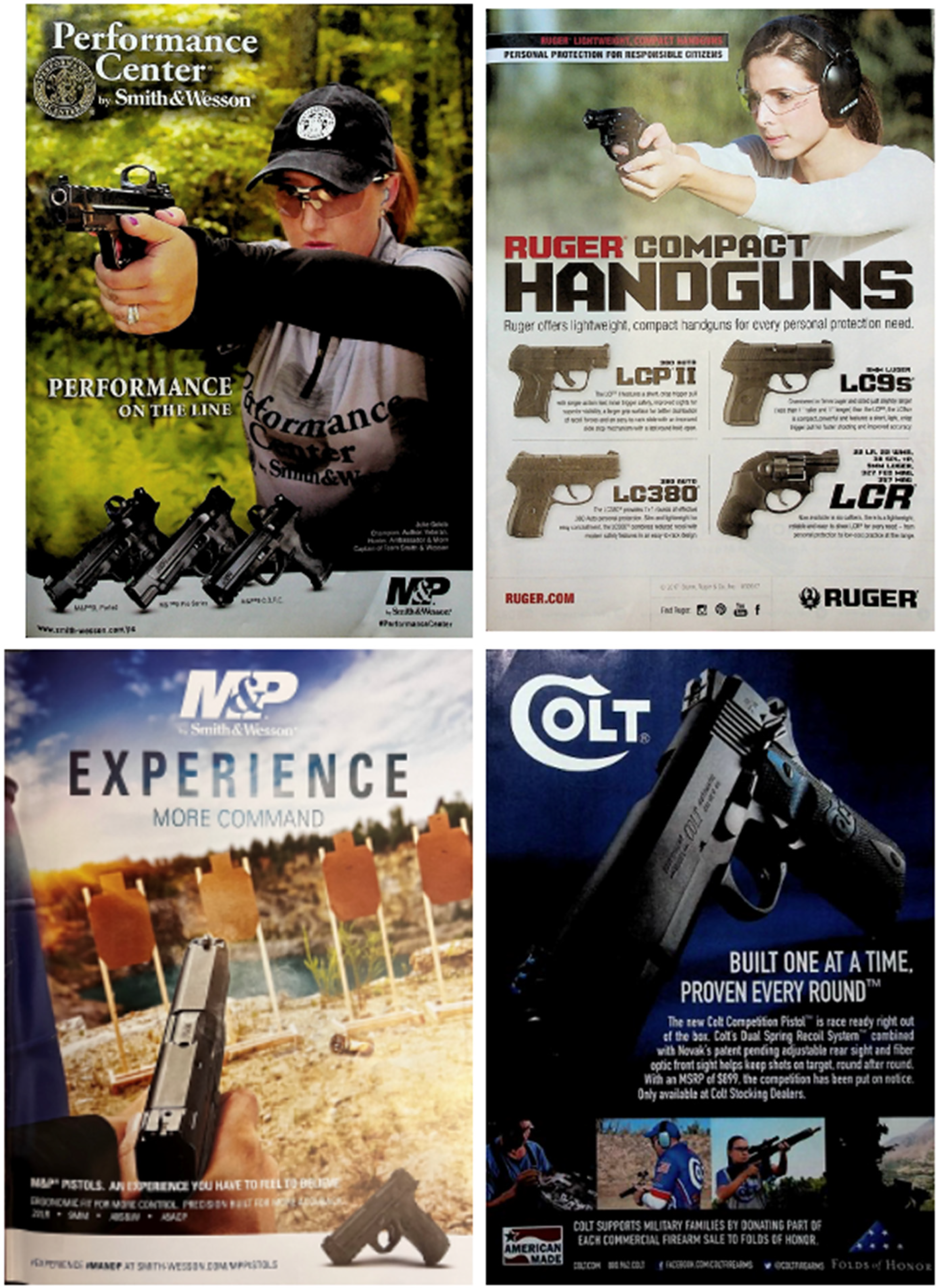
Sample Ads Using “Serious Student” Frame (Numbered Clockwise from Top-left).
The Serious Student uses guns for the practical purpose of developing expertise, experience, and confidence. Serious Students are focused, diligent, and concentrating on their firearm use. In most ads, the models can be seen wearing practical, appropriate attire for a shooting range, including long sleeves, ear and eye protection, and with long hair pulled back (in contrast to the models in Figure 5). Seriousness on its own is insufficient to motivate legitimation; the armed American woman must also actively pursue and partake in training in order to be accepted.
This frame enables women and men readers to understand women's personal gun ownership as serious, responsible, and safe. Training with one's firearm is an important practice for gun owners seeking to mitigate risks to themselves and to be taken seriously by others (Barnhart et al. 2018; Carlson 2015b). The models are not portrayed as engaging in leisure or social activity; they are typically unsmiling, and are depicted without other people.
Capable Carrier
In the second frame, observed in 16 ads (27% of the ads), the armed American woman is cast as a capable carrier of handguns. Figure 9 includes examples of the Capable Carrier frame. The Capable Carrier is a competent gun owner and has the capability to defend herself and her children (see Figure 7, ad #3) if necessary. This frame is similar to prior frames of empowerment (e.g., in Phase 3; Figure 6, ads #1 and #2), but more subtle; it foregrounds her abilities rather than her eagerness to use the gun. Ads communicate that she is relaxed (ads #1 and #4), confident and alert (#3), or cautious and prepared for a potential threat (ad #2), and she is understood to be a competent, proficient handgun owner.
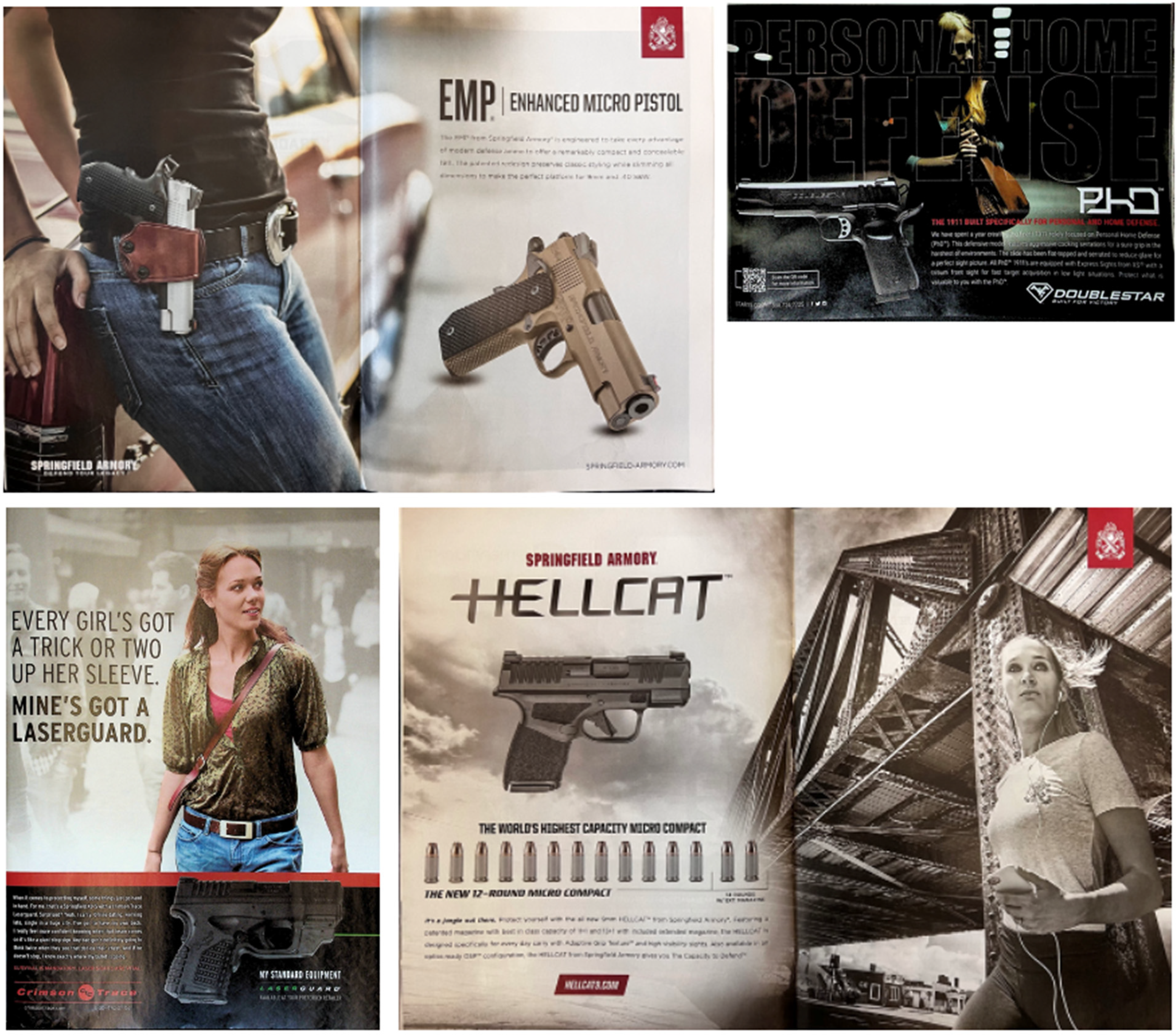
Sample Ads Using “Capable Carrier” Frame (Numbered Clockwise from Top-left).
Her capability is conveyed in the models’ body language, context, and the absence of a male companion; all 16 ads feature women in public or a parking garage (see Figures 7 and 9). The Doublestar ad (Figure 9, ad #2) subtly features the tag line, “PERSONAL HOME DEFENSE,” abbreviated to “PHD” – a possible double entendre implicating the armed American woman's savvy. This frame enables women and men readers to understand the practical rationale for women's personal gun ownership. Gun ownership enables women to be in public and be capable of protecting themselves and their children. The Capable Carrier owns a firearm for a practical, utilitarian reason.
Domestic Defender
In the third frame, the armed American woman is depicted as a Domestic Defender. This frame appeared in only 4 ads, but we consider it a frame, rather than a set of outliers, because it is used by three different manufacturers, and the type of armed American woman it depicts is strikingly distinct from the other frames. Figure 10 includes examples of this frame.
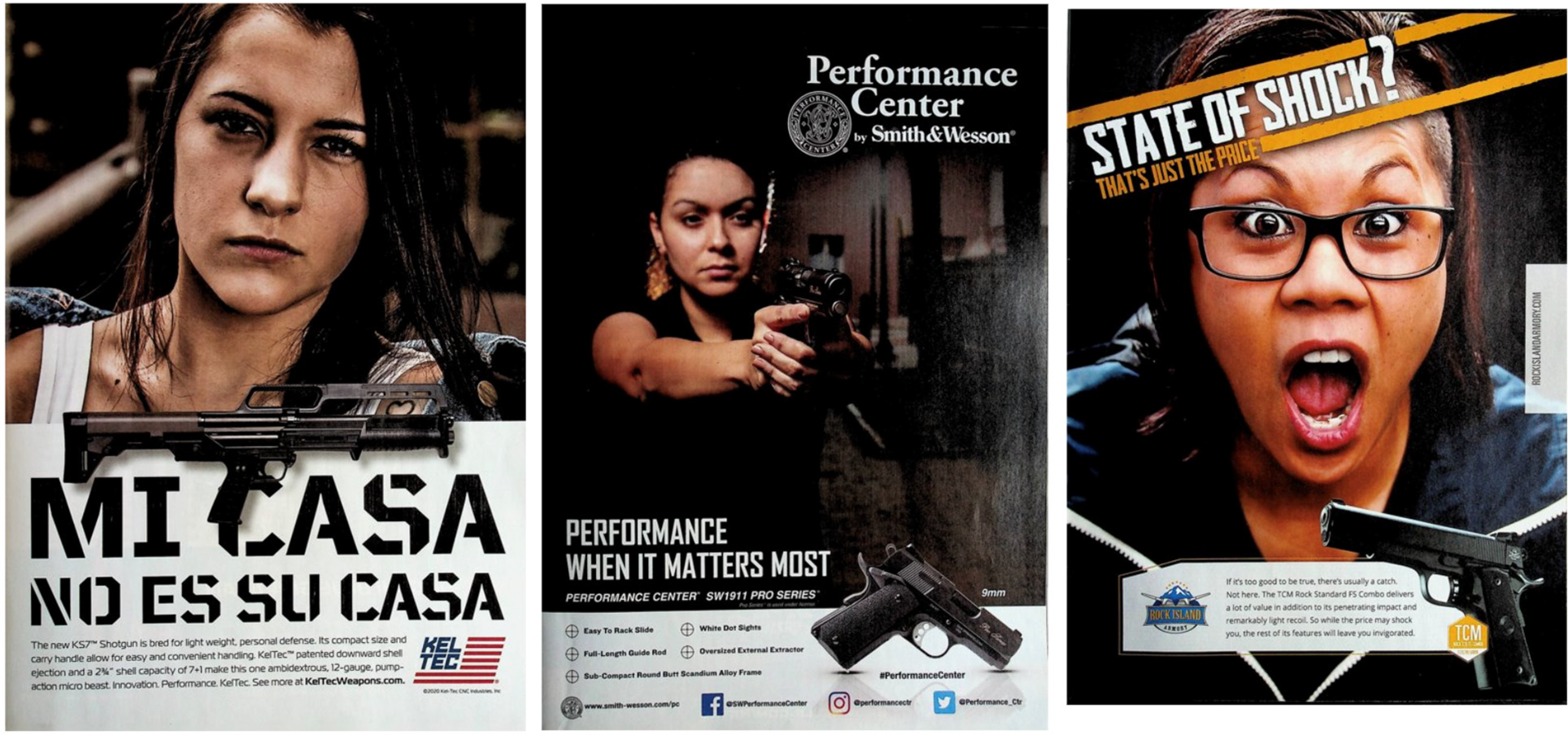
Sample Ads Using “Domestic Defender” Frame (Numbered from Left to Right).
The Domestic Defender is a woman of color who uses a gun to protect her home. Like the Serious Student and Capable Carrier frames, this frame centers specifications of the firearm in the copy, but it is the only frame that depicts women at home, and the ads are suggestive of high-crime conditions, low income, and women's vulnerability. In contrast to other frames, this frame portrays the armed American women hardened, and in need of a firearm to protect against the dangers in her neighborhood.
The tag line, “MI CASA NO ES SU CASA,” (translated from Spanish: my house is not your house) is targeted to Hispanic women. Notably, this was the only instance of non-English text in either dataset, and this framing did not appear until the third year of our 5-year dataset.
We include ad #3 in this frame because she is a woman of color, she appears to be in an indoor setting that is not a gun range, and the ad is strictly about price. We interpret the racialized model and the price appeal (i.e., low price featured in the tag line) as indications that she is of low socio-economic status. Generally, we interpret this frame as a novel attempt by manufacturers to appeal to non-white readers.
Action Hero
In the fourth frame, the armed American woman is depicted as an action hero. This frame appeared in 11 ads, and it foregrounds aspirational and fantastical aspects of gun ownership. Rather than being oriented to practical gun usage, as are the previous frames, this frame is oriented to vague but compelling ideas of guns as tools in gun-centric ideological and identity projects. Figure 11 includes examples of the Action Hero frame.
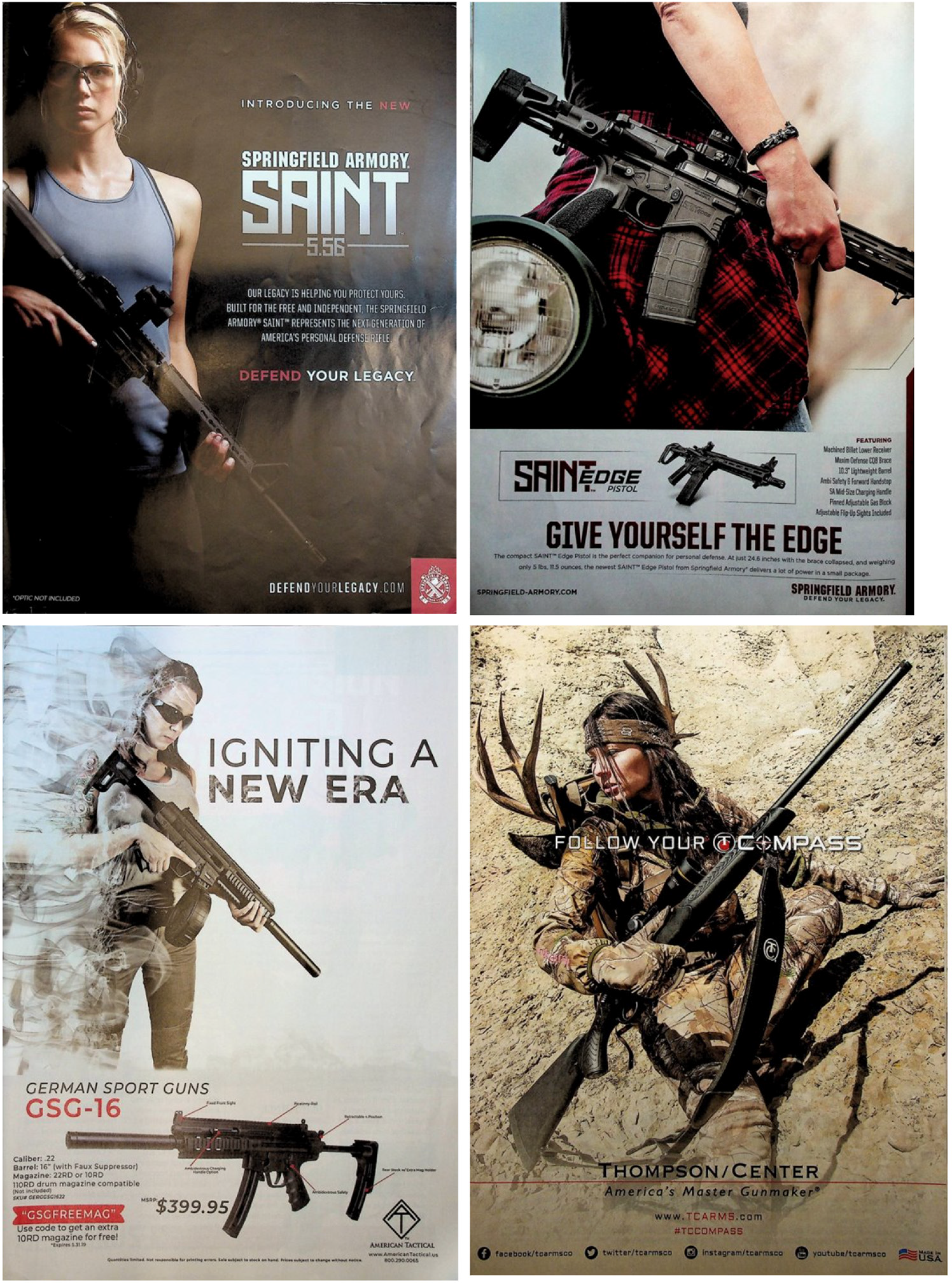
Sample Ads Using “Action Hero” Frame (Numbered Clockvise from Top-left).
This frame is likely appealing to both survivalists and women oriented to gun rights activism, because the tag lines can be interpreted in multiple ways; the tag lines, “DEFEND YOUR LEGACY,” “GIVE YOURSELF THE EDGE,” “IGNITING A NEW ERA,” and “FOLLOW YOUR COMPASS” are ambiguous, giving the reader no specific guidance on how to understand the declaration or direction. Further, unlike the three other frames, the tag lines focus on the emotional and psychological benefits to the gun owner, rather than the features of the gun itself. We interpret this as intentional, because the Action Hero's firearm, unlike the firearms belonging to the three other armed American women, does not serve a clear and practical purpose in the service of personal protection, and therefore a rational appeal would be less persuasiveJMK.
The women in these ads are distinctly feminine, with long hair and form-fitting clothing, and they are serious – unsmiling, tough, and holding long guns with strong, authoritative grips, bearing a striking resemblance to armed action hero actresses Sigourney Weaver in Alien, Linda Hamilton in Terminator, or Angelina Jolie in Lara Croft, Tomb Raider (Floyd 2008; Schwartz 2021). Unlike the other frames, the purpose of the gun for the Action Hero is not specific or explicit. There are references to hunting (Figure 11, ad #3), training, and protection (ad #1), but the consumer benefits are largely left to the viewer's interpretation. This is consistent with the emergence of “Second Amendment” gun culture that focuses on gun rights activism and subverts conventional ideals about femininity and firearms (Boine et al. 2020; Light 2021; Talbot 2005).
Discussion
In this research, we investigated how gun manufacturers’ advertising framing of the armed American woman changed from 2001–2020, and identified the meanings and practices conveyed in advertisements that coincide with her becoming a more legitimate institution. In our content analysis, we identified shifts in the number of ads featuring women, the types of appeals used, and the framing of the armed American woman in the ads over this time, with two predominant frames aligning with the period of increasing legitimacy that is indicated by women's gun ownership and purchasing rates. We observe that in our sample of gun manufacturers’ ads that ran in Guns & Ammo from 2001–2020, ads that featured armed women first appeared in 2008, and the number of these ads increased until 2016, when the volume of all print ads began to decline. Throughout this time, ads portraying armed women appeared much less frequently than ads portraying armed men (see Figure 3). Like ads that did not show armed women, those that did primarily featured pistols for the purpose of self-defense, consistent with the shift in American gun culture toward self-defense (Boine et al. 2020). These findings suggest that the frames used from 2016 to 2020 facilitated and reinforced an increasing legitimacy of the armed American woman.
In our subsequent visual analysis of ads that depict armed women, we identified four phases distinguished by different frames: phase 1 (2001–2007) was characterized by a lack of armed women, phase 2 (2008–2012) framed the armed American woman as sexy, phase 3 (2013–2015) framed her as empowered and confident, and phase 4 (2016–2020) framed her as capable and proficient. The second visual analysis involved a larger dataset – all ads portraying armed women in each monthly issue during phase 4 – and enabled us to examine the specific frames used during this period, which immediately preceded and overlaps the year in which the legitimacy of the armed American woman increased to the point that women represented half of all new gun sales (2019–2021). In this analysis, we identified two predominant framings, the Serious Student and the Capable Carrier, which convey congruent meanings related to focused skill development and competence in using a firearm for self-defense. In addition, we identify two secondary framings, the Domestic Defender and the Action Hero.
Employing the lens of institutional theory and legitimation of cultural institutions (Deephouse and Suchman 2013; Scott 2008), we interpret the frames utilized in 2016–2020 as both reflecting and facilitating an increased cultural-cognitive legitimacy of the armed American woman. In contrast to predominant frames used by gun manufacturers in prior years, at least two of the four frames we identified appear to align with Americans’ tacit understandings and cognitive structures and support legitimation, as indicated by their frequent use by gun manufacturers, presumably due to their effectiveness in achieving advertising goals that led to the dramatic increases in women's purchase and personal ownership seen in 2019–2021 (Brenan 2022; Miller, Zhang, and Azrael 2022). These findings are consistent with Humphreys’ (2010) study of the legitimation of casino gambling, wherein she finds that industry actors strategically use framing strategies (Benford and Snow 2000) to establish and entrench positive associations with the industry. Building on this, and more recent work on legitimation of contested consumer products (Huff, Humphreys, and Wilner 2021), we demonstrate how industry actors can influence the transformation (Benford and Snow 2000) of meanings and understandings of an institution – the armed American woman – to reinforce and spur her cultural-cognitive legitimacy. This, in combination with her regulative legitimacy, may facilitate the emergence of normative legitimacy, or broad acceptability and alignment with cultural expectations and values.
Our findings contribute to scholarship on visual and textual discourses in American gun culture, first, by shedding light on discourses aimed at a broad range of American gun owners and potential purchasers beyond NRA members; and second, by illuminating the changes and nuance in discourses related to armed American women that align with an increase in cultural cognitive legitimacy of women's personal gun ownership. Previous work specifies the strategic and successful efforts of the NRA to establish individual gun ownership as a constitutional right (Lacombe 2021) and the discourses it employed to promote a gun-centric identity and corresponding ideology to its claimed five million members (Filindra 2023; Franks 2019; O’Neill 2007). In elucidating the work of gun manufacturers speaking to an audience outside the ideological radius of the NRA, we shed light on visual discourses aimed at the approximately 80 million American gun owners, as well as potential owners, who are not members of the NRA (Lacombe 2021), and we identify those that align with increases in the legitimacy of the armed American woman.
While both the discourses employed by gun advertisers in our sample and those employed by the NRA over the same time period prominently reference self-defense, in contrast to those used by the NRA, discourses in our dataset included relatively few references to the right to bear arms, the Second Amendment, or policy and cultural threats posed by liberals. Rather, it appears that at least since 2016, with the possible exception of the relatively infrequent Action Hero frame, gun manufacturers’ discourses aimed at women in the general public have largely steered clear of overtly political themes and instead focused on framing armed women as capable and responsible users of sophisticated utilitarian tools for protecting themselves and their families.
Our findings offer a response to calls for more research on armed American women to prompt new conversations about how society understands guns, gun ownership, and gender. In their investigation of feminism and firearms, Stange and Oyster 2000, 5) argue that bringing armed American women into the light of day will mean shattering some stereotypes and reevaluating some truths about female weakness, fear, vulnerability, and nonaggressiveness. And it may just mean that men will have to alter the way they look at themselves as well as women.
Browder 2006 work traces depictions of armed American women since the American Revolution, highlighting how she continued, in the early 2000s, to spark intense debate because she failed to align with normative and tacit understandings of guns as symbols of masculinity, power, and American identity. Our findings indicate that these understandings have shifted in recent years. Floyd 2008, and others, have observed that guns have been depicted as appropriate protective tools for middle- and upper-class white women, and our findings suggest that manufacturers have generally maintained this framing in 2020, with the exception of the Domestic Defender, and it remains unclear whether advertising will offer more diverse depictions of the armed American woman. Additionally, Twine (2013) examines how feminism and femininity are reflected in the experiences of armed American women, their unarmed counterparts, and military women, as they are situated in a society with easy access to guns, gun violence, gender inequities, and an entrenched gun culture; and Kelley (2022) observes that women handgun owners who identify as feminist are more likely to carry guns regularly. Our findings indicate that framing the armed American woman as a capable, serious, knowledgeable gun owner might animate a shift in acceptance of her femininity and power.
In addition, the visual and textual discourse of the ads aimed at women beyond NRA members portray gun use as empowering for women, but in a different and more nuanced way than it was previously portrayed by the NRA. Extant research reveals that the NRA's notion of women's armed empowerment, embodied in NRATV spokeswoman Dana Loesch from 2016 to 2019, is entrenched in white nationalism (Light 2021), and that the NRA has tried to appeal to white women by integrating gun ownership with conservative ideals, stoking fear of being personally attacked by a stranger and of the government stripping citizens of their gun rights, and glamorizing guns, gun-centric communities, and political engagement (Lacombe 2021; Schwartz 2021). While white women dominate the ads in our sample, and the Capable Carrier frame is consistent with the threat of being attacked by a stranger, we observe an absence of overt politicization of women's gun ownership, likely in an effort to appeal to less conservative women who may count themselves among the 62% of American women who favor increased gun control (Brenan 2022). Even among women who report personally owning a gun or living in a household with guns – who likely have greater exposure and receptivity to gun advertising than those in households without guns – a substantial percentage support stricter gun laws (Brenan 2022; Gallup 2023). The nuanced discourse of empowerment we observe in the Serious Student frame, with its references to safety, responsibility, and developing a high degree of competence, may reflect and reinforce the legitimacy of personal gun ownership for these women more than the overtly political discourses of the NRA.
In addition, our findings complement previous studies of gun advertising in the 19th and 20th centuries (Blair and Hyatt 1995; Haag 2016; Henning and Witkowski 2013), research on American gun advertising targeted to NRA members (Yamane, Ivory, and Yamane 2019, Yamane, Satterwhite, and Yamane 2021), and studies of ads aimed at increasing purchases by and for men and boys (Jordan, Kalin, and Dabrowski 2020; Saylor, Vittes, and Sorenson 2004; Witkowski 2020) by tracing the evolution of gun manufacturers’ early twenty-first century advertising to a broad audience aimed at increasing gun purchases for and by women. Consistent with a shift in American gun culture toward self-defense (Boine et al. 2020; Yamane, Yamane, and Ivory 2020), we find that from 2001 to 2020, Guns and Ammo magazine ads most commonly featured pistols. Our findings reflect manufacturers’ efforts to capitalize on socio-political and regulatory shifts of the time. In 2008 and 2010, the U.S. Supreme Court expanded constitutional gun rights to include individual rights to own handguns for the purpose of self-defense (District of Columbia v. Heller 2008; McDonald v. Chicago 2010), and there was a net expansion of non-constitutional gun rights and protections for gun owners across the states (Charles 2022), many of which had in previous decades regulated handguns more strictly than long arms (Waldman 2014). Our findings offer rich elaboration of advertisers’ shift toward guns for self-defense, which has been documented in previous research (Yamane, Ivory, and Yamane 2019), by detailing changes over time in the presence of people and genders depicted in ads, and gender differences in types of guns, specific uses (e.g., protective versus assertive), and prominent text featured in ads.
Previous research on women in gun advertisements during the 80 years prior to and including the time period we study found some evidence of the sex appeals that we observe in our data. In their study of 457 firearms, ammunition, and gun accessories advertisements depicting armed people in The American Rifleman from 1920 through 2019, Yamane and colleagues (2021) found 61 ads that depicted a woman, 3 of which used a sexualized image. This low number of ads depicting women is consistent with the predominantly male readership of the magazine. Further, the authors found that women models were less likely than male models to be featured as authoritative and more likely to be passively engaged with the gun, suggesting that women's capabilities were of less importance to advertisers. With our richer 20-year dataset, we were able to identify more nuanced shifts in recent gun advertising depicting women, including the use of sexualized imagery being replaced by other types of appeals, and ultimately a focus on women's capability.
We localize the sex appeals to 2008 to 2012, when advertisers of the era may have attempted this approach in response to research in the 1990s and early 2000s that showed that men may buy guns for women as gifts or offer guidance when women purchase guns (Blair and Hyatt 1995; Browder 2006). Thus, advertisers may have created ads that they thought would appeal to husbands, boyfriends, fathers, and brothers instead of, or in addition to, women. While these ads may have been appealing to male readers, reporting on the gun industry's and NRA's attempts to appeal to women concluded that until the mid-2010s, advertisements depicting women as silly and sexy, or as lacking the necessary gun-related knowledge that men naturally hold, failed to connect with potential women gun owners (Wofford 2018). Similarly, earlier, overtly feminist frames appeared to have little effect on women gun ownership. The gun industry's framing of women's personal gun ownership in the two decades preceding our study involved feminist frames (e.g., ads that said “She’ll be able to shoot YOU”), which did not spur a substantial increase in sales (Browder 2006). Further, the feminist, socially-progressive frame clashed with the existing cognitive schema for gun ownership that understood women as inherently maternal and non-violent (Browder 2006; Stange and Oyster 2000). This clash may have reinforced understandings of guns as masculine; Stroud (2015, 63) observed that feminine gun embellishments and accessories, such as pink grips, rather than evoking widespread interest from women audiences, “inadvertently reinscribe the notion that ‘normal guns,’ ‘real guns’ are for men.”
We note a shift after 2013 from sex appeals to primarily emotional appeals and then to more rational appeals that utilize nuanced framings. The noticeable increases in women's gun purchasing and ownership, which occurred 5 years after these more rational appeals began to regularly appear, indicates an increase in cultural cognitive legitimacy of a particular representation of the armed American woman as competent and safety-oriented, in addition to empowered. This focus on competence in ads targeted to an audience beyond the NRA began to occur near the end of the time period that Yamane, Satterwhite, and Yamane 2021 investigated. Notably, we distinguish between confidence bestowed by the gun itself through the simple act of carrying (Capable Carrier) and the empowerment of capability gained through dedicated practice using a gun (Serious Student). The Serious Student appears more frequently in recent years, indicating that manufacturers are finding this particular discourse of empowerment more effective in driving sales, which are predicated on potential customers finding her acceptable.
This framing and a focus on guns’ features also aligns with the 2020 consumer segmentation report for gun manufacturers and retailers produced by the National Shooting Sports Federation (NSSF, the trade organization representing the firearm industry). In 2020, the NSSF folded their prior all-woman segment (“Debbie Defense,” comprising 15% of the 2000–2015 market) from their 2016 report into a new segment called “Prepared for the Worst,” comprising 22% of the market (7.9 million gun owners) (National Shooting Sports Federation 2020). This segment prefers semi-automatic handguns, owned for the purpose of being ready to protect themselves in a dangerous situation, and visits shooting ranges to develop their practical skills and confidence. Notably, this segment is “quite deliberate in their firearms purchases;” they report diligently researching products, and trying different guns at different retailers before purchasing. Increases in women's gun ownership in recent years indicates that women and the men in their lives respond positively to ads that provide abundant product information and frame women owners as safety-oriented, prepared, and responsible.
Future Research
We map the progression of advertising to women that corresponds with an increase in cultural-cognitive legitimacy of the armed American woman. We call for more work on legitimizing and other effects of gun advertising, including extending or challenging existing research on the effects of viewing gun-related advertisements on pro-gun attitudes (Blair and Hyatt 1995). Future research could investigate the legitimizing effects of advertisements for other categories of armed people; specific guns, such as modern sporting (i.e., “assault-style”) rifles; and particular gun practices, such as concealed and open carry. Consistent with prior work on gun advertising and NRA appeals (Light 2021), we observed that armed American women and men are predominantly depicted as white, indicating that notions of armed racialized Americans are not currently legitimate. Future research could examine the success, or lack thereof, of the emerging Domestic Defender frame in legitimizing women gun owners of color, and depictions of racialized Americans in gun advertising more broadly, including as a legitimate American gun-owner, or as the threat that motivates others’ gun ownership. Notably, the time period of our study is marked by dramatic shifts in public attention to the racial politics of crime and policing (see Carlson 2020), raising questions about how gun-related attitudes, purchases, ownership, usage, and policy support relate to understandings of the disproportionate harms inflicted on racialized Americans by the state.
Other research is needed to investigate types of appeals that are more or less effective in different media channels. For example, gunfluencers – “sexy, young, gun-brandishing Instagram influencers” (Light 2021, 912) – embody the sexiness frame that seems to have been abandoned in print ads, and have successfully attracted hundreds of thousands of followers in pursuit of an ideology built around gun rights activism (Drenten et al. 2023). Future research on portrayals of armed women should examine media channels targeted to current and potential women gun owners. Examples include specialized print magazines such as Women & Guns; lifestyle websites, such as The Well Armed Woman, whose mission is to “educate, equip, empower;” or NRA-owned media, such the NRA Women website. We analyzed a general interest magazine (with predominantly male readership) because it would offer a broader look at the phenomenon, but specialty channels aimed at non-male readers are likely to offer more nuanced portrayals. In particular, we encourage studies that map changes over time, to understand how portrayals shift in response to macro social phenomena.
We also call for more research on the complexities of gender, gun ownership, and attitudes toward gun control. The time period of our study is characterized by significant and sustained gender differences in support for gun control; in 2022, more women gun owners than male gun owners (40% versus 32%) were supportive of stricter gun laws (Brenan 2022). Other social and political changes during our time period are notable: the ten-year national “assault weapons ban” expired in 2004; death tolls and public concern over mass shootings increased (Berman et al. 2022), and a national gun control movement began to emerge (Huff et al. 2017). Goss (2017) found that gun rights groups had not been successful in motivating increased women's gun ownership, and that pro-regulation women outnumbered pro-gun men, but recent polling data suggests that conditions are changing. Future research could examine how women are navigating social identities, consumption behavior, and issue stances in ways that blend gun ownership and support for gun control.
Finally, we call for more scholarship on the ethics and impact of promoting handguns to women for use against threatening or violent strangers, when domestic partners have consistently been shown to be the larger threat to women, and courts often charge and convict women for using guns against abusive domestic partners (Blair and Hyatt 1995; Kelley 2022; Light 2017). Perhaps the further legitimation of the armed American woman will allow fellow citizens to conceptualize her as a legitimate user of a gun for self-defense, or perhaps it will lead to a false sense of security for women who believe that her use of a gun for self-defense will be understood and deemed legal by the justice system (Penal Reform International 2016).
Footnotes
Acknowledgments
The authors wish to thank Callie Hall, Nusrat Jahan, and Josephine Clark for their assistance with data collection and coding, and participants at the 2023 Atlantic Marketing Research Symposium for their helpful feedback.
Associate Editor
Terrance H. Witkowski
Declaration of Conflicting Interests
The authors declared no potential conflicts of interest with respect to the research, authorship, and/or publication of this article.
Funding
The author(s) disclosed receipt of the following financial support for the research, authorship, and/or publication of this article: This research was funded in part by a Winter 2023 Research Grant from the Oregon State University College of Business.

Author Biographies
Coding Categories for Content Analysis
| Code Category | Code | Description |
|---|---|---|
| Firearm type (select all that apply; all types contain example images for reference) | Traditional rifle | Traditional rifle: no pistol grip, solid stock, and may contain wooden components |
| Modern rifle | Modern rifle: pistol grip; may visually resemble an AR-15 style rifle | |
| Pistol | A handgun with an internal/aligned chamber | |
| Revolver | A handgun with a revolving chamber/cylinder where the bullets are loaded | |
| Shotgun | May visually resemble a rifle, but the text should indicate bolt-action, lever-action, break-action; text may reference bird or clay target shooting | |
| Other | ||
| Activities in image or text (select up to 2 per ad) | Hunting | Hunting: killing animals for meat or sport |
| Farming | Farming/ rural life: protect the ranch, varmint control | |
| Sporting | Sport shooting: target practice, shooting range, competition | |
| Defending | Defensive: personal or home protection | |
| Concealing | Concealed carry: handgun to carry in a holster, purse | |
| Asserting | Assertive: combat, tactical, special ops, aggressive activities, etc. | |
| Collecting | Collecting, antique | |
| Other | ||
| None | No activities depicted | |
| Features in the text (select all that apply) | Specifications | Specifications: size, weight, balance, barrel size |
| Comfort | Comfort: control, recoil, vibration, noise, smooth, blowback | |
| Performance | Performance: precision, accuracy, lethal, speed | |
| Power | Power: force, velocity, lethality, speed, toughness | |
| Reliability | Reliable: dependable, durable, field-proven, built to last | |
| Customization | Customizable: adjustable, adaptable, interchangeable, choices | |
| Design | Design: appearance, aesthetics | |
| Simplicity | Simple, easy-to-use | |
| Innovation | Innovative: technology, new, modern, state-of-the-art | |
| Professional | Professional: used by snipers, military, law enforcement | |
| Classic | Classic, authentic, vintage | |
| USA | Made in the USA | |
| Concealability | Concealable (handguns only): for concealed carry | |
| Materials | Materials: metals, polymers, etc. | |
| Craftsmanship | Craftsmanship: manufacturing, assembly, machining | |
| Warranty | Warranty, guarantee | |
| Value | Price, cost, value | |
| For women | For women (eg, pink, for her small hands) | |
| Capacity | Magazine size, number of rounds, how much it can shoot | |
| Human | Human | Does the ad include the image of at least one human? |
| Gender (mutually exclusive categories) | Men only | “One human, appears to be male” or “More than one human, all appear to be male” |
| Women only | “One human, appears to be female” or “More than one human, all appear to be female” | |
| Ambiguous | One human, gender is ambiguous | |
| Multiple genders | More than one human, mixed genders | |
| Firearm use in image (mutually exclusive categories) | Hands-free carry (open or concealed) | “Carrying firearm on person, not using hands; gun is visible (eg, handgun is in a holster)” or “Firearm is not visible (eg, the ad implies the firearm is concealed under a jacket, or in backpack)” |
| Hands-on, passive carry | Holding firearm in passive position (eg, rifle is slung over shoulder, handgun is resting on their lap) | |
| Hands-on, ready position | Holding firearm in ready position (human is aiming the firearm on a target) | |
| Other | ||
| Tag line | Tag line | Record most prominent text from the ad (usually the largest text). Ensure you enter the text *exactly* as it appears. |
Reliability scores (Gwet's AC) for “activities” and “features”
| Code | Gwet's AC |
|---|---|
| Activity: Hunting | 1.00 |
| Activity: Farming | 0.92 |
| Activity: Sporting | 0.51* |
| Activity: Defense | 0.92 |
| Activity: Concealing | 0.86 |
| Activity: Asserting | 0.80 |
| Activity: None | 0.80 |
| Feature: Specification | 0.80 |
| Feature: Comfort | 0.90 |
| Feature: Performance | 0.76 |
| Feature: Power | 0.92 |
| Feature: Reliability | 0.69 |
| Feature: Customization | 0.53* |
| Feature: Design | 1.00 |
| Feature: Ease | 0.93 |
| Feature: Innovation | 0.78 |
| Feature: Professional | 0.72 |
| Feature: Vintage | 0.85 |
| Feature: Made in USA | 0.92 |
| Feature: Concealment | 0.86 |
| Feature: Materials | 0.90 |
| Feature: Craft | 0.92 |
| Feature: Warranty | 1.00 |
| Feature: Price | 0.69 |
| Feature: For women | 0.93 |
| Feature: Capacity | 0.77 |
Note: Some codes do not appear because they were not detected in the testing sample. Cells with asterisks indicate less than “substantial” reliability. Gwet's AC calculated using Klein's (2018) `kappaetc` package for Stata, using coding data for two coders and 16 ads.