



Abstract
The long standing appropriation of Native American culture for promotional purposes has received ample criticism from tribal members, Indigenous advocates, professional organizations, and scholars. Mounting disapproval has pressured private companies and public institutions to curtail these practices in the United States. This article expands historical understanding of these contested representation by analyzing the advertising of three major firearms manufacturers – Savage, Remington, and Winchester – and a few other gun sellers who have periodically exploited American Indian images and language from the late nineteenth century until the present day. These depictions, their historical context, and their macromarketing implications are critically examined. Also discussed are intersections with U.S. gun culture, study limitations, and opportunities for further research on Native American appropriation globally.
Introduction
For centuries, the dominant white culture of the United States has appropriated Native American tribal names, dialects, and imagery for use as brand names and logos, and as advertising trade characters. Pictorial conventions have drawn inspiration from the fine arts, where many painters and sculptors recreated American Indians in their works. Marketing representations also have reflected myriad forms of popular visual culture, from dime novel and comic book covers to posters for Wild West shows to motion pictures and television, that fed an unsatiable appetite for commodifying Indigenous people as imagined by others (see, e.g., Berkhofer 1978; Delaney 2019; Nichols 1982; Slotkin 1992). Commercial appropriation of Native culture has existed within a society where generations of adults and children dressed as Indians in diverse activities ranging from political protests to plays and pageants (Deloria 1998). Figure 1, photographed in 1909 by Frank H. Nowell (1864–1950), shows Caroline Burke on her porch in Seattle accompanied by her mother and a third woman. They all wear elaborate Native American costumes and jewelry. The wife of a prominent lawyer, Burke collected Indigenous artifacts that she bequeathed, after her death in 1932, to the Burke Museum of Natural History and Culture on the University of Washington campus.
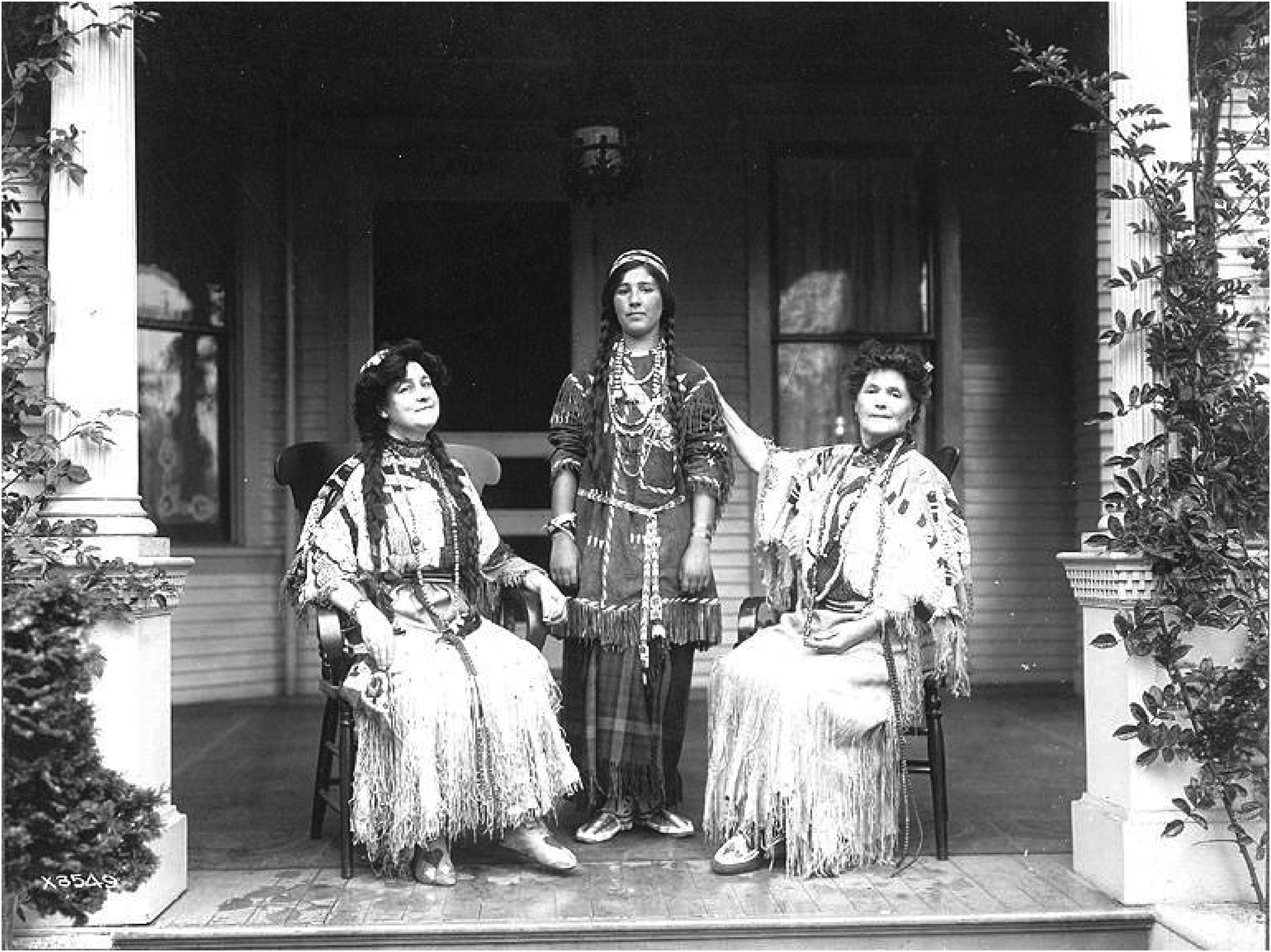
Caroline Burke (left), her mother (right), and a third woman dressed in Native American clothing, 1909. Photographed by Frank H. Nowell. Source: University of Washington Special Collections.
Criticism of this widespread appropriation, and of its blatant stereotyping, racism, sexism, and historical ignorance, started to gain traction in the late 1960s and has remained quite vocal into the twenty-first century. Numerous tribal voices, joined by those of non-Native advocates for Indigenous rights, have been raised in opposition (see e.g., Merskin 2001; Race & Ethnicity in Advertising 2023; Sanchez 2012). The U.S. Commission on Civil Rights called for the retirement of Native American mascots in 2001 and the American Psychological Association made similar statements in 2011 and 2014 (Merskin 2012). Advertising historians have weighed in with pointed accounts of dubious past practices (Biron 2016; O’Barr 2013; Steele 1996). This mounting censure eventually persuaded many businesses, and perhaps American society at large, to adopt new standards of conduct regarding Indigenous culture. Mascot, brand, and place names have been retired and offensive advertising imagery has diminished.
Research Purpose and Methods
The historical arc of one culture marketizing elements of another, only to change course in the face of evolving public opinion, deserves serious consideration. To better understand such phenomena, this article investigates the appearance of Native Americans in firearms advertising and promotions from the 1860s until the present. Evidence from three manufacturers will be examined. Savage Arms used Indigenous logos and trade characters to sell its rifles starting around the turn of the twentieth century when cultural appropriation had become wide-ranging. A few years later Remington Arms tried its hand, and Winchester Repeating Arms did so again in the late 1960s when opposition to such stereotyping had begun to gain attention. The commercial exploitation of Native people by these and other gun companies illuminates once common but now unacceptable stereotyping, and raises questions about representational ethics, a topic within the macromarketing domain (Borgerson and Schroeder 2008; Kennedy and Makkar 2020; Merskin 2012; Schroeder and Borgerson 2005; Young 2005).
The firearms connection provides a significant perspective on cultural appropriation. American Indians have had a very long and deep association with guns, one that had devastating consequences for them and their way of life (Silverman 2016). Thus, the portrayal of Native American characters in firearms advertising is both a visually and historically compelling topic. In addition, this research also seeks to remedy shortcomings in the small literature on Indigenous advertising appropriation. First, compared to some of these other works, which tend to sample ads across different consumer product categories over limited periods (Biron 2016; O’Barr 2013; Steele 1996), here the focus is upon a single industry over a long enough stretch of time to ascertain continuities and change in representations. Second, writers have taken a deservedly critical stance (Merskin 2012; Sanchez 2012), but some (Race & Ethnicity in Advertising 2023) have drifted into polemical presentism where this history is evaluated according to contemporary progressive norms, not the standards that people understood and operated by in the past. To guard against such presentism, this research emphasizes the larger context of the advertising at different points of time. In particular, it seeks to unpack prevailing social representations “a substratum of images, assumptions, and public meanings that are taken for granted and widely distributed” (Fryberg et al. 2008, p. 210).
Primary visual sources (the data or evidence created in the past) include oil paintings, lithographs, photographs, magazine ads, trade cards, posters, cardboard displays, book and magazine covers, and firearm engraving and embedded medallions. These images, mostly gathered in 2022 and 2023, have come from the collections of the University of Washington, the Smithsonian Institution, the Library of Congress Prints and Photographs Online Catalog, the Digital Commonwealth (Massachusetts Collections Online), the Sid Richardson Museum and the Amon Carter Museum of American Art in Fort Worth, Texas, and the Roy Marcot Firearms Advertisements Collection in the McCracken Research Library at the Buffalo Bill Center of the West in Cody, Wyoming. Wikimedia Commons, listings on eBay, and online auction sales catalogs revealed additional sources, especially for sources from the later twentieth century. A private collector, Gordon Fosburg, shared Remington ephemera from his extensive holdings, and the author added a personal snapshot.
Assembling these sources entailed an iterative process where insights gained from the secondary literature and from interpreting previously collected visual data triggered new purposeful searches that led to still more evidence and further analysis. Reading, writing, and data collection worked in tandem. However, a few images were found serendipitously while perusing firearm and Western art auction catalogs. Although some studies of themes and trends in firearms advertising have drawn from a single source, such as The American Rifleman (Yamane, Ivory, and Yamane 2019) and Boys’ Life magazine (Witkowski 2020a), this approach was deemed unsuitable here because of the relatively infrequent use of American Indian trade characters in any one publication.
A visual database of art and advertising representations of Native Americans was constructed and from this group particularly expressive and well-documented images were chosen for the figures and further analysis. Although the selection process relied upon investigator judgment, it was not unlike the methods of qualitative consumer research except that pictures and advertising copy constituted the primary data set instead of apposite respondent interviews. In most cases, the analysis started with a visual description of the primary source and then added relevant historical context and, for the firearms ads, material on the specific type of gun being promoted. Green's (1993) typology of Native American representations in popular culture (see below) was applied and also augmented.
Roadmap and Language
The remainder of the article will proceed as follows. First, it will introduce the highly charged issue of cultural appropriation and marketization. Then, it will provide relevant historical context through brief accounts of how American Indians were placed in different advertising media from the late nineteenth into the twentieth century, and of the simultaneous craze for collecting Indigenous material culture. This will be followed by a brief history of Native American gun culture and how it was visualized by three noted Western artists. The fourth section will examine Savage, Remington, and Winchester advertising that appropriated Native characters and language. Next, the macromarketing implications of Native Americans in gun advertising will be considered. The conclusion will end with thoughts about the purpose of historical analysis, U.S. gun culture, research limitations, and the appropriation of American Indians overseas.
Following current academic conventions, the general terms “Native American,” “American Indian,” “Indigenous,” and “Native” will be used interchangeably when referring to the original inhabitants of what became the United States. “Indian” occasionally will be used in connection with past attitudes, practices, and federal policies. Interestingly, most Indigenous people in North America still refer to themselves as Indians though this collective noun was coined by whites centuries ago (Bauer and Ellis 2023; Berkhofer 1978). Tribal and individual names will be applied when they are known. “First Nation,” the preferred term for tribes in Canada, seems less pertinent to U.S. history and will not be utilized.
Cultural Appropriation and Marketization
Cultural appropriation entails the repurposing of elements of one culture or identity by members of another culture (Britannica 2023). These elements might include language, cuisine, hairstyles, clothing, artifacts, music, myths, and religious rites. Of course, cultures have borrowed from each other since ancient, perhaps even prehistoric times, both through direct physical contact and via representational or virtual contact. Appropriation (also called misappropriation) occurs when a dominant group (outsiders) takes cultural elements from a minority or subjugated group (insiders) without compensation and permission (Rogers 2006). These acts are said to constitute a form of colonialism. In addition to arrogating a great deal from Indigenous people in the United States, whites have been accused of appropriating elements of African American culture and, in Australia and New Zealand, of aboriginal art and Māori traditions (Kennedy and Laczniak 2014; Young 2005).
Not all acts of appropriation are equal. What, where, how, and when cultural elements are assumed makes a difference (Kennedy and Makkar 2020; Young 2005). For example, fine art and serious photographic representations of Native Americans have received much less social criticism than have stereotyped portrayals in advertising, movies, and television. Team mascot and product brand names, exposed to vast audiences over long periods, have elicited the most pointed scrutiny, especially those perceived as derogatory (e.g., Washington Redskins) and/or disrespectful of a historic individual (Crazy Horse Malt Liquor). Herein, the focus is upon visual cultural appropriation through marketing by profit-making companies in the firearms industry. The ethics of this commercialization, whether appropriation may cause harm and offense to Indigenous people, will be considered in a later section.
Originally focused on portable objects and monuments, concerns about appropriation have expanded to include traditional knowledge and cultural heritage (Brown 2005; Riley and Carpenter 2016). Appropriation of cultural ideas and their expression has been likened to the theft of intellectual property, but most legal systems only address the taking of tangible things. Copyright law generally protects specific works (texts, images, designs) produced by individuals, but not the unrecorded cultural attributes of groups as collective authors (Brown 1998). And copyright does not last in perpetuity. Aside from trademarks, which can remain in force so long as an entity continues to operate, at some point works under copyright enter the public domain. In the United States this protection currently is limited in most cases to 95 years from publication. Many countries assign rights according to the life of the creator and a fixed number of years (Kennedy and Laczniak 2014; Kennedy and Marrak 2020). As a practical matter, Indigenous people may lack the financial resources to challenge big businesses and institutions, though this has not always been the case (Riley and Carpenter 2016).
Anthropologists and legal scholars have been very supportive of minority populations, a few even tending toward “polemical romanticism” (Brown 1998, p. 195). Yet, a number of commentators have pushed back against cultural appropriation critiques. Writing in the conservative Observer, Steve Patterson (2015) railed against concepts like benign cultural differences, cultural pride, and group identity as expressed by progressives. Similarly, Kenan Malik (2017) accused the appropriation opponents of creating a form of secular blasphemy and questioned their self-appointment as cultural gatekeepers. Philosophy professor Jason Hill (2018) argued that “culture belongs to the world. It is universal. It cannot be the property of any group, let alone any one individual.” He went on to state that claims to cultural originality, especially with regards to cuisine, have been shown to be false in light of centuries of global exchange, and more harshly asserted that opponents of appropriation “want to have a coercive monopoly over victimology.” Many comparably strident opinion pieces from a right-wing perspective have been published. However, even more measured legal commentary has acknowledged that rights to free speech can justify the copying of cultural elements (Riley and Carpenter 2016).
Cultural appropriation concepts intersect with other sizeable literatures on topics such as cross-cultural contact, cultural hybridization, and cultural appreciation (see, e.g., Cruz, Seo, and Scaraboto 2023). Explaining all of these complicated theoretical connections is beyond the scope of this paper. Instead, the focus will be upon the temporal dimension of visual cultural appropriation for profit. As will be described below, representations of Native American culture have been marketed more widely and enthusiastically in some periods than in others. The visual exploitation of one particular group and era, such as repeatedly favoring images of Plains Indians in the late 1800s, can create a template for subsequent representations. Thus, practices of cultural appropriation can change, but also leave a legacy that governs conventions of thinking and seeing for long stretches of time.
Representing and Collecting Native American Culture
Advertising Images of American Indians
Appropriating Indigenous persons for commercial purposes in the United States has had a very long history. In 1787 and 1788, the Commonwealth of Massachusetts minted half and one cent copper coins (see Figure 2) with the figure of an Indian man on the obverse side (Yeoman et al. 2021). Wearing a pleated skirt, he holds a bow and an arrow. On May 27, 1789, Peter and George Lorillard ran an ad in New York City that illustrated a Native American man wearing the same skirt, but smoking a long clay pipe while standing by a hogshead of “Best Virginia” tobacco (Richards 2022). The association of Native Americans with tobacco products continued through the nineteenth and well into the twentieth century through brand names like Red Man chewing tobacco, illustrations on cigar box labels, and most prominently as large, three-dimensional cigar store Indians carved in wood (O’Barr 2013).
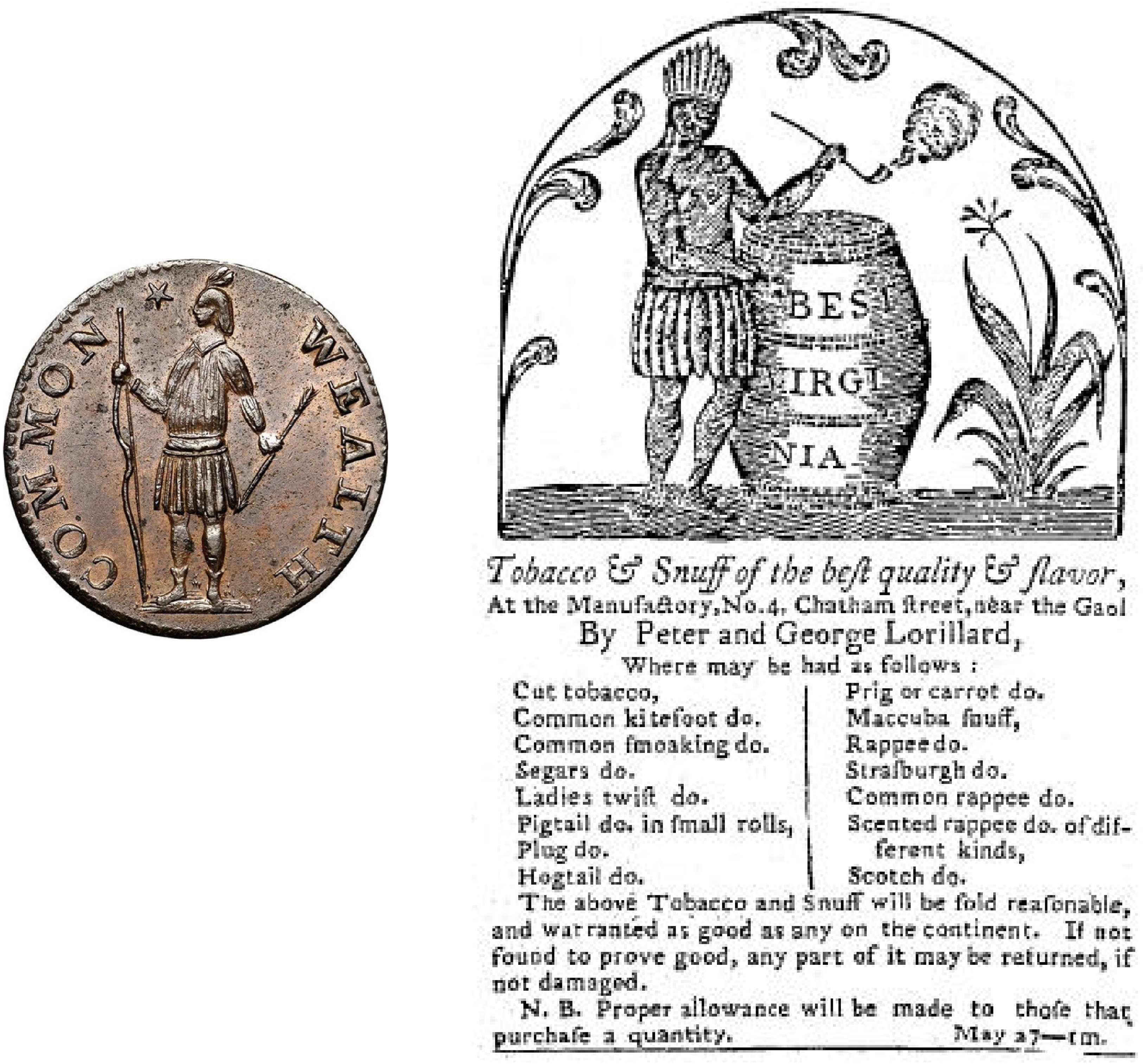
Commonwealth of Massachusetts Half-Cent Coin, 1787 and Lorillard Tobacco and Snuff Advertisement, New York City, May 1789. Sources: Coinscatalog.NET (2023) and Wikimedia Commons.
In the 1870s and 1880s, the time when the U.S. Army was extinguishing American Indian resistance to white encroachments in the West, and when the federal government was sequestering tribes on reservations, manufacturers and retailers back east adopted Native likenesses for advertising purposes. A popular medium, chromolithographed trade cards, frequently portrayed Indian men and women (Jay 1987). Traveling sales representatives known as drummers brought these colorful postcard-sized ads to merchants who in turn gave them to customers, some of whom pasted them into scrapbooks. Trade card artists and printers did not operate under the same constraints they might face when advertising in periodicals. Thus, they could indulge the whimsies and prejudices of dominant white consumers with caricatures of Irish servants, African Americans, Chinese Americans, and Indigenous people. As Steele (1996, p. 47) states: “As a result, nineteenth-century trade cards remain to this day the most graphic examples of racial and ethnic stereotypes being used as marketing tool.”
Figure 3 depicts a trade card for Magnolia Hams, printed ca. 1879, which pictures three Native men in front of a tipi (teepee) cutting into a ham and speaking a faux dialect “Big Injun Eat Much Magnolia Ham.” The back of the card contains data on the number of pieces cured by the brand owner, McFerran, Shallcross & Co. of Louisville, Kentucky. Production grew from 7500 pieces in 1863 to 375,000 in 1878. Figure 4 is a surreal but charming cartoon ca. 1885 of an Indian as a corn man for Rice's seeds. Both of these companies produced still more trade cards with parodies of other ethnic and social types (New-York Historical Society 2011). In addition to plugging a variety of food products and condiments, Native Americans appeared on cards for patent medicines, perfumes, clothing, and fertilizers (Jay 1987; Steele 1996).
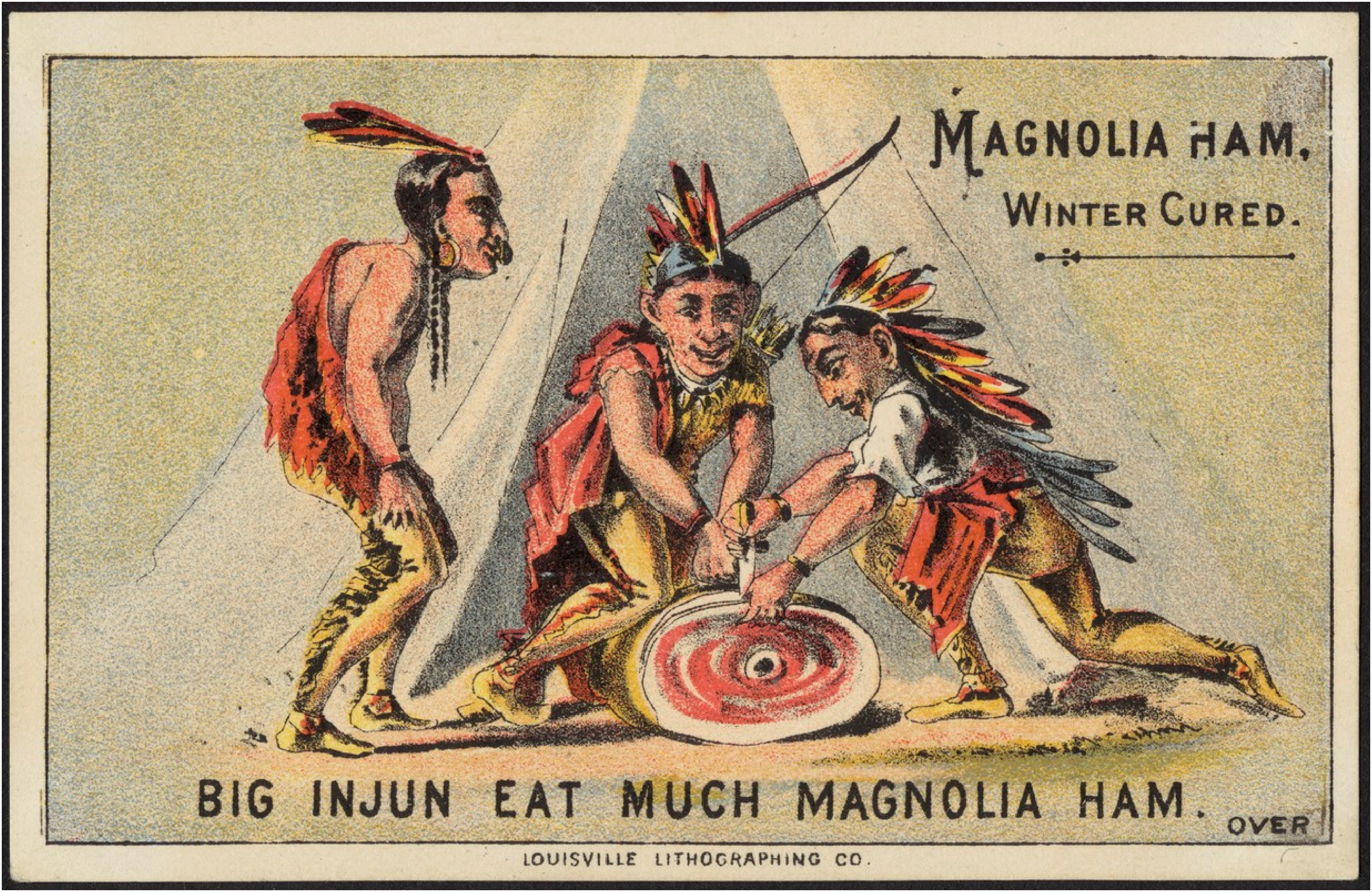
Trade Card, Magnolia Ham, ca. 1880. Louisville Lithographic Co. Source: Boston Public Library via Digital Commonwealth.
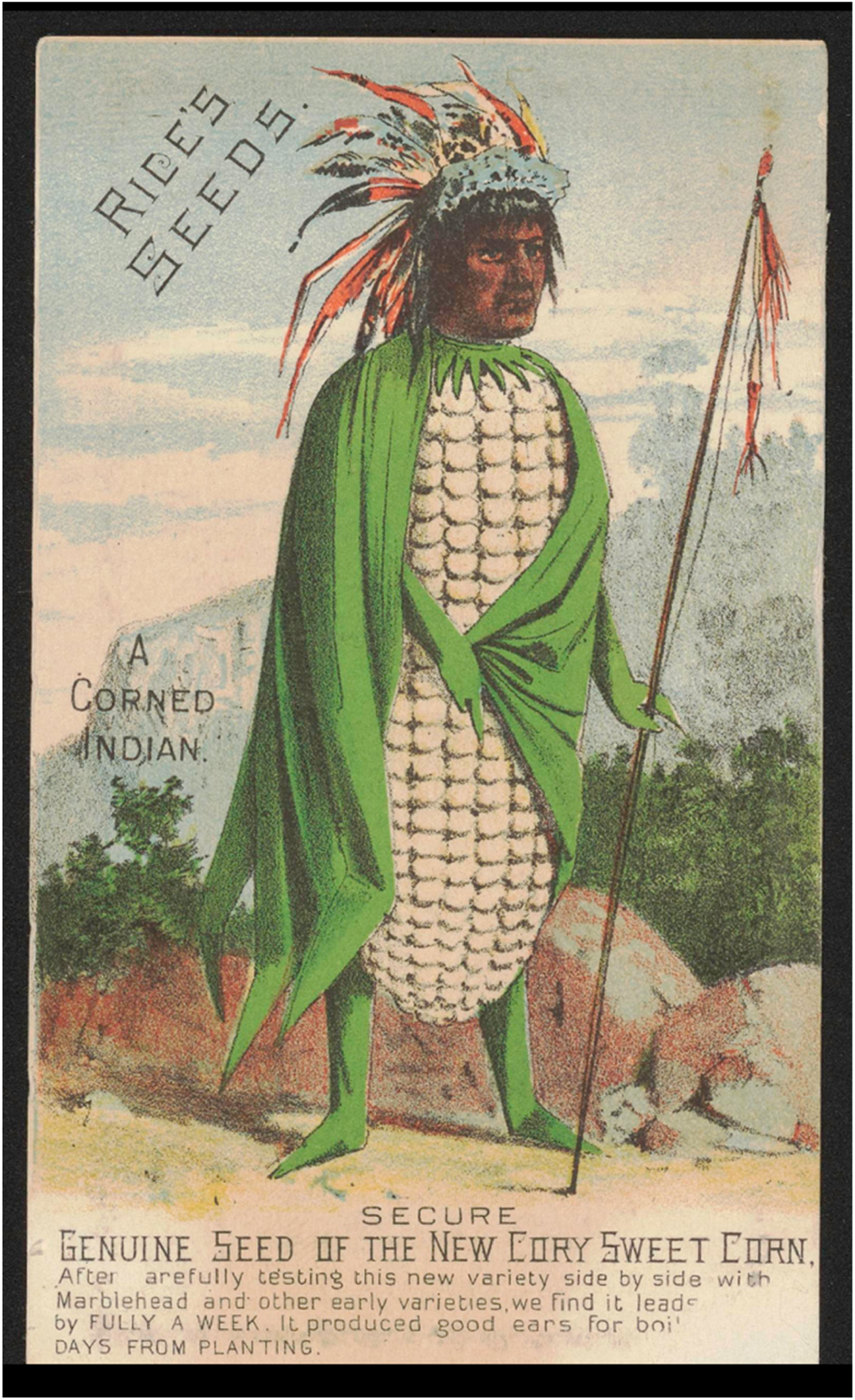
Trade card, Rice's Native American corn man, ca. 1880–1889. Lithograph on paper, Jerome B. Rice & Co. 5 1/4 × 3 in. (13.3 × 7.6 cm). Source: Smithsonian Gardens, Horticultural Artifacts Collection.
In the 1890s, the trade card medium began to wane in importance as advertisers moved to periodical advertising. Although mostly limited to black and white ads, magazines could offer efficient national circulation without the need to rely upon personal selling intermediaries for message distribution. Indigenous characters appeared frequently even though the now isolated and impoverished Native Americans themselves were rarely part of the target market. Illustrations were a bit more restrained and realistic than on trade cards, but these depictions were still largely ornamental and often demeaning. Biron (2016) covers the period from 1880 to 1920 and articles by O’Barr (2013) and Race & Ethnicity in Advertising (2023) provide many examples through the 1950s. Most characters were hand-drawn. Advertisers did not very often incorporate photographs of American Indians until after World War II.
Additional images lithographed in color appeared on various promotion ephemera, such as fruit box labels and posters. In 1891, for example, a Sheboygan Boot & Shoe poster illustrated an Indian woman and a man on horseback wielding a lance (Figure 5). Three tipis and two other figures are in the background. These appear to be Plains Indians rather than the tribes who once had lived around Sheboygan, Wisconsin. Also incongruous, but not an uncommon visual device in the advertising and corporate stationary of the period, are two small drawings on the bottom of the print that show the city's Lake Michigan waterfront and the factory building itself. Posters continued as a supplemental medium during much of the twentieth century. Alluring travel posters, for example, regularly portrayed Native Americans, as will be shown in Figure 6 discussed below. Another medium, roadside billboards, used similar representations. One for the Outdoor Advertising industry ca. 1940–1956 showed a Native man with feathers, a headband, a beaded vest, and a peace pipe surrounded by an apt description of the medium in capital letters: “NO WASTE WORDS MAKE LONG STORY SHORT” (Race & Ethnicity in Advertising 2023).
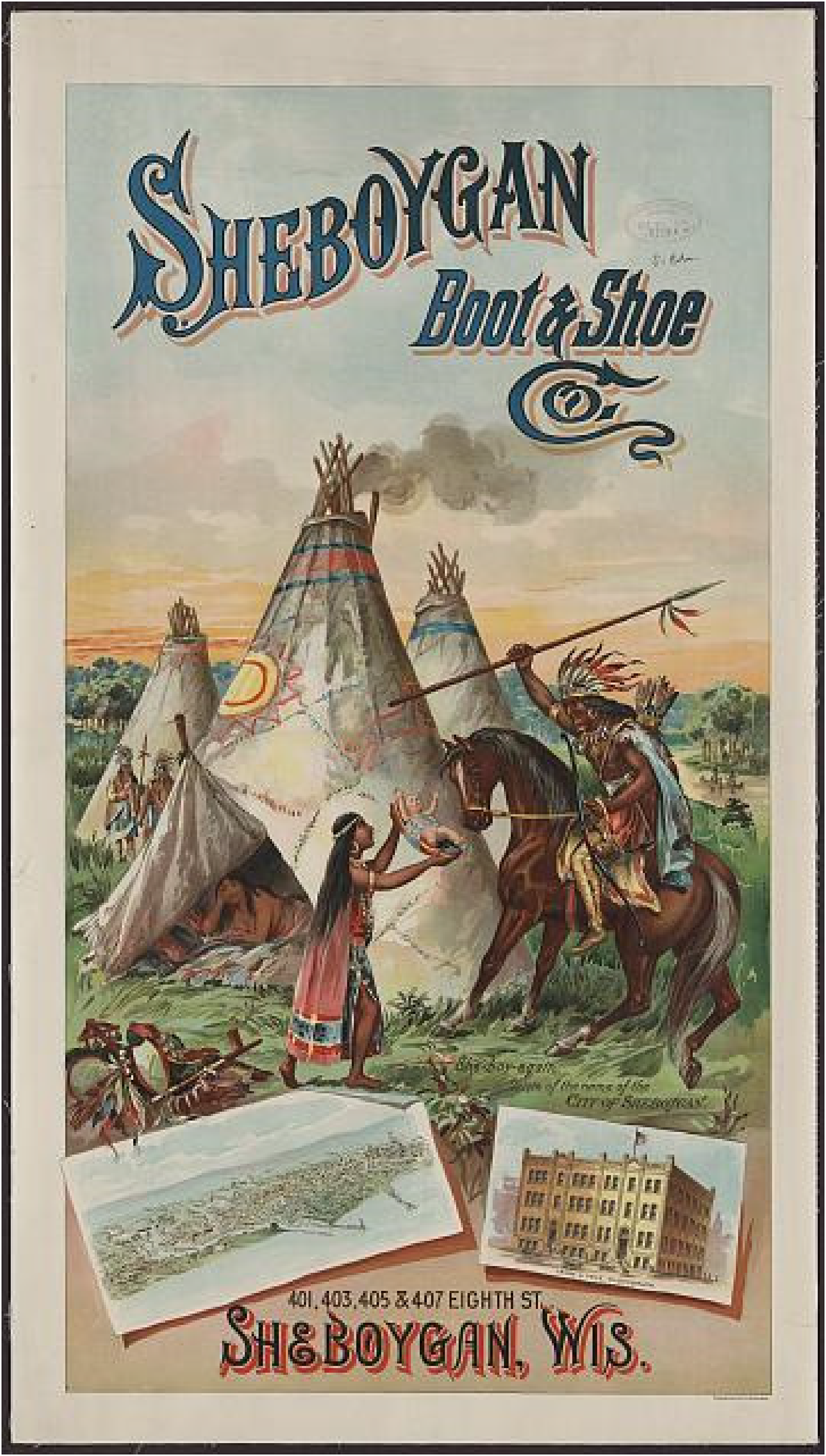
Poster for Sheboygan Boot & Shoe Co., 1891. 28.35 × 15.94 in (72 × 40.5 cm). Source: Library of Congress Prints and Photographs Online Catalog.
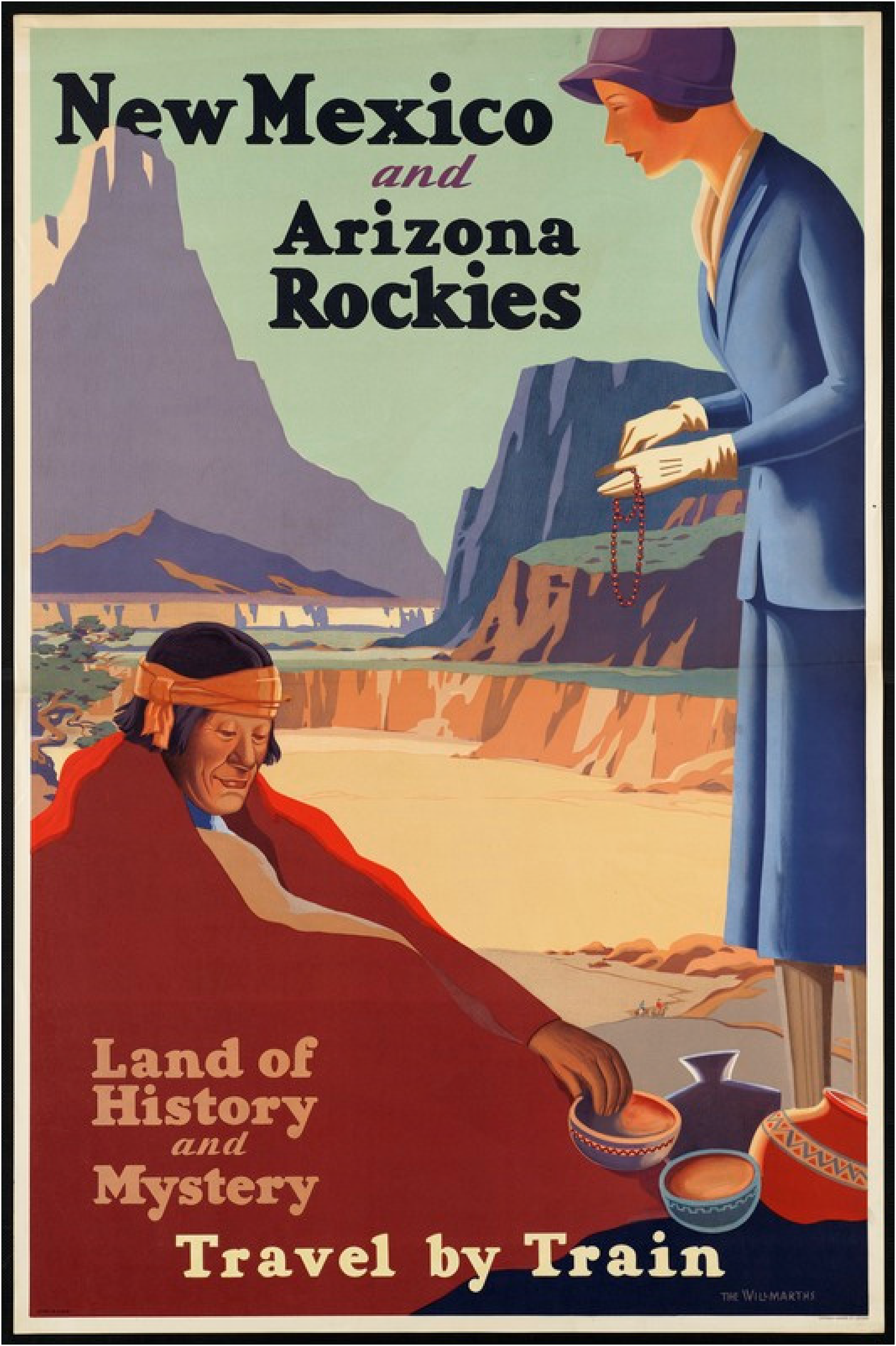
Travel poster, ca. 1925. Newman-Monroe Co. publisher. Source: Boston Public Library via Digital Commonwealth.
The U.S. Patent and Trademark Office categorizes logos according to the images they contain. As of 2014, its records indicated over 600 active trademarks with Native American men and women registered to 450 different companies (Wilson 2014). Some brand names used generic terms such as Indian (motorcycles), Red Man (chewing tobacco), and Big Chief (meat snacks, paper products). Others appropriated tribal names, such as Calumet (baking powder), Chippewa (clothing), Kickapoo Joy Juice (soft drinks), and Jeep Cherokee. Still more brands used the names of historical Indians such as Tecumseh Products Company (refrigeration) and Crazy Horse Malt Liquor (Merskin 2001). Some companies have registered multiple images. For instance, the Nimmons-Joliet Development Corporation recorded at least nine different illustrations for its Big Chief paper brand (Wilson 2014). Tribal groups also have registered seals with images of their people. The trademarks of Native American gaming casinos, on the other hand, have not included human figures as elements.
Michael Green (1993) has argued that American Indian representations in popular culture can be broken into three general categories: Noble savages, Civilizable savages, and Blood-thirsty savages. The first group boasts admirable traits, such as spirituality and respect for the natural environment. The second type has been saved by embracing advanced Western culture. The third kind symbolizes the brave and ferocious warrior adopted as mascots by countless sports teams. Native women have been depicted as either beautiful and virtuous princesses, such as the kneeling Mia character who adorned Land O’ Lakes butter packages and tubs from 1928 until 2020, or as uncultured squaws performing gendered duties like collecting and preparing food and caring for children. Their babies, meanwhile, typically have been imagined as swaddled papooses (O’Barr 2013). Advertising reproduced these tropes in print, on television, on billboards, and imprinted on promotional items.
The Indian Craze
Representations of Native Americans in late nineteenth and early twentieth century advertising were created during what art historian Elizabeth Hutchinson (2009) has termed “the Indian craze.” Both individual consumers and institutional curators showed a passion for collecting Native American material culture, such as baskets, pottery, beadwork bags and pouches, woven blankets, clothing, masks, and bows, arrows and war clubs. Affluent mavens displayed these artifacts in cozy home “Indian corners,” while public museums and university anthropology departments made space to exhibit their growing collections. Hutchinson focuses on the period 1890–1915, but the mass enthusiasm for things made by Native Americans lasted from about 1880 to 1940 (Valdes-Dapena 2004). Indeed, a robust collectors’ market still exists today for items made in the nineteenth century and later.
This accumulative desire had roots extending back to the early1800s when President Thomas Jefferson formed a collection at Monticello of Indian items brought back by the epic 1804–1806 lewis and Clark Expedition across the Great Plains and Rocky Mountains to the Columbia River and the Pacific Ocean. Other people acquired artifacts through direct contact with American Indians. In the 1830s, for example, artist George Catlin (1796–1872) traveled among tribes along the Missouri River capturing numerous tribal people on canvas while simultaneously amassing a substantial trove of indigenous objects. In 1837 he took his “Indian gallery” on promotional tours to New York and other cities across the United States and, in 1839, on to London, Paris, and Brussels (Delaney 2019; Watson 2002). Later in the century the noted Western artists Frederic Remington (1861–1909), Charles Marion Russell (1864–1926), and Charles Schrevogel (1861–1912) brought home Native things from their travels as souvenirs of their adventures and as authentic props for their paintings and illustrations (Horan 1969; Samuels 1982; Taliaferro 1996).
Native Americans had traded their handicrafts with whites since the seventeenth century. After their final containment on reservations in the 1880s, Indigenous artisans produced traditional goods for urban consumers. These craft industries were strongest in the Southwest, Great Lakes, California, and Pacific Northwest. The colorful “Travel by Train” poster in Figure 6, created for the Union Pacific Railroad by artist William Willmarth (1898–1984), encouraged tourists to visit them in the New Mexico and Arizona Rockies. With impressive mountains and mesas in the background, the illustration shows a fashionably dressed woman in a blue cloche hat, tailored jacket, and matching skirt – who is wearing white gloves – in the desert! Apparently bartering over some beadwork and pottery, she towers above a stoic Indian with downcast eyes who sits on the ground wrapped in a red blanker. The picture evokes the tagline, “Land of History and Mystery,” but also literally suggests a white upper hand in the exchange. In 1932, Willmarth's watercolor sketch of this image won a poster contest (Nisbet 2020).
Retailers, meanwhile, had been buying Indigenous products from middlemen and then marketing them through periodical advertising, special sales, and mail order catalogs. By the early 1900s, New York City had at least four stores specializing in Native American merchandise and similar shops could be found in other cities. Department stores, such as Marshall Field's in Chicago and Wanamaker's in Philadelphia, also carried these products and sold them through the most advanced merchandising of the day such as glass display cases. Hutchinson (2009) argues that mainstream American society wanted Native Americans to be “authentic” Indians. Indigenous people fulfilled this expectation to some extent because they themselves were reluctant to give up their tribal heritage. This intercultural market was not an exchange among equals, but the production and consumption of Native goods did have lasting impact on American popular visual culture. It was both an aspect of, and an antidote to, late nineteenth century commodity culture (Hutchinson 2009).
Native American Gun Culture
The Fatal Attraction
North American Indians showed a strong interest in European goods manufactured from metals and cloth going back to their first contacts with explorers (Axtell 1999). They especially craved the weapons colonist brought across the Atlantic Ocean and quickly saw their utility for hunting, inter-tribal warfare, and marking personal status. Natives eagerly exchanged deerskins, beaver pelts, and other local resources – including thousands of enslaved Indian men and their families captured from rival tribes – for muskets, shot, and powder supplied by British, French, Dutch, Swedish, and American traders (Hämäläinen 2022; Silverman 2016). Some of these guns were surplus or obsolete military arms, but starting in the late seventeenth century, gunmakers produced cheaper versions designed expressly for the Indian market. Colonial authorities and later representatives of the U.S. government also gifted numerous firearms to tribal leaders for diplomatic purposes.
By the middle of nineteenth century this too often fatal attraction to firepower and gun violence had diffused across the continent. Eastern woodland Indians who had been forced west of the Mississippi River provisioned the native Prairie Indians of the southern plains until the latter tribes formed their own connections with American gun merchants. To the north along the upper Missouri River, permanent trading posts had been established in the 1830s to supply the Blackfeet with munitions (Silverman 2016). Three miles east of present-day Chadron, Nebraska in the state's northwest panhandle, James Bordeaux opened a trading post in 1837 to exchange goods with American Indians who wintered in the area. After the Civil War, later post managers smuggled arms and ammunition to warriors fighting U.S. forces until, in 1876, the Army shut down its operations (Museum of the Fur Trade 1999).
Native Americans had long been astute gun consumers. In the flintlock era from the late 1600 s to the 1840s, they preferred muskets with stylized brass serpent sideplates and large trigger guards that would accommodate gloves in cold weather. They associated certain maker symbols, such as the little fox-in-circle punchmark on the barrels of Hudson Bay Company trade guns, with product quality. Some learned how to cast bullets, knap flints, and do basic repairs themselves. Surviving artifacts document that men carved and painted gunstocks and, in the nineteenth century, added brass tacks as decoration. Native women made gun cases from animal skins. In 1882, Colonel Richard Irving Dodge published Our Wild Indians, a first-hand account of his thirty-three years on the frontier. He observed, “They are connoisseurs of these articles, and have the very best that their means and opportunities permit” (cited in Silverman 2016, p. 246). For nearly three centuries, firearms helped Native Americans defend their lands from encroaching whites. Yet, by ruthlessly deploying firearms against other tribes, either on their own initiative or in alliance with colonial and later U.S. military forces, American Indians depleted their numbers and, hence, collaborated in their own eventual subjugation and cultural decline and demise.
Painting American Indians with Guns
The illustrations of Native Americans in advertising followed conventions established in the fine arts. Antebellum Western painters frequently depicted American Indians as portrait subjects within their own social milieus, as intrepid hunters, and as warriors engaged in deadly conflicts with white trappers. Yet, these early artists produced very few images of Indigenous people with firearms. Out of 625 works by George Catlin held by the Smithsonian American Art Museum (2023), only three show Natives with firearms and one of these was a Florida Seminole, not a Plains Indian. Given the diffusion of firearms discussed above, Catlin may not have accounted for the importance of American Indian gun culture. Perhaps he chose to portray a more romantic, unspoiled, even primitive image of Indigenous peoples. On the other hand, firearms may not have proliferated among the Western tribes before the Civil War. If so, painters simply did not see that many guns on their travels.
Figure 7 is one of the few exceptions where Catlin depicted a Native American with a gun. This oil on canvas from 1834 shows Steeh-tcha-kó-me-co, Great King (called Ben Perryman), a Chief. Typical of the many portraits in Catlin's “Indian Gallery,” the subject is brightly dressed, but also holds a crudely painted flintlock, possibly a trade musket made for the indigenous market. The somewhat shorter barrel length and larger trigger guard are characteristic of the type, but the gunlock appears to be on the wrong side of the stock! Overall, Catlin's paintings were highly influential in planting the image of Plains Indians in American (and European) minds as a universal representation of all North American Indians (Flavin 2002).
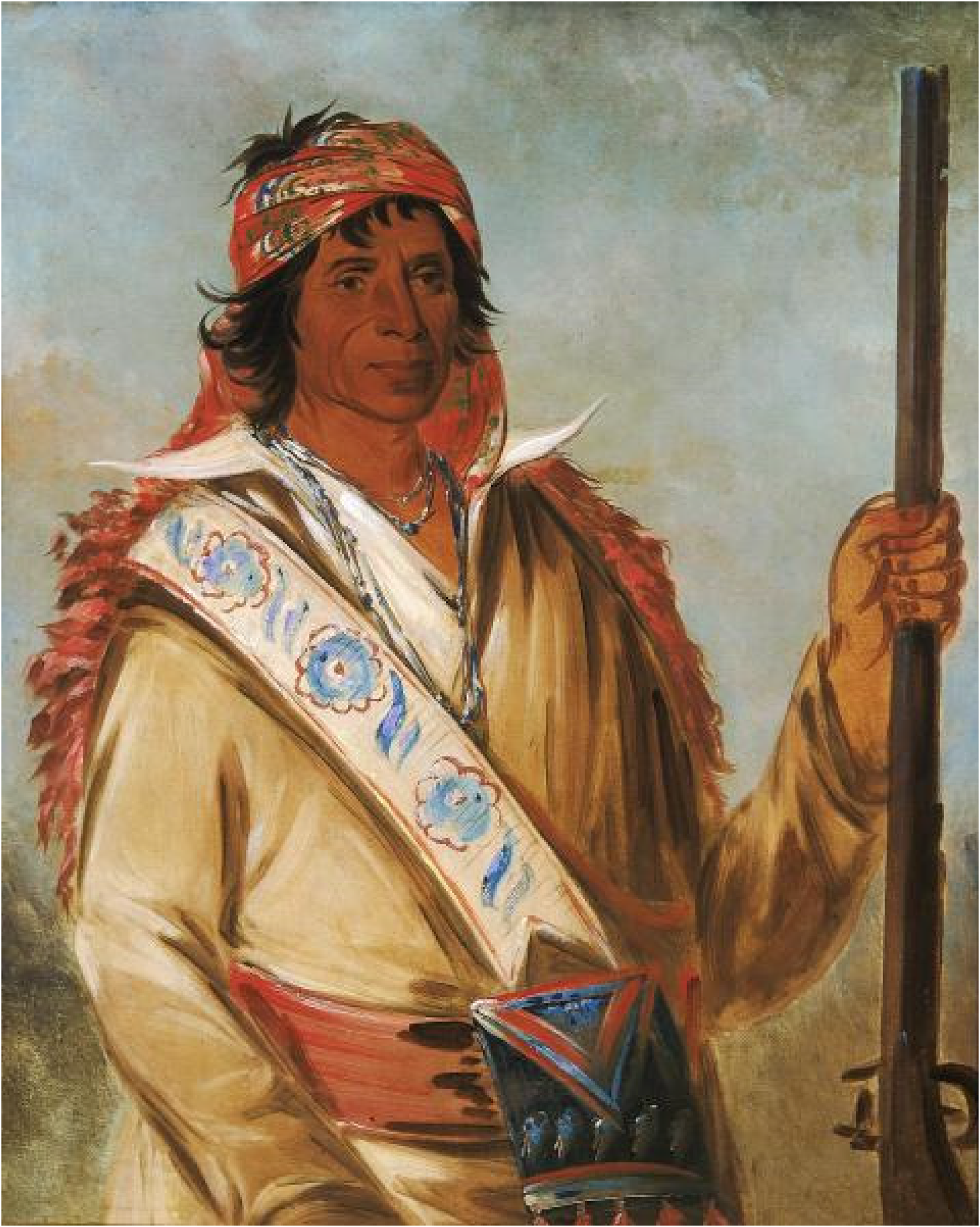
Steeh-tcha-kó-me-co, Great King (Called Ben Perryman), a Chief by George Catlin, 1834. Oil on Canvas, 29 × 24 in. (73.7 × 60.9 cm). Source: Smithsonian American Art Museum.
Sixty years later, a new generation of Western artists visualized American Indians and their firearms. The work of Charlie Russell ranks second only to that of Frederic Remington (though some art enthusiasts may disagree with this assessment) in the Western genre. Russell lived most of his adult life in Montana, arriving in 1880 soon after his sixteenth birthday, and he acquired intimate knowledge of and a sympathetic regard for Native Americans. Many of his works represented them in everyday life activities while encamped or on the move (Dippie 1994). Unlike the exclusively masculine depictions created by Frederic Remington and other artists, Russell especially liked to portray young Indigenous women including some posing suggestively, at least by late Victorian standards (Renner 1984). Apparently, he had been intimately acquainted with the subject matter.
Firearms are present in a number of Russell's Native scenes and are visually central to Figure 8, Crow Indians Hunting Elk, one of his early oil on canvas works painted in 1890. Crouching in the snow watching a group of elk below them on the right, the upper man raises his right hand to signal silence and patience until the animals come closer. Both of these highly competent hunters appear to have Winchesters. The one nearer the viewer holds a Model 1866 carbine easily identifiable by its brass frame. The first model to bear the Winchester name, it was manufactured from 1866 until 1898. On the frontier it was popularly dubbed the “Yellow Boy,” while American Indians purportedly called it “many shots” or “heap firing” gun (Flayderman 2007). Notice how the butt has been decorated with brass tacks. The other gun is probably a Model 1873 rifle or carbine. One man wears an ammunition belt, and both hunters are nicely attired from the feathers in their hair and cap down to the moccasins on their feet. Originally from Ohio, the Crow tribe had been pushed far to the west in the nineteenth century until settling in southern Montana. Photographs from the period show the Crow and other Plains Indians with Winchesters, some tack decorated (Witkowski 2018).
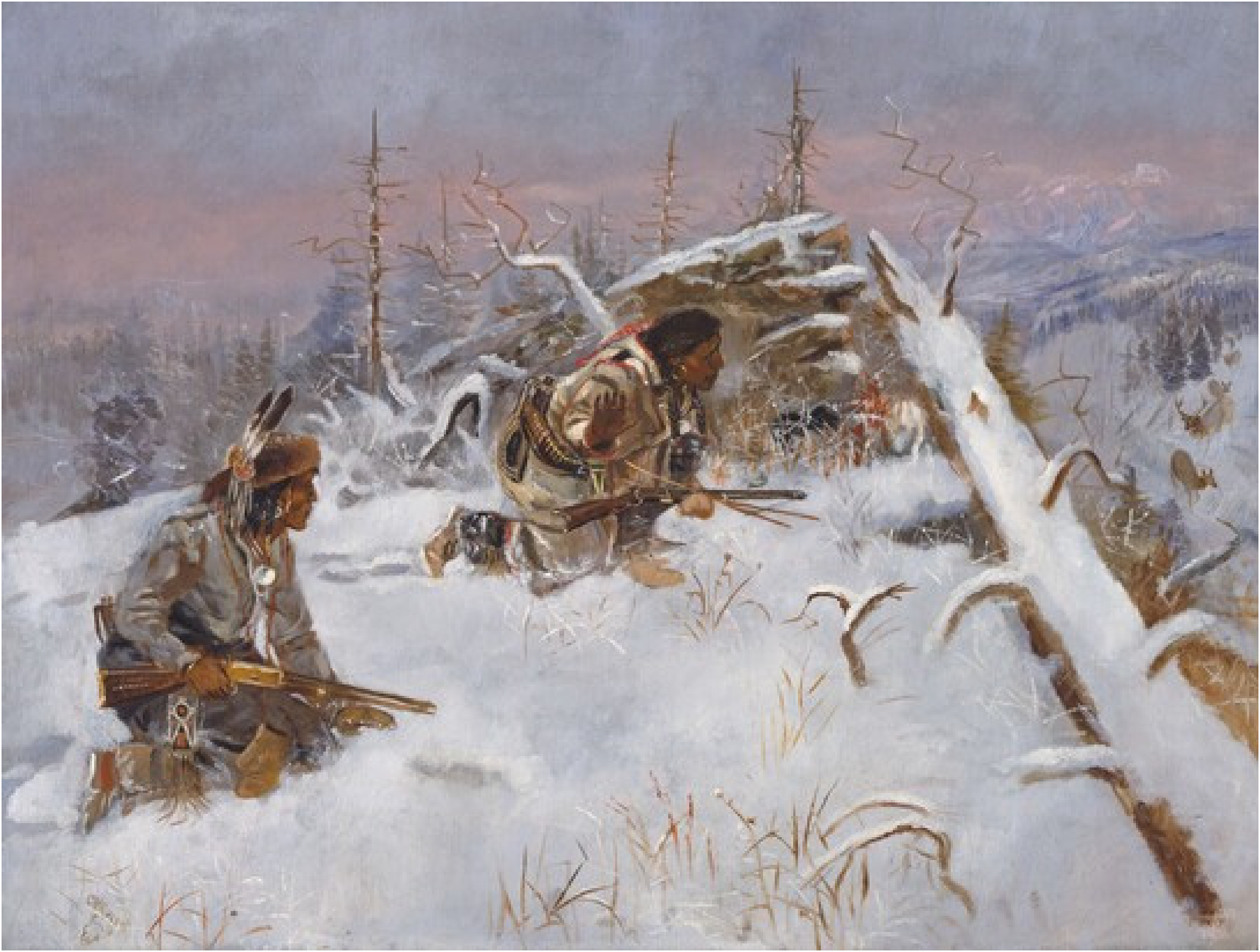
Crow Indians Hunting Elk by Charles M. Russell, 1890. Oil on canvas, 18 1/8 × 24 in. (46.0 × 61.0 cm). Source: Amon Carter Museum of American Art.
Charles Schreyvogel made a name for himself painting the violent armed conflicts between Native Americans and the U.S. Calvary or with white cowboys. Born into a German immigrant family, he grew up in the Lower East Side of New York City before moving to Hoboken, New Jersey. Schreyvogel had been fascinated by Western characters and events since boyhood and, when Buffalo Bill's Wild West show was in the area, he enthusiastically sketched its horses, cowboys, and American Indians. In 1893, his Western imagination raging, Schreyvogel visited the Ute Indian Reservation in Colorado for five months of drawing, collecting Native American and cavalry artifacts, and learning sign language and how to ride. He returned to Hoboken, married Louise Walther, and commenced painting Western canvases, but struggled financially until My Bunkie, his painting of cavalry troopers fending off hostiles, won the National Academy's Thomas Clarke Prize on December 31, 1899.
Schreyvogel graphically reimagined the lethal conflicts with Plains Indians that had occurred twenty to thirty years earlier. One example is Attack on the Herd (Close Call) from 1907 (Figure 9). The cowboy appears to have the upper hand in the shooting contest. This oil on canvas is unusual in that both characters are armed with revolvers. Previous and subsequent paintings, sculptures, photography, and advertising have usually shown American Indians with rifles or shotguns. Schreyvogel stressed realism, but his work never showed any gaping wounds, gushing blood, disfigured bodies, and other unpleasant consequences of gun violence. This visual decorum may have appealed to the art buyers of 1900, but it abstracted and sanitized combat. His Natives appear as well armed as their white opponents, which may have been true in some fights, but the so-called Indian Wars were not the fierce contests between equals he depicted. All too often the “battles” of the latter nineteenth century were simply massacres of Native men and noncombatant women and children already suffering from disease and starvation.
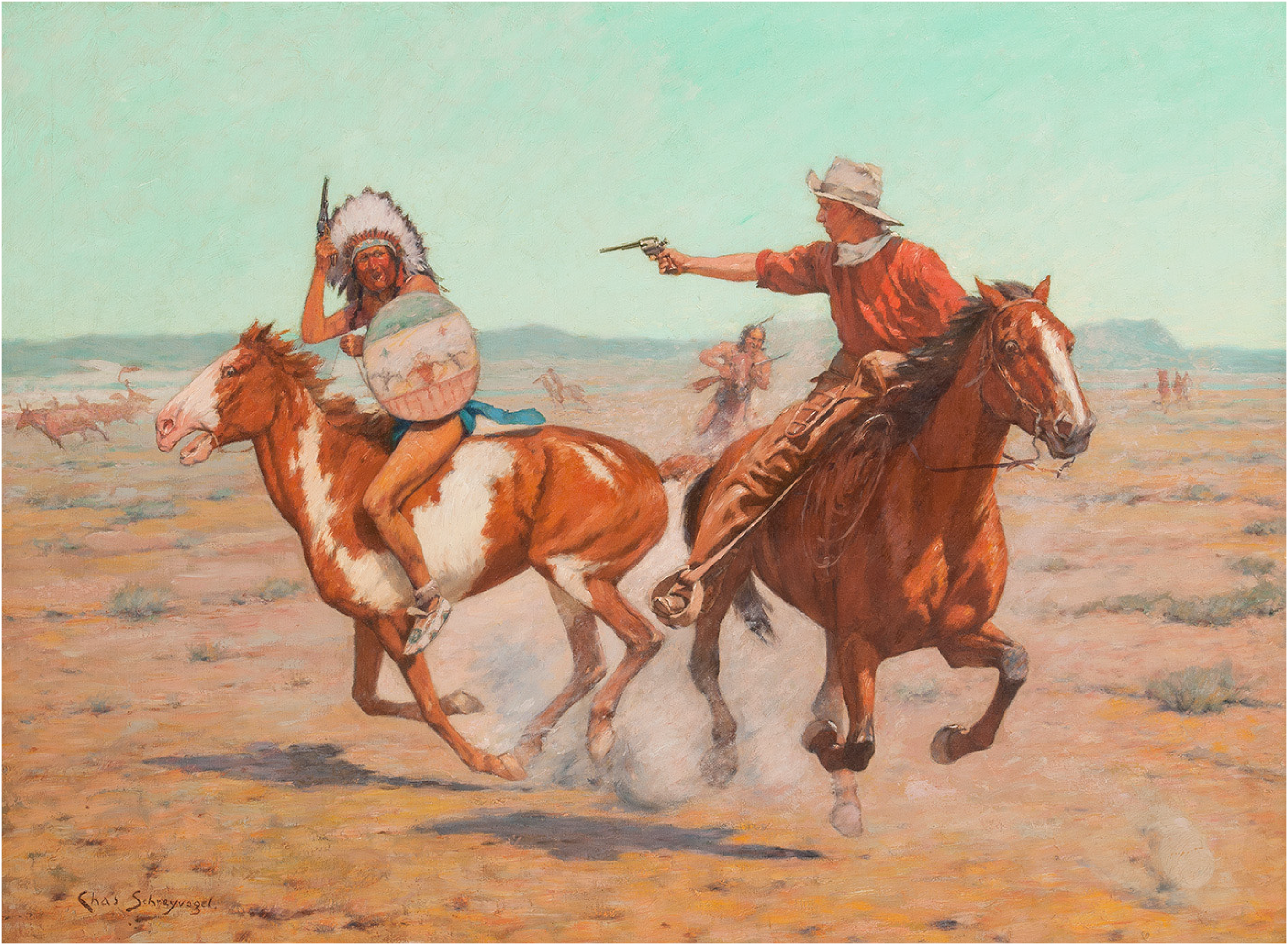
Attack on the Herd (Close Call), 1907 by Charles Schreyvogel. Oil on Canvas, 26 1/8 × 34 ¼ in. (cm). Source: Sid Richardson Museum.
Fine art representations of Native American gun culture by Catlin, Russell, Schreyvogel, and other artists, contributed to the increasingly prevalent image of the timeless American Indian being a historical denizen of the Great Plains and Mountain West. The nomadic horse and bison culture of the Western tribes was visually exciting and very romantic compared to the more settled ways of eastern woodland Indians who, in any event, had largely disappeared. The rendering of the Indigenous West could evoke an emotional response from viewers (Flavin 2002). Painters have recreated these visions over and over again right up to the present day. The advertising and promotional materials sponsored by firearms companies have contributed to this visual tradition.
Native Americans in Firearms Advertising
Overall, American arms makers do not seem to have featured Indigenous images and words in their advertising and promotional ephemera any more frequently than did companies in other industries. Two important manufacturers, Colt and Smith & Wesson, appear never to have used them in ads, perhaps because these companies concentrated on handguns, weapons infrequently placed in the hands of Native Americans, Schreyvogel's painting and a handful of period photographs notwithstanding. However, Colt did engrave a “Ranger and Indian” skirmish on the cylinders of its percussion revolvers in the 1840s and 1850s, and a fellow collector showed me a Smith & Wesson cartridge revolver (Model 3 .44 Russian) from the 1870s with an engraved Indian head and war bonnet.
Three companies that specialized in hunting rifles and shotguns – Savage, Remington, and Winchester – advertised with Native trade characters on enough occasions to be worthy of further analysis below. A fourth major manufacturer, Marlin, ran an ad for a .22 caliber sporting rifle containing a cartoon of a hunter and his Indian guide above two columns of conversational copy replete with “heap much” pseudo language. Headlined “Marlin Melodramas #3” at the top of the page, the drawing and silly writing were probably the work of humorist Ed Zern (1910–1994). No other examples from the campaign had a Native character. The eBay seller dated the ad to 1957, and the drawing and parlance seem true to this period, but no information on which magazine published it has been found. Given this partial documentation, it will not be considered further.
Savage Indians
Over many years the Savage Arms company in Utica, New York, used a logo consisting of an American Indian head in profile wearing a feathered war bonnet. Embedded as a medallion in pistol grips and included as an element in print advertising (Figure 10), it resembled the obverse design of the American Indian Head quarter and half eagle gold coins ($2.50 and $5.00) minted from 1908 to 1929 (Yeoman et al. 2021). According to company lore, a deal was struck in 1919 where Savage promised to sell some guns at a discount to a chief named Lame Deer in exchange for the tribe's permission to use this Native American face (Smithsonian 2017). This story has not been verified independently. Several Savage ads in the Marcot Collection document variations of this same logo being used in print advertising as early as 1905. It was officially registered on October 10, 1914 (Justia 2023). The logo obviously played upon the name of founder Arthur Savage and, of course, the derogatory term “savage Indian,” which had a long timeline in the American vernacular (Berkhofer 1978; Deloria 1998; Green 1993). A search of Savage ads and catalog covers on eBay revealed that the logo continued to be featured until about 2015. Today, the company uses an abstract design of a black letter S over a red or white background with the word SAVAGE® to the right (Savage 2023).
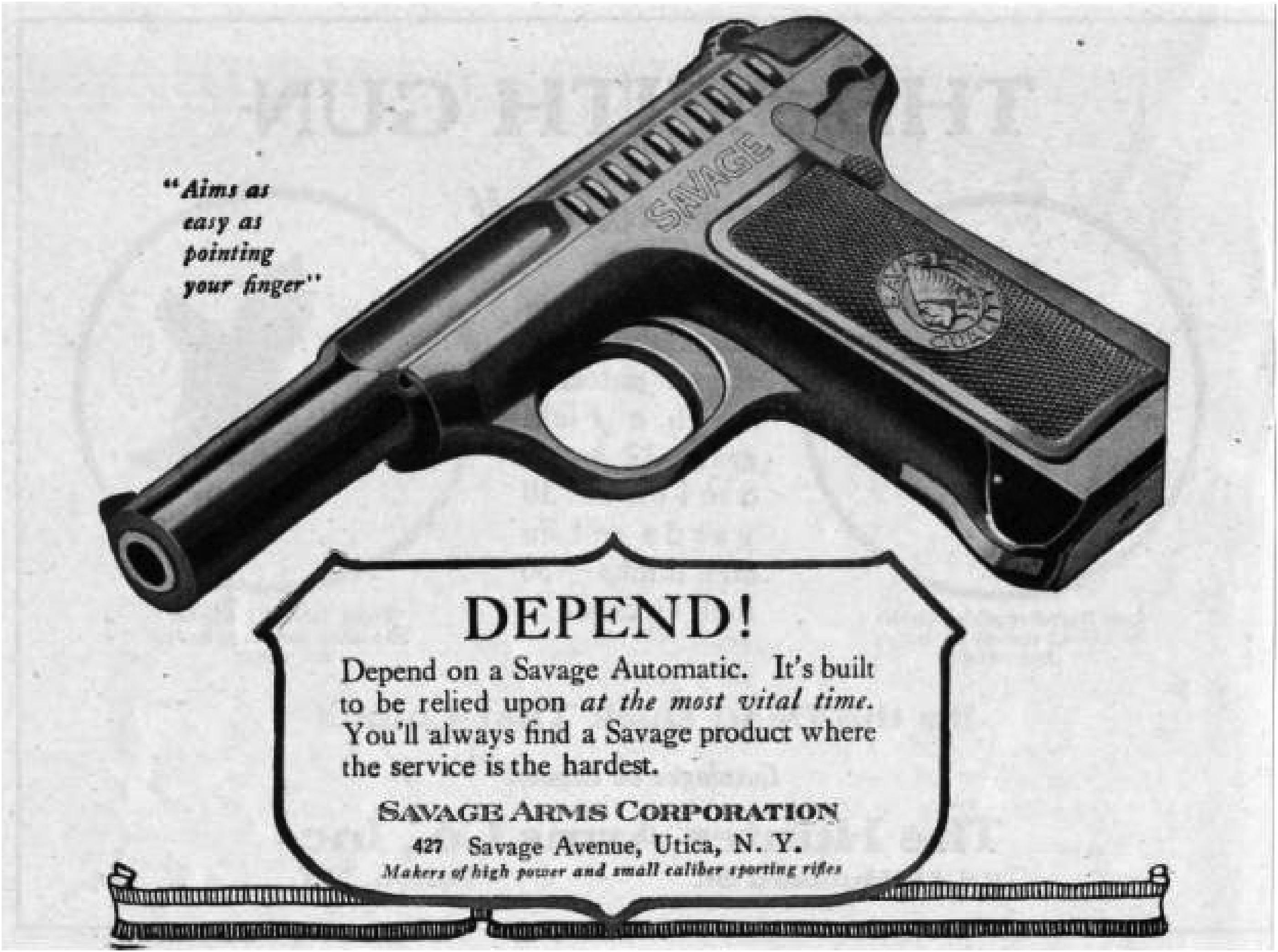
Savage Arms Corporation, Hunter-Trader-Trapper, November 1917. The medallion says, “Savage Quality.” Source: Roy Marcot Firearms Advertisements Collection, McCracken Research Library, Buffalo Bill Center of the West.
Not only did Savage Arms use the face of a Native American in its logo, but the company also featured different Indigenous archetypes as central advertising characters. The Marcot Collection has nine examples, all different and extracted from five separate magazines published between 1896 and 1909. More can be found by searching magazines from about the same time frame in the HathiTrust Digital Library or via the Internet Archives. In March 1899, for example, Savage advertised its Model 1899 hammerless repeating rifle in Recreation magazine. Taking up most of the ad space, the illustration shows a bare-chested man wearing two feathers, a bear claw necklace, and buckskin breeches reloading his gun while sitting on a grizzly bear he just had killed (Figure 11). The superior design of this gun kept it in production for almost 100 years (Flayderman 2007). The “On Top” headline is a double entendre referring to the rifle's quality and to where the man sits. Using Green's (1993) typology, this trade character is a Civilizable savage using a modern weapon.
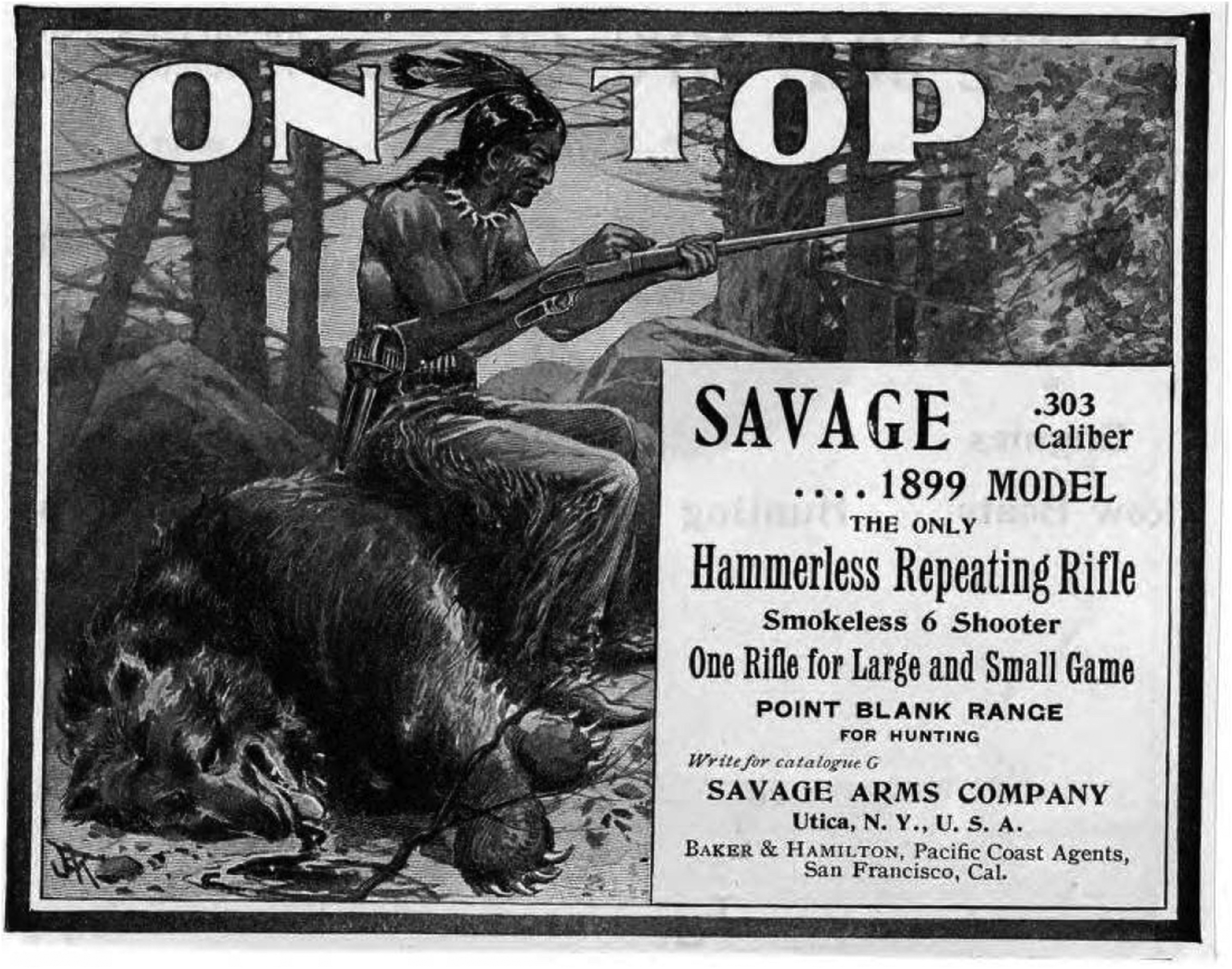
Ad for Savage .303 Model 1899 Hammerless Repeating Rifle, Recreation, March 1899. Source: Roy Marcot Firearms Advertisements Collection, McCracken Research Library, Buffalo Bill Center of the West.
In contrast, the ad in Figure 12 visualizes a light hearted Native boy. Published in the September 1905 issue of Recreation, it promoted two rifles in .22 caliber. The “Little Savage Hammerless Repeater” was priced at $14 or $468 in 2022 and the “Savage-Junior 22-calibre Single-Shot Rifle” sold for $5 or $167 in 2022 (Friedman 2023). In the twentieth century, rifles in .22 caliber were understood as the type of firearm suitable for boys (Witkowski 2020a). The character, wearing a satisfied grin, holds a dead rabbit he has bagged. His medallion says, “The Little Savage.” The body copy lists the advantages of the two guns. A large letter S entwines the Indian logo on the left and in small print a poem proclaims, “No savage beast would dare to trifle / With a man who shoots a Savage rifle.” A string of bullets serves as the border for the ad. Another Savage ad in the Marcot collection, published in the September 1905 issue of National Sportsman, touts the .22 Target Model with a less prominent Indian boy but a much larger logo. Still another ad for the .22 Repeater appeared in Recreation for May 1906. At the top, it has four little Native boys sitting on a tree limb shaped to spell SAVAGE. These caricatures do not fit into the Green (1993) typology and thus constitute another popular social type who might be called the “comic Indian boy.” A half-century later, from 1956 to 1958, a series of five minute cartoons called The Adventures of Pow Wow aired on the children's television show, Captain Kangaroo. Young Pow Wow, a Native girl, and a medicine man (another stock tribal character) helped protect wildlife and the forest.
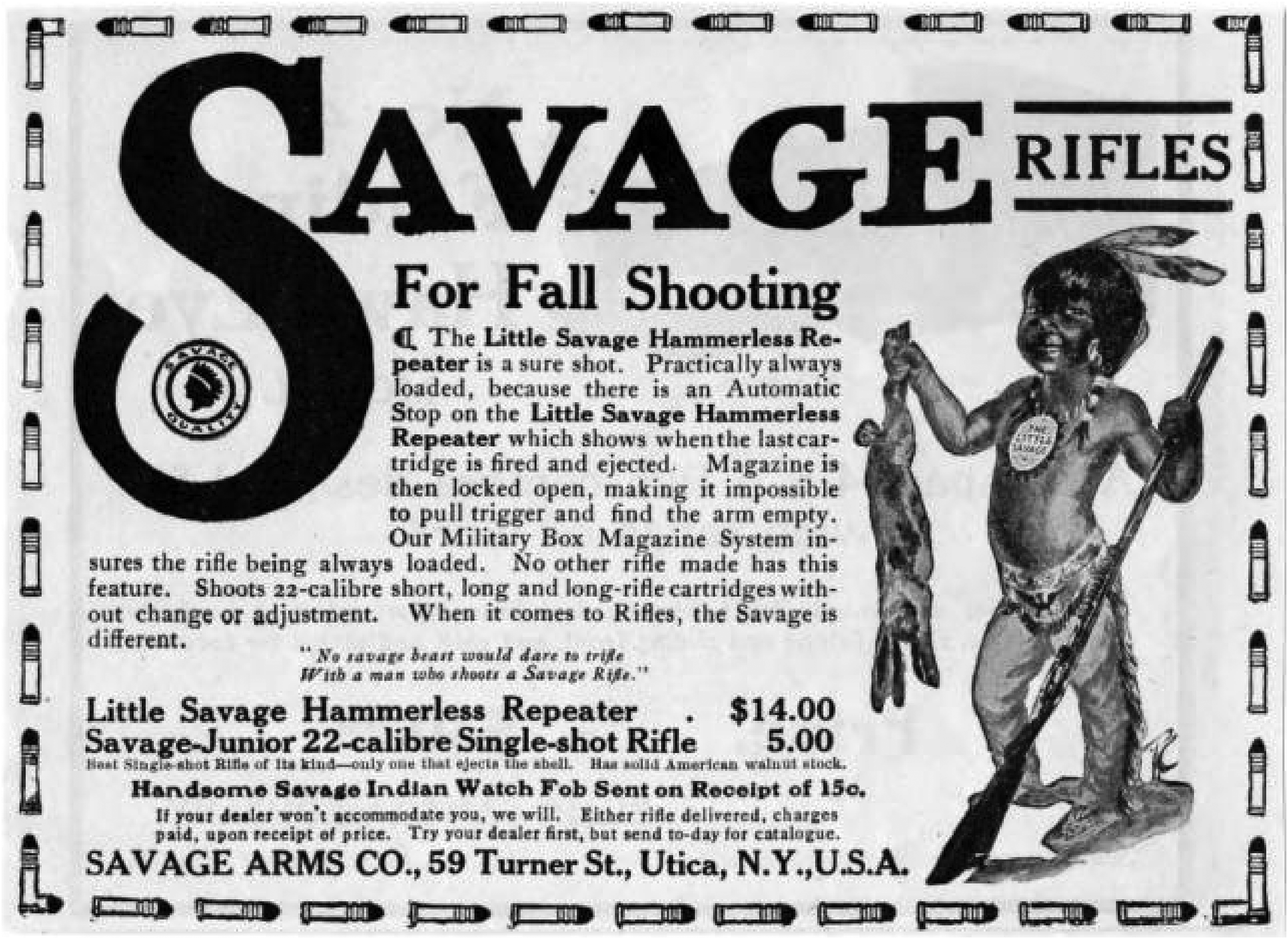
Ad for Savage Rifles, Recreation, September 1905. Source: Roy Marcot Firearms Advertisements Collection, McCracken Research Library, Buffalo Bill Center of the West.
Among other Native American characters, the well-executed image of a seemingly Noble and Civilizable Savage is central to an ad published in Outdoor Life in 1908. Here, a mature man decked out in full war bonnet and buckskin sits cross-legged while closely examining a Savage Model 1899 takedown rifle (Figure 13). This model variation could be easily disassembled for transport. The handsome and contemplative character, a Native gun maven so to speak, appears to be suitably impressed by the rifle's design. The body copy makes classic reason why selling points by praising product attributes and quality. The advertised price was $20 or $668 in 2022 dollars (Friedman 2023). Note the name of the ad agency, Street & Finney, seen on the lower right. American agencies very rarely have signed their work (Richards 2022). Savage switched its account to J. Walter Thompson in 1922 (JWT 1922).
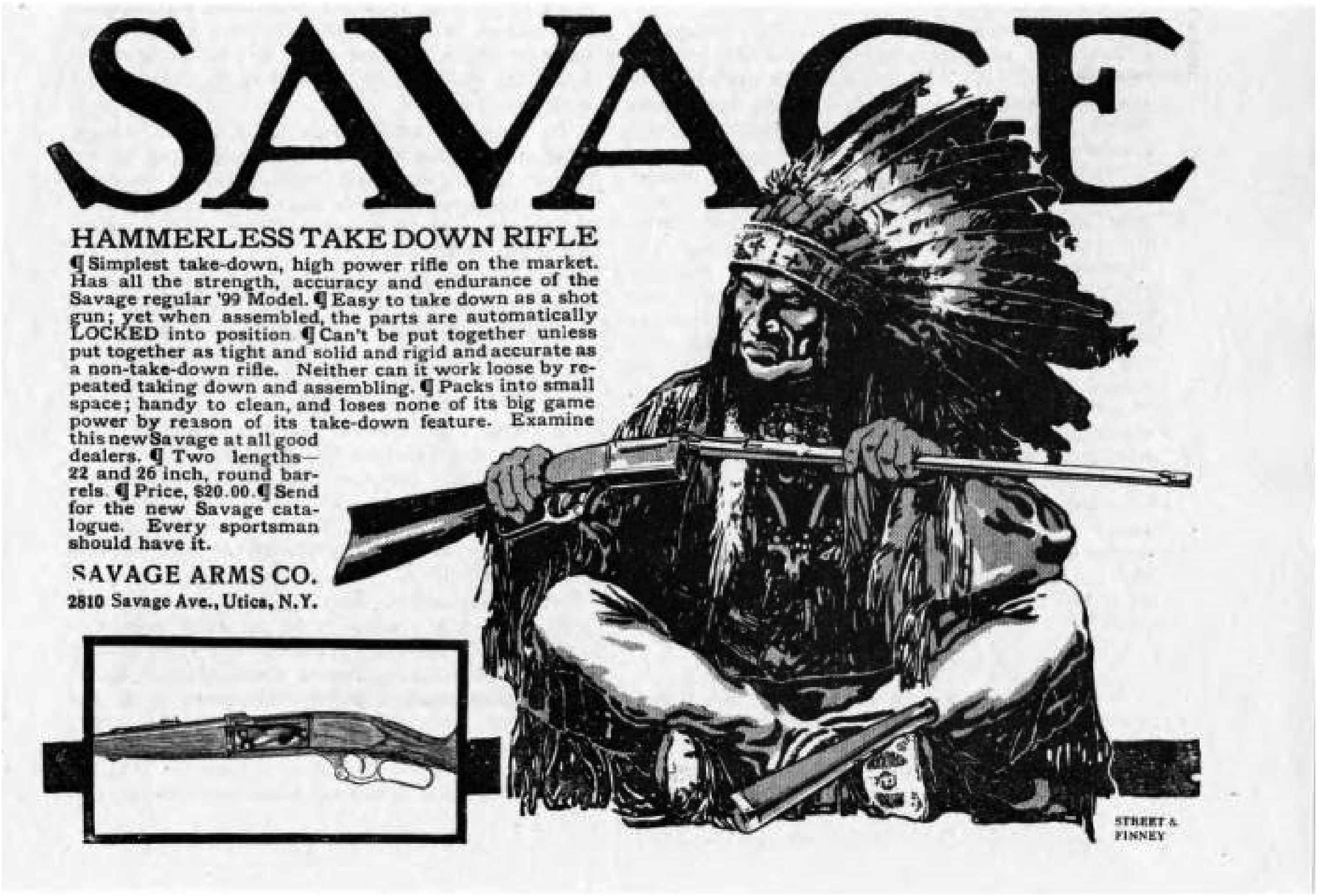
Ad for Savage Hammerless Take Down Rifle, Outdoor Life, 1908. Source: Roy Marcot Firearms Advertisements Collection, McCracken Research Library, Buffalo Bill Center of the West.
The above three advertisements appeared in Recreation and Outdoor Life. Launched in 1894 and 1898 respectively, these titles joined the then burgeoning field of outdoor magazines (McLaughlin 2020). The Marcot collection also has Savage ads with Native American characters printed in Forest and Stream (founded in 1873), The Outing Magazine (starting 1882), and National Sportsman (from 1899). Altherr (1978) and McLaughlin (2020) have discussed how these and a few other publications championed concepts such as the “hunter-naturalist” and high-minded (understood as elite) sportsmanship. Editors looked down on overly rapacious sport and market hunters and in print shamed “game hogs” who bagged too many kills in one field trip. Caspar Whitney (1864–1929), the owner and editor of Outing, even denounced pump-action shotguns (Whitney 1900) and autoloading shotguns (Whitney 1906) as unethical for their rapidity of fire and magazine capacities. Since American Indians presumably husbanded animal resources and consumed all of the game harvested, their advertising presence may have signified Indigenous sportsmanship to readers. However, neither the headlines nor body copy in any of these ads actually mentioned conservation or Native Americans. These were product-focused, reason-why appeals. Their characters may simply have been attention getters.
Savage continued to use its American Indian head logo and trademark for many years. In addition to the catalog covers mentioned above, sellers on eBay have offered both neon and porcelain signs from the 1950s and 1970s showing various portrayals of its chief in profile, all facing to the viewer's right. These objects appear intended for the retail trade and some examples have been imprinted with the names of dealers. However, no evidence has been unearthed of the company using Native Americans as characters in its print ads after 1910 until 1970 when a new campaign posed Indian men for two-page spreads in color. Five different ads have been located thus far, one in O’Barr (2013) and four others offered by eBay sellers. The subjects in the photographs do not appear to be white actors, but their origins are unknown.
A couple of them are shown in Figure 14. On top, a man in an elaborate headdress and buckskin ensemble promotes a reproduction of the Model 1895 lever-action rifle, while beneath him another man in vintage dress touts the Model 110 bolt-action rifle. The 1970 Savage catalog cover also reproduced the same photo of the chief. Similar ads (not shown) have other Natives, one of whom wears more contemporary attire, posing with the Savage pump and over/under shotguns. The pictures all seem to have been taken at the same photo shoot. The characters are very similar to those illustrated decades earlier. The long body copy in the ads does not refer to the men in the photos, which begs the question: What purpose did the pictures serve? Perhaps they simply were meant to attract the eyes of gun buyers with traditional imagery. Whether they transferred additional meaning to these sporting firearms is hard to determine.
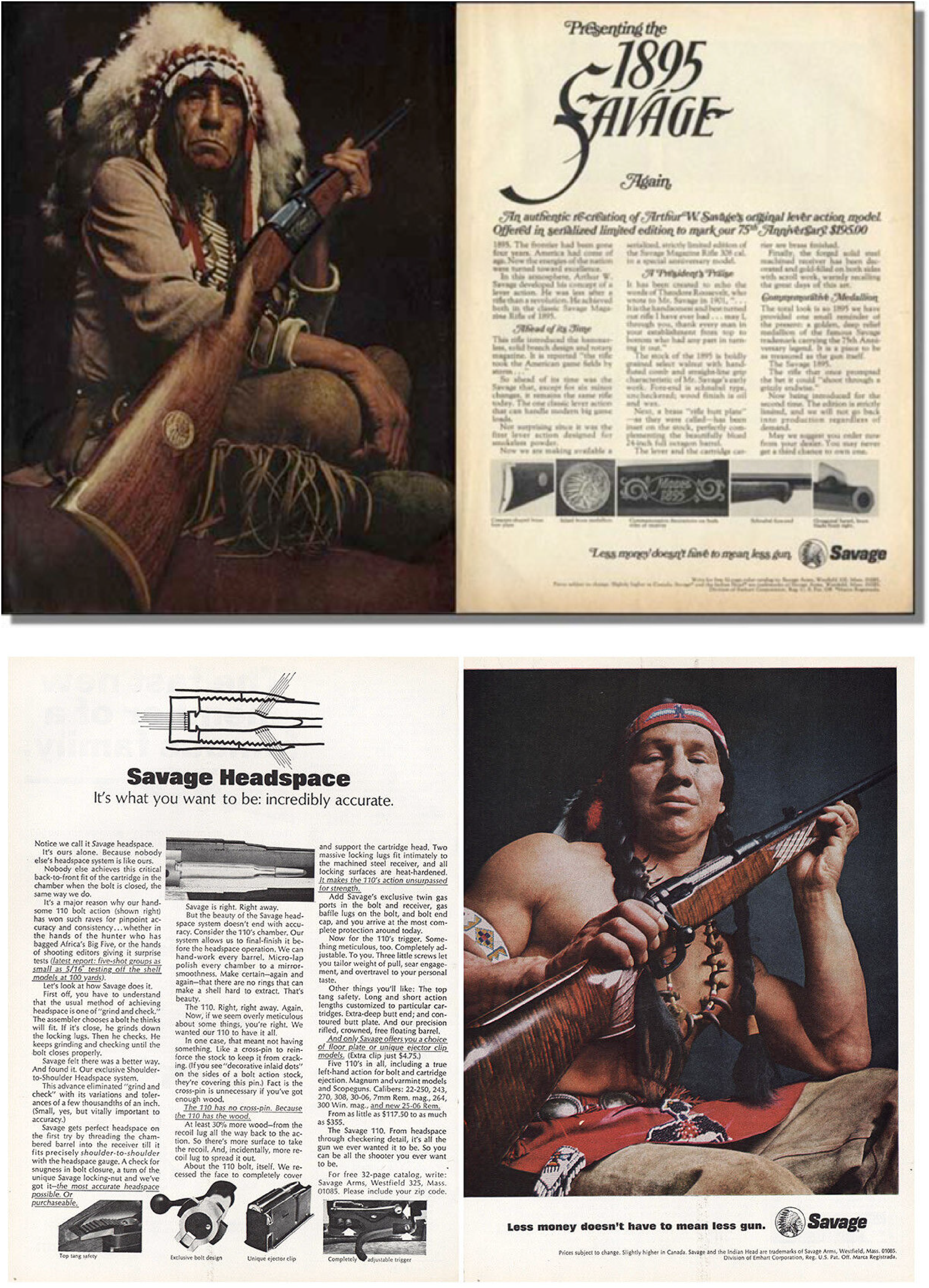
Savage ads for Model 1895 re-creation and Model 110 bolt-action, ca. 1970. Sources: O’Barr (2013) and eBay seller (bottom).
Remington Indians
After Google, eBay, and other searches had revealed only one example of Remington Arms being promoted through a Native representation, I queried Remington ephemera expert Gordon Fosburg about this lack of evidence. In an email sent to me on January 17, 2023, he stated, “Remington was not a proponent of using Indians in advertising. I only know of two examples.” He shared digital copies of material from his extensive collection. Figure 15 shows a cloth banner for Remington-UMC illustrated with two Plains Indians shooting bison with Remington rifles. Union Metallic Cartridge, a maker of ammunition, owned Remington at the time. Variations of the red ball logo trademark appeared in advertising from 1911 to 1929. Beneath the banner, a photo shows how two of them were displayed about 1915 at an amusement booth called “Kentucky Bill Shooting Gallery.” The hanging pennants suggest this small exhibitor traveled around Kansas, Missouri, and Kentucky. The same hunting image on this banner has been imprinted on reproduction metal signs currently available on eBay in different sizes. Whether Remington-UMC issued this particular tin signage in the past is unknown. The eBay items may have been fabricated much more recently.
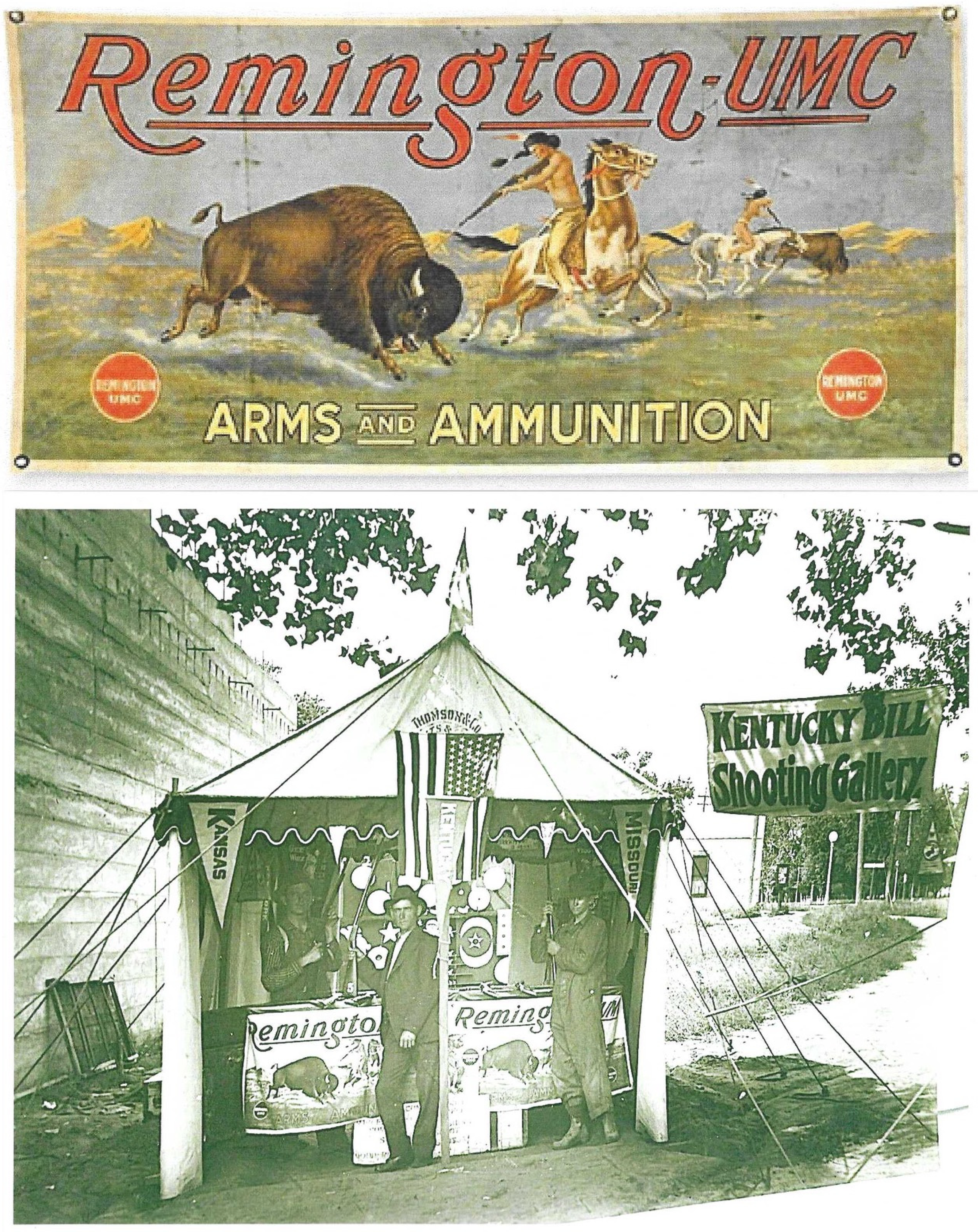
Remington Banner and Shooting Gallery Photo, ca. 1915. Source: Collection of Gordon Fosburg.
Remington later commissioned a portrait drawing of a standing chief in full plains regalia holding a hunting rifle. This striking illustration appeared in color on the cover of Hardware Age magazine for December 22, 1932 (Figure 16) and, in black and white, on page 37 of Sporting Goods Dealer for January 1933. In both versions the Remington wordmark is on the lower right and the upper left caption reads: “Greeting to my brothers—Kleanbore Shooters—throughout the world.” Kleanbore was the brand name for a line of Remington cartridges. The ad does not contain the typical business address though in very small print below the image it says “R. A. Co.” The thinking behind these placements can only be surmised. At the time, the company was in financial trouble until E. I. DuPont De Nemours & Company saved it by taking a controlling interest in 1933. Was this picture and hand gesture a visual swan song for the old company and a signal to the soon to be new owner?
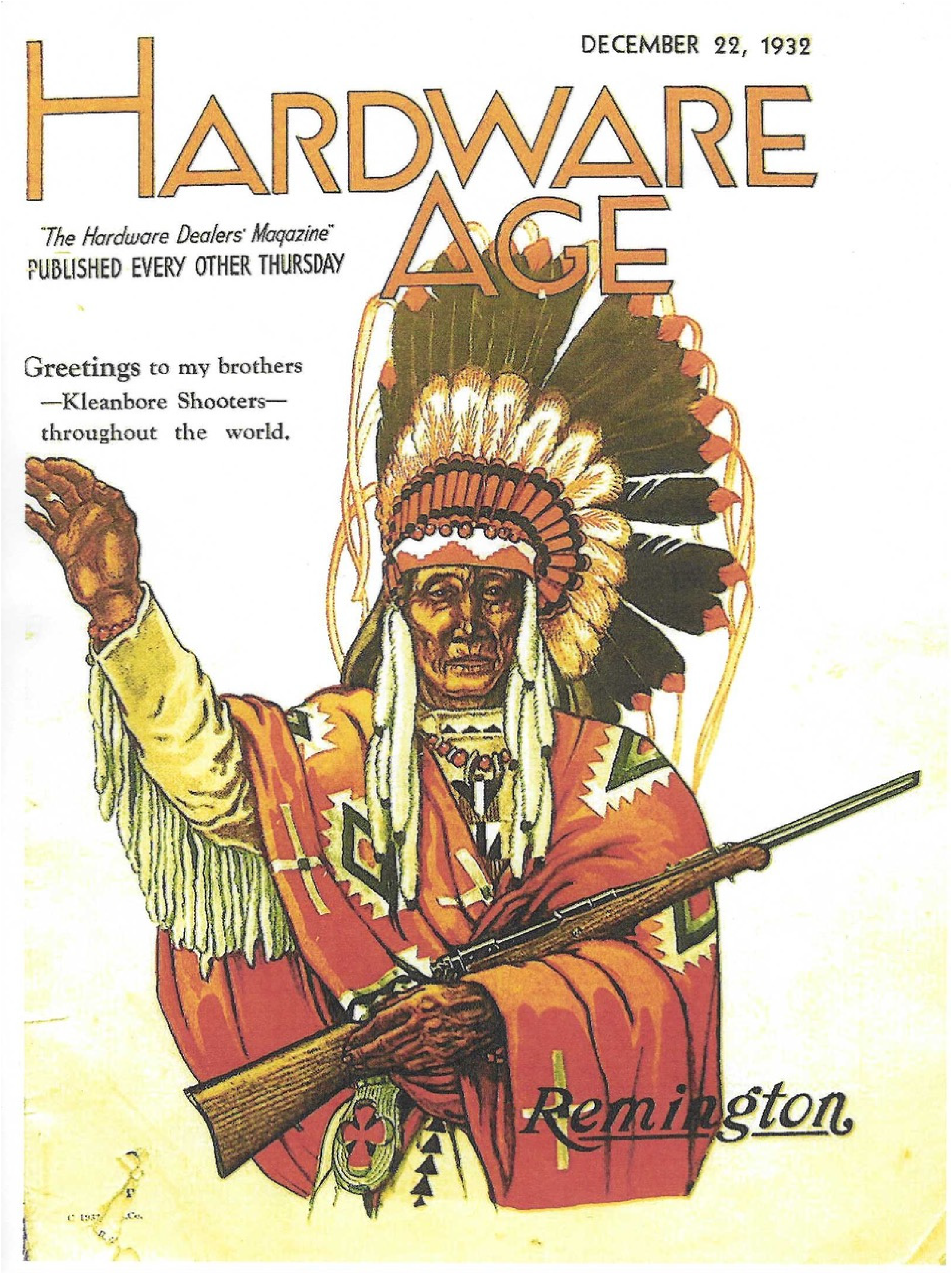
Remington cover, Hardware Age, December 22, 1932. Source: Collection of Gordon Fosburg.
Winchester Indians
Firearm manufacturers have referenced American Indians in their brand advertising quite callously. Immediately after the Civil War many Americans still viewed Natives as dangerous hostiles who posed a threat on the frontier where they defended their lands and cultures from greedy, encroaching whites. Stoking this sentiment, Winchester printed a large (18.25 × 11.5 inches) full page ad (or possibly a handbill) touting its new Model 1866 rifles and carbines. Below the title, an illustration or two rifles, and the subhead promising “two shots a second,” the sixth line of copy said, “For Indian, Bear, or Buffalo hunting, it is unrivaled.” The text subsequently mentioned the Indian threat two additional times. The names of board of directors Secretary O. P. Davis and President O. F. Winchester appear at the bottom of the sheet (Cowan's Auctions 2022). Since this ad was probably written in New Haven, Connecticut, far from the war on the Western frontier, it affirms continuing anti-Indian feeling. Repeatedly during times of conflict, Colonial authorities, and later federal and state governments, put bounties on Native men, women, and children as a reward for whites who killed them (Deloria, Jr. 1969; Riley and Carpenter 2016).
Attitudes toward Native Americans became less hostile in the twentieth century, but the language and imagery of potentially lethal gunfire persisted. A 1967 advertisement for General Electric flashcubes stated, “When you decide to shoot wild Indians you can’t afford to miss.” The sentence was written tongue in cheek since the ad showed photos of white children playing Indians and the shooting was to be done with a camera. Magnavox television sets and Kohler Plumbing Fixtures repeated this phrasing in some of their advertising that depicted youngsters aiming pretend guns at a Native on TV, and at an Indian doll perched on a bathroom sink (Race & Ethnicity in Advertising 2023).
About the same time as the GE ad appeared, Winchester built a retail advertising campaign around timeworn American Indian cliches. A conspicuous cardboard dealer display from 1967 delivered visual impact (Figure 17). About 5½ feet high unfolded, it promised extra Winchester barrels as a premium with the purchase of any Model 1200 or 1400 shotgun. On one side of the display stood a cigar store type of Indian, a caricature from the long-standing visual meme associating Native Americans with tobacco. Wearing a typical headdress, the man admires the three barrels he holds aloft with his right hand, while his left grasps the barrel of an autoloading shotgun. In a phony sounding Native dialect, the copy promised “Heap Big Savings! Ugh, hunt'em all: Waterfowl, upland game, deer. Shoot'em trap and skeet.”
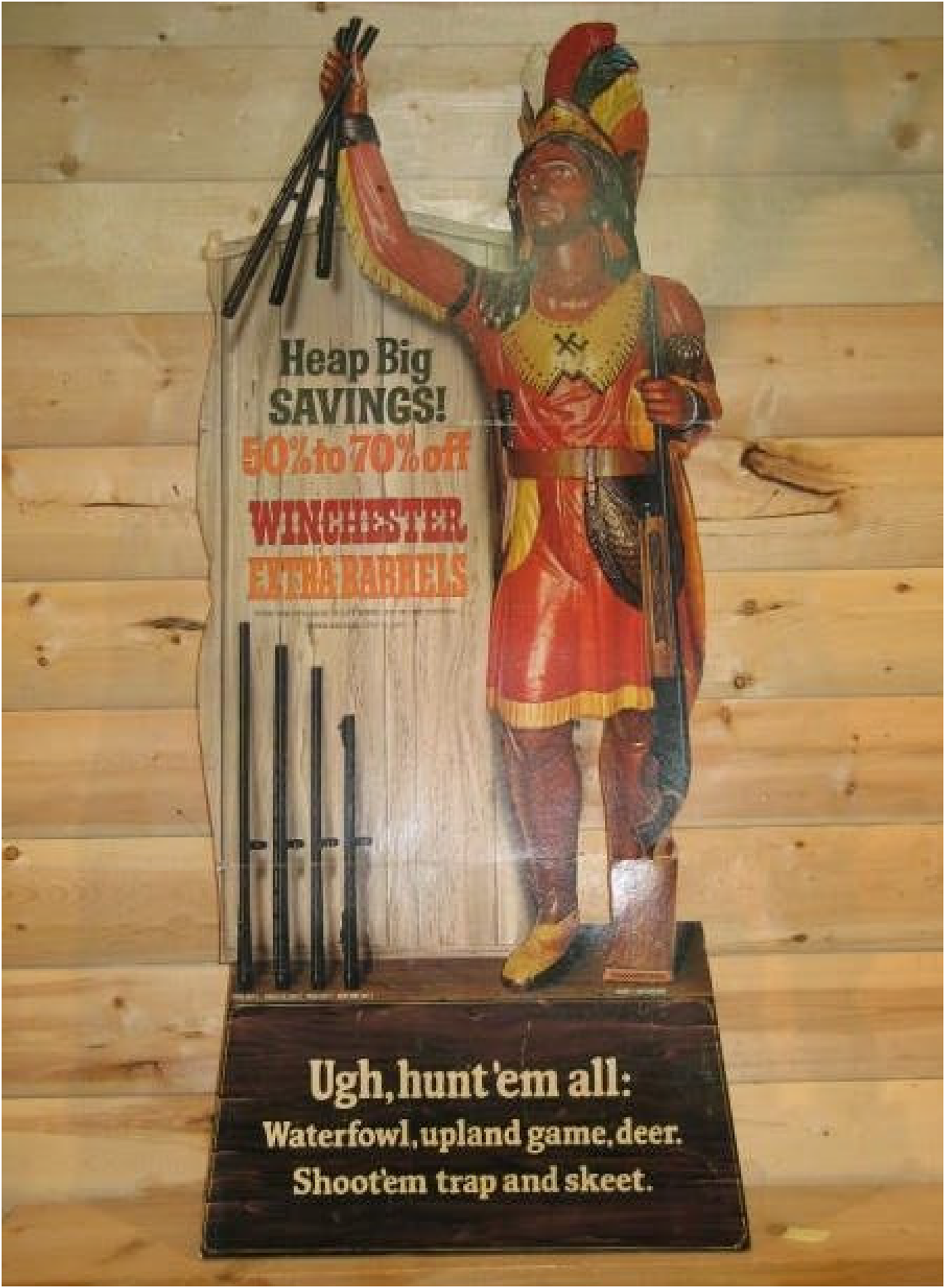
Winchester Foldable Cardboard Display, 1967. Source: Photo from EBay Listing January 2017. Also see Rock Island Auction (2022).
In the late 1960s, Winchester also created advertising posters in the same vein for its bolt-action .22 caliber rifles. A large one (37 × 26 inches) portrayed a young white cowboy showing the rifle to a much shorter Native boy wearing feathers and other accessories (Figure 18). The headline read “New WINCHESTER Bolt Action 22 s / So much fun for so little wampum.” A second poster (24 × 18 inches) depicted an Indian brave riding a cool pinto horse bareback (Figure 19). With a rifle upright in his right hand, he too wears fancy Native attire. Big letters spelled “Scout out WINCHESTER 22 s,” a reference to Indians who served as frontier guides. A third large poster (25 × 37 inches) showed five grown Indian men in colorful costumes standing abreast with each holding his rifle with two hands (Figure 20). The headline punned, “A whole new tribe of WINCHESTER Bolt Action 22 s.” An older man in the middle wears buckskin and an enormous, feathered headdress (Rock Island Auction 2022). This group photo may have been inspired by a famous picture of Apache leader Geronimo (1829–1909) and three braves holding Winchesters and single-shot rifles. Taken in 1886 by Camillus Sidney Fly (1849–1901), copies can be found in the Library of Congress, in the collections of other institutions, and occasionally on the collectors’ market. In still another poster (not shown), a rather comical looking man wearing a buffalo head headdress sits in front of a teepee with an autoloading rifle. This time the headline reads “WINCHESTER 22 s / Heap Big Medicine for small bore shooters.” The visual staging and shooting of these photos required no little effort on the part of Winchester.
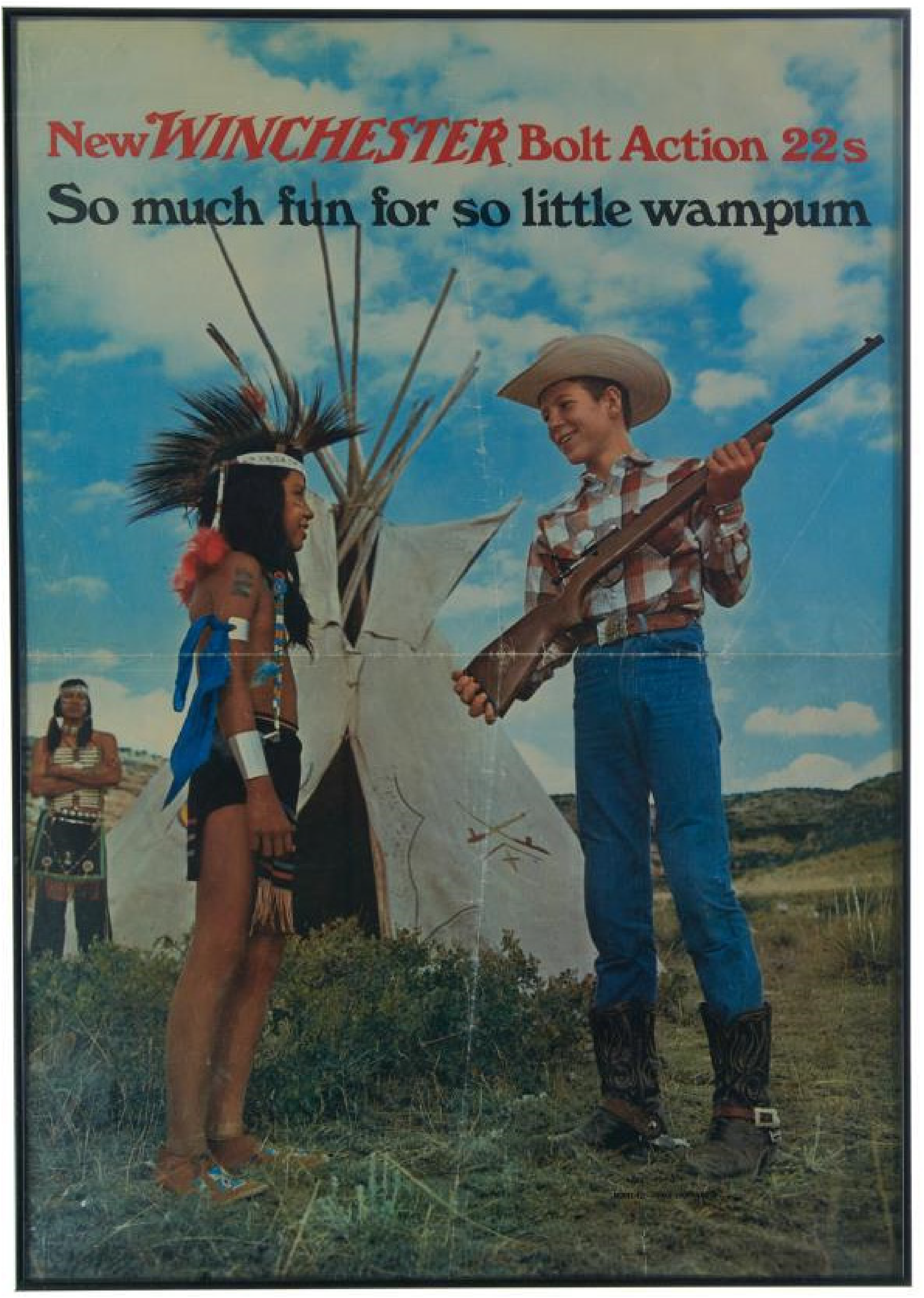
Winchester Poster, ca. Late 1960s. Paper, 37 × 26 in. (94 × 66 cm). Source: Rock Island Auction (2022).
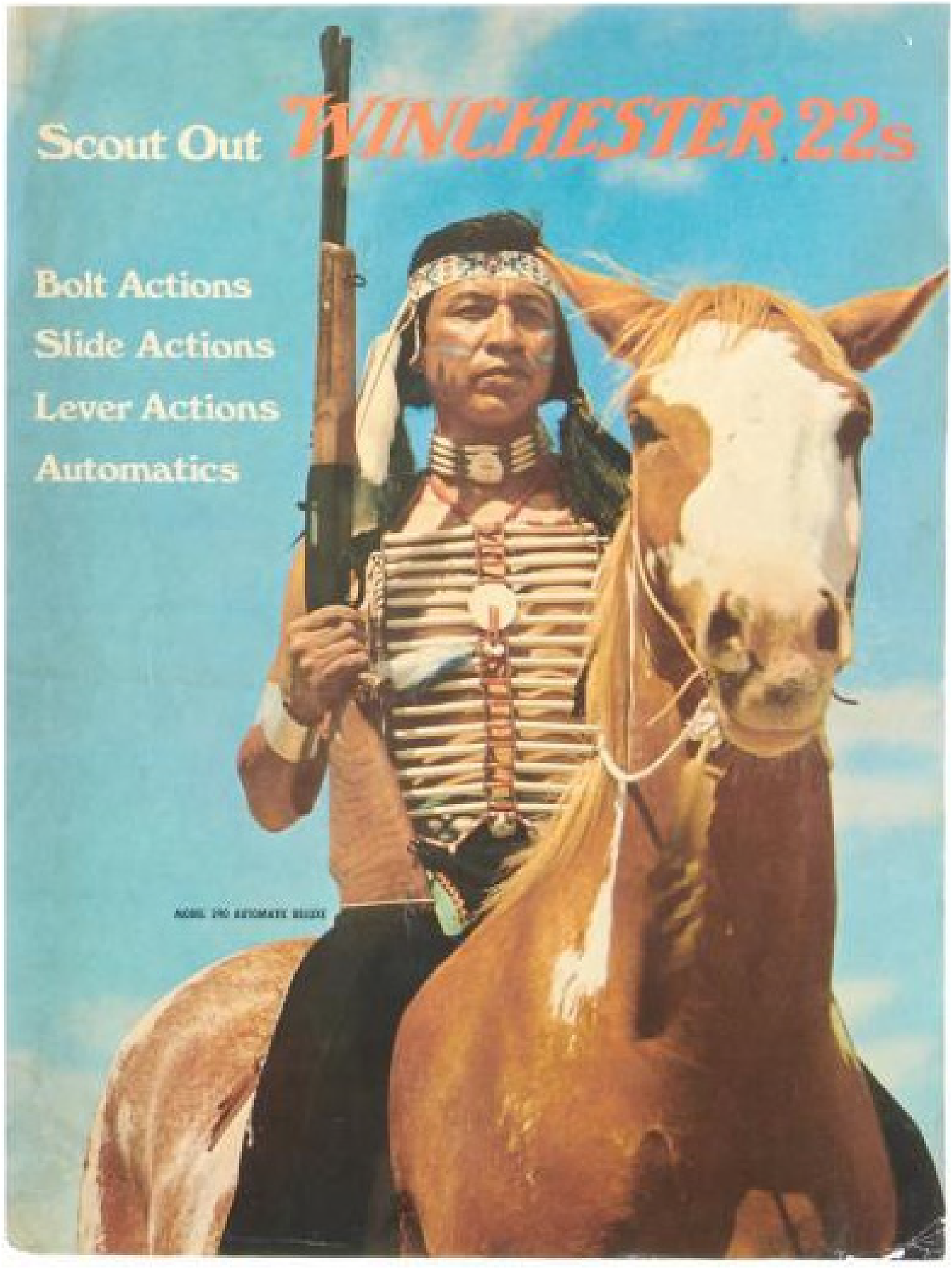
Winchester Poster, ca. Late 1960s. Paper, 24 × 18 in. (61 × 45.7 cm). Source: Rock Island Auction (2022).
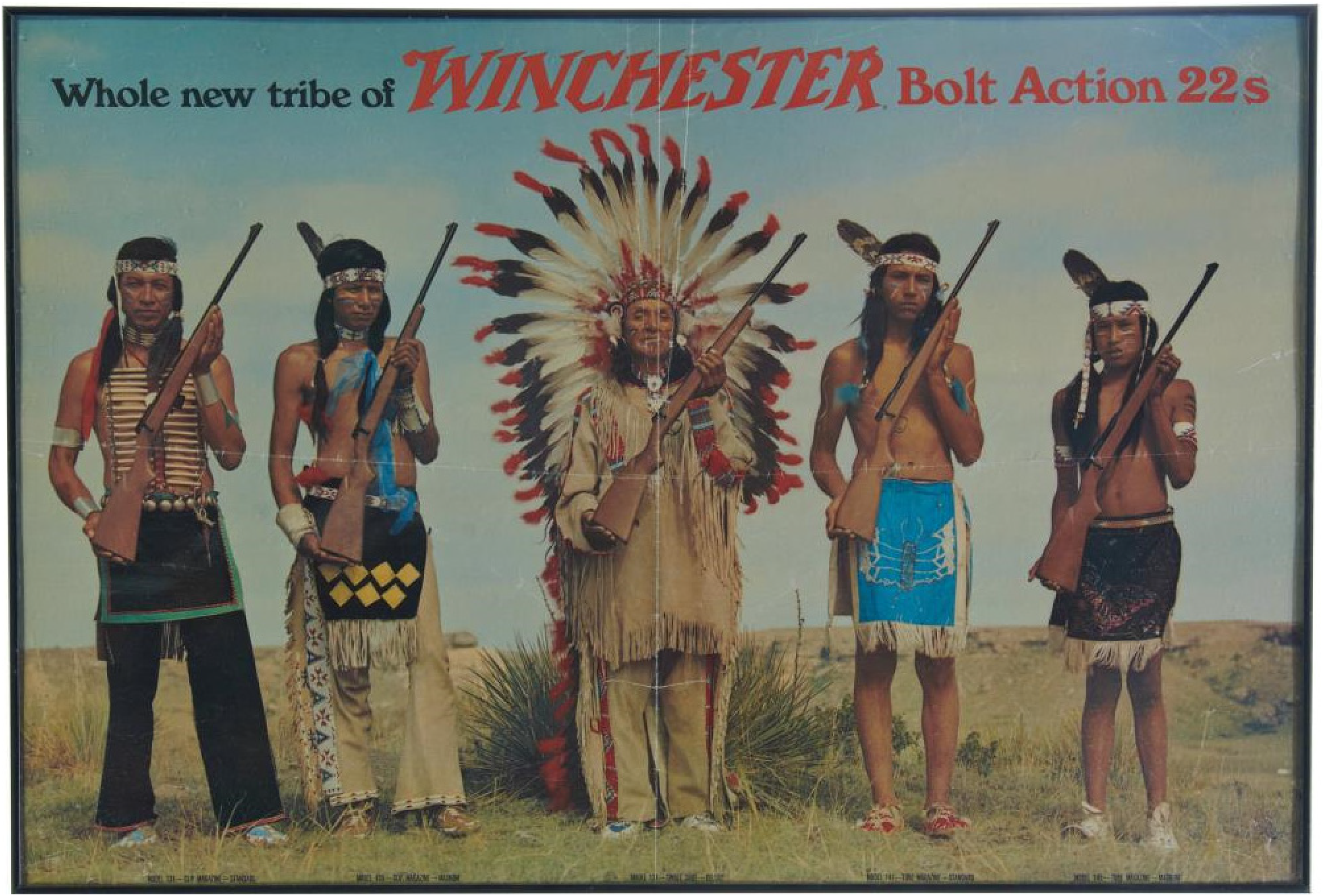
Winchester Poster, ca. Late 1960s. Paper, 25 × 37 in. (63.5 × 94 cm). Source: Rock Island Auction (2022).
Macromarketing Implications
In addition to their appearances in advertising, Indigenous characters and references to wampum, scouts, tribes, and big medicine could be found in postwar films, television, and cartoons. Popular culture kitsch in the form of costumes, headdresses, dolls, candles, ceramics, and imprinted glassware added still more highly stylized Native Americana (Miranda 2018; O’Barr 2013). I grew up within this milieu. Figure 21 shows me wearing war paint and Native boy attire in a photo taken at our flat on Division Street in Chicago, probably around Halloween in 1954. Playing Indians and appropriating their images and cultural artifacts had become deeply embedded in mainstream U.S. culture by mid-century (Deloria 1998). Most white people never gave the morality of their appropriations a second thought.
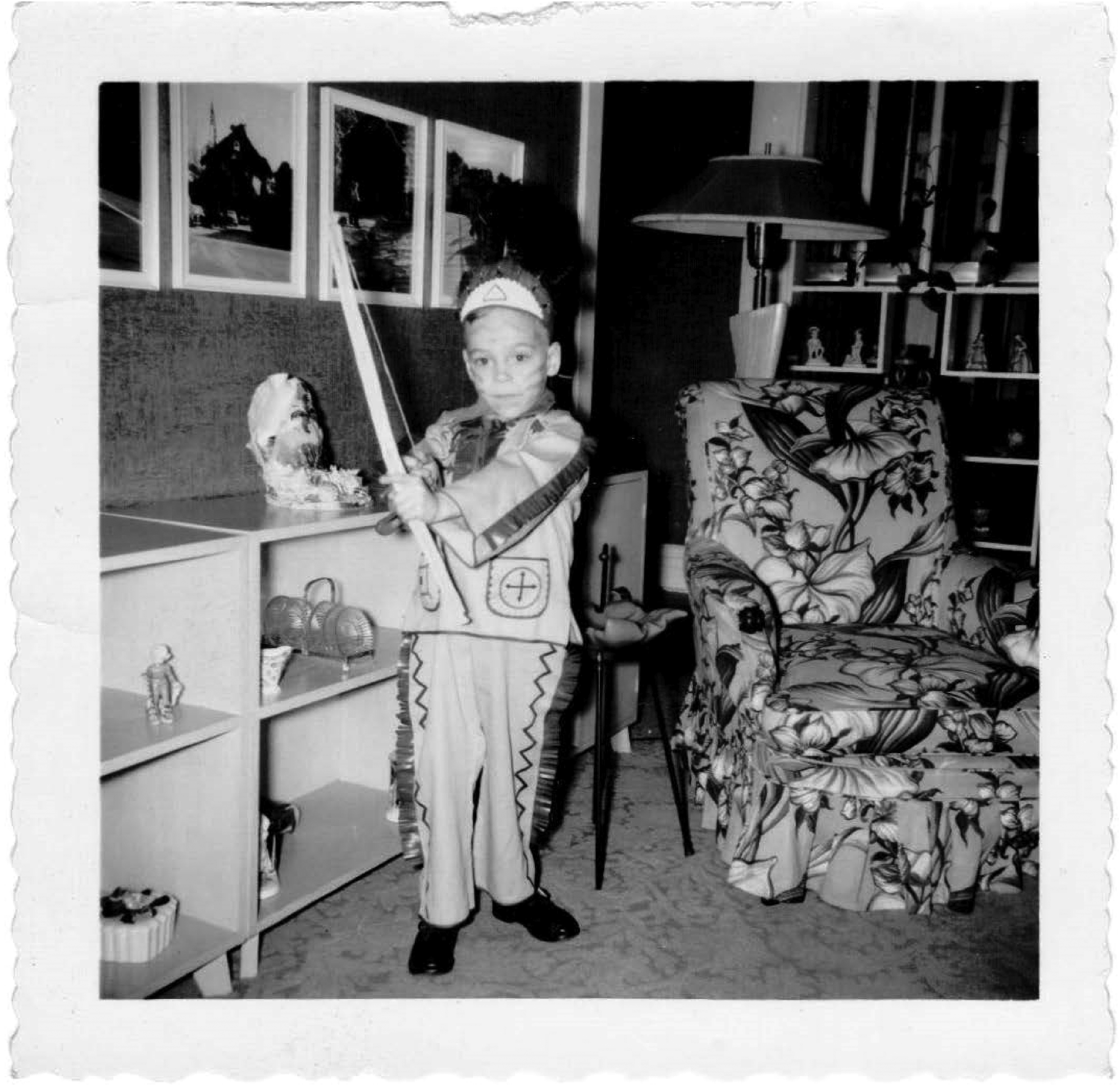
The Author as Indian boy in war paint, ca. 1954. Image, 3 × 3 in. (7.62 × 7.62 cm). Source: Collection of the Author.
Yet, social norms eventually changed. In 1968 activists formed the grass roots American Indian Movement (AIM) to advance the welfare of Indigenous peoples. In 1969, Vine Deloria Jr. (1969) confronted white audiences with his most famous book, Custer Died for Your Sins: An Indian Manifesto, and the following year Dee Brown (1970) published the bestseller, Bury My Heart at Wounded Knee: An Indian History of the American West. A group of Native Americans and their supporters occupied Alcatraz Island in San Francisco Bay from November 20, 1969 to June 11, 1971. Further protests and legal actions in subsequent years kept the issue of cultural appropriation in the public consciousness. In the twenty-first century, U.S. businesses slowly began to turn away from commercializing Indian names, language, and social types. The advocacy of tribal critics and their allies had gradually driven many, but not all, time-worn representations off the market and away from public view.
Societal Consequences of Appropriation
Regarding advertising specifically, critics have lambasted the treatment of Native Americans through the extensive use of stereotypes, occasional intimations of violence, and misrepresentations of history. Such ads work to denigrate, vilify, and malign American Indians, both historically and contemporarily (Race & Ethnicity in Advertising 2023). Strong words to be sure, but today many observers will visually interpret previous depictions, such as the Winchester ephemera from the 1960s, as clearly patronizing. Michael Green (1993) has argued that such depictions have been based on ideas that ultimately deny Indigenous people their humanity. There is much truth to this point of view given the sad historical record of Native displacement, ethnic cleansing, and genocide. The dominant American culture has cherry picked its representations, sometimes maliciously.
The consequences for Indigenous people of their marketized cultural appropriation can be divided into two categories: harm and offense. Young (2005) defines harm as a setback to one's interests, such as being injured, robbed, or cheated, whereas offense is a disliked state of mind, such as being disgusted, outraged, or appalled. He goes on to describe profound offense as an insult to moral sensibilities that “strikes at a person's core values or sense of self” (p. 135). The conceptual distinction between a practice being harmful rather than offensive is perhaps not always hard and fast, as Young (2005) readily admits, but serviceable for macromarketing analysis at a societal level.
A vast literature has documented the suffering of Native Americans from imported diseases, armed conflict, confiscation of land, and removal and sequestration (see, e.g., Brown 1970; Deloria, Jr. 1969; Hämäläinen 2022). To this day their communities are afflicted by high rates of poverty, alcoholism, and mortality, especially on some reservations (Silverman 2016). Gun violence among American Indians, often directed at women, remains deeply troubling (Nguyen and Drane 2022; Salway 2018). However, attributing these endemic and chronic conditions to cultural stereotyping through firearms advertising, or any other type of popular naming and imaging, would seem rather speculative, especially in comparison to the long history of brutally punitive colonial, state, and federal policies that even in recent years still hinder tribal sovereignty and economic development (Crepelle 2023). Whether visual appropriation may have amplified such serious harms remains possible, but unproven.
Moreover, a case could be made that recycling Native culture may even have mitigated injury by creating positive or, at least, less malevolent feelings among the dominant white public. Many images, such as the paintings of Catlin, Russell, and later Western artists; the noble faces on U.S. gold coins and the Savage Arms logo; and the illustrations and photographs on much promotional ephemera, have been respectful toward and even wistful about a people and their vanished way of life. Firearms and other product advertisers surely must have anticipated Native representations channeling positive meaning into their brands. The literature on advertising appropriation has not considered this perspective. Yet, as with visual appropriation causing harm, concrete evidence for its reducing harm also is lacking.
Turning to being offended by cultural appropriation, critics have stressed plausible psychological consequences for individual Natives and how they feel about themselves. Studies investigating American Indian team mascots, for instance, have found negative impacts on Indigenous perceptions of self and community worth (Fryberg et al. 2008; 2020). No similar research has been found that documents whether advertising portrayals have had similar effects, but it seems reasonable to assume some tribal people have taken varying degrees of offense at their unendorsed commercial appearances. Given the past treatment of their people, who could blame them? Still, Native Americans have not all thought alike and over time have held a range of attitudes toward the exploitation of their culture. On an individual level, many American Indians have participated in performative market exchanges, such as appearances in Wild West shows, movies and television, and in firearms advertising photo shoots, for which they were compensated (though probably at reduced rates). And some forms of appropriation, like the early 1900s Savage ads in sporting magazines, could not cause offense because they probably did not reach an Indigenous audience on reservations.
Schroeder and Borgerson (2005) and Borgerson and Schroeder (2008) have introduced concepts of representational ethics for gaining understanding of the visual world. They urge consideration of both representation conventions – “customary ways of depicting produces, people, and identity” (Borgerson and Schroeder 2008, p. 87) – and the contexts from which these practices emerged. In their view, marketing communications comprise more than just persuasion targeting potential buyers. When advertising relies upon preconceived stereotypes, it runs the risk of distorting identities and negatively influencing the way cultures and communities see each other. Misrepresentations through visual imagery becomes more ethically problematic the more they diverges from reality. In other words, context is important.
This conceptual framework can be applied to the study of visual appropriation over time. For example, the characters in the Savage ads from around 1900, who appeared serious and dignified (except for the comical Indian boys), were already becoming dated and dissociated from the poverty and pressures to assimilate that were afflicting actual Native Americans. A few years later, the bison hunters on the Remington banner and the Indian chief touting the Kleanbore brand were definitely anachronistic. By the late 1960s when the Winchester ephemera appeared, and in 1970 when the Savage ads with Native men were published, this disconnect from the actual Indigenous context had become palpable. The passage of time increasingly made reusing the same representational conventions an ethical concern. Critics argue that so much attention to a sterotypical past increasingly had rendered contemporary Native American life as unimportant.
Appropriation's Historical Arc
The societal context at any given time affects how cultural appropriation is marketized. This temporal interface raises two important historical questions. First, why did advertising and other forms of Native Americans appropriation originate, become commonplace, and then persist for so long? From the earliest period of settlement, certain Europeans, including Jesuit and Protestant missionaries, sympathized with Indians (Hämäläinen 2022). They saw them as a tragic, but dying race succumbing to the onslaught of an advanced European civilization (Berkhofer 1978; Deloria 1998). In the past and ever since, some whites have harbored feelings of remorse over the way Natives have been driven violently from their lands and frequently cheated by settlers, soldiers, and state and federal governments. Cultural appropriation through imagery possibly served as a form of atonement for some Americans. Yet, white appropriation could be interpreted much differently as a symbolic form of trophy acquisition related to the taking of hostages, or scalps, heads, and assorted body parts from the dead after a victory in battle. Actual scalping, by the way, was practiced by both Natives and whites from the colonial period through the Indian Wars (Axtell and Sturtevant 1980; Deloria, Jr. 1969). In any event, whites have had a love-hate relationship with the Indigenous people they replaced.
Dressing as and identifying with Indigenous people served political interests in Colonial America, most famously at the Boston Tea Party in December 1773, when opponents to Britain's Tea Act “disguised” themselves as Natives to dump cargo imported by the East India Company into the harbor. Playing Indians helped colonists differentiate their identity from that of England (Deloria 1998). On the cultural front, a growing romantic movement in the early nineteenth century saw Indigenous lifestyles as having a noble purity and a sensible approach to nature that was being increasingly violated by the industrial revolution (Flavin 2002). Visualizing American Indians in connection with the outdoors and environmental concerns later became a fixture of the new scouting movement in the early 1900s and later still the counterculture of the 1960s and 1970s. This association acquired iconic status on Earth Day 1971 with the broadcast of the “Crying Indian” commercial that lamented the pollution of America. The sponsoring organization, Keep America Beautiful, retired the campaign and transferred rights to the American Indian Fund in 2023. Over time these public service announcements had taken flak for their cultural appropriation, in part because the main Native character, Iron Eyes Cody, was an Italian American who claimed Cherokee heritage (Kaur 2023). To white America he looked the part.
The sheer visual power and magnetism of Native American culture has proven irresistible. Eastern woodland Indians have been portrayed as exotic (see Figure 2), but images of the tribal peoples of the Great Plains and Mountain West were and remain exciting wellsprings of aesthetic delight to many eyes. Adding iconic Western vistas, animals, and firearms to the mix has strengthened this impact. The growing use of chromolithography after the Civil War brought vivid color representations to a national audience. By the fourth quarter of the nineteenth century the dynamics of pity and triumph; political identity, romanticism, and the environment; and sheer visual impact had combined to provide fertile ground for cultural marketization that, once tried, spread and spread, and then rolled onward into the future largely unchecked for more than a century.
The second historical question asks: Why did serious opposition to the appropriation of Native American culture emerge when it did in the late 1960s? Perhaps we should be surprised had it not. This was a time when several other vigorous social movements – most prominently the antiwar and Black power protests, women's and gay liberation, and environmental protection – confronted mainstream American business, culture, and politics. American Indians and their advocates have been relatively few in numbers compared to the other groups with whom they only sometimes collaborated (Deloria 1998; Deloria, Jr. 1969), but over the years the Red Power crusade has encountered somewhat muted culture war pushback to its claims from conservative whites (see, e.g., Hartman 2019). The onset of Native American casinos in the 1970s and 1980s, helped along by the passage of the Indian Gaming Regulatory Act of 1988, catered to white (and other) customers, while generating significant revenue streams for many tribes. This money has supported economic development, language and cultural revitalization, political mobilization, and legal actions.
Despite the headwinds from Indian advocacy, the marketing of cultural appropriation has not disappeared. For example, despite more than five decades of objections to stereotyped attire, a number of websites at present (e.g., amazon.com, etsy.com) host vendors hawking Native American costumes and feathered headdresses for men, women, and children. Advertising as a vessel for appropriation has moved onto digital platforms where independent sellers can reach a dispersed market. Although some of them purport to be respectful conveyors of tribal cultures, others use sexualized images of young, white women posing as skimpily clad Indian maidens. Victoria's Secret, a controversial fashion brand, has apologized for their runway model wearing a headdress (AP 2012), but online numerous photos from small merchants still show attractive females wearing war bonnets. This was not an Indigenous practice and it has been decried as offensive. Interestingly, there have been monetary antecedents for this trope. The so-called “Indian Head” penny minted from 1859–1909 and the $10 “Indian Head” gold eagle minted from 1907 to 1933 actually featured the Caucasian face of Liberty crowned with a feathered bonnet (Yeoman et al. 2021). Augustus Saint-Gaudens (1848–1907), one of America's most distinguished sculptors, created the image on the $10 eagle.
Past visualizations of Native Americans continue to echo in twenty-first century firearms marketing. America Remembers® (2023), based in Ashland, Virginia, sells replicas of historic firearms with nearly a hundred different engraved images of famous people ranging from U.S. and Confederate soldiers to law enforcement officers and notorious criminals to movie and television stars. The company's online listing includes an “American Indian Tribute Henry Rifle” ($2495), a “Native American Warrior Tribute 1866 Rifle” ($2395), a “Geronimo Tribute Rifle” (a reproduction Model 1873 Winchester for $2395), and a “Sitting Bull Tribute Single-Action Revolver” ($1995). Manufactured and engraved by A. Uberti of Brescia, Italy, in 24-karat gold and nickel, the decorations are derived from period photographs and other source material. The historical connection between the honorees and the guns their pictures embellish is usually tenuous, and the gaudy designs verge on kitsch, but these products seem to respond to deep-seated consumer nostalgia, one would assume, among the mostly older white males who dominate American antique and vintage gun collecting (Witkowski 2020b). The marketization of cultural appropriation can find new channels to reach niche segments.
It still can serve political ends. For example, pro-gun groups have deployed the image of American Indians brandishing firearms. In 2013, a highway billboard in Greeley, Colorado, featured a photograph of three Native men dressed in traditional attire. The man in the center, unsurprisingly sporting in a full feathered war bonnet, held a rifle. The copy stated, “Turn in your arms. The government will protect you.” This sarcastic message alluded to oft-repeated, but unfounded fears stoked by the National Rifle Association and the firearms lobby of an impending confiscation of guns. In response to this appropriation, both gun control and tribal advocates rebuked its insensitivity and scorned the sponsor for choosing to remain anonymous. After the story received national coverage (see, e.g., Yan and Hassan 2013), the sign came down, but an ideological meme had been created for Second Amendment enthusiasts. As of this writing, Amazon.com, eBay, and other sites sell tee shirts imprinted with the same or similar words and pictures. The history of Native American cultural appropriation and marketization on behalf of firearms is far from over.
Concluding Thoughts
Hilary Mantel, the late, prize-winning author of historical fiction, once said that the job of history is not to issue report cards on the past. Historians should accurately reconstruct what has transpired – the good, the bad, and the very ugly – but be extremely judicious in their assessments and definitely avoid the self-righteousness of the present. Historical research should encourage understanding and critical thinking, and “make you wonder, of any moment in the past; what was the right thing to do? What was the wrong one?” (Economist 2023, p. 51). This perspective has guided the research reported herein.
The depiction of Native Americans in firearms advertising shows that the commercial side of U.S. gun culture essentially repeated the same tropes and language circulating within society at large. Over seventy years, similar stock renderings of chiefs, hunters, and young boys appeared in both illustrations and photographs. However, unlike advertising and packaging in other industries, which portrayed both male and female American Indians, major gun companies concentrated exclusively on masculine characters. In the twentieth century, Indigenous females were likely not a target market, and they lacked the gun-friendly symbolic attributes – bravery, nobility, and even good humor – that Native men and boys represented for readers. In contrast, ads for firearms often have made white women star characters promoting rifles and shotguns for hunting, and revolvers for self-protection (Browder 2006). Presumably, white males created the different appropriations in gun ads. Indian men (rather than white actors) probably posed for the later Savage and Winchester photographs, but doubtless had little input about copy platforms. Thus, these ads reflect the thinking of the white, male dominant U.S. gun culture.
This study has limitations. Firearms advertising has been just one small swell in a great sea of Indigenous appropriation for profit. They seem typical, but not exhaustive of all forms of marketization. Moreover, the evidence discussed may not tell the whole story of the gun industry's complicity. Firearm manufacturers and retailers could very well have deployed additional Native American trade characters and language in their advertising and sales promotions at different times that have not yet been found. Locating these primary sources can be difficult. Very few archives, especially ones accessible online, provide access to the many consumer and trade magazines that have hosted gun ads over the past 100 years. Thus, the findings as reported should be taken as tentative. Going forward, periodic visits to eBay, regular skimming of auction catalogs, and occasional serendipity may turn up more historical evidence of cultural appropriation through firearms advertising.
The exploitation of Native American culture by people outside the United States presents opportunities for further macromarketing research. Appropriation has been exported. When touring Europe at various times from 1887 to 1906, Buffalo Bill's Wild West shows electrified audiences with staged events featuring real American Indian actors. The Western genre in Hollywood films and American television shows has replayed endless variations on these performances and has distributed them to global audiences through much of the twentieth century and into the new millennium. Appropriation also has been localized. Germans, for example, have been enthralled by Indianertümelei or “Indianthusiasm.” They have devoured the Wild West novels written by Karl May (1842–1912) whose Apache character, Winnetou, has appeared well armed on book covers (Figure 22), in films, and on postage stamps. Reenactors have formed hobbyist clubs and have attended Karl May festivals (see, e.g., Galchen 2012). Different traditions of appropriation – including their past and present commercial practices, political contexts, and representation of firearms – should be fascinating research topics.
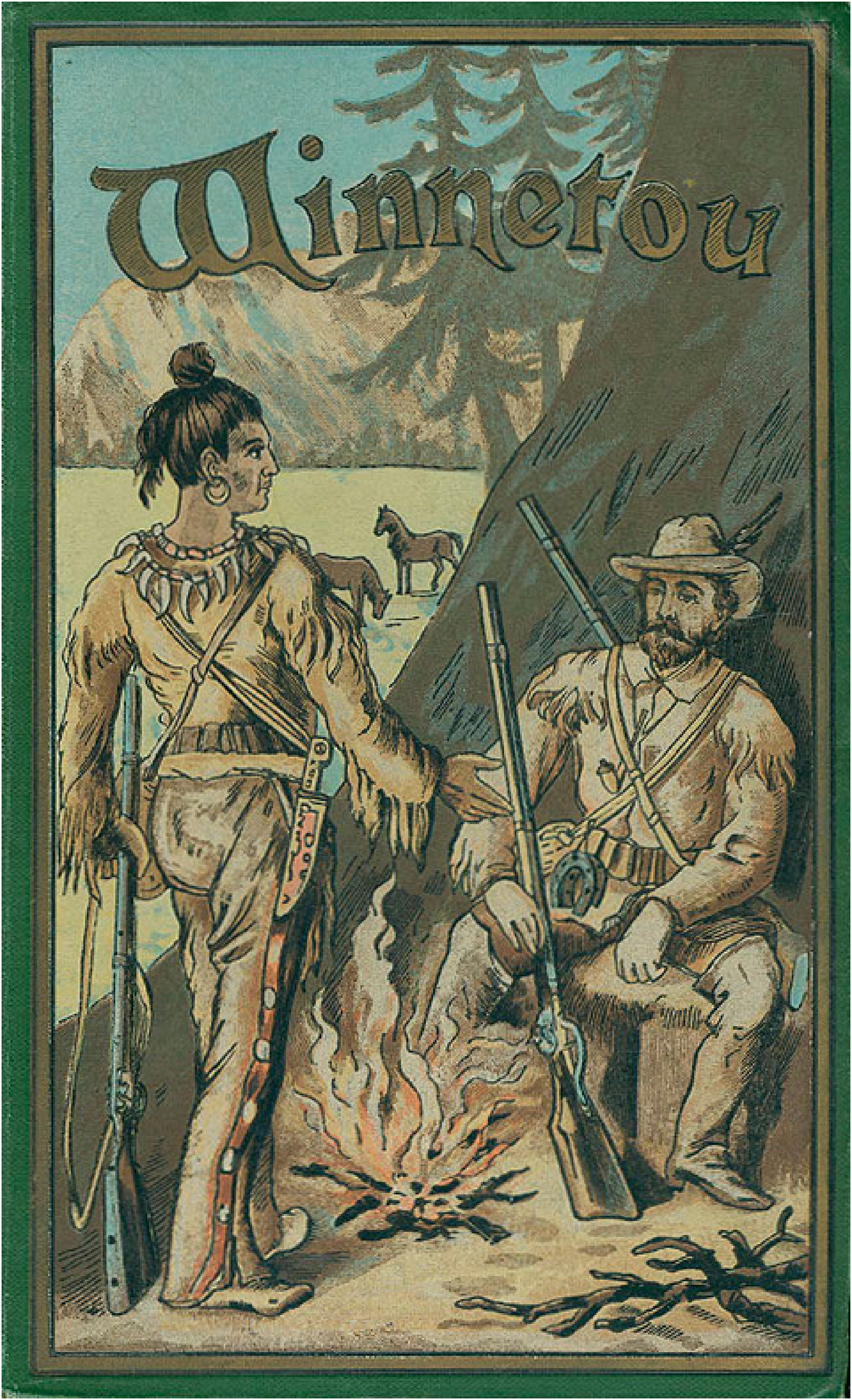
Book cover for Winnetou novel by Karl May, 1893. Source: Wikimedia Commons.
Footnotes
Associate Editor
M. Joseph Sirgy
Declaration of Conflicting Interests
The author declared no potential conflicts of interest with respect to the research, authorship, and/or publication of this article.
Funding
The author received no financial support for the research, authorship, and/or publication of this article.
