



Abstract
Social media wellness is an emerging topic due to the numerous adverse effects of social media (SM) usage, yet it is an uncommon topic in marketing curricula and research. This paper introduces this novel topic as an opportunity to extend macromarketing curricula. Following a class survey and activity, an analysis of 187 respondents indicates that the majority of students feel that too much SM consumption may impact their time management, course success, and well-being. Many students note they consume more SM than desired, and they overwhelmingly agree that this topic should be included in marketing curricula and that marketers should consider consumers’ SM wellness. These findings highlight the importance of the SM wellness topic integration into course materials to enhance students’ awareness and behavior with SM, with an opportunity to enhance systems-thinking. We close with recommended resources and activities where students take an active role to reflect, critically evaluate, and ideate on how this impacts consumers and marketers.
Keywords
Our students deserve a more holistic social media (SM) marketing education, as baseline content stunts how students navigate complex marketing systems (Heath et al. 2023). Providing students with a more well-rounded marketing education, where students leverage critical thinking skills to evaluate the complex social and ethical impacts they are likely to face in industry and life, is a more promising venture. A more holistic education is not “mere training” – it is “not simply ticking off a list of competencies needed for a graduate-level marketing job” (Heath et al. 2023, p. 5). Instead, macromarketing education offers and supports students’ critical thinking skills within these complex systems (Stanton 2022). As such, we aim to respond to the need for macromarketing content (Shapiro 2012; Shapiro et al. 2021; Stanton 2022) by moving beyond “reductionist principles” (Watson et al. 2022) and offering extensions to marketing curricula that support students’ involvement, well-being, and development post-graduation.
Interest in macromarketing pedagogy, while still emerging, has a rich foundation (e.g., Bradshaw and Tadajewski 2011; Peterson 2012; Radford and Hunt 2008; Shapiro 2012). Despite recent development in macromarketing educational resources, including the Journal of Macromarketing's pedagogy section and Macromarketing Pedagogy Place, there is much opportunity to advance these approaches. For instance, macromarketing pedagogy has offered several sustainability-oriented activities (Manna et al. 2022; Watson et al. 2022). Nevertheless, well-being issues (including mental health, poverty, justice, etc.) are still underrepresented in marketing curricula despite being of significant concern to young adults (Kemper et al. 2022). This leaves open a space for understanding how we can elevate students’ and budding marketers’ need to understand the impacts of technology – specifically, SM. Importantly, the adverse impact of SM in the context of marketing curricula has remained largely unexplored. Therefore, this paper highlights this phenomenon and introduces the emerging topic of social media wellness as an opportunity to extend macromarketing curricula.
Technology is seen positively as a result of the “dominant social paradigm” (Polonsky et al. 2014); nevertheless, several negative unanticipated consequences arise from technology consumption and reliance within marketing systems. On average, consumers spend nearly three hours a day looking at a smartphone (Dixon 2022), and this does not include the time consumers think about using their smartphone, or their fear of missing out (FoMO; Altuwairiqi, Jiang, and Ali 2019; Riordan et al. 2020). These addictive behaviors to technology and SM can decrease well-being (Orben 2020; Tromholt 2016). Scholars in several disciplines are noting the impacts of these problematic attachments, such as decreased self-esteem (Vogel et al. 2014), body dissatisfaction (Bennett et al. 2020), increased anxiety (Woods and Scott 2016), and compromised mental health (Twenge and Farley 2021; Twenge et al. 2020). Similarly, scholars in macromarketing are beginning to highlight the ever-increasing impact that SM has and will have (Redmond 2023), with several pointing out the negative consequences associated with such usage (Areni 2021; Bradley et al. 2023; Chaudhury et al. 2021). Further, numerous media sources reinforce these concerns by emphasizing SM's harmful impact on youth (e.g., Mayo Clinic Staff 2022; Mills 2023; Travers 2022). Consequently, some are even calling for litigation. For example, The Washington Post highlights the ongoing lawsuit between SM platforms and various U.S. school districts who claim that “Instagram, Snapchat, TikTok, and YouTube have helped create the nation's surging youth mental health crisis and should be held accountable” (St. George 2023). Notably, even Meta's data supports academic findings of the negative repercussions that platforms, like Instagram, have on its younger users (Lampen 2021). Tech companies are now wedged between a rock and a hard place as CEOs like Tim Cook from Apple have urged parents to monitor and regulate their kids’ screen time via “hard rails” or usage guidelines (Varanasi 2023). As such, it is sadly not surprising to find consumers beginning to reject normative practices and find SM marketers (our recent graduates) feeling burned out. As we prepare our students to tackle the world's problems with a marketing solutions mindset, it seems as though we also need to coach our students on how to deal with the well-being repercussions of using SM as a business tool. The current void of this topic and educational resources within marketing curricula is concerning. Academics are calling for more focus on ethical practices as a marketing curricula component (Hagenbuch and Mgrdichian 2020; Ferrell and Ferrell 2020), including SM marketing curricula (Faulds and Mangold 2014; Parker and James 2022). Furthermore, AACSB reinforces ethics and social responsibility as key tenets (i.e., guiding principles 1 and 2). This drives home the need to focus more on our students’ SM consumption and careers.
Furthermore, the marketing industry (or meso-system) points to a need. We have seen growing acknowledgment of the negative implications of SM through traditional media, consumer discourse, and even firm documentaries (e.g., Lush's SM boycott, #SocialMediaDetox, The Social Dilemma, and TikTok Boom). As the COVID-19 pandemic turned consumers and marketers to screens for daily interactions, SM consumption became relied upon and potentially created additional awareness of overuse and burnout from SM (Mertz et al. 2023). Regardless, the time consumers spend on SM applications has continued to rise, with an increase of over 63% in the last decade (Dixon 2022). This increasing SM consumption rate warrants a greater need for young marketers and managers to be skilled in these marketing practices, both to offer business value through online platforms and to understand how SM affects those who use these platforms. Thus, we argue for an updated integration of SM into the marketing curricula, one that acknowledges and supports these developing side effects of SM consumption: SM wellness. SM wellness is a facet of digital wellness that recognizes consumers’ desire for an optimum state of well-being while intentionally managing their SM consumption (Mertz et al. 2023).
Students are a central actor group in a society struggling to attain SM wellness. Students are consumers, co-creators, and (future) marketers. Notably, our students are aware of the harms of overconsumption. Open discussion data collected for the present study highlights how students are aware of the adverse side effects of SM usage but do not know what to do about it. Most students’ discourse with friends and family, as well as entertainment/news consumption takes place through a screen. This disconnect widens when our academic marketing curriculum does not provide the resources necessary to help students manage this seemingly unavoidable tool. This is true even in focused SM marketing curricula. Our preliminary analysis of four recently published SM marketing textbooks (published 2019–2021) and 20 publicly available SM marketing syllabi captured from April to May 2022 point to the limited nature of the conversation. Specifically, we find sparse review of ethical practices to consider for SM
1
, and we find no inclusion of the negative impact of SM on consumers’ or marketing managers’ well-being. Furthermore, the academic conversation in marketing education journals has been predominantly silent surrounding this topic, excluding one article that reviewed the challenges of an ‘unplugged’ class assignment (Wood and Muñoz 2021). As such, we aim to fill this literature gap by asking the following research questions:
In this manuscript, we offer a foundation to help faculty reflect on the importance of SM wellness and point to students’ perceptions and stated desires to learn more about the topic. The manuscript aims to provide marketing faculty (and thus students) with an initial review and playbook necessary to incorporate SM wellness into marketing curricula. First, we define SM wellness and its connection to existing student practices. Next, we share an andragogical-driven 2 student survey followed by a group discussion activity that offers insights into students’ desired behavior and potential consequences. Results from the exploratory analysis alongside grounded pedagogical and wellness literature provide insights to be further investigated in future research. In addition to offering supplemental SM wellness resources to help macromarketing instructors incorporate this topic into marketing courses (see Appendix A), we also discuss the potential long-term benefits and implications. In the end, we aim to encourage discourse on how to best think about, manage, and work with SM rather than viewing it as a poison.
SM Wellness: Warrants Marketing Attention
The definition of social media (SM) wellness in the present study draws upon previous digital media research. Gui et al. (2017) defined digital well-being (DW) as “a state where subjective well-being is maintained in an environment characterized by digital communication overabundance” (p. 166). Gui et al. (2017) argue that DW is characterized when individuals work toward a sense of comfort, safety, satisfaction, and fulfillment. This definition is built on the foundation of Nansen et al. (2012) and Beetham's (2015) work that characterizes digital well-being as an effort to bridge the differences between digital engagement benefits and health risks when using digital communications. These conceptualizations are broad as “digital” encompasses much more than just activities completed on the internet. As such, research has begun to view digital marketing and SM marketing as nested entities but with distinct research tracks. For example, Poddar and Agarwal (2021) define digital marketing as creating awareness through internet marketing, SEO advertising, and pay-per-click advertising, while SM marketing is exclusive to platforms with more dynamic means of two-way communication (e.g., Facebook, Twitter, Instagram, TikTok). This distinction is key for the present study, as SM wellness may serve as a subset within DW but deserves its conceptualization due to the nature in which users engage with online content.
SM wellness is defined as the optimum state of well-being a consumer pursues while intentionally managing SM consumption accessible on mobile devices and other digital technology through the awareness of how such consumption affects one's mental health, well-being, and priorities (Mertz et al. 2023). SM usage is inherently related to consumption for its users, and such consumption is tied to positive outcomes like enhanced connectedness, social capital, and social support when they are part of an online community (Green and Elliott 2010; Merolli et al. 2013; Valenzuela et al. 2009). SM also has the potential for kindness contagion from actors such as SM influencers (Bradley et al. 2023). Conversely, SM usage can also be linked to adverse outcomes such as depression (Appel et al., 2020; Lin et al. 2016), decreased well-being (Orben 2020; Tromholt 2016), decreased self-esteem (Vogel et al. 2014), anxiety (Woods and Scott 2016), envy (Krasnova et al. 2013), mental overload (Maier et al. 2012) and can impact productive behaviors by interfering with consumers’ ability to focus (Brooks 2015). Alongside these adverse impacts, scholars from macromarketing call for a better understanding of the entanglement of SM and marketing systems (Redmond 2023).
Altuwairiqi, Jiang, and Ali ’s (2019) exploratory research points out that not all consumers with problematic attachment to SM use it similarly. For instance, while some utilize SM to escape into a different reality, others utilize SM to help stay close to existing “real” relationships. Some also leverage SM to attain a sense of control in life. The concept of control is pivotal; for some, lacking control points to lacking agency over time management and life. Vanden Abeele et al. (2022) offer a substantial review of SM usage and wellness regarding agency. Agency is defined as the registration and belief that individuals are the initiator and in control of their actions (Synofzik et al. 2008; Tapal et al. 2017). Vanden Abeele et al. (2022) identify three metaphors that characterize how scholars envision an individual's negative relationship with technology. Namely, SM can be considered a donut, a drug, or a demon. Each of these alludes to differing opinions on individuals’ versus SM's agency (or control). For those who conceive of SM as a ‘drug,’ human agency is recognized as limited as humans are susceptible to SM's addictive properties. Like a drug, consumers can battle addiction and reclaim their agency by focusing on solutions to battle addiction (e.g., no longer using the drug, attending clinics, etc.). Digital detox, cutting out SM usage, is a commonly recommended practice. For the demon metaphor, researchers argue that we as consumers have no agency and, in fact, SM and associated technology have the most agency and power over us. As such, our human agency needs to be reclaimed. Practices such as grayscaling the smartphone, muting notifications, and even installing apps to keep individuals aware are common practices recommended. For researchers envisioning SM as similar to a donut, human agency is possible but not a given. It is dependent upon social, environmental, and technological nuances. In this case, scholars recommend mindfulness activities and physically placing your phone somewhere else to help consumers reclaim and retain agency.
Although the marketing literature currently lacks much conversation on well-being within SM, one article reviews an ‘unplugged’ class assignment where interested students are invited to disconnect from digital media for 48 h (Wood and Muñoz 2021). In pairs, one of the group members assumes a researcher role to maintain accountability and collect data. Students share video documentaries reviewing core marketing concepts, and the instructor invites students to share their opinions through a survey. Results from these artifacts revealed the huge taxation placed during their disconnection, specifically feelings of irritability, melancholy, and isolation, similar to other research external to marketing (Schneider et al. 2022). Students felt frustrated due to the void in their reality in addition to a likely sense of lacking agency. Notably, this study highlights the complexity of this phenomenon and points to the need for further exploration of this area. Though complete disconnection from SM may not be practical for many, students could benefit from being exposed to and educated on SM wellness, what it means, and what can be done to manage these feelings when digital media is removed from our lives.
Our students, often digital natives, are seen as coming into SM marketing courses and SM manager positions armed with general knowledge and intuition relating to SM. Logically, this knowledge is only related to usage as a consumer, as instructors often recognize gaps in their knowledge, especially in strategic planning and analytics (Muñoz and Wood 2015). Usage, strategic planning, and analytics are only part of what is needed to navigate SM's impact on its users and the business world. Understanding the repercussions of our SM usage followed by a reflection on this usage, students may realize they underestimate the negative impacts of SM and how to manage that relationship when there is a lack of agency.
Methodology
To evaluate students’ perceptions surrounding their SM consumptions and impacts to their wellness and student success (RQ1), we utilized an in-class activity, including a self-directed survey and reflection, followed by a group discussion. 3 The activity was intended to help students log their estimated and actual SM consumption, reflect on their own SM behavior, perceptions of SM wellness, and log behavioral intentions and involvement in coursework. Details on the class activity and how this was used for analysis are below.
Data Collection Activity: Engaging Student's Self-Reflection in SM Wellness
To gain insight into students’ current perceptions of SM wellness, time management, and coursework success, we engaged students in a self-reflective activity embedded within a survey tool 4 followed by a class discussion to consider how marketers can contribute to supporting consumers’ SM wellness. The activity was held during class time in mid-March 2022 in six independent undergraduate marketing classes across three universities in the southern United States. 5 For this data collection activity, students entered the classroom with no knowledge of the specific topic of SM wellness but knew the topic would relate to digital or SM marketing. In total, 187 usable responses were collected after removing those that did not meet the criteria and those who rushed through the activity to the point of providing potentially inaccurate data. Students were predominantly juniors and seniors with an average of a 3.3/4.0 GPA (self-stated GPA captured in the survey).
We engaged in an andragogical approach to help students access and reflect on their SM usage and its impact on their well-being. Andragogy is a philosophical perspective in education that argues that education predominantly focuses on children, or pedagogy (Knowles 1974, 1984, 2014). Andragogy instead argues that teaching adults is unique from teaching children. Knowles (1984) lists five assumptions to keep in mind for adult learners. Specifically, (1) adult learners prefer autonomy, (2) they have more life experience than children and desire to learn through experience, (3) they are open to learning more about their role in society, (4) they learn through problem-solving, and (5) as they mature their motivation is more likely intrinsic. These assumptions align well with desired meta-skills; thus, crafting an andragogical activity may be beneficial in teaching SM wellness.
In the activity, students were first prompted to confirm that they used SM and input their current GPA. Next, students were asked to estimate their overall screen time and SM usage by platform. They were then requested to open their smartphones to actively look up and document their actual overall screen time and SM usage. Following this comparison, students wrote reflections on their motivation for using SM and how overuse made them feel. Next, they were prompted to share their perceived time management skills and student success, involvement in college coursework, and their perceptions of SM wellness. It is important to note that the study sought to understand the student's perceptions of SM wellness based on how SM negatively impacts student well-being. In other words, on a scale of 1 to 7, a 7 indicates strong perceived negative effects of SM on student well-being. Items of perceptions of SM wellness were reverse-coded for clearer interpretation due to the original items being negatively worded. Therefore, after reverse coding, a higher score means positive perceptions of SM wellness and a lower score means negative perceptions of SM wellness. Descriptive statistics for the items are available in Table 1. Following the independent activity, instructors led a student discussion to reflect on their results and if/how marketers should take action knowing consumers’ desired SM wellness pursuits. During the discussion, the definition of SM wellness was shared with the class.
Items, Descriptive Statistics, and Reliability.
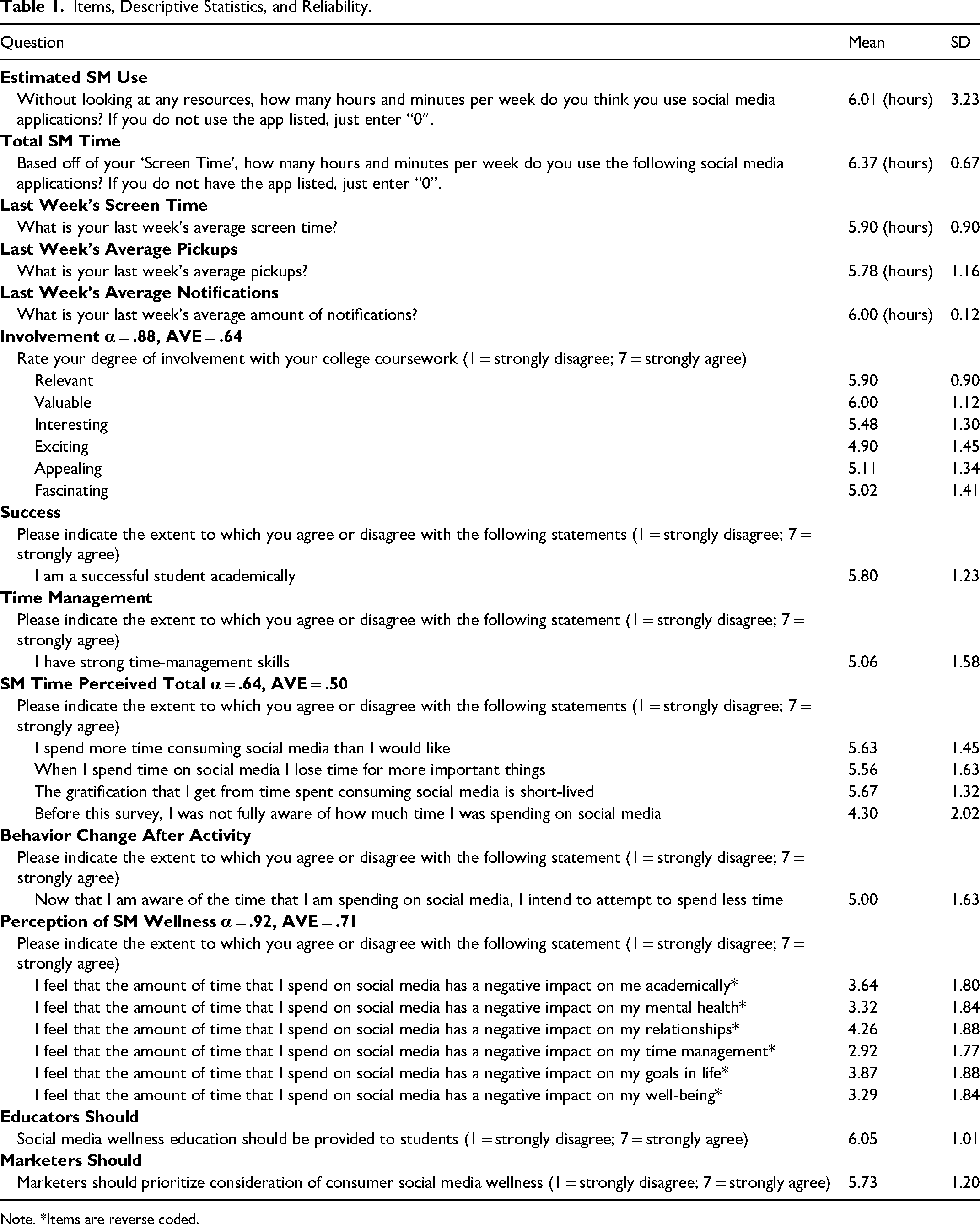
Note. *Items are reverse coded.
Exploratory Results
Objective Versus Subjective Measures of SM Consumption
As a result of the discrepancies found between studies using objective versus subjective SM measurement, scholars are now strongly encouraged to use objective measures to achieve valid and accurate findings (Parry et al. 2021; Sewall et al. 2020). Therefore, this study utilizes the Screen Time application to capture objective measurements accordingly. We compared the difference between students’ estimated and actual SM usage by platform and screen usage using t-tests. The distinction between collecting students’ estimated and actual SM usage is noteworthy due to the overreliance on problematic, self-reported measurements in many studies related to SM usage (Parry et al. 2021; Sewall et al. 2020). Unfortunately, subjective SM measurement is prone to faulty findings (Araujo et al. 2017; Kobayashi and Boase 2012; Scharkow 2016).
Students’ estimated and actual overall smartphone screen time was not significantly different. This was unsurprising as most smartphones now present weekly screen time statistics to users. However, students significantly underestimated their pick-ups and total notifications (p < .001). Qualitatively, students shared that they were surprised by these numbers (166 mean actual pick-ups and 216 mean actual notifications). It should be noted that a “pick-up” is presumed to be when one interacts with their phone beyond simply “raising to wake” the screen to check the time. This data was the average across seven days, indicating that, on average, students interacted with their smartphone about once per hour for durations that exceeded the time needed to simply check the time or read a notification. Across all platforms except TikTok, students significantly overestimated their time spent on SM platforms. TikTok is a unique platform that shares consumers’ usage directly on the app. So, while students communicated that they spent ‘too much time on the app scrolling,’ they were fully aware due to the app's notifications. Although we anticipated that actual SM usage overall would be higher than students’ estimates, the students’ overestimation may indicate their knowledge of SM overuse as a social phenomenon, as communicated through media outlets.
Consumer Perceptions of SM Wellness
Students overwhelmingly communicated that they spent “more time consuming SM than [they] would like” (81%). Additionally, 80% communicated that when they spent time on SM, they lost time for more important things. Eighty-two percent stated that their gratification from time spent consuming SM was short-lived. About half of the students were unaware of how much time they spent consuming SM (53%), and 68% said they would now attempt to spend less time on SM. In the end, students felt strongly that SM wellness education should be added to curricula and that marketing practitioners should also be cognizant of SM's impact on individuals’ well-being. The vast majority (91%) stated that SM wellness education should be provided to students and felt that marketers should prioritize consideration of consumer SM wellness (85%).
Correlation Results
To better understand perceptions of students’ SM wellness, we conducted an additional correlation analysis on the collected subjective measures (see Table 2). Students’ perceptions of SM wellness were negatively and significantly associated with SM perceived time total (−0.48, p < .001), willingness to change SM behavior after the activity (−0.47, p < .001), and whether educators (−0.44, p < .001) and marketers (−0.38, p < .001) should prioritize SM wellness. Further, students’ perceptions of SM wellness were also marginally positively associated with students’ perceptions of success (0.16, p < .05) and their time management skills (0.16, p < .05). Interestingly, SM wellness was not strongly or significantly associated with the level of involvement in coursework or the objective measures of SM usage.
Pearson's Correlations Between the Variables.
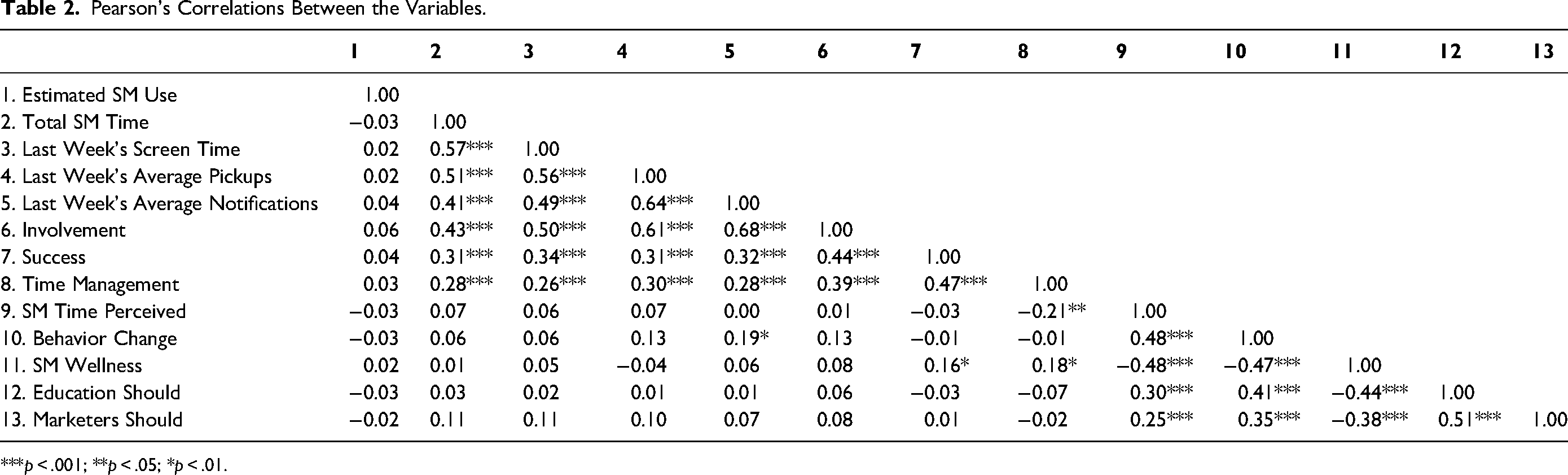
***p < .001; **p < .05; *p < .01.
Discussion
We present SM wellness as an extension opportunity for macromarketing instructors. This topic offers a way for students to introspectively evaluate their own SM consumption and how it impacts the broader marketing system. The present study sought to explore students’ perceptions of SM wellness and evaluate educational opportunities to integrate this topic into the classroom. The exploratory analysis offers several useful findings for macromarketing educators. First introducing this topic to students will likely create internal conflict for some students. The present study suggests that students recognize that time spent on SM is related to their well-being, and this relationship is negatively associated with their success and time management in a course. The internal conflict presents itself when students realize that their primary communication channel to keep up with friends, family, and the news cycle is SM. Yet, the usage of SM is disrupting their well-being and education performance. This internal struggle may boil-over into mental health issues since individual SM usage is deeply personal, and many students rely on their social communities to form a sense of belonging and identity (Tajfel 2010).
When students are introduced to the topic of SM wellness, some seem to immediately realize that their SM consumption level is unhealthy. Notably, results from this study show that students overestimate time spent on all SM platforms except for TikTok. This finding was interesting but not surprising, as there are numerous external cues priming students to think they are overconsumers of SM platforms via current articles and news stories. Exploratory analysis also highlighted the significant relationship that students’ perceptions of SM wellness have in relation to the perceived total amount of time spent on SM, as well as on their willingness to change their SM behavior after exposure to a SM wellness activity. Thus, it is reasonable to consider the beneficial implications that could stem from SM wellness being introduced in the classroom.
The general overestimation of SM time spent indicates that while students are aware of their daily consumption, they have not been taught how to manage such consumption healthily. In other words, students may not have reflected on SM's impact on their well-being until they compare their estimated and actual time spent on SM, or until they are presented with a definition that helps educate them on the concept of healthier SM consumption. Specifically, students may have heard from others (e.g., parents, media, teachers) that their SM consumption can be disruptive but have been reluctant to change that behavior until confronted with their raw consumption numbers. After this realization takes place, students may become agents for change. Therefore, creating a safe space, void of judgment, will be beneficial for students to work through this dilemma and come to a solution unique to their experience and needs. Recognizing that there is not solely one pathway to “perfect wellness” may benefit students who seek to improve their studies. In addition to shorter-term impacts on students’ academic engagement and achievement, this topic may also enable additional long-term benefits to help reverse the consequences of SM overuse, such as anxiety or depression. Lastly, there is potential for students to gain additional agency going into SM marketing as a career to help reduce fatigue and burnout, and potentially support ethical and socially responsible marketing practices that support consumers’ SM wellness.
Macromarketing Implications
Our data builds upon the need for wisdom to strive for societal benefit and well-being (Mick et al. 2009). Introducing SM wellness to students and allowing a natural internal debate and critical engagement to arise, supports students’ ongoing growth beyond ‘checking the boxes’ to a more holistic education (Heath et al. 2023; Watson et al. 2022). For future society to attain well-being when SM is accounted for, instruction should not solely focus on goal attainment but also expanded discourse to foster potential wisdom, with an aim to decrease foolishness (Mick et al. 2009). As students become more aware of SM wellness, there is an opportunity for their wisdom to expand, impacting consumer well-being, which nurtures micro-marketing practices, and eventual long-term macromarketing orientation.
Relatedly, it is important to note that SM wellness is subjective to the individual, and today's cultural norms often make students lacking SM usage feel ostracized. Notably, approaching SM usage as all negative can be tenuous. We recommend keeping a dialogue with students open to different perspectives. In other words, introducing the SM wellness topic is not intended to make one feel bad about their consumption. Rather, SM wellness is an educational tool that allows students to be more introspective and aware of how their online interactions can affect their well-being as well as thier involvement in the classroom. It can also allow for critical engagement to help students recognize inconsistencies and contradictions in the marketplace (Preece and Whittaker 2023). Importantly, SM wellness is not just subjective but also socially constructed. Depending on the culture and time of living, the conceptualization of “wellness” may differ.
SM Wellness Classroom Implementation
As supported by the exploratory data collected, there is an opportunity for developing students who are more equipped to navigate SM's foothold in many daily interactions. We call for more research to be synthesized into textbooks incorporating SM marketing and macromarketing. However, we also recognize that many instructors opt to keep content fresh due to the speed of SM development versus longer publication timelines (Crittenden 2021; Crittenden and Crittenden 2015; Rohm et al. 2021), not to mention the challenge of constantly updating macromarketing course content (Shapiro et al. 2021). As such, we have provided resources and ideas for engaging students in the current topic in Appendix A. The appendix includes the activities used in the present study and other related content and activities. The intention of the appendix is to offer a starting point, but the opportunities to engage students in the concept are vast. Note that the activities and content are presented in a way to fit instructors’ preferred andragogical style. This could fit the lecture class format, where instructors can develop their own material to review with students in class. In line with other marketing education scholarship (e.g., Green 2015; Hass et al. 2021; Mostafa 2015; Ottley and Bechwati 2018), we suggest that this developing material may be best implemented in co-creation environments (e.g., experiential and active learning classrooms). Naturally, this topic tends to raise more questions without definitive answers for students. Allowing students to reflect and discuss may provide a more fruitful implementation. For educators preferring a flipped classroom environment, the content and some assignments can be assigned before class to help prompt group or class discussion. Ultimately, short content and group activities can be done solely in class. An instructor may opt to integrate the topic for a single day within a pre-existing topic or module (ex: Ethics in SM) or develop a new content module of SM wellness for the classroom.
To bolster macromarketing instruction, we recommend instructors craft courses that first offer students baseline content to support their foundational knowledge (Lang 2021) in SM wellness, then prompt personal reflection in students’ micro-interactions, and end by utilizing class time or assignments to foster students’ systems-thinking. Rounding out the course content with activities that incorporate other stakeholders allows students to recognize the complexity of our marketing systems and the longer-term ethical and social implications (Stanton 2022).
This may, however, differ based on the course content. Students in a SM marketing course may dive deeper into the concept of SM wellness and the related agency practices of consumers and SM managers (Vanden Abeele et al. 2022) before attending class. The classroom setting can be dedicated to discussion and group ideation around appropriate managerial practices. See Appendix B for a lesson plan that describes a possible SM marketing classroom session 6 . Because students in this course are more likely to take on SM management positions, this topic may be a more prominent portion of the course content. Echoing the data collection across several courses, we recommend implementing this topic beyond solely SM marketing courses. For instance, a Principles of Marketing course is a wonderful way to introduce the topic of SM wellness to a wide range of majors within a college. The content preparation could include a light review of SM wellness followed by an implementation of self-reflection to set the stage for a class activity. Because of students’ differing backgrounds, groups could be intentionally organized to prompt students’ multiple perspectives on how this movement might impact consumers, advertisers, finance, product development, etc.
Marketing Analytics courses may find that discussing SM wellness through data trends may reveal correlations of when consumers stop using a platform due to mental fatigue or overstimulation based on user consumption data. Advertising courses commonly include content that discusses advertising and promotional regulations. A macromarketing-SM wellness ‘take-over’ could include additional readings related to the risks of SM usage for youth, where students are invited to reflect on their own SM consumption as a child. This could be framed as a ‘Dear 12-year-old [self]’ assignment that prompts the student to write a letter to their younger self highlighting what they wish they would have known and giving advice on how to manage growing up with SM. Taken a step further, a discussion could be encouraged among classmates. This would prepare students for a systems-oriented activity where they actively investigate the current and proposed legislation across at least two countries and then are prompted to make future advertising regulations or a brand's self-governance stipulations.
Limitations
Several limitations within this study are worth discussing and exploring further in future studies. First, it is important to recognize that our study assessed and reported correlations related to students’ general academic perceptions and should not be interpreted as causational. Next, though the methodology used in our study was sound, further exploration via additional forms of measurement would be beneficial. Specifically, our student survey utilized self-reported constructs, which can be prone to social desirability bias and invalid input (Roxas and Lindsay 2012). Thus, objective forms of measurement are encouraged subsequently. Additionally, the exploratory research was performed in a classroom setting, which offered efficiency and is appropriate based on past research (Hoeppner et al. 2011). However, future research could benefit from utilizing more robust scales. Furthermore, the literature lacks a validated scale to evaluate Perceptions of SM Wellness. While the present study engages in some of the steps necessary for scale development (e.g., qualitative review and synthesis with existing literature in developing items) and analysis of the items showed strong reliability, a formal scale development process was beyond the scope of this paper. Thus, there is a great opportunity for further scale development of this construct for continual usage. Lastly, though our sample size (n = 187) was adequate, it lacks diversity and cultural variance as it was composed primarily of students from universities in the southern United States.
Future Research Directions
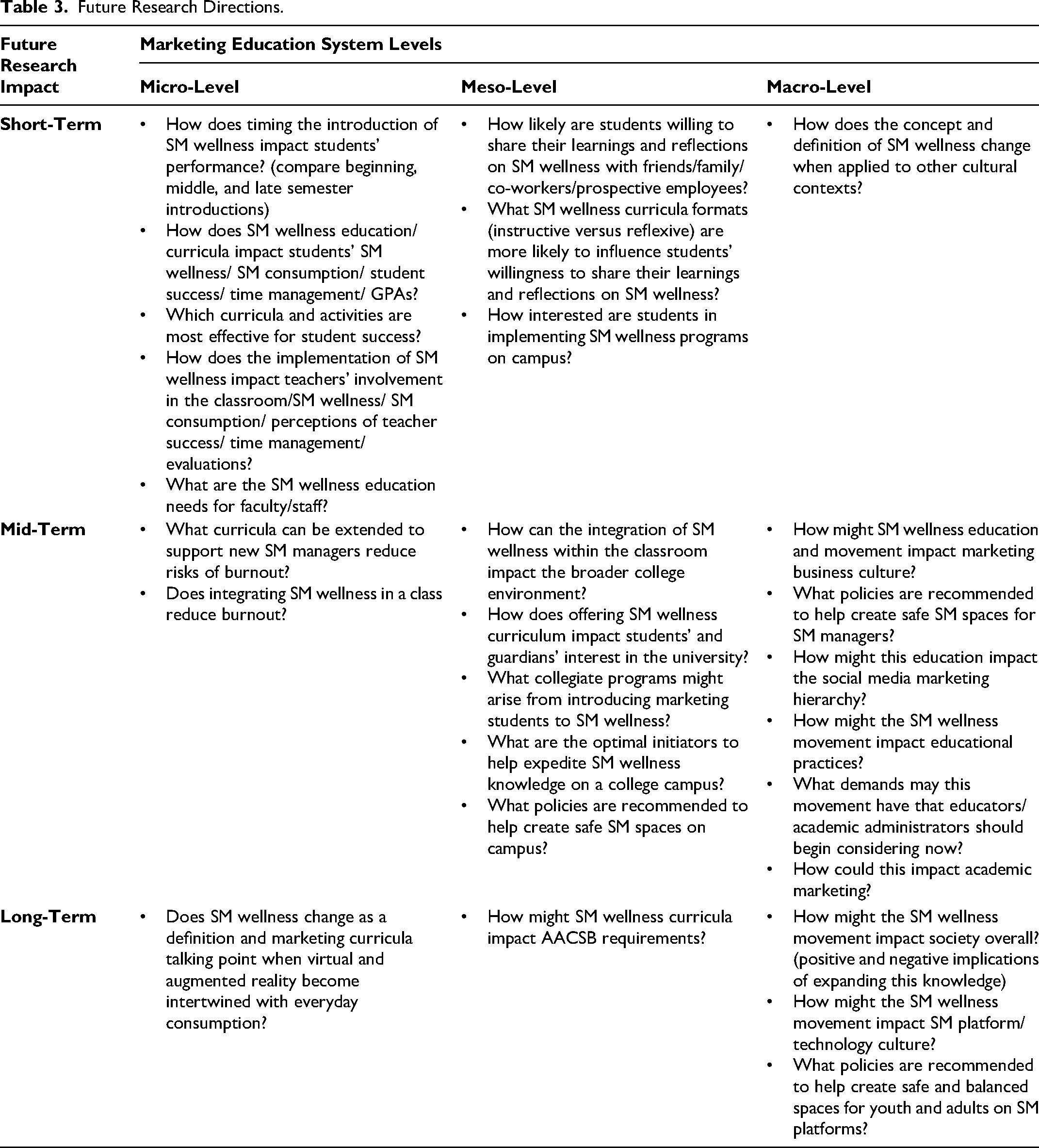
There is a substantial opportunity to broaden the research agenda to explore how SM wellness impacts multiple marketing system actors. The approaches suggested in Appendix A provide educators diverse ways to cultivate classroom discussion and student awareness of SM wellness. However, an official assessment of how such activities impact the level of involvement in SM wellness has yet to be explored. Thus, we encourage the approaches presented within this paper to be implemented in the classroom and investigated accordingly. To address the impact on the wider marketing system, Table 3 provides a sampling of research questions organized by micro-, meso-, and macro-marketing system layers. The micro-marketing level impacts individuals (e.g., students, instructors), the meso-level impacts organizations (e.g., departments, colleges), and the macro-level impact broader society and cultures. Furthermore, we note the temporal nature of these research questions if it creates an impact short-, mid-, or long-term. For instance, an immediate impact can happen for some students upon reflection in class. For others, the impact of SM wellness can take time, through intermediate reflections throughout the first year after exposure to SM wellness in class (0–1 year). Once a student processes the implications of SM wellness on their life, they may become more active in noticing it in their daily lives throughout college (1–4 years). Post-college, SM wellness;s implications, manifestations, and coping mechanisms may become clearer (>4 years). This progression and the implications for future research and discovery within each stage of this student wellness journey are highlighted in Table 3.
Future Research Directions.
Conclusion
In response to the call for building up macromarketing curricula (Shapiro et al. 2021; Stanton 2022), this paper introduces the concept of SM wellness as a necessary extension for macromarketing curricula. While SM wellness (i.e., the optimum state of well-being a consumer pursues while intentionally managing SM consumption) is of building interest for media, consumers, and businesses, it is not commonly discussed in marketing courses. As such, this paper argues for the topics’ inclusion and offers instructors applicable content and activities to integrate SM wellness into existing curricula across several marketing courses. Specifically, Appendix A includes various resources for instructors with content spanning from recommended readings and videos to activities for independent students, pairs/groups, and entire classes. We recommend leveraging a format that offers students foundational knowledge to support reflection and, later, systems-oriented activities. This study also highlights the potential benefits of SM wellness to students through an in-class activity and discussion. The in-class activity and discussion shed light on several significant findings, one being an overwhelmingly favorable response (91% of students) to the idea of SM wellness education being provided in marketing classes. Exploratory analysis indicates that students’ perceptions of SM wellness are correlated with students’ educational outcomes. These findings highlight the importance of educators integrating SM wellness into classes to potentially enhance students’ awareness and modify behavior with SM, which has the potential to positively impact students’ personal lives and society.
Footnotes
Associate Editor
Julie Stanton
Declaration of Conflicting Interests
The author(s) declared no potential conflicts of interest with respect to the research, authorship, and/or publication of this article.
Funding
The author(s) received no financial support for the research, authorship, and/or publication of this article.
Notes
Author Biographies
