




Abstract
Research related to consumers’ ethical judgments has generally neglected the effects of psycho-social variables (variables with both social and personal psychological components), e.g., perceived income inequality and subjective socio-economic status. In order to address this gap, an online survey of 373 US consumers was conducted to examine relationships between perceived income inequality and judgments regarding unethical and prosocial consumer actions. The mediating role of trust (general distrust of others and distrust of corporations) and moderating role of subjective socio-economic status were examined. Moderated mediation analyses demonstrated that the effects of perceived income inequality on consumers’ ethical judgments were mediated by distrust of corporations (but not by general distrust of others), for consumers who had higher subjective socio-economic status. These novel findings related to the effects of distrust of corporations highlight that, in order to explain consumers’ ethical judgments, it is essential to focus on trust relationships between consumers and other participants in the marketing system. Perceived income inequality erodes trust within marketing systems leading to negative effects on consumers’ ethical judgments. These effects are paradoxically only evident among consumers with higher subjective socio-economic status. Findings contribute to the macromarketing literature on marketing systems, marketing ethics, sustainable consumption, and distributive justice.
Introduction
Macro marketers and business ethicists have an enduring interest in understanding consumers’ ethical judgments (Casais and Faria 2022; Chowdhury 2020; Smith et al. 2023), as consumers are a key stakeholder and participant in marketing systems (Layton 2007). Consumers’ ethical judgments are important to examine as, in many instances, these are related to unethical or pro-social consumer behavior (Vitell and Hunt 2015). Unethical consumer behavior can create costs for and burdens on marketing systems (Chowdhury 2018), while ethical (pro-social/pro-environmental) consumer behavior is synonymous with sustainable consumption, which is an area of interest for macromarketers (Martin et al. 2019; Ozdamar Ertekin and Atik 2015). Consumers’ unethical behaviors have significant economic implications on marketing systems, e.g., the estimated cost of the piracy of movies and TV shows on the US economy is at least $29.2 billion annually (Blackburn, Eisenach, and Harrison 2019). The 2020 National Retail Security Survey in the United States revealed that retail shrink, which includes shoplifting, cost US retailers $61.7 billion annually (National Retail Federation 2020). Consumers’ pro-social behaviors also provide financial impetus for sustainable marketing systems, e.g., the global fairtrade market provided €179.4 million in premiums to producers of the top seven fair trade certified products in 2020 (Fairtrade International 2021).
Over the last three decades there has been considerable research on understanding the antecedents of consumers’ ethical judgments (see Hassan, Rahman, and Paul 2022; Smith et al. 2023, for recent reviews on this stream of research). Much of the research on examining consumers’ ethical judgments has been based on the theoretical framework proposed in the Hunt-Vitell theory of marketing ethics (Hunt and Vitell 1986, 2006). Vitell and Hunt (2015) state that although this theory was originally developed to describe the ethical behavior of marketers, the theory can also be used to explain consumers’ ethical judgments. The Hunt-Vitell theory of marketing ethics (Hunt and Vitell 1986, 2006) proposes that there are several personal characteristics that can affect consumers’ ethical judgments. These include values systems, moral character, ethical sensitivity, religious beliefs etc. In addition to personal variables, Hunt and Vitell (1986, 2006) note that the “general environment” can influence consumers’ ethical judgments. The “general environment” refers to macro variables, i.e., the social/political/legal context within which consumers make ethical choices.
However, compared to the research on the effects of personal variables on consumers’ ethical judgments, there has been considerably less research on the effects of variables that have social components. A few socially related variables that have been examined in relation to consumers’ ethical judgments include culture (Swaidan 2012), the political environment (Rawwas, Vitell, and Al-Khatib 1994), macro-societal reforms (Chen et al. 2019) etc. Considering this limitation, researchers have advocated the need to jointly utilise psychological and socio-cultural approaches to studying ethics in consumer contexts (Chatzidakis, Shaw, and Allen 2021). From a macromarketing perspective, the lack of research on the influence of variables that have social components on consumers’ ethical judgments is a significant gap in the research literature on consumers’ ethical judgments, as macromarketing focuses on the interplay of society and marketing systems (Hunt, Hass, and Manis 2021).
An important variable, which has a social component, that has been neglected in research on consumers’ ethical judgments is income inequality. The International Monetary Fund defines income inequality as “the extent to which income is evenly distributed within a population” (International Monetary Fund 2022). Hence, income inequality is related to the distribution of income across society. Wilkinson and Pickett (2017, p.11) state “inequality appears to have its most fundamental effects on the quality of social relations”. Elgar and Aitken (2011) demonstrate that income inequality erodes trust and social capital leading to negative social outcomes. Buttrick and Oishi (2017) note that greater income inequality leads to weaker morality among individuals, while Du et al. (2021) shows that income inequality is related to reduced civic honesty.
In addition to negative social outcomes, there is evidence for the detrimental effects of income inequality in the domains of business and economics. For example, a consequence of income inequality is greater exploitation of workers by business managers (Desai, Brief, and George 2009). Furthermore, income inequality leads to the rise of the shadow economy, i.e., greater tax evasion and contravening of regulations by businesses and individuals (Berdiev and Saunoris 2019). Thus, income inequality has implications for participants in the marketing system, e.g., businesses, employees, consumers etc. Considering the erosion of morality and honesty among individuals as well as the prevalence of violations of regulations in the economy when there is high income inequality, income inequality may also be negatively related to consumers’ ethical judgments.
Oshio and Urakawa (2014) and Siahpush et al. (2006) note that perceived income inequality rather than objective income inequality is an even stronger predictor of detrimental personal and social outcomes. Schmalor and Heine (2022, p. 210) define subjective inequality as “how individuals perceive inequality within their environment”. Perceived income inequality can be considered as a psycho-social variable as it has both a social component (the distribution of income in society) and a psychological component (the psychological perception of income distribution). Perceived income inequality is negatively associated with trust (Schmalor and Heine 2022). Prior research shows that trust is negatively related to consumers’ ethical judgments (Arli, Tjiptono, and Winit 2015; Chiou and Pan 2008). Considering these findings, the current study examines the effects of perceived income inequality on consumers’ ethical judgments and the mediating role of trust in this context.
Another variable, which has both a social component and a psychological component, that has not been examined in the context of consumers’ ethical judgments is subjective socio-economic status. Navarro-Carrillo et al. (2020, p. 3) state that subjective socio-economic status “is conceptualized as individuals’ perceptions pertaining to their standing on the social hierarchy relative to others (Adler et al. 2000; Kraus et al. 2012)”. Measures of subjective socio-economic status examine an individual's assessment of their social position in comparison to others in society based on educational attainment, income levels, and occupational reputation (American Psychological Association 2023). Although income is a relevant element when individuals assess their subjective socio-economic status, it is not the only determinant of subjective socio-economic status. This is clearly different from perceived income inequality, which is purely focused on the perception of relative income levels. Subjective socio-economic status can be considered as a psycho-social variable as it includes a social component (the relative social status of an individual) and a psychological component (the psychological perception of where one is located on the social hierarchy).
Several studies have shown that subjective socio-economic status is related to unethical behavior. Individuals with higher subjective socio-economic status are more likely to engage in unethical behaviors (Piff et al. 2012) and less likely to engage in pro-social behaviors (Piff and Robinson 2017). Furthermore, socio-economic status can interact with income inequality to affect social outcomes (Schneider 2019). Hence this study also examines the moderating role of subjective socio-economic status in relation to the effects of perceived income inequality on consumers’ ethical judgments.
The current research makes several contributions to both the macromarketing literature and the business ethics literature on consumers’ ethical judgments. First, since macromarketing is concerned with the effects of society on actors within marketing systems (e.g., consumers, businesses etc.), examining the role of psycho-social variables such as perceived income inequality and subjective socio-economic status on consumers’ ethical judgments makes an important contribution to the macromarketing literature. Second, considering the effects of perceived income inequality and subjective socio-economic status, which have psychological components as well as social components, in relation to consumers’ ethical judgments addresses the call to jointly utilise psychological and social approaches in research on ethics in consumer contexts (Chatzidakis, Shaw, and Allen 2021).
Third, this research examines the role of trust as the mediator of the effects of perceived income inequality on consumers’ ethical judgments. Both general distrust of others (Elgar and Aitken 2011) and distrust of corporations (Adams, Highhouse, and Zickar 2010) are examined as potential mediators. Hence this research can clarify whether the detrimental effects of perceived income inequality on the ethical judgments of consumers are driven by a general distrust of others or driven by a specific distrust of an important actor in marketing systems, i.e., corporations. Fourth, by showing that the negative effects of perceived income inequality on consumers’ ethical judgments through distrust occur primarily for consumers with higher subjective socio-economic status, this research highlights the adverse outcomes of social hierarchy in unequal societies. This reveals that the effects of specific psycho-social variables (e.g., perceived income inequality) on consumer behavior in a marketing system is complex and may be contingent on the effects of other psycho-social variables (e.g., subjective socio-economic status). This further portrays the complex interaction of society and actors within the marketing system.
This paper is structured in the following manner. The paper starts with an overview of the theoretical foundations of this research. This is followed by a brief review of the literature on negative outcomes of income inequality on trust, followed by a review of the relationship between trust and consumers’ ethical judgments. Hypotheses are developed regarding the moderated mediation of the effects of perceived income inequality on consumers’ ethical judgments through general distrust of others and distrust of corporations at different levels of subjective socio-economic status. The method and results of an online survey to test the hypotheses are discussed. Subsequently the theoretical contributions and macromarketing implications of these findings are provided. Finally, the limitations of this study and future research opportunities are discussed.
Theoretical Background
This research is based on conceptual underpinnings from several relevant theories As noted earlier, the first theoretical framework that is utilised is the Hunt-Vitell theory of marketing ethics (Hunt and Vitell 1986, 2006). According to the Hunt-Vitell theory of marketing ethics (Hunt and Vitell 1986, 2006), consumers’ ethical judgments are affected by the general environment, i.e., the social environment, as well as the personal psychological characteristics of the consumer making the decision. In this study, the role of perceived income inequality, a construct that has both social and psychological components, is examined in relation to consumers’ ethical judgments.
The second theoretical framework that is relevant to this study is equity theory (Adams 1963). Equity theory is a form of exchange theory as it describes responses to the exchange of goods and resources among individuals and firms in society (Adams 1963; Polk 2011). Equity theory can explain perceptions of fairness in exchange processes based on how costs are incurred and benefits are distributed among various stakeholders (Adams 1963; Ross and Kapitan 2018). Steenhaut and Van Kenhove (2005) state that equity theory primarily examines two issues: whether an exchange is perceived as equitable and the responses of individuals when they perceive that exchanges are not equitable. In prior research, equity theory has been used to explain unethical and pro-social consumer judgments and behaviors (Douglas, Cronan, and Behel 2007; Ross and Kapitan 2018; Steenhaut and Van Kenhove 2005; Tseng and Kuo 2014).
Equity perceptions are subjective and relative (Adams 1963). Ross and Kapitan (2018, p. 532) state that “consumers intuitively compare their own exchange benefits and costs with other consumers and society at large”. Perceptions of inequity exist when individuals believe that their input-outcomes ratio are not similar to other exchange partners’ (individuals, firms etc.) input-outcomes ratios (Adams 1963). In marketing contexts, consumers’ inputs may be time and money while their outcomes may be product quality, status etc. (Steenhaut and Van Kenhove 2005). Marketers’ inputs may be time and effort and their outcomes may include reputation, customer loyalty, profits etc. (Steenhaut and Van Kenhove 2005). The consequence of equitable relationships in an exchange is commitment to the other party in the exchange (Steenhaut and Van Kenhove 2005). As trust is an antecedent to commitment in relationships (Garbarino and Johnson 1999), this would also indicate greater trust for the other party in the relationship.
Ross and Kapitan (2018) demonstrated that equity theory is also relevant in relationships between individuals and society. Cappelen et al. (2014) state that income inequality is accepted as equitable when it is proportionate to inputs, e.g., work effort. However, when the inequality is high and not perceived as proportionate to inputs, this creates perceptions of inequity (Cappelen et al. 2014). From an equity theory perspective, high perceptions of income inequality may represent beliefs of disproportionate benefits to other stakeholders (e.g., other individuals, business firms etc.). This should lead to a lack of trust and commitment toward other stakeholders.
The third and final theoretical foundation for this study is provided by system justification theory (Jost and Banaji 1994). The basic premise of system justification theory is that “people are motivated (often implicitly rather than explicitly) to defend, justify, and bolster aspects of the societal status quo, including existing social, economic, and political systems, institutions, and arrangements” (Jost 2019, p. 266). Jost et al. (2003) found that, paradoxically, system justification is enhanced among disadvantaged individuals in society.
All societies have some level of social hierarchy. Societies with more inequal social hierarchies are considered as being high on the cultural dimension of “power distance” (Hofstede 1991). The enhanced system justification behavior of disadvantaged individuals has been demonstrated in both low and high “power distance” cultural contexts. Jost et al. (2003) empirically demonstrated this in the context of the United States, which is a democratic society with relatively low scores on the dimension of “power distance” (Hofstede 1991). Using data from China, which is a non-democratic society with relatively high scores on the dimension of “power distance” (Hofstede 1991), Li et al. (2020) demonstrated that individuals with lower subjective socio-economic status are more likely to support existing social structures consistent with system justification theory. Recently, Valdes, Liu, and Williams (2022), replicated the findings that individuals with lower subjective socio-economic status have enhanced system justification tendencies in both the United States and China.
This indicates that subjective socio-economic status is related to how strongly individuals feel that social structures, such as the level of income inequality in society, are justified. Where individuals perceive themselves in terms of social status can affect whether they believe that existing income differentials in society are justifiable and equitable. The negative effects of income equality, including any potential negative effects on consumers’ ethical judgments, may thus be attenuated for those whose who perceive themselves as disadvantaged.
These three theories (the Hunt-Vitell theory of marketing ethics; equity theory; and system justification theory) are integrated to examine the moderated mediation effects of perceived income inequality on consumers’ ethical judgments through distrust of others and distrust of corporations based on the subjective socio-economic status of consumers. Before proposing specific hypotheses regarding these effects, the relationship between income inequality and trust and the relationship between trust and ethics in consumer contexts are further reviewed.
Income Inequality and Trust
Elgar and Aitken (2011) examined the relationship between income inequality and trust using data from thirty three different countries. They were motivated to examine this relationship in order to explain why greater income inequality is associated with more violence. Elgar and Aitken (2011) found that there was a negative relationship between income inequality and trust. Furthermore, trust mediated the relationship between income inequality and violent behaviors such as homicides.
Other research also shows that income inequality loosens social ties. Lancee and Van de Werfhorst (2012) found that income inequality had negative effects on social cohesion. They provided evidence from twenty four European countries showing that higher income inequality in a country is associated with lower levels of participation in civic organizations such as volunteering associations, political parties, religious organisations etc. Uslaner and Brown (2005) demonstrated similar findings showing that inequality is a strong negative predictor of trust and the negative implications of inequality through trust are particularly detrimental for civic participation. Oishi, Kesebir, and Diener (2011) found that in years when income inequality was relatively higher in the United States, there was lower levels of happiness and this negative relationship between income inequality and happiness was mediated by the lack of general trust. Hence there was greater distrust of others when there was more inequality. De Vries, Gosling, and Potter (2011) found that in more inequal states in the United States average scores of individuals on the personality trait of agreeableness was lower. Since agreeableness relates to empathy, trust, and co-operation (Wilkinson and Pickett 2017), this further supports the negative relationship between income inequality and trust. Collectively these studies provide substantial evidence for the negative link between income inequality and trust.
As noted earlier, in addition to the negative effects of objective income inequality on trust, subjective or perceived income inequality is negatively associated with trust (Schmalor and Heine 2022). Discussing the importance of examining subjective (perceived) income inequality, Schmalor and Heine (2022, p. 210) state the following: “Understanding the full psychological impact of inequality also requires considerations of its subjective component”. Examining the subjective (perceived) rather than the objective level of income inequality is important as all individuals in society may not be equally aware of the level of inequality in society (Schmalor and Heine 2022). Schmalor and Heine (2022) further note that even if individuals are aware of the income distribution in society, not all individuals can comprehend the meaning of different types of distributions (Kahneman and Tversky 1973). Sanchez-Rodriguez et al. (2019) demonstrate that higher perceptions of income inequality lead to beliefs that the normative social climate is individualistic where individuals are expected to look after themselves and social ties are weak.
Other research also supports the view that a strong perception of income inequality is critical for the negative effects of income inequality to manifest. Nishi et al. (2015) conducted an experimental public goods game to investigate the relationship between income inequality, distrust, and formation of communities. Nishi et al. (2015) found that greater inequality led to higher distrust which subsequently led to less cooperation within communities, however this only occurred when the inequality was visible to individuals, i.e., they perceived the income inequality. In other words, the detrimental social effects of income inequality that have been found in previous research should be driven not only by objective inequality but by individuals’ perceptions of income inequality.
The research on the relationship between income inequality and trust has mainly examined the effects of income inequality on general trust of others. Buttrick and Oishi (2017) noted that future research should focus on the effects of income inequality on specific forms of trust, e.g., trust in institutions, trust in neighbours, trust of politicians etc. In recent years, the effects of income inequality on trust have been demonstrated in specific contexts such as business organizations. For example, recent research shows that high levels of inequality in employee pay within organizations leads to lower levels of employee trust in managers (Schulz, Valizade, and Charlwood 2022). There has also been limited research on the relationship between income inequality and political trust (Lee, Chang, and Hur 2020; Zmerli and Castillo 2015), with the consistent finding that these are negatively correlated. Lipps and Schraff (2021) found that income inequality is negatively related to institutional trust among citizens (e.g., trust in national governments and supranational institutions such as the European Union). Considering that income inequality leads to reduced social capital and reduced trust in institutions, income inequality should also lead to a lack of trust among consumers for institutions within marketing systems such as corporations. Thus, income inequality should have negative effects on trust of corporations.
Trust and Ethics in Consumer Contexts
Hosmer (1995, p. 393) define trusts as “the reliance by one person, group, or firm upon a voluntarily accepted duty on the part of another person, group, or firm to recognize and protect the rights and interests of all others engaged in a joint endeavour or economic exchange”. Lewis and Weigert (1985) state that, from a sociological perspective, trust is a prerequisite for social relationships and functional social systems. Triole (2018) notes that trust is essential for economic activities to function. Since trust is critical for both social systems and economic systems, this implies that trust among participants within a marketing system (such as buyers and sellers) is important for the functioning of marketing systems.
Trust implies moral duties between parties that trust each other (Hosmer 1995). Adams, Highhouse, and Zickar (2010, p. 39) states, “trust relations are based on the expectation that each person's actions will capture the best interest of the other and will be consistent with established social norms”. In other words, trust leads to morality based on reciprocal cooperation. A breakdown of trust should conversely lead to condoning immoral actions. Weiss, Burgmer, and Mussweiler (2018) showed that distrust led to moral hypocrisy, i.e., having different moral standards for oneself compared to others. Weiss et al. (2021) demonstrated that distrust was related to lack of cooperation, particularly with distant others (not members of an individuals’ kin or ingroup). Fukuyama (1995) referred to trust as a social virtue and stated that individuals living in societies with a deficit of interpersonal trust predominantly rely on kinship structures. Such reliance on kinship or ingroup loyalty may lead to greater acceptance of corruption in support of ingroup members (Fukuyama 1995; see also Chowdhury 2019 for the negative effects of ingroup loyalty on consumers’ ethical judgments).
Prior research has examined the role of trust in relation to consumers’ ethical judgments (Arli, Tjiptono, and Winit 2015). Arli, Tjiptono, and Winit (2015) showed that general trust of others was negatively related to supporting actively benefiting from illegal actions as a consumer, passively benefiting from the mistakes of the seller, and actively benefiting from legal but questionable actions as a consumer. Furthermore, trust was positively related to support for pro-social/pro-environmental consumer actions (Arli, Tjiptono, and Winit 2015). Since perceived income inequality leads to an erosion of general trust in society (Schmalor and Heine 2022), and trust is related to consumers’ ethical judgments (Arli, Tjiptono, and Winit 2015), it can be expected that trust mediates the effects of perceived income inequality on consumers’ ethical judgments. Perceived income inequality should have indirect effects on consumers’ ethical judgments through distrust of others.
Soule (1998) notes that, in business relationships, trust requires going beyond self-interest and caring for the interest of the trusted other party in the relationship. Lack of trust in businesses and corporations would relieve consumers from the moral duty of upholding the rights and interests of businesses and corporations. Ndubisi et al. (2016) state that trust is related to greater consciousness and recognition of ethics. Trust among parties in an exchange facilitates positive ethical development away from Kohlberg's (1981) preconventional stage of ethics, where parties partake in calculative, self-oriented moral thinking, to the postconventional stage of ethics, where parties partake in principled thinking (Ndubisi et al. 2016). Hence, trust motivates long-term relationships in exchanges based on mutual respect and benefits rather than short-term relationships in exchanges based on maximizing self-interest (Ndubisi et al. 2016).
Similar to how a lack of general trust leads individuals to condoning immoral actions (Weiss, Burgmer, and Mussweiler 2018) and supporting unethical actions in consumption related scenarios (Arli, Tjiptono, and Winit 2015), distrust of businesses and corporations may lead to supporting unethical behaviors in consumption related contexts, particularly unethical behaviors that are against the interests of businesses and corporations (e.g., shoplifting, digital piracy etc.). Furthermore, as trust fosters cooperation between actors in economic systems (Triole 2018), distrust of businesses and corporations can lead to a lack of support for pro-social consumer actions that help businesses and corporations (e.g., returning money owed to businesses). Thus, it can be expected that distrust of businesses and corporations may also mediate the effects of perceived income inequality on consumers’ ethical judgments (in addition to mediation effects through general distrust of others). Income inequality should have indirect effects on consumers’ ethical judgments through distrust of corporations.
Perceived Income Inequality, Trust, and Consumers’ Ethical Judgments: the Moderating Role of Subjective Socio-Economic Status
Research in social psychology has demonstrated that an individual's subjective socio-economic status is also a predictor of unethical behaviors (Piff et al. 2012; Piff and Robinson 2017). Piff et al. (2012) demonstrated that higher subjective socio-economic status was related to unethical behaviors across a range of domains, e.g., breaking road rules when driving, taking resources from others, not telling the truth when negotiating, cheating to gain an award, and immoral actions in an organisation context. Piff and Robinson (2017) showed that individuals who perceived themselves to have higher social class were more likely to engage in self-beneficial behavior rather than pro-social behavior. These findings suggest that higher subjective socio-economic status should lead to supporting unethical consumer behaviors and not supporting pro-social consumer behaviors. Piff (2014) demonstrated that subjective social class was positively related to increased feelings of entitlement. Since psychological entitlement is negatively related to ethical decision-making (Thomason and Brownlee 2018), this may explain why higher subjective social class leads to greater unethical behaviors and less pro-social behaviors (Piff et al. 2012; Piff and Robinson 2017).
The effects of higher subjective socio-economic status on unethicality may be accentuated in cases of greater income inequality. Cote, House, and Willer (2015) demonstrated that the well documented effect that individuals with higher social status are less generous only holds for conditions when there is high income inequality. Since income inequality is related to biased self-perceptions (Loughnan et al. 2011), it is not surprising that individuals with higher social status feel greater levels of self-entitlement when living in unequal societies. As noted above, sense of entitlement stemming from higher subjective socio-economic status can lead to greater unethicality (Piff 2014; Thomason and Brownlee 2018). Hence the effects of perceived income inequality on consumers’ ethical judgments through distrust should be higher for consumers who have higher subjective socio-economic status.
On the contrary, the effects of perceived income inequality on consumers’ ethical judgments through distrust may be attenuated for consumers who have lower subjective socio-economic status. As noted earlier, Jost et al. (2003) demonstrated that, based on system justification theory (Jost and Banaji 1994), individuals who were the most disadvantaged by the existing status quo in a society were least likely to reject existing social structures and institutions. This implies that consumers who have lower subjective socio-economic status are less likely to act upon distrust of institutions such as businesses and corporations even when experiencing high income inequality in society. Furthermore, even if consumers who subjectively feel that they are lower in socio-economic status distrust corporations when living in societies with high income inequality, these consumers may not feel empowered to act upon this distrust against the interests of established institutions such as corporations as these consumers do not feel psychologically entitled (unlike consumers with higher socio-economic status). Hence consumers with lower socio-economic status will be less likely to support unethical actions in consumption situations and less likely to reject pro-social consumer actions even when there is high perceived income inequality.
The discussion above implies that the mediating roles of general distrust of others and distrust of corporations in relation to the effects of perceived income inequality on consumers’ ethical judgments regarding unethical consumer actions will be moderated by subjective socio-economic status. The following hypotheses are proposed:
Perceived income inequality will have a positive indirect effect on judgments regarding unethical consumer actions through general distrust of others, for consumers who have high subjective socio-economic status.
Perceived income inequality will have a positive indirect effect on judgments regarding unethical consumer actions through distrust of corporations, for consumers who have high subjective socio-economic status.
Similarly, the mediating roles of general distrust of others and distrust of corporations in relation to the effects of perceived income inequality on consumers’ ethical judgments regarding pro-social consumer actions will be moderated by subjective socio-economic status. The following hypotheses are proposed:
Perceived income inequality will have a negative indirect effect on judgments regarding pro-social consumer actions through general distrust of others, for consumers who have high subjective socio-economic status.
Perceived income inequality will have a negative indirect effect on judgments regarding pro-social consumer actions through distrust of corporations, for consumers who have high subjective socio-economic status.
In addition to examining the proposed hypotheses regarding the indirect effects of perceived income inequality on consumers’ ethical judgments through distrust of others and distrust of corporations, this research also examines whether perceived income inequality has residual direct effects on judgments of unethical consumer actions and pro-social consumer actions after accounting for the proposed indirect effects. Furthermore, this study examines whether these direct effects are moderated by subjective socio-economic status.
The conceptual model of the study is provided in Figure 1.
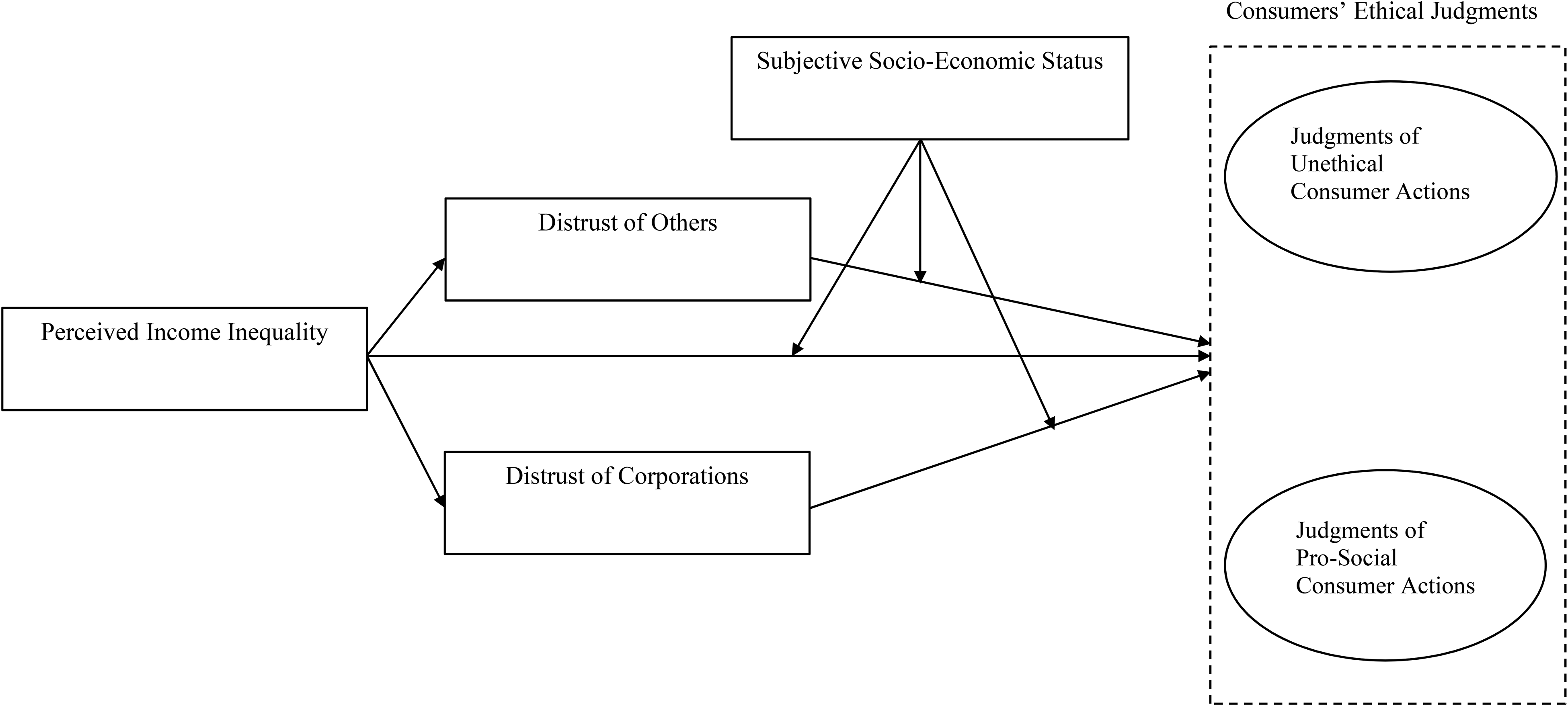
Conceptual model.
Method
Sample
An online survey of 373 US consumers was conducted to test the hypotheses. The participants were members of an online consumer panel affiliated with Qualtrics. The sample included 50.4% females and 49.6% males. The mean age was 46.07 years (standard deviation 17.01 years). The age distribution was as follows: 18–30 years of age 24.4%; 31–40 years of age 17.2%; 41–50 years of age 16.3%; 51–60 years of age 17.7%; 61 years of age and above 24.4%.
Measures
Perceived income inequality was measured with a single item scale adapted from Oshio and Urakawa (2014) who utilised the same scale in a Japanese context. Participants were specifically asked: “do you think that the disparity between the rich and the poor has grown in the past 5 years in the United States?” Similar to Oshio and Urakawa (2014), a five point scale was used to record responses to this question (1 = ‘no’, 2 = “if pressed to say, I would say no”, 3 = “I cannot say either way”, 4 = “if pressed to say, I would say yes”, 5 = ‘yes’).
Subjective socio-economic status was measured with the MacArthur Ladder (Adler et al. 2000) which is a widely used measure in research on the effects of subjective socio-economic status (Piff et al. 2012; Piff and Robinson 2017 etc.). The MacArthur Ladder has ten rungs and participants have to select where they believe they are positioned within the social hierarchy. Specifically, participants were provided with a figure of a ladder and were given the following information on the structure of the ladder: “At the top of the ladder are the people who are the best off – those who have the most money, the most education, and the most respected jobs. At the bottom are the people who are the worst off – who have the least money, least education, and the least respected jobs or no job.” Participants had to select where they believed they stood in the social hierarchy by placing an ‘x’ on the rung of the ladder that reflected their relative position.
General distrust of others was measured with the two-item scale developed by Elgar and Aitken (2011). Distrust of corporations was measured with the thirteen-item scale developed by Adams, Highhouse, and Zickar (2010). For both these measures, participants provided their agreement or disagreement with five point scales (1 = “strongly disagree”; 5 = “strongly agree”).
Fifteen items from the Vitell-Muncy consumer ethics scale (Vitell and Muncy 2005) were utilised to assess moral judgments regarding unethical consumer actions. This is similar to Chowdhury (2020). These items are related to consumers’ judgments regarding actively benefiting from illegal actions (e.g., insurance fraud), passively benefiting from the mistakes of the seller (e.g., not divulging the actual age of a child to get a child discount for a service), and actively benefiting from legal but questionable actions (e.g., using an expired coupon). Participants assessed each item on a five point scale (1= “strongly believe that this action is wrong”; 5 = “strongly believe that this action is not wrong”). The responses to the fifteen items were averaged to create an index of support for unethical consumer actions (higher scores indicate that consumers judged these unethical actions to be “not wrong”). Eight separate items from the Vitell-Muncy consumer ethics scale (Vitell and Muncy 2005) were utilised to assess consumers’ moral judgments regarding pro-social actions. This is also similar to Chowdhury (2020). Participants assessed each item on a five point scale (1 = “strongly believe that this action is wrong”; 5 = “strongly believe that this action is not wrong”). The responses to the eight items were averaged to create an index of support for pro-social consumer actions.
This research proposes that subjective socio-economic status moderates the effects of income inequality on consumers’ ethical judgments, since consumers with high subjective socio-economic status have greater psychological entitlement which leads to positive judgments of unethical consumer actions and negative judgments of pro-social consumer actions. Prior research has shown that the personality trait of narcissism is also related to unethicality in business and social contexts (Harrison, Summers, and Mennecke 2018). Since narcissism and psychological entitlement are related (Piff 2014), the effects of narcissism were controlled for in this study in order to validate that the effects were not driven by trait narcissism rather were due to the psychological entitlement stemming from higher subjective socio-economic status.
Narcissism was measured with the Narcissistic Personality Inventory (NPI-16, Ames, Rose, and Anderson 2006). Participants were provided with sixteen different pairs of statements. Each pair included one statement that reflected narcissistic tendencies (e.g., “I think I am a special person”) and another statement that reflected the opposite (e.g., “I am no better or worse than most people”). Participants had to select one statement from each pair of statements. The selection of the narcissism statement was scored as 1, and the selection of the non-narcissism statement was scored as 0. The scores across sixteen pairs of items was summed to create an overall narcissism score.
In order to further validate the scales used in this research, a confirmatory factor analysis was conducted with the items related to the multi-item scales for distrust of others, distrust of corporations, judgments of unethical consumer actions, judgments of pro-social consumer actions, and narcissism. The measurement model was significant X2 = 3311.73, df = 1367, p < .01; however, the model fit was acceptable based on the following fit indices: SRMR = .067, X2/df = 2.423, RMSEA = .062 (Iacobucci 2010 states that SRMR <.9 indicates good fit; Kline 2011 states that X2/df ≤ 3 demonstrates acceptable fit; Steiger 2007 states that RMSEA < .07 indicates appropriate fit). Incremental fit indices such as CFI were not utilised to assess model fit, as Kenny (2020) notes that incremental fit indices should not be used if the RMSEA of the null (independence) model is not greater than .158 (the RMSEA of the null model was .145). An examination of the factor loadings of the various items showed that the factor loadings of three items (pairs) of the narcissism scale were < .40 (Cabrera-Nguyen 2010 notes that factor loadings < .40 in CFA are weak; Gliner, Morgan, and Leech 2017 state that the minimum cut-off for factor loadings in factor analysis is .40). These three items from the narcissism scale were deleted (the final scale for narcissism included thirteen items) and the confirmatory factor analysis was conducted again. The model fit of the final confirmatory factor analysis was acceptable based on the following fit indices: SRMR = .065, X2/df = 2.497, RMSEA = .063.
The items means of all the scales (including the single item scales for perceived income inequality and subjective socio-economic status), the factor loadings of the items for the multi-item scales, and the reliabilities of the multi-item scales are provided in Table 1.
Reliabilities, Item Means, and Factor Loadings of Variables.
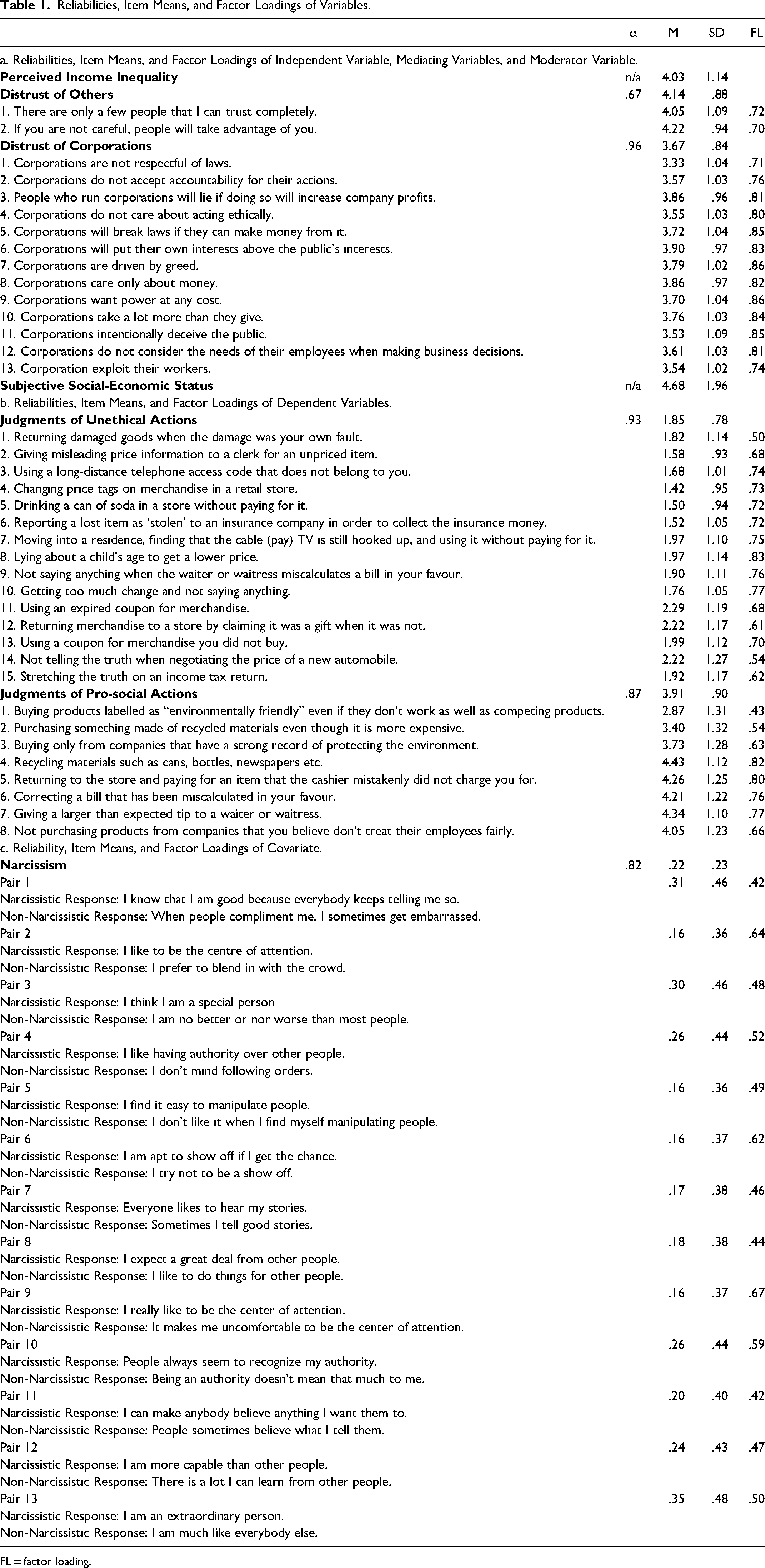
FL = factor loading.
Discriminant validity among the multi-item scales was assessed using the heterotrait-monotrait (HTMT) ratio of correlations (Henseler, Ringle, and Sarstedt 2015). The highest HTMT ratio was .361, which was lower than the prescribed cut-off of .85 (Kline 2011) indicating that discriminant validity was not an issue. Common method bias was assessed using Harman's single factor test. An exploratory factor analyses with all the items across all the scales revealed more than one factor and the first factor accounted for only 17.8% of the total variance. Furthermore, a confirmatory factor analysis where all the items loaded on one common factor revealed very poor model fit (SRMR = .181, X2/df = 6.232, RMSEA = .119). These results indicate that common method bias was not an issue.
Results
The correlations among the key variables are provided in Table 2. The relationships between the key variables were in the expected directions. Of particular note, distrust of others and distrust of corporations only showed a small positive correlation, indicating that, although these constructs reflected various facets of trust, the object of trust (others vs. corporations) were clearly not the same. Perceived income inequality and subjective socio-economic status were slightly negatively correlated, consistent with other studies that have examined the correlation between these variables (Vezzoli et al. 2023).
Correlations Among Key Variables.
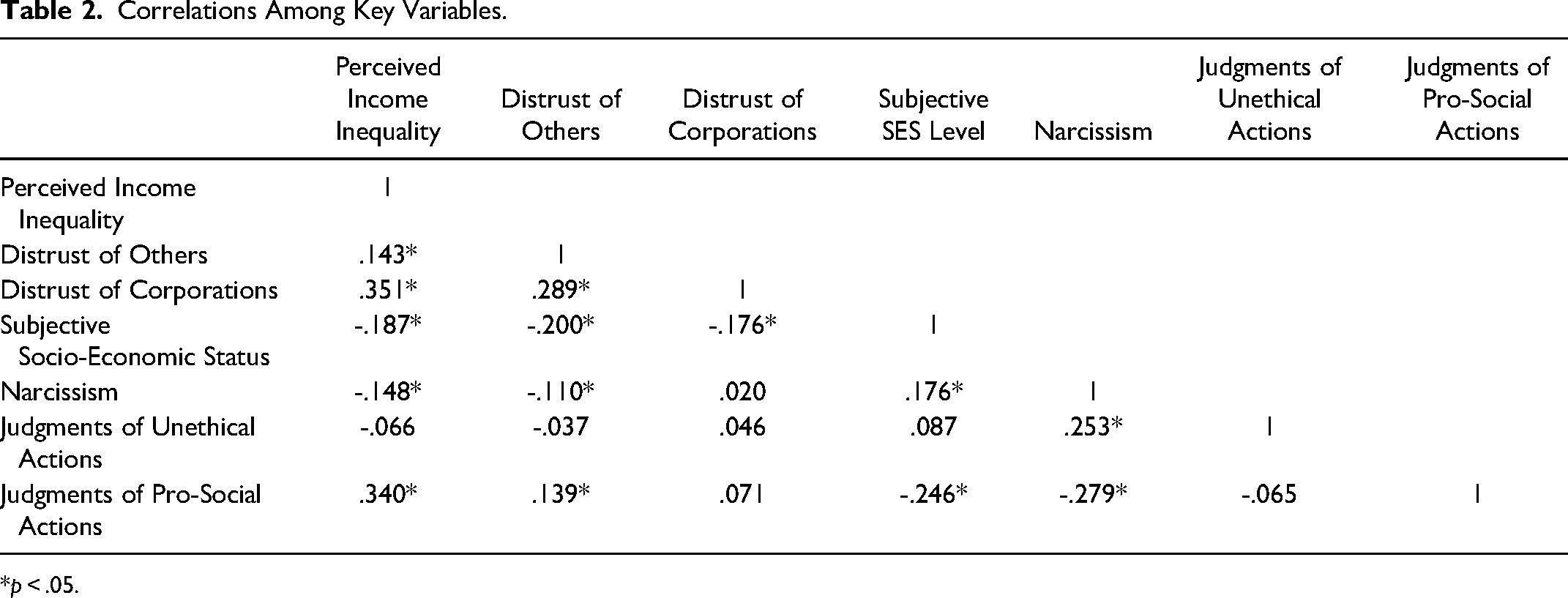
*p < .05.
Two separate moderated mediation analyses were conducted using Model 15 of the PROCESS macro in SPSS (Hayes 2017) to test the hypotheses. PROCESS utilises OLS regression to estimate the parameters of the equations in moderated mediation models (Hayes 2017; see also Hayes, Montoya, and Rockwood 2017 for a discussion on the benefits of using PROCESS for estimating moderated mediation models). Model 15 of PROCESS was selected as it was reflective of the conceptual model of this research (see Figure 1).
In the first moderated mediation model, the independent variable was perceived income inequality, the two mediators were general distrust of others and distrust of corporations, and the dependent variable was judgments regarding unethical consumer actions. Subjective socio-economic status was included as a moderator in the model, which moderated the relationships between the independent variable and the dependent variable as well as between the mediators and the dependent variable. Narcissism, age, and gender (male = 0; female = 1) were included as covariates. Results are provided in Table 3.
Moderated Mediation Analysis 1.
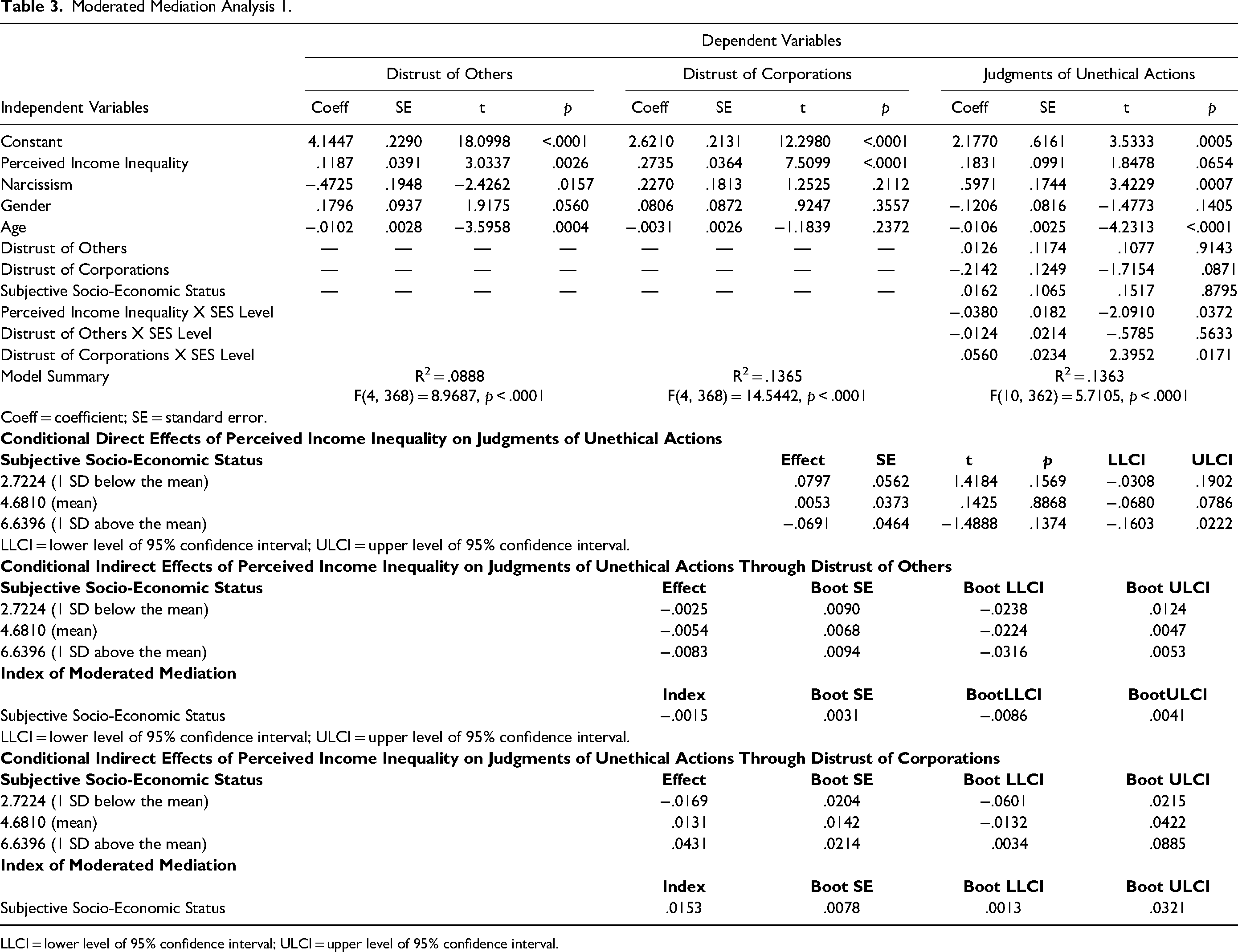
LLCI = lower level of 95% confidence interval; ULCI = upper level of 95% confidence interval.
Results showed that general distrust of others did not mediate the effect of perceived income inequality on judgments of unethical consumer actions, whereas distrust of corporations mediated this effect. The path between distrust of corporations and judgments of unethical consumer actions was moderated by subjective socio-economic status. Hence, higher perceived income inequality led to distrust of corporations, which subsequently led to positive judgments of unethical consumer actions. However, these effects were only evident for those with high (1 SD above the mean) subjective socio-economic status. These results support H2, but not H1. The direct effects of perceived income equality on judgments of unethical consumer actions were not significant at any level of subjective socio-economic status. This indicates full mediation.
In the second moderated mediation model, the independent variable was perceived income inequality, the two mediators were general distrust of others and distrust of corporations, and the dependent variable was judgments regarding pro-social consumer actions. Subjective socio-economic status was included as a moderator in the model, which moderated the relationships between the independent variable and the dependent variable as well as between the mediators and the dependent variable. Narcissism, age, and gender (male = 0; female = 1) were included as covariates. Results are provided in Table 4.
Moderated Mediation Analysis 2.
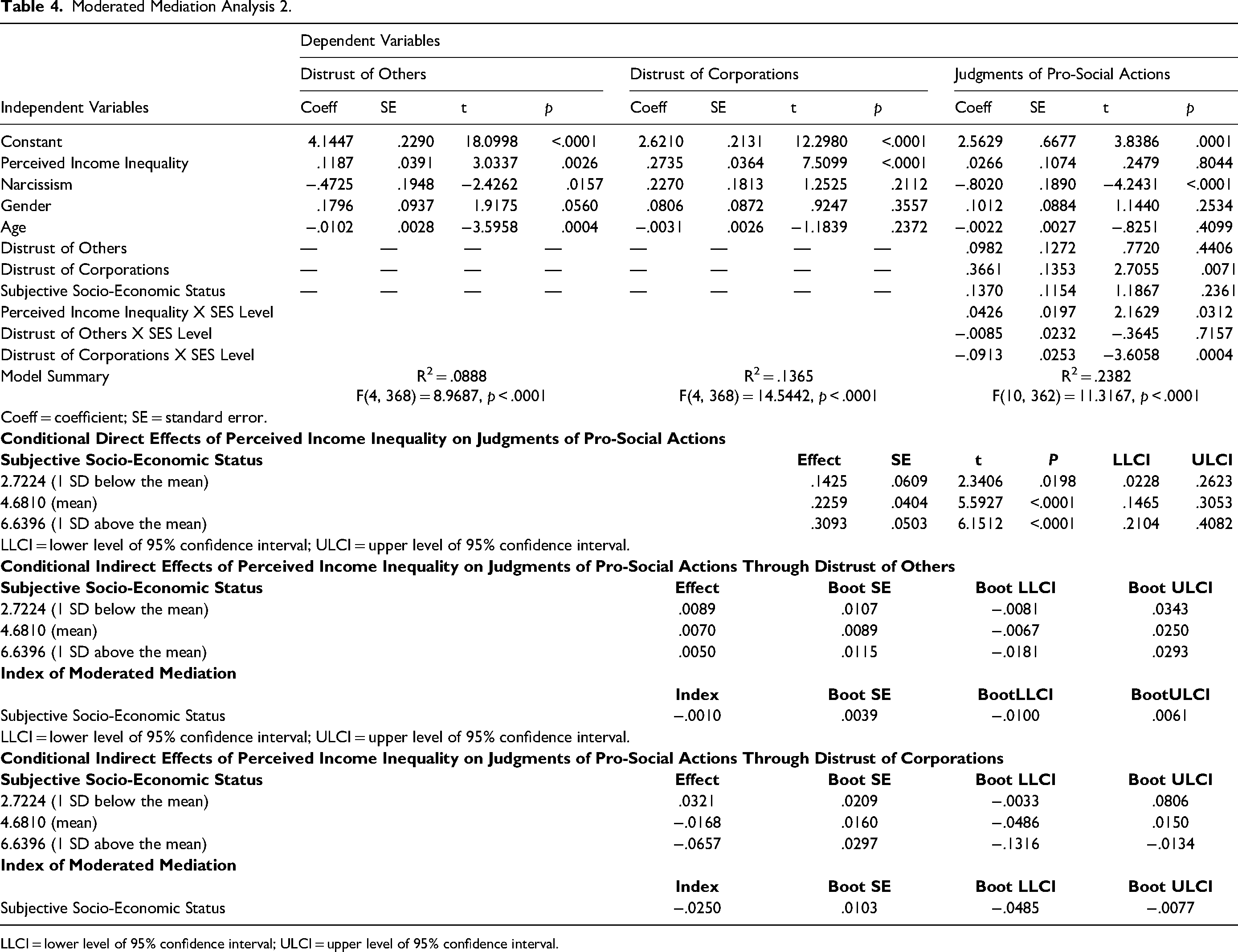
LLCI = lower level of 95% confidence interval; ULCI = upper level of 95% confidence interval.
Results showed that general distrust of others did not mediate the effect of perceived income inequality on judgments of pro-social consumer actions, whereas distrust of corporations mediated this effect. The path between distrust of corporations and judgments of pro-social consumer actions was moderated by subjective socio-economic status. Hence, higher perceived income inequality led to distrust of corporations, which subsequently led to negative judgments of pro-social consumer actions. However, these effects were only evident for those with high (1 SD above the mean) subjective socio-economic status. These results support H4, but not H3. The direct effect of perceived income equality on judgments of pro-social consumer actions remained significant at low (1 SD below the mean), moderate (mean), and high (1 SD above the mean) levels of subjective socio-economic status. This indicates partial mediation.
Discussion
This research provides several insights on the specific relationship between perceived income inequality and consumers’ ethical judgments, and on consumers’ ethical judgments in general. First, the findings of this research empirically demonstrate the importance of studying psycho-social variables in relation to ethics in consumer contexts (Chatzidakis, Shaw, and Allen 2021). Although previous research has examined some social variables in relation to consumers’ ethical judgments such as culture (Swaidan 2012), macro-societal reforms (Chen et al. 2019) etc., these studies have not examined how these social variables lead to mediating psychological constructs (e.g., trust) that affect consumers’ ethical judgments. Identifying the novel effects of the psycho-social variables of perceived income inequality and subjective socio-economic status on judgments of unethical and pro-social consumer actions is a key contribution of this research.
Second, the findings of this research provide further evidence for the view that income inequality has negative effects on trust in institutions (Lipps and Schraff 2021). This research answers the call to examine the effects of income inequality on specific institutions such as corporations beyond simply examining the effects of income inequality on trust in general (Buttrick and Oishi 2017). Negative effects of perceived income inequality on trust in corporations leads to stronger support for unethical actions and less support for pro-social actions among consumers who have higher subjective socio-economic status.
Third, the results of this study show that it is not general distrust of others that mediates the effects of perceived income inequality on consumers’ ethical judgments among higher social status consumers, rather it is specific distrust of corporations. This is different from prior research that has demonstrated that general distrust of others affects consumers’ ethical judgments (Arli, Tjiptono, and Winit 2015). However, unlike this study, prior research did not concurrently examine the effects of general distrust of others and distrust of corporations in relation to consumers’ ethical judgments.
In marketing contexts, trust of corporations may be more relevant than general trust of others, as corporations are important participants in the marketing system (Ferrell and Ferrell 2008). Trust builds reciprocal cooperation (Adams, Highhouse, and Zickar 2010; Hosmer 1995). Since many consumer actions are based on exchange relationships with businesses/corporations, a lack of trust in corporations should inhibit cooperation on behalf of consumers leading to judgments supporting unethical consumer actions (e.g., supporting actions that are harmful to businesses, such as insurance fraud) and not supporting pro-social consumer actions (e.g., not supporting fair-trade businesses).
On the contrary, general distrust of others is not specifically related to marketing exchanges, and may include perceptions of trust related to entities with whom consumers do not have marketing exchange based relationships, e.g., friends, family members, neighbours, work colleagues etc. Hence, general distrust of others may have more influence in social outcomes (see e.g., Wilkinson and Pickett 2017) that are not governed/regulated by formal procedures/contracts as are marketing exchanges. This may explain why distrust of corporations mediated the effects of perceived income inequality on consumers’ ethical judgments, whereas general distrust of others was not a mediator of these effects.
Fourth, the mediating roles of distrust in relation to the effects of perceived income inequality on consumers’ ethical judgments are only evident for consumers with higher subjective socio-economic status. This validates the view that low social status consumers are more likely to paradoxically support existing social structures and will not be motivated or empowered to engage in detrimental behaviors against institutions in marketing systems such as corporations even if they do not implicitly trust these institutions. This corresponds to system justification theory (Jost et al. 2003; Jost and Banaji 1994) which proposes that individuals of lower socio-economic status are least likely to resist societal and economic institutions that perpetuate structural differences.
Fifth, the findings of this research also support the notion that perceived income inequality is an important psycho-social variable that has implications for social relationships (Schmalor and Heine 2022). Hence perceived income inequality can provide important insights beyond those provided by only examining objective income inequality, as has been done in most of the previous research on the effects of income inequality. Schmalor and Heine (2022) state that since subjective perceptions of income inequality are related to how people feel the level of inequality in a society, such feelings are likely to be associated with other feelings of societal relationships such as trust. This has been empirically demonstrated in the current research.
Finally, distrust of corporations fully mediate the effects of perceived income inequality on judgments regarding unethical consumer actions. However, in the case of judgments regarding pro-social actions there was only partial mediation. These results support previous research that has shown distinct effects of independent variables on judgments of unethical consumer actions versus judgments of pro-social consumer actions (Chowdhury 2019; Webster, Morrone, and Saucier 2021).
Macromarketing Implications
The findings of this research have implications for four main areas of interest to macromarketing scholars: marketing systems, marketing ethics, sustainable consumption, and distributive justice (De Quero-Navarro, Stanton, and Klein 2021). From a marketing systems perspective, this research shows that the economic and social relationships among participants in a marketing system (e.g., the level of income inequality among consumers) can affect the trust of other institutions within the marketing system (e.g., corporations). Macromarketers are interested in the relationships among participants in marketing systems (e.g., between consumers and corporations), hence these findings are particularly relevant for macromarketing scholarship. Layton (2007) notes that when researching marketing systems, macromarketers are interested in distributional effects and the existence of inequalities as well as the related ethical implications. This research demonstrates how income distribution inequalities in society can have ethical implications in consumption contexts and can affect consumer-corporation relationships, which validates the importance of having a systems approach to understanding marketing.
From the perspective of understanding ethical issues in consumer related contexts at a higher level of aggregation (i.e., at a societal level), this research highlights the need to examine the social context of consumption. Trust can be considered as the lifeblood of a marketing system (Layton 2017), and income inequality can lead to the erosion of trust in institutions, such as corporations, within the marketing system, which can have downstream implications on consumers’ ethical judgments. Such negative effects on consumers’ ethical judgments in unequal societies are paradoxically more likely to be evident among those having higher socio-economic status (who are already reaping the benefits of inequality). Thus, this study advances knowledge in the burgeoning research field examining consumers’ ethical judgments (Hassan, Rahman, and Paul 2022; Smith et al. 2023).
From a marketing ethics perspective, this research shows the key role of trust of corporations in relation to consumer-business ethical relationships. Since distrust of corporations motivated greater support for unethical consumer actions and reduced support for pro-social consumer actions, reducing distrust of corporations among consumers is essential for the sustainable functioning of marketing systems. Ndubisi et al. (2016) state that firms need to engage in actions that demonstrate ability, benevolence, and integrity to become trustworthy. Hence, corporations should engage in consumer-oriented actions that reflect their ability, e.g., by providing innovative goods and services that satisfy consumers’ evolving needs. Corporations should also demonstrate benevolence and highlight concerns for consumers’ well-being through their actions, e.g., by supporting social and environmental sustainability practices. Most importantly, corporations must exemplify integrity by fulfilling commitments and promises to consumers. These recommendations will help enhance the trustworthiness of corporations.
Since this study examines pro-social and pro-environmental actions, this study also contributes to the macromarketing literature on sustainable consumption. Macromarketers are interested in creating sustainable societies (Hunt 2012) that resist or overcome the dominant social paradigm (Kilbourne and Carlson 2008) which is preoccupied with economic growth and encourages excessive consumption. The findings of this research that show that unequal societies are less likely to support sustainable consumer behavior should further motivate macromarketers to strive for egalitarian societies.
Pitzz, Steiner, and Pennington (2020, p. 302) note that macromarketing provides a critique of inequitable economic and social relationships by examining “the ways that embedded marketing processes affect and are affected by the systems and the society in which they function”. In line with this, this study clearly shows that economic and social relationships among consumers have important marketing implications. From a distributive justice perspective (see Ferrell and Ferrell 2008 for a discussion of distributive justice and its relevance for marketing systems), the findings show how the lack of an egalitarian distribution of income in society or the lack of an affirmative action system in society that mitigates differences among the well-off and worst-off members in society (as per the difference principle, Rawls 1971), can lead to negative outcomes to other stakeholders, such as businesses, in marketing systems.
Limitations and Future Research Opportunities
As can be expected, this research is not devoid of limitations. These limitations also provide insights into future research opportunities. The respondents of this study were American residents. The perceptions of inequality among such Western, educated, industrialised, (relatively) rich, and democratic (WEIRD) consumers (Henrich, Heine, and Norenzayan 2010), as well as the implications of these perceptions, may be different from the perceptions of inequality among consumers in other societies that are culturally more accepting of hierarchies. Thus, cross-cultural studies in other countries should be conducted to validate these findings.
The measure of income inequality in this study was based on Oshio and Urakawa (2014). Participants were required to reflect on whether disparity between the rich and poor has increased over the last five years in the United States. Technically, this scale measures perceptions of how income inequality has developed over time and is not a direct measure of perceptions regarding the absolute level of income inequality in the United States. Since perceived income inequality was considered as a continuous variable in this study, the Oshio and Urakawa (2014) scale of perceived income inequality enabled the measurement of any changes in perceived income inequality and allowed for the examination of the effects of these changes on consumers’ ethical judgments. However, it is possible that some respondents who perceived that income inequality has grown over the past five years still believed that the absolute level of income inequality is low in the United States. Future research should utilise more direct, absolute level measures of income inequality to validate the findings of this research.
Another weakness of this study was that the dependent variable was judgments of unethical and pro-social consumer actions rather than actual consumer behavior. In a review paper on the Hunt-Vitell theory of marketing ethics, Vitell and Hunt (2015) state that, in relation to ethics in consumer contexts, behaviors are generally reflective of attitudes. However, other research frameworks such as the Theory of Planned Behavior (Fishbein and Ajzen 1975) state that attitudes do not always lead to behaviors (see also Casais and Faria 2022 on the attitude-behavior gap in ethical consumption). Hence, future research should measure consumers’ actual behaviors instead of moral judgments.
The intriguing findings of this research regarding the role of psycho-social variables in relation to consumers’ ethical judgments also open up other avenues for future research on social variables within the context of marketing systems that may affect consumers’ moral judgments. These include research on the role of political systems (e.g., democracies versus one party systems) and distributive justice systems (e.g., egalitarian societies versus meritocratic societies versus hierarchical societies based on heredity) in relation to consumers’ ethical judgments. Furthermore, since this research identified that trust of corporations affects consumers’ ethical judgments, future research should examine how trust of other actors/institutions in the marketing system and political system such as retailers, wholesalers, judiciary, law enforcement, consumer protection agencies etc. influence consumers’ ethical judgments. Future research can also use objective measures of income inequality, e.g., the Gini coefficient, to measure whether the effects of objective income inequality on consumers’ ethical judgments mirror the effects of perceived income inequality found in this research.
Finally, this research demonstrated that subjective socio-economic status moderated the effects of perceived income inequality on consumers’ ethical judgments in the context of a relatively low “power distance” culture (Hofstede 1991), namely the United States. Even though the United States has a relatively low “power distance” culture, this does not mean that social hierarchy does not exist, it only means that social hierarchy is relatively less inequal in the United States compared to other nations that score higher on “power distance”. Hence, subjective socio-economic status is still a meaningful research construct in the context of the United States (Tan et al. 2020). Future research can replicate this study in high “power distance” cultures to validate whether the moderating effects of subjective socio-economic status are stronger.
Conclusion
The current research has examined the role of perceived income inequality and subjective socio-economic status on consumers’ ethical judgments and has empirically demonstrated that psycho-social variables (variables that have both social and personal psychological components) are particularly important for understanding consumers’ roles in marketing systems. This addresses a major gap in the research on consumer's ethical judgments as prior research has neglected examining the roles of variables that have both social and personal psychological components (Chatzidakis, Shaw, and Allen 2021). By identifying the mediating role of distrust of corporations in relation to the effects of perceived income inequality on consumers’ ethical judgments, this research has demonstrated that it is not general distrust of others, rather it is specific distrust of participants in the marketing system that affects consumers’ ethical judgments. This expands the research literature on consumers’ ethical judgments, as prior research that has examined the role of trust in this context (Arli, Tjiptono, and Winit 2015) has not distinguished between the effects of general distrust of others and distrust of corporations. Considering the valuable and interesting findings of this research, macromarketing researchers should further examine the role of psycho-social variables and trust in relation to consumers’ ethical judgments and marketing ethics.
Footnotes
Associate Editor
Alexander Nill
Declaration of Conflicting Interests
The author(s) declared no potential conflicts of interest with respect to the research, authorship, and/or publication of this article.
Funding
The author(s) received no financial support for the research, authorship, and/or publication of this article.
