




Abstract
Over the years, marketing has been influenced by the soft sciences (i.e., economics, psychology, and sociology) and hard sciences (i.e., mathematics and physics). In this study, we discuss the various intersections between chemistry and marketing, and we elaborate on the areas in which chemistry can help develop marketing from both theoretical and practical perspectives. In doing so, we do not intend to assert definitive conclusions or provide substantial scientific evidence but instead to introduce a new interdisciplinary research area that we call the chemistry of marketing and highlight its potential areas of application and some future research directions. To establish the initial scientific bridge between marketing and chemistry, we rely on: 1) metaphors which as figures of speech have long been used in the development of marketing science and 2) the general systems theory which is recognized as a prevailing form of generalization. Moreover, we provide a novel explanation of closed and isolated marketing systems, present initial evidence on their emerging importance in the business world, and offer some suggestions for their potential application to the first and second laws of chemical thermodynamics.
Keywords
The tragic sense of life in men and nations, Chapter XII, p. 356
Introduction
The sciences are conventionally classified into two broad categories: soft sciences, comprising economics, sociology, and psychology; and hard sciences, comprising mathematics, physics, and chemistry. As a relatively young discipline that originated from economics around the beginning of the previous century (Sheth and Parvatiyar 1995), marketing has been largely influenced by the soft sciences owing to its focus on complex environmental systems, which often involve subjective variables and qualitative methods (Grønhaug and Kleppe 2016; Kimmel 2016; Varey 2016). This may reduce the generalizability of results and diminish the probability of establishing relatively stable laws and principles, which is why high-impact marketing journals (e.g., Journal of the Academy of Marketing Science, Journal of Marketing, Journal of Marketing Research, and Marketing Science) today prefer publishing studies that employ complex mathematical and econometric models. Over the years, important contributions have also been made in the intersection of marketing and physics, some of which include Reilly's law of retail gravitation based on Newton's law of gravity (Reilly 1931), the concept of entropy studied in terms of brand purchase behavior (Herniter 1973), retail distribution (Cliquet 1998) and its relationship with technology and standard of living (Reidenbach and Oliva 1983). The first quantitative model of innovation diffusion (Bass 1969) is analogous to the equations associated with mean-field kinetic theory (Fibich and Gibori 2010). Synergy is already a foundational concept in marketing mix theory and cross-media communications (Lesscher, Lobschat, and Verhoef 2021; Sridhar, Naik, and Kelkar 2017). Moreover, since the 1980s, statistical physicists have been largely contributing to the development of neural networks and machine learning (Carleo et al. 2019; Hopfield 1982), agent-based models (Abergel et al. 2014), and game theory (Benjamin and Hayden 2001; Hauert and Szabó 2005; Perc et al. 2017; Swiecicki, Gobron, and Ullmo 2016), which have become the backbones of modern quantitative research in marketing. There is even an interdisciplinary research field called “econophysics” that relies on probabilistic and statistical methods to study the application of physical concepts and theories to economic behavior (Mantegna and Stanley 1999).
However, there is still a lack of research on how chemistry-related theories, concepts, laws, and principles can be applied to marketing. As we will discuss later, we believe that during the last few years, there has been an increase in the number and variety of phenomena with characteristics of closed and isolated systems. Therefore, we see a potential in chemistry, whose laws and principles are only applicable to closed and isolated systems, for better understanding their behaviors. Moreover, the prevailing marketing models are still dedicated to open systems (Layton 2007, 2015, 2019) and/or promoting the transition toward open systems (Gygli et al. 2019), but they cannot adequately explain and predict the behavior of closed systems or what motivates an open system to go toward its closure state (e.g., the shift from globalization toward deglobalization). Therefore, this study focuses on the possible applications of certain chemistry-related laws to closed and isolated marketing systems, although the line between physics and chemistry may at times be blurred due to interrelated concepts that cannot be exclusively attributed to a single scientific domain (e.g., physical chemistry or chemical thermodynamics). Moreover, it does not aim to provide strong scientific justifications or engage in the long-standing debate regarding whether marketing is a science or an art (a debate as impossible to resolve as the ancient chicken-and-egg paradox) because, in the end, marketing has characteristics of both soft and hard sciences. Instead, we seek to introduce a new field of interdisciplinary research that we call the chemistry of marketing, highlight some of its potential areas of application and future research directions.
In this study, we aim at bringing contributions to the following domains: 1) System theory: to provide a novel explanation of closed and isolated systems, presenting initial evidence on their emerging importance in the business world, and offering some suggestions for their potential applications to certain chemistry-related laws. Therefore, we partially challenge the conventional paradigm according to which open systems prevail in the business world (Scott 1981, 2004; Scott and Davis 2007), and that closed and isolated systems cannot adequately describe important existing phenomena (von Bertalanffy 1968). Moreover, we partially dispel another common misconception that open systems represent the highest evolutionary stage of marketing systems (Dowling 1983), and that most extant marketing models should be exclusively developed for open systems (Layton 2007, 2015, 2019). 2) Marketing theory: Tapp and Hughes (2008) highlight the following six main differences between chemistry and marketing: “[1] In contrast to chemistry, constructs in marketing are woolly and prone to disagreement. … [2] Chemists deal largely with absolutes, marketers usually deal with probabilities. … [3] Sodium explodes in hot water all round the world. But people behave differently from one place to the next. … [4] Chemists can isolate the problem. Marketers can’t. … [5] Ironically, marketers can’t isolate the system, but do isolate their theories. … [6] The formula-driven approach of scientific marketing kills thinking by the researcher that in turn kills insight and understanding” (pp. 273–274). Therefore, to overcome the above cross-disciplinary differences and lay the foundations of the chemistry of marketing, we rely on metaphors, “thinking of one thing in terms of something else” (Van den Bulte 1994, p. 407), or in Aristotelian terms, “[m]etaphor consists of giving the thing a name that belongs to something else,” due to some kind of resemblance (Murray 1920, pp. 71–72). We do not suggest that there are chemical reactions (chemical thermodynamic processes) in the market, rather phenomena similar to these reactions that might be better understood when studied through the lens of chemistry. Although metaphors play pivotal roles in developing marketing science (Arndt 1985; Brown et al. 2018; Hunt and Menon 1995; Van den Bulte 1994) and metaphoric transfers have been continuously made to marketing from various scientific fields since the 1900s (Brown and Campelo 2014; Kerin 1996; Kumar 2015; Markin and Duncan 1981; Scully 1996; Shen 2019), chemistry-related metaphors have not yet been exploited in marketing. For example, chemical metaphors can be used as building blocks for modeling self-organizing structures (Zambonelli and Viroli 2011) and autonomous systems (D'Angelo 1995) and for providing a unique perspective on causality (Harré 2016) because “only when prediction is associated with an explanation of the causal mechanisms will we reach the highest level of understanding” (Wooliscroft 2021, p. 113).
This paper is organized in the following manner. First, we start with a general overview of the intersections between marketing and chemistry and after that we narrow down the scope of chemistry to the specific field of chemical thermodynamics. Then, we set forth the marketing equivalents of thermodynamic systems and a systematic framework for establishing a metaphoric transfer to marketing. Second, we present initial evidence on the relative importance of closed and isolated macromarketing systems by analyzing the overall level of openness (globalization) of countries and world regions. Third, we discuss some marketing applications of the first and second laws of chemical thermodynamics to closed and isolated marketing systems. Fourth, we suggest a classification framework according to which the potential scope (areas of application) of the chemistry of marketing may be extended to a wider spectrum of macro, meso, and micro phenomena that may be associated with closed and isolated systems. Finally, we conclude by highlighting some general directions for future research.
Chemistry of Marketing: Scope and Future Research Agenda
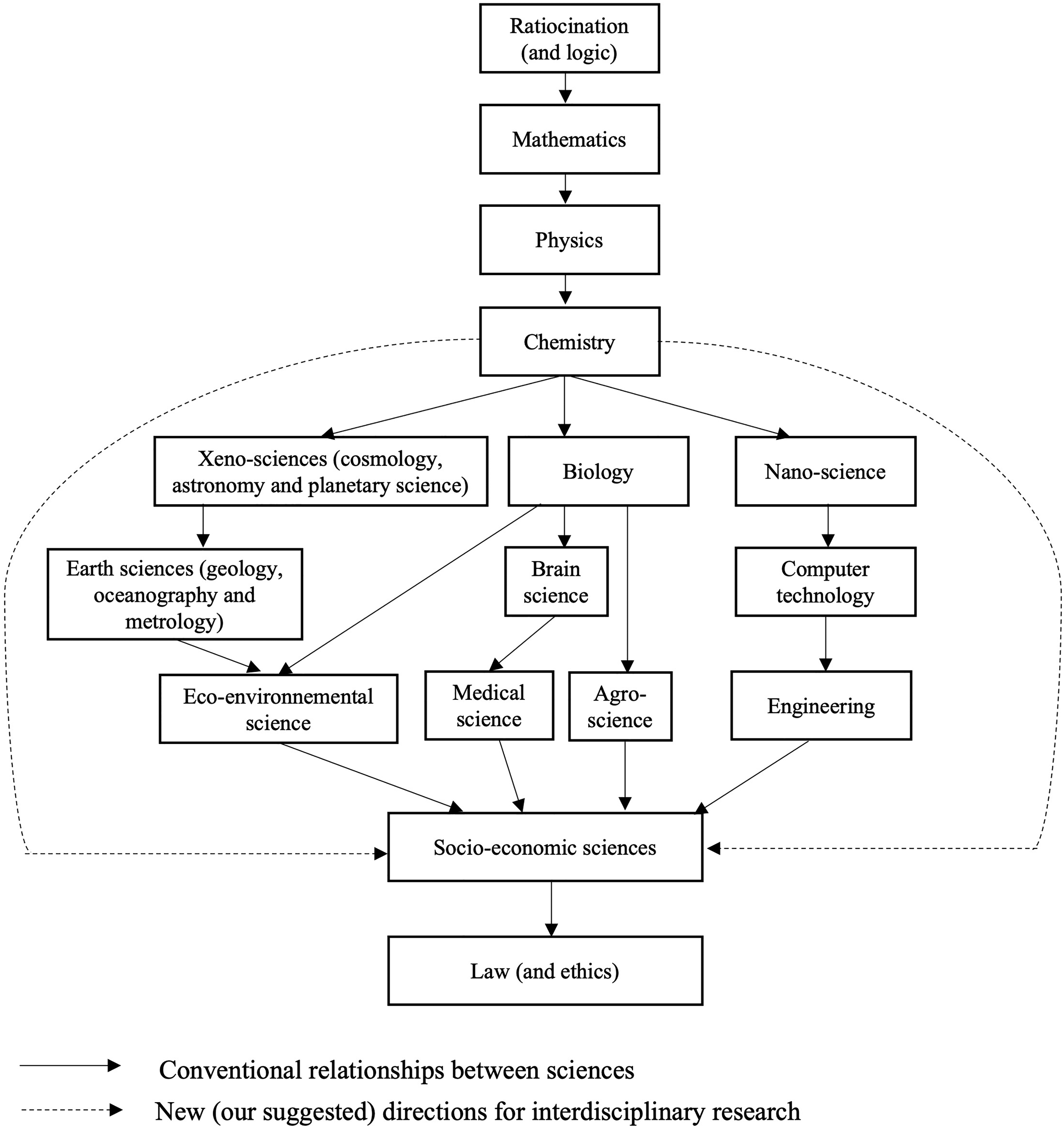
Chemistry as a central science: New directions for interdisciplinary research. Source: Adopted from Balaban and Klein 2006.
First, this scientific bridge can be built via the general systems theory (GST), which has been viewed as “a valid and powerful form of generalization” (Emery 1974, p. 7) and an important methodological area in macromarketing research that still needs further study (Wooliscroft 2021). Moreover, chemical systems enable us to investigate non-linear phenomena, such as periodic and non-periodic behavior, hysteresis [the property of a system to be dependent on its historical state] and multistability [the property of a system to have numerous points of stable equilibrium] (Vidal and Pacault 1984), which can be beneficial for macromarketing that deals with complex and non-linear phenomena (Wooliscroft 2021). Contrary to other scientific fields (e.g., biology) that have significantly influenced the GST and where open systems prevail (von Bertalanffy 1968), most chemistry-related laws and principles are only applicable to closed and isolated systems that are still largely ignored in the macromarketing literature (Layton 2007, 2015, 2019). “In essence, the ahistorical assumptions and closed system thinking of single-cause theories are epistemologically indefensible” (McArthur, Weaven, and Dant 2016, p. 11). However, “[m]acromarketing also deals with wider systems and the use of a closed system assumption is appropriate” (Wooliscroft 2021, p. 119). For example, Krisjanous and Kadirov (2018) demonstrated that “marketing systems can be selectively open for a supposedly ‘superior’ input that fits the purposes of internal meaningfulness, while developing selective closedness toward inputs deemed inferior. … Hence, not all marketing systems evolve into open and free exchange milieus” (p. 436). Without understanding these phenomena, their specifics, and fields of application (e.g., how closed and isolated systems emerge, to what extent they are different from open systems, and which laws and principles they obey), marketers can neither identify their distinguishable behavioral patterns nor forecast their performance. As suggested by the inductive realist model of theory generation, whenever researchers face unexplained market phenomena, problems that cannot be accurately predicted by current theories, or problems “that result from an extant theory's lack of conceptual ‘fit’” (Hunt 2018, p. 1346), this can be a signal for them to engage in creative cognitive acts and suggest new theorical proposals. For example, autarky remains an important but still understudied phenomenon (Helleiner 2021) and is defined as “[n]ational economic isolation of a country achieved [by] creating a self-sufficient independent economy” (Kotlyakov and Komarova 2007, p. 56). Moreover, although free market economies (often associated with open systems) have prevailed since the Second World War, over the last few years the largest world economies have made significant attempts to return to national self-sufficiency (Dieter and Biedermann 2022). One study even demonstrated that “deglobalization is more apparent in developed countries than in developing countries, because when the national economy is maturing, the political choice is to protect the resources within the governance compared to risks of international trades and investments” (Kim, Li, and Lee 2020, p. 90). Unsurprisingly, The Economist (2020) asked provocatively “Has Covid-19 killed globalisation?” and Barclays Corporate and Investment Bank confirmed recently that, due to the pandemic, war between Russia and Ukraine, and the climate crisis, “[t]here are strong signals that the era of globalisation is coming to an end” (Keller and Marold 2023).
Second, chemistry and marketing can also be bound through metaphors—figures of speech traditionally used by marketers to formulate novel research questions and hypotheses, to transfer terminology from one scientific domain to another, and as highly effective didactic tools in rhetorical discourse analysis (Brown and Campelo 2014; Hunt and Menon 1995; Markin and Duncan 1981; Scully 1996; Shen 2019; Van den Bulte 1994). For example, chemistry is the science that studies the composition, structure, and properties of matter by investigating the behavior of its elements/entities (atoms and molecules) and compounds, and the changes that occur as energy is released or absorbed (Usselman and Rocke 2023). Similarly, marketing pertains to the creation, communication, and delivery of customer value, and occurs whenever there is an exchange between two or more parties (Kotler and Armstrong 2020). The difference is that chemistry deals with objective matter (representing anything with mass that occupies space), whereas marketing deals with the subjective perception of that matter called “customer value” (the ratio between the perceived benefits and costs of a product, a tangible or intangible matter, available for sale or attention). Chemists study the structure and transformation of matter through the behavior of chemical entities such as atoms, molecules, and ions. Marketers deal with marketing entities (stakeholders) like customers, suppliers, shareholders, policymakers, employees, and communities (Ferrell and Ferrell 2008) whose transformations and dynamic behaviors are “critical to successful value (co)creation and the totality of value creation in a marketing system” (Domegan et al. 2019, p. 138). In a similar manner to chemical entities, each of these stakeholders can exist as a relatively independent entity (closed or isolated system), or they can engage in mutually beneficial and long-term relationships with each other (open systems) to attain their most stable and lowest energetic state of existence.
Finally, chemistry and marketing are two complementary scientific fields. Chemistry, as a central science, has long influenced other disciplines such as physics, biology, engineering, and medical sciences (Adam 2001; Nature 2011) and therefore can be viewed as one of the most important “knowledge exporters.” Marketing, as a relatively young and hybrid discipline, has mostly adopted ideas from other sciences, and can therefore successfully play the role of a “knowledge importer” in the relationship between the two scientific fields. Moreover, many recognized marketing scholars today first received degrees in chemistry prior to joining the marketing field (e.g., James R. Lumpkin, currently, dean of the Soules College of Business at the University of Texas; John Hulland, editor-in-chief of Journal of the Academy of Marketing Science; and Adam Lindgreen, co-editor-in-chief of Industrial Marketing Management).
In the following subsection, we narrow down the scope of chemistry to the specific field of chemical thermodynamics, where we briefly discuss the marketing equivalents of chemical thermodynamics systems and a framework for establishing a metaphoric transfer to marketing from chemical thermodynamics.
Marketing Equivalents of Chemical Thermodynamic Systems
Chemical thermodynamics is a branch of chemistry (physical chemistry) that studies chemical processes and phase transformations in thermodynamic systems. “A thermodynamic system is defined as a quantity of matter or a region in space that is of interest. The mass or region outside the system is called the surroundings, and the surface that separates the system and the surroundings is called the boundary” (Okawa et al. 2021, p. 77). As presented in Figure 2, there are three types of chemical thermodynamic systems:
Open systems: these can exchange both energy and mass/matter with their surroundings. Closed systems: these can exchange only energy (not mass) with their surroundings. Isolated systems: these cannot exchange mass or energy with their surroundings.
Most marketing systems (e.g., countries, companies, industries, and institutions) are open and continuously exchange inputs and outputs with their business environment. This concept is consistent with what von Bertalanffy (1968), biologist and founder of the GST, stated when explaining the prevailing open nature of living organisms—the result of their constant evolution—and the impossibility that closed systems can adequately describe existing phenomena. Even earlier, Ashby (1962) introduced the principles of adaptive systems by observing the process of homeostasis, in which complex systems exposed to turbulent environments are capable of self-regulation, within strictly established limits. His idea became a stepping stone to the viable system model introduced by Beer (1972), which showed that an organization can be a viable system and capable of independent existence if it is in balance with the surrounding environment.
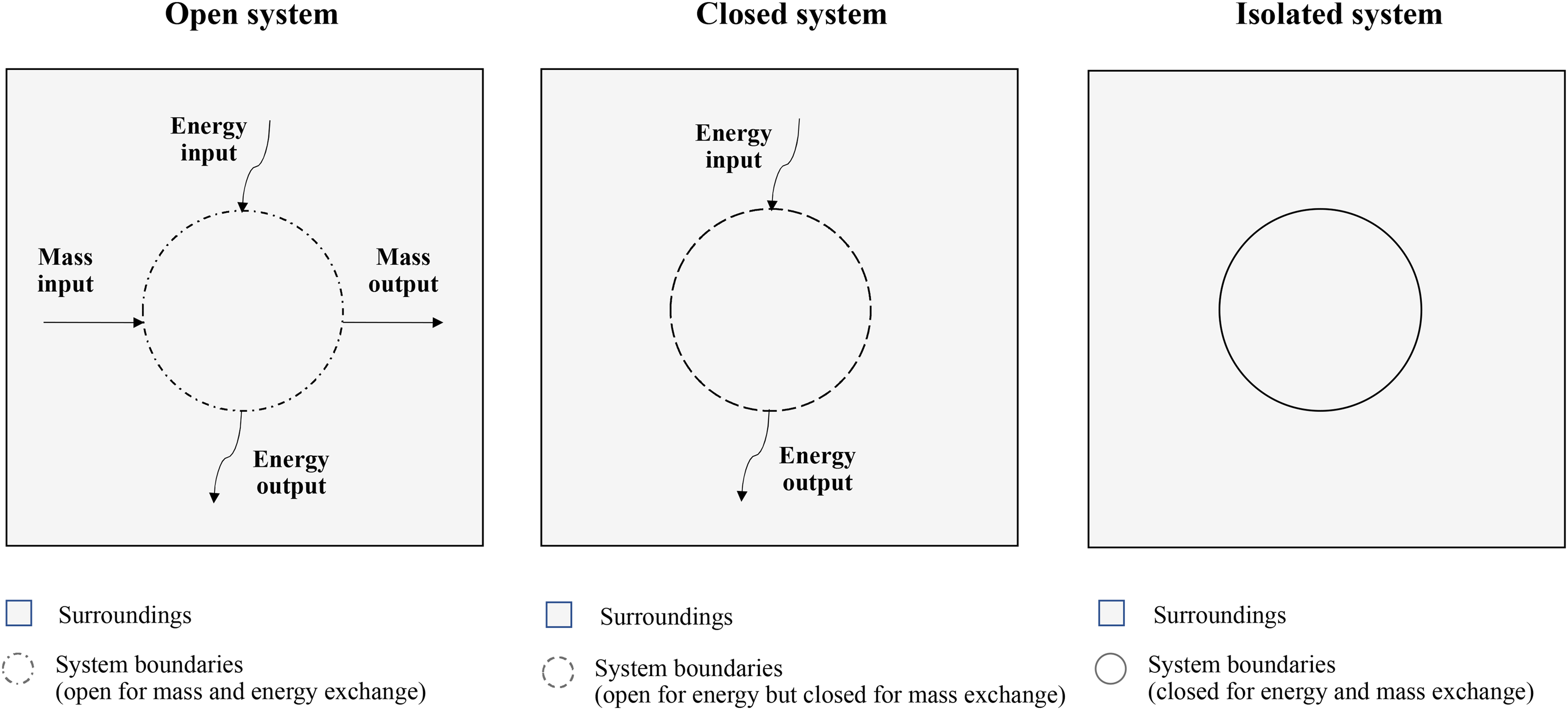
Classification framework of the classical chemical thermodynamic systems.
Therefore, in the context of the GST, Dowling (1983) defines marketing systems as ones that “adapt to their environments or change their environmental influences” (p. 22). The author suggests that closed marketing systems are typical only for the first evolutionary stages of economic development (i.e., economic self-sufficiency and primitive communalism), while modern marketing systems are open by nature. Since the 1960s, open system models have become a dominant paradigm in the organizational behavior literature (Scott 1981, 2004; Scott and Davis 2007) and have even contributed to developing the theory of boundary-spanning marketing organizations (Hult 2011).
In 1977, Ilya Prigogine was awarded the Nobel Prize in Chemistry for developing a thermodynamics model for nonequilibrium systems that explains how the nonequilibrium state may become a source of order, and that exchanges with the environment may promote a change that stabilizes the structure of the system resulting in a new random order (Lusch and Laczniak 1989). Some of its applications were suggested for open systems in marketing and social sciences (Dowling 1983; Maruyama 1978). Henderson (1983) suggests that, though marketing is often considered a part of economics, “[t]here is no reason to think of business competitive systems as being different in any fundamental way from other biological competition. . . . The basic principles of competition are as universal as the laws of chemistry and physics are universal” (p. 8). Kiel, Lusch, and Schumacher (1992) add that marketing conforms to other exchange systems that “evolve in a universally applicable pattern” (p. 60) and, therefore, knowledge of non-living and living exchange systems (e.g., atoms, molecules, cells, and organs) can be used to enhance marketing theory and practice. Layton (2011) holistically defines a marketing system as “a network of individuals, groups, and/or entities, embedded in a social matrix, linked directly or indirectly through sequential or shared participation in economic exchange, which jointly and/or collectively creates economic value with and for customers, through the offer of assortments of goods, services, experiences, and ideas, that emerge in response to or anticipation of customer demand” (p. 259).
Over the years, various system theories have been developed (i.e., organizational behavior, the GST, biology, sociology, cybernetics, system dynamics and smart systems) with important applications in management, marketing, and service systems engineering (Mele, Pels, and Polese 2010). However, extant contributions in marketing remain limited to theoretical discussions on open systems (Layton 2011; Shaw 2020; Vargo et al. 2017). For example, the openness of marketing systems in terms of exchanging, growing, adopting, and evolving in the business environment has often been conceptualized in macromarketing (Layton 2007, 2015, 2019). However, closed and isolated systems, which may also explain important business phenomena, have largely been ignored in system theories. According to Scott (1981), the major theoretical contributions to closed systems in organizational behavior were made before the 1960s. Inspired by Gouldner (1959), he classified them into two categories: 1) rational closed system models (e.g., Fayol 1916; Taylor 1911; Weber 1921/2019) that consider companies as formal structures with fixed boundaries, clear objectives, and no external influences; and 2) natural closed system models (e.g., Barnard 1938; Dalton 1959; Mayo 1945; McGregor 1960; Roethlisberger and Dickson 1939) that consider only the internal influences within an organization but whose management is characterized by unplanned (spontaneous) decisions and a lack of consensus on common goals other than the survival of the organization.
Recognized nowadays as “the father of modern marketing” (Shaw, Lazer, and Pirog 2007), Alderson (1957) classified marketing systems according to the relationship type established between the system and its elements into: 1) atomistic, 2) mechanical, and 3) ecological (see Table 1). He highlights the importance of the ecological system as a complex system that simultaneously has features of a closed system (because it has a coordinated operating structure) and an open system due to its expansion capability. Moreover, he associates the term “closure” used in communication theory with a self-sufficient system that has all its components needed to complete a task. For example, he explains that a telephone system operates efficiently only as a closed circuit but not when there is a broken wire and the system is open. As Alderson (1958/2006) mentions, “[i]t frequently happens that some marketing system is incomplete or out of balance in some direction. The act of supplying the missing element constitutes closure, enabling the system to handle a greater output or to operate at a new level of efficiency. The incomplete system in effect cries out for closure” (p. 70). Moreover, closed systems were previously viewed as applicable in economic processes where repetitive operations are involved as they can be maintained efficiently or in societies where individuals are triggered by cooperation rather than competition (Alderson 1957). For example, ancient Egypt is a historical case of a merely self-sufficient society, where individuals were primarily organized on the basis of their cooperation with rules established from the top, an organizational pattern that was effective for coordination and interaction (Alderson 1965/2006).
System Models Inspired by Hard Sciences and Used in Marketing.
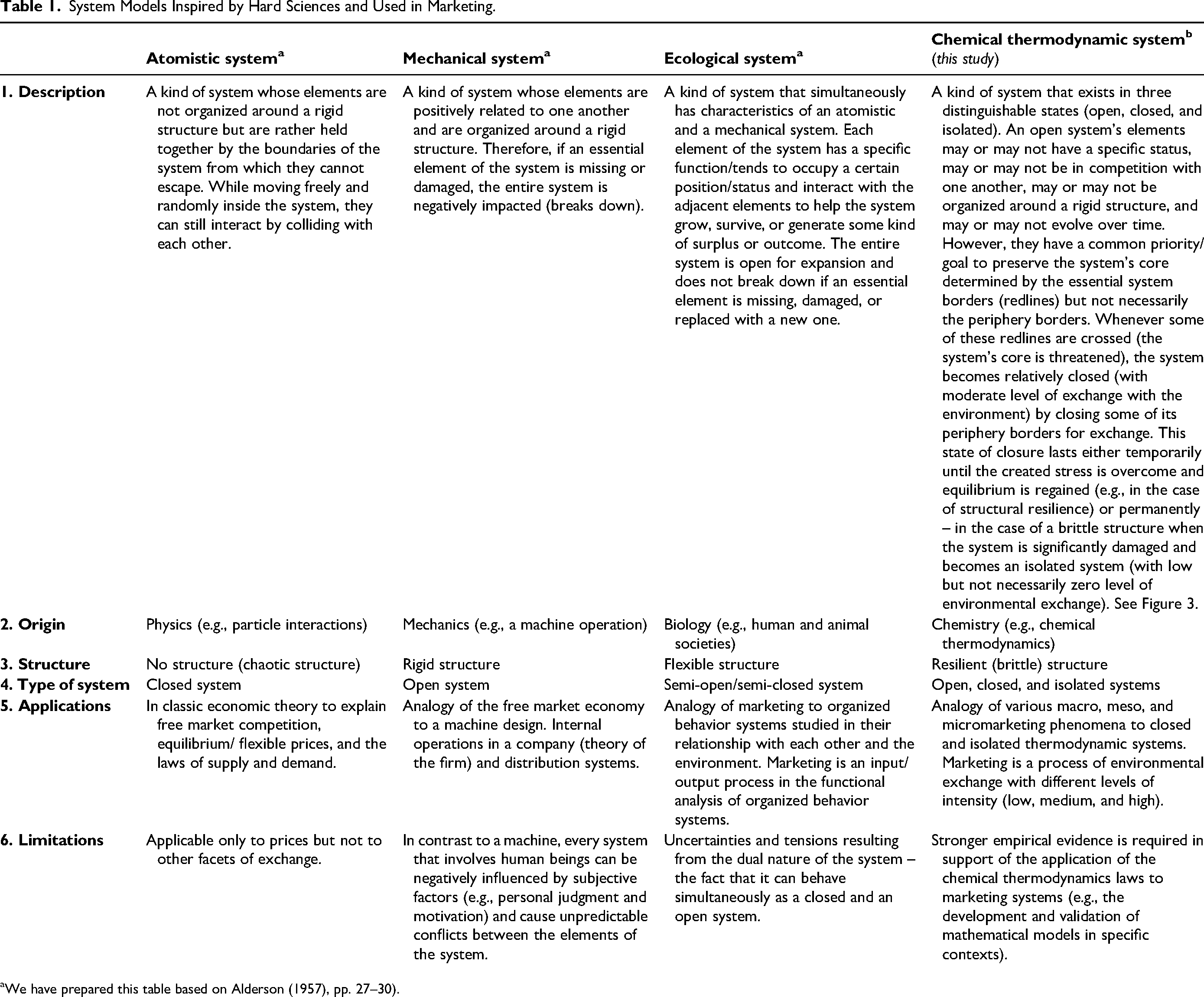
We have prepared this table based on Alderson (1957), pp. 27–30).
Our extension/suggestion for a new type of marketing system.
Source: Adopted and updated from Alderson (1957), pp. 27–30).
However, closed-loop systems, originating from control theory and referring to the presence of a feedback in a control system, should not be confused with the closed thermodynamic systems discussed here, which reflect the relationship between a system and its environment. Though similar in terminology, these two systems derive from different classification frameworks and have a different meaning. For example, closed-loop marketing is defined as “a cycle in which customer information is continuously and automatically collected, advanced analytics are used to predict customer behavior, and services and marketing effort are redesigned and personalized, in short cycles” (Chung, Wedel, and Rust 2016, p. 81). It belongs to the adaptive personalization systems that, as discussed earlier, are open by nature because they repeatedly (cyclically) interact with the environment by collecting data about it and adapting accordingly. Dowling (1983) suggests that in closed marketing systems, disturbances are generated inside the system rather than from the environment. This idea is consistent with the concept of first-order cybernetics, in which the interactions within systems are considered independent from the observer. However, as suggested by second-order cybernetics, reality can be a multiverse and self-referential (Becvar and Becvar 2013). Consequently, any system can be viewed as part of a larger system or can be decomposed into multiple smaller systems, each with its own separate environment. We believe that the definition of a system will always be relative to the scope of the business environment; therefore, some marketing systems can be simultaneously viewed as open, closed, or isolated, depending on the research context.
Though completely closed and isolated systems are rarely found in the business world, we believe that since the beginning of the twenty-first century, there has been an increase in marketing systems with characteristics of closed and isolated systems. Therefore, the conventional rigid and theoretical distinction between open, closed, and isolated systems (presented in Figure 2) should be updated with new (more flexible and operational) definitions to enable the association of certain marketing phenomena to closed and isolated marketing systems and their application to certain chemical thermodynamics laws. Here, it is important to mention Alderson's (1950/2006) statement that “[e]very operating system may be said to occupy a seat or footing in the total economy. … If the firm's market position were pictured as a circle on a chart, it might show a dense core at the center and gradually shade off toward the fringe. The circle should not usually be regarded as having a hard and fast boundary, but as being marked off in an approximate way by that might be called the ‘indifference contour’. The reality of the footing consists more in its hard core and the shading off from the center than in being marked off from the rest of the economy as a closed system” (pp. 82–83). We fully share Alderson's vision that a system has a core and a periphery. For us, the core is the essential system that is always relatively closed for exchange because it preserves the priorities, redlines, or existential principles of the entire system; the periphery involves different layers that tend to be more open for environmental exchange; however, under certain circumstances (e.g., when the system's existential principles are threatened), the size of the core can increase and lead to the closure of some peripheral layers (see Table 1). Therefore, by default, every system (at its core) is a relatively closed one (as every system is closed for certain compromises, regardless of its general level of openness) and no system is completely isolated from the environment, as there is always at least one peripheral layer open for exchange, with only the size of the core and the number of open peripheral layers determining the prevailing nature of the system and its environmental exchange intensity. This is because, although isolated systems are traditionally viewed as systems that do not interact at all with the environment (Dowling 1983; von Bertalanffy 1968), their very existence can influence the environments of other systems. We believe that openness and isolation can be viewed as the two extremes of the exchange continuum, with relative (high vs. low) rather than absolute (yes vs. no) values for exchange. Therefore, closed marketing systems are systems with a partial (moderate) exchange with the business environment, rather than systems closed to exchange with any type of environment or any type of environmental exchange (see Figure 3).
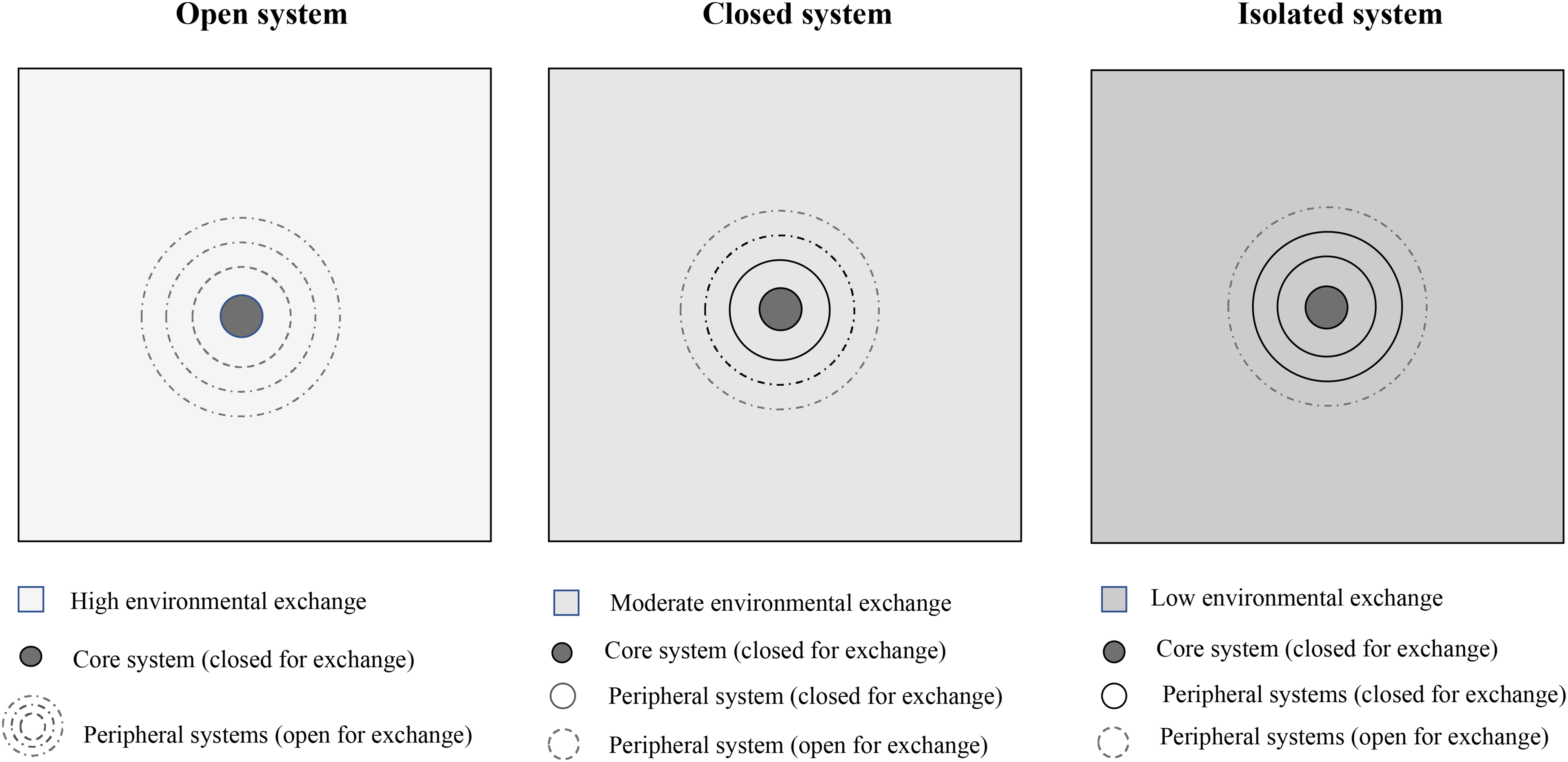
Classification framework of marketing systems based on exchange intensity. 2
Finally, by paraphrasing the metaphorical reflections of Hunt and Menon (1995), we can say that, while denotatively speaking, marketing systems are clearly not thermodynamic systems, the metaphor connotatively suggests that some characteristics of thermodynamic systems can be carried over, transferred to, or borrowed by marketing. Moreover, although some transfers that we use in this article may be viewed as literarily metaphoric (that simply aim to vividly convey a meaning), others are scientific, as they encourage researchers to study chemical thermodynamics for theories, propositions, and concepts that may provide valuable and long-term contributions to marketing. However, both types of metaphoric transfers are essential to marketing due to the existence of multiple research paradigms rather than a single one (Arndt 1985). Moreover, we relied on the holistic framework of Hunt and Menon (1995) to avoid any potential limitations related to metaphoric transfers (e.g., short life cycle of the metaphor, literary rather than scientific metaphors, unsystematic and indiscriminate borrowing of concepts and theories), which suggests that “metaphorical transfer consists of multiple, integrated elements not individual, isolated ones” and therefore “the value of a metaphor to a discipline is determined by the appropriateness of its (intentionally and/or unintentionally) transferred source, ontology, concepts, theories, and values” (p. 89) (see Table 2). For example, some underlying goals of chemical thermodynamics are related to efficiency and process improvements – these are all values that can be easily translated to various understudied processes in closed and isolated marketing systems, and to which the thermodynamics laws can provide fresh insights or clarify unexplained behavioral patterns.
A Framework for Establishing a Metaphoric Transfer to Marketing from Chemical Thermodynamics.

Based on Hunt and Menon (1995).
Our suggestions for a potential metaphoric transfer to marketing from chemical thermodynamics are not exhaustive.
Source: Adopted from Hunt and Menon (1995).
Rise of Closed and Isolated Macromarketing Systems
In a macromarketing context, we believe that open, closed, and isolated systems, that we defined earlier as systems of high, medium, and low levels of environmental exchange, may be associated with the following three phenomena: 1) hyper-globalization: a form of globalization that the world experienced between 1990 and 2008, 2) slowbalization: the current stage of globalization that started with the financial crisis in 2008 and preceded deglobalization, and 3) deglobalization: an extreme form of self-reliance that the world is already experiencing in some geographical areas but is not yet uniformly experienced globally (Keller and Marold 2023). Moreover, Helleiner (2021) reviewed the main contributions made to the autarkic literature since the seventeenth century and identified three drivers for adopting this kind of a self-sufficient national policy: “(1) insulation from foreign economic influence, (2) insulation from foreign political and/or cultural influence, and (3) the promotion of international peace” (p. 935). As for us, these drivers may represent the redlines or existential principles initiating the overall closure state of macromarketing systems. Consistent with these definitions, we present here initial evidence on the prevailing importance of macromarketing systems (countries and world regions) with moderate levels of environmental exchange (closed systems) (Figure 4a). By doing so, we partially challenge the conventional paradigm according to which open systems prevail in the business world (Scott 1981, 2004; Scott and Davis 2007), and that closed and isolated systems cannot adequately describe important existing phenomena (von Bertalanffy 1968).
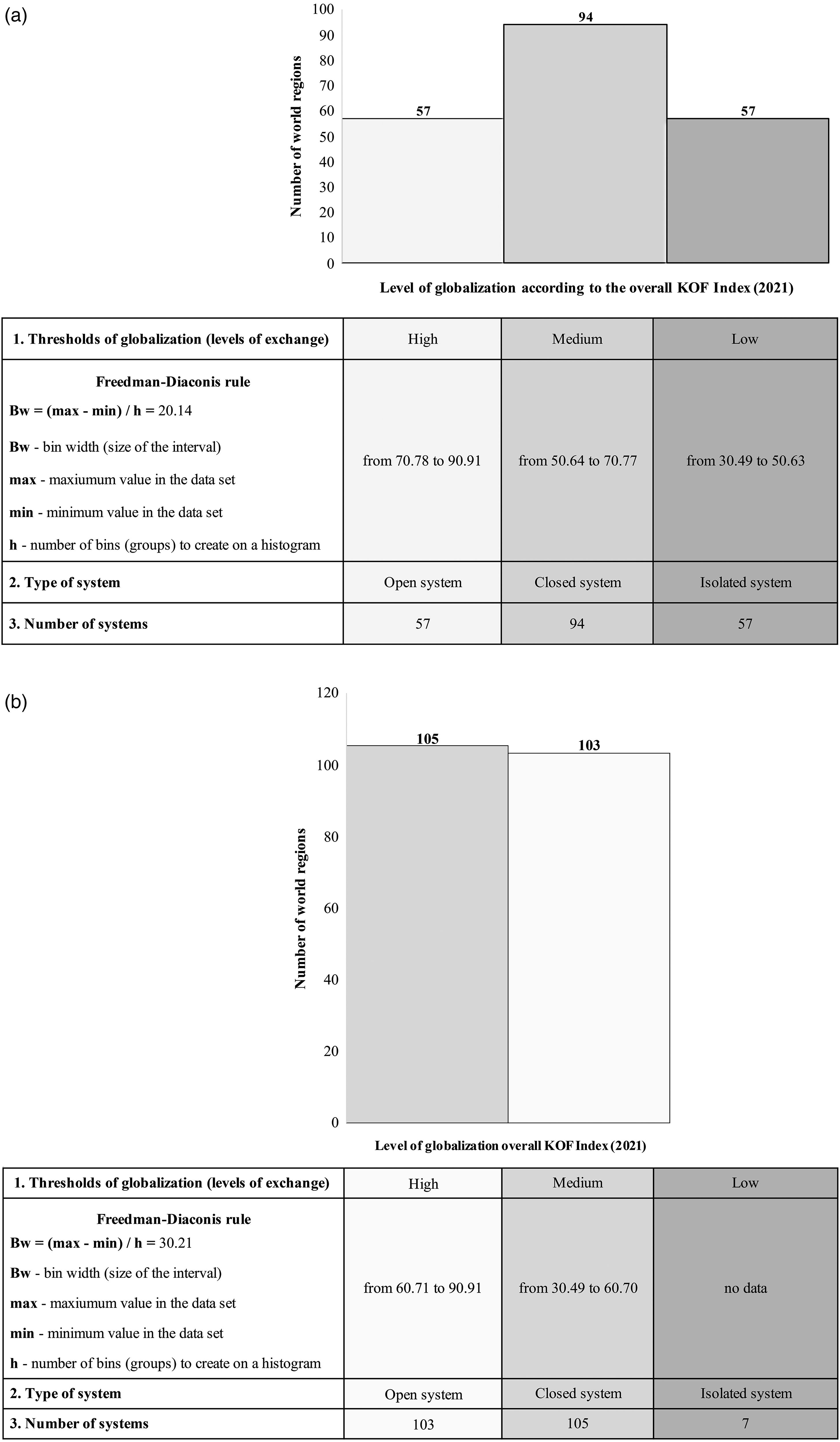
To build Figure 4a, we used data for 197 countries and 11 geographical regions and for their performance on the overall KOF Globalisation Index that measures the level of political, economic, and social openness of world regions (Gygli et al. 2019; KOF Swiss Economic Institute 2022). To generate a histogram with three distinctive levels of environmental exchange intensity (low, medium, and high), we relied on the rule of Freedman and Diaconis (1981), whose application does not necessarily require all 208 observations in the dataset to be normally distributed. Interestingly, the number of countries and regions with low and high levels of exchange are the same (57), and those with medium levels represent the highest segment on the histogram (94). A detailed list of the countries and geographical regions with characteristics of open, closed, and isolated systems is presented in Appendix 1 (see Tables 1.1, 1.2, and 1.3). For example, Switzerland ranks second worldwide on the overall KOF Globalisation Index, with a score of 90.45 out of 100. However, we do not believe that a system can be 100% open or 100% isolated; we consider that regardless of the high level of overall openness of a system in its core, a system is always relatively closed due to priorities and redlines, and the question is to identify which these are. For Switzerland, some of these redlines, at the time of writing, can be related to its war-neutrality policy. Moreover, regardless of the low level of overall openness of a system, it always has at least one peripheral layer open for exchange. For example, Somalia has the lowest score on the overall KOF Globalisation Index (30.49 out of 100), but still maintains certain international relationships and is, therefore, engaged to a certain extent in environmental exchange. For example, the World Bank (2018) established a program called “Country partnership framework” to consolidate Somalia and its relationships with the rest of the world. Moreover, this form of isolation closely resembles an adiabatic thermodynamic system, a special closed system where no heat energy can be exchanged, but work can still be done on the system.
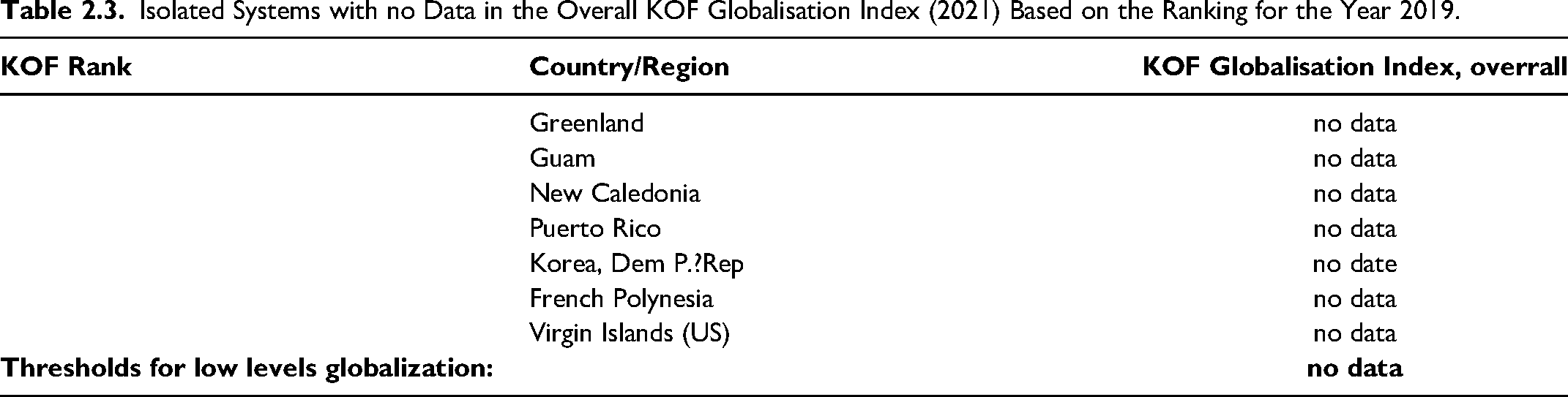
A potential limitation of the above conclusions in distinguishing between the three types of systems is due to the fact that the overall KOF Globalisation Index does not provide data on the performance of Greenland, Guam, New Caledonia, Puerto Rico, North Korea, French Polynesia, and Virgin Islands. Therefore, if we assume that some or all of these geographical regions have deliberately decided not to send any data to the KOF Swiss Economic Institute (e.g., no data is available for North Korea since 2009), we can classify them by default as isolated systems and divide the 208 observations into two categories to identify only the open and closed systems in the dataset (see Appendix 2, Tables 2.1, 2.2, and 2.3). In this case, the number of countries and regions with high or moderate levels of exchange are almost the same, which still justifies studying closed systems as a relatively important phenomenon in the twenty-first century (see Figure 4b). Moreover, as discussed previously, we do not believe in 100% open or isolated systems. Therefore, though in our second established classification, we interpreted world regions with no data on the overall KOF Globalisation Index as isolated ones, this does not mean that they have absolutely zero environmental exchange. For example, even North Korea, long described as “a hermit nation” (Griffis 1882/2015) governed through an extreme form of autarkic (self-reliance) system, still has some forms of exchange with the rest of the world, such as diplomatic relationships and participation in international organizations (The World Factbook 2022). Moreover, for us, this form of isolation closely resembles a cyclic thermodynamic system, a special case of an isolated system where a set of processes called “cyclic processes” leave the system in the same state as it started.
To conclude, we have presented so far the initial evidence on the relative importance of closed and isolated macromarketing systems by analyzing the overall level of openness (globalization) of countries and world regions. In the following subsection, we will discuss some marketing applications of the first and second laws of chemical thermodynamics to closed and isolated marketing systems.
Chemical Thermodynamics Laws in Closed and Isolated Marketing Systems
Although presently no empirical evidence supports applying the laws of thermodynamics to social systems, some researchers suggest that they can be still used to develop theoretical frameworks and ideas for better understanding and managing physical processes and systems that human beings heavily rely on (Jantsch 1975; Nicolis and Prigogine 1977; Reidenbach and Oliva 1983). Moreover, viewing some marketing phenomena as closed and isolated chemical systems allows researchers to create useful analogies about their origins, structures, and functioning, which is why some are discussed in the following subsections.
First Law of Chemical Thermodynamics
The first law of chemical thermodynamics states that energy can neither be created nor destroyed in an isolated system; it can only be transformed. Similarly, the law of conservation of mass which was the first law of conservation established in science states that mass can neither be created nor destroyed in an isolated system; it can only be transformed. For example, the famous English economist Alfred Marshall (1890/2013) claims that in the exchange with the environment, human beings behave as isolated systems, as they are incapable of creating new matter; rather they simply modify the level of utility of the existing matter: “Man cannot create material things. In the mental and moral world indeed he may produce new ideas; but when he is said to produce material things, he really only produces utilities; or in other words, his efforts and sacrifices result in changing the form or arrangement of matter to adapt it better for the satisfaction of wants. All that he can do in the physical world is either to readjust matter so as to make it more useful, as when he makes a log of wood into a table; or to put it in the way of being made more useful by nature, as when he puts seed where the forces of nature will make it burst out into life” (p. 53).
The laws of conservation are based on the general principle that when we know what cannot happen, we better predict what will happen. We believe that these laws can be successfully applied in contingency marketing planning to help countries understand how to maintain competitiveness and profitability during uncertain times and to forecast various turbulent events (e.g., pandemics, sustainability crises, and wars/conflicts). For example, as the primary role of macromarketing has always been to save the world, and the world still needs to be saved (Wooliscroft 2020), even more than ever before according to the latest update of the Doomsday clock (Bulletin of the Atomic Scientists 2023), we believe that contingency planning is one of the main tools that macromarketers can use to accomplish their mission, as presented in the following subsection.
Second Law of Chemical Thermodynamics
The second law of chemical thermodynamics is one of the most important laws in science, as “it provides a foundation for understanding why any change occurs” (Atkins 2007, p. 49). It introduces the concept of entropy as an advanced property of a system. According to the second law of chemical thermodynamics, the total entropy, a measure of the level of disorder in a closed or an isolated system (and defined here as “the entropy of the universe”) can never change negatively; it can either increase over time or stay the same (
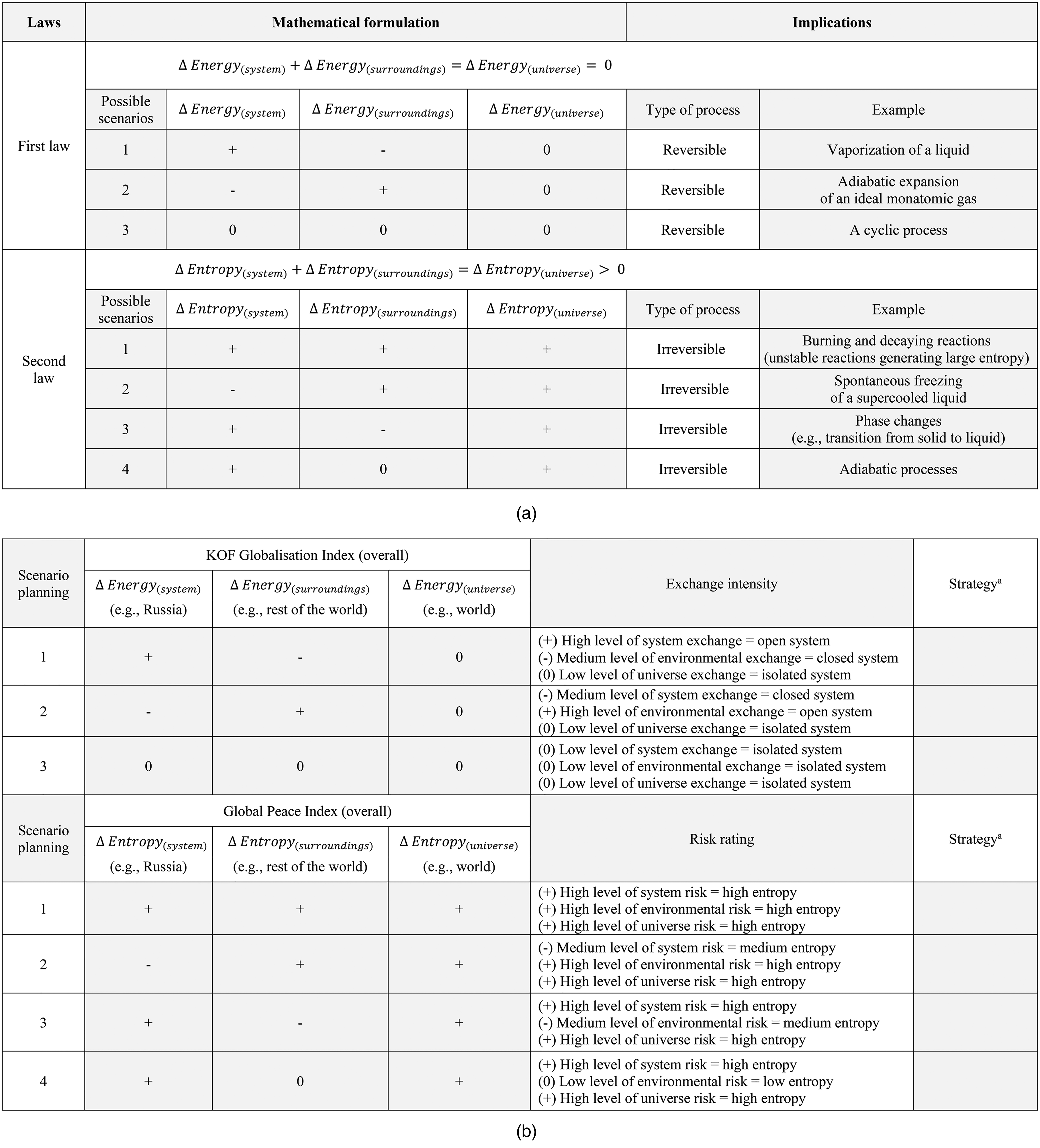
(a) Mathematical formulations and implications of the first and second laws of chemical thermodynamics. Source: We have prepared this figure based on Ott and Boerio-Goates (2000, pp. 90–92). (b) Application of the first and second laws of chemical thermodynamics to contingency planning. a Sections related to the selection of appropriate strategies are intentionally left empty. These are potential research questions/gaps that may become the foci of future studies.
In line with the scope of the journal, we present here some ideas on the potential applications of the two laws to macromarketing systems. Following the logic of these two laws, as well as the earlier presented idea for the transition of marketing systems from an open state to a closed state and from a closed state to an isolated one (see Table 1), we may understand what happened in the context of the current war between Ukraine and Russia, what initiated the transition of Russia from an open to a closed state, and what may be the consequences of the country's isolation due to international restrictions?
As discussed in subsection 2.1, based on its overall performance on the KOF Globalisation Index, Russia was an open system as of 2019 (see Appendix 1, Table 1.1.). However, as the country's redlines have been crossed (e.g., the perception of the increased threat of US influence in Ukraine and the possible Ukrainian membership of NATO), we believe that Russia moved toward a closed state when invading Ukraine in 2020, as it resulted in a reduction of its levels of exchange with the rest of the world (many countries from the rest of the world). Although more recent data are not available on the KOF Globalisation Index so that we can provide a more substantial proof of our claims, we base our assumptions on the following facts: 1) when we identified Russia to be an open system earlier, it was already at the bottom of the ranking of open systems (it ranked 51 out of 57 countries and world regions) with a score of 72.03 that was only slightly higher than the KOF threshold of 70.77 for not being classified as a closed system (see Table 1.1. in Appendix 1); 2) since the beginning of the war, Russia significantly degraded its performance on many indicators used to calculate the KOF Globalisation Index. For example, some structural elements used in calculating the aggregated KOF Globalisation Index involve political, social, and economic indicators such as trade regulations and tariffs, foreign direct investments, international reserves, embassies, McDonald's restaurants, Ikea stores, international tourism, and treaty partner diversity; all such indicators were significantly impacted since the beginning of the war (BBC 2022). 1
The current political and economic restrictions imposed on Russia by many countries aim at moving Russia from the state of a closed system to that of a completely isolated system in a manner that obeys the first law of thermodynamics, where the energy and matter in an isolated system (e.g., money, military forces circulating in the country, or the economic power in general) cannot change. Moreover, the second law of thermodynamics states that the level of disorder in an isolated system cannot be reduced (it can either increase or remain stable), which may result in significant system malfunctioning. In Figure 5b, we present a basic contingency plan inspired by the two laws and based on the following assumptions: 1) the overall KOF Globalisation Index is used as a measure of the energy exchange; 2) the Global Peace Index (GPI) is used as a measure of entropy because it is “the world's leading measure of national peacefulness ….. [it] measures the state of peace across three domains: the level of societal Safety and Security; the extent of Ongoing Domestic and International Conflict; and the degree of Militarisation” (Institute for Economics & Peace 2022, p. 2). The higher the score on this index, the higher the entropy, and vice versa; 3) Russia's behavior is viewed as a reversible system process in terms of its energy exchange (
If we refer to the three possible scenarios of the first law, as presented in Figure 5b, we can conclude that in terms of its exchange with the rest of the world, Russia can either stay open, closed, or isolated and each of these states are reversible. According to the first scenario, when it decides to behave as an open system, the rest of the world (surroundings) will still be closed for exchange, so the law of conservation holds true. According to the second scenario, if Russia decides to initiate its closure for exchange with the rest of the world, the rest of the world can still decide to exchange to a certain extent with Russia, probably to avoid political tensions, war, and conflicts, or simply due to energy dependency. Both scenarios describe what we call a “frenemy exchange” in which neither of the two parties dare to break the established relationships. The third scenario suggests that both Russia and the rest of the world act separately from one another as isolated systems and independent entities (although even in isolated systems, certain diplomatic relationships can still be maintained). In neither of the three scenarios can the exchange be viewed as a friendly one (associated with a simultaneously high exchange from both sides).
Now, we look at the four possible scenarios of the second law. It should be noted that the entropy of a system or surroundings can individually decrease, although the total entropy in the universe will always increase. In fact, as presented in Scenarios 2 and 3, entropy can decrease in one part of the universe (either in
Scope of Application and Future Research Agenda
This subsection presents a classification framework of the potential areas of application of the chemistry of marketing by extending its scope to a wider spectrum of business phenomena (not only limited to slowbalization and deglobalization) that may also be associated with closed and isolated systems on macro, meso, and micro levels (in a country, industry, and company/individual setting). As suggested by Ostrom (1990), “[t]he power of a theory is exactly proportional to the diversity of situations it can explain” (p. 24). Moreover, by doing this, we try to partially challenge another conventional misconception that open systems represent the highest evolutionary stage of marketing systems (Dowling 1983), and that most extant marketing models should be exclusively developed for open systems (Layton 2007, 2015, 2019). We conclude this subsection by providing a short list of questions that can hopefully inspire other researchers to contribute to the field.
Macromarketing
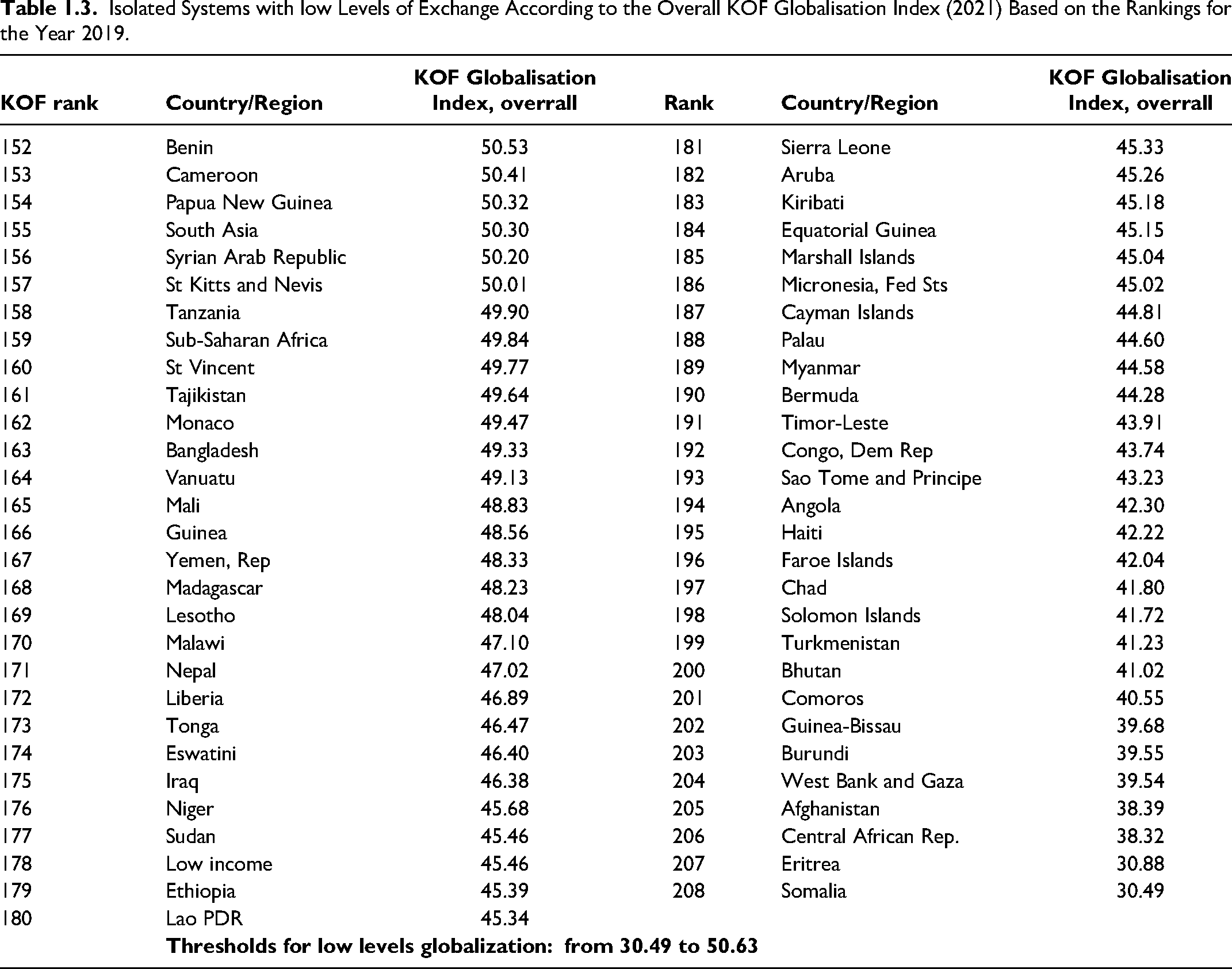
According to the overall KOF Globalisation Index, the top 10 least globalized countries are: Somalia, Eritrea, Central African Republic, Afghanistan, the West Bank and Gaza, Burundi, Guinea-Bissau, Comoros, Bhutan, and Turkmenistan (see Appendix 1, Table 1.3). However, each of these geographical regions also represents important areas of marketing research (e.g., marketing of war, marketing of terrorism, cult branding, sustainable marketing, and place branding). Apart from Bhutan, these countries have all experienced civil wars and multiple coups since the beginning of the twenty-first century. For example, on a ranking of the potential risk of terrorism, Afghanistan ranks 1st, Somalia 5th, Central African Republic 16th, and Burundi 35th (Institute for Economics & Peace 2020). Bhutan, the “world's first—and only—carbon-negative country,” is recognized as the greenest country worldwide and the developer of the Gross National Happiness Index (Love 2017). Unsurprisingly, Boulding (1966) compares the current state of the world economy to an open system disposing infinite resources, and predicts that in the future it will resemble a closed system with limited resources: “[t]he closed economy of the future might similarly be called the ‘spaceman’ economy, in which the earth has become a single spaceship, without unlimited reservoirs of anything, either for extraction or for pollution, and in which, therefore, man must find his place in a cyclical ecological system which is capable of continuous reproduction of material form even though it cannot escape having inputs of energy…. The essential measure of the success of the economy is not production and consumption at all, but the nature, extent, quality, and complexity of the total capital stock, including in this the state of the human bodies and minds included in the system” (pp. 7–8). His idea becomes foundational to the frameworks of demarketing (Kotler and Levy 1971), responsible consumption (Fisk 1973), and a circular economy (Pearce and Turner 1989), each of which plays a pivotal role in sustainable marketing today.
Mesomarketing
Closed and isolated systems may also play important roles in mesomarketing. Kotler (1986) used the term “blocked markets” to explain that “[a]s they mature, markets acquire a fixed set of suppliers, competitors, distributors, and customers. These players develop a vested interest in preserving the market's closed system and seek to protect it against intruders. They are often supported by government regulatory agencies, labor unions, banks, and other institutions. They may erect visible and invisible barriers to entry: taxes, tariffs, quotas, and compliance requirements” (p. 118). For example, in monopolistic and publicly owned industries (e.g., retailing of liquified petroleum gas), the transition from conventional to closed distribution systems is an essential part of the value creation process (Mittal, Agarwal, and Selen 2018). Moreover, horizontally and vertically integrated systems, prevailing during the latest industrial revolution (also known as Industry 4.0), enable companies to generate organizational synergy and gain a sustainable competitive advantage in the value chain (Pérez-Lara et al. 2020). Frank, Dalenogare, and Ayala (2019) define Industry 4.0 as the new stage at which the following emerging industrial technologies are converging to deliver digital solutions: 1) base technologies (i.e., IoT, big data, cloud and analytics) and 2) front-end technologies (i.e., smart supply chain, smart working, smart manufacturing, and smart products). In a conventional marketing system, each participant (e.g., member of the supply chain) tries to maximize its own value, but in an integrated marketing system, the goal is to maximize the overall value of the entire system. A systematic literature review dedicated to IoT ecosystems identifies the following evolutionary paths of the business models: “opening up the ecosystem for industry collaboration, replicating the solution in multiple services and return to closed ecosystem as technology matures” (Leminen et al. 2018, p. 758). The main idea here is that IoT emerges with closed systems trying to open up, and once they do, they try to close “by taking a platform leadership and encouraging other service providers to create applications and services for their platforms” (Leminen et al. 2018, p. 761).
Micromarketing
Closed and isolated systems may have important implications for micromarketing. For example, in segmentation, these systems are sometimes associated with ethnic minorities, immigrants, refugees, criminals, medical deserts, and other marginalized communities and subcultures that cannot—or do not, deliberately—evolve or adapt to a host/prevailing culture (e.g., Amish community or self-proclaimed republics like Transnistria which even has its own unofficial currency). These segments have specific needs, habits, and behaviors and therefore, can represent a distinctive and substantial market segment with a latent demand (e.g., for health care, transportation, and education). Moreover, closed and isolated systems can also be observed at individual human levels (e.g., the psychological effects of deliberate or forced isolation). For example, there are 11 million prisoners worldwide (a 20% increase since the beginning of this century); this population represents a major challenge globally in managing various health-related conditions of the men, women, children, and disabled people inside prisons (Penal Reform International 2020). Simultaneously, this represents a huge marketing opportunity for pharmaceutical, healthcare, and wellness organizations.
Closed and isolated systems are also gaining importance in the digital world. For example, most social networks allow their users to create private and secret groups to share sensitive information (e.g., health-related support groups or groups regarding alternative sexuality, medicine, religion, or politics). Depending on local legislations and the data privacy policy of the platform, these groups can be targeted by online marketers and require a special regulation from policymakers. Bleier, Goldfarb, and Tucker (2020) used the term “walled gardens” in reference to “closed ecosystems, controlled by a single operator” where consumers look for privacy (e.g., the App Store and anti-tracking features of the Safari browser provided by Apple). Godin (2011) introduces the term “marketing of conspiracy theories” in reference to the kind of marketing that targets “people conspiring together, sometimes in secret.” These are individuals who are fascinated by theories, rather than objective facts, and for whom marketing provides comfort by “selling” doubts, instead of evidence. For example, private Facebook groups were used by Donald Trump's supporters to plan the attacks on the United States Capitol building (Collier 2021). Frances Haugen, a former product manager at Facebook, recently revealed some secrets behind the platform's algorithms, one of which was that the company capitalized on hateful messages and misinformation shared by some users, thus compromising overall user safety for higher profits (Mac and Kang 2021). According to a report issued by the Centre for Countering Digital Hate, there are 31 million anti-vaccine group members, an important source of annual revenue for social media owners—around US $1 billion (Burki 2020). Finally, a recent study relied on meta-analysis to measure that the effectiveness of the loyalty programs implemented over the last 40 years showed that closed enrollment programs were more effective than open ones, which had little impact on customer loyalty (Belli et al. 2022).
To conclude, as presented in Table 3, a wide spectrum of important marketing phenomena on macro, meso, and micro levels may be associated with closed and isolated systems, which is why they deserve the full attention of the academic community in describing their internal processes.
Phenomena Associated with Closed and Isolated Systems and Their Potential Areas of Marketing Applications.
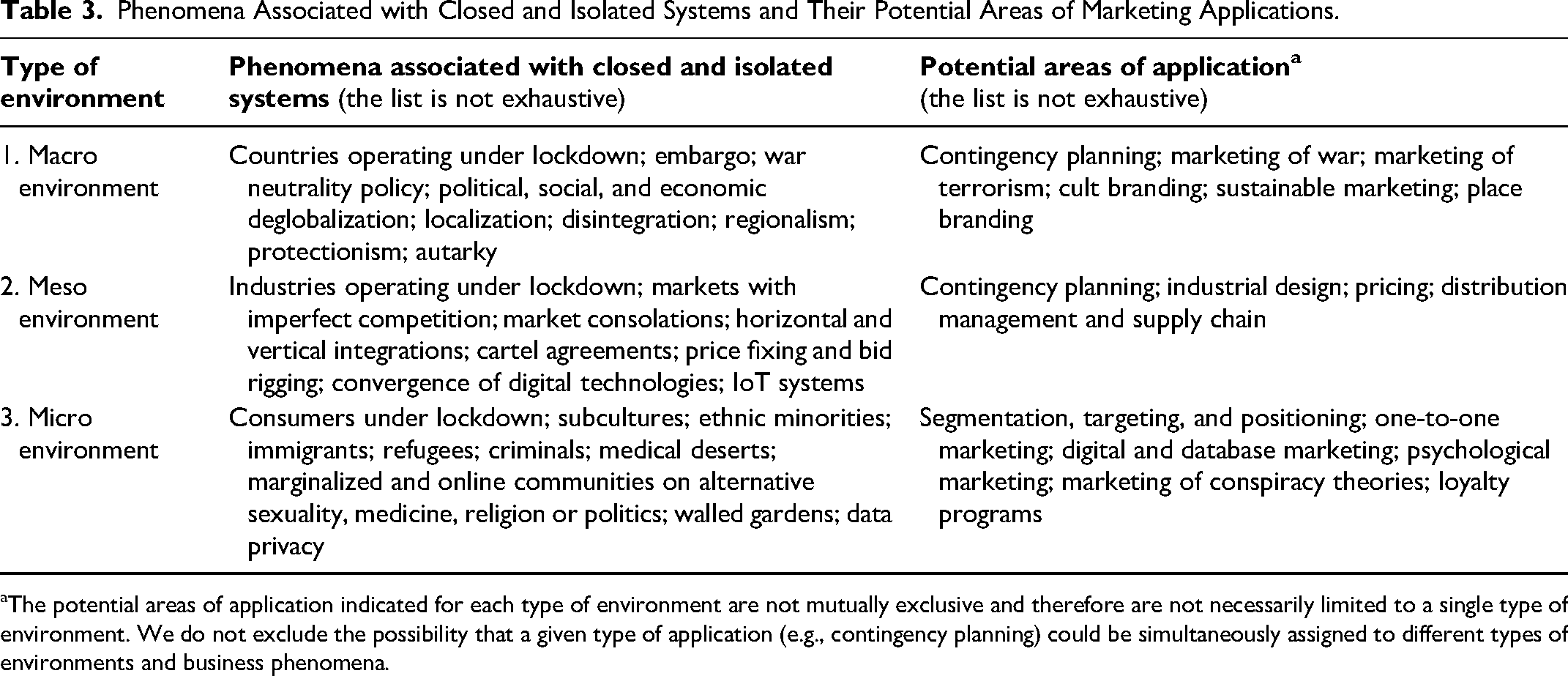
The potential areas of application indicated for each type of environment are not mutually exclusive and therefore are not necessarily limited to a single type of environment. We do not exclude the possibility that a given type of application (e.g., contingency planning) could be simultaneously assigned to different types of environments and business phenomena.
Directions for Future Research
Some important questions worth studying in the chemistry of marketing are as follows:
What are the environmental determinants and consequences of the growing importance of closed and isolated systems, and the transition of open systems into closed and isolated ones? Under what environmental conditions can closed and isolated systems exist as viable business models and/or outperform (or be more competitive than) open systems? For example, Layton (2011) states that “it is also possible that disaster, whether due to causes such as nature, war, disease, or simply a consequence of systemic collapse brought about by a combination of internal dynamics and failures in external environmental regulation or control, may reduce a sophisticated marketing system to something close to autarchy [a system where individuals or households are primarily self-sufficient]” (p. 265). During COVID-19, many countries decided to reduce their exchanges partially or completely with the rest of the world and implement national lockdown policies, and therefore adopted a behavior typical of closed and isolated systems. It would be interesting to study the efficiency of these restrictive national policies and how they can be optimized by applying the classic efficiency enhancement models from chemical thermodynamics that we mentioned earlier in Table 2 (e.g., Carnot and Stirling cycles of maximum energy efficiency, Helmholtz, or Gibbs free energy). Which measurable factors and outcomes can be successfully integrated into mathematical models (and into which ones) to predict the transition from open to closed and isolated systems? For example, Layton and Duffy (2018) demonstrated that “all marketing systems, whether micro, meso or macro in scale and level, exhibit path dependence” (p. 400), and their future states are dependent on their past. Therefore, we believe that the various mathematical models on path dependency (and hysteresis) traditionally used in chemical engineering and adopted to the economic literature (Arestis and Sawyer 2009) may also be applied to forecast the non-linear behavior of marketing systems. Qualitative studies may also be beneficial in the chemistry of marketing for identifying behavioral patterns or potential factors and outcomes prior to measuring them or integrating them in above mentioned quantitative models. For example, Hedlund (2005) demonstrated that “Russian historical development has been marked by powerful patterns of path dependence, by which institutional solutions that emerged in distant Muscovy [in fifteenth- and sixteenth-century] have been reproduced over time” (p. 263) which impedes Russia to make a complete and durable transition to a free market economy. How can the three types of systems (i.e., open, closed, and isolated) co-exist, what are the particularities of each type of co-exchange, and what is the potential for value co-creation? As discussed previously, marketing occurs whenever there is an exchange between two or more parties (Kotler and Armstrong 2020). However, as for us, the value co-creation varies depending on the types of systems involved in the exchange process, and a high level of exchange may not necessarily reflect a high co-created value. For example, it would be interesting to study if the co-created value resulting from an exchange between countries experiencing slowbalization (closed systems) and/or deglobalization (isolated systems) can outperform the co-created value resulting from an exchange between the globalized countries conventionally associated with high levels of environmental exchange (open systems)? What are the marketing equivalents of mass and energy exchanges (e.g., tangible and intangible products or others)? Which marketing phenomena obey the first and/or second laws of chemical thermodynamics, what are the implications for business, societies, and policymakers, and how can these phenomena be modeled in scenario planning, performance management, and market differentiation? For example, “[i]n thermodynamics, efficiency is one of the most frequently used terms to indicate how well energy is converted into useful work….. Energy efficiency (i.e., ratio of output energy to input energy) is primarily based on the 1st law of thermodynamics. It helps to understand the system's behaviour to some extent and provides the relative magnitude of energy losses” (Munir, Yu, and Young 2014, p. 1131). Similarly, in marketing, transvection is a term used “to convey the meaning of ‘flowing through,’ with special reference to something which flows through a marketing system in one end and out the other……A transvection includes the complete sequence of exchanges, but it also includes the various transformations that take place along the way (Alderson and Martin 1965, p. 118). It is a basis of differential advantage and in a way a measure of a system's efficiency. Therefore, the concepts of energy exchange and transvection may be metaphorically related through the concept of efficiency to study the possible applications (lawlike generalizations) of the law of conservation of transvection. Which other chemistry-related concepts, laws, and principles can predict the (de)evolution of closed and isolated marketing systems on macro, meso, and micro levels? For example, “[m]ost physical and chemical reactions and most social systems do in fact exhibit a tendency to equilibrium – otherwise the world would have exploded or imploded long ago” (Boulding 1956, p. 203). Le Chatelier's principle on chemical equilibrium states that a closed or isolated system at equilibrium always works to restore its equilibrium state when exposed to a stress impact (e.g., a change in concentration, temperature, or pressure). To the best of our knowledge, its business applications have been so far limited to the study by Samuelson (1960), who developed a mathematical model of economic equilibrium to explain how to minimize costs and maximize profits in a small price change scenario. Therefore, we believe that significant advancements in technology and availability of extensive data in the twenty-first century may enable this principle to inspire other mathematical models. These models could reveal optimal strategies for restoring the equilibrium of a closed or isolated marketing system affected by outcome variables other than profitability and factors other than price. Moreover, contrary to conventional economic theory, which views market equilibrium in reference to the laws of supply and demand, a marketing system can be in a state of disequilibrium when it is simply unable to deliver customer satisfaction at a profit. The definition of equilibrium in a marketing system can even go beyond that in an economic system. In the context of more complex marketing systems (e.g., sustainability of marketing systems), we can even claim that the impossibility of a system delivering sustainable customer value (e.g., value to society, environment, consumers, or the company itself) can result in a state of disequilibrium across the entire system. Therefore, Le Chatelier's principle may have important implications for closed and isolated marketing systems.
Conclusion
Grand theories are still missing in marketing, as most studies are dedicated to specialized, narrow-in-scope marketing problems (Wierenga 2021) that researchers continuously try to solve by applying the same theories, models, and methods again and again (Paul et al. 2019). A bibliometric analysis by Clark et al. (2014) even showed that marketing is the least influential of the business disciplines (i.e., finance, accounting, and management). This is partially because, due to strong pressures associated with conformity (e.g., having a successful academic career, receiving grants, and publishing in high-impact journals), “research communities sometimes become closed systems” and journal editors —“guardians of the faith” (gatekeepers of the prevailing empiricist paradigm) which can become a threat to the primary scientific vision of “the autonomous, objective, and open-minded researcher, creatively and doggedly pursuing the truth” (Arndt 1985, p. 19). However, “as time passes, anomalies may arise for which normal science fails to provide adequate answers. When such anomalies build up and scientists are losing faith, the field enters the crisis stage. This culminates in a scientific revolution, and a new paradigm emerges” (Arndt 1985, p. 14).
This study partially challenged the conventional paradigm of the open nature of marketing systems by presenting initial evidence on the relative importance of closed and isolated macromarketing systems. It suggested that by default, every system (at its core) should be viewed as a relatively closed one (as every system is closed for certain compromises regardless of its general level of openness) and no system is completely isolated from the environment (as there is always at least one peripheral layer open for exchange). Whenever some of these redlines are crossed (a system's core is threatened), a system becomes relatively closed by closing some of its periphery borders for exchange. Moreover, inspired by chemistry, whose laws are only applicable to closed and isolated systems, we discussed a holistic framework for establishing a metaphoric transfer from chemical thermodynamics to marketing and demonstrated how some important business phenomena may be better managed by individuals, companies, and policymakers if they are studied from the perspective of their closedness and isolation as systems obeying certain thermodynamics laws. By doing this, we introduced a new interdisciplinary research area which we refer to as the “chemistry of marketing,” highlighted its potential areas of application and future research directions, in an attempt to develop marketing one step further from both the theoretical and practical perspectives and therefore extend its conventional boundaries.
We did not develop specific mathematical models because as mentioned by Shugan (2003), chemistry tends to produce interdisciplinary contributions more oriented toward problem-solving than procedure developments (e.g., chemical physics, photochemistry, nanotechnology, and organometallic) and marketing models are often context-dependent (Stremersch et al. 2023). Therefore, future studies can contribute in this direction by developing appropriate models and empirically validating them. Moreover, the applications of chemistry in marketing can go beyond those discussed in reference to closed and isolated systems because chemistry is a mature scientific field, and “[t]here is no shortage of problems to which chemists can contribute solutions” (Nature 2011, p. 5). For example, an interesting paradox is that, although human relationships are often colloquially associated with chemistry, chemical bonding theories have not yet been applied in the relationship marketing context to better explain the nature, characteristics, and types of business relationships. Similar to chemistry, where catalysis is the process of adding substances in relatively small doses (catalysts) to speed up or slow down a chemical reaction, in the business world, certain marketing tools can also serve as catalysts to achieve certain business outcomes more quickly or slow down certain undesirable processes. Therefore, catalytic effects and mechanisms in chemical reactions can also be investigated in relation to marketing.
Footnotes
Appendix 1
Isolated Systems with low Levels of Exchange According to the Overall KOF Globalisation Index (2021) Based on the Rankings for the Year 2019.
|
|
|
|
|
|
|
|---|---|---|---|---|---|
| 152 | Benin | 50.53 | 181 | Sierra Leone | 45.33 |
| 153 | Cameroon | 50.41 | 182 | Aruba | 45.26 |
| 154 | Papua New Guinea | 50.32 | 183 | Kiribati | 45.18 |
| 155 | South Asia | 50.30 | 184 | Equatorial Guinea | 45.15 |
| 156 | Syrian Arab Republic | 50.20 | 185 | Marshall Islands | 45.04 |
| 157 | St Kitts and Nevis | 50.01 | 186 | Micronesia, Fed Sts | 45.02 |
| 158 | Tanzania | 49.90 | 187 | Cayman Islands | 44.81 |
| 159 | Sub-Saharan Africa | 49.84 | 188 | Palau | 44.60 |
| 160 | St Vincent | 49.77 | 189 | Myanmar | 44.58 |
| 161 | Tajikistan | 49.64 | 190 | Bermuda | 44.28 |
| 162 | Monaco | 49.47 | 191 | Timor-Leste | 43.91 |
| 163 | Bangladesh | 49.33 | 192 | Congo, Dem Rep | 43.74 |
| 164 | Vanuatu | 49.13 | 193 | Sao Tome and Principe | 43.23 |
| 165 | Mali | 48.83 | 194 | Angola | 42.30 |
| 166 | Guinea | 48.56 | 195 | Haiti | 42.22 |
| 167 | Yemen, Rep | 48.33 | 196 | Faroe Islands | 42.04 |
| 168 | Madagascar | 48.23 | 197 | Chad | 41.80 |
| 169 | Lesotho | 48.04 | 198 | Solomon Islands | 41.72 |
| 170 | Malawi | 47.10 | 199 | Turkmenistan | 41.23 |
| 171 | Nepal | 47.02 | 200 | Bhutan | 41.02 |
| 172 | Liberia | 46.89 | 201 | Comoros | 40.55 |
| 173 | Tonga | 46.47 | 202 | Guinea-Bissau | 39.68 |
| 174 | Eswatini | 46.40 | 203 | Burundi | 39.55 |
| 175 | Iraq | 46.38 | 204 | West Bank and Gaza | 39.54 |
| 176 | Niger | 45.68 | 205 | Afghanistan | 38.39 |
| 177 | Sudan | 45.46 | 206 | Central African Rep. | 38.32 |
| 178 | Low income | 45.46 | 207 | Eritrea | 30.88 |
| 179 | Ethiopia | 45.39 | 208 | Somalia | 30.49 |
| 180 | Lao PDR | 45.34 | |||
|
|
|||||
Appendix 2
Isolated Systems with no Data in the Overall KOF Globalisation Index (2021) Based on the Ranking for the Year 2019.
|
|
|
|
|---|---|---|
| Greenland | no data | |
| Guam | no data | |
| New Caledonia | no data | |
| Puerto Rico | no data | |
| Korea, Dem P.?Rep | no date | |
| French Polynesia | no data | |
| Virgin Islands (US) | no data | |
|
|
|
|
Acknowledgments
The authors take full responsibility for any possible mistakes or inaccuracies remaining in the article but would like to sincerely thank the Editor-in-chief of the Journal of Macromarketing, Dr. Joseph Sirgy, Special issue editor, Dr. Ben Wooliscroft, and the two anonymous reviewers whose constructive comments and recommendations have been extremely valuable for improving the initial version of the manuscript. The authors are also grateful to Editage for their continuous editorial support and to Dr. Carl Scheisser for reviewing the chemistry-related part of the manuscript and providing them with valuable insights. Dobromir Stoyanov would explicitly like to thank Dr. Julia Uzunova, a full-time professor at the University of Economics - Varna, Bulgaria, for teaching him 15 years ago the insightful course on International Marketing and being the first and the only one to explain to him the topics of “marketing of war” and “marketing of terrorism,” in relation to the General System Theory.
Author Contributions
All authors equally contributed to the conception and design of the paper.
Associate Editor
Ben Wooliscroft.
Declaration of Conflicting Interests
The authors declared no potential conflicts of interest with respect to the research, authorship, and/or publication of this article.
Funding
The authors received no financial support for the research, authorship, and/or publication of this article.
Notes
Author Biographies
 .
.
.
.