




Abstract
The authors introduce meta-analysis as a compelling tool for macromarketing research in an increasingly complex and data-driven world, and share an example of its application. They synthesize and generalize empirical findings on the relationships between marketing systems (MS) and quality-of-life (QOL), two concepts integral to macromarketing. Results indicate dimensions of MS are positively associated with QOL, suggesting that marketing systems enhance consumer well-being across contexts and metrics. The promotion dimension of MS has the highest correlation with QOL; the strongest positive MS-QOL relationship was estimated for personal health. Measurement, cultural, and socioeconomic factors that affect the strength of MS-QOL relationships also were assessed. Results suggest the association between MS and QOL is stronger in studies based on primary/subjective measures of QOL constructs, in samples drawn from developed economies, and in more indulgent, uncertainty-tolerant, and long-term-oriented cultures. Implications for theory, policy, practice, and opportunities for further research are discussed.
Introduction
Marketing systems and quality of life (QOL) are existentially crucial to Homo sapiens (e.g., McMillan 2003; Shultz 2007), and thus generate keen interest among Macromarketing scholars. Indeed, marketing systems and QOL are foundations of the Macromarketing discipline (e.g., Domegan 2010; Fisk 1967; Layton and Grossbart 2006) and the genesis of the Journal of Macromarketing (e.g., Fisk 1981; Hunt 1981). Moreover, these foci have been “core” to the discipline for more than 60 years (e.g., Alderson 1957; DeQuero-Navarro, Stanton, and Klein 2021; Layton 2007; Lee and Sirgy 2004; Shapiro and Layton 2019), and are regularly featured in the Journal as it embarks upon its fifth decade of publishing impactful research (e.g., Domegan et al. 2020; Laczniak and Shultz 2021; Sirgy 2021).
Better understanding of marketing systems and QOL will require new tools and a new generation of scholars who can apply those tools. Toward those outcomes and in response to a recent call for papers seeking manuscripts that emphasize, identify and implement meaningful quantitative methods to explore macromarketing topics (e.g., DeQuero-Navarro et al. 2022b; see also Layton and Duffy 2018), we have assembled an author-team composed of diverse international researchers. The team's objective is twofold. First, to introduce and to spark interest in meta-analysis as an appropriate research method for the rigorous scholarly study of marketing systems and QOL – and potentially other complex macromarketing constructs and their measures. Second, and again as encouraged in the call for papers, to meaningfully engage junior scholars and doctoral students in the process of macromarketing research design, administration, analysis, reporting and writing (in a second or third language), manuscript review, revision(s) and resubmission(s), and the joys and professional benefits of a publication in a leading scholarly journal.
Going forward, the importance of meta-analysis to macromarketing cannot be overstated. Exponential growth in measures and data, quality of data, nuances and complementarity of data, and greater access to data necessitate methods that can help us to make sense of vast amounts of information. Meta-analysis can enhance research capabilities and insights, and subsequently policies and practices throughout and across marketing systems, ultimately enhancing well-being for as many stakeholders – people – as possible and the survival of our delicate biosphere. Conceptually, we explore the relationship between Marketing Systems, broadly defined as a network of market actors who are engaged in dynamic economic exchanges and who create assortment and value demanded by customers (Domegan et al. 2019; Shapiro and Layton 2019) and Quality-of-Life (QOL) metrics that capture various aspects of well-being and overall satisfaction with life (Sirgy 2021). Practically, we provide empirical generalization of the findings from empirical studies on the concept and we estimate effect size for the MS-QOL relationship.
In the sections that follow, we provide a brief overview for the conceptual background of QOL Theory and Marketing Systems and posit these macromarketing subdisciplines are compelling foci for meta-analysis. We describe meta-analysis, including its underpinnings and procedures. We then present a novel study administered by the research team to illustrate meta-analysis of relevant studies that can enhance understanding of macromarketing phenomena in the forms of QOL and marketing systems. Finally, we share and discuss results and findings, and conclude with considerations for further, impactful macromarketing research.
Conceptual Background
Quality of Life
Quality of Life (QOL) is an established concept in the social sciences that includes consumer welfare and social well-being. In Macromarketing, QOL reflects well-being of consumers, communities, societies, countries, and other stakeholders (DeQuero-Navarro, Stanton, and Klein 2021) and may manifest at both secondary levels (e.g., wealth and access to high quality market offerings) (Mullen et al. 2009) and subjective levels (e.g., perceptions of life satisfaction) (Ekici and Peterson 2009), as seen in Table 1. Peterson (2006) suggested advancing QOL research using Macromarketing lenses and adopting a focus on societal development; this approach may be used to examine macrophenomena, such as effects of globalization on consumers, markets, and societies. Ekici, Genc, and Celik (2021) more recently administered a thorough content analysis of articles published in the Journal of Macromarketing. QOL is the most frequently studied topic in the context of societal development: 33% of all articles reviewed QOL concepts and 45% of the articles classified QOL as integral to societal development, with a stable interest, over time. QOL moreover can be measured and facilitated to evaluate the well-being of communities and their residents. Shultz, Rahtz, and Sirgy (2017) reviewed and synthesized a large body of literature leading to the conclusion that endogenous factors (various forms of capital, motivation, literacy), macro factors (physical, political, economic, social, technological forces), and catalytic institutions (governments, businesses, NGOs) greatly influence and perhaps determine whether – or the extent to which – best practices for the marketing of goods, services and experiences are responsible for the health and well-being of communities, local and global citizen-members of those communities, and innumerable other stakeholders of them.
Empirical QOL Studies in Macromarketing.
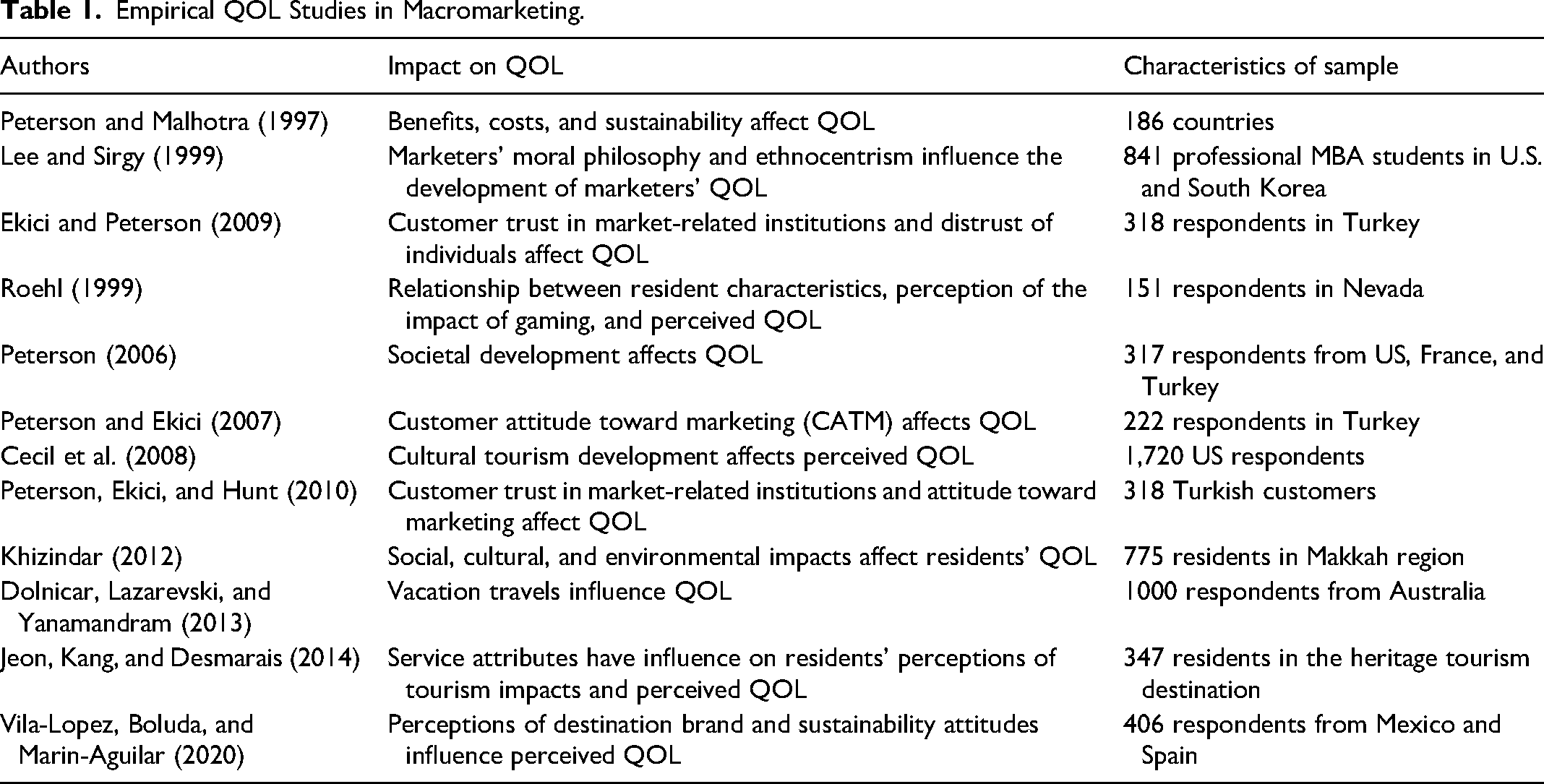
QOL research is theoretically grounded in a human development framework introduced by Maslow (1954), which conceptualizes quality-of-life as a hierarchy of satisfied needs for a given member of a society (Sirgy 1986). Higher levels of QOL are observed in communities where individuals evaluate positively their overall personal life, community development, environment, and consumption experiences (Ekici and Peterson 2009). Comparatively, the bottom-up theory (Dluhy and Swartz 2006) suggests that an individual's life satisfaction is driven by satisfaction with different life domains, including health (both physical and mental), family, social life, work life, personal safety, and access to education. Lower-order needs (e.g., safety, shelter, food, health) accordingly should be addressed before an individual is able to satisfy higher-order needs, culminating ideally in self-actualization (Sirgy 1986). Community conditions and services represent another important set of QOL drivers. The perceived level of satisfaction with one's community may be assessed through four domains: social justice (e.g., equality in basic rights) personal safety, environmental conditions (e.g., noise levels or pollution), and a community's economic development (Rawls 1971; Sirgy, Gao, and Young 2008).
QOL also may be explained through capabilities-and-functioning (Sen 1993)—human life as a combination of doings and beings—referred to as “functionings.” In turn, QOL is assessed as a person's freedom (i.e., capabilities) to choose among the various functionings, which specifically refer to the activities and scenarios that people consider to be important in their lives. They can be captured through observable achievements, such as health status, level of education, and current employment status functionings” or things that societies or individuals value (Alkire 2002). Higher QOL correspondingly may be observed in individuals with higher perceived levels of capabilities and functionings. Collectively, these perspectives address diverse theoretical pathways, through which individuals form overall evaluations of their lives.
QOL studies rely on an extensive set of metrics that help to develop a holistic understanding of QOL constructs, and relate them to social phenomena (Shultz, Rahtz, and Sirgy 2017; Sirgy 2011, Sirgy 2021). The subjective QOL evaluations are related to measures of personal utility arising from personal satisfaction with overall life, life domains, and condition of services rendered by a community. The surrounding environment may also affect subjective evaluations of QOL; hence, measurable manifestations of community conditions—such as quality of the environment, rate of change to the natural landscape, crime rate, ties with people or neighbors in the community, economic development, and other community metrics—may serve as indicators of QOL based on secondary data (Cummins 2000).
Marketing Systems and QOL
Marketing systems are customarily regarded to be: a network of individuals, groups and/or entities, embedded in a social matrix, linked directly or indirectly through sequential or shared participation in economic exchange, which jointly and/or collectively creates economic value with and for customers, through the offer of assortments of goods, services, experiences and ideas, that emerge in response to or anticipation of customer demand (Barrios Fajardo, Shultz, and Joya 2019, p. 371; Layton 2007, p. 230; cf. Layton 2015, p. 304).
They fundamentally exist to enhance individual QOL and societal well-being (e.g., McMillan 2003; Shultz 2007). Note, however, that QOL and well-being are dependent on prosocial, inclusive and efficacious marketing activities, business institutions, and governing bodies throughout systems (Layton 2009; Mittelstaedt et al. 2014; Shultz, Rahtz, and Sirgy 2017).
Deciding how to meet and satisfy the needs of customers and other stakeholders, locally and globally—and thus to ensure or enhance well-being over time—drives individual and institutional activity, including marketing strategies, management, and practices in and regulation of the marketing system (Alderson 1957; Shultz et al. 2012; Shultz et al. 2022; Zif 1980). In other words, the marketing mix aggregated across firms, throughout systems, and over time affect QOL and societal well-being.
The relationship between QOL and marketing is reflected in various market processes: value creation through customer engagement in economic exchanges (Layton 2007); continuous engagement with customers to affect customer well-being (Möller 2013); sustainable and socially responsible marketing to enhance stakeholder well-being (Gummesson 2008; Kotler, Kartajaya, and Setiawan 2019); targeting customers based on their needs (Keller 2013). QOL marketing is an extension of these concepts, which introduces an idea of enhancing and preserving stakeholder well-being through responsible marketing (Laczniak and Shultz 2021; Lee and Sirgy 2004). Requisite to customer well-being is an assortment of safe and useful products, including product information—that is, marketing as a provisioning technology (Fisk 1981)—in an accessible way, at affordable prices. Preserving the well-being of other stakeholders implies the absence of harm (Lee and Sirgy 2004), and the actuality or possibility of flourishing (Shultz, Rahtz, and Sirgy 2017).
The research pertaining to ways/whether marketing is improving QOL is voluminous. Dagger and Sweeney (2006), for example, argue that QOL depends on satisfaction with services because of marketing activities. Peterson and Ekici (2007) demonstrate a relationship between consumer attitudes toward marketing and the overall quality of life; they found that consumer trust in market-related institutions is correlated with the assessment of the overall QOL for people below the poverty line. Mullen et al. (2009) found economic development has a positive impact on overall QOL as well as on individual components (health, social life, environment, finances). Research confirms (1) the existence of a link between marketing and QOL and (2) the multiplicity and diversity of marketing variables that can affect the QOL, the well-being of consumers.
Conceptually, the heterogeneous impact of marketing on QOL may be examined using the Marketing Systems (MS) framework (e.g., Domegan et al. 2016; Layton 2007; Redmond 2018; see also Domegan et al. 2019). The MS captures mechanisms, structures, and roles that leverage all the factors associated with the marketing mix, such as market selection, product, plan, price, distribution, and promotions, to enhance consumer well-being while retaining the well-being of the other stakeholders of the firm (Hunt 1981; Layton 2007). The prominent feature of MS involves systematic (as opposed to one-off) exchanges between or among customers, companies, collaborators, competitors, and stakeholders within the context of a larger socioeconomic environment (Layton 2007). Lee and Sirgy (2004) similarly proposed a set of antecedent factors—e.g., the environment, organizational and individual tendencies—that can influence marketing systems, actualize societal goals, and enhance QOL. DeQuero-Navarro, Stanton, and Klein (2021) more recently have also demonstrated how MS is related to QOL marketing in firms.
Analysis of individual elements of marketing systems facilitates the extension or effective application of QOL-related concepts (e.g., corporate social responsibility and sustainable marketing) and QOL metrics capturing behavioral change (Domegan 2021). Consider, for example, a study by Kim et al. (2018) to investigate the perceptions of hospitality employees about corporate social responsibility (CSR), and the impact of these perceptions on their quality of work life (QWL), job satisfaction, and overall QOL. Building on needs satisfaction theory, Kim et al. (2018) revealed that CSR has positively impacted QWL and ultimately contributed to an improved QOL for employees. Collectively, a systems perspective integral to macromarketing can or should build upon relational aspects of dynamic market exchanges—perhaps a countless and infinite number of ongoing exchanges, at micro, meso and macro levels, actually and digitally, locally and globally—which necessitate shared participation, common goals, and predictability of exchange actors (e.g., Barrios Fajardo, Shultz, and Joya 2019; Domegan et al. 2019; Fisk 1967; Shultz et al. 2020).
Impact of Marketing System Activities on QOL
Aggregated marketing activity comprising marketing systems—and its impact on society and customers—is at the heart of macromarketing (Hunt 1981; see also Alderson 1957; Bartels and Jenkins 1977). Hunt and Burnett (1982) further broadened the MS concept to include public and nonprofit sectors, and allowed various levels of aggregation of such systems to study impact on societal well-being. Similarly, Fisk (1967) had previously classified MS by the level of organization ranging from the individual consumer to the global economy. The outcomes of market transactions occurring within marketing systems may be described in terms of potency of the assortments, which are exchanged during transaction and which are differentiated by product type (e.g., physical goods v. services) and attributes (e.g., tangible v. intangible); delivery (e.g., location and time); communication (e.g., advertisement and incentives); value (e.g., price), and other factors (e.g., Conejo and Wooliscroft 2015; Layton 2007; Shultz et al. 2022; Shultz, Rahtz, and Sirgy 2017). Correspondingly, we examine the impact of MS on QOL by using characteristics of assortments, which are created in response to consumer demand, as seen in Figure 1.
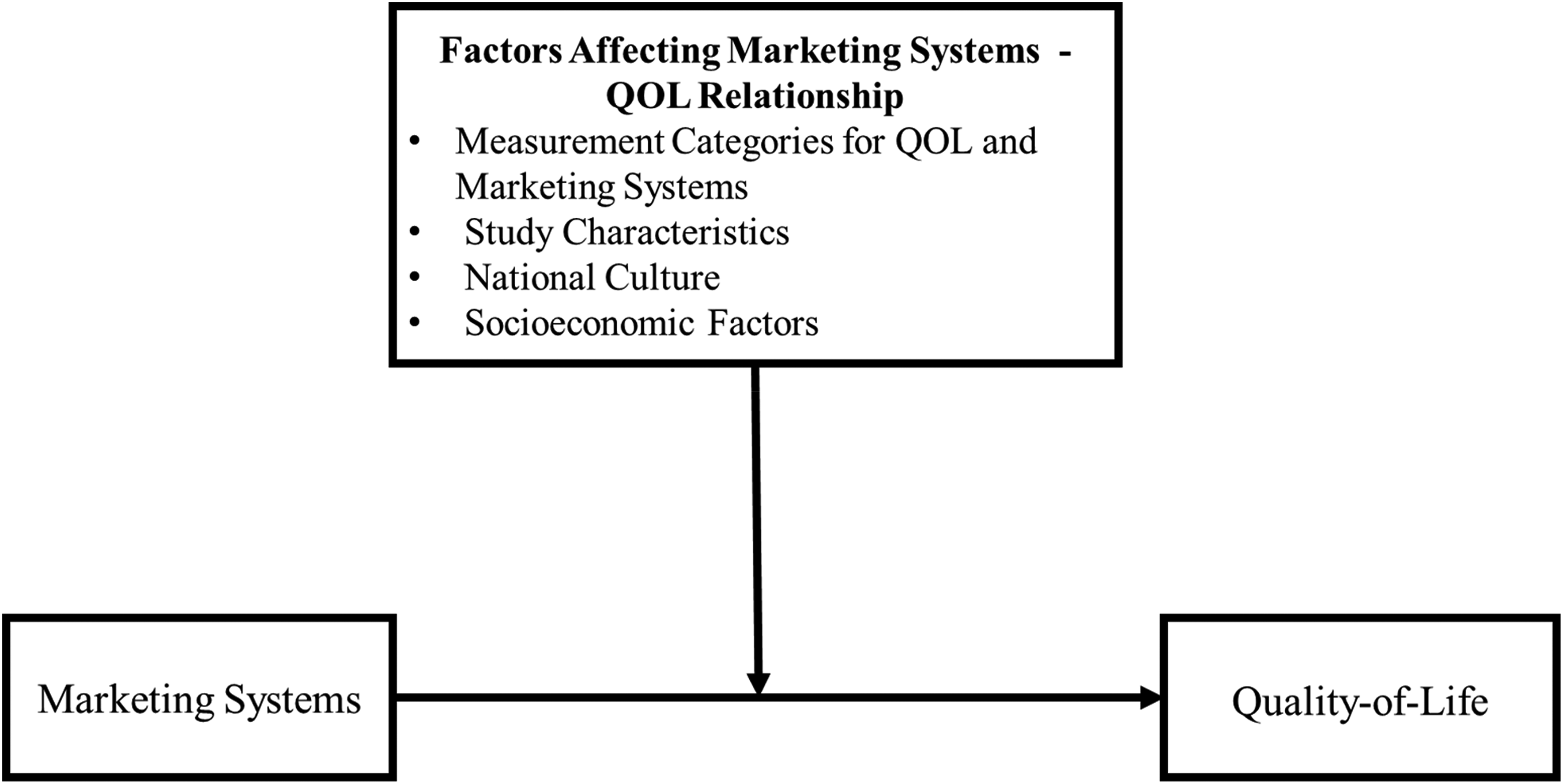
Conceptual framework for meta-analysis.
QOL marketing has been described as business mechanisms by which assortments are designed, communicated, and delivered to consumers in the ways that enhance consumers’ well-being without jeopardizing well-being of other stakeholders (Lee and Sirgy 2004; Sirgy 2021). With respect to products, marketing systems may encourage firms to develop products and services that can significantly contribute to the QOL of target consumers. Multiple examples reveal marketing beneficence and nonmaleficence guide marketing practices for designing offerings targeting specific populations (e.g., elderly or displaced) or contexts (such as healthcare, transitioning economy, forced displacement) in relation to specific life domains (e.g., family, social life, work, and education, culture/traditions) (Ekici and Peterson 2009; Shultz et al. 2020; Sirgy et al. 2000). The focus on consumer well-being guides strategic planning towards efficient use of resources and developing products that positively affect people's lives.
Pricing decisions within a QOL marketing framework should balance affordability to target customers with preserving interest of stakeholders and other collaborators involved in value creation. While stakeholders may get fair returns on their investment, the low-price considerations should not jeopardize environmental conditions and/or fairness in employee compensation (Kaufmann, Ortmeyer, and Smith 1991). Next, enhancement of consumers’ QOL often requires consumers to understand benefits and risks associated with consumption, which draws attention to the role of marketing communications. Further to the communications dimension of QOL marketing, accurate and relevant information provided by marketers may be used to educate consumers and to sustain well-being by, for example, diminishing emphasis of advertising on materialism or living standards (Sirgy et al. 1998). Fourth, accessibility, availability and assortment of products are also related to QOL of target consumers. Distribution channels or supply chains are pervasive, often global and are becoming increasingly complex (and sometimes contentious), which implies shared participation and predictability of exchange parties in marketing systems. In this regard, the disruptions of logistics and channels caused by natural disasters, the COVID-19 pandemic, political discord and systemically violent social conflict, heightened consumer vulnerability, and suppressed QOL can lead to significant changes in consumption habits around the world (Sheth 2020; Sirgy, Shultz, and Rahtz 2022). In summary, past research in macromarketing and adjacent disciplines conceptually established and empirically tested links between and among various dimensions of marketing systems and QOL metrics. In the following sections, we describe our approach to derive empirical generalizations of such relationships.
Overview of Meta-Analysis
This meta-analysis addresses the association between key macromarketing constructs. More precisely, it aims to address these questions:
How strong is the relationship between marketing systems and QOL? What determines the strength of such relationship?
Our meta-analysis provides answers to these questions, which are more accurate and more credible than could be presented in any single primary study or non-quantitative, narrative review attempting to understand a macro phenomenon (Rosenthal and DiMatteo 2001). Meta-analysis helps us to see the similarities and differences among the methodologies and the effect sizes of many studies of marketing systems and QOL. Meta-analysis is based on a combination of results (both statistically significant and non-significant) from studies based on different sample sizes (Kraus 1995). Moreover, the cumulative techniques of meta-analysis allow researchers to further the field of macromarketing studies, in which the nature of research precludes deployment of large and disparate samples (e.g., across expansive geographies or widely dispersed people representing various cultures).
Meta-analysis also uncovers variation in the effect sizes aggregated from multiple studies (Rosenthal and DiMatteo 2001). Patterns can be examined in relationship to moderating variables of interest, which may emerge from characteristics found in the corpus of studies. For example, researchers often examine the role of methodologies for testing hypotheses or composition of samples included in meta-analysis. Correlations between moderator variables and effect sizes point to associations that are very helpful to understand potential causal influences and why various results occurred. The examination of moderator variables contributes to theory development and increases the richness of empirical work.
Approach to Meta-Analysis. Our meta-analysis is guided by three interrelated principles: accuracy, clarity, and simplicity (Kraus 1995). In these regards, our approach is rooted in precepts by Hall and Rosenthal (1995), who suggested that the best quality scientific inquiry often poses straightforward questions and uses basic statistical techniques for analysis. Furthermore, simplicity—that is, scientific elegance—helps meta-analytical inquiry to remain logical and straightforward, and to avoid misconceptions in coding complex and tacit marketing constructs.
Guided by these general principles, we approached our meta-analysis in the following steps. First, we grounded definitions of our key construct in marketing systems and QOL frameworks discerned and used in macromarketing. Second, we systematically conducted a search for studies. Several criteria for inclusion in the corpus were established to ensure that each study was relevant and a rigorous test of our research questions. Third, we transformed various types of effect sizes (e.g., correlations) into a common metric (z-statistics) that is used to estimate variability and central tendencies of effect sizes across various studies (Rosenthal and DiMatteo 2001). Z-statistics follows normal distribution, has zero mean and unit variance, which make it suitable for significance tests of the average effect sizes and regression analysis. Next, we used past studies and macromarketing frameworks to identify moderators that may be coded within our sample of studies. Finally, we analyzed the variation of the effect sizes, across different contexts and study characteristics, which were introduced as moderator variables. We describe these steps, below.
Study Characteristics: The Marketing Systems – QOL Relationship
To capture and explain variability in the relationships between/among marketing systems and QOL, we coded construct and study characteristics that might also have an impact on the overall relationship between marketing systems and QOL. Next, we discuss study characteristics that may affect the magnitude of effects.
QOL Metrics. As noted previously, past research examined QOL in association with the enhanced consumer well-being (Lee and Sirgy 2004), human development (Domegan 2021), improved living conditions (Peterson and Ekici 2007), and satisfying higher-order needs (Sirgy 1986). Building on a rich literature on QOL metrics, we coded QOL in terms of personal health (satisfaction with individual's health status), social life (perceptions of social cohesion; work, spiritual, and family life), community development (community services and amenities that serve popular needs of community residents), and overall well-being (personal utility based on evaluation of core life domains) (Sirgy 2011, Sirgy 2021). For coding, we used binary categories to assign an effect size to one of four metrics.
Dimensions of Marketing Systems. The link between marketing systems and QOL may vary for different dimensions of MS. Larger marketing systems (e.g., measured at national or regional levels) have more idiosyncrasies in which multiple exchanges take place and more complex assortments are furnished (Layton 2009; Shultz et al. 2022). By categorizing components of such assortments, it is possible to capture the impact of MS on individual well-being. Building upon the MS framework (Layton 2007; Lee and Sirgy 2004), we classify various components of marketing systems into five dimensions: market selection, product, promotion, pricing, and distribution. We created categorical variables to capture each of the dimensions of MS.
Primary Subjective Data v. Objective Secondary Data. The strength of the relationship between marketing systems and QOL could vary based on the types of data used in a study. Both marketing systems and QOL are multidimensional constructs and may not be adequately captured by aggregated secondary data. Moreover, QOL typically reflects personal utility, which may be better captured with subjective evaluations of respondents. Such measures however may be susceptible to common method bias. Accordingly, we created a dummy (PRIM) for whether a study used primary or secondary data.
Timing of Study. The studies used in our research were published over 23 years (from 1999 to 2022). Timing of study (e.g., financial crisis in 2008–2009) possibly could have affected respondents’ evaluations of QOL; therefore, we introduced a dummy variable (D2011), if a study was published after midpoint year (2011).
Cultural and Socioeconomic Context. Prior meta-analyses in marketing have examined whether the relationship of interest varies based on the geographic, economic, technological, and cultural characteristics of the study. Marketing systems reflect hierarchies of relationships between and among actors participating in market exchanges. These relationships are shaped by institutional and cultural characteristics of a market in which transactions occur (North 1990). Importantly, macromarketing literature (Laczniak and Santos 2018) emphasizes importance of cultural and spiritual dimensions of QOL as a counterpoint of widely used economic indicators (such as GDP) tied to wealth. By capturing the cultural and institutional influences on consumer well-being, we aim to determine boundary conditions of the proposed framework and to test its generalizability across diverse settings. As such, we aim to examine how the strength of relationships varies between different cultural and socioeconomic contexts. Past research has found that consumers in more indulgent (less restrained) cultures have a tendency to seek gratification of basic and hedonic human needs and may be more susceptible to marketing activities (Hofstede 2011). Thus, we used Hofstede's classification of national culture (Hofstede, Hofstede, and Minkov 2005) to capture impact of cultural context, in which a study was conducted.
Next, the ability of MS to enhance QOL depends on the economic development, which captures creation and distribution of wealth in an economy. Larger economies have stronger potential to address residents’ basic and higher-order needs by providing a variety of objects, conditions, characteristics, and energies that people value. However, economic inequality and wealth disparity may negate impact of marketing on QOL. We captured economic development with two variables: gross domestic product per capita (GDP in thousands of USD) measured at purchasing power parity and Gini coefficient for inequality in the countries (GINI), from which samples were drawn for participating studies. The GDP and GINI values were obtained from the International Monetary Fund (IMF 2022).
Development of Database for Meta-Analysis
In this section, we outline the steps in the development of the database for the meta-analysis. Our approach was consistent with those used in previous meta-analyses published in the marketing literature (Krasnikov and Jayachandran 2008). We began with keyword search using the Web of Science database. We examined abstracts and attempted to identify all studies that used terms such as “QOL” and “quality of life” together with marketing keywords (“marketing”, “product”, “promotion”, “advertisement”, “price”, and “distribution”). Next, we searched for studies that referenced the most cited articles in the QOL and MS literatures. In addition, we contacted several researchers and requested working papers or effect sizes from already published manuscripts.
We used several criteria to develop our database for meta-analysis. First, we chose those empirical studies that used definitions of QOL and MS constructs, which are discussed above. Second, we used studies that provided r-family of effect sizes to ensure meaningful comparison of effect sizes across various studies (Lipsey and Wilson 2001). Upon completion of article collection—and the vetting and distillation of approximately 30 thousand studies—by January 2022, we obtained 30 studies, which were prepared for coding and meta-analysis (Table 2). Next, we developed a coding protocol to specify the type of information to be extracted from the 30 studies (Hedges and Olkin 2014). Using definitions of QOL and MS, our research team coded articles; that step was followed by the discussion between coders to clarify disagreements and achieve 100% consistency in the coding.
List of Articles for Meta-analysis.
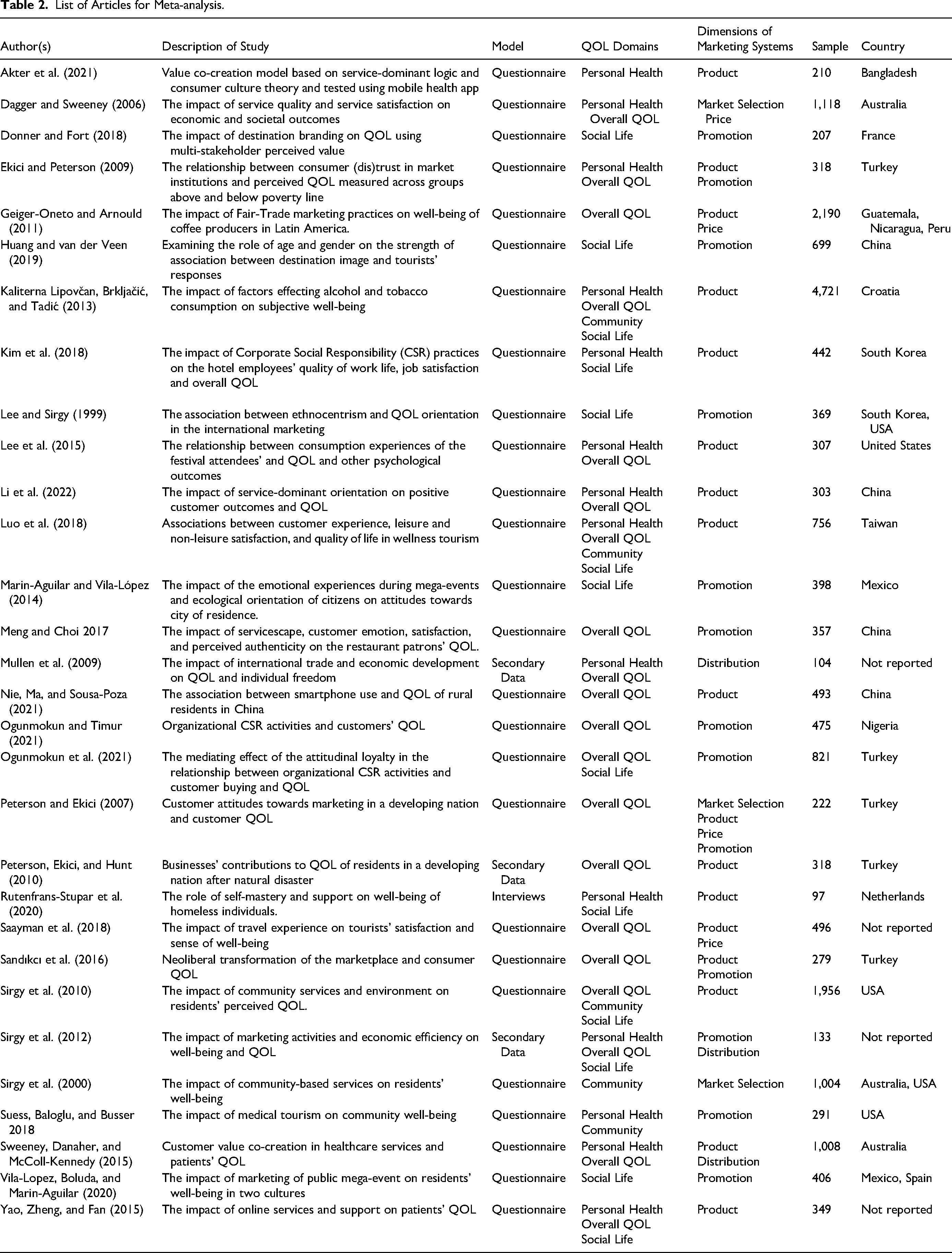
Among the studies selected for meta-analysis, the most common indicator of quality of life was the category “Overall QOL”, corresponding to the assessment of the quality of life as a whole (20 articles). The Personal Health and Social Life facets of QOL were measured in 14 and 13 articles, respectively. Community QOL was captured in five studies. The most frequent dimension of MS was Product (17 articles), followed by Promotion (13 articles), Price (four studies), Market Selection (three studies), and Distribution (three studies). The selected studies used data from major geographical regions and a variety of economic systems (developed and developing). Table 2 provides details on the contexts and research questions, examined in these articles.
We estimated z-scores using collected effect sizes following the procedure recommended by Hunter and Schmidt (1991). First, we divided the effect sizes by the square root of the product of the reliabilities of the two correlated constructs and estimated z-values. Then, for each study the weighted mean of the z-scores was calculated using the inverse of their variance (N – 3) as weight, where N is the sample size. Finally, the estimated z-scores were used as dependent variables in the regression analysis and also to calculate the revised correlations (Hedges and Olkin 2014).
Regression Analysis Using Effect Sizes
To assess the role of the study characteristics on the strength of the MS-QOL relationship, we used harvested effect sizes in a regression analysis. First, several effect sizes are nested with studies that may lead to biased estimates. We checked for heteroscedasticity (White 1980) and found that our data had constant error variance; therefore, traditional regression analysis is appropriate to model variance in the z-scores. We formulated our regression model as follows:
PRIMi = 1 if primary data are used to measure effect size, 0 – otherwise,
D2011i = 1 if a study was conducted after 2011; 0 – otherwise,
MAi = score for Hofstede's Masculinity cultural dimension for country, where a study was conducted,
UNi = score for Hofstede's Uncertainty Avoidance cultural dimension for country of study,
LTi = score for Hofstede's Long Term Orientation cultural dimension for country of study,
INi = score for Hofstede's Indulgence cultural dimension for country of study,
GDPi = GDP per capita for a country, where a study was conducted, and
GINIi = GINI score for a country, where a study was conducted.
εI – captures unexplained variance after partitioning effects of the study variables (random errors).
Results
Descriptive Analysis
Table 3 provides a summary of effect sizes for the relationships between marketing systems and QOL for the different types of QOL metrics and MS dimensions. Overall, we collected 148 effect sizes from 30 studies with a total sample size of 28,565. As anticipated, and consistent with past research, we estimated a positive significant correlation between MS and QOL (r = .276, p < .05). Furthermore, we examined the strength of relationships for various dimensions of MS and QOL metrics. Among all five dimensions of MS, the largest sample (11,349) and the largest number of effect sizes (56) were recorded for Product MS. The correlation of Product MS with QOL is positive, statistically significant, and equal to .210 (p < .05). The strongest correlation for MS dimension was estimated for the Promotion dimension (r = .327; p < .05; 32 effect sizes). Next, the correlations for different QOL metrics ranged from .234 to .351; the strongest correlation was recorded for Health QOL (18 effect sizes, total sample 8,473) (Table 3). Most effect sizes (81) were obtained for the Overall QOL (r = .238, p < .05). Finally, the largest sample (19,072) was associated with the correlation between MS and Social Life QOL (r = .292; p < .05). Collectively, the results in Table 3 confirm positive impact of marketing systems on quality-of-life.
Average Effect Sizes (Correlations).a
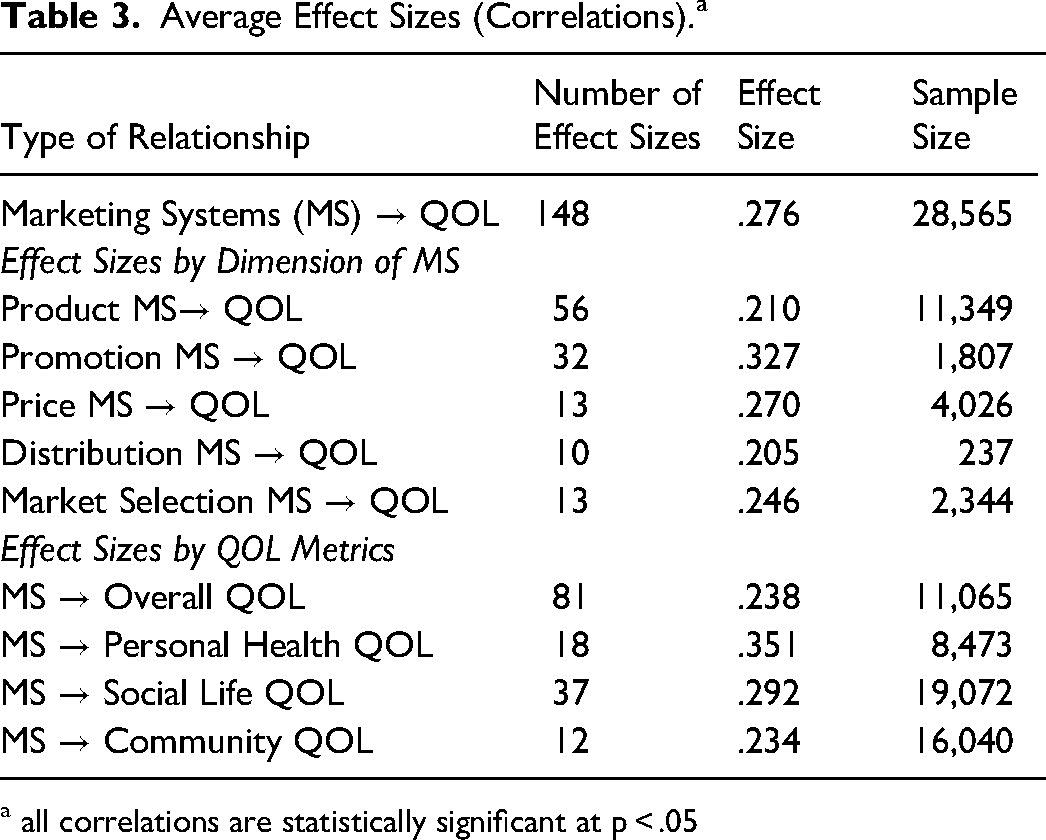
a all correlations are statistically significant at p < .05
Regression Analysis
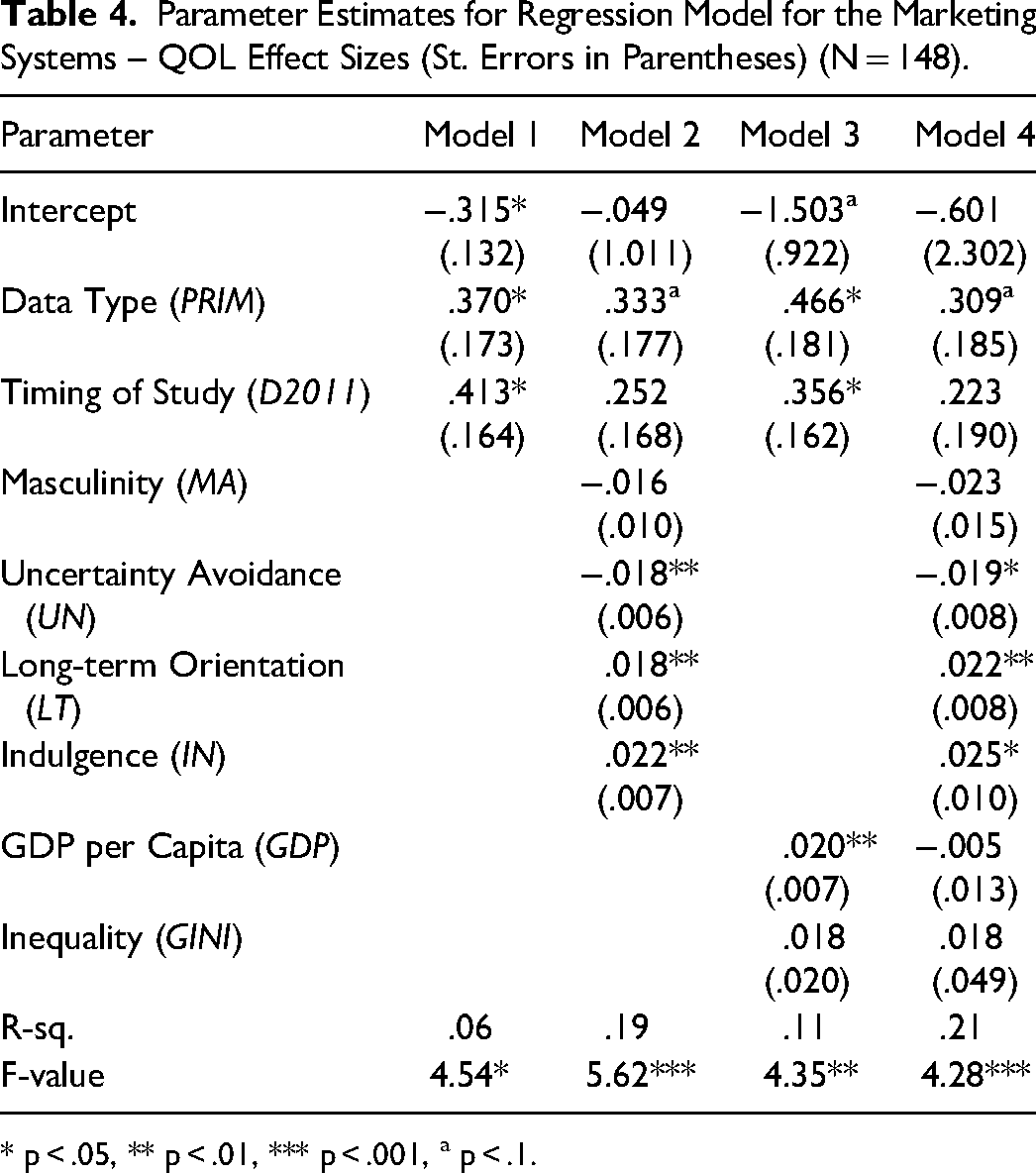
We estimated Equation 1 in the hierarchical technique, as seen in Table 4. First, we estimated regression model using two dummies for data type (PRIM) and timing of a study (D2011) (Model 1, Table 4). Second, we added cultural variables (MA, UN, LT, and IN) (Model 2, Table 4). Third, we used country variables GDP and GINI to explain variability in the z-scores (Model 3, Table 4). Finally, we used all variables in Equation 1 to estimate parameters β1–β8 (Model 4, Table 4).
Parameter Estimates for Regression Model for the Marketing Systems – QOL Effect Sizes (St. Errors in Parentheses) (N = 148).
* p < .05, ** p < .01, *** p < .001, a p < .1.
Parameter estimates for variable PRIM are positive and statistically significant at p < .05 in two models (Model 1 and Model 3, Table 4) and marginally significant (p < .10) in the other two models (Model 2 and 4, Table 4). Therefore, effect sizes were higher in the studies using primary data collection. Slopes for D2011 are positive and significant in Models 1 and 3 (Table 4), suggesting potential inflation of MS-QOL relationships in studies, administered after 2011. Next, among four cultural variables, three dimensions (UN, LT, and IN) had significant impact on the z-scores. Specifically, the estimated MS-QOL relationships were weaker in the societies characterized by higher levels of uncertainty avoidance (β = −.018 and β = −.019 in Models 2 and 4, respectively). However, the effect sizes were stronger in more indulgent (β = .022 and β = .025 in Models 2 and 4, respectively) and more long-term oriented (β = .018 and β = .022 in Models 2 and 4, respectively) cultures. Finally, Model 3, Table 4 suggests that MS-QOL relationship was stronger in the countries with higher levels of economic development captured with higher GDP per capita (β = .020; p < .05). Parameters for income inequality (GINI) were not statistically significant.
Discussion
We aimed to synthesize and generalize empirical findings on the relationships between marketing systems and quality-of-life using meta-analysis. Our results indicate that dimensions of MS are positively associated with QOL, suggesting that marketing systems enhance consumer well-being in the sample of articles. Particularly, we find that the promotion dimension of MS has the highest correlation with the QOL; the strongest positive MS-QOL relationship was estimated for Personal Health metric (Table 3). We also examine measurement, cultural, and socioeconomic factors that affect the strength of MS-QOL relationships. Our results suggest that the association between MS and QOL is stronger in studies based on primary/subjective measures of QOL constructs and in samples drawn from the developed economies and more indulgent, uncertainty-tolerant, and long-term-oriented cultures (Table 4). These findings also highlight the role of various contexts, in which the studies were conducted. Below, we discuss implications for theory, policy, and practice.
Implications for Theory
The key finding in our study that Marketing Systems positively affect QOL across contexts and metrics highlights the role that marketing systems should play in macromarketing research. The output of marketing systems is an assortment of goods, services, information, and values which are provided in response to consumer demand (e.g., Layton 2009). Consistent with macromarketing discourse, we provide insights how the characteristics of such assortments—which are created and delivered by marketing systems—enhance and improve consumer well-being. Furthermore, we have shown through empirical generalization that various components of provisioning systems (e.g., product, distribution, promotion, price, and market selection) can enhance consumer well-being through positive change in behaviors and social processes, a view consistent with systems-thinking social marketing (e.g., Domegan et al. 2016; Fisk 1967).
Regarding QOL theory, our study has interesting theoretical and methodological implications based on our empirical analysis of various QOL metrics. In reviews of theoretical perspectives driving QOL research, Sirgy (2011, 2021) proposes a taxonomy of QOL indicators – including factors based on personal utility, functioning, and human development and flourishing – that offer researchers opportunities to capture QOL with meaningful and theoretically distinct indicators. Furthermore, the importance of theory driven QOL indicators is emphasized as integral to the formulation of public policy. By capturing the variability in effect sizes for different QOL metrics we provide empirical support for QOL theory that guides selection of well-being indicators to study complex market phenomena.
Another interesting theoretical implication of our meta-analysis concerns studies of QOL across markets, societies, and cultures (e.g., Steenkamp 2001). Culturally determined human values and beliefs were found to be associated with subjective well-being both for individuals (Sagiv and Schwartz 2000) and communities (Paton et al. 2017). By explicitly measuring variability of MS-QOL relationships across various aggregations and contexts, we contribute to macromarketing theory by examining moderating effects of national culture and socioeconomic factors. Thus, one implication of our results for QOL studies is that QOL metrics should integrate cultural and institutional components.
Implications for Policy Makers
Governments and public policy institutes have adopted a wide variety of QOL indicators in an attempt to capture well-being of individuals, communities, and even regions (e.g., Hagerty et al. 2001). Our results provide additional insights for policy makers on the veracity of QOL metrics for capturing well-being of consumers and societies. Importantly, as we demonstrate in our study, the potency of QOL metrics is context specific. Accordingly, policy makers need to carefully evaluate QOL taxonomy to capture the impact of policies that affect individuals, communities, countries, and regions. The recent COVID-19 pandemic has revealed that similar health-protective measures (such as, lockdowns and working from home) and communications had varying impacts on well-being of people around the world (Fetzer et al. 2020; Sirgy, Shultz, and Rahtz 2022). One can reasonably conclude that national culture and a country's socioeconomic characteristics may impose boundary conditions on the impact of such policies on QOL (Shultz, Rahtz, and Sirgy 2017). Consequently, our results confirm the view by Hagerty et al. (2001) that QOL indices should be subjected to predictive validity and reliability tests prior to use by public authorities.
Next, we demonstrate positive correlation between MS and Personal Health QOL; this finding may motivate governments to facilitate development of marketing systems, the impact of which may extend beyond consumption and lead to improving the health of individuals and communities. In these regards, beneficence and nonmaleficence principles of QOL-focused marketing systems (Lee and Sirgy 2004; Sirgy 2021) may be extended beyond business practices to guiding policies aimed at improving public health and community well-being.
Implications for Marketing Practice
Our findings also have important implications for marketing practitioners and businesses. Our results regarding positive impact of MS on QOL may assist firms to plan their depth and breadth of engagement with marketing systems by considering outcomes that extend beyond traditional financial indicators. The focus on QOL may enable marketers to devise business models that help companies to prosper in the long run and to achieve legitimacy among key stakeholders throughout marketing systems (Lee and Sirgy 2004). Our findings provide insights for businesses that consider—or should consider—QOL metrics as important indicators of firm success. Firms should explore ways to constructively engage other actors in the marketing system, including other businesses, governments, NGOs and consumer citizens to develop policies, programs and initiatives to ensure enhanced well-being for as many stakeholders as is possible (Shultz 2007). Among many opportunities are inclusive, system-wide outreach and training programs, and dedicated marketing management, strategies and activities with a focus on QOL, consumer well-being, and responsible and ethical conduct. In this regard, we have considered micro-marketing factors with important implications for complex marketing systems. The interactions among micro, meso and macro forces, and subsequent effects on QOL may be underappreciated in some quarters, despite the extraordinary and often devastating global impact of irresponsible marketing management and practice (Laczniak and Shultz 2021), encouragement by macromarketing pioneers regarding the micro-meso-macro dynamic (e.g., Alderson 1957; Hunt 1981; Layton 2015) and more recent studies exploring this dynamic (e.g., DeQuero-Navarro et al. 2022a; Sirgy, Shultz, and Rahtz 2022).
Another implication of our study is that, as part of an internationalization or global strategy, firms should consider—and redouble efforts to understand—the increasing complexities, nuances and interactions of marketing systems, in and among different markets, regions and cultures. Multinational companies (MNC), for example, often struggle to establish relationships with important stakeholders in foreign markets. MNCs that are constructively engaged in marketing activities that enhance QOL for as many stakeholders as possible may develop a climate that instills and rewards responsible/ethical practices by demonstrating positive, measurable impact on consumer well-being in the host markets, which is more likely to increase acceptance of MNCs in such markets, and win-win outcomes for firm, hosts and local/global consumers, over time (Domegan et al. 2019; Shultz et al. 2022).
Limitations and Opportunities for Further Research
Our study is not without limitations that should be considered in evaluating our findings – and stimulating further research. We consider available published research on the MS-QOL relationship, which largely adopts subjective evaluations of the QOL and MS constructs at a single point in time. From a methodologic perspective, these studies provide higher values of correlations compared to studies based on secondary data. Some care is required when generalizing the findings to latent constructs, as elevated correlations may result from the abstract nature of a marketing construct, socially desirable responses, or artifactual overlap of scales capturing various facets of well-being and marketing systems. This is evident in the studies capturing the relationships between the Promotion Dimension of MS and QOL, and MS and Personal Health QOL. Promotions often tend to persuade consumers how their needs may be satisfied and to communicate an image of an exemplar customer. Perhaps, momentary emotional experiences shaped by advertisements add to the evaluations of life, which lead to the stronger correlations. Similarly, respondents may be more likely to evaluate changes in marketing systems vis-à-vis personal health rather than community well-being. Nevertheless, the facet-level analysis provides important perspectives about which aspects of MS tend to be important in predicting different dimensions of QOL.
This study reminds that macromarketing often deals with constructs that are difficult or challenging to quantify, leading to use of proxies; it in turn may motivate scholars to develop consistent metrics of marketing constructs and to combine them with measures introduced in earlier work (e.g., Sirgy 2011, 2021; Sirgy et al. 2010). We call on macromarketing scholars to further develop consistent metrics of macromarketing constructs, where feasible, and to use extant measures when appropriate. Doing so should improve the prospects for effective meta-analysis—including the attendant value to inform responsible policy, marketing and consumption.
Future research should therefore examine a range of metrics for these constructs involving a different scope of contexts (temporal and geographic), as well as parameters based on objective measures. We also believe promising opportunities exist to examine additional contextual factors (e.g., national culture and economic development) that affect magnitude of effects across studies. Future research should also consider additional contextual factors that are of substantive importance (e.g., country's institutions, political systems, infrastructure, and sustainability) but have not received sufficient attention in the literature.
Finally, we have examined fairly traditional dimensions or components of Marketing Systems – market selection, product, promotion, price, and distribution – in relationships with QOL. Our study explores a relatively small set of variables, as a key objective is to introduce and describe meta-analysis, to share a tangible example of its application vis-à-vis core macromarketing interests, and hopefully to generate enthusiasm for meta-analysis when conducting future macromarketing research.
Going forward, the number of elements, constructs and activities comprising marketing systems—and the dynamic interactions throughout them, over time and space—is nearly limitless. We therefore emphasize the number of compelling issues and variables in any given marketing system, from small rural communities to global alliances and indeed the entire planet, is also vast, as are the opportunities for meta-analysis of them. Consider these pressing societal and global issues and controversies: human rights, climate change and sustainable practices, war and its mitigation, ethical/unethical behavior and social justice, pro-choice v. pro-life, poverty, forced displacement, food safety/security, deforestation/reforestation, drug trafficking, crime and its prevention, drought and water rights, universal health care, whale protection, bee protection, racism/ethnocentrism, prenatal care, elderly care, social security, technological threats/opportunities, trade agreements, supply chains and channels conflict, physical and intellectual property rights, transportation, and so on. Policies related to all of them and marketing mix variables affecting them – as all of them, in turn affect QOL – are but a few possible foci for meta-analysis. Related components of MS clearly may lead to different QOL outcomes; therefore, future research should also examine other aspects of such systems and mechanisms by which they affect consumer and societal well-being. Applications of meta-analysis for such studies in an increasingly data-rich world hold tremendous possibilities for better understanding of the dynamic relationship between marketing systems and QOL, and ultimately the well-being of all people, their/our eco-systems and the planet.
Footnotes
Acknowledgments
The authors thank the Editor, Associate Editors and anonymous reviewers for helpful comments on early and evolving versions of the manuscript published as this article. The authors also acknowledge the support of HSE Graduate School of Business 2022–2024 Research Program while working on this project.
Associate Editor
Julie Stanton
Declaration of Conflicting Interests
The author(s) declared no potential conflicts of interest with respect to the research, authorship, and/or publication of this article.
Funding
The author(s) received no financial support for the research, authorship, and/or publication of this article
