



Abstract
Trust has long been recognized as an important component of marketing systems. However, while macromarketing researchers argue that a lack of trust in business can impact other components of marketing systems, very few empirical studies in marketing investigate the determinants or outcomes associated with this type of trust. Accordingly, we begin with the premise that trust in major corporations is a critical, micro-level attitude that affects the performance of a marketing system. Then, we investigate the factors that influence trust in major corporations by analyzing how perceptions of government involvement in business, political ideology, and other attitudinal and demographic variables affect trust. Using hierarchical linear modeling, we find that trust has a curvilinear relationship with perceptions of free-market competition, in which too much trust, or too little, leads to negative perceptions - trust plays a critical mediating role in constructing beliefs about free markets. Additionally, we show that macroeconomic variables influence the first stage of attitude formation toward major corporations, with gross domestic product (GDP) per capita and foreign direct investment (FDI) acting as moderators in our analysis. Overall, the multi-level moderated-mediation model used in this research embodies a true systems approach to the analysis of marketing systems by demonstrating how the economic outcomes of marketing systems (e.g., GDP and FDI) can also have feedback effects on participants within a marketing system.
Keywords
Introduction
Macromarketing scholars have long recognized that trust is a critical component of an efficient and effective marketing system (Dixon 1984; Layton and Grossbart 2006; Redmond 2018), which Layton (2007) defines as a network of individuals, groups, and/or entities linked directly or indirectly through participation in economic exchange. Customers trust firms to provide reliable and safe products. Employes trust firms to compensate them for work and reward high performance. Investors trust managers to protect their interests and increase their wealth. Consumers, employes, shareholders, and other stakeholders trust societal institutions to promote sustainable economic development. Trust is critical, as it facilitates exchange in marketing systems; and in its absence, distribution, innovation, competition, economic growth, and, ultimately, quality of life suffer (Hunt 2000; Layton 2009, 2011).
The news, past and present, highlights the critical role of trust in marketing systems and the consequences of trust being abused. Numerous highly publicized corporate scandals have led to increases in unemployment, loss of wealth, and less liquidity in marketing systems. For example, corporate scandals involving financial institutions, such as Countrywide Financial, contributed to the Great Recession that began at the end of 2007. The Great Recession eroded trust in financial and regulatory institutions as Americans lost roughly $9.8 trillion in wealth and the unemployment rate reached 10% (Merle 2018). More recently, cryptocurrencies and the institutions that support them have come under scrutiny. An estimated $60 billion was lost in 2022 when the Luna crypto network crashed and caused a lack of liquidity in the cryptocurrency market (Q.ai 2022). Furthermore, the cryptocurrency exchange FTX has collapsed. Its founder, Sam Bankman-Fried, has been accused of fraud and arrested (Yaffe-Bellany, Goldstein, and Flitter 2022). These crises not only demonstrate the importance of trust, but also caution against placing too much trust in corporations.
Given the importance of trust, several macromarketing studies have examined its role at the macro, meso, and micro levels of marketing systems. Trust, traditionally conceptualized “as existing when one party has confidence in an exchange partner's reliability and integrity” (Morgan and Hunt 1994, p. 23), usually exerts a positive influence in marketing systems and leads to a number of desirable outcomes such as enhancing community well-being (Baktir and Watson 2021). Furthermore, the macromarketing literature has developed a myriad of conceptual frameworks involving trust, in which marketing system inputs influence outcomes through trust at the macro, meso, and micro levels (e.g., Elliot, Zhu, and Wang 2019).
Although several conceptual frameworks have been proposed and advances have been made, there remains a lack of macromarketing literature that empirically examines how elements at the macro, meso, and micro levels interact to influence trust. Many studies about the role of trust have been conceptual or qualitative in nature (e.g., Ruvalcaba, Akdevelioglu, and Schroeder 2022). Furthermore, studies that do empirically test the inputs and outcomes of trust usually restrict the analysis to one level of the marketing system (e.g., Pedersen et al. 2022). Thus, there remains a dearth of multi-level studies that empirically examine the role of trust and its interactions with elements at various levels of the marketing system.
Accordingly, the purpose of this study is to empirically test antecedents and outcomes associated with trust in major corporations, with a particular focus on how elements of the marketing system at the macro and micro levels interact to influence trust. We start with the premise that trust in major corporations is a critical, micro level component that can influence outcomes of a marketing system (Layton 2011; Peterson and Ekici 2007). Specifically, we investigate how trust in major corporations affects perceptions of free-market competition. We include perceptions of free-market competition as an outcome of marketing systems because it reflects an individuals’ satisfaction with competition in the market, and a key element of marketing systems is that “competition is fostered” (Layton 2007, p. 237). We then investigate the marketing system inputs that influence trust in major corporations by analyzing how perceptions of government involvement in business and political ideology affect trust. In addition, we demonstrate that macro level elements of the marketing system affect the first stage of attitude formation toward major corporations by testing the influence of gross domestic product (GDP) per capita and foreign direct investment (FDI) on trust. We find that perceptions of government involvement in business and political ideology influence perceptions of free-market competition through trust, and that GDP and FDI moderate these relationships.
Our study makes three contributions to the marketing systems literature. (1) Our exploration of the inputs and outcomes of marketing systems answers calls for more multi-level research on the functional/structural components of marketing systems (Layton 2019). For example, our analysis reveals antecedents of trust while also showing that trust in major corporations has a curvilinear relationship with perceptions of free-market competition, in which too much trust, or too little, leads to negative perceptions. (2) Our study adds to a resurgent body of empirical research that uses data from different levels of marketing systems to test macromarketing theory (e.g., Watson and Wu 2022). In particular, our study demonstrates how economic indicators at the macro level of marketing systems (e.g., GDP and FDI) can influence individuals’ perceptions at the micro level within the marketing system. The findings provide validity to (Layton 2007, 2009) conceptualization of marketing systems, which suggests that certain elements in the external environment, such as the political setting and economic conditions, influence the components, attributes, and outcomes of the marketing system (see Figure 1). (3) Our final contribution is methodological. In the spirit of the special issue, we have taken a quantitative approach to the measurement and analysis of marketing systems. After collecting and merging secondary data from the European Values Survey (EVS), the World Values Survey (WVS), and the World Bank, we tested a multi-level moderated-mediation model on a sample of 73,007 individuals across 56 countries. Our analytical approach brings further attention to the benefits of using secondary data for macromarketing research, as described in Simkins and Peterson (2016). Additionally, our application of hierarchical linear modeling (HLM) to the nested data structure embodies a true systems approach to the analysis, answering calls for more methods that allow macromarketing researchers to examine a “higher order of systems” rather than a simpler consumer level or firm level approach (Wooliscroft 2021, p. 117). Indeed, marketing systems are, by definition, multi-level (Layton 2011, 2019), and HLM is one of the few techniques that allows researchers to properly investigate how macro level variables affect micro level phenomena.
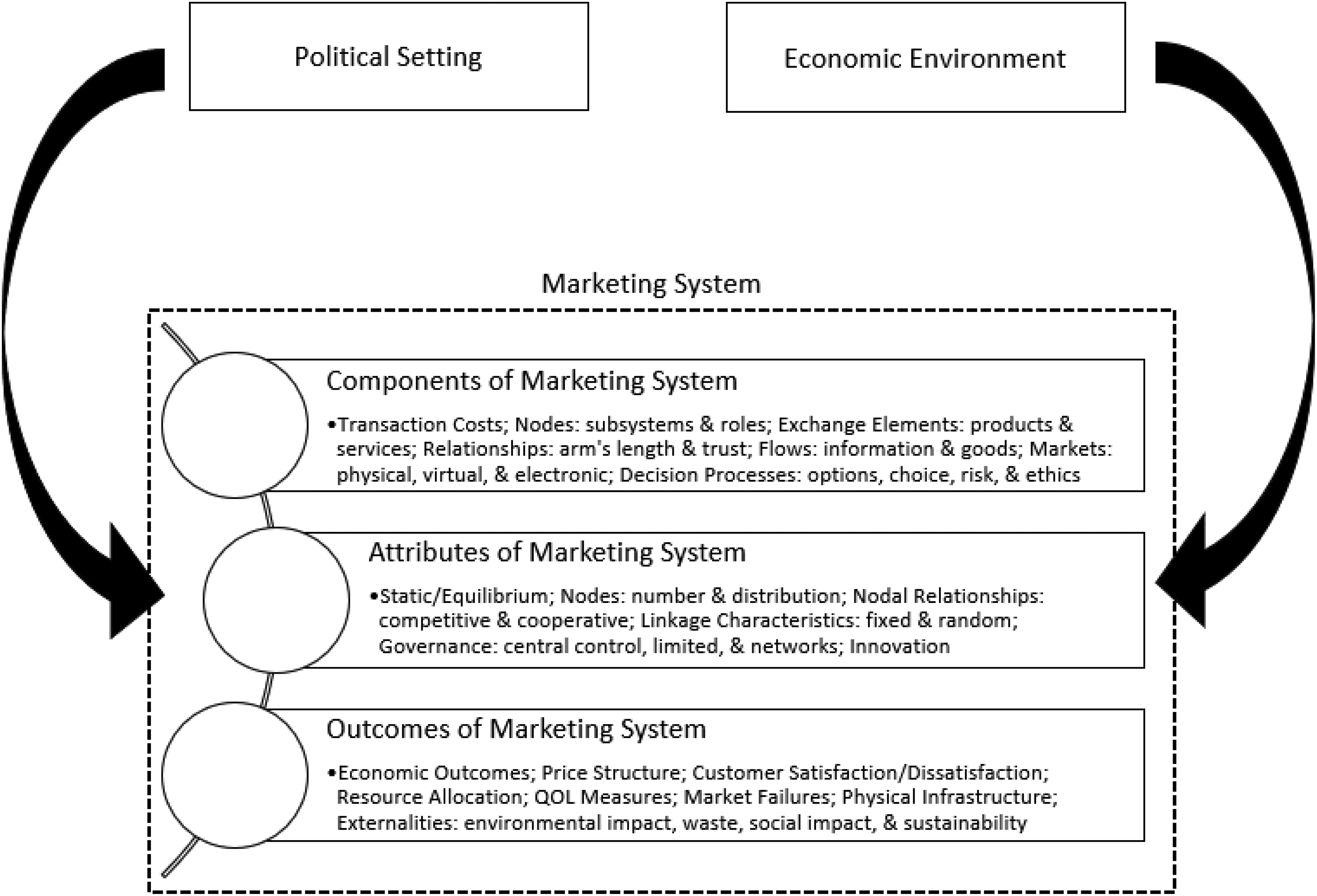
The Marketing System.
The remainder of this article is organized as follows. First, we provide a brief background on marketing systems and a review of the literature on trust in marketing systems, focusing on studies that appear in the Journal of Macromarketing and similar publications. Second, we develop our hypotheses and describe the methodological components of the study, including the characteristics of the sample, measures, and model specification. Third, given the topic of the special issue is developing research methods and metrics in macromarketing, we provide a detailed elaboration on HLM, followed by the results. Finally, we conclude with a discussion of the study's implications for macromarketing scholarship and public policy.
Conceptual Framework and Hypotheses
Background on Marketing Systems
A substantial amount of research investigates marketing systems (Fisk 1967; Glaser 1985; Layton 2007, 2009, 2011, 2019; Wilkie and Moore 1999). In fact, the study of marketing systems provided the foundation for marketing as an academic discipline (Hunt, Hass, and Manis 2021), and marketing systems remain a focal topic within macromarketing scholarship (Peterson 2020). Layton (2011, p. 259) defines a marketing system as a network of individuals, groups and/or entities; embedded in a social matrix; linked directly or indirectly through sequential or shared participation in economic exchange; which jointly and/or collectively creates economic value with and for customers, through the offer of assortments of products, services, experiences and ideas; and that emerge in response to or anticipation of customer demand. Accordingly, marketing systems exist within various economic and political environments and have many inputs, components, attributes, and outcomes (Layton 2007, 2009; Layton and Grossbart 2006). The multitude of actors involved in a marketing system includes individuals, organizations, and government entities, which may spread across the system's macro, meso, and micro levels (Wilkie and Moore 2003). The micro level of a marketing system encompasses the decision processes of buyers and sellers and outcomes related to exchange. At a slightly higher level of aggregation, the meso level, a marketing system may form around groups or clusters of sellers offering products/services to groups of buyers. The macro level of a marketing system involves social, political, and economic institutions on a national or regional scale. Marketing systems are embedded in these larger institutions, and they have the ability to shape institutions in the long-term (Layton 2011). Market participants interact with each other at different levels, and a great deal of interaction occurs between levels of aggregation (Layton 2015; Shaw 1995).
The macromarketing literature has arranged the inputs, components, attributes, and outcomes of a marketing system into a multitude of conceptual frameworks and testable models. Several of these models span the macro, meso, and micro levels of a marketing system, in which the inputs, components, attributes, and outcomes act as antecedents, mediators, moderators, and dependent variables. For example, Kumar, Kumra, and Singh (2022) develops a conceptual framework for Bottom of the Pyramid entrepreneurship that includes a range of inputs, such as push and pull factors, and outcomes, such as reduced poverty, as well as other components and attributes of the marketing system at the macro, meso, and micro levels.
In a similar fashion, we arranged some elements of the marketing system into a testable model that spans the macro and micro levels (see Figure 2). Specifically, we investigate how the marketing system inputs of perceptions of the role of government in business and political ideology influence the outcome of perceptions of free-market competition through trust in major corporations at the micro level. Furthermore, we test how economic indicators at the macro level moderate the influence of perceptions of the role of government in business and political ideology on trust in major corporations.
Individuals’ Trust in Major Corporations: A Component of Marketing Systems
Empirical studies on consumers’ or employes’ trust in market-based institutions are surprisingly scarce and disconnected in the macromarketing literature. Although the term “trust” appears frequently in the marketing strategy literature over the past 30 years (e.g., Mangus et al. 2020; Moorman, Deshpande, and Zaltman 1993; Morgan and Hunt 1994; Palmatier et al. 2006), the extant research has primarily investigated relational trust, also termed narrow-scope trust or dyadic trust. Relational trust is the trust between specific types of exchange partners. Often, the exchange partners are suppliers and customers in business-to-business exchanges (Grayson, Johnson, and Chen 2008). Fewer studies investigate trust in macro level institutions, or what previous scholars have referred to as broad-scope trust (Grayson, Johnson, and Chen 2008; van der Cruijsen, de Haan, and Roerink 2021), institutional/institutional-based trust (Bachmann and Inkpen 2011; Ekici and Peterson 2009; Hain, Johan, and Wang 2016; Maguire and Phillips 2008), or system trust (Bachmann 1998). However, in macromarketing there is an explicit need to focus on a broader scope of trust in market institutions, such as large corporations, because trust serves as a facilitator of marketing system inputs and outcomes.
The concept of trust in major corporations is similar to institutional trust and trust in market-related institutions. For example, institutional trust is the public's trust in various institutions, such as government agencies, the media, schools, and corporations, to perform their role satisfactorily (Ekici and Peterson 2009). Additionally, trust in market-related institutions focuses on consumers’ trust in businesses and government regulators as well as other market-related institutions (Ekici and Peterson 2009). By contrast, while institutional trust and market-based trust include several types of institutions, trust in major corporations focuses on one type of institution, and reflects an individual's confidence in the reliability and integrity of large, for-profit organizations (e.g., Kanagaretnam, Khokhar, and Mawani 2018).
Like institutional trust, trust in major corporations increases efficiency in marketing systems, at least up to a point. Institutions foster trust and increase efficiency through the security they provide. Institutions implement and enforce regulations to provide safety nets and guarantees in exchanges between buyers and sellers (Ekici and Peterson 2009). Similarly, corporations can foster trust and increase efficiency in marketing systems by engaging in business practices that provide satisfactory exchanges, which involves delivering what is promised and can reduce risks by providing guarantees and warranties (White and Truly 1989). Such practices provide security similar to the security provided by other types of institutions, and, in turn, they may increase efficiency in marketing systems. On the other hand, if consumers and regulators blindly trust major corporations, excessive levels of trust could encourage opportunism on the part of the firms’ managers that ultimately leads to anti-competitive behaviors (e.g., predatory pricing, dumping, collusion), bribery, fraud, or product safety problems (Forkmann et al. 2022). In sum, broad-scope trust in corporations plays a critical role in the functioning of marketing systems, which we explore further in this study.
Drawing from previous studies of trust in the macromarketing literature, we contend that broad-scope trust in corporations may impact all three levels of a marketing system. For example, at the macro level, Baktir and Watson (2021) demonstrate that trust may enhance community well-being by reducing economic uncertainty and encouraging entrepreneurial activity. At the meso level, trust affects the likelihood that a foreign firm partners with a local firm in emerging markets (Elliot, Zhu, and Wang 2019). At the micro level, trust influences product perceptions and customer preferences (Pedersen et al. 2022). Furthermore, antecedents of trust, such as whether a firm is state-owned or privately owned (a meso level input), occur at each level of the marketing system (Elliot, Zhu, and Wang 2019). Through trust, these system inputs can influence downstream outcomes at the macro, meso, and micro levels.
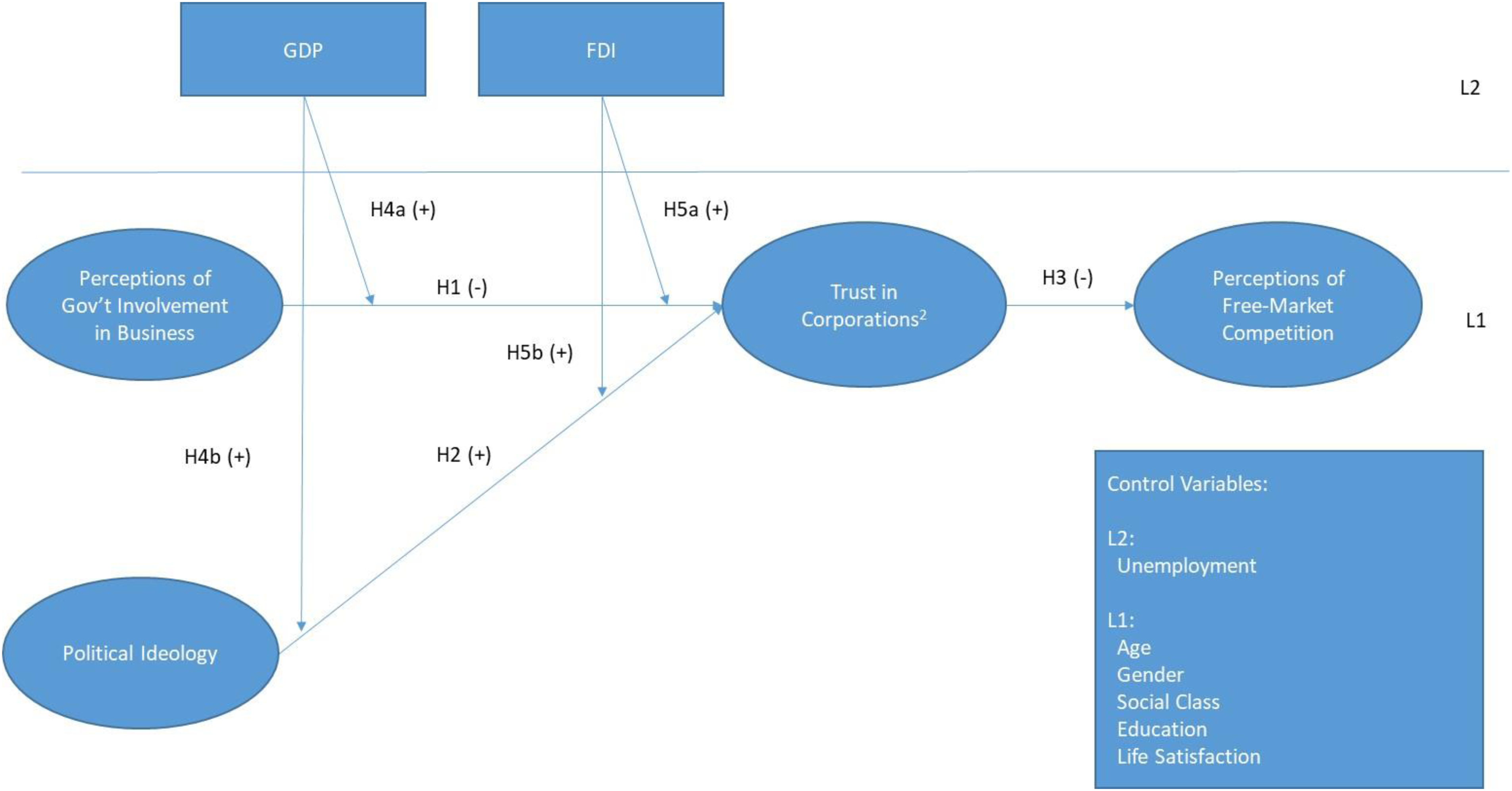
Conceptual Model.
Antecedents of trust: perceptions of government involvement in business. There are competing schools of thought regarding how consumers develop trust in macro level institutions. One competing view comes from cultural theorists, who view trust as exogenous. Cultural theorists argue that perceptions of institutions are learned at an early age and influenced by cultural norms. In contrast, institutional theorists argue that trust is endogenous and based on performance (Ekici and Peterson 2009).
The cultural theorist view recognizes that cultural norms shape individuals’ perceptions of institutions and institutions’ roles in marketing systems. Ackerman, Hu, and Wei (2009), for example, demonstrate that cultural norms affect perceptions of state ownership and business regulations. Furthermore, Wilkie and Moore (2003) discuss how the “aggregate” marketing system differs in each society due to the “idiosyncrasies of the people and their culture, geography, economic opportunities and constraints, and sociopolitical decisions” (p. 118). Indeed, cultural norms often specify the level of government involvement in markets (Scott 2013) with some cultures exhibiting greater levels of government involvement than others (Boubakri et al. 2016).
We posit that perceptions of the roles of government institutions influence trust in major corporations. Our argument aligns with Elliot, Zhu, and Wang (2019) proposition that privately owned and state-owned businesses influence institutional trust in different ways. They find that privately owned businesses were more agile, more willing to adapt to local business practices, and worked with locals to develop relationships. These efforts by privately owned businesses increased situational normality. Situational normality is a dimension of institutional trust. It pertains to expecting success, because the situation is familiar. Furthermore, the efforts of privately owned businesses enhanced facilitating conditions, another dimension of institutional trust. Facilitating conditions are shared beliefs and values about behaviors and goals (Pavlou, Tan, and Gefen 2003). In contrast, state-owned businesses were better at developing structural assurances, the third dimension of institutional trust. Structural assurances “are beliefs that favorable outcomes are likely because of contextual structures, such as contracts, regulations, and guarantees” (Pavlou, Tan, and Gefen 2003).
We contend that trust in major corporations is based more on situational normality and facilitating conditions than structural assurances. Although major corporations can influence regulations, government institutions ultimately implement and enforce regulations. Furthermore, government institutions provide safeguards for when corporations fail. Thus, individuals are more likely to look to government institutions than major corporations for structural assurances. However, corporations are more likely to be successful if they develop relationships with consumers and business partners. Developing shared standards and beliefs about goals and behaviors enhances relationships and creates an expected way of doing business. In other words, it fosters situational normality and facilitating conditions.
We posit that individuals who want less government involvement in business expect privately owned businesses to foster situational normality and facilitating conditions. They may view privately owned businesses as better at developing relationships with consumers and business partners and working with them to develop shared standards and goals. In contrast, individuals who want more government involvement in business may believe businesses are more likely to respect the interests of all stakeholders, not just the interests of consumers and business partners, when there is a high level of government involvement in the market. Therefore, we expect individuals who want more government intervention in business to place less trust in corporations and have negative views of free-market competition.
Antecedents of trust: political ideology. Over the past 20 years, research investigating political ideology has become more popular across the business disciplines (Jost 2017; Jung and Mittal 2020; Swigart et al. 2020; Weber et al. 2021). Concurrently, politics and political polarization are salient issues in North America and Europe (Finkel et al. 2020; Levy 2021; Swigart et al. 2020; Van Bavel et al. 2021; Weber et al. 2021), which underscores the importance of understanding how political ideology can influence macromarketing phenomena (Layton and Grossbart 2006). Political ideology refers to “a schema of interconnected attitudes, beliefs, and values that people use to organize and process social and political information” (Swigart et al. 2020, p. 1065) and exists on a spectrum from left (liberal) to right (conservative) (Jost 2017). Individuals that are more left-leaning value changes to the status quo, and they are concerned with societal and economic factors that impede equality or reinforce existing social class hierarchies. By contrast, those that are more right-leaning value traditions, accept social status hierarchies, and believe it is the responsibility of individuals (rather than the government) to change their position in society (Swigart et al. 2020).
The values underlying a specific political ideology manifest themselves in expressed beliefs and behaviors. Right-leaning individuals, for example, value tradition and stability, and support the status quo (Jost, Federico, and Napier 2009). These values manifest themselves in consumption behaviors such as purchasing more national than generic brands and being less likely to purchase new products (Khan, Misra, and Singh 2013). In contrast, left-leaning individuals are more concerned with social and economic factors that impede equality. They support pro-social policy, the regulation of corporations, and tend to distrust major corporations (Adams, Highhouse, and Zickar 2010). Accordingly, we contend that right-leaning individuals will have more trust in major corporations and, in turn, are more likely to hold favorable views of free-market competition.
An outcome of trust: perceptions of free-market competition. It is well established that economic growth is tied to economic freedom (Doucouliagos and Ulubasoglu 2006) and competition (Hunt 2000, 2007, 2011). However, less is understood regarding individuals’ perceptions about economic freedom and market competition, or what some have referred to as a free-market philosophy, ideology, or perspective (e.g., Heath and Gifford 2006; Jost et al. 2003; Kardos et al. 2016; Malin et al. 2017). The literature suggests that perceptions of free-market competition exist on a spectrum from “preferences for state-planned economy and egalitarian distribution of resources” to “preferences for… complete market allocation of resources and individual economic freedom” (Pecot, Vasilopoulou, and Cavallaro 2021, p. 63). Sociodemographic characteristics are key drivers of perceptions of free-market competition (Eber, François, and Weill 2021; Guiso, Sapienza, and Zingales 2003), but attitudinal variables also contribute to perceptions of free-market competition. For example, trust in market-related institutions (e.g., businesses, banking systems) is positively correlated with better functioning marketplaces (Ekici and Peterson 2009). Thus, greater trust may lead to more favorable perceptions of free-market competition.
Although the above argument implies that more trust in corporations leads to positive perceptions of free-market competition, we posit that there is a point past which more trust leads to negative perceptions of free-market competition. Too much trust in corporations may lead to reduced monitoring of corporate behavior (Gargiulo and Ertug 2006). Reduced monitoring of corporate behavior allows for opportunism and the violation of societal norms, regulations, and laws (e.g., fraud, bribery, etc.) (Forkmann et al. 2022). Opportunism, defined as “self-interest seeking with guile” (Williamson 1985), can take on the form of brazen behavior, such as stealing and cheating, or can be subtle behavior, such as deception. Corporations engaging in opportunistic behavior can taint individuals’ views of the free market and lead to negative perceptions of free-market competition. Indeed, when trust in major corporations erodes, individuals are more likely to favor government intervention in markets to ensure fair competition between companies (Pinotti 2012), and some people may even develop more favorable attitudes toward state ownership as a result (Eaton and Hasmath 2021). Additionally, too much trust in corporations may lead to an aversion to search for new companies for products and services (Villena, Choi, and Revilla 2019). Trust fosters loyalty (Watson et al. 2015). Loyal customers are less likely to switch to competitors or to want competition that could disrupt the marketing strategies of their favored brands. In other words, the desire to protect the corporations they are loyal to may lead to negative perceptions of free-market competition. Therefore, we hypothesize the following:
GDP per Capita and FDI
Previous studies from the fields of economics and macromarketing indicate that trust in market-related institutions is influenced by institutional performance and economic welfare (Ekici and Peterson 2009; Hudson 2006). Outside the macromarketing domain, researchers have explored the direct impact of different macroeconomic performance indicators, such as unemployment, on trust in major corporations (Leibrecht and Pitlik 2020; Stevenson and Wolfers 2011). The consensus is that trust is enhanced when economic performance indicators are positive, as is the case with low unemployment rates (Leibrecht and Pitlik 2020; Stevenson and Wolfers 2011). Within the macromarketing domain, Layton (2009) conceptualization of marketing systems allows for interactions among elements at the macro, meso, and micro levels, such that macroeconomic performance indicators can influence individuals’ attitudes at the micro level. In this study, we treat GDP per capita and FDI as macro-level indicators of economic conditions of a marketing system, and we explore how they influence the formation of trust in major corporations at the micro level (i.e., the individual level).
The moderating role of GDP per capita. GDP per capita is a measure of economic productivity (Baumol 1986). From a macromarketing perspective, GDP per capita is an important element of a marketing system, because it is positively associated with the volume of goods and services available to the average consumer, technological development, and healthcare system development (World Bank 2022). Additionally, high levels of GDP per capita inspire confidence in the economy (Eaton and Hasmath 2021). Thus, high levels of GDP per capita may attenuate citizens’ desires for government intervention in markets and increased state ownership of businesses. Furthermore, high levels of GDP may reinforce right-leaning individuals’ faith in traditional free-market economic structures, in which market participants are free to exchange goods and services. When an economy falters and GDP per capita drops, the opposite is true. Poor economic conditions may cause individuals to be more critical of a lack of government intervention and erode individuals’ confidence in major corporations (Lins, Servaes, and Tamayo 2017). Formally stated,
(b) Gross domestic product per capita strengthens the positive relationship between political ideology and trust in major corporations (i.e., the cross-level interaction term is positive).
The moderating role of FDI. Foreign companies enter a marketing system through exporting or FDI. FDI involves a foreign multinational enterprise (MNE) taking partial or full ownership of a business in a host country (Piteli, Kafouros, and Pitelis 2021). According to the Organization for Economic Co-operation and Development (OECD), FDI provides an important channel for the transfer of technology between countries, promotes international trade, increases consumer access to higher quality and/or less expensive foreign goods, and provides a vehicle for economic growth (OECD 2023). During the course of FDI activities, there is a transfer of explicit (e.g., analytical skills) and tacit knowledge (e.g., managerial skills) to the host country, and some of this knowledge spills over to local entrepreneurs (Acs et al. 2007, 2012). Market entry by foreign MNEs also creates opportunities for local entrepreneurs to launch new ventures to support the MNE's operational and marketing activities, thereby creating new jobs (Acs et al. 2007). Although the marketing systems literature does not explicitly examine the link between FDI and trust in market-related institutions, it seems plausible that the economic benefits associated with FDI would move relationships between individuals and major corporations in a positive direction. Therefore, we predict that high levels of FDI will attenuate calls for increased government involvement in business activities while simultaneously reinforcing right-leaning individuals’ predispositions to trust large firms. Formally stated,
(b) Foreign direct investment strengthens the positive relationship between political ideology and trust in major corporations (i.e., the cross-level interaction term is positive).
Methods
Sample Characteristics
The sample for the study combines secondary data from the World Bank (World Bank 2022) with survey data from the latest waves of the EVS (EVS 2021) and the WVS (Haerpfer et al. 2021). The World Bank maintains databases containing information about economic growth and levels of development across its 189 member countries. The EVS and the WVS are two large-scale, cross-national, and repeated cross-sectional longitudinal survey research programs. Many of the questions and scales related to demographics, business, markets, and economics overlap between the EVS and WVS, and thus it is possible to combine sections of each survey to form a larger, integrated dataset. After merging the World Bank data with the integrated EVS and WVS datasets, our sample contains demographic and attitudinal information about individual respondents as well as macroeconomic information at the country level. We deleted obvious outliers and observations that contained any missing data. The final sample for the analysis consists of 73,007 individuals in 56 countries.
Measures
The two independent variables, perceptions of government involvement in business and political ideology, are latent variables measured on single-item, ten-point rating scales. To measure perceptions of government involvement in business, trained interviewers read the following instructions to each respondent: “How would you place your views on this scale? 1 means you agree completely with the statement on the left [private ownership of business should be increased]; 10 means you agree completely with the statement on the right [government ownership of business should be increased]; and if your views fall somewhere in between, you can choose any number in between.” To measure the second independent variable, political ideology, interviewers read the following prompt to each respondent: “In political matters, people talk of “the left” and “the right.” How would you place your views on this scale, generally speaking?” A value of “1” indicates the respondent has a “Left” political ideology, whereas a value of “10” indicates the respondent has a “Right” ideology. The EVS and WVS provide the data for the Level-1 independent variables (EVS 2021; Haerpfer et al. 2021).
The mediator, trust in major corporations, is measured on a single-item, four-point category rating scale. The EVS and WVS interviewers provide respondents with a list of major companies headquartered in the respondent's country and ask them “how much confidence” they have in the companies. The researchers reverse-coded the original unipolar scale so that higher values correspond with higher levels of trust in major corporations. Specifically, the scale ranges from a value of “1” (none at all) to a value of “4” (a great deal [of trust]) (EVS 2021; Haerpfer et al. 2021).
The dependent variable, perceptions of free-market competition, is measured on a single-item, ten-point category rating scale that captures the extent to which individuals hold an ideology that is consistent with free-market competition. The researchers reverse-coded the original scale so that higher values correspond with more favorable views of free-market competition (1 = “Competition is harmful”/10 = “Competition is good”) (EVS 2021; Haerpfer et al. 2021).
The moderators are measured at the macro-level (i.e., country-level). The first moderator, GDP per capita, represents the gross value added by all resident producers in the country, scaled by the country's population. Per capita values for GDP are expressed in international dollars converted by a purchasing power parity (PPP) conversion factor. The second moderator, FDI, is defined as the purchase of an interest in a company by another company or investor located outside the focal firm's home country. The World Bank's measure of FDI is net inflows (new investment inflows less disinvestment) in the reporting economy from foreign investors, calculated as a percentage of GDP for the year the survey data was collected.
Following the advice of Spector and Brannick (2011), we include theoretically relevant control variables that previous literature suggests influence trust and perceptions of free-market competition. At the individual-level, we control for demographic variables such as social class, age, gender, and education because they influence attitudes toward competition (Eber, François, and Weill 2021) and trust in institutions (Guiso, Sapienza, and Zingales 2003). Social class is measured on a five-point rating scale. Age is the self-reported age of the EVS or WVS respondent in years. The EVS and WVS use a dichotomous variable for gender (1 = male, 0 = female). Education is measured on a four-point rating scale.We also control for respondents’ satisfaction with their lives because Ekici and Peterson (2009) find that trust in market-related institutions is correlated with quality of life. Life satisfaction is measured with a single-item, ten-point semantic differential scale (1 = “completely dissatisfied”/10 = “completely satisfied”). Additionally, we control for unemployment at the macro-level because it could affect the efficiency and effectiveness of marketing systems. Unemployment refers to the share of the labor force that is without work but is seeking employment, and it is measured as a percentage of the total labor force in the year the survey data was collected. The World Bank provides the data on unemployment rates. Table 1 displays a list of all 56 countries in the sample and provides summary information about their economies.
Nations Included in Sample.
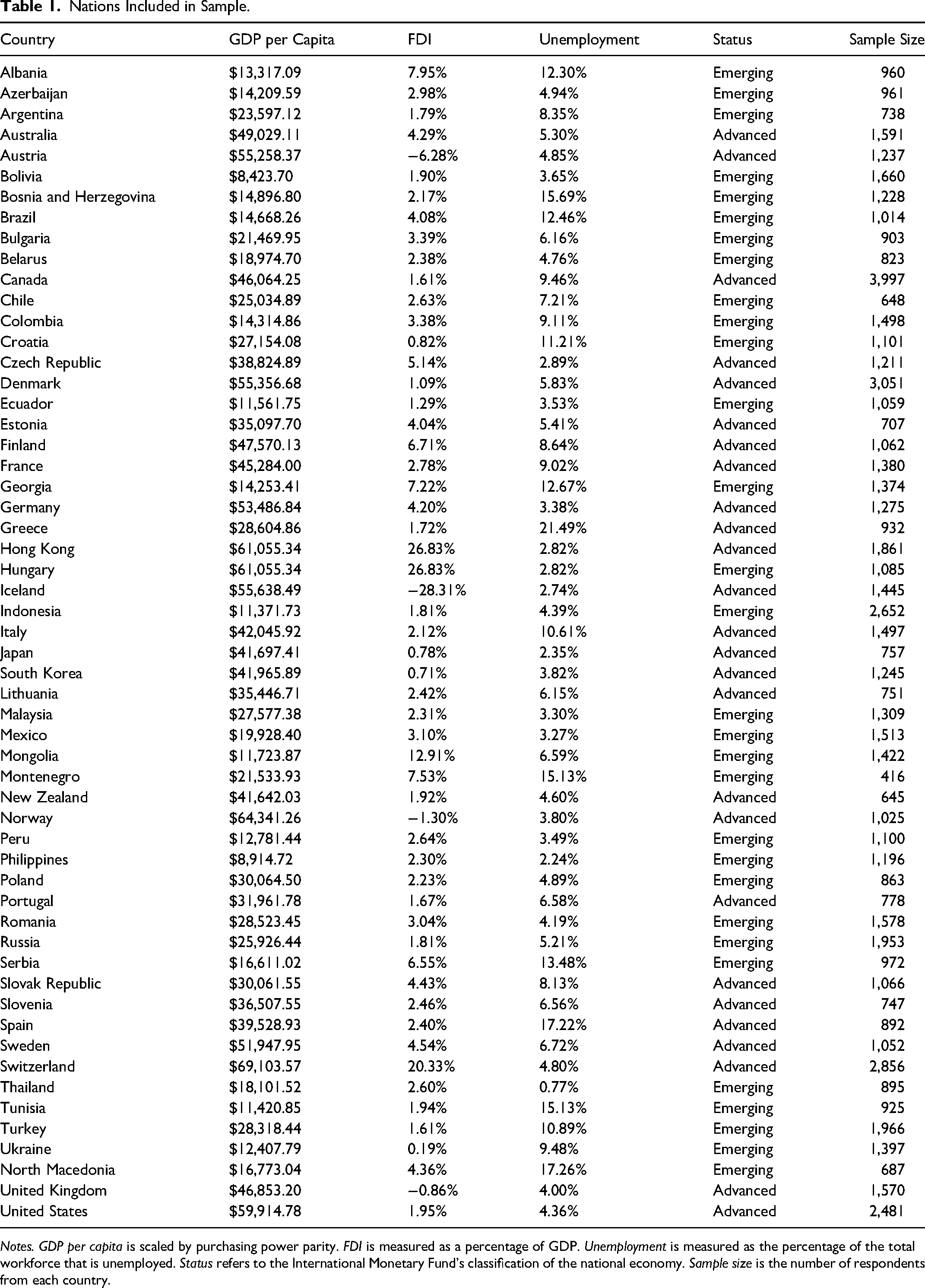
Notes. GDP per capita is scaled by purchasing power parity. FDI is measured as a percentage of GDP. Unemployment is measured as the percentage of the total workforce that is unemployed. Status refers to the International Monetary Fund's classification of the national economy. Sample size is the number of respondents from each country.
Analysis
We test our conceptual model with hierarchical linear modeling in HLM 7 (Raudenbush et al. 2011). Hierarchical linear modeling (HLM) is appropriate for our analysis of marketing systems because the sample consists of individuals at Level 1 (L1) grouped within countries at Level 2 (L2). HLM allows us to estimate the relationships of country-level independent variables, such as FDI, with individual-level dependent variables, such as perceptions of free-market competition, while estimating relationships among individual-level independent and dependent variables. Additionally, HLM accounts for the influence of grouping individuals by country. The grouping can cause non-independence in the data that biases the estimation of relationships at the individual level (Raudenbush and Bryk 2002). In other words, individuals’ perceptions may vary by country, because of differences in countries. For example, the regulatory environment, governmental institutions, and culture vary by country and can affect individuals’ perceptions about business and competition. Using HLM enables us to estimate the influence of these country-level variables on individual-level variables. Furthermore, it enables us to remove the influence of country-level effects that are fixed, or constant, across individuals.
In general, HLM is particularly useful when analyzing data from multilevel conceptual frameworks. It enables researchers to evaluate the influences of higher-level concepts, such as concepts at the meso- or macro-level, on concepts at the micro-level. Indeed, it is recommended to use HLM when analyzing multilevel data, because the grouping of observations at the micro-level can cause non-independence in the data, which violates an assumption of OLS regression (Raudenbush and Bryk 2002). Thus, when using HLM, it is recommended that the researcher determine the amount of influence the grouping of observations has on endogenous variables at lower levels in the model (e.g., mediators and dependent variables at the micro-level). Additionally, when estimating how higher-level variables (e.g., macro-level variables) interact with lower-level variables (e.g., micro-level variables), it is recommended that the higher-level variables be grand-mean centered and the lower-level variables be group-mean centered (Raudenbush and Bryk 2002). Then, the model may be analyzed.
In accordance with recommended practices, we test for the influence of grouping individuals by country by calculating intra-class correlations (ICCs). We calculate the ICCs for the mediator and dependent variable, because the ICC indicates the proportion of variance in these individual-level variables that can be explained by country membership (Bryk and Raudenbush 1992). We calculate the ICCs by running null models for trust in major corporations (the mediator) and perceptions of free-market competition (the dependent variable). In other words, we run models that have no independent variables. They only have an intercept at the country-level and the variables of interest (trust in major corporations and perceptions of free-market competition) as dependent variables, so that the variance in trust in major corporations and perceptions free-market competition that's due to country membership can be estimated. First, we run a null model with trust in major corporations as the dependent variable to calculate the influence of the country grouping on trust in major corporations. The results reveal the country-level grouping accounts for approximately 6% of the variance in trust in major corporations (ICC = .06, χ2 (55, N = 73,007) = 4,487.94, p < .01). Second, we run a null model with perceptions free-market competition as the dependent variable to calculate the influence of the country grouping on perceptions free-market competition. The results reveal the country-level grouping accounts for approximately 6% of the variance in perceptions free-market competition (ICC = .06, χ2 (55, N = 73,007) = 4,521.64, p < .01). According to James (1982), the ICCs fall within acceptable levels, and an HLM analysis is more appropriate for this data than techniques that assume observations are independent.
In accordance with Raudenbush and Bryk (2002), we group-mean centered the L1 independent variables and grand-mean centered L2 variables. Grand-mean centering L2 variables and group-mean centering L1 variables is recommended for cross-level interactions, and group-mean centering L1 variables yields an unbiased estimate of the L1 relationships. In other words, centering the variables yields purer estimates of the interactions between country-level and individual-level variables and of individual-level relationships. Additionally, we standardized the variables to facilitate the interpretation of cross-level interactions and relationships among differently scaled variables.
Results
The correlations and descriptive statistics are shown in Table 2. The correlations of independent variables and moderators are below 0.4, indicating no multicollinearity issues. The mean rating of perceptions free-market competition is 7.08 with a standard deviation of 2.49, and the mean level of trust in major corporations is 2.32 with a standard deviation of .78. All means and standard deviations are reported in Table 2.
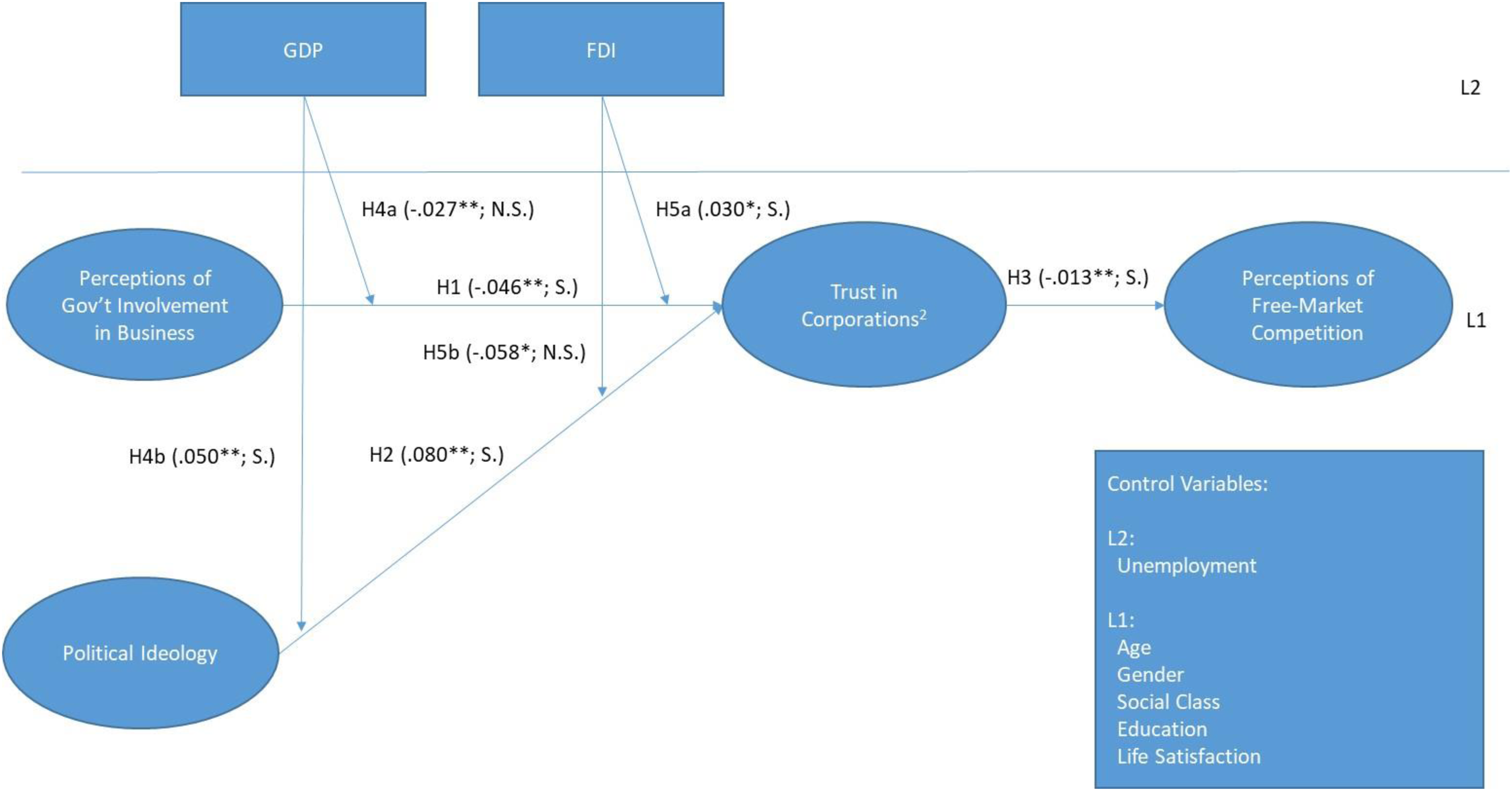
Results.
Correlation Matrix and Descriptive Statistics.
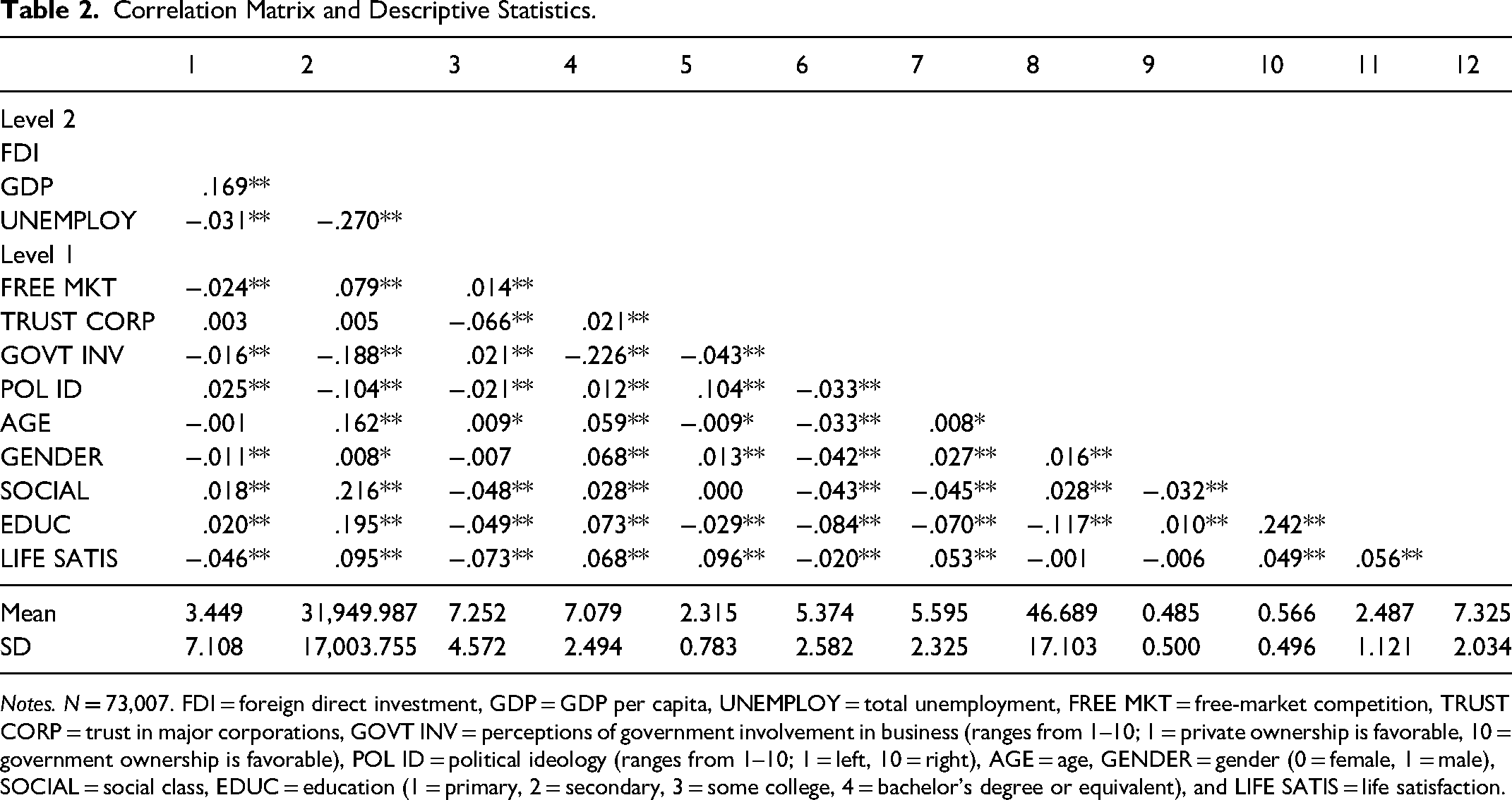
Notes. N = 73,007. FDI = foreign direct investment, GDP = GDP per capita, UNEMPLOY = total unemployment, FREE MKT = free-market competition, TRUST CORP = trust in major corporations, GOVT INV = perceptions of government involvement in business (ranges from 1–10; 1 = private ownership is favorable, 10 = government ownership is favorable), POL ID = political ideology (ranges from 1–10; 1 = left, 10 = right), AGE = age, GENDER = gender (0 = female, 1 = male), SOCIAL = social class, EDUC = education (1 = primary, 2 = secondary, 3 = some college, 4 = bachelor's degree or equivalent), and LIFE SATIS = life satisfaction.
HLM Results.
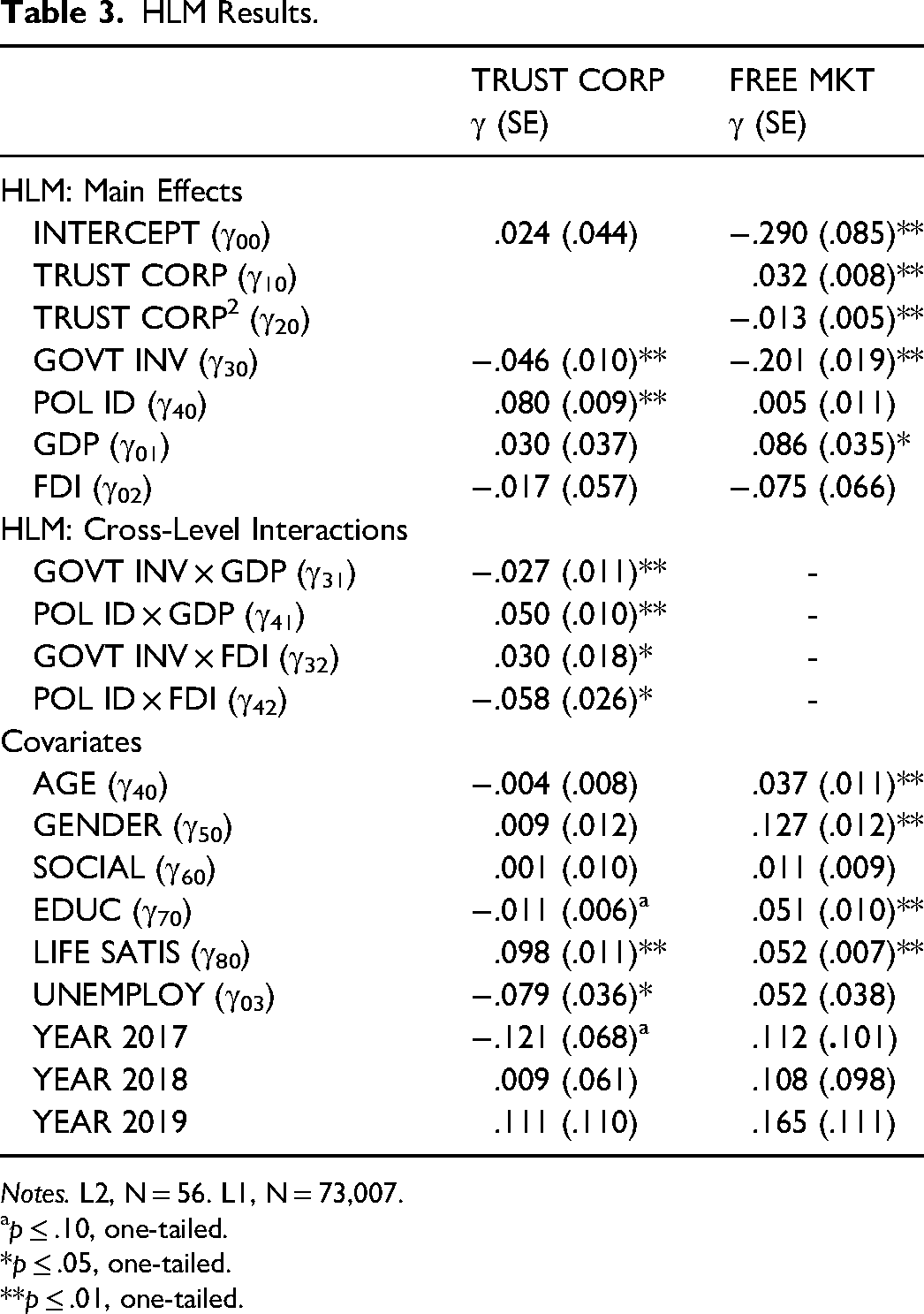
Notes. L2, N = 56. L1, N = 73,007.
p ≤ .10, one-tailed.
*p ≤ .05, one-tailed.
**p ≤ .01, one-tailed.
Results of Mediation Analysis
We hypothesize that trust in major corporations mediates the relationships between perceptions of government involvement and perceptions free-market competition in H1 and political ideology and free-market competition in H2. Furthermore, we hypothesize that trust has an inverted, U-shaped relationship with perceptions of free-market competition, through which government involvement and political ideology influence perceptions of free-market competition (H3). We take two approaches to testing the mediated relationships. First, we follow the causal steps approach advocated by Baron and Kenny (1986). Second, we use a bootstrapping procedure recommended by Hayes and Preacher (2010) to account for the quadratic term in the mediator, which could violate the assumption of normally distributed data.
For the causal steps approach, we run three analyses in HLM. First, we regress perceptions free-market competition on perceptions of government involvement and political ideology (we refer to this as path c). Second, we run an HLM analysis with trust in major corporations as the dependent variable (path a). Finally, we run an HLM analysis, in which we regress perceptions free-market competition (the dependent variable) on trust, trust2 (path b), and the independent variables (path c’). Then, we compare path c to c’. If paths a and b are significant and c’ is weaker than c, mediation is supported (Baron and Kenny 1986). We find support for H1 (γpath a = −.046, p < .01; γpath b = −.013, p < .01; γpath c = −.209, p < .01; γpath c’ = −.201, p < .01). The path from perceptions of government involvement in business to trust in major corporations is statistically significant and negative (as hypothesized), the path from trust2 to free-market competition is statistically significant and negative (in support of H3), the path from perceptions of government involvement to perceptions free-market competition is significant (path c), and path c’ is weaker than path c. We test H2 in the same manner as H1, and we do not find support for mediation (γpath a = .080, p < .01; γpath b = −.013, p < .01; γpath c = .000, p > .05; γpath c’ = .005, p > .05). Paths a and b are statistically significant at the p < .01 level, indicating a relationship between political ideology and trust. However, path c is not significant, and path c’ is not weaker than path c.
Next, we test mediation with a bootstrapping procedure advocated by Hayes and Preacher (2010). Hayes and Preacher (2010) advocate the bootstrapping procedure for curvilinear mediators because of the non-normality of the indirect effect. Unfortunately, HLM 7 does not have bootstrapping capabilities. Therefore, we used the MLMED macro for SPSS advocated by Hayes and Rockwood (2020). This macro can test the indirect effect of up to three mediators at once with a bootstrapping procedure, and it is specifically designed for multi-level mediation models . However, it can only accommodate one independent variable at a time. Therefore, we tested the indirect effects of perceptions of government intervention and political ideology through trust2 separately. The results support H1 (γindirect effect = −.001, p < .01), H2 (γindirect effect = −.001, p < .01), and therefore H3 (see Table 3).
Results of Moderation Analysis
Next, we test cross-level interactions hypothesized in H4 and H5. H4 hypothesizes that GDP per capita moderates the relationships between (a) perceptions of government involvement in business and trust in major corporations and (b) political ideology and trust in major corporations. We do not find support for H4(a) (γ = −.027, p < .01). Although the result is statistically significant, the cross-level interaction is negative. We hypothesized a positive interaction, in which GDP per capita weakens the negative relationship between perceptions of government involvement in business and trust in major corporations. This result indicates that increases in GDP actually strengthen the negative relationship between perceptions of government involvement in business and trust in corporations. By contrast, we find support for H4(b) (γ = .050, p < .01), because the interaction of GDP and political ideology is positive and statistically significant. In sum, these results provide partial support for H4. Similar to H4, H5 hypothesizes that FDI moderates the relationships between (a) perceptions of government involvement in business and trust in major corporations and (b) political ideology and trust in major corporations. We find support for H5(a) (γ = .030, p < .05). The cross-level interaction is positive and significant. By contrast, we find no support for H5(b). The cross-level interaction is significant, but it is negative instead of positive (γ = −.058, p < .05). In this case, the negative sign indicates that as FDI increases, individuals with more right-leaning political ideologies have less trust in corporations (see Figure 3).
Several control variables are statistically significant at the p < .05 level. Life satisfaction and the unemployment rate are related to trust in major corporations. Life satisfaction is positively related to trust in major corporations. The unemployment rate is negatively related to trust in major corporations, suggesting there is less trust when the unemployment rate increases. Age, gender, education, and life satisfaction are positively related to perceptions of free-market competition. Being older, more educated, and more satisfied is correlated with a stronger preference for free-markets. The results further suggest that males have more positive perceptions of free-market competition than females. The results regarding gender are consistent with previous research (see Eber, François, and Weill 2021 for a review) that have highlighted how “women shy away from competition and men embrace it” (Niederle and Vesterlund 2007, p. 1067). Finally, we added dummy variables for the years the data were collected to control for cyclical effects, but none of the year dummy variables are statistically significant (see Table 3).
Additional Analysis
We provide a robustness check of our results by analyzing an alternative model that replaces GDP per capita with the Human Development Index (HDI). The HDI is a composite measure that indicates a country's standard of living, health, and knowledge. Specifically, it is comprised of gross national income per capita, life expectancy, and years of education (World Health Organization 2022). Some macromarketing scholars suggest that HDI is a better measure of economic development than GDP per capita because it provides a more holistic picture of a country than GDP (e.g., Dapice 2008). Thus, we use HDI in the alternative model. The results of the alternative model are similar to our initial model. H1, H2, H3, H4(b), and H5(a) are supported. H4(a) and H5(b) are not supported. The full results of the alternative model appear in Table 4. In short, the results of the alternative model substantiate our findings.
HLM Results of the Alternative Model That Replaces GDP Per Capita with HDI.
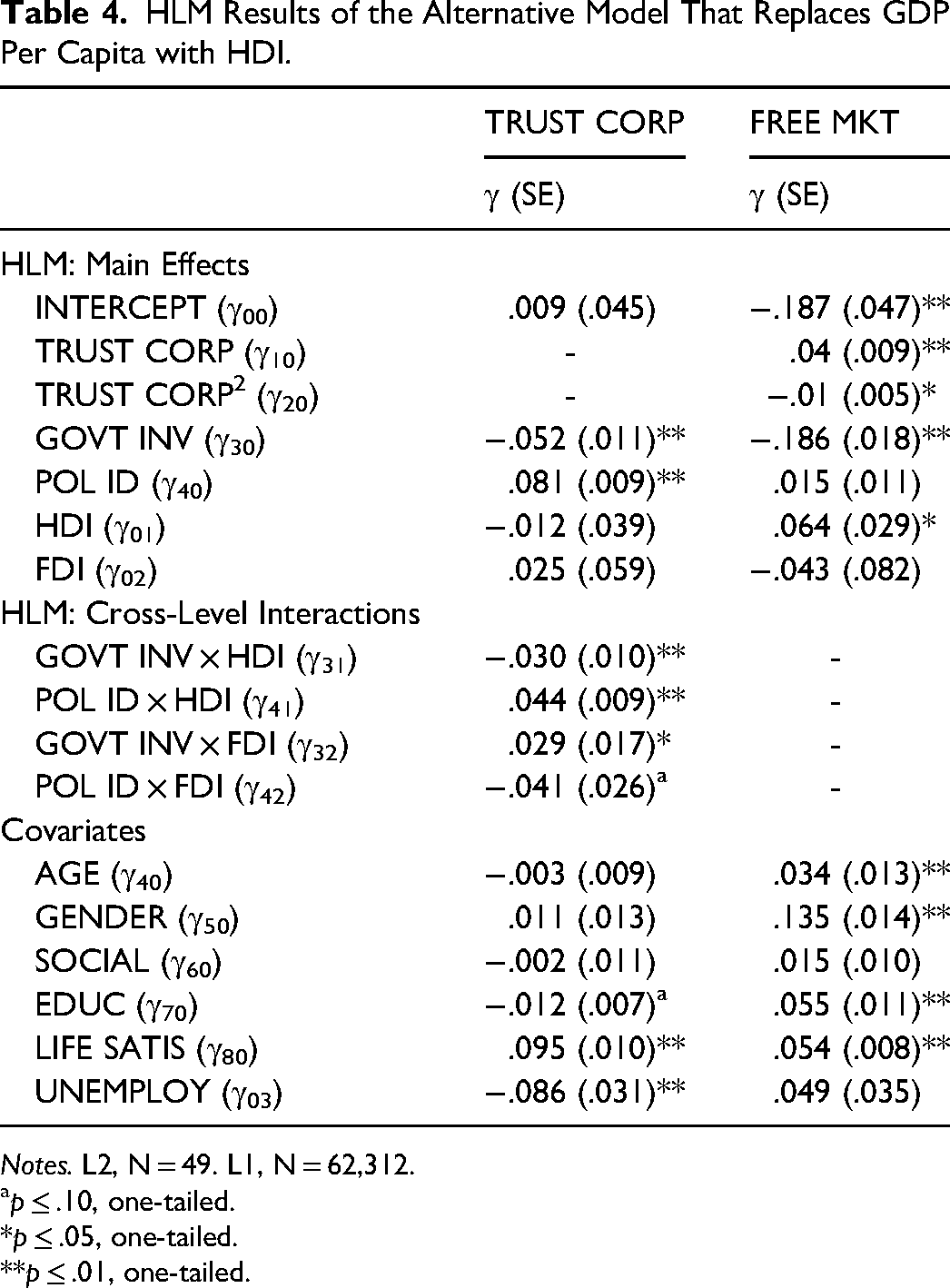
Notes. L2, N = 49. L1, N = 62,312.
p ≤ .10, one-tailed.
*p ≤ .05, one-tailed.
**p ≤ .01, one-tailed.
Discussion
Implications for Macromarketing Scholarship
This study has multiple implications for macromarketing scholarship, particularly as it relates to the “systems thinking” or “S” dimension of the macromarketing “QUEENSHIP” acrostic (Peterson 2020). First, our exploration of the micro level inputs, components, and outcomes of marketing systems answers calls for more research on their functional/structural elements (Layton 2019). This approach implies that collective phenomena also require consideration of lower-level entities, such as individuals and businesses, and their interactions (Felin et al. 2012; Felin, Foss, and Ployhart 2015). We empirically demonstrate that trust in major corporations is a vital component of a marketing system, because it plays a central, mediating role in the formation of attitudes toward competition. An individual's perceptions of government involvement in business and political leanings indirectly affect perceptions of free-markets via trust in major corporations. Relationships between customers and major businesses that supply goods, services, experiences, and ideas are critical linkages in any marketing system, and those relationships are built on trust (Layton 2011). When individuals completely lack confidence in corporations, they may develop preferences for government-sanctioned oligopolistic or monopolistic competition, which limits a marketing system's capacity for innovation, entrepreneurship, and economic growth (Hunt 2011). However, the curvilinear relationship between trust and perceptions of competition suggests that too much trust can lead to negative perceptions of free-market competition. Placing too much trust in corporations can reduce monitoring of corporate managers and lead to environmentally and socially irresponsible business practices, such as excessive pollution, waste, fraud, bribery, and anti-competitive tactics. Additionally, too much trust can cause consumers to stop searching for competitive offerings and be suspicious of rival firms and new entrants that could increase competition.
Our study also contributes to research on the outcomes of marketing systems, although not in the traditional sense of modeling GDP, FDI, or another macroeconomic indicator as a function of the system. Instead, we demonstrate how macro variables associated with the larger national economy, such as GDP per capita and FDI, can influence the attitudes of individual actors within a marketing system. We find that individuals who want more government involvement in business trust corporations less when GDP per capita increases, whereas right-leaning individuals trust corporations more when GDP per capita increases. By contrast, individuals who want more government involvement in business trust corporations more when FDI increases, whereas right-leaning individuals trust corporations less. Broadly, the findings give credence to Layton (2009) assertion that individual actors influence and are influenced by their environments. Thus, a better understanding of marketing systems should acknowledge that macroeconomic variables like GDP and FDI can shape individual perceptions of businesses and markets.
There are two surprising results associated with the tests of the cross-level interactions. The result of testing H4(a) suggests that increases in GDP at the national level reinforce the negative relationship between individuals, who want more government involvement in business, and trust in major corporations. Perhaps increases in GDP make disparities in wealth more obvious to those, who favor a larger government role in business, and such individuals may lay some of the blame for the wealth gap at the feet of large corporations. Likewise, the surprising result associated with H5(b) suggests that rightwing individuals lose confidence in major businesses as FDI increases. Such individuals may be concerned that FDI could lead to higher costs of living and more bribery and corruption (Nguyen and Pham 2012). Furthermore, in developing and emerging economies that lack legal protections for small-to-medium size enterprises (SMEs) and entrepreneurs, right-leaning individuals may fear that MNEs will harm smaller, local competitors and suppress local sources of innovation (Wang et al. 2013).
The third contribution of the study is methodological. Our two-level model answers calls for more macromarketing research featuring hierarchically structured data (Friske and Cockrell 2019; Malhotra 2006). Our study also answers a general call for macromarketing research featuring secondary data (Simkins and Peterson 2016). The World Bank, the EVS, and the WVS are useful sources of information for macromarketing researchers, because their databases contain information pertaining to the quality of life, ethics, environment, and systems thinking dimensions of macromarketing. Furthermore, by combining data from the three sources into a large sample of individuals nested within national economies, we can use HLM to facilitate a true systems approach to macromarketing research (Layton 2007, 2019; Wooliscroft 2021).
We contend that HLM is underutilized in the macromarketing discipline. To the authors’ knowledge, there are only three articles in the Journal of Macromarketing that use HLM (see Arslanagic-Kalajdzic, Cerne, and Kadic-Maglajlic 2019; Friske, Cockrell, and King 2022; Friske and Cockrell 2019). However, several articles in the Journal of Macromarketing conceptualize multilevel frameworks and discuss marketing systems, in which macro-level concepts influence micro-level outcomes (e.g., Akaka et al. 2023; Domegan et al. 2019; Lusch 2006; Mundt and Houston 2010). Layton (2007) defines a marketing system as “a network of individuals, groups, and/or entities linked directly or indirectly through sequential or shared participation in economic exchange.” HLM enables us to evaluate how entity- or group-level concepts influence individual-level concepts. For example, Lindeman (2014) builds a multilevel conceptual framework for understanding how the “macro-level phenomenon of market creation” influences individuals’ well-being. Future macromarketing research could quantify the influence of the macro-level concepts put forth in the conceptual model on micro-level concepts, such as individuals’ well-being, with the use of HLM. We contend that HLM is an important tool for quantitative macromarketing research because it allows researchers to test hypotheses at the macro, meso, and micro levels and model interactions between levels. Indeed, HLM is one of the few techniques that would allow us to accurately estimate the micro-macro linkages in our conceptual model because 6% of the variance in trust in corporations and 6% of the variance in perceptions free-market competition are attributable to macro level factors.
Implications for Public Policy
This study has implications for public policy. Our study touches on an important part of the marketing systems literature that investigates noncompetition and markets (Layton and Grossbart 2006). We show that lack of trust affects more than the individual's relationships with focal firms, it also indirectly affects the person's overall perspective of free markets. Our findings suggest policymakers can encourage support for open competition and suppress the formation of anti-competitive, monopolistic, or oligopolistic attitudes by acting on the mediating variable of trust in major corporations. To build this trust, policy makers should take steps to limit corporate scandals through accounting, finance, and environmental regulations and pay particular attention to anti-trust legislation (Child and Rodrigues 2003; Kaptein 1998). Balanced and fair competition is vital to the efficiency and effectiveness of the overall marketing system (Hunt 2011). Policy makers cannot take the appropriate steps to promote competition unless they have the support of individual actors within the system, and trust in major corporations plays a central role in the formation of healthy attitudes toward competition.
Policymakers may have little control over the micro-level attitudinal variables (e.g., political ideology, financial satisfaction) and demographic factors (e.g., gender, education) that directly affect trust in major corporations, but knowledge of the structural/functional components of marketing systems is still useful. The results of our analysis suggest that perceptions of government involvement in business, political ideology, financial satisfaction, gender, social class, and education are all predictive of trust in major corporations. Policymakers could use this collection of attitudinal and demographic variables as leading indicators of trust in marketing-related institutions. Shifts in such attitudes and demographic patterns would signal forthcoming changes in trust and might allow policymakers time to intervene. Moreover, by monitoring constituents’ attitudes and tracking changes in demographics, policymakers could better predict whether the public will be amenable or hostile to new policies that impact their relationships with large corporations. Monitoring changes in consumer attitudes is critical, because our results indicate that psychological variables have a relatively larger effect on trust and perceptions free-market competition than demographics.
If policy makers want to influence trust in business without making dramatic changes to business regulations, they should focus on the influence of GDP per capita and FDI. Admittedly, all politicians would prefer high levels of GDP to low levels of GDP, ceteris paribus. Furthermore, improving GDP per capita is complicated, and it is not entirely in the hands of policymakers. Attracting FDI, on the other hand, is an attainable goal, but increasing FDI has both positive and negative consequences within the marketing system. Our results indicate that FDI can enhance trust in major corporations when individuals believe that government should play a larger role in business activities. This outcome may be partially due to the belief that FDI brings new assortments of goods and services to the host country and creates employment as long as regulations are in place to protect the environment and limit corruption and bribery (Acs et al. 2007). FDI also involves a transfer of explicit knowledge (e.g., technology) and tacit knowledge (e.g., managerial skills) from MNEs to smaller companies in the host country. Assuming the government takes adequate steps to protect local businesses, some of the knowledge will spill over to entrepreneurs who leverage that knowledge to develop innovative new products (Acs et al. 2012; Acs, Audretsch, and Lehmann 2013).
Successful FDI programs in Ireland throughout the 1990s and early 2000s provide a blueprint for policymakers looking to increase FDI inflows, and such programs have been replicated in Taiwan, Singapore, and Israel. Ireland created a government agency, the Industrial Development Authority (IDA), to promote and encourage FDI, and Ireland also relies on low corporate taxes and easy access to employment and capital grants to attract foreign investors. Taiwan, Singapore, and Israel rely more on policies that encourage research and development (R&D), and FDI inflows are a primary outcome of those policies (Acs et al. 2007). Either strategy can be successful. However, increases in FDI can also foster distrust in right-leaning individuals, perhaps because these individuals are concerned about the government's ability to protect local SMEs from the anti-competitive practices (e.g., bribery, dumping) of foreign multinationals. In sum, FDI is a double-edged sword, as it can either promote trust or distrust in major corporations, depending upon constituent's political ideology.
Limitations and Future Research Directions
Although this study contributes to the literature on marketing systems, it has limitations that require elaboration. First, our reliance on secondary data means that we have no control over measurement or data collection procedures. Data from the World Bank and similar international institutions is credible; however, the use of single-item scales to measure psychological constructs in the EVS and WVS surveys is not ideal. Most methodologists prefer multi-item scales to single-item scales when measuring latent variables (Diamantopoulos et al. 2012). However, there is a precedent for using single-item measures when surveys are exceptionally long (Bergkvist and Rossiter 2007) and when constructs are unidimensional and well-defined (Fuchs and Diamantopoulos 2009). Furthermore, working with secondary data from three different entities (EVS, WVS, and the World Bank 2022) poses unique challenges. The countries selected for the EVS and WVS surveys do not always match the countries in other publicly available datasets maintained by institutions like the World Bank, the International Monetary Fund, etc. Second, this study is cross-sectional, so we cannot track within-subjects or between-subjects effects over time. Therefore, we cannot speculate whether trust in major corporations and perceptions free-market competition are relatively stable attitudes.
Another limitation is that in our analysis of the micro level elements of marketing systems, we stop short of identifying how individuals’ attitudes towards corporations and competition ultimately lead to behaviors. These attitudes probably have wide-ranging effects on shopping behaviors, purchase decisions, and consumption, but we cannot make any of those connections within the scope of the study. Finally, while some studies suggest that culture plays an important role in shaping individuals’ attitudes and beliefs regarding government involvement in business (Ackerman, Hu, and Wei 2009; Eaton and Hasmath 2021), we do not measure culture directly in this study. Future studies could build on our work and the work of McCarty and Shrum (2001) to assess how specific cultural norms influence individuals’ attitudes and beliefs about macro-level phenomena.
Some of the limitations point to future opportunities for research. For example, dynamism is an important characteristic of marketing systems (Layton 2011; Wooliscroft 2021), yet it is impossible to observe dynamism with cross-sectional data. Finding a relevant source of time-series data for marketing systems research is challenging, but it will be a necessary step in the advancement of the field. Moreover, empirical studies that compare and contrast different marketing systems will be welcome additions to the field. Our study looks at the marketing systems of 56 countries and includes poor, emerging, and developed nations, but studies based on larger samples of national marketing systems would have more generalizability. In addition, researchers could employ hierarchical linear modeling to assess higher aggregations of data at the trade bloc or regional level, as countries are nested in regions. Given macromarketing's interest in the effects of geopolitics on marketing systems (e.g., Papadopoulos and Malhotra 2007), a three-level model of market efficiency/inefficiency with individuals at L1, countries at L2, and regions at L3 could provide unique insights. Alternatively, researchers could use HLM to analyze culture's effects on individual attitudes within marketing systems by substituting national culture at L2 or a larger, regional measure of culture (e.g., Hofstede's individualist/collectivist index) at L3.
Another avenue of research could focus on the behavioral elements of marketing systems. Our study focuses on the attitudinal components, or how individuals’ thoughts shape different aspects of a marketing system, but we do not examine how these attitudes/beliefs become specific actions that influence the system. Modern marketing systems research has deep connections to Alderson's (1965) theory of functionalist behavior. As the theory's name implies, behaviors (not just attitudes and intentions) are central to the study of marketing systems. Indeed, it is impossible to read an article on marketing systems without seeing the words “actors,” “exchange,” “evolution,” and “flows,” all of which connote actions. Finding relevant behavioral data may be as challenging as finding longitudinal data, but such data would open many avenues for future marketing systems research. With respect to developing appropriate measures, or metrics, for future macromarketing research, the results of our analysis suggest that HDI is not necessarily a better measure of wellbeing than purely economic variables such as GDP per capita. Indeed, the correlation between HDI and GDP per capita in our sample is .928. Perhaps the WHO's measure of Quality of Life has more potential as a macromarketing variable that is not solely based on country-level economic data, but the original scale for it is multi-dimensional and consists of 20-plus items, which limits its practicality in long surveys. Clearly, there is still room for improvement in the number and quality of wellbeing metrics at the national level that can be used in macromarketing research (Sirgy 2021).
Footnotes
Associate Editor
Julie Stanton
Declaration of Conflicting Interests
The author(s) declared no potential conflicts of interest with respect to the research, authorship, and/or publication of this article.
Funding
The author(s) received no financial support for the research, authorship, and/or publication of this article.
ORCID iDs
Kerry T. Manis https://orcid.org/0000-0001-7895-8946 
Wesley Friske https://orcid.org/0000-0003-3946-7209