



Abstract
Cancellations, often referred to derogatively as “cancel culture”, are becoming increasingly pervasive in public discourse, political debate, and the marketing field. Cancellations pose a clear threat to established market actors and have the potential to re-organize institutional structures. However, empirical work investigating this phenomenon is limited. This study adopts an institutional theory lens to investigate how calls for brand cancellation unfold. In doing so, it provides insight into how markets are shaped to realign with prevailing institutional logics around political ideology, race, gender, sexuality, abuse, and corporate greed. Further, it outlines the triggers that prompt institutional entrepreneurs to attempt to delegitimize the existence of incumbent brands. It also reveals how various actors (consumers, brands, media, affiliates, influencers, opponents) engage in institutional work to disrupt, create, or maintain institutional logics, as well as their own legitimacy. Macro implications for social values, political factions, markets, marketing practices, and brands are discussed.
In 2020, multimillion-dollar celebrity brand Ellen DeGeneres was the subject of a mounting social media campaign against her personally and her award-winning “Ellen Show”. The campaign was prompted by employee complaints about treatment amid the Covid-19 pandemic and gained momentum as claims multiplied and revealed disturbing details of a toxic workplace environment centered on racism, ostracism, intimidation, and sexual misconduct (Giacomazzo 2020; Yandoli 2020). Those participating in the campaign deemed the issues unacceptable and unrecoverable, especially given the show's “be kind to one another” premise. While Ellen herself attempted to take responsibility for the issues and pledged changes in a memo issued to staff, the show's producer Warner Media independently investigated the claims. The campaign intensified at this point, receiving increasing levels of media attention and outrage from employees, consumers, as well as fellow celebrities, and show sponsors. Although many fans and entertainment industry associates publicly supported Ellen, backlash continued to grow, sponsors abandoned the show, and celebrities became harder to engage. The campaign peaked as the media reported fellow celebrities and industry associates turning against Ellen and the #ReplaceEllen hashtag started trending on Twitter (Guerrero 2022). Following months of silence, Ellen apologized for the issues in her opening monologue of the show's Season 18 premiere. By this time, much of Ellen's prior support dissipated and the show's audience numbers plummeted (Quinn 2021). The campaign against Ellen diffused as NBC announced the end of her show in May 2022 after 19 seasons – almost a year after the initial allegations (Spencer 2021).
The above example illustrates a new phenomenon wherein socially networked consumers call out brands for highly problematic views and/ or behavior, with the target brand said to be “canceled”. More specifically, firms, celebrities, influencers, and public figures who wield influence on their respective networks are strictly held against current social acceptability standards (Velasco 2020). Consumer calls for cancellation have proliferated since 2020 and the term “cancellation” has become central to extensive popular commentary and public debate across politics, culture, and media (Mohsen 2022).
While critics view cancellation as a barrier to true social progress on the grounds that it stifles open debate and free speech, promoting ideological conformity and self-censorship (Norris 2020), proponents argue its importance as a tool to achieve social justice for those in less advantageous positions (Bakhtiari 2020; Clark 2020). The existence of cancellations has also been contested (Hagi 2019; Willingham 2021), as have its morality and motivations (Bouvier 2020). Nonetheless, and as transpired for Ellen DeGeneres, calls for cancellation can have detrimental consequences for brands (e.g., reputational damage and financial loss) that can be hard to recover from (Mohsen 2022), particularly if third parties apply sanctions (Saint-Louis 2021). Many brands also fail to accurately identify and assess the potential impacts of being canceled (Proulx, McNair, and Conroy 2022). Academics and marketers therefore need to understand this burgeoning and crucial phenomenon.
We define a cancellation as deliberate collective action on part of consumers – today typically performed on social media – which attempts to force market change through calling for the cancellation of a brand in retribution for an irreparable transgression. To this end, cancellations represent a new form of active consumer resistance that seeks to withdraw all support for a brand to (re)align markets and marketing practices with prevailing societal values and logics. While conceptually related to previously established forms of consumer resistance, we argue that calls for cancellation differ in motive and behavior. Given cancellations arise in response to an “irreparable” brand transgression, transpire publicly on social media, employ relatively sophisticated tactics, attempt to cause permanent harm to a brand, and potentially have severe consequences, it is critical for brands and marketers to understand the new and complex phenomenon of cancellations.
We contribute to the literature on consumer resistance through understanding consumer attempts to “cancel” brands and developing a model to illustrate how such calls unfold over time. Guided by theoretical considerations from institutional theory as a lens for examining market change, as well as data from actual calls to cancel brands that transgressed irreparably, we develop an understanding of this emergent form of consumer-brand activism. First, we conceptualize a cancellation as a new and unique form of active consumer resistance to a brand. Second, we empirically examine and illustrate how consumer calls for brand cancellation unfold and seek to achieve change by re-aligning the market, marketing practices, and individual actors with newly imposed logics around political ideology, race, gender, sexuality, abuse, and greed. This knowledge is critical given the nascent stage of scholarly understanding of cancellations (Saldanha, Mulye, and Rahman 2022; Tandoc et al. 2022), increasing number of calls for brands to be canceled (Bakhtiari 2020), and potential for permanent harm to brands (Clark 2020). Further, calls for cancellation have profound macro implications for organizing and realigning markets with prevailing societal values, brand public relations strategies, and the evolution of consumer resistance.
The remainder of this paper is organized as follows. First, literature pertaining to consumer resistance, consumer movements as manifestations of active and collective resistance, and cancellations as an emergent form of consumer-brand activism is reviewed. From here we present an overview of institutional theory as macro perspective of market change. Next, we outline our methodological approach and empirical understanding of the process underpinning calls for the cancellation of brands. We then discuss our findings and how they contribute to the emerging understanding of cancellations and conclude with directions for future research.
Conceptual Overview
Consumer Resistance
Consumer resistance falls under the broad realm of anti-consumption (Chatzidakis and Lee 2013; Lee 2022) and was initially conceptualized in the marketing domain as a “resistance against a culture of consumption and the marketing of mass-produced meanings” (Penaloza and Price 1993, p. 123). The subsequent literature features various adverse behavioral responses to dominance within the marketplace such as influence, strategies, logic, or discourses that are perceived by consumers as antagonistic to their beliefs (Lee et al. 2011) and unacceptable due to the dissonant representations and negative emotions evoked (Roux 2007). Consumer resistance is thus a form of targeted opposition (or escape), which aims to influence the meaning, authority, and power structures of markets (Roux and Izberk-Bilgin 2018), firms or subsidiaries (Giesler 2006; Giesler and Pohlmann 2003), brands (Holt 2002; Klein 2001), products and signs (Duke 2002; Moisio and Askegaard 2002), marketing techniques such as advertising (Handelman 1999; Rumbo 2002) or sales (Kirmani and Campbell 2004), and even consumerism itself (Cherrier, Black, and Lee 2011; Gabriel and Lang 2015). Through such influence, consumers can adversely affect the achievement of firm objectives (Lee et al. 2011).
To take account of the reactive character of consumer resistance, it is important to understand the motivational triggers (Roux 2007), with the literature featuring a wide range of such factors. Examples include market conditions that are deemed unacceptable, products or brands not conforming to the consumer's self-image or self-identity, and dominant cultural values that are rejected due to their hegemonic nature (Moisio and Askegaard 2002; Thompson and Arsel 2004). Such work has largely adopted the consumer as the level of analysis (Chaney and Slimane 2014).
While consumers can voice their grievances collectively, they can also resist silently, individually, and sometimes permanently (Roux 2007). Consumers also express resistance on a “continuum”, with the spectrum of adverse actions ranging from the passive avoidance of brands or products to intermediate behaviors such as adjusting or reducing consumption to a more active (often aggressive) opposition of brands (Fournier 1998; Roux 2007). Thus, the manifestation of resistance varies based on the intensity of dissonant elements perceived by consumers. Passive consumer resistance includes frugality (Witkowski and Reddy 2010), simplification (Cherrier 2010), escape (Kozinets 2002), cultural resistance (Holt 2002), consumption restraint (Paschen, Wilson, and Robson 2020), avoidance (Banister and Hogg 2004) and alternatives (Banister and Hogg 2004), sustainable consumption (Black and Cherrier 2010), symbolic consumption (Chatzidakis and Lee 2013), and “creative consumers” (Berthon et al. 2007).
In contrast, active consumer resistance involves a more radical and confrontational opposition to a market or brand (Kozinets and Handelman 2004) and is underpinned by a desire for change, consumer rights, ethical or moral values, public good, collectiveness, and organization (Gabriel and Lang 2015). Examples of active consumer resistance to a brand range from negative word of mouth (Charlett, Garland, and Marr 1995; Hennig-Thurau et al. 2004), and sabotage (Kähr et al. 2016) to more severe forms of revenge/ retaliation (Grégoire et al. 2018; Huefner and Hunt 2000), collaborative attacks (Rauschnabel, Kammerlander, and Ivens 2016), and boycotting (Braunsberger and Buckler 2011; Klein, Smith, and John 2004). Table 1 provides a definition and the goals, motives, and illustrative behaviors of these various forms of active consumer resistance.
Positioning Cancellations in Relation to Other Forms of Active Consumer Resistance in the Literature.
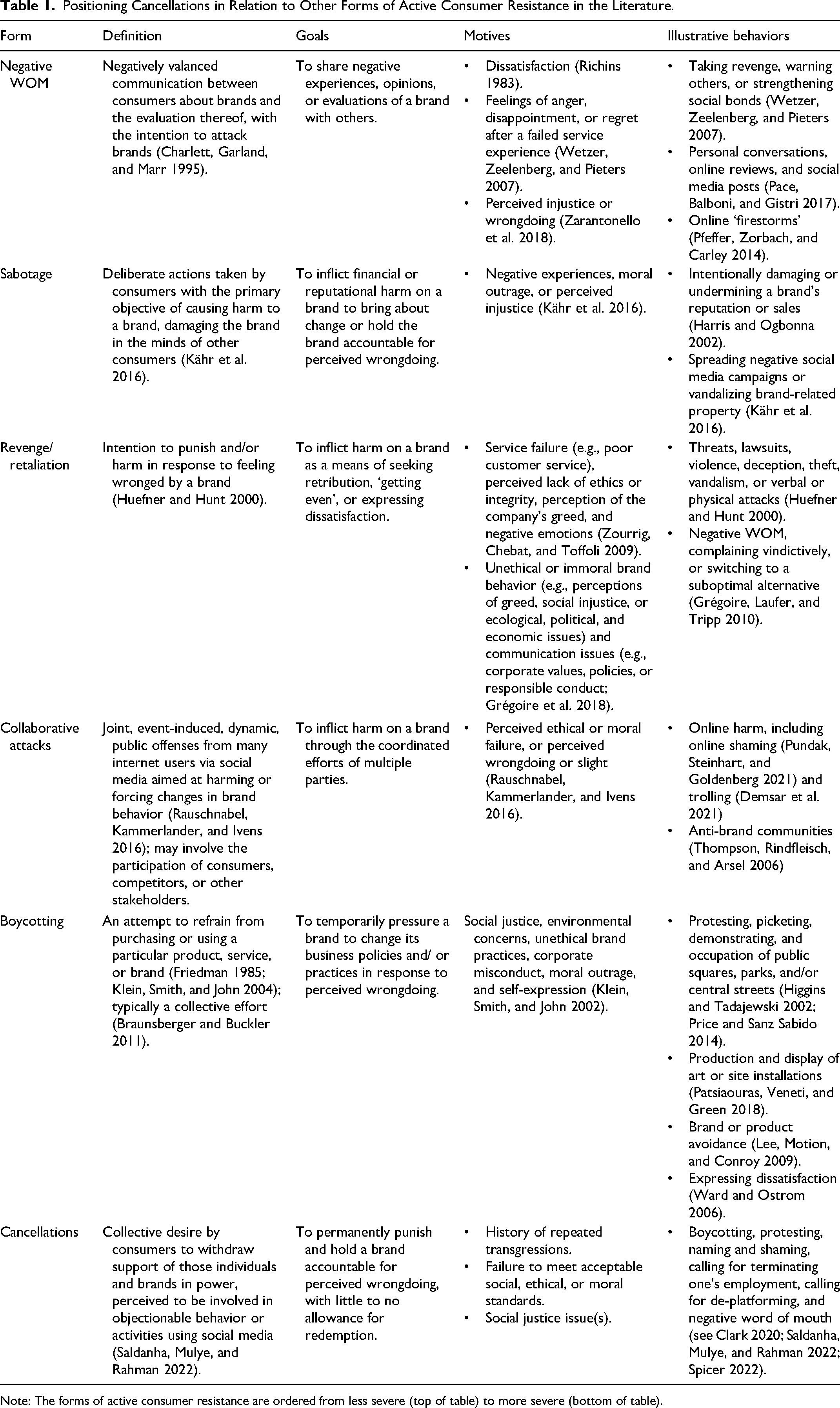
Note: The forms of active consumer resistance are ordered from less severe (top of table) to more severe (bottom of table).
Consumer Movements as Manifestations of Active and Collective Resistance
Active consumer resistance can manifest as collective efforts to transform various elements of the social order surrounding consumption and marketing (Izberk-Bilgin 2010) – a “consumer movement”. Typically driven by issues of identity, social justice, quality of life, and consumption (Goodwin and Jasper 2003), consumer movements aim to force organizations, brands, industries, and governments to enact changes in principles, practices, and policies (King and Pearce 2010). The literature portrays consumer movements as organized around goals that resist marketing practices, such as publishing deceptive advertising (Kozinets and Handelman 2004), as well as more radical goals that seek to transform consumer culture through anti-consumption (Kozinets 2002; Lee 2022), and markets via boycotting (Friedman 1985; 1999).
To be successful, a consumer movement must collectively articulate grievances and a vision for change that resonates with the broader public (Goodwin and Jasper 2003) and translate that vision into a collective identity for individual members (Kozinets and Handelman 2004). Further to a movement's success, members must develop a tactical repertoire or means of organizing dramatized public performances to draw attention to the cause (Jasper 2008). Traditional tactics within consumer movements includes occupying symbolic sites through rallies, demonstrations, protests, engaging in collective actions such as boycotting or lobbying (Kozinets and Handelman 2004), and ludic and creative actions such as parody, playful pranks, stunts, and the carnivalesque (Weijo, Martin, and Arnould 2018). While such tactics can be executed both in the real world and online, digital technology allows members to organize, collaborate, expand their actions, and disseminate messages with relative ease (Kozinets, Patterson, and Ashman 2017). Indeed, consumer activism has intensified with social media, enabling digital participatory cultures and social movements (Velasco 2020). Facilitated by social media, cancellations represent an emergent form of consumer-brand activism that can progress into a movement.
Cancellations as an Emergent Form of Consumer-Brand Activism
Despite growing scholarly attention in the fields of media, communications, public relations, and cultural studies, cancellations are yet to be established within the marketing domain (Saldanha, Mulye, and Rahman 2022). Across the literature, cancellations are discussed in various ways, including as a polarized outcome of digital media participation (Ng 2020), a form of contemporary online shaming (Holman 2020; Wahyudiputra, Amrullah, and Adrian 2021), “cultural backlash” (Norris 2021) and “cultural boycott” (Clark 2020; Ng 2020), a manifestation of “wokeism” (Beiner 2020), an expression of affective online communities (Bouvier 2020), an effective tool for addressing social justice issues (Bouvier 2020; Norris 2020), as a social weapon (Ahuja and Kerketta 2021), and closely associated with the pejorative terms “cancel culture” and “call-out culture” (Clark 2020). Given this, there has been a focus on the legitimacy of cancellations as a phenomenon, rather than the development of an understanding of the phenomenon itself (Saldanha, Mulye, and Rahman 2022).
Current understanding of cancellations also lacks consensus and clarity, with a wide range of definitions, explanations, and interpretations (Ahuja and Kerketta 2021; Simpson and Srinivasan 2018). Nonetheless, three common definitional components of cancellation exist: it involves (a) the public shaming of objectionable or offensive words or deeds by organized collectives on social media, and (b) attempting the complete withdrawal of attention and support for a target brand or public figure, which is (c) motivated by wanting the target to be ostracized or experience some form of severe consequence or penalty for violating social norms. As indicated by Table 1, we situate cancellations within the broad domain of active consumer resistance. While similarities can be drawn to established forms of consumer-brand activism, calls for cancellation differ in motive and behavior. Specifically, cancellations arise in response to an irreparable brand transgression, rapidly circulate given they primarily occur publicly on – or are facilitated by – social media, employ relatively sophisticated tactics, and attempt to cause permanent harm to a brand.
While empirical work on cancellations has begun, these studies tend to investigate isolated aspects of the cancellation process. For instance, prior research examines specific types of transgressions underpinning cancellation (Bouvier and Machin 2021), specific calls for cancellation (Bouvier and Machin 2021; Lee and Abidin 2021; Pereira de Sa and Pereira Alberto 2022; Sailofsky 2022), the effect of cancellation on specific target groups (Saint-Louis 2021; Wahyudiputra, Amrullah, and Adrian 2021), the nature of a specific social media platform (Lewis and Christin 2022), as well as the role and power of a specific actor involved (Holman 2020; Saldanha, Mulye, and Rahman 2022). Academic understanding of the dynamics between multiple actors involved in a cancellation is emerging in the literature (Lewis and Christin 2022; Saldanha, Mulye, and Rahman 2022), as it is in relation to consumer motivations for (Bouvier and Machin 2021; Mueller 2021; Tandoc et al. 2022) and perceived consequences of (Hooks 2020; Zhang and Laiu 2020) participating in a cancellation. Despite this growing body of literature, however, a comprehensive understanding of why and how calls for cancellation transpire does not exist.
Against this background, this study advances understanding by empirically examining how calls for cancellation progress over time among socially networked consumers and other actors. We achieve this in two ways. First, by conceptualizing cancellations as a new and unique form of active consumer resistance to a brand that transgresses irreparably. And second, by illustrating how calls for brand cancellation unfold and can progress into a consumer movement that seeks to achieve change by re-aligning the market, marketing behavior, and individual actors with prevailing societal values and logics.
Institutional Theory as a Macro Perspective of Market Change
At a macro level, market change is viewed as a complex social process that occurs over time (Slimane et al. 2019). From this perspective, markets are regarded as organizational fields – “the totality of actors and organizations involved in an arena of social or cultural production and the dynamic relationships among them (DiMaggio 1979, p. 1463).” Like all organizational fields, a market comprises of a set of institutions (such as marketing), defined as the persistent practices, understandings, and rules shared by actors within the field (Lawrence and Phillips 2004). In consumer research, scholars have used institutional theory to analyze organizational fields and understand how various actors create, maintain, or disrupt both markets and marketing practices, leading to transformative change (cf Baker, Storbacka, and Brodie 2019; Beninger and Francis 2021; Ertimur and Coskuner-Balli 2015; Humphreys 2010b; 2010b; Kates 2004; Lindeman 2012; Scaraboto and Fischer 2013).
Legitimacy is a core principle of institutional theory and is separated into regulative, normative, and cultural-cognitive forms (Humphreys 2010b; Suchman 1995). In consumer research, these conceptions of legitimacy are concomitantly applied to markets and marketing practices (Scaraboto and Fischer 2013; Slimane et al. 2019). Specifically, regulative legitimacy signifies being sanctioned by explicit rules or policies, such as the (il)legalization of markets, offerings, or practices, like gambling (Humphreys 2010b). Normative legitimacy is the congruence between the social values expected by specific actors and the established logics within a social system, such as the inclusivity of marginalized groups (Scaraboto and Fischer 2013). And cultural-cognitive legitimacy describes the degree of fit between existing cognitive and cultural schemas, perpetuated through discourse (Kates 2004). Understanding this is helpful in examining how actors attempt to change markets and marketing practices by influencing regulative, normative, and cognitive-cultural legitimacy.
Another element of institutional theory we draw on is institutional logics (Alford and Friedland 1985). Institutional logics are the socially constructed assumptions, values, and beliefs by which actors provide meaning for their social reality, and which thereby help to define the content and meaning of institutions (Thornton 2004). Institutional logics both enable and constrain the agency of various actors in a field (Greenwood and Suddaby 2006; Thornton and Ocasio 2008). As such, we cannot understand how actors in a field operate, unless we understand how their agency is embedded within its established institutional logics. While actors can become institutional change agents who create or transform fields, they cannot operate entirely outside of the institutional logics which are cognitively embedded (Leca and Naccache 2006; Maguire, Hardy, and Lawrence 2004). The concept of “embedded agency” therefore helps us to understand how actors reproduce institutions over time and how they attempt to transform institutions while being constrained by established logics.
In consumer research, institutional theory is used to examine fields where specific actors are dissatisfied with the status quo, such as the legitimacy or illegitimacy of specific institutions, institutional logics, or even other actors (Scaraboto and Fischer 2013). Institutional entrepreneurs are those who act on their dissatisfaction and attempt to change or re-organize the field. While these actors can be profit-seeking firms, often they are consumer activists who desire social justice or equality (Maguire et al. 2004). Institutional entrepreneurs are typically unsuccessful, and on the balance of things, their attempts at changing the field fail frequently. Studies have documented that these failures occur due to limited political opportunities, poor mobilization, limited audience reach, co-optation by dominant players, and incompatibility between dominant logics and the subversive framing of alternative logics (Olsen and Boxenbaum 2009). The changes promoted by institutional entrepreneurs tend to emerge as a synthesis from conflict between many actors who hold opposing positions and interests. As such, final outcomes rarely turn out to be what institutional entrepreneurs envision (Hiatt, Sine, and Tolbert 2009).
Institutional work allows actors to create, maintain, or disrupt the underpinning institutional logics within an organizational field (Baker, Storbacka, and Brodie 2019; Middleton et al. 2022). It is an intentional effort by an actor to shape an organizational field or institution (such as a market or marketing practices) or manage (including maintaining) a given situation (Lawrence and Suddaby 2006) and can occur at a micro (individuals and practices), meso (governments, firms, etc.), and macro levels (via social collectives) (Baker, Storbacka, and Brodie 2019; Battilana and D'Aunno 2009). Disruption occurs against a backdrop of economic, social, or environmental pressures (Lawrence and Suddaby 2006), as the accepted ethical or normative functions of an organizational field are challenged, thus compelling entrepreneurs to attempt to change the institutions and institutional logics considered to be legitimate (Battilana and D'Aunno 2009; Zietsma and Lawrence 2010). This can lead to cycles of definition and redefinition of rules, reconfiguration of previously accepted institutional logics, and reconceptualization of ideas and practices (Lawrence and Suddaby 2006). As new institutional logics develop, incumbents are scrutinized, and actors educate others to assist with the legitimation and adoption of both existing and new ideas and practices (Baker, Storbacka, and Brodie 2019).
In sum, institutional theory provides a useful lens to examine complex social processes that lead to market change. This approach regards markets as organizational fields, and marketing as an institution, where dominant actors (incumbent brands) and established institutional logics hold legitimacy. Taking this perspective allows us to examine how institutional entrepreneurs (consumers who are dissatisfied with the status quo) leverage broader economic, social, and environmental pressures, and interact with boundary actors in the field (e.g., media, affiliates, etc.) to engage in institutional work. Ultimately, this institutional work aims to disrupt, create, and maintain institutional logics to enact market change.
Method
A qualitative study was conducted to answer our three research questions. First, how do cancellations change or re-organize markets and marketing practices? Second, what triggers prompt consumers to de-legitimize the existence of a brand through cancellation? And third, how do various actors engage in institutional work during a cancellation attempt to disrupt, create, or maintain institutional logics and their own legitimacy?
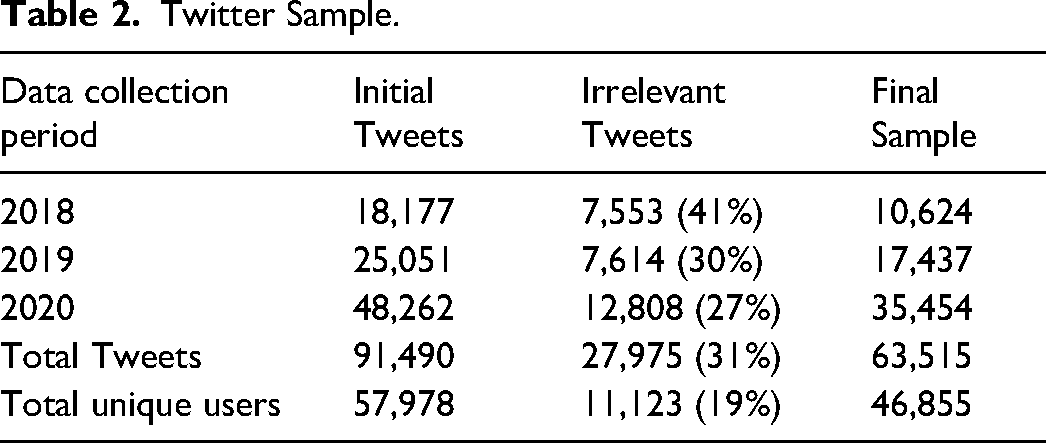
Based on the hashtag-driven discussion of cancellation incidents (Clark 2020), we selected Twitter as the starting point for data collection. Twitter plays an important role in shaping public discourse, features rich discussions regarding social justice, and enables social mobilization (Guidry, Waters, and Saxton 2014). This makes the platform a central locus for participation in subversive activity such as cancellations. Data were automatically scraped using a custom Python script, which was specifically programmed to identify and collect tweets containing the hashtags: #cancel, #canceled, or #cancelled (Neu et al. 2020). Data scraping was performed for the period between 1 January 2018 and 9 December 2020, during which time cancellations became part of pop-culture vernacular. This generated an initial sample of 91,490 tweets from 57,978 unique users.
To verify that the Twitter dataset contained discussions related to cancellation, automated text analysis was conducted using Leximancer. Leximancer uses machine learning techniques to parse large unstructured text datasets efficiently and reliably (Angus, Rintel, and Wiles 2013; Campbell et al. 2011; Smith and Humphreys 2006). Using frequency and co-occurrence, the software stochastically calculates a visual map, revealing the concepts present in the data, their percentage share, and the relationships between them (Cretchley, Rooney, and Gallois 2010). The analysis confirmed that the Twitter data contained discussions that were relevant to the research questions and provided researchers with a broad overview of the substantial dataset prior to conducting more granular analysis (Aleti et al. 2019; Demsar et al. 2021; Humphreys and Wang 2018). However, the Leximancer outputs also indicated that a proportion of Tweets contained in the total dataset were not relevant to cancellations. Two trained research assistants then screened each Tweet to ensure it was written in English and related to cancellation, removing irrelevant Tweets. This resulted in a final sample of 63,515 tweets from 46,855 unique users. Table 2 outlines the Twitter dataset.
Twitter Sample.
The Tweets comprising the final Twitter dataset were then manually coded by the two trained research assistants using a combination of open coding and pattern coding in QSR NVivo 12 (Miles, Huberman, and Saldaña 2018). First-cycle open coding involved careful line-by-line analysis of each Tweet, looking for meaningful statements around cancellation in natural language (Saldaña 2016). Second-cycle pattern coding was then used to aggregate the initial array of codes into thematic concepts (Miles, Huberman, and Saldaña 2018). Throughout the coding process, the research assistants conferred, debated, and iteratively reviewed coding structures with the authors, while also tacking back and forth between the data and literature (Spiggle 1994). The Twitter data allowed us to get an understanding of the triggers of cancellations, the processes by which they occur, the role of incumbents (brands), entrepreneurs (consumers), and boundary actors (the media, influencers, affiliates, and opponents), and how they engage in institutional work to disrupt, create, and maintain institutional logics and their legitimacy within the organizational field.
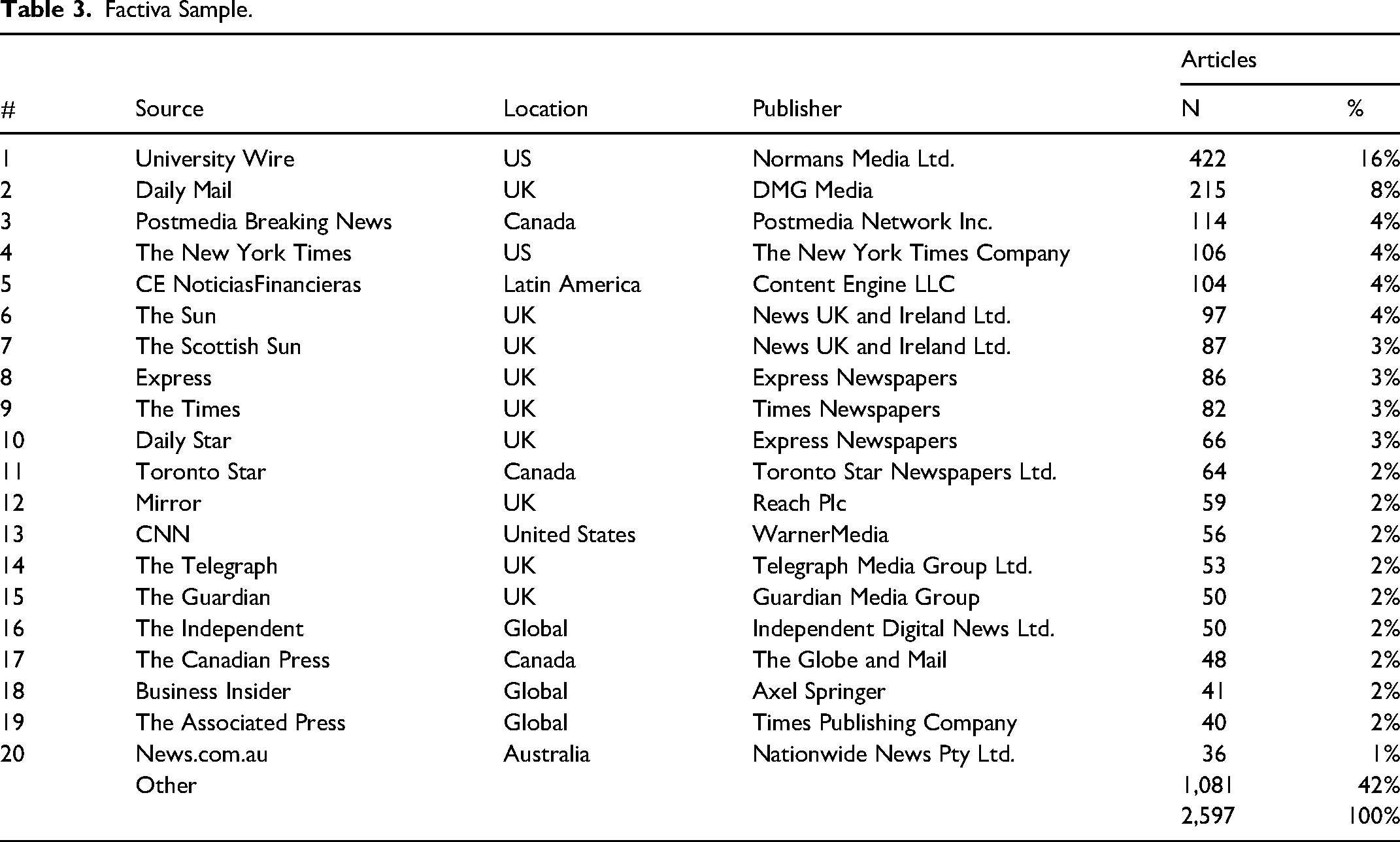
To complement the Twitter data, we examined media coverage of cancellations during the same period (1 January 2018 and 9 December 2020). Data were collected using Factiva, which provides reliable media data from a comprehensive list of global sources including newspapers, magazines, trade press, broadcast transcripts, and websites (Blatchford 2020). Factiva's advanced search function was used to identify relevant articles by inputting complex search strings (for example: “cancel culture” or “callout culture” or cancel* and “brand” or company* or business* or influencer* and/or facebook* or instagram* or twitter* or tumblr* or youtube* or linkedin* or tiktok*). Search strings were developed iteratively through a process of searching, identifying relevant terms, inclusion/ exclusion of terms, and repeat searches. To not include articles about travel cancellations, terms such as flight* or plane* or “trains” or “busses” or “trams” or “public transport” were excluded. Searches were also narrowed to articles written in English. This led to an initial sample of 3,747 news articles, reduced to a final sample of 2,597 articles after the removal of 1,150 duplicates. One of the authors then scanned each article to determine if it had relevance to cancellations, with no additional articles excluded. Table 3 shows the top 20 publications by the number of articles collected.
Factiva Sample.
Given the volume, depth, and richness of the media articles collected, Leximancer analysis was used to conduct an initial parse of the Factiva data efficiently and reliably (Angus, Rintel, and Wiles 2013; Smith and Humphreys 2006). This preliminary analysis revealed the presence of in-depth coverage about cancellations within mainstream media publications, providing researchers with an initial overview of the dataset prior to manual coding (Aleti et al. 2019; Demsar et al. 2021). Subsequently, all media articles were coded using a combination of open coding of natural language, and second-cycle pattern coding to aggregate codes into themes (Saldaña 2016). For consistency, articles were coded by the same trained research assistants, who iteratively reviewed coding structures with the research team while making constant comparisons to and contrasting against the existing literature (Spiggle 1994). Insights from the media database supplemented those from the Tweets, with the analysis looking for evidence of what triggers cancellations, how incumbents (brands), institutional entrepreneurs (consumers), and boundary actors (media, influencers, affiliates, partners, and opponents) engage in institutional work, and how markets and marketing practices change as a result.
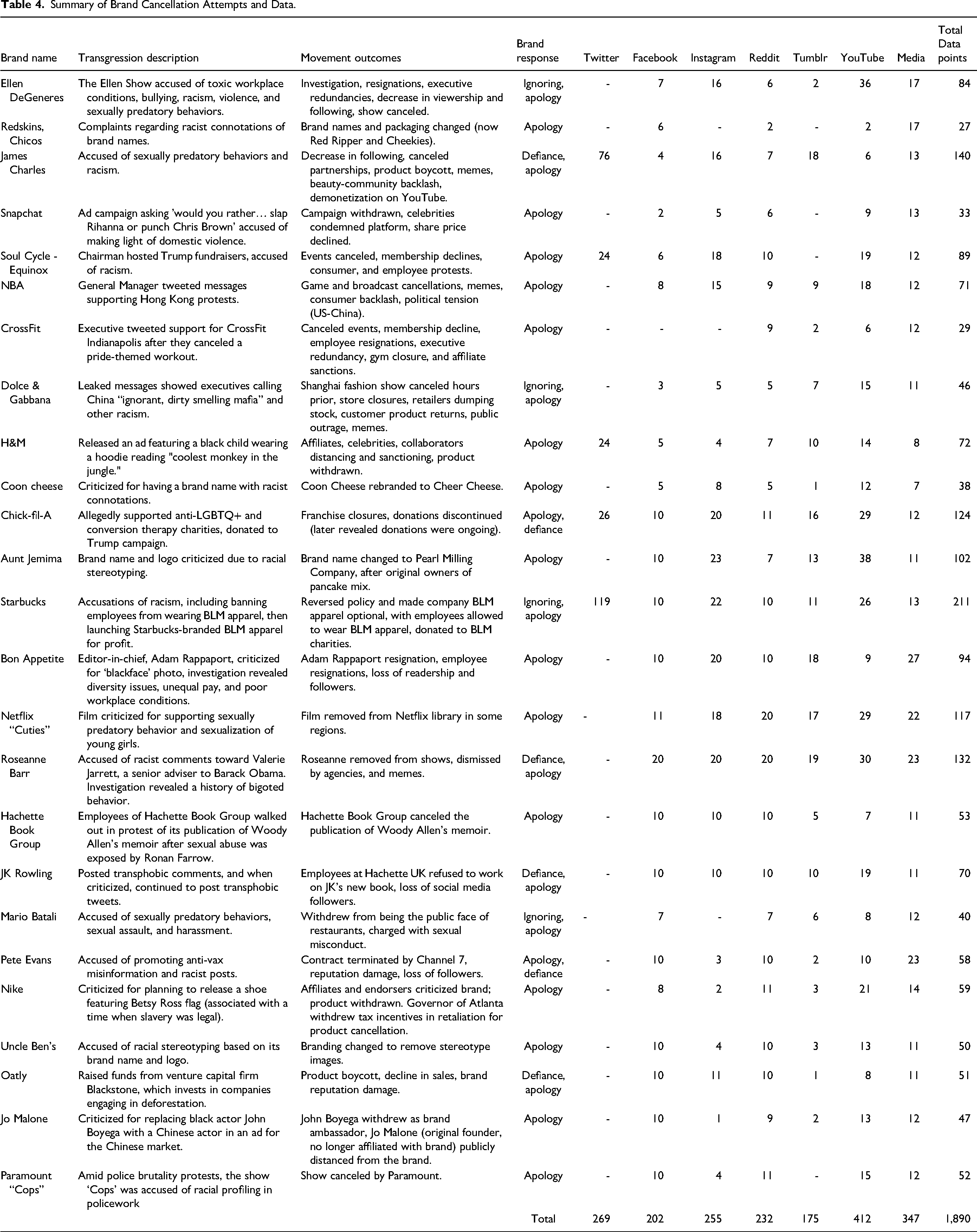
Throughout the Twitter and Factiva analysis, researchers coded mentions of specific cancellations, allowing us to compile a list of 25 major cancellation attempts occurring during the data collection period. For each of the 25 cancellation attempts, we identified and collected additional data using extensive Google searches. Keywords related to each specific incident were used to identify data from a range of sources, including online media publishers and major social media websites (Twitter, Facebook, Instagram, YouTube, Reddit, and Tumblr). Data collection occurred between June and July 2021, covering a similar period to the Twitter and Factiva data. Each researcher scanned the article, post, or content they were collecting to ensure it was relevant to cancellations. This process resulted in approximately 50–70 data points for each of the 25 identified cancellation attempts, totaling 1,590 data points. Data included videos (and transcripts), images, GIFs, articles, social media posts, and entire comment threads. Table 4 provides a summary of these brand cancellation attempts and outlines the data sources drawn on for each identified attempt.
Summary of Brand Cancellation Attempts and Data.
As with the Twitter and Factiva analysis, our two trained research assistants used a combination of first-cycle open coding and second-cycle pattern coding to analyze each cancellation attempt (Saldaña 2016). Research assistants reviewed coding structures with the authors while iteratively comparing to existing literature (Miles, Huberman, and Saldaña 2018). Focusing the analysis on specific incidents of cancellation in this way allowed researchers to follow each cancellation attempt from beginning to end. This provided additional insight into the processes that occur within a cancellation and how they instigate market change. Analysis concluded when theoretical saturation was reached, or in other words when no new information was being discovered (Wallendorf and Belk 1989).
Throughout the analysis process, we applied several procedures for ensuring trustworthiness of the data analysis and findings (Hirschman 1986; Wallendorf and Belk 1989). Firstly, the two trained research assistants conducted the initial coding, and then subsequently reviewed, checked, and adjusted their emerging analytical categories with the authors (Miles, Huberman, and Saldaña 2018). Secondly, we shifted between units of analysis, examining who played a role in negotiating institutional logics, how they engaged in specific institutional work, and what processes occurred to achieve market change (Wallendorf and Belk 1989). Thirdly, we gathered different perspectives from consumers, brands, mainstream media, influencers, affiliates, partners, and opponents, providing a rich and in-depth understanding from several distinct vantage points. Fourthly, we triangulated across data sources, collecting data from Twitter, Factiva, Facebook, Instagram, YouTube, Reddit, and Tumblr (Denzin 1989). And finally, we actively searched for refutation within each dataset which added further nuance to the insights generated (Spiggle 1994).
How Calls for Brand Cancellation Unfold
Through an institutional theory lens, our analysis reveals how calls for brand cancellation unfold as a complex social process resulting in market change. To depict this, a four-stage call for brand cancellation process model is developed, comprising Transgression evaluation, Consumer mobilization, Brand response, and Market realignment (Figure 1).
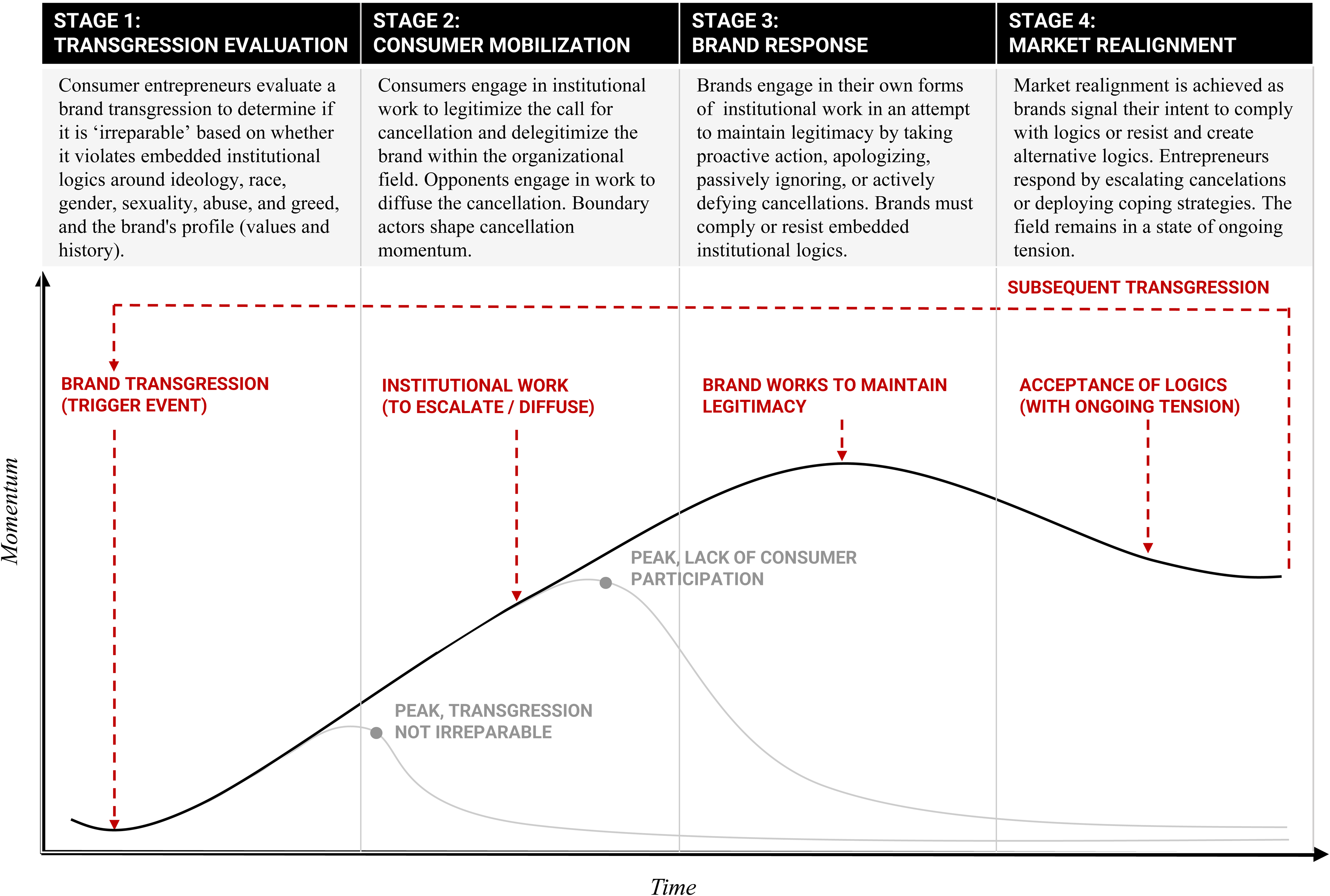
The brand cancellation process.
Our findings outline the triggers that prompt institutional entrepreneurs (consumers) to attempt to de-legitimize brands. We describe how various actors within the organizational field (consumers, brands, and boundary actors) engage in institutional work to disrupt, create, and maintain institutional logics, as well as their own legitimacy. And we show how calls for brand cancellation change and re-organize markets and marketing practices. In the subsequent sections, each stage of the process is described in detail.
Transgression Evaluation (Stage One)
The first stage of the call for brand cancellation process is contextualized by consumers’ heightened awareness of macro social movements around political ideology, race, gender and sexuality, abuse, and corporate greed. Consumers are acutely aware of how the institutional logics associated with these macro-social movements have become infused into the organizational field (market), institutions (marketing), and institutional logics. Consumers believe that to maintain their normative and cognitive-cultural legitimacy within the field, brands have a responsibility to support these movements by adhering to their institutional logics and thereby meaningfully contributing to broader society. When a brand transgresses by failing to meet these expectations, this constitutes a trigger for a brand cancellation attempt. However, for consumers to mobilize against a brand, they must first evaluate the transgression and collectively determine if it is a severe or “irreparable” breach of ethical and/ or moral expectations. Evaluations tend to be based on two criteria: the transgression type and the brand's profile, which comprises the type of brand, its size, values, and historical behavior. Only when a transgression is perceived as irreparable does it warrant the mobilization of social collectives to attempt to de-legitimize the brand's existence in the market.
Transgression Type
The first factor that consumer evaluations of irreparability are based upon relates to the type of brand transgression committed. While brands can transgress in numerous ways, our data shows there are five common transgression types, corresponding to each of the macro social movements, which are typically deemed as irreparable. These transgressions include political ideology, racism, gender and sexuality discrimination, abusive behavior, and corporate greed (see Table 5).
Identified Transgression Types That led to Calls for Brand Cancellation.
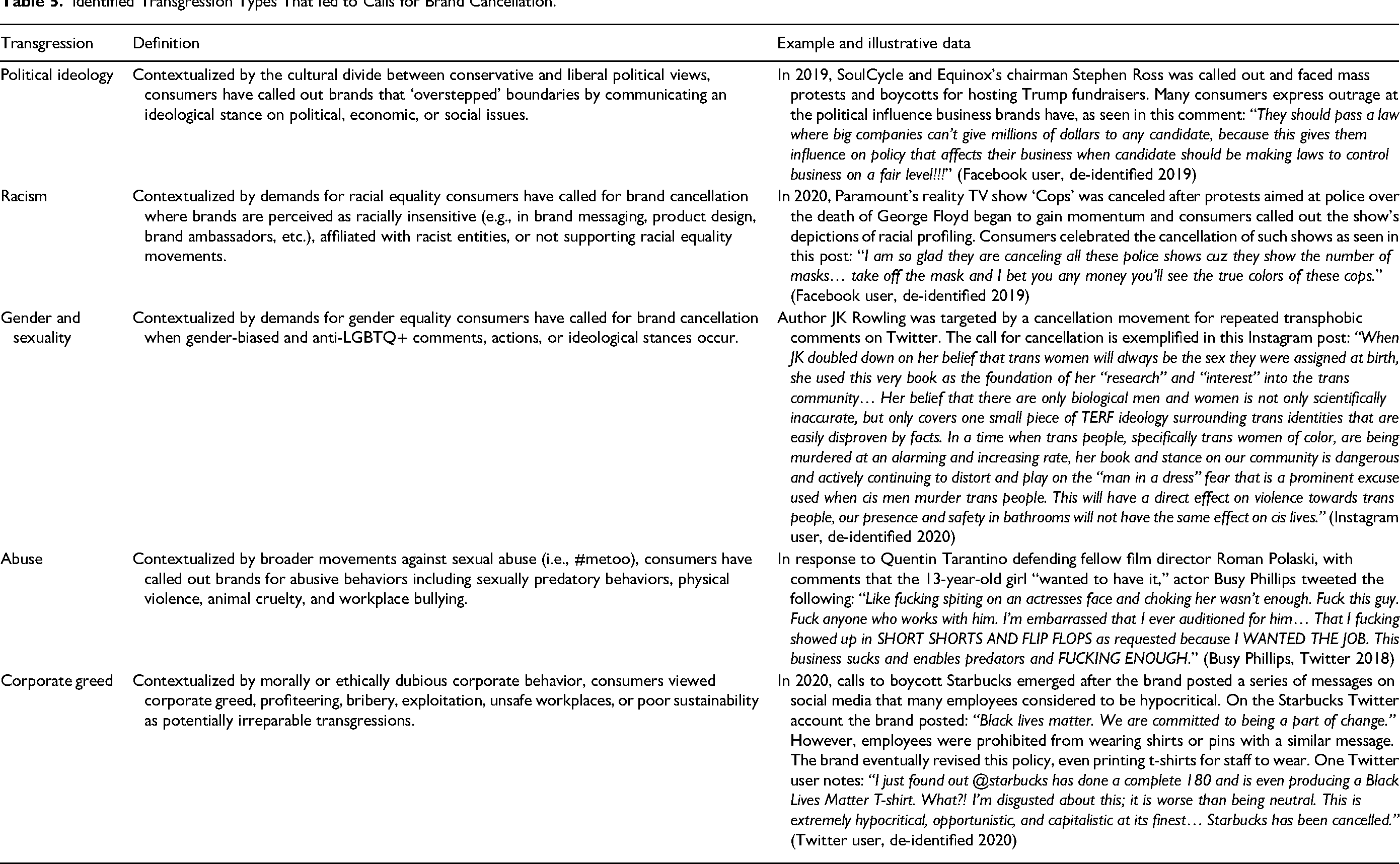
An ideological brand transgression is contextualized by the cultural divide between conservative and liberal political ideologies. We identified numerous cases where consumers called out a brand for “overstepping” perceived boundaries through the communication or assertion of an ideological stance on political, economic, or social issues. Transgressions typically occur due to support, lack of support, censorship, or association with ideologically conflicting viewpoints. In our dataset, examples included ideologically opposed views on immigration, abortion, anti-vaccination, conspiracy theories, human rights, distribution of wealth, gun laws, and many other examples. These transgressions can be challenging for brands to manage. They face pressure to meet consumer expectations and align themselves with the institutional logics brought into the field by macro-social movements around political ideology, but struggle to resonate with fragmented ideological factions, even within their own loyal customer bases.
Racially-oriented brand transgressions have been spurred by #blacklivesmatter and the recent backlash against racially motivated police brutality (particularly in the US). They are typically seen as irreparable transgressions because they violate the institutional logics around racial equality and discrimination imposed on the organizational field by these macro-social movements. Consumers are increasingly aware of brand action (transgressing through perceived racism) or inaction (failing to act in support of racial equality or fight against racial injustice) when it comes to racial issues. As such, brands (both personal and corporate) that fail to comply with the institutional logic that exhibiting racial prejudice is not acceptable within the organizational field (market) or its institutions (marketing), are seen as transgressing irreparably. Numerous examples of racial transgressions were present in the data, along with subsequent consumer calls for brand cancellation, evident in the following Reddit post. It's a good thing there was outrage. It means people are still sensitive to issues of race which they should be. A celebrity or politician who makes a slightly antisemitic comments is playing with fire and usually gets burnt. People were happy to see an ESPN presenter get fired for the “chink in the armor” comment about [Jeremy] Lin. No one knows if it was intended as a racial slur. People SHOULD be afraid they make an insensitive comment about black people… this is the fault of H&M's marketing team. They should know better. (Reddit user, de-identified 2018)
Gender and sexuality-related brand transgressions were also common within the dataset and are underpinned by institutional logics established through fourth-wave feminism and LGBTQI + movements. They occurred when brands engaged in business activities or marketing communications that were seen as discriminating based on gender and sexuality or did not actively support and contribute to gender and sexuality equality. This often resulted in gender and sexuality transgressions being perceived as irreparable. In one example, consumers called for the cancellation of Chick-Fil-A, alleging that the brand had repeatedly donated money to anti-LGBTQ + and conversion therapy charities. They persistently shamed and called out other consumers who continued to dine at the restaurant chain after the transgressions had been uncovered, to de-legitimize the brand and sexuality-based discrimination as an acceptable business activity.
Abuse-oriented brand transgressions draw on the recent #metoo movement and occur when brands engage in behaviors that violate abuse-related institutional logics. These behaviors include sexual abuse, sexually predatory actions, physical violence, domestic violence, bullying, or animal cruelty. This applies to situations where an individual (personal brand) such as a celebrity transgresses by engaging in these acts, as well as when brands fail to take action to prevent and respond to these behaviors occurring amongst employees in their workplace. Ellen DeGeneres is one example in our data that exemplifies this transgression type. In this example, accusations of toxic workplace behavior including harassment, bullying, sexual misconduct, and racial discrimination were seen as irreparable transgressions, resulting in calls to cancel the Ellen Show. Similar accusations led to cancellation movements directed at celebrity chef Mario Batali.
Greed-oriented brand transgressions are rooted in historical anti-corporate movements (i.e., #occupywallstreet), which have established institutional logics that morally or ethically dubious corporate behavior (such as corporate greed, profiteering, appropriation, bribery, exploitation, unsafe workplaces, or poor sustainability) are irreparable. Numerous examples exist in the data. In the following example, a Facebook user calls out cosmetic companies for targeting vulnerable market segments, such as young girls. I’m a primary school teacher, and a mum of two girls, and I’m already seeing the heartbreaking reality of the pressure girls feel at younger and younger ages over their appearance. Why would you feed into this? They don’t need tips on makeup from the age of 12. (Facebook user, de-identified 2019).
Brand Profile
The second factor that consumer evaluations of irreparability are based upon is the brand's profile. That is, the type and size of the brand, and its values and historical conduct, the latter of which are important indicators of the brand's compliance with institutional logics and therefore its legitimacy in the organizational field.
Given that most entrepreneurial attempts to change an organizational field fail, consumers consider the likelihood of successful cancellation when evaluating brand transgressions. Cancellation attempts aimed at large, established, and monolithic corporate brands (i.e., Nike, Spotify, Dolce & Gabbana, etc.) are deemed less likely to succeed. As such, our analysis indicates that rather than aiming their attempts at the brand generally, consumers will target transgressive products, services, marketing campaigns, or events instead, as their delegitimization attempts are more likely to be effective. In contrast, personal brands (i.e., J.K. Rowling, Pete Evans, Roseanne Barr, etc.) are more vulnerable to successful cancellation attempts. Indeed, consumers find it easier to delegitimize a personal brand and have an influence on that brand by not viewing, reading, following, watching, or attending brand events, while encouraging others to do the same.
A brand's values and historical conduct also influence how a transgression is evaluated. When a brand communicates values (both implicitly and explicitly) or takes a public stance that fails to align with institutional logics imposed by macro-social movements, it is often deemed as an irreparable transgression. For some brands, this meant that sponsorships, affiliations, and endorsements linked with celebrities and influencers who had transgressed were seen as exhibiting values that fail to align with newly established institutional logics, thereby leading to calls for cancellation, as illustrated in this Tweet. @nytimes you are #cancelled as long as you ignore #domesticviolence to all genders. Amber Heard is not an activist but an abuser. Shame on you for giving a voice to her and be part of her filthy PR campaign. That is NOT OK. #MenToo #metoo (Twitter user, de-identified 2018-2020)
A brand's historical conduct is also important in evaluating transgressions for irreparability. When a transgression occurs, consumers research and draw upon a brand's history of repeated transgressions, inaction in supporting macro-social movements, and negative media coverage to make judgments about irreparability. When a brand has a history of transgressive behavior, each new transgression is more likely to be seen as irreparable and therefore results in calls for cancellation. This is seen in the example below pertaining to JK Rowling and her view on transgender individuals. TRANS WOMEN ARE WOMEN. Like many, I was horrified to read yet another slew of hateful and transphobic tweets this weekend from JK Rowling. There's not even enough room in an Instagram caption to go over the many ways she has destroyed her legacy since the Harry Potter books were released, and I honestly should have said something on this platform a long time ago, but I am now pledging to never spend 1 cent on JK Rowling's works again. (Instagram user, de-identified 2020)
In summary, in the Transgression Evaluation stage, when a brand transgression occurs, consumers evaluate its severity based on transgression type and brand profile. Transgressions that fail to align with institutional logics around ideology, race, gender and sexuality, abuse, or greed imposed on the market through prevailing macro-social movements are typically seen as irreparable. Likewise, if a brand exhibits values which fail to meet consumer expectations, and the brand has a history of repeated transgressions, consumers draw on this to define recent transgressions as irreparable. In situations where a transgression is deemed irreparable, consumers will mobilize to delegitimize the existence of a brand, while sending a signal to other actors that institutional logics around ideology, race, gender, sexuality, abuse, and greed must be adhered to, in order to maintain their legitimacy.
Consumer Mobilization (Stage Two)
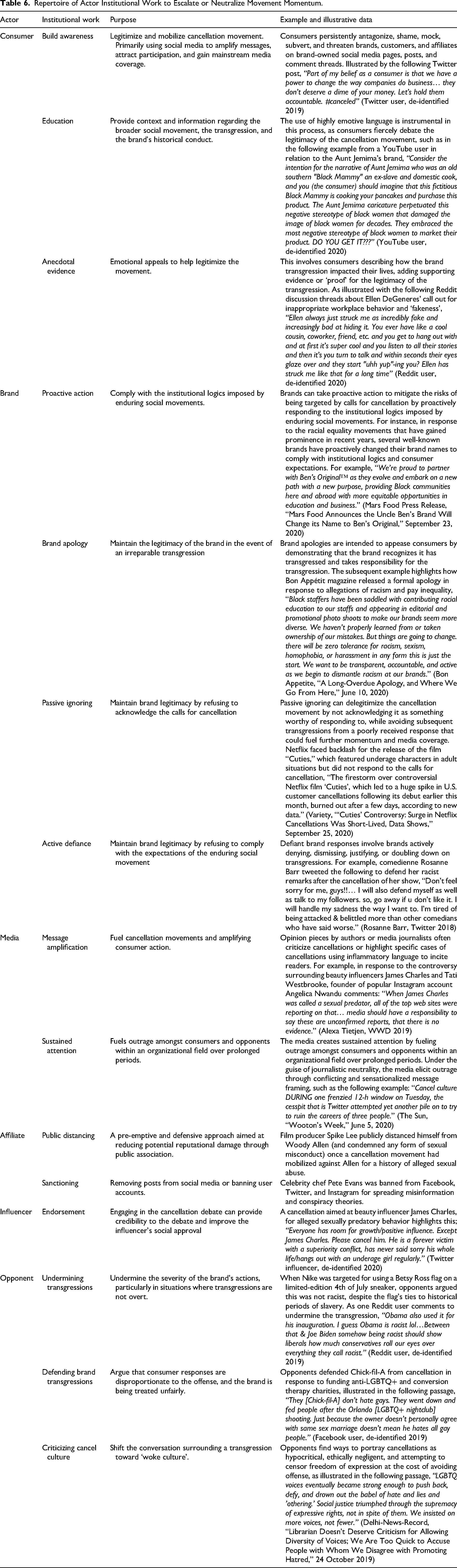
In the second stage of the call for cancellation process, consumer entrepreneurs engage in institutional work to legitimize their cancellation attempt and mobilize social collectives to delegitimize the existence of the brand. In doing so, entrepreneurs disrupt the status quo and send a signal to other actors in the field that institutional logics (around ideology, race, gender and sexuality, abuse, and greed) must be complied with to maintain legitimacy. At the same time, consumers who oppose the cancellation attempt engage in institutional work to stifle the momentum of the cancellation and maintain the legitimacy of the transgressing brand, while resisting the acceptance of institutional logics imposed by macro-social movements. Other actors, including the media, affiliates, and influencers work to shape the escalation and diffusion of cancellation momentum. We summarize the institutional work performed by each actor in Table 6 before describing each in more depth.
Repertoire of Actor Institutional Work to Escalate or Neutralize Movement Momentum.
Consumer Entrepreneurship
Consumers engage in institutional work to legitimize the call for cancellation and mobilize large collectives against a transgressing brand. As such, consumer institutional work seeks to coordinate provocations aimed at dramatizing transgressions and promoting the call for cancellation. Within the data, we identify three common forms of institutional work consumers engage in: building awareness, education, and anecdotal evidence.
The first form of institutional work performed by consumers is building awareness and drawing attention to transgressions and how they violate institutional logics around ideology, race, gender and sexuality, abuse, and greed. Awareness building primarily occurs through posting on social media and has the effect of establishing camaraderie amongst likeminded consumers, helping them to form a collective identity, and communicating a shared vision that brands must comply with embedded logics or face cancellation. This is evident in this example, a response to H&M's ‘monkey in the jungle’ controversy. I will never buy another piece of clothing from @hm ever again. I’ve only shopped in your Switzerland store once. This is 2018. Your disregard for that Black child's humanity and disgusting marketing tactics are horrific. You should be ashamed! #BoycottHM #Cancelled (Twitter user, de-identified 2018)
A second form of institutional work consumers engage in is the education of other consumers. This helps those who are unsure about participating to understand why the transgression is irreparable, how it violates institutional logics, and creates a collective sense of outrage toward a transgressing brand. One example in our data is that of the Aunt Jemima brand whose logo was based on racial stereotypes. In 2020, debate ignited between consumers believing the brand logo was a racial stereotype, and those who believed removing it reduced black representation. Education helps consumers make sense of the ideological roots of the macro social movement, understand why the brand has transgressed, and legitimizes the call for cancellation for a larger number of consumers. In the Ellen DeGeneres cancellation attempt, Reddit users educated each other about why the term “spirit animal” was or was not a transgression.
User 1: Can someone explain more about the use of “spirit animal” as a derogatory term? User 2: I think it's not so much about it being derogatory, but more so about it being cultural appropriation of native Americans/First Nations people. User 3: Cultural appropriation is a cancerous concept. It's hinged on the racist notion that white people can’t adopt or utilize beliefs from other cultures but it's fine the other way because white culture is systematically racist… (Reddit users, de-identified 2020)
In the above passage, Reddit users debate the term “spirit animal”, following media reports of issues of race and representation on the Ellen Show. Following an employee going public after being shut down for asking producers not to use offensive terms like “spirit animal” in segments, questions arose as to how the term was derogatory. The above passage shows consumers engaging in education, by explaining that the term appropriates Native American culture for entertainment.
A third form of institutional work consumer entrepreneurs engage in is the provision of anecdotal evidence, typically via emotional appeals. This enhances the legitimacy of the cancellation attempt and involves consumers describing how the brand transgression impacted their personal lives, adding supporting evidence or “proof” for the legitimacy of the transgression. Following on from the example above, when discussing accusations of workplace abuse on the Ellen Show, consumers provided anecdotal evidence of their own experiences of workplace bullying, sexual abuse, and toxic workplace behavior. These highly personal and emotive appeals give further credibility to the call for cancellation and draw other consumers into participating. Those taking part can also provide evidence of participation by sharing proof of action, such as screenshots of canceled memberships and/ or destroyed products.
Finally, by persistently calling out and publicly shaming brands that transgress, consumer entrepreneurs send a powerful message to other actors in the institutional field. In essence, by calling for cancellation, entrepreneurs indicate that brands must adhere to the institutional logics imposed by macro-social movements around race, gender, sexuality, abuse, and greed, or risk being delegitimized. In a cancellation attempt targeted at Spotify for broadcasting Alex Jones’ Infowars, a podcast accused of spreading misinformation, consumers outlined their expectations as illustrated by the following Tweet. I’ve been an evangelist for @Spotify … But I will #cancel it IN A HEARTBEAT if you continue to offer A13x J0n3 s and Inf0W@rs (Twitter user, de-identified 2020).
Opponent Resistance
Opponents, or those opposed to a call for cancellation, engage in institutional work aimed at delegitimizing the cancellation attempt by undermining the dominance of institutional logics imposed by macro-social movements and questioning whether a brand transgression even occurred. This involves downplaying the severity of the brand's actions, particularly in situations where transgressions were not overt or intentional. This was evident in a cancellation attempt directed at Jo Malone, which occurred after the brand replaced African American actor John Boyega with Chinese actors when adapting their advertising for the Chinese market. Where are all the stupid leftie sjws [social justice warriors] calling out for China to be cancelled over this? (YouTube user, de-identified 2020)
A second form of institutional work opponents engage in is defending transgressions by arguing consumer responses were disproportionate to the offense, and that the brand is being treated unfairly. As illustrated in the Chick-fil-A example presented in Table 6, opponents cite how the brand contributed to feeding gay nightclub shooting survivors in Orlando, and therefore the owner's personal views of same-sex marriage do not mean he hates all LGBTQI + people. Incidents like this exemplify how opponents label consumer actions as an over-dramatization to stifle the momentum of a cancellation attempt.
A third form of institutional work opponents perform is labeling and criticizing calls for cancellation as “cancel culture”, thereby shifting the conversation surrounding the severity of a transgression toward a debate around “woke culture” instead. For example, in response to the removal of lyrics from Rule Britannia and Land of Hope and Glory at the BBC Proms, popular public commentator Piers Morgan tweeted. Absolutely pathetic, the BBC needs to grow a pair and stop grovelling to such insane ‘woke’ cancel culture nonsense that most Britons find utterly absurd. (Piers Morgan, Twitter 2020)
Media Amplification
The media engage in institutional work aimed at message amplification, which fuels calls for cancellation and amplifies consumer actions. Evident in our data, the controversy and outrage caused by cancellation attempts allows media outlets to gather attention, encourage clicks, and acquire audiences by providing coverage. In turn, when the media broadcasts messages about a cancellation attempt, it provides legitimacy, giving credibility to the call for cancellation by signaling it is important and warrants broader discussion. Media reporting reaches wide audiences, explains the nature of the irreparable brand transgression, and outlines the institutional logics the brand has transgressed against.
As an example, media coverage surrounding the incident involving singer Rihanna and the social media app Snapchat demonstrates the amplification effect of news reporting. Rihanna publicly criticized the app for allowing an advertisement that seemingly trivialized domestic violence. The ad in question, promoting the “Would You Rather” mobile game, presented pictures of Rihanna and her ex-boyfriend Chris Brown, asking players to choose between slapping her or punching him. Brown's assault on Rihanna in 2009 led to his arrest, and the ad's insensitivity towards domestic violence caused widespread outrage. The media coverage not only communicated the nature of the brand transgression but also underscored the broad audience reached by such reporting. As a result of Rihanna's criticism, Snap Inc., the parent company of Snapchat, experienced a near 5% decline in value. As such, media coverage can attract large numbers of consumers to participate in the cancellation attempt, and force brands to take notice and respond when they otherwise would not have.
Interestingly, our analysis shows that the media amplifies the messages of both those participating in the cancellation and those opposing it, maximizing their reach and revenue generation. As such, the media often portrays “cancel culture” pejoratively, describing it as an unwarranted frenzy aimed at ruining brands and personal careers, as seen in the following news article. We live in a society of hypocrites, of Pharisees, of moral lynchers, who, however, are pouring water over everything. A society in which the mob exerts an apparent puritanism. Nevertheless, the same mob promotes sexual aberrations like cramming a minor with hormones to initiate his transition to a gender that is not his own, in an impossible and irreversible process that will condition the rest of his life. The same vigilantes who ask Plácido to stop singing or who want to censure Polanski, enthusiastically applaud every time an idiot tries to indoctrinate the minors of any school in aberrant sexual practices. (Guest Contributor, PanAm Post 2020)
Affiliate Distancing
Affiliates – including partner brands, social media platforms, and brand endorsers – engage in institutional work aimed at maintaining their own legitimacy, for instance by striving to publicly distance themselves from callouts of irreparable brand transgressions. This is a pre-emptive and defensive action aimed to reduce potential reputation damage through public association. In some cases, consumers also called out affiliates for cancellation, characterizing them as “sympathizers” and “apologists” who condone the transgressive behavior. In response, affiliates engaged in public distancing when a partner brand was targeted by a call for cancellation. As is the case when Spike Lee publicly distanced himself from Woody Allen once a cancellation attempt mobilized against Allen for alleged sexual abuse.
In many cases, affiliates imposed formal sanctions on the transgressing brand to maintain their own legitimacy in the field and signal their own compliance with prevailing institutional logics, for instance by limiting purchases, stopping sponsorships, or withdrawing from partnerships. These can be temporary while the transgression is investigated, and/ or a permanent severing of ties (such as contract termination). In one example, the National Basketball Association's (NBA) General Manager tweeted comments that were pro Hong Kong, resulting in outrage within China and a suspension of all events, campaigns, and retail store operations by the Chinese government. This is illustrated in a CNN article that reported, “all of the NBA's official Chinese partners have suspended ties with the league as it grapples with the fallout from a team manager's controversial tweet about Hong Kong” (Toh and He 2019). Sanctioning is also imposed by social media platforms in response to transgressions, for instance by removing posts or banning accounts (typically personal user brand accounts) when a transgression threatened community safety or did not comply with terms of service. In essence, both distancing and sanctioning provide legitimacy to cancellations by acknowledging the offending brand had transgressed and can fuel media coverage.
Influencer Commentary
Social media influencers can strive to legitimize (or delegitimize) calls for cancellation and help mobilize social collectives by amplifying messages to their followers. Like the media, influencers are driven by increasing followers, engagement, and viewership. For some influencers, supporting and disputing cancellations provided a stream of new, relevant, and engaging content. Influencers, therefore, provided commentary and took sides in brand cancellation attempts. Influencers can provide anecdotal evidence when they felt strongly about a transgression. This is seen in the following example posted by a beauty influencer responding to the calls for cancellation of fellow influencer Jeffree Star, Hey boos, as some of you may know as of this week, I will no longer be a @MorpheBrushes affiliate…I refuse to align myself with a company that continues to retail antiblack racist beauty brands. I strongly encourage other influencers to do the same! (Twitter user, de-identified 2020)
Hence, in the Consumer Mobilization stage, consumer entrepreneurs engage in institutional work to legitimize their cancellation attempt and mobilize social collectives to delegitimize the existence of the brand. This disrupts the organizational field and sends a signal to other actors that institutional logics around ideology, race, gender and sexuality, abuse, and greed must be adhered to in order to maintain legitimacy. Conversely, consumers who opposed the cancellation attempt engage in work to stifle the momentum of the cancellation, and maintain the legitimacy of the transgressing brand, while resisting the acceptance of institutional logics imposed by macro-social movements. Other actors, including the media, affiliates, and influencers work to shape the escalation and diffusion of cancellation momentum for their own benefit. Institutional work performed to mobilize the cancellation attempt typically forces a response from the offending brand, which attempts to maintain its legitimacy in the organizational field.
Brand Response (Stage Three)
In the third stage of the call for brand cancellation process, brands engage in their own forms of institutional work to maintain their legitimacy in the organizational field. Brands face the threat of being delegitimized by consumers for failing to adhere to institutional logics, as well as the added pressure and scrutiny created by boundary actors such as the media, affiliates, and influencers. Our data identifies four types of institutional work that brands perform: proactive action, apology, passive ignoring, and active defiance. For brands, each of these responses is an attempt to either comply (and align with) or resist institutional logics to maintain legitimacy.
Proactive Action
The first way brands work to maintain legitimacy is through proactive action. Brands that take proactive action by complying with the institutional logics imposed by macro-social movements can both prevent calls for cancellation and mitigate their ability to delegitimize the brand if they occur. Among the cancellation attempts in our data, several brands acted proactively in response to macro-social movements to avoid calls for cancellation. For instance, in response to racial equality movements, brands including Aunt Jemima, Uncle Ben's, Red Skins, and Coon Cheese all proactively changed their brand name – illustrated in the following news coverage. Today we announced that we will change the name of Red Skins and Chicos lollies. This decision acknowledges the need to keep creating smiles, ensuring that nothing we do marginalizes our friends, neighbors and colleagues, or is out of step with our values. (Australian Broadcast Corporation (ABC) News, “Nestle to change names of Allen's lollies products Red Skins and Chicos”, June 23, 2020)
Brand Apology
If an irreparable transgression does occur, and a call for cancellation ensues, some brands attempt to maintain their legitimacy through apology. This type of institutional work is designed to appease consumer entrepreneurs by recognizing that the brand has transgressed against embedded institutional logics, taking responsibility for the transgression, and outlining a plan for ensuring it does not transgress again. To increase their chances of maintaining legitimacy in the organizational field, apologies must be interpreted as sincere. However, this does not always seem to be the case, as many transgressing brands offered insincere apologies which further legitimized the cancellation attempt. For example, celebrity chef Pete Evans posted the following apology after sharing a cartoon on social media that incorporated a symbol associated with neo-Nazism. Sincere apologies to anyone who misinterpreted a previous post of a caterpillar and a butterfly having a chat over a drink and perceived that I was promoting hatred, I look forward to studying every symbol that have ever existed and research them thoroughly before posting. (Pete Evans, Facebook 2020)
Genuine apologies tend to avoid outward blame and sarcasm whilst outlining the measures that will be implemented to avoid future transgression. Apology, if viewed as sincere, can help to diffuse and neutralize the momentum of the cancellation attempt, and if the brand commits to making changes, win back customers, and repair brand reputation. As brands publicly acknowledge their failure to comply with institutional logics and change their behavior to align with expectations, the new rules are further embedded into the organizational field (market) and its institutions (marketing).
Passive Ignoring
Another way in which brands perform institutional work to maintain their legitimacy is by ignoring calls for cancellation. Indeed, some brands refuse to acknowledge cancellation attempts at all. In comparison to proactive action and apology, ignoring was a more passive response and had an interesting impact on cancellation momentum. In some cases, this type of response fueled consumers to ramp up their escalation to force the brand to respond. In other cases, this served to delegitimize the cancellation attempt by not acknowledging it as something worthy of responding to, while avoiding subsequent transgressions from a poorly received response that could fuel further momentum and media coverage. For example, Adidas remained silent regarding the call to cancel brand ambassador Hailey Baldwin for racist comments, resulting in the following consumer Tweet. So @adidasWomen @adidasUS don't care @haileybaldwin says the n word. Is that the kind of shit y'all promote? She's your ambassador really. Why not fire her ass like real companies do when they say racist words like n word (Twitter user, de-identified 2018)
Active Defiance
A final way brands strive to maintain their legitimacy is through defiance. This involves brands actively denying, dismissing, justifying, or doubling down on transgressions, and thus refusing to comply with the expectations of entrepreneurs and the institutional logics they are enforcing. On the balance of things, defiance was more common amongst individual brands (influencers and celebrities) than corporate brands. For example, JK Rowling followed up on her alleged transphobic Twitter posts by doubling down on her ideological stance and continuing to Tweet similar rhetoric. Similarly, Roseanne Barr acknowledged her racist comments but refused to be labeled as a racist. I'm not a racist, I never was and I never will be. One stupid joke in a lifetime of fighting 4 civil rights 4 all minorities, against networks, studios, at the expense of my nervous system/family/wealth will NEVER b taken from me. You guys make me feel like fighting back. I will examine all of my options carefully and get back to U. (Rosanne Barr, Twitter 2018)
Finally, it should be noted that the work performed by boundary actors such as media, affiliates, and influencers, plays an important role in a brand's ability to maintain its legitimacy. Intense media coverage and influencer commentary of current and past transgressions can place pressure on brands to respond and force them into apologizing and complying with consumer expectations and institutional logics. Similarly, media coverage and influencer commentary can also help brands to maintain legitimacy by siding with cancellation opponents and dismissing calls for cancellation as “cancel culture” or “woke culture”. Likewise, affiliates such as technology platforms (e.g., social media), can force brands to comply by de-platforming them or suspending their accounts until they align themselves with consumer expectations.
Thus, in the Brand Response stage, brands perform institutional work to maintain their legitimacy in the organizational field while facing pressure from entrepreneurs and boundary actors. Brands can opt to comply with prevailing institutional logics and consumer expectations by taking proactive action or apologizing when a transgression occurs. Alternatively, they can resist these institutional logics and expectations by ignoring and defying the calls for cancellation and thus create opportunities to appeal to cancellation opponents through the creation of alternative logics. Once the brand responds, the momentum of the call for cancellation stabilizes, resulting in market realignment.
Market Realignment (Stage Four)
As calls for cancellation gain momentum and brands respond to maintain their legitimacy, these consumer-brand tensions lead to realignment within the organizational field. This leads to further reinforcement of institutional logics around ideology, race, gender, sexuality, abuse, and greed, while also creating alternative logics. Though realignment does lead to stabilization in the organizational field, ongoing tensions typically remain, as consumer entrepreneurs continue to monitor and reinforce their desired institutional logics.
Acceptance of Institutional Logics
Market realignment occurs as brands opt to either comply or resist the pressure from consumer entrepreneurs to align with institutional logics imposed by macro-social movements. Most transgressing brands observed in our study responded to cancellation attempts by adopting institutional logics around ideology, race, gender, sexuality, abuse, and greed. This typically eventuated in realignment through changes in logo designs, withdrawal of market offers, replacing advertising campaigns, and executive resignations or terminations. Brands that choose to comply with consumer expectations and institutional logics are usually successful at maintaining their legitimacy in the eyes of consumers, as highlighted by the following YouTube user. H&M is one of the few high street brands that featured diverse models in their main campaigns from the get-go… I can't believe how no one thought this was wrong or at least not politically correct …This was a bad choice and I just read H&M's response and I'm glad they took responsibility for this, no excuses… I hope H&M never falls into this again. (YouTube user, de-identified 2018)
Conversely, when a brand's apology is insincere, or the brand defies or ignores consumer expectations, entrepreneurs calling for cancellation can either continue to mobilize against the brand or employ coping strategies to deal with the failed cancellation and the creation of alternative logics. In one example from our dataset, Dolce & Gabbana transgressed through an advertising campaign that was seen as racist. The brand apology was subsequently seen as delayed and insincere, resulting in escalated calls for cancellation, as seen in the YouTube comments below. I like the bit when Stefano said ‘I like to apologize to Chinese around the world too because there are many of them’… is this guy for real… so basically, he was forced to give this apology… it's not genuine… (YouTube user, de-identified 2018) You don’t love our culture. You love our money…To say that you like our culture because there are so many of us just makes you seem greedy and cowardly. Respect everyone, gays, women, etc. You have a pattern of being rude, condescending, sexist, racist, and generally hateful. The ads are stupid and insulting. Your apology is insincere and revealing of your true greedy nature. Your comments about gay parenting, ugly women, fat people…Go peddle your hateful products elsewhere. Your account got hacked? Did they hack your account when you made those ridiculous ads too? (YouTube user, de-identified 2018)
However, the backlash to these types of brand responses is not always overt. In some cases, consumers passively withdraw their support for the brand by reducing or changing their consumption patterns. For example, many stopped following JK Rowling but claimed “public ownership of her books”. In other cases, like Bon Appetite, whose owner was photographed in “blackface”, consumers shifted their support toward brands that complied with new expectations. Another coping strategy was to categorize transgressions as isolated incidents, regions, or attribute them to specific individuals. In the case of SoulCycle, consumers decoupled the director's support of Trump from the brand. Such strategies help consumers to cope with the unresolved outcomes of a cancellation attempt and realign their expectations to acknowledge the existence of alternative (opposing) logics.
Ongoing Tensions
Despite market realignment, ongoing tensions remain between transgressing brands and consumer entrepreneurs. With heightened awareness of macro social movements around ideology, race, gender, sexuality, abuse, and corporate greed, consumers and boundary actors continue to monitor the field for behavior that transgresses these institutional logics. Brands that were targeted by a cancellation attempt are more vulnerable as they have a documented history of transgressions, which can be illuminated when new transgressions occur. In these cases, the call for cancellation is easily legitimized, and consumers mobilize quickly, and in most cases, more aggressively against the brand. The threat of future cancellations results in brands self-regulating their corporate ideological stances, brand positioning, product and service offerings, and marketing messages, to avoid sparking calls for cancellation. By changing their behavior to comply with consumer expectations, brands help to embed these institutional logics as normatively, and cognitive-culturally legitimate business practices, thereby realigning the market with prevailing societal values.
In sum, in the Market Realignment stage, as brands respond to cancellation attempts to maintain their legitimacy, this leads to a realignment of the organizational field with prevailing societal values. This eventuates in further reinforcement of institutional logics around ideology, race, gender, sexuality, abuse, and greed, while also creating alternative logics. Whilst realignment results in field stabilization, tensions remain, as actors continue to monitor the field for transgressions and reinforce desired institutional logics.
Discussion and Implications
Micro-level theorizing about calls for cancellation, often derogatively labeled as “cancel culture”, focuses on the conflictual and individual aspects in the direct relationship between consumers and brands. With this study, we provide a macro-level perspective of how calls for cancellation act as a mechanism for realigning markets with prevailing societal values.
Adopting an institutional lens to examine market change (Baker, Storbacka, and Brodie 2019; Ertimur and Coskuner-Balli 2015; Scaraboto and Fischer 2013), we add to the understanding of this emergent form of active consumer resistance in two ways. First, we conceptualize a cancellation as a new and unique form of active consumer resistance. Second, we empirically examine and illustrate how consumer calls for brand cancellation unfold and seek to achieve change by re-aligning the market, marketing practices, and individual actors with newly imposed logics. This knowledge is critical given the nascent stage of scholarly understanding of cancellations (Saldanha, Mulye, and Rahman 2022; Tandoc et al. 2022), lack of consensus and clarity in emerging knowledge (Ahuja and Kerketta 2021; Simpson and Srinivasan 2018), and narrow scope of the few empirical studies on cancellations (Bouvier and Machin 2021; Saldanha, Mulye, and Rahman 2022). Further, and critically, calls for brand cancellation have profound macro implications for organizing and realigning markets with prevailing societal values, development of public relations strategies, and the evolution of consumer resistance.
The Role of Macro-Social Movements in Organizing Markets
This study adds weight to the growing body of macro marketing work highlighting the powerful role of broader and enduring social movements in organizing markets. Recent studies have shown how social movements around gender, body image, sexuality, and animal welfare (among others) create new institutional logics that shape markets and institutions (Baker, Storbacka, and Brodie 2019; Coleman, Zayer, and Karaca 2020; Kates 2004; Scaraboto and Fischer 2013). We broaden this view by highlighting the influential role that macro-social movements around political ideology, racial equality, gender discrimination, sexuality discrimination, abuse, and corporate greed played in organizing markets in our data. Importantly, we demonstrate that these macro-social movements create and impose new institutional logics, redefining the socially constructed assumptions, values, and beliefs by which actors provide meaning for their social reality. Consequently, these logics interact with, and infuse into, specific organizational fields (markets) and institutions (marketing), thereby governing the persistent practices, understandings, and rules shared by individual actors. Indeed, by changing the rules and setting new expectations, institutional logics created by macro-social movements serve to redefine normative and cognitive-cultural forms of legitimacy, which must be carefully cultivated and managed to remain a legitimate market actor.
Coinciding with most of the work in consumer resistance and activism, the majority of macro social movements that resulted in calls for cancellation observed in this study emanated from left-leaning progressive political causes. However, a small number of the calls for cancellation we observed support recent work detailing how resistant and activist consumer movements emerge from right-wing conservative causes (Witkowski 2021). Our study extends this perspective by showing that right-wing and conservative political views are largely reflected in the institutional work of cancellation opponents, who work to embed alternative logics around race, gender, sexuality, abuse, and greed, aiming to stifle and diffuse cancellation attempts. While it is plausible that calls for cancellation originate from conservative political views and follow a similar process to what we have outlined, the entanglement of cancellation discourse with left-wing political views means cancellation attempts resulting from right-wing causes are more likely to attract different labeling (such as boycotts, brand trolling, sabotage, etc.). It is critical, then, to move away from pejoratives such as “cancel culture” – and recognize calls for cancellations for what they are – a mechanism for realigning markets with prevailing societal values, which should be politically agnostic in nature, although they rarely are.
A Mechanism for Realigning Markets with Prevailing Societal Values
There is no guarantee that new institutional logics produced by macro-social movements will become embedded in markets or accepted as legitimate and true within institutions and by actors over time. Previous studies have shown that for this to occur, actors engage in institutional work to create, maintain, or disrupt the underpinning institutional logics within a market (Battilana and D'Aunno 2009; Lawrence and Suddaby 2006). This type of “market shaping” involves many actors, at all levels (micro, meso, and macro) and occurs through an interdependent process involving institutional practices, beliefs, and expectations (Baker, Storbacka, and Brodie 2019; Coleman, Zayer, and Karaca 2020). We add to this stream of literature by revealing the four-stage brand cancellation process (transgression evaluation, consumer mobilization, brand response, market realignment), a mechanism by which institutional logics imposed by macro-social movements are enforced to bring the market into alignment with societal values. We also extend existing work by detailing the specific institutional work performed by consumer entrepreneurs (building awareness, education, anecdotal evidence), incumbent brands (proactive action, brand apology, passive ignoring, active defiance), and boundary actors including the media (message amplification, sustained attention), affiliates (distancing, sanctioning), influencers (endorsing), and opponents (undermining transgressions, defending brands, criticizing cancel culture) at each stage.
Further, we illuminate how the willingness of specific actors to align with prevailing institutional logics influences their ability to maintain legitimacy in the market. Previous work has argued legitimacy – the perception that an entity's actions are desirable, proper, or appropriate within a socially constructed system of norms, values, beliefs, and definitions (Kates 2004; Suchman 1995) – is negotiated among several market actors (Baker, Storbacka, and Brodie 2019; Beninger and Francis 2021). As part of our brand cancellation process, we show that when brands commit transgressions that are deemed to be irreparable or misalign with newly imposed institutional logics, consumer entrepreneurs mobilize to force them to realign. Additional pressure is then applied by boundary actors, who attempt to shape the process to serve their own interests and further establish their own legitimacy. In cases where brands refuse to align by either proactively or retrospectively changing their behavior, they face the prospect of being delegitimized by consumers. Therefore, in line with previous studies, we emphasize that the cancellation process redefines both normative and cognitive-cultural legitimacy (Humphreys 2010a; Slimane et al. 2019), placing pressure on brands to self-regulate their behavior to comply with newly imposed institutional logics.
Brand Self-Regulation as a Public Relations Strategy
This study reveals that to retain their legitimacy within the market, brands respond by self-regulating their behavior to comply with macro-social movements and their institutional logics, in an attempt to prevent future calls for cancellation. This finding closely resembles a megamarketing strategy - an effort by brands to counter reduced legitimacy by managing the mega forces of political and social power (Kotler, Kartajaya, and Alaydrus 2021). Previous studies have shown that brands can apply megamarketing strategies by understanding the political and social landscape, drawing upon relevant functions (marketing, public relations, legal, customer service, etc.), and addressing issues that restrict or threaten market access (Humphreys 2010a; Kotler, Kartajaya, and Alaydrus 2021). We support and extend this work, demonstrating that brands increasingly monitor macro-social movements and internal teams work to proactively integrate their compliance with prevailing institutional logics into their market positioning, brand values, public relations, and advertising. For example, Aunt Jemima, Uncle Bens, Red Skins, and Coon Cheese all preemptively changed their brand names to avoid calls for cancellation for racial transgressions. These megamarketing strategies serve to both preemptively avoid calls for brand cancellation and align the brand with prevailing institutional logics so it can remain legitimate and retain its access to the market. This is a challenging prospect for brands, however, as over-commercialization of macro social movements may lead to negative consequences (Polonsky and Wood 2001), such as accusations of corporate greed.
We contribute to existing public relations and social media crisis management literature by empirically demonstrating how different brand response strategies play out in the context of a cancellation (Coombs 2001). Previous work has shown that brand apology is the most effective way of neutralizing social media crises (Grégoire et al. 2018; Rauschnabel, Kammerlander, and Ivens 2016). This study outlines how brand apologies serve to realign the brand with prevailing institutional logics and help it retain its legitimacy as a market actor. It was not surprising, therefore that when an irreparable transgression occurred, the majority of brands we observed quickly acted to appease their customers and the broader market with an apology and a plan to change their behavior to realign with consumer expectations. These apologies must be sincere, or the brand risks further cancellation attempts.
Interestingly, our study reveals that public relations and crisis response strategies that resist prevailing institutional logics can result in positive and negative outcomes (Kähr et al. 2016; Rauschnabel, Kammerlander, and Ivens 2016). In this study, brands that passively ignored or actively defied the logics imposed by macro-social movements did so intentionally to avoid alienating their core customers (i.e., Adidas), or for personal reasons (i.e., JK Rowling, Roseanne Barr). While in some cases, this created alternative logics that opposed macro-social movements and appealed to cancellation opponents, in other cases it led to intensified calls for cancellation. These findings should be used to inform the design of megamarketing, public relations, and crisis response strategies, as cancellations claim their place as a pervasive new form of consumer resistance.
Cancellation as a New Form of Active Consumer Resistance
Unlike emerging studies of cancelations, our work is not limited to a focus on “cancel culture” and instead develops an understanding of the phenomena itself (Saldanha, Mulye, and Rahman 2022). Further, our research addresses the lack of conceptual clarity and consensus surrounding cancellations (Ahuja and Kerketta 2021; Clark 2020; Saldanha, Mulye, and Rahman 2022; Simpson and Srinivasan 2018) by conceptualizing canceling as a new form of active consumer resistance. More specifically, we define the cancellation phenomenon as deliberate collective action on part of consumers – today typically performed on social media – which attempts to force market change through calling for the cancellation of a brand in retribution for an irreparable transgression. Cancellations, therefore, represent a new manifestation of active consumer resistance that attempts to completely delegitimize a brand through calling for the withdrawal of its support to (re)align market practices with prevailing societal values and logics. In this way, our research advances typical micro-level conceptualizations of active consumer resistance and reflects the social and cultural contexts that shape and dictate consumer behavior (Chaney and Slimane 2014).
While conceptually related to some established forms of active consumer resistance such as boycotting (Klein, Smith, and John 2004), we demonstrate that cancellations are unique, differing in motive and behavior. First, calls for cancellation arise in response to an irreparable brand transgression – an action (or inaction) perceived to be unforgivable and unrecoverable - affirming that some transgressions are beyond repair (Kähr et al. 2016). Second, cancellations rapidly circulate on social media platforms, facilitating fast, large-scale responses to acts deemed problematic, resulting in the empowerment of traditionally marginalized groups (Saldanha, Mulye, and Rahman 2022). This finding also reflects the open narrative within which institutional leaders no longer hold sway in the public sphere (Mueller 2021) and signals that resistant consumer behaviors are becoming more salient. Third, cancellation attempts employ relatively sophisticated tactics and are not limited in scope by factors of structural power, time, and access to resources (Clark 2020). Fourth, calls for cancellation can have detrimental consequences, particularly if third parties apply sanctions on transgressing brands (Saint-Louis 2021). Finally, unlike retaliation and boycotting which seek to force brands to change their behavior or restore parity for a perceived grievance (Grégoire et al. 2018; Kozinets and Handelman 2004), cancellations attempt to cause permanent and persistent harm to the brand as retribution (Kähr et al. 2016) - aiming to completely remove its influence or existence.
Taken together, our findings reinforce that consumer resistance continues to manifest in new ways, often in a form that is more severe than those that have come before (Nepomuceno, Rohani, and Grégoire 2017). Indeed, cancellations are unpredictable, unmediated, and enmeshed in a more punitive logic compared to other forms of active consumer resistance.
Limitations and Future Research
The limitations of this study create opportunities for future research on cancellations. Firstly, although our fieldwork generated a substantial dataset, it was constrained to a historical period where specific discourses around political ideology, race, gender, sexuality, abuse, and corporate greed dominated both on social media and in mainstream media coverage. Analyzing cancellations from adjacent historical periods could provide valuable insight into how emerging discourses impact the types of transgressions that trigger cancellations and how this impacts the organizational field, its institutions, logics, and various forms of legitimacy. Major events such as the COVID-19 pandemic, climate change and sustainability, and intensifying political tensions (left versus right-leaning ideologies) (Witkowski 2021) have become increasingly pervasive in popular culture. Future work could investigate how cancellations have evolved and become intertwined with these – and other – emerging discourses.
Secondly, this study did not include participant observation or interviews with the various actors who partake in cancellation attempts. Although these views are captured to an extent, social media platforms can lack nuance due to the brevity and speed of online exchanges, which often leads to a reduction in considered responses (Ng 2020). As such, understanding consumers’ lived experiences could reveal further insight into cancellations. In addition, this could be expanded to include interviewing boundary actors such as opponents, journalists, influencers, technology platforms, and partner brands on how they experience cancellations. For example, understanding how opponents work to stifle “cancel culture” or how journalists “play both sides” could provide value.
Finally, we did not attempt to understand brand perspectives or measure the impact of cancellation on key performance indicators. Understanding how employees and internal teams (such as marketing, public relations, or legal) mobilize to pre-empt and formulate responses to cancellations may provide a novel perspective. Likewise, measuring the effectiveness of brand responses could help brands to develop more effective crisis management and public relations strategies to realign their positioning and public image with prevailing societal values.
Footnotes
Associate Editor
Terrence Witkowski
Declaration of Conflicting Interests
The author(s) declared no potential conflicts of interest with respect to the research, authorship, and/or publication of this article.
Funding
The author(s) received no financial support for the research, authorship, and/or publication of this article
