




Abstract
WEIRD countries (Western, Educated, Industrialised, Rich, Democratic) consume well above the earth's capacity to produce. Non-WEIRD countries look on, with justifiable envy and want to increase their standard of living. Not only do we need to reduce consumption in WEIRD countries, we need also to understand the non-WEIRD citizens’ motivations to avoid/reduce future issues caused by over-consumption. This paper covers the breadth of phenomena of ethical consumption habits and their drivers in Pakistan. In-depth unstructured interviews were conducted with Pakistani respondents and analysed using laddering technique to uncover drivers of ethical consumption. Consumption choices in Pakistan are driven primarily by religiosity and frugality. While concern for health and environmental conservation is shared with WEIRD countries, underlying values (conformity and tradition) differ. These results emphasize the need to understand the drivers in developing societies and adjusting our marketing programs to improve societal wellbeing and environmental protection.
Keywords
Introduction
Western, Educated, Industrialised, Rich, Democratic (WEIRD) countries (Henrich, Heine, and Norenzayan 2010) are the epicentre of overconsumption (Humphery 2010), leading to destruction of the environment and depletion of its resources (Brown and Cameron 2000). Recent economic growth in non-WEIRD countries is also leading to overconsumption, as consumers strive to improve their standards of life (Hubacek, Guan, and Barua 2007). The Earth's resources are limited and we need to analyse sustainable choices of consumers in different economic and cultural contexts to address challenges regarding sustainability (Mittelstaedt et al. 2014). The results of studies from WEIRD countries are likely to be misleading if applied to non-WEIRD countries.
Non-WEIRD countries are in different stages of development, where growing economies struggle with increasing environmental pollution, often as a results of production for WEIRD countries, while increased consumption has become possible and desirable for rising middle-classes (Liu et al. 2012; Martinez et al. 2015; Patel, Modi, and Paul 2017; Sharma and Jha 2017; Sony and Ferguson 2017; Wang, Liu, and Qi 2014). Research on ethical consumption issues in non-Western, developing countries, has increased in the last decade (Hamelin, Harcar, and Benhari 2013; Hwang 2018; Kushwah, Dhir, and Sagar 2019; Ramayah, Lee, and Mohamad 2010; Shadma, Ahmed, and Hasan 2018), but the topic is still underexplored and treating non-WEIRD countries as being the same is careless or dangerous (Morren and Grinstein 2016; United Nations 2015).
Literature on ethical consumption covers a wide range of areas including environmental concerns, sustainability, fair trade, boycotts and voluntary simplicity (Adams and Raisborough 2010; Jägel et al. 2012; Wooliscroft, Ganglmair-Wooliscroft, and Noone 2013). It includes all “conscious and deliberate choices to make certain decisions due to personal and moral beliefs” (Crane and Matten 2004, p. 2). Ethical consumption behaviour reflects concerns about the environmental, ecological and human cost of consumption (Adams and Raisborough 2010) and frequently overlaps with issues discussed in sustainable consumption. Sustainable consumption is defined as satisfying “the needs of the present while safeguarding Earth's life-support system, on which the welfare of current and future generations depends” (Griggs et al. 2013, p. 306). This intermingled nature of the two concepts is also evident in empirical studies. For example, Chowdhury (2020), states that the “focus on consumer ethics is topical, because responsible consumption is one of the sustainable development goals (SDGs) …, underlining the importance of consumer ethics in relation to sustainable development” (p. 415). Studies investigating ethical and/or sustainable consumer behaviours often deal with the same behaviours relating to different environmental and/or social impacts of consumption (Sheth and Parvatiyar 2021). The current study builds on this stream of ethical / sustainable consumption research.
What it means to be ethical is strongly influenced by the cultural context, and ethical choices vary from culture to culture. Recent years have seen an increase in sustainable consumption behaviour studies in non-WEIRD countries and studies have found a number of drivers behind ethical consumption (Kushwah, Dhir, and Sagar 2019; Michel, Mombeuil, and Diunugala 2022; Minton et al. 2022). Some drivers are similar to those discussed in a Western context while others, for example religion, are a particularly relevant driver for non-WEIRD ethical consumers (Hamelin, Harcar, and Benhari 2013; Shadma, Ahmed, and Hasan 2018).
Studies conducted in the non-Western world generally use large consumer samples and a quantitative (survey) approach, not exploring the phenomenon in greater breadth, focusing on one aspect of ethical behaviour like purchasing Halal or organic food, cloth diapers, etc. The current research investigates a broad spectrum of ethical consumption behaviours as identified by self-identifying ethical non-WEIRD consumers, rather than exploring one specific ethical/sustainable behaviour in great detail.
Using Means End Chain Laddering (Reynolds and Gutman 1988), different values and motivations that drive a broad range of ethical consumption behaviour in a non-WEIRD country are explored. Values determine the motivation (Schwartz 2003, 2010) to perform a particular action (Maslow 1943, 1970). Schwartz (2010) recognises that the range of core values are universal, while their relative importance differs between countries and cultures. The values and subsequent motivations that drive ethical behaviours in a non-WEIRD country are specific to the cultural context.
Given the population of non-WEIRD countries – Pakistan's population alone is 231 million, the fifth highest in the world (worldometers.info) – any negative change in individual consumption will have a major impact on environmental and social degradation. Governments, NGOs and citizens need to comprehend the drivers guiding consumption. Understanding the values and motivations that drive a broad range of ethical consumption choices in Pakistan will provide information for public and private organisations to target initiatives that fit with a country specific context, while having potential insights for other, similar, non-WEIRD countries.
Ethical Consumption
Ethical consumption is driven by a person's ethical beliefs (Bird and Hughes 1997) and includes concerns about product and environmental safety, animal rights, resource conservation, consumer privacy, employee well-being and philanthropy (Carrier 2010; Casais and Faria 2021; Crane 2001; Strong 1996). Ethical consumption decisions are not special occurrences but influence all consumers’ everyday consumption. Research on ethical consumption frequently focuses on specific aspects of the phenomenon. These include green consumption (Nair and Little 2016, p. 169), consumer boycotts (Yuksel and Mryteza 2009, p. 249), voluntary simplicity (Shama 1985, p. 169), fair trade (Tallontire 2000, p. 166) and sustainable consumption (Peattie and Collins 2009, p. 109).
Green consumption stresses environmental conservation. Green products are environmentally friendly, produced using recycled materials (Dangelico and Pontrandolfo 2010) or using less resources in their production while performing the same functions as conventional products (Junior et al. 2015). Guillard and Roux (2014) observe that reusing objects provides a means of continued use, reducing environmental waste. Green consumption is frequently driven by a wish to avoid (excessively) harming the environment (Hartmann and Apaolaza-Ibáñez 2012). The behaviour is influenced by education and environmental knowledge (Barnhart and Mish 2016; Vicente-Molina, Fernández-Sáinz, and Izagirre-Olaizola 2013), information distributed by popular media and regulated through government policies on carbon emissions (Dryzek, Norgaard, and Schlosberg 2011). Green consumers may also be cynical towards companies merely pretending to be environmentally friendly, so called green-washing (Joshi and Rahman 2015). This cynical view is one driver for (green) consumers boycotting certain products or brands.
Consumer boycotts emphasize consumption reduction in response to egregious acts by an organization. Ethical consumers who boycott products refrain from purchasing a product or brand. They react against a company to voice their dissatisfaction (Funches, Markley, and Davis 2009) with a perceived offensive act of that organization, or its home country (Smith 1989). These offensive acts include raising products’ prices, introducing products having negative impact on the environment, human rights issues and discrimination against minorities (Friedman 1985). Chatzidakis and Lee (2012) observe that consumers knowingly sometimes do not boycott unethical companies because of peer pressure as their peers may not share similar views.
Voluntary simplicity involves living a simplistic life by reducing consumption and to achieve sources of satisfaction through non-materialistic means (Etzioni 1998). Voluntary simplifiers choose to consume less reducing their consumption and consume differently for example by preferring to purchase green and fair trade products (Peyer et al. 2017).
Fair trade focuses on improving quality of lives of the impoverished. It emphasizes equity to all parties in the supply chain, so producers can keep up with the production and improve their living conditions (Simpson and Rapone 2000). Fair trade products are certified by fair trade organizations (Fridell 2004) and are relatively more expensive (Andorfer and Liebe 2015). Consumers concerned about the underprivileged in developing countries are more inclined to buy these products (Doran 2010; Doran and Natale 2011).
Sustainable consumption is an umbrella term that emphasizes the importance to conserving the Earth's ecosystem (Brundtland et al. 1987), conserving resources and benefitting the world using technology (Thiele 2013). The focus is on consuming less (Banbury, Stinerock, and Subrahmanyan 2012; Evans 2011) and on being mindful of the harmful impact of consumption on environment (Lim 2017). Weak sustainable consumption (WSC) stresses technical solutions for efficient use of resources while strong sustainable consumption (SSC) emphasizes changing consumption patterns and reducing overall utilization of resources (Church and Lorek 2007; Fuchs and Lorek 2005). Sustainable consumption, particularly strong sustainable consumption (SSC) is an overarching concept which includes elements of green consumption, consumer boycotts, voluntary simplicity and fair trade.
Links, distinctions and overlaps between the different components of ethical consumption are shown in Figure 1. Green consumption overlaps with the sustainable consumption through environmental concern, pollution control and efficient use of energy and material resources. Fair trade stresses the empowerment and well-being of workers such as payment of fair price and human rights. These themes correspond with the sustainable consumption and the concept of protecting the welfare of current and future generations. Consumer boycotts, voluntary simplicity and green consumption are linked to strong sustainable consumption (highlighting consumption reduction).
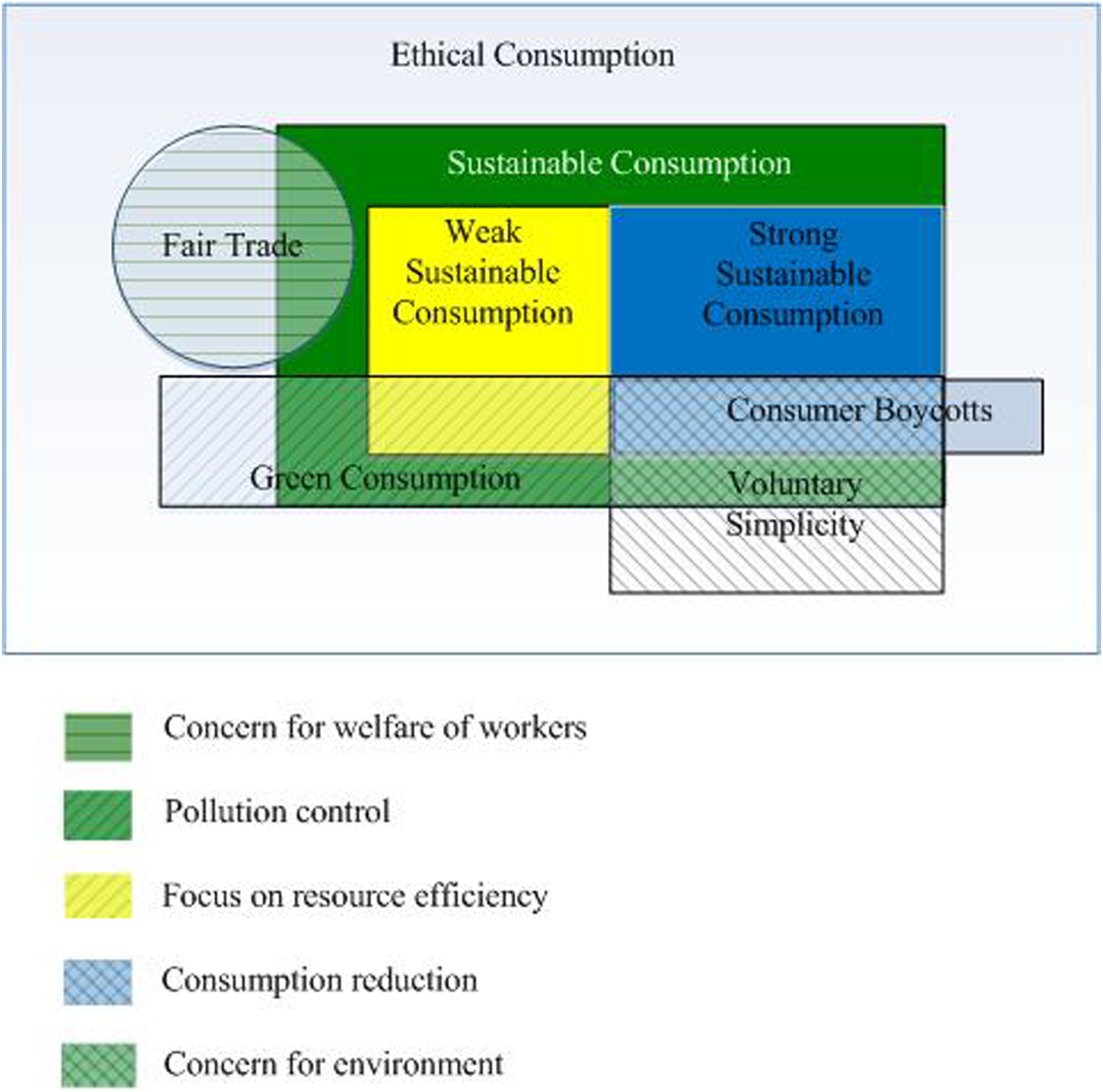
Ethical consumption components.
Various backgrounds and shadings in Figure 1 reveal different foci. The light green argyle pattern referring to environmental concern covers green consumption, voluntary simplicity and sustainable consumption. It involves concepts such as using products having reduced ecological impact and being environmentally responsible. Light blue coloured argyle denotes consumption reduction, which can be achieved by practicing strong sustainable consumption, consumer boycotts, voluntary simplicity and green consumption. Horizontal shaded lines exhibit concern for workers’ welfare which is observed in fair trade and sustainable consumption. Overlapped area of green consumption and weak sustainable consumption is depicted by light yellow slanted lines which focuses on efficient use of resources. Figure 1 emphasizes the overlap between concepts and justifies treating ethical and sustainable consumption as largely interchangeable. Based on the literature that is almost exclusively from WEIRD contexts, both sustainable and ethical consumption focus on environmental aspects (concern for the environment, pollution control, and/or efficient use of resources) with social aspects, relate to exploring workers’ rights and fair trade.
In WEIRD and non-WEIRD countries ethical and sustainable consumption behaviour is driven by contextual and personal factors, including cultural and personal values, attitudes, moral obligations and personal motivation (Biel and Thøgersen 2007; Steg and Vlek 2009; Thøgersen and Ölander 2006). Values and motivations are key components of Means End Chain / value laddering (Reynolds and Gutman 1988), the methodology applied in this research.
Values and Motivations
On a societal level, values are relatively stable; they provide continuity, but can shift, enabling social change (Rokeach 1973). Different cultures have dissimilar predominant values (Schwartz 2011). Values drive social norms (Schwartz 1994b) and acceptance of these norms is required for individuals to function within that society (Schwartz 2011). They are an important constituent of every society (Ramayah, Lee, and Mohamad 2010).
Schwartz's Theory of Human Values (2010) is based on multi-national research exploring the dimensions and structure of personal values. Table 1 provides a synthesis of the Schwartz's value dimensions and examples of some lower order values. Values discussed in Schwartz's theory are universal, but their importance varies in different societies with different societies and cultures having different core values (Schwartz 2006, 1992; Solomon 1999). The Theory of Human Values lends itself to investigations in multi-national contexts.
Schwartz Value Types.
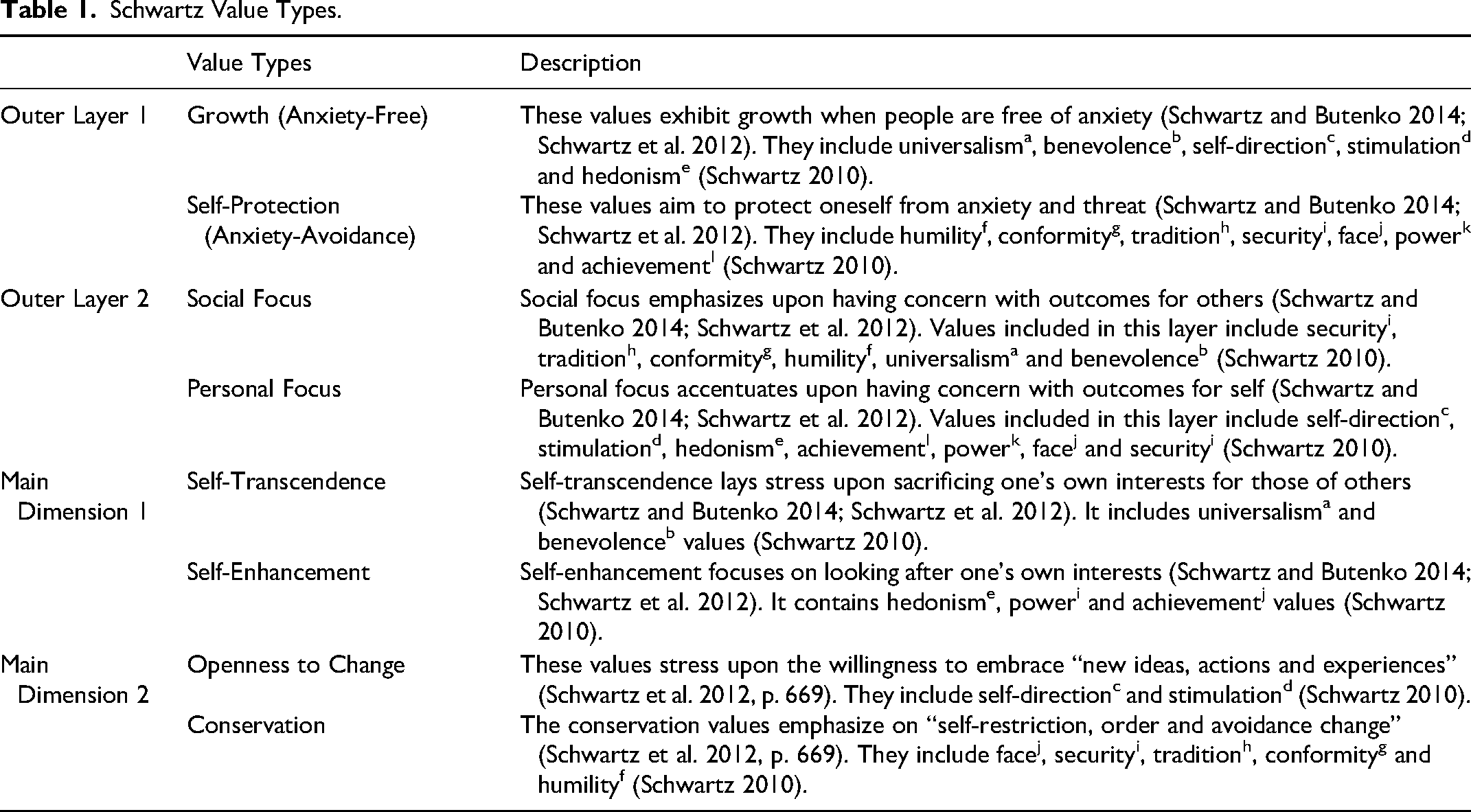
Human values are depicted on two dimensions, relating to openness to change versus conservativism and self-enhancement values versus self-transcendence values (Schwartz 1992). When the values are represented in a circumplex, these two dimensions are further encompassed by two offset circles. Values relating to a personal focus contain openness to change and self-enhancement while a social focus includes values relating to conservation and self-transcendence. Alternatively, one can also look at the encompassing dimensions of growth and being anxiety free, including self-transcendence (social focus) and openness to change (personal focus) values or self-protection and anxiety avoidance, containing conservation (social focus) and self-enhancement values (personal focus) (Schwartz et al. 2012).
Values determine the motivation (Schwartz 2003, 2010) to perform a particular action (Maslow 1943, 1970). The stronger a value is, the more motivated people will be to behave in accordance with that value (Schwartz 2010). Thøgersen and Ölander (2002) refer to Schwartz (1994a) to determine that causal relationship goes from basic values to environment friendly behaviour. Studies investigating the link between values and ethical consumption in developed countries generally find a strong relationship between values and ethical behaviour. Biospheric and altruistic values are found to be particularly important drivers of specific ethical behaviours (Jacobs et al. 2018; Jägel et al. 2012; Lundblad and Davies 2016; Thøgersen and Ölander 2002).
Motives refine and explain specific characteristics between personal values and behaviour. Research from developed countries suggests a wide range of motives behind specific ethical behaviours include health, quality (Cornish 2013), environmental concerns, animal welfare (Lockie et al. 2002), higher self-accountability (Tran and Paparoidamis 2019), product liking (Brenton 2013) and peer pressure (Cornish 2013).
Many of these values and motives also explain specific (but often different) ethical consumption choices in non-WEIRD countries. For example, Minton et al. (2022) observe that self-transcendence and openness to change values are positively associated with ethical/sustainable purchases whereas self-enhancement is negatively associated with sustainable consumption. Biospheric and egoistic values drive green lifestyle behaviour in non-WEIRD countries (Sony and Ferguson 2017) and link to environmental responsibility, sensitivity and perceived behavioural control (Wang, Liu, and Qi 2014).
The majority of studies in non-WEIRD countries focus on motivations for environmental concerns and behaviours, similar to research in western countries. Sharma and Jha (2017) report that pro-environmental attitude moderates the relationship between values and SCB, while norms, cognitive and regulatory dimensions impact environmental attitudes leading to pro-environmental behaviour (Martinez et al. 2015). Demographic factors also impact the pro-environmental behaviour. Married, middle aged and highly educated consumers score higher as compared to single, younger and lesser educated consumers on pro-environmental behaviour (Patel, Modi, and Paul 2017).
When the focus shifts to studies investigating particular ethical consumption behaviour in non-WEIRD countries, Michel, Mombeuil, and Diunugala (2022) note that perceived environmental knowledge, drive for environmental responsibility and attitudes toward green consumption have a positive effect on green consumption intention. Many studies in non-WEIRD countries focus on food consumption, for example, Kushwah, Dhir, and Sagar (2019) find that consumer knowledge has highest impact on the purchase decisions of organic goods. Non-WEIRD consumers report being prepared to pay higher prices for Halal products (Shadma, Ahmed, and Hasan 2018).
It has also been suggested that consumers in developing countries are prepared to pay more, and potentially even lower their living standards for environmental conservation (Hwang 2018). Availability of product information also influences consumers’ green purchase behaviour (Liu et al. 2012). In spite of their potentially lower standard of living, non-WEIRD consumers express interest in buying healthy and environment friendly products (Hamelin, Harcar, and Benhari 2013) and are keen to accept other consumers’ views regarding environmental consequences of consumption (Ramayah, Lee, and Mohamad 2010).
Methodology
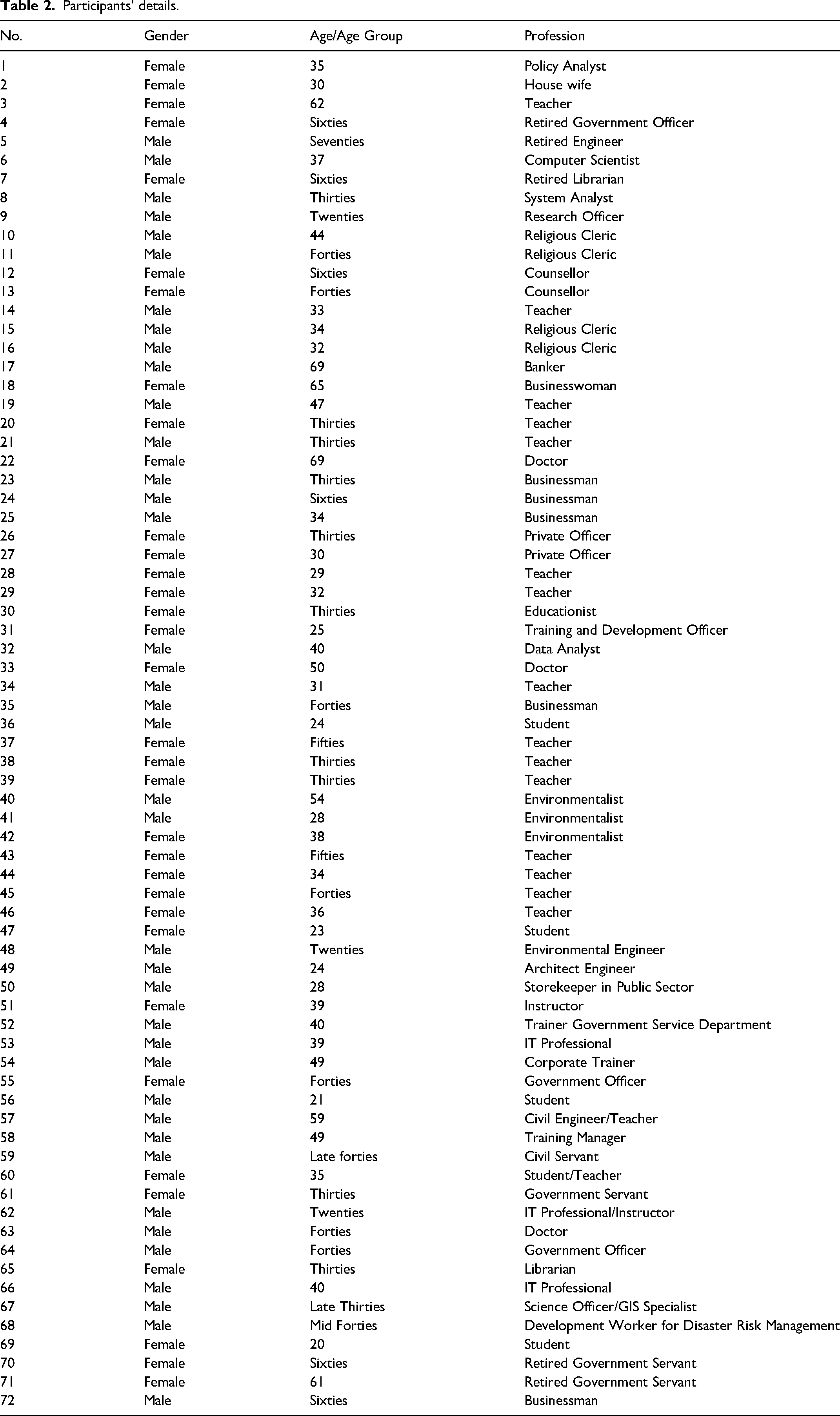
This research is based on 72 in-depth interviews in Pakistani. The aim was to gain a broad sample of self-described ethical consumers who were engaged at various levels of ethical consumption to get a variety of ethical consumption choices and drivers behind them. Pakistan is a conservative, developing country and a researcher should have a good cultural understanding while collecting data. The techniques of data collection in the West cannot simply be applied to a non-WEIRD country. Convenience sampling along with a broad range of personal contacts and subsequent referrals were used to get an appropriate set of respondents for this research. The purpose of the research was to explore the breadth of the ethical consumption phenomena in the Pakistani society. Ethics approval was obtained from the University of Otago prior to the research. The consent form was signed by interviewees and their identity was anonymized in all reporting. Informants belonged to diverse age groups and included members of academia, government and private employees, religious clerics, business owners etc. as shown in Table 2.
Participants’ details.
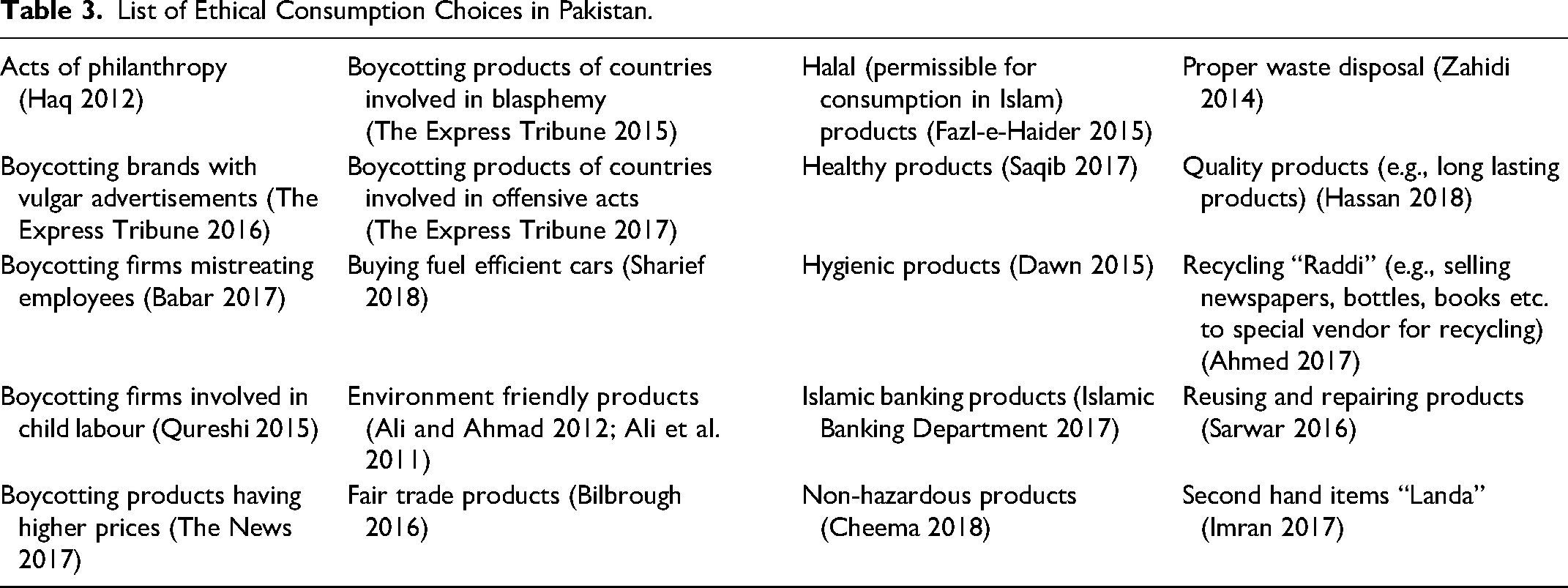
Forty interviews were conducted in English, 28 in Urdu, while four were bilingual. All interviews were conducted and transcribed by the first author who is fluent in both English and Urdu. Interviews conducted in Urdu in part or in whole were translated into English by the first author. In each interview, participants were first asked to list any ethical consumption practices they undertake. This unaided recall of ethical consumption activities was followed by aided recall using lists of ethical consumption. As ethical choices vary in different cultures, and consumption behaviours that are considered ethical in a western context are not necessarily relevant in an eastern (Pakistani) context, the provided lists were adapted for Pakistan (see Table 3). The list of ethical consumption behaviours shown to Pakistani participants is based on previous research on ethical consumption in non-western societies (Hamelin, Harcar, and Benhari 2013; Shadma, Ahmed, and Hasan 2018; Swimberghe, Flurry, and Parker 2011), supplemented by emerging consumption trends in the Pakistani society as found in regional websites, blogs, journal articles and newspapers.
List of Ethical Consumption Choices in Pakistan.
Following the unaided and aided selection of ethical consumption behaviours, Means End Chain Laddering was applied to reveal underlying motivations and values that drive these behaviours.
Means End Chain/Laddering
Human values were defined by Rokeach (1973) in his value system. Later studies showed how these values drive consumer behaviour (Vinson, Scott, and Lamont 1977). Young and Feigin (1975) presented Grey Benefit chain which displayed how consumers seek benefits sought from a product during its purchase. Gutman (1982) extended upon the research of Vinson, Scott, and Lamont (1977); Young and Feigin (1975) to present a Means-End model. In means-end theory, means are attributes or ethical consumption habits and ends are terminal states or values. Consumers’ actions have consequences associated with them, which are driven by values. Means-end theory links attributes with consequences or motivations driving them and values directing these motivations (Gutman 1982).
Laddering theory by Reynolds and Gutman (1988) utilizes the means-end model to analyse data collected from the respondents through which they can link attributes to consequences and values held important by them (Kaciak, Cullen, and Sagan 2010). Laddering technique can be either hard using a questionnaire format (Phillips and Reynolds 2009) or soft in which semi structured interviews are conducted with respondents (Eugene and Carman 2009). Respondents are asked why something is important for them, which unveils drivers, i.e., consequences and values behind ethical consumption habits (Veludo-de-Oliveira, Ikeda, and Campomar 2006). In similar studies, 40 to 98 in-depth interviews have been conducted for analysis through means end model (Jägel et al. 2012; Jüttner et al. 2013; Reynolds and Rochon 1991). Means end theory has been applied in tourism (Jiang, Scott, and Ding 2015; McDonald, Thyne, and McMorland 2008; Nunkoo and Ramkissoon 2009) and consumption behaviour (Davies and Gutsche 2016; Jägel et al. 2012).
Data Analysis
The transcribed interviews were analysed using Reynolds and Gutman (1988) laddering technique. The first step in the data analysis was interview coding. The first author led the coding process due to their emersion in the data, their cultural familiarity and linguistic abilities. During the coding process, the interviews were searched for different keywords which depict the ethical consumption behaviours, motivations and values. Similar behaviours or motives were summarized and given a unique code. The extraction of specific ethical behaviours, motives and values as well as necessary consolidation (summarizing behaviours or motives) were extensively discussed among all three authors in an ongoing and iterative process.
In line with Reynolds and Gutman's prescribed analysis process the extracted and agreed codes were turned into a hierarchy value matrix (HVM). In the HVM generation process, for every interview, and using the codes extracted and agreed in the coding process, a ladder diagram is constructed, in which ethical consumption choices are displayed at the bottom with motivations and values building upon them. Individual HVMs were constructed for all Pakistani interviews with direct and indirect relations between two different nodes for each HVM counted and displayed in an implication matrix in Microsoft Excel.
In the final steps the 72 individual HVMs for Pakistan were combined into one HVM. The complex task of summing up of all relations across 72 matrices and choosing the most appropriate cut off value was achieved by employing a purpose written Excel macro. The combined HVM was achieved after running different cut off values with an aim to arrive at rich but meaningful and interpretable HVM. A cut off value of 14 produced the best results. The HVM for Pakistan is shown in Figure 2.
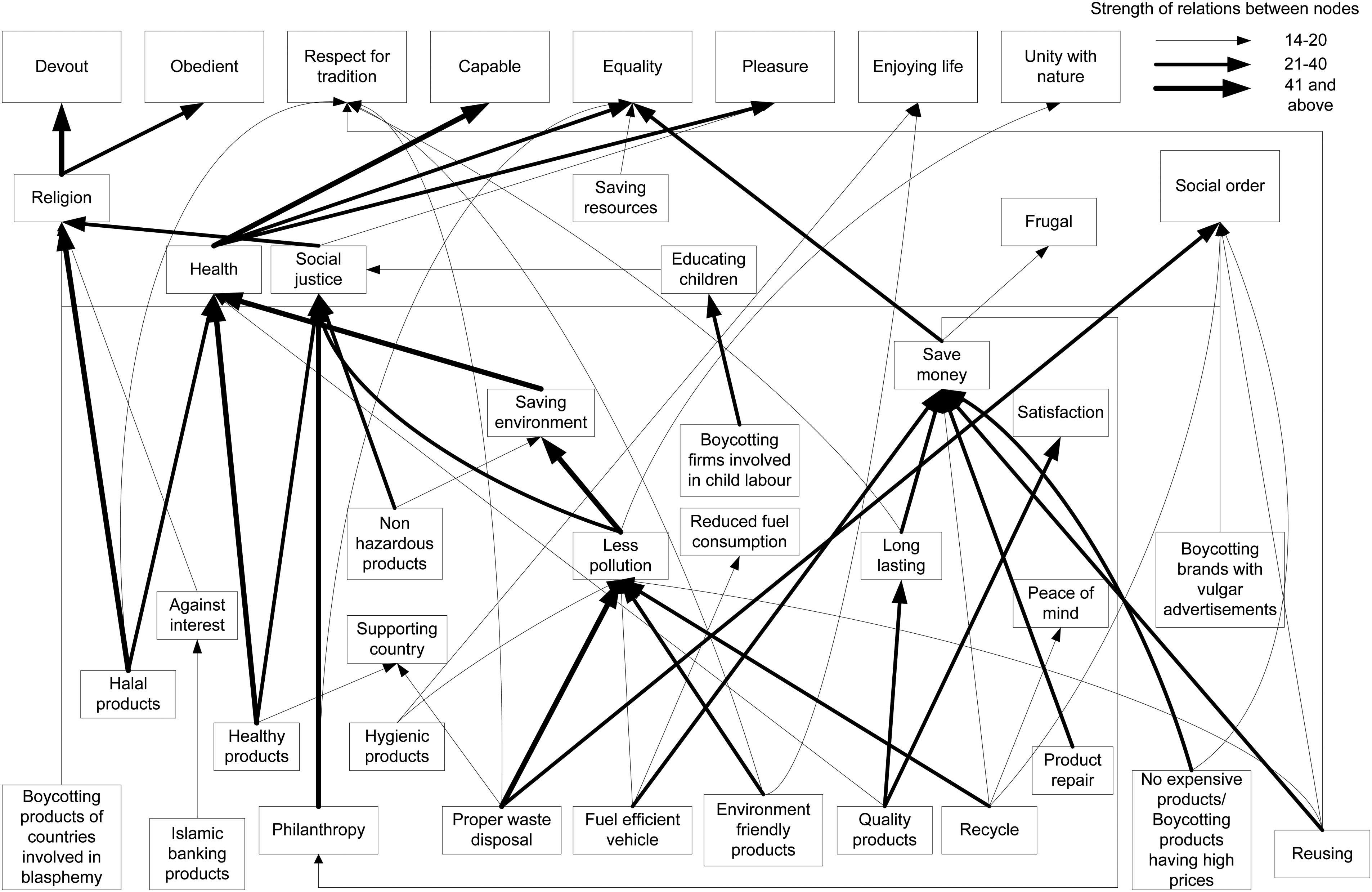
Values and motivations driving ethical consumption choices in Pakistan.
Results
Figure 2 shows ethical consumption choices, and the motivations and values driving them in Pakistan, a religious and developing country. This figure is a purposeful simplification of the results, based on the combined HVM of 72 interviews, applying the most appropriate cut-off value. Ethical consumption choices, motivations and values included in the figure can be considered as important for the respective interviewees with the thickness of links between different layers depicting the strength of the connection between e.g., ethical behaviour and motivations or motivations and values.
The complex nature of ethical consumption behaviours and their drivers is apparent in Figure 2. In Pakistan the most prominent ethical consumption choices extracted through the HVM are shown at the bottom. They include Halal and Islamic banking products, healthy, hygienic and non-hazardous products, while consumer boycotts are also prevalent in the Pakistani society. Buyers boycott expensive products, products of countries involved in blasphemy, firms involved in child labour or brands with vulgar advertisements. The participants stress consumption choices like recycling, proper waste disposal, reusing, environment friendly products and fuel efficient vehicles.
A range of motivations guide these consumption choices, including religion, saving money, educating children, concern for health and environment. These motivations are ultimately driven by values: Devout, Obedient, Respect for Tradition, Capable, Equality, Pleasure, Enjoying Life, Unity with Nature and Social Order. The following section provides examples of these values and subsequent motivations that are particularly important.
Tradition and conformity, the two of the most important values driving ethical consumption in Pakistan are part of Schwartz's conservation dimension. In the current study, respondents express themselves as devout (a sub-value of tradition) or obedient (a sub-value of conformity). From the 72 interviewees, 46 discussed devout, and 39 discussed obedient with both sub-values found in the Pakistani HVM.
Devout and obedient values drive religiosity as the most prominent motivation for ethical consumption behaviour in Pakistan (68 from 72 interviewees). Religion is the motivational factor behind multiple ethical consumption choices.
Religion is strongly linked to the purchase of Halal products (products permissible for consumption in Islam) with 65 out of the 72 respondents directly discussing it. A religious cleric (male, 40 s) when asked why he would consume Halal products, stated “The use of Halal products as per Islam are not just for me, this I have ticked, rather compulsory for every Muslim.” Religion is also the motivating factor behind buying Islamic banking products (banking products without interest). A university teacher (female, 30 s) said that “why Islamic banking because again, Islam has provided us a principle not to take interest… interest ultimately increases the distance or differences between rich and poor.” Religion is related to boycotting products of countries involved in blasphemy and companies displaying vulgar advertisements. A religious cleric (male, 34) talking about boycotting companies displaying vulgar advertisements said “the same thing comes that being a Muslim we have a responsibility that vulgarity and sinful acts, illegal acts be stopped. Just like there is to call for acts of virtue and dissuade from sinful acts.” Another female officer (aged 35) working for a private organization, when asked about the reasons leading to boycotting products of countries involved in blasphemy stated “I am a Muslim. It's against my practices if I am respecting their beliefs and their god and their prophets etc., then I think every person should do the same for every other religion.” Religion is further linked to social justice, with the latter concept driving the purchase of non-hazardous products, boycotting firms involved in child labour (linked via children's education) as well as engaging in philanthropy. A university teacher (male, 30 s) while giving reasons for being engaged in acts of philanthropy stated “there are there are various reasons for that. One reason is obviously in terms of my religion… Like there is someone in the employees, like there is someone in the family which is in need of money every month and I give the donations to them give them easy living.”
The value of tradition for Pakistanis is also expressed as valuing traditions set by their elders. This view of tradition is not explicitly linked to religion, but to keeping the status quo in society; a value with a social focus (see Table 1). For example, people not only buy Halal products due to religious reasons, but because their elders undertake that ethical behaviour as one respondent (female, 30 s) stated “May be it is part of my upbringing that I was in an Islamic environment. My parents brought me up this way and they say that only the Halal is to be eaten.” This form of tradition is also evident in behaviours such as proper waste disposal, reusing items, purchasing long lasting or environment friendly products.
Another value that is an important driver for ethical consumption choices among the group of interviewees is unity with nature, a sub-value within universalism and part of the self-transcendence values. Pakistani respondents express their unity with nature by cutting down pollution. They purchase environment friendly products, recycle, reuse, dispose of waste properly and use fuel efficient vehicles. An environmentalist (male, aged 28) stated that he would buy fuel efficient vehicles because “They are economical to use… secondly, its environment. So they are less dangerous to the environment. They pollute less. These are the two main reasons.”
Health is another important motivator of a range of ethical consumption choices for Pakistani respondents and is associated with a number of higher-order values. Pleasure, a sub-value of hedonism, and a part of growth and of personal focus values; and capable, a sub-value of achievement and part of the self-protection, anxiety avoidance value types are discussed by respondents. Health is linked to both values, mentioned by almost all interviewees (71 out of 72).
As a teacher (male, aged 34), when asked why he consumed healthy products, replied “Actually the main reason I told you that health and body, we have to take care of it… If we don't have health then there is no happiness in the world, no comfort. And the comfort and happiness is that the health maintains.” A student (male, aged 24) when asked about the importance of health said “With health, there is everything. If there is no health then we won't be capable for doing any job.” Respondents in addition link health to equality (a sub-value of universalism) or caring for themselves and their families. Social justice, an instrumental value is also linked to pleasure as a female policy analyst (aged 35), when asked about the importance of helping others said “Because it gives me happiness, caring about the other person… it's good for society in general if people are not poor. If there is less poverty in a country, if people are happy, if they are healthy, then the country faces less problems. It places less economic burden, it places less social burden etc. on the country overall.” The previously discussed Halal products are also consumed for health. A professional doctor (female, 69) when asked why she would buy Halal products stated “For example if we buy Halal meat, now the people say that there is scientific reason why we should go for Halal because there is a process. You know the animal should bleed or animal should you know… be away from these the blood of the animals which are sacrificed or which we eat. May be it is harmful sometimes. So I think it has got scientific reason as well in addition to our religious beliefs.” Healthy and quality products and ethical choices related to conserving the environment are also motivated by health. A university teacher (female, 34) said “So if I am polluting the environment, with reference to air, we are breathing in the same environment. So ultimately our health will be affected. The plants, food chain that will be affected… They are accumulated, they are bio-polymers being formed in the plants, in the soil, which then ultimately come to our body.” Consumers do purchase environment friendly products, recycle, reuse, dispose of waste properly and use fuel efficient vehicles to reduce pollution and to protect the environment, which is linked to health. Interviewees’ responses were not detailed and few of them mentioned specifics like landfills or climate change, a reflection that environmental protection is a relatively new concept in Pakistani society.
In Pakistan, respondents mentioned quality products having longer life, repairing and reusing goods, recycling, not purchasing expensive products and buying fuel efficient vehicles to save money. These financial foci enable respondents to care for their family (equality) and spend it on charitable causes linking to social justice. A retired banker (male, aged 70) talked about “raddi” or discarded newspapers “for example, like a newspaper, you have read it and now it is useless for you. But if it is disposed of then the vendor collecting raddi buys it. You give it to your maid, she makes some money from it and then the newspaper through vendors who buy raddi, reaches the resource where it can be recycled and can be reused.”
Discussion
This research shows ethical consumption choices, motivations and values in an eastern developing and religious country. Pakistan has an overwhelming Muslim population (Pakistan Bureau of Statistics 2021) and religion is the guiding force behind several ethical consumption choices. Consumers in a religious country have their consumption choices shaped by religion, including the choice of halal products (Jusmaliani and Hanny 2009; Shadma, Ahmed, and Hasan 2018) and other food choices (Graafland 2017; Minton, Johnson, and Liu 2019), a finding that is supported in the current study. In line with Fam, Waller, and Erdogan (2011); Ghani and Ahmad (2015), interviewees in Pakistan consider advertising of sex, health related products and social/political groups more unpleasant than Christians, Buddhists and non-religious groups. The Pakistani consumers also boycott products of countries involved in blasphemy. This confirms the findings of Heilmann (2016); Swimberghe, Flurry, and Parker (2011) that religious consumers may refuse to purchase products if the seller supports contentious issues or hurts religious sentiments. Pakistani consumers also boycott firms involved in child labour citing social justice. This is in contrast to findings by Yuksel (2013) that consumers give counter arguments or provide other reasons for non-participation in consumer boycotts.
Health is an important motivation for ethical consumption choices in Pakistan, often in combination with improving the environment. Consumer choices were motivated by wanting to have a better environment and was reflected in consuming healthy products. Respondents frequently stated that being healthy would allow them to carry on with their daily lives and fulfil their duties and responsibilities.
While a healthy environment was discussed in support of personal health, reducing environmental degradation in general was not prominent as a motivating force. Informants in this study mentioned lessening plastic consumption which harms the environment but ethical consumption choices related to lessening pollution and environmental conservation were very few. Pakistan is a poor country with a meagre GDP per capita of $1,186.7 (United Nations Statistics Division 2021) and literacy rate of 62.3% (Ministry of Federal Education and Professional Training 2021). The less educated poor have little means of living, are ignorant about the environmental issues and their consumption choices are inexpensive products (Barnhart and Mish 2016).
Pakistani consumers are focused on consumption choices which allow them to be economical and refrain from buying products with higher prices. These consumers cannot be termed voluntary simplifiers, as they cut down their expenditures due to financial constraints (Etzioni 1998).
Managerial and Policy Implications
This study used a qualitative approach and further research should investigate the findings using a large generalizable sample, while retaining the full breadth of the phenomena of ethical consumption. The present results suggest a number of business and policy initiatives.
Contrary to many western societies (Wooliscroft, Ganglmair-Wooliscroft, and Noone 2013), and in spite of recent large scale policy initiatives (MOCC 2022), to curb pollution in major cities (Jamal 2021), results show that environmental protection is not yet a key concern for ethical consumers in Pakistan (Dernbach and Brown 2009; Zsóka et al. 2013). This appears to be due to a lack of knowledge about the issue and economic constraints. To increase environmentally friendly or green consumption, public policy and business initiatives need to address both issues: knowledge and affordability. Given the values of the respondents it is unlikely that environmental appeals will have impact in the Pakistani market place.
Religion drives different ethical consumption choices and these choices can be supported by government and business initiatives. In 2016, the Government established Pakistan Halal Authority to promote trade in Halal goods (Government of Pakistan 2016). Our results highlight the importance of Halal choices for Pakistani consumers and encourage the increased uptake of respective certification. Products certified Halal by a single authority are cost effective for the marketers and considered authentic by the consumers (White and Samuel 2016). Similar recommendations for making stronger use of government regulations are suggested for ethical alternatives of banking practices. For example, the Government recently announced the establishment of interest free banking in Pakistan by 2027 (Rana 2022). This provides an opportunity for conventional banks to switch to Islamic banking practices.
The Pakistani respondents also strongly reported consumers’ boycotts of products from countries involved in blasphemy or brands with vulgar advertisements as they go against the teachings of Islam. Marketers should be careful in importing products and refrain from airing vulgar advertisements as it may create a stigma, particularly in a globally connected digital world.
Conclusions
This research provides a comprehensive view of values and motivations that drive a broad range of ethical consumption habits in a non-WEIRD country, Pakistan. It highlights that we have to reconsider transporting research on ethical consumption from WEIRD to non-WEIRD countries. Pakistan is a religious country and consumers explain that their ethical consumption choices are strongly driven by religiosity.
Respondents mentioned lessening pollution to conserve environment which enables them to stay healthy to carry on with their responsibilities and is a source of pleasure, but environmental conservation is new concept in Pakistani society and consumption options aimed at promoting sustainability are very few. Future studies should focus on finding the effective channels of communication educating consumers in the Pakistani society about environmental protection or promote those behaviours in terms of religious values held by citizens.
Current research gives a rich understanding of drivers of ethical consumption in Pakistan. These results help understand the breadth of phenomena of ethical consumption in the Pakistani society. A future quantitative study should investigate if these results can be generalized to the Pakistani population. The research should be further expanded to other Islamic developing countries to reveal whether their consumption habits are equally driven by religious values.
Footnotes
Associate Editors
Eunju Ko and M. Joseph Sirgy.
Declaration of Conflicting Interests
The author(s) declared no potential conflicts of interest with respect to the research, authorship, and/or publication of this article.
Funding
The author(s) received no financial support for the research, authorship, and/or publication of this article

Author Biographies
Sabeehuddin Hasan is an assistant professor at the Department of Management Sciences in COMSATS University Islamabad, Lahore Campus, Pakistan, where he teaches Strategic Marketing and Marketing Research. He did his PhD in Marketing from University of Otago, Dunedin, New Zealand. His research interests include ethical consumption and quantitative techniques. He also holds a Bachelor’s degree in Computer Science and is a professional programmer with many years of experience in multinational software houses.
Ben Wooliscroft is a Professor of Macromarketing, Auckland University of Technology, Auckland New Zealand. He is the current President of the Macromarketing Society and an Associate Editor of the Journal of Macromarketing. His research is centred around macromarketing, with research streams in systems, sustainability, marketing history, brands, quality of life and sustainability transitions.
Alexandra Ganglmair-Wooliscroft is a Senior Lecturer in the Business School, Massey University, Auckland, New Zealand, Vice President Conferences for the Macromarketing Society and Associate Editor of the Journal of Macromarketing. Her research focuses on the wider implications of consumption - particularly consumption, well-being and quality of life.