



Abstract
This case study of a UK-based global fast fashion brand Boohoo encourages critical exploration of a complex, ethical and reputational crisis. Taking a macromarketing perspective, the reader is encouraged to consider all of the factors, actors and relationships in the industry, society and the supply chain to appreciate the resulting ethical considerations that arise. Boohoo has been described as a successful online company that provides a wide range of products, including clothing, footwear, beauty products and accessories. However, the company came under fire in July 2020 after an exposé published in the Sunday Times, the Sunday paper of The Times, named Britain's most trusted national newspaper. The exposé published a report from an undercover investigation that revealed some unacceptable practices in relation to working conditions. The poor working conditions were worsened by the COVID-19 outbreak. As the media criticised Boohoo, the company launched an independent review which eventually confirmed the allegations and stated that the investigation's findings were “substantially true”. Written from the perspective of a PR consultancy that wants to help Boohoo restore its reputation, the case uses secondary information to thoroughly understand Boohoo's situation. The PR consultants therefore investigate the Sunday Times’ allegations, Boohoo's practices and responses to those allegations, and the company's practices from an ethical point of view. The PR consultancy also investigates the fashion industry, with a focus on fast fashion, which creates an environment where suppliers and retailers in the system try to produce products as cheaply and profitably as possible. To fully understand those affected by this exposé, those influential to the industry and those stakeholders who govern or put pressure on the industry, they consider: the people and local government of Leicester (pronounced Lester), the supplier factories, national government websites and views of pressure groups and charities.
Keywords
Appropriate Uses
This case can be used for upper-level undergraduate students within modules which address: Public Relations and/or Marketing Communication, Macromarketing, Business Ethics, Corporate Social Responsibility (CSR), Stakeholder Theory and the Attitude-Behaviour Gap. It can also be used for modules focusing on the fashion industry. The case study should be used to provide the context to understand, explore and debate the theoretical marketing phenomena previously outlined.
Suggested case study questions have been developed to assist facilitators with their use of the case. These questions have been separated into four sections: developing the PR strategy, macromarketing, micromarketing and revisiting RYR's PR strategy for ease of use. The teaching notes which have been provided online also include suggested answers, discussion points, in class activities as well as background reading and other materials that may add value to teachers’ own teaching materials and the case study.
Introduction
Saana and Michelle recently started their own consultancy, called ‘Restoring Your Reputation’ (RYR) and have been scanning the local environment to find potential clients they can help with their specific expertise. While conducting this scan it became apparent that Boohoo, the fast fashion company with head offices in Manchester, UK, might need some advice because they had come under fire from the media and community due to the discovery of poor treatment of the workers in their supply chain in Leicester City, UK. As experts in restoring reputations and regaining stakeholder trust after these types of incidents, RYR decided to prepare a presentation detailing how they could help the company and see if they could entice Boohoo to be a new client.
Saana and Michelle have therefore conducted secondary research, making sure they understand their potential client Boohoo, its growth, development, marketing strategy and CSR practices. They perused the local and social media to understand the situation Boohoo found itself in, determining customers’ reactions and what varying pressure groups and the press have to say about it. Finally, RYR investigated the context within which this situation occurred, specifically looking at Leicester, and UK Laws and regulations around employment and health and safety.
Boohoo's Background
Founded in 2006 by Mahmud Kamani and Carol Kane, Boohoo Group PLC is a UK company which was incorporated in 2013 (Boohoo 2021a; Financial Times 2021). Boohoo, an online fashion retailer, offers a wide range of low-priced, medium quality products including clothing, footwear, beauty products and accessories through their website and mobile app, with no physical outlets. The company adopted an ultra-fast fashion strategy (Hendriksz 2017), which means that it only takes one to four weeks for them to introduce new fashion products for sale. Their online retail competition therefore includes companies such as ASOS and Missguided as well as other low-price, high street, affordable fashion retailers such as Primark, Matalan and Tesco.
Boohoo's vision focuses on different stakeholders with a business model called test and repeat, to share the latest trends with their customers. For the test and repeat model the company offers several items for sale as part of their market testing, and those items which are popular with the target audience are then reordered (BBC 2018). “Our vision is to lead the fashion e-commerce market globally, in a way that delivers for our customers, people, suppliers and stakeholders. Our brands operate along the same principles today as when Boohoo was founded in 2006: through a test and repeat model that brings the latest trends and fashion inspiration in a matter of weeks to our customers across the world” (Boohoo 2021c).
Boohoo targets both male and female customers from 16 to 30 years old, across several countries. These customers have their own social network and shop online (Statista 2021a; Statista 2021b), and according to the McKinsey report (Francis and Hoefel 2018), most of Generation Z (1995–2010) would “try to purchase products from companies they consider ethical” (p. 9). Similarly, Millennials (1981–1996) have been found to be strongly motivated to make ethical purchases when influenced by both social and personal feelings such as supporting worthy causes (Bucic, Harris, and Arli 2012).
In order to remain relevant and attractive to their “younger” customers, the company is committed to using technology in their promotion and customer experience. They have therefore implemented a 360 degree view of all products online, developed and offered an easy to use mobile application and attract customers through social media using influencers, YouTube stars and bloggers.
Boohoo's emphasis on stakeholders results in the commitment to their people. Notably, their website states that “our commitment to our people is woven into the fabric of our business”, where ‘people’ includes everyone who works directly with the company such as their 3,040 employees (Financial Times 2021). ‘People’ also includes those who work indirectly with the company such as local UK-based suppliers who provide at least 40% of their garments as well as their international suppliers who provide the remainder of their stock.
According to the company's annual report (Boohoo, 2021b), the company managed to achieve strong revenue growth across all geographies, with the UK up 39% and international up 46% since the 2020 annual report. The revenue in 2021 was £1,745 million. The company's subsidiaries include Boohoo Holdings Limited, Boohoo Germany GmbH, Boohoo France SAS, boohoo.com Australia Pty Ltd, boohoo.com UK Limited, boohoo.com USA Inc and Burton Online Limited (Reuters 2021). The company has also bought other brands which were important to their customers, such as: Pretty Little Thing, Nasty Gal, MissPap, Karen Millen, Coast, and more recently, Oasis and Warehouse.
From its inception, Boohoo has developed into an example of a successful company, not only through their continued advancement but also through the number of awards it has received over the years including: the BT Online Retail Excellence Awards in 2005, Top 10 Heat Magazine Online Retailer Awards in 2008, ‘Best Newcomer’ in the Cosmopolitan Online Fashion Awards in 2009 and the Reveal Click To Buy Awards: Brilliant Bargains in 2010.
The Fashion Industry and its Effect on People and the Planet
Despite its success and numerous awards, Boohoo operates within an industry that is plagued by numerous accusations of unethical behaviour and its effect on people and the planet. Some of the accusations and issues that RYR have discovered that have been made against the fashion industry are briefly summarised below.
The fashion industry is known as one of the most polluting industries. It is responsible for 10% of the annual global carbon emissions (Johnson 2019; Ro 2020). It has a negative effect on the environment through using material derived from petroleum or using natural ones that can be used in food. In addition, it contributes to the dumping of wastewater and plastic microfibers into the ocean. It is associated with the term ‘Sweatshop’ (Leach 2020). The industry is accused of having poor working conditions in terms of low wages and poor health and safety conditions. Child labour: there have been many accusations of the industry employing children in overseas supply chains (Moulds n.d.). Overconsumption: the fashion industry helps in increasing consumption. Even with companies who introduced the take-back scheme (in-store recycling), it has been argued that this gave consumers an opportunity to develop a guilt-free consumption attitude (Gould 2017; Stål and Jansson 2017). Issues with body image: the fashion industry has been accused of using thin models (size zero) which lead to negative consequences among a lot of females including eating disorders and poor self-esteem (de Freitas, Jordan, and Hughes 2018).
All of these issues become amplified through ultra-fast fashion where companies focus on getting their new designs on the market within a few weeks. Therefore, Boohoo, like other fast fashion players, often face criticism regarding their sustainability models. Cavender, Min-Young, and Gannon (2017) argue that the fast fashion business model (i.e., high volume, low cost) opposes sustainable consumption moves. It is therefore not surprising that Boohoo was also required to answer questions in Parliament in 2018 based on environmental concerns (House of Commons Environmental Audit Committee 2019).
Boohoo's Corporate Social Responsibility
Considering the challenges of the fashion industry and their perception within the global community, RYR continued their data collection by next looking at Boohoo's CSR practices to understand how they currently combat these negative perceptions. They specifically focused on how they interact with society and Boohoo's response to the COVID-19 pandemic.
Commitment to Society and Community
It became clear that Boohoo demonstrates their commitment to society and community through a number of initiatives. This commitment was demonstrated when Boohoo launched a sustainable fashion line called ‘For the Future’ where they used recycled materials to develop clothing for sale in 2019 (Boohoo 2021d). During that year, they also introduced 100% recyclable parcel bags. Boohoo also provided customers with tips on how to wear their clothing for longer and remain fashionable while helping the planet (Boohoo 2022). They have also launched the Regain app, which allows customers to recycle their old clothing and receive discount codes in exchange for this practice.
Boohoo also demonstrates its commitment through donations to charities such as Red Cross and those tackling the Australian wildfires. In a similar way, in response to the terror attack in the UK's Manchester arena in 2017, the group launched its own charity ‘One Love’ where all the profits go to the Red Cross fund (Boohoo 2021a).
Boohoo's Response to COVID-19
At the beginning of 2020, the world became aware of a new virus in China. By March, 2020, the World Health Organisation (WHO) declared that COVID-19 was a pandemic. This outbreak affected almost all countries and most countries went into lockdown. The UK was no different. On the 23rd of March, Boris Johnson, the Prime Minister of the UK at the time, announced lockdown measures. These lockdown measures meant that several businesses, schools and universities were closed for business. These measures were implemented in order to minimise contact between individuals to curb the spread of the virus.
During the COVID-19 pandemic, in addition to selling face masks, Boohoo started to sell National Health Service (NHS) Charity Rainbow Slogan T-Shirts, and the value of sales was donated to Manchester Foundation Trust Charity. They also offered discounts to NHS staff and shared videos featuring applause for NHS carers on their social media (See Figures 1 and 2).
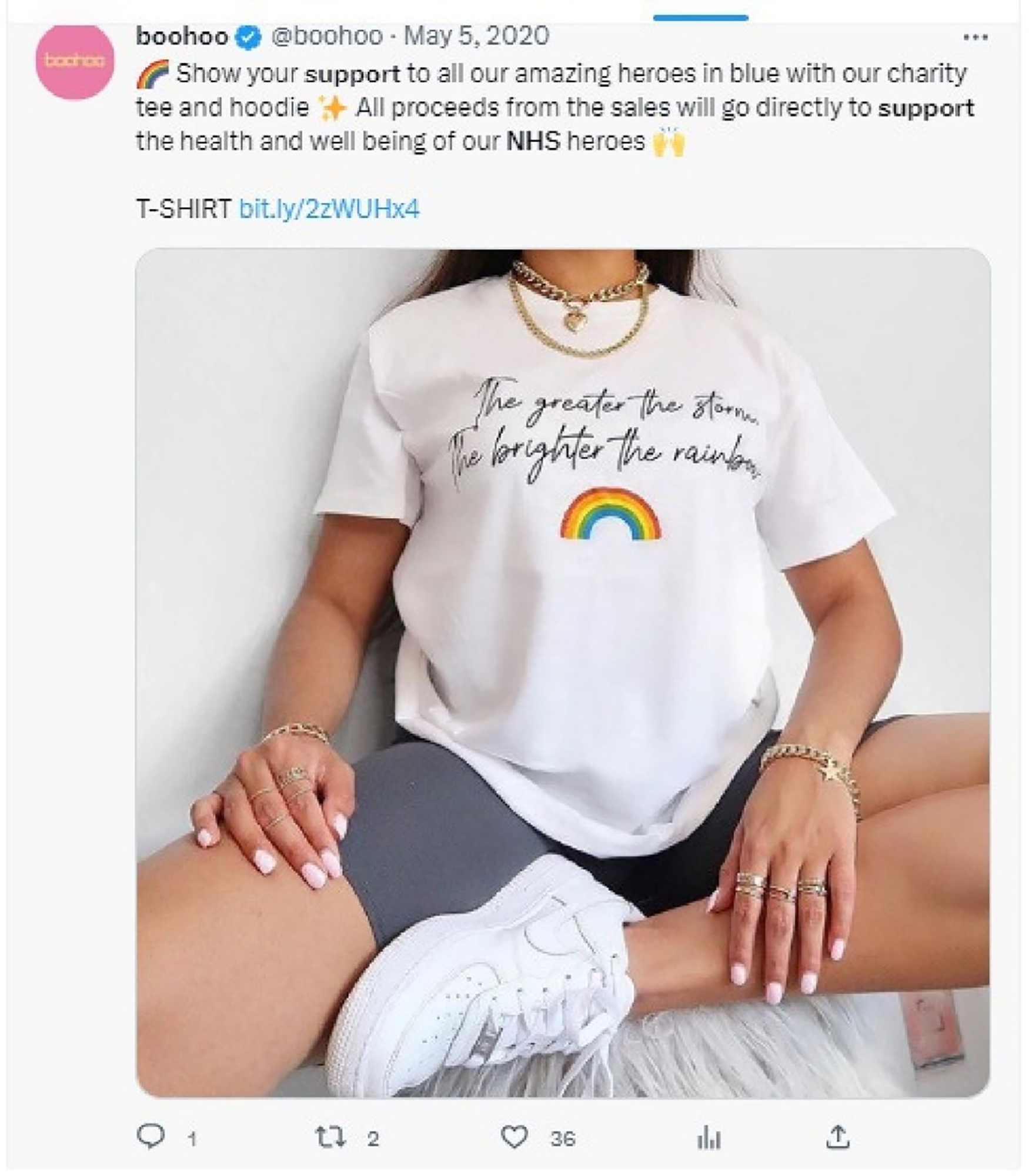
T-shirts sold by Boohoo.
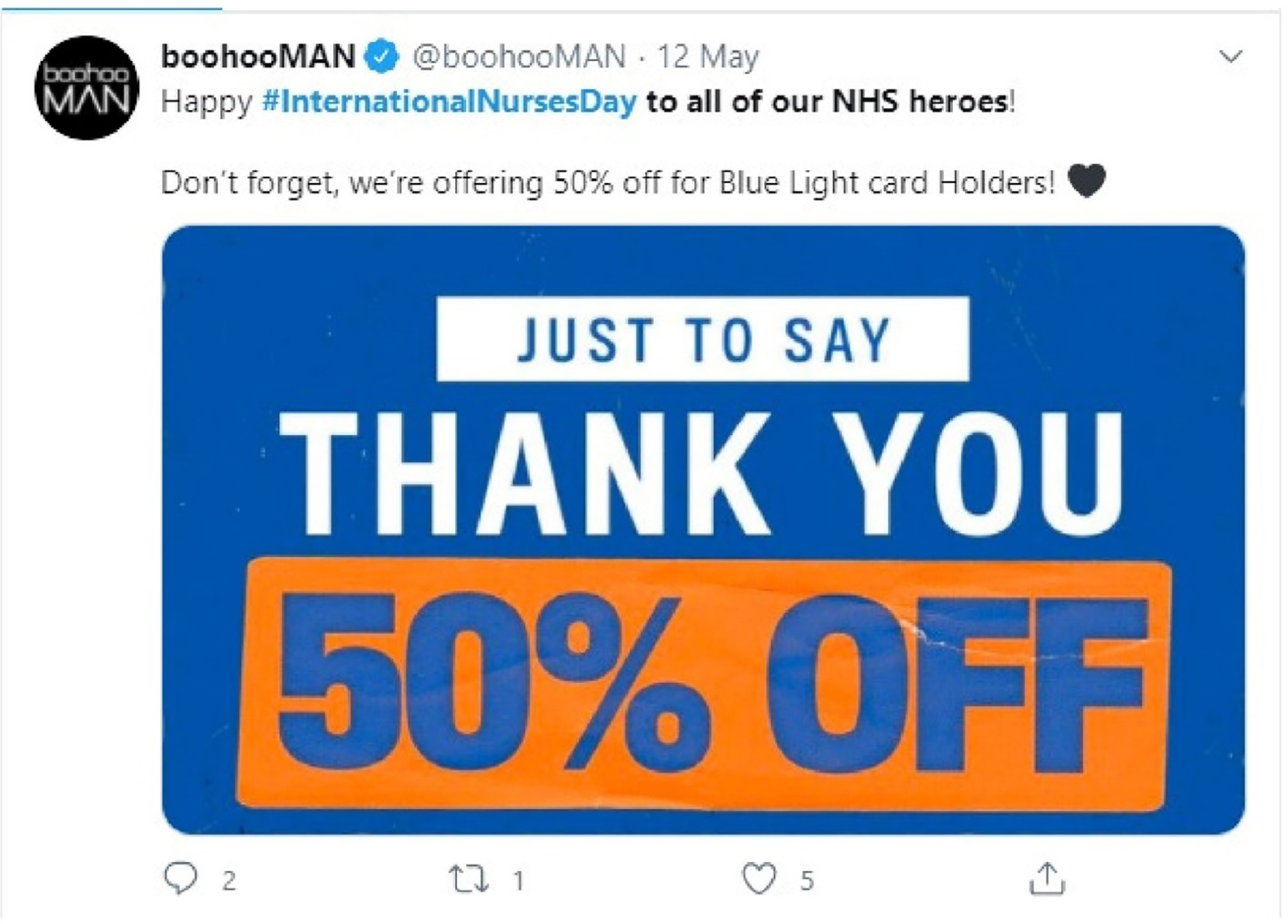
Boohoo offer to NHS carers.
With an understanding of Boohoo's CSR, commitments to society and community and response to the pandemic, Saana and Michelle turn their focus to the crisis that drew media attention to their potential client, Boohoo.
The Sunday Times Undercover Exposé
Everything was going well for Boohoo until the 5th of July, 2020 when Wheeler, Bassey, and Matety (2020) Sunday Times article shed light on an undercover investigation into a Leicester-based garment factory. The Sunday Times reporter who went undercover, found that the staff in that factory were paid “as little as £3.50 an hour”, compared to the minimum wage from April 2020 to March 2021 of £8.72 (National Minimum Wage and National Living Wage rates, 2021). The report also stated that the required health and safety measures were not in place to protect staff from the spread of COVID-19 as staff were not wearing protective masks. Incidentally, this incident was highlighted just as Leicester's lockdown was imposed due to an increase in COVID-19 cases.
Allegations were reported widely and negative messages began to be framed by the traditional media and the Labour behind the Label group, discussing Boohoo's exploitation of workers (Bland and Butler 2020; Bland and Campbell 2020). A debate also started on social media and Boohoo was attacked by different stakeholders including customers, the media and influencers on this platform. Moreover, issues concerning exploitation and modern slavery were raised in Parliament (BBC 2020a). Following this coverage, Boohoo's value dropped by almost 50% on the London Stock Exchange (2022).
Saana and Michelle discovered that an estimated 75–80% of Leicester's garment output is sold to Boohoo (Bland and Kelly 2020) and that the factory being investigated was one of Boohoo's suppliers. In addition, it also became clear that low wages and poor working conditions were common in the garment district of Leicester. These findings determined the next step in their investigation.
Society, Laws and Regulations
Having reviewed The Sunday Times article, and gained a better understanding of the allegations that were made against Boohoo, it was necessary to try to understand the context/setting within which this occurred. RYR wanted to know more about: (1) Leicester, the city where the supplier factory was located, and therefore, home to the society and workers who were directly affected by these allegations and (2) the laws and regulations regarding employment within the wider environment of the UK which governs the society and industry that Boohoo operates within.
Leicester: Culturally and Ethnically Diverse
Saana and Michelle found that Leicester is one of the most culturally and ethnically diverse places in the UK. Leicester residents hail from over 50 countries around the world (Leicester City Council 2012). Whilst the majority of Leicester county's inhabitants (89%) report as White British, within the City of Leicester itself, a minority of residents (45%) identify as such, with the second largest group identifying as Indian (28%) (Leicester City Council 2020). With such a large proportion of residents hailing from India, the world's third largest exporter of textiles (Sabanoglu 2021), it may stand to reason that this population group brings a specialist skill set in garment and textile production.
Saana and Michelle discovered that Leicester is home to a garment district with over 1,000 factories (Butler 2020) and that textile manufacturing has been important to Leicester since the Victorian times (1837–1901) (The Centre for Social Justice 2020). In 2019, Leicester was the city with the second highest concentration of these types of manufacturers in the UK, with thousands of textile workers employed, who produced approximately one million items of clothing weekly (UK Parliament 2019). The majority of the clothing produced by these workers are for the fast fashion industry and offered to customers at low prices. It is therefore argued by garment manufacturers that the practices of fast fashion retailers create an environment where factory owners can only pay their workers less than minimum wage (Johnson 2021; The Centre for Social Justice 2020). As summarised by Mak (2021), “low online prices are popular among consumers, price competition has spurred aggressive negotiations with clothing manufacturers, as industry operators have been forced to cut prices to retain clients”.
It was also interesting for RYR to note that those areas where ethnic minorities are most clustered in Leicester have the poorest English proficiency (ESRC 2013). In addition to limited language proficiency, their legal status and country of origin influence their ability to lead healthy and productive lives in Leicester (Leicester City Council 2012). Indeed, several factory workers within the textile industry fall into these categories and for fear of reprisal do not speak out against unfair practices and payment, particularly as their lack of language proficiency make them vulnerable and unaware of their rights (The Centre for Social Justice 2020).
What are Workers’ Rights? Employment Laws in the UK
Saana and Michelle wanted to understand the rights that the factory workers within the ethnic minorities were unaware of and therefore reviewed the UK Government website to garner a more comprehensive understanding of its labour and employment market. The labour and employment market is regulated by employment laws, and more specifically, employment rights (Employment Status n.d.).
Employment rights in the UK specify the minimum wage, the number of hours to be worked and the entitlement to particular types of statutory pay. The minimum wage is based on age: individuals between 18 and 20 should receive £6.45 per hour, those between 21 and 24 should receive £8.20 per hour and anyone over 25 should receive the national living wage of £8.72 (National Minimum Wage 2021). However, as stated by the exposé in the Sunday Times, workers in the factory were paid “as little as £3.50 an hour.”
Health & Safety Regulations for Workers in the UK
It was also noted by Saana and Michelle that between 2017 and 2020, Leicester's garment district had received fewer than 60 health and safety inspections and only 28 fire inspections despite long-held concerns (Butler 2020). Further, the approach of audits and inspections has been criticised by the anti-slavery charity, Hope for Justice, as being less than effective in the face of factory bosses who are creatively hiding the exploitation of workers (Johnson 2021).
These audits and inspections are in place to ensure that the workplace meets the requirements of the Health and Safety at Work etc. Act 1974. Saana and Michelle discovered that this act governs the general duties that employers have towards members of the public, their workers, as well as the health and safety responsibilities that workers have towards themselves and each other (Health, and Safety Executive n.d.- a). The law dictates that all businesses should develop a health and safety policy that explains how they will manage health and safety within the business (Health, and Safety Executive n.d.- b). Notably, the pandemic required an even higher level of health and safety regulation to protect workers.
COVID-19's Effect on UK Laws and Regulations
The UK Government introduced new regulations in response to COVID-19 (Health and Safety 2020). A face mask and coverings policy was introduced from the 24th of July, when it became mandatory indoors (BBC 2020b). Guidance for employers was published and employers had to continue the health and safety risk assessments, increase cleaning, provide adequate ventilation, put self-isolation in place, facilitate workers ‘checking in’ at venues and finally communicate safety measurements to staff and visitors (Local Government Association 2022). Of note, the exposé indicated that workers were not wearing masks in the factory and there were no health and safety measures in place to protect these workers.
The RYR team now has a better understanding of the context within which Boohoo operates and it is clear to them that there is competition among Boohoo's suppliers, as suppliers in this industry try to provide ultra-fast fashion retailers with the products that they offer at the lowest price available, to meet the growing needs of a demanding customer base, with questionable regulation. The team also understands the effect that COVID-19 had on the industry, and now needs to understand how Boohoo responded to these changes.
Boohoo's Practices During COVID-19
As previously mentioned, lockdown measures were announced in the UK on the 23rd of March. These lockdown measures placed the fashion industry in an extremely challenging position, as it forced retailers to close brick and mortar locations and affected their supply chains, forcing them to become reliant on online sales. In contrast to brick and mortar companies, Boohoo's sales continued to increase during lockdown, even compared to other similar online retailers (Howcroft 2020).
This increase in sales could have been attributed to Boohoo's response to the pandemic, although it had a rocky start. Immediately following the lockdown, the company did not quickly change their messaging and take into consideration that customers could not go out, instead their messages still focused on going out on the weekend and getting ready for that with shoes and dresses. However, Boohoo recovered and quickly changed their communication and focus on different products including starting a ‘night in’ thread. Additionally, the company started to sell clothes for the sofa and lounge sets (See Figure 3). Furthermore, in order to clear old stock, they advertized that everything “must go” and offered a sale of 70% off all stock. These initiatives demonstrated the company's flexibility and its ability to be agile, according to its Chief Executive, John Lyttle (Bland and Kelly 2020). Moreover, it ensured that the company did not just survive the pandemic but managed to increase sales during April more than previous years, which allowed Boohoo to offer a £150 million bonus as part of an incentive plan for company bosses (Sweney 2020).
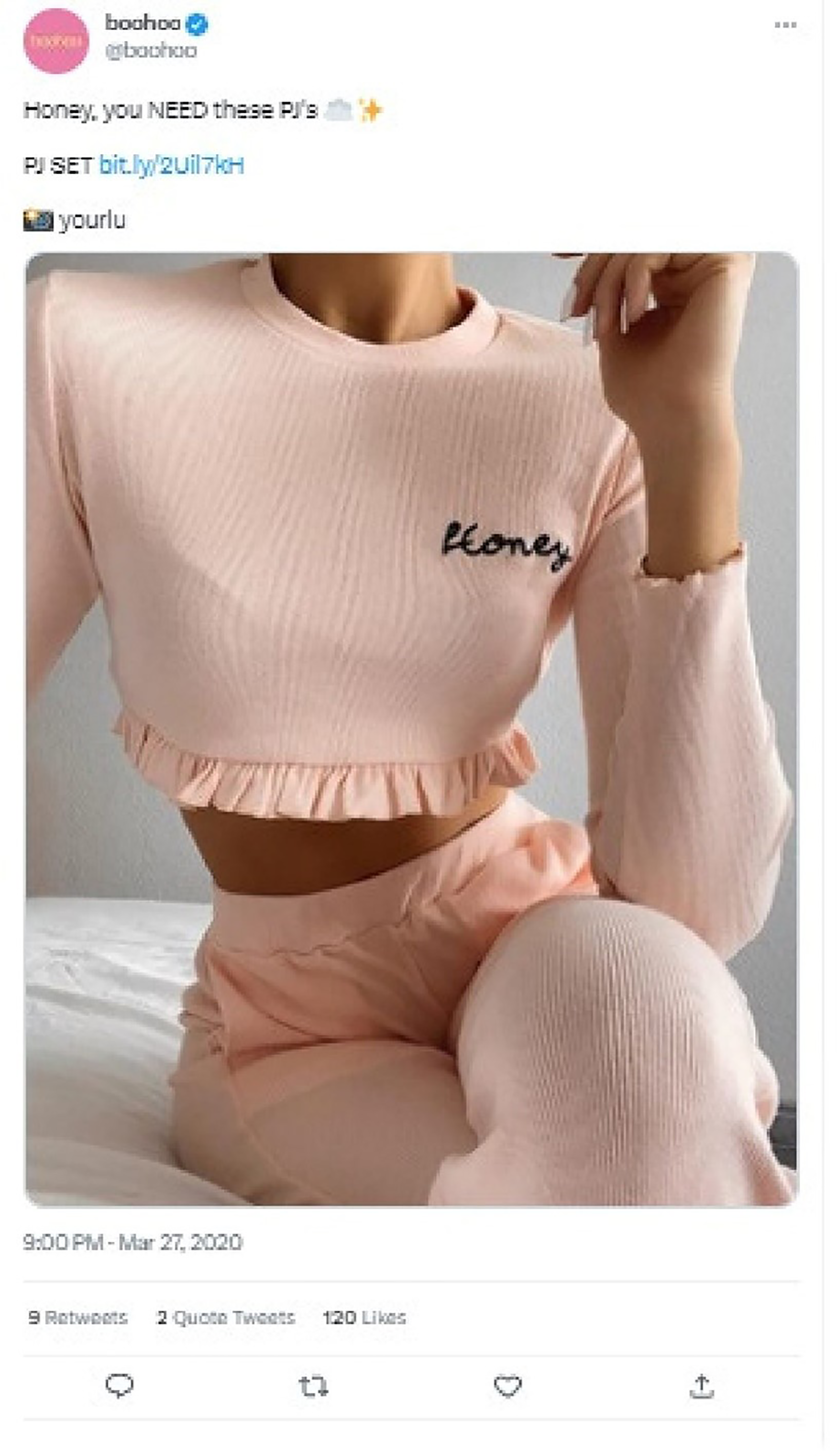
New PJ's from boohoo.
However, this all changed after the Sunday Times undercover exposé on the 5th of July, 2020, as previously discussed. According to Cornelissen (2020), a crisis can be defined as “an event or issue that requires decisive and immediate action from an organisation” (p.215). The crisis for Boohoo started after the Sunday Times article and Labour Behind the Label report were published. Both reports affected Boohoo's reputation with its direct customers and their distribution relationships. Social media users started to tackle the issue and Boohoo's image started to be associated with exploitation and modern slavery. Moreover, after the exposé was released, other companies such as Next, ASOS, Very and Amazon removed Boohoo products from their own websites.
Boohoo's Response to the Sunday Times Undercover Exposé
Initially, Boohoo publicly denied any responsibility for these unethical practices and launched an independent review, stating that: “As a board, we are shocked and appalled by the recent allegations that have been made…. We want to ensure that the actions of a few do not continue to undermine the excellent work of many suppliers in the area…” (Financial Times 2020).
On the 24th of September 2020, the company published the independent review report on its website, as a reply to the original Sunday Times article which highlighted that the allegations of poor working conditions were “substantially true” (Levitt 2020). It also stated that Boohoo's monitoring system of its supply chain was not adequate and their risk management system was not well developed. Interestingly, the report indicated that Boohoo did not deliberately allow this to happen, despite them having previous knowledge of problems within their Leicester supply chain (since March 2019), but rather, the actions taken demonstrated an “insufficient sense of urgency” (Levitt 2020).
In contrast, this statement and report were not mentioned on their social media platforms which led to anger among the public who felt that they were being deceived. Rather than addressing the report and repeating their statement on social media platforms, Boohoo instead posted light-hearted content such as the meal from their Twitter page (shown in Figure 4). This disparity in their communication across the various media, may have also led to the hashtag ‘#boycottboohoo’ being shared on social media platforms where the public started to raise their concerns regarding Boohoo's unethical practices. After this review, RYR are even more certain that Boohoo is a promising candidate as a client, as they need to pay more attention to their communication with different stakeholders, in particular their customers through social media channels, their resellers, their suppliers and others, ensuring that the right message is conveyed to the right audience at the right time to restore Boohoo's reputation.
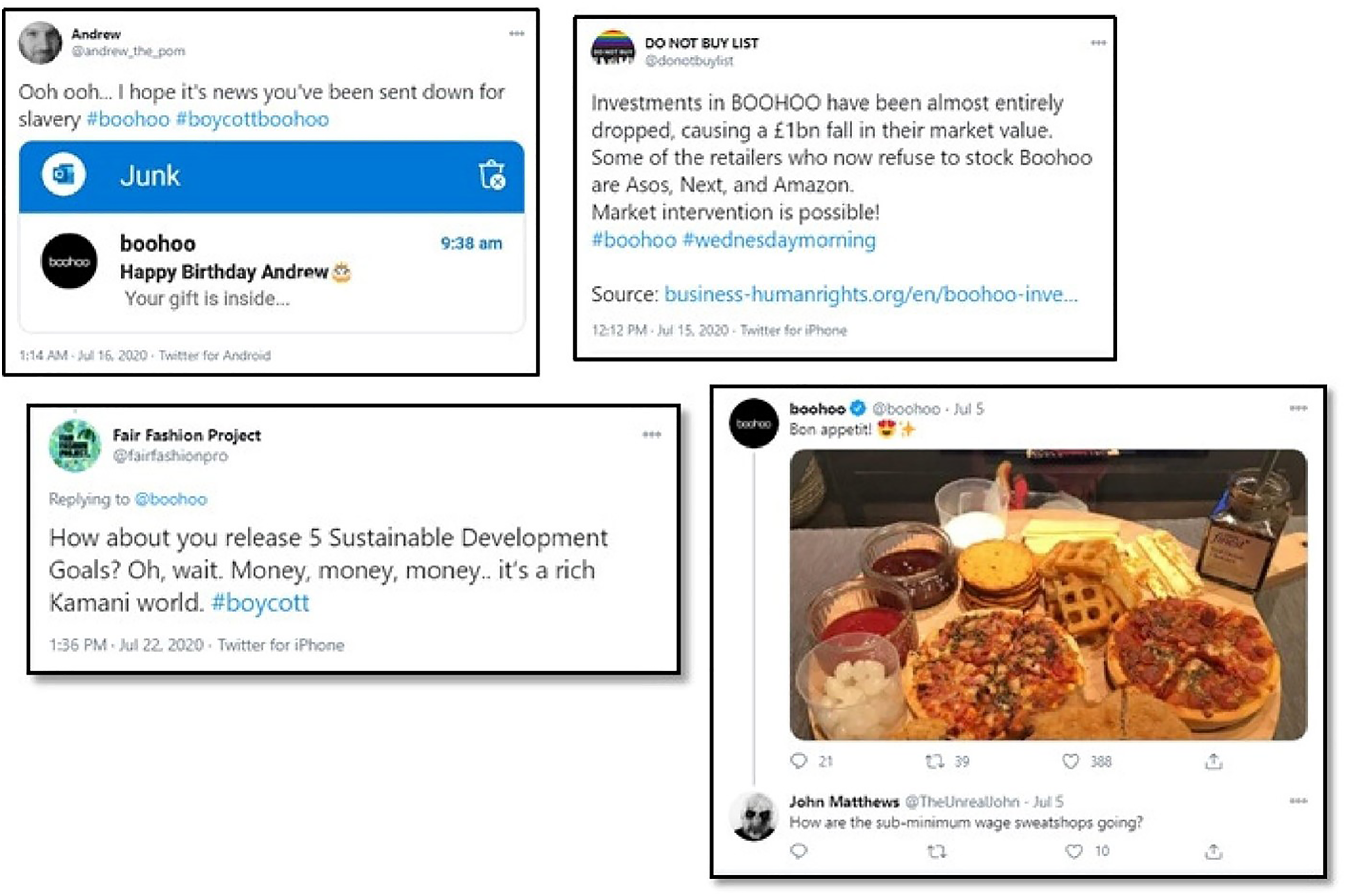
Examples of negative customer feedback.
Developing the PR Strategy: RYR's Response
Having reviewed the situation, Saana and Michelle have realised that this is not as simple as it first seemed for a number of reasons, particularly as Boohoo does not own the factory that has taken part in this unethical behaviour. However, Boohoo, as a fast fashion provider, demands that this factory produces what they require quickly and at a low cost to achieve their profits, satisfy shareholders and be a successful company. In some ways it feels like they have been left with more questions than when they started, including why Boohoo chose a factory based in Leicester. Was Boohoo looking for expertise within the workforce or were they knowingly taking advantage of the low cost of labour that this area is known for? Furthermore, RYR still needs to understand where the power, interest and responsibility lie within the system so that they can craft their internal and external PR strategy. They also need this information to make recommendations for what else Boohoo could do that would compensate the workers and community, and have a positive impact on the society, system and environment, as well as improve their reputation. Importantly, whatever they learn and whatever Boohoo decides to do, each of these stakeholders: customers, shareholders, suppliers, competitors, press, government and local government, each with their own interest and focus, will need appropriate communication. What can RYR propose to Boohoo to improve their communication, and restore their reputation among these stakeholders?
Case Study Questions
This case study provides the context to understand, explore and debate a number of theoretical marketing phenomena within this system including the attitude-behaviour gap, Mendelow's matrix, Porter's 5 forces, etc.
Developing the PR Strategy
What PR strategy could Saana and Michelle of RYR recommend to help Boohoo at this time?
Macromarketing
Boohoo is one actor in a large system with numerous other actors, including suppliers who own the factories, shareholders, etc.
2) Develop a comprehensive list of all actors within the system based on the case study. 3) With reference to the list created in question 2, discuss and debate which actor has the power to influence change within this system that will positively impact the workforce within the factory. 4) As an actor within this larger system, how can Boohoo influence change to positively impact the workforce within the supplier's factory? 5) What responsibility, if any, does the government (local and/or national) have to protect workers within the Leicester community who work within the garment district? 6) What responsibility, if any, does the government (local and/or national) have regarding changing consumer attitudes regarding fast fashion?
Micro Environment
7) Using the Porter's Five Forces model, explore the competitive environment that Boohoo exists within and discuss where power and influence lie.
8) Using the Attitude-Behaviour Gap theory or the Intention-Behaviour Gap in Ethical Consumption theory, consider consumers’ role in the system and their power, interest and responsibility to effect change.
9) Debate and discuss: Does Boohoo have the responsibility to attempt to change consumer attitudes towards fast fashion?
Revisiting RYR's PR Strategy
10) Using the previous discussions, and your suggestion on how Boohoo could influence positive change within this system, develop a communications strategy for each stakeholder/actor within the system.
Supplemental Material
sj-docx-1-jmk-10.1177_02761467231164960 - Supplemental material for Walk the Talk: The Boohoo Case Study
Supplemental material, sj-docx-1-jmk-10.1177_02761467231164960 for Walk the Talk: The Boohoo Case Study by Mona Nassar, Tara Goddard and Regine Freeman in Journal of Macromarketing
Footnotes
Associate Editor
Julie Stanton.
Declaration of Conflicting Interests
The author(s) declared no potential conflicts of interest with respect to the research, authorship, and/or publication of this article.
Funding
The author(s) received no financial support for the research, authorship, and/or publication of this article

Supplemental Material
Supplemental material for this article is available online.
Author Biographies
References
Supplementary Material
Please find the following supplemental material available below.
For Open Access articles published under a Creative Commons License, all supplemental material carries the same license as the article it is associated with.
For non-Open Access articles published, all supplemental material carries a non-exclusive license, and permission requests for re-use of supplemental material or any part of supplemental material shall be sent directly to the copyright owner as specified in the copyright notice associated with the article.
