




Abstract
In this research, we investigate consumers’ willingness to cooperate with luxury versus non-luxury hotels’ environmental protection programs. We find that while consumers’ cooperation with non-luxury hotels becomes less favorable when consumers perceive the sustainability program to have a profit motive, consumers’ cooperation with luxury hotels remains high even when consumers perceive the hotel’s sustainability program to be profit-driven. We find a similar pattern for customer loyalty. In addition, we find that this interactive effect emerges when affective attitudes toward luxury brands are strong. These results contribute to the literature by identifying a condition where profit motive attribution does not hurt consumer conservation intentions and by revealing a condition where luxury brands may benefit from sustainability programs. We discuss theoretical and practical implications as well as directions for future research.
Introduction
Social and sustainable issues have been increasingly considered by consumers in all societies (Hennigs et al. 2013). In response to the trend of building more sustainable societies, the hospitality industry, including luxury hotel chains such as the Sheraton, Hilton, Ritz Carlton, and Kimpton Hotels, engage in sustainability programs (e.g., environmental protection actions) such as using solar energy, using chemical-free cleaning, and motivating customers to conserve resources by reusing towels or saving energy (Amatulli, De Anglelis, and Stoppani 2021; Peng and Chen 2019b; Dief and Font 2010; Manaktola and Jauhari 2007). Consumers’ support for or cooperation with such sustainable initiatives is crucial for the impact of these sustainability programs on not only the luxury hospitality industry but also on social well-being (Peng and Chen 2019b), thus fulfilling these programs’ macromarketing potential to have a positive impact on society (Sheth and Parvatiyar 2021). The more consumers cooperate – for instance, by reusing their towels – the stronger the downstream consequences of these programs for the industry (e.g., strengthening the relationship between consumers and hotels, saving costs for the hotels, fulfilling the hotel’s commitment to social responsibility) and for society (e.g., improving the natural environment, saving resources for future generations, facilitating sustainability development in the whole society).
Testing our hypotheses in the context of hospitality, in this research we examine consumers’ willingness to cooperate with hotels’ sustainability programs (environmental protection), measured via towel reuse and general cooperation, in addition to consumers’ loyalty towards the hotel (willingness to restay, willingness to engage in positive word-of-mouth). We analyze these consumer responses as a function of brand positioning (luxury and non-luxury hotels) and perception of the extent to which the hotel’s sustainability program is profit-driven (profit motive attribution). We find that these two factors interact to predict consumer responses, and we find that affective attitudes toward luxury brands pose a boundary condition for this interactive effect.
The findings of this research contribute to the literature in two central ways: First, we contribute to the literature in sustainability more generally by identifying a condition where perceived profit motivation for sustainability programs does not necessarily harm consumers’ responses. Most of prior research indicated that the profit motive attribution of sustainability engagement negatively influences consumers’ responses (e.g., Du, Bhattacharya, and Sen 2007; Ellen, Webb, and Mohr 2006; Habel et al. 2016; Vlachos et al. 2009). We replicated this effect for non-luxury (“standard”) hotels. Interestingly, however, we found that consumers’ responses to luxury hotels are not affected by profit motive attribution and remain high even when consumers believe the hotel has a profit motivation behind this program. Thus, the same sustainability program can result in different consumer responses, depending on perceived profit-orientation and brand positioning.
Second, this research contributes to luxury research by revealing a new condition where luxury brands can benefit from sustainability programs. We provide hints for a possible explanation for the robust interaction between hotel positioning (luxury vs. non-luxury) and profit motive attribution. We showed that this interaction holds when consumers have strong (vs. weak) affective attitudes to luxury brands. From a practical perspective, these results help to generate clearer prescriptions for luxury firms that wish to be more active in the sustainability front. In the hospitality industry, this may be even more relevant, given that consumers often have the opportunity to actually take part in and contribute to the success of the programs that the hotels are promoting.
More broadly, these results add to the emerging field of transformative luxury research by showing that consumers are willing to cooperate with luxury hotels’ environmental protection programs, bringing potential benefits for the consumers themselves, the companies involved, and the environment and society at large. The literature that examines the integration of luxury and sustainability is growing, but still more work is needed to understand and potentially reconcile different results (e.g., Achabou and Dekhili 2013; Carrigan, Moraes, and McEachern 2013; Davies, Lee, and Ahonkhai 2012; Diallo et al. 2021; Kunz, May, and Schmidt 2020; Moraes et al. 2017; Osburg et al. 2021; Peng and Chen 2019b; Pinto et al. 2019). The more scientific research reveals conditions under which luxury and sustainability generate positive responses on consumers, the more luxury companies can realize the potential to contribute to social well-being by engaging in socially responsible practices. The results suggest that luxury hotels can leverage the affective attitudes that tend to be associated with luxury brands to promote business practices aimed at enhancing social well-being, such as, for example, motivating consumers to cooperate with environmental protection programs. These results also open up a wealth of inquiries to be investigated in future research.
Theoretical Background
Profit Motive Attribution of Sustainability Program
The hospitality industry’s inherent function of providing services such as hot water, clean towels, disposable toiletries, and air-conditioning can potentially cause a significant impact on the environment and natural resources (Bohdanowicz 2006; Chan, Wong, and Lo 2009; Dief and Font 2010; Radwan, Jones, and Minoli 2010). Hotel customers recognize the importance of environmental awareness (Giardina 2019; Goldstein, Cialdini, and Griskevicius 2008; Jones, Hillier, and Comfort 2016; Yoon, Jang, and Lee 2016), and many consumers expect hospitality companies to engage in environmentally friendly practices (Yoon, Jang, and Lee 2016). Hotel customers are increasingly demanding sustainably-designed hotels (Chan, Okumus, and Chan 2017; Gavilanes, Ludeña, and Cassagne 2019), and some are even willing to pay a higher price for such facilities (Chan, Okumus, and Chan 2017).
Past research found that, for the same sustainable action that a firm engages in, different beliefs about the action might result in different consumer responses (Forehand 2000; Friske, Cockrell, and King 2022). The perceived underlying motive of sustainability engagement is an important factor that generates different consumer reactions (Brown and Dacin 1997; Edinger-Schons et al. 2018; Godfrey 2005; Habel et al. 2016; Vlachos et al. 2009). In particular, profit motive attribution of sustainability initiatives is one of those conditions under which sustainability engagement may backfire (Ellen, Webb, and Mohr 2006). When consumers are suspicious that the motive of a company’s sustainability initiative is making a profit, they will perceive the company as greedy and attribute its initiative as profit-driven (Grégoire, Laufer, and Tripp 2010; Vlachos et al. 2009). If a sustainability initiative is perceived as profit-oriented, consumer responses become more negative.
Sustainability acts that are perceived as profit-driven tend to have several negative consequences, including harming consumer trust, patronage intentions, and positive recommendations (Ellen, Webb, and Mohr 2006; Vlachos et al. 2009; Wang, Krishna, and McFerran 2017; Yoon, Gürhan-Canli, and Schwarz 2006). For example, Habel et al. (2016) found that the attribution of a firm’s sustainability engagement as profit-driven has a negative effect on consumers’ perceived fairness of the firm’s prices, which can affect downstream customer loyalty. Profits are often perceived as a sign of greed, especially for organizations with a prominent social mission, hurting consumers’ support for social ventures (Lee, Bolton, and Winterich 2017). Profit-motivated giving hurts consumer trust in a company’s CSR efforts, also decreasing loyalty (Vlachos et al. 2009). Both the perception of CSR motives as sincere and its “opposite” - perception of motives as profit-driven - affect the efficiency of communication trying to repair a company’s reputation: When consumers perceive a company's motives as sincere, a company’s CSR activities improve the company’s image, but when motives are perceived as insincere, CSR activities hurt the company’s image (Yoon, Gürhan-Canli, and Schwarz 2006). In the hospitality industry, recognition of a hotel’s ulterior motive increases consumer skepticism about the hotels’ environmental claims, leading to reduced cooperation with the hotel’s program and reduced willingness to revisit the hotel (Rahman, Park, and Chi 2015). If a hotel’s sustainability engagement is perceived as “greedy” (vs. genuinely “green”), consumers are less willing to engage in conservation behaviors (Wang, Krishna, and McFerran 2017).
Importantly, this perception varies in consumers’ minds. For example, while sometimes consumers perceive sustainability engagement more positively (i.e., less profit-oriented, more sincere), many cause-related marketing initiatives (e.g., joining charities or placing an environmental protection appeal) have been criticized as “greenwashing,” (Bowen 2014; Siano et al. 2017) or tactics to make money (Krishna and Rajan 2009; Wang, Krishna, and McFerran 2017). In many cases, such as the case for hotels’ environmental protection programs, engaging in sustainability has little or even no cost for the firm and can even be cost-saving (e.g., when customers cooperate and use less towels, save water or energy, etc.). Therefore, many consumers may attribute the real objective of firms’ sustainability acts as making profits (Becker-Olsen, Cudmore, and Hill 2006; Forehand and Grier 2003; Luo and Bhattacharya 2006; Porter and Kramer 2002). When hotels’ costs to engage in environmental efforts are visible, this criticism is reduced and consumers perceive the hotels as “greener” (Wang, Krishna, and McFerran 2017). In sum, it is important to understand the extent to which consumers perceive sustainability initiatives to be profit-driven and how these perceptions affect their responses.
While extant research suggests that profit-motive attribution turns consumers responses more negative, as summarized above, a gap in the literature is a systematic comparison between luxury and non-luxury firms. Would the same negative effect emerge? Is there something about luxury brands that would render different consumer responses? We believe there is, and understanding this could help us reconcile previously contradictory results on luxury and sustainability. The rationale leading to our hypotheses 1–3 is presented next.
The Role of Luxury Positioning
The market for experiential luxury (e.g., hotels) grew at a faster rate compared to the market for luxury goods in recent years (Dubois 2020), consistent with the trend “from owning to being” (Achille 2014). In line with the general definition of “luxury brands” (e.g., Vigneron and Johnson 2004), a luxury hotel is defined as “a hotel that is unique and superior in quality and that provides excellent service, symbolizing the wealth and status of its patrons” (Berthon et al. 2009; Peng and Chen 2019a, 2019b). Following a general trend, luxury hotels’ demand for sustainability engagement is rising (Amatulli, De Anglelis, and Stoppani 2021; Chan, Okumus, and Chan 2017; Gerdt, Wagner, and Schewe 2019; Manaktola and Jauhari 2007; Pereira, Silva, and Dias 2021).
Previous research on the effect of sustainability initiatives for brands of luxury products is mixed (for a review, see Kunz, May, and Schmidt 2020). While earlier research suggested an incompatibility between luxury and sustainability (e.g., Achabou and Dekhili 2013; Davies, Lee, and Ahonkhai 2012; Torelli, Monga, and Kaikati 2012), more recent research has been revealing conditions where luxury and sustainability can generate positive results for products or for brands (e.g., Amatulli et al. 2017; Amatulli, De Anglelis, and Stoppani 2021; De Angelis, Adıgüzel, and Amatulli 2017; Hagtvedt and Patrick 2016; Janssen and Vanhamme 2014; Petersen and Perez 2022; Perez et al. 2020; Pinto et al. 2019; Sun, Bellezza, and Paharia 2021).
In hospitality, the results are similarly mixed. Some research suggested that a commitment to sustainability might backfire for luxury hospitality brands, such as increasing consumers’ perceived risks of staying at these hotels (e.g., lowered service quality, raised costs, decreased indulgence and luxury value, and damaged self-image of consumers) (Peng and Chen 2019b; Line and Hanks 2016), and decreasing consumers’ intention to stay or willingness to pay (Baker, Davis, and Weaver 2014; Peng and Chen 2019b). However, some other research revealed a positive effect of luxury hotels’ sustainability engagement on consumers’ responses (e.g., Amatulli, De Anglelis, and Stoppani 2021). For example, communication that highlights a luxury hotel’s enviromental sustainability (vs. highlighting customer service) leads to higher willingness to book a room by increasing the hotel’s integrity (Amatulli, De Anglelis, and Stoppani 2021). There are also successful business cases in hospitality that combine a luxury hotel with a strong social orientation (Dimanche and Lucia 2020).
Despite these studies, the effect of profit attribution of the hotels’ sustainability engagement on consumer responses has not been examined. In this research, we would like to point out a condition when consumers’ responses to hotels’ sustainability engagement can benefit from the “luxury” brand positioning. As discussed in the previous section, research suggests that profit-driven sustainability engagement negatively affects consumers’ responses. We expect this effect to be attenuated for luxury hotels. Research providing insights into this is scant, but a series of studies (Krishna, McFerran, and Wang 2014, 2015; Wang, Krishna, and McFerran 2017) that examined consumer responses to high-priced hotels’ environmental actions suggests a similar negative effect when high-priced hotels are perceived as “greedy” (i.e., profit-motivated). However, a luxury brand/ firm offers more than just high price. Many cues (e.g., rarity, high quality, uniquely qualified craftspeople) contribute to the perception of luxury (e.g., Kapferer and Laurent 2016; Kapferer and Valette-Florence 2016; Vigneron and Johnson 2004). Another study, which showed that recognizing the ulterior motive caused consumer skepticism about hotels’ environmental claims, did not examine the positioning of the hotels (Rahman, Park, and Chi 2015).
We expect luxury brands’ stronger affective attitudes to “shield” consumers’ responses, offsetting the negative effect of profit-motive attribution. Recent research indicated that consumers have greater attachment to and a stronger feeling of bonding for luxury brands (vs. non-luxury brands) (Bansal, Irving, and Taylor 2004; Peng and Chen 2019a; Shukla, Banerjee, and Singh 2016). This is due to luxuries’ inherent features of providing more positive emotions (Patrick and Hagtvedt 2009; Petersen, Dretsch, and Komarova Loureiro 2018). Luxuries are associated with aspirations and hedonism, which can provide consumers with emotional benefits (Berry 1994; Hansen, Samuelsen, and Silseth 2008; He, Li, and Harris 2012; Murphy and Zajonc 1993; Patrick and Hagtvedt 2009; Steenkamp, Batra, and Alden 2003; Zajonc 1984), and luxury products and services often have higher quality (Aaker 1996; Baek, Kim, and Yu 2010; Cailleux, Mignot, and Kapferer 2009; Garfein 1989; Nia and Zaichkowsky 2000; O’Cass and Frost 2002; Patrick and Hagtvedt 2009; Phau and Prendergast 2000; Presbury, Fitzgerald, and Chapman 2005; Quelch 1987; Vigneron and Johnson 2004; Yoo, Donthu, and Lee 2000; Zeithaml 1988).
Consumers’ prior impression and satisfaction have been shown to directly affect their subsequent judgments and behaviors (Hoch and Deighton 1989; Smith and Bolton 1998). Affective attitudes are powerful in determining consumers’ responses to the brands (Fullerton 2003; Grayson and Ambler 1999; Mathieu and Zajac 1990). Previous research has revealed this influence from different perspectives. For example, strong brand-consumer relationships are effective to mitigate the negative impact of brand misconduct on consumers’ responses (Fournier 1998; Huber et al. 2010). A high degree of emotional bonding can reduce the spillover effects of negative information on behavioral intentions (Mattila 2004). Similarly, affective attachment and a feeling of bonding to a brand have been shown to help consumers resist attitude-inconsistent information about the brand (Ahluwalia, Burnkrant, and Unnava 2000; Ahluwalia, Unnava, and Burnkrant 2001).
When consumers have a strong attachment to a brand, they tend to resist negative information about the brand and show little change in their attitudes toward the brand. This is because the feeling of bonding can lead to a “defense motivation” which triggers consumers’ selective cognitive processing of information and, therefore, limits consumers' counter argumentation. In contrast, if consumers are weakly attached to a brand, they can quickly show an attitude change in response to negative information about the brand. Interestingly, it seems that people tend to “neutralize” negative information regarding ethics and sustainability also in the tourism and hospitality sector (e.g., Apostolidis and Haeussler 2018).
Based on this, consumers’ responses to a non-luxury (“standard”) hotel should decrease as the profit motive attribution of the hotel’s environmental protection program increases, consistent with past research reviewed in the previous section. In contrast, consumers’ responses to a luxury hotel should not be affected to the same extent when customers perceive the hotel’s sustainability program as profit-driven. This leads to the following hypothesis:
In addition, we examine customer loyalty as a consumer response measure targeted at the hotels. These measures let us disentangle any potential benefits for the hotel itself and for the environment, which are the two fundamental aims of a firm’s sustainability engagement (Edinger-Schons et al. 2018; Lee, Bolton, and Winterich 2017; Schaltegger and Burritt 2018).
Customer loyalty has been regarded as a central construct in business-to-consumer relationships (e.g., Ball, Coelho, and Machás 2004; Singh and Sirdeshmukh 2000; Sirdeshmukh, Singh, and Sabol 2002). Given the importance of customer loyalty in business, discussions around the antecedents of customer loyalty are constant and necessary (Chaudhuri and Holbrook 2001; Chiou and Droge 2006; Dick and Basu 1994; He and Li 2011; He, Li, and Harris 2012; Martinez and Bosque 2013; Singh and Sirdeshmukh 2000). For example, engagement in corporate social responsibility (CSR) has been shown to increase customer loyalty (Ball, Coelho, and Machás 2004; Kennedy, Ferrell, and Leclair 2001; Liu et al. 2014; Marin, Ruiz, and Rubio 2009; Pérez, Salmones, and del Bosque 2013; Swaen and Chumpitaz 2008; Wang 2014), and attribution of this engagement as profit-driven has been shown to decrease customer loyalty (Habel et al. 2016). Therefore, we are interested in investigating the effect of hotels’ environmental protection activities on customer loyalty (willingness to re-stay at the hotel and positive word-of-mouth). As such, we derive the following hypothesis:
Finally, we examine the role of affective attitudes as a moderator of the predited effects, which gives us insights into the psychological process by means of a moderation-of-process design (Spencer, Zanna, and Fong 2005) and offers a boundary condition. We suggested that the stronger affective attitudes that consumers typically hold toward luxury brands contributes to consumers’ persistent cooperation with luxury hotels’ sustainability programs and loyalty. Consistent with this proposition, we expect the predicted effects to emerge under a condition where luxury brands enjoy of stronger affective attitudes (Makkar and Yap 2018; Peng and Chen 2019a). If consumers hold stronger affective attitudes toward luxury brands, consumers’ responses to luxury hotels should be more stable, regardless of the extent to which consumers’ attribute the luxury hotel’s sustainability program to be profit-driven. Thus, we hypothesize that:
Overview of Studies
In sum, the current research examines the role of luxury branding and profit motive attribution on consumers’ willingness to reuse towel during the stay (Studies 1–2), consumers’ general willingness to cooperate with the hotel’s sustainability initiatives (Study 2), and customer loyalty to the hotel (Studies 1–2). In addition, we examine the role of affective attitudes as a moderator of the effect (Study 2).
Study 1
Study 1 was designed to examine the interactive effect between hotel positioning and profit motive attribution on consumers’ willingness to reuse towels and customer loyalty. We expected that the more a non-luxury (i.e., “standard”) hotel’s sustainability program was perceived to be profit-driven, the less consumers would reuse their towels and the less loyal customers would be to the hotel. However, we expected that customers of luxury hotels would be less sensitive to whether the hotel’s sustainability program was perceived as profit-driven and, consequently, we expected their responses to be more stable.
Method
Design and Participants
The design included two independent variables, where hotel brand positioning was manipulated and the perceived profit motive of the hotel’s sustainability program was measured. In a two-level between-subjects manipulation, participants were randomly assigned to one of the two hotel brand positioning conditions (luxury vs. non-luxury). We measured the perceived profit orientation of the hotel’s environmental protection program as a continuous variable.
Participants were 115 people (75.7% male), recruited from a subject pool managed by a business school that included people living in a large city in Germany. In the sample, as well as in the subject pool, participants possessed a wide range of age Mage = 29.97; SDage = 7.53), education (high school or less: 9.6%; some college: 15.7%; bachelor’s degree: 32.2%; masters/some graduate school: 39.1%; doctoral and/or professional degree: 3.5%), income (less than €20,000: 40.9%; €20,000 to €49,999: 26.1%; €50,000 to €74,999: 14.8%; €75,000 to €99,999: 11.3%; €100,000 to €149,999: 5.2%; €150,000 to €199,999: 1.7%), and occupation (self-employed: 5.2%; employee: 47.8%; unemployed, laid off, looking for work: 5.2%; retired: 2.6%; in school/student: 37.4%; keeping house: 1.7%). Each participant received monetary payment (€3) as participation fee.
Stimuli and Measures
Participants read through a scenario with a corresponding picture of a luxury (vs. non-luxury) hotel room. In the luxury hotel condition, the scenario read: “Imagine that you just checked into a luxury hotel. The architecture is grand, the decoration is elegant, the service is excellent (professional, friendly and courteous staff) and the food is extremely tasty. You settled down in your fantastic room and relaxed for a few moments. As you walk around your room, you notice a card in the bathroom. On the card, it is stated: “Help the environment. You can show your respect for nature and help save the environment by reusing your towels during your stay”. In the non-luxury hotel condition, the scenario was similar to that of the luxury hotel condition, with only one exception: instead of checking into a luxury hotel, participants read: “Imagine that you just checked into a standard hotel”. Participants read the same passage describing the “help the environment” card.
We measured consumers’ willingness to reuse towels with two items (“To what extend would you be willing to reuse your towels in this situation?”, “How likely are you to reuse your towels in this situation?”) using 7-point Likert-type scales (1- not at all, 7- very much). This measure was adapted from Krishna, McFerran, and Wang (2014, 2015), Rahman, Park, and Chi (2015) and Theotokis and Manganari (2015). The two items were highly correlated (r = .87, p < .01) and were averaged into an index of towel reuse.
Loyalty towards the hotel was measured with four items (“To what extent would you like to stay at the hotel again?”, “If someone is looking for a hotel, I will suggest him/her to stay at this hotel.”, “I will say positive things about this hotel.”, and “I will encourage my friends and relatives to stay at this hotel when traveling.”) adapted from previous research (Chaudhuri and Holbrook 2001; Harris and Goode 2004; Zeithaml, Berry, and Parasuraman 1996) and using 7-point Likert-type scales. The reliability of the scale was high (α = .91) and the items were averaged into an index of loyalty.
Finally, we measured participants’ motive attribution of the hotel’s sustainability program with an item adapted from previous research (Krishna, McFerran, and Wang 2014, 2015). Participants indicated their “opinion about the hotel” on a 7-point Likert-type scale where 1 referred to the hotel being “totally committed to going green” and 7 referred to “using ‘going green’ as an excuse to save money”. In the end, we asked participants to freely guess the real purpose of this experiment and collected the demographics (e.g., income, age, etc.).
As manipulation checks, we asked participants to indicate their perception of the hotel on a 7-point Likert scale (1- totally disagree, 7- totally agree) consisting of three items related to the basic characteristics of luxury hotels (“This is a luxury hotel”, “The price of this hotel is high compared with other hotels”, “This hotel is a first-class, high-quality hotel”; α = .90).
Results
Since consumers’ responses are crucial in this paper, we screened for outliers. The data selection rule across the studies was eliminating the participants whose scores of responses were + /-3 standard deviations beyond the mean. This elimination rule was decided a priori and it is a standard elimination rule (Hair et al. 1998). No participant was + /- 3 SD beyond the mean in consumers’ responses score. We used all 115 participants in our analysis.
Manipulation Checks
Confirming that the manipulation of hotel type (luxury vs. non-luxury) was effective, participants in the luxury hotel condition (M = 5.12, SD = 1.39) perceived the hotel to be more luxurious than participants in the non-luxury hotel condition (M = 4.02, SD = 1.34; F(1, 111) = 18.71, p < .01). None of the participants guessed the real purpose of this study.
Towel Reuse
Using PROCESS model 1 (Hayes 2012), we regressed participants’ willingness to reuse towels on hotel brand positioning (non-luxury vs. luxury), mean-centered profit motive attribution of the sustainability program, and the interaction between these two variables using the bias-corrected bootstrapping method.
The regression analysis revealed a significant main effect of the profit attribution of the hotel’s sustainability program on willingness to reuse towels (F(1, 111) = 14.46, p < .01). This main effect suggests that the more profit-driven the sustainability program was perceived to be, the less consumers were willing to reuse towels.
The regression analysis also revealed a marginal interaction between hotel brand positioning and the profit motive attribution on consumers’ willingness to reuse towels (F(1, 111) = 2.80, p = .097). Although the interaction was marginal, the simple effects were consistent with our expectations when decomposing this interaction by looking at responses to luxury and non-luxury hotel separately (see Figure 1). In the non-luxury hotel condition, consumers’ willingness to reuse towels significantly decreased with the increase of profit motive attribution (B = -.57; t(56) = −4.38, p < .01). However, in the luxury hotel condition, consumers’ willingness to reuse towels was not significantly influenced by the profit attribution of the hotel’s sustainability program (B = -.022; t(55) = −1.35, ns.).
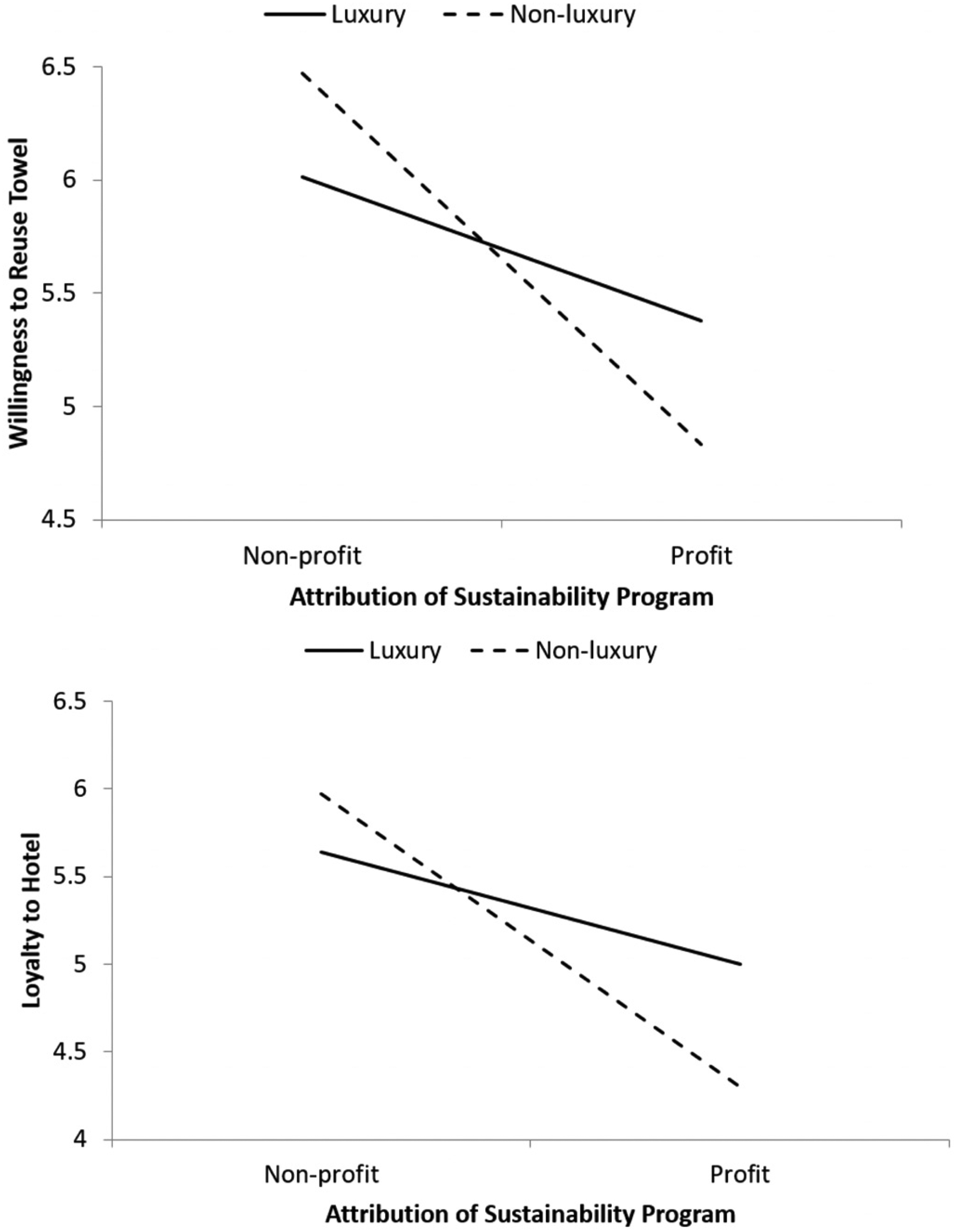
Consumers’ responses as a function of hotel brand positioning and profit attribution of the sustainability program (Study 1).
Customer Loyalty
Using PROCESS model 1 (Hayes 2012), we regressed participants’ loyalty on hotel brand positioning, mean-centered profit motive attribution of the sustainability program, and the interaction between these two variables using the bias-corrected bootstrapping method.
The regression analysis revealed a significant main effect of profit motive attribution on customer loyalty (F(1, 111) = −5.22, p < .01). This main effect suggests that the more profit-driven the hotel’s sustainability program was perceived to be, the lower customer loyalty was.
More importantly, the regression analysis revealed the predicted interaction between hotel brand positioning and profit motive attribution on customer loyalty (F(1, 111) = 5.35, p = .023; see Figure 1). In the non-luxury hotel condition, customer loyalty significantly decreased as the profit-driven attribution of the hotel’s sustainability program increased (B = -.58; t(56) = −6.03, p < .01). However, in the luxury hotel condition, customer loyalty was not influenced by the attribution of the hotel’s sustainability program (B = -.022; t(55) = −1.83, ns.).
Discussion
We obtained at least partial 1 support for H1a and support for H2 by revealing that consumer responses to a luxury or a non-luxury hotel’s sustainability programs differ as a function of profit motive attribution. The results suggest that both consumers’ willingness to reuse towels and customer loyalty decrease when a non-luxury hotel’s sustainability program is perceived to be profit motivated. These results are consistent with previous research showing a negative effect of extrinsic attribution of sustainability on consumer reactions, as reviewed in the theoretical background (e.g., Becker-Olsen, Cudmore, and Hill 2006; Ellen, Webb, and Mohr 2006; Ginder, Kwon, and Byun 2021; Habel et al. 2016; Homburg, Stierl, and Bornemann 2013; Lee, Bolton, and Winterich 2017; Torelli, Monga, and Kaikati 2012; Vlachos et al. 2009; Wagner, Lutz, and Weitz 2009). In contrast, profit motive attribution did not significantly affect responses to a luxury hotel’s program: neither consumers’ willingness to reuse towels nor customer loyalty were significantly affected when a luxury hotel’s sustainability program is perceived to be profit-driven.
Study 2
The first aim of study 2 was to replicate the results of study 1 on towel re-use and customer loyalty and extend these results by investigating the effect on a general measure of consumers’ cooperation with the hotel’s sustainability initiatives. The second aim of this study was to investigate a boundary condition for the interactive effect, which shed light onto the psychological mechanism leading to this effect via a moderation-of-process design (Spencer, Zanna, and Fong 2005). We propose that consumer cooperation with a luxury hotel’s sustainability program is less affected by profit motive attribution because consumers, in general, tend to hold stronger affective attitudes toward luxury brands. This should turn consumers less sensitive to “negative” information about the brand (such as a profit orientation) and make their responses more stable. In that case, we should replicate the effects found in study 1 when affective attitudes toward luxuries are strong, but not when they are weak. When affective attitudes toward luxury brands are weak, we should observe the same interaction found for non-luxury hotels and shown in previous research for other non-luxury firms. We use an individual-difference measure of affective attitudes toward high-end luxury brands to test this proposed boundary condition.
Method
Design and Participants
The design included three independent variables: hotel brand positioning (luxury vs. non-luxury) was manipulated (two-level between-subjects manipulation with random assignment); perceived profit motive of the hotel’s sustainability program was measured; and consumers’ affective attitudes toward luxury brands was also measured.
Participants were 100 people (47% male; Mage = 39.69, SDage = 12.40) based in the U.S.A. and recruited through Mechanical Turk. Participants varied in terms of income (less than $20,000: 22.1%; $20,000 to $49,999: 35.8%; $50,000 to $74,999: 22.1%; $75,000 to $99,999: 13.7%; $100,000 to $149,999: 4.2%; $150,000 to $199,999: 2.1%) and education levels (below high school: 1.1%; high school or equivalent: 49.5%; university undergraduate: 37.9%; master’s degree or above: 11.6%). Each participant received monetary payment ($3) as participation fee.
Stimuli and Measures
In this study, the scenario in the luxury hotel condition was simplified. In study 1, the description of the luxury hotel was lenghthier than the description of the non-luxury hotel. To keep the two descriptions more balanced, instead of the detailed description of the luxury hotel, in this study there was only one sentence: “Imagine that you’ve just checked into a luxury hotel.” This simplified hypothetical scenario made the luxury hotel condition more comparable to the non-luxury hotel condition, which didn’t include any detailed description of the non-luxury hotel. Participants saw the same pictures shown in study 1. As a manipulation check measure, we asked participants to complete the “brand luxury index” scale consisting of twelve items (e.g., for wealthy-for well-off, conspicuous-noticeable, extremely expensive-affordable; α = .87) adapted from Vigneron and Johnson (2004).
Consumers’ willingness to reuse towels was measured with two items (r = .97, p < .01) as in study 1. In addition, we measured general willingness to cooperate with the hotel’s sustainability initiatives (“To what extent would you be willing to cooperate with the hotel’s ‘help save the environment’ program?”) using a 7-point Likert-type scale (1- not at all likely, 7- very likely). We analyzed this general cooperation measure separately to be able to replicate results of study 1 for the towel reuse measure. Customer loyalty (α = .97) and participants’ motive attribution of the hotel’s sustainability program were both measured as in study 1.
In the end, we measured participants’ affective attitudes toward high-end luxury brands (“Please indicate how you perceive high-end luxury brands”) with a scale consisting of 8 semantic-differential items (e.g., unfavorable-favorable, negative-positive, I dislike them-I like them, not hedonic-hedonic, not exclusive-exclusive) adapted from Dubois, Laurent, and Czellar (2001) and Patrick and Hagtvedt (2009). We created an index of affective attitudes toward luxury brands (α = .78) that, importantly, was not correlated with the manipulation check measures of the hotel brand positioning manipulation (r = - .0020, ns.). Thus, our index of affective attitudes was independent from the manipulation and, therefore, consisted of an appropriate moderator variable (Sharma, Durand, and Gur-Arie 1981).
Results
According to our elimination rule defined a-priori, five participants whose customer loyalty to the hotel or willingness to reuse towel was + /-3 SD beyond the mean were eliminated, leaving us with a sample of ninety-five participants.
Manipulation Checks
Confirming that the manipulation of hotel type (luxury vs. non-luxury) was effective, participants in the luxury hotel condition (M = 4.32, SD = .89) indeed perceived the hotel to be in line with a “luxury brand” compared to participants in the non-luxury hotel condition (M = 3.35, SD = .70; F(1, 91) = 33.86, p < .01). None of the participants guessed the real purpose of this study.
Towel Reuse
First, to replicate the results of study 1 in this study, we conducted the same regressions conducted in study 1, using PROCESS model 1 (Hayes 2012). We regressed participants’ towel reuse on hotel brand positioning, mean-centered profit motive attribution, and the interaction between these two variables using the bias-corrected bootstrapping method. We followed this procedure with all three dependent variables.
The regression analysis showed that profit motive attribution had a significant effect on consumers’ willingness to reuse towels (F(1, 91) = −15.21, p < .01): Consumers’ willingness to reuse towels reduced the more participants considered the sustainability program to be profit motivated. Moreover, the regression analysis revealed a significant interaction effect between hotel brand positioning and profit motive attribution (F(1, 91) = 7.22, p < .01; see Figure 2). Consistent with the results of study 1, profit motive attribution had a negative effect on consumers’ willingness to reuse towels in the non-luxury hotel (B = −0.88; t(91) = −4.71, p < .01), but consumers’ willingness to reuse towels in the luxury hotel was not affected by profit motive attribution of sustainability program (B = −0.15; t(91) = −0.78, ns.).
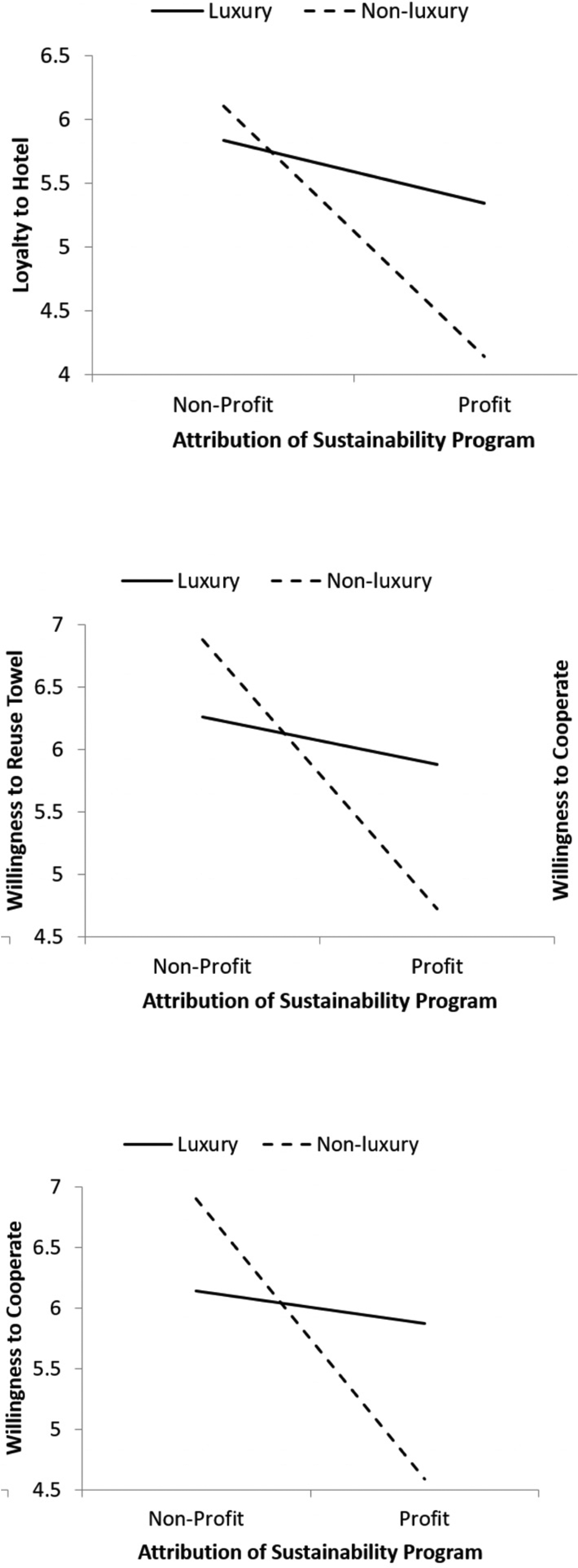
Consumers’ responses as a function of hotel brand positioning and profit attribution of the sustainability program (Study 2).
Willingness to Cooperate
The regression analysis revealed a significant main effect (F(1, 91) = −16.13, p < .01), implying that consumers’ willingness to cooperate was negatively affected by their attribution of the hotel’s sustainability program as profit-driven. More importantly, the regression analysis showed a significant interaction effect (F(1, 91) = 9.54, p < .01; see Figure 2). We found that in the non-luxury hotel condition, consumers’ willingness to cooperate decreased as their profit motive attribution increased (B = −0.94; t(91) = −5.08, p < .01). However, in the luxury hotel condition, consumers’ willingness to cooperate did not change with profit motive attribution of the sustainability program (B = −0.11; t(91) = −0.57, ns.).
Customer Loyalty
This regression analysis revealed a significant main effect of profit motive attribution on customer loyalty (F(1, 91) = −21.34, p < .01). It suggested that customer loyalty decreased as profit motive attribution of the sustainability program increased. More importantly, consistent with our predictions and with the previous study, the regression analysis revealed the predicted interaction between hotel brand positioning and profit motive attribution (F(1, 91) = 7.36, p < .01; see Figure 2). We found that customer loyalty to a non-luxury hotel significantly decreased as the profit-driven attribution of hotel’s sustainability program increased (B = −0.80; t(91) = −5.25, p < .01). However, customer loyalty to a luxury hotel was not influenced by the profit-driven attribution of hotel’s sustainability program (B = −0.20; t(91) = −1.26, ns.).
The Role of Affective Attitudes toward Luxuries
This part of the analysis examined the role of affective attitudes toward luxury brands. We conducted three sets of regressions using PROCESS model 3 (Hayes 2012), one with each dependent variable (towel reuse, willingness to cooperate, and customer loyalty). We regressed each dependent variable on hotel brand positioning, mean-centered profit motive attribution, mean-centered affective attitudes, the products of every two of these three independent variables, and the product of all of these three independent variables.
When willingness to reuse towel was the dependent variable, the regression analysis revealed a significant 3-way interaction effect (B = 1.06; t(87) = 2.63, p = .010) among hotel brand positioning, profit motive attribution, and affective attitudes toward luxury brands. When willingness to cooperate with sustainability initiatives was treated as the dependent variable, this 3-way interaction was also significant (B = 0.84; t(87) = 2.07, p = .042). Finally, when customer loyalty was the dependent variable, the regression analysis showed a consistent pattern although the 3-way interaction effect was non-significant (B = 0.49; t(87) = 1.44, p = .15). All of these 3-way interactions are consistent with our prediction that consumers’ affective attitudes toward luxury brands offer a boundary condition for the interactive effect between hotel brand positioning and the profit attribution of hotel’s sustainability program.
To further examine and visualize the role of affective attitudes toward luxuries, we analyzed the data using a median-split on the measure of affective attitudes. Participants whose attitude score was greater than the median (M = 3.63), were assigned to the “strong affective attitude” condition; while participants whose attitude score was lower or equal to the median (M = 3.63), were assigned to the “weak affective attitude” condition. Therefore, we had 42 participants in the “strong” condition and 53 participants in the “weak” condition. To examine the role of affective attitudes to luxuries, we compared the 2-way interaction effect between hotel brand positioning and profit motive attribution in the “strong affective attitude” condition with the same 2-way interaction in the “weak affective attitude” condition.
In the “strong affective attitude” condition, there was a significant interaction effect between hotel brand positioning and profit attribution on towel reuse (F(1, 38) = 6.24, p = .017; see Figure 3). The pattern was similar to that reported earlier. That is, consumers’ willingness to reuse towels in a non-luxury hotel decreased as the profit-driven attribution of the hotel’s sustainability program increased (B = −1.13; t(18) = −3.50, p < .01), but consumers’ willingness to reuse towels in a luxury hotel was not affected by the profit attribution of the sustainability program (B = −0.040; t(20) = −.14, ns.).
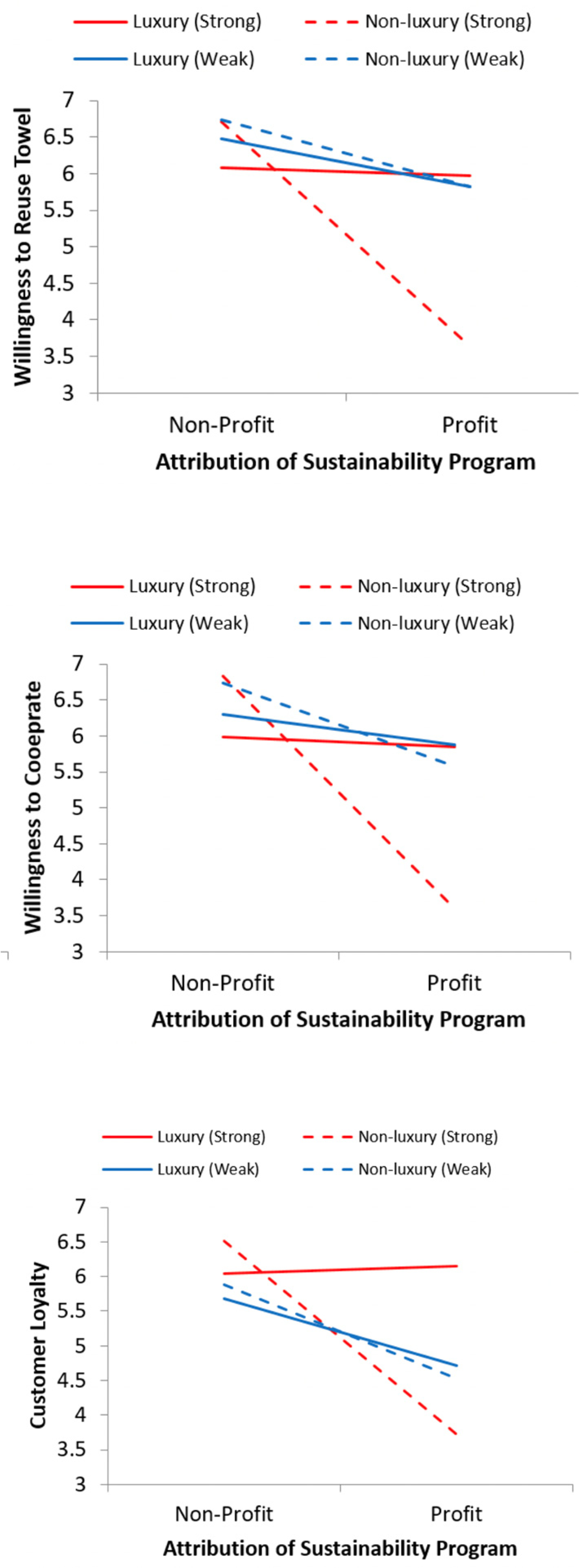
Affective attitudes moderate the effects of hotel brand positioning and profit attribution of the sustainability program on consumers’ responses (Study 2).
Similarly, the 2-way interaction on willingness to cooperate with the hotel’s sustainability initiatives was also significant (F(1, 38) = 7.23, p = .011; see Figure 3). Consumers’ willingness to cooperate with a non-luxury hotel’s sustainability initiatives was negatively influenced by the profit attribution of the sustainability program (B = −1.19; t(18) = −3.80, p < .01). In contrast, when it was a luxury hotel, consumers’ willingness to cooperate was not affected by the profit attribution of the hotel’s sustainability (B = −0.051; t(20) = −.18, ns.).
Finally, the 2-way interaction on customer loyalty was also significant (F(1, 38) = 9.93, p < .01; see Figure 3). For a non-luxury hotel, customer loyalty significantly decreased as the profit-driven attribution of hotel’s sustainability program increased (B = −1.03; t(18) = −4.10, p < .01); while for a luxury hotel, customer loyalty was stable regardless of the profit-driven attribution of hotel’s sustainability program (B = 0.039; t(20) = .17, ns.).
In the “weak affective attitudes” condition, the interaction effect between hotel brand positioning and the profit attribution of the sustainability program on towel reuse was non-significant (F(1, 49) = .12, ns.). This 2-way interaction effect on consumers’ willingness to cooperate with hotel’s sustainability initiatives was also non-significant (F(1, 49) = .86, ns.). Finally, the 2-way interaction on customer loyalty was also not significant (F(1,49) = .31, ns.; see Figure 3). In this condition, we only found main effects of profit motive attribution on towel re-use (p = .072), cooperation with the sustainability program (p < .05) and customer loyalty (p < .01), such that consumer responses turned more negative as perceived profit orientation increased.
Discussion
Consistent with study 1, the results of study 2 reveal that the profit motive attribution of the hotel’s sustainability program has a different impact on consumers’ responses to a non-luxury and a luxury hotel. In addition, study 2 reveals that the strength of affective attitudes toward luxury brands consists of a boundary condition for the interactive effect revealed. The pattern of the results is consistent with the notion that stronger affective attitudes toward luxury brands “shield” consumers’ responses, turning them more stable. When consumers have strong affective attitudes to luxury brands, the interaction between hotel brand positioning and the profit attribution of the sustainability program is significant, consistent with the results of study 1. However, for consumers who have weak affective attitudes to luxury brands, the interaction effect between hotel brand positioning and profit attribution on consumers’ responses is eliminated. In other words, the finding that the interaction that we found is more prominent when consumers hold strong affective attitudes toward luxury brands suggests that strong affective attitudes to luxury brands may contribute to consumers’ different responses to luxury and non-luxury hotels when hotel’s sustainability program is attributed as profit-driven. These results support H1-H3 2 .
General Discussion
While previous research suggested that consumers respond negatively when they attribute a profit motive to a firm’s sustainability program, this research shows that this detrimental effect does not hold for luxury brands in the hospitality context. Studies 1 and 2 demonstrated that consumer responses to a non-luxury (i.e., standard) hotel deteriorate the more consumers attribute a profit motive to the hotel’s sustainability program, but this does not happen to a luxury hotel. In addition, study 2 showed that this interactive effect between profit attribution and hotel brand positioning (luxury vs. non-luxury) emerges when consumers hold strong affective attitudes toward luxury brands, shedding light on why consumers’ responses to a luxury (vs. non-luxury) hotel are more stable.
Theoretical Implications
The main theoretical contributions of this research are twofold. First, this research reveals a condition where increased perceptions of profit orientation do not necessarily harm consumer responses. This contributes to research in ethical consumption more generally (e.g., sustainability, CSR) as well as to service research focusing on consumers’ attribution of a firm’s actions, be them related to sustainability or not. Most previous research in this field has shown that the effect of profit-driven attribution of sustainability engagement can be negative for the firm, both in terms of firm perceptions and behavioral intentions (e.g., Edinger-Schons et al. 2018; Elving 2013; Lee, Bolton, and Winterich 2017). Qualifying such previous results, our findings show that the effect of profit-motive attribution is attenuated for luxury hospitality brands. We extend the ethical consumption and sustainability literature by identifying luxury brand positioning (vs. non-luxury) as a new moderator of the effect of sustainability engagement on consumers’ responses to the brands.
Second, this research shows a condition where luxury brands may benefit from sustainability programs, even if consumers perceive such actions as profit-driven. There is increasing research showing conditions and contexts where luxury and sustainability together are positively perceived, but there is also research questioning if luxury and sustainability can go hand in hand and research empirically showing that consumers perceive “sustainable luxury” as an oxymoron (for a review, see Kunz, May, and Schmidt 2020). Although it is beyond the scope of this research to reconcile these views and results, our results contribute to research in this area by elucidating a context where luxury and sustainability function well together from both consumers’ and firms’ perspectives. While we still need an overarching theoretical framework to understand consumers’ reactions to responsible luxury at a higher level, our research reveals a new condition where luxury benefits from sustainability. The more scientific research reveals conditions where luxury and sustainability generate positive responses on consumers, the more luxury companies can realize the potential to contribute to social well-being by engaging in socially responsible practices.
Past research revealed that when hotels request cooperation with sustainability programs, consumers’ conservation behavior/intention may decrease (e.g., they consume more electricity), and this is especially the case for high-price hotels (Wang, Krishna, and McFerran 2017). Different from these findings, we found that consumers’ conservation intention in a luxury hotel (vs. a non-luxury) is less influenced as the profit motive attribution of sustainability engagement increases. This apparent inconsistency might be due to the inherent differences between “luxury” and “high price”. We focused on hotels’ luxury image, which is not equivalent to price image (Kapferer 1998; Roux, Tafani, and Vigneron 2017). Although luxury is typically associated with high prices, the core concept of luxury is different from high price (Kapferer and Valette-Florence 2016; Patrick and Hagtvedt 2009). The results of study 2, where we find that the proposed effect emerges for consumers who hold strong affective attitudes toward luxury brands, are in line with this contention.
These results have implications for macromarketing and, in particular, to the emerging field of transformative luxury research. Our findings show the power of a luxury positioning to potentially generate positive changes (more sustainable behavior) and business practices contributing to environmental protection. Our results drive the sustainable actions embedded into the hospitality industry by suggesting an approach of strengthening consumers’ affective attitudes to the brands. In fact, the trend of “experiential consumption” may open room for less harmful consumption and might be a window for corporations to contribute to an increased social commitment to sustainable practices. This is in line with a recent call in macromarketing for corporations to be more active instead of “simply” responsive to consumers’ demands (Sheth and Parvatiyar 2021).
Limitations and Future Research
In this research, we suggested that the typically stronger affective attitudes toward luxury brands contribute to the interactive effect between luxury branding and profit motive attribution. To test this, in study 2 we examined a moderation by affective attitudes, such that the predicted interaction should emerge when affective attitudes are strong, but not when affective attitudes are weak (Spencer, Zanna, and Fong 2005). Although the results support our prediction and are robust across three dependent measures, this is arguably initial evidence of an investigation of the mechanism of the effect. Future research may further verify whether affective attitudes to luxury brands are responsible for the supported interaction, for example, by manipulating consumers’ affective attitudes to luxury and non-luxury hotels. In addition, future research can potentially test alternative explanations or identify additional boundary conditions. For instance, what are the specific aspects of luxury branding that would make the effect more or less likely to hold? Is it because hotels constitute experiential luxury?
Previous research showed that underlying motives for sustainability engagement could be mixed and complex, especially with consumers’ increasing understanding of sustainability (Ellen, Webb, and Mohr 2006; Ginder, Kwon, and Byun 2021; Porter and Kramer 2011; Sen, Du, and Bhattacharya 2016). A sustainability program could be associated with both firms’ intrinsic motives (e.g., a genuine concern for taking care of the environment) and extrinsic motives (e.g., saving costs) at the same time (Edinger-Schons et al. 2018; Ginder, Kwon, and Byun 2021). That is, the underlying motive could be a hybrid of the profit-driven motive and the environment-protecting motive. Therefore, it would be interesting for future research to understand how consumers form their attributions and how these shape their responses to firms’ actions.
Another possibility for future research is to integrate potential effects of luxury positioning and profit-motive attribution on perceptions of the hotels. Past research suggested that perceptions of a firm’s motives for engaging in sustainability can impact how the firm is perceived. These perceptions include trustworthiness (Jahn and Brühl 2019; Vlachos et al. 2009), competence (DiDonato and Jakubiak 2016; Lee, Bolton, and Winterich 2017), integrity (Amatulli, De Anglelis, and Stoppani 2021), evaluations of the firm (Forehand and Grier 2003), and reputation (Elving 2013; Yoon, Gürhan-Canli, and Schwarz 2006). Variables such as these could potentially mediate the effects we found on cooperation with the sustainability programs and loyalty to the hotel. In other words, these variables are the perceptions of the firm per se, while profit attribution is related to perceptions of the motive for sustainability initiatives.
There are also additional limitations in our methodological approach. Study 1 and study 2 adopted two different ways to manipulate hotel type, as well as employed two different scales for manipulation checks. In the data collection process, we also used two different samples from two different subject-pools (study 1: a pool managed by a business school; study 2: Mechanical Turk). Although it is encouraging that the results are consistent across the studies, these are conceptual and not exact replications (Easley, Madden, and Dunn 2000; Schmidt 2009), which limit the robustness and comparability of the results to a certain extent. Another limitation is that we measured the independent variables and dependent variables in the same instrument, opening potential for common method bias (Podsakoff et al. 2003). Although many of our methodological choices should have minimized the incidence of common method bias (Podsakoff, MacKenzie, and Podsakoff 2012), future research can implement further solutions that would require new efforts. In addition, it is also important to test our findings in the market. Future research could conduct a field study with luxury hotels, which would help increase the external validity of our results.
Moreover, it would be beneficial to investigate the influence of individual-level variables (e.g., socio-economic status) on the degree of emotional bonding to different brands. Finally, the current research focused on hospitality, but there are many other luxury and non-luxury contexts in which sustainability initiatives are involved. For instance, luxury and non-luxury department stores may also engage in sustainability activities. Selfridges, one of the largest luxury department stores in the UK, was awarded the World’s Best Sustainability Campaign by a Department Store at the Global Department Store Summit 2016, due to its significant achievement in CSR such as its reduction of carbon and water. Thus, can our findings be generalized to the context of luxury and non-luxury department stores or other service or product (e.g., fashion) providers (Ertekin and Atik 2020; Gupta, Gwozdz, and Gentry 2019)? This is another direction for future research.
Practical Implications
Although hotels’ engagement in environmental protection actions is ubiquitous and luxury hotels are increasingly promoting their sustainability programs (García de Leaniz and Rodríguez DelBosque Rodríguez 2015; Goldstein, Cialdini, and Griskevicius 2008), consumers’ responses to hotels’ sustainability programs in the context of luxury hotels has not been well understood. We showed that while a profit-driven attribution of hotels’ sustainability programs (e.g., environmental protection behaviors) might hurt consumers’ responses to the hotel, this negative effect can be mitigated by a luxury branding positioning. We observed consistent results across two studies. The reliable pattern increases our confidence in the robustness of the effect. In addition, we find that consumers’ affective attitudes toward luxury brands play an important role: since consumers tend to hold strong affective attitudes toward luxury brands, they are less sensitive to “negative” information about the brand (such as a profit orientation) and this effect emerges.
This is an important step because luxury hotels can benefit from sustainability in terms of customer loyalty, willingness to reuse towel, and consumers’ general willingness to cooperate with environmental protection initiatives. Managers of luxury hotels may expect high utility from sustainability programs because these programs seem to be beneficial to the hotel. In the luxury hotel, customer loyalty, as well as consumers’ willingness to behave environmentally friendly, is stable regardless of the attribution of sustainability programs. As such, the results suggest that environmental protection programs play an important role in the management of relationships between customers and hotels.
This is not to say that engaging in profit-driven sustainability initiatives is well-perceived by consumers. But, according to the results, consumers’ perceptions about the firm’s intentions of their sustainability engagement is more critical for non-luxury hotels compared to luxury hotels. For non-luxury hotels, consumers’ attribution of the hotel’s sustainability program negatively influences their responses to the hotel more promptly. Since consumers’ negative responses are harmful for companies (Grappi, Romani, and Bagozzi 2013), managers and marketers of non-luxury hotels should try to prevent consumers from attributing hotel’s environmental protection programs as profit-driven, regardless of the hotel’s actual motives. For example, hotels should constantly monitor consumers’ evaluation of the company’s sustainable behaviors (Huber et al. 2010). Hotels that have discovered that customers attribute a profit motive to the sustainability program should try to find a good way to communicate with their customers, such as providing explanations. Managers and marketers of these – and all – hotels should think about how to improve the credibility of their sustainability initiatives when communicating with their customers, starting by understanding that sustainability programs should not just be a marketing gimmick.
Last but not least, this research contributes to society’s expansion in terms of ecological and environmental considerations. With this expanding value of building sustainable societies, the hospitality industry has increasing responsibilities to address the unsustainable problems during the production and consumption processes.
Footnotes
Special Issue Editors
Wided Batat and Danae Manika
Declaration of Conflicting Interests
The author(s) declared no potential conflicts of interest with respect to the research, authorship, and/or publication of this article.
Funding
The author(s) disclosed receipt of the following financial support for the research, authorship, and/or publication of this article: This work was partly supported by the People Program (Marie Curie Actions) of the European Union's Seventh Framework Program [FP7/2007-2013/ under REA grant agreement 290255] that supported the Consumer Competence Research Training, of which the two authors were members.
Note: This research is based on the first author’s dissertation, supervised by the second author.
