



Abstract
During the last two decades, childhood obesity has become a global pandemic, creating harmful impacts on children, tutors, and society. If the obesity/overweight trend continues upwards, especially in developing countries, it may significantly alter millions of children's professional, social, and psychological well-being. Furthermore, it is conceivable that when obesity/overweight issues appear at a young age, they may persist during adulthood and disrupt individual development and community well-being. By targeting children at a very young age and with a broad array of strategies, junk food marketers have often been accused of inducing children to (over)consume junk food from an early age and throughout adolescence until adulthood. This paper reviews the literature about childhood obesity/overweight and junk food marketing strategies to develop a conceptual framework delineating the forces and counter-forces to the childhood obesity phenomenon and identify avenues for future research and managers.
Introduction
Since the 2000s, childhood obesity/overweight has been called a “global pandemic” (Kimm and Obarzanek 2002; The Surgeon General 2001). While “responsibility, locus of control, and self-management” matter (Berry 2020, p. 2), this holds for adults but differs for children since they lack the skills and maturity to be held accountable for their actions and self-regulate like adults. Therefore, food marketing to children in general and junk food marketing to children plays a risky game by deliberately promoting unhealthy products to the most vulnerable. In marketing, “children” refers mostly to minors, including toddlers (0–3 years), preschoolers (2–5 years), children (6–8 years old); pre-adolescents (9–12 years old), and adolescents (13–16 years old). Compared to adolescents, the other categories are more particularly vulnerable to junk food (Johansen 2007).
The notion of “junk food” can be defined as “foods that have low nutrient density, that is, they provide calories primarily through fats or added sugars and have minimal amounts of vitamins and minerals” (CDC, 2006, p. 9 in Taber et al. 2011). Junk food conceptually overlaps with “unhealthy food,” which is “food that is nutritiously poor and contains high levels of saturated fat, trans-fatty acids, sugar or salt (HFSS) [that has] often undergone a major industrial transformation and when consumed, […] makes the total diet less healthy” (Tatlow-Golden and Garde 2020, p. 2). Besides, the WHO (2015) classifies foods into “permitted” or “non-permitted” to be marketed to children. Hence, there are “unhealthy food 1 “ and “non-permitted foods 2 “ categories (Vandevijvere et al. 2018, p. 1101) and both overlap.
Thus, “junk food marketing” refers to the marketing of unhealthy food that is theoretically not permitted to be marketed to children (according to the WHO [2015]). While the WHO's guidelines are not coercive, they are increasingly integrated into local governments’ roadmaps (Belz and Peattie 2012). Besides, junk food marketing to children is not illegal but “can give rise to questions” (CAB, 2006, p. 4). From a consequentialist perspective, the unethical nature of junk food marketing to children can be evident in the obesity pandemic, affecting millions of children's physical, psychological, and social well-being.
To show more concretely the deleterious effects of junk food marketing on children, it has been recurrently shown that the latter has strong ties with the overweight and obesity phenomena (Castronuovo et al. 2021). As a strong influencer of attitudes and preferences, marketing impacts the perceptions, especially of the most vulnerable. Although children show positive implicit associations towards vegetables (Dixon et al. 2007; Smith et al. 2019), they tend to prefer consuming unhealthy/junk food. Marketing has contributed to framing unhealthy foods with appealing imagery and branding while eluding its poor nutritional content. Apart from taste, this might explain children's proclivity to consistently favor unhealthy food over more healthy ones, toward which they nonetheless have positive attitudes (Dixon et al. 2007; Smith et al. 2019). Thus, marketing might have contributed to obesity and overweight issues, a pandemic that has been shown to cause severe psychosocial illnesses such as social discrimination, reduced self-esteem, depression, isolation, and negative body image (Pizzi and Vroman 2013; Pulgarón 2013). Biologically, overweight and obesity cause “diet-related noncommunicable diseases later in life” (WHO, 2020d, p. 2). Rising obesity among the youngest also compounds financial and economic issues overall, since it costs “$2 trillion [USD] annually from direct health-care costs and lost economic productivity” (Bentham et al. 2017).
More recently, it has been shown that the obesity pandemic has reciprocal links with the COVID-19 pandemic, a phenomenon coined as “CoVesity” (Zakka et al. 2021, p. 1). On the one hand, the obesity pandemic has only worsened with the COVID-19 pandemic while failing to enact responsive action (Senthilingam 2021). The measures taken to contain the COVID-19 spread, such as social lockdowns, quarantines, online learning, teleworking, travel limitations, curfews, and closure of many shops, entertainment and sports venues (e.g., fitness centers), on a global scale, have created significant barriers to weight management, while calorie intakes remained high or have even increased (Robinson et al. 2021; Balzer 2021). On the other hand, obese and overweight people “are in a chronic state of low-grade inflammation, making them particularly susceptible to developing severe forms of respiratory failure” (Zakka et al. 2021, p. 1). Consequently, obese and overweight individuals have been consistently reported to be more likely to suffer from COVID-19 or more severe forms of the virus (e.g., Cai et al. 2020; Gao et al. 2020; McSharry and Malhotra 2020, among many others). While regrettable from a human and medical viewpoint, this burdens society, the economy, and healthcare systems which bear proportionally higher costs and pressure with rising obesity rates. It is all the more difficult to witness children already struggling with obesity and overweight being at greater risk of suffering from the COVID-19 pandemic. Understanding the role of marketing in childhood obesity and overweight is also crucial to fight against CoVesity as a “pandemic within the pandemic.”
Children obesity and overweight is, therefore, a critical issue to which marketing has contributed in a significant way by influencing children's attitudes toward food and their food choices (Castronuovo et al. 2021). As it has been practiced for over 60 years, Junk food marketing to children constitutes a crucial problem of macromarketing in the sense that marketing actions have a substantial impact on society and its well-being. To tackle this issue, it is consequently important to have a comprehensive and integrated picture of the different marketing levers that might have contributed to the children obesity/overweight pandemic. Yet, such a comprehensive framework summarizing the multidimensional and multilevel influences exerted by marketing on children to explain the obesity/overweight phenomena is still missing. This is a great lack since such a framework would provide and identify the main intervention points to restrain the pandemic. Given the criticality of the issue, this article's overall objective is to shed light on junk food marketing to children by developing a conceptual framework of forces and counter-forces that lead to childhood obesity and propose a theory-based agenda for future research. As such, it answers the following research questions:
What are the forces driving the spread of the obesity epidemic? What are its counter-forces? How do these agentic factors interact and influence each other? What are the conclusions and the needs for future research in junk food marketing to children?
Drawing on a large and inter-disciplinary sample of topical literature retrieved rigorously, this article aims at contributing critically to the micromarketing literature. It addresses the lack of a comprehensive framework summarizing the multilevel and multidimensional influences that have favored or hindered children's obesity/overweight pandemic. It informs marketers, business developers, decision-makers, and scholars on a better understanding of the influences to the issue to better guide action and reduce the issue.
Method
We used Scopus, Web of Science, ABI/Inform, and Business Source Complete to retrieve publications using the following keywords: “(junk OR unhealthy OR fast-food marketing) AND (child* obesity OR overweight).” The search process resulted in the extraction of 250 publications. The inclusion criterion was that the publications be written in English, in a scientific paper, book chapter, or conference proceedings format, and related to junk food marketing to children and obesity. As a second step, the title, abstract, keywords, and content were analyzed to ensure topical fit. After the removal of duplicates, 150 publications remained in the dataset. As a final step, the publication's content was analyzed in more detail for validation, which led to 110 final publications. Table 1 provides a sample of those studies highlighting their author(s), year of publication, objectives, methodology, and results.
Sample of Studies on Junk Food Marketing and Children Obesity/Overweight.
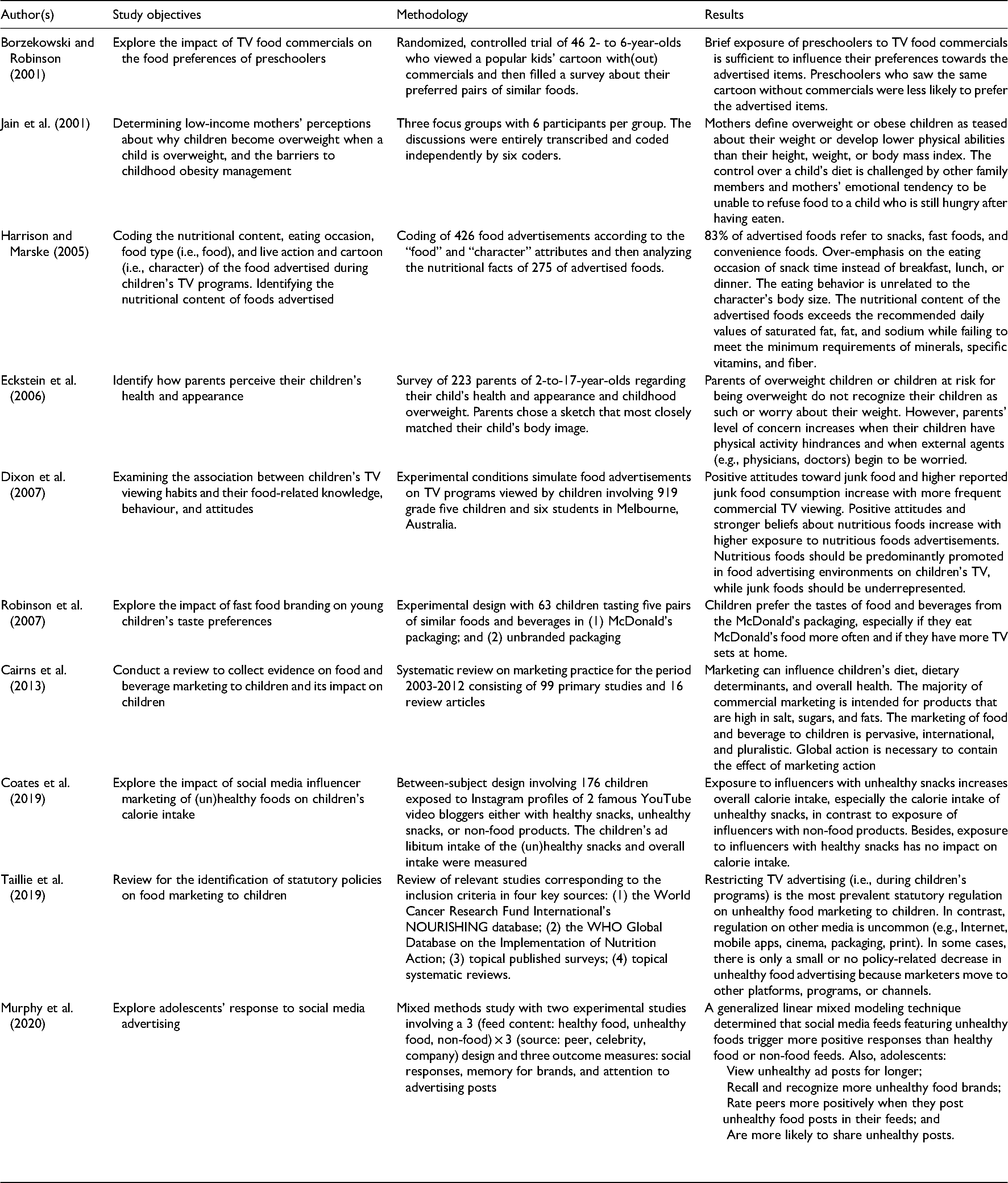
The next section presents the proposed conceptual framework that has been derived from the sample of articles retrieved. More specifically, it discusses, compares, contrasts, and assesses the topical literature following a specific multilevel and multidimensional structure that has emerged through the analysis of each study.
Proposed Conceptual Framework
The proposed conceptual framework highlights the forces (counter-forces) that contributed to (hindered) obesity and overweight pandemics, with a particular emphasis on junk food marketing strategies (Figure 1).
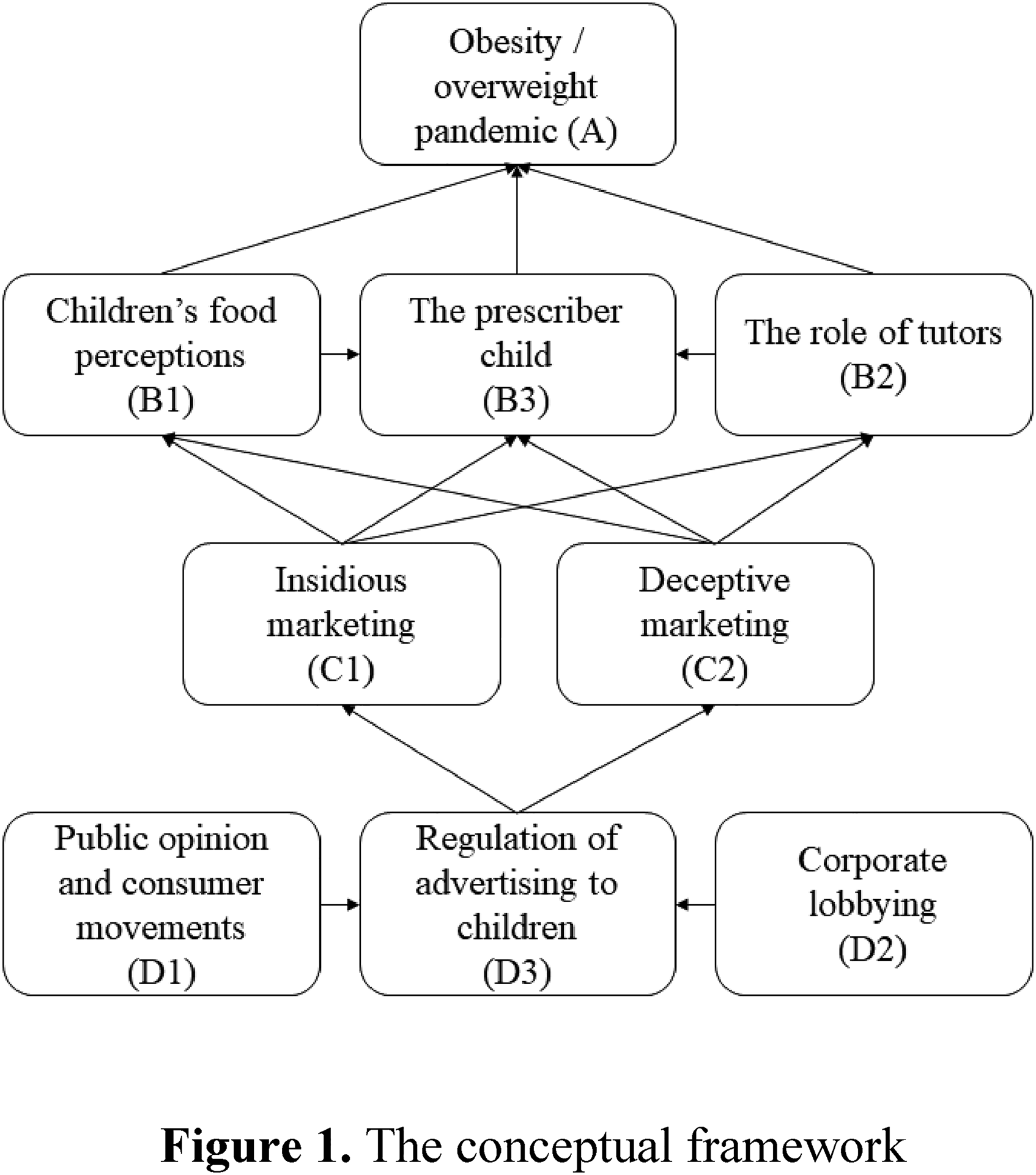
The conceptual framework.
Figure 1 shows that the pandemic results from a multi-layered and multi-dimensional array of forces and counter forces on children. Forces refer mainly to the two dimensions of marketing at the micro-level and lobbying at the macro-level. In contrast, counter-forces refer to the three dimensions of tutors at the micro-level and the public/opinion civil society at the macro-level. In addition, policy-making has an ambivalent role by being a force through laissez-faire/laxer policies and a counter-force when implementing stricter policies. Emphasizing those different layers of influence is important to highlight since it recasts the influence of marketing into a broader perspective, with each level – including marketing – having its own stream of effects. While this does not mean shifting away from the responsibility of marketing, it offers a more balanced and nuanced understanding of the compound effect of multiple drivers contributing to a complex issue. By dissecting those different effects as forces and counter-forces, this analysis critically contributes to the literature since such a comprehensive framework remains missing, impeding effective tackling of the issue. Furthermore, the proposed structure also presents the main authors in the field by emphasizing which level or dimension they predominantly researched.
The Obesity/Overweight Pandemic (A)
In 2016, 124 (196) million children were suffering from obesity (and overweight) worldwide, and this number has only grown since 1975 (Bentham et al. 2017). Table 2 shows that the proportion of children with obesity was multiplied by eight between 1975 and 2016. It can also be seen that boys seem more affected than girls since boys are more intensively exposed to food advertising, while their preferences tend to be more impacted by this exposure due to a relatively male-dominant advertising content (Castronuovo et al. 2021). Overall, in 2016, no less than 18% of children aged 5 to 18 were overweight, including obese children (Bentham et al. 2017; Castronuovo et al. 2021). Moreover, after the 1990s, the number of children victims of obesity and overweight increased significantly in developing regions, while this growth moderates in wealthy countries (WHO, 2020d). A conjoint study by the UNICEF, WHO and World Bank further showed that the proportion of children aged less than five years old and suffering from obesity grew from 4.9 percent in 2000 to 5.6 percent in 2019 (WHO, 2020d). The number of children suffering from overweight problems is expected to exceed that of children suffering from undernutrition by 2022 (WHO, 2020d).
Proportion (in %) of Children in Situation of Obesity Between 1975 and 2016.
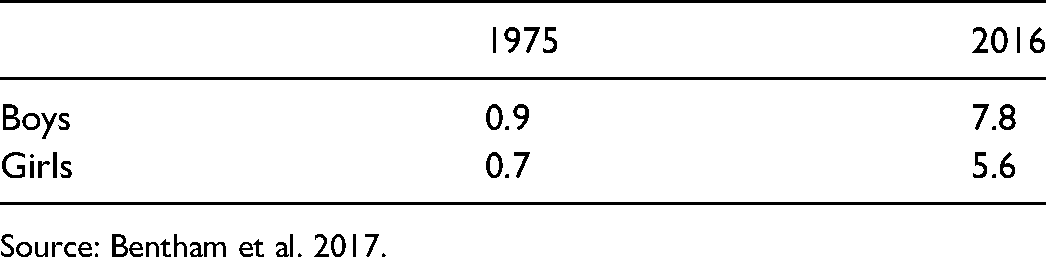
Source: Bentham et al. 2017.
According to the WHO, most children with overweight or obesity live in developing countries, where the disease grows 30% faster than in developed countries (WHO, 2017, 2020d). Developing countries struggle to ensure a healthy food transition for their populations (Bentham et al. 2017). Their population consumes food that is poorly nutritious but inexpensive and has very high energy value. The lack of information on the risks of junk food (WHO, 2017) and its ease of access to more impoverished populations (Ernsberger 2009) contribute to the spread of obesity/overweight.
Children's Psychological and Behavioral Changes (B)
After examining the state of the obesity/overweight pandemic among children, this section advances more into marketing territory by discussing children's consumer behavior. Finally, it highlights research about the effects of marketing activities on children's food perceptions (B1) and how their tutors might counteract those influences (B2), resulting in the key discussion of the prescriber child (B3).
Food Perceptions in Children (B1)
This section shows how marketing efforts are cleverly adapted according to children's cognitive development and the consequences on children's food perceptions.
Adaptive Junk Food Marketing Strategies
Past research highlighted how junk food marketers take advantage of children's lack of cognitive defenses - due to their cognition being still in development - to subjugate them with aggressive commercial messages that nudge them into junk food consumption (Brée 1993; Brucks, Armstrong and Goldberg 1988; Cheung and Louie 2020; Johansen 2007; Kapferer 1993; Qutteina, De Backer and Smits 2019). This strategy tends to morph into a stronger emphasis on identity search and social acceptability (i.e., playing on emotions) towards adolescence (Kent et al. 2019; Montgomery and Chester 2009; Murphy et al. 2020; Strasburger 2001). The common denominator to both routes boils down to more junk food consumption.
Starting with children first, past research has documented very precisely how junk food marketing communication strategies evolve with children's cognitive development to effectively target children at all stages of their lives (Cheung and Louie 2020; Qutteina, De Backer and Smits 2019). Piaget (1931) distinguished four periods of infant cognitive development (see Table 3), which junk food marketing specialists use to adapt their marketing messages (see also Table 3). Before the age of eight, children do not understand advertising's commercial nature; they see it as a fun and entertaining program (John 1999). During the “period of concrete operations” (6–12 years), children interpret the interests hidden behind an advertisement (Brée 1993; Johansen 2007; Kapferer 1993). However, to Brucks, Armstrong and Goldberg (1988), even if children have sufficient cognitive skills to understand an incentive to consume, they will not necessarily criticize the advertisement if nothing prompts them to do so (e.g., parents, teachers, public authorities), which we will get back to when discussing the role of tutors (B2).
The Different Stages of Cognitive Changes in Children, According to Jean Piaget, and Examples of Adapted Marketing Strategies.
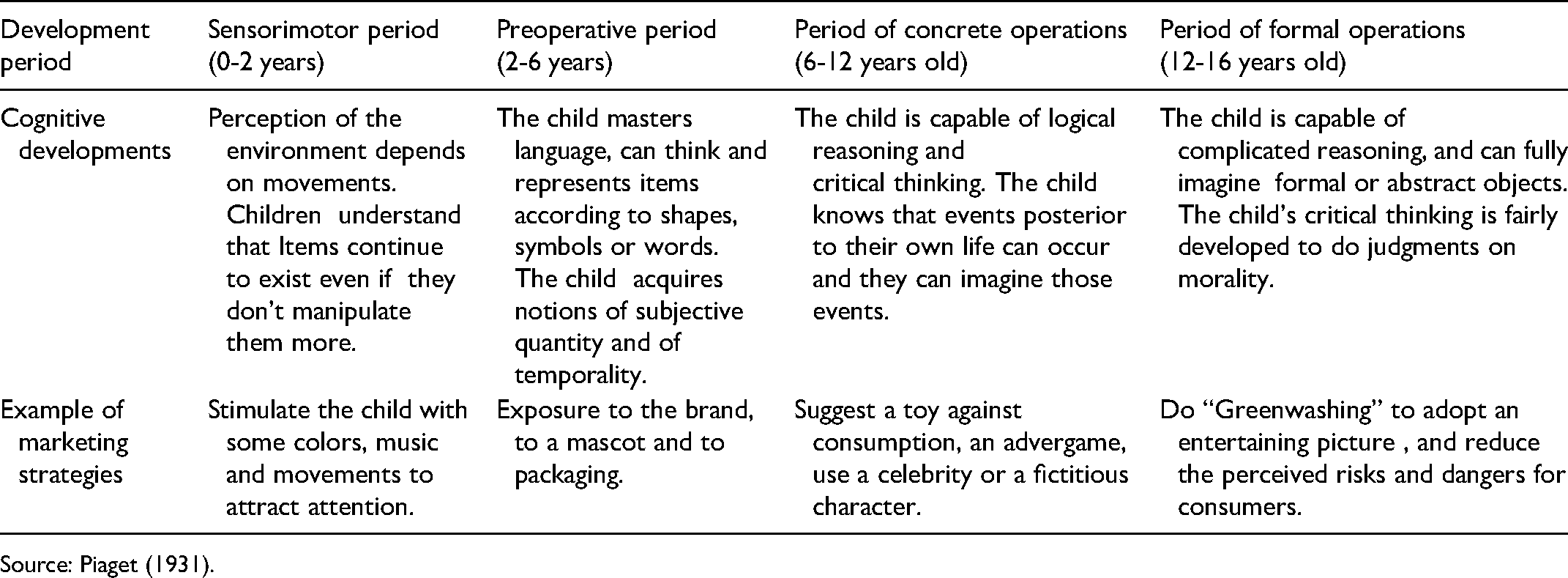
Source: Piaget (1931).
Once children differentiate advertising from reality, junk food companies play on emotions (Strasburger 2001) and the search for identity (Montgomery and Chester 2009), particularly on social networks (Kent et al. 2019; Murphy et al. 2020). In this “period of formal operations” (12–16 years) (see Table 3) (Piaget 1931), their critical minds are more developed, and they scrutinize what is presented to them. In this configuration, junk food companies are interested in presenting themselves on their best day to maintain their positive image. This explains why Riefer and Hamm (2011) found that young adolescents may be attracted to junk food even though they have been accustomed to a healthy diet by their parents.
Advertising Consequences on Children Psychology and Eating Habits
Advertising has negative consequences on children's psychology and eating habits inasmuch as it induces children to have better knowledge and more positive attitudes towards junk food, which leads them to be more inclined to consume such foods. Advertising as a tool is not the problem, although it may aggravate it because it has an impact on children's eating habits through changes in their psychology (i.e., beliefs, perceptions, preferences, attitudes, intentions) (Cairns et al. 2013; Chernin 2008; Dixon et al. 2007; Harrison and Marske 2005; Kraak, Gootman, and McGinnis, 2006). What matters is the content of advertisement that needs to be revised since junk food advertisement exceeds healthy food advertising (Dixon et al. 2007; Elliott 2011; Harrison and Marske 2005; Robinson et al. 2007; Ross et al. 1981). To date, no research has found evidence of the opposite. Since children are more solicited by junk food than healthy foods (Harrison and Marske 2005), and that junk food is combined with entertainment and toys (Ross et al. 1981), intensive junk food marketing contributes very strongly to shaping children's eating habits through changes in their psychology (Kraak, Gootman, and McGinnis, 2006), nutritional learning, food preferences, perceptions, and shopping behaviors (Cairns et al. 2013; Chernin 2008), even if they are used to healthy diets (Riefer and Hamm 2011).
Nonetheless, it should be mentioned that this deleterious effect of advertising in changing children's psychology and eating habits combines with other business initiatives that are less related to marketing. Junk food composition is namely crucial in this regard. Junk food is tastier with more sugar, fat, or salt than healthy foods. Yet, taste is the primary consumption motive for children (Norton, Falciglia and Ricketts 2000), who thus naturally favor junk food over healthy products. Furthermore, junk food is ready-made, has a soft constitution, making it quick to eat and easy to chew, which tends to profoundly modify eating habits and develop addictions (Wansink 2005). In fact, when children think of “child food,” they think of processed, high-sugar, low-nutrient foods (i.e., junk food), characterizing a large part of products intended for children, while “adult food” would include the opposite (Elliott 2011). Food composition ties back to marketing since fatty and sweet foods cause hyperactivity of brain regions linked to the reward, and the mere sight of a junk food brand logo garners, therefore, attention and interest (Burger and Stice 2013). Children consuming junk food feel thus abnormally satisfied. They then become more inclined to sympathize with the brand and be more easily attracted and convinced by its messages (Burger and Stice 2013). Thus, through synergistic effects between advertising to children and food composition, junk food marketing has a clear relationship with obesity through changes in children's psychology and habits.
To counter these compound forces of junk food marketing and composition, the role of tutors appears crucial. One in three children would not have an overweight disorder if not exposed to junk food marketing (Veerman et al. 2009). Besides, reducing the number of junk food ads and increasing those promoting healthy eating is an excellent way to improve children's perception of food (Dixon et al. 2007). Yet, even if children have a reasonably good knowledge of good health food (fruits, vegetables, etc.), they have little understanding of nutrients, cholesterol, or adverse effects of excessive fat and sugar consumption (Gracey et al. 1996). The more a child is exposed to advertising, the lower his nutritional knowledge (Wiman and Newman 1989). The ads are so effective that brief exposure is enough to shape childhood preferences for junk food (Borzekowski and Robinson 2001). If a toddler is exposed to even a thirty-second ad, that is enough time to influence him. Through their authority, tutors are therefore valuable in their capacity to exert control on exposure and improve education.
The Role of Tutors (B2)
Tutors are those who have guardianship over children. They are the parents most of the time, but the impact of tutors is ambivalent, which weakens their counter-force effect.
On the one hand, as the guardians of their children, they are often the first accused if their child develops overweight or obesity problems (Eckstein et al. 2006; He and Evans 2007; Jain et al. 2001). However, there is a consensus in past research on how parents perceive their overweight or obese children. Interestingly, they do not perceive them as overweight or obese even though their children's weight, body mass index might and overall physical appearance may suggest this is the case. Instead, external influences such as external diagnostic (e.g., doctor) or their child's limited physical activity will alarm parents/tutors, while they find it emotionally challenging to refuse food to a hungry child (Eckstein et al. 2006; He and Evans 2007; Jain et al. 2001) or difficult to resist the “pester power” (Christino et al. 2019; Elliott 2011; Marshall, O’Donohoe and Kline 2007; McDermott et al. 2006). Such emotional and perceptual filtering by tutors complicates the containment of the overweight/obesity pandemic. On the other hand, researchers also emphasize that tutors have a bad opinion of junk food and have the cognitive defenses to deal with junk food advertising (Imoisili et al. 2020; Kelly, Turner and McKenna 2006; Mazzocchi et al. 2015; Simon et al. 2014), although sometimes also lacking appropriate education about the real effects of junk food (Eckstein et al. 2006; He and Evans 2007). The following explains tutor ambivalence in more details.
Although tutors (e.g., [grand]parents) are not necessarily the originator or end consumers of purchases, they control final purchase decisions. Overall, parents have a bad opinion of junk food marketing to children and want public authorities to regulate them (Mazzocchi et al. 2015; Simon et al.2014). Most tutors say they are aware of the role of the media and the child's peers in their food choices (Imoisili et al. 2020) while knowing the harmful effects of junk food on health (Kelly, Turner and McKenna 2006). However, this does not necessarily prevent them from purchasing these products since they give in to the “pester power”/“nag factor” (Elliott 2011) or consider young people mature enough to make their own consumption choices. Besides, tutors underestimate the impact of junk food on their children. While they know that it is indeed harmful to health, they do not have sufficient knowledge of its actual effects (Eckstein et al. 2006). Also, the more children are overweight, and the less their tutors recognize their disease (He and Evans 2007). Finally, tutors consider that their children cannot be a victim of overweight as long as they engage in physical activity and adopt a healthy diet (Jain et al. 2001), albeit “healthy eating” is not always judiciously established among parents. Also, junk food has an energy value that sometimes makes physical activity insufficient to burn calories. Eventually, both children and tutors lack proper nutrition information since tutors are subject to the same junk food marketing influence as children.
The Prescriber Child (B3)
Knowing the ambivalent role of tutors, marketers tend to use children to drag tutors towards giving into junk food while downplaying its adverse effects, what past research unanimously called the “pester effect” or “nag factor” (Christino et al. 2019; Dougherty 2014; Elliott 2011; Lawlor and Prothero 2011; Marshall, O’Donohoe and Kline 2007; McDermott et al. 2006). Children may send their tutors a formal request to purchase junk food directly or take a product by themselves without asking for permission. The last practice is facilitated by placing junk food products on store shelves, deliberately placed at eye level, and children's hands (Foodwatch 2020b). Children's prescriber behavior can be a form of consumerist independence vis-à-vis tutors (McDermott et al. 2006) without knowing that their product choices are heavily influenced by junk food marketing. To influence parents, marketers rely on the “pester power” or “nag factor,” which consists in creating a conflict between a child wishing to buy a product (because of his often erroneous perception of the product, resulting from micromarketing force) and their tutor(s) who refuse to do so (counter-force to micromarketing), which results in harassment and discontent on the part of the child, until the tutor(s) give(s) in (Dougherty 2014; Lawlor and Prothero 2011). Marketing of junk food targeting children is a significant contributor to “pester power” by making them believe that they have a right to consume despite their young age (Christino et al. 2019; Marshall, O’Donohoe and Kline 2007; McDermott et al. 2006) and communication strategies make those products too attractive to be ignored by children in points of sale. Therefore, children indirectly buy these products using their tutors as genuine buyers through pester power if needed.
However, past research distinguishes between the pre-adolescent phase and the adolescent one because the child's status tends to change at this age (De la Haye et al. 2013; Mahan and Escott-Stump 2004; Riefer and Hamm 2011). Adolescents become buyers and consumers of junk food (Riefer and Hamm 2011). Teens tend to use their prescription power with their friends to convince them to eat the same junk food items while also being influenced by their peers (De la Haye et al. 2013; Mahan and Escott-Stump 2004; Riefer and Hamm 2011). Therefore, children seek to influence their tutors to buy a product they like and enjoy. In contrast, teenagers influence their close circle of acquaintances to strengthen their sense of belonging with a junk food brand's common factor.
Junk Food Marketing to Children (C)
Recent reviews have concluded that exposure to marketing increases children's likelihood to suffer from underweight and obesity (e.g., Castronuovo et al. 2021). This section presents how marketing reaches children (C1) and then the deceptive nature of marketing content (C2).
Insidious Marketing (C1)
Marketing is highly adaptable and creative, for good and for worse. Unfortunately, when marketing junk food to children, that endeavour has more often than not been done for the worse. This section introduces the different channels and means through which marketing targets children.
The Traditional medium for Targeting Children
Television has long been a favorite tool for junk food marketing because children are in an entertainment perspective that makes them feel emotions, vectors of commitment, which make them more receptive to accept advertising messages (feeling) and to memorize it (thought) (Lajante 2015). Junk food television marketing consists of advertisements and product placements. Junk food advertising to children via television has been abundantly documented in the literature (e.g., Banet-Weiser, 2007; Kunkel and Gantz, 1992). Authors are unanimous regarding the deleterious impact of most TV food advertising aimed at children on their food preference, leading them to prefer junk food, snacks, and overall unhealthy food (Borzekowski and Robinson 2001; Dixon et al. 2007; Harrison and Marske 2005; Taillie et al. 2019). The impact of TV ads is powerful on children because they interpret television advertising differently from adults, namely by failing to identify commercials as an inducement to consume (Johansen 2007). Children function rather in a logic of discovering the world, multiplying experiences, and solving problems (Johansen 2007). Their exposure to an advertising message can constitute a form of learning for them and the proposed good's consumption as a solution to a problem (and not as a response to a need) (Guichard 2000). Television advertisements also associate the products shown with abstract concepts (e.g., entertainment) rather than describing their characteristics (Banet-Weiser 2007; Kunkel and Gantz 1992).
Junk food companies reach similar effects to advertising by reaching children within the television programs intended for them (e.g., shows, films, series) through brand placement (Naderer, Matthes and Zeller 2018). Here, the brand displayed on the screen is not the core of the consumer's attention; it is focused on the program they are watching. Even if exposure to advertising is brief, it will still lead the child to consume junk food, regardless of age (Naderer, Matthes and Zeller 2018). More broadly, out of 250 mainstream films that appeared at the US box office between 1991 and 2015, 64.4% used at least one junk food brand placement (Naderer, Matthes and Spielvogel 2019). There are more placements in films for children aged 6–12 than those for ages 12 and over (Naderer, Matthes and Spielvogel 2019). Therefore, the placement of brands in children's films has been a widespread practice since the 1990s.
Internet, the Future media of Choice for Promoting Junk Food
Children are at the heart of the Internet boom around the world. About 60% of American children aged 3–17 used an Internet connection at home in 2017, up from only 41% in 2000 (Child Trends 2018). Young people also spend more time watching videos on YouTube (i.e., 2 h 11 min) than on television (i.e., 1 h 52 min) (Office of Communications 2019). Social media (e.g., YouTube) are also preferred to traditional media (e.g., TV) because it allows them to watch community videos and watch people filming themselves unwrapping gifts or product packaging (Office of Communications 2019). Social media allow not only the dissemination of traditional advertisements (videos, banners, native advertisements) but also valuable interactions with intended audiences, which may interact with the brand and share the advertising content to their network, creating commitment and fulfilling an identity construction need (Montgomery and Chester 2009). With little or no exception, researchers also unanimously agree on the negative impact of using the Internet channel on children's food preferences and consumption (Coates et al. 2019; Gerhards 2019; Murphy et al. 2020; Schwemmer and Ziewiecki 2018). The effect might even be stronger than with TV because junk food companies rely on content creators (e.g., Youtubers, Instagrammers, Snappers) to reach children. Brands can make multiple placements within videos for a fee for creators (e.g., This With Them) (Gerhards 2019). The success of these YouTube channels with young people is that they can relate to the creators. However, YouTube videos share the codes of television advertising: an attractive character (influencing it) who guarantees the authenticity of the product presented in the video and abstract concepts to describe it (Banet-Weiser 2007; Kunkel and Gantz 1992). The attractive environment is replaced by the creator's themes (e.g., video games, toys). However, when a brand pays a creator to make a placement in the video, they control their creation (e.g., script, guests) (Gerhards 2019).
Moreover, the proliferation of brand placements on social networks makes it increasingly difficult for young people to distinguish between commercial and non-commercial content on these networks (Schwemmer and Ziewiecki 2018). These actions have direct consequences on young people's health: children who watch videos or photos of influencers promoting junk food are more likely to consume more calories than they should (Coates et al. 2019), particularly in the form of more junk food (Montgomery et al. 2012). In sum, junk food companies are very good at using social media codes to promote junk food.
Advergames and Video Games
In “advergames” (“advertisement” in the form of a “game”), the junk food offered by the brand is found at the center of the game, and children must play with it if they want to progress (Lee et al. 2009). As early as 1983, games such as Kool-Aid-Man, Pepsi Invaders (Bogost 2011), Chips Ahoy! Backyard Cabana (Lee et al. 2009), McDonald's Treasure Land Adventure or M&M's: The Lost Formulas, and many more appeared. All media are affected by these games: computers, consoles, or mobiles, to reach as many children as possible (Paek et al. 2014). Past research shows consensus on the harmful effect of these games on children's food preferences and behaviour (Chen and Deterding 2013; Harris et al. 2012; Lee et al. 2009; Paek et al. 2014; Van Reijmersdal et al. 2010). The causes are multifarious: about 87% of gamers aged 13–44 exposed to an advergame had a strong advertising memory of the promoted brand, even several months after playing the game, and 40% of them said they were more inclined to buy the brand (Activision-Blizzard 2005). Again, children and adolescents exposed to such games consume more junk food than usual (Harris et al. 2012). The effectiveness of advertising memory may lie in the fact that in these games, the brand, its logo, the products it markets, its graphic charter, and its mascots are used as elements constituting the game (Flowers, Lustyik and Gulyás 2010). However, like for TV advertisements, Internet communications, and brand placements, the games do not mention the risks of overweight, obesity, or addiction from consuming junk food (Lee et al. 2009). Similar observations have been made for online video games (Van Reijmersdal et al. 2010) or in social games (video games on social networks) (Chen and Deterding 2013), in which there were junk food products placements.
Therefore, junk food companies resort to insidious practices when speaking to children. They use media that induce a form of captivity (such as television), interactivity, and authenticity (social media) or even immersion (video games) to promote junk food. While insidious marketing is not illegal – and very akin to marketing's essence, it is unethical and therefore morally reprehensible when applied to children (CAB, 2006) due to the absence of messages presenting the risks of obesity/overweight when consuming the advertised junk food. This absence contributes to maintaining the vagueness between healthy and unhealthy food for children and even tutors.
Deceptive Marketing (C2)
Marketing is not only about reach but also about content and influence via deceptive information. This section shows how education has been highjacked to promote junk food and the cues to recognize junk food advertisements to children.
Highjacking Education to Promote Junk Food
Schools are strategic areas to occupy because they are an important place to target young people (Rachel 2017). At school, children learn what food to eat and how to do so in an environment outside the home and parental intervention (Pipes 1977). Thus, the eating habits adopted by children at home can be modified by the menus offered at school (Mahan and Escott-Stump 2004). However, junk food marketers take advantage of parents’ absence and do branding through education and school environments (Barquera et al. 2018; Brée 1993; Chambers 2019; Elliot, 2018; Kapferer 1993; Mazzocchi et al. 2015). This marketing in schools might be specific to North America, especially the United States, where a legal vacuum exists and seems perpetuated by junk food marketers themselves (Ruskin and Schor 2005). Even if marketing in school might be unallowed in other countries, there is evidence of “subverted educational content,” such as in France (Rouchon 2020). In the North American context, though, junk food companies take advantage of the legal vacuum on protecting children against marketing in schools and parents’ absence. For example, they participate in the purchase of educational materials for schools. When they do not have the authorization to offer their products directly or brand in schools, they post advertising messages near establishments (Barquera et al. 2018; Chambers 2019). Lack of education or misinformation about nutrition in children (Elliot, 2018; Mazzocchi et al. 2015) combined with government inaction to address the problem (Ruskin and Schor 2005) is in the best interests of junk food companies. The highjacking aspect can be particularly salient in some educational programs that promote junk food. For example, the mini-film “The wonderful meal of Ulysses” (Rouchon 2020), released in 2013, was to extol the merits of French gastronomy to young people. However, there are many very sweet products (i.e., cakes, candies, chocolate) in a scene describing fruits and vegetables. By investing in education, junk food companies blur further the distinction children make between nutritious foods and junk food. This deceptive marketing taking place within a school, place of learning, or in supposedly objective educational materials, contributes to the confusion among children, particularly the youngest (Brée 1993; Kapferer 1993). So, how to distinguish educational content from commercial content?
Confusing Characteristics of Junk Food Advertisements Aimed at Children
Past studies highlighted the multiple levers of junk food advertisements that induce children into liking and consuming (more) junk food (Brownell 2017; Elliott, Den Hoed and Conlon 2013; Hirani and Gujarati 2020; Kraak and Story 2015a, 2015b; Vandevijvere et al. 2017; Vassallo et al. 2018). Junk food marketers resort to specific advertising codes and branding while also putting a lot of effort into packaging, thus conveying deceptive communication through misinformation and misrepresentation of junk food.
Advertising codes. Junk food marketing often resorts to the appearance of real or fictional characters in advertisements to gain the sympathy of young audiences (Coates et al. 2019; Vassallo et al. 2018). Junk food companies partner with animation studios to create fictional hero toys that the child will receive only as a reward for buying junk food. Some McDonald's toys are exclusive because they are licensed by Disney and can only be obtained by purchasing a “Happy Meal” (ProjectAdHand 2011). Brand mascots also participate in the marketing effort of junk food companies. Friendly, colorful, and eye-catching characters, their presence strongly influences children when they have to choose what food to eat (Kraak and Story 2015a), and the regulations are generally very lax as to their use as a marketing tool to reach young people (Kraak and Story 2015b). Brand mascots can intensify advertising memory in children and capture their attention more (Hirani and Gujarati 2020), particularly when displayed on product packaging (Brownell 2017). In addition to health risks, these communications blur the line that children make between entertainment and advertising.
Branding. Branding also plays a crucial role in target influence. Children find foods with a displayed brand to taste better than those without (Robinson et al. 2007). Brand-stamped junk food causes children to eat more than usual and significantly more if the brand has a strong reputation and the young person already has overweight disorders (Forman et al. 2009). Today, branding is reinforced with social networks, which allow real-time dissemination to young people (Harris,Yokum and Fleming-Milici 2020) by playing on proximity to building a community (Montgomery and Chester 2009; Vandevijvere et al. 2017). Branding is also remarkably homogeneous across junk food brands. When compiling certain corporate logos (e.g., McDonald's, Burger King, Wendy's, Pizza Hut, Sonic, Popeyes, Hardee's, DelTaco), we see the ubiquity of yellow and red. The human mind associates yellow with joy, energy, friendliness. This color's mere sight produces mental and physical stimulation, while red is associated with speed, immediacy and produces a sensation that stimulates appetite and hunger (Cerrato 2012). These two warm colors associated together are particularly striking; they quickly catch the eye. The graphic charter plays a vital role in the advertising message since it allows the consumer to understand the positioning (Bottomley and Doyle 2006) and the ethical values (Sundar and Kellaris 2017). In the case of the junk food sector, the message that comes to mind is: “eat tasty food very quickly, in a happy and friendly environment.” According to Boyatzis and Varghese (1994), children as young as five already experience positive emotions when confronted with warm, flashy colors. The logos used by junk food companies are, therefore, naturally appealing to children.
Packaging. In addition to branding, product packaging plays a critical role in the behavior of buyers or prescribers of young people (Pires and Agante 2011). Children find the food better when presented in highly decorative, aesthetic, and unbranded packaging, rather than food delivered in plain packaging that does not showcase it but has a known brand (Elliott, Den Hoed and Conlon 2013). Young people are therefore more attracted by the way food is made available to them than by the brand affixed to it. The colors, the letter characters used to present the product's name, the brand, and a possible slogan (Letona et al. 2014), catch the eye and show certain qualities of the product sold. Other packaging attributes, such as price or a likable character, can also help make junk food more appealing to children (Elliott, Den Hoed and Conlon 2013; Kraak and Story 2015a). Unlike healthy food packaging, which emphasizes the high nutritional value of the product sold, junk food packaging does everything to give a fun and entertaining dimension to the merchandise, a “pleasure” marketing intended to divert attention from the health risks caused by junk food consumption (Elliott 2011; Elliott, Den Hoed and Conlon 2013). Since these packages cannot promote nutritional qualities, they promise children to experience positive emotions when they eat them. This type of communication entails some danger: the child no longer eats to fill his hunger; he eats to play. As a result, he consumes more than what he needs for fun, opening the door to overweight and obesity.
Macroenvironmental Influences (D)
The fight against obesity plays perhaps most crucially on the macroenvironmental level, where societal transitions and change take a much broader perspective and significance.
Consumer Movements and Public Opinion (D1)
Public opinion and NGOs have often had decisive effects on marketing to children, and this section explores how such action is enacted through influence on government for regulation.
Public Opinion on Junk Food Marketing and Influence on Government
Public opinion has gradually attacked junk food companies and governments deemed unwilling to regulate the market (Ruskin and Schor 2005; WHO, 2020c), especially since overweight and obese children have a good chance of remaining so as adults and will become primarily obese tomorrow (WHO, 2020b). Overall, past research highlighted a paradoxical stance of public opinion regarding how the pandemic should be addressed. North American authors emphasized that the public opinion is hostile to public authorities’ regulations or taxes, but they favor rules for children (Ruskin and Schor 2005; Simon et al. 2014). Advertising restrictions against younger people and taxes are the two most popular measures (Simon et al. 2014). Therefore, public authorities are more sensitive to the pandemic than before but remain divided between regulating the junk food market or letting companies self-regulate under public opinion pressure (Ruskin and Schor 2005).
Conversely, in the European context, public opinion is much more in favor of government intervention (Clemons, McBeth and Kusko 2012; Mazzocchi et al. 2015). Establishing a mandatory label indicating the nutritional level of food, educating children in nutrition principles, and regulating food marketing to which children are subject, are all popular (Mazzocchi et al. 2015). Developing countries might be tempted to follow the North American laissez-faire because they might find it challenging to place strong health policies to protect and educate their population.
It is clear, however, that public opinion is globally in favor of somewhat more regulation. Furthermore, the duty is really on elected governments because their words are considered more admissible than unelected international bodies (e.g., WHO) by the general population (Clemons, McBeth and Kusko 2012). Regardless of how much government intervention is needed, the challenge is to shape public opinion about the dangers of junk food and the importance of nutrition education without continually blaming consumers, who are also part of the public opinion.
The Actions of NGOs and Consumer Movements for Regulation
Several NGOs and other consumer movements tried to counter the spread of industrial junk food and safeguard each country's traditional and nutritious cuisine. In that sense, they may be considered the lobbying force of public opinion against the corporate lobbying forces. For example, the NGO “Slow Food,” created in 1986 in Italy, aims to remedy junk food culture by promoting healthy and unprocessed food (Chrzan 2004; Petrini 2003). Starting as a regional initiative, the organization is now present in over a hundred countries. The European NGO “Foodwatch” educates consumers about the dangers of junk food, denouncing unethical business practices that target children and petitioning to defend consumers’ rights (Foodwatch 2020a). Anti-globalization, a movement and not an organization per se, has also been very active against junk food. The role of globalization in the spread of the pandemic of childhood overweight and obesity is undeniable when looking at China (WHO, 2020a), Brazil (WHO, 2020b), and many developing countries (Bentham et al. 2017; WHO, 2017, 2020a). Therefore, it needs to be regulated. However, while junk food companies use the legal systems to make their voices heard, the alter-globalization movement resorts to civil disobedience, signaling mistrust of public bodies regulating junk food marketing. Documentary films (e.g., Super Size Me, Fed Up, The Kids Menu) have also resonated with criticism in the cultural world.
Corporate Lobbying (D2)
Lobbying exerts pressure on decision-makers formally by asserting their expertise (Potters and Van Winden 1992) or informally by resorting to corruption (Campos and Giovanni 2006). The junk food industry interest group, dubbed “Big Food,” wields influence in four policy areas: science, public opinion, media, and politics. Acquiring policies for their cause is seen as the ultimate goal of interest groups (Miller and Harkins 2010). On the one hand, public opinion pressure political authorities to regulate junk food marketing, whereas companies influence these same decision-makers to keep the status quo. On the other hand, there is an abundance of past research and reports describing aborted government attempts to regulate junk food marketing to children due to Big Food corporate lobbying (Corporate Europe Observatory 2010; The Federal Trade Commission 2011; Foodwatch 2019; Mello, Pomeranz and Moran 2008; Parliament of Canada 2016; Pomeranz 2010; Bartz 2011). For example, in 2015, the European Union debated a tax on overly sweet products, causing the food industry to react by discrediting the measure. Thus, “Big Food” has multiplied the messages calling into question the merits of a tax while promoting sugar as a natural and essential food and pointing to obese and overweight consumers responsible for their overconsumption (Foodwatch 2019). This discourse is exceptionally similar to the tobacco industry's claims when cigarettes started to be regulated (Tselengidis and Östergren 2018). In 2010, the European Union discussed a bill to impose a rating on food packaging to inform consumers of the product's nutritional content (similar to Nutri-Score). To defend itself, the European agri-food lobby, the Confederation of the agro-food industries of the EU, spent more than a billion euros in counter-studies as well as communication campaigns to discredit the legislation, and in “recommendation of a vote” near the members of the European Parliament, so that the bill will ultimately be rejected (Corporate Europe Observatory 2010).
With regards to advertising, between 2010 and 2011, the Federal Trade Commission, the US agency responsible for enforcing consumer rights, received numerous complaints asking it to ban junk food television ads to children, responsible for childhood overweight and obesity (Mello, Pomeranz and Moran 2008; Pomeranz 2010). In response to this threat, “Big Food” embarked on a massive lobbying campaign to influence the organization not to form a bill that would harm their junk food marketing (Bartz 2011). At the end of 2011, the Federal Trade Commission (2011) decided that it would not take any action to regulate advertising directed at children because it considered that the link between their viewing and the pandemic was not sufficiently well established, that children did not watch television as much as before, and are now influenced by other media, making any bill unnecessary. The report concludes by saying that the agency has been solicited before by similar requests and responded negatively. None of its staff will see any interest in future similar claims. Canada has experienced a similar situation. In 2016, Bill S-228 was presented to the Senate to ban all junk food advertising forms to children under 13 (Parliament of Canada 2016). Having reached the final stage before its adoption, the law suddenly experiences an abnormally excessive delay in decision-making because of the pressure exerted by the agri-food lobby on the senators to delay their final vote further, arguing that the ban on these advertising messages would be a “commercial disaster” (Le Devoir 2019). The CAB informs that the bill is still abandoned, and there is no sign that it will come back to date.
Regulation of Advertising to Children (D3)
When seeking to regulate the market, the measures focus more on prevention and education than regulating junk food marketing to children (Taillie et al. 2019). However, while children's education, tutors, and public opinion is undoubtedly important, the most influential factor driving consumption remains marketing. Education cannot work effectively if regulation only focuses on one aspect, failing to comprehensively address the issue (Taillie et al. 2019).
Like the ambivalent and culturally-dependent public opinion stance toward tackling the overweight and obesity issue, government regulation varies across cultural contexts (Kovic et al. 2018; Mello 2010; Taillie et al. 2019). North American countries are much more cautious about adopting restrictive regulations on junk food. For example, the United States primarily relies on junk food companies’ self-regulation to solve health problems. This choice is debatable, especially if no government action encourages organizations to take their responsibilities (Kovic et al. 2018). In 2006, the American Beverage Association, a lobby of major American sweet drink brands, committed to withdrawing its products from schools (Mello 2010). In 2019, the association announced that more than 90% of American schools no longer offered sugary drinks to their children (American Beverage Association 2019). Even if these actions are laudable, it should still be observed that these companies do nothing to regulate their marketing towards children, which is the primary driver of junk food consumption.
Researchers reported that government regulation has a more balanced approach in the European context regarding the combination of education and marketing regulation (Maif 2018; Nabec and Durieux 2019). For example, in 2011, France launched the PNNS (MangerBouger 2020), which is still relevant today. Among the actions undertaken, we find nutrition guides in school programs, recommendations for reducing fatty and sugary foods, and messages encouraging balanced eating in food advertisements broadcast on television. Also, all forms of advertising are prohibited in schools (Maif 2018), which helps protect children from certain marketing abuses, as in the United States. Furthermore, since 2016, all foods marketed in France must display a Nutri-score on the packaging, i.e., a note informing consumers of the nutritional content of the product they are buying, which influences them to reduce their junk food purchases in favor of healthier products (Nabec and Durieux 2019). On the other hand, as Taillie et al. (2019) reported, junk food advertisements aimed at children, attractive packaging in stores, or even advertising practices on the Internet are insufficiently addressed. In France, for example, new laws that are part of the 2018–2022 National Health Strategy program promise to handle the case of junk food marketing to children but remain unclear as to their content (Ministry of Solidarity and Health, 2017).
Interestingly, some of the best examples of drastic measures protecting children from junk food have been implemented in developing countries. In 2016, Chile adopted the Ley de Alimentos (food law in Spanish), a set of overly restrictive measures for junk food companies, which can no longer practice their marketing as they see fit (Ministerio de Salud 2016). Attractive characters and mascots on the packaging are prohibited, as is the addition of a toy, while the sale of junk food is forbidden in school settings. Also, neutral labels must be affixed on the packaging to warn consumers of excessive sugar, salt, fat, or a high number of calories (DW, 2016). These measures are effective: since their adoption, 40% of Chileans in 2017 said they rely on neutral labels to guide them in their purchases, which pushed them to buy healthier foods more than before (El Mercurio 2017). Chile has thus become a pioneer country in the fight against childhood obesity/overweight: it has not only made junk food companies comply with its jurisdiction, but it has also taken simple measures to guide its population in their daily consumption. However, not all nations find it as easy as Chile to regulate junk food marketing. They face economic issues and ideological hindrances that challenge their decision-making for the common good.
In conclusion, the proposed conceptual framework explains the obesity/overweight pandemic as being the result of a multilevel (consumer behavior, micromarketing, macroenvironmental forces) and multidimensional (child consumer behavior, tutors, micromarketing agents, consumer movements and public opinion, corporate lobbying, and government) either to promote (forces) or to hinder (counter-forces) junk food marketing to children. It should be noted that what further emboldens junk food marketing is that counter-forces in tutors or consumer movements and public opinion are subject to the same junk food marketing as children, thus confusing them also about the dangers of junk food. While marketing is not solely responsible for the pandemic, it plays a central role in the process at the micromarketing level through insidious and deceptive practices. These practices are further backed at a macroenvironmental level through effective corporate lobbying, which battles to ensure the status quo and laissez-faire policies to the detriment of children's health. What is nonetheless informative is that this review highlighted actionable marketing techniques used by junk food producers that healthy food producers could use to promote healthy eating habits.
Theory-Based Agenda for Future Research
One of the fundamental ethical marketing principles is to do better than the law (Murphy, Laczniak and Harris 2016). This proactive and self-regulatory approach protects the company from adverse effects on its business in the event of more restrictive legislation (Belz and Peattie 2012). In doing so, the organization develops a competitive advantage related to sustainability over its less considerate competitors (Martin and Schouten 2012). We established a conceptual framework based on the literature to account for the multiple forces and counter-forces explaining the obesity / overweight pandemic's evolution (see Figure 1). Marketing strategies are at the center because of their capital importance in this public health issue, which is also macromarketing.
Although the proposed conceptual framework (Figure 1) analyzes the various forces and counter-forces that led to the obesity/overweight epidemic, many refinement opportunities still exist. This section briefly discusses avenues for conceptual advancements and possible empirical research in this area of study.
Research on Policy-Making and Regulation
A more detailed analysis of the interactions between the market and consumers at the microenvironmental level and the legislator's lobbying actions at the macroenvironmental level. In the proposed conceptual framework (Figure 1), junk food companies mainly focus on two stakeholders: consumers, primarily children, and to a lesser extent, parents who will be buyers and the legislator. However, the influence exerted on these two levels is contradictory. At the legislator's level, junk food companies ally themselves with interest groups to exert better pressure on the public authorities and thus escape regulations in opposition to public health bodies and populations wishing to regulate marketing towards children. However, this laissez-faire attitude of the authorities allows junk food companies to practice a seductive and deceptive marketing strategy, the goal of which is to influence the consumer's mind as much as possible in favor of their products when that consumer is the most vulnerable, that is, from an early age. To do this, Big Food bombards children with daily advertising messages, sending them an extraordinarily positive and misleading image of junk food while playing its influence to undermine nutrition education programs that would reveal the dangers to health represented by their children. The literature has well documented the prevalence of junk food advertising against children (e.g., Henderson and Kelly, 2005) and the impact of government initiatives to limit the influence of junk food marketing (e.g., Phulkerd et al. 2017a, 2017b). Despite these advances, some questions remain. More specifically, there is a need for research on the following points:
Watson et al. (2017) distinguish foods advertised (non-core [unhealthy], core [healthy], miscellaneous) by companies. Drawing on Kelly et al. (2007, 2010), core food items are “those foods/drinks that are required daily to meet nutrient requirements (such as bread, pasta and fruit, and vegetables)” (Boyland et al. 2012, p. 660). In contrast, non-core items are “those foods/drinks that provide nutrients and/or energy over daily requirements (such as fast food and high sugar / low fiber breakfast cereals)” (Boyland et al. 2012, p. 660), while items classified as miscellaneous include, for example, tea/coffee and vitamin supplements (Kelly et al. 2007, 2010). Simultaneously, government public health initiatives take the form of programs, going beyond the simple communication of healthy foods, notably by setting up workshops, presentations, and sports activities (e.g., Défi Énergie in Canada), school meals. More research is needed to examine the simultaneous (interactional) influence of these two types of communication on children's preferences, attitudes, intentions, and food choices in these three advertised food categories? To what extent is junk food marketing outperforming government programs promoting non-core foods (to the detriment of core foods)? How do consumers (especially parents) perceive this divergence between the pleasant way companies promote junk food and their lobbying and public relations to suppress or discredit any restrictive legislation?
Consumer-Centric Research
Big Food's actions are formidable at all levels of society, and the industry's hold on government and the minds of young consumers seems total and irreversible. Yet, these companies remain subject to the opinions of their consumers. Since the 2000s, in developed countries, we have observed an increase in the populations’ hostility to junk food marketing and public authorities’ inaction (Simon et al. 2014). Some governments of emerging countries do not hesitate to take strong measures to protect their young people, even if it means bending multinationals. Also, new food consumption trends unfavorable to junk food are appearing, such as organic food (Paull 2011), responsible and civic commerce (Renting et al. 2012), the Slow Food movement (Chrzan 2004; Petrini 2003), as well as “artificial” foods that are harmful to health (Asioli et al. 2017; Falguera, Aliguer and Falguera 2012). If one were to summarize these new trends simply, we could say that consumers seek to find deep meaning in the products they buy (Ertz, Hallegatte and Bousquet 2019). This notion of purpose goes beyond the mere immediate satisfaction of consumer needs, which remains the anchor point in marketing in general and junk food marketing in particular (Murphy, Laczniak and Harris 2016). The notion of meaning is a metaphysical quest, joining moral and ethical concerns. Now, from their marketing practices considered at least questionable from an ethical point of view, junk food companies are currently unable to meet these expectations because of their offer, the way they present it (deceptive and insidious marketing), and the final consequences (obesity, overweight) they create. Consumers today want an authentic and quality product that aligns with their values (Guiné, Ramalhosa and Paula Valente 2016). On the other hand, junk food is a mediocre, empty product that focuses on the packaging. Based on this observation, studies should be conducted with specific reference to the marketing of junk food to children and in various markets (developed, developing):
How can junk food companies satisfy a need for depth when all their success and reputation rests on appearance? To satisfy this search for meaning and ease the growing mistrust of many consumers, adult citizens, and other stakeholders, does this mean that junk food companies will in the future be forced to restrict their marketing to children as well as offering healthier food for health? To what extent can junk food, which will continue to be loved and appreciated by children, continue to be marketed to children without harming them and without breaking society as a whole? Under what conditions can new entrants in the junk food industry, responsible positioning and wishing to do better than the law, perform and remain viable? What reactions should established players in the junk food industry take (e.g., rebranding, repositioning, coopetition) regarding these new entrants?
The Issue of Obesity and Overweight in an International Context
Claims of the emergence of new consumer behavior and growing consumer mistrust deserve to be qualified. These trends apply mostly to the better-off social classes, while the less well-off classes seek low prices (Shavitt, Jiang and Cho 2016) or packaging (Russell et al. 2017). They are also the most affected by obesity and overweight (Hales et al. 2017). Conversely, in developing countries, it is the wealthiest who represent the population. Most are affected by being overweight (Kinge et al. 2015) because Western food, even if it is not very dietetic, has a prestigious character (Zhang et al. 2016). Thus, as described in research, these new consumption trends do not apply to the entire population globally but rather to the well-to-do people from rich countries. Therefore, junk food companies may opt to tailor their marketing and products to new demands from better-off consumers, in developed countries, without modifying their approach to the less well-off or developing countries. Finally, with the targeting of customers becoming more and more precise thanks to technological progress (e.g., mobile, georeferencing, dynamic recommendation) (Smith et al. 2019), organizations could potentially offer advertising messages to children based on their social origin (Montgomery et al. 2019). It can be seen here that the literature describing new consumer behavior is limited to only a small part of the world population. The studies carried out are insufficient to define precisely the future reactions of consumers to the actions of junk food companies. However, the question deserves to be studied because these reactions form the population's protest against marketing abuses. Therefore,
To what extent does the adaptation of marketing on a geographic basis (marketing for developed markets vs. Marketing for developing markets) contribute to accentuating obesity and overweight in developing countries compared to developed nations? To what extent can technological advancements in digital marketing and dynamic advertising capabilities based on child characteristics maintain the status quo (healthy wealthy children and less well-off children more prone to being obese or underweight? overweight)? Consumers in developing countries attribute a prestigious character to Western food (Zhang et al. 2016). Much research has shown it, but this is true for adults. How is it the same for children? In the event of an erosion of the attribute “prestige,” how should junk food companies adapt their marketing in developing countries?
The Role of Corporate Social Responsibility
For now, junk food companies have found a way to distract consumers from their questionable business practices, while on the surface, satisfying new consumer expectations, not in the products they offer but in their marketing. Thus, corporate social responsibility (CSR) for junk food focuses more on supporting social and environmental justice movements than on regulating their unethical practices. Population activism in social justice movements has increased since the arrival of the Internet and social networks (Kahn and Kellner 2004), media on which junk food companies play a lot today to win over young people., in particular, by using the emotional dimension to attract their sympathy (Strasburger 2001). In recent years, these companies have therefore started to show their support in movements such as the protection of the environment or the Black Lives Matter movement (e.g., seven fast-food brands support the Black Lives Matter movement [Sharma 2020]), while African Americans are one of the ethnic groups most affected by overweight and obesity. Stamping your brand with these messages helps build consumer sympathy for it (Xie, Bagozzi and Grønhaug 2019), which, in the case of junk food companies, helps distract from the products. not very healthy they offer. But the subterfuge will not work forever, and these companies soon risk finding themselves the target of these social justice movements for their deceptive and insidious marketing to children (Bryan, Yeager and Hinojosa 2019). Some take half-hearted measures to improve their products’ elements (Scott 2018; Trillist 2020) while maintaining intense lobbying to send advertising messages to children. Such contradictory actions risk creating a “breaking point” on the part of the public. The latter will pressure the public authorities to adopt very restrictive legislation on junk food companies’ products and marketing (Micheletti and Stolle 2008). Therefore, there is a need for research examining the extent to which organizations that have been most resilient to these legislative and social changes will be able to gain a competitive advantage from this new situation:
How can junk food companies rethink their business practices to make them more responsible for future market and legal developments? Under what conditions will these changes be perceived as more or less credible by consumers, particularly parents?
Conclusion
Advertising messages promoting junk food to children are a major influencing factor in children's perception of food, even substituting for nutrition education and good eating habits provided by parents. Marketing has evolved its form over time to adapt to its targets’ age and expectations, the appearance of new media, challenges from public opinion, and any binding regulations from authorities. However, the marketing of junk food to children has remained unchanged for 60 years. This paper shows that junk food marketers adopt various marketing strategies and lobbying to associate unhealthy products with entertainment for younger children or play on identity and emotionality to appeal to teens. However, the disruptive and enabling effects of sustainability impetus and calls for increased accountability and corporations’ responsibility are dramatic. Failure to take heed of the current pandemic and reform marketing practices at both the micro and macro levels will put junk food interests at peril. Such companies and their products shouldn't vanish altogether. This situation may leave established companies vulnerable to new entrants that conceive their marketing offer around a heightened sense of sustainability and ethics. At least, they may market their products more ethically and responsibly, even if it be “junk food.” In a growing number of industries, it is now common to see emerge Vice President Sustainability (VPS) Chief Sustainability Officer (CSO), Sustainability Manager, Vice President for Ethics and Compliance or Vice President and Chief Ethics and Compliance Officer positions, to be accountable for evaluating and monitoring compliance of corporate practices with association guidelines, industry codes, or other suggested best practices.
Similarly, junk food companies may consider creating such positions or specific departments in their corporate organigram. If they have already done so, they may consider empowering those officers and managers to deploy the authentic change. Their tasks will evaluate and monitor new laws, recommendations, and guidelines and their potential effect on corporate strategy, stakeholders, and markets. However, in contrast to what has already been done up until now, the objective of the monitoring is not to oppose supposedly threatening legislation but rather to cooperate with civil society, policy-makers in drafting that legislation in a mutually satisfying way or, at least, evaluate the imminence of stricter regulation and adapt marketing strategies accordingly and beneficially for the company in contrast to the competition before the official adoption of the law. Given the strategic nature of such position, department, or function, greater involvement of the chief marketing officer and other key executives will be required to select, identify, and implement adaptive changes more effectively. Without such a stronger focus on ethics, morals, and sustainability, the opportunities to develop an ethics-based or sustainable competitive differentiation advantage may be unattainable.
Footnotes
Associate Editor
Ann-Marie Kennedy.
Declaration of Conflicting Interests
The author(s) declared no potential conflicts of interest with respect to the research, authorship, and/or publication of this article.
Funding
The author(s) received no financial support for the research, authorship and/or publication of this article.
