



Abstract
The marketing literature is showing an increasing interest in Africa. This article addresses the contextual macro-level characteristics that such studies have in common, and traces the typical characteristics of African marketing systems back to their ultimately biogeographical foundations. These foundations include the north-south orientation of the main continental axis, the low presence of geological boundaries such as mountains and rivers, and Africa as the “cradle of mankind.” Through their evolutionary consequences, these factors evolved into the aggregate marketing system traits typical to Africa, which include the existence of multi-level markets connected by traders, a sharp distinction between the formal and informal sectors, and an overwhelming presence of micro-entrepreneurs and smallholder farmers. This analysis generates new insights into, among others, the role of biogeographical factors in marketing systems theory and the potential sources of competitive advantage and disadvantage for the endogenous African firms inherent to the system.
Introduction
Over the past two decades, Africa has witnessed an economic upswing that constitutes a structural break with its past and has led to the emergence of new companies, foreign direct investment, and new opportunities for poverty eradication (e.g., Frankema and van Waijenburg 2018; Mahajan 2008). Unsurprisingly, these dynamics have also resulted in increased attention from marketing scholars (e.g., Adekambi, Ingenbleek, and van Trijp 2015, 2018; Allo 2014; Amankwah-Amoah, Boso, and Debrah 2018; Babah Daouda, Ingenbleek, and Van Trijp 2019; Dadzie et al. 2013; Ingenbleek, Tessema, and van Trijp 2013). These studies generally perceive African contexts as fitting with the common institutional and market characteristics of emerging markets, rather than as a distinct category in its own right (cf. Burgess and Steenkamp 2006; Roberts, Kayande, and Srivastava 2015; Sheth 2011).
To some extent, Africa deviates from other developing and emerging regions because many African countries are still among the poorest in the world, and the continent faces enormous challenges to create jobs and provide food, healthcare, education, and infrastructure for the rapidly growing population (World Bank 2018). At a macro level, African marketing systems are traditionally characterized by the relatively large size of the informal sector, the dominance of agricultural products over processed products and services, and the limited presence of substantial indigenous businesses (cf., Arnould and Mohr 2005; Hounhouigan et al. 2014). Consistent with the general state of economic development, other authors have used Africa as a typical base of the pyramid context (Adekambi, Ingenbleek, and van Trijp 2015; Arnould and Mohr 2005; London et al. 2010) or to investigate the functioning of marketplaces for those living in poverty (Babah Daouda, Ingenbleek, and Van Trijp 2019; Chikweche and Fletcher 2010). While these approaches pay respect to the weaker sections of African economies, they do so, similarly to the literature on emerging markets, from a set of general contextual characteristics. The emerging body of knowledge has not explained the typical characteristics of the African marketing system nor, therefore, what could potentially be learned from these characteristics for the strategies and functioning of African businesses and their contributions to African societies in terms of achieving sustainable development goals. A deeper understanding of the African marketing system may help to gain more from the current market growth for long-run development.
In this article, I investigate the essential characteristics of African marketing systems and their underlying causes as outcomes of an evolution-development process based on Africa’s fundamental biogeographical factors. The macromarketing literature has for decades acknowledged that marketing systems might vary considerably around the world (cf. Cundiff 1982). More recent contributions assign these differences to global differences in climatic and geographic factors, which are at the basis of cultural development and consumption (Sheth 2017). In response to these local differences, marketing systems then evolve through an evolutionary, path-dependent process of adaptation and selection (Layton and Duffy 2018), creating system traits that typically fit the local circumstances.
The complexity and specialization of marketing systems are associated with economic growth and consumer welfare, which explains why biogeographical foundations are linked to differences in economic development (Layton 2009; Wilkie and Moore 1999). In economics, the correlation between biogeographical factors and development is seen as definitive. Some economists claim that these effects are caused by current adverse effects, such as low agricultural production (Sachs 2005); however, consistent with recent ideas from macromarketing and drawing on the groundbreaking work of Diamond (1997), others have argued that the roots of the current states of economic development can be traced way back in human history (e.g., Easterly and Levine 2016; Olsson and Hibbs 2005; Spolaore and Wacziarg 2013). These authors draw heavily on the work of Diamond (1997), who argued that differences in development are grounded in biological conditions, such as the numbers of plants and animals that could potentially be domesticated, and geographical conditions, such as the size and ruggedness of the continent to which humans had to adapt.
In short, while there is enough evidence to expect that marketing systems connect to biogeographical conditions, this connection has not yet been established in the macromarketing literature. This article fills this gap by making two contributions. First, taking Africa as a case study, this article connects the marketing systems approach to the macro-level biogeographical conditions on which marketing systems are ultimately founded, thereby providing a more solid grounding for the typical traits of African marketing systems than has previously been recognized in the literature (e.g., Fafchamps 2004; Hounhouigan et al. 2014; Kambewa, Ingenbleek, and van Tilburg 2008). This article recognizes the commonalities between African research contexts, and develops a more coherent body of knowledge on African marketing, or, more generally, on African business. I relate the typical characteristics of African marketing systems to fundamental biogeographical conditions using ideas from human evolution (e.g., Johnson and Earle 2000; Wilson 2019). Second, these insights may assist African companies in recognizing the potential advantages and disadvantages inherent to the systems that they are a part of (Ingenbleek 2019). As such, this article responds to the calls of scholars studying African business who regard research into African indigenous business as a top priority (Lituchi et al. 2013; Zoogah 2008). The insights provided in this review may further assist policymakers in designing effective policies that support African businesses and societies at large.
The remainder of this review is structured as follows. First, I discuss the background of marketing systems, typical characteristics of African marketing systems, and existing explanations of these characteristics. Next, I introduce biogeographical and evolutionary approaches, followed by a discussion that connects Africa’s biogeographical foundations to the typical characteristics of its marketing systems. This article finishes with a discussion of the implications of these insights.
Background
Marketing Systems
Layton (2011, p. 259) defines a marketing system as “a network of individuals, groups, and/or entities; embedded in a social matrix; linked directly or indirectly through sequential or shared participation in economic exchange; which jointly and/or collectively creates economic value with and for customers, through the offer of assortments of products, services, experiences, and ideas and that emerge in response to or anticipation of customer demand.” Marketing systems can be identified at different levels, varying from two transaction partners in a micro-system to aggregate systems that span entire sectors in a country or beyond (Layton 2007). The African marketing system discussed in this article, clearly is an example of the latter. Marketing systems are the result of evolutionary processes that explain their formation, growth, adaptation, and, potentially, their collapse (Layton and Duffy 2018).
To concretize the concept of marketing systems, Layton (2009, 2011) identified the main conceptual dimensions. Marketing systems can be described by the distinctive features of the customer groups whose needs are served by the operations or the nature of the assortments generated in response to these needs (Layton 2009, 2011). The systems can further be described in terms of their structural and functional elements, which include the exchange logic and context, flows and roles, networks (including their dynamics), and governance (Layton 2009, 2011).
African Marketing Systems
Many studies in marketing and related disciplines, such as economics and economic history, have contributed to our understanding of the characteristics of African marketing systems. These studies may take the form of specific cases (Arnould 2001; Arnould and Mohr 2005; Bohannan and Dalton 1962; Kambewa et al. 2008) or more general descriptions and analyses at macro levels (e.g. Fafchamps 2004; Hopkins 1973). The present review uses Layton’s (2011) dimensions to describe the marketing systems from the perspective of indigenous African exchange partners (see Table 1).
Typical Characteristics of African Marketing Systems.
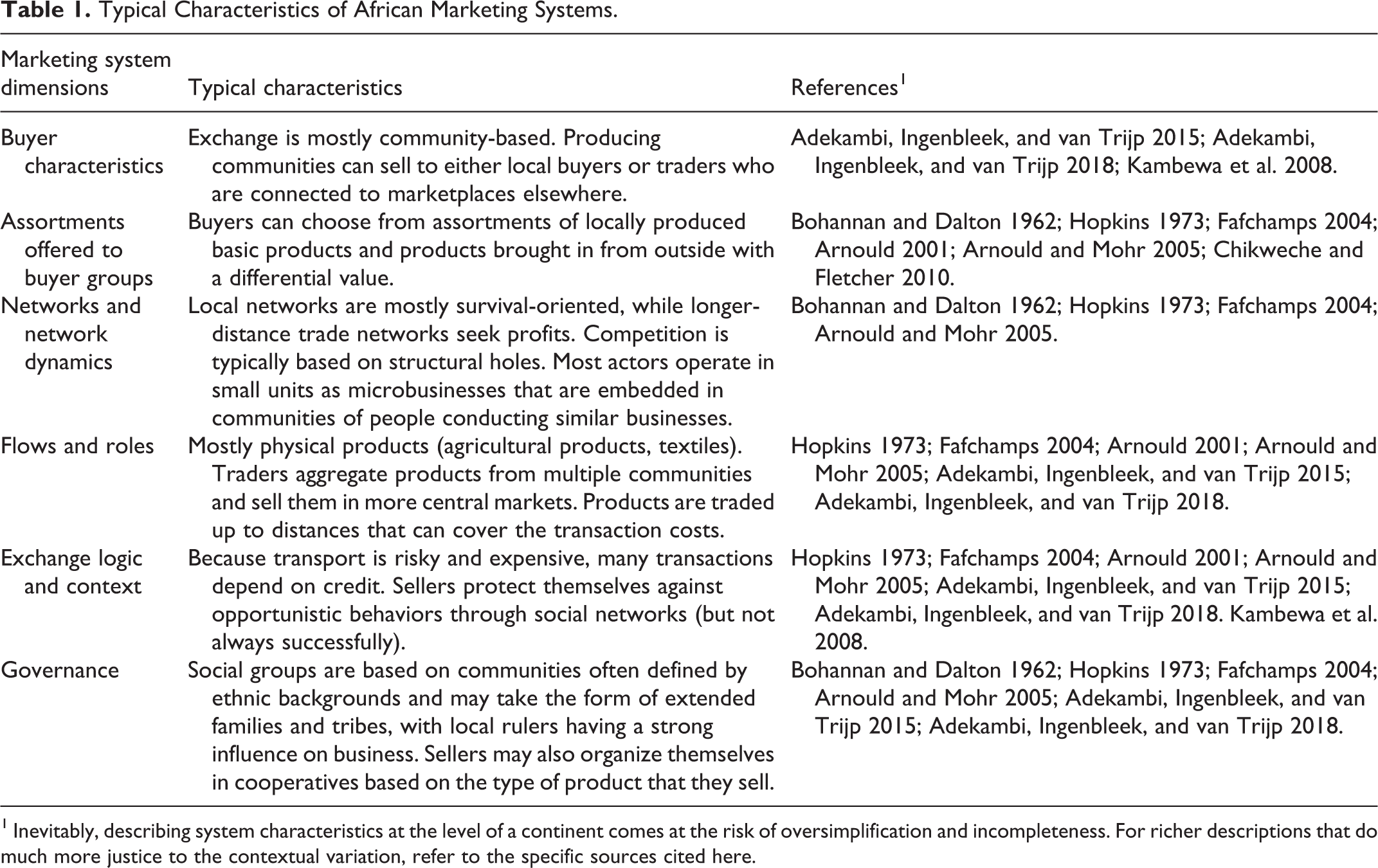
1 Inevitably, describing system characteristics at the level of a continent comes at the risk of oversimplification and incompleteness. For richer descriptions that do much more justice to the contextual variation, refer to the specific sources cited here.
To summarize the content of Table 1, the literature suggests that African marketing systems typically trade basic products, such as agricultural outputs, food, textiles, body ornaments, and body care products. Many of the exchanges take place within communities or with nearby communities. Buyers from further afield may also participate, either to aggregate products in larger quantities for buyers from the formal sector or to obtain products that have a differential value elsewhere in Africa. Trade, therefore, takes place in a network of marketplaces at different levels varying from local (small) to central (large) markets, often established in capitals or at important road crossings (multi-level markets). The transportation of products is risky, and products travel from marketplace to marketplace essentially as far as the transaction costs can bear.
Competition between traders often takes the form of finding and maintaining structural holes (Burt 1992), meaning that traders maintain unique connections between buyers and sellers. The information asymmetry in these relationships can make both buyers and sellers vulnerable because, in the resource-scarce environment, many transactions take place on a credit basis. Buyers and sellers protect themselves through social relationships based on kinship or cooperative forms of organization. The system is connected to buyers and sellers outside of Africa through cities at the border of the Sahara, facilitating the trans-Saharan trade with North Africa and seaports at the Atlantic and Indian oceans.
The system has a clear distinction between formal and informal sectors, with the informal sector being particularly large and dominated by microbusinesses of a single, or at most a few, person/s. The formal companies can be large, and often have strong connections with governments. Despite their size, they often depend on informal-sector traders to purchase products from communities or to reach consumers in these communities.
To strengthen the consistency with the literature on African markets and marketing systems, this article uses the terms indicated above in italics as the typical characteristics that are then connected to biogeographical foundations. Table 1 explains how these characteristics connect to the marketing system dimensions.
Explanations for Differences between Marketing Systems
The literature offers several explanations for how marketing systems have developed into their current forms. Early research into marketing systems recognized that lower levels of economic development were associated with less advanced marketing systems (Cundiff 1982). These studies followed a so-called deterministic approach, in that they saw marketing as passively following economic development and seizing opportunities in markets where wealth had already increased (Hosley and Wee 1988). Additionally, researchers in history and other disciplines initially used deterministic approaches, albeit without much success, to determine convincing explanations for the differences that they observed. European explorers in the Middle Ages noticed differences in technology and the political, social, and economic organization between the people that they encountered and what they were accustomed to. These explorers assumed that the differences stemmed from innate ability (Diamond 1997). Darwin’s theory of evolution and later the discovery of genetics gave rise to social Darwinism as another frame to interpret these differences as forms of evolutionary origins and natural selection. Therefore, it was previously erroneously assumed that evolutionary processes would always lead to only one possible outcome (Wilson 2019).
During the 1970s, the formalist or activist approach suggested that marketing can make active contributions to development by making changes in marketing systems (Cundiff 1982). For example, Slater (1974) emphasized macro-level interventions in marketing institutions, such as cooperatives and marketing boards, the latter of which was widely implemented in Africa in the 1970s and 80 s in an attempt to modernize the smallholder-based agricultural systems (Van der Laan 1986). Others emphasized the importance of individual entrepreneurs or companies that, through their innovations at the micro level, collectively shape more complex and specialized marketing systems (see Wood and Vittell 1986 for a review of the older literature and Wilkie and Moore 1999 and Layton 2009 for more recent contributions).
While the formalist view emphasized the abilities of humans to build their own economic systems, attention paid towards the specific conditions that may constrain these abilities, which is central to deterministic thinking, faded. In this respect, the two different views complement one another. While African entrepreneurs, as with all entrepreneurs, integrate resources to create value and make changes to marketing systems, it is undeniable that these resources depend on what the African environment can offer. This context may eventually, perhaps not determine, but create the foundational basis to which humans should adapt their behaviors to survive and thrive. This is where the biogeographic and evolutionary approaches come in.
Theoretical Approach
Biogeographic Foundations
Diamond’s (1997) popular contribution, Guns, Germs and Steel, combines a biogeographical approach with ideas from evolutionary theory and the social sciences to explain the global differences in development resulting from the biogeographical advantages and disadvantages that stem from the relative positions of continents on the Earth’s surface. More specifically, Diamond compared the biogeographical differences between the east-west-oriented landmass of Eurasia and the north-south-oriented continents of the Americas, Africa, and South Asia/Australia. He argued that complex social orders emerged predominantly in Eurasia because the spread of agriculture across this landmass was fostered by the substantially larger availability of domesticable plants and animals (which could be adapted to human needs through selection and breeding). Plants, animals, and farming practices could spread along the east-west-oriented landmass because of its limited variation in climate and few barriers, such as oceans, dense rainforests, and deserts, which could hinder their dissemination. Diamond further argued that farm animals and their associated germs helped people in Eurasia to develop a higher tolerance for infectious diseases than, for example, the native American people, who were profoundly affected by these diseases after the Europeans arrived in 1492. The agricultural advantages stimulated food production and, in turn, population growth, followed by the development of more complex societies and states and their advances in script, armies, centralized power, technologies (such as seafaring, metallurgy, and the development of guns), and (though not mentioned by Diamond specifically), marketing systems.
Subsequently, researchers have added to Diamond’s ideas, tested them, and provided critiques. Frankema (2015) compared two north-south axis continents, Africa and the Americas, and as a result, added several new factors to Diamond’s (1997) ideas, such as Africa’s disease environment and geological structure, including the presence of mountain ranges. In economics, a growing literature emerged that quantitively tests the hypotheses posed by Diamond and seeks explanations for them (see Spolaore and Wacziarg 2013 for a more extensive review of these studies). Olsson and Hibbs (2005) found strong support for Diamond’s hypotheses regarding the geographic conditions of the continents, including their size, major axis, and climatic factors, which they conclude explain more of the variance of the contemporary development levels than the biological conditions (the number of animals and plants suitable for domestication at the location 12,000 years ago). Ashraff and Galor (2011) show that the biogeographical variables caused an early switch to agriculture which in turn spurred development.
A critique of Diamond’s work came from Acemoglu, Johnson, and Robinson (2001, 2002), who argued that European colonists introduced inclusive institutions (supporting the participation of all citizens) in regions where they encountered favorable biogeographical conditions (low mortality rates), low population densities, and low urbanization. In contrast, the colonists introduced extractive institutions (supporting the power and enrichment of rulers or a small elite) where they met unfavorable biogeographical conditions and/or entered regions with higher development levels that were difficult to control by a small number of colonists without repressing measures. As such, the authors argued that colonialism would have reversed the fortunes created by geography, and concluded that instead of biogeographical factors, the decisions of the colonists regarding whether to confront a society with inclusive or extractive institutions determined development (Acemoglu and Robinson 2012).
Because the effects of institutions cannot be empirically disentangled from other variables, their findings are open to other interpretations. Glaeser et al. (2004) suggested that, rather than the institutions implemented by the colonists, the effects may have been caused by the human capital that arrived during colonization: the knowledge, practices, and traditions that were transmitted from one generation to another. Other studies provide support for this idea, finding that historical legacies of populations matter more for current development levels than location (Putterman and Weil 2010). It was also found that technology adoption in 1500 CE, and even in 1000 BCE, can help to explain current development levels (Comin, Easterly, and Gong 2010). Finally, Easterly and Levine (2016) examined the effect of the European proportion of the population during colonization on income per capita, concluding that if any adverse effects of institutions existed, they must have been compensated for by other positives that Europeans brought with them, such as human capital and technology. In short, the evidence of why biogeographical factors influence development (and the associated marketing systems) moves towards an explanation based on human evolution.
Human Evolution
Evolutionary processes are based on individual differences and selection, so that the selected traits that enable an individual to perform better in their environment than others become the traits of larger groups (Wilson 2019). Over the past two decades, several important works have been published, in which evolution theories are central to the explanation of human development. These works cover fields such as cultural anthropology (Johnson and Earle 2000), history (Harari 2014), biology (Wilson 2019), and economics (Seabright 2004).
To understand how marketing systems evolved from biogeographical conditions, multiple interacting evolutionary processes should be taken into consideration. First, humans are the result of evolution in which the innate traits that made them successful in their environment were passed on through generations. Two of these traits that help to explain why humans would create marketing systems, include reciprocity and calculation (cf. Seabright 2004). Through calculation, humans can assess and trade-off the costs and benefits of their actions (Wilson 2019). Reciprocity is the ability to repay favors with favors and betrayal with revenge (I will help you, if you helped me in the past; if you do not help me, I will stop helping you). People that have both traits can see the benefits of exchange and eventually of enduring, trust-based relationships in which they collaborate with (exchange) partners. People who are only calculative will not be trusted, and those who are only reciprocal will be exploited by others (Seabright 2004).
Humans’ innate abilities may explain why humans are capable of building marketing systems, but not why these systems may differ. Differences between marketing systems stem from the differences in the environments from which they evolve. In this respect, evolution is also an individual learning process in which different practices compete, and the most successful practice “survives” (Wilson 2019). Anthropologists use the term adaptation to coin the process through which people make changes to their behavior so they perform better in their environment (Johnson and Earle 2000). Because groups living in different biogeographical conditions follow different development paths, human evolution is multilinear: it will logically evolve in different directions depending on the circumstances thus leading to different marketing systems. The geographical conditions are to this respect relatively stable over time, but biological aspects go through evolutionary processes themselves; for example, immune systems adapt to rapid microbial evolution in what is experienced by humans as the disease environment. If such an adaptation is successful, individuals may live longer and/or with greater energy (Wilson 2019).
The importance of the latter argument cannot be underestimated, because if people live longer and more energetically, they are more capable of transmitting the lessons learned to the next generation (for example, on which plants are edible and which are poisonous, or how to send a rocket to the moon). This process of so called cumulative cultural evolution distinguishes human adaptation from the adaptation of other species, as it enables us to change the values, norms, and practices of a group. Cumulative cultural evolution is the basic explanation for why humans were able to spread to and survive in almost all possible geographic and climatic conditions on Earth without evolving into different species (Wilson 2019).
Groups of humans should however not only adapt to the biogeographic conditions that they encounter. Each cultural group must adapt not only to their geography but also to the political and economic conditions created by other groups who are adapting to their own biogeographical conditions and may develop faster, slower, or simply in a different direction. They may, therefore, develop advantages over other groups that they force into their institutional system, or perhaps enslave or even kill (Johnson and Earle 2000). Diamond (1997) refers to this process as “engulfment”.
Most people lived in small groups, such as families, for the greater part of human history. Cumulative cultural evolution was relatively easy in these groups, because decision-making processes, incentives, punishments and norms could be implemented relatively efficiently and to everybody’s liking in support of group cohesion (Wilson 2019). Well-functioning groups would likely produce enough food to increase the size of their population and they would adapt to their increased size until they reach a resource threshold (Johnson and Earle 2000; Harari 2014). After reaching the threshold they must expand their resource base, for example through warfare or by inventing or adopting new technologies to intensify food production. Both solutions bring risks that can be managed by a leader or ruling elite that establishes institutions, makes political arrangements with other groups, organizes and distributes control over the storage of food, materials and capital, as well as trade relationships. Groups that keep growing may not only build more complex marketing systems, but also evolve into states. States incorporate large, ethically and economically diverse populations, have a system of property rights, institutions, bureaucracy, an army, law enforcement, and ceremonies and symbols that may legitimize the distribution of resources that facilitate the growing complexity and specialization in the economy (Johnson and Earle 2000).
The evolutionary path towards larger, more complex societies is however full of hurdles. When groups grow larger, the mechanisms that were designed to support group living may no longer function, because they were never designed to secure the internal functioning of large groups or even states. In this respect, the learning process at a societal level would first lead to failures, because leaders are first likely to develop extractive institutions that benefit the elite at the expense of the rest of the group (Acemoglu and Robinson 2012), and in the dynamic process of increasing group sizes always new fractions may come up that seize control merely for self-interest (Wilson 2019). When different marketing systems therefore start to connect, conflicts and issues may evolve before people learn how to integrate the systems in a way that fosters their mutual development. Understanding the origins of the systems can perhaps speed up the process.
African Biogeography and Its Consequences
To portray the evolutionary chains of causation that trace proximate factors back to the ultimate biogeographical “factors underlying the broadest patterns of history,” Diamond (1997, p. 83) used a causal flow model showing the key factors in the line of argumentation. In the same fashion, Figure 1 shows the causal chains that connect the ultimate biophysical factors of Africa to the more proximate marketing system characteristics discussed earlier.
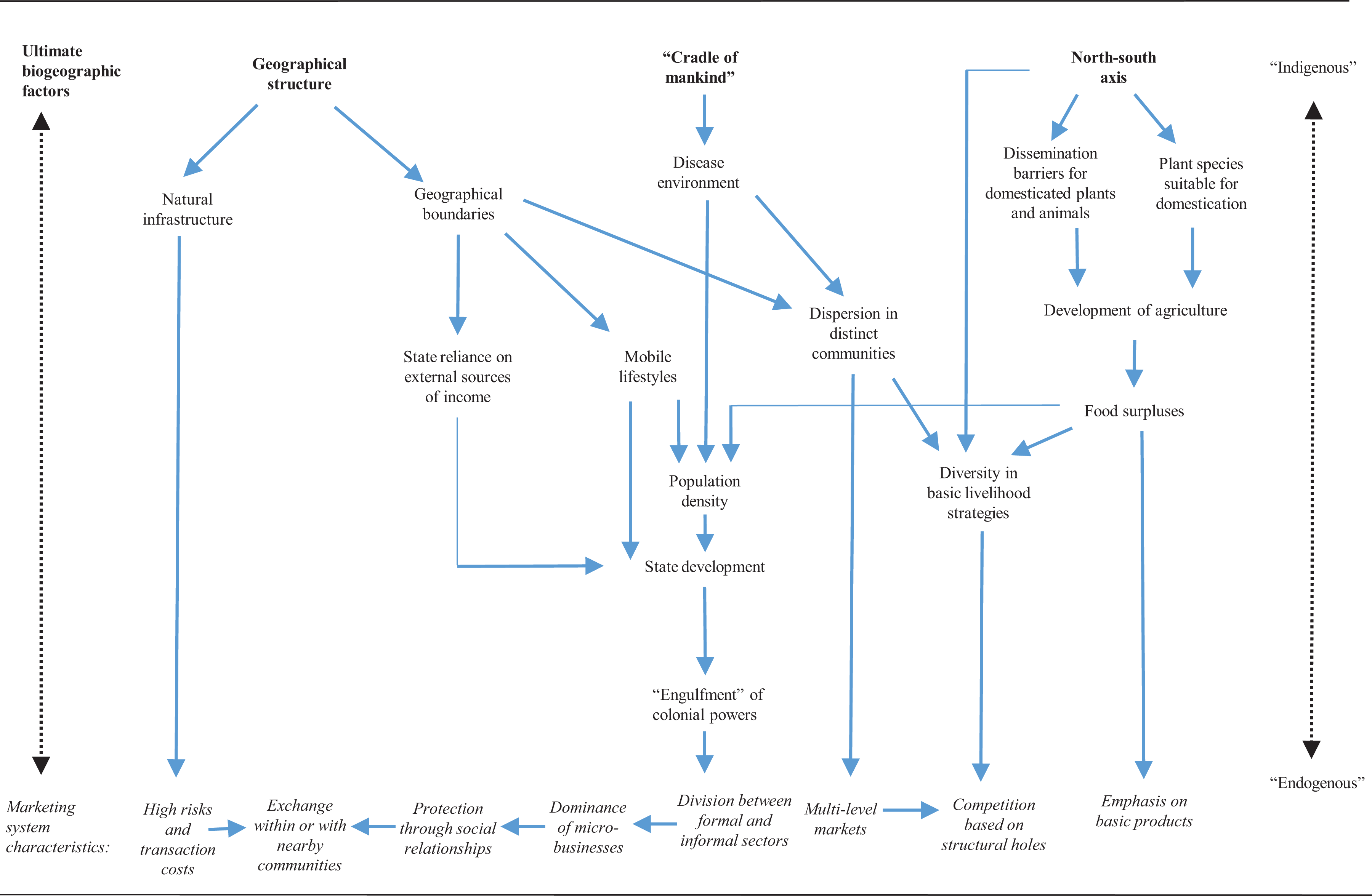
Factors underlying the typical characteristics of African marketing systems.
To understand the ultimate biogeographical factors, consider the situation 250 to 210 million years ago. At this time, approximately at the location where Africa is currently situated, the Earth’s single supercontinent Pangea was located, surrounded by a single ocean. During the Jura era, 201 to 145 million years ago, Pangea began to disintegrate under the pressure of tectonic forces in the Earth’s crust (Rogers and Santosh 2004). The supercontinent first split into two, with North America and Eurasia becoming the northern part, and Africa, South America, Antarctica, India, and Australia comprising the southern part. Around 160 million years ago, the southern group of continents were located at the position of modern-day Antarctica, after which Africa, India, Australia, and South America split from this mega-continent and began moving towards their current positions (Merali and Skinner 2009). Before India collided with Asia, it lost an area of land that was retained on the African tectonic plate, now known as Madagascar.
The breakup of Pangea created the continents as they are known today. This event determined the size, orientation (north-south or east-west), climate, amount of sunlight, and rainfall of the different continents. The event also had a substantial impact on the evolution of plant and animal species, the time at which the continent would become populated by humans, and the growth speed of that human population. It therefore helps to understand the developments that covers about one-fifth of the Earth’s land surface (30,365,000 square kilometers) that we know as Africa.
Comprising a distance of about 8,000 kilometers from the most northern point of Tunisia to the most southern point of South Africa, the main orientation of Africa is north-south. Africa is centered around the equator, with the major part of the continent being tropical (situated between the tropics of Cancer and Capricorn). Consequently, the continent covers multiple climatic zones that symmetrically fade into each other from a central point around the equator and extend to the northern and southern temperate zones. In the wet equatorial climate in the center of Africa, tropical rainforests emerged, while in the north and south, the forests give way to savannah grasslands, semiarid lands, and hot desert climates in the Sahara and Kalahari deserts. The Sahara dried to approximately its current size at around 4200 BCE when the monsoons retreated to their current positions due to long-term climatic changes (Houérou 2008).
Factors such as ocean streams, rainfall, altitude, mountain ranges, and urban settlement create further deviations in this rough pattern of climates. On the northern side, the widest distance between the most western point in Senegal and the most eastern point in Somalia is 7,400 kilometers, a distance that, being far from the nearest coast, creates a climate for desert areas further inland, causing decreased rainfall (Smedley et al. 2018).
In terms of its geological structure, Africa’s most prominent mountains are found near the rift valley in East Africa (e.g., Kilimanjaro, Mount Kenya, and the Ethiopian highlands). Around the same rift, large lakes, such as Lake Victoria and Lake Malawi, can be found. More generally, and disregarding mountain ranges such as the Atlas Mountains in Morocco and the Drakensberg in South Africa, geologists tend to consider Africa as a vast plateau (Smedley et al. 2018). The majority of the surface of Africa is not divided by mountain ranges, nor by navigable rivers (again with notable exceptions, such as the Nile and Niger). With relatively few river mouths, the 30,500-kilometer coastline is relatively straightforward, with few bays or inlets, and is shorter in length than the coastline of Europe.
Over time, Africa became a fertile breeding place for primates and subsequently became known as the “cradle of mankind.” Our human ancestors lived in forests similarly to closely-related primates, such as the bonobo and chimpanzees. As the first hominids were both capable of climbing trees and walking on two legs (bipedalism), it seems that they developed bipedalism before applying it when they moved from the forest to the savannah (Green and Zeresenay 2017). Standing upright is advantageous for reaching food in trees, freeing hands for carrying food, scanning the field for enemies, and scaring enemies by appearing bigger, among other benefits (Dean 2000).
A recent theory suggests that Homo sapiens did not evolve from a single African population in East or South Africa, but that its origins more likely were multiregional (Scerri et al. 2018). Going back at least 500,000 years, groups of Homo sapiens with substantial genetic differences lived all over Africa, encountering each other rarely due to the vast distances or hindrance by barriers, such as dense rainforests. During the stone age, about 300,000 years ago, different groups also developed different stone tools. Modern human traits, such as rounded skulls, slender faces, and protruding chins, would have evolved from interactions between the separated groups between 100,000 and 40,000 years ago (Scerri et al. 2018). Though the geological structure and north-south axis of the continents probably contributed to the conditions that eventually brought forward the modern appearance of Homo sapiens, the exact role of these factors has not yet been fully elucidated. Therefore, in this causal flow model, “the cradle of humankind” is taken as a separate biogeographical factor.
In summary, after its birth out of the supercontinent Pangea, Africa was endowed with at least three biogeographical traits that would impact the development path of its inhabitants, namely its geological structure in terms of mountains, open waters, and coastline; the fertile climate for primates; and the fact that its main continental axis is north-south. This review will further discuss the consequences of these traits in order.
Geological Structure
The early Africans adapted to the geological structure of their continent in several ways. First, with relatively few navigable rivers, no inner seas, and few natural harbors, the emphasis of all transport and trading activities was highly dependent on land routes. Given the climatic conditions of Africa, such routes crossed dense rainforests where pathways are quickly overgrown by vegetation, savannah lands where travelers were easy prey for predators, and deserts where extreme temperatures and navigation pose major challenges. Crossing any of these zones between the east and west would already come with many risks, let alone crossing in the northern or southern direction. Over time, people discovered ways to overcome these barriers, such as navigating through the desert based on the positions of the stars with protected caravans (Hopkins 1973). This knowledge was passed down through generations, but these innovations could not prevent the difficulties and dangers that were faced when traveling long distances. Where the services of specialized guides and protective caravans were required, these may have come at a high financial cost.
In modern marketing language, this long-distance trade would be described as incurring high transaction costs. Consequently, the majority of exchange took place in the relatively safe and nearby environment of local communities, and perhaps neighboring communities with whom enduring relationships had been built. For the average African, foraging, and later small-scale farming, were logical adaptive livelihood strategies because, for most Africans, a career in trading was not an option. An estimated 600 million African farming households still mainly produce food for their consumption, and setting aside small portions for buyers (Rockefeller Foundation 2011).
Because evolution is also an individual learning process, it is expected that some individuals would have explored new strategies to build or improve their business. They would discover areas that offered relatively unique products and others that demanded such products. Goods would travel as far as their transaction costs could bear; therefore, the most valuable products crossed the longest distances (cf. Fafchamps 2004). Throughout African history, these included gold, diamonds, ivory, and salt (Hopkins 1973). At the same time, adaptations were made that reduced transaction costs, such as trust-based relations that were transferred to the next generations. Some communities would make it their specialization to organize markets and protect trade-routes as a source of revenue (Hopkins 1973). Though the scale and size of long-distance trade, and the empires built on its revenue, can be impressive (Casely-Hayford 2012), on a global scale these were merely small corrections to a geographical structural disadvantage.
Second, with a relatively large share of the land consisting of open plains without noteworthy geographical boundaries, living in remote communities was a safe strategy to minimize the chance of violent encounters. In a study conducted within Africa, Nunn and Puga (2007) found a strong effect between land ruggedness and current development levels, which they saw as evidence for the protection that mountains and natural barriers provided against slave raids. In the absence of such barriers, the safest places to live were far from the primary passages used by travelers, some of whom may have had bad intentions.
An even safer option than settling in a remote place is to keep moving, as pastoralists do, which is still a prominent lifestyle, particularly in the Horn of Africa and Sahel (in Ethiopia alone the pastoralist population is estimated to be 12 million [Getahun 2008]). With marginal conditions making agriculture extremely difficult or sometimes impossible, people adapted to these conditions by building their livelihoods on keeping herds of cattle, camels, sheep, and goats that they could move from one place to another, thus allowing the vegetation to recover after they had left. The prominence of this mobile lifestyle has two consequences. First, mobile lifestyles are associated with lower birth rates (Frankema 2015; Harari 2014), thus resulting in lower population densities. Second, mobile lifestyles divert development away from the development of states and economic specialization. Because the highest cultural virtue of pastoralists is to increase the size of their herds, they often only sell animals out of necessity for cash or because natural conditions require smaller herds (Teklehaimanot et al. 2017). Throughout the generations, they have developed hierarchical structures and enforce rules to ensure the common grazing lands will not get depleted.
While living in a remote place may be a relatively safe strategy for keeping dangerous people at bay, it also hinders the process of state-building as it is more difficult to retain people. Worldwide, most ancient states therefore emerged in places with circumscribed land (Frankema 2015). Within these natural boundaries, rulers could develop institutions to centralize power, tax farmers, and raise armies (Johnson and Earle 2000). The people who were taxed and recruited for armies were discouraged from leaving by the natural barriers they had to cross (Frankema 2015). African rulers instead had to cope with people being able to leave easily, something that would not be unlikely if the leadership became extractive as the groups grew larger (Wilson 2019). The groups that developed state-like features found external sources of income to finance themselves; for example, by controlling mineral resources or trade routes (Hopkins 1973). In this respect, the states functioned as businesses that generated income for their people, rather than creating institutions for the people to effectively run their businesses and pay part of their profits as taxes to the state. Major trading cities in the Trans-Saharan trade network, such as Gao, Djenne, and Timbuktu, for example, also lacked the signs of centralized power or group cohesion, such as palaces, temples, or pyramids. These cities instead consisted of scattered villages, the population numbers of which could substantially fluctuate depending on whether trade was “on” or “off” that season (see also Hopkins 1973).
Cradle of Mankind
The fact that Africa was a fertile breeding place for new types of primates and later hominids and a variety of Homo sapiens is of importance because it gives rise to a significant biological factor, namely the evolution of germs that spread diseases. Many evolutionary ancestors of Homo sapiens were present in Africa and as a consequence human pathogens could simultaneously mutate and spread throughout Africa for millions of years (Frankema 2015). Consequently, when the first humans began to move out of Africa, they enjoyed a relatively disease-free environment (McNeill 1976; Reader 1998). Nine of the ten most severe epidemic diseases in the “Old World” originated from wild animals that were widespread in Africa. Of these diseases, smallpox, tuberculosis, malaria, yellow fever, and dengue fever can be traced back to sub-Saharan African wild animal sources. Many Europeans who arrived on the coast and settled in Africa suffered from these diseases because they lacked genetic resistance (Frankema 2015).
The disease environment forms part of the explanation for the differences in population growth across the continents. Frankema (2015) computed that the evolutionary growth rates up to the year 1500 were much smaller in Africa than in Eurasia (three times greater than Africa) and especially the Americas (eight times greater than Africa). According to estimates, Africa was inhabited by approximately 1.7 to 3.4 inhabitants per square kilometer in the year 1500 (if the Sahara is omitted, this number rises to 1.9 to 3.8). By comparison, in the same year, the number of inhabitants per square kilometer was 6.6 in Eurasia, with Western Europe, India, and Japan being as high as 16.3, 36.7, and 37.5, respectively. Central and South America and North America are estimated to have contained 0.8–3.6 and 0.2–1.2 inhabitants per square kilometer, respectively. Humans arrived in the Americas approximately 12,500 years ago, while Homo sapiens appeared in Africa 200,000 years ago; thus, despite its head start, by the year 1500 Africa had become one of the least densely populated places on Earth.
Alongside the previously mentioned safety reasons, the African disease environment is an additional explanation for the dispersion of distinct communities on the continent. As large population groups are more vulnerable to crowd diseases, it is, in an evolutionary sense, logical to expect that people would eventually live in more dispersed, smaller communities. Large population concentrations of 10 people per square kilometer were, therefore, most likely absent in sub-Saharan Africa for a long period of history (Frankema 2015). If the number of languages present is taken as an indicator for dispersion, with an estimated 1,250 to 2,100 spoken languages in Africa (Heine 2000), about a quarter of all languages are spoken only on this continent (Diamond 1997).
Life in dispersed communities has at least three consequences. First, dispersion in distinct communities leads to greater diversity in livelihood strategies due to multilinear evolutionary processes. A greater differentiation is expected, not only in languages but also in consumption, what people eat, how they dress, and the tools they make to survive or to make life easier (Sheth 2017). As early as the stone age (about 300,000 years ago), different groups of Homo sapiens had already developed different stone tools (Scerri et al. 2018). The likely explanation for this is that, because conditions differed, the needs, the available materials to fulfill these needs, and learning processes, all varied between locations, leading to different tangible outcomes (this point will be returned to in the next section).
Second, dispersion in distinct communities also has consequences for the structure of the marketing system. Traders learned that aggregating small production amounts of agricultural surpluses from different communities into larger quantities was a viable strategy to sell to buyers with higher levels of demand. This type of demand was found in communities where such products were not found, and later from traders connected to the European or Asian ships arriving at the coast. This, in turn, explains the typical system of markets at multiple levels, varying from small and local marketplaces where small-scale traders would meet producers from nearby communities in regional markets evolving, for example, at important road crossings, to eventually large and centralized marketplaces in capitals. In the central marketplaces, either large buyers purchase the entire quantity to be transported elsewhere, or the quantity is again disaggregated in different directions (Fafchamps 2004). As such, the same market system can be used in reverse to eventually reach consumers in dispersed communities.
Finally, the fragmentation along ethnic, lingual, and religious lines, among other factors, as outcomes of different cultural evolutionary processes, which is still typical for many parts of Africa today, has been suggested by several authors as a barrier to the evolvement of larger cohesive groups and state development (Alesina and La Ferrara 2005; Casey and Owen 2014; Easterley and Levine 1997). These barriers hinder the exchange of ideas, norms, and institutions that can create cohesion in larger groups (Wilson 2019). As such, remote communities living in relative separation could maintain their lifestyles for many centuries without significant changes (Johnson and Earle 2000).
North-south Axis
Diamond (1997) presented the north-south axis as the primary explanation for the different levels of development across continents because it creates dissemination barriers for domesticated plants and animals. These plants and animals are, in turn, crucial for the spread of agriculture, which is needed to increase food production and support population growth en route to states with higher levels of political organization, technology development, and literacy (Diamond 1997; Johnson and Earle 2000). The dissemination barriers are, in Africa’s case, considerable. Crops, such as barley and wheat, were imported into North Africa from the Middle East where they were first domesticated, but require winter rains that are typical for temperate climates and would therefore not grow south of the Sahara. People living in sub-Saharan Africa had to domesticate their own plants, such as sorghum and pearl millet, that are adapted to less variation in day length and summer rains. The farming practices for these plants disseminated across the Sahel from east to west but not much further south. Cattle imported from Eurasia did not spread across the forest belt because they could not survive the tsetse flies. These factors constrained the advancement of agriculture and food production (Diamond 1997).
The north-south axis placed another constraint on African food production; it left Africans with fewer choices of plants to domesticate. While the variation in vegetation is considerable across the zones of Africa (e.g. Meredith 2014), the variation within each zone itself is smaller than in Eurasia for the simple reason that the landmass of each zone is smaller. The larger landmass of Eurasia offers more species in almost any plant- or animal-based category (Diamond 1997). Take the example of grasses; less than 1% of the total number of grass species (56 in total) have seeds large enough to be suitable for domestication for agricultural use (Diamond 1997), including barley and emmer wheat. Of these 56 species, only six originally evolved in sub-Saharan Africa. Six species is perhaps still a sufficient number, but the chance that any of them were discovered and successfully domesticated is much smaller when compared to the 33 that appeared in Western Eurasia (including North Africa) (Blumler 1992).
Animals are important for human development for many reasons. They provide meat, milk (and with that a basis for other dairy products), leather, wool, plow traction, transport, and can be used in the armed forces (Diamond 1997). The guinea fowl is, however, the only animal which we can be sure was domesticated in Africa. None of the large mammal species, of which Africa has 51), such as zebras, wildebeests, rhinos, hippos, giraffes, or buffalos, were domesticated (Diamond 1997). None of the 14 main herbivorous domestic mammals, including the five most productive ones (sheep, goats, cows/cattle, pigs, and horses), were indigenous to Africa (Diamond 1997).
The constraints on food production hindered population growth in Africa. It is likely that communities would move to (or began in) places where natural resources were favorable to build a livelihood specifically adapted to the local environment. Lakes, rivers, and coastal areas with reasonable fishing grounds started to host groups that would evolve into fishing communities, while in other communities hunter-gatherers would specialize in understanding the flora and fauna in their neighborhoods. Communities across Africa would also develop conservation and processing practices adjusted to the specific attributes of the foods. Groups that had access to resources that were of value to others could potentially benefit more from sales than from their own direct consumption, as was the case for communities with mining resources, such as gold and diamonds. Specific fruits, vegetables, and processed goods, such as shea butter and textiles, were traded on a more modest scale. These so-called endogenous products are often restricted to specific ecological zones and/or manufactured with specific artisanal practices developed over many generations (Babah Daouda, Barth, and Ingenbleek 2019). As such, food scarcity, in combination with the natural diversity related to the north-south axis, contributed to the diversity of communities in Africa and the emphasis on basic products in the African marketing system.
The diversity that evolved from multilinear evolutionary processes in the different communities would logically have stimulated traders to move around to find places selling something of value for their home community or for other buyers. The diversity between communities thus leads to the hypothesis that in order to extend assortments, the most rewarding strategy was to search for communities that could offer something different. In an environment with substantial diversity between communities, trade became an opportunity for making a living, especially if the sources of the products were not transparently available to everyone, thus creating structural holes. More so than production or technological development, trade was, therefore, the basis for developing a business. Many indigenous African languages do not have a word for business. Instead, they refer to business as trade, thus assuming that a business can only be a trading business. In Northern Benin, the word for “company” means literally “the building where they trade.”
There are some noteworthy exceptions to the general picture of dissemination barriers and diverse communities that did not manage to build enduring states. In Ethiopia, farmers domesticated a number of crops that are particularly suitable to the highland climate, including teff, ensete, chat, and coffee. To date, Ethiopia is one of the most densely populated countries in Africa. It has a long history of centralized government and developed its own script and calendar. In Madagascar and East Africa, Asians landed between 300 and 800 CE and brought Asian yams and banana, after which these two crops were disseminated widely and are now generally seen as indigenous. In West Africa, farmers domesticated cola nuts, (African) yams, African rice, and palm-oil trees. Farming practices enabled Khoisan-speaking tribes from modern-day Nigeria and Cameroon to “engulf” pygmy homelands further south in around 3,000 BCE. They also moved east and arrived at the great lakes about 2,000 years later, and then towards in the direction of South Africa.
The “Engulfment” of Africa
The mobile lifestyles of many Africans, the unfriendly disease environment in which they lived, and the limited food surpluses had kept the population density on the African continent relatively low. Together with the reliance of early states on external sources of income, the mobile lifestyles and low population density left Africans with a relative disadvantage compared to European powers. The Europeans arriving in Africa in the fourteenth century had developed relatively higher levels of political organization, technology, and literacy. These are elements that Diamond (1997) sees as crucial for one group of people to “engulf” another. Europeans built ships and started to explore the African coast, build settlements, and organize a permanent presence of traders and armed soldiers. Their trading presence would lead to an intensification of trade, the emergence of the Atlantic slave trade, and, after the abolishment of the slave trade in the 19th century, an eventual colonial invasion of the continent.
Around the year 1800, development began to accelerate with the industrial revolution in Western Europe. International trade intensified, and the level of business activity in Africa grew with it. The first signs of a more diversified economy started to appear during the last decades of the nineteenth century (Allen 2011). In the eyes of Europeans, coastal trade had reached its limits. The subsequent colonization interrupted the organic development of African marketing systems. During the Berlin Conference of 1884–85, the colonial powers drew boundaries on the African map. Geographical boundaries had, until then, been mostly irrelevant because labor, not land, had been the limiting production factor.
The colonial system had a relatively straightforward business model in that it focused on a selected group of minerals and cash crops, such as palm oil and cotton. These mono-crops were valuable input materials for the emerging European industries of manufactured consumer goods. These manufactured goods could in return cater to the emerging demand of a new African workforce of civil servants in the colonial institutions and producers of cash crops. The colonial administrators tried to unlock the production capacity and purchasing power of agricultural producers further inland with railroads (Hopkins 1973).
Though colonial rule initially brought improved welfare and higher living standards to some parts of the African population, it also introduced a division between the formal and informal economic systems. The formal system constituted the businesses related to the European companies that created the colonial economic systems, while the informal systems largely constituted the economic activities that had been developing in Africa before colonization. Men were often employed in the formal sector, while women sometimes took over the (informal) businesses (Hopkins 1973). Some activities continued informally without government support, although others were prone to extractive institutions, in that activities were discouraged or forbidden if they potentially competed with the interests of companies of European colonizers. In many colonies, Africans had to purchase expensive licenses before they could trade, and some goods they were not allowed to trade at all. In Uganda, for example, Africans were not allowed to export coffee due to an Act created in 1930. Comparable measures were taken to discourage commercial farming. In Kenya and northern Rhodesia, non-Africans were restricted in the amount of money they could lend to African businesses. While on the one hand, this may have been intended to protect Africans from high debts, it also restricted business development (Kennedy 1988).
After decolonization, the distinction between formal and informal activities remained. The economic policies of the post-colonial governments often aimed to create jobs through investments in industry. More recently, many African countries adopted policies to remove trade barriers, thus improving conditions for businesses to seize new opportunities. In an empirical study, Michalopoulos and Papaioannou (2010) found that in Africa, national institutions have little impact on the economic performance of the ethnic groups that live on different sides of a border. Their findings suggest that the long-term features of populations, including the marketing systems built over many generations as an adaptation to biogeographical conditions, seem to affect development more than national institutions do.
Discussion and Implications
In this article, I have identified the typical traits of African marketing systems and connected them to three biogeographical factors, namely Africa’s geographical structure, Africa as the birthplace of humankind, and the main-axis of the African continent being north-south rather than east-west. The inhabitants of Africa had to adapt to these conditions, and in these human evolutionary processes they gradually built marketing systems of which the typical traits are still often recognizable. For many centuries, the biogeographical foundations have directly or indirectly placed important constraints on the development of African marketing systems.
Over the past few decades, the impact of these foundations has fundamentally changed. First, the impact of the natural infrastructure is being addressed with significant investments in road infrastructure, among others, through projects led by the United Nations and Chinese investments (Brautigam 2015). With roads, other vital services can be disseminated, such as irrigation pipelines, electricity, standardized consumer products, supermarkets, and online connectivity. Second, though there is substantial variance within Africa, progress is being made with state formation. Several African states are finding ways to combine open market policies with the improvement of internal institutions (Meredith 2005). Third, the most considerable change is probably taking place in the disease environment with the reduction of infectious diseases and infant mortality. Population growth is therefore steeply increasing, leading to a market size that starts to pull towards specialization in marketing systems (Frankema and van Waijenburg 2018). In particular, the urban environments are rapidly becoming more densely populated with more complex economies (Economist 2010). Fourth, the dissemination of plants no longer requires an organic diffusion process, but is now supported with substantial research to bring in foreign species and develop underutilized local species for commercial value (Dansi et al. 2012).
The biogeographical and evolutionary perspectives aid our understanding of how fundamental these changes are. In the rapidly changing environment of the past few decades, new opportunities, as well as potential threats, are emerging for businesses and entrepreneurs. These entrepreneurs are making changes to African marketing systems by extending the product assortments for the growing populations and adding new layers to the system as they seize opportunities in business markets (Babah Daouda, Ingenbleek, and Van Trijp 2019). At the same time, new foreign entrants are attracted to Africa from both the traditional trading partners in Western Europe and Northern America and other, rapidly developing, countries, such as India, Brazil, and China. While these entrants may contribute to the growth of the African economies in general, they may also threaten the upcoming African companies in their existence once market growth curves start to flatten and markets become more competitive. One of the most important questions to consider therefore is how can African businesses create a position of competitive advantage.
The framework in Figure 1 provides some direction in this respect, though more research is necessary to develop these directions into evidence-based marketing strategies. First, African firms have a potential advantage over foreign entrants for any business that comes with high transaction costs. Transport costs are a source of successful exploitation by African firms, particularly for building materials, such as cement (cf. Akinyoade and Uchi 2017). Another source is the diversity of livelihoods that produce many products with which consumers may have positive associations because they originate from their country or region of origin. These products include manufactured skincare products such as shea butter, endogenous fruits and vegetables that are usually not found in Western supermarkets (Dansi et al. 2012), and cultural products such as textiles. Though such products are already produced and sold by informal-sector microentrepreneurs, the challenge is to grow or manufacture them with a stable quality under an equitable brand name so they become attractive for the growing middle classes. The authenticity of these products may increase further if they can be connected to specific origins in rural parts of Africa (see also Babah Daouda, Barth, and Ingenbleek 2019). Possibly, African entrepreneurs who originate from those areas may feel supported to organize enduring access to supplies from those areas using their social or kinship ties. From a policy perspective, this means that African countries should not only give way to large-scale agriculture and upscaling projects leading to greater similarity between communities. Though such projects may be necessary to provide food for the growing populations, it is also important to cherish the heritage as potential sources of competitive advantage for endogenous African firms.
It is also important to recognize the disadvantages emerging from the path dependency of the system. In most African countries the traditional distinction between the formal and informal sectors can still be easily recognized. While the established, large, formal-sector corporations may be important employers, they are not always in the best positions to recognize and seize opportunities in the rapidly changing environment. The creation of supportive environments for entrepreneurs to start their business informally but grow and formalize it over time without encountering too many bureaucracy barriers is, therefore, essential (Babah Daouda, Ingenbleek, and Van Trijp 2019). The dispersion of communities in rural areas is another key characteristic that evolved from the past. To connect rural communities in the value chains of emerging African businesses, the information streams in the trade network should improve, so that all participants receive customer feedback on their achievements as a source of learning and competence development (Adekambi, Ingenbleek, and van Trijp 2015). Interrelationships between business and government are logically explainable in a regulatory environment still under development. Such practices may have some roots in the external financing of states that go back a long way in African history. It should therefore be considered whether firm competences of interrelating with government and politics are the most important ones to help African businesses create sustainable competitive advantages and flourishing economies.
Theoretical Implications
Our case description has some implications for marketing theory. First, the biogeographical approach has some commonalities with deterministic approaches to marketing systems, namely that the current state and appearance of marketing systems can be traced back to factors that cannot be changed. No other factors are as immutable as the fundamental biogeographical characteristics on which the marketing systems are built. The approach does, however, leave room for formalist ideas, in that people can intervene in the direct consequences of their biogeographical foundations. The path-dependency perspective to marketing systems, as introduced by Layton and Duffy (2018), creates an important basis to bring these perspectives together to understand how the past has created the marketing systems we observe today. The human evolution approach, as applied in the current article, offers theoretical ideas on change processes that further assist our understanding of path-dependent processes.
Second, several African business scholars have recently questioned the nature of African firms, especially compared to the foreign entrants arriving to take their share of the growing African markets (Lituchi et al. 2013; Zoogah 2008). They often refer to the African businesses as “indigenous,” which may correctly apply to the origins of the business owners, but in many cases not so much to their business practices, products, distribution systems, and competences. There are considerable influences from abroad in terms of new managerial approaches, system interventions, and even species that are prominent in Africa but are not indigenous, such as chickens, pigs, cattle, pineapples, and bananas. For businesses building on these elements, the term “endogenous” may be more appropriate (Ingenbleek 2019). The biogeographical approach helps to distinguish these terms. As indicated in Figure 1, the term indigenous is more applicable when origins can be traced more closely to the biogeographical foundations, while the term endogenous determines origins into the social, technological, biological, and economic/marketing systems that were built on those biogeographical origins.
Third, the case of Africa clarifies that biogeographical factors are more than just one category in the list of factors that comprise a social matrix within which marketing systems develop. Instead, they are the fundamental factor from which social matrices evolve, ultimately giving us an understanding of why marketing systems at aggregate levels have the characteristics they do. In Africa, humans adapted to the geographical structure, disease environment, and north-south orientation in ways that affected, among others, their culture, socio-economic conditions, and power relations. In this respect, the case of Africa shows the importance of taking path dependency into account in the analysis of marketing systems.
Conclusions
In conclusion, the typical characteristics of African marketing systems can be traced back to fundamental biogeographical factors. While these factors created a unique development path, the most important structural constraints have been considerably reduced in the past few decades. These improvements have allowed for a greater emphasis in a formalist fashion in which policymakers and entrepreneurs can make changes to the marketing system, and with that bring changes to the welfare levels of Africans. Looking into the past may help endogenous African firms to see potential pitfalls and opportunities, and build on the advantages of the system that they are a part of.
Footnotes
Acknowledgments
The author thanks the African Studies Centre Leiden for inspiring discussions with researchers there while he was visiting. The insights obtained during the visit have contributed to this article in many ways. Special thanks goes to Marleen Dekker, Chibuike Uche, and Michel Doortmont. He also thanks Desalegn Gigussa for comments on an earlier version of this article and the editorial team for their constructive comments.
Declaration of Conflicting Interests
The author(s) declared no potential conflicts of interest with respect to the research, authorship, and/or publication of this article.
Funding
The author(s) disclosed receipt of the following financial support for the research, authorship, and/or publication of this article: the author thanks the Social Science Group of Wageningen University for supporting this research with a grant from the Excellence Fund.
