



Abstract
Public administration scholars have extensively explored organizational scandals through two lenses: (1) inside stories of organizational scandals examining the main causes of scandals and (2) the effects of scandals on trust in government, trust in governmental officials, and public financing. Yet, we know little about how organizational scandals affect government employees’ work attitudes. Understanding how public employees react to organizational scandals deserves scholarly attention because public employees not only execute their agencies’ key functions and programs but are involved in actively addressing the organization's failures. To address this gap, we apply a quasi-experimental approach using the 2014 Department of Veterans Affairs waitlist scandal, with a specific focus on the effects of the scandal on employee job satisfaction and perceived organizational attractiveness. Empirical results using the Federal Employee Viewpoint Survey from 2011 to 2017 show that the organizational scandal had a negative effect on both outcomes.
Keywords
Introduction
In April 2014, news of a scandal within the Veterans Health Administration (VHA) made national headlines. The scandal centered on allegations that employees were falsifying data regarding the wait time to see doctors at Veterans Affairs (VA) hospitals, starting with allegations at a Phoenix VA hospital and then spreading to multiple VA facilities across the United States (American Legion, 2014). An internal audit report of the VA later discovered that more than 120,000 veterans were left waiting for care or had never been served, leading to the deaths of 40 veterans (VA Office of Inspector General, 2014). Actual wait times were on average 115 days long; much longer than the VA's 14-day waiting goal as well as the 24-day waiting period it falsely reported (VA Office of Inspector General, 2014). The scandal dominated news headlines for months: both the VA and its Inspector General were heavily criticized for downplaying the seriousness of the whistleblower allegations, and VA administrators were found to have maintained secret lists of actual wait times (Lopez, 2014a). The central question motivating this article is what effects, if any, do such organizational scandals have on the work attitudes of public employees.
Scandals—such as the VA waitlist example—are generally defined as “violations of accepted values and social norms, which are exposed through the media, [and] arouse public criticism and anger” (Huberts et al., 2022, p. 333). Public administration scholars have extensively explored two aspects of organizational scandals. The first line of research focuses on inside stories to investigate the main causes of organizational scandals (e.g., Eikenberry et al., 2007; Molina, 2018; Mujkic & Klingner, 2019; Nelson & Afonso, 2019; Patrick et al., 2018; Schneider, 2005). The second line of literature explores the effects of scandals on trust in government and government officials (Bowler & Karp, 2004; Solé-Ollé & Sorribas-Navarro, 2018; Wang, 2016; Zhang & Kim, 2018), government reform (Bozeman & Anderson, 2016; Grimmelikhuijsen & Snijders, 2016; Rauh, 2016), and public financing (Liu & Mikesell, 2019; Liu et al., 2021; Liu et al., 2017). However, despite the attention paid to the external effects of organizational scandals, research on the impact of scandals on government employees has gone virtually unexplored. Understanding how public employees react to organizational scandals deserves scholarly attention because public employees, as internal constituents, not only execute key agency functions and programs but are actively involved in addressing failures. Further, it sheds light on how public employees react to a negative external environment, identity threats, and reduced levels of public support, all of which have implications for motivation and organizational performance (Abner et al., 2020; Hameduddin, 2021).
To address this gap, the focus of this study is to assess the effects of organizational scandals on employee attitudes. More specifically, relying on the case of the 2014 VA waitlist scandal, we empirically investigate whether the scandal affected job satisfaction and the perceived organizational attractiveness of the VA among its employees. Our attention to both job satisfaction and perceived organizational attractiveness is not arbitrary: job satisfaction is a key antecedent of turnover and work attitudes such as individual commitment, absenteeism, and cooperative work behaviors (Hur & Abner, 2023; Judge et al., 2017), while perceived organizational attractiveness is a key predictor of turnover intention, employee engagement, and the likelihood that job applicants will apply to an organization (Abner et al., 2022; Gomes & Neves, 2011; Hameduddin & Lee, 2021; Slåtten et al., 2019). Despite its value, however, perceived organizational attractiveness has received little scholarly attention in the public management literature. By understanding the effects of organizational scandals on these two outcomes, we can identify how scandals affect the attitudes and behavior of public employees and the general desirability of public organizations as places to work.
Our research design utilizes a quasi-experimental approach, along with 7 years of data from the Federal Employee Viewpoint Survey (FEVS), from 2011 through 2017. Relying on difference-in-differences (DiD) estimation, we compare changes in job satisfaction and perceived organizational attractiveness among public employees working at the VA (which experienced the administrative scandal), against two control agencies [the Department of Agriculture (AG) and the Department of Justice (DJ)].
We first present the details of the 2014 VA waitlist scandal below, before turning to a theoretical model based on social identity theory and organizational identity threats. We then present the methodology and results and end with a discussion based on the findings.
The 2014 VA Waitlist Scandal: Overview and Effects
Under the authority of the VA, the VHA employs approximately 400,000 employees, with an operating budget of approximately $300 billion. The main mission of the VHA is to offer comprehensive medical care services to over 9 million veterans in more than 1,200 healthcare facilities across the United States. In 2014, allegations emerged that scheduling clerks at the VHA in Phoenix were instructed to falsify appointment wait-time data. The data were falsified to “make it appear as though the facility was meeting the VA's 14-day wait-time standard for veterans seeking appointments” (Molina, 2018, p. 872). Supervisors received performance bonuses for meeting the 14-day wait-time standard, and thus they had the incentive to game the system when their performance fell short. A subsequent investigation by the VA Inspector General's office found that the falsification of wait-time data was widespread across the VHA system (Molina, 2018; VA Office of Inspector General, 2014). Moreover, whistleblowers “alleged that up to 40 veterans had died because of delays in care” (Devi, 2014, p. 841). In response to the scandal, the Secretary of the VA, Eric Shinseki, resigned. It later became apparent that the VA's leadership was well aware of waitlist issues as revealed in Congressional testimony, 1 especially since multiple government audits found severe inaccuracies in the VA's scheduling systems, as well as inconsistencies and ambiguities in its scheduling policies (Government Accountability Office, 2012, 2014), further adding to the criticism (Lopez, 2014b).
The scandal received a great deal of attention from the media and Congress and was nationally televised by CNN and other major news broadcasting outlets between April and June 2014. Given the intense media attention, the seriousness of the allegations, and the malfeasance involved, average Americans were paying attention: a nationally representative Pew Research Center survey found that 61% of respondents were closely following the story in 2014 (Light, 2014), while another nationally representative Gallup poll conducted in June 2014 found that 69% of Americans were closely following the VA scandal story, which is higher than the 60% average for most news stories (Swift, 2014).
This negative attention produced sharp effects on the favorability of the VA: a 2015 Pew Research Center survey found that the favorability of the VA dropped by 16 points compared to 2013 (from 68% to 52%), a steep decline compared to other federal agencies, the majority of which didn’t see a change in their favorability between 2013 and 2015 (Pew Research Center, 2015). The VA also faced an increase in its unfavorability, from 25% in 2013 to 38% in 2015. Further, the Gallup poll referenced earlier also found generally negative sentiments about VA employees: “Fire all employees of VA” was the second most frequent answer when respondents were asked for ways to fix the VA's problems (Swift, 2014). This negative sentiment was not only limited to the general public but also led to high levels of distrust of the VA among veterans, who form the main beneficiaries of the VA (Jones et al., 2021). All of this evidence points to the seriousness of the scandal, the high degree of attention paid to it, the specific focus on VA employees (e.g., “fire all employees” as a fix), and its effects on the perceptions of the VA.
The scandal also led to changes in legislation. In July 2014, just months after news of the scandal broke, “Congress approved an additional $16 billion for veterans’ health … and made it easier to fire hospital administrators and senior VA executives for negligence or poor performance” (Devi, 2014, p. 841). Further, Congressional hearings on the scandal in 2014, and the House Committee on Veterans’ Affairs pushed the Obama administration to create an independent, bipartisan commission to take the lead in investigating the scandal. Congress took action to increase the accountability of the VA and its employees with the passage of the VA Accountability Act in 2015.
In sum, due to its salience, the 2014 VA waitlist scandal is a compelling case for investigating employee responses to organizational scandals. In the following section, we present the theoretical foundation for predicting the effects of the VA scandal on job satisfaction and the perceived organizational attractiveness of the VA among its employees.
Theory and Hypotheses
In exploring how organizational scandals influence employee job satisfaction and perceived organizational attractiveness, we anticipate two paths. The first path reflects the direct effects of the scandal as an event threatening organizational identity, while the second one captures the indirect effects of the scandal through changes in managerial rules/practices to address the main problems leading to the scandals.
First, regarding the direct effects of organizational scandals, we rely on social identity theory, which predicts whether and how members of an organization react to events that threaten their organization's identity—also known as organizational identity threats (Pienning et al., 2020). Petriglieri and Devine (2016) define organizational identity threats as “events that refute or cause members to question their beliefs about their organization's central and distinctive attributes” (Petriglieri & Devine, 2016, p. 239). Organizational scandals that entail unfavorable media coverage represent examples of organizational identity threats. Scandals in particular “are threatening because they are discrepant with members’ perception of their organization's identity, a threat that can be summarized as the emergence in members’ minds of the reaction, ‘This is not who we are!’” (Petriglieri & Devine, 2016, p. 242).
The VA scandal represents a prime example of an identity threat, given that it likely threatened their image of the VA as a competent and well-respected agency, as evinced by its high unfavorability and reduced trust among average Americans, beneficiaries, and lawmakers. Organizational identity threats “usually harm…efforts to uphold a sound external reputation and image” (Petriglieri & Devine, 2016, p. 239). Negative media coverage of the VA undoubtedly harmed the agency's standing in the eyes of the public. For example, Jones et al. (2021) found that distrust in the VA healthcare system increased for both men and women immediately following initial news coverage of the scandal.
We anticipate that organizational scandals and their coverage affect public employees. More specifically, we hypothesize that scandals undermine the job satisfaction of public employees and their perceptions of the organizational attractiveness of their agency. Social identity theory contends that an individual's self-concept is based, in part, on their linkage to social groups and organizations, their so-called organizational membership. Members of an organization are more likely to identify with their organization and their work when their organization is evaluated or perceived positively by external stakeholders (Dutton et al., 1994; Simon, 1997). Conversely, poor evaluations by external stakeholders lead employees to hold more negative attitudes toward their organization and their work as they seek to enhance their self-esteem by distancing themselves attitudinally from their organization and their work.
Several studies demonstrate that organizational members’ beliefs about how outsiders view their organization affect their work attitudes. For example, Carmeli and Freund (2009) examined “social workers’ beliefs about the prestige that outsiders…attribute to their organization and the way these beliefs influence [their]…job satisfaction” (p. 236). The authors found that perceived external prestige was positively correlated with job satisfaction. Relatedly, Nezhina et al. (2021) identified a positive correlation between perceptions of prestige and image of working in government, and job satisfaction in a sample of Russian government officials. Bright (2021) examined the relationship between perceived organizational prestige and job satisfaction among employees of the U.S. Transportation Security Administration, finding a positive relationship between perceived organizational prestige and job satisfaction. Lastly, Lee et al. (2023) find a positive association between perceptions of external organizational evaluations among public employees and their work engagement.
To our knowledge, the previous literature on organizational scandals has seldom investigated the direct link between external events—such as organizational scandals and their associated negative media coverage—and internal members’ view of the organization's attractiveness. However, several studies have found that members’ perceptions regarding the prestige of their organization can hinder affective organizational commitment (Carmeli, 2005; Carmeli & Freund, 2009; Carmeli et al., 2006) and organizational identification (Gkorezis et al., 2012), both of which are closely related to organizational attractiveness.
Second, as an indirect path, organizational scandals in the public sector are often accompanied by legal reforms that result in significant reorganizations and changes in managerial rules and practices, which in turn may affect employee well-being negatively. For example, the failures of the Federal Emergency Management Agency (FEMA) in response to Hurricane Katrina set the ground for the Post-Katrina Emergency Management Reform Act (PKEMRA). The 2006 Act mandated FEMA to implement new emergency management education and training requirements and added additional oversight and review requirements to reduce fraud and wasteful practices in emergency responses.
Another example is the corruption and alleged abuses of the Internal Revenue Service (IRS), which led to the IRS Reform Act in 1998. In addition to imposing a major structural reorganization of the IRS (from a geography-based structure to a divisional structure), the Act codified a statute enabling easy removal of IRS employees, as well as two external oversight entities, the IRS Oversight Board and the Treasury Inspector General for Tax Administration (TIGTA). As detailed earlier, the VA waitlist scandal—the context of this study—was followed by the passage of the VA Access, Choice, and Accountability Act in 2015. Under this act, the VA secretary was given new authority, allowing the removal of any senior executives without cause. Both senior executives and other employees in the VA, therefore, observed a job security rule change infusing an at-will employment system within the Department of Veterans Affairs.
These new practices may lead employees to encounter an increased level of political interference and oversight and perceive another layer of a work process. In particular, public employees under the “at-will employment system” may come to feel a threat to their job security. Research on psychological contracts and work stress has well-documented evidence of the potential harm produced by changes in organizational structure, managerial rules, and practices, especially on employee work attitudes (Hur, 2019; Isabella, 1993; Lee et al., 2019; Robinson & Rousseau, 1994; Spector, 1997).
Overall, organizational scandals act as an identity threat that challenges public employees’ belief that their agency is competent and well-respected. Therefore, we posit that the scandals undermine the job satisfaction of public employees and their perceptions regarding the organizational attractiveness of their agency as internal members seek to enhance their self-esteem by attitudinally distancing themselves from the organization. Further, scandals in the public sector often entail new managerial rules/practices that may negatively affect remaining employees’ work morale and attitudes. Therefore, we present the following hypotheses:
Methods
Data
To analyze changes in the attitudes of VA employees in reaction to the waitlist scandal, we use responses from the FEVS collected between 2011 and 2017. The FEVS, during this period, was administered yearly by the Office of Personnel Management (OPM). Through the FEVS, federal employees provided their perceptions of their work experiences in diverse areas, such as leadership, managerial practices, and relationships among employees. The OPM administered the survey through both the Internet and paper surveys. To produce representative samples, OPM used a stratified sampling technique and sought to obtain responses from all employees in small agencies. The annual response rate of the FEVS was between 40.6% and 49.7% during the period 2011–2017. Since 2018, the VA left the pool of federal agencies participating in the FEVS and now operates its own survey; therefore, we created a panel from 2011 to 2017.
Dependent Variables
The two dependent variables in this study are job satisfaction and perceived organizational attractiveness. Job satisfaction reflects how much current employees feel satisfied with their job. The variable is measured using responses to the following FEVS item: “Considering everything, how satisfied are you with your job?” This survey item uses a Likert scale with five response categories ranging from strongly dissatisfied (1) to strongly satisfied (5). Although it is a common approach to use an arithmetic average based on ordinal-level measurement for this type of survey item, this approach makes interpreting regression coefficients cumbersome. Therefore, we transformed this ordinal variable into a binary variable. To do so, we re-coded individual responses to the job satisfaction survey item as “1” if the response indicated being satisfied or strongly satisfied or as “0” if the response indicated being neither satisfied nor dissatisfied, dissatisfied, or strongly dissatisfied. As a result, the job satisfaction variable is interpreted as the proportion of employees who feel satisfied with their job in an agency.
The current measure of job satisfaction among employees reflects employees’ overall satisfaction with their job as a global measure. Although there exist criticisms of using a single survey item to measure overall job satisfaction, using multiple survey items similarly presents limitations (Scarpello & Campbell, 1983). First, a measure using multi-items may not completely capture critical aspects of job satisfaction (Scarpello & Campbell, 1983). Second, the measure may capture some irrelevant aspects of the given respondents (Lee & Lee, 2020; Tett & Meyer, 1993). Further, the reliability of a single-item measure of job satisfaction is comparable to its multi-item counterpart (Tett & Meyer, 1993). For these reasons, we decided to use the global measure of job satisfaction employing a single survey item.
Next, the perceived organizational attractiveness variable captures “the degree to which a person favorably perceives an organization as a place to work” (Gomes & Neves, 2011, p. 687). Our measure of perceived organizational attractiveness relies on employees’ evaluation or perception of an organization. The previous literature relies on multi-items to measure organizational attractiveness (see more Korac et al., 2018), but we were only able to identify a single item tapping the behavioral dimension of organizational attractiveness from the FEVS (Gomes & Neves, 2011; Korac et al., 2020). Therefore, this variable is measured using responses to the following FEVS item: “I recommend my organization as a good place to work.” While the original survey item includes five response categories ranging from strongly disagree (1) to strongly agree (5), we dichotomized it into a binary variable corresponding to “1” if the response indicated agreement or strong agreement and “0” if the response indicated neither agreement nor disagreement, disagreement, or strong disagreement. The perceived organizational attractiveness variable is interpreted as the proportion of employees who recommend their organization as a good place to work.
Control Variables
This study includes control variables that may lend confounding effects on employee job satisfaction and perceived organizational attractiveness. The empirical models of this study include the following three demographic variables: gender (male), supervisory status (supervisor), and race (minority) which may account for differing levels of job satisfaction and perceived organizational attractiveness. We also include a control for the agency's yearly budget.
Models
To study changes in job satisfaction and organizational attractiveness, this study selects the DiD regression approach. We investigate changes in the proportion or rate of employees who reveal satisfaction with their job and who recommend their organization as a good place to work in the VA before and after the waitlist scandal, using data collected between 2011 and 2017. We compare these data to the answers of employees working in the AG and the DJ. As a way to mimic a natural experiment research design, the DiD regression approach is designed to estimate a before-after change in the outcome of a treatment group using longitudinal data. The DiD regression analysis presents the net effect of a specific policy or event intervention on an outcome variable through the comparison of the changes in the outcome variable over time between treatment and control groups.
The intervention in this study is the 2014 VA waitlist scandal. Regarding setting up the VA waitlist scandal for the DiD estimation approach, we treat the years 2011 through 2013 as the pre-organizational scandal period and the years 2014 through 2017 as the post-organizational scandal period. As noted above, U.S. national media reported allegations regarding the falsification of wait-time data in April 2014. In the meantime, both Congress and the White House became aware of the issues, and further investigations were conducted until the end of June 2014. The 2014 FEVS was administered amid the scandal, from April 29, 2014, to June 6, 2014. Therefore, VA employees faced significant disapproval and criticism of their agency and their work by political appointees and the media when the survey was in the field.
In selecting two federal agencies as a control group, we applied three major criteria. First, with a focus on cabinet-level agencies, we identified agencies that exhibited a similar trend in employee job satisfaction and organizational attractiveness with the Department of Veterans Affairs during the 2011–2013 pre-scandal period. Next, agencies that did not experience similar events (administrative failure or scandal) between 2011 and 2017 were included. Third, we chose cabinet-level agencies that hold a similar organizational culture to the VA. The U.S. OPM developed a set of index scores—employee engagement index, performance confidence index, and DEIA index—that offer useful information on employees’ assessment of their workplace in terms of managerial practices. The OPM's index scores have been a useful and reliable tool to assess the culture of federal agencies (e.g., Kang and Rubin, 2022). The employee engagement index among other index scores is the only source available for the period of this study (2011–2017), and the index score reveals federal agencies reporting a similar engagement index with the VA. Using these criteria, two federal agencies were selected as a control group: the AG and the DJ.
In investigating our hypotheses, we set up the following regression equation for employee job satisfaction and perceived organizational attractiveness over time for the pre-organizational scandal period (2011–2013) and the post-organizational scandal period (2014–2017):

The key assumption of the DiD estimation approach is a parallel trend assumption that in the absence of a policy intervention—before the organizational scandal in this study—the trend in the outcome variable for the treatment group would have followed the same path as the trend in the outcome variable for the control group over time. The assumption requires that both the treatment and control groups have similar trends in the outcome variable during the pre-treatment or pre-intervention period, which allows researchers to estimate the causal effect of the intervention by comparing the change in the outcome variable for the treatment group before and after the intervention to the change in the outcome variable for the control group over the same period. If the trends in the outcome variable were parallel, it is assumed that any difference in the outcome between the treatment and control groups after the intervention is due to the intervention. If the parallel trend assumption is violated, the DiD estimation approach is likely to produce biased estimates of the treatment effect.
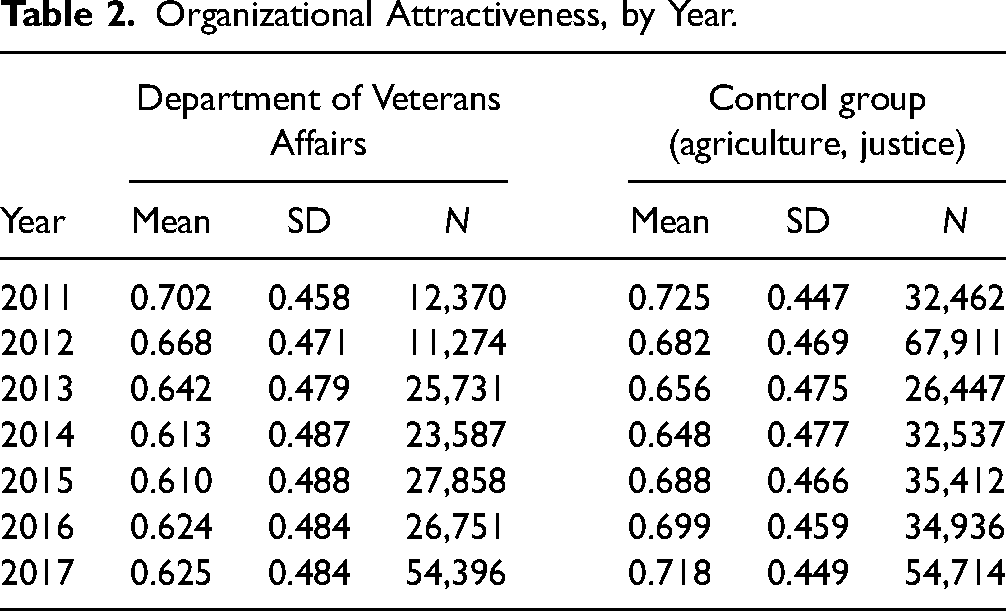
One common approach to confirm whether this assumption is met is to use visual inspection by plotting the outcome variable for both the treatment and control groups over time. If the lines representing the two groups are roughly parallel, the parallel trend assumption can be met. The average employee job satisfaction—measured as the proportion of employees who are satisfied with their job—for the treatment (VA) and control group (AG and DJ) between 2011 and 2017 is presented in Figure 1 and Table 1. Specifically, while the VA presents a lower level of employee job satisfaction than both the AG and DJ, both Figure 1 and Table 1 confirmed that the difference between the VA and the control group is constant (about 3 percentage points) during the pre-organizational scandal period (2011–2013). Moreover, regarding the organizational attractiveness variable, both Figure 2 and Table 2 present that the VA observed fewer employees who responded as recommending their organization as a good place to work than the control group agencies over the years: In particular, during the pre-scandal period (2011–2013), the control group agencies reported about 2 percentage points higher than the VA in terms of the proportion of employees who recommend their agency as a good place to work. More importantly, both Figures 1 and 2 reveal that both control group agencies (AG and DJ) exhibited downward trends in employee job satisfaction and perceived organizational attractiveness before the scandal, in parallel to the VA. Therefore, the parallel trend assumption is met in this study.
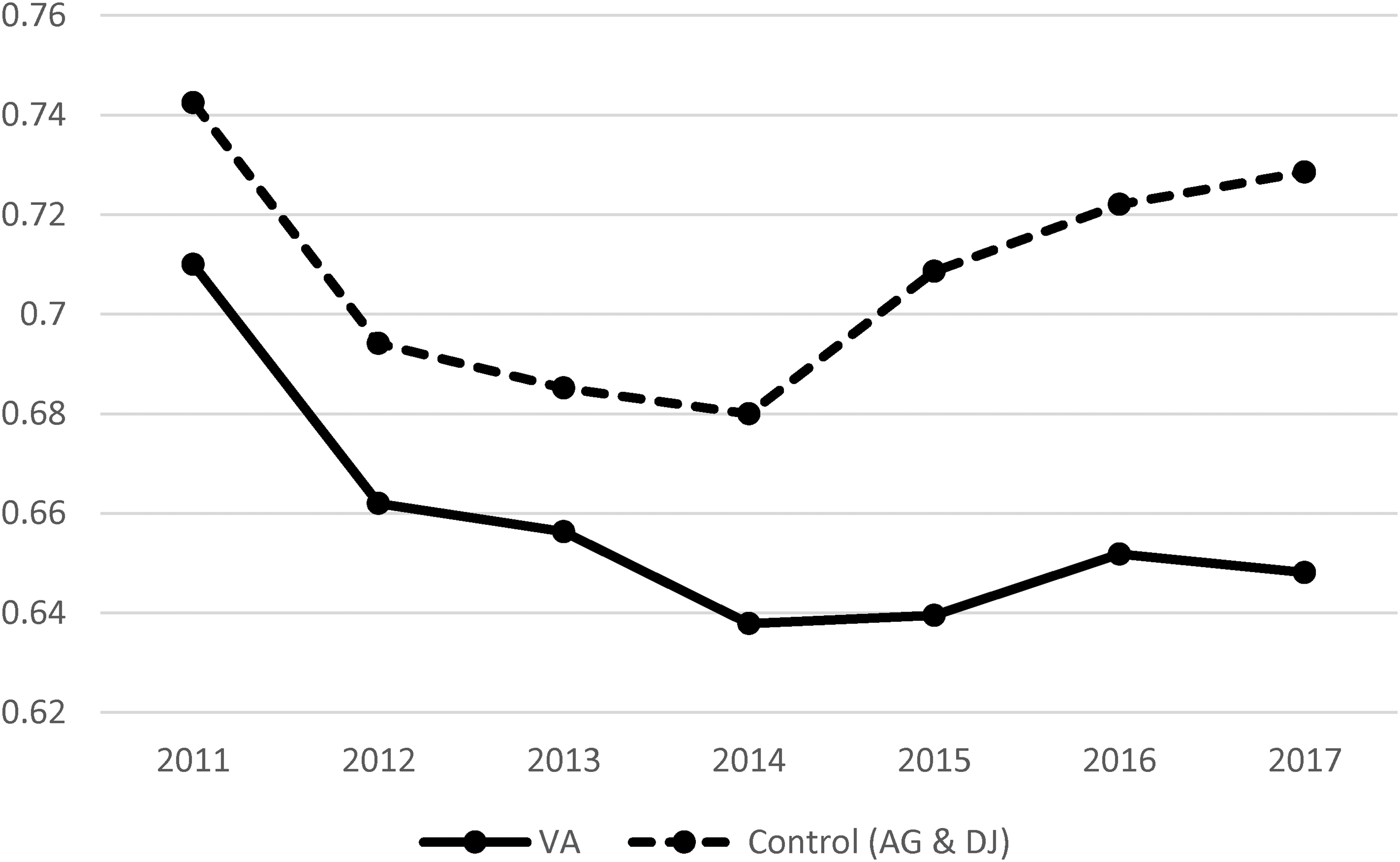
Average employee job satisfaction, 2011–2017.
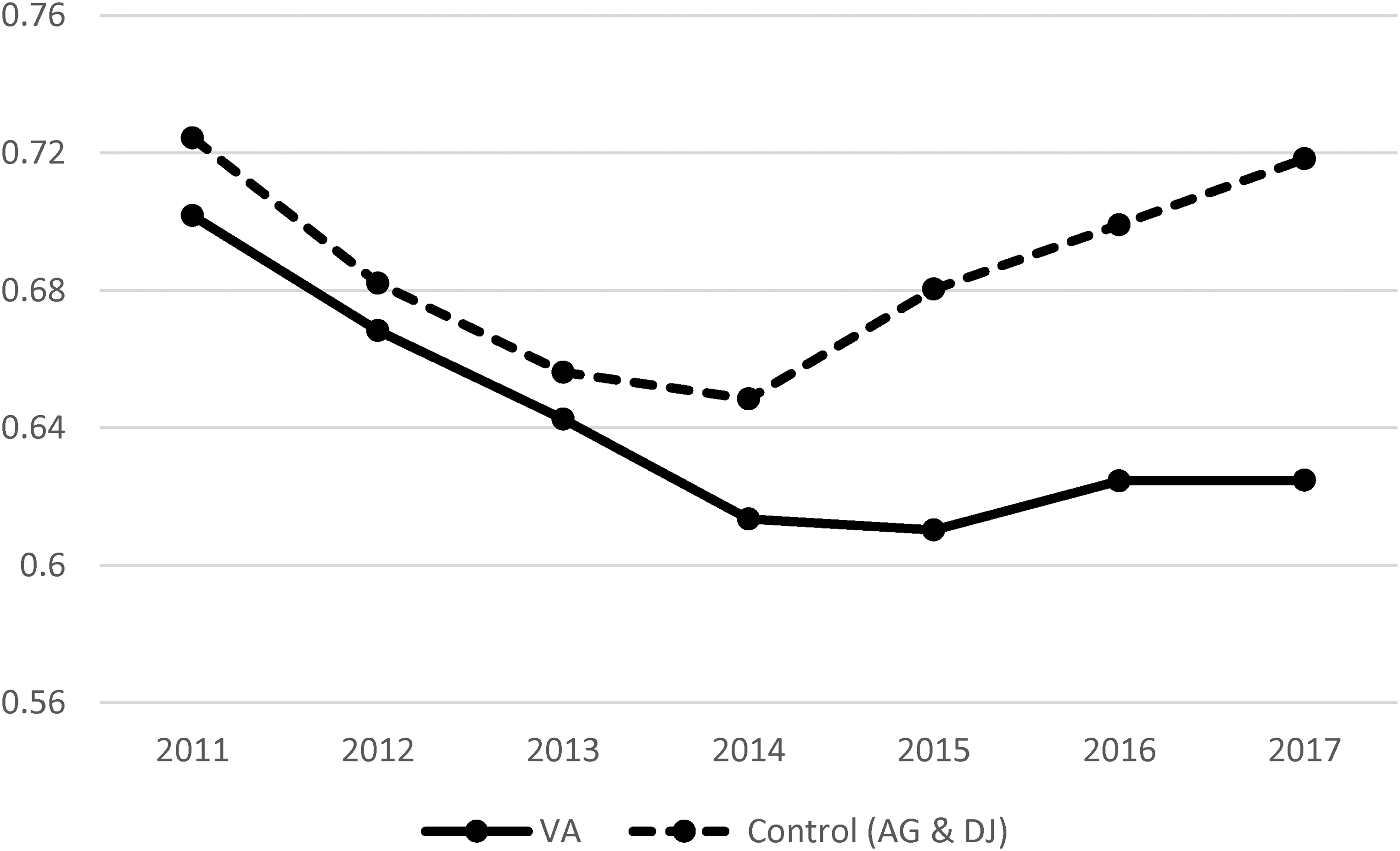
Average perceived organizational attractiveness, 2011–2017.
Employee Job Satisfaction, by Year.
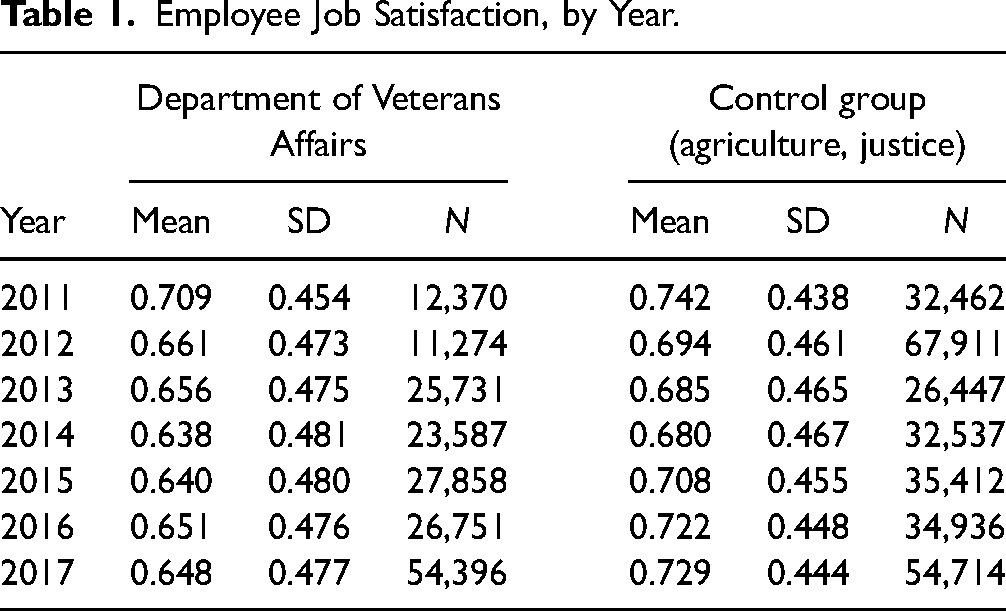
Organizational Attractiveness, by Year.
Further, we performed a falsification test presenting diagnostic evidence to determine whether a DiD regression model meets the parallel trend assumption or whether other factors may have influenced the outcome variable (Grembi et al., 2012; Hur & Perry, 2020; O’Neill et al., 2016). That is, the falsification test is used to check whether both the treatment and control groups would have followed the same trend over time if the intervention had not been implemented. The test involves two stages. First, within the control group observations, the falsification test assigns one agency as the treatment group and the remaining one as the control group. Next, the DiD regression model is tested: if the DiD interaction dummy variable is statistically significant, then it suggests that other factors may cause the observed outcome and that the treatment effect is not valid. The falsification test result confirmed that the DiD estimator variable between the treatment group and organizational scandal variable is not statistically significant at a p-value over .100. Both visual inspection and falsification test present evidence enough to conclude that our DiD regression model satisfies the requirement of the parallel trend assumption.
Results
Descriptive statistics for the VA, including the average employee job satisfaction, perceived organizational attractiveness, and control variables, are presented in Tables 1, 2, and 3. Table 3 presents the demographic composition of the VA workforce which is about 60% male and 55% white employees across the survey years. Supervisors account for about 15% to 20% of the entire VA workforce over the years. During the pre-organizational scandal period between 2011 and 2013, the VA experienced a decrease in the average rate of employees satisfied with their job from about 70.9% to 65.6% and in the average rate of employees who recommend their organization as a good place to work from about 70.2% to 64.2%. Yet, after its 2014 scandal, the average rate of both outcome variables drops slightly and presents a small rebound in 2016.
Department of Veterans Affairs Descriptive Statistics.

The comparison of employee job satisfaction and perceived organizational attractiveness between the VA and control agencies provides additional context (Tables 1 and 2). Specifically, when moving from 2011 to 2013, the average level of employee job satisfaction and perceived organizational attractiveness across the VA and control agencies decreased by about 6 to 8 percentage points. Yet, during the post-scandal period from 2014 to 2017, while the control agencies experienced a large increase in both outcome variables, the VA exhibited no increase or a smaller increase than the control agencies. The large increase in scores for both outcome variables among the control agencies was consistent with broader trends among federal agencies. Across the federal government employee engagement declined from 2010 to 2014, before increasing from 2015 to 2017 as agencies made more concerted efforts to improve the employee experience (Partnership for Public Service, 2017). Contrary to these broader trends, employee job satisfaction in the VA flattened out in the post-scandal period. We postulate that the negative effects of the scandal may outweigh the benefits of those concerted efforts, which establishes the motivation of this study.
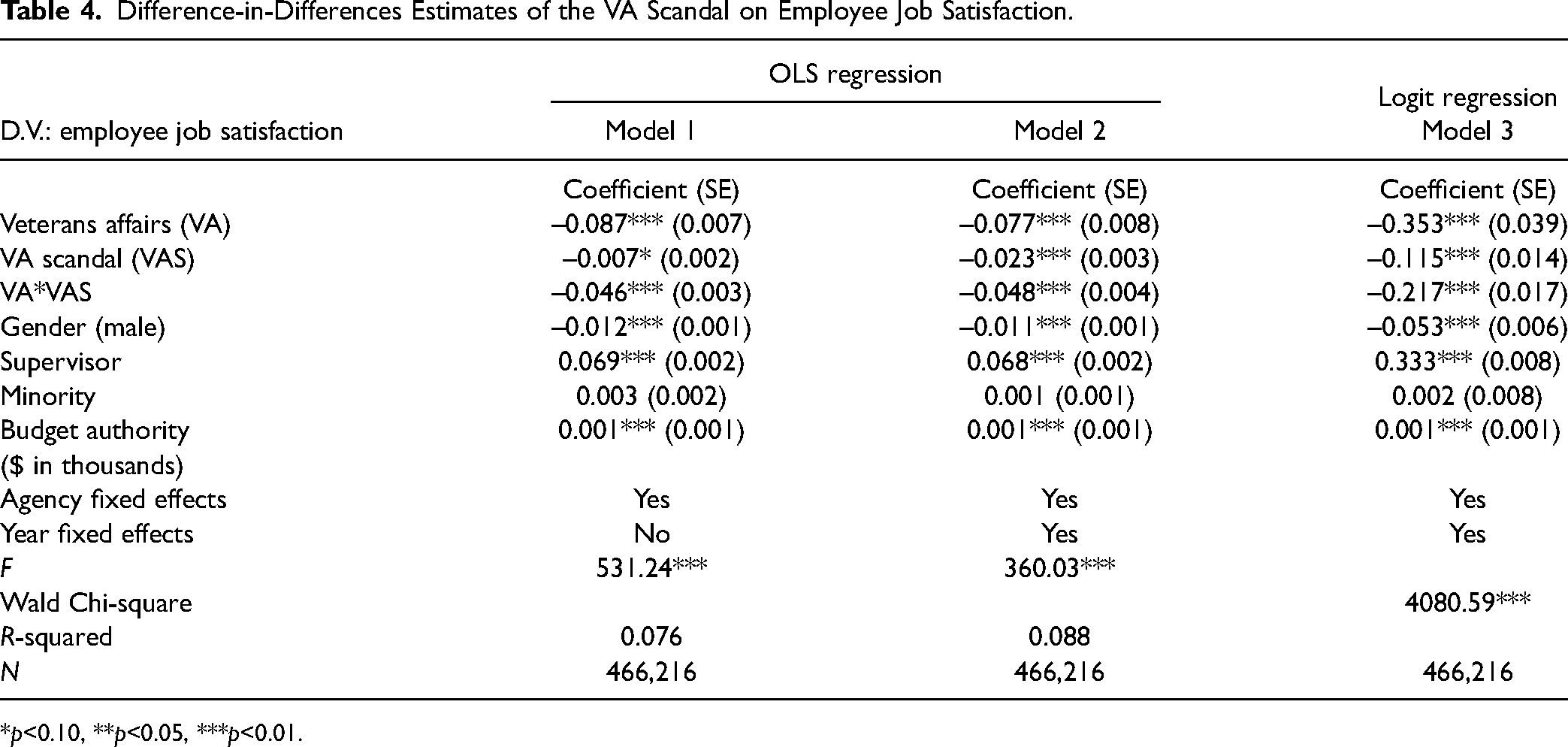
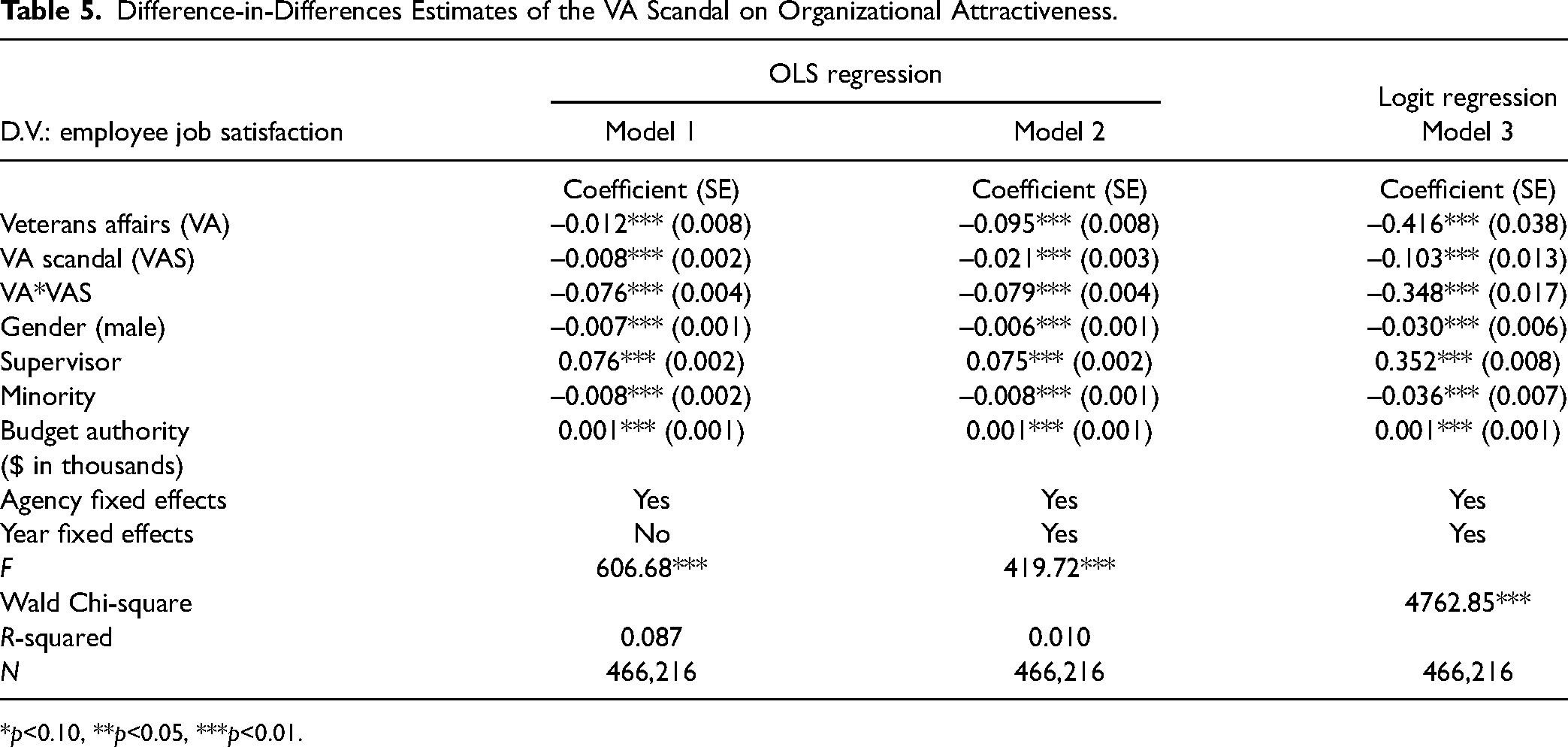
We now turn to the results of the empirical analyses. Tables 4 and 5 show the results of our DiD regression models. The average level of employee job satisfaction is the dependent variable in the regression models of Table 4, while the regression models in Table 5 include the average level of perceived organizational attractiveness as the dependent variable. Each table includes different models corresponding to three different regression specifications. Model 1 in Tables 4 and 5 uses an ordinary least square (OLS) regression model without year fixed effects. On the other hand, Model 2 in both tables relies on an OLS regression model including year fixed effects. Finally, given that the dependent variable in this study is a binary one, we present Model 3 which uses a logistic regression model with year fixed effects in both Tables 4 and 5. The results present similar levels of statistical significance of key independent variables in the same direction. To ease interpretation, findings from Model 2 in Tables 4 and 5 are discussed.
Difference-in-Differences Estimates of the VA Scandal on Employee Job Satisfaction.
*p<0.10, **p<0.05, ***p<0.01.
Difference-in-Differences Estimates of the VA Scandal on Organizational Attractiveness.
*p<0.10, **p<0.05, ***p<0.01.
Table 4 presents the estimated effect of the organizational scandal on employee job satisfaction moving from the pre-organizational scandal period (2011–2013) to the post-organizational scandal period (2014–2017). The results from all three models in Table 4 present evidence to support the hypothesized effect that the VA scandal negatively affects the job satisfaction of the VA employees (Hypothesis 1). Specifically, Model 2 presents that moving from the pre-organizational scandal period (2011–2013) to the post-organizational scandal period (2014–2017) employee job satisfaction decreases by about 4.8 percentage points (p < .01). Further, Table 5 presents the statistical evidence supporting the hypothesized effect of the organizational scandal on the perceived organizational attractiveness variable. The results estimate that the organizational scandal caused the VA employees’ perceived organizational attractiveness to decrease by about 7.9 percentage points (p < .01), thereby supporting Hypothesis 2.
Examining the variation in both dependent variables with other variables provides additional context. First, the coefficients of the Veterans Affairs variable in Model 2 of both Tables 4 and 5 are statistically significant and negative (−.077 and −.095, respectively), indicating that the average level of employee job satisfaction and perceived organizational attractiveness of the VA is lower on average than the control agencies. Next, the estimated coefficients (−.023 and −.021, respectively) of the organizational scandal variable from Model 2 of both tables affirm that both the VA and control agencies observed a lower average level of employee job satisfaction and organizational attractiveness during the post-organizational scandal period between 2014 and 2017. These results are consistent with the overall trend presented by Figures 1 and 2/Tables 1 and 2. Further, as indicated by the estimated coefficients of the Supervisor variable (.069 and .076, respectively), the supervisor group holds a higher level of employee job satisfaction and perceived organizational attractiveness than its counterparts across all agencies.
As a robustness check, we tested additional regression models based on different measurement scales—the nominal scale, the ordinal scale, and the binary scale with the neutral response added to the satisfied and agree categories—of both dependent variables. Those models presented consistent results with the current one reported (see Appendix A for model results).
We also checked for the potential of reverse causality by conducting additional analyses that test whether VHA employees had a lower level of job satisfaction and perceived organizational attractiveness following the scandal compared to their counterparts at other VA sub-agencies. If the estimated effect of the DiD variable (the interaction variable between the VHA employee status and the scandal, VHA*VAS) is not statistically significant, it suggests that the scandal had similar effects on VHA employees as compared to non-VHA VA employees. In such a case, reverse causality could not be the driving force behind our findings given that the scandal took place in the VHA and not in the other non-VHA VA organizations. The results from the DiD models failed to present evidence showing statistically significant differences in job satisfaction and perceived organizational attractiveness between VHA and other VA employees following the scandal, all of which indicate that reverse causality is unlikely (see Appendix B for model results).
To assess whether the selection of the control agencies may affect the main results of our analyses, we compared our current results to those of removing one agency from the control agencies. The direction and significance of the DiD estimates are not only robust but consistent between the two approaches. Finally, we want to note that our regression models hold a low level of the explained variance (R-squared). This is tolerable given that the main purpose of this study is to confirm the distinctive causal effect of a key factor, organizational scandal, on employee work motivation (Hur & Perry, 2020).
Discussion and Conclusion
There are two major streams in the literature on organizational scandals in the public sector. These streams have focused on (1) the main factors causing scandals and (2) the consequences of scandals for the execution and operation of governmental services. There is a paucity of research, however, that examines whether and how employees’ attitudes are affected by organizational scandals. This is important because affected employees will be asked to fix the issues that are believed to have caused the scandals.
To advance the understanding of the consequences of organizational scandals on employee attitudes, we examined the effects of the 2014 VA waitlist scandal on VA employees. To do this we drew upon data from the FEVS and utilized DiD estimation, a quasi-experimental approach, to examine how job satisfaction and perceived organizational attractiveness among VA employees changed from 2014 to 2017 as a consequence of the VA scandal.
The results of this study demonstrate the negative influence of scandals on employee job satisfaction and perceived organizational attractiveness as our hypotheses predicted. From 2014 to 2017, following the scandal, the VA observed a decrease of about 4.8 percentage points in the proportion of employees who were satisfied with their job and a decrease of about 7.9 percentage points in the proportion of employees who would recommend their organization as a good place to work. Gaps in employee job satisfaction and perceived organizational attractiveness between the VA and the control agencies were constant during the pre-scandal period from 2011 to 2013, but they expanded during the post-scandal period from 2014 to 2017.
Our findings support the reality that VA employees experienced continued criticisms of their agency in the years following the scandal by external stakeholders. For example, in 2016 the Commission on Care submitted a report evaluating newly implemented management systems to improve the quality and access of veterans’ health care to the President. Later, CNN issued a media report concluding that the VA still suffers profound deficiencies and requires urgent reform. Our results show that the exposure to at least a 3-year-long negative portrayal of their agency by the media and Congress made VA employees more likely to re-evaluate their organizational membership, which resulted in fewer employees who felt satisfied with their job and who would recommend their agency as a good place to work.
Our findings of the negative consequences of the 2014 VA scandal for public employees are a meaningful contribution to the literature on government scandals because it indicates that the consequences of organizational scandals are more detrimental than currently explored in the literature, which has largely focused on its effects on trust in government and public financing. Furthermore, our findings provide some insights into the impact of organizational image and prestige on job satisfaction, given that the scandal lowered job satisfaction for VA employees (Bright, 2021; Carmeli & Freund, 2009; Nezhina et al., 2021). This study also helps advance current research as it utilizes a quasi-experimental design in an area where non-experimental designs have been used almost exclusively.
Another contribution of this study is that it explores the effects of a scandal on organizational attractiveness. Organizational attractiveness has not received much attention among public administration scholarship despite its role as a key predictor of turnover intention, employee engagement, and the likelihood that job applicants will apply (for an exception see Bankins & Waterhouse, 2019). Organizational attractiveness is an important area of study given that federal organizations generally face uniquely negative media coverage. For instance, scandals, especially those involving taxpayer-funded public services, loom large in the public consciousness (Goodsell, 2003; Molina, 2018). This, coupled with the public's negative performance bias regarding public organizations (Hvidman, 2018), makes it difficult to recruit and retain public employees, which makes studying scandals and organizational attractiveness all the more important.
Based on the findings from this study, we encourage practitioners to take a more active role in supporting employees during the aftermath of an organizational scandal. Managers should remind employees of the importance of their work and, when possible, provide employees with credible positive feedback regarding their work from program recipients (Christensen et al., 2017). Additionally, practitioners should share credible, timely, and positive organizational performance metrics with employees so that they are aware of what the organization is doing well to help round out their understanding regarding the identity of the organization. Moreover, supervisors and senior leaders within the organization should clearly and unequivocally condemn any unethical or illegal behavior associated with the scandal, so that employees know that the scandal is not an embodiment of the organization.
This study is not without limitations. First, there remains a possibility that changes in the outcomes, i.e., employee job satisfaction and perceived organizational attractiveness, were influenced by another event that we did not identify. If this is the case, the current quasi-experimental approach would not be able to isolate the effects of the VA scandal on the outcome variables. We carefully investigated media coverage featuring the VA and the control agencies to assess whether any other exogenous events occurred, and we did not find any. The reality is that it is impossible to randomize an organizational scandal. One could conduct a survey experiment regarding an organizational scandal, but the realism of such a study design would be compromised, and such a design would likely generate ethical concerns.
Second, the design of this study does not allow us to perfectly isolate the effects of public outrage caused by an organizational scandal on employee attitudes from the effects of efforts to address that outrage on employee attitudes. Given that the scandal and efforts to address the scandal are happening at the same time, it is very unlikely that any research design could perfectly isolate the effects of the two. A macro-event observed in the social science context is often accompanied by other micro-events, and therefore, it is well acknowledged that the treatment effects of the macro-event or reform in the public sector—the VA scandal in this study—are not easily separable from those of micro-events—job security rule change in this study (Hong & Raudenbush, 2006; Kang & Rubin, 2022). Therefore, we theorized two different paths—direct and indirect—of the effects of organizational scandals in investigating the outcomes of the scandals.
Third, we anticipate questioning the usefulness of two departments, the AG and the DJ, as a control group for the comparisons because these two departments are different from the Department of Veterans Affairs in terms of the services they provide. However, we applied two formal rules—a parallel trend assumption and no external events affecting the outcomes—that the previous literature applying the DiD estimation approach recommends relying on (Hur, 2019; Kang & Rubin, 2022; Lee & Lee, 2021; Rubin & Weinberg, 2016). Further, after reviewing the OPM's employee engagement index data, we confirmed that the VA and the two control agencies hold a similar culture in operating employee engagement practices. We were not able to identify other sources to capture inherent and unobservable characteristics across three agencies. Notwithstanding, organizational characteristics are in general time-invariant, and therefore, the inclusion of an agency fixed-effects estimator in the regression models should adjust for unobservable differences among three agencies in the sample data set.
Finally, although our quasi-experimental research design was applied to minimize statistical bias in estimates, we still acknowledge the potential of the endogeneity issue raised by two cases. First, given the observational design of this study, omitted variable bias may occur. While we controlled for three individual demographic variables (supervisory status, gender, and race), and the agencies’ yearly budget—which may have confounding effects on the outcomes—additional time-varying variables (i.e., age, tenure in the federal bureaucracy and tenure in current agency) were not controlled in our empirical models. The survey item measuring employees’ tenure in their current agency was dropped from the FEVS starting in 2013. Furthermore, the response options for the survey items on age and tenure in the federal bureaucracy changed over the period of the study. It is important to note, however, that past research on the relationship between such contextual factors and job satisfaction and organizational attractiveness has found that such factors have little if any effect on the outcomes (Huang, 2021; Judge et al., 2017; Onken-Menke et al., 2022).
Second, our sample data set may include continuing employees in the VHA who had been involved in the “falsification of wait-time data” scandal and other employees who may have observed their former colleagues lose their job under the new “at-will employment” system. These employees might have reported more disgruntled responses, which may be accountable to the negative bias of the estimated effects of the scandal on the outcomes. Methodologically, it is not possible to identify and exclude those who were involved or those who have lost their colleagues due to the at-will employment system. To address this concern, we performed additional analysis testing whether the VHA employees and other non-VHA VA employees differed in their job satisfaction and perceived organizational attractiveness after the VA scandal in 2014. The results of those analyses did not find a statically significant difference between the two groups (i.e., the VHA employees and other non-VHA VA employees) for either outcome. Thus, it appears that our findings are not driven by continuing employees in the VHA who had been involved in the “falsification of wait-time data” scandal and other employees who may have observed their former colleagues lose their job under the new “at-will employment” system given that we observed declines in job satisfaction and perceived organizational attractiveness in VA employees working in agencies other than the VHA.
In future studies, we encourage scholars to explore the effects of other scandals such as the 2013 IRS scandal under the Obama administration, when the IRS had selected groups to investigate with greater scrutiny based in part on their political leanings. By studying scandals of varying salience and scandals that occur in differing policy spheres, we can get a better understanding of the impact of scandals on employee attitudes. Additionally, in future research, we encourage scholars to pursue alternative research designs, such as surveys, which might help uncover mediating and moderating effects. For example, it may be the case that public service motivation, transformational leadership, and/or supportive leadership helps buffer the negative effects of scandals on employee attitudes.
Regarding mediating effects, scholars could more directly test whether organizational scandals undermine the organizational image, reputation, and/or prestige and whether that is mediating the effect of the scandal on job satisfaction and organizational attractiveness. In particular, longitudinal surveys would be beneficial as they could help clarify the relationship between time, scandals, and employee attitudes. Lastly, scholars should consider employing qualitative interviews as a research design to investigate what support employees receive in the aftermath of a scandal and which support they would like to receive and why.
Supplemental Material
sj-docx-1-arp-10.1177_02750740231191524 - Supplemental material for The Effects of Organizational Scandals on the Desirability of Public Organizations as Places to Work: Evidence From the VA Waitlist Scandal
Supplemental material, sj-docx-1-arp-10.1177_02750740231191524 for The Effects of Organizational Scandals on the Desirability of Public Organizations as Places to Work: Evidence From the VA Waitlist Scandal by Shinwoo Lee, Gordon Abner and Taha Hameduddin in The American Review of Public Administration
Footnotes
Declaration of Conflicting Interests
The author(s) declared no potential conflicts of interest with respect to the research, authorship, and/or publication of this article.
Funding
The author(s) received no financial support for the research, authorship, and/or publication of this article.

Supplemental Material
Supplemental material for this article is available online.
Notes
Author Biographies
References
Supplementary Material
Please find the following supplemental material available below.
For Open Access articles published under a Creative Commons License, all supplemental material carries the same license as the article it is associated with.
For non-Open Access articles published, all supplemental material carries a non-exclusive license, and permission requests for re-use of supplemental material or any part of supplemental material shall be sent directly to the copyright owner as specified in the copyright notice associated with the article.
