




Abstract
The question of who is appointed to key administrative posts at the expense of whom lies at the heart of public administration research. In this paper, I study what career experiences have increased senior civil servants’ chances of being appointed to a secretary general position. The civil service politicization and core executive literatures suggest such appointments are impacted by loyalty, ability, and proximity to power. These hypotheses are investigated using a mixed methods research design combining quantitative analysis of the career paths of all active senior civil servants in the years 2000–2020 (n = 247) with 22 elite interviews with cabinet ministers and bureaucrats in the Netherlands. The main findings of this paper are that active affiliation with minister-delivering political parties and having worked in the prime minister's office significantly increased the odds of a candidate's appointment to an SG position, whereas managerial experience did not. These findings challenge the conventional theory of nonpoliticized appointments and unlock possibilities for comparative research on bureaucrats’ biographies.
Introduction
In 1994, the Dutch cabinet decided that the upper echelons of the civil service would form a general civil service: a pool of “mobile” civil servants that would rotate across departments. Traditionally, civil servants would rise through the ranks within one department; now senior civil servants (SCSs) were incentivized to move across departments, going from one domain to another in a “bureaucratic merry-go-round.” One could work in education policy, before transferring to economic policy or move up in home affairs. Modeled after the British civil service, this institutional reform sought to reaffirm political control of departments, prevent policy siloes by stimulating cross-pollination, advance the professionalization of public management, and offer an opportunity for SCSs to diversify their career paths (Noordegraaf et al. 2020; Steen and Van der Meer 2011). Today, this general civil service (Dutch: Algemene Bestuursdienst, hereafter: ABD) has become an institutional fixture within the Dutch core executive.
Positioned to act as a driver of renewal and professionalization of the senior civil service, the Dutch ABD system is an example of a wider phenomenon. In various countries, senior executive services were developed with similar strategic goals (Kuperus & Rode, 2016). Centralized executive services, in, for example, the United Kingdom, the United States, and Estonia, are key to senior civil service training and socialization (Van Wart et al. 2015) and performance appraisal (Van der Wal, 2017a). Such institutional reforms can help civil servants to strike a bargain between their partisan and professional leanings, as they bond civil servants in a professional group with a shared esprit de corps (Ebinger et al., 2019; Hood and Lodge 2006). Moreover, and central to the aim of this paper, such executive services play a critical role in appointing SCSs.
In this paper, I study the career paths of the SCSs that make up the ABD's elite cadre: The Top Management Group. Within this pool, I focus on those individuals who reach the very top and become a “secretary general” (SG) in the Dutch system. I map their careers and see if and how they differ from those elite members who do not. More specifically, I ask this research question: what career experiences have increased SCSs’ chances of being appointed to a SG position during 2000–2020?
My approach to answer this question is to study SCSs’ career paths in close detail and to examine if these paths help to explain who among them gets to be appointed secretary. From those who are appointed from within the ABD pool, is there a “road much travelled” that sets them apart from those who do not? Needless to say, appointments are a complex and contingent phenomenon and there are multiple factors at play. Hence, this analysis cannot account for all factors—or provide a full explanation of variables that factor into secretary appointments—but it does point to the relative weight of a selection of important factors.
To that end, I draw on an original database and use Cox regression analysis to map and analyze the careers of all Dutch SCSs who were potential secretaries in the period 2000–2020. I identify which key “places” (i.e., working in a certain department) and “practices” (i.e., doing a certain kind of job) positively or negatively predict the odds of being appointed SG. This quantitative analysis is complemented by 22 elite interviews with individual current and former secretaries and other SCSs to obtain up-close reflections on the SCSs’ craft, their personal career paths, and their beliefs about the factors that shaped them.
In doing so, I build on earlier studies in different contexts. Both Bach and Veit (2018) and Fleischer and Seyfried (2015) used a candidate pool selection technique to study which career paths increase the chances of being promoted to high office (respectively administrative and ministerial positions). I have applied this research method to the Dutch context and have embedded it into a broader mixed method design that also encompasses a qualitative component, e.g., elite interviews with SCSs.
The main finding of this article is that explicit affiliation with minister-delivering political parties and having worked in the Prime minister's office (PMO) significantly increased the odds of a candidate's appointment to an SG position from the candidate pool, whereas managerial experience did not.
Who is appointed to key administrative posts at the expense of whom is a question at the heart of public administration research. It matters cognitively, as we try to better understand how governments operate and appoint senior administrators. It is also democratically vital to assess how political influence is wielded in staffing central bureaucracies. The concrete design and specific operationalization of this study are relevant for three reasons. First, it helps to gain a better understanding of the career paths that lead civil servants into high office. These career paths matter to civil service professionalization (e.g., Van Wart et al. 2015), What do they bring to high office? To what extent do partisan preferences, professional background, early and midcareer positionality and socialization matter? What expertise and experience are valued? Is there a particular career-incubating “cradle of power” (Trangbaek, 2022)?
Second, this paper bridges the literature on formal politicization and the core executive (Dunleavy & Rhodes, 1990; Peter and Pierre 2004). I bring tried and tested hypotheses from the politicization domain (e.g., about partisan alignment) and combine these with hypotheses concerning central agencies in the core executive (e.g., about the importance of the PMO). Taking the organization of the state, and in particular central agencies, into consideration provides a novel perspective to the study of government elite appointments.
Third, answering Bach and Wegrich (2020) call for more studies of SCSs’ careers, the original database of SCSs’ careers compiled for this article allows for an analysis of factors associated with secretary-level appointments between 2000–2020. While cross-sectional and descriptive accounts of Dutch secretaries’ political membership, age, gender, and other variables do exist (e.g., Raadschelders & van der Meer, 2014; Steen and Van der Meer 2011), this study allows for more rigorous and nuanced analyses. In contrast to these existing studies, the analyses in this paper serve to show the relative importance of certain career paths. The database unlocks publicly available data and opens up comparative opportunities as similar studies in other contexts continue to be published (Bach & Veit, 2018; Cooper et al., 2022; Trangbaek, 2022). These comparative studies inform academic debates on civil service appointments but are also used by practitioners in national, European and OECD contexts (Gerson, 2020; Kuperus & Rode, 2016).
The article is structured as follows. I first introduce the SG's position and role within the Dutch core executive, before mining the literature and outlining three sets of hypotheses concerning plausibly important predictors of secretary appointments: (1) partisan affiliation, (2) managerial experience, and (3) central agency experience. After describing the mixed methods research design, I present the empirical findings, answer the research question and discuss the findings in light of recent academic and public debates.
SGs in the Dutch Core Executive
The SG (Dutch: “Secretaris-Generaal,” hereafter: SG) is the top-ranking official within the 12 Dutch national government departments (Lemstra, 1993; Raadschelders & van der Meer, 2014). SGs chair the departmental board and are responsible for the management of their departments, though they often explicitly share this responsibility with other members of the departmental board, including the Directors-general (DG) and the deputy SG. The Board of SGs meets weekly to discuss supra- and interdepartmental issues, current affairs, and the upcoming cabinet meeting's agenda. This weekly meeting is chaired by the SG of the ministry of General Affairs (effectively the PMO), who acts as a primus inter pares (Weller et al., 2021). While all SGs are hierarchically level, the gravitas of this position varies across office holders and departments. For example, Raadschelders and Van der Meer (2014, p. 730) note that DG at the Ministry of Finance (MoF) have considerable clout, at the expense of the department's SG.
Secretary-level appointment procedures involve some key steps. First, vacancies are published and advertised by the ABD. The position-based civil service system has open vacancies and anyone can apply. Some candidates may be asked to apply by recruiters. Ministers can also suggest names for the position, but their suggested candidates must always pass the selection procedures. A preselection committee consisting of an independent chair, HR professionals and peer SGs draws up a shortlist, based on CVs and experience. Candidates are carefully screened by the ABD office. In the end, the prospective candidate is interviewed by the respective minister to see if there is a “match” between them. If not, a minister can veto a candidate. If all is well, the minister of the Interior and Kingdom relations—who is responsible for the civil service and the ABD—will nominate the candidate for the post, after which the cabinet officiates accordingly. The procedure is formalized, but exceptions happen. For example, the procedure can be reversed, so candidates are first interviewed by the minister to see if there is a match before they enter the selection procedure (Noordegraaf et al. 2020).
Understanding Senior Civil Servants’ Careers
What career experiences make that some people are appointed SG while others are not? Two separate literary works provide comprehensive explanations which can be empirically tested. First, The civil service politicization literature identifies two, competing, key predictors of SG appointments. They are political alignment and managerial experience (Bach & Veit, 2018). In Lewis (2008) terms: is it loyalty or ability that gets senior bureaucrats appointed? Second, the core executive literature suggests a third key predictor: central agency experience (Bourgault & Gow, 2020; Dunleavy & Rhodes, 1990).
Partisan Affiliation
First, as the SG is considered the chief bureaucrat in a department, s/he is an important adviser to the minister. This position requires considerable ability as well as loyalty—ministers must be able to trust their SGs in both regards (Hood and Lodge 2006). In order to increase trust in SGs, minister have a say in appointment procedures, opening the angle of politicization of civil service appointments. Peters and Pierre (2004) assert that politicians’ wish to control bureaucracies – often referred to as “politicisation”—is a powerful force in many governments. They define formal politicization as “the substitution of political criteria for merit-based criteria in the selection, retention, promotion, rewards, and disciplining of members of the public service” (2004: 2). Typically, political officeholders will prefer both: they rationally seek appointees who are loyal and able. But many times they cannot have it both ways. As a key example, Lewis (2008) finds that US presidents trade competence, at least some of it, for (future) loyalty. In Europe, Bach and Veit (2018) find that for the appointment of state secretaries in Germany, partisan loyalty outweighs other factors including managerial experience. Bach et al. (2020:, p. 14) map the levels of perceived politicization of senior-level appointments in 18 European countries. They place Iceland and Denmark on the low end, with Portugal and Spain on the top end, reflecting a broad consensus among civil servants about politicization of appointments in these respective countries. In this range of European countries, Germany—where partisan loyalty outweighs all other tested variables (Bach & Veit, 2018)—takes a middle position. In Australia and France, experience in ministerial offices or cabinets has become a sine qua non for departmental secretary positions (Russell, 2021).
In Bach et al.’s (2020) study, senior-level appointments in Dutch central government are perceived to be only slightly politicized. This reflects a formal policy where ministers have a say in SG appointments as part of a merit-based process (Bourgault & Gow, 2020). Van der Velde (2021) does not find evidence of party-political considerations in SG appointments in the Netherlands, based on a quantitative analysis of 63 appointments between 1994 and 2020.
Notwithstanding that, Van der Meer (2004:, pp. 216–21) noted that claims about the political steering of top civil service appointments continue to be aired. Van Thiel (2012:, p. 250) claims that patronage is neither nonexistent nor highly exceptional in the Netherlands. A prominent fact underpinning such claims is the high proportion of visible party membership among SGs and DGs (Van der Velde, 2021). In a study of Dutch SGs from 1945 until 2013, Ennser-Jedenastik (2016) finds that 70% of SGs have a discernible partisan affiliation, with a strong increase from 1970 on. He concludes: “party politicization remains a significant feature of the Dutch elite bureaucracy” (2016: 468). Providing cross-sectional descriptive data from 2009, Steen and Van der Meer state: “it is rare that a secretary-general with a party affiliation divergent from the political color of the ruling coalition is appointed” (2011: 226). In the 1990s, partisan appointments were less common (Van der Meer, 2004), while they were common before the 1990s (Ennser-Jedenastik, 2016). So, political control of appointment to SG positions appears to be neither an alien phenomenon nor a clear trend (Van Thiel, 2013). To assess the question of loyalty, it is necessary to investigate to what extent partisan affiliations are a factor in SG appointments. Seeking to either support or refute this claim, I therefore, hypothesize that: Candidates who are affiliated with a coalition party are more likely to be appointed secretary general than those who are not.
Managerial Experience
A competing set of theoretical explanations is found in managerial experience. Rather than loyalty, this set centers around ability. SGs are responsible for the management of their departments. This responsibility relies on the managerial experience and practical wisdom they must have acquired in their career. Van Dorp and ‘t Hart (2019) describe the Dutch SGs as straddling steering and serving their ministers at the same time. This dual craft involves blending political astuteness with administrative and managerial skills (Goetz, 1997; Hartley et al., 2015; Van Dorp, 2022). In merit bureaucracies, skills, craft, and managerial experience are key characteristics of civil service competence (Noordegraaf, 2015; Van der Wal, 2017b). Weber deemed Dienstwissen essential to thriving civil servants. Experience, doing time in administrative organizations, is how civil servants gain this practical knowledge. SGs are responsible for the management of their department. Experience in senior managerial positions in government, for example having experience working as a DG, is likely an important requirement for an SG position. On the wings of New Public Management, managerial skills and experience have become more valued in many bureaucracies (Hood and Lodge 2006). Cooper (2020) identifies a managerial bargain for deputy ministers in Canada from the 1980s onwards. Therefore, all potential SGs are likely to have extensive managerial experience, either in government or elsewhere. Therefore, I hypothesize: Candidates with senior managerial experience in a ministry are more likely to be appointed secretary general than individuals without this experience.
Second, as SGs are general managers of their departments, they likely benefit from experience in multiple settings, departments, and sectors (Lemstra, 1993; Van der Wal 2017). As SG, they are likely to require generalist experience. Ever since its inception in 1995, the ABD has sought to forge a break with the siloed careers in single departments and mindsets of past generations of SCSs (Noordegraaf et al. 2020). In its vision on public leadership, SCS (in general) and SGs (in particular) are now expected to be credible as champions of cross-departmental collaboration (ABD, 2016). This implies that wide experience, rather than in-depth departmental history advances one's chances of a successful appointment. Therefore: The more ministries an individual has worked in, the larger the chance of appointment as secretary general.
SGs are responsible for the full range of the department's functions and organizational entities, often encompassing large service delivery agencies and regulatory agencies. In civil service common parlance, SGs act as the “owners” of these arms-length agencies. Given this, one would expect that work experience at senior levels in these different functions will be to the credit of candidates for SG appointments (ABDTOPConsult, 2020). Hence: The more government functions an individual has worked in, the larger the chance of appointment as secretary general.
Central Agency Experience
A third set of factors is derived from the core executive literature, which stresses the growing influence of the center on government processes, including appointments (Bourgault & Gow, 2020; Dunleavy & Rhodes, 1990; Weller et al., 2021). In the dominant view in the literature, governments are run from the center. But, does proximity to power influence appointments? The importance of central agencies for SG appointments in the Netherlands remains unevaluated until now.
Many core executive studies highlight the importance of the Prime Minister and the Minister of Finance as nodal actors (Dunleavy & Rhodes, 1990; Weller et al., 2021). The core executive revolves around them. In a recent study of the Danish cabinet government, Rhodes and Salomonsen (2021) assert that the PMO and the *MoF form a “duopoly”—together they shape the heart of the core executive in Denmark. The impact of these central agencies is profound. Policies, they find, must be cleared by both and a veto from the MoF will block any bill (see also Weller et al., 2021). In Canada, Cooper (2020) finds that secretary-level appointments rely on prime ministers’ preferences, illustrating the strength of the center of executive government. Also, although departmental secretaries in Australia may serve their ministers, they are appointed by the prime minister (Podger, 2009; Russell, 2021).
Civil servants working in these agencies are likely to be formed by these central agencies too (Goetz, 1997). They develop a “view from the centre” rather than a siloed outlook. Given SGs’ responsibilities for working interdepartmentally and coordinating across government organizations, the PMO and MoF are plausibly places which stimulate skills and practices that are recognized as being important to SGs, including generating networks across departments.
In the Netherlands, the PMO is responsible for the effectiveness of the Cabinet (Weller et al., 2021). Councilors in the PMO are likely to develop a good sense of “political management”; they learn to broker conflicts in cabinet and committees before they escalate and build wide-ranging and high-level networks across departments, which again is likely helpful for becoming SG. The MoF also nurtures a view from the center, but with an eye for budgets rather than political management, and there are few policies which do not involve budgets. Analogous to the pivotal role of their ministers in cabinet (Weller et al., 2021), civil servants from the MoF have considerable clout among their peers in other departments. Treasury know-who and know-how is a considerable asset for any secretary. Therefore, I hypothesize that: Candidates with experience in the Prime Minister's Office are more likely to be appointed as secretary general than those without.
Candidates with experience in the Ministry of Finance are more likely to be appointed as secretary general than those without.
This section has identified theoretical factors that plausibly increase an individual's chances on a successful SG appointment. Some of these, e.g., H1, have been tried and tested in multiple countries, but not yet in the Netherlands. Others, e.g., H4 and H6, are more explorative and serve to test the outcomes of institutional settings. How I tested these hypotheses is the subject of the next paragraph.
Research Design: Mapping Career Paths
In order to map the careers leading up to SG positions, I use a candidate pool selection design, drawing on biographical data on Dutch SCSs who were active in the past 20 years (cf. Bach & Veit, 2018; Fleischer & Seyfried, 2015). To analyze the beliefs of SGs and other key actors, I have conducted elite interviews with SGs and relevant key actors in the core executive. Combined into a mixed methods design, these two research methods allow an analysis of the emergent patterns of SG appointments over the past decades (using career data), as well as an analysis of the beliefs and practices regarding the careers of Dutch SGs (using elite interviews).
Candidate Pool Selection Design
The analysis should encompass the careers of people who became SG and those who had reasonable prospects but were not appointed. A candidate pool selection design (Bach & Veit, 2018; Fleischer & Seyfried, 2015) requires a predefined pool of candidates who had the potential to become SG, out of which only a subset was actually appointed. In total, 247 candidates were included in the pool based on the positions they held between 2000 and 2020. The criterion for inclusion into the candidate pool was membership of the Top Management Group, the Dutch senior civil service's top cadre. This group includes all SGs, DG and inspector-generals. Interim members were not included. The pool used to consist of roughly 60 candidates. During the observation window (2000–2020), the TMG expanded to include additional positions, including deputy SGs and some directors, totaling just under 100 candidates in the pool. Taking the Top Management Group as the candidate pool emulates Dutch senior civil service appointment practice: from 2000 until 2020, 39 SG appointments came from the defined candidate pool (85%). Only 7 from outside it (15%).
Although this design is time-sensitive and encompasses a span of 21 years, it is not longitudinal. It does not offer insight into how the rules of the game of SG appointments have changed over time. It would be possible to divide the observation window into multiple sub-windows, e.g., 2000–2010 and 2011–2020 (which would coincide with a change of prime ministers). However, this would severely limit the number of observations in each window. The shorter timeframe would also increase the limiting effect of “left-censoring,” making the result less reliable (Cain et al., 2011). Multiple time windows could work with analyses over a longer time span or with a larger candidarte pool.
The Staatsalmanak (the Dutch government‘s “Who's who”) was the key data source for including candidates in the pool. Additional resources—manually searching LinkedIn profiles, government websites, press releases, newspaper articles, and academic studies—were then used as data sources to retrieve and triangulate each candidate‘s biographies and career paths.
As Table 3 shows, some variables report missing data. As cases were excluded list-wise from the analysis, the final models include 183 cases of which 39 were appointed to SG positions. 48 cases with missing values were excluded, plus an additional 16 cases who left the pool before the first SG appointment.
Measures
The dependent variable for analyzing the “successful” career paths is measured as the time between entering the candidate pool and reaching the “end station,” i.e., becoming SG (mean = 5.86 years, SD = 3.44) As not everyone in the pool becomes SG during the period of observation, the observation of careers is “right censored”—that is ended—either by leaving the candidate pool due to e.g., retirement or by the end of the observation period (31 December 2020). Some may become SG later on, but some will not.
Corresponding to the candidate pool selection design, candidates who were appointed from outside the candidate pool were excluded from the analysis (15% of appointments). Those who were appointed as SG were right censored on the day of appointment. Candidates who were appointed twice were duplicated with corresponding right censoring dates and experiences. A variable “SG Experience” measured the effect of repeating SG appointments. Each candidate‘s career was reconstructed from its beginning until right-censoring.
Variables that measured the time spent in a certain place (e.g., the PMO) were recoded into binary variables. Such binary variables reflect whether a candidate has a certain experience under their belt or not, rather than reflecting the amount of time they spent in that place.
In addition to the independent variables stipulated in the hypotheses I included common demographic characteristics as control variables: age upon pool entry, gender (male/female), and whether candidates have earned a PhD or not. Having an MA degree is not included in the analysis because there is very little variance in the data—94% of the pool has earned at least an MA degree. This renders it a plausible precondition for entering the candidate pool, but not for appointment from within the pool.
Analysis
I use cox regression models to analyze the career data (Box-Steffensmeier & Jones, 1997). As career data are time-sensitive and right-censored, Cox regression models are preferred over OLS models (Bovens et al., 2015; Golub, 2008; Howard Grøn et al., 2021). All variables meet the proportional hazards assumption necessary for these models. A Cox regression model presents an estimate (hazard ratio) of the increased/decreased odds that a given independent variable adds to the event happening. In other words, whether a variable such as PMO Experience increases or decreases the odds of the appointment to SG. The models in Table 3 allow an analysis of the direct relationships between the independent variables and the dependent variable.
Elite Interviews
Twenty-two semistructured elite interviews with long-serving SGs, ministers, and SCSs were conducted between 2015 and 2021. Fourteen interviewees were male, four female; thirteen were still in office during the time of the interview, five had recently retired. Most interviews took one hour, some two. Interviews were designed to discuss the progression of their careers. The interviews were conducted independent of the quantitative analysis: the participants reflected on their own experiences. They did not respond to the findings that I present in this paper. The interview transcripts were analyzed using thematic coding, guided by the themes that structure this paper: political affiliation, managerial experience, and central agency experiences (Braun & Clarke, 2006).
SG Appointments: Career Path Data
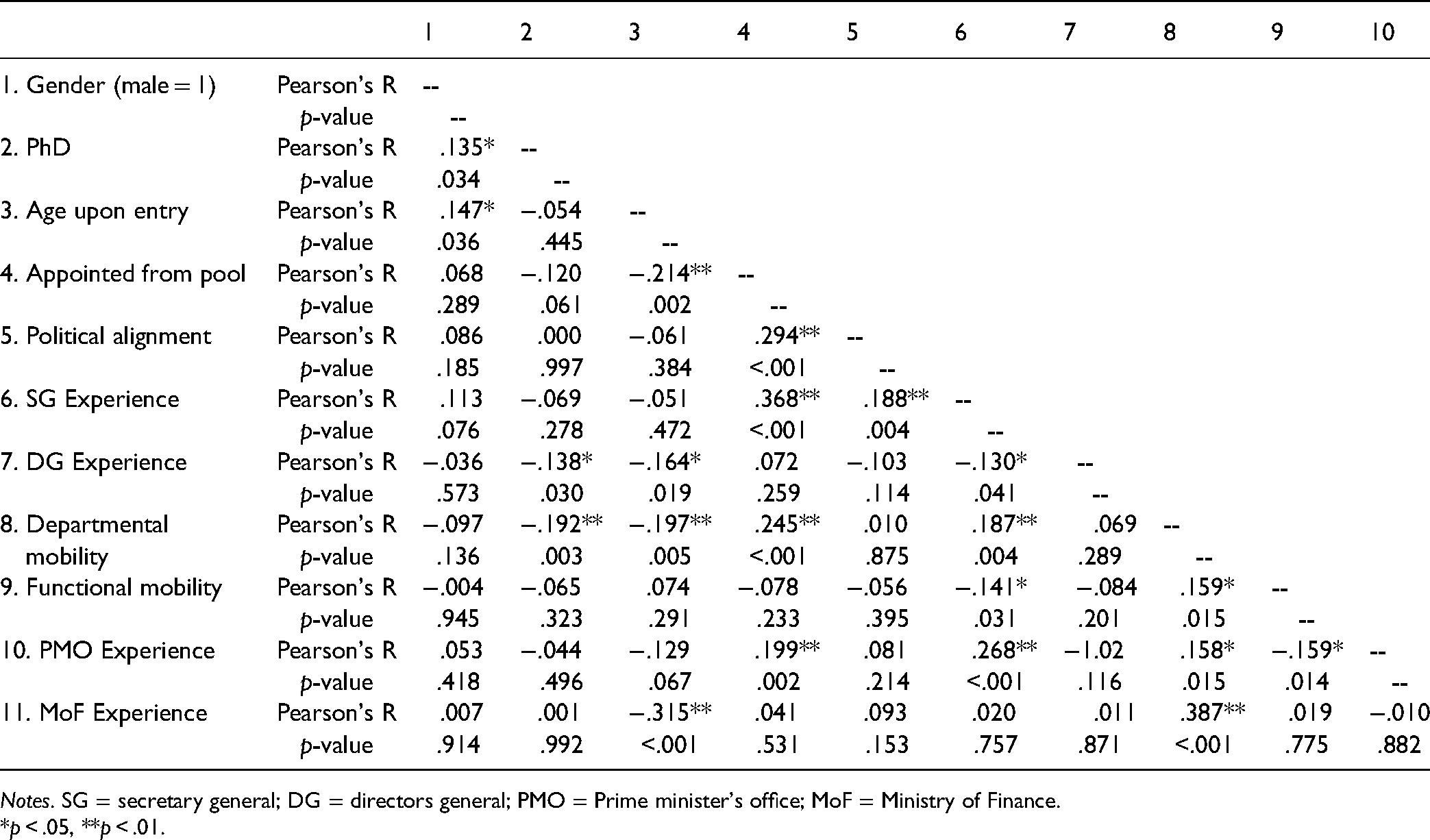
In this paragraph, I first report the career path data which suggest multiple explanations of SG positions, before I complement these with qualitative elite interviews. Table 2 presents the descriptive data and Appendix A provides a correlations matrix of the same variables.
Table 3 presents the results of the Cox regression analysis in five successive models. The first model includes only the control variables. Model 1 suggests that candidates with a PhD were significantly less likely to become SG than those without (Exp(B) = 0.17, p < .05). This variable remains stable across all subsequent models (although the p-value varies slightly). A plausible explanation is the inclusion of several (former) researchers and professors in the pool who acted as heads of research institutes, planning agencies, and inspectorates. While up until the 1990s, several professors had been appointed straight out of academia, that has not occurred since. The gender variable signals that the odds for men were favorable compared to women, but the variable is not statistically significant.
Model 2 adds the “partisan activity” variable to the first model. This variable shows a positive exp(B) of 5.16, with p < .001, meaning explicit partisan activity in the political parties that routinely carry cabinet responsibilities increased the odds of a candidate's appointment to SG by 516%. This provides clear support for hypothesis H1. In the career paths, partisan activity ranges from being assistant to MPs, being elected city councilor and holding mayoral office to relatively low-profile partisan activity such as chairing a regional committee of a political party. The partisan affiliation hazard ratio is larger than any other in any of the models. Table 1 shows that only 27% of the candidates in the pool had been explicitly active in political parties, making it an unlikely necessary precondition for pool entry, but a characteristic that sets potential SGs apart from their fellow candidates in the pool.
Measures.
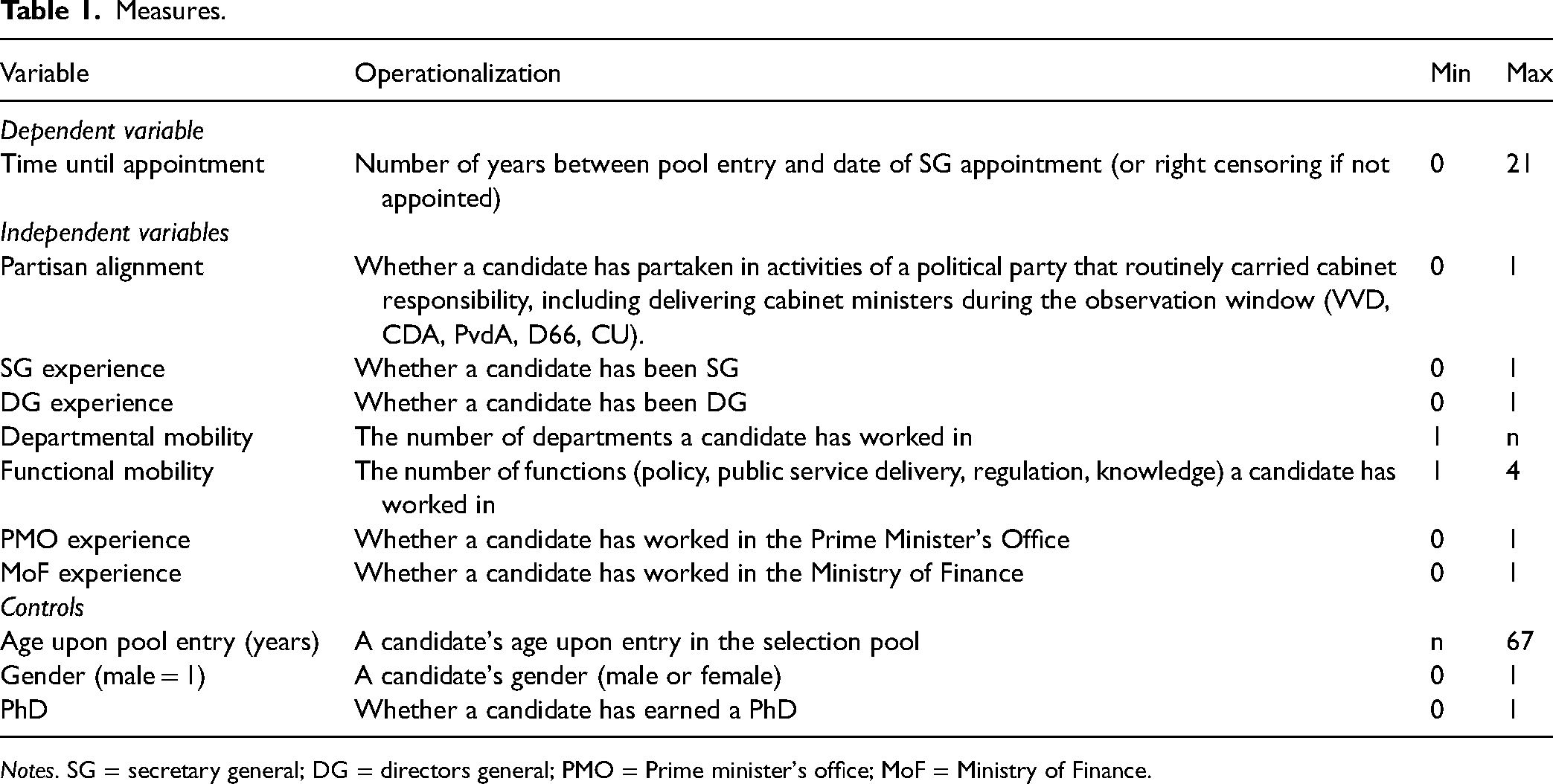
Notes. SG = secretary general; DG = directors general; PMO = Prime minister's office; MoF = Ministry of Finance.
Descriptive Statistics of the Candidate Pool.
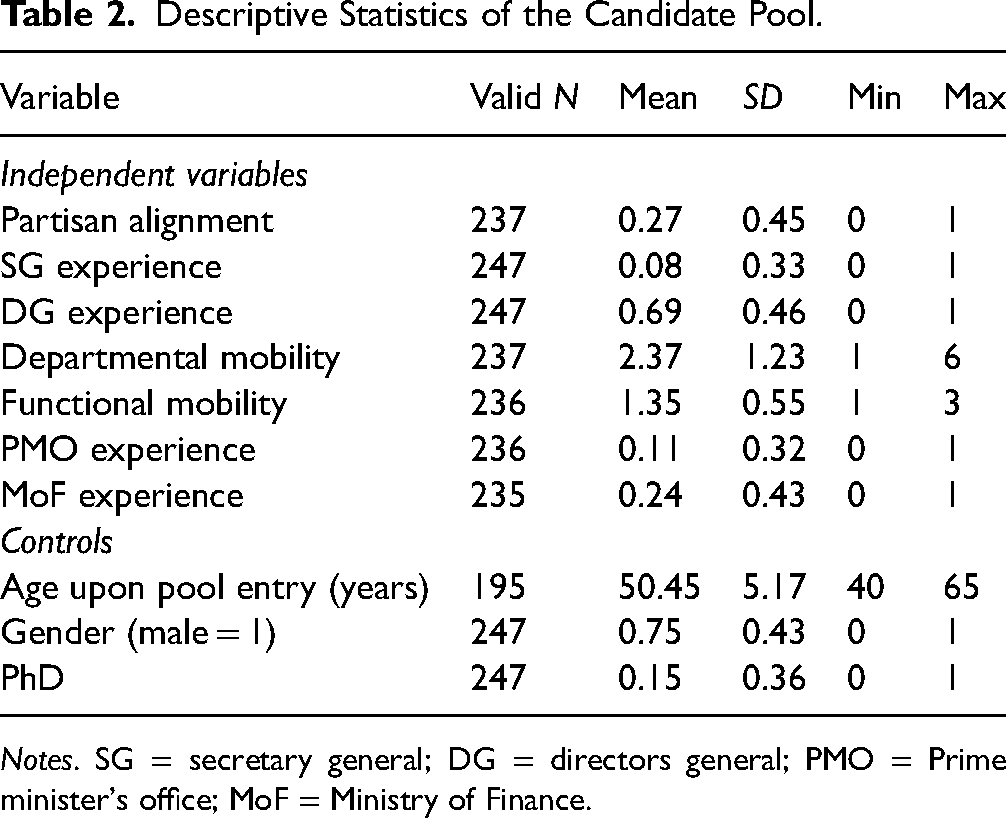
Notes. SG = secretary general; DG = directors general; PMO = Prime minister's office; MoF = Ministry of Finance.
Cox Regression Results.
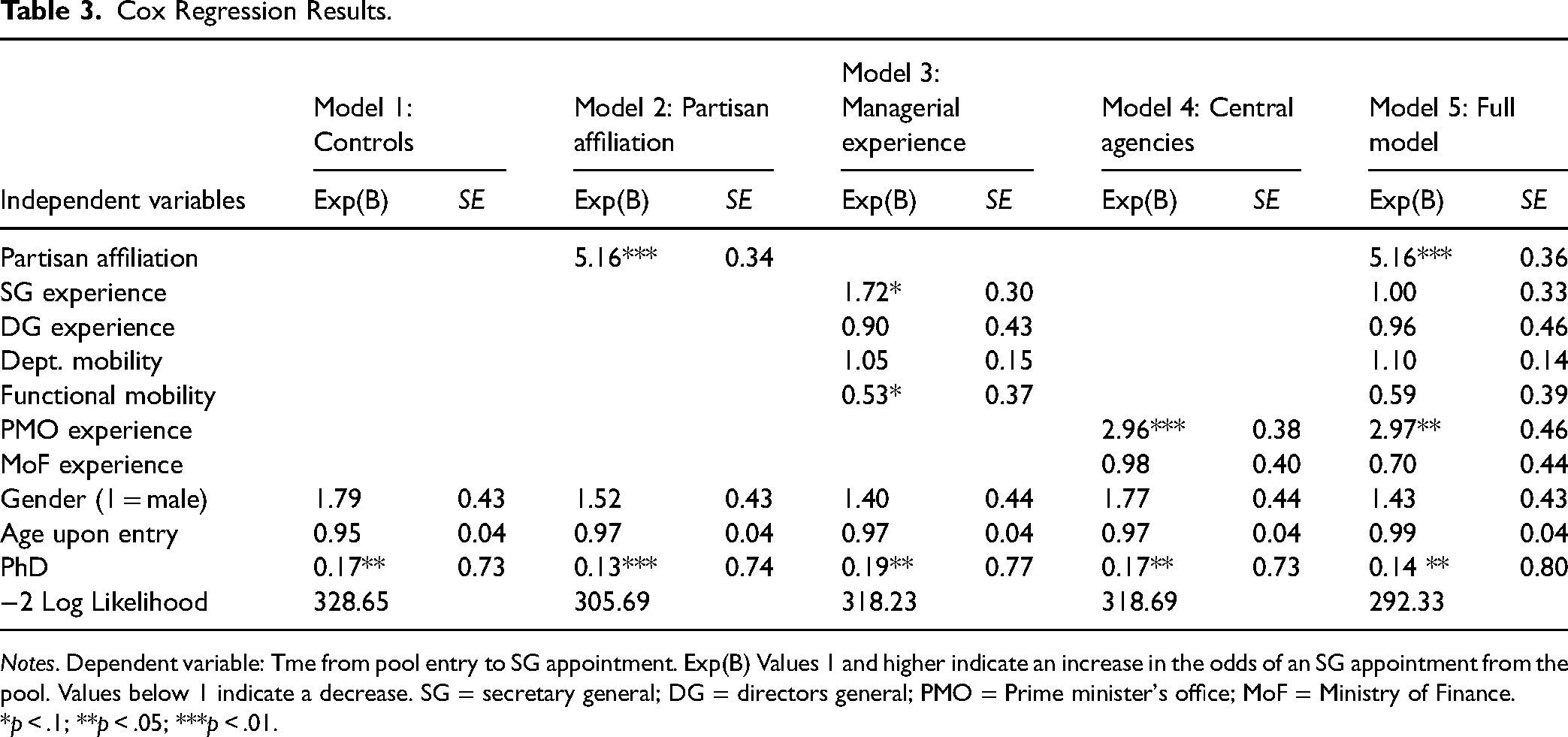
Notes. Dependent variable: Tme from pool entry to SG appointment. Exp(B) Values 1 and higher indicate an increase in the odds of an SG appointment from the pool. Values below 1 indicate a decrease. SG = secretary general; DG = directors general; PMO = Prime minister's office; MoF = Ministry of Finance.
*p < .1; **p < .05; ***p < .01.
Model 3 includes the variables regarding managerial experience on top of the control variables. Having prior experience as SG (for example before the observation period) had a positive effect (1.72), but the effect is only statistically significant at p < .1. Unexpectedly, having previous experience as DG did not seem to increase one's odds of becoming SG. On the contrary, a statistically nonsignificant hazard ratio of 0.90 indicates a small decrease, challenging the narrative of “rising through the ranks.” While DG experience is not necessarily bad for a candidate's prospects, the statistics provide no basis to conclude that it is a necessary (or even a helpful) condition for becoming SG. Together, this provides mixed results, but no support for H2. SGs’ career paths often include many senior managerial positions, just not necessarily DG positions. Departmental mobility reveals a slightly positive effect, but it is not significant. Functional mobility, having worked in multiple functions (policy making, frontline agencies, regulation) rather than in a single function, did not seem to advance SG appointments. The hazard ratio of 0.53 (p < .1) shows a decreasing effect. Together, the Cox regression provides no support for hypotheses H3 and H4.
Model 4 tests the relative importance of central agencies as critical “cradles of power” (Trangbaek, 2022) where candidates hone their craft and are likely to develop a “view from the centre.” The PMO Experience variable shows a strong and significant positive impulse for SG appointments (2.96, p < .01), trumped only by partisan activity (see model 2). This provides clear support for hypothesis 5. As with partisan activity, PMO Experience does not seem a likely precondition for pool entry as only 11% of the candidate pool has spent time in the PMO. Former PMO staff appears to be overrepresented among the highest echelon of the Dutch civil service. Contrary to my expectations, experience in the MoF shows a small inverse effect (Exp(B): 0.98, n.s.), leaving no support for H6.
Finally, model 5 includes all variables. Three things stand out. First, partisan affiliation remains the strongest variable in the model, reflecting an important indicator of successful SG appointments (Exp(B): 5.15, p < .001). Second, PMO Experience also retains a strong positive hazard ratio in the final model (Exp(B): 2.97, p < .019). The remaining variables (SG experience, DG experience, departmental mobility, functional mobility, and MoF experience,) show no significant effects in model 5. Contrary to the theorized expectations, these variables did not significantly predict advanced SG appointments, while partisan activity and PMO experience did. The control variables gender and age upon entry in the pool do not show significant effects, whereas having a PhD appears to be a nonstarter for an SG appointment.
Interpreting Secretary Appointments: Elite Interviews
The qualitative component of the research design comprises interviews with SGs, ministers, and elite HR experts in the Dutch civil service system. It highlights some of the critical experiences in SCSs’ career paths that predict an increase in the odds of becoming SG. These findings contextualize and nuance the significance of partisan affiliation and central agency experience.
Partisan Affiliation
The influence of politicians and partisan activity on SG appointments proves a mealy-mouthed subject among Dutch interviewees. Some interviewees defend the neutrality of the system and suggest that political appointments do not happen. Instead, they emphasize the importance of “chemistry” between minister and SG—the need for “compatibilité d‘humeur.” For instance: “There must be a fit with the secretary general” (Interview DG, 2020). Also, “the political complexion [of a SG] does not matter, it is a matter of competence” (Interview Minister, 2020). A SG stresses the trust that should exist between the minister and SG: “apparently he thought that I was a nice guy and that‘s not unimportant because it‘s very much a one-on-one trust relationship” (Interview SG, 2017). In this vein, a government HR executive noted that the current prime minister was keen to say about SG appointments: “I don‘t care who it is, as long as they are not from my party” (Interview government HR executive, 2020). At the same time, however, interviewees agree that even if ministers cannot force appointments of their choice, they can shape appointment processes by vetoing candidates they do not want. An SG told a story of an appointment in the observation window, in which a minister used his/her veto to bend an appointment to his/her liking: There was a vacancy for a SG position. The ABD came up with a shortlist of candidates that met the department‘s and minister‘s preferences and requirements. Good candidates with ample experience etc. After the shortlist was presented, the minister asked X [name withheld], who was not on the shortlist whether s/he‘d be interested. Explaining his/her request, the minister “sensed opposition in the department” and, plainly, wanted someone else – a need for a “breath of fresh air.” By now, the ABD realised their top candidates would be vetoed anyway. In the end X was appointed SG (Interview SG 2020).
This excerpt tells of a minister's influence and ability to ignore shortlists with prospective candidates, not necessarily of blunt party-political colonization of the departments. Indeed, most interviewees share nuanced experiences. However, this does not rule out partisan appointments or appointments of people who “think like we do.” In response to the question “for Ministers, is it a matter of finding a safe pair of hands, or rather introducing fellow partisans on the field?” an SG answered resolutely: “It‘s both” (Interview SG, 2021).
While all top management group appointments risk partisan influence, it seems to be more salient in SG appointments. “There are many checks and balances in the system that prevent political appointments, but political considerations play a bigger role in SG appointments” (Interview SG, 2020). Another SG echoed this: “At the top level, there's a professional system with checks and balances, but in the end, it is a cabinet decision. […] There's a fair bit of pressure in the system. You need to have a strong backbone to deal with that” (Interview SG, 2020).
Additionally, a senior ministerial advisor was confident about the weight of ministerial preferences in appointments: “when a minister wants someone, they will get that person. If they are to have a political complexion, its going to be theirs” (Interview ministerial adviser, 2017). Together, these quotes illustrate that though seasoned SGs may believe in neutral civil service appointments, they foster few illusions about the partisan influence on the process: “Ministers love to be involved in civil service appointments” (Interview SG, 2021).
The importance of partisan influence may likely ebb and flow, contingent on cabinet composition, personal ambitions, and windows of opportunity. One SG believed it became more important over the past 20 years: “I rose through the ranks: head of a group, deputy director, director, DG, SG. Not once was I asked about my political affiliation. Nowadays I would be, I‘m sure” (Interview retired SG, 2017). Others look on the bright side of neutral appointments. An incumbent SG confided that the ABD and the SGs collectively had “prevented a few partisan appointments” in recent years (Interview SG, 2020). Again, SGs showed that they were mindful of partisan influence. However, s/he stressed the resilience of current merit-based procedures in the light of partisan involvement.
A long-serving SG believed that hiring and firing procedures were tweaked “to repair the underrepresentation of one political party among top civil service positions. That‘s how anxiety creeps into the system” (Interview retired SG, 2020). This quote suggests that when deciding on appointments, the cabinet has an eye for a level of equity in the distribution of SG positions among the cabinet parties that routinely deliver ministers (cf: Van Thiel, 2013).
Central Agency Experience
The quantitative analysis signals the importance of doing time in the PMO for SG appointments. Interviewees concur but stress the relatively recent nature of that phenomenon. For example, a former DG reflected on the seemingly permanent tenure of PMO councilors: When I was in the Prime Minister's office, you would die there. I nearly died there. I spent 20 years in the Prime Minister's office, but it has changed now and it's now a senior career move. (Interview former DG, 2017). This development of the PMO, from an end-of-career-paradise to a career catalyst for midcareer civil servant with skill and ambition, did not happen by accident. This make-over was a deliberate move to position the PMO at the center of the core executive, according to a former SG of the PMO. He reflects: “I developed the PMO as a place in the Civil Service where you gather talents who then go on to become DG or SG in different departments. […] I strongly emphasized this, and it worked. All councilors were replaced. All of them became DG or SG. They all went on, and half of them were women” (Interview retired SG, 2015).
In this paper, I theorized that experience in central agencies provides civil servants with a view from the center. If these civil servants go on to fulfill top positions, chances are they share a common socialization, including biases: “the risk of emphasizing central agencies as a condition for promotion, is that there‘s not enough variety in the top. That's why you need people in these agencies from all departments” (Interview retired SG, 2015).
Discussion: The Politics of SG Appointments
The findings provide an answer to the research question: what career experiences have increased SCSs’ odds of being appointed to an SG position during 2000–2020? Partisan activity and PMO experience stand out as factors that catalyze SG appointments from the candidate pool. As stated, there are multiple factors at play. This paper cannot provide a full explanation of SG appointments between 2000 and 2020 in all their complexity and contingency. The predictors I identify in the empirical analysis do not fully determine appointments, but they show their relative weight in SG appointments from the pool. Also, appointments are not purely individual decisions in isolation. In many ways, they are contingent on team dynamics and complementary competence, networks, and experience. In other words, a civil servant's career path depends in part on the career paths of her colleagues in the pool. Moreover, SG appointments are not even just a bargain between minister and SG-to-be but are actively mediated and moderated by the ABD.
Reflecting on the findings and hypotheses, I identify three lessons for students of senior civil service appointments. First of all, this analysis underlines the politics of appointments in an otherwise neutral civil service system. It showed support for the first hypothesis: Candidates who are affiliated with a coalition party are more likely to be appointed as SG than those who have not. While the Netherlands may score comparatively low on formal politicization (Bach et al., 2020), partisan pressure is not absent and looms large in civil servants’ minds.
Still, the analysis suggests there has been a premium on explicit partisan affiliation – as expressed in active involvement and not just passive party membership—for SG appointments. In the mix of other factors that influence someone's appointment, partisan activity in one of the cabinet parties predicted an increase in one's odds. It is however not a necessary condition, as there were multiple SGs who do not partake in partisan activities. Others argue that ministers appoint cross-partisan officials, reflecting a tradition of consensus politics in administrative appointments. (Van Thiel, 2013). Even if this were the case, it would not annul the effect of appointing party-aligned SGs. After all, the data show that opposition party-aligned bureaucrats are underrepresented in the pool. During the window of observation, only a single SG with a clearly distinguishable opposition affiliation was appointed. As more routinely minister-delivering party-minded SGs hold office, certain viewpoints may be taken for granted, or doctrinally ignored among the upper echelons. In Schattsneider (1960) language, some biases are mobilized at the expense of others.
Explaining this effect as political control of the bureaucracy is at odds with Dutch government policy: partisan affiliation has no place in appointment procedures (Noordegraaf et al. 2020). This paper does not provide conclusive evidence to the contrary. Other explanations are necessary. A contextual explanation for partisan overrepresentation may be the low numbers and junior status of partisan ministerial advisers (cf: Van den Berg 2018; Van Thiel, 2013). While the need for tactical political advice is likely as high in the Dutch system as it is anywhere else, its policy advisory system offers few hands who can deliver. This puts SCSs, and SGs in particular, “in the zone” where they are expected to fuse policy advice with political advice (Belloir et al., forthcoming). The causal mechanism of partisan affiliation remains elusive. However, having first-hand experience doing party political work may well be perceived to provide SCSs a leg up in doing the functionally political work that SGs cannot shy away from. The rationale for this explanation is that individuals with first-hand experience in political arenas may be more empathetic to ministers and their struggles. After all, they may know what it is like to be in their shoes. A second explanation could be a self-selection mechanism: people interested in SG jobs are also interested in party political work.
Second, the hypotheses regarding managerial experiences (H2-H4) were not supported by this analysis. These results are counterintuitive and only partly correspond with existing findings by Bach and Veit (2018). In the German context, managerial experience was a significant “determinant of promotion to the highest bureaucratic office.” Yet, like my analysis, they also found that ministers give more weight to partisan loyalty than they do to managerial expertise. At first glance, it seems like managerial experience is not important for SG appointments in the Netherlands—as if, in the language of the politicization literature, cabinets value loyalty over ability. For the United States, presidents may indeed have different priorities. Lewis (2008:, p. 202) found that presidents trade some competence to “ensure bureaucratic responsiveness and generate support for their candidacy and programs through the distribution of patronage.” However, the descriptive data shows that all members of the pool have considerable experience, as directors or equivalent, in various departments, working in policy, implementation, regulation and beyond. Those who became SG tended to have focussed on policy making, rather than implementation or regulation, but the differences are not statistically significant. As virtually everyone in the pool is an experienced manager, this makes it a likely precondition for TMG pool entry. However, once candidates are in the pool, their senior managerial experience, e.g., having been a DG, no longer sets them apart from others in the pool. This effect may be related to the operationalization of the variable of senior managerial experience. Still, a more inclusive operationalization would not likely have yielded different results: all members of the pool have extensive experiences working as a public manager. Ultimately, this may corroborate some of the interviewees’ belief that “chemistry” is crucial to appointments. However, this chemistry may well include both managerial experience—as a minimum—and first-hand political experience.
Third, the analysis points to the clout of the core executive in an otherwise departmentalized organized civil service system. The quantitative evidence shows that experience in the PMO increased an individual's odds in SG appointment procedures in departments elsewhere. The elite interviews corroborate this finding and provide a rationale for it. It has been a deliberate intent to attract talent into the PMO, who would then go on to become DG or SG. The Dutch PMO appears to weigh in on departmental appointments too, through successfully plugging PMO staff into senior executive positions in other departments. Arguably, this catapults people who are acquainted with a “view from the centre,” an awareness of coalition management, and an understanding of the PM as leader of the government into pivotal positions across the civil service. The PMO plausibly mobilizes a center-focused bias among SGs (cf: Schattsneider, 1960).
In contrast, the equivalent to the Danish duopoly (Rhodes & Salomonsen, 2021) or an ascendancy of central agencies as (has been) occurring in other contexts, in terms of its impact on SG appointments, is not yet in sight. While PMO Experience predicts an increase in one's odds of becoming SG (support for H5), MoF Experience shows a (nonsignificant) negative hazard ratio (no support for H6).
Speculatively, MoF Experience is shared among a larger group in the pool (24% of the members spent time in the MoF, see Table 1). Similarly, Managerial Experience and having earned a MA degree, may be a factor contributing to pool entry, but not for appointment to SG from within the pool. Also, while the Dutch PMO holds a few dozen staff—rendering having such experience exceptional—the MoF employs thousands. This makes MoF Experience a less unique experience than PMO experience. So, while experience in the PMO proves a significant predictor of an SG appointment, experience in the MoF does not necessarily increase one's odds of being appointed.
Conclusions
Who is appointed to crucial posts in government departments at the expense of whom? This is a core question in public administration research. In this study, I fleshed out and tested predictors of SG appointments in the Dutch government in order to gain a better understanding of what career experiences improve one's chances of being appointed as SG. Civil service politicization and core executive literary works provided pointers to what places and practices may be helpful in becoming SG. The mixed-methods research design, coupling career path data with elite interviews, answers that question. Combined, these findings allow for three headline conclusions that illustrate the practice and politics of top civil service appointments, not just in the Netherlands. First, having a cabinet party affiliation increased one's chances, notwithstanding the conventional image of the Netherlands as an apolitical civil service system. In this paper, I do not find evidence of clear political control of the bureaucracy, but I challenge the claims of apolitical appointments. Second, while managerial experience is a plausible precondition for entering the upper echelons of the civil service, it did not increase one's odds from there on. Third, as shown in both the quantitative and qualitative analysis, experience in the PMO served as a stepping stone for future appointments.
Together, this informs theoretical debates about civil service appointments and politicization, public management, and core executive studies. In providing an original database, this paper opens up new possibilities for comparative research across systems. It also informs democratic debates about how we want governments to appoint senior bureaucats.
One such future, comparative, research possibility ought to be longitudinal. The quantitative analyses are time-sensitive but cannot show changing trends in SG appointments over time. The Dutch elite interviews suggest a trend toward more pressure on the system by politicians, whereas the institutional maturation of the Dutch ABD suggests a counter-trend towards increasing professionalization at the expense of ministerial influence. As careers continue to evolve, and selection procedures and practices too, repeating longitudinal analyses can illuminate new ways to high office.
Footnotes
Declaration of Conflicting Interests
The author(s) declared no potential conflicts of interest with respect to the research, authorship, and/or publication of this article.
Funding
The author(s) disclosed receipt of the following financial support for the research, authorship, and/or publication of this article: This work was supported by the Ministerie van Binnenlandse Zaken en Koninkrijksrelaties.

Author Biography
Appendix A. Correlations Matrix.
| 1 | 2 | 3 | 4 | 5 | 6 | 7 | 8 | 9 | 10 | ||
|---|---|---|---|---|---|---|---|---|---|---|---|
| 1. Gender (male = 1) | Pearson's R p-value |
-- -- |
|||||||||
| 2. PhD | Pearson's R p-value |
.135* .034 |
-- -- |
||||||||
| 3. Age upon entry | Pearson's R p-value |
.147* .036 |
−.054 .445 |
-- -- |
|||||||
| 4. Appointed from pool | Pearson's R p-value |
.068 .289 |
−.120 .061 |
−.214** .002 |
-- -- |
||||||
| 5. Political alignment | Pearson's R p-value |
.086 .185 |
.000 .997 |
−.061 .384 |
.294** <.001 |
-- -- |
|||||
| 6. SG Experience | Pearson's R p-value |
.113 .076 |
−.069 .278 |
−.051 .472 |
.368** <.001 |
.188** .004 |
-- -- |
||||
| 7. DG Experience | Pearson's R p-value |
−.036 .573 |
−.138* .030 |
−.164* .019 |
.072 .259 |
−.103 .114 |
−.130* .041 |
-- -- |
|||
| 8. Departmental mobility | Pearson's R p-value |
−.097 .136 |
−.192** .003 |
−.197** .005 |
.245** <.001 |
.010 .875 |
.187** .004 |
.069 .289 |
-- -- |
||
| 9. Functional mobility | Pearson's R p-value |
−.004 .945 |
−.065 .323 |
.074 .291 |
−.078 .233 |
−.056 .395 |
−.141* .031 |
−.084 .201 |
.159* .015 |
-- -- |
|
| 10. PMO Experience | Pearson's R p-value |
.053 .418 |
−.044 .496 |
−.129 .067 |
.199** .002 |
.081 .214 |
.268** <.001 |
−1.02 .116 |
.158* .015 |
−.159* .014 |
-- -- |
| 11. MoF Experience | Pearson's R p-value |
.007 .914 |
.001 .992 |
−.315** <.001 |
.041 .531 |
.093 .153 |
.020 .757 |
.011 .871 |
.387** <.001 |
.019 .775 |
−.010 .882 |
Notes. SG = secretary general; DG = directors general; PMO = Prime minister's office; MoF = Ministry of Finance.
*p < .05, **p < .01.