




Abstract
Although much has been written about public sector innovation in the last two decades, we still do not fully understand how public sector organizations become innovative. Therefore, this study inductively explored how four Norwegian municipalities developed innovation capabilities. I found that public sector organizations develop two forms of innovation capability in a path-dependent manner: low-routinized innovation capability and highly routinized innovation capability. In the former, dynamic managerial capabilities in the form of individuals’ entrepreneurial and leadership skills comprise the source of innovation capability. In contrast, in the latter, innovation capability emerges from dynamic organizational capabilities, that is, a set of innovation-stimulating routines, processes, tools, and structures. Notably, I found that regardless of the form of innovation capability, both spur the continuous development and implementation of various radical and incremental public sector innovations. Based on these findings, this study offers several contributions to the literature on public sector innovation and to the dynamic capabilities research agenda.
Keywords
Introduction
The myth of the ossified public sector has long existed in the minds of nearly all innovation and public administration scholars; however, that myth has finally been dispelled (Torfing, 2019). Intensive research over the last two decades has provided rich evidence of public sector organizations’ innovativeness (De Vries et al., 2016). The current literature demonstrates that public sector organizations develop and implement innovations that are novel (at least to the implementing public sector organizations) and that create or improve public value (Chen et al., 2019). We also know that public sector innovation can take different forms, such as service innovation (Nelson & Svara, 2012), collaborative innovation (Sørensen & Torfing, 2017), or innovative public procurement (Torvinen & Haukipuro, 2018). In addition, the existing findings show that public sector innovations help public sector organizations increase their efficiency and effectiveness (Arundel et al., 2019), deal with constantly emerging social and economic challenges (Torfing et al., 2019), and respond to pressures and expectations from multiple stakeholders (Sørensen & Torfing, 2019).
However, less is known about how public sector organizations “systematically raise innovation outputs over time” and manage their innovation processes and how such systematic development and implementation of innovations affect the public value that they create (Arundel et al., 2019, p. 794). The current research suggests that the possession of innovation capability explains why public sector organizations can continuously develop, manage, and implement innovations (Clausen et al., 2020; Trivellato et al., 2021). The previous studies define innovation capability as an organizational dynamic capability that stimulates continuous innovation activities and strategic change (Schilke et al., 2018). Although these recent insights shed some light on why public sector organizations can continuously develop and implement innovations, it is clear that we need additional investigations to explain how public sector organizations develop the capabilities that make them innovative (Zyzak & Jacobsen, 2020).
Therefore, drawing on the insights from the dynamic capabilities perspective (Schilke et al., 2018), this study seeks to explore how public sector organizations develop their innovation capabilities and how such innovation capabilities spur public sector innovations. As we know little about public sector organizations’ innovation capabilities, I employed an inductive, longitudinal research design. Using the case replication approach (Eisenhardt & Graebner, 2007; Huy & Zott, 2019), I studied innovation capabilities in four Norwegian municipalities over a period of 4 years.
This study makes three important contributions to the literature. First, this study provides new insight into how public sector organizations develop their innovation capabilities (Piening, 2013; Trivellato et al., 2021). I found that politicians and top public managers used their dynamic capabilities to successfully respond to various external and internal challenges that emerged in the focal organizations over time. Their decisions initiated and then strengthened the development of low-routinized or highly routinized types of innovation capabilities in the examined public sector organizations.
Second, this study deepens our understanding of the outcomes of innovation capability in a largely unexplored context of public sector organizations (Arundel et al., 2019; Clausen et al., 2020). Current private-sector-situated conceptualizations (Slater et al., 2014) describe innovation capability as a highly routinized organizational capability that spurs radical, mostly product and service, innovations (Janssen et al., 2016) and that endows the organization with revenue and profit growth. Instead, this study showed that in the public sector context, innovation capabilities take two forms—low-routinized and highly routinized. I found that both types lead to equifinal outcomes (Eisenhardt & Martin, 2000)—they spur continuous development and the implementation of both incremental and radical public value-creating policy, management, partner, service, and citizen innovations.
Finally, this study enhances our current poor understanding of the relationship between three dimensions of dynamic capabilities—the functional domain of innovative capability, its degree of routinization, and the source of its “dynamism” (Schilke et al., 2018). My research demonstrated that when the entrepreneurial and leadership skills of individuals—their dynamic managerial capabilities—are the source of innovation capability in a public sector organization, the innovation capability is low-routinized. However, when organizational structures, processes, tools, and routines—dynamic organizational capabilities—are the source of innovation capability in a public sector organization, the innovation capability is highly routinized. Hence, this study provides evidence that the dominance of either dynamic managerial or dynamic organizational capabilities in the process of continuous innovation development and implementation determines the degree of routinization of innovation capability in a public sector organization.
Theoretical Background
Innovation Processes in Public Sector Organizations
The phenomenon of public sector innovation has been extensively examined in recent years (De Vries et al., 2016). The main focus of the prior research has been the antecedents and outcomes of various public sector innovations (Barrutia & Echebarria, 2019). Consequently, we have a relatively deep and nuanced understanding of public sector innovations’ outputs such as new services, processes, or policies; their determinants; and the effects of such outputs on public sector organizations (Chen et al., 2019).
We also know that public sector organizations are innovative (Arundel et al., 2019). The prior studies provide substantial evidence that innovation processes are performed simultaneously in several public sector organizations’ departments and that such processes lead to the continuous development and implementation of different innovation types (Clausen et al., 2020). In addition, we have some insight into the relevant antecedents that facilitate or hinder the development of public sector organizations’ capability for innovation (Sørensen & Torfing, 2017). We know, for example, that the heroic efforts of innovation sponsors and champions stimulate innovation processes in public sector organizations (Zyzak & Jacobsen, 2020). Some studies also note that innovation-friendly organizational culture, available resources, and structures and systems can stimulate public sector organizations to continuously innovate (Trivellato et al., 2021).
However, the foregoing contributions offer a relatively static and fragmented picture of the innovation processes in public sector organizations. We know relatively little about how the interactions of the relevant antecedents result in the development of innovation capabilities in public sector organizations (Arundel et al., 2019; Clausen et al., 2020). Furthermore, we need more profound insight into how public sector organizations manage their innovation processes so that the abovementioned innovation outcomes can come to fruition (De Vries et al., 2016).
Adopting an innovation capability lens may deepen our insight into innovation processes in public sector organizations (Clausen et al., 2020). The concept of innovation capability is well established in the literature on dynamic capabilities (Schilke et al., 2018). Therefore, I draw on the dynamic capabilities theoretical framework to comprehensively explore how public sector organizations develop and manage their innovation capabilities to pursue innovations. In the following section, I briefly discuss the current state of knowledge on the dynamic capabilities perspective.
The Current State of Knowledge on the Dynamic Capabilities Perspective
The dynamic capabilities perspective explains how processes related to sensing, shaping, and seizing entrepreneurial opportunities enable an organization to reconfigure its resource bases and strategically change (Wilden et al., 2016). Dynamic capabilities are based on two pillars comprising “the organization’s values, culture, and collective ability to quickly implement a new business model or other changes” and “individual managers and the top management team” (Teece, 2016, p. 211). The former pillar embraces dynamic organizational capabilities (Schilke, 2014). The latter pillar is understood as the source of dynamic managerial capabilities (Helfat & Martin, 2015).
Dynamic organizational capabilities have been the most extensively explored area of research in the field of dynamic capabilities (Wilden et al., 2016). Consequently, we have great insight into organizational and individual-/team-related antecedents that are conducive to dynamic organizational capabilities (Teece, 2016). Among the most frequently identified antecedents of dynamic organizational capabilities are organizational learning, the willingness of organizational members to act entrepreneurially, and organic organizational structure (Schilke et al., 2018; Wilden et al., 2016). We also know that dynamic organizational capabilities can reside at two or more hierarchical levels (Schilke, 2014) and that they improve organizational-level performance (Helfat & Winter, 2011).
Research on dynamic managerial capabilities, in turn, has gained increased attention in the last decade or so (Helfat & Martin, 2015). Dynamic managerial capabilities studies have focused on the managerial impact on strategic change (Helfat & Martin, 2015; Martin & Bachrach, 2018). In contrast to dynamic organizational capabilities, dynamic managerial capabilities “do not fit well within the formal definition of routines” and are “inseparable from the individual managers with the ability to perform them” (Martin & Bachrach, 2018, p. 29). The vast majority of prior empirical research on dynamic managerial capabilities has explored how the underlying factors of dynamic managerial capabilities—managerial cognition, managerial social capital, and managerial human capital—(separately and together) enable managers to change their organization (Helfat & Martin, 2015; Schilke et al., 2018). We also have a relatively good understanding of the effects of dynamic managerial capabilities on organizational performance (Martin & Bachrach, 2018).
The dynamic capabilities perspective is built on several assumptions. First, the dynamic capabilities scholarship assumes that every organization comprises a collection of ordinary and dynamic capabilities (Teece, 2014). Ordinary capabilities enable organizations to achieve high levels of efficiency. However, such capabilities cannot be a source of long-term competitive advantage because they are easy to replicate (Teece, 2016). Dynamic capabilities, in turn, satisfy valuable, rare, imperfectly imitable, and nonsubstitutable (VRIN) criteria and enable an organization to strategically change (Teece, 2014). Second, dynamic capabilities have a certain degree of routinization, are path-dependent, and lead to organizational survival and growth (Wilden et al., 2016). Third, dynamic capabilities are based on the assumption that decision-makers have bounded rationality (Schilke et al., 2018).
Furthermore, dynamic capabilities have a universal character (Wilden et al., 2016). The prior research has found dynamic capabilities in virtually all organizations—private (Song et al., 2016), public (Trivellato et al., 2021), large (O’Reilly et al., 2009), and small organizations (Sawers et al., 2008). Although dynamic capabilities are universal, they also have a highly context- and organization-specific nature (Schilke, 2014). Our current understanding of dynamic capabilities in public sector organizations is that they rely on innovation-stimulating routines, processes, tools, and structures—dynamic organizational capabilities—in directing strategic change (Piening, 2011). However, the importance of exploring how public managers affect strategic change in public sector organizations has also been noted in the more recent research (Ongaro & Ferlie, 2020).
Finally, we know that dynamic capabilities are complex and multidimensional (Schilke et al., 2018; Wilden et al., 2016). The current literature distinguishes dynamic capabilities along a variety of dimensions such as procedural dimensions (Teece, 2014), degree of routinization (Helfat & Winter, 2011), functional dimensions (Lawson & Samson, 2001), or hierarchical domains (Eisenhardt et al., 2010). From this study’s perspective, the most central dimension of dynamic capabilities is the functional domain of innovation capability (Schilke et al., 2018). Therefore, in the following section, I synthesize our current understanding of innovation capability in the dynamic capabilities literature.
Innovation Capability as a Functional Domain of Dynamic Capabilities
Innovation capability can be defined as the capacity of an organization to continuously innovate by sensing and seizing entrepreneurial opportunities and transforming the organization to exploit these opportunities to benefit the organization and its ecosystem (Lawson & Samson, 2001; Teece, 2016). Interestingly, innovation capability is the most frequently explored functional domain of dynamic capabilities (Schilke et al., 2018).
A large body of studies has investigated different aspects of innovation capability in various contexts (Clausen et al., 2020; Janssen et al., 2016; Slater et al., 2014). Knowledge generated by these studies indicates that the Schumpeterian concepts of disruptive innovations and creative destruction constitute the building blocks of innovation capability (Breznik & Hisrich, 2014). Consequently, the vast majority of research provides evidence that innovation capability leads to radical innovations in organizations (Lee & Kang, 2015; Schneckenberg et al., 2015). The prior studies also show that innovation capability mainly results in the development of new products and services (Breznik & Hisrich, 2014; Schilke et al., 2018). Furthermore, some investigations offer insight into the process of innovation capability development. The foregoing studies find that innovation capability is built on certain organizational- and individual-related components such as passionate and visionary leaders, organic structure, or organizational learning (Schneckenberg et al., 2015; Slater et al., 2014).
Interestingly, however, the current literature pays little attention to the phenomenon of innovation capability in the public sector context (Arundel et al., 2019; Clausen et al., 2020). This gap is surprising because the public sector comprises an essential context for the validity, scope, and explanatory adequacy of the innovation capability research (Fisher & Aguinis, 2017). Our current understanding is that innovation capability spurs public sector innovations (Clausen et al., 2020; Trivellato et al., 2021). Nevertheless, it remains unclear whether public sector organizations develop and manage their innovation capabilities differently than private firms (Arundel et al., 2019). The public sector context is characterized by a lack of “innovate or die” culture (De Vries et al., 2016), a lack of connection between performance and revenues (Choi & Park, 2014), a nonprofit orientation and focus on achieving multiple goals (Piening, 2013), and high media attention, risk aversion, and political inference (Sørensen & Torfing, 2017). Therefore, the question of how the public sector context affects the development and role of innovation capability in public sector organizations constitutes a useful starting point for additional research. My study addresses this issue by exploring how four Norwegian municipalities develop their innovation capabilities and how such innovation capabilities spur public sector innovations.
Method
Research Setting
The empirical context of this research is the Norwegian municipal sector. The Norwegian municipal sector offers several advantages for investigating the development and role of innovation capabilities in public sector organizations. First, the prior research has accumulated evidence that Norwegian municipalities are highly innovative (Rønning et al., 2014), actively pursue strategic change (Askim et al., 2008), and systematically engage in innovative processes (Torfing et al., 2019). These findings indicate that numerous Norwegian municipalities must have developed innovation capabilities. Moreover, Norwegian municipalities are easily accessible, enjoy a high level of citizens’ trust, and eagerly engage in collaboration with research institutions (Christensen & Lægreid, 2020). This, in turn, creates an ideal context for conducting a longitudinal and in-depth study of the development and role of innovation capabilities in public sector organizations.
Sample Selection and Data Collection
To inquire into how public sector organizations develop and manage their innovation capabilities, I used a theoretical sampling approach (Eisenhardt & Graebner, 2007; Huy & Zott, 2019). Such an approach involves the selection of between four and 10 “polar” cases where a researcher can transparently observe the examined phenomenon. To identify the relevant cases, I searched the official websites of all Norwegian municipalities. The initial list comprised 426 municipalities. I looked for municipalities that (a) frequently develop and implement innovative projects/innovations (i.e., projects that contain the words innovation and/or entrepreneurship in their title or description) and (b) emphasize innovation in their organizational strategy, strategic plans, and/or political-level policies. The initial screening process showed that 32 Norwegian municipalities fulfilled both criteria.
In June 2015, at the annual national conference of Norwegian municipalities, I conducted unstructured informal interviews with representatives of the 32 selected Norwegian municipalities to gain an initial understanding of the nature of the innovative processes in the focal organizations. I observed that two patterns emerged in my informants’ descriptions of how their municipalities pursue innovations. Some focused on heroic innovative individuals and discussed how critical they were for developing and implementing innovations in their municipalities. In contrast, others did not pay too much attention to heroic public sector innovators. Instead, they argued that the existence of innovation-stimulating tools, processes, structures, and routines was essential for pursuing innovations in their organizations. This helped me to choose the four municipalities presented in Table 1. I selected two municipalities where informants reported a high involvement of innovative individuals in developing and implementing innovations and two where informants reported a high usage of innovation-stimulating tools, processes, structures, and routines in developing and implementing innovations. Hence, variance in how the municipalities pursue innovations comprised my key sampling principle.
Overview of Cases.

Table 1 presents an overview of the selected cases and collected data. The table shows that the selected municipalities adequately represent the variation in the population of Norwegian municipalities. Each reported pattern of the pursuit of continuous innovation is built on insights from two municipalities that differ in terms of (a) their geographical location, (b) the ideology of the political parties that control their legislatures, (c) whether they have won the annual Norwegian Innovation Award for the Municipal Sector, and (d) their economic situation. I adopted such a sampling strategy because it allowed me to increase the likelihood that the observed similarities and differences between these two patterns would solely be attributed to those identified in these organizations’ innovation capabilities.
I collected the data from three sources: (a) semi-structured interviews with politicians, chief administrative officers, and top public managers as well as with project managers and workers; (b) follow-up emails and telephone conversations; and (c) archival data composed of project and municipality websites, internally published books, press articles, and other internal documents provided by the informants. The primary source of data was 60 semi-structured individual interviews and focus groups, which were conducted with informants between 2016 and 2020. The length of the interviews ranged from approximately 20 min to more than 120 min. The length of all interviews exceeded 48 hr. All the interviews were recorded and transcribed.
To triangulate the informants’ reports of how their municipalities pursue innovations, I interviewed both innovative project managers and workers who worked with various innovative projects and top public managers and politicians who created and managed innovative organizational environments in the focal municipalities. This approach allowed to me to elaborate and validate the obtained accounts (Huy & Zott, 2019). The interview guide for project managers and workers differed from that used to interview top public managers and politicians. The interviews with the project managers and workers were concerned with the project idea and the development and implementation of their project. I also asked them questions concerning the influence of the municipal organizational environment on their project. Politicians and top municipal managers were in turn asked to discuss the history and various aspects of the organization’s work on innovation. In addition, they provided a “bird’s-eye” perspective on the projects in their municipality.
The archival material contained descriptions of innovative projects, applications for funds, reports, internal strategies, brochures, PowerPoint presentations, and the websites of innovative projects along with internally published books and media coverage of the municipalities’ innovative work. The collected secondary data comprised approximately 2,500 pages and slides, 16 Excel files, and more than 40 min of video recordings. I used secondary data to triangulate informants’ accounts and thereby to increase the quality and validity of the gathered data.
Research Design and Data Analysis
Following the approaches used in inductive research designs (Eisenhardt & Graebner, 2007), I sampled the cases drawing on variations in outcomes and then attempted to identify the causes of these variations (Huy & Zott, 2019). The use of a multiple-case study approach allowed me to employ replication logic (Eisenhardt & Graebner, 2007). Replication logic defines cases as experiments that either confirm or disconfirm the findings from other analyzed cases and extend the obtained theoretical insights (Yin, 2014).
I distinguished between low-routinized and highly routinized innovation capability based on the emerging findings and the dynamic capabilities literature. In the analyzed interviews, I found quotes that described how the innovative activities of individuals or innovation-stimulating organizational tools, processes, structures, and routines caused the focal municipalities to become innovative. In cases where the innovative activities of individuals were the source of organizational innovativeness, I found a relatively low degree of innovative process routinization. However, in cases where innovation-stimulating organizational tools, processes, structures, and routines constituted the “engine” of organizational innovativeness, the routinization of innovative processes was relatively strong. Given such insight, I turned my attention to the dynamic capabilities literature. The dynamic capabilities literature indicates that dynamic capabilities are based on two pillars: dynamic managerial capabilities (innovative individuals) and dynamic organizational capabilities (organizational culture, values, and collective ability to make strategic change; Teece, 2016). The dynamic capabilities literature also provides strong evidence that different types of dynamic capabilities can have a different degree of routinization (Schilke et al., 2018). Given such insight, I based my analysis on the variation in the routinization of innovation capabilities in public sector organizations. To identify the building blocks of each type of innovation capability, I first inferred the concepts that emerged from the data.
As an example, when I asked the mayor of Narvik about the drivers of innovativeness in his organization, he, among others, said, “We would not be that innovative if we weren’t organized in the way we are organized now. I mean . . . We use a two-level structure, which significantly strengthens our innovativeness.” I coded this statement as “lean organizational structure as innovation stimulus.”
In the next step, I used other cases to confirm or disconfirm the emerging findings. The cross-case analysis demonstrated that lean organization structure also stimulated innovative processes in the municipality of Asker: “Without any doubt, a two-level structure is a building block of our innovativeness” (top manager in the municipality of Asker). Moreover, in both municipalities, I found that because of such an organizational structure, both organizations have little hierarchy in all of their departments. To illustrate, consider the following quote from the mayor of Narvik: It [our structure] does not include so-called middle management such as the chief of schools or the chief of nursery homes. It is simply the chief administrative officer’s team and the 42 unit managers/leaders divided in 13 sectors. So, as you can see, our structure is quite flat.
In addition, I found that the lean organizational structure in these two municipalities supported the development of bottom-up and top-down innovations: “The two-level structure gives us so much flexibility and supports interdisciplinarity. That is why we have developed so many of both bottom-up and top-down innovation projects” (top manager in the municipality of Asker).
Then, to firmly establish the analysis in the theoretical realm (Gioia et al., 2013), I performed a more literature-informed, rigorous coding of what comprises low-routinized innovation capability and what constitutes highly routinized innovation capability. To this end, I relied on the microfoundational categories developed by Felin et al. (2012). Following Felin et al. (2012), I coded the above components of innovation capabilities as “flat and flexible organizational structure”—a microfoundation of highly routinized innovation capability.
Overall, the conducted data analysis revealed that a highly routinized innovation capability is built on four microfoundations: interdisciplinarity and organizational learning, networking, centralized support for innovation development and implementation, and a flat and flexible organizational structure. Performing similar analyses, I found that a low-routinized innovation capability rests on three microfoundations: public entrepreneurs, political and managerial leadership, and employee empowerment (see Figure 1).
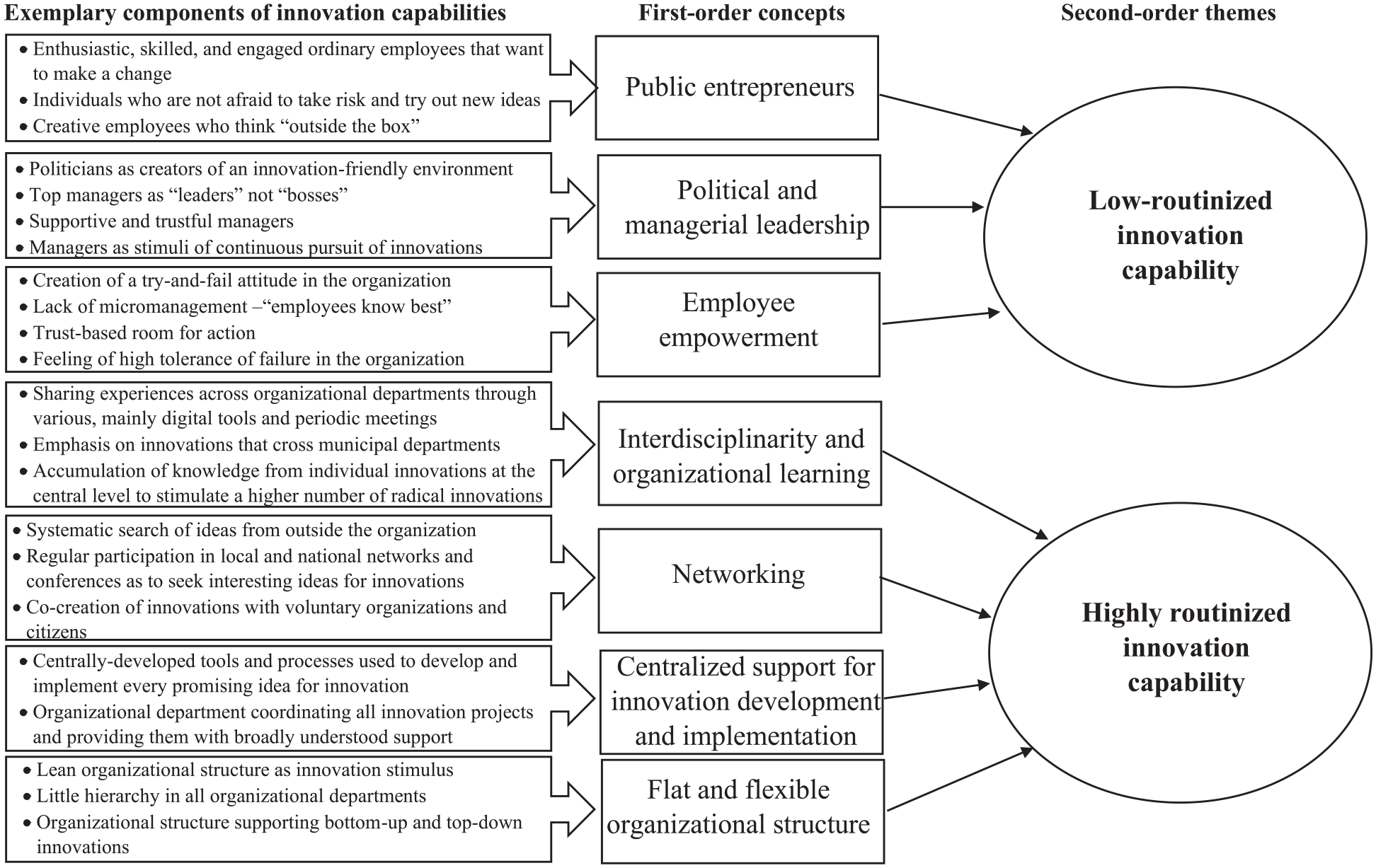
Data structure.
In line with theoretical sampling, the selected municipalities in my sample demonstrate considerable differences with regard to the nature and development of their innovation capabilities. The municipalities of Arendal and Bodø developed their innovation capabilities based on the dynamic managerial capabilities of their employees and lower-level managers as well as low routinization. The municipalities of Asker and Narvik, in turn, developed strongly routine-based innovation capabilities such that dynamic organizational capabilities played the critical role in innovative processes.
Findings
This section elaborates on the development, nature, and outcomes of low-routinized and highly routinized innovation capabilities in public sector organizations. My data suggest that public sector organizations with low-routinized innovation capability can continuously pursue various public sector innovations because their employees and lower-level managers possess dynamic capabilities. At the same time, public sector organizations with highly routinized innovation capabilities infer their innovativeness from the possession of dynamic organizational capabilities. The main findings of this study are summarized in Figure 2.
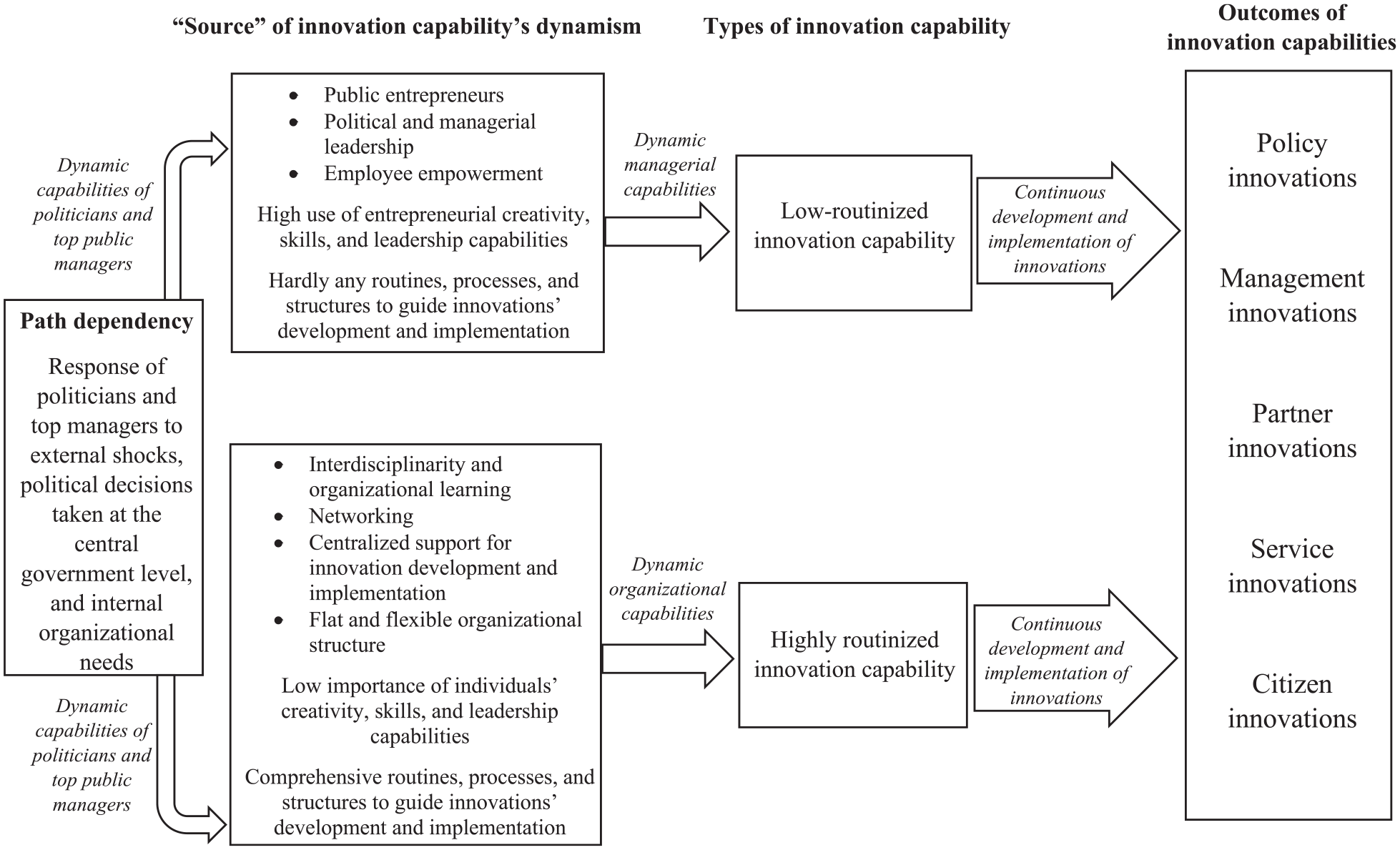
The development and outcomes of innovation capabilities in public sector organizations.
The rest of this section discusses my research model. The empirical evidence and the description of the identified microfoundational components are presented in Table 2.
Components of Innovation Capabilities in Public Sector Organizations.

Low-Routinized Innovation Capability
The development of a low-routinized innovation capability in the municipalities of Arendal and Bodø was the consequence of past decisions made by politicians and top managers (see also Figure 2). The origins of Arendal’s low-routinized approach to innovation development and implementation can be traced to a large reorganization project launched in 1998. In the 1990s, the municipality of Arendal experienced a severe financial crisis. To recover from the difficult economic situation, politicians and top managers decided to make innovation the central point of the organizational strategy. The chief administrative officer told me that it was then that their “innovation culture with a dominant role of individual innovators was born during this big reorganization project.”
The path initiated toward more innovation was strengthened by several radical and incremental changes that were made in the first decade of the 2000s. The most significant of these was the late 2004 construction of and move to a new town hall. Arendal’s chief administrative officer argued that this event ultimately shaped the bottom-up and individual-oriented approach to the continuous development and implementation of innovations: I think I can say that the year when we moved into the new town hall and removed almost all structures was decisive. It was an “innovative grip” and a brave move in relation to the bureaucracy, but we succeeded. We thought, “let’s try out new ways of working and base an organization on self-management, where professional discussions were aimed more at horizontal exchanges of knowledge and experience, and maximal delegation of power to ordinary employees.” So it was the employees and their professional colleagues who were actually given the authority to make a decision. (Chief administrative officer in the municipality of Arendal)
In addition, the charismatic style of leadership employed by Arendal’s chief administrative officer and the innovation and development advisor has been decisive for the development of this particular type of innovation capability. For example, the advisor encouraged all employees to innovate and emphasized the more informal, interpersonal development of ideas and exchange of experiences in the organization (instead of preparing many internal documents, which “no one reads anyway”).
In the case of municipality of Bodø, the “turning point” was the central government’s decision to close the local military air base in 2012. Since the 1950s, the military air base was a vital part of the city’s economy and the local community. The closure of the military air base was, as the chief administrative office reported, “a shock for the whole municipality.” However, this decision encouraged the top managers and politicians to fully emphasize innovative attitude, which “created positive energy, and excitement in the whole organization.” The main task of all municipal employees and managers became generating innovative solutions that would make Bodø green, smart, more people-oriented.
The politicians and top municipal managers decided to build their innovation capacity around individuals. As Bodø’s chief administrative officer reported, It is obvious that some people are fascinated by new things [tools, routines, structures, and processes]. But my view is that you need to have people who have the ability to think outside the box [to innovate] . . . Therefore, we think that the main source of innovation in the municipality of Bodø cannot be tools, routines, structures, or processes . . . but the outgoing, innovative individuals who continuously look for new opportunities and solutions. We want them to look for new solutions. That’s why we put so much emphasis on both culture and environment for innovative thinking. (Chief administrative officer in the municipality of Bodø)
Similar to the municipality of Arendal, the construction of a new town hall in 2019 allowed the municipality of Bodø to strengthen its low-routinized innovation capability. The chief administrative officer noted that moving to a new town hall further developed “the sharing culture” in the municipality and further empowered employees and managers to “come up with new solutions in cooperation with the external actors and, above all, citizens.”
As some may point out, high reliance on individuals to continuously pursue innovation can make an organization very vulnerable—such that when an individual leaves, his or her creativity, innovative skills, knowledge, and experience also leave the organization. Both municipalities took particular measures to minimize such a risk. The chief administrative officer in the municipality of Bodø told me that this measure is . . . a rule, which we call “twin competencies”—never have just one person who has a knowledge about a particular area. That is to reduce our vulnerability. I wouldn’t say we are very dependent on individual people, managers, project managers, and so on, but . . . they are central for us. We have exceptionally skilled employees and managers and—God forbid—we don’t want to miss them. It is not like that when one person quits, it is simple to replace him or her. We then need to use some time to build up the same competencies, experience, and so on. However, because we have “twin competencies,” we are less vulnerable. (Chief administrative officer in the municipality of Bodø)
Interestingly, the recent coronavirus crisis has demonstrated how critical the possession of low-routinized innovation capability has been for both municipalities. For example, the chief administrative officer in the municipality of Bodø noted that the corona crisis has clearly shown how easily we can adapt to turbulent events. Because we develop innovations in all areas of the municipality, all the time, we were so well-prepared to the deal with the crisis. For example, it wasn’t luck that we had provided all pupils with computers. We had them because one of our employees had dared to think innovatively. So, when corona [crisis] happened: “pang” . . . three days later [after imposing the lockdown], our teachers could easily start teaching digitally . . . No problem. (Chief administrative officer in the municipality of Bodø)
As Table 2 and Figure 2 illustrate, a low-routinized innovation capability was developed in both municipalities on three microfoundations: public entrepreneurs, political and managerial leadership, and employee empowerment. Table 2 describes these components and provides extensive empirical evidence.
The data from both municipalities reveal that the dynamic capabilities of public entrepreneurs (i.e., dynamic managerial capabilities) are the “source” of dynamism of low-routinized innovation capability (see Figure 2). I found that public entrepreneurs can use their dynamic capabilities to continuously pursue innovations only because they operate in an innovation-friendly environment. My data indicated that such an environment is characterized by political and managerial leadership and employee empowerment. In other words, my analysis reveals that in public sector organizations, where politicians and top managers act as leaders and empower their employees, public entrepreneurs use their dynamic capabilities to continuously develop and implement innovations.
Highly Routinized Innovation Capability
As in the case of the development of low-routinized innovation capability, the highly routinized innovation capability in the municipalities of Narvik and Asker also emerged from past decisions made by politicians and top managers (see also Figure 2). The municipality of Narvik has been in a difficult economic situation since the 1990s. Due to large-scale redundancies in its largest local enterprises, it became a restructuring municipality. A severe local financial crisis was the trigger for politicians and top managers to develop a culture of thinking differently and continuously seeking new solutions to the obstacles it must overcome to achieve its objectives.
After the recovery and a decade of prosperity, Narvik experienced yet another crisis, at the beginning of the 2010s, in the form of the collapse of the local solar cell industry and the departure of the headquarters of a large Norwegian cruise, ferry, and cargo operator. The internal economic situation was also difficult because of unsuccessful municipal investments in complicated U.S. financial products. Because resources for innovations were very limited, the municipality of Narvik had to perform its innovation processes in a somewhat structured manner. Top managers and politicians decided that working in interdisciplinary teams would be the best approach to stimulate continuous innovation development and implementation. The mayor of Narvik told me that to encourage entrepreneurial attitude and working together in teams, employees and managers were provided with various tools, routines, structures, and processes: We have management group meetings where project managers share their experiences and findings from their innovative projects and give feedback to each other. They also prepare some documents so that others can look at them at any time . . . We also have an internal online “project room” where project managers provide feedback to each other and follow the progress of other projects. (Mayor of Narvik)
The municipality of Asker, in turn, began its journey toward highly routinized innovation capability in 2003 when politicians and top management decided to establish the innovation unit. The purpose of the innovation unit was to create a place where innovations could flourish. Given the insights from scientific research and after consultation, the municipal administration decided to work on innovations in interdisciplinary teams. To facilitate their work on innovation, the municipality of Asker developed a project methodology and a number of tools, processes, and routines. Because of its interdisciplinary character, over time, the innovation unit became a place where innovations have been continuously developed and implemented.
The highly routinized nature of Asker’s innovation capability was particularly strengthened by two events: the preparation of a document called “Innovation Strategy” in 2015 and the move of the innovation unit to a new location in Lensmannslia in Asker in June 2020. The “Innovation Strategy” briefly summarized innovation culture and Asker’s systematic methods of working with innovation. These systematic methods described the actions that every manager of an innovative project should perform in each phase of innovation development and implementation. They specified where to seek ideas for an innovative project, how to develop the initial concept, how to plan and execute the innovation implementation process, and how to assess the results of the implemented innovation. One of the top managers in the municipality of Asker told me that the implementation of the “Innovation Strategy” greatly enhanced Asker’s ability to connect small incremental improvements into more radical changes at the organizational level: We think that if these small things are shared inside and outside the organization, it can lead us to quite big things that will be beneficial for the municipality. That is why we are concerned with working systematically. It is crucial to take a strategic look at projects and know where to go at all times. The most important thing is that we move in the correct direction. (Top manager in the municipality of Asker)
The move of the innovation unit to a new facility in June 2020 made the municipality of Asker even more innovative because, as one of the top managers in the municipality of Asker noted, it “. . . created a ‘garage environment’ where creative processes and new ideas have free rein.”
Highly routinized innovation capability, similar to low-routinized innovation capability, turned out to be critical in dealing with the recent coronavirus crisis. As one of the top managers in the municipality of Asker told me, because of their innovation capability, they could “. . . quickly respond—in the form of smart and creative solutions—to challenges in different areas such as teaching or local economy stimulation.”
As Table 2 and Figure 2 demonstrate, both municipalities developed a highly routinized innovation capability on four microfoundations: interdisciplinarity and organizational learning, networking, centralized support for innovation development and implementation, and flat and flexible organizational structure. Table 2 presents these microfoundations and offers extensive empirical evidence.
My study reveals that in both municipalities, tools, routines, structures, and processes (i.e., dynamic organizational capabilities) are the “source” of dynamism of highly routinized innovation capability (see Figure 2). Dynamic organizational capabilities in these two cases comprise (a) a lean organizational structure that maximizes the interdisciplinary character of teams that pursue innovation in organizations; (b) a number of tools and centralized support from innovation units that guide innovation teams throughout the entire innovation process; and (c) the capability to systematically search for innovative ideas in established networks. In other words, my analysis suggests that in public sector organizations that use such tools, routines, structures, and processes, dynamic organizational capabilities stimulate continuous innovation development and implementation.
Outcomes of Low-Routinized and Highly Routinized Innovation Capabilities
The inquiry into the outcomes of the innovation capabilities in selected public sector organizations has resulted in an interesting observation: Regardless of the type of developed innovation capability, both stimulated the continuous development and implementation of the same types of public sector innovations. I understand a public sector innovation as the development and implementation of any idea that is new to the adopting public sector organization and that creates or improves public value (Chen et al., 2019). I found that municipalities with low-routinized and highly routinized innovation capabilities continuously develop and implement both radical and incremental 1 policy, management, partners, services, and citizen innovations. 2 Table 3 provides some examples of public sector innovations that were developed between 2016 and 2020 in the investigated organizations.
Examples of Innovations Developed Between 2016 and 2020 in Municipalities With Low-Routinized and Highly Routinized Innovation Capabilities.

Discussion
My inductive field study provides a more nuanced and deeper understanding of the development, nature, and outcomes of innovation capabilities in public sector organizations. I discuss notable past decisions that shaped the form of innovation capability in each of the examined public sector organization. I also identify two distinct types of innovation capability in the public context (low-routinized and highly routinized innovation capabilities) and their building blocks. In addition, I show the outcomes of each type of innovation capability in the form of developed and implemented public sector innovations.
Innovation Capabilities, Their “Source” of Dynamism, and the Public Sector Context
How do public sector organizations continuously develop and implement innovations? Contrary to the prior research (Clausen et al., 2020; Trivellato et al., 2021), my findings suggest that innovation capability in public sector organizations need not solely emerge from the routines, culture, structures, and collective ability to stimulate innovations (Schilke, 2014)—the dynamic organizational capabilities—that are located at the meso- and organizational levels of analysis. My study indicates that in some public sector organizations, innovation capability can have its “source” of dynamism in the dynamic managerial capabilities (Helfat & Martin, 2015) of public entrepreneurs. This is important because the prior studies have indicated the critical role of public managers in creating or improving public value (Ongaro & Ferlie, 2020; Trivellato et al., 2021). For example, Piening (2013) observed that dynamic capabilities in public sector organizations are dependent on “how extensively and appropriately public managers use established dynamic capabilities” (p. 236) However, to the best of my knowledge, my study is one of the first in the field of dynamic capabilities to acknowledge that public sector employees and lower-level managers themselves can possess and use their dynamic capabilities to continuously develop and implement innovations.
By finding that innovation capability can take two forms in public sector organizations—low-routinized and highly routinized—and that these two forms of innovation capability are built on different building blocks, my study also contribute to our understanding of the relationship between three dimensions of dynamic capabilities—the functional domain of innovative capability, its degree of routinization, and the source of its “dynamism” (Schilke et al., 2018). The prior studies have largely focused on how the external environment influences the degree of routinization of dynamic capabilities in organizations (Peteraf et al., 2013). Making significant headway on this issue, my study indicates that organizations operating in the same environment (i.e., the public sector) can develop both low-routinized and highly routinized innovation capabilities and have their “source” of dynamism at different organizational levels.
Do low-routinized and highly routinized innovation capabilities lead to different outcomes? My findings suggest that both types of innovation capability result in a continuous development and implementation of the same types of innovation. My study showed that municipalities with both low-routinized and highly routinized innovation capabilities have developed radical and incremental policy, management, partners, services, and citizen innovations. This is an important finding because it indicates that the equifinality of dynamic capabilities’ outcomes does not occur only in the moderately dynamic environments of the private sector (Eisenhardt & Martin, 2000; Peteraf et al., 2013) but also in the public sector context.
This is also significant in the light of the prior work on public sector innovation (Arundel et al., 2019) and innovation capability (Breznik & Hisrich, 2014). The recent research on innovation capability in the public sector (Clausen et al., 2020; Trivellato et al., 2021) explores neither the scope nor the types of public sector innovation developed and implemented by innovation capabilities. In turn, the insights from the literature on dynamic capabilities (Janssen et al., 2016; Slater et al., 2014) suggest that innovation capability stimulates the development and implementation of mainly radical product and service innovations. Hence, my study offers an important theoretical insight into both of these areas of research because it reveals that compared with innovation capability in the private-sector context, innovation capability in the public sector context results in different outcomes.
Is it thus relevant which type of innovation capability a public sector organization develops? My study reveals that it is of great relevance because the legacy of the past shapes and defines the nature of innovation capabilities. This finding is in line with the prior studies on dynamic capabilities in both public sector (Piening, 2013) and private-sector organizations (Teece, 2016) that have found that dynamic capabilities are developed in a path-dependent way. My study demonstrates that the past decisions of politicians and top managers result in organizational strategic change and a successful response to various external shocks, central government-level decisions, and internal organizational challenges. These decisions initiated and then strengthened the process of building the “source” of dynamism of organizational innovation capability around either dynamic managerial or dynamic organizational capabilities. This is an interesting finding because it indicates that public sector organizations also require decision-makers in the upper echelon who can direct strategic change. In other words, my study suggests that public sector organizations require politicians and top managers who possess dynamic capabilities to develop innovation capability (Helfat & Martin, 2015). The current literature offers very limited insight into the dynamic capabilities of politicians and top public managers (Schilke et al., 2018). To the best of my knowledge, this study is the first to acknowledge that politicians and top public managers can also have dynamic capabilities.
As the process of innovation capability’s development happens over many years and in several stages, it appears that any considerable changes in the nature of a particular innovation capability cannot be made in the short term. This theoretical insight offers important implications for practitioners. Recent policy agenda in Norway and other Scandinavian countries (Government.no, 2018) have been focused on encouraging municipalities to take a more systematic approach to working with innovation—an approach that largely corresponds with the above-discussed highly routinized innovation capability. The most prominent example of this trend is the recommendation of the Norwegian Association of Local and Regional Authorities to use “The Project Wizard,” which was developed together with, among others, the municipality of Asker, in developing innovation processes (Bøgh et al., 2018; KS, 2019). My study calls for avoiding a one-size-fits-all approach to innovation capability development in public sector organizations. As my findings showed, innovation capabilities are developed over time in a path-dependent manner, and they are built on the resource and competence base of a particular public sector organization. Therefore, my study encourages policy-makers to uphold the diversity of innovation capabilities in public sector organizations.
Limitations, Future Research, and Conclusion
As with all research, my study is not without limitations. First, my study was conducted in the context of the Norwegian municipal sector, which can be described as highly innovative. Consequently, such an innovation-friendly environment may well be an enabling antecedent of the observed innovation processes. While my data do not indicate that this is the case, I acknowledge this potential limitation of my research model. Second, because my study sought to explore how public sector organizations develop their innovation capabilities and how these capabilities spur public sector innovations, my sampling strategy was naturally limited to innovative Norwegian municipalities. However, it may be that if the sample were extended to include less innovative municipalities, my research would provide a more refined understanding of the role and development of innovative capabilities in public sector organizations. It is also essential to note that my research model does not capture the strength of the individual microfoundations’ influence on the observed forms of innovation capabilities. Therefore, based on the current model, we cannot explain how innovative a public sector organization would be if it adopted only one of the building blocks of the identified forms of innovation capability. Furthermore, my study demonstrates the importance of path dependency for developing the identified forms of innovation capability. However, it may also be the case that path dependency influences the types of innovations that public sector organizations pursue. I see particular merit in performing additional investigation on these issues.
My research raises other intriguing questions for future studies. First, future studies could explore different “shades” of low-routinized and highly routinized innovation capabilities in public sector organizations. In my study, I focused on “polar cases” (Eisenhardt & Graebner, 2007). However, it is possible that public sector organizations develop more nuanced forms of low-routinized and highly routinized innovation capabilities that build their “source” of dynamism on different mixtures of dynamic managerial and organizational capabilities. If there are more nuanced forms of low-routinized and highly routinized innovation capabilities, one may wonder whether they are made with different building blocks and at what point innovation capability becomes low-routinized or highly routinized. Second, we need more insight into the cognitive capabilities, social capital, and human capital (Helfat & Martin, 2015) of politicians and top public managers as well as lower-level public managers and public employees who possess dynamic capabilities. In doing so, future research could examine the similarities and differences between (a) the dynamic capabilities of top public managers and top managers in private firms, (b) the concept of the dynamic capabilities of managers (i.e., dynamic managerial capabilities) and the dynamic capabilities of politicians, and (c) the dynamic capabilities of top public managers as well as lower-level public managers and employees. Third, future work could explore the generalizability of the findings of my study. Therefore, I call for quantitative studies that can test and compare low-routinized and highly routinized innovation capabilities in different organizations, country contexts, and sectors.
To summarize, my study provides a rare insight into how public sector organizations develop and use their innovation capabilities to continuously pursue public sector innovations. Drawing on the dynamic capabilities perspective, my research demonstrates how the strategic change-oriented decisions of politicians and top public managers can, over time, shape the form and degree of routinization of innovation capability in a public sector organization. I also find that both low-routinized and highly routinized forms of developed innovation capability result in equifinal outcomes—the continuous development of the same types of public sector innovations. I hope my work encourages other scholars in the fields of public administration, innovation and entrepreneurship, and strategic management to explore the interesting research questions that have been identified in my study and thereby support the flourishing of the research on innovation capability in public sector organizations.
Footnotes
Declaration of Conflicting Interests
The author(s) declared no potential conflicts of interest with respect to the research, authorship, and/or publication of this article.
Funding
The author(s) disclosed receipt of the following financial support for the research, authorship, and/or publication of this article: This study was supported by the Regional Research Fund of Northern Norway (Grant/Award No. 257023).
