




Abstract
Our core argument is that the entrepreneurial school of thought in strategic management as conceptualized by Mintzberg and colleagues holds explanatory value for advancing knowledge about the behavior of public sector organizations, as it does for private firms, albeit with important qualifications when applied to public services: chiefly, the temporal limitation in post for the office-holder of a public organization. After describing our methods, we present qualitative data from a longitudinal case study of strategy making in an European Union (EU) agency, the European Aviation Safety Agency, which has become a key actor globally in civil aviation. Our interpretation of the case suggests the additional usefulness of the entrepreneurial school of strategy, suitably adapted for public agency settings, as an explanatory prism to enlarge the repertoire of conceptual tools for the study of public agencies. Our broader argument is that the field of strategic management may provide theoretical resources for the study of public agencies, provided its theoretical lenses are properly selected and adapted.
Introduction
Our core argument is that the “entrepreneurial school of thought in strategic management” as conceptualized by Mintzberg and colleagues (1998, 2009, chapter 5) holds explanatory value for advancing knowledge about the behavior of public services organizations, alongside its widely recognized explanatory power for commercial organizations in competitive markets. A proper understanding of the role of the entrepreneur as strategist within public organizations requires some specific qualifications, though, which this article aims to unveil. Specifically, we elaborate on how statutory limit to the term of office in the public sector (a feature of most public posts, at least in liberal-democratic regimes) qualifies the ways in which the entrepreneurial school of thought in strategic management can be applied to public organizations. This way, a theoretical prism from the disciplinary field of strategic management can be brought into the field of public management and added to the repertoire of conceptual tools utilized in public administration and management to study public agencies, like those drawn from political science (e.g., Carpenter’s study of the forging of agency autonomy, Carpenter, 2001; Downs’ inside bureaucracy, Downs, 1967; Peters’ politics of bureaucracy, Peters, 2018) or public choice (e.g., Dunleavy’s bureau-shaping model, Dunleavy, 1991).
We develop our argument through the case study of how the director general of the European Aviation Safety Agency (EASA) led this public organization (an agency of the European Union (EU)) to become the second most important player on the world stage in civil aviation, after the U.S. Federal Aviation Authority, over the relatively short time period 2003–2012. The case shows how the entrepreneurial school of strategic management helps explain the behavior of “core” public bureaucracies, provided the qualifying traits of the public entrepreneur are appropriately profiled. We thus outline some qualifying traits of public entrepreneurship, meaning the entrepreneur active in public services organizations, and notably in organizations established by and operating under the regulation of public and administrative law. The findings of this case study help derive the profile of the “public entrepreneur,” thus expanding in a novel direction the limited literature on strategic management for public organizations (e.g., Berry, 1994; Bryson, 2018; Bryson et al., 2010; Ferlie & Ongaro, 2015: an early theorization of strategic management for public organizations is developed by Ring & Perry, 1985). Strategic management is in our view an underutilized theoretical source within public management, which may contribute to better the understanding of how public officials lead public organizations, thus contributing to the burgeoning literature on public leadership by furnishing a distinctive angle from which to add to it.
Literature Review: Profiling the Public Entrepreneur
The Notion of Public Entrepreneurship in the Literature
A first and major distinction is between entrepreneurship exercised within the core public sector, the entrepreneurial behavior brought about in the pursuit of distinctively public functions, and the notion of public entrepreneurship to denote the running of state-owned enterprises. The former is the focus of this work: understanding how entrepreneurial behavior may bear significance also within the core bureaucracy, a place not expected to be awash with the entrepreneurial spirit. The latter concerns the running of enterprises which are public in the sense of being owned or controlled by the government; such state-owned enterprises may pursue different goals, and there may a plurality of motives whereby they are in public hand (Bernier, 2014, provides an account of public enterprises seen as instruments of public policy; it is in this sense that, interestingly, the term gets mentioned one of the first times in Elinor Ostrom’s 1965 dissertation at Indiana University (Ostrom, 1965)—to then get to be used with a meaning more closely associated with the entrepreneurial spirit brought into the role of the public administrator in later works of the same author (e.g., Ostrom, 2005).
Llewellyn and coauthors have contributed to specifying the domain of application of the entrepreneurial behavior brought about in the pursuit of distinctively public functions: the public administrator deploying the entrepreneurial spirit in the way in which she or he conceives of her or his job. Llewellyn and Jones aptly distinguish two types of entrepreneurial action. The first type is conducted away from the core service and is governed by commercial considerations: It is about bringing out of the public service and disciplining according to commercial and market competition along with the production of some outputs previously carried out within the public sector; these are typically peripheral products that for historical reasons used to be run within the public sector but may be conducted outside of it. The second is linked to the core statutory service and is governed by bureaucratic obedience, and it is here that bringing the entrepreneurial spirit into public administration may be deemed more challenging (Llewellyn & Jones, 2003; see also Edward et al., 2006). Klein et al. (2010) attempt to identify some of the main traits of the public administrator as public entrepreneur, whereas Bernier and Hafsi (2007) propose a stage model whereby—their argument goes—individual entrepreneurship (if and when existent) dominates in the first stages of growth of a public organization, and subsequently leadership becomes more collective in thrust. It is important to note that this, necessarily brief, review of the literature points mostly to the contemporary treatments of the notion of public entrepreneur—but the idea has olden roots in a number of works: Meltsner’s (1976, 1990) qualification of the policy analysist as a “political actor” and his characterization of how such figure may perform a key role in effecting change goes a long way in identifying a figure in many respects akin to the public entrepreneur delineated in this article: Indeed, we argue a distinctive contribution of this article lies in revisiting the analytics of both how the public entrepreneur may (re)shape the public sector (how this form of exercising individual agency can be productive of social effects) and how contextual influences—notably the different traditions of governance detectable across countries and jurisdictions in the world (Bevir, 2009; Pierre & Peters, 2000; Pollitt & Bouckaert, 2017)—may shape the form of this social action; in other words, there is not one type of public entrepreneur, but to some extent public entrepreneurship is contextually embedded. Finally, and from a more normative standpoint, it has also been questioned in the literature whether public entrepreneurship is compatible, or at least reconcilable, with democracy (Bellone & Goerl, 1992) or even a danger for it (Terry, 1993).
To our knowledge, however, there is in the literature no discussion of public entrepreneurship conducted in the perspective of the entrepreneurial school of thought as developed in the field of strategic management, notably by Mintzberg and colleagues: that is, it is absent a discussion of the public entrepreneur as strategist, as the key actor in the forming of the organizational strategy, and hence on how her or his behavior may shape the way in which strategy forms in the public organization. It is to the application of this school of thought that we now turn, to qualify the public entrepreneur as the strategist of the public organization, and the entrepreneurial school of thought in strategic management as one framework to explain how strategy may form in public organizations, under certain conditions and qualifications. We do so by resorting to the highly influential approach wrought out by Henry Mintzberg and colleagues (1998, 2009).
The Entrepreneurial School Within Strategic Management
The entrepreneurial school typically highlights the role of the founder as the key player in the strategy process. The overview of the literature on the entrepreneurial school of strategic management from Mintzberg et al. (1998, 2009, chapter 5) emphasizes some implications of the entrepreneurial mode of organization for strategy making. First, strategy is here conceived of as a ‘perspective’: More than detailing things to do, strategy is what gives sense and provides the overall direction of where to go (drawing on Bennis & Namus, 1985), thus stimulating and energizing people within and around the organization; it is a notion associated with image and sense of direction, namely about vision (so strategy is seen as a visionary process). A detailed plan (business plan) may be elaborated, but it is not the core of the strategy, rather it is a consequence of it, and may be easily adapted en route to best pursue the imagined vision.
Crucially, the strategic perspective is the construct of the leader, and it lies mainly in the head of the leader—based on her or his intuition, judgment, wisdom, experience, and insight. This “soft” perspective is very different from more formal and rational analytic models of strategy such as the design and planning schools. Another key feature is that growth is the dominant goal of the entrepreneurial organization as it can be seen as a visible sign of personal achievement (McClelland, 1961) which is a goal typically highly valued by entrepreneurs. Power is highly centralized in the hands of the founder/chief executive who has a “hands-on,” personalized, and single-minded leadership style rather than taking a more collective form of leadership (as might be the case in a professionalized bureaucratic mode of organizing where the college of senior professionals has much influence). Strategy making in this perspective tends to embrace risk and to favor “bold strokes” to make dramatic gains, rather than taking the form of more gradual, evolutionary, and incrementalist approaches to strategy (e.g., as might be seen in the learning school). Finally, the entrepreneurial approach to strategy may be particularly appropriate early on in the life cycle of an organization as effective visioning may helpfully contribute to the building of collective sense making across the whole of a new organization—later on, the organization may be less in need of its entrepreneur-founder for its own long-term survival (Bernier & Hafsi, 2007). It is also at this intersection that the entrepreneurship literature could be usefully linked to the burgeoning literature on public leadership.
Leadership Theory and the Public Entrepreneur
A long but also recently developing stream of literature has explored leadership roles, configurations, and styles within public and not for profit organizations.
Some writers take a more individualistic view of such senior leadership roles, a position readily compatible with the entrepreneurial school of thought in private sector settings. For instance, Pettigrew (1979)’s classic paper explored the development of an innovative and distinctive education setting in Scotland, highlighting the (enduring) role of the individual founder (i.e., the first headmaster) in creating and also institutionalizing a collective value set and culture which underpinned the school over an extended period. Writing on leadership roles within American public agencies, Moore’s (1995) influential work stresses the role of some individual heads who created and communicated a vision to enable their agencies to add public value, as well their role in attracting enduring political legitimacy and support (like in the cited case William Ruckelshaus in building up the mandate of the newly created Environmental Protection Agency, Moore, 1995). Also writing within a public value framing, Winkley’s (2010) case study of the renewal of an English school in a challenged urban setting which increased its engagement with community groups paradoxically stresses the individual leadership role of the headmaster in this organizational transformation.
Recent work on private and also public services settings has often reacted against the notion of heroic or transformational leadership from a single Chief Executive and has rather stressed alternative plural, distributed, or collective forms of leadership (see the overview by Denis et al., 2012). Denis et al. (2001) present an empirical study of pluralistic leadership within Canadian health care organizations where the general management function coexists with a variety of embedded and powerful professions.
These pluralistic ideas of leadership have been explored in other empirical studies. Fitzgerald et al.’s (2013) work on leadership in English health care settings stresses the role of small, mixed, teams (making up “twos and threes of change”) in driving through service improvements. Buchanan et al. (2007) develop this argument further in similar English health care settings to suggest even that “no one is in charge.” Leadership in complex networks—now apparent in many public policy arenas—may well be more pluralistic than in one large vertically integrated organization or agency. Leading effectively in such arenas may also involve an alliance of political as well as managerial elements (Hartley & Fletcher, 2008; Harvey et al., 2010).
Hartley and Rashman (2010) suggest that the leadership style evident in public agencies may vary by the dominant policy agenda. There may well be a policy level choice between encouraging leadership for performance management (we suggest that this pattern may be common in strongly New Public Management systems) or leadership for learning (which may be more apparent in network governance systems). They produce a table (p. 156) which summarizes the key leadership characteristics associated with both models. For example, a performance orientation could well be associated with a more technical style of leadership and the pursuit of preplanned outcomes. A learning style, by contrast, might well demonstrate an adaptive style of leadership and greater reliance on sense making activity and the encouragement of experiment and discovery.
A final suggestion is that leadership roles, configurations, or styles may evolve or go through distinctive phases, as seen in Denis et al. 2001’s study of shifting (as well as pluralist) leadership constellations within Canadian health care organizations. This view is contrary to the view that one founder can “imprint” an organization with a distinctive vision and culture over the long duration (see Pettigrew, 1979 on an innovative educational setting; also Ormrod et al., 2007 on innovative mental health settings).
Such phasing may be influenced by various factors. A financial crisis in an agency may, for instance, trigger a sudden centralization of leadership as retrenchment decisions have to be forced through rapidly. If an agency then moves into a period of financial stability, then there may be a transition to a more collective and also incremental leadership style. The presence of a “single leader” who entrepreneurially grows a public agency may also be especially important in the initial developmental phase of an agency. As the agency or setting grows in scale, one further task for the founder may be to develop a wider senior level “core group” who go on to undertake important leadership tasks (Sarason, 1972) within a second phase of development. Our study, arguing for the usefulness of bringing the entrepreneurial perspective à la Mintzberg into the analysis of the strategic behavior of public agencies notably in their initial phase of dramatic growth, takes the mover from this stream of literature, to then interconnect more broadly with the more recent strands of public leadership literature.
Finally, received styles of public leadership may vary according to dimensions of national culture which also exert influence on national public administration systems; of Hofstede’s (1980) key dimensions, the degree of power distance (high power distance may favor hierarchical and top down styles) and the balance between individualism and collectivism (high collectivism may favor group-based decision-making) may be especially important.
After presenting our methods and substantive case study, we consider how the investigated case sits in relation to this wider literature which has high relevance to the study of leadership forms in public and not for profit agencies.
Research Method
The research design is based on a longitudinal case study. We used this approach because our research questions are exploratory and “how” questions (Yin, 2014), for which this design is appropriate. The empirical fieldwork followed an initial literature review to help design the interview pro forma, reflecting a theoretically informed rather than a grounded theoretical/purely inductive approach.
Case Selection
The story of EASA is a striking and major case: It shows how its director general led this public organization—at risk of termination just after its establishment in the hands of some hostile national civil aviation authorities—to become the second most important player on the world stage (after the U.S. Federal Aviation Authority) in the field of civil aviation over the relatively short time period 2003–2012 (observation period).
Data Collection Procedures
Our approach to data collection triangulated data, using multiple sources for confirming the “facts” on which the analysis is grounded. First, documentary data were accessed including: the formal act establishing the agency; its regulatory acts; multiyear plans; minutes of board meetings; reports and other agency ‘factsheets’; documentation of meetings; EU and sectoral documentation on agency activities. A second source was face-to-face interviews with selected key informants: the director general; all the other agency senior executives, in both line and staff functions, forming the top management team; management board members; and other stakeholders. Seven interviews took place in this way. These were very senior people so the interviews were most informative. In-depth formal interviews were coupled with informal talks with these and other informants both during site visits and over the phone. Some informants became “intimates,” with whom it was possible to exchange views and inquire for additional information on an informal basis.
After the literature review and pilot empirics, a final interview protocol for semistructured interviews was crafted. It covered the history of the agency; history of (prima facie) strategy-making events; and explored the formation of strategy according to different possible schools (using Mintzberg et al., 1998, 2009, as a reference). All questions were open ended. A priori identified interview questions were supplemented with questions considered fruitful to pursue during the interview (Eisenhardt, 1989). Interviews were long and lasted between one and three hours and a half. When more time was needed, respondents always agreed. While permission to tape record the interview was always asked, only some were tape-recorded: Initial interviews showed that respondents were more at ease without tape recording. Transcripts of notes from all interviews were produced and cross-checked with respondents. The final interviews (chronologically speaking) provided only confirmatory evidence to prior accounts (they pointed to the same “facts” as “landmarks” and the same actors playing a key role), suggesting empirical saturation was reached. Further data originated from direct observations during multiple site visits to the agencies. Field notes were taken (providing ongoing commentary based on both observation and analysis). Ethical approval from the supporting University was received.
Data Analysis: The Narrative Approach to Process Analysis
The unit of analysis is the strategy-making process in the agency. Methodologically, one can identify alternative approaches for theorizing from process data. Langley (1999) reviews different models: the one employed here is the narrative approach based on constructing a detailed story from raw data. Classic examples of this genre within strategic management include: Chandler (1962) and, for public sector settings, Barzelay and Campbell (2003). Narratives serve different purposes, which suggest different treatments of data. First, they may be “a preliminary step aimed at preparing a chronology for subsequent analysis—essentially, a data organisation device that can also serve as a validation tool” (Langley 1999, p. 695). These descriptive (as opposed to explanatory) narratives answer questions about “what has occurred.” Such early steps may lead to higher order analytical narratives aiming to “clarify sequences across levels of analysis, suggest causal linkages between levels, and establish early analytical themes” (Pettigrew, 1990, p. 280). The goal is to explore and explain case histories, but then move to attempts to generalize analytically beyond the extant cases (Pettigrew, 1990). We now present the analytic narrative.
Strategic Management at the EASA
Students of air transport policy have pointed out the major change—of a revolutionary kind—that the EU has brought about globally yet over a short time span (Kassim & Stevens, 2010). In the field of air transport: “The European Union has brought about a revolution [. . .] before the creation of the single market, European aviation was characterized by protectionism, collusion, fragmentation [where] Governments used their authority to promote the interests of state-owned “national champions of the air” . . . Action by the Union has transformed the regulation of the sector. The EU has not only created a regional system, interposed between the national and the global, that is liberal in inspiration, but has displaced a state-centred regime with a multilateral framework of rules that are enforced by a supranational regulatory authority.” (Kassim & Stevens, 2010, p. 1) As a consequence, “the Union is an international actor in aviation and not merely an international presence.” (Kassim & Stevens, 2010, p. 156) Internally, the EU developed a new regulatory architecture with “impact on national policy, policymaking, and the structure of the European industry.” (Kassim & Stevens, 2010, p. 216)
The strategic behavior of the EASA powerfully contributed to make such a revolution happen: It is this less known part of the broader story of change in air transport to be recounted here.
Within the frame of this major change, EASA has grown over a period of less than 10 years into a well-respected organization on the international stage. It is highly regarded by such organizations like the century-old U.S. Federal Aviation Administration (FAA), leading the way toward various national authorities in aviation safety. EASA was able to dramatically expand its tasks and cope with an impressive growth in assigned competencies over a relatively short time frame (see Table 1), and it is an organization that embodied a story of supranational European integration (liked or disliked as this may be) in a decade in which European integration is deemed not to have progressed that far (these events occurred in the period in which a proposed “constitution” for Europe was rejected, and a less ambitious treaty—the Lisbon treaty—was approved only after a tortuous path). With its annual budget of about 130 million euro and more than 600 staff, EASA has grown into one of the largest EU agencies (Barbieri & Ongaro, 2008; Ongaro et al., 2012, 2015).
Mandate, Key Profiles of Relationship With Stakeholders, and Organizational Configuration of EASA (2003–2012).
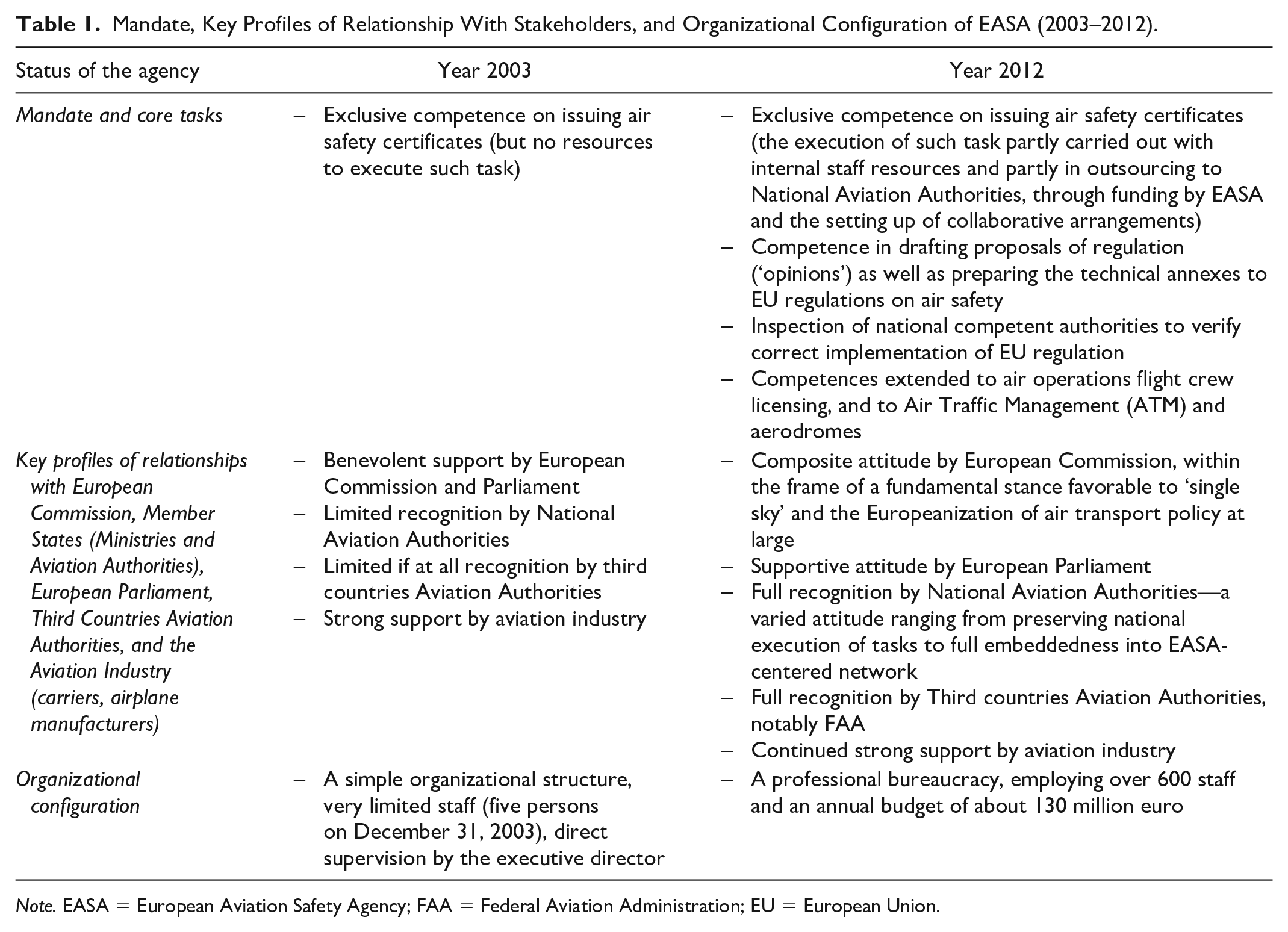
Note. EASA = European Aviation Safety Agency; FAA = Federal Aviation Administration; EU = European Union.
EASA underwent such an impressive growth in large measure thanks to the strategic guidance of its executive director since its establishment, Mr Patrick Goudou. The story recounted here shows how such a public entrepreneur led a public agency whose future was (at the time of its establishment) highly uncertain to become a central institution in air transport, at European and global level. EASA can be seen as an organization permeated by a clear sense of direction and perspective (“to become the Federal Aviation Administration of the EU”) and equipped with the capacities to implement such vision, a state of affairs that reflected a set of consistent decisions taken in a fast-moving and often not benign environment. An overview of the influence of the leadership of Director General Goudou exercised in summarized in Table 2 and analyzed in the remainder of the section.
The EASA Change Process (2003–2012)—Phases, Process Dynamics, and Leadership Style of the Public Entrepreneur.
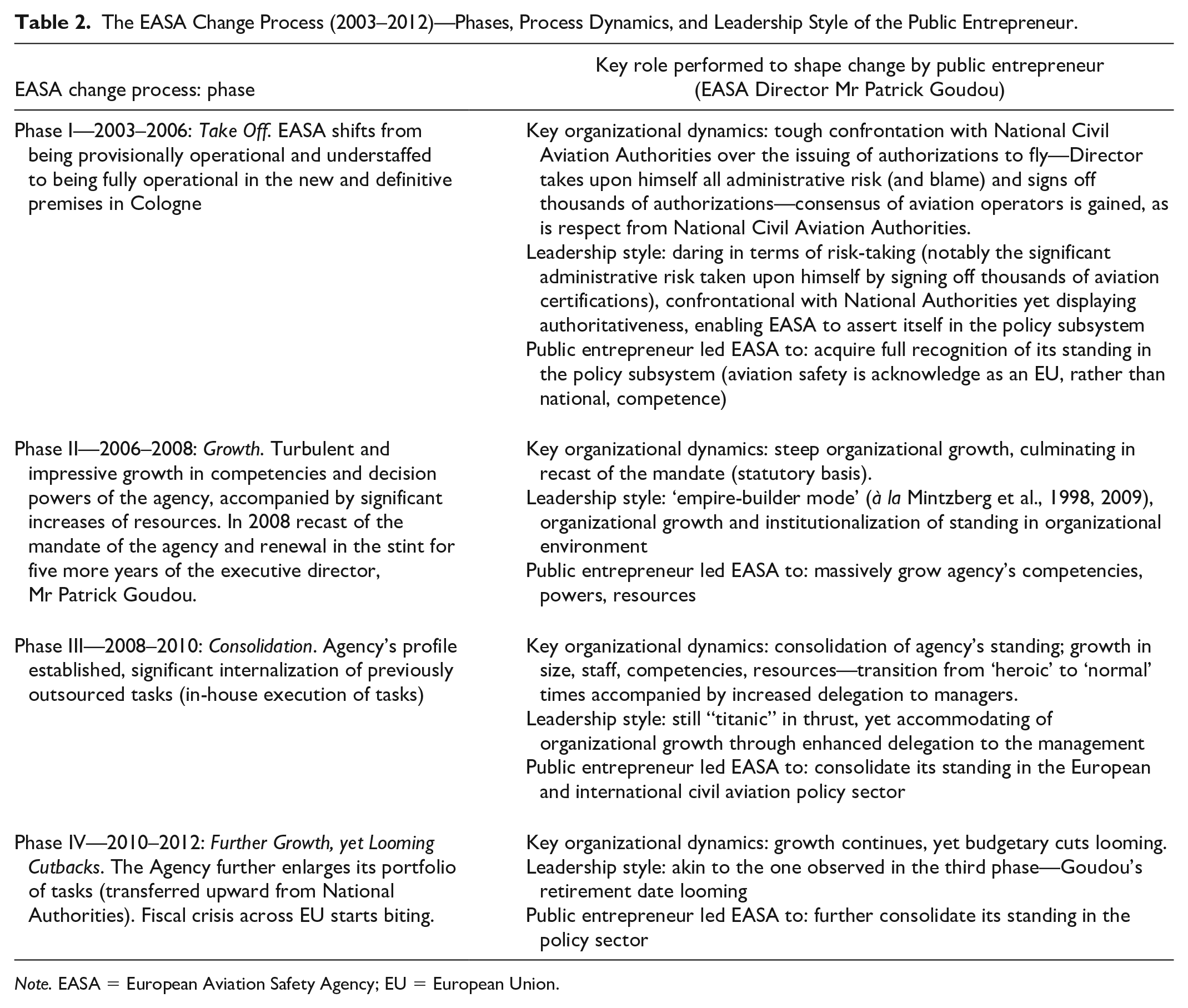
Note. EASA = European Aviation Safety Agency; EU = European Union.
The need to harmonize airworthiness requirements first originated when the British and French aviation authorities had to certify the Concorde, the famous supersonic airplane, leading to an association between these two National Aviation Authorities (NAAs; Kassim & Stevens, 2010). Later, the establishment of Airbus, the consortium of French, German, and Spanish aerospace industries, further pushed toward the establishment of a more secure footing for loose associations among European aviation authorities, leading to the establishment of the Joint Aviation Authority (JAA): a network of NAAs. A few years later, “[T]he [European] Community created a partnership with the JAA [. . .] using Community law to apply the JAA standards that were not legally binding,” but “[W]hen that arrangement proved problematic, the Commission blocked the establishment of an autonomous aviation safety authority, and substituted its own proposal for the EASA” (Kassim & Stevens, 2010, p. 132). The Commission thus played a key role in the structural design of this emerging Europeanized policy subsystem. The JAA was superseded by EASA, and eventually terminated in 2009 (with the exception of a branch active in training of NAAs staff). The nature of the process of transition from the JAA to EASA is analyzed by Pierre and Peters (2009); the early phase of the process of Europeanization is analyzed by Lawton (1999).
The European Commission and EASA are two organizations that played a decisive role in the development of air safety in Europe and the “Single European Sky.” Their relationship, not without struggles or tensions at time, became one of an alliance reflecting the overarching goal of building a pan-European system: the Europeanization of the aviation sector, which meant to move beyond bilateralism (each country’s authorities negotiating with other countries respective agreements and arrangements) toward a centrally regulated and steered (“federal”) system—something which in the hindsight may well be claimed to have occurred. Goudou’s leadership in seeing this process through accounts for this developmental path.
The organizational development of EASA may be interpreted as unfolding along four phases, in each of which Goudou’s leadership proved decisive. The first one started in 2003, with the establishment of EASA in provisional premises in Brussels, and ended in 2006, when EASA overcame a financial crisis, determined by a tough confrontation with NAAs about the system of fees in place. By that time, the agency, operating at full steam in its Cologne premises, had gained the legitimacy of its main stakeholders and interlocutors: primarily the aircraft industry and the same NAAs (and not just those of EU Member states but also others like the powerful U.S. FAA). Pierre and Peters (2009) studied the recognition and acceptance of EASA by its environment, seen as a process of institutionalization paralleled by deinstitutionalization of the previous institutional arrangement, namely, the JAA. In leading EASA through this phase, Goudou’s leadership style was daring in terms of risk-taking (notably as seen the significant administrative risk he took upon himself by signing off thousands of aviation certifications, in the absence of a fully operational supporting administration); it was also confrontational with National Authorities, yet displaying authoritativeness, enabling EASA to carve its space and assert itself in the now “Europeanized” policy subsystem.
The second phase spans 2006–2008, a period marked by a turbulent and impressive growth in the competencies and decision powers of the agency, epitomized in the 2008 recasting of the mandate of the agency and accompanied by significant increases of the financial and personnel resources administered by the agency, and concluded by the renewal of the executive director, Mr Patrick Goudou, in the stint for the subsequent 5-year term. The leadership style was “empire-builder mode” in the way magnificently depicted by Mintzberg et al. (1998, 2009), whereby organizational growth and institutionalization of the standing in the organizational environment became the overarching goal driving organizational efforts under the direction of Goudou.
The third phase encompasses 2008–2010 and may be placed under the label of the “consolidation” of the agency in its recognized role in aviation safety and the running of its operations with a significant component of inhouse activities (initially when the agency started, it had to outsource all its tasks, with the sole exception of the key act of issuance of authorization to fly, as it had no internal capabilities to execute the tasks). The leadership accompanied the transition from “heroic” to “normal” times also by increasing delegation to managers.
The fourth and final period (2011–2012) is one of looming budgetary cuts, which had not at the end of the observation period prevented further growth of the agency. The leadership style is similar to the one observed in the third phase. Goudou’s retirement date was looming.
Following on from the enactment of the founding regulation, the agency was materially established the following year (2003) in Brussels. It is important to highlight that the founding statute of the agency assigns relevant formal powers to the director. The agency’s governance structure was designed by the founding regulation ( Regulation (EC) No. 1592/2002 of the European Parliament and of the Council of 15 July 2002), which vests in the executive director all powers of legal representation as well as exclusive signature power—to be wielded “in full independence,” so the statute recites—as regards the key competence that the founding regulation assigns to the agency: the power of issuing safety certificates, that is, the authorization that any airplane must have to land or take off from any EU and associated countries’ airport. The executive director also holds wide-ranging powers as regards the organization and finance of the agency.
Within the framework of the mandated tasks assigned by the founding regulation, there were partly conflicting expectations about what the agency was to become. In certain countries, the view that EASA would not have a future was widely held, and even recruiting staff from those countries proved difficult. To some extent, these contrasting views were reflected in the agency’s Management Board. The Board holds a general oversight responsibility, mainly in the approval of the budget and the annual Work Program. It is a relatively large body, where each EU Member State and a few other partner countries are represented (like Norway, Switzerland, or Turkey), together with a representative of the European Commission. Important acts approved by the Board include the fees level that EASA may charge for processing an application of request of certification: such fees represent an important part of the agency’s budget (about two-thirds). The Chairman of the Management Board has a biennial or triennial appointment, and Mr Thilo Schmidt presided over the period 2003–2008, and Mr Michael Smethers over the period 2009–2012.
The person to be hired as executive director was Mr Patrick Goudou, a French national, with a graduation in engineering at the prestigious Ecole Polytechnique and significant experience in the French public administration, notably in the defense sector. A military by training and career, before joining EASA he had reached the higher tiers in the French Armée (the army). He held previous responsibilities in procurement and ran a large service organization in the defense sector. Goudou was in an organizational sense the “founding director” of the agency.
The newly appointed director had to imagine a vision for EASA, and to carry it through. There was an exemplar at hand: the FAA of the United States of America. Although the differences between a composite supranational politico-institutional architecture like the EU and a nation state (and the world superpower) like the United States were crystal clear to the director, the FAA could well represent a model, maybe unreachable unless perhaps in the very long term—in terms of its remit, decision powers, size, and budget (around 15 billion US$ per year)—but an aspirational model to look at, a perspective that might inspire behaviors and provide consistency to organizational decisions over time: “to become the European FAA” became the shared motto and narrative to depict the future of EASA. And indeed the FAA turned out to be factually supportive to EASA: FAA signed up to an agreement for setting up close collaboration with EASA in 2005, when EASA was moving its first steps, this was an event which provided recognition and legitimacy to EASA (as an FAA official put it: ‘it is good to have a one-stop shop for the whole of Europe’—Interview 3). This agreement was followed up by successive arrangements, including a bilateral EU-U.S. agreement for exercising certain tasks jointly within the Certification Oversight Committee. The significance of such agreement can hardly be overestimated: It did not just constitute a working partnership, but it signaled to EASA’s stakeholders the model toward which the agency was heading—it provided the vision for EASA. The agreement struck with the FAA was put in frames and hanging to be very visible to whoever visited the executive director or his close aides in the director’s corridor at the 16th floor of the Cologne headquarters. This vision of EASA as the European FAA and the imagery associated with it powerfully contributed to legitimizing the new vision broached by the director, and to win consensus both “downward,” within the rank and file of the agency staff which had started to recruit only a couple of years before, and “upward,” in the Management Board where Member States are represented.
At about the same time (2004), the process of recruiting the staff of the agency started, and the director was heavily engaged in the selection process, chairing all the competent committees: a very hands-on approach to choosing the new collaborators and the staff of the agency at large. Due to his unique status of having been the first person to be hired by the agency after its establishment, and to have directly or indirectly supervised the process of appointment of each of the staff that entered the agency over the subsequent years, Mr Goudou came to be perceived not just as the formal hierarchical top of the organization but also, and significantly, as “the founder” of the organization, the one that everybody when joining the agency recognized as the ultimate boss, the leader who molded the organization, and “authoritative” due to his charismatic leadership, alongside the formal status of being the top hierarchical authority.
The initial phase (2003–2006) was very challenging. EASA was going to take over the responsibilities of the NAAs, some of which had a very long history and significant administrative capabilities in the tasks they had been running for many years. The founding regulation assigned to EASA the formal decision power of issuing certifications, and the agency was entrusted with the execution of such task to start on September 1, 2003: 6,000 certification requests per year were expected to be processed. But at the beginning, EASA had no administrative capacities in terms of available skills and expertise to perform the technical controls; hence it had to outsource to the NAAs the entire execution of the activities, while remaining legally responsible for issuing the pertinent authorization. In these challenging circumstances, Patrick Goudou took all the administrative risk of signing acts on whose preparatory phase he did not have the full control upon himself, as these tasks were carried out entirely outside the organization—an organization that at that time did not have even the least resources even to monitor such outsourced processes. Had he not taken upon himself such risk, the agency would have been very likely to run into an irreversible legitimacy crisis: If applicants—manufacturers, air carriers—had been denied a response to their application beyond a reasonable amount of time, they would have soon become vocal and an obvious course of action would have been to advocate a return back to NAAs, as investments of millions or billions of euros in a new aircraft cannot afford to wait for too long before commercialization takes place. To build up internal capacities, the recruitment process was done hurriedly. Most of the new staff came from the JAA headquarters as well as from NAAs—where the experts in the field (overall limited in number, in a very technical, highly specialized field like aviation safety) were being employed at the time. With the building up of internal capacities, the agency senior managers also gained some leverage by being able to be more selective in resorting to outsourcing and, especially, having the buffer resources necessary to cope with tight deadlines and unexpected peaks of work.
Also the relocation from Brussels to Cologne proved challenging, and concerns were raised about the attractiveness of the agency site to the potential staff, about whether professionals in the field would be willing to relocate from their extant workplace in their own home country to a “central” location—which for most of them but the German contingent meant to relocate abroad, and moreover to a location which was however outside the common location of EU institutions, that is, Brussels. Challenges came also from the funding arrangements, because while the regulatory activities of the agency were funded from the EU budget, for the certification activities, instead, funding was fee-based, and accounting rules prescribed that funds could not be transferred from one part to the other one of the agency: An adequate level of revenues deriving from the fees was thus crucial for the execution of the certification tasks, the core competence that was transferred from the State to the European level. Encashment processes were also crucial, as at the beginning the agency did not have reserves, nor could it use money earmarked for regulation tasks. The level of fees was to be set by EU regulation, upon approval by the Management Board, and too low a level might have meant the impossibility to ensure the coverage for the recruitment of staff—and the situation was made more complex by the fact that with the revenues associated with the fees, the agency paid the NAAs to which the same agency had outsourced the tasks. The situation was critical and “EASA had a very low point in 2005: the Financial regulation was a complete failure, it was in disarray and at risk of financial collapse” (Interview 6). Eventually, the tenacity of Patrick Goudou and the EASA executives paid off as the revision of fees in 2006 led to setting them at an “adequate” level, in the sense that they allowed the survival and subsequent development of the agency. In the process of fee revision, Mr Goudou was sustained by the Commission representative in the Management Board, as well as by the industry, quite influential over national authorities. Sector firms, in fact, gauged the increased costs of higher fees against the much higher benefits of having a single certification issued by just one authority, rather than several applications to be submitted to dozens of national authorities, answering with a different timing, and at times providing substantially different responses. EASA could thus eventually overcome this difficult passage and enter a period of rapid growth that lasted for the two subsequent years (second phase: 2006–2008). Once again, we found that Mr Goudou’s lead proved to be decisive—in these circumstances teaming up with the European Commission representative and, especially, representative of smaller Member States, who looked favorably at a centralized management of certification.
The year 2008 also marked the renewal in office of Patrick Goudou as EASA executive director. It was, however, also the year of a global financial crisis: even though investments in new aircrafts are long-term projects, the expectation that air carriers could postpone certain projects meant the trend toward a continued growth of revenues could not necessarily last. EASA executives adopted a stance more marked by the explicit and continuous search of consensus: They adapted to new circumstances, tilted toward seeking support of national governments rather than allegiance to supranational authorities like the European Commission, but did so without fundamentally altering the orientation to expand the tasks of the agency and ultimately to “Europeanise” aviation safety, as witnessed also by the continued flow of substantive proposals of regulation, the agency continued to elaborate. The period 2008–2010 saw a further growth of EASA, which continued into the subsequent biennium.
This period also marked a major transition to a new executive director replacing the founder and the person who more than anybody else contributed to give shape to the agency. To what extent was this event going to affect the position and the “status” of EASA? The feelings among those who had powerfully contributed to set the agency up and develop it were overall positive, given a spirit of a ‘mission accomplished’: ‘EASA has now taken deep roots’; “I think it [EASA] is no more reversible” (Interview 3). A strong feeling that the European (and, with it, the global) system of air safety had been reshaped as an effect of the way EASA developed was present to all those who made it happen. Table 2 reports on the phases undergone by EASA and how Mr Goudou’s entrepreneurial approach has led it to become a major institution in air safety on the world stage.
Interpreting the Forming of Strategy at EASA Through the Frame of the “Entrepreneurial School of Thought” in Strategic Management
Mintzberg et al. (1998, 2009, chapter 5) enlarged the array of the perspectives used to study the strategy process by conceptualizing (through a wide range of previous literature) the so-called “entrepreneurial school of thought in strategic management.” We consider this school, to our knowledge so far insufficiently employed to interpret and analyze the behavior of public sector organizations (despite some fragmented public management literature which we reviewed earlier), to have significant explanatory power in this case, employed in a complementary fashion with the broader findings of the public leadership literature (reviewed earlier).
The forming of strategy at EASA displays certain traits. First and foremost, strategy was shaped since the inception by the executive director and “founder” of the agency: EASA has grown (in size, tasks, “power,” and status) together with him and been affected in fundamental ways by his bold leadership and consistent course of action (summed up in the statement “once he has decided, he always keeps his stance,” as emerged in all the interviews conducted at the agency).
The centrality of the role performed by the entrepreneur did not rule out the presence of a relative extensive “strategy paraphernalia,” which is so evident in many large commercial sector organizations: At EASA, strategy meetings were held—two per year, devoted to discussing issues like the long-term impact of the economic and financial crises on the air transport industry; a 5-year strategic plan was developed, as was a cascading system of objectives supported by an integrated information system (based on ERP—enterprise resource planning—technologies). The agency also adopted an official vision: “Ever safer and greener civil aviation”—as well as a clearly specified mission: “Our mission is to foster and provide efficiently for the highest common standard of civil aviation safety and environmental protection, through a total system approach, in Europe and worldwide.” However, this set of tools may well have contributed to provide legitimacy to an organization that aimed to be recognized as a modern, “cutting-edge” agency in the European landscape, as well as to support tactical decision-making (e.g., cost information provided by the integrated information system that may be used for strengthening the agency’s negotiating position regarding fees), but the locus of strategy in the EASA case is elsewhere, in the mind of the strategist, and the substantive content of strategy is other than the however important and carefully crafted long-term business plan.
Entrepreneurship has not been underpinned only by some exceptional, “heroic” characteristics of the first executive director of EASA. There seem to have been some preconditions for the executive director to act as the entrepreneur, imagine the vision for his organization, and lead it to an impressive growth, in a challenging environment and over a relatively limited time frame. The preconditions detected in the EASA case are as follows. First, the chief executive was very much the “founder” of the organization, being the first person to work for it and for a not irrelevant time span (over 1 year) the only one. Although in modern, Weberian bureaucracies the direction of a public office can only be ‘held’—under the rule of law, and for a definite time frame—and never be owned, the circumstances of being the first and for some time the only person hired by the organization, to have a certain time frame ahead as the chief executive (the 5-years renewable once term) and to have been in charge of human resources since the inception (meaning that for all staff the executive director was “the person who hired you, the only person to have always commanded in the organisation, the person that everybody recognises as the boss”) reproduced conditions that resemble those of the entrepreneur after she or he has established and set up his or her organization (although with the important difference that there is most often an explicit limit to renewal of appointment in public sector organizations, where only a very few executive functions can be held indefinitely—at least in liberal-democratic regimes).
A second precondition for the executive director to act as the entrepreneur lies in formal authority. The executive director in EASA enjoyed (given the corporate governance configuration of the agency) high autonomy in exercising his responsibility (chiefly, to grant or withhold a certificate of airworthiness), and he held and concentrated significant organizational powers (chiefly, the hiring of new staff) in his hands. In other words, the director enjoyed strong formal authority which, even though it probably cannot be equalled to that enjoyed by many entrepreneurs within the privately owned organization they have established under commercial law (public law tends to put more limits to the authority enjoyed by public administrators than commercial law does to private managers in private law organizations), can nonetheless be likened to it. In other words, EASA has been a relatively malleable organization in the hands of the chief executive—a trait commonly associated with the entrepreneurial school.
Thus, what we observe are institutional–organizational circumstances that have combined with leadership skills to provide both the authority—hence the power base—and the authoritativeness (inspired by the leadership skills) for the exercise of an entrepreneurial role in leading the organization. This led to exploiting opportunities in the environment, envisioning the future of the organization, energizing and mobilizing the people in and around it which led to an impressive organizational growth—all such things being done in a public sector organization in ways not too dissimilar from those detected by the entrepreneurial school literature for private sector organizations. The “director and founder” has indeed teamed up with other main actors—like the chairman of the Management Board, or the European Commission representative—in key passages for the development of the agency, yet it has been his course of action to pivot the development of the agency: Albeit possibly nowadays, a bit “out-fashioned,” the individual leader—who, we should immediately specify, does not mean the lonely leader—may under certain conditions be making the difference in the course of events leading a public agency to grow impressively, in mostly adverse circumstances which would have likely led to alternative outcomes, notably when the public leader enjoys the properties of acting as the “founder” of the agency. In these circumstances, the “entrepreneurial school” in strategic management may properly capture many of such features, if appropriately adapted to fit the public sector context (Ring & Perry, 1985).
What kind of public leader/public entrepreneur could shape such an organization? He possessed various traits often associated with entrepreneurship: risk-taking; authoritativeness; a firm grasp over organizational processes; a capacity to formulate and communicate a clear vision that could mobilize people (“we are the European FAA”); commitment to work very hard. Next to this, he had various traits that may perhaps be associated with his specific background and career path: a strong sense of the service public (in the French sense, entailing a strong sense of the preeminence of the public service, within the frame of an administrative tradition—the Napoleonic one—in which the state is entrusted the role of a guiding force of society, a “statist” system, Ongaro, 2009, 2010; Peters, 2008); an orientation to keep a firm grasp on all key dossiers (hands-on leadership style, supported by a strong technical expertise); and an emphasis on confidentiality, at times perceived as leading to a somewhat excessive secrecy (also reflecting the organizational environment of the agency, specifically the EU institutional setting, where the emphasis on confidentiality is driven by the threat of leaking, a powerful and often used weapon in the “Brussels village”).
In this section, we have argued about the explanatory power of the entrepreneurial school of strategy in providing much of an interpretation of strategy formation at EASA. We now query what broader lessons in the form of analytical generalizations/theorizations can be drawn from the study of this case.
Drawing Lessons From the EASA Case for Expanding the Remit of the Entrepreneurial School and Applying It to Public Sector Organizations
Applicability of the Entrepreneurial School of Strategic Management to Public Organizations
The entrepreneurial school of thought in strategic management helps explain the organizational development of EASA and its achievements over the period 2003–2012. Strategy is here conceived of as ‘perspective’: More than detailing things to do, strategy is what gives sense and provides the direction where to go, thus stimulating and energizing people within and around the organization. The strategic perspective is the construct of the leader, and it lies mainly in the head of the leader—based on her or his intuition, judgment, wisdom, experience, and insight. Growth is the dominant goal and power is centralized in the hands of the chief executive.
It may be posited that such school holds explanatory power in interpreting the strategic management of a wider set of public sector organizations (beyond EASA) operating under such circumstances: Indeed such conditions may not necessarily be so rare in a world where the administrative phenomenon of the “public agency” as the (allegedly) “modern” organizational form for the delivery of public services is mushrooming, in a number of polities across the globe (Pollitt & Talbot, 2004; Verhoest et al., 2012). Public agencies are a semiautonomous public organization for the delivery of specialized public functions, often led by a monocratic organ, a general director entrusted with decision powers not dissimilar from that of the chief executive officer (CEO) of a firm (Pollitt & Talbot, 2004).
What are such conditions, at least as seen in the EASA case? Two can be identified. First, the chief executive was also the “founder” of the organization, in the very specific sense of being the first person to be hired by it and for some time the only one. Such circumstances, coupled with the opportunity to have a certain time period ahead as the chief executive (in the case, the 5-years renewable once term of office) and to have concentrated multiple organizational powers in his hands, not least the fact of having been in charge of human resources and first of all the recruitment process since the inception (at the beginning directly as also director of human resources (HR), later indirectly by supervising the HR director), determined a frame that resembles that of the entrepreneur after she or he has established and set up her or his own organization. However, for the entrepreneur to “successfully” lead the organization to continued growth, such “external” conditions need to be matched by the personal leadership skills of the person who operates in such circumstances—something which undoubtedly occurred in the EASA case, guided by a talented and charismatic executive director since its establishment.
The second condition lies in the formal authority held by the “entrepreneur.” The executive director in EASA enjoys (given the corporate governance configuration of the agency) significant autonomy in the exercise of his technical responsibility (chiefly, to grant or withhold a certificate of airworthiness, which is an exclusive competence of the director). Hence, the second condition lies in the director of the agency enjoying a high degree of formal authority similar to the concentration of executive authority generally entrusted by commercial law to the entrepreneur in privately owned organization.
By way of summative proposition, it may be formulated the claim that under the combined conditions of, first, circumstances which may replicate the role of “founder” of the organization, and, second, a power base (formal authority over her or his own organization) that resembles that of an entrepreneur in the business sector, if the top official of the public agency is also endowed with the leadership skills providing the required authoritativeness, the strategy process in public agencies may potentially unfold along the pattern of the entrepreneurial school in strategic management, marked by one person, the entrepreneur, leading the organization in a visionary way, by exploiting the opportunities that arise in the environment (also by taking the appropriate dose of risk), envisioning the future of the organization, and energizing and mobilizing the people in and around it—all such things being done in a public sector organization in ways broadly similar to those detected by the literature on the entrepreneurial school for private sector organizations.
A very important qualification is required: The argument about the “individual leader” who entrepreneurially grows a public agency must positioned vis à vis the important and burgeoning literature on more collective, or distributed forms of leadership (Denis et al., 2001; Hartley & Fletcher, 2008). Although these plural forms of leadership are crucially important (and the authors of this article do recognize this and share the view that in a large number of circumstances it is forms of collective leadership to make the difference), this specific study aims at showing that under certain conditions the individual leadership may be pivotal—and notably, when this is read through the theoretical lens of the entrepreneurial school à la MIntzberg, such framework may help explain massive organizational growth of a newly established organization operating under threatening circumstances, as it occurred in the EASA case.
The—Limited—Term of Office and the Public Entrepreneur
There is one fundamental difference between the narrative from the entrepreneurial school as it has been applied so far to commercial sector organizations (see the account of the retail chain set up by Sam Steinberg, starting from a small grocery in Montreal, Canada, by Mintzberg & Waters, 1982) and the narrative developed for the public sector: Office holding expires in public sector organizations, differently from the private sector entrepreneurs who (not always and necessarily, but quite often) “own their creature.” Differently from the entrepreneur who establishes her or his own business through a private law act, the public entrepreneur has to be appointed by an external appointing authority; to recall Lynn (2006), “[the public sector] is constituted through sovereign mandate, the [private sector] through individual initiative.” The would-be public entrepreneur may play a function in him or her getting the post and be appointed (because of the inherent strength of her or his curriculum; or because of some effective lobbying; or a combination of the two), but the entrepreneur cannot set up what will become her or his creature with a self-determined act, by simply making a legal transaction grounded in private/commercial law: A public act, the outcome of a collective (political) decision-making process regulated by public law is the necessary premise. The way the appointment process unfolds thus becomes a necessary condition for strategic management of the entrepreneurial kind to occur in the public sector. However, term of office is analogous to managers in commercial sector organizations that act as entrepreneurs in an appointed post and without controlling, by means of property rights, the organization. Those who own their organization also in legal terms, by holding a right of property over it, may potentially lead their creature throughout their entire working life (at times coinciding with life tout court), although this may happen rarely as disruptions or other fortuitous circumstances may lead to them handing over the control of the organization they had set up.
Founders of private law–based organizations, however, may be able to pass the baton to somebody of their choice, notably their offspring. In public sector organizations in modern times in liberal–democratic regimes, this is simply not possible. In modern Weberian bureaucracies, the direction of a public office can only be ‘held’—under the rule of law, and for a definite time frame—and never be “owned.” Office holding expires in the public sector, and the public entrepreneur has to act under an a priori limited time frame. Indeed, also for being appointed or reappointed to the stint, consensus in the governing and appointing bodies (the EASA Management Board, the European Commission and European Parliament) must be maintained over the time, and especially at critical junctures like the renewal of the term of office, and there is often a limit to renewal of the mandate (in the EASA case, the director could be renewed only once). This is perhaps one of the most significant differences between entrepreneurship in the public sector when contrasted with entrepreneurship in the private/commercial sector, at least in the “paradigmatic” case of the entrepreneur being the owner of the organization.
Hence, the main difference between entrepreneurs in the private sector, especially when they are the founder of the enterprise and property rights ensure them legal control over their creature, and entrepreneurs in the public sector lies in the statutory limitations to office holding. Public entrepreneurs have an “expiry date” as well as generally no entitlement to organize succession, and they have to act within such timeframe: They have to deploy their skills and energies within such horizon, and are faced with the challenge to “act within constrained time frame.” This is a defining feature of entrepreneurship in the public sector. The specifics of how it is articulated in actual cases hinges upon the governance structure of the organization under consideration (like, for example, for how many terms of office the general director may be renewed).
However, time limitation has interesting potential implications if we ponder speculatively what the entrepreneurial school has to say about the “duration in office” of the entrepreneur. On one hand, there seems to be some degree of agreement in the literature about the relatively less relevant role of the entrepreneur as the organization grows larger: If at the beginning the role of the entrepreneur is irreplaceable, after the organization has grown large this may be much less so. Indeed, the very same leadership skills and behaviors that help drive successful early growth of the organization and around perilous turns may also sow the seeds of inappropriate behaviors, ultimately damaging the very organization that they helped create. Notably, provisions ensuring statutory temporal limitations to office holding prevent those risks that are associated with visionary leadership being exercised “lifelong,” and other limitations of an organization depending too heavily on one person only in charge.
Summing up, time limitation is a qualifying feature of the entrepreneurial school of strategic management when the scope encompasses public sector organizations: Differently from privately owned organizations, not only there is generally a preset time limit to renewals in the stint, but transition and the handing over of chief responsibility is forced in public sector organizations, and cannot be controlled by the “founder” (no matter how much he or she would like to remain in the post). Time limitation constrains not just the entrepreneur’s course of action but also the entrepreneur’s expectations: It may restrain the deployment of the intellectual and volitional energies the entrepreneur invests into the organization; speculatively, this may occur because such circumstances may limit the process whereby the entrepreneurs identify with her or his creature.
Differentiation Within the Public Sector: Contextual Influences and Public Entrepreneurship
A final qualification may be added, drawing from the EASA case accounted in this article: the public entrepreneur is embedded in specific value-systems about what is proper behavior in the public governance regime where she or he operates (Bevir, 2009; Pierre & Peters, 2000). The picture is more nuanced than just generically contrasting proper behavior “in the public sector” as opposed to proper behavior in the market/commercial sector: Any analysis about value-premises and proper behavior should consider what is deemed as proper behavior in certain specific administrative traditions rather than generically “in the public sector.” In the case of EASA, the Napoleonic administrative tradition (Ongaro, 2009, 2010; Peters, 2008) that is embodied in the French public administration and which has deeply influenced the EU administration (originally patterned on that model, see (Page, 1997; Preda, 2000; Sassi, 2000; Stevens & Stevens, 2001,—a model which has showed endurance over time, Ongaro, 2013) is the institutional context affecting what is appropriate behavior (March & Olsen, 1989) for a public entrepreneur that has matured her or his professional identity within such political–administrative context. Therefore, it appears more proper to speak in the plural of public sectors characterized by different governance and administrative traditions (Ongaro et al., 2011; Painter & Peters, 2010), whereby, for example, a public entrepreneur whose previous identity has been shaped by education, training and, a career path in the United States will likely display different traits from a public entrepreneur whose professional identity formation took place, for example, in France and whose career unfolded in the EU institutional setting.
Concluding Remarks
Summing up on the argument proposed in this contribution, we challenge the “common sense” face value interpretation that the literature on the role of the entrepreneur is of no use for advancing knowledge for the management of public organizations, given how distinct and distant is—in terms of governance, regulatory framework, and operating conditions—a privately owned business (set up from scratch by a creative businessman inspired by his or her “animal spirits” that make him or her envision a market for new products) from a public sector organization, set up by the law or other public act. Instead, we argue that under certain conditions, the entrepreneurial school of thoughts focus on the figure of ‘the founder’—the core traits, skills, temperament, and how they are deployed in to create new and successful businesses that at times become economic ‘empires’—is an apt source discipline from which to draw the intellectual resources and conceptual tools to study the organizational behavior of public agencies in the aftermath of their establishment and throughout a significant period of time, one in which the “public” entrepreneur leads them to organizational growth and legitimization in the organizational environment. We interpret the figure of the public entrepreneur by connecting the public leadership literature (notably from its roots in Meltsner’s (1976, 1990) conceptualization) and the entrepreneurship literature to better profile the public entrepreneur.
Footnotes
Declaration of Conflicting Interests
The author(s) declared no potential conflicts of interest with respect to the research, authorship, and/or publication of this article.
Funding
The author(s) received no financial support for the research, authorship, and/or publication of this article.
