




Abstract
This article contributes to the growing body of literature within public management on open government data by taking a political perspective. We argue that open government data are a strategic resource of organizations and therefore organizations are not likely to share it. We develop an analytical framework for studying the politics of open government data, based on theories of strategic responses to institutional processes, government transparency, and open government data. The framework shows that there can be different organizational strategic responses to open data—varying from conformity to active resistance—and that different institutional antecedents influence these responses. The value of the framework is explored in two cases: a province in the Netherlands and a municipality in France. The cases provide insights into why governments might release datasets in certain policy domains but not in others thereby producing “strategically opaque transparency.” The article concludes that the politics of open government data framework helps us understand open data practices in relation to broader institutional pressures that influence government transparency.
Introduction
Public organizations around the world have increasingly released datasets as Open Government Data (OGD; Attard, Orlandi, Scerri, & Auer, 2015). OGD are non-privacy-restricted and non-confidential data, produced with public money and made available without any restrictions on their usage or distribution (M. Janssen, Charalabidis, & Zuiderwijk, 2012). OGD are expected to strengthen transparency and democratic processes, to stimulate economic growth and innovation, and to lead to more effective public services and programs (Borzacchiello & Craglia, 2012; Gonzalez-Zapata & Heeks, 2015; Margetts, 2014; Peled, 2011; Ruijer, Grimmelikhuijsen, & Meijer, 2017; Worthy, 2015; Zhang, Puron-Cid, & Gil-Garcia, 2015). However, so far a large share of the potential for society of OGD is yet to be realized (Attard et al., 2015; Smith & Sandberg, 2018; Worthy, 2015).
Several empirical studies show that resistance by government organizations to data-driven transparency is one of the “barriers” that needs to be dealt with, for OGD to reach its full potential (Huijboom & Van den Broek, 2011; M. Janssen et al., 2012; Zuiderwijk, Janssen, Choenni, & Alibaks, 2012). Leadership, a clear account of the benefits of OGD, and a change of government culture are indicated as options to overcome the resistance to release data (Huijboom & Van den Broek, 2011; M. Janssen et al., 2012; Nam, 2015). These elements are of great importance, but they ignore a key aspect of OGD: its strategic nature and the purposive actions of government organizations resisting the pressure from external stakeholders to publish their data. This article challenges the assumption that a lack of willingness to make data available to the public is an aberration or a type of behavior that can be changed through culture interventions, by highlighting the politics of OGD.
Cleveland (1985, p. 185) points out that in the information age, “information (organized data, the raw material for specialized knowledge and generalist wisdom)” has become a key strategic resource of organizations. And exactly for that reason, organizations are not likely to share it: “When information is the primary unit of organizational currency, we should not expect its owners to give it away” (Davenport, Eccles, & Prusak, 1992, p. 54). Davenport et al. (1992) speak of “information politics” and argue that information is a source of power and indispensability. According to them, information politics is an inherent aspect of organizational life and when consciously managed, true information-based organizations will emerge (Davenport et al., 1992).
This argument can also be translated to OGD because data and information are intricately tied together. Data in their raw state are without meaning, but if they are given meaning within a context, it becomes information (Mandinach, 2012). OGD are perceived as valuable strategic assets (Michener & Ritter, 2017; Peled, 2011). If these datasets are crucial to government organization’s existence, can we expect organizations to give data away? Our key assumption is that the politics of OGD is a natural aspect of organizational behavior (Bolman & Deal, 2008; Davenport et al., 1992; Elg & Johansson, 1997). This does not imply that we need to accept secrecy and opaqueness as a given. It means that we do not assess this behavior in moral terms but that we study it empirically to have a better understanding of this type of strategic behavior.
The aim of this study is to obtain a better understanding of the strategic responses of government organizations to the push of OGD. Our study’s contribution is twofold. First, we contribute to the ongoing debate of government transparency by using a political perspective of organizations. This political perspective implies that organizational interactions can be understood as a power struggle for the allocation of resources (Bolman & Deal, 2008; Elg & Johansson, 1997). Organizational action results from bargaining and negotiation among competing stakeholders about these resources. We will develop an analytical framework by combining Oliver’s (1991) work on strategic responses to institutional processes with more recent analyses of the complex dynamics of transparency (Fox, 2007; Meijer, 2013) and the current literature on OGD (Birchall, 2015; Longo, 2011; Michener & Ritter, 2017; Peled, 2011; Worthy, 2015). The framework helps to better understand why institutional pressure on government organizations to release OGD can result in full access to government data but also in partial access. Second, we demonstrate based on a systematic empirical analysis, that sharing data is in fact a strategic action resulting from external pressures and negotiations. It shows that governments release datasets in certain policy domains but not in others, thereby producing “strategically opaque transparency.”
The article is structured as follows. The next section describes the political perspective of OGD, resulting in a framework: The Politics of Open Government Data Framework. Following, we apply the framework in two different European countries using action research and an embedded case design (Yin, 2003). Data were collected via a qualitative mixed method, using an abductive research approach (Kovacs & Spens, 2014). The findings of the case studies are presented and analyzed using process tracing. The discussion and conclusion focus on the more general insights derived for public administration and for practitioners.
Political Perspective of OGD
Our political perspective of OGD builds upon the political perspective of organizations: the idea that organizational interactions can be understood as a struggle for the allocation of scarce resources (Bolman & Deal, 2008; Elg & Johansson, 1997; Tushman, 1977). Politics in this view refers to the structure and process of the use of authority and power to effect definitions of goals and directions of the organization (Tushman, 1977). From this perspective, organizational decisions are the results that emerge from bargaining and negotiating among competing stakeholders about resources (Bolman & Deal, 2008; Elg & Johansson, 1997; Tushman, 1977). Organizational survival then depends on the ability to strategically acquire and maintain the flow of resources (Pfeffer & Salancik, 2003). This problem would be simplified if organizations were in control of these resources. However, organizations are embedded in an environment (DiMaggio & Powell, 2003; Pfeffer & Salancik, 2003). Organizations are not autonomous but often depend on external demands and pressures by other organizational actors (Handel, 2003). According to Cleveland (1985), information can be viewed as a power resource. Yet it is different from other resources in that it is inherently more accessible, and that once accessed it unlocks other resources (Cleveland, 1985, p. 193). The more information or knowledge is spread, the more power gets diffused (Cleveland, 1985). Consequently, according to Meijer (2013), “efforts to change the distribution of this resource often trigger intense strategic interactions” (p. 431). Meijer (2013) argues that transparency can be considered as a strategic response that is the outcome of a complex political game influenced and shaped by the interaction between different internal and external actors. Transparency is defined in this article as “the availability of information about an organization or actor allowing external actors to monitor the internal workings or performance of that organization” (Grimmelikhuijsen & Meijer, 2012, p. 139).
This argument can also be translated to OGD. So far, the OGD literature has mainly focused on different social and technical considerations for OGD programs: from data- and program-oriented perspectives to more complex user and ecosystem perspectives (Dawes, Vidiasova, & Parkhimovich, 2016; Zuiderwijk, Janssen, & Davis, 2014). These perspectives have shed a light on the benefits of OGD and on the technical, organizational, and legal challenges that need to be addressed to reap the benefits of OGD (Huijboom & Van den Broek, 2011; Zuiderwijk & Janssen, 2014). Recently, some scholars (Birchall, 2011; Keen, Calinescu, Paige, & Rooksby, 2013; Keen et al., 2013; Worthy, 2015) have concluded that politics also play a role in open data policies and programs. They point out that OGD can be viewed as valuable strategic assets (Michener & Ritter, 2017; Peled, 2011). Government agencies labor hard to create these datasets and therefore, they are reluctant to release these datasets for free (Peled, 2011). By releasing data, organizations fear a loss of control of datasets by having to hand responsibility over to others and in some cases potentially losing their reason for being (Barry & Bannister, 2014). Moreover, agencies have their own agenda and objectives and compete with other agencies over resources, influence, and autonomy (Peled, 2011). These studies address the politics of open data, but they do not systematically examine the strategic actions of government organizations resulting from external pressures and negotiations.
So, who is exerting pressure on government agencies to release OGD? National governments all around the world have developed OGD programs, pushing (local) government agencies to make their data available to the public (Dawes et al., 2016). These programs consist of soft measures such as financial aids and the communication of best practices but also of formal legislation and regulation (Dawes et al., 2016; Huijboom & Van den Broek, 2011). In Europe, the European Directive on the reuse of public sector information, for example, has had some influence on the opening of OGD, but the impact varies among European Union (EU) Member States (K. Janssen, 2011). In the United States, the Obama Administration pushed OGD by requiring the release of machine-readable datasets as the default for government information and by setting up the Global Open Government Partnership together with seven other countries (Bertot, Gorham, Jaeger, Sarin, & Choi, 2014). The Global Open Government Partnership is a multilateral initiative that currently has 79 participation countries and stimulates transparency, including open data initiatives (Piotrowski, 2017). A legal framework for public information access is a membership criterion for the Global Open Government Partnership (2018). In addition, there is a push for more OGD by a broad range of other societal actors such as citizens (Piotrowski & Van Ryzin, 2007), the media, nongovernmental organizations, and research institutes (Mulgan, 2014). In general, the pressure can take the form of sanctions (the stick), financial incentives (the carrot), or convincing communication (the sermon) (Bemelmans-Videc, Rist, & Vedung, 1997). The expectation is that this push will result in the release of datasets.
However, the political perspective results in other expectations (Greenwood, Raynard, Kodeih, Micelotta, & Lounsbury, 2011; Oliver, 1991). This literature highlights that responses to institutional pressures are more complex than the complete compliance often expected by regulators or funding sources (Bigelow & Stone, 1995). It might in fact explain why organizations not always release all information or none at all (Birchall, 2011). In the transparency literature, Fox (2007) makes a distinction between clear and opaque transparency. Clear transparency refers to information that sheds light on institutional behavior, whereas opaque or fuzzy transparency refers to information that does not reveal how institutions actually behave in practice, in terms of how they make decisions, or the results of their actions (Fox, 2007). In the OGD literature, we find that there are several ways for organizations to appear transparent to outside observers but keep certain practices opaque, for instance, by releasing incomprehensible datasets (Birchall, 2011), by releasing minimal amounts of datasets (Lassinantti, Bergvall-Kareborn, & Sahlbrost, 2014), or by only publishing those datasets that are considered relatively “safe” to publish (Zuiderwijk & Janssen, 2014). Bureaucrats, according to Peled (2011), know when and how to release data as part of their efforts to increase their agencies autonomy and reputation (Peled, 2011, p. 2089). Furthermore, Longo (2011) argues that governments can selectively release data, and therefore it could even be expected that governments will be more supportive of opening data related to policy successes than to policy challenges. Thus, organizations might not release all datasets or none, but they might decide to release some datasets. Creating certain forms of data-driven transparency may therefore be a deliberate strategy of an organization to generate strategic gains. To enhance our understanding of these strategic responses of organizations, we will develop a framework based on Oliver’s (1991) work on strategic responses to institutional processes.
Politics of Open Government Data Framework
Oliver’s work on strategic responses has been highly influential in the study of organizations and has spurred a stream of publications (Bigelow & Stone, 1995; Delmas & Toffel, 2008; Greenwood et al., 2011; Hyvonen, Jarvinen, Pellinen, & Rahko, 2009; Rautiainen & Jarvenpaa, 2012; Standing, Sims, & Love, 2009), including empirical replications (Clemens & Douglas, 2005; Ingram & Simons, 1995). Oliver challenges the notion that institutional pressure will always result in conformist behavior of organizations. Based on an integration of the resource dependency perspective (Pfeffer & Salancik, 2003) and the institutional theory perspective (DiMaggio & Powell, 2003), she demonstrates that the reaction of organizations depends on the (perceived) nature of external institutional pressure (Oliver, 1991).
Oliver (1991) distinguishes five different types of responses to institutional pressures. Organizations may fully comply with pressures (acquiesce), may partially comply and bargain with stakeholders (compromise), may avoid pressures through precluding the necessity of conformity, may actively refuse (defy), and finally, they may actively change or exert power over institutional pressures (manipulate). These responses may sometimes partly overlap or coexist without a clear domination (Rautiainen & Jarvenpaa, 2012). In addition, Oliver (1991) identifies five institutional factors that influence these strategic responses of organizations: cause, constituents, content, control, and context. Cause refers to the underlying rationale or expectations associated with institutional pressures (Goodstein, 1994; Oliver, 1991). When the demands can enhance organizational legitimacy and efficiency, the organization will show less resistance (Oliver, 1991). Constituents refer to interest groups, other public agencies, and the general public. When there are multiple stakeholders involved with conflicting interests, resistance to pressures will be greater. Moreover, the lower the dependence on these pressuring constituents by the organizations, the greater the resistance will be (Oliver, 1991). The content of the demand is a critical determinant of organizational responsiveness (Goodstein, 1994, p. 353). When the demands conflict with organizational goals or constrain the ability of an organization to reach its goals, resistance is more likely. Control refers to legal coercion and voluntary diffusion, the extent through which a practice has already voluntarily spread through the organization (Oliver, 1991, p. 168). If powerful institutions impose regulation or institutional demands, there will be less resistance. Furthermore, when norms and expectations are adopted voluntarily, there will also be less resistance. Finally, the context refers to environmental uncertainty; the degree to which future states of the world cannot be accurately predicted (Pfeffer & Salancik, 2003) and to interconnectedness; the density of interorganizational relations (DiMaggio & Powell, 2003; Oliver, 1991; Pfeffer & Salancik, 2003). High environmental uncertainty will motivate organizations to attempt to reduce uncertainty by complying with institutional pressures or compromising with groups. Furthermore, when there is high interconnectedness among organizations, the likelihood of conformity is high (Goodstein, 1994; Oliver, 1991). Translating Oliver’s work to OGD practices results in the following analytical framework for studying the politics of OGD (see Table 1).
Politics of Open Government Data Framework.
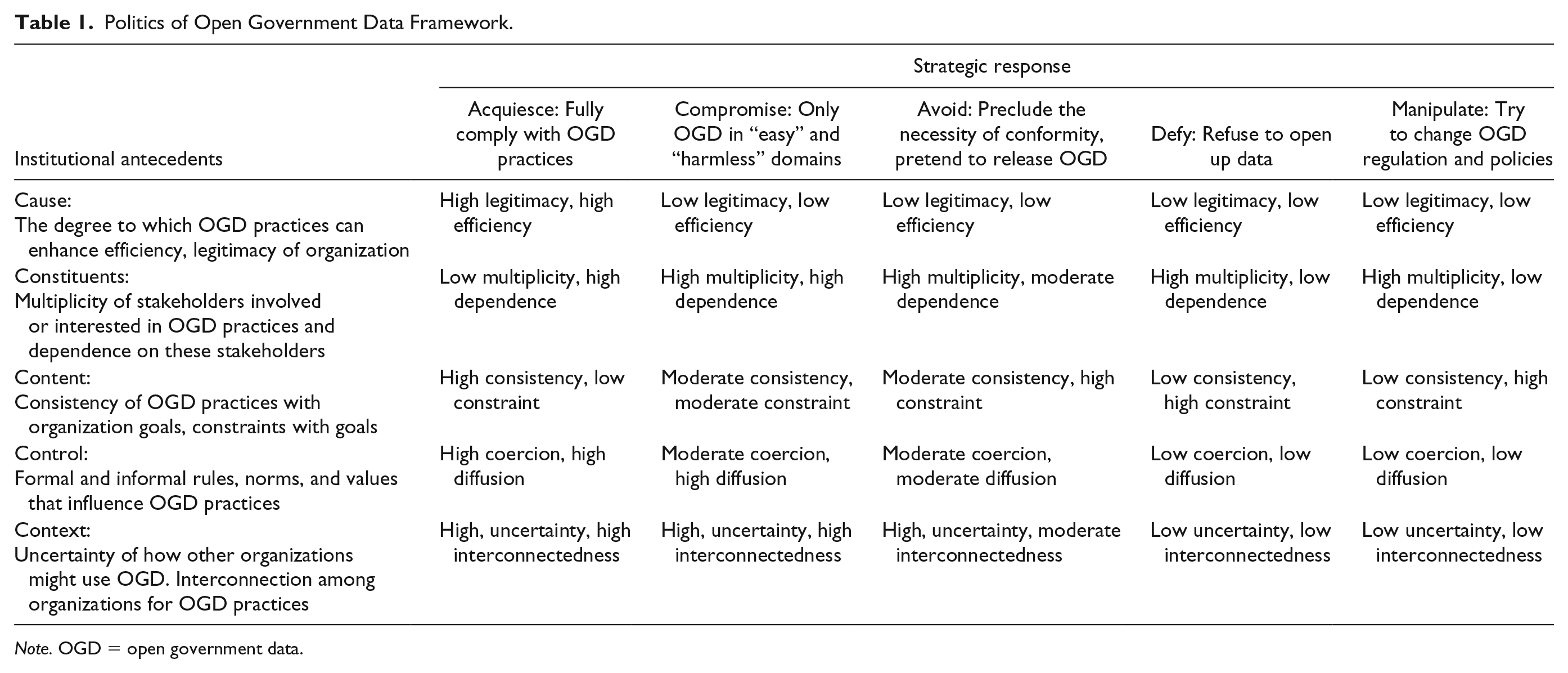
Note. OGD = open government data.
The Politics of Open Government Data Framework shows that compliance with national OGD policies is only one of the strategic responses of (local) government. Strategic responses can vary in their degree of compliance and organizations can use the strategy of manipulation to change the institutional pressures on OGD. While “acquiescence,” “defy,” and “manipulate” are relatively straightforward, “compromise” and “avoid” are more complex categories. Organizations can respond by releasing data in safe domains, but they can also limit what data are made available, how these data are made available, when these data are made available, and how easily they can be retrieved. What the politics of OGD framework adds to the current literature is that we can formulate expectations on how government organizations will respond to pressures to publishing OGD (see Table 1):
In the next section, we will present qualitative empirical research that we conducted to explore these propositions and to further investigate whether our theoretical framework can indeed explain the strategic responses of government organizations to a push for OGD.
Research Methods
Research Design
The empirical research aims to explore whether the framework for studying the politics of OGD can help to understand the strategic responses of organizations to the push for OGD. We used an embedded case design: We analyzed the OGD practices of two local governments in two different European countries (Netherlands and France) that participated in the same OGD innovation project. 1 An embedded case design consists of more than one unit of analysis. The case may consist of an overarching public program, such as an EU project, that consists of several embedded units, for example, participating local governments (Yin, 2003). The data were collected at a province in the Netherlands and a municipality in France. The cases were selected not with the aim of comparing countries or localities but as two separate exploratory tests for the explanatory potential of the framework. The purpose is replication (Yin, 2003). It allows us to test our framework and propositions in two settings and to analyze whether the cases work as predicted and whether based on the cases, the theory must be modified (Yin, 2003).
Our research data are based on action research. Action research is an approach in which researchers and members of a social setting collaborate (Bryman, 2012). In our study, we used an abductive research approach, which fits well with action research (Kovacs & Spens, 2014). Abductive reasoning is commonly used when theory development and data collection occur simultaneously, implying a loop between theory and empirical data (Kovacs & Spens, 2014). Abduction uses probability thinking to draw temporarily, plausible propositions that can help to improve the process of knowledge production. Based on this process, the best possible inferences and conclusions are selected (Van Buuren, 2017).
The research project started with the identification of policy domains within the two participating government organizations. To be able to participate in the overarching EU program, the responsible policy domain in the organization had to be willing to release and work with OGD. The cases reflect the search for the policy domains within the government agencies. During our action research, we took a political theoretical perspective as our point of departure and noticed differences in responses of the organization regarding different policy domains, following we searched for suitable theories that we had observed empirically (Kovacs & Spens, 2014), which led to the five responses and antecedents distinguished by Oliver (1991), and to the propositions that we explored empirically.
Case Descriptions
The Dutch case consisted of a province, one of the 12 provincial government agencies in the Netherlands. In the province, we collected data for the policy domains: population decline, gas drilling, and finances. These domains were identified by the government organization as high priority topics. For the province, keeping up the livability in the area is a high priority because it is currently one of the areas with the highest population decline in the Netherlands. In some areas, the population will have declined by 20% in 2040. The recent economic recession and the consequences of natural gas drilling, causing earthquakes in the province and damage to citizen housing, have impacted these developments as well (D6 2 ). Like other provinces in the Netherlands, this province was, at the time of our research, in the process of opening its data. The province had an OGD portal, which contained more than 70 open datasets. The province had released several datasets related to financial transparency (D1) and health concerns. However, few available datasets on the portal directly related to the theme population decline or gas drilling.
In the French municipality, our analysis focused on two interrelated policy domains that were identified as a priority by the municipality: digital economy and mobility. The French municipality adopted in the mid-1990s, a series of measures with the aim of transforming the city into a cyber-city. In 1996, it adopted a Local Information Plan to develop Information and Communication Technology (e.g., e-government, electronic voting, opening of datasets) to efficiently respond to the challenge of building a new and better relationship with citizens and civil society actors. The municipality relies on the digital economy, and by extension, on the potential partnerships and innovations that they produce to promote the development of e-democracy. Today, the municipality hosts approximately 100 companies in the field of information and communication technologies. It has numerous digital services concerning, for example, smart mobility. The municipality has become one of the most recognized smart/cyber cities of France. In line with its ambition of being a cyber-city, the municipality actively publishes OGD. Since 2012, it started publishing OGD on the national portal data.gouv.fr. The municipality created its own OGD portal in early 2015. At the time we carried out our study (2015-2016), the portal contained 140 open datasets.
Data Collection and Analysis
Our empirical data consisted of three focus groups with in total 31 participants, 11 semistructured interviews, and document analysis between March 2015 and November 2016 (see Table 2). At each site, a focus group was held with both public administrators and stakeholders with the aim to identify options and barriers for releasing and working with OGD (Hogan et al., 2017). The public administrators consisted of open data experts, information managers, communication experts, and policy experts. The stakeholders consisted of journalists, grassroots initiatives, nongovernmental organizations, and industry. Following, in-depth interviews were held with public administrators and stakeholders and questions related to the motives for releasing (certain types of) datasets, the expected benefits and possible disadvantages of opening data, the involved stakeholders and their roles, but also to what extent OGD is in line with the ambitions and goals of the government organization and the formal and informal rules that influence OGD programs. In addition, government documents such as policy documents, the coalition agreement, and regulations were studied. The study used process tracing to analyze the collected data (George & Bennett, 2005). Process tracing is a method that attempts to trace the links between possible causes and observed outcomes. One form of process tracing is the analytical explanation, couched in explicit theoretical forms. It provides the ability to explore whether the observed processes match those predicted by the theory (George & Bennett, 2005). The interviews, documents, and transcripts of the workshops were analyzed and coded, guided by the definition of the OGD strategic responses (acquiescence, compromise, avoid, defy, and manipulate) and the five institutional antecedents (cause, constituents, content, control, and context) as defined in Table 1.
Data Collection.

Empirical Findings
Province in the Netherlands
At the time of our study, the province in cooperation with an NGO had published general financial data on a separate portal and on www.openspending.nl, to increase transparency (D7). On the website www.openspending.nl, financial information regarding the income and expenses of provinces and cities in the Netherlands are published. In this domain, the province is complying with OGD standards. Moreover, after releasing the initial general financial information as OGD, the province decided together with the NGO to release more detailed financial information. In fact, the province was the first in the Netherlands to publish detailed financial information that specifies how government money is spent (D7, D9). In this domain, the province fully complied with OGD practices. The OGD response in the domain of financial transparency can, therefore, be characterized as acquiescence.
Another policy issue high on the agenda of the province at the time of our study was consequences of natural gas drilling. Natural gas drilling had caused earthquakes in the province and damage to citizen housing and discussion regarding compensation was debated. The province indicated that it was reticent to start an OGD initiative concerning this topic due to the political sensitivity of the issue. The province attempted to preclude the necessity to conform, buffering themselves from institutional pressures. This OGD response regarding the domain of natural gas drilling can be characterized as avoidance.
Finally, the policy domain “population decline” was also high on the agenda of the province. OGD was not yet used as an instrument for solving population decline issues. The province decided to focus on this issue for the OGD innovation project. The participating stakeholders indicated that there were insufficient data available of interest and that the data were difficult to find because the data are spread out over different organizations (D3, workshop). Despite these shortcomings, ways were sought by the province to meet the expectations of citizens (D3, D4). The province involved stakeholders of citizens’ initiatives and discussed with them which type of data could contribute to their projects. In this domain, the province decided to balance and bargain with external constituents. This response in the domain of population decline can be characterized as compromise.
Hence, at the start of the innovation project when the province was to decide in which policy domain OGD practices were to be developed, we can observe three different responses: acquiescence for the financial domain, avoidance for the consequences of gas drilling and compromise for population decline. In the next section, we zoom in on the institutional factors that are expected to influence these responses based on our framework.
Institutional antecedents
First, regarding the cause or legitimacy, the coalition agreement of the province mentions that the present society demands an open management style in which collaboration, service, and transparency are essential for trust between government and society. However, if we analyze the policy domains more closely, some similarities and differences between the three domains can be observed. The cause for financial information is high because the information is used as an accountability instrument (www.rijksoverheid.nl). Since 2009, provinces and cities in the Netherlands must report financial information to the national government and to third parties via an open format that specifies which financial information should be provided (Ministerie van Binnenlandse Zaken, 2009). Population decline and gas drilling are high on the agenda and explicitly mentioned in the coalition agreement as one of the main tasks of the province (D7). Moreover, both domains are not just a local but also considered an issue of national importance (D9). Until then OGD had not yet been used as an instrument for population decline and its value was unknown. For the field of gas drilling, OGD was perceived as possibly undermining legitimacy (R7). Hence, for these two domains, the perceived gain can be considered low.
Second, concerning constituent involvement some differences can be observed for the three domains. Regarding the financial information, there is low constituent involvement because the third parties involved largely have a similar interest using financial information as an accountability instrument. The third parties are the National Government, the Central Bureau of Statistics, the EU, the financial regulatory agency but also other local governments and finally journalists (www.rijksoverheid.nl, R6). The external dependency in this domain is high because the province receives budget from the national government based on their financial information. In the policy domain, consequences of gas drilling, there is a high degree of constituent involvement with conflicting interests. Citizens are organized in action groups who demand release of information (r3b, D6) and would like to use OGD for their initiative (R7). The external dependence can be considered moderate because in the domain of gas drilling, a new separate government agency was established at the time of our study, specifically focused on the consequences of gas drilling. In the new agency, the national, province, and local governments joined forces and participated together. In the policy domain population decline, several citizens’ initiatives had been developed and many diverse actors are involved because policy decline effects housing, education, health care, and so on. Conflicts, however, were less of an issue and constituent complicity can therefore be considered moderate. The dependence is high because the province depends on collaboration with citizens and stimulates citizens’ initiatives by taking a specific bottom-up policy approach (D9).
Third, in terms of the content, the coalition agreement supports openness of data; however, it does not specify which type of data when, where, or how it should be published. In general, there is political pressure and support within the province for OGD practices (R1 and R2), but support for OGD within the organization, at the management level, is moderate to low (R1, R3b, D5). As one respondent noted, Even though OGD is one of the objectives, it is not followed through in practice because resources are lacking. (R2)
OGD requires a different way of thinking and a culture change within the organization (D4). Again, some differences between the domains can be observed, collecting financial data was already part of the organizations’ work process and was already made public, however not yet in machine-readable formats (R2). Hence, we can speak of high consistency in this domain and low constraints. Data regarding the consequences of natural gas drilling were considered sensitive and are therefore considered highly constraining. The value of OGD regarding population decline was not yet clear for the organization at the start of the project and can therefore be considered as moderately constraining.
Fourth, in terms of control, the Dutch national OGD policy applies to the provinces which is based on the Dutch Freedom of Information Act (Wet Openbaarheid Bestuur, Wob), implemented in 1980, and the 2003 Directive of the European Parliament and the Council of the European Union on the reuse of public sector information, implemented in Dutch law in 2015. The National Wob also applies to the provinces. The Wob does not specificy which type of information should be proactively released. However, for the domain finances, the legal coercion is high because additional financial law requires that financial information should be released, and it states how it should be released. Information is structurally collected, and the voluntary diffusion can be considered high. Next to formal rules that apply to government organizations, the province also stated in a memo (D10) that in general the OGD quality and access of data of the province should be improved and that it should be systematically mapped out within the organization which data might be relevant for reuse: The re-use of data should become part of policy proposals, project assignments and agreements. (D10)
However, civil servants are not always aware of the importance and usefulness of releasing information (D4), nor is information always structurally collected within the organization (workshop1). Parties outside the province often collect information about population decline and gas drilling but there is no general overview of all information collected. Within the organization, information or OGD is not yet seen as an instrument, like other instruments such as law or subsidies (R1). The voluntary diffusion can therefore be assessed as moderate.
Finally, in terms of the context all three domains require multilevel governance, which demonstrates a high level of interconnectedness. Some differences between the domains can be observed for the different policy domains. For financial data, the environmental uncertainty can be assessed as low. There was some initial fear of losing control. Nevertheless, it was decided to systematically release financial data as OGD because the information was already part of the organizations’ work processes and was already made public, however not yet in machine-readable formats (R2). Furthermore, once the first government organizations started to publish their information, others followed: “It is a ripple effect” (R6). In the domain population decline, cooperation between the ministry, the province, and municipalities, and with stakeholders such as companies, health care and education facilities, and citizens are required (Bikker, 2012). There is moderate uncertainty in this domain due to fear of privacy issues, especially once different datasets are linked together. In the domain of gas drilling, a new separate government body was established in which the central, province, and local governments participate together. The policy issue “was considered politically sensitive and there was a fear for reputation damage” (R7). Due to the politically sensitivity of the topic and the uncertainty of what stakeholders would do with the information, the environmental uncertainty and interconnectedness can be assessed as high.
Analysis
In line with the Politics of Open Government Data Framework, we found different organizational strategic responses acquiesce, compromise, and avoidance for three different policy domains, respectively, financial information, gas drilling, and population decline, within one government organization. Largely in line with Oliver’s framework, the institutional antecedents for the three domains show a different pattern (see Table 3). The factor cause is different for the domains with a high-perceived gain for the domain financial data, but not for the other two domains. The policy domains population decline and gas drilling are a priority but the value of OGD in relation to these domains was perceived as limited or undermining at the time of our study. The factors constituents, content, and control also show a pattern largely in line with our expectations. However, for the factor context, we observed an opposite pattern regarding the dimension uncertainty. In the case of the financial domain the environmental uncertainty was low; there was some initial fear of releasing data, but because the data were already available in a different format, the organization decided to pursue OGD practices nevertheless. In the case of gas drilling because of the political sensitivity of the topic and the fear of the consequences of releasing data, it was decided to not pursue OGD practices in this domain at the time of our study because it could undermine legitimacy. Based on our propositions, we expected that a highly uncertain and unpredictable environment would exert greater effort by an organization to reestablish the reality of control and stability over future organizational outcomes. We expected in this case that organization would be more likely to comply with demands imposed on them, thereby protecting them from environmental turbulence. However, in the case of OGD that expected turbulence withholds the organization of complying especially if it is perceived to undermine legitimacy.
Overview of Strategic Responses and Antecedents Netherlands.
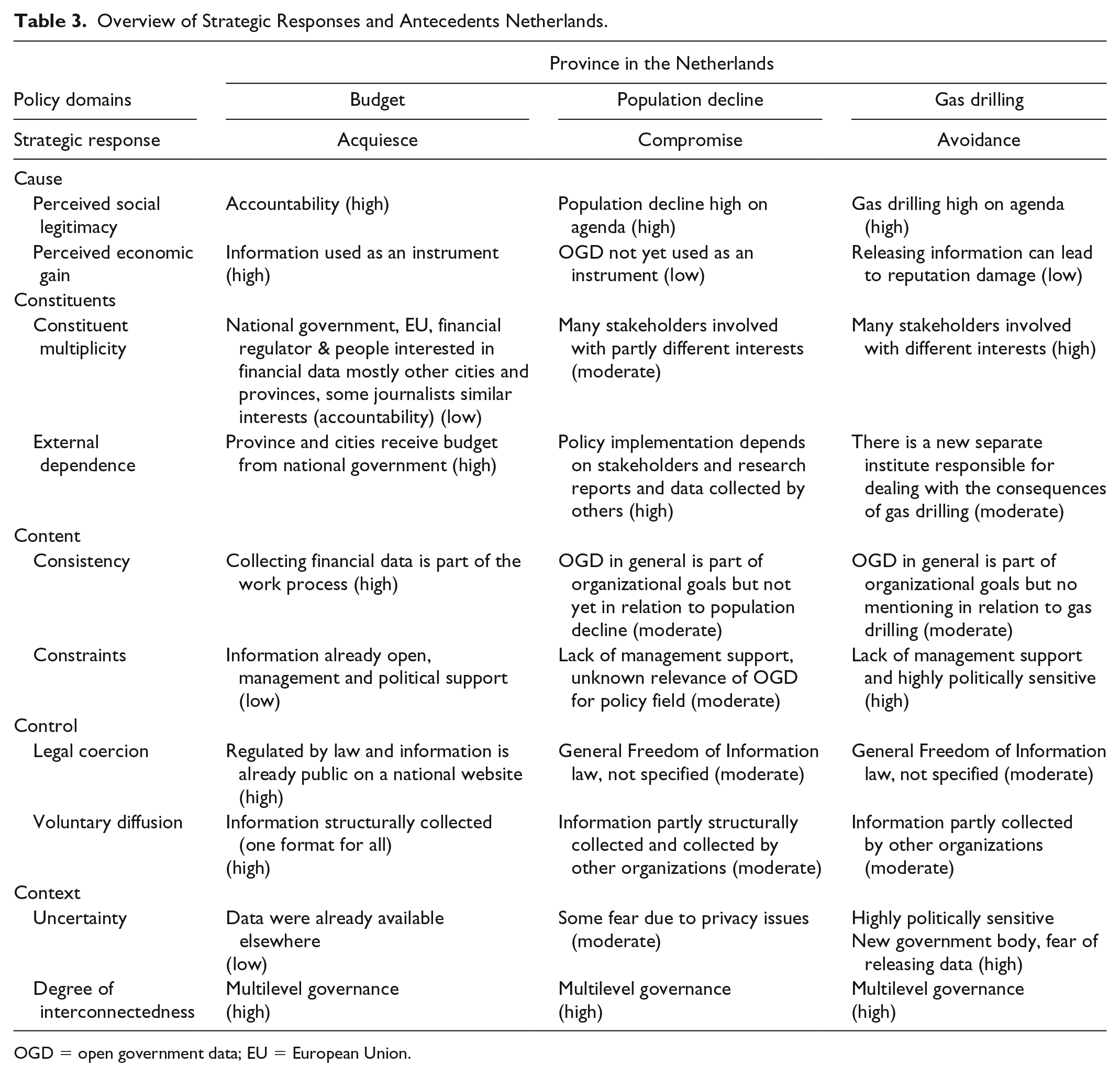
OGD = open government data; EU = European Union.
A Municipality in France
At the time of our study, the French municipality had organized and taken on the leadership of an OGD group, consisting of civil servants of local municipalities with the aim to develop good OGD practices. Furthermore, the municipality promoted the digital economy: Companies were encouraged to transform OGD into economic resources. Geo-located data were particularly considered as having high value for the digital economy. The OGD response for the digital economy in general can be characterized as a case of “acquiescence”: The municipality fully complied with OGD practices. However, when we zoom in more closely in this broad domain, it can be observed that the municipality is in fact reticent to publish data that might have a negative effect on the attractiveness of the city, in terms of economics or safety. They attempted to preclude the necessity for conformity. Hence, within the policy domain of the digital economy we can observe both acquiescence and avoidance as strategic responses. Mobility is another high priority policy domain of the municipality. In this domain, the municipality is more a facilitator than a producer of OGD and the municipality must negotiate with external stakeholders for the release of data. In general, the strategic OGD responses for mobility can be considered as compromise. However, if we zoom in on data concerning access to public transport for people with disabilities, there again reluctance can be found. Publishing this type of OGD could allow local pressure groups to criticize the local government, for example, regarding a lack of services. Hence, within the policy domain of mobility, we can observe both compromise and avoidance as response strategies. In the next section, we will analyze the antecedents that are expected to influence these responses.
Institutional antecedents
In terms of the first antecedent cause, we can observe that in both domains there is a high degree of legitimacy. The digital economy is of high priority for the municipality. It is a way to create employment and to attract new inhabitants. As one of the first smart cities in the world (2009) and one of the most recognized cyber cities of France, the municipality aims to keep its leadership in this domain. For that purpose, it encourages developers who work in information and communications technology (ICT) companies established in the city, start-ups, and big companies, to participate in events around the ICT economy such as conferences and hackathons. OGD can be used for improved services and applications and the perceived economic gain is considered high. By defending its leadership, the municipality wants to generate new forms of relationships between the administration and citizens, among others by using OD platforms. This benefits the municipality: It is a question of communication. We want to propose a service that is useful for citizens.
Regarding transportation, the municipality is a key city in the domain of “connected mobility,” and civil servants would also like to keep this leadership. De facto, they comanage a consortium devoted to mobility, consisting of private companies and public institutions. Within this context, OGD are namely used as instruments for improving traffic: (a) to optimize business productivity by reducing time spent by employees in transport, (b) to respect the EU directive 2010/40/UE, and (c) to reduce air pollution and limit economic impact on health services. The economic gain is perceived as moderate. Furthermore, the policy domain transportation is also chosen as a priority based on public consultation: citizens had voted public transportation and accessibilities as one of the main problems in the city (R3).
Second, in terms of the antecedent constituents, we can observe some differences between the policy domains. For the policy domain digital economy, the participating cities would like to find a common solution. The external dependence is considered high because the city depends on technical developers and experts in computer sciences to make this work. In the policy domain transportation, the constituency is more diverse and is highly dependent on effective transportation. In mobility, data in general are not perceived as difficult to release because partners share their data on demand.
Concerning transport, it was politically easy to have access to data. We faced only some technical problems for collecting data from services in charge of producing it. (R1)
However, the data availability and the potential lack of access for people with disabilities depend on many stakeholders (e.g., private companies, regional institution, local governments). Publishing such OGD could allow local pressure groups to criticize the local government with respect to a lack of services for which the city is not directly responsible.
Third, regarding the content, there is a high degree of consistency between institutional norms and organizational goals for the digital economy. The municipality is working on a political and economic plan for promoting digital action (R3). The digital economy is a priority of the municipality because it wants to keep its leadership position as a cyber city. An OGD project on transportation is also in accordance with the digital strategy of the municipality. The city publishes data provided by transport companies. In addition, some constraints can be pointed out for both domains. The municipality faces a lack of employees for data management and digitalization. This raises two recurring barriers: (a) difficulties in identifying available datasets and (b) a limited interoperability of the data format.
Fourth, in terms of control the respondents referred to the French “Lemaire Law.” This law is aimed at enhancing the availability of OGD and obliges administrations of 50 agents or more to release data that are already digitalized. However, the respondents pointed out that the law did not influence their project because they had begun opening their data already before the law. In addition, in the area of mobility, the public administrators also use OGD to reduce traffic to comply with the EU directive 2010/40/UE. The legal coercion can therefore be considered moderate for the digital economy and high for mobility. Diffusion can be assessed as high in both domains because they already published data before the law. Moreover, participants involved in the policy domain transport explicitly referred to the diffusion of OGD in other cities: a major part of big cities did it in Europe. For example: Santander in Spain. In this city, traffic decreased by 40% with the exploitation of OD by PAs and local companies. In Paris, PAs tried to do the same thing in some areas. (R1) We are behind schedule compared to the cities (. . .) and (. . .) which have already developed projects and applications. (R2)
Finally, in terms of context, regarding both domains there is high degree of interconnectedness due to the different layers of involved administrations and supplier services. Regarding the digital economy, the municipality has made data accessible to stakeholders (including other cities and citizens) that does not generate controversy and preserves the economic and political interests of the city. We can assess this as low uncertainty. However, there is reticence to for instance release air pollution data, because it could negatively impact real estate prices. Here we observed high uncertainty in the same domain. In terms of access to public transportation, there is low uncertainty due to a strong cooperation between civil servants and transport companies. However, for data concerning people with disabilities, a higher degree of environmental uncertainty can be observed. Publishing these data could allow local pressure groups to oblige public administrators to engage in time-consuming discussions, with respect to a lack of services for which the city is not directly responsible.
Analysis
Hence in the French case we found different strategic responses for different domains (see Table 4). In line with Rautiainen and Jarvenpaa (2012), we observed coexisting responses within the domains. It can be observed that the municipality prefers to publish OGD in “harmless” domains that would not enable or encourage political dispute or specific demands from groups of citizens. At the same time the municipality is reticent to publishing data that might have a negative effect on the attractiveness of the city, in terms of economics, ecology, safety, or access of public transport for people with disabilities. If we analyze the factors that affect the response, then we can observe that for the factor cause (see Table 4) the digital economy follows our propositions but in the domain mobility we assessed the economic gain as “moderate” instead of the expected score “low.” The factor constituents follows the politics of OGD framework for the domain digital economy but for the domain mobility a mixed score can be observed. In general, in the field of mobility the stakeholders have similar interest, but this is different for the area of people with disabilities. Content and control are in line with our expectations. Finally, in terms of context, it can be observed that for the dimension of uncertainty we again see a mixed opposite score because there is a general perception of pursuing the releasing data for the domains but not in specific areas within the domains that are perceived as potentially harmful for the legitimacy of government.
Overview of Strategic Responses and Antecedents France.
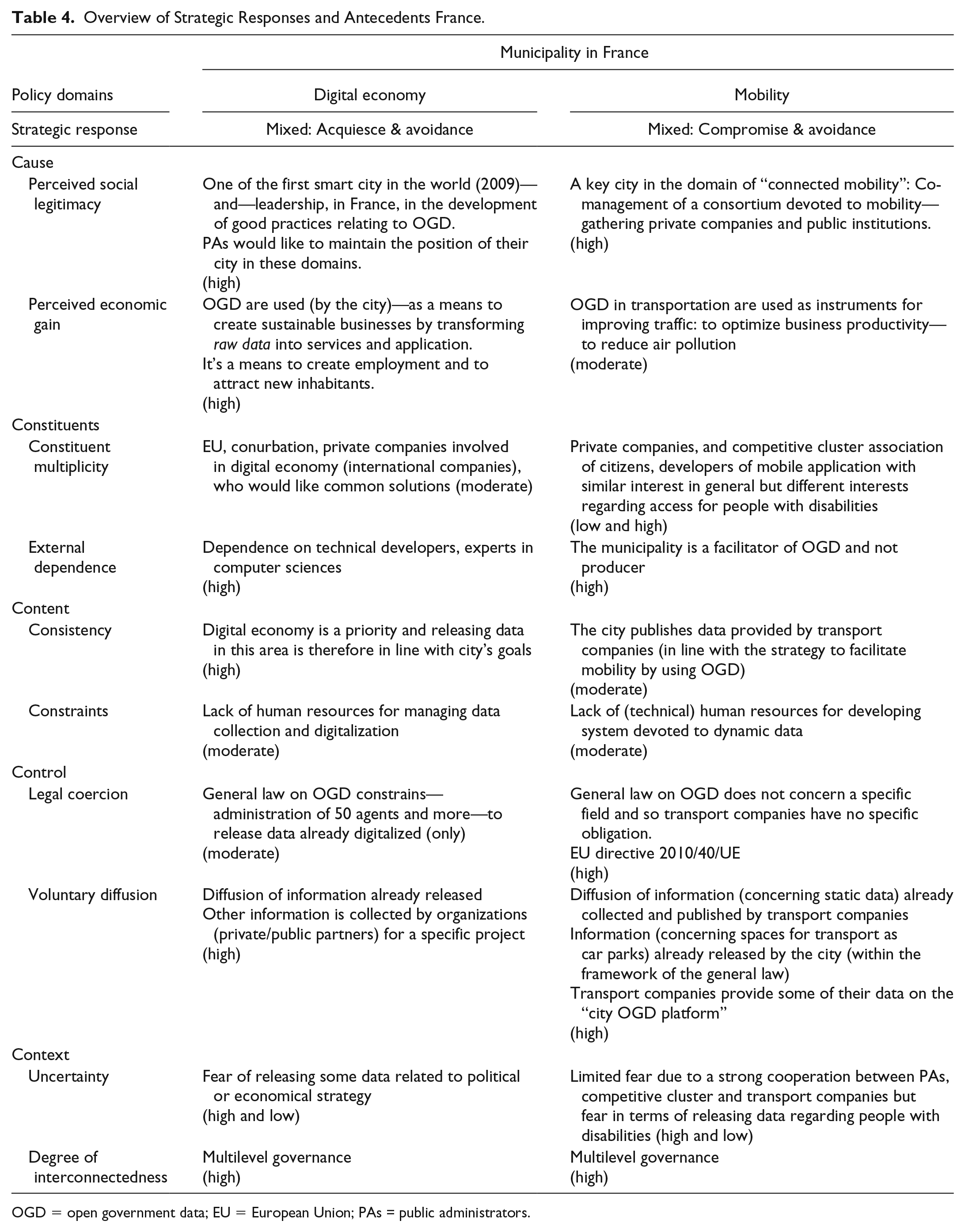
OGD = open government data; EU = European Union; PAs = public administrators.
Discussion and Conclusion
The purpose of this article was to develop a better understanding of strategic responses of organizations to the push for OGD by highlighting the politics of open data. Government organizations are complex adaptive systems that interact dynamically with their environment (Baumgartner & Jones, 2015; Meijer, 2013). Two separate cases in two countries, The Netherlands and France, who both participated in the same OGD innovation project, were analyzed for the explanatory potential of the Politics of Open Government Data Framework.
Our key contribution to the public administration literature is that the organizational push for OGD can lead to varying strategic responses per policy domain resulting in hybrid organizational OGD practices. Our study contributes to the ongoing transparency debate. We term such strategies involving restricting the available data or else distributing it across disparate datasets, strategically opaque transparency (cf. Groff, Baker, & Détienne, 2016). We define strategically opaque transparency as the purposive action of revealing information about the internal workings or performance of an organization in certain domains but not revealing information in other domains. It confirms Longo’s (2011) assumption that governments can selectively release OGD. Our findings are also in line with Roberts’ (2006) argument that the increase in transparency should not be understood as homogeneous. Our findings imply that the transparency debate needs to focus more on the differences between types of datasets and between policy domains. Our study shows that OGD are especially released in “easy” and “harmless” domains.
Furthermore, three of the five identified strategic responses were found in both cases: acquiescence, compromise, and avoid. We did not find strategies of defiance and manipulation. One possible reason could be the setting in which this study took place: two local governments in democratic European countries that both score rather low on the international corruption perceptions index (Transparency International, 2017) and high on the international Open Data Barometer (2016). Perhaps in other (nondemocratic) countries, other responses might be found. This requires further research. Another reason of not finding these strategies might be due to the mostly in person methods used which might lead to more socially desirable answers (Bryman, 2012).
The five institutional antecedents cause, constituents, content, control, and context can explain the different responses of local governments in terms of eagerly opening certain types of data but much less willing to open others. Largely, in line with our propositions, we found that government agencies will more likely comply with OGD practices when these practices enhance the legitimacy or efficiency of the organization, when the formal and informal rules and organizational goals support OGD practices and when there is a low multiplicity of stakeholders. Contrary to our propositions, however, we found that when the environmental context is highly uncertain and unpredictable and when there is a high multiplicity of constituents and high legitimacy stakes, organizations tend to compromise and avoid open data practices in the policy domain. A possible explanation for this surprising finding could be that information is not like other resources (Cleveland, 1985). Information is sharable and expandable in ways we cannot imagine (Cleveland, 1985). Open data have no value in itself but become valuable when used (M. Janssen et al., 2012). Others can use data in ways that organizations cannot imagine or foresee. Organizations also fear that stakeholders are actively seeking for negative accomplishments or data might be abused or misinterpreted (Barry & Bannister, 2014; Fung, 2013). These findings indicate that a modification of our theoretical framework is necessary: Low contextual uncertainty might, in fact, lead to more willingness to release data, whereas high uncertainty and high legitimacy lead to more resistance. However, this study was based on an exploratory qualitative analysis. Further research is encouraged to determine causal links between antecedents and institutional responses regarding the release of OGD based on quantitative analyses to further test the politics of OGD framework.
This article highlights that the incentive created by the institutional environment for OGD should be understood as an incentive for the release of specific types of data by government organizations. The perceived incentives focus on policy domains that are rather harmless such as budget data in the Netherlands and data about the digital economy in France. The incentives for opening more sensitive data are less powerful mostly because local governments feel that data about earth quakes (Netherlands) and accessibility (France) may undermine the legitimacy of government. Yet these sensitive types of datasets might be high-value datasets for citizens and stakeholders and contribute to insights in societal issues relevant for them. More is needed for effective transparency (Heald, 2006). Our analysis indicates that a general push for OGD is not strong enough to provide an incentive for governments to open this type of valuable but sensitive data. Subsequently, the question can be asked what should be done in practice to open more sensitive data?
The key contribution for practice is that getting governments to release OGD is not only a matter of informing and facilitating OGD and removing barriers (M. Janssen et al., 2012). It is also a matter of creating institutional incentives in the form of enhanced legitimacy, economic gain, and reducing constraints in the organization. In addition, legal coercion in specific policy domains could be used to force governments to open data to the public. Institutional pressure from regulators can help to ensure this focus. An example is the Aarhus Convention that requires the passive and proactive release of environmental information. Without institutional incentives or pressures, local governments will selectively pick certain harmless policy domains but avoid releasing sensitive OGD. We suggest that a better understanding of specific institutional responses is crucial to enhancing OGD practices in public administration.
Footnotes
Acknowledgements
The authors would like to thank their ROUTE-TO-PA colleagues for their valuable contributions.
Declaration of Conflicting Interests
The author(s) declared no potential conflicts of interest with respect to the research, authorship, and/or publication of this article.
Funding
The author(s) disclosed receipt of the following financial support for the research, authorship, and/or publication of this article: This project has received funding from the European Union’s Horizon 2020 research and innovation program under grant agreement No. 645860.
