




Abstract
In response to industry calls for better digital marketing education, this study develops and validates an integrated framework for digital marketing curriculum design. A multi-phase, mixed-methods design was employed across four European countries, including an exploratory analysis of existing courses, qualitative focus groups and interviews with stakeholders, and a culminating quantitative survey (n = 334) of professionals. Data were analyzed using t tests and hierarchical cluster analysis to determine curricular priorities. The findings identified essential modules for an introductory course, empirically clustering them into a three-stage pathway: Foundation (traffic & data), Applied Content (engagement), and Optimization (conversion). For advanced study, specialization blocks were validated and grouped into coherent capability sets – performance & analytics, experience, and foundational – reflecting learner preference for integrated pathways. Competencies-set breadth was found to be independent of organization size. The study provides an empirically validated framework for a transversal digital marketing curriculum, supporting a structured model that progresses from foundational competencies to integrated, specialized pathways. This framework addresses current fragmentation in educational provision and enhances the development of transferable competencies applicable across diverse professional contexts.
Keywords
Introduction
The systematic revision of business-school programs remains essential to aligning curricula with institutional missions and maintaining the relevance of courses, aligning teaching with the needs of companies (Schirr, 2014). Nonetheless, according to Zahay et al. (2018), students often perceive marketing syllabuses as being overly theoretical in nature and failing to provide competencies, even though marketing professors are increasingly striving to incorporate relevant technologies. We are educating our students in an era of pervasive digital disruption, which necessitates continual updates to the marketing curriculum (Crittenden & Peterson, 2019a). As asserted by Harrigan and Hulbert (2011), graduates frequently lack the competencies demanded of 21st-century practitioners. The importance of this subject has been widely emphasized in the literature. Yet, the marketing curriculum has often been criticized for lagging behind advancements in marketing practice, especially in terms of technological integration (Crittenden & Crittenden, 2015). Royle and Laing (2014) add that, within the digital domain, the competencies essential for success remain ill-defined and difficult to measure. Moreover, the accelerated evolution of technology, coupled with organizations’ increasing reliance on digital platforms, exacerbates this pedagogic-professional gap (Graham et al., 2020). This digital disruption has fundamentally challenged marketing educators to maintain curriculum relevance (Crittenden & Crittenden, 2015), with the transformation from traditional to digital marketing requiring pedagogical approaches that engage Digital Native students while addressing the competencies demanded by contemporary employers. Furthermore, digital marketing education is currently facing three main problems that limit its effectiveness in preparing graduates for professional practice: (a) Digital marketing courses are often taught as individual tactics, without integrating them into strategic frameworks (Royle & Laing, 2014); (b) There is a lot of variety in content, depth, and quality, with limited consensus on what is essential (Chen & Chen, 2022); (c) There is debate about whether digital marketing competencies are universally applicable (Verma et al., 2023) or require localization for different markets (Matosas-López, 2021; Ru-Zhue et al., 2025). An empirically validated curriculum with core components applicable across markets addresses these problems by structuring the content around strategic frameworks, basing essential competencies on evidence-based consensus, and ensuring transferability across organizational and geographical contexts.
While the intellectual history of marketing offers valuable context for curriculum design (Shaw, 2009), the present research focuses on the practical challenge of developing and validating a transversal digital marketing curriculum. Prior marketing education literature has established a rich tradition of organizing knowledge into Schools of Marketing Thought (SMT) (Hunt, 2010; Sheth et al., 1988). However, no such school has been formally proposed for digital marketing, nor has a comprehensive, empirically validated curriculum been developed. Therefore, despite the wealth of literature available in the field, there is a lack of research to assess if digital marketing is indeed a new SMT or, as stated by Shaw (2009), a relabeling of long-established concepts. Such statements can raise the question of whether there is currently an educational gap in digital marketing, and whether it lacks a recognized school of thought and thus has an underdeveloped pedagogy. Furthermore, in an era of complete digital interconnectedness, where information flows instantaneously and unrestrictedly, where even the smallest businesses can operate on a global scale, and where digital marketing competencies can be exercised remotely, it is imperative to consider the need for a transversal curriculum in digital marketing. Nevertheless, the digital transformation of marketing practice has fundamentally altered the industry landscape. Organizations increasingly use digital channels for consumer acquisition, engagement, and retention. Search Engine Optimization (SEO), social media marketing, marketing automation, and analytics-driven decision-making are now key marketing roles. Educational institutions have struggled to adapt their courses to this rapid industry evolution (Wilson et al., 2018). Thus, a thorough analysis of fundamental digital marketing knowledge and its instructional structure is necessary (Crittenden & Peterson, 2019b).
As proposed by Sheth et al. (1988), the concept of a transversal digital marketing curriculum is indispensable. This is defined as a structured set of core, evidence-based hard competencies and a progressive pathway in digital marketing that higher education can standardize and deploy, maintaining its effectiveness and transferability across different geographical and organizational settings to address digital disruption in marketing education. Nevertheless, the question of whether digital marketing constitutes a new SMT remains subject to scholarly debate.
The motivation for a coherent, cross-context core arises from persistent competence gaps and heterogeneous curricula that jeopardize program relevance and graduate employability (Crittenden & Peterson, 2019a) and confuse stakeholders (Muñoz & Wood, 2015). In contrast to transversal competences (i.e., general transferable or soft competences), the present focus is on domain-specific digital marketing competencies whose inclusion is repeatedly evidenced as foundational in contemporary curricula (Almeida et al., 2018). Transversal is used to indicate competencies that show applicability irrespective of country, sector, or firm size, consistent with sector-wide calls for digital-first orientations and standardized technical training in higher education (Rohm et al., 2018). Furthermore, a digital-first orientation in marketing education further necessitates coherent technical foundations that keep pace with disruption while remaining pedagogically integrative (Crittenden & Crittenden, 2015). Indeed, empirical audits demonstrate widespread, albeit heterogeneous, adoption of digital courses, thus emphasizing the necessity for common baselines as opposed to idiosyncratic menus (Langan et al., 2019). Therefore, a digital-first curriculum architecture is recommended to integrate such competencies systematically across programs and levels (Cowley et al., 2020). Concurrently, evidence from social media curriculum research highlights fragmentation in content scope, pedagogy, and assessment, further supporting a structured baseline of competencies (Muñoz & Wood, 2015). In line with prior Journal of Marketing Education (JMED) work, the core typically encompasses analytics, digital strategy, content, SEO, online advertising, and email marketing, which recur as indispensable pillars across programs (Parker et al., 2023). Moreover, editorial and review work in JMED underscores that maintaining currency amid digital disruption requires curricula that integrate emerging technologies while retaining strategic coherence (Crittenden & Crittenden, 2015). Accordingly, a transversal curriculum provides a consensus-driven foundation that programs can adapt at the periphery to local needs without diluting core capability formation.
This research aims to address the following research objective: to develop and validate a transversal digital marketing curriculum, a framework of core, evidence-based competencies that demonstrate transferability and applicability across diverse geographical and organizational contexts. However, identifying which competencies to teach is necessary but insufficient; curriculum designers also require empirical guidance on how those competencies should be sequenced and grouped, given that digital marketing topics exhibit logical dependencies that demand a scaffolded progression. By evidence-based pedagogical structure, we refer to an empirically derived framework that specifies the clustering and sequencing of modules, thereby translating a validated set of competencies into a coherent and implementable curriculum architecture. Specifically, the research addresses the following research objectives: (a) to identify core digital marketing competencies that stakeholders across academia and industry consider essential for contemporary marketing practice; (b) to determine an evidence-based pedagogical structure for organizing these competencies within an integrated curriculum framework; and (c) to assess whether core digital marketing competencies exhibit transferability across different organizational contexts and educational markets. These objectives together address the fragmentation challenge in digital marketing education by establishing what should be taught, how it should be structured, and the extent to which a unified curriculum framework can serve diverse contexts.
Revising the Digital Marketing Curriculum
The primary objective of marketing education is to equip students with the skills and knowledge necessary to thrive in the corporate world (Robideaux & Good, 2015). In the contemporary labor market, which is characterized by intense rivalry, equipping students for the requirements of the contemporary workplace is a fundamental goal for marketing professors instructing the students in digital settings (Key et al., 2019). Employers have repeatedly called for a reduction in the discrepancy between the competences taught in educational settings and those required in professional environments (Zahay et al., 2021). It is evident that educators engaged in the domain of marketing education encounter a persistent challenge in aligning the marketing curriculum with the competencies and knowledge deemed essential by employers within the industry (Graham et al., 2020). An analysis of the industry’s present condition reveals several areas of concern: insufficient specialized technical competences, a demand for best-practice guidance on evaluation metrics, and a deficiency in intelligent future proofing considering dynamic technological change and development (Royle & Laing, 2014). Moreover, digital marketing requires extensive training and external industry support for effective classroom management, requiring significant financial and time commitments from faculty members (Zahay et al., 2021). This is exacerbated by the recognition that the integration of data-driven marketing has outpaced talent development, leading to a marketing competencies gap (Wilson et al., 2018).
The development of curricula with broad applicability across contexts aligns with competency-based education (CBE) frameworks, which emphasize observable, measurable abilities that learners can demonstrate in varied settings (Frank et al., 2010). The CBE focuses on defining outcomes (what graduates should know and be able to do) rather than prescribing specific content or delivery methods. In marketing education specifically, competency frameworks have been developed by professional bodies including the American Marketing Association, the Chartered Institute of Marketing, and the Digital Marketing Institute, each specifying core capabilities that practitioners require regardless of organizational context (Parker et al., 2023; Zahay et al., 2018). The concept of transversal competencies is central to contemporary higher education policy internationally. In particular, transferable competencies in professional education contexts refer to knowledge, skills, and competencies that apply across different organizational settings, remain relevant despite technological change, and can be adapted to varied geographical and cultural contexts with minimal modification (Davies, 2017). In the digital marketing domain specifically, the question of transferability is particularly salient given debates about whether digital competencies are universal or culturally contingent (Matosas-López, 2021).
Five outstanding topics necessitate additional examination: (a) Resources for curriculum development; (b) Fundamental principles for formulating curricula in digital marketing; (c) Incorporation of digital marketing into conventional marketing curricula or the establishment of new curricula; (d) Transversality relevance of curricula across markets; (e) Prior investigations on digital marketing curricula.
Research on marketing curriculum design highlights the importance of balancing technical and professional competencies (Makienko & Bernard, 2012), identifying core marketing capabilities, and engaging students through tailored educational strategies (Horng et al., 2024). Recent research indicates that dedicated digital marketing courses have become widespread in university programs, with many institutions now making them a core requirement (Langan et al., 2019). A structured and iterative curriculum development process (Sun, 2025), including feedback from various stakeholders (Sebsibe et al., 2023), is crucial for creating effective marketing education programs. In addition, enhancing the learning context within the curriculum is a key focus to ensure relevance and practical value for students (von der Heidt & Quazi, 2013). Also, curriculum design has highlighted three principal determinants of new course offerings: faculty assets and motives, student requests, and feedback from alumni and businesses concerning the competencies necessary for student success in the workplace (Graham et al., 2020). Marketing instructors can ascertain the necessary competencies through company feedback and employ this information to evaluate their curriculum and inform the development of courses and curricula (Ellen & Pilling, 2015). As Ellen and Pilling (2015) indicated, any evaluation process is inherently intricate and requires contributions from numerous parties. Furthermore, examining undergraduate catalogs from universities that provide marketing programs can yield significant insights about the variety of marketing courses available and their frequency in curricula, facilitating the development of a thorough digital marketing curriculum (McDaniel & Hise, 1984).
Concerning the conception of digital marketing curricula, it demands a fundamental realignment with the advancing technical world and shifting marketing attitudes. Designing digital marketing curricula demands a fundamental realignment with the advancing technological environment (Wymbs, 2011). The challenge extends beyond content updates to encompass fundamental questions about curriculum structure and delivery, as marketing educators must divorce themselves from traditional instructional practices to embrace technology-enabled teaching that reflects industry realities (Crittenden & Peterson, 2019b). Furthermore, it is essential to understand the implications of technological improvements on marketing education and practice (Langan et al., 2019), and to provide self-directed learning and to sustain adaptability to new competencies in the working environment (Ray Chaudhury, 2019). Emerging content areas such as the influencer (Cowley, 2025) represent the evolving nature of digital marketing practice, requiring curriculum frameworks sufficiently flexible to incorporate new competencies while maintaining coherent learning progressions. Two additional perspectives are pertinent. Schirr (2014) asserted that there exists potential for the incorporation of product and service innovation principles into course and curriculum design, which may include methodologies such as continuous improvement and market-oriented development. Conversely, Key et al. (2019) asserted that a methodology centered on comprehensive experiential learning projects provides a technique for attaining this goal, enabling the synthesis of academic knowledge with practical application.
Debate continues regarding the optimal way to integrate digital marketing content into existing courses or whether a specialized curriculum is warranted. Williamson et al. (2015) emphasized the significant debate around the optimal integration of digital information into existing courses or the development of a specialized curriculum. Similarly, other authors assert that digital marketing must be incorporated into traditional marketing curricula to align with the changing marketing environment and address the needs of contemporary consumers (Zahay et al., 2021; Zambrano et al., 2022). In contrast, several scholars assert that digital marketing courses differ from traditional marketing curricula. They contend that digital marketing curricula integrate contemporary methodologies, like social media marketing, SEO, pay-per-click (PPC), and experiential marketing (Imanova, 2022; Zahay et al., 2021; Zambrano et al., 2022). Nevertheless, Lamberton and Stephen (2016) asserted that, as nearly all marketing operations possess a digital component, contemporary digital marketing is essentially synonymous with marketing. To sum up, incorporating digital marketing into conventional marketing curricula involves integrating digital tools like social media (Fazel & Sayaf, 2025), developing standalone digital marketing programs (Shaltoni, 2016), collaborating with industry experts (Gilmore et al., 2020; Ru-Zhue et al., 2025), and continuously updating the curriculum to reflect technological advancements and industry needs (Fazel & Sayaf, 2025). Further support is given by Cowley et al. (2020), that more generally asserts that bridging the industry-academia divide requires not only updated course content but also integration of industry-validated credentials and practical skill development opportunities, ensuring graduates possess demonstrable competencies that employers value.
In terms of curriculum transversality, it is important to determine whether digital marketing courses can be applied to global markets. Transversal competences are essential in higher education curricula for the contemporary labor market, as they improve students’ adaptability across many markets (Almeida et al., 2018). While many studies have investigated the internationalization of business education, few have concentrated on the particular challenges associated with the internationalization of marketing education (Tyagi, 2015). As Yeomans et al. (2025) observed, higher education providers are adapting their courses to ensure students gain the necessary digital marketing competencies for future careers. Similarly, Sanches (2025) noted that digital marketing curricula now align with global trends. A different perspective is contended by Matosas-López (2021), who asserts that digital marketing needs to be reformulated, indicating that a one-size-fits-all global curriculum may not be effective. Nevertheless, as posited by Crittenden and Peterson (2019a), the transdisciplinary future of marketing education necessitates curricula that transcend traditional disciplinary boundaries, particularly as digital marketing roles increasingly demand capabilities spanning technology, analytics, creative content, and strategic thinking.
Relatively little research has been carried out on digital marketing curriculum development, and even less on its transversal applicability across markets. A digital core consisting of search, social media, mobile marketing, and analytics is evident in the principal textbooks in this field, as well as in the existing research on the educational dimensions of digital marketing (Zahay et al., 2018). Similarly, Ye et al. (2023) delineated three overarching categories: marketing analytics, digital marketing, and social media marketing. The authors contended that the methodology utilized has been mostly tactical, rather than guided by a cohesive strategic plan. In particular, data analytics and related digital modules are increasingly mandated in marketing degrees as essential competencies for graduates (Langan et al., 2019). Nonetheless, the most exhaustive and substantiated reference is that of Parker et al. (2023), who advocated for the categorization of digital marketing into nine principal domains: Content Marketing, Social Media Marketing, Search Engine Optimization, Paid Search (PPC) via Google Ads, YouTube and Display Advertising, Email Marketing, Website Optimization, Analytics and Analytics with Google, and Digital Marketing Strategy. Homburg and Wielgos (2022) additionally mention Mobile Marketing, Search Engine Marketing (SEM), and Marketing Automation, while Chueh and Kao (2024) further add E-commerce Marketing, and Chutiphongdech et al. (2024) also refer to Omni-channel Strategies and Influencer Marketing.
Notwithstanding its ubiquity, numerous concerns surrounding digital marketing persist. Consequently, upon examination of the extant literature, which is characterized by contradictory and inconsistent perspectives, the research question that has been formulated is as follows: “What core subjects and structure should a transversal digital marketing curriculum include?”
Research Design
The study adopted a multi-phase, sequential mixed-methods design (QUAL→QUAN) to develop an evidence-based digital marketing curriculum. The research was conducted in four countries (Finland, Poland, Portugal, and the Netherlands) between January and June 2023, proceeding through four phases: (a) an exploratory analysis of 47 existing digital marketing courses to identify common topics, structural patterns, and gaps in current provision, establishing the empirical baseline for subsequent phases; (b) four country-specific focus groups (n = 48) to elicit stakeholder perspectives on essential competencies and curriculum structure, using a discussion guide directly informed by the exploratory findings; (c) six semi-structured interviews with purposively selected experts to deepen and validate emergent themes from the focus groups; and (d) a cross-national survey (n = 334) to quantify and validate the competency priorities identified in the qualitative phases. Each phase informed the design of the subsequent phase, ensuring progressive refinement of the curriculum framework.
Data collection occurred during early 2023, prior to the widespread adoption of generative AI applications in marketing. Consequently, while AI-related competencies appear within the Analytics, Performance, and Marketing Automation domains, AI had not yet emerged as a distinct curriculum topic. This temporal positioning is acknowledged as a limitation; however, the block-based framework accommodates the integration of emerging topics without requiring fundamental restructuring. Furthermore, AI is not limited to a single topic but is integrated in multiple domains of digital marketing, including advertising, customer engagement, data analysis, and educational curricula, among others (Dwivedi et al., 2021; Hocutt, 2024; Kareem, 2025; Mohd Amin et al., 2025).
This exploratory approach aligns with calls for systematic curriculum audits that examine not only what is taught but how digital content has been incorporated across marketing education landscapes (Crittenden & Crittenden, 2015), providing an empirical foundation for evidence-based curriculum design. The following four sections present each research phase as a discrete study, with methodology and findings reported together to facilitate an assessment of each phase on its own merits before integration in the Discussion.
Study 1: Exploratory Analysis of Existing Courses
Method
The first phase comprised a desk-based exploratory analysis of existing digital marketing courses to establish an empirical baseline of current curricular provision. The curriculum review was conducted between January and March 2023. Courses were sampled if they met the following criteria: (a) They were actively offered and available for enrolment as of January 2023; (b) They had been updated within the previous 18 months to ensure currency; (c) They provided publicly accessible syllabuses or detailed course descriptions specifying learning outcomes and topic coverage; (d) They represented substantive programs (i.e., more than 20 hours of instruction for short courses, more than 3 months’ duration for medium-term courses, and more than 6 months for postgraduate programs). This sampling approach yielded 47 courses: 12 were sourced from major MOOC platforms (Coursera n = 4; edX n = 3; Digital Marketing Institute n = 3; Udacity n = 2); 23 were postgraduate programs from Financial Times-ranked institutions (United Kingdom n = 9; rest of Europe n = 8; North America n = 6); and 12 were from institutions in the four participating countries (Finland n = 3; Poland n = 3; Portugal n = 3; the Netherlands n = 3). Thus, the geographic distribution of the sampled courses extended beyond the four primary research countries, enhancing the comprehensiveness of the landscape analysis while ensuring proportionate representation of offerings in each research context.
All sampled courses were dedicated digital marketing courses. The majority (n = 32) offered comprehensive coverage of multiple digital marketing domains, while the remainder focused on specific areas such as social media marketing (n = 6), digital analytics (n = 5), or search engine marketing (n = 4). Courses ranged from short professional certificates (20–40 hr) to full postgraduate programs (12+ months). The deliberate inclusion of diverse course formats served the exploratory aim of mapping the full landscape of digital marketing education. Following a comprehensive examination of courses across a range of delivery modes, durations, and institutional contexts, it was possible to identify topics that recur with consistent frequency, irrespective of program type. This process thereby established a robust empirical baseline for the subsequent qualitative and quantitative phases.
Results
The desk-based exploratory analysis examined 47 digital marketing courses across major MOOC platforms (Coursera, EDX, and DMI) and higher-education providers, revealing clear patterns in curricular emphasis. Seven core subjects recurred in more than 85% of medium-length, postgraduate, and master’s curricula: Social Media (present in 100% of courses), SEO (98%), Digital Marketing Strategy (96%), Analytics (96%), Digital Advertising (94%), Web Content (91%), and E-mail Marketing (87%). These subjects formed the consistent foundation across programs, regardless of provider type or geographical location. Short courses focused on the same core set but incorporated a wider range of niche or tool-based topics. Emerging areas appeared with moderate frequency, specifically, e-commerce (present in 64% of courses), UX (53%), conversion rate optimization and landing pages (47%), and digital selling (36%). These emerging areas appeared inconsistently and warrant further evaluation for curricular centrality.
These findings informed the design of the subsequent qualitative phase in two ways. First, the seven core subjects provided the structural backbone for the focus group discussion guide, enabling participants to evaluate topics with demonstrated curricular prevalence. Second, the emerging areas were included as probing topics to assess whether their inconsistent presence reflected genuine pedagogical uncertainty or merely variation in institutional emphasis.
Study 2: Focus Group Discussions
Method
A semi-structured discussion guide was developed based on the findings from the course review analysis and comprised eight main sections, progressing from general to specific issues: (a) opening questions explored participants’ current engagement with digital marketing and their organizations’ digital maturity; (b) transition questions examined which digital marketing topics and competencies participants considered most essential; (c) key questions probed deeper into specific curricular areas identified in the course review; (d) participants were asked to evaluate the relative importance of foundational versus specialized knowledge; (e) discussion addressed the balance of theoretical understanding versus practical, tool-based instruction; (f) emerging topics identified in the course review; (g) participants were invited to suggest topics not yet discussed; (h) ending questions explored preferred curriculum structures and learning pathways.
We conducted four country-specific focus groups in April 2023 to elicit stakeholder views on digital marketing competencies. Sessions were performed in April: Finland (n = 12), Poland (n = 13), Portugal (n = 11), the Netherlands (n = 12), yielding a total of 48 participants. All sessions were hosted via Zoom videoconferencing to enable participation from geographically dispersed stakeholders within each country. Discussions were held in the local language, with facilitators fluent in the relevant languages. Recruitment commenced 3 weeks prior to each session using institutional networks supplemented by snowball sampling from initial contacts. Eligibility criteria required, for practitioners, a minimum of 3 years’ professional experience in digital marketing and, for educators, at least 2 years’ teaching experience; all participants were required to be currently active in the field and willing to join a 90-min discussion. Industry representation included communication agencies (31%), product companies (27%), and service organizations (23%), with coverage of both B2B (38%) and B2C (62%) sectors. No financial incentives were offered, and participants were promised a summary report of the findings on project completion. Informed consent was obtained electronically 1 week before each session and reconfirmed verbally at the outset of the discussion. All sessions were recorded with participants’ permission.
Results
All four country groups converged on the view that foundational marketing knowledge is a non-negotiable prerequisite for digital marketing education. Participants identified positioning, branding, value proposition, differentiation, and other main subjects as essential prior competencies. This consensus signals that curriculum designers should not treat digital marketing as a self-contained discipline but rather as one that presupposes fluency in classical marketing strategy.
Two topics were unanimously identified as the most important pillars of any digital marketing curriculum: digital strategy and customer experience. Regarding strategy, participants across all sessions called for an integrated vision that connects tool use with business objectives. The groups articulated this through complementary emphases: linking strategy to operations, aligning digital initiatives with corporate business models, and developing critical ability to transform data into actionable intelligence. Customer experience generated an equally rich discussion. All groups identified consumer-journey mapping as a central competency and emphasized client centricity, though with an important contextual distinction: participants, some from product and service organizations, stressed that B2B customer journeys involve longer cycles and multiple decision-makers, requiring different pedagogical treatment than B2C scenarios. Additional sub-themes included sales-funnel optimization (conversion rate optimization, landing pages, lead generation, and nurturing), digital consumer behavior and insight generation, and omnichannel integration from both consumer and organizational perspectives. Participants further argued that marketing automation and mobile marketing should be embedded within the customer experience module rather than treated as standalone topics.
Beyond these two pillars, participants reached consensus on a set of core subjects: strategy, customer experience, web content, SEO, digital advertising, analytics, social media, website management, and e-commerce. This list closely mirrors the seven high-frequency subjects from the course review (Study 1), with the notable elevation of customer experience and e-commerce from emerging to core status. Regarding curriculum structure, the groups endorsed a model of comprehensive foundational training followed by specialization through thematic blocks, a T-shaped competency profile combining breadth across the discipline with depth in selected domains. In addition, participants noted the value of intensive short-format courses (1–3 days) for practicing professionals updating specific competencies.
A forcefully expressed theme across all sessions was the demand for strong practical components. Participants prioritized experiential learning, real-world projects, case studies spanning B2B, B2C, and non-profit contexts (including both success and failure cases), over platform-specific tool training. A critical pedagogical distinction emerged: participants insisted that curricula should teach how marketing concepts work rather than how specific platforms operate, reasoning that concept-driven competence is transferable whereas tool-centric instruction risks rapid obsolescence.
The discussions also raised several emerging topics as areas of growing relevance: UX design (debated as either a core competency or an adjacent discipline), GDPR compliance, CRM (argued to warrant explicit rather than implicit curricular inclusion), marketplace management and internationalization, and the professional’s digital self (personal branding as a career competency). Digital selling (e-selling) merits particular attention: participants with B2B experience described online sales competencies as mandatory, arguing that the traditional marketing versus sales separation is untenable in digital environments. This finding is noteworthy given that the course review identified digital selling in only 36% of existing courses, suggesting a significant gap between industry demand and educational provision.
These preliminary thematic categories and the emergent areas identified by the focus groups participants were subsequently incorporated into the semi-structured interview protocol, enabling the interviews to probe individual perspectives on the relative importance, sequencing, and depth of the topics that had surfaced during the group discussions.
Study 3: Interviews
Method
In-depth one-to-one interviews were conducted in May 2023, following the focus groups, to achieve two specific objectives that the group format could not adequately address: (a) to explore in greater depth individual perspectives on curriculum structure and pedagogical progression without the influence of group consensus dynamics that can emerge in focus group settings; (b) to validate and refine the preliminary thematic categories that emerged from focus group analysis through detailed individual accounts. A total of six semi-structured interviews were conducted with purposively selected individuals possessing expert knowledge across different stakeholder categories: two senior industry professionals (with 15+ years of experience leading digital marketing teams), two academic lecturers (with substantial teaching experience in digital marketing at postgraduate level), and two recent graduates (who had completed digital marketing programs within the previous 2 years and were currently employed in the field). This sampling strategy enabled triangulation across stakeholder perspectives. While modest in number, six interviews align with established qualitative methodological guidance for homogeneous, expert samples where information power is high and the study aim is narrow (Malterud et al., 2016). The interviews took place via videoconference, typically lasting between 45 and 60 min. An interview guide, mirroring the thematic areas covered in the focus group, was used to ensure consistency while allowing flexibility for probing each interviewee’s unique experiences. Interview questions centered on the interviewee’s opinions of necessary curriculum content and competencies for digital marketing roles, the importance of foundational marketing knowledge, and suggestions for improving current training offerings. Participants were asked to identify what they regarded as the main topics and competences for digital marketing practitioners, to evaluate the relevance of including certain modules in a curriculum, and to discuss the ideal balance between generalist and specialized training. All interviews were audio-recorded (with prior permission) to ensure an accurate record of responses. The recordings were subsequently transcribed, and any identifying information was removed to maintain anonymity. The transcripts and interview notes were subjected to a thematic analysis, and thematic saturation was reached by the fourth interview, with the fifth and sixth serving as confirmation. These qualitative findings directly informed the design of the subsequent survey instrument.
Following analysis of the focus groups and interviews, specialization blocks were constructed to represent coherent groupings of advanced digital marketing competencies. The development process comprised two iterative steps. First, all digital marketing topics identified through the exploratory course analysis, focus group discussions, and interview transcripts were compiled into a comprehensive list, yielding 31 distinct topics. Second, two members of the research team independently grouped these topics into thematic blocks, using three explicit criteria: (a) conceptual coherence, defined as logical relatedness of subject matter; (b) practical workflow alignment, reflecting how competencies are combined in professional practice; and (c) competence complementarity, ensuring that topics within a block build upon one another. The two independent groupings were then compared, and discrepancies were resolved through discussion until consensus was achieved. Minor refinements were made based on their feedback, yielding 15 distinct specialization blocks.
Results
The findings from semi-structured interviews clarify the expectations for a transversal digital marketing curriculum, so as to contextualize the subsequent quantitative phase. All the interviewees stated that each canonical domain (Digital Marketing Strategy, Web Content, Digital Advertising, SEO, Social Media, E-mail Marketing, Analytics, and E-commerce) had similar significance. A recurring topic in the data was the necessity for a dedicated module on digital strategy that could link marketing objectives with company goals; five participants considered this “important,” while one expressed “partial” agreement. Also, the interviewees unanimously concurred that journey mapping, client-centricity, and funnel management necessitate systematic attention in the context of customer experience. In the context of professional practice, four interviewees expressed a preference for e-selling to be a mandatory component, while two favored its inclusion within specialized pathways. The interviewees were also consensual in expressing that a comprehensive foundational course should precede block-based specializations in response to the inquiry about the pedagogical framework. Concerning instructional depth, most interviewees advocated for a multilayer approach, allowing learners to graduate from basic to advanced proficiency. The findings from these interviews indicate that theoretical framing, practical experience, and tool-focused workshops should be incorporated into each module.
Development of Specialization Blocks
Following analysis of the focus groups and interviews, specialization blocks were constructed to represent coherent groupings of advanced digital marketing competencies. The development process comprised three iterative steps. First, all digital marketing topics identified through the exploratory course analysis, focus group discussions, and interview transcripts were compiled into a comprehensive list, yielding 31 distinct topics. Second, two members of the research team independently grouped these topics into thematic blocks, using three explicit criteria: (a) conceptual coherence, defined as logical relatedness of subject matter; (b) practical workflow alignment, reflecting how competencies are combined in professional practice; and (c) competence complementarity, ensuring that topics within a block build upon one another. The two independent groupings were then compared, and discrepancies were resolved through discussion until consensus was achieved. Third, the resulting block structure was validated through consultation with two external industry experts (a digital marketing agency director and a senior in-house marketing manager), who reviewed the blocks for completeness, practical relevance, and internal coherence. Minor refinements were made based on their feedback, yielding 15 distinct specialization blocks that represented comprehensive advanced competency areas while avoiding excessive granularity.
Results From the Qualitative Researches
When considered as a whole, the qualitative findings provided three key inputs for the quantitative validation phase (Study 4): a validated list of 19 candidate modules for an introductory digital marketing course; a set of 15 thematically coherent specialization blocks for advanced study; and a clear stakeholder preference for a tiered curriculum structure progressing from a broad foundational course to specialized, block-based pathways. These inputs exerted a direct influence on the subsequent survey instrument, the description of which is provided in the following section.
Study 4: Survey
Method
Drawing on the insights from the qualitative phases, a structured questionnaire was developed as the final data collection instrument. The survey was designed to quantify and validate the stakeholders’ priorities for curriculum content and to capture background information on current digital marketing practitioners. It consisted of multiple sections, combining different question formats. The first section gathered respondent demographics and professional context (e.g., years of experience in digital marketing, job role, organizational sector and size) to characterize the sample. Subsequent sections addressed the research questions more directly. Participants were asked to “select all the digital marketing activities you have performed or participated in in the last 7 days,” a multi-response item aimed at identifying which tasks practitioners commonly engage in. This was followed by a series of matrix-style questions using Likert-type scales: respondents were prompted to “indicate the degree of importance” of various curriculum components previously identified in the qualitative phase. In particular, they rated (a) the importance of each module for inclusion in an introductory digital marketing course and (b) the importance of each specialized digital marketing topic (organized as thematic “blocks”) in advanced training. Finally, respondents were asked to specify the desired level of knowledge (e.g., basic, intermediate, advanced) they would want to achieve after completing each specialized block of the curriculum. The questionnaire was reviewed by the research team to ensure clarity and relevance, and then pilot-tested on a small subset of participants to refine wording and format as needed. To ensure clarity and facilitate implementation, each curriculum module and specialization block is defined with explicit scope specification, Introductory Course Modules in Appendix A, and Specialization Blocks (Advanced Study) in Appendix B.
The survey was administered online using the Google Forms platform during May and June 2023. Two reminder notices were distributed at 2-week intervals through the original distribution channels. A non-probability, purposive sampling approach was employed, recognizing that the target population required directed recruitment. The survey link was disseminated through multiple channels: (a) institutional networks of the participating universities, reaching alumni and professional contacts – email and social media; (b) professional marketing associations in each country, which distributed the survey link through their member communications – email and social media; (c) LinkedIn professional groups focused on digital marketing in each country; (d) targeted invitations to digital marketing professionals identified through professional networking platforms, selected to ensure representation across organization sizes, sectors, and roles.
All qualitative data from the focus group sessions and interviews were handled with careful attention to accuracy and confidentiality. Quantitative data from the survey were subjected to statistical analysis once the online collection period concluded. Before analysis, the data were cleaned by removing any invalid or incomplete responses and by assigning numerical codes to categorical answers. As for ethical considerations, the study was conducted in accordance with ethical guidelines for research involving human participants. At each stage of data collection, participants were informed about the purpose of the research and how their contributions would be used to inform the development of new educational curricula. All participants were volunteers and were guaranteed anonymity and confidentiality.
Results
This section summarizes and discusses the main findings of the work. As for geographical distribution, the 334 respondents were drawn chiefly from Finland (n = 111, 33.2%), Portugal (n = 106, 31.7%), Poland (n = 65, 19.5%), and the Netherlands (n = 39, 11.7%); a smaller contingent came from the United Kingdom (n = 8, 2.4%), while single informants were located in other European countries.
The variables years of experience in digital marketing, academic qualifications, position/function, organization size, industry sector, and digital marketing activities conducted in the preceding 7 days were evaluated. The initial data-quality check revealed no missing values in years of experience, academic qualifications or the “last-seven-days” digital-marketing-activity item. Conversely, position/function, organization size and industry sector each contained 81 missing cases (24.3% of the sample). Applying Tukey’s ± 1.5 IQR rule to years of experience singled out eight high-end outliers (>20.5 years), representing 2.4% of observations; no low-end outliers were detected, and no implausible categories were observed in the categorical variables.
The first analysis consists of assessing whether the variables years of experience and activities performed are related to each other. A Spearman rank-order correlation was conducted to examine the relationship between respondents’ years of digital-marketing experience and the number of distinct activities undertaken in the previous 7 days (summed across 20 binary activity items). The analysis yielded a modest yet significant positive association, ρ (332) = 0.22, p < .001, indicating that participants with longer professional tenure tended, on average, to report engaging in a broader range of digital-marketing tasks. A non-parametric test was chosen because both variables depart from normality, where the activity score represents the count of 20 binary items (M = 8.55, SD = 4.37). Removing the eight high-end experience outliers (>20.5 years) slightly strengthens the association (ρ = +0.25, p < .001, n = 326). This finding suggests that more experienced practitioners naturally engage with a wider repertoire of digital marketing activities, implying that curricula should be structured to progressively introduce complexity and breadth as students advance through their educational journey, requiring a scaffolded approach. Furthermore, the implementation of tiered learning pathways is recommended, initiating with fundamental competencies and systematically extending to encompass more advanced and diverse digital marketing applications. More importantly, the results derived from 20 binary items (M = 8.55, SD = 4.37) provide a practical framework for curriculum design. The activities performed by the respondents provide an evident insight into the topics that constitute the core subjects of the digital marketing curriculum.
A central question for transversal curriculum design is whether core digital marketing competencies transfer across organizational sizes or whether distinct curricula are warranted for SMEs versus large corporations. In this study, we operationalized practice breadth as the count of distinct digital marketing activities performed in the prior 7 days and compared four headcount categories (<10, 10–49, 50–249, ≥250 employees) using a Kruskal–Wallis H test. The activity-count variable was non-normal, and organization size is ordinal, justifying a non-parametric approach. The analysis (n = 253) yielded H(3) = 1.19, p = .756, η² ≈ 0.005, indicating no statistically significant association between organization size and the breadth of recent digital marketing activity. Median activity counts were identical across all size categories (Md = 7), with inter-quartile ranges of 4–9 (micro), 4–10 (small/medium), and 5–10 (large). These results suggest that competency breadth is organizationally transferable in this sample, thereby supporting the feasibility of a unified transversal core for diverse employment contexts.
From a curriculum perspective, these findings align with calls to prioritize a digital-first, platform-agnostic baseline of market-relevant competences that can be deployed across contexts (Rohm et al., 2018). Evidence of a broad adoption of digital coursework, especially analytics becoming required in many programs, further supports the plausibility of a common capability set (Langan et al., 2019). At the same time, persistent fragmentation in social media curricula underscores the need for peripheral localization alongside any shared core (Muñoz & Wood, 2015), and editorial guidance consistently emphasizes keeping curricula current with technology-driven change, reinforcing the value of transferable competencies as a foundation (Crittenden & Peterson, 2019a). Recent commentary also points to the growing salience of competency-based preparation, strengthening the case for a coherent transversal core that supports employability across organizational settings (Crittenden, 2024).
The modules to be included in an introductory digital marketing course were determined based on data obtained from focus groups, interviews, and a review of existing courses: Social Media; SEO; Landing Pages; E-Commerce; Website; Analytics; Web Content; User Experience; Digital Selling; Web Design; Digital Advertising; E-Mail Marketing; Leads; CRM; Digital Public Relations; Digital Marketing Strategies; Customer Experience; Conversion Rate Optimization; Reputation Management. Respondents were asked to use a 5-point scale of importance (interval scale). Consequently, the scale has one point of indifference (3), two points of no importance (1) and (2), and two points of importance (4) and (5). One-sample t tests (H₀: μ ≥ 4, one-tailed, α = 0.05) on the 19 candidate modules yielded the following pattern for the introductory course (n = 334). Based on the one-sample t tests (μ ≥ 4 and tc = -1.65), the introductory syllabus should therefore encompass the modules listed in Table 1.
One-Sample Test (Identification of Modules That Have a Mean Greater Than or Equal to 4).
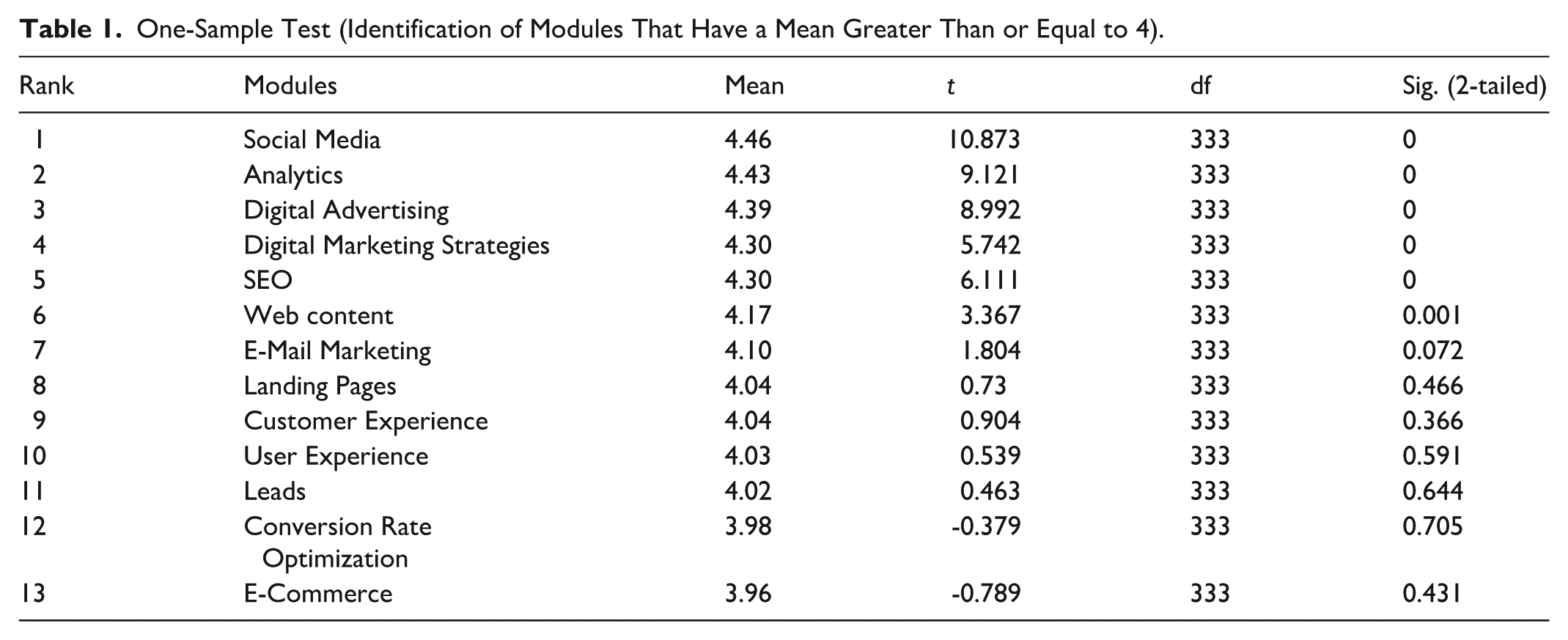
Given the exploratory aim of identifying important modules, we did not adjust for multiple comparisons; instead, we corroborated the findings with a cluster analysis for robustness. Modules were clustered based on their importance. Given that each module is represented by a five-point ordinal rating, the most robust method of grouping them by perceived importance is via an agglomerative Hierarchical Cluster Analysis (HCA). This is performed on a Gower dissimilarity matrix and coupled with Ward’s linkage. The HCA is specifically suited to situations where the number of clusters is unknown a priori and for deciding how many clusters (e.g., “high-,” “moderate-,” and “low-importance”) are empirically warranted. In addition, Gower’s coefficient accommodates ordinal-scale items without forcing the ratings to behave as interval data, and Ward’s linkage minimizes within-cluster variance and tends to produce compact, interpretable clusters, which is advantageous when communicating curriculum design decisions. Applying an HCA with Gower dissimilarity and Ward linkage yields a three-cluster solution. The cophenetic correlation (0.82) and an average silhouette width of 0.31 indicate a reasonably coherent structure; bootstrapped Jaccard stability coefficients (≥0.78) confirmed that the three-cluster solution is robust. The three-cluster solution is described in Table 2.
The Three-Cluster Solution for the Introductory Digital Marketing Curriculum.
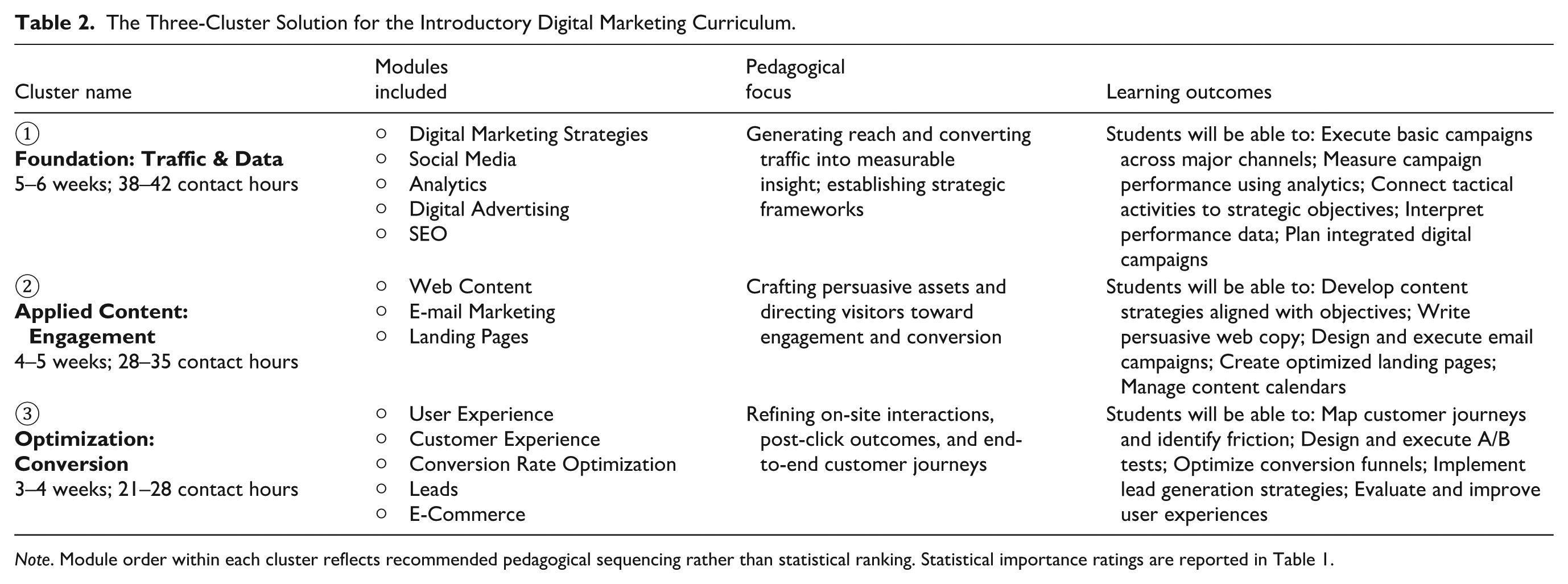
Note. Module order within each cluster reflects recommended pedagogical sequencing rather than statistical ranking. Statistical importance ratings are reported in Table 1.
This three-stage structure is based on hierarchical cluster analysis. The sequence reflects both logical dependencies and natural professional progression. The recommended duration assumes a semester-long course (12–15 weeks), and institutions may adjust timing based on credit structures and instructional intensity. Clusters should be taught in sequence, with assessment integrating across clusters.
Regarding the digital marketing specialization blocks, they were determined based on data obtained from focus groups, interviews, and a review of existing courses: Analytics Block; Digital Advertising Block; Web Content Block; User Experience and Usability Block; E-Brand Block; Digital Marketing Strategies Block; Performance Block; Customer Experience Block; E-Mail Marketing Block; Website Block; SEO Block; Social Media Block; E-Commerce Block; Digital Selling Block; Web Design Block. The same previous procedure was applied, with one-sample t tests (H₀: μ ≥ 4, one-tailed, α = 0.05) conducted on the 15 candidate blocks, and the results are outlined in Table 3.
One-Sample Test (Identification of Digital Marketing Specialization Blocks That Have a Mean Greater Than or Equal to 4).
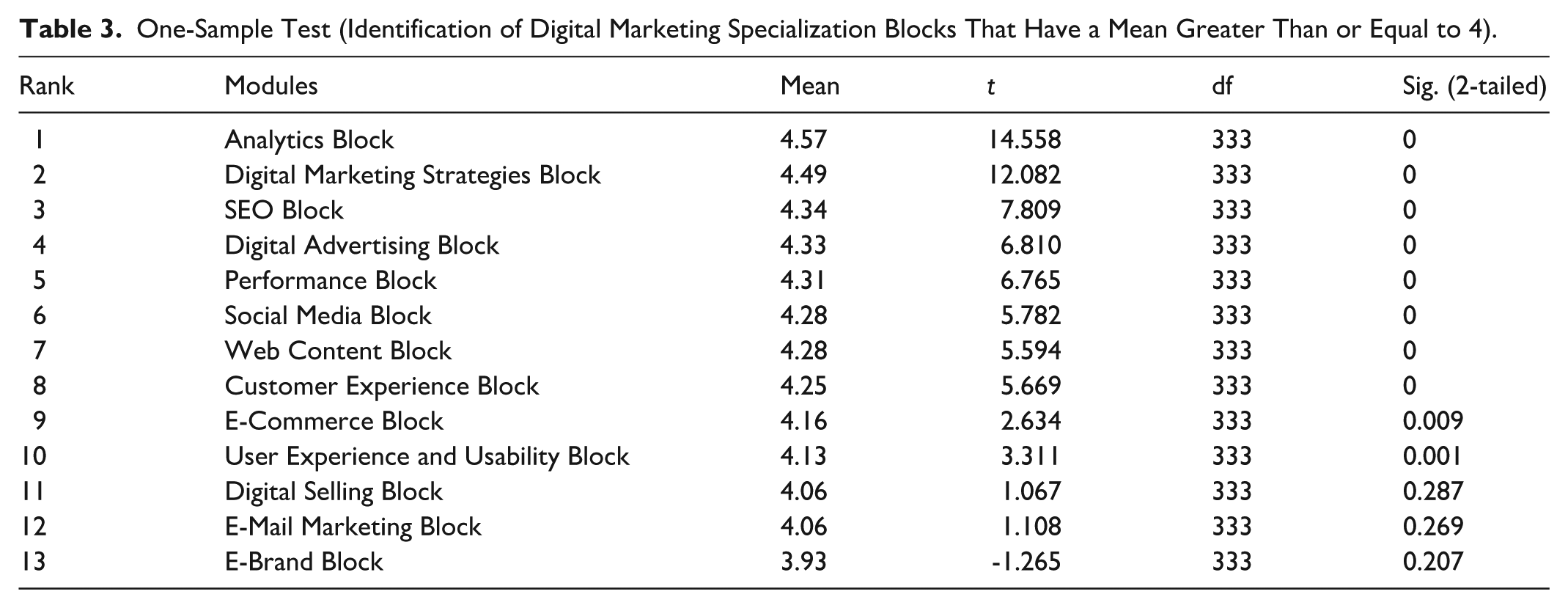
Adjustments for multiple comparisons were once again not taken into account because findings will be validated with a cluster analysis. The findings indicate that 13 out of the 15 specialization blocks exhibit mean importance ratings that are not significantly lower than four. On closer inspection, eight of these blocks demonstrate a significantly higher mean importance rating. The remaining two blocks, Website and Web Design, are significantly below the inclusion threshold and therefore fall outside the recommended specialization curriculum at this stage.
The level of proficiency for each specialization block still needs to be analyzed. For this, respondents were asked to indicate their desired level of proficiency (basic – 1, intermediate – 2, or advanced – 3) for each specialization block (see Table 4).
Desired Level of Proficiency for Each Specialization Block (Basic – 1, Intermediate – 2, or Advanced – 3).
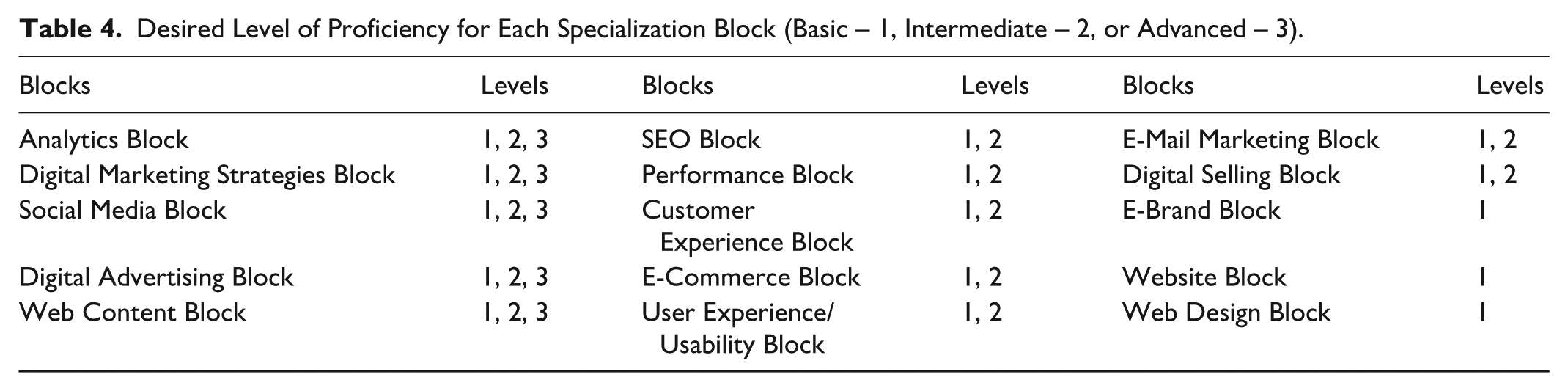
Not all specializations were expected to be taught to the same depth: on average 41% of respondents desired an intermediate level, 33% advanced, and 26% basic. Two specialization blocks (Digital Marketing Strategies and Social Media) had especially high demand for advanced mastery (45%–49% of respondents), whereas Web Design and Website had the most calls for only basic coverage (38%–45% of respondents).
The 15 specialized blocks can be empirically grouped rather than treated as stand-alone silos, through group blocks by similarity in the level profiles (basic, intermediate, and advanced). A Gower dissimilarity matrix between blocks was constructed, and Ward’s hierarchical algorithm was then applied (see Table 5).
The Three-Cluster Solution with HCA of Specialization Blocks (Level Profiles).
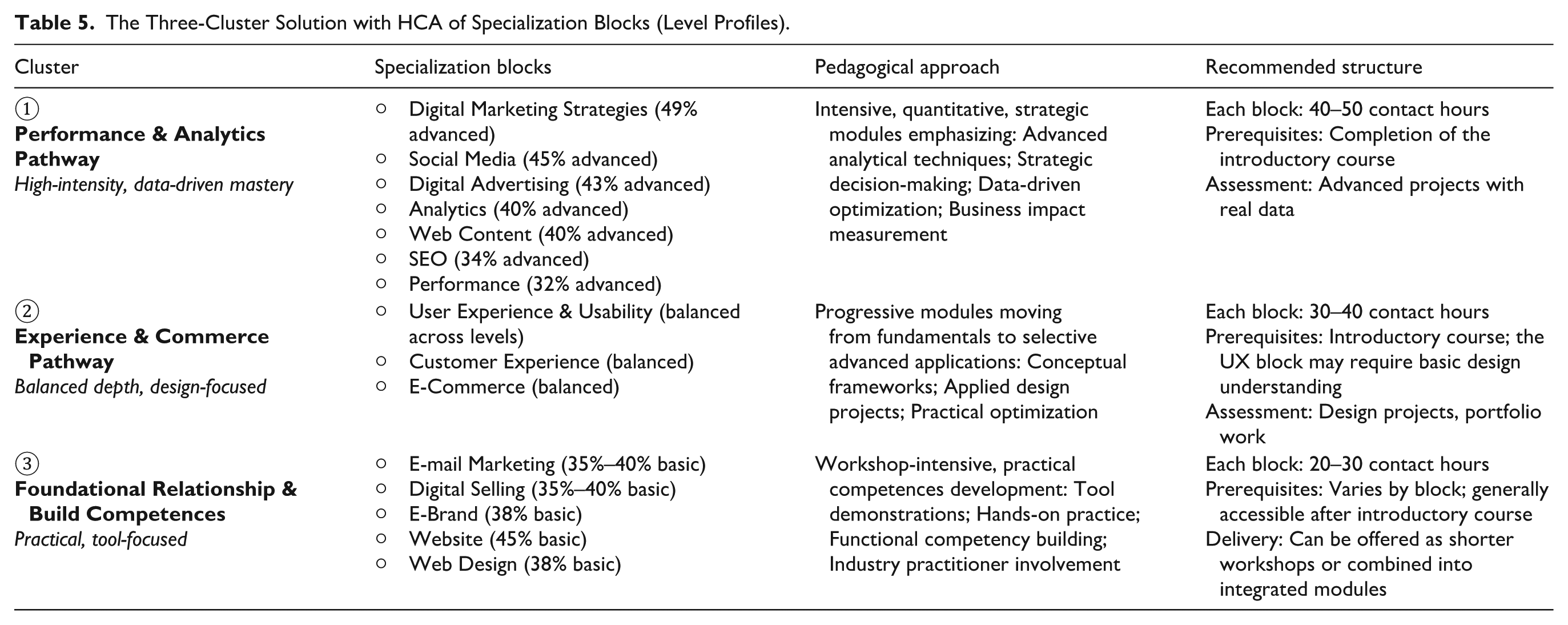
The emergence of these distinct specialization pathways parallels broader trends in marketing education toward offering concentrated expertise in high-demand areas (Cowley et al., 2020), enabling students to develop deep competencies while maintaining foundational breadth. Methodologically, the clustering is adequately coherent and moderately stable. Specifically, the cophenetic correlation is 0.709, indicating a good fit between the structure and the underlying dissimilarities; the average silhouette for the three-cluster cut is 0.441, which suggests reasonably separated groups with some boundary ambiguity; and the bootstrap Jaccard stability averages 0.627 (95% CI: 0.38–1.00), implying that the cluster memberships are retained under resampling more often than not, albeit with variability. The hierarchical clusters show that respondents envisage the specialization blocks not as isolated topics but as interlocking capability sets. Nevertheless, clusters are not mutually exclusive, and institutions may offer them as areas of concentration within programs, as certificate options, or as elective groupings. This enables students to select modules from multiple clusters based on their career interests. While the distribution of proficiency levels indicates an appropriate level of pedagogical intensity, this should not restrict institutional decisions regarding depth.
Discussion
Comparison with Existing Digital Marketing Curriculum Models
Our proposed framework exhibits both convergence and important distinctions when compared with prominent existing models. Parker et al. (2023) identified nine key domains through thematic analysis of 25 years of digital marketing education literature: Content Marketing, Social Media Marketing, SEO, PPC, YouTube and Display Advertising, Email Marketing, Website Optimization, Analytics, and Digital Marketing Strategy. Our framework aligns substantially with these domains, confirming their curricular importance through multi-stakeholder empirical validation. However, our research extends this foundation in three ways: (a) We provide empirical evidence for pedagogical sequencing through our three-stage pathway (Foundation → Applied Content → Optimization), whereas Parker et al. (2023) presented domains without prescribing order; (b) We identify and validate additional emerging domains (customer experience, user experience, digital selling, e-commerce) that were not emphasized in Parker et al. (2023)’s historical literature analysis; (c) We demonstrate through clustering analysis how specialization topics naturally group into coherent capability sets, guiding program designers regarding how to structure advanced pathways. Moreover, Zahay et al. (2021) proposed an integrated model emphasizing the need to balance foundational marketing knowledge with digital-specific competencies, delivered through experiential learning approaches. Our findings strongly corroborate Zahay et al. (2021)’s integration principle: our stakeholder consultations unanimously emphasized the necessity of grounding digital competencies in classical marketing foundations (positioning, segmentation, value proposition). However, our research provides an empirical specification of which foundational topics should be included and in what sequence, whereas Zahay et al. (2021)’s model was primarily conceptual. In addition, our evidence of transversal applicability extends Zahay et al. (2021)’s work by demonstrating that transversal curricula can be developed with broad geographical transferability, at least within European contexts. Both existing models have been valuable in advancing digital marketing education discourse. Our framework builds upon their foundations by providing a large-scale quantitative validation of curriculum priorities (n = 334), empirical evidence for pedagogical structure and sequencing, demonstration of competency transferability across organizational contexts; and detailed specification of specialization pathways with validated depth requirements. These contributions move the field from conceptual frameworks toward implementable curriculum designs with empirical grounding.
The Spearman and Kruskal–Wallis results provide valuable evidence to guide the development of curricula for digital marketing education. They suggest that the content of the curriculum should be extensive and integrative, covering the full range of essential digital marketing topics, and that it should be delivered in stages that correspond to the increasing range of competences acquired through professional experience. The core competences set thus developed will be broadly applicable, supporting graduates’ adaptability across different organizational sizes and potentially geographical markets. These conclusions concur with and refine the insights from prior literature: they confirm the importance of the broad, integrated competences framework that many scholars have advocated, while also providing empirical evidence to dispel concerns that a single curriculum cannot serve varied contexts. Overall, these statistical findings strengthen the case for a transversal digital marketing curriculum that transcends fragmentation by emphasizing subject integration, experiential learning strategies and a focus on universally relevant competencies, thereby better preparing students for the evolving digital marketing landscape.
Notably, these empirical findings align with several topics from the literature review, while also clarifying debated issues. Parker et al. (2023) identified nine key areas of proficiency in digital marketing, and the present results confirm that experienced professionals engage with most of these areas in practice. Thus, these data-driven insights lend weight to calls in the literature for academic programs to provide comprehensive coverage of core digital marketing categories (Ye et al., 2023; Zahay et al., 2018). Furthermore, the recommendation of a scaffolded curriculum structure is supported by pedagogical studies that emphasize progressive competences development and stakeholder-informed course design. This progressive, integrative approach addresses the digital challenge that has confronted marketing educators for over a decade (Crittenden & Crittenden, 2015), providing structured pathways that balance theoretical foundations with applied digital competencies while maintaining flexibility for emerging technologies and platforms. Taking a gradual approach to introducing complexity, as evidenced by our findings, enables the curriculum to align with Makienko and Bernard (2012) emphasis on balancing fundamental and advanced competences, as well as with Schirr (2014)’s advocacy of continuous curriculum improvement through iterative enhancements. Including experiential, integrative projects at higher levels of instruction, as suggested above, also aligns with the methodology of comprehensive practical projects championed by Key et al. (2019) to bridge the gap between theory and practice. In essence, our evidence-based recommendations reinforce the existing pedagogical consensus that digital marketing curricula should be broad in content and structured in delivery. Nevertheless, it is worth noting that certain established domains, such as database marketing, are not represented as discrete modules but are instead distributed across multiple curriculum components. Database marketing competencies, including customer data management, segmentation, and data-driven targeting, permeate the Analytics, CRM/Leads, and E-mail Marketing modules. Future iterations of the framework should evaluate whether the growing importance of first-party data strategies warrants the creation of a dedicated database marketing module.
Transversal competences are deemed essential for today’s labor market, and our results concretely illustrate this principle in the context of digital marketing. This convergence suggests that a well-crafted curriculum can produce graduates whose competencies are portable and adaptive, aligning with global trends in marketing education. Indeed, higher education providers have been urged to ensure students gain the digital marketing competencies necessary for a range of future careers (Yeomans et al., 2025). The present study’s evidence of organization-size independence in competence relevance bolsters the argument that a unified set of learning outcomes can, in principle, serve students in a variety of business environments. This challenges the perspective of Matosas-López (2021), who questioned the efficacy of a one-size-fits-all global curriculum. While cultural and regional nuances may still require educators to be mindful of local context, the lack of variance in task breadth across company sizes implies that at least a foundational curriculum can be globally consistent. Our findings, therefore, tilt the balance of the debate toward designing a universal core curriculum, supplemented as needed rather than fundamentally overhauled for different contexts.
Practical Implications for Curriculum Design
As marketing education confronts ongoing transformation driven by technological advancement and shifting industry demands (Crittenden, 2024), the transversal curriculum framework proposed herein offers a replicable model for institutions seeking to maintain relevance while ensuring pedagogical rigor and graduate employability across diverse market contexts. Our findings offer specific, implementable guidance for marketing educators and program directors revising digital marketing curricula.
For introductory digital marketing courses, the empirical clustering supports a three-block pedagogical sequence. The Foundation Block (approximately 5–6 weeks) should integrate social media fundamentals, analytics basics, digital advertising principles, SEO fundamentals and digital marketing strategy. Teaching should explicitly connect traffic-generation tactics with measurement and strategic objectives; for example, SEO assignments should require students to design and implement optimizations, analyze performance in Analytics and relate outcomes to business goals. The Applied Content Block (approximately 4–5 weeks) should focus on web content strategy and copywriting, email marketing campaign development and landing-page design, emphasizing the translation of traffic into engagement and conversion. Practical work may include developing content calendars, email nurture sequences, and landing pages tailored to defined conversion goals. The Optimization Block (approximately 3–4 weeks) should address user experience principles, customer experience and journey mapping, conversion rate optimization, lead generation and management, and e-commerce fundamentals. Capstone projects can ask students to conduct conversion audits, identify friction points, formulate optimization hypotheses, and design A/B tests. For advanced or specialist programs, the three specialization clusters indicate coherent elective pathways. The Advanced-Leaning Performance and Analytics cluster (Digital Marketing Strategy, Social Media, Digital Advertising, Analytics, Web Content, SEO, Performance) corresponds to areas where deep expertise is sought; institutions may offer quantitatively demanding specialist modules with introductory digital marketing as a prerequisite. The Balanced Experience and Commerce Design cluster (User Experience and Usability, Customer Experience, E-commerce) lends itself to applied modules that combine conceptual frameworks with project-based work, such as customer-journey mapping for real organizations or UX audits with redesign recommendations. The Foundational Relationship and Build Competences cluster (E-mail Marketing, Digital Selling, E-Brand, Website, Web Design) is well suited to shorter, competencies-oriented modules or workshop formats, potentially co-taught with industry practitioners.
The absence of significant differences across organization sizes suggests that specialization need not be tailored to anticipated employer type. Students can select pathways according to personal interest and aptitude, confident that these competencies are broadly transferable. Evidence from four European countries indicates that core curriculum components exhibit substantial cross-national transferability. Institutions designing international programs or pursuing international accreditation can structure curricula around the validated core and specialization blocks, while localizing regulatory and compliance content, platform emphasis and case studies and examples.
Conclusion
Findings
Concerning the Introductory Course, results show a clear tiering of perceived importance, with 13 core modules confirming their centrality. Hierarchical clustering creates a hierarchy: Cluster 1 (Foundation block); Cluster 2 (Applied content); Cluster 3 (Optimization block). The silhouette and stability diagnostics reported attest that this structure is both interpretable and robust. Results align with the literature review, which stresses three recurrent topics: (a) the primacy of strategy and analytics as employability competencies; (b) employer frustration with graduates’ limited ability to translate traffic into insight; (c) emerging demand for optimization expertise once core competencies are established. The present clusters map neatly onto those topics, validating the review’s contention that a progressive, competency-layered structure is preferable to an undifferentiated module list. Moreover, the modest ratings for optimization topics highlight the very gap the literature identifies, underscoring the need to embed these subjects later in the curriculum or follow-on specialist blocks. To sum up, the Introductory Course (modules and cluster) solution provides convergent, data-driven guidance, prioritizing a traffic-and-analytics core, followed by applied content, and reserve optimization for advanced study.
One of the most significant findings to emerge from this study is the clear delineation of specialization blocks within the digital marketing curriculum. The analysis identified a comprehensive set of thirteen distinct blocks, each representing a key domain of digital marketing. Importantly, these blocks were not of equal standing; instead, they naturally fell into a hierarchy of basic, intermediate, and advanced levels. Clustering analysis provided further insight by grouping these specialization blocks into three coherent clusters. In practical terms, this clustered pattern of results demonstrates a nuanced structure: certain groups of competences and knowledge naturally co-occur and reinforce each other, whereas others remain relatively independent. This evidence-based grouping lends quantitative support to a tiered and modular view of the digital marketing curriculum, where each cluster of subjects could form a thematic module or track.
These findings have important implications for structuring the digital marketing curriculum. First and foremost, the results suggest a multi-tier curriculum design that combines a broad core with targeted specializations. A logical approach would be to introduce a comprehensive general digital marketing course covering fundamental concepts and basic competencies, ensuring that all students acquire essential marketing knowledge (a need underscored by all respondents in this study). This foundational stage should emphasize basic digital competencies, so that students appreciate how digital tactics align with the overarching marketing strategy. Building on this base, the curriculum should then offer specialization blocks corresponding to the advanced clusters identified. Such an approach allows students to develop deep expertise in critical areas after mastering the basics. The evidence from the data strongly supports this structure: an overwhelming majority of industry and academic participants advocated a curriculum model consisting of a generalist core followed by multiple specialized blocks. This model enables flexibility and breadth; students start as generalists to gain holistic competence, then progressively specialize in line with their interests or career needs. In structuring the curriculum as a series of modular blocks, each covering a coherent set of competencies, educators can ensure that emerging areas such as conversion optimization, digital sales, and marketing analytics are given due emphasis without sacrificing coverage of fundamental marketing knowledge. Moreover, our research goes further by examining whether core digital marketing competencies are valued similarly across different European countries and organizational sizes. The three-stage pedagogical progression we propose (Foundation → Applied Content → Optimization) reflects Bloom’s taxonomy of educational objectives (Krathwohl, 2002), progressing from knowledge and comprehension (foundational competencies) through application (applied content) to analysis and evaluation (optimization). This theoretical grounding provides principled justification for our proposed curriculum structure beyond purely empirical patterns. In Appendix C, specific implementation guidance for different institutional contexts is offered to facilitate the adoption of the previous guidelines.
Distinctive Contributions to Marketing Education Literature
The present study makes three distinctive contributions to marketing education scholarship. First, it provides the most comprehensive empirically validated framework for digital marketing curriculum design to date, combining exploratory course analysis, extensive stakeholder consultation (n = 54 in qualitative phases), and large-scale quantitative validation (n = 334). While prior studies have proposed curriculum frameworks (Parker et al., 2023; Zahay et al., 2021), these have primarily relied on literature synthesis or limited expert consultation. Our multi-phase methodology provides robust empirical grounding for curricular decisions. Second, our findings demonstrate that digital marketing competencies exhibit significant transferability across organizational sizes and, tentatively, across European markets. This finding directly addresses ongoing debates about whether digital marketing curricula can be standardized or must be extensively localized (Matosas-López, 2021). Our evidence suggests that core competencies are largely portable, supporting the development of baseline curricula that can be adapted at the margins for local context rather than requiring fundamental restructuring. Third, our clustering analyses reveal an empirically derived pedagogical structure, progressing from Foundation (traffic and data) through Applied Content (engagement) to Optimization (conversion) that reflects both the logical dependencies between competencies and the natural progression of professional practice. This structured pathway offers curriculum designers a principled basis for sequencing content, addressing long-standing challenges in digital marketing education regarding the order and integration of topics.
Limitations
Despite the success demonstrated, a few significant limitations deserve to be mentioned. The samples for the focus group, interviews, and survey were convenience samples, which may not fully represent all digital marketing professionals. Results should therefore be generalized with caution. In addition, the statement about transferable digital marketing competences should be interpreted with restraint, as the sample focused on only four EU countries. Furthermore, a key temporal limitation is the absence of AI as a distinct curriculum topic, since data collection in early 2023 predated the surge in generative AI applications in marketing education. While AI-related competencies were included in existing categories such as Analytics (predictive modeling and machine learning), Performance (algorithmic optimization) and Marketing Automation, AI had not yet emerged as a distinct or integrated topic. This underscores the rapid evolution of competencies and the need for curriculum frameworks that support modular updating rather than complete redesign. Our block-based specialization structure allows new content to be incorporated quickly, enabling institutions to introduce an AI in Marketing specialization or embed targeted elements, such as AI-powered analytics or generative content applications, within current blocks. More broadly, the lag between data collection and publication in fast-moving fields highlights the importance of flexible, principles-led frameworks over rigid prescriptions. In practice, we recommend that adopters of our framework proactively incorporate AI-related competencies, either by augmenting the Analytics and Performance blocks or by creating a dedicated AI specialization that aligns with institutional priorities and demand. Nevertheless, further research is needed to address these limitations. Another limitation arises because the exploratory analysis of courses focused mainly on prominent online platforms and selected higher education institutions. A more systematic analysis, covering academic courses at various institutions and disciplines (including Communication departments, which increasingly offer courses in digital marketing and social media), would have provided a more comprehensive overview of the landscape and potentially identified additional topics as distinct curriculum components. In addition, emerging areas such as influencer marketing (Cowley, 2025) and AI-driven content creation have gained significant prominence since data collection. While these topics can be accommodated within the existing block-based structure, future empirical validation is needed to determine whether they warrant distinct curricular positioning.
When comparing these results with the existing literature on digital marketing education, a number of similarities and differences become apparent. On one hand, our findings corroborate the core topics highlighted in prior studies. For example, the prominence of analytics, social media, digital strategy, content marketing, SEO, online advertising, and email marketing mirrors the key subjects identified by Parker et al. (2023) as common in digital marketing curricula. This convergence lends credence to those areas as indispensable pillars of a modern digital marketing syllabus. On the other hand, our study extends the literature by identifying additional domains that have been comparatively neglected. A recent systematic review by Ye et al. (2023) focused on only three broad categories – marketing analytics, digital marketing, and social media marketing – which are overly generic and provide limited guidance for curriculum design. In contrast, our research offers a more granular breakdown, pinpointing specific subjects that should be included to address industry needs. These topics emerged from our empirical data but are not emphasized in the existing bibliography. The inclusion of these emergent subjects represents a notable enhancement to prior curriculum models. Moreover, the structured, block-based approach advocated here aligns with calls in the literature for integrated yet flexible marketing education. Previous authors have stressed the importance of blending traditional marketing foundations with specialized digital competences in a cohesive program, specifically the integrated model of digital marketing curriculum design proposed by Zahay et al. (2021). Our results provide concrete evidence for how such integration can be achieved: by ensuring marketing strategy and customer experience remain central (as fundamental knowledge areas) while layering on specialized modules for rapidly evolving digital domains.
In direct response to the research question, “What core subjects and structure should a transversal digital marketing curriculum include?,” Tables 1 to 4 provide a comprehensive overview of the relevant information. In summary, the present findings broadly support established recommendations in digital marketing education while also pushing the frontier by specifying under-addressed competencies areas and proposing a clear structural framework. This research underscores that a transversal curriculum, one that produces well-rounded digital marketers with both a strong generalist foundation and targeted expertise, is not only desirable but empirically grounded in the patterns observed in data. The hope is that these insights will help curriculum developers refine academic programs to better prepare students for the complexities of the digital marketing profession. Finally, it should also be noted that while the question of whether digital marketing constitutes a distinct SMT merits continued scholarly examination, the results of this research provide an empirically validated curriculum framework that addresses immediate pedagogical needs within marketing education.
Beyond its substantive findings, this research contributes a replicable methodological process for curriculum validation. The sequential mixed-methods design (exploratory analysis → stakeholder consultation → quantitative validation) can be deployed periodically to capture shifts in competency demands. We recommend that institutions undertake such revalidation cycles every 2 to 3 years, with particular attention to rapidly emerging domains such as AI in marketing, which has accelerated considerably since data collection. The framework should be understood not as a static prescription but as a living architecture that requires systematic, periodic revalidation. The pace of technological change, most notably the integration of generative AI into marketing practice, underscores the urgency of establishing institutional mechanisms for ongoing curriculum review using the multi-phase validation approach demonstrated herein.
Footnotes
Appendix A
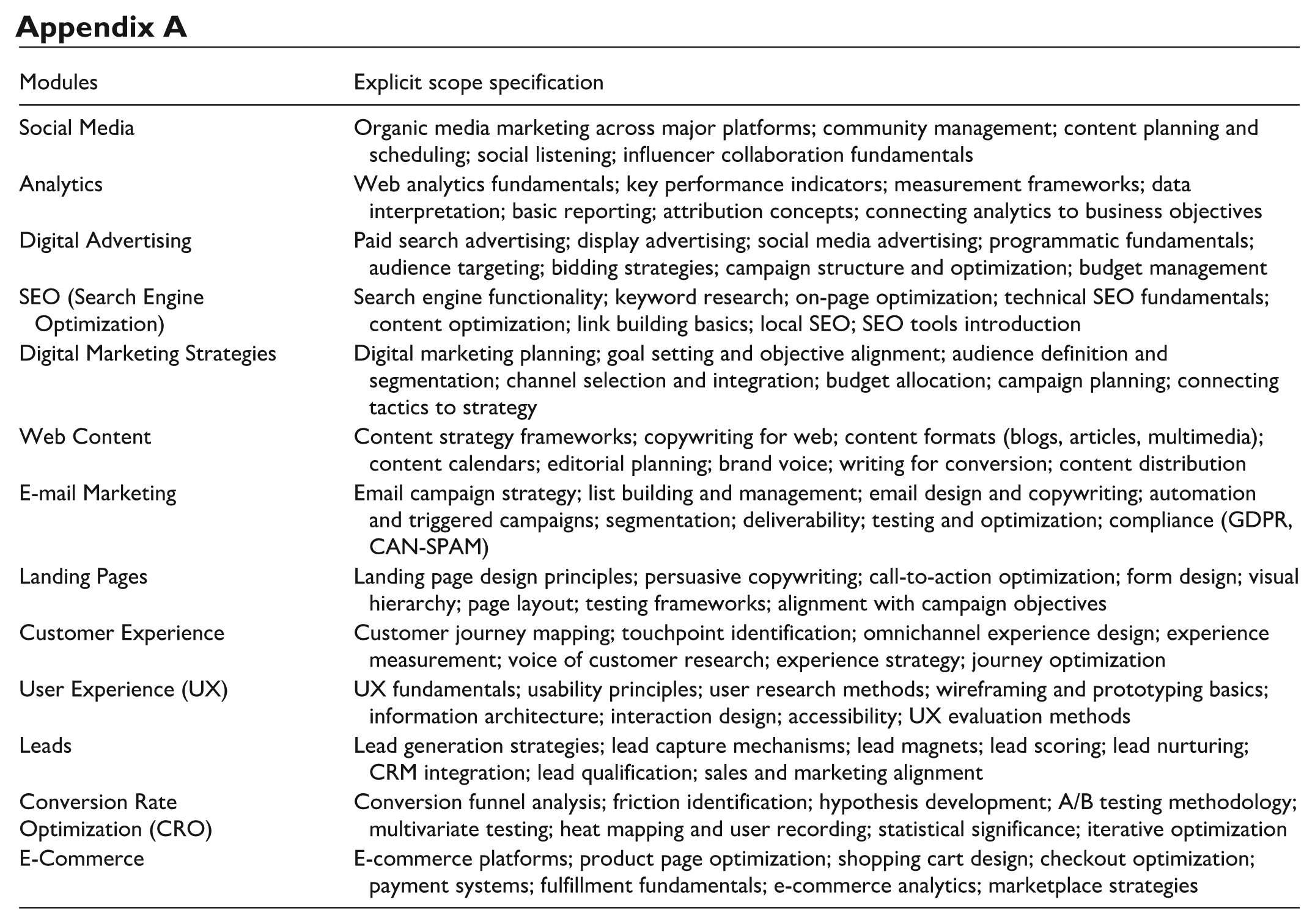
| Modules | Explicit scope specification |
|---|---|
| Social Media | Organic media marketing across major platforms; community management; content planning and scheduling; social listening; influencer collaboration fundamentals |
| Analytics | Web analytics fundamentals; key performance indicators; measurement frameworks; data interpretation; basic reporting; attribution concepts; connecting analytics to business objectives |
| Digital Advertising | Paid search advertising; display advertising; social media advertising; programmatic fundamentals; audience targeting; bidding strategies; campaign structure and optimization; budget management |
| SEO (Search Engine Optimization) |
Search engine functionality; keyword research; on-page optimization; technical SEO fundamentals; content optimization; link building basics; local SEO; SEO tools introduction |
| Digital Marketing Strategies | Digital marketing planning; goal setting and objective alignment; audience definition and segmentation; channel selection and integration; budget allocation; campaign planning; connecting tactics to strategy |
| Web Content | Content strategy frameworks; copywriting for web; content formats (blogs, articles, multimedia); content calendars; editorial planning; brand voice; writing for conversion; content distribution |
| E-mail Marketing | Email campaign strategy; list building and management; email design and copywriting; automation and triggered campaigns; segmentation; deliverability; testing and optimization; compliance (GDPR, CAN-SPAM) |
| Landing Pages | Landing page design principles; persuasive copywriting; call-to-action optimization; form design; visual hierarchy; page layout; testing frameworks; alignment with campaign objectives |
| Customer Experience | Customer journey mapping; touchpoint identification; omnichannel experience design; experience measurement; voice of customer research; experience strategy; journey optimization |
| User Experience (UX) | UX fundamentals; usability principles; user research methods; wireframing and prototyping basics; information architecture; interaction design; accessibility; UX evaluation methods |
| Leads | Lead generation strategies; lead capture mechanisms; lead magnets; lead scoring; lead nurturing; CRM integration; lead qualification; sales and marketing alignment |
| Conversion Rate Optimization (CRO) |
Conversion funnel analysis; friction identification; hypothesis development; A/B testing methodology; multivariate testing; heat mapping and user recording; statistical significance; iterative optimization |
| E-Commerce | E-commerce platforms; product page optimization; shopping cart design; checkout optimization; payment systems; fulfillment fundamentals; e-commerce analytics; marketplace strategies |
Appendix B
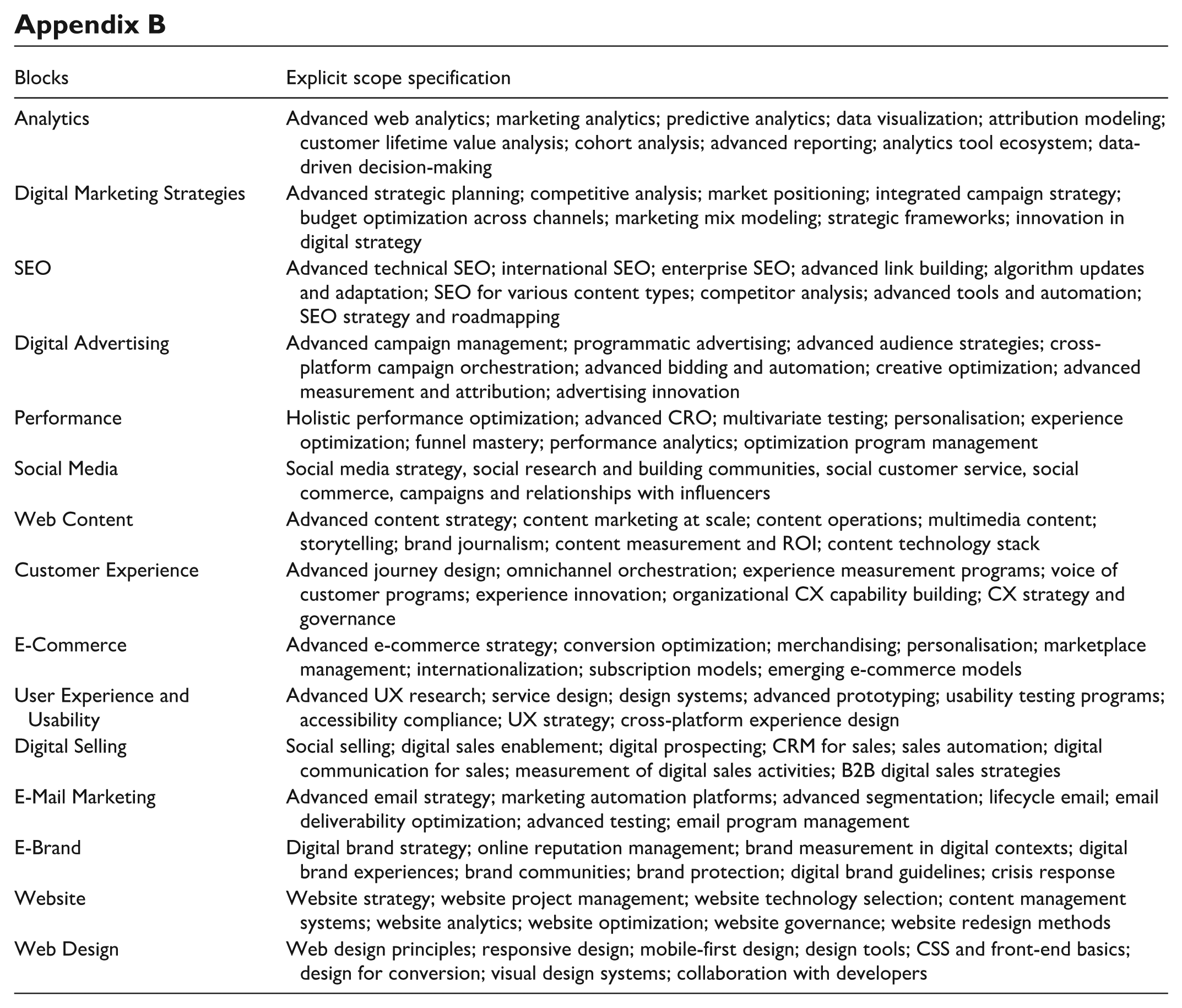
| Blocks | Explicit scope specification |
|---|---|
| Analytics | Advanced web analytics; marketing analytics; predictive analytics; data visualization; attribution modeling; customer lifetime value analysis; cohort analysis; advanced reporting; analytics tool ecosystem; data-driven decision-making |
| Digital Marketing Strategies | Advanced strategic planning; competitive analysis; market positioning; integrated campaign strategy; budget optimization across channels; marketing mix modeling; strategic frameworks; innovation in digital strategy |
| SEO | Advanced technical SEO; international SEO; enterprise SEO; advanced link building; algorithm updates and adaptation; SEO for various content types; competitor analysis; advanced tools and automation; SEO strategy and roadmapping |
| Digital Advertising | Advanced campaign management; programmatic advertising; advanced audience strategies; cross-platform campaign orchestration; advanced bidding and automation; creative optimization; advanced measurement and attribution; advertising innovation |
| Performance | Holistic performance optimization; advanced CRO; multivariate testing; personalisation; experience optimization; funnel mastery; performance analytics; optimization program management |
| Social Media | Social media strategy, social research and building communities, social customer service, social commerce, campaigns and relationships with influencers |
| Web Content | Advanced content strategy; content marketing at scale; content operations; multimedia content; storytelling; brand journalism; content measurement and ROI; content technology stack |
| Customer Experience | Advanced journey design; omnichannel orchestration; experience measurement programs; voice of customer programs; experience innovation; organizational CX capability building; CX strategy and governance |
| E-Commerce | Advanced e-commerce strategy; conversion optimization; merchandising; personalisation; marketplace management; internationalization; subscription models; emerging e-commerce models |
| User Experience and Usability | Advanced UX research; service design; design systems; advanced prototyping; usability testing programs; accessibility compliance; UX strategy; cross-platform experience design |
| Digital Selling | Social selling; digital sales enablement; digital prospecting; CRM for sales; sales automation; digital communication for sales; measurement of digital sales activities; B2B digital sales strategies |
| E-Mail Marketing | Advanced email strategy; marketing automation platforms; advanced segmentation; lifecycle email; email deliverability optimization; advanced testing; email program management |
| E-Brand | Digital brand strategy; online reputation management; brand measurement in digital contexts; digital brand experiences; brand communities; brand protection; digital brand guidelines; crisis response |
| Website | Website strategy; website project management; website technology selection; content management systems; website analytics; website optimization; website governance; website redesign methods |
| Web Design | Web design principles; responsive design; mobile-first design; design tools; CSS and front-end basics; design for conversion; visual design systems; collaboration with developers |
Appendix C
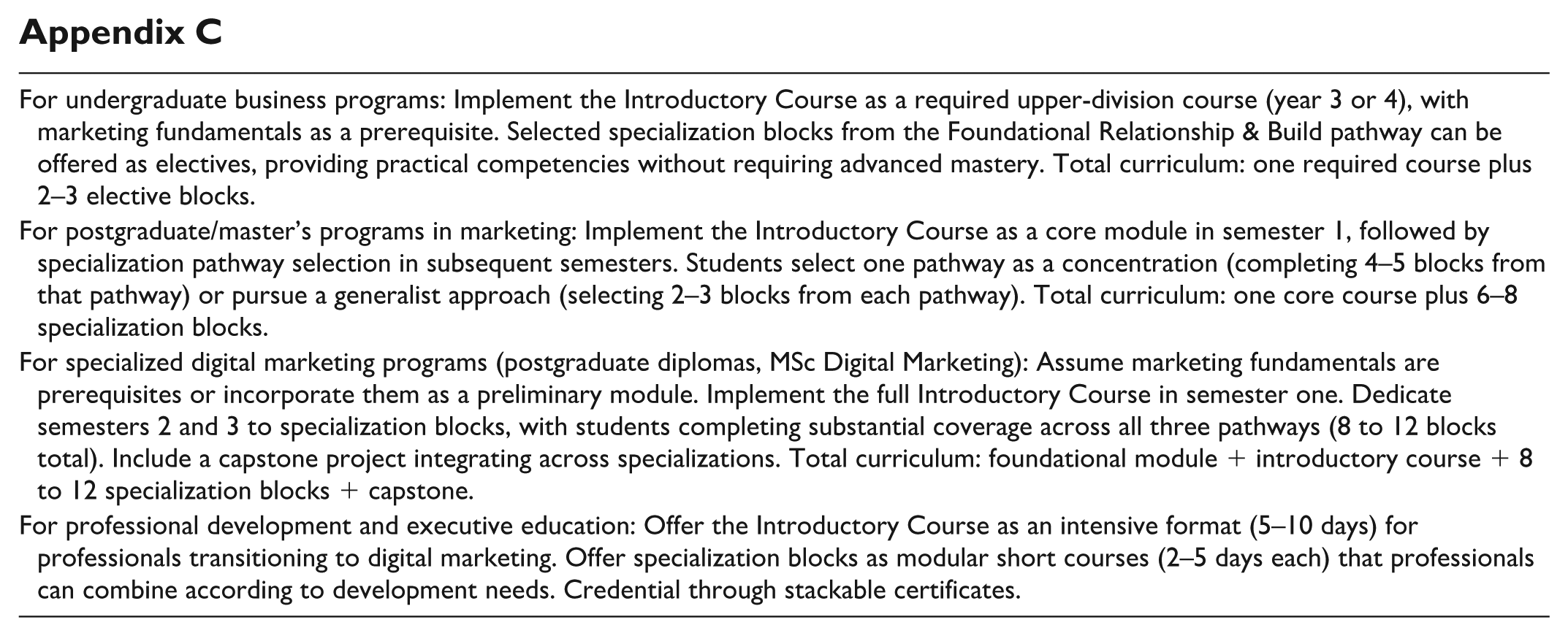
| For undergraduate business programs: Implement the Introductory Course as a required upper-division course (year 3 or 4), with marketing fundamentals as a prerequisite. Selected specialization blocks from the Foundational Relationship & Build pathway can be offered as electives, providing practical competencies without requiring advanced mastery. Total curriculum: one required course plus 2–3 elective blocks. |
| For postgraduate/master’s programs in marketing: Implement the Introductory Course as a core module in semester 1, followed by specialization pathway selection in subsequent semesters. Students select one pathway as a concentration (completing 4–5 blocks from that pathway) or pursue a generalist approach (selecting 2–3 blocks from each pathway). Total curriculum: one core course plus 6–8 specialization blocks. |
| For specialized digital marketing programs (postgraduate diplomas, MSc Digital Marketing): Assume marketing fundamentals are prerequisites or incorporate them as a preliminary module. Implement the full Introductory Course in semester one. Dedicate semesters 2 and 3 to specialization blocks, with students completing substantial coverage across all three pathways (8 to 12 blocks total). Include a capstone project integrating across specializations. Total curriculum: foundational module + introductory course + 8 to 12 specialization blocks + capstone. |
| For professional development and executive education: Offer the Introductory Course as an intensive format (5–10 days) for professionals transitioning to digital marketing. Offer specialization blocks as modular short courses (2–5 days each) that professionals can combine according to development needs. Credential through stackable certificates. |

Funding
The authors received no financial support for the research, authorship, and/or publication of this article.
Declaration of Conflicting Interests
The authors declared no potential conflicts of interest with respect to the research, authorship, and/or publication of this article.