




Abstract
The rise of business schools around the globe has been a success story. However, paradigmatic changes in technology, fundamental shifts in values and major demographic developments have put business schools on the defensive. Students question whether business schools still adequately prepare them for their future careers, managers are concerned about the relevance of business schools’ research output, and some stakeholders even debate whether business schools prioritize profit and neoliberal values over societal needs. Consequently, there is an urgent need for business schools to enhance their legitimacy. This article offers a pathway to the strategic renewal of business schools. Using a Socratic questioning approach, we propose a guide to review a business school’s key strategic decisions. This offers insights on selecting a competitive positioning that aligns external stakeholder demands with the resources and capabilities of a business school.
Introduction
Business schools are going through tough times. After a long period of successful growth (Thomas et al., 2013), many stakeholders are criticizing specific dimensions of business schools’ teaching and research, and some observers even question the societal legitimacy of business schools. In terms of teaching, students and employers raise concerns about outdated curricula and the lack of alignment with real-world career demands (Abrahamson et al., 2016; Mainga et al., 2022; McCowan, 2015). With regard to research, it is the balance between rigor and relevance of business school research that is questioned, with many bemoaning a lack of practical relevance (Hawawini, 2005; Pence & Wulf, 2009). Finally, there are authors who critique business schools for prioritizing profit and neoliberal values over societal needs (Frederick, 2008; Ghoshal, 2005; Ghoshal & Moran, 1996; Koris et al., 2016; Wang et al., 2011).
All this points to a need for radical innovations of business school (Schlegelmilch, 2020). However, how can business schools best renew their strategies to enhance their legitimacy? Often, the required change processes are viewed as too slow (Hommel et al., 2012; Marens, 2010) and institutional concerns, such as donor alienation and financial repercussions, hinder reforms (Edmondson et al., 2020). As a result, incrementalism prevails and changes are often symbolic rather than substantive (Moratis, 2016; Patenaude, 2011; Rasche & Gilbert, 2015). This article aims to provide a pathway toward a systematic strategic renewal of business schools. Using a Socratic questioning approach to query strategic decisions, it offers insights into selecting an appropriate positioning that aligns external stakeholder demands with the resources and capabilities of a business school.
Below, we briefly summarize the main critiques levied against business schools. Next, we introduce our analytical framework and relate its main building blocks to key strategic decisions a business school has to take. At the core of the article, we disentangle each of these decisions, and raise questions on the possible alternative trajectories a business school may wish to pursue. In summary, the answers to the questions raised will give business schools a better understanding of their options, help them to enhance their legitimacy and to achieve a differentiated profile.
Questioning the Legitimacy of Business Schools
The legitimacy of business schools has long been debated, with many newspapers, magazines, and books criticizing different facets of the schools (Daniel, 1998; Spender, 2005). Two influential reports date back to the 1950s. At this stage, The Ford Foundation (Gordon & Howell, 1959) and The Carnegie Foundation (Pierson, 1959) were both highly critical of business schools, and criticized their poor students, lax academic standards, untrained faculty, unintellectual curricula, and unclear missions. In fact, according to these reports, there was little in favor of business schools. In later years, the New York Times, Forbes, and The Economist joined the critique of business schools, touching on diverse topics ranging from the lack of integrating ethics in the curriculum (Salmans, 1987) to the importance of business law (Prentice, 2002).
While these two foundation reports arguably damaged the reputation of business schools for years to come, they also prompted a substantial shift toward a more theoretical emphasis. However, this was also not universally welcomed. Daniel (1998) criticized the reports’ focus on quantifiable metrics, for example, the low percentage of doctorates in business schools. In a widely quoted paper titled “How Business Schools Lost Their Way,” Bennis and O’Toole (2005) lament the shift toward theoretical research, which they deemed irrelevant to real-world business challenges. More contemporary critics such as Chapman (2012), Dyllick (2015), and Routon et al. (2023) also raise concern about the gap between theoretical research and business needs. More recently, influential CEOs such as Elon Musk and Mark Cuban have echoed these concerns and expressed skepticism about the efficacy of business degrees (Clifford, 2018; Thomas, 2020).
In the academic literature, the discourse about business schools primarily focuses around three themes: the value and appropriateness of business schools’ research output; the efficacy of business school teaching; and the societal literature in terms of the values a typical business school represents (Hay, 2008).
In terms of research legitimacy, Dyllick (2015) argues that today’s strong scientific orientation of business schools inevitably leads to a self-focused scholarly community, which is largely detached from practical business and societal needs. Chapman (2012) bemoans the convenience of using journal rankings as a metric for faculty performance, which has led to the neglect of more significant measures such as the impact on business practices or teaching effectiveness.
As for teaching, experts frequently bemoan that business school faculty is giving too little attention to the scholarship of teaching and learning (Crittenden, 2023). Most, authors who do contribute scholarly papers in the field are highlighting the changing business landscape and speculate how this may impact the future of business education (Crittenden, 2024; Guha et al., 2024). Tseng et al. (2019) and Mainga et al. (2022) focus on technological advancements, globalization, and evolving business models, and argue that these factors changed job structures and increased the emphasis on workforce capabilities. This puts pressure on business schools to produce graduates who are immediately valuable in the workplace (Clarke, 2017; Dacre Pool & Sewell, 2007; Knight et al., 2023). In response, some business schools are placing greater emphasis on teaching “employability skills” (Groves et al., 2018). Approaches that can improve such skills are, for example, self-directed learning (Boyer et al., 2014) and the use of live cases (Cummins & Johnson, 2023).
Finally, there is a plethora of papers that criticize the societal contribution of business schools. Typical are Gonin (2007) and Witesman et al. (2023), who claim to detect a growing detachment from broader societal concerns, criticize the focus on efficiency and monetary value-maximization, and point to the sidelining of ethical considerations. Other critics argue that business education has contributed to corporate dominance, environmental degradation, and societal challenges such as widening wage disparities and ethical scandals (Cobb et al., 1995; Kurtz, 2003; Nussbaum & Sen, 1993; Ramanna, 2020; Tang, 2007). Business schools are also said to focus too strongly on shareholder value, which may inadvertently promote unethical behavior (Ghoshal, 2005; Matten & Moon, 2004) and have neglected to integrate the United Nations Sustainable Development Goals into their curriculum (Satyam and Aithal, 2024; Watson et al., 2022).
Taken collectively, there are plenty of vocal critics who question the legitimacy of business schools. This prompts a need to critically review the role of business schools and revisit their strategic choices. This article aims to illustrate how a careful analysis of fundamental strategic cornerstones can help business schools in enhancing their legitimacy and adopt clear value propositions.
Analytical Framework
Figure 1 outlines our strategic framework, which applies a widely used approach to marketing strategy formulation (e.g., Schlegelmilch, 2022) to the context of business schools. In the center of any business school’s strategy lies its purpose. This will primarily be driven by the school’s governance structure (e.g., a state-run business school embedded in a large multidisciplinary university or a private, self-standing business school) and the political and economic system in which the school is embedded. Driven by its purpose, a business school then defines its market scope and determines how best to compete in its market. These decisions determine the school’s resource requirements and the systems it uses to run and control its operations. Of course, this is not a purely linear sequence of decisions. Instead, defining the purpose of a business school and all subsequent decisions should be viewed as a dynamic process with inherent feedback loops. For example, a demographic shift in a country, such as a rapidly aging population in Japan or Korea, may trigger a review of the purpose of a school and a subsequent revision of the market scope.

Analytical Framework.
Strategic Crossroads: Deciphering the Key Decisions
Purpose
Most business schools draft a vision and a mission statement to describe their purpose. However, while the vision and mission statements offer a first indication of a school’s purpose, these statements are to be treated with a pinch of salt. Too often they are detached from reality, trying to portray small training-oriented business schools that operate in a local market as global players. Table 1 shows four positive examples of how different business schools describe their purpose. The business schools of Imperial College London and Yonsei University in Korea are Triple-Accredited (with AACSB, AMBA, and EQUIS accreditation) and have top global rankings. They can clearly claim to belong to the elite of global business schools. In contrast, the Chinese Southwest Jiaotong University, School of Economics and Management (SEM), and the Chilian Universidad del Desarrollo, Facultad de Economía y Negocios, are strong domestic schools that are primarily focused on teaching.
Defining the Purpose.
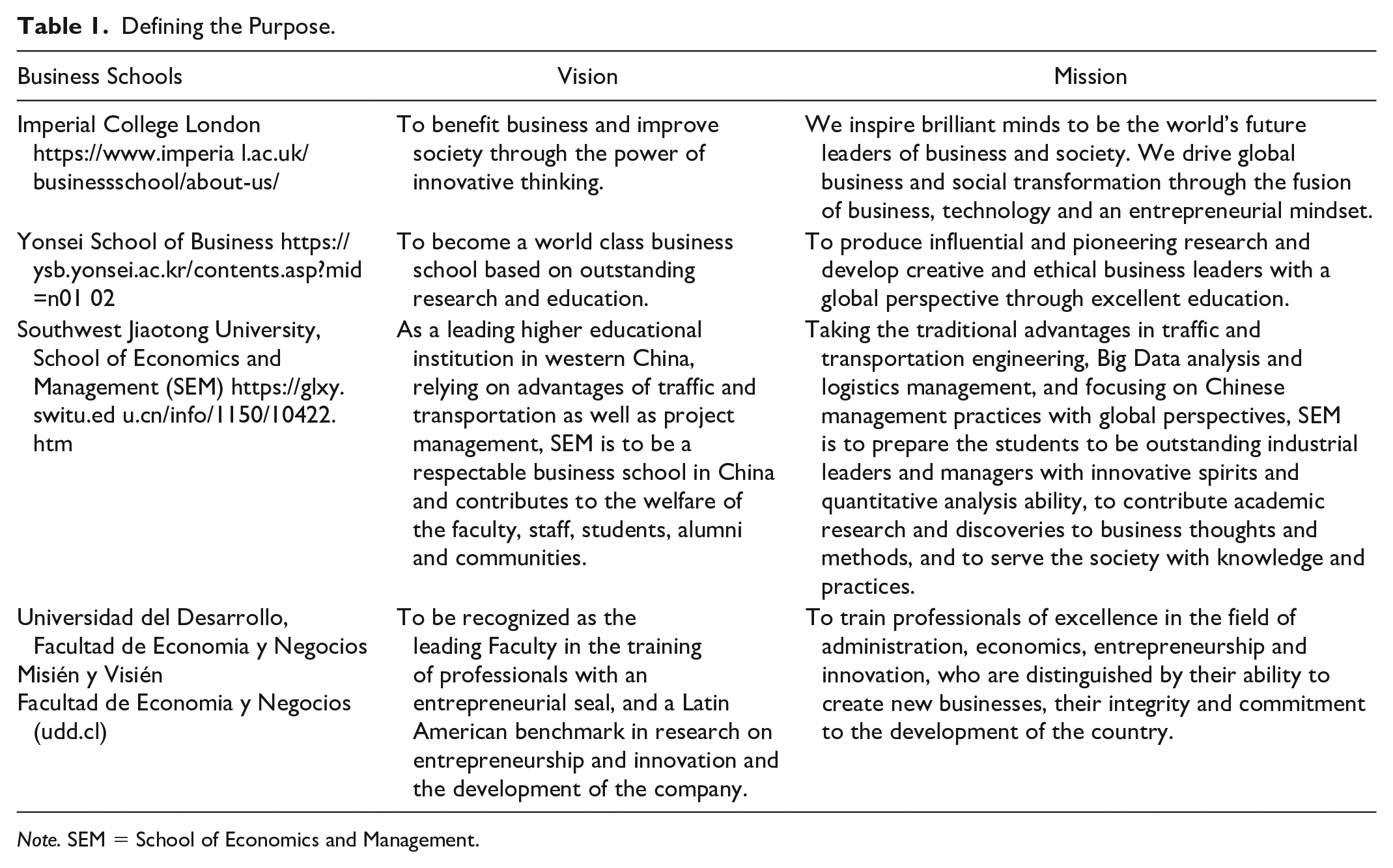
Note. SEM = School of Economics and Management.
We suggest the following diagnostic questions to scrutinize the purpose of a business school and to assess whether the vision and mission statements adequately capture a school’s intent. The suggested questions are merely examples with no claim to completeness.
When drafting or assessing vision and mission statements, it is important to involve different stakeholders. This ensures a sense of ownership and buy-in toward the business school’s stated purpose. Vision and mission statements should also be reviewed and updated regularly to ensure they remain relevant. For example, topics such as sustainability, lifelong-learning, societal-impact, and responsible management have moved from backstage to center stage for most business schools. Finally, a business school needs to bear in mind that its vision and mission statements can only ever serve as guiding principles. Translating them into actionable initiatives requires nuanced fine-grained decisions. For example, while a business school may stipulate its objective to conduct research, it still needs to decide which type of research it encourages: research focusing on the development of theories and methods, applied research, quantitative research, qualitative research, and so on. Similarly, in terms of teaching, the business school will need to decide whether it favors a particular pedagogical approach such as case teaching, or leaves this decision to individual faculty members. Choices also need to be made in terms of delivery methods: purely offline (in person), purely online (web-based), synchronous (live online), asynchronous (prerecorded online), blended online-offline mix (some classes online, some offline), hybrid (some students in class, some online). The number of options is staggering, and students prefer to learn when, how, and where it suits them best.
Market
A next big decision block refers to the definition of the market. From a strategic marketing point of view, this is primarily a segmentation and targeting exercise. In terms of geographic segmentation, a school needs to decide from where to recruit the bulk of its students: is the school seeking top talents globally or is it primarily a regional (e.g., Asian) player? If a business school has mainly a domestic orientation, does it focus on a certain region within the country or does it recruit nationwide? For business schools operating in large markets, such as China or the United States, the latter is obviously more relevant than for business schools that operate in small countries, such as The Netherlands or Austria.
Of course, other segmentation approaches can also be applied. Businesses schools can segment by socio-demographic principles. A segmentation by age may lead to a focus on pre- versus post-experience students, while a segmentation by income (i.e., the ability to pay fees) may be relevant for private, profit-oriented business schools or for offering expensive high-touch executive education programs. Moreover, behavioral segmentation based of lifestyle and habits can also lead to interesting market segments such as the growing group of digital nomads who can work anywhere globally with just a laptop. Finally, psychographic segmentation based on interests and motivations (e.g., brand and prestige seeking, knowledge seeking, degree seeking, or community seeking) may also inform the market scope decisions.
Overall, there are plenty of choices to divide the market. However, a business school is not entirely free in deciding which segment or segments to target. A school with a (government) remit to offer management education to the local community will obviously be more restricted in its segmentation approach than a stand-alone business school. In general, a school needs to consider whether the pursuit of a particular segment is in line with its remit and purpose. Notwithstanding such constraints, a school will make a targeting decision on a mix of generic considerations that apply to any such decisions, including the size, growth, profitability, and accessibility of the segments, as well as school-specific considerations. As to the latter, we suggest some example questions to scrutinize whether a school’s target market decision is appropriate:
Asking these and similar questions and analyzing the likely implications of alternative options, business schools are able to make more informed decisions on their target markets. The questions also illustrate the strong interdependencies between determining the target market and other important strategic dimensions, such as the allocation of resources and, most importantly, the positioning and competitive advantage of a business school. The following section discusses the main options business schools have in order to compete.
Competition
Any discussion on the competition of business schools has to start with an acknowledgment that the number and type of competitors a business school faces has changed substantially during the last few decades. This is particularly noticeable in their nondegree offerings, but also impinges on degree provisions (Schlegelmilch, 2020). Long gone are the times when the only competitors were other business schools. Now, business schools may even face competition from their own faculty members, some of whom provide education directly to companies. In addition, online education platforms such as Coursera and LinkedIn Learning pose a challenge, offering courses to millions of users. Dissatisfaction with traditional business school curricula has also led to the rise of corporate universities. As a result, fewer such organizations are turning to business schools for executive education, preferring in-house services, consulting firms, or online providers instead.
Finding an effective way to compete has therefore assumed more urgency than ever. On a conceptual level, business schools compete like any other brand, namely primarily through a choice between differentiation and low cost. Differentiation tends to be based on cornerstones such as accreditations, rankings, and a strong brand recognition. To succeed in building these cornerstones, business schools invest in excellent faculty who are able to publish research in top academic journals. The ability to create new knowledge and publish is the hallmark of top business schools and, especially among academic peers, is the main driver of a school’s reputation. In fact, Bennis and O’Toole (2005) complain that the selection and promotion decisions within business schools emphasize research performance and often overlook other crucial aspects such as teaching effectiveness and societal impact.
However, publications in top journals are not the only path to differentiation for a business school. Teaching excellence can also lead to differentiation, for example, through top case method faculty or in carefully choreographed student-centered projects. An attractive campus, first-class teaching facilities, and student services that match those of top conference hotels further enhance teaching-based differentiation. Finally, a business school can also differentiate itself through displaying a strong expertise in a certain area such as entrepreneurship (cf. Table 1, vision and mission of the Universidad del Desarrollo, Facultad de Economía y Negocios), or closeness to a particular industry (e.g., through consulting projects or training courses in the health care industry).
The alternative model is to compete on costs. Here a business school needs to focus on volume (i.e., student numbers) and tries to hire relatively low-paid faculty that offer an adequate teaching quality and but are willing to carry a comparatively high teaching load. In this way, such business schools try to keep their operating costs low. There are typically only minimal research expectations in these business schools, and the physical facilities for students tend to be basic, where teaching is delivered in class. Where teaching is online, cost-efficient asynchronous delivery methods (with video recordings which can be reused repeatedly), will be preferred over synchronous online teaching.
Here are some examples of diagnostic questions a business school can consider before deciding on its competitive strategy.
It is evident that some of these questions are overlapping. However, looking at issues from slightly different angles will result in a better and more nuanced understanding of the factors that drive a business school’s competitive strategy. In the decision-making process, a school may also wish to employ a SWOT (Strengths, Weaknesses, Opportunities, Threats) analysis. Although such an analysis is sometimes viewed as basic, a thorough and honest assessment of the status quo (strengths and weaknesses), coupled with a future-oriented assessment of opportunities and threats, can be helpful in deciding how best to compete.
Resources
A major factor driving the competitive posture of business schools is the available resources. We propose to analyze existing resources and capabilities based on a Resource-Based View theory (Barney, 1991). This theory suggests that resources hold the potential to lead to competitive advantages if they are valuable, rare, imperfectly imitable, and not substitutable (VRIN criteria). Moreover, the Resource-Based View encourages organizations to develop unique core-competences that will permit them to outperform their competitors by doing things differently (Prahalad & Hamel, 2009). Relating these concepts to business schools, the most valuable and rare resources are arguably the academic faculty, including a strategically minded and visionary leadership team. Consequently, we can observe a global competition for acquiring and retaining top talent. Business schools that can afford to hire leading researchers and to reward their researchers with staggeringly high financial premiums for top journal publications are clearly having a strong resource advantage. However, there are other resources and capabilities that play an important role in supporting competitive advantage. Inimitable are, for example, hundreds of years of academic excellence and history, which institutions like Oxford and Cambridge can bring to the table. That their respective business schools have a relatively short history is, understandably, downplayed by Oxford’s Saïd Business School and the Cambridge Judge Business School. What is non-substitutable is ultimately a market judgment and leads back to the topic of trade-offs. Would an Executive MBA student, for example, be willing to trade off the convenience of attending a more affordable local business school against the prestige of an elite business school located in another country? Are such trade-off decisions made differently by mid-career postexperience students compared to more junior students? The answers to such questions will depend on the personal circumstances and preferences of each potential student.
Capabilities and systems also play an import role in achieving competitive advantages. Just compare the follow-up of a potential student who showed an interest in a particular program and downloaded a brochure. Some business schools initiate no follow-up, whereas other business schools have systems in place that ensure further presales qualifications. Large business schools such as Kellogg often outsource such digital follow-up to marketing agencies that inundate potential customers with offers of further online personal consultations, connections with former students, sample materials, and so on.
To analyze a business school’s resources and capabilities and their potential impact on its competitiveness, we suggest classifying them into tangible and intangible resources. Tangible resources include, for example, physical assets, financial assets, and human resources; intangible resources refer to reputation, culture, and experience. Inter- and intra-organizational routines and practices further represent relevant capabilities such as the participation in international research collaborations or student exchange networks. Taken collectively, there is a plethora of diagnostic questions a business school can ask to scrutinize its resources and capabilities. Here are some examples:
The variety of the different facets touched by the suggested questions illustrate the complexity of contemporary business schools. We now proceed to the last building block and analyze what a business school needs in order to monitor the delivery of its strategy and to ensure that its activities remain congruent with its mission.
Systems
Traditional financial measures capturing income and expenditure are insufficient in diagnosing the underlying performance drivers. Consequently, a business school needs to develop a system of key performance indicators (KPIs) that monitor its mission congruence.
A first indication of the values and priorities of a business school is offered by its faculty management system. This regulates, among others, the workload distribution, the requirements for career progression and the underlying faculty performance metrics. It also shows how open a business school is to diverse career options, such as teaching focused career paths and the employment of nontraditional faculty (e.g., professors of practice or clinical professors).
In general, a business school’s KPIs should not only monitor performance but also direct behavior. For example, a school that intends to differentiate itself from competing business schools through its research performance will typically develop fine-grained KPIs relating to this area. This may include exact measures on each faculty’s research productivity, including the number and quality of publications, the impact of these publications (e.g., citation scores) and their relevance (e.g., use of faculty research by industry and policy makers). In addition, the ability to attract external research grants may be used as an indicator of research reputation. In such business schools, research-related KPIs will typically determine financial awards such as premium payments for outstanding research contributions, and form the basis for nonfinancial recognition such as researcher award ceremonies.
Teaching orientated schools, on the contrary, need to prioritize the relevance of the curriculum (e.g., through accreditation), the teaching quality, student satisfaction, employment outcomes, alumni satisfaction, and feedback from employers on the knowledge, skills, and attitudes of the school’s graduates. Top teaching performance and teaching innovation will be awarded, and outstanding teachers will be put on the pedestal.
Analogously, a business school that aims at close industry cooperation needs to develop measures of successful engagement, such as the number and financial value of joint industry projects, participation in industry seminars and practice-oriented conferences, joint panel sessions at industry exhibitions, as well as participation in industry sponsored student competitions (e.g., Loreal’s Brandstorm), entrepreneurship competitions (e.g., Vrije University of Amsterdam’s European Student Startup Competition), or collaboration in incubation centers. Moreover, the number and caliber of practitioners engaging with students and faculty on campus should be captured, as well as the nature of their engagement (e.g., guest speakers, mentors, judges of student competitions, co-presenters in case teaching sessions, etc.).
Similar arguments hold for other important strategic goals of the business school, such as sustainability targets, inclusion and diversity goals, internationalization objectives, social outreach, and commitment to community welfare.
Last but not least, the organizational culture of a business school plays an important role in achieving its strategic objectives. While more difficult to measure, business schools should be encouraged to conduct employee surveys aimed at gauging factors like satisfaction, engagement, collaboration, integrity, and confidence. Below are some questions a business school could employ to scrutinize its performance measurement systems. Again, there is no claim to completeness and the questions should only be seen as examples.
Strategic Options: Selecting a Coherent Strategy
Having analyzed the key strategic building blocks, namely the purpose (vision and mission), the market (where to compete), the competition (how to compete), the resources (with what to compete) and the systems (how to monitor its strategy), a business school can draft a more informed and coherent strategy.
In Figure 2, we suggest that a business school can follow three principal options: it can prioritize research, teaching, or social relevance (e.g., in terms of industry closeness and the services it offers to the community it is embedded in). While, at first glance, this may appear obvious, most business schools fail to clearly prioritize one of these three domains. Instead, their spread their efforts too thinly and end up with mediocre performance in all three domains. They are a Jack of all trades but a master of none, which leads to an undifferentiated positioning of such business schools.
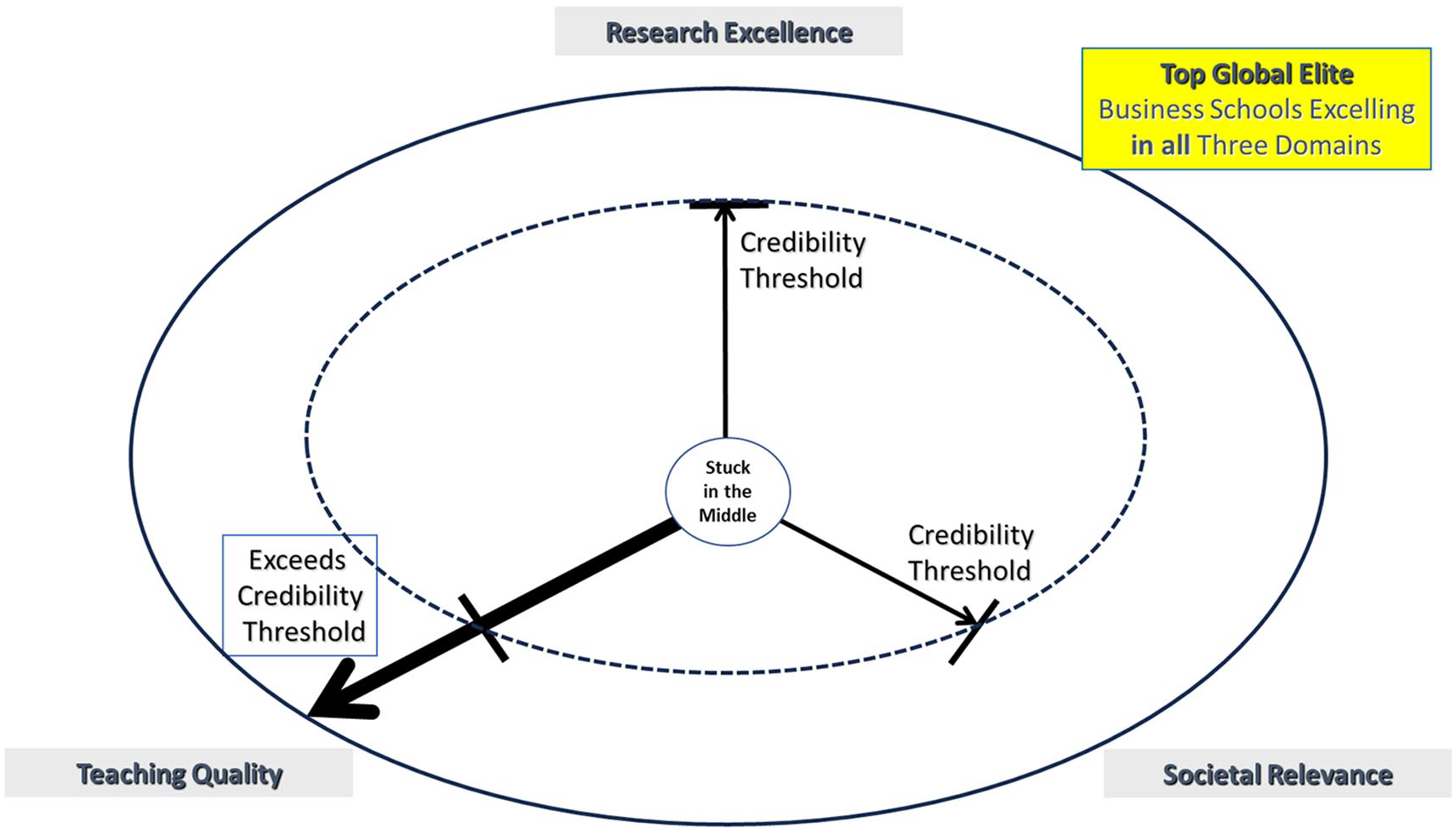
Selecting a Coherent Strategy
To overcome this trap and achieve a clearer profile, we encourage schools to make explicit trade-offs between the three domains. Specifically, we argue that a business school needs to reach a minimum performance threshold in all three dimensions (dotted line in Figure 2) to be a credible player, but that only a few top global elite business schools will have the resources to exceed these credibility thresholds in all three domains (solid line in Figure 2). Most business schools will have resource constraints that force them to concentrate on one domain, such as teaching quality in Figure 2, to excel and differentiate itself from competition. Whether a school prioritizes teaching quality, research excellence, or social relevance will primarily depend on its mix of resources and capabilities.
Unfortunately, there are also some schools that are “stuck in the middle” and do not even reach minimum credibility thresholds in any of three key competitive domains. These schools will clearly find it difficult to compete and are bound to struggle, unless they are externally funded by government or wealthy individuals who would like to have a business school named after them. As a result, there are many institutions that have business schools “written on the box but not in the box.” Such schools typically hire mediocre faculty who offer mediocre education to mediocre students.
Using the framework proposed in Figure 2 to develop a strategy will offer strategic clarity to business schools and prevent unproductive and expensive wavering between alternative trajectories. This will reinforce the legitimacy of the business school in the selected domain and avoid frustrations from competing in domains where the school cannot win.
The elite business schools that do have the resources to excel in all three competitive domains will be difficult to beat. The combination of research excellence, outstanding teaching, and social relevance represents a self-sustaining business model: the best researchers want to be associated with such schools, and the schools can pay them the salaries they demand. Excellent students are attracted by high brand recognition and teaching quality. In turn, the student quality makes it easier for the business school to place them in good jobs after graduation. Supported by solid financial resources, these top schools can also forge successful collaborations with industry and run attractive outreach programs.
Conclusion
The legitimacy of business schools is under scrutiny. Various stakeholders question the relevance of faculty research, the efficacy of their teaching, and even their societal value. Consequently, business schools need to critically review their strategies. This article presents an analytical framework for such a review. By providing diagnostic questions relating to key strategic building blocks, we encourage business schools to systematically review their strategies with the aim to enhance their legitimacy.
First, business schools should scrutinize their purpose, ensuring alignment with stakeholder expectations, clarity, timeliness, and inspiration. Vision and mission statements serve as guiding principles and need to be reviewed regularly. Such reviews should involve various stakeholders to ensure their identification with the purpose of the school.
Second, a school needs to decide where to compete. This is more complex than looking at potential geographic catchment areas. Opportunities for teaching remotely have diminished the relevance of geography. Demographic shifts, changes in the values, attitudes, and behavior of potential students may also necessitate a review of a business school’s targeting decisions. However, serving different target markets has substantial operational and financial implications.
Third, business schools need to define their competitive approach. This largely centers on identifying areas of competitive differentiation, such as excellent research performance, teaching quality, and societal impact. Ranking success and accreditations are means to communicate competitive differentiation. Decisions on how to differentiate are informed by a multitude of factors, including aspirations, resources and opportunities, stakeholder perceptions, competitive benchmarks, and trade-offs.
Fourth, analyzing resources and capabilities is crucial for evaluating the potential competitive advantages of a business school. This starts with a self-critical look at the qualities of the leadership team and continues with an evaluation of factors such as faculty quality, teaching and research infrastructure, institutional reputation, organizational culture, and financial position.
Last, effective systems are essential for monitoring a school’s chosen strategy and ensuring that it stays on track. Measures need to be selected carefully as they have behavior consequences and need to ensure that the focal activities are aligned with the mission of the business school.
The strategic building blocks presented above do not represent a strict sequential process. Instead, the suggested strategic review should be seen as an iterative process with feedback loops designed to refine and tweak decisions. Building on the critical review of their key strategic decisions, most business schools will need to decide whether they prioritize research, teaching or social relevance. While all business schools should aim to reach minimum thresholds in these three areas, resource constraints will compel most schools to focus on one domain to excel and differentiate themselves from competitors. A clear focus on one competitive domain prevents wasting resources and enhances legitimacy.
Finally, we argue that only top global business schools will have the resources to excel in all three competitive domains. These schools benefit from a self-sustaining business model, which cements their competitive position. At the other end of the spectrum, there are business schools that fail to reach minimum thresholds in any of the three competitive domains. These schools can be viewed as “stuck in the middle.” Facing legitimacy challenges, these schools will struggle unless they receive external financial support.
Footnotes
Declaration of Conflicting Interests
The author(s) declared no potential conflicts of interest with respect to the research, authorship, and/or publication of this article.
Funding
The author(s) disclosed receipt of the following financial support for the research, authorship, and/or publication of this article: This study was supported by Bualuang ASEAN Chair Professor Fund.
