



Abstract
Background
Health state utility measurements are central in health policy and medical decision making. Common methods are the standard gamble (SG) and the time tradeoff (TTO). They typically use hypothetical questions. It is unknown whether this leads to a bias.
Methods
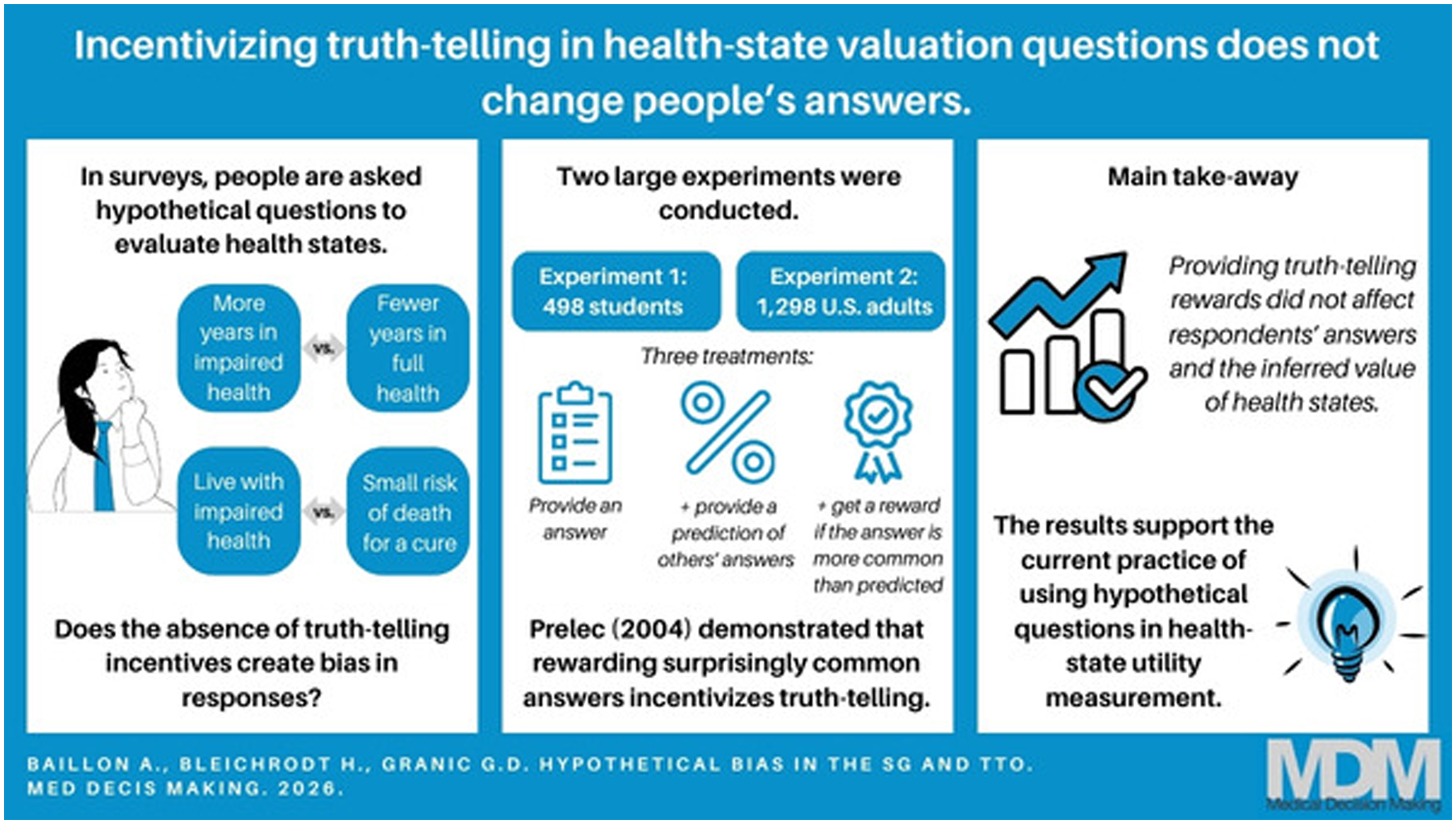
We used the Bayesian truth serum (BTS) to incentivize choices in the SG and the TTO. We asked these choices both with and without incentives in 2 online experiments: 1 with 498 Dutch students and 1 with 1,298 members of the US general population. To give incentives their maximal possibility to work, we deliberately introduced default bias in the US sample.
Results
Incentives made no difference. Individual choices and aggregate valuations in the SG and the TTO were the same with and without incentives in both experiments. Defaults affected the TTO, but not the SG.
Limitations
The BTS assumes that respondents have a common prior and use Bayesian updating. Moreover, it is hard to explain why answering truthfully is in respondents’ best interests in the BTS.
Conclusions and Implications
Incentives did not affect the SG and TTO. Our results support the current practice of using hypothetical questions in health state utility measurement.
Highlights
We found no evidence of hypothetical bias in the choices made in the SG and TTO measurements.
This was true even when we introduced a default bias.
The common practice to use hypothetical questions in health state utility measurement seems valid.
Keywords
Get full access to this article
View all access options for this article.
References
Supplementary Material
Please find the following supplemental material available below.
For Open Access articles published under a Creative Commons License, all supplemental material carries the same license as the article it is associated with.
For non-Open Access articles published, all supplemental material carries a non-exclusive license, and permission requests for re-use of supplemental material or any part of supplemental material shall be sent directly to the copyright owner as specified in the copyright notice associated with the article.
