




Abstract
Background
Network meta-analysis exploits randomized data to compare multiple interventions and generate rankings. Selecting an optimal treatment may be complicated when multiple conflicting outcomes are evaluated in parallel.
Design
The present study suggested the incorporation of multicriteria decision-making methods in network meta-analyses to select the best intervention when multiple outcomes are of interest by creating partial and absolute rankings with the TOPSIS, VIKOR, and PROMETHEE algorithms. The TOPSIS and VIKOR techniques represent distance-based methods for compromise intervention selection, whereas the PROMETHEE analysis method allows the definition of preference and indifference thresholds. In addition, the PROMETHEE technique allows a variety of modeling options by selecting alternative preference functions. Different weights may be applied to outcomes objectively with the entropy method as well as subjectively with the analytic hierarchy process, enabling the individualization of treatment choice depending on the clinical scenario.
Results
Visualization of decision analysis may be performed with multicriteria score-adjusted scatterplots, while league tables may be constructed to depict the PROMETHEE I partial ordering of interventions. A simulated study was performed assuming equal weights of outcomes, and the TOPSIS, VIKOR, and PROMETHEE II methods were compared using a similarity coefficient, indicating a high degree of agreement among methods, especially with higher numbers of interventions.
Conclusions
Multicriteria decision analysis provides a flexible and computationally direct way of selecting compromise interventions and visualizing treatment selection in network meta-analyses. Further research should provide empirical data about the implementation of multicriteria decision analysis in real-world network meta-analyses aiming to define the most suitable method depending on the clinical question.
Highlights
Multicriteria decision-making methods can be implemented in network meta-analysis to indicate compromise interventions.
The TOPSIS, VIKOR, and PROMETHEE methods can be used for optimal treatment selection when conflicting outcomes are evaluated.
The weights of outcomes can be defined objectively or subjectively, reflecting the priorities of the decision maker.
This is a visual representation of the abstract.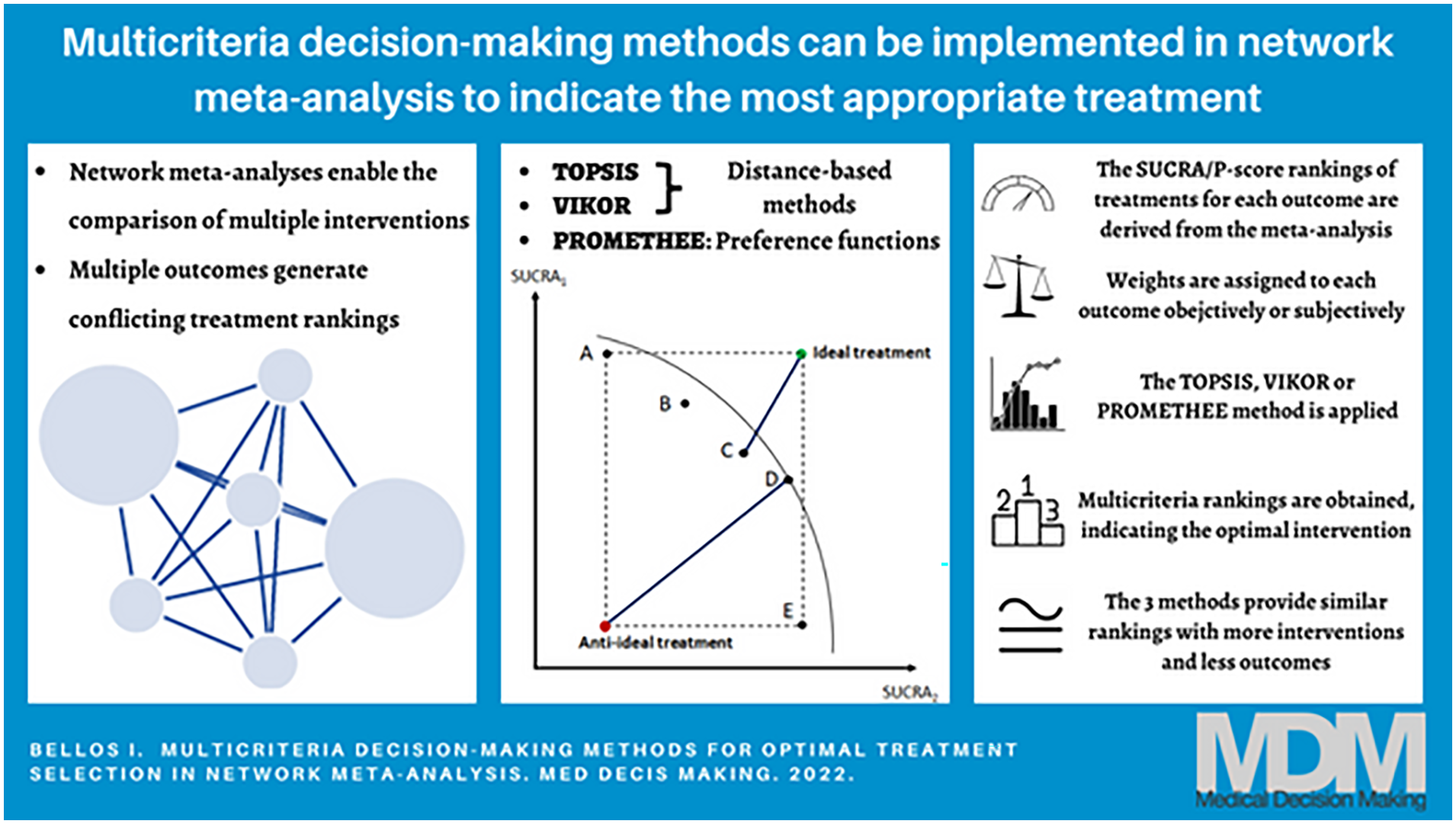
Get full access to this article
View all access options for this article.
References
Supplementary Material
Please find the following supplemental material available below.
For Open Access articles published under a Creative Commons License, all supplemental material carries the same license as the article it is associated with.
For non-Open Access articles published, all supplemental material carries a non-exclusive license, and permission requests for re-use of supplemental material or any part of supplemental material shall be sent directly to the copyright owner as specified in the copyright notice associated with the article.
