




Abstract
Background
Clinical pathways with multiple diagnostic tests are complex to model, but problematic and simplistic approaches are often used in economic evaluations.
Methods
We analyzed statistical methods of handling multiple diagnostic tests and provided guidance on applying these methods in economic modeling. We first introduced a statistical model to quantify the correlations between 2 tests and how those correlations can be incorporated within an economic model. We also presented the general form of conditional dependence among multiple tests. We then introduced net reclassification improvement (NRI), a measure that evaluates the added value of a new risk factor (e.g., biomarker) for risk prediction. We further provided 2 examples to illustrate the application of these methods.
Results
Our first example illustrated how to model an add-on test to an existing test, in the absence of a perfect reference standard. After accounting for the imperfect nature of both tests and the conditional dependence between tests, the potential health benefits from the additional test were reduced. This led to differential cost-effectiveness results when comparing models using the perfect test and conditional independence assumptions. The second example illustrated how to evaluate the added value of a new risk factor using the NRI measure. Using the new risk classification provides greater precision in risk prediction, and in the example, the strategy using the new risk classification with treatment for selected individuals led to more favorable cost-effectiveness results.
Conclusions
These innovative methods for handling multiple diagnostic tests have improved the methodology within the field and should be adopted to provide more accurate estimates within cost-effectiveness analyses.
Highlights
Economic evaluations of multiple diagnostic tests often apply problematic simplistic approaches, such as ignoring conditional dependence between 2 tests or assuming a perfect final test in the diagnostic pathway. We provided guidance on how to apply improved methods for economic modeling.
We introduced methods to model conditional dependence between 2 imperfect tests. We used an example to illustrate how assumptions about perfect diagnostic test accuracy and conditional independence between tests affect cost-effectiveness.
Compared with the results of the area under the receiver-operating-characteristic curve, net reclassification improvement has distinct advantages in measuring the added value of a new risk factor for model-based economic evaluation.
Economic evaluations that appropriately account for the complexities of diagnostic test pathways can help decision makers ensure efficient use of resources.
This is a visual representation of the abstract.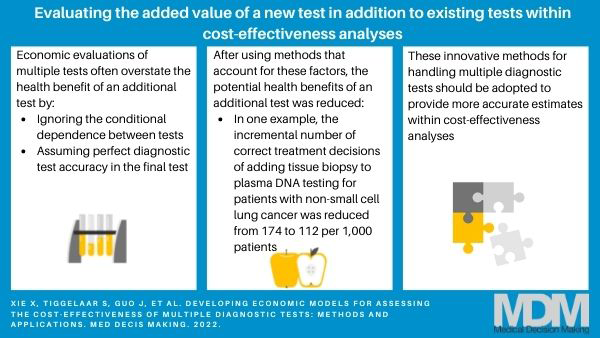
Get full access to this article
View all access options for this article.
References
Supplementary Material
Please find the following supplemental material available below.
For Open Access articles published under a Creative Commons License, all supplemental material carries the same license as the article it is associated with.
For non-Open Access articles published, all supplemental material carries a non-exclusive license, and permission requests for re-use of supplemental material or any part of supplemental material shall be sent directly to the copyright owner as specified in the copyright notice associated with the article.
