



Abstract
Globally, food is acknowledged as a primary focus for addressing challenges facing cities. City councils create and support food-related policies or strategies to enhance healthy and sustainable environments, and multiple food practitioners engage closely with these initiatives. However, the visibility of educational aspects of food within governments, policy development, public spaces, or across society is limited. There is a lack of evidence about how pedagogical frameworks can inform these initiatives. This study aims to develop a draft food pedagogies framework, whose application can inform food initiatives beyond the classroom to increase adults’ awareness of, engagement with and empowered action relating to food, with the goal to advance societal health and sustainability. A qualitative approach included semi-structured interviews with 39 experienced food leaders from diverse food-related fields in Australia. Using thematic analysis, five key themes to assist adults learn about food in everyday life settings were identified: (1) Making use of (in)formal pedagogical spaces in communities; (2) Encouraging interactions with a range of people related to food; (3) Creating enjoyable and practical experiences as part of daily lives; (4) Developing supportive and transparent systems that reflect communities’ needs; and (5) Utilizing broader social issues. A proposed framework, based on the five themes and existing theoretical frameworks, can be used to inform policy makers and diverse food practitioners to develop urban food strategies that aim to create food-centred changes within urban settings toward societal health and sustainability.
Introduction
Increasingly there is recognition that food should be a primary focus for addressing complex challenges in urban areas. Rapid urban growth and limited resources raise complex challenges concerning food. Food-related challenges include hunger and malnutrition, 1 increased risk of diet-related diseases (obesity and other non-communicable diseases), 2 poverty and food insecurity, 3 unhealthy food environments, 4 disconnection from traditional and cultural values of food, 5 environmental contamination, 6 and unsustainable food systems. 7 These issues are directly linked to what we eat and how we connect with food within food systems. Societal health refers to “the requirements at the individual, family, community and population levels-across the continuum of care-to achieve physical, cognitive, emotional, social and spiritual wellbeing”. 8 (p3) Sustainability is critical to support communities’ wellbeing and sustainable development, along with economic and environmental sustainability in urban areas and sustainability of food systems. 9
While food is pervasive in societies, its importance to human and planetary health is not embedded within government organizations, policy development, educational systems (curriculum and services), public spaces, or across society. For example, all levels of government have policies on water, energy and waste but food policy, or government departments focusing on food strategies, are rare. 10 Adult focused, urban education activities related to social, cultural, economic and environmental impacts of food also are not common.11,12 Such food education can underpin or support a wide range of food-related initiatives 13 and thus warrants exploration.
Pedagogy is defined as the overarching term to encompasses acts of teaching, curricula, didactics (what must be taught), relationships for learning between the learner, the process of learning, and what is learned. 14 It also involves issues of educational philosophy, institutional context, and a wide range of more sociological concepts. 15 In accordance with this broad approach, Flowers and Swan 12 define food pedagogies as “education, teaching and learning about how to grow, shop for, prepare, cook, display, taste, eat and dispose of food by a range of agencies, actors, and media; and aimed at a spectrum of ‘learners’…”. 12 (p425)
How to enact such a definition to assist adults to gain food knowledge and skills beyond the classroom, across a spectrum of social settings and practices, in other words the practice of food pedagogy, has not been well articulated.11,16,17 Research focus has been directed towards food literacy, what an individual should know and how to make practical food decisions for nutrition and other food-related outcomes such as food security, food systems, sustainability, informed consumerism, and active citizenship.18,19 Research also has focused on children, exploring the attainment of food literacy through school-based nutrition education curricula or food literacy programs for children and adolescents within formal education systems.20,21 How to support and facilitate adult’s attainment of critical food literacy is less explored. Furthermore, there is no commonly accepted theoretical frameworks that diverse food practitioners can utilize to inform development of food-related activities, including food policies/strategies, food initiatives, and food education programs within urban settings. 22
The current study seeks to explore development of a theoretical framework for food pedagogies through linking community food leaders’ perspectives of food-related activities with existing theoretical frameworks pertinent to food pedagogies. Their insights identified key themes of a framework that can assist adults to learn about food in urban settings, which was strengthened by components from four existing theoretical frameworks. A brief overview of these theories is first introduced in Section of background information, followed by research methods and the results of the analysis. The paper concludes with a discussion of the implications for the importance of a theory-based food pedagogy framework to inform diverse food practitioners to develop urban-based food initiatives that aim to raise the relevance of food within urban settings and to support healthy communities and sustainability.
Background Information: Existing Theoretical Frameworks
A range of theoretical frameworks for food studies has been identified 22 with four particularly relevant to the method and practice of teaching adults about food.
Foucault introduced the term governmentality, “an activity that undertakes to conduct individuals throughout their lives by placing them under the authority of a guide responsible for what they do and for what happens to them”. 23 (p68) This framework acknowledges the importance of understanding a variety of authorities governing in different sites, such as in homes, schools, workplaces, communities, and nations. Governmentality seeks to answer the questions: “who governs what, who is being governed, why should they be governed? With what techniques, and to what effects and to what ends.” 24 (p85) Drawing on this framework, some studies have investigated how the pedagogical authorities of different food pedagogues are positioned and implemented within daily lives.25–29
Public pedagogy, deployed by Giroux, refers to a range of forms, processes, and sites for education that happen outside of formal institutions, including popular culture, informal educational institutions and public spaces, public policy, grassroots organizations, and social movements. 30 The public pedagogy framework has been constantly employed in various studies, including cultural studies, to enhance the pedagogical values and influences across a spectrum of social and cultural settings. 31 In relation to food, this theory encompasses various informal learning spaces and practices, such as cafés and restaurants, verge gardens, community gardens, and urban spatial policies.11,32–34
Sumner’s critical food pedagogies 16 emphasises the importance of learning and practices to understand the social, economic, political and environmental aspects of food in adult education for promoting social change and to address complex food issues, including global food systems and sustainability. This concept is based on Freire’s political economy perspectives, which emphasizes gaining a better insight of the social context between politics and the economy with critical attitudes and perspectives. 16 Sumner’s political economy perspective19,35 informs the concept of food literacy through encouraging people’s awareness of a wide range of food-related issues for individual and social change. This concept of food literacy can be considered a type of food pedagogy and supports the concept of critical food pedagogies for adults in academic settings.16,19,36
Flowers and Swan12,17 proposed a definition for food pedagogies incorporating various forms, sites and processes of teaching and learning about food. Their comprehensive definition drew on aspects of four pedagogical theories: public pedagogy; cultural pedagogy; pedagogies of everyday life; and governmentality. Incorporating these related approaches, the food pedagogies definition focuses on teaching and learning processes about food beyond the classroom in both formal and informal learning settings. This definition also denotes the importance of relations of power, authority and expertise regarding teaching and learning processes about food, with consideration of race, socio-economic classes, and gender across different social settings.
Methods
Study Design
A qualitative research design was adopted to investigate in-depth understanding of community food leaders’ views on engagement with food-related activities within personal and social systems and how these encounters may provide teaching opportunities to enable people to learn about food. Semi-structured interviews were chosen to elicit broad views and insights of the key issues from different food related sectors. 37
Participants
Community food leaders from a diverse range of food-related areas in Australia were recruited via purposive and snowball sampling. 37 Food-related areas included food production, distribution, consumption, education, nutrition, food business and hospitality, food service, food media, public health, and policy development or implementation. Potential participants were identified through web-based investigation; the research team’s knowledge of experts in the field; and recommendations from initial interview participants. Participants were grouped into three categories: government officials, chefs/food professionals, and academics. Email invitations were sent to 92 potential participants and 39 agreed to participate: 9 government officials, 19 chefs/food professionals, and 11 academics.
Interview guide
An interview guide with key questions was developed based on previous literature.38,39 Open-ended questions and relevant prompts (if necessary) were used to elicit in-depth information from participants and to facilitate a participant-oriented way of talking. 40 The interview guide was pretested using a convenience sample of four adults engaged in food-related fields, to confirm the coverage and relevance of the content of the interview guide. 37
The key open-ended questions were: (1) Please tell me about interesting food-related activities happening in your community/city. Can you think of ways to increase people’s engagement with food-related activities? (2) At a personal level, how have you gained knowledge about food and where food comes from? Regarding your local community, where do you think people learn food-related knowledge and ideas? (3) How is your local government encouraging local food-related activities? What do you think can be done to make food more of a priority/core business of local governments?
This study was approved by the Human Research Ethics Committee, the University of Wollongong (approval No.: 2018/557).
Data Collection
Individual face-to-face (N = 11) and phone/zoom (N = 28) interviews were conducted between February and June 2020. Prior to interviews, each participant read the information sheet and provided their written consent as well as permission for the interview to be audio-recorded. Each participant could clarify any questions regarding the research. Interview duration ranged from 30 to 70 min, with an average of 49 min. Interviews were audio-recorded, and data transcribed verbatim. The first author crosschecked and reviewed all transcriptions for accuracy and made corrections as required. Data collection and data analysis were conducted iteratively, and data saturation was achieved.
Data Analysis
Data were analysed thematically to identify patterns or meaning, and in relation to research questions. 41 The first three transcripts from each group were analysed manually to generate an initial coding framework with potential themes. Analysis was an iterative process including reading and re-reading the data, generating initial codes, searching for potential themes, and gradually developing refined themes. 40
After developing the initial coding, data analysis was undertaken using the software NVivo 12 (QSR International Pty Ltd.). Data were coded and themes developed and refined from the initial coding framework, and new codes were added as they emerged. 41 Framework matrices were created to summarize and synthesise data by each interview participant and by themes, and to make comparisons across each group and the whole data set. 37 Coding was completed by the first author and key themes discussed and finalized with the research team. Identified themes were reviewed, refined, and confirmed by all authors. 42
Results
Participants’ perceptions on how to enable or facilitate adult’s learning about food and how to increase engagement with food within communities were grouped into five themes. Pseudonyms for participant names have been used.
(1) Making use of (in)formal pedagogical spaces in communities
Many participants (30 of 39) indicated that most learning about food and food knowledge comes from the ordinary food-related spaces of daily life. They referred to community gardens, local markets, food events and festivals, media, cafés and restaurants, and readily accessible public spaces in urban areas. Participants stressed the importance of physical spaces such as food markets or restaurants for visibility of and accessibility to food. At such locations, people naturally see food, connect with food-related activities, and learn about food or sustainable food practices.
“I think the visibility is really important, people actually seeing food or useful plants or food plants grown in the public realm. … via community gardens or orchards, or… as a part of incidental landscaping.”
(Vickey, City council official)
Some participants, particularly from government groups, identified a range of other locations in communities like public squares, libraries, playgrounds, main street shopping, and sport centres as key places to expose people to food-related activities and enable them to come together around food. These community spaces encourage people to interact with each other and indirectly expose them to food information and food-related skills.
(2) Encouraging interactions with a range of people related to food
Twenty-two participants indicated that it is important to encourage casual food-related interactions with others, particularly with people who are actively involved in diverse food-related areas. They noted that initially food knowledge is learned at home, then at school, and through social interactions in society, for example having a conversation with food practitioners and listening to their stories increases people’s interest in food and their practical knowledge and skills about urban food-related issues.
“People learn about food …, particularly if they have access to things like farmer's markets … you get to talk to the farmer about the impact of the lack of water or… what's going on, actually on their farm and how their family might manage … it’s always good to be able to learn from people directly.”
(Anna, Food history academic)
Participants considered food practitioners play a critical role in transferring practical food knowledge and enriching food experiences. They deliver positive messages via food, such as the value of food, sustainable food practices, and healthy lifestyles, to both the individual and communities.
“I really [didn’t] have an interest in food. I got into it by accident. I go to a local restaurant called [XX] sustainable café, … I went there for months before I realised it was a vegetarian restaurant. I got interested in the way that he [chef and business owner] promotes both social and environmental sustainability through this restaurant. And he just sparked my curiosity …”
(Fiona, Tourism and hospitality academic)
Some participants discussed barriers to learning about food from food practitioners in informal settings. One participant said that when food practitioners lacked the appropriate skills and relevant food knowledge, they confused people, providing conflicting messages about food without considering the broader perspectives of food and food systems.
“I think there's so many wellness practitioners [who] teach people about food.… sometimes that teaching is really helpful but I think usually it's not grounded in good knowledge of food systems.”
(Tessa, NGO president)
Participants emphasized that anybody who connected with or leads food-related activities has a responsibility to maintain their learning about food, to inform themselves in terms of a holistic approach to food and food systems, and to share the knowledge and skills they have with the general population.
“… in the chef's role, I think they have a responsibility to learn more about the food that they procure for their restaurants. They should know where it comes from and how it's grown and they should pass that knowledge on to the people they feed.”
(Ava, Food content CEO)
(3) Creating enjoyable and practical experiences as part of daily lives
Many participants (25 of 39) indicated a need to create more enjoyment and engagement with food as part of people’s everyday lives. They noted that developing awareness of food and skills cannot be forced on adults if they are not interested in food. Offering enjoyable and practical experiences in daily lives, including enjoyment of eating, shopping, growing, cooking, or sharing food, could promote personal connections and intimacy with food, encourage more interest and curiosity about food, and be beneficial for people’s health and wellbeing.
“I used to go with my mom or my grandma, you know, to the markets to buy food, to buy tomatoes. And I learned from seeing them that, you know, they wouldn't buy a tomato without smelling it first. … meaning the piece of fruit, vegetable is ready to be eaten. So this is for me, the best way to learn about food is by being with food, working with food.”
(Paige, Chef)
Linked to practical experiences, some participants indicated the need to develop creative learning experiences, taking into account social, cultural, and environmental aspects of food. Examples include mobile community gardens, food festivals in public squares, and sustainable food campaigns or practices in cafés and restaurants. Participants considered creative learning experiences should be easily accessible for everybody and inspire people’s understanding of food and other related subjects, such as health and diets, food cultures, food systems and sustainability.
(4) Developing supportive and transparent systems that reflect communities’ needs
A key requirement identified by participants (25 of 39) was the development of systems to support communities’ needs. Many participants mentioned that supportive and transparent infrastructures such as urban food policies or strategies, and accreditation to facilitate people’s engagement with food in cities or communities, were still limited. They indicated a need for a systems approach to generate people’s interest in food, increase better food choices and understandings about food, and create healthy and sustainable food environments.
“I think governments probably have a [role] to play in that. I guess there's a two-tiered approach … from the top you want governments to care because you want them to incentivize us purchasing locally, then supporting local farmers and supporting small businesses. … Then a lot of those cafés are getting their food from a farmers market or something nearby. Government can [support that] with incentives and tax and things like that, to encourage that behaviour.”
(Parker, Food business CEO)
The participants, in particular from government groups, stated that having in place policies or strategies with a holistic view of food is very important. It not only facilitates food-related activities and programs but also guides city governments, policy makers to move forward and sustain their activities within the system.
“… without a policy, you can't get any resources to do anything. So, one of the first and most urgent things that the council needed to do was to actually develop a food strategy. … it gives you an overarching sort of cohesive way of addressing the food issues for local government.”
(Jade, City councillor)
Academics, chefs and food professional participants also stated the importance of developing infrastructure that is transparent, logical, and accountable to communities. They believed it should provide evidence-based food knowledge and useful information relating to food systems and sustainability to people, including consumers, food retailers, and other food workers in urban areas. A systemic approach would assist in overcoming proliferation of inaccurate information from ill-informed food influencers, mentioned previously. It also could empower action for sustainable food practices in their businesses and everyday lives.
“Having some type of accountability…. In the UK, they've got an organization called SRA, which is a Sustainable Restaurant Association, creating accountability. It's like a Michelin Star Guide in a way, but it's all around sustainability. And it's giving people that have restaurants and cafés the knowledge and empowering them to do better to be more sustainable in their businesses. But it's also giving that transparency to a consumer to say like, this fish and chip shop actually uses sustainable fish …”
(Jenny, Food exhibition manager)
(5) Utilizing broader social issues
Participants (17 of 39) noted that broader social issues such as COVID-19 provide opportunities for people to rethink food matters and the dilemmas within the current food systems, and to reset unsustainable food environments. Many mentioned that national or global disasters, such as COVID-19 and climate change, provide opportunities for adults to reflect on what is working or is not working around food and food-related issues, in order to create change for both individuals’ and communities’ health and wellbeing.
“I think [in] a COVID-19 world lots of people would love to see the opportunities that are there in our food system… I think pandemics help. Because it gives you a chance to reset, rethink, get off, and have that reflective learning. … Australians will probably [be] more likely not to go out and have a smashed avocado on toast. Mostly because they've learned how to do that at home in the last two or three weeks…. Which means influencing people in terms of the home choices, the home skills, the habits, around waste management around all those kinds of things.”
(Ryder, Food social entrepreneur)
Participants underscored the need to embed social issues in food education programs and strategies. They noted that social isolation, mental health, equity and social justice issues have not gained much consideration as being food-related. They are less visible issues in educational institutions and policy development within government organizations, compared with other food-related matters such as nutrition, obesity issues, and cooking skills.
“… this program, based about social isolation. It is more about getting people together for social types of things, but all the content is about healthy eating and cooking skills. Bringing people [together] around food. Background foundation is actually social connection type of program.”
(Ruby, Public health official)
One NGO general manager commented “Do not presume that people being better educated or skilled with regard to growing and preparing food is the only way to ensure that they value and appreciate food. It is one way, but it is not the only way.” Participants stressed that it is critical to consider broader social and cultural issues within food systems and to embed these in the process of learning and teaching about food to address complex food-related issues. They considered that food is at the heart of healthy communities and healthy societies.
“You only have to look globally to see where there is unrest, and at the heart of a lot of unrest is[the] price of food, or food shortages, or food restriction. We need to really take care of our food systems, because they are at the heart of healthy communities and healthy societies.”
(Samantha, NGO general manager)
Discussion
Community food leaders considered most learning about food knowledge and skills derived from ordinary spaces in daily lives, via interactions with people, practical experiences, supportive systems, and engagement with broader social issues. However, the creation and promotion of opportunities within such ordinary spaces in the community, for adults to learn about food and food-related matters beyond nutrition and diets, was under-developed.
Five key themes pertinent to assisting adults learn of food in everyday life settings were identified: (1) Making use of (in)formal pedagogical spaces in communities; (2) Encouraging interactions with a range of people related to food; (3) Creating enjoyable and practical experiences as part of daily lives; (4) Developing supportive and transparent systems that reflect communities’ needs; and (5) Utilizing broader social issues.
The educative value of each theme has been independently identified previously,11,32,43,44 however this is the first known study to bring together these five themes as a package rather than as individual elements. Participants themselves did not systematically think about pedagogical processes and did not generally use a learning framework to inform their food education or policy activities. Participants emphasized the need to equip food practitioners to deal with the complexity of food knowledge and food-related issues. To facilitate this, a framework based on the key themes identified in this study was developed (Figure 1). The key themes of the proposed theoretical framework align with components of four existing theoretical frameworks pertinent to food pedagogies, including governmentality, public pedagogy, critical food pedagogies, and food pedagogies definition (Table 1). Key Themes of a Food Pedagogy Framework to Guide Effective Urban-Based Food-Related Activities. Key Themes and Alignment With Related Frameworks.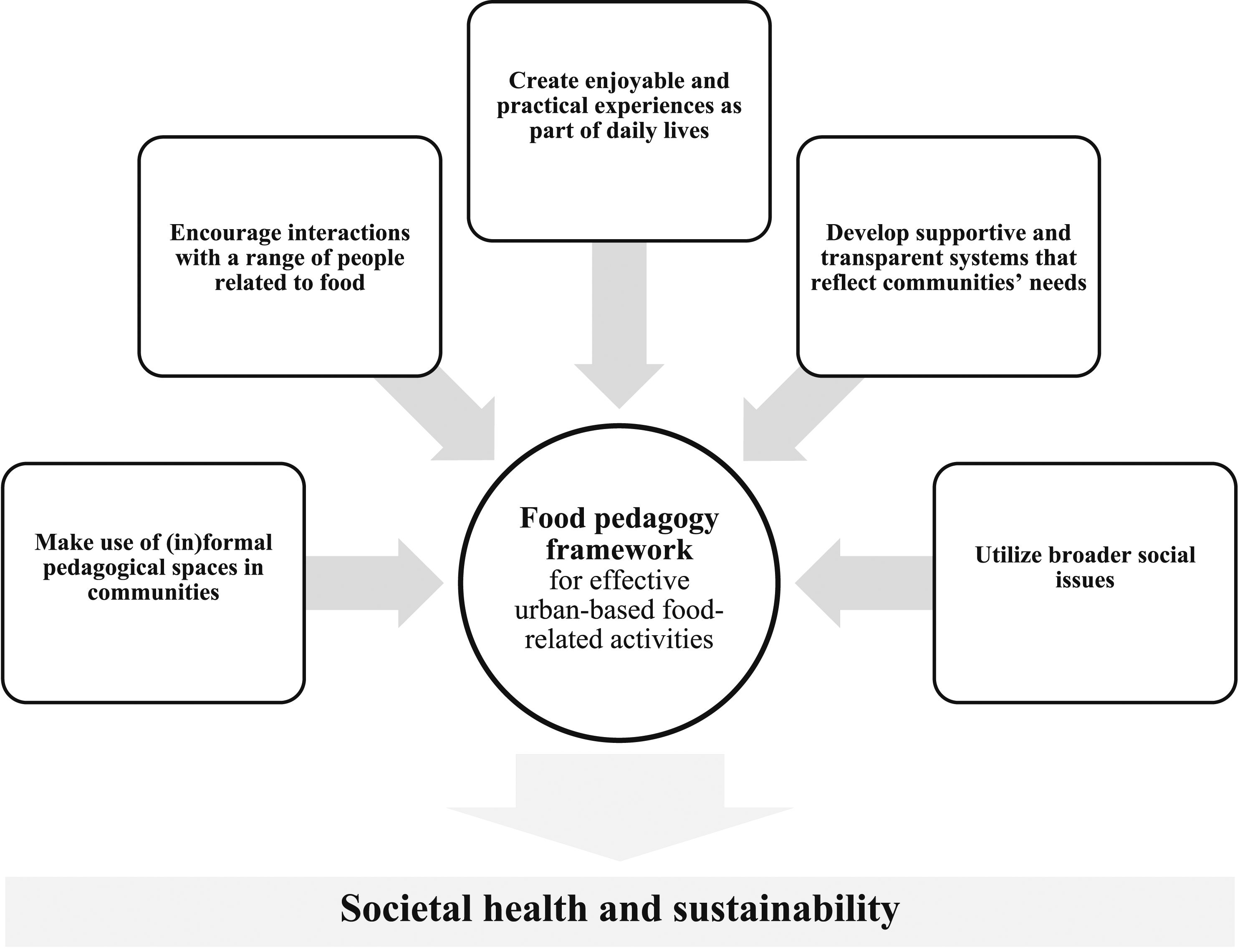
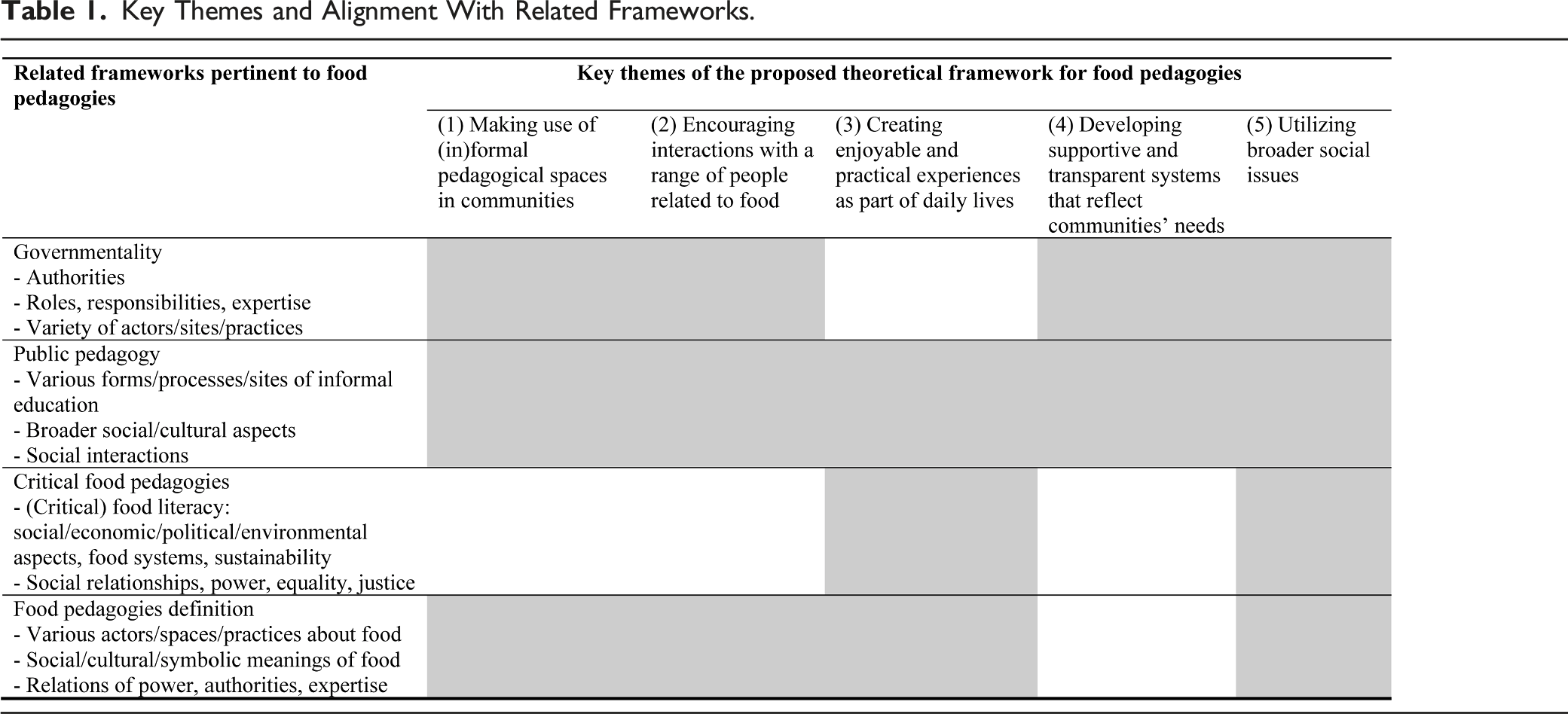
This study highlights five key themes that provide systematic consideration of food in social contexts. Together they inform a draft theoretical framework of pedagogical practices and processes about food-related activities. The themes also link the reported perspectives with existing theoretical frameworks. There is no comparable literature framing all key themes as a package for food pedagogies. Of the existing theoretical frameworks pertinent to food pedagogies (as depicted in Table 1), only public pedagogy incorporates all five themes. However, it is a framework that is broader than just food related areas.
Above all, an important component of the proposed framework is the development of supportive and transparent systems for food and food initiatives. Participants reported several urban food policies and food-related initiatives developed to support, guide, facilitate, regulate, and educate around food knowledge and practices to promote communities’ health and sustainability. This is consistent with the public pedagogies framework, which identifies policy instruments as education-related activities to create learning messages and learning environments and transmit food knowledge and practices for the public in social and cultural settings. 45 Hsu’s findings 34 demonstrated that policy has an educational influence, advancing food knowledge, skills and its societal value, and also influencing systems through creating public pedagogical spaces in cities. The governmentality framework also incorporates enabling supportive systems to facilitate better food choices and create healthy and sustainable food environments.
Secondly, this study identified food practitioners’ knowledge of food and food systems as important. Achieving and ensuring appropriate levels of practitioners’ food knowledge could be considered as one element of the supportive and transparent system component of the framework for food pedagogies. Participants noted issues around the in/adequacy of food practitioners’ knowledge of food and food systems and their variable expertise to create positive messages and interact with communities. An effective system needs to include a process to verify the credibility and accuracy of food practitioners’ expertise, and specify who is responsible for oversighting these requirements. This aspect of food pedagogy is consistent with Foucault’s governmentality framework. Reflecting this finding, previous studies have used components of the governmentality framework, such as problematisations, authorities, technologies and subjectivities, to explore the pedagogical roles or influence through cooking shows and government programs of food practitioners, food activist educators and food-related celebrities.25–27,29
Linked to food practitioners’ (in)adequate awareness of food and food systems, is the need to create meaningful learning experiences related to social, cultural, and environmental aspects of food as part of people’s everyday lives. This aligns with Flowers and Swan’s12,17 food pedagogies definition. Food-related activities interconnect with a diverse group of people and spaces, everyday food practices and culture, individual (emotional) and social issues, healthy and sustainable lives and broader social issues. This broad remit of these food activities can elicit variable responses, such as support or conflict, acclaim or denigration, resistance or disregard. 46 Intellectual, health or sustainability goals can be challenged by other factors, such as aesthetic, visceral, emotional, cultural or habitual.47,48 To address such competing interests, people need to engage with broader aspects of food through the embedding of practical experiences into food initiatives and food education programs. 49 Integrated and creative teaching and learning processes about food together with food knowledge in social contexts not only equips individuals for their everyday lives but also is essential for an informed urban population to strive for food system change.
The critical food pedagogies framework addresses the need to incorporate broader social issues in food initiatives. It provides a useful lens to explore how food practitioners can achieve critical literacy, capacities and competencies about food. It also can assist in the exploration of related social and political issues, food systems and sustainability, and the multiple relationships of food with global contexts such as globalizations and neoliberalism. 16 The applications of the critical food pedagogies framework in community settings, and identification of who could transfer such critical food knowledge within communities, are not yet well developed. 22
Overall, this study highlights that the importance of systematically considering a range of approaches to assist adults, including food practitioners, to raise their understandings of food and food-related issues in everyday settings. Prior studies identified the importance of each of the five themes of the framework in enabling individuals and communities to advance their health and well-being 22 and understand and take action to support sustainable food systems. 50 These themes comprise the food pedagogy framework that can achieve effective and sustainable food policies and urban-based food initiatives. With respect to urban food-based activities, the themes, such as ‘Making use of (in)formal pedagogical spaces in communities’ and ‘Developing supportive and transparent systems’, need to be reflected in government sectors and within policy making processes.
No single entity has overall responsibility for connecting these areas or for having a role in developing or implementing food policies and food initiatives within government organizations.51,52 Thus, the public pedagogies and the governmentality components of the food pedagogy framework are particularly applicable to improve urban food policies and initiatives and build the roles, authorities, and responsibilities of food practitioners within government and community structures.
Participants’ reference to the importance of pedagogical processes to advance food for public health and sustainable living was limited. They identified various urban food strategies or food initiatives with specific foci, such as to change individual behaviors for healthier eating or to change unsustainable food systems. However, very few mentioned the educational impacts of broadly based policies that regulate, support, and deliver holistic food learning experiences to the public. These findings reinforce the need to examine and highlight the pedagogical values embedded in urban food policies or food initiatives and the roles played by diverse food practitioners including policy makers, public health professionals and those working in the food industry.34,38
Limitations
This study contributes to the development of a draft framework for food pedagogies. However, it has some limitations. First, this study set out with the broad aim of exploring food leaders’ perspectives of how adults learn about food and how to make food visible in urban life. The responses of participants were both within and beyond the scope of this study. For example, other themes that arose from the data such as school and tertiary education systems, childhood experiences, and family environments (with a focus on children’s learning), were not considered as main themes for this study, given the focus on adult learning. Second, this study explored a range of community food leaders’ views as food pedagogues in urban areas. However, community members’ views were not included. A further limitation was that differences between the three groups of participants were not considered as part of the analysis within this study as this was not a primary focus. It would be useful to explore different communities’ perspectives to provide further insights into food pedagogies.
Conclusions and Implications
Food is an integral part of our daily lives. Food is tightly intertwined with major challenges that go far beyond the individual health sector at community, national and global levels. 53 Many people undergo economic, geographic or environmental constraints on healthy and sustainable eating. Changes in social, economic and physical environments are needed that support communities to access healthy, equitable and affordable food through sustainable practices. 1 Enabling and facilitating such environments occurs through food policies and urban initiatives underpinned by theoretically based pedagogical practices and processes.
This study provides a draft framework of food pedagogies as a tool to inform food initiatives that raises people’s understanding of, engagement with and empowered actions relating to societal health and sustainability. The five key themes of the framework provide systematic consideration of food in the social contexts. The application of a shared theory-based food pedagogy framework provides government officials, policy makers and urban food practitioners including public health practitioners, with a systematic and encompassing approach to facilitate new and creative food-based transitions toward societal health and sustainability. Further research with community members, practitioners and policy makers is required to develop the draft framework further, with case examples of how its application can reshape and connect existing initiatives for greater effectiveness. Future studies should also explore the relationships between food pedagogy based policies and initiatives and other food-related policies such as food production and marketing, food regulation and social policies that have an impact on food cost and access.
Footnotes
Acknowledgements
The Authors thank the participants in this study who contributed their time for the interviews.
Declaration of Conflicting Interests
The author(s) declared no potential conflicts of interest with respect to the research, authorship, and/or publication of this article.
Funding
The author(s) received no financial support for the research, authorship, and/or publication of this article.
Ethical approval
Ethics application approval was granted by the Human Research Ethics Committee of the University of Wollongong (approval No.: 2018/557).
