




Abstract
Classroom norms are important in shaping individual students’ prosocial behavior. Research documents that students often misperceive classroom norms by underestimating their classmates’ prosocial intentions – a phenomenon known as pluralistic ignorance. The current study investigated whether 5th- and 6th-grade students in Germany (N = 234, 10-13 years, 51% female) expressed varying degrees of pluralistic ignorance regarding same- and opposite-gender classmates. Participants listened to a gender-matched scenario about a classmate with learning difficulties seeking inclusion in a group task. They indicated their own inclusive intentions as well as their perception of same-gender and opposite-gender classroom norms. The results supported the main hypothesis that students perceived lower levels of pluralistic ignorance regarding same-gender than opposite-gender classmates. These findings have implications for interventions aimed at correcting students’ norm misperceptions to promote prosocial behavior in classrooms.
Keywords
Introduction
Classrooms are important contexts where students adjust and adapt their social behavior through daily interactions with their classmates (Farmer et al., 2019). Through these interactions, students establish norms that provide a reference for what is appropriate and typical within the classroom (Veenstra & Lodder, 2022). Students often infer these norms by observing how frequently certain behaviors occur in their classroom (i.e., descriptive norms; Cialdini et al., 1991). When students align with these classroom norms, they are often rewarded with social status and approval. However, those who deviate from the norm may face negative social consequences, such as exclusion or rejection (Laursen & Veenstra, 2021). Through these mechanisms, norms regulate individual prosocial and antisocial behavior in the classroom (Busching & Krahé, 2020; Dijkstra et al., 2007).
Thus, targeting classroom norms promises fruitful avenues for interventions aimed at promoting prosocial behavior in the classroom (Veenstra & Lodder, 2022). These interventions often focus on early adolescents, since this developmental period is marked by heightened conformity, sensitivity, and susceptibility to peer influence (Laursen & Veenstra, 2021). Moreover, in many contexts, this period coincides with the transition to secondary school, when classrooms are newly formed. Establishing prosocial norms during this period may therefore be particularly effective as group dynamics are still emerging.
Recent interventions in early adolescence have specifically targeted students’ norm perceptions by correcting potential misperceptions (Dillon & Lochman, 2022; Perkins et al., 2011; Tolmatcheff et al., 2022). Such misperceptions can occur as a result of pluralistic ignorance. Pluralistic ignorance can arise when students mistakenly assume that their classmates’ attitudes differ from their own, while in fact they do not (Sargent & Newman, 2021). For example, students may individually report having prosocial intentions, yet when asked what is considered normative in their class, they systematically perceive that their classmates have fewer prosocial intentions (Sandstrom et al., 2013). This phenomenon has been observed among children and adolescents in relation to their perceptions of prosocial and bullying norms in the classroom (e.g., Barth & Grütter, 2024; Levy-Friedman & Kogut, 2025; Sandstrom et al., 2013).
Such underestimations of the norm may discourage students from engaging in prosocial behaviors (Sandstrom et al., 2013; Shin & Gyeong, 2024); hence, correcting them has become a central aspect of interventions (Dillon & Lochman, 2022; Perkins et al., 2011; Tolmatcheff et al., 2022). However, evidence regarding the effectiveness of these norm-correction interventions on individual behavior and attitudes is mixed, with only one study documenting changes in self-reported bullying behavior (Perkins et al., 2011). To better target classroom norm interventions, it may be insightful to take a step back and investigate whether pluralistic ignorance varies within the classroom (Sargent & Newman, 2021). The current study contributes to this by examining, within the context of inclusion, how pluralistic ignorance differs when norms are assessed for gender-specific subgroups rather than for the classroom as a whole.
The Role of Norm Reference Groups in Pluralistic Ignorance Research in the Classroom
When assessing students’ perceptions of norms, it is critical to select an appropriate norm reference group (Marsh et al., 2012). This group should represent a meaningful reference concerning the ultimate behavior of interest (Tankard & Paluck, 2016). Studies identifying pluralistic ignorance in bullying, defending, and inclusion typically select ‘most classmates’ (Gasser et al., 2018; Tolmatcheff et al., 2022), ‘most kids in my grade’ (Dillon & Lochman, 2022), or ‘other students’ (Perkins et al., 2011) as norm reference groups. However, qualitative evidence suggests that these norm reference groups may be too broadly defined to adequately capture prosocial peer dynamics in the classroom. Thus, Barth et al. (2025) showed that third-to sixth-grade students held differentiated expectations about their classmates’ inclusive attitudes. Rather than anticipating uniformity, students often expected that some classmates would be inclusive, while others would not. Thus, students’ norm perceptions might underlie within-classroom variations, which could be masked when norms are assessed only at the classroom level rather than within subgroups.
Gender as a Salient Norm Reference Group in Students’ Classroom Norm Perception
Various lines of research suggest that it is important to assess students’ perceptions of prosocial classroom norms within gender-specific subgroups. Early adolescents are more likely to follow the norms of same-gender peers than those of opposite-gender peers, indicating that gender serves as a salient social norm reference group in the classroom (Busching & Krahé, 2020). Furthermore, during early adolescence, prosocial peer dynamics underlie gender homophily, with students being more likely to help, include, and befriend same-gender rather than opposite-gender peers (Killen & Rutland, 2013; Mehta & Strough, 2009; Weller & Lagattuta, 2014). This gender homophily might also extend to students’ perceptions of prosocial classroom norms. Thus, students might perceive their classmates to be more prosocial towards a same-gender peer than opposite-gender peer. Furthermore, more frequent interactions with same-gender peers may increase familiarity with their prosocial attitudes. Given that pluralistic ignorance tends to emerge when people lack insight into others’ private attitudes (Sargent & Newman, 2021), it is likely that students perceive same-gender peers’ attitudes as more similar to their own than those of opposite-gender peers. This assumption is also supported by research showing that students tend to identify more strongly with same-gender than opposite-gender peers (Bennett & Sani, 2008), and that stronger group identification is associated with greater perceived similarity between one’s own attitudes and those of the group (Thijs & Wiemers, 2023; Van Veelen et al., 2016). In summary, these lines of research indicate that students’ perception of prosocial norms might vary for same-and opposite-gender classmates. Yet, no study has examined how students perceive prosocial norms for gender-specific norm reference groups in the classroom. Addressing this gap, however, can have important implications for research and interventions targeting pluralistic ignorance in prosocial contexts.
The Current Study
The current study investigated whether secondary-school students in Germany (10-13 years) expressed varying degrees of pluralistic ignorance in their perception of gender-specific inclusive classroom norms. To answer this question, participants were presented with a gender-matched scenario about a classmate with learning difficulties who seeks to be included in a group task. Based on that scenario, participants indicated their own inclusive intentions and their perception of same-gender and opposite-gender classmates’ inclusive intentions.
We chose inclusion as the context for our research question because inclusion represents a prosocial behavior that is central to fostering inclusive classroom climates (Gasser et al., 2018). Additionally, research indicates that friendships within inclusive classrooms are often organized along gender lines (Garrote et al., 2023). The study was conducted in inclusive secondary school classrooms in Germany. In this context, recent educational reforms have introduced specific types of schools in which students of all learning abilities are taught together following the transition to secondary school. We chose a peer with learning difficulties as the inclusion target to better reflect real classroom dynamics, where such students are often at higher risk of social exclusion (Schürer et al., 2025).
The hypotheses were preregistered at OSF [https://osf.io/jt72x/?view_only=25a6b83d961b4a479c5b850e71a5c270]. Based on previous research pointing towards pluralistic ignorance in students’ perceptions of inclusive norms (Barth & Grütter, 2024; Gasser et al., 2018), we hypothesized that students would report higher inclusive intentions themselves but perceive lower inclusive norms from same- and opposite-gender classmates (H1). We predicted that this effect would differ for same- and opposite-gender norms (Bennett & Sani, 2008; Busching & Krahé, 2020; Mehta & Strough, 2009; Veenstra & Lodder, 2022). Specifically, we expected students to perceive lower inclusive norms from opposite-gender classmates than from same-gender classmates, resulting in greater pluralistic ignorance towards opposite-gender classmates (H2).
Methods
Sample
The data were collected in spring 2023. The sample included 234 early adolescents (M age = 11.04 years, SD age = 0.76, range 10-13) attending eleven inclusive secondary school classes in Germany (Grades 5 and 6). Fifty-one percent were girls, 49% boys, and 0% non-binary. Forty percent of participants reported having a migration background, meaning that they held at least one non-German nationality. Among these adolescents, the most frequently cited nationalities were Turkish (14%) and Italian (13%). The research project was conducted as part of a broader study on classroom dynamics and received ethical approval from the University of Konstanz. The participating classrooms were recruited via a teacher training module. Of the 283 students invited for study participation, 239 (84%) received informed written consent from their parents. Five of these students were sick on the days of data collection and did not participate. Before the study administration, all participants provided verbal assent. Students above the age of 11 additionally provided written assent. In line with the WHO, the APA, and the Helsinki Declaration, they were informed that their participation was completely voluntary, that they could withdraw from the study at any time, and that their data would be treated confidentially.
Procedure and Measures
Participants completed one-on-one interviews with trained research assistants. The interviews lasted for 20-30 minutes and included additional questions that were not analyzed in this study.
Inclusion Scenario
Students were introduced to a scenario about a new classmate with learning difficulties joining their school class (adapted from Gasser et al., 2018). The scenario was accompanied by pictures (illustrated by illumueller.ch, see Figure 1) and was gender-matched, meaning that girls listened to a scenario about a girl (Sarah), and boys listened to a scenario about a boy (Severin). The scenario read as follows: “Sarah/Severin, a new girl/boy whom you don’t know, joins your class. Your class teacher tells you that Sarah/Severin has great difficulties at school. She/he takes a long time to complete tasks and needs lots of support.” Inclusion Scenario (Girl Version), illustrated by illumueller.ch.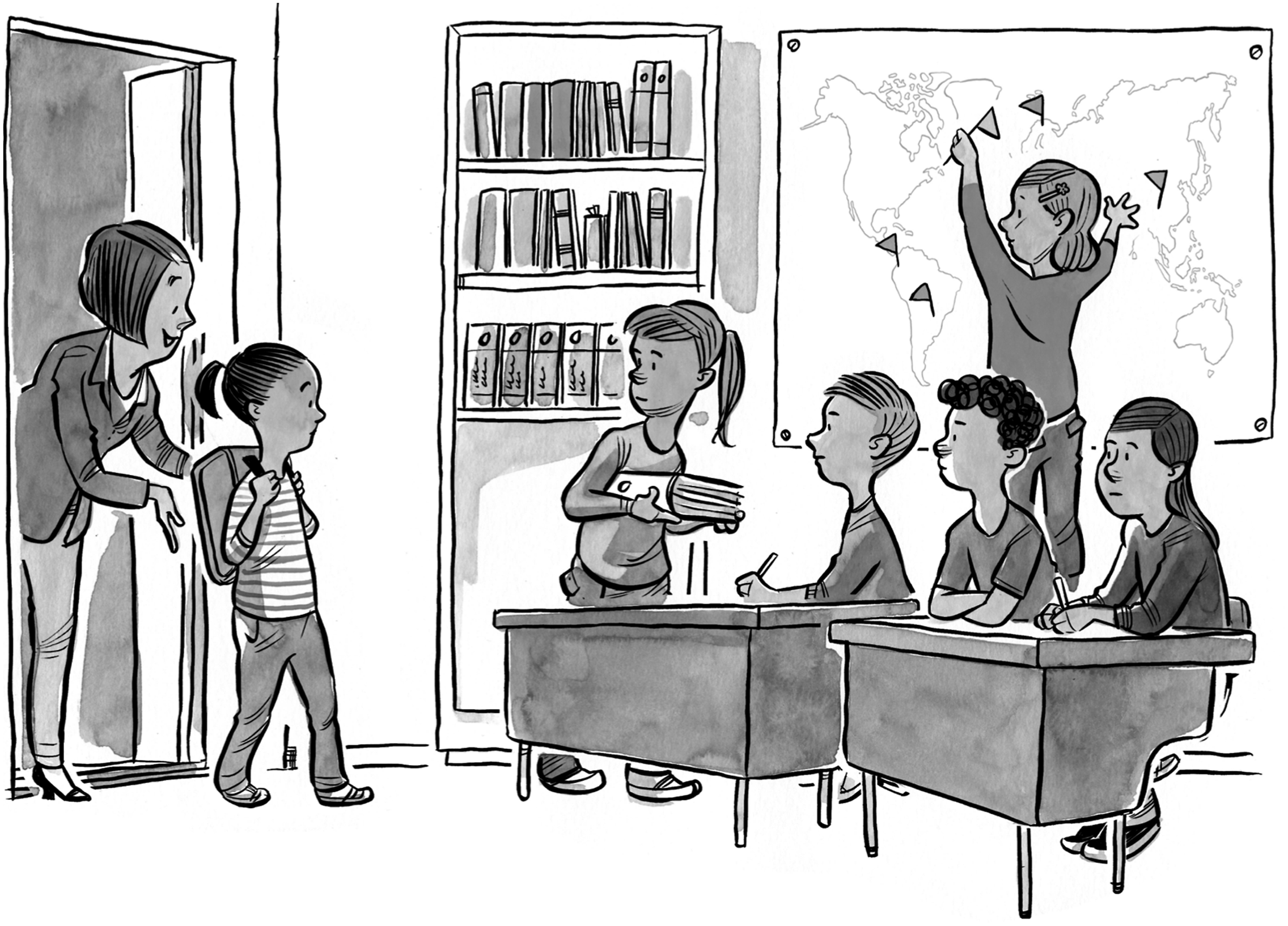
Data Analytic Plan
We transformed the data into long format, with students’ ratings of inclusiveness on the four-point Likert scale as the dependent variable and perspective (inclusive intentions, same-gender norm, opposite-gender norm) as a within-subjects factor. Because the data were nested within students, we analyzed our hypotheses with multilevel linear regression models including random intercepts at the student level. The predictor perspective was specified at level 1 (within-student measure), while students’ gender (boys, girls) and age (continuous) were included as covariates at level 2 (between-student measures). To assess between-student variance in inclusiveness ratings, we computed conditional ICCs based on models including all fixed effects (Hox et al., 2017). These indicated that 22% of the total variance was accounted for by differences between students. Additionally, likelihood ratio tests indicated that models with random intercepts fitted the data significantly better than models with fixed intercepts, χ2 (1) = 27.68, p < .001. Age and gender were included as covariates based on research demonstrating their correlation with students’ ratings of inclusiveness from different perspectives (Gasser et al., 2017, 2018). All analyses were conducted in R version 2.4 (R Core Team, 2022).
Results
Results of Multilevel Linear Regression Models Predicting Students’ Ratings of Inclusiveness From Three Different Perspectives
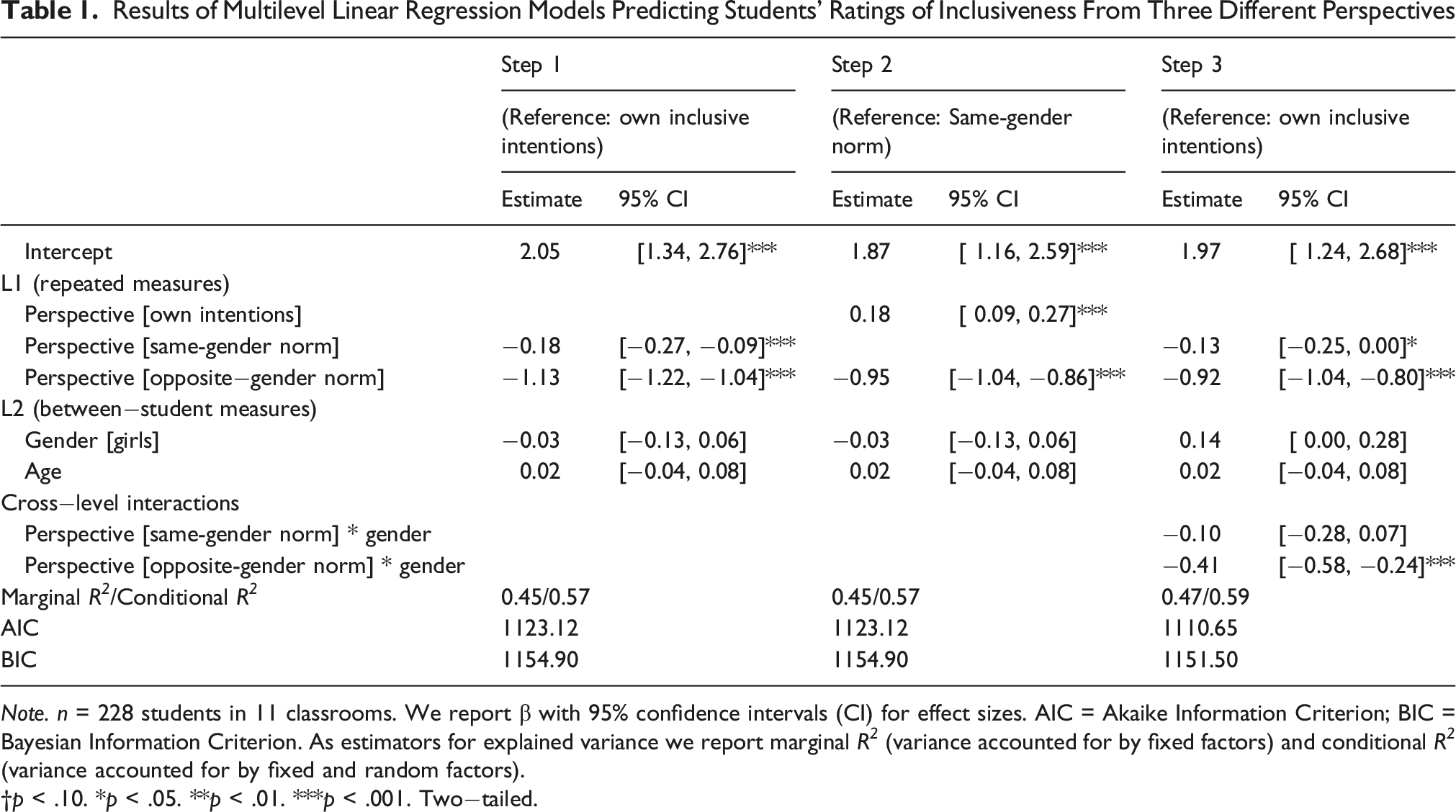
Note. n = 228 students in 11 classrooms. We report β with 95% confidence intervals (CI) for effect sizes. AIC = Akaike Information Criterion; BIC = Bayesian Information Criterion. As estimators for explained variance we report marginal R 2 (variance accounted for by fixed factors) and conditional R 2 (variance accounted for by fixed and random factors).
†p < .10. *p < .05. **p < .01. ***p < .001. Two−tailed.
In a second step, we examined whether the degree of pluralistic ignorance varied depending on the norm reference group. Specifically, we tested whether students perceived lower inclusive norms from opposite-gender compared to same-gender peers (H2). To assess this difference, we re-specified the reference category for the perspective variable to ‘same-gender norm’ (see Table 1, Step 2). The model revealed a significant main effect of perspective: students perceived significantly lower inclusive intentions from opposite-gender than from same-gender classmates. This supports H2, that students perceived greater pluralistic ignorance towards opposite-gender classmates.
Number of Students who Perceived a Discrepancy Between Their Own Inclusive Intentions and Same- and Opposite-Gender Norms

Finally, we conducted exploratory analyses to examine the role of students’ gender by adding an interaction between gender and the reference perspective to the model (see Table 1, Step 3). As displayed in Figure 2, there was no significant main effect of gender, indicating that boys and girls reported equally high inclusive intentions. Similarly, there was no significant interaction for same-gender norm perception, indicating that boys and girls perceived a similar discrepancy between their own and same-gender classmates’ inclusive intentions. However, there was a significant interaction for opposite-gender norm perception, showing that girls perceived a larger difference between their own intentions and those of boys, than boys perceived between themselves and girls. Students’ Ratings of Inclusiveness by Perspective and Students’ Gender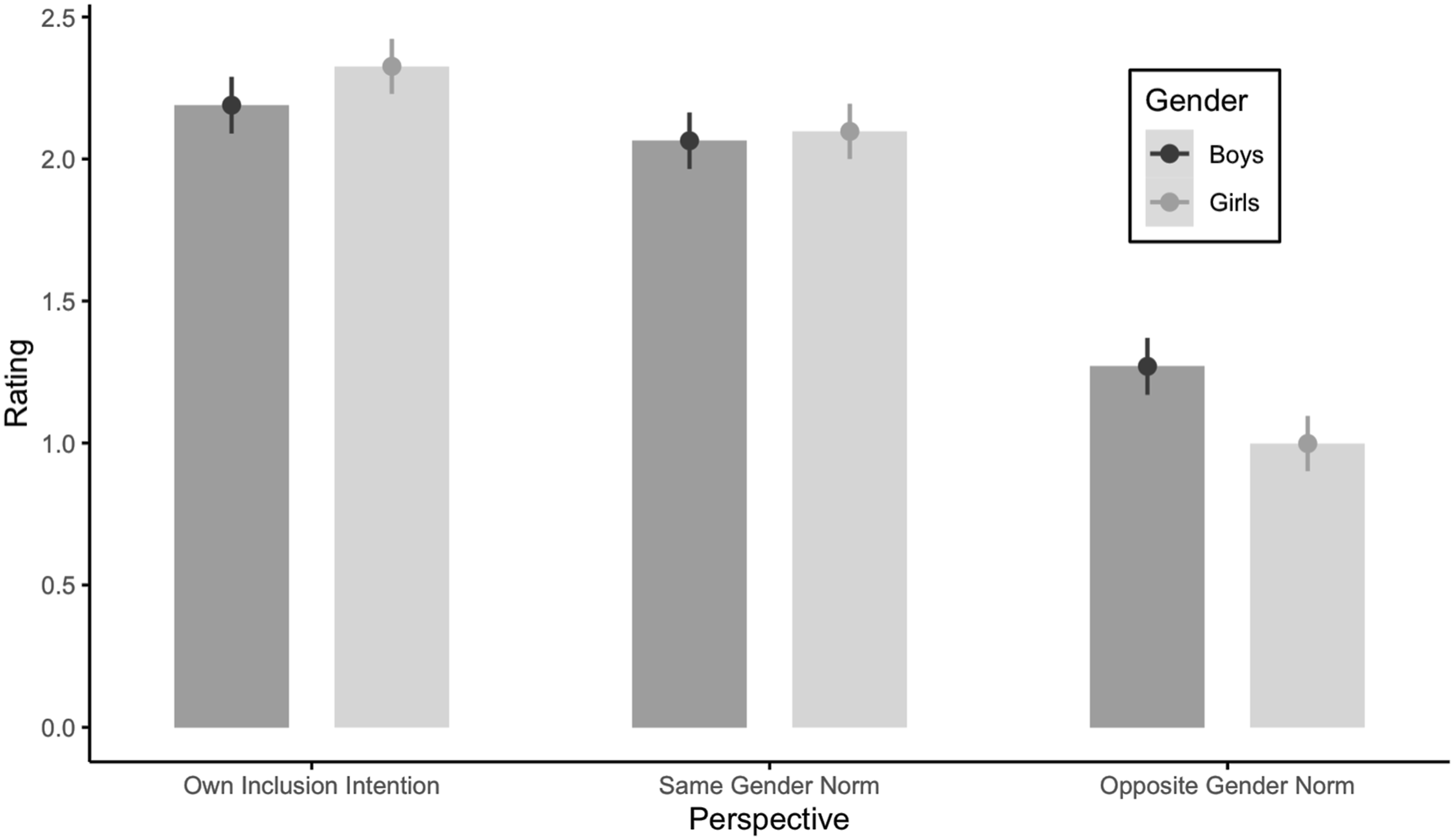
Discussion
The current study examined whether early adolescents expressed varying degrees of pluralistic ignorance in their perception of gender-specific inclusive classroom norms. Consistent with pluralistic ignorance theory (Sandstrom et al., 2013; Sargent & Newman, 2021), students reported higher inclusive intentions themselves but perceived lower inclusiveness from both, same- and opposite-gender classmates. Extending prior research in this field, our findings demonstrate that this self-other discrepancy was smaller for same-gender than for opposite-gender classmates. While the mean difference between students’ own inclusive intentions and their perception of same-gender norms was statistically significant, it was very small. Descriptively, fewer than half of the students perceived themselves as more inclusive than their same-gender peers. By contrast, 89% of students perceived that they would be more inclusive than their opposite-gender classmates. This finding contributes novel evidence for research on inclusive norms by showing that the choice of the norm reference group can moderate the extent of the discrepancy students perceive between themselves and their classmates. When students’ norm perceptions are assessed only at the level of the entire classroom, important subgroup differences may remain hidden or be averaged out.
By showing that the norm reference group matters, our study lays the groundwork for future research to better understand why students perceived a greater discrepancy regarding opposite-gender than same-gender classmates. One potential explanation involves gendered interaction preferences (Mehta & Strough, 2009). Because the inclusion target was gender-matched, adolescents may have perceived inclusion as more likely when initiated by same-gender rather than opposite-gender classmates. This could have led to higher perceived inclusive norms among same-gender peers and, consequently, to a smaller perceived self-other discrepancy. Future research could employ vignettes featuring both same- and opposite-gender inclusion targets to disentangle the role of gendered interaction preferences in shaping children’s self-other perceptions in inclusive contexts (Weller & Lagattuta, 2014). If such interaction preferences were the primary mechanism, students’ inclusion predictions for themselves, same-gender, and opposite-gender classmates should vary systematically depending on the gender congruence with the inclusion target in the vignette. If interaction preferences were not the primary mechanisms, students’ inclusion predictions should remain stable, independent of the gender of the inclusion target.
Another possible explanation involves the role of social identification, which may have contributed to the smaller discrepancy towards same-gender compared to opposite-gender peers. In our study, students reported uniformly high inclusive intentions for themselves. This finding aligns with prior research showing that early adolescents often report high inclusive intentions towards peers with learning difficulties in interview settings (e.g., Barth et al., 2025; Gasser et al., 2017). However, it contrasts with social network studies indicating that students with learning difficulties are frequently excluded in secondary school classrooms (Schürer et al., 2025). One explanation for this discrepancy is that students’ responses in these vignettes may reflect their desire to be (and appear) fair and inclusive, rather than representing their actual inclusive behavior (Palmer et al., 2023). This desire might be strongly embedded in their self-identity (Verkuyten, 2021). Moreover, as students’ self-identity is closely tied to their social group identity, they might not have been willing to say that same-gender classmates (i.e., a social group with which early adolescents strongly identify, Bennett & Sani, 2008) were less inclusive than themselves. Future research could assess whether students who strongly identify with opposite-gender classmates might also perceive a smaller discrepancy between their own and opposite-gender peers’ inclusiveness.
Taking a closer look at students’ perceptions of opposite-gender norms could be especially valuable in light of our exploratory findings. While both boys and girls expected relatively low inclusive intentions from opposite-gender classmates, girls held an even more pessimistic view of boys’ inclusive intentions than boys did of girls’. Future research is needed to clarify the role of gendered-interaction preferences, gender identification, but also gender-stereotypes that may have contributed to this finding (Weller & Lagattuta, 2014).
In summary, our study provides implications for interventions that aim to heighten students’ perceptions of prosocial classroom norms (e.g., Dillon & Lochman, 2022; Tolmatcheff et al., 2022). Students in our study perceived only a small discrepancy between their own and their same-gender classmates’ inclusive intentions. Previous research suggests that early adolescents’ prosocial behavior is primarily guided by same-gender norms (Busching & Krahé, 2020). Thus, it may be possible that correcting perceptions of same- and opposite-gender norms might have only limited impact on fostering inclusive behavior in the classroom. Future research could connect students’ perception of same-gender norms to their actual inclusive behavior and determine whether even small degrees of pluralistic ignorance prevent students to follow their own inclusive intentions.
Conclusion
The present findings show that the choice of the normative reference group matters when investigating early adolescents’ perceptions of inclusive classroom norms. Whereas most existing studies on pluralistic ignorance focus on the entire classroom or peers in general as the reference group, our results highlight the importance of examining how adolescents perceive the norms of specific subgroups within the classroom.
Footnotes
Acknowledgments
The authors are grateful to the research assistants who assisted in the data collection (Leon Beil, Sophie Bernlochner, Hannah Brunner, Sarah Bunz, Jana Carstensen, Franziska Greiner, Anne-Madeleine Kamm, Esther Krukowski, Ramona Mutschler, and Patrizia Rombach). We also would like to express our gratitude to the teachers and students who supported and participated in the study.

Ethical Consideration
The study procedure was approved by the ethics committee of the University of Konstanz [number: 15/2022]. The study is in line with the ethical recommendations of the Helsinki Declaration, the American Psychology Association (APA), and recommendations from the World Health Organization (WHO). For the students, parents or primary caregivers provided informed written consent for their study participation.
Consent to Participate
Additionally, all participants provided verbal assent, and participants above 11 additionally provided written assent, to participate in the study.
Author contributions
Carmen Barth: Conceptualization, Investigation, Writing – original draft, Methodology, Visualization, Formal analysis, Project administration, Data curation. Jeanine Grütter: Conceptualization, Investigation, Funding acquisition, Methodology, Writing – review & editing, Project administration, Supervision.
Funding
The authors disclosed receipt of the following financial support for the research, authorship, and/or publication of this article: The second author was funded by the Swiss Federal Office for the Equality of Persons with Disabilities, (18.l.059), and received additional funding from The University of Konstanz and The Paul Scherrer Foundation.
Declaration of Conflicting Interests
The authors declare no potential conflicts of interest with respect to the research, authorship, and/or publication of this article.
Data Availability Statement
The data that support the findings of this study are available from the corresponding author upon reasonable request.