




Abstract
Despite work demonstrating that executive function development is influenced by the social environment during childhood, little is known about these processes during adolescence either inside or outside the classroom. This study examined the relationship between executive function development and two social-contextual factors, namely the impact of classroom descriptive norms regarding executive functioning, and perceived social support from teachers and peers. Self-report data was collected from 425 early adolescents (Mage T1 = 13.28; SD = 0.80, 47.1% female) at two timepoints approximately one year apart. Multilevel analyses showed that individual levels of executive functioning were a stronger predictor of executive function development than classroom levels of executive functions. Social support from teachers and peers was not related to executive function development. While these findings offer an initial suggestion that executive function development may occur relatively independently of the social environment, we offer suggestions for future studies to explore this relationship in more detail.
Keywords
Introduction
Executive functioning is a multidimensional construct that refers to the group of cognitive processes used in the conscious control of thoughts, acts and emotions (Zelazo & Carlson, 2012). Executive functions allow us to set goals and guide behaviour towards those goals, as well as monitor our progress in attaining them. High levels of executive functioning are related to positive developmental outcomes in multiple domains, ranging from academic achievement (Lee et al., 2012; Spiegel et al., 2021) to work, interpersonal relationships and health (Diamond, 2013; Moffitt et al., 2011). Consequently, to understand how children’s and adolescents’ growth in executive functions can best be supported, it is important to understand how executive functions develop and which factors contribute to this process.
Executive functions show significant improvement throughout childhood and adolescence (Tervo-Clemmens et al., 2023). This developmental progress allows children and adolescents to learn from others how to effectively utilise and optimize these cognitive abilities (Anderson et al., 2008). Recent research in (young) children suggests that during the preschool and primary school period executive functions are influenced by the social environment (e.g., by interactions with teachers, for a review see Sankalaite et al., 2021). However, few studies have focused on social impacts on executive functioning specifically during adolescence, either inside or outside the classroom. As adolescence is a period characterised by a heightened sensitivity to the social environment, social influences are thought to be a powerful determinant of adolescent behaviour (Blakemore & Mills, 2014). Therefore, the current study attempts to examine these social effects in more detail by investigating the roles of peer and teacher support and the contribution of classroom norms to executive function development during early adolescence.
Executive Functioning During Adolescence
Executive functions are often viewed as an umbrella term for the cognitive processes that are involved in higher order cognition and goal-directed behaviour. Most models presume that executive functions consist of several separable but related components, which develop at different rates. Relative consensus exists about the core components which comprise the ability to suppress dominant and prepotent responses (i.e., inhibition) and to shift flexibly between various tasks (i.e., cognitive flexibility or shifting). These processes are supported by the third component, working memory capacities (also described as updating), which enable individuals to hold information in mind in order to generate responses and complete tasks (see e.g., Friedman & Miyake, 2017; Huizinga et al., 2006; Karr et al., 2018). In these models, executive functions facilitate top-down control over lower-order reflexive responses, thereby enabling goal-directed motivated behaviour. In addition to the three component model, a distinction has also been made between ‘cold’ (i.e., cognitive) and ‘hot’ (i.e., socio-emotional) executive functions. Cold executive functions (such as inhibition and cognitive flexibility) are used for cognitive information processing in relatively emotionally neutral contexts. Hot executive functions (such as emotional control) are used to regulate responses under affective conditions, such as those that are motivationally significant (Zelazo, 2020).
The development of executive functions shows a protracted course which starts during childhood and continues into adolescence (see e.g., Best et al., 2009; Huizinga & Smidts, 2011; Laureys et al., 2022). This development does not follow a linear trajectory, but is characterised by alternating periods of rapid and more gradual improvement in both accuracy and speed (Tervo-Clemmens et al., 2023). There is an initial period of substantial improvement during the preschool years (ages 3-6; Zelazo & Carlson, 2012), with a second developmental spurt at the beginning of adolescence, characterised by refinement of these abilities (ages 11-13; Prencipe et al., 2011). Previous work has shown that inhibition improves rapidly during childhood, and at least into early adolescence, while cognitive flexibility and working memory improve until late adolescence or early adulthood (Huizinga et al., 2006). Some work has shown differences between boys and girls, though these results are somewhat inconsistent (see e.g., Grisson & Reyes, 2019 for a review). However, the developmental trajectories of executive functions do appear sensitive to variations in individual experiences. Studies in children have demonstrated strong environmental influences, showing that both proximal (e.g., quality of parent-child interactions; Fay-Stammbach et al., 2014) and more distal social factors (e.g., poverty and socioeconomic risk factors; Hackman et al., 2015; Rhoades et al., 2011) can impact executive function development.
Adolescence has been described as a period of enhanced opportunity for the refinement of executive functions, when the brain is primed to flexibly adapt to a changing environment (Fuhrmann et al., 2015; Larsen & Luna, 2018). It is also a period of significant social change, when friendships become more intense, and relationships become increasingly important. Peer acceptance becomes a powerful motivator for adolescents to conform to patterns of behaviour that receive approval from their peer group (Blakemore & Mills, 2014), and those who are less able to conform are at a heightened risk of rejection (Evans et al., 2015). Together, these developments suggest that adolescent executive function development could be susceptible to social influence. Given the extensive amount of time adolescents spend at school, it is likely that much of this social influence will occur within the school environment. Therefore, the current study examines the contribution of the social context to executive function development in this age period, with a particular focus on processes within the classroom.
The Role of Social Norms
Research increasingly indicates that individuals adapt their behaviour in line with social norms within the group. Different processes can underly the effects of social norms on individual behaviour. A general explanation of adaptation of behaviour is given by social cognitive theory (or social learning theory), which has demonstrated that people are frequently motivated to model behaviour they observe in others if they believe this will lead to desirable outcomes (Schunk & DiBenedetto, 2020). Peers are often influential models, as adolescents frequently look to those similar to themselves (e.g., in age or gender) as models of appropriate behaviour. This influence can be particularly strong within the context of the classroom, as children see what their classmates do and how they behave. Based on this information they can deduce the central behavioural tendencies within the group, known as the descriptive norm (Cialdini et al., 1991; Veenstra & Lodder, 2022). This norm is based on the prevalence of behaviour, and therefore reflects what is considered typical behaviour within a classroom. As described by Cialdini et al., (1991) these descriptive norms provide a shortcut for decision making, as they provide information about what would be the most adaptive and/or efficient way to behave. Others have shown that that peer acceptance increases when individuals show behaviour consistent with the group norm (e.g., Boor-Klip et al., 2017; Chang, 2004). Thus, understanding the descriptive norm enables children to learn and apply these behaviours themselves (Müller & Zurbriggen, 2016), which could positively impact their peer relationships.
When adolescents are exposed to classmates with well-developed executive functions, this may encourage them to utilise their executive functioning skills and exert more control over their own behaviour in the classroom. Previous work in this area has focused on children. Montroy and colleagues (2016) showed that the level of classmates’ self-regulation in preschool predicted individual self-regulation later in the school year. Finch and colleagues (2019) found that performance on a number of executive function tasks (measuring inhibition, cognitive flexibility, and working memory) improved during primary school if their classmates showed faster and more accurate responses. In a study in pre-schoolers, Doebel and Munakata (2018) showed that the extent to which children inhibited their behaviour could be modified through experimentally manipulated group norms.
To our knowledge, there are no studies currently available that test the influence of classroom peers on executive function development during adolescence. However, a number of studies in adolescent samples have shown influences of classmates on outcomes such as disruptive behaviour and aggression (Müller & Zurbriggen, 2016), which are related to inhibition. Furthermore, adolescents show a strong tendency to adapt their behaviour to that of their peers, for example showing increasing levels of inhibitory control in order to receive positive feedback from peers (Hollarek et al., 2020), or showing more cognitive flexibility to engage in exploratory learning behaviours when they are with peers than when they are alone (Silva et al., 2016). Combined, these findings suggest that classroom descriptive norms with regards to executive functioning may influence individual levels of executive functions during adolescence. This may particularly be the case for those components of executive functions where descriptive norms are easily observable by others, such as those involved in regulation of overt behaviour (e.g., inhibition or emotional control), or those which influence the dynamics of classroom interactions (e.g., cognitive flexibility when working with classmates). These components of executive functioning will therefore be the focus of the current study.
The Role of Social Support
Executive functions are shaped and refined during our interactions with others. Supportive environments, for example within the classroom, provide low-stress interactions for adolescents to practice and enhance these cognitive abilities. Both peer (Lecce et al., 2018) and teacher-student relationships (Vandenbroucke, Spilt et al., 2018) play an important role in this process. Supportive interactions with peers allow individuals to practice and co-construct cognitive skills (Rubin et al., 2006), creating a context where executive functions can be practiced and refined. These effects can also be indirect, as those who experience positive interactions with peers and classmates are likely to experience more positive feelings and lowered levels of stress (Telzer et al., 2015), which supports executive function development (Diamond & Ling, 2016). Taken together, these findings suggest that the quality of relationships with classmates can impact executive function development, both through social expectations within peer relationships and by influencing the environment within which these skills are acquired. Hence, it seems likely that during adolescence both class group norms and relationships with classmates will influence individual executive functions, however this requires further investigation.
Similar processes are likely to be involved with regard to relationships with teachers and the development of executive functioning. Studies examining the influence of teachers on children’s executive functioning have mainly focused on the role of the quality of teacher-student relationships. A meta-analysis showed that positive teacher-child relationships (characterized for example by warmth, responsiveness, low conflict) are related to higher levels of executive functions, such as inhibition, among primary school children. No relationship was found with cognitive flexibility, though the authors note there was a lack of studies examining this relationship (Vandenbroucke, Spilt et al., 2018). Positive relationships with teachers are likely to reduce children’s levels of stress, and make children feel happy and confident, thereby creating an environment conducive to learning (Ahnert et al., 2012). This is in line with the observations of Diamond and Ling (2016) who argue that stress and negative feelings (e.g., sadness or loneliness) are negatively related to executive functioning performance or behaviour (Diamond & Ling, 2016).
Teacher-student relationships may be particularly influential when the quality of the parent-child relationship is low (Vandenbroucke et al., 2017) allowing positive relationships with teachers to play a compensatory role. Increases in executive functioning abilities have been observed in classrooms where teachers support their students’ autonomy (Sosic-Vasic et al., 2015). Consequently, classrooms characterized by positive teacher-student relationships can provide an ideal context for executive functioning to be applied and to develop (Cumming et al., 2020). To date, research examining the social impact of teachers on executive functioning has focused on young children. One study in adolescents did show that higher levels of general academic support were related to better executive functioning abilities (Piccolo et al., 2019). To our knowledge no research has examined the effects of teacher support on adolescent executive function development. However, based on the idea that positive relationships with teachers affect executive functioning through decreases in stress and increases in positive feelings, such influences may also be expected in adolescents.
The Current Study
There are numerous reasons to expect that the social context of the classroom could be play a role in executive function development during adolescence. However, there are very few studies currently available that provide empirical evidence of this, especially with regards to the early adolescence. This despite others suggesting that the impact of social norms on behaviour may be stronger in adolescence than in childhood, as the social benefits of conforming to group norms increase during this period (Veenstra & Lodder, 2022). This gap is addressed by the current study. Whereas previous work has largely focused on young children or the family environment, we specifically examined the effects of classroom norms and the experienced social support by classmates and teachers on the development of early adolescent executive functions.
Early adolescents completed an executive function questionnaire which assessed daily behaviour related to executive functions in the home and school environment. They also reported on the social support they received from both classmates and their teachers. By using self-report questionnaires, we were able to examine adolescents’ experiences in the “real world” classroom environment, which may provide higher ecological validity than cognitive tasks. Both descriptive classroom norms regarding executive functioning and social support were used to predict individual change in executive function abilities across two time points approximately one year apart (statistically controlling for earlier levels of individual executive functioning). This allowed us to examine the persistence of effects once students had transitioned to a new class (i.e., in the new school year).
With regards to executive functioning, we focused on two of the three core ‘cold’ components of executive functions (see Miyake et al., 2000), namely inhibition and cognitive flexibility. While the third component, working memory, plays a central role in facilitating inhibition and cognitive flexibility, it has less of an influence on overt behaviours that can be observed by peers, and may therefore be less suited to measurement in terms of a behavioural norm. Additionally, we also focused on the ‘hot’ executive function of emotional control. Emotional control is essential in interactions with classmates, where it enables modulation of the emotions, thereby allowing adolescents to get along with peers and resolve potential conflicts (Romero-Lopez et al., 2021).
Our first research question examined if descriptive classroom norms regarding executive functioning performance are related to adolescents’ individual executive functioning. We hypothesised that higher classroom levels of Inhibition, Cognitive Flexibility and Emotional Control would predict higher individual levels of these executive functions one year later, controlling for executive functioning at the first timepoint (Doebel & Munakata, 2018; Montroy et al., 2016; Müller & Zurbriggen, 2016). The second and third research questions addressed how social support from classmates (research question 2) and the teacher (research question 3) affect adolescents’ executive functioning. We hypothesised that if adolescents felt more supported by their teacher and classmates they would show greater increases in Inhibition and Emotional Control (Ahnert et al., 2012; Diamond & Ling, 2016; Vandenbroucke, Spilt et al., 2018). Though previous work is less clear about associations between social support and Cognitive Flexibility (Vandenbroucke et al., 2018b), we tentatively hypothesised a positive relationship between levels of teacher and classmate support and levels of Cognitive Flexibility. As there is some evidence for gender differences in executive functioning (see e.g., Grisson & Reyes, 2019 for a review), we controlled for gender differences when testing our hypotheses.
Method
Participants
This study included two waves of data collection within a larger project examining adolescent cognitive, social and emotional functioning (see e.g., Vandenbroucke et al., 2018b). The current target sample involved early adolescents living in urban and rural areas in the Netherlands, who at the beginning of the study were attending the last year of primary or the first year of secondary education in mainstream schools. All participants provided written informed consent for the study (parental consent and participant assent for children and adolescents) at both time points. Instead of receiving individual compensation, participants received a voucher for an excursion together with their classmates. At baseline (T1), data were collected from 541 participants (mean age 13.13 years, SD = .86, range = 10.98–16.05; 254 girls) in 28 classroom peer groups (i.e., a fixed group of students that they take all lessons with).
Data collection took place between November and March, and lasted two to four weeks per school (depending on the size of the school). Thus, at T1 the participants had spent between two and seven months among their current classmates. Approximately one year later, at which point participants had moved to the first or second year of secondary school (mean time difference = .89 years; SD = .08), all participants were invited for the second wave of data collection (T2). A total of 99 participants had moved, or indicated that they could not or did not want to participate again and there were 17 participants with incomplete questionnaires, which resulted in partially missing data for 116 cases. Further analyses revealed that those who transitioned to secondary school between T1 and T2 were overrepresented among the dropouts compared to participants who moved from the first to the second year of secondary school (χ2(4) = 129.05; p < .001). On the other hand, boys and girls were equally distributed among dropouts and non-dropouts (χ2(1) = 0.009; p = .923). Analyses on T1 key variables indicated that dropouts experienced more social support by the teacher (t(539) = 2.95; p = .003, d = .31) and more problems with Emotional Control (t(539) = 2.54; p = .011, d = .27).
As a result of schools creating new classroom groups at the beginning of the new school year, participants were spread over 74 classroom groups at T2. This is largely due to schools grouping students based on their academic performance after the first year of secondary school, as is customary in the Dutch school system.
Estimated intelligence scores were obtained by using the object matrix reasoning subscale of the Stanford Binet V (Roid, 2003). This includes items assessing sequential and matrix reasoning, and provides an index of non-verbal fluid reasoning. At T1, the mean score on this task was 25.39 (SD = 3.69) and T2 it was 25.82 (SD = 3.34).
Materials
Executive Functions
To assess executive functions in daily life (in relation to behaviour regulation) we used the Dutch version of the Behaviour Regulation Index of the validated Behaviour Rating Inventory of Executive Function – self report version (BRIEF; Guy et al., 2004; Huizinga & Smidts, 2012). The BRIEF consists of 75 items, concerning specific behaviours relating to executive functioning in children and adolescents. Adolescents are asked to indicate how often a given behaviour occurred in the past 6 months by endorsing one of three responses, namely “Never,” “Sometimes,” or “Often”. The Behaviour Regulation Scale comprises three clinical scales, (1) Inhibit (12 items, range of scores 12–36), (2) Shift (8 items, range of scores 8–24) and (3) Emotional Control (10 items, range of scores 10–30), which were used as variables of interest to measure respectively (1) Inhibition, (2) Cognitive Flexibility and (3) Emotional Control. Example items include: “Gets out of seat at the wrong times” (Inhibit), “Is disturbed by change of teacher or class” (Shift), or “Has outbursts for little reason” (Emotional Control). For each scale higher scores indicated more problems with behaviour regulation. A total Behaviour Regulation score was also calculated by summing the three subscales. All analyses were run using raw scores. The reliability of the T1 measures was α = .90 for the total Behaviour Regulation scale, α = .81 for the subscale Inhibition, α = .64 for the subscale Shift, and α = .78 for the subscale Emotional Control. At T2 the reliability was α = .91 for the total Behaviour Regulation scale, α = .81 for the subscale Inhibition, α = .65 for the subscale Shift, and α = .81 for the subscale Emotional Control. For the analyses, individual sum scores per subscale, as well as the total behaviour regulation score at T2, were used as dependent variables. In addition, the T1 classroom mean was calculated for each of the subscales (based on all students’ scores) to determine the context effect on the T2 behaviour regulation scores of each individual student. This is a common procedure to investigate classroom-level effects (e.g., Burningham et al., 2024; Busching & Krahé, 2020; Hofmann & Müller, 2018).
Perceived Social Support From Classmates and Teachers
To assess the perceived social support from classmates and teachers, we used an adapted version of the Social Support Scale (Harter, 1985). For the current study we focused on questions assessing support from classmates (4 items) and teachers (4 items. Example items of the Classmates and Teacher scales are: “I have classmates I can become friends with”, “I have a teacher who cares about me”. Respondents indicated on 5-point scales (“Not at all true” = 1, “Not true” = 2, “Somewhat true” = 3, “True” = 4, “Certainly true” = 5) which of the answer options applied to them. As Dutch secondary school students are taught by multiple teachers throughout the day and week, the teacher questions did not refer to specific teacher. The variables of interest were the total scores on the Classmates and Teacher scales at T1. Higher scores indicated a higher level of perceived social support. The reliability was α = .69 for the Classmates scale and α = .83 for the Teacher scale. When multiple individuals in a group make judgments about the same person or groups of persons, sufficient interrater reliability is required to use the group mean as Level 2 predictor. For this purpose, an adjusted form of the intraclass correlation coefficient was used (ICC2; Lüdtke et al., 2007). To demonstrate sufficient agreement, the ICC2 should be greater than .70 (James et al., 1984). For the present data, it was found that the ICC2 regarding teacher support was satisfactory at 0.74, but the score for classmates’ support was much too low at 0.03. The result is not surprising, since it can be assumed that each student has his or her individual peer group in the overall class by which he or she is supported. We therefore decided to treat classmates' support as an individual level variable, while teacher support was considered a classroom level variable.
Procedure
The survey data was collected in groups of no more than 15 participants, and took place in a computer lab at participating schools, which had been reserved for testing. Participants were tested together with their classmates. Each questionnaire testing session lasted approximately 1 hour. Instead of receiving individual credit, payment was given to schools for a joint activity for participating classes. The study was approved by the Ethical Committee of the University of Amsterdam Faculty of Behavioural and Social Sciences.
Data Analytic Approach
We will first provide information about the mean and distribution of behaviour regulation problems, perceived classmates’ support among individuals, and perceived teacher support among all students in a classroom. For hypothesis tests we used multilevel analyses in order to take into account that individual students’ measures were not independent but nested within classrooms (Raudenbush & Bryk, 2002). Random intercept models were estimated using the software Mplus version 8 (Muthén & Muthén, 2017). We used full information maximum likelihood estimation with robust standard errors, which allows unbiased significance testing even when assumptions about residual distributions are violated. In addition, cases with missing data on one or more variables can be included in the analyses (Muthén & Muthén, 2017). To test Hypothesis 1, the classroom mean of behaviour regulation problems (Inhibition, Cognitive Flexibility, Emotional Control, and total score) at T1 was used to predict individual behaviour regulation problems at T2, controlling for the individual score at T1. To obtain a correct estimation of the Level-2 effect, the individual scores at T1 were centred around the classroom mean at T1 (group-mean-centring). This procedure is recommended if both the individual value and the group mean of the same variable are predictors in the model and produces a within-group effect (Level 1 effect) and a between-group effect (Level 2 effect) (Bell et al., 2017). However, to obtain the actual context effect, which is over and above the individual effect, the within-effect must be subtracted from the between-effect in a next step. Finally, the context effect is tested for significance.
With regard to Hypothesis 2, the individual student’s perceived support by the classmates at T1 was used to predict individual behaviour regulation problems at T2, controlling for T1 individual behaviour. Finally, to test Hypothesis 3, the classroom mean of individual students’ perception of teacher support at T1 was included as a predictor of individual behaviour regulation problems at T2. Again, the individual score of behaviour regulation problems at T1 was controlled for.
In addition to our main analyses, we conducted further sensitivity analyses to investigate the stability of results regarding teacher support. While the majority of our sample consisted of secondary school students, a smaller proportion (N = 41; 9.6 %) was in primary school at T1. Since primary school students only had one class teacher, but secondary school students were taught by multiple teachers, the classroom mean of perceived teacher support refers to a single person for primary school students and to several persons for secondary school students. Due to large differences in test power, separate analyses for the two groups would have been difficult to compare in terms of significance. Hence, we reran the analyses on teacher support excluding primary school students to examine whether or not the results changed.
Results
Descriptive Statistics
Descriptive Statistics of Individual and Classroom-Aggregated Behaviour Regulation Problems, Perceived Classmates’ Support, and Perceived Teacher Support (Classroom Mean).
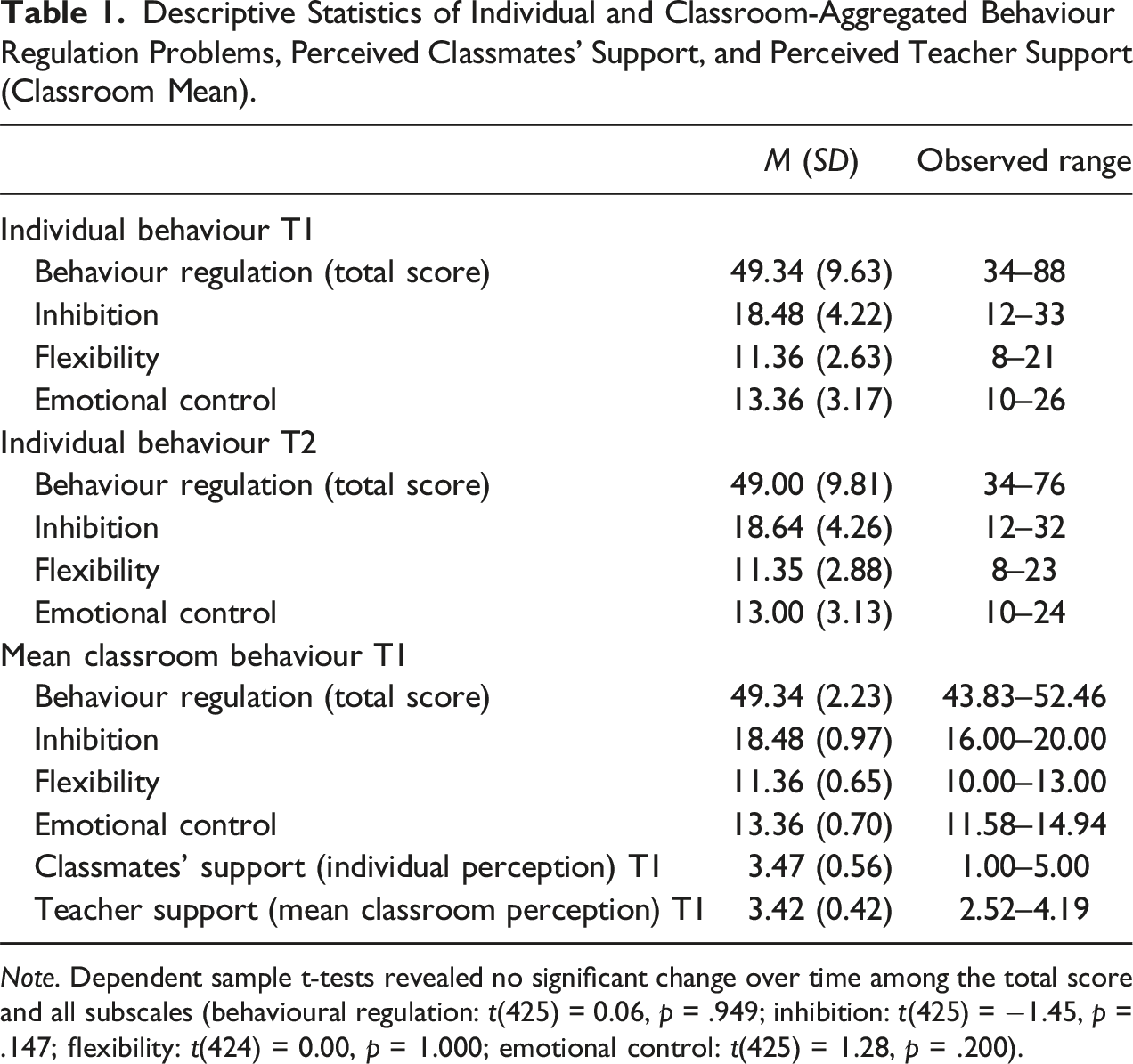
Note. Dependent sample t-tests revealed no significant change over time among the total score and all subscales (behavioural regulation: t(425) = 0.06, p = .949; inhibition: t(425) = −1.45, p = .147; flexibility: t(424) = 0.00, p = 1.000; emotional control: t(425) = 1.28, p = .200).
With regard to the total sample, scores for behavioural regulation problems, Inhibition, Cognitive Flexibility, and Emotional Control remained stable from T1 to T2 (no significant differences in scores; p from .147 to 1.000). The individual scores at T1 (as reported in Table 1) also corresponded to the classroom means at T1, which is not surprising as classroom mean scores are composite measures of all student scores in a classroom. The mean scores of perceived social support by the classmates (M = 3.47) and by the teacher (M = 3.42) indicated that on average students felt well-supported by their classmates and teachers.
Hypothesis Tests
Multilevel Analyses Predicting Individual Executive Functions T2 by T1 Descriptive Norms, Teacher Support, and Classmates’ Support.
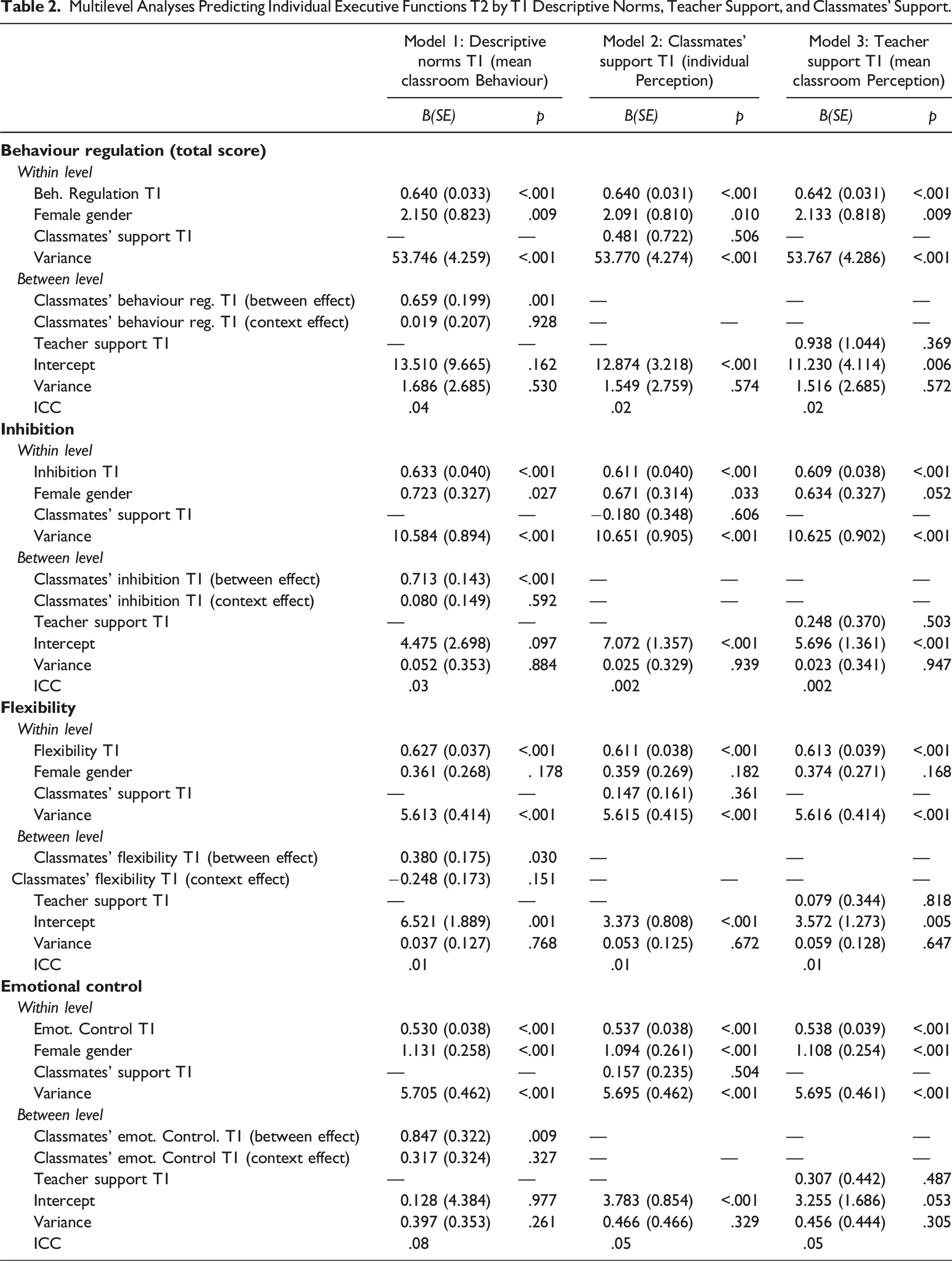
In terms of our sensitivity analyses on teacher support, we found no relevant change in results when we excluded primary school students (i.e., the results remained non-significant; Inhibition: B = 0.278, SE = 0.325, p = .393; Flexibility: B = 0.160, SE = 0.372, p = .666; Emotional Control: B = 0.439, SE = 0.385, p = .254; Behaviour Regulation: B = 1.434, SE = 0.853, p = .093).
Discussion
In this study we examined the relationship between the development of executive functions during the early adolescent period, and descriptive classroom norms and peer and teacher support. While these developmental effects have been described in childhood (see e.g., Finch et al., 2019; Montroy et al., 2016; Vandenbroucke, Spilt et al., 2018), much less information is available about these processes during early adolescence, despite this being a period of heightened social influence. Our results show that role of the social context may be more complex during adolescence than during childhood: classroom norms were related to the various components of executive functioning, but this association did not go beyond what could be explained by individual levels of executive functioning at T1. Furthermore, in contrast to our hypotheses, no relationship was found between perceived social support and executive function development.
The Effect of Classroom Descriptive Norms
Our results regarding the effects of classroom descriptive norms on executive functioning development were not in line with our hypotheses. In fact, adolescent’s individual level of executive functioning was related more strongly to their executive functioning a year later than the average level of executive functioning among their peers (i.e., the descriptive norm). This suggests that individual developmental trajectories had a greater effect than the behaviour adolescents observed from their classmates. There appears to be relatively strong individual consistency in executive functions during this early adolescent period.
Work in younger samples was able to establish a link between classmates and children’s level of executive functioning (Finch et al., 2019). Our results suggest that this relationship may change during early adolescence, despite the continued development of executive functions during this period. Most early adolescents will have acquired the necessary executive function abilities to perform goal-directed tasks, and the ensuing age-related improvements are typically characterised by increased speed and accuracy (Tervo-Clemmens et al., 2023). Perhaps these aspects of executive function development are less associated with environmental influences, such as the descriptive norm within a classroom. The relationship between environmental factors and executive functions may also change over time: our design focused on the effects of classroom descriptive norms over the course of a year. Due to the nature of school years, the participants will also have spent a number of months in their T2 classroom before the follow-up measurement took place. It could be that the effects of the descriptive norm in their T1 classroom did not persist once an adolescent had moved to a different class, suggesting that environmental effects may be more temporary. These effects may be similar to those seen for example in work on adolescent risk-taking, where adolescents showed reduced levels of inhibitory control in the presence of their peers (e.g. Chein et al., 2011; O’Brein et al., 2011) and took more risks when this was in line with the social norm (van Hoorn et al., 2017). Future work could focus more specifically on the differences between short-term and longer-term effects of the descriptive norm.
Finally, the classes included in the present sample were characterised by relatively high levels of executive functioning. During childhood the largest effects of contextual factors are generally seen in those with relatively low executive function scores (Vandenbroucke et al., 2016), suggesting that it may be basic executive function development, as opposed to the fine-tuning that occurs during adolescence, that is most receptive to environmental factors such as the descriptive norm.
The Role of Social Support
Contrary to our hypotheses, we were unable to establish a relationship between executive functions and classroom-level social support from teachers or peers in this age group. These effects have been relatively well established in childhood, with studies showing that positive relationships with both peers and teachers are related to improvements in executive functioning (Cumming et al., 2020; De Wilde et al., 2016; Holmes et al., 2016; Sankalaite et al., 2021; Vandenbroucke et al., 2018b). Supportive environments are characterised by relatively low levels of conflict and high levels of positive behavioural support (Dishion, 2016). These classroom environments are thought to provide more feedback and learning opportunities, thereby fostering executive function development (Cumming et al., 2020). Our results suggest that these scaffolding experiences play less of a role during early adolescence. This may be due to differences in the focus of executive function development with age. While childhood is a period characterised by substantial improvement across executive function domains, adolescence is a period of refinement of these abilities (Best et al., 2009; Huizinga & Smidts, 2011; Prencipe et al., 2011) in which scaffolding may play less of a role.
With regards to the specific supportive effect of peers, Holmes et al. (2016) have proposed that executive function development may be most sensitive to peer influences during childhood. They suggest that during childhood supportive peer interactions largely occur in the form of play activities, which require multiple executive abilities such as inhibition, flexibility, organisation and adherence to rules. Successful social interactions therefore provide an important opportunity for children to practice and develop these skills. During adolescence peer interactions become more focussed on interpersonal intimacy (Bagwell & Schmidt, 2013), and as result may be more conducive to the development of socio-cognitive and communication skills than executive functions.
Similarly, as adolescents strive to increase their personal autonomy and become less dependent on adult attachment figures such as parents and teachers (Inguglia et al., 2015), these relationships may become less consequential to executive function development than they are during childhood. Studies in children have explained the positive effects of social support from teachers based on their roles as ad hoc attachment figures during the school day (Ahnert et al., 2012). These effects are likely to be stronger when students are taught by a single teacher, as is the case at most primary schools. However, the majority of the students in our sample were taught by multiple teachers throughout the day and week. This is typical in Dutch secondary schools and in many other countries. Consequently, most adolescents will spend their school day with multiple teachers, and perhaps have less time and opportunity to forge the (ad hoc) attachments which may be necessary for support from their teachers to impact their executive function behaviour. This may explain why we were unable to find an effect of level of social support from teachers. However, previous work in adolescent samples has been able to demonstrate a relationship between higher quality relationships with nonfamily adults (such as teachers) and positive developmental outcomes, such as lower risk taking and improved well-being (Scales et al., 2006), as well as lower levels of problem behaviour (Obsuth et al., 2017). This suggests that even though interactions between students and individual teachers become less frequent during adolescence, these teachers can still meaningfully influence adolescent behaviour. More work is needed to examine these associations in the context of executive functions in more detail, for example taking into account the strength of the relationship students have with their teachers, which may moderate this effect.
Strengths and Limitations
In interpreting our results, we must consider the strengths and limitations of the current study. We were able to examine the relationship between classroom factors and executive function development within relatively complete classroom peer groups at the first timepoint, where we determined the descriptive norm. As has previously been noted (Finch et al., 2019), high participation rates per classroom enable better detection of peer effects, and therefore we were able to reliably estimate the classroom norms. However, as data collection proceeded over the course of a number of months (November – March) it should be noted that there were individual differences between participants in the amount of time they had spent in the T1 class configuration at the time of measurement. As described above, our design was better suited to examining the persistence of the relationship between executive functions development and the descriptive norm over the course of a year, rather than shorter-term effects. Future studies could benefit from using other timeframes for data collection to examine the differences between these associations in more detail.
In the present study, executive functions and social support were measured using self-report questionnaires. This method is well-suited to measuring perceptions, including the perceived social support examined in our study. Additionally, it has been described as more ecologically valid for assessing real-life situations, and more reflective of problems individuals encounter in their daily lives (Snyder et al., 2021). Self-reports of behaviour, such as the BRIEF, require assessing and reflecting on your own behaviour, an ability which improves throughout adolescence. This suggests that some adolescents in our sample could have struggled to accurately report their executive functioning behaviour. However, the BRIEF is validated instrument which has been specifically developed for use with adolescent participants of this age, taking into account their ability to self-reflect. Despite using instruments validated in and designed for this age group, closer examination in our sample showed low reliability scores for the ‘Shift’ scale for the BRIEF and the ‘Classmates’ scale of the Social Support Scale. Replication in samples where these scales show higher reliability scores is therefore recommended.
While in this study we focussed on proximal context factors (descriptive norms and social support) within the school environment, previous work has shown that contextual factors outside the classroom, such as relationships with parents or social-economic status (SES) may foster executive function development (Hackman et al., 2015; Rhoades et al., 2011). For example, in one study the impact of teacher support on executive functions was predominantly found for children with a negative parent-child relationship (Vandenbroucke et al., 2016) and children from low SES homes appear to benefit more from teacher support than those from higher SES backgrounds (Vandenbroucke et al., 2018b). Little is known about the contribution of similar factors during adolescence and combined with the previously established lack of research examining the effects of group norms and social support within the classroom, this suggests the importance of further work in this field to further elucidate these effects. This work could also consider the role of the teacher’s behavioural norm or beliefs, and its interaction with the group norm. A teacher’s norms will impact which behaviours are deemed acceptable and are therefore visible in a classroom, as well as which behaviours teachers model in their interactions with students (Finch et al., 2019). This suggests that adolescents model their executive function behaviour on a descriptive norm that is guided by the teacher’s invisible hand, and thus teachers can influence which behaviours are encouraged or discouraged.
Implications and Conclusions
In summary, the current research shows that in contrast to childhood, early adolescents’ executive functioning does not appear to be related to the descriptive norm or level of social support. More research is needed to further elucidate the differences between short-term and longer-term effects of the descriptive norm, and to disentangle these from the effects of individual developmental trajectories. Future work could also further examine the effect of social support, for example by examining moderating effects of the strength of the relationship between students and teachers, or the effects of social support from peers outside the classroom environment. A better understanding of the effects of the social environment on executive function development could aid the design of future interventions targeting executive functions. Many interventions target direct training of executive functions (in clinical or home settings), but these have been unable to facilitate persisting durable effects, and have not shown transfer of the trained executive function skills to everyday life (Diamond, 2013). Therefore, more recent executive function programs for children have started to intervene in settings where executive functions are intensively used, such as the classroom context, and to focus on creating environments within these contexts in which executive functioning development could thrive more strongly (Diamond, 2013; Diamond & Ling, 2016). While our results do not currently support the use of similar designs in adolescent groups, more work is needed to examine this.
ORCID iD
Nikki C. Lee https://orcid.org/0000-0001-9135-4821
Footnotes
Acknowledgments
The authors gratefully acknowledge the contribution of participants, their parents and their schools, as well as Lisa van der Heijden, Daan van Es, and Juri Peters for their help with data collection, and Loren Vandenbroucke for her contribution to the design of the study.
Declaration of Conflicting Interests
The author(s) declared no potential conflicts of interest with respect to the research, authorship, and/or publication of this article.
Funding
The author(s) disclosed receipt of the following financial support for the research, authorship, and/or publication of this article: This work was supported by a grant from the National Initiative Brain and Cognition (NIHC 056-34-016).