




Abstract
This study aimed to examine the developmental progression of gender similarity, an important aspect of gender identity, in early adolescence. At 11 (Mage = 11.01) and 14 years of age (Mage = 14.00), 156 youths (77 girls, 76 boys, 2 transgender boys, 1 gender fluid participant) reported on their perceived own-gender and other-gender similarity levels. Latent change score models suggested that mean levels of own-gender similarity remained stable over time while mean levels of other-gender similarity decreased. No gender differences were found in these mean-level trends. Using autoregressive cross-lagged models to investigate individual differences, a cross-over effect emerged for both gender groups, wherein other-gender similarity at age 11 negatively predicted own-gender similarity at age 14 (controlling for baseline levels of own-gender similarity). These results suggest that both perceived own-gender and other-gender similarity should be assessed when examining gender similarity in early adolescence, as these two subdimensions follow distinct developmental patterns.
Keywords
Introduction
As an integral aspect of personal identity, gender identity holds significant importance for healthy development in childhood and adolescence. One central dimension of gender identity is gender typicality, defined as the extent to which individuals feel compatible with their own gender group, that is, the extent to which they feel their gender is typical of other members of the same gender group (Egan & Perry, 2001). More recently, researchers expanded on this idea by arguing that it is important to consider “gender similarity,” that is, the extent to which an individual feels similar to the two most common gender collectives—girls and boys—and those for which children hold strong stereotypes (Martin et al., 2017). Little is known about the development of gender similarity, but it is likely that it fluctuates throughout the life span. The transitional years when children become adolescents (i.e., between 11 and 14 years old) may be particularly important in this regard (Nielson et al., 2024). Indeed, the enhanced salience of identity processes during those years (Branje et al., 2021), along with pubertal maturation and changing social dynamics, may promote changes in youths’ feelings of similarity to gender groups (Martin et al., 2017). Surprisingly, though, longitudinal research has yet to investigate the developmental patterns of change in gender similarity in early adolescence. The current study aimed to tackle this gap and thus expand understanding of gender similarity.
Conceptualizing Gender Similarity
Modern views of gender identity recognize that sex (i.e., an individual’s assignment to a group at birth) and gender identity (i.e., the experience of being a man, woman, or anywhere along the gender spectrum) do not always coincide. For instance, compelling challenges to the gender binary have been raised (Hyde et al., 2019). Instead of viewing humans as dichotomous groups that vary qualitatively from each other, Hyde et al. recommend viewing all individuals—including children—as “belonging to a common human group that varies in quantitative ways along various gender-related dimensions” (p. 188).
One such gender-related dimension is gender similarity, which has been the object of renewed interest in recent years (e.g., Andrews et al., 2022; Gülgöz et al., 2019; Hässler et al., 2022; Nielson et al., 2022; Nielson, Flannery, et al., 2020; Nielson, Schroeder, et al., 2020). Gender similarity approaches were developed to expand earlier views of gender typicality in which gender was assessed in relation to one’s own gender group only; researchers have argued that such an approach is limited and that felt similarity to both genders should be assessed (Martin et al., 2017; Perry et al., 2019). As such, Martin et al. (2017) proposed assessing gender similarity using a dual identity approach, wherein felt similarity to both gender groups are considered independently. That is, individuals may report varying degrees of similarity to both groups, neither group, same-gender group only or other-gender group. This approach allows for a richer description of distinctions between individuals.
An early example of a dual identity approach can be traced back to Sandra Bem’s theory of androgyny (1974), in which she proposed that individuals may possess both masculine and feminine traits. The concept of measuring the endorsement of personality characteristics in relation to both gender groups was described as a major historical shift in the conceptualization of gender identity (Huston, 1983). The dual identity approach to measuring personality informed the more recent dual identity approach to assessing gender similarity in children, and this general approach contributed to more modern views that gender is multi-faceted, such as in Ehrensaft’s theory (2012) of gender creativity, and allows for a more nuanced and inclusive conceptualization of gender identity.
When assessing gender similarity using the dual identity approach, two distinct dimensions are measured on continuous scales: perceived own-gender similarity and perceived other-gender similarity. Own-gender similarity refers to an individual’s perceived similarity to the gender group aligning with their assigned sex at birth, while other-gender similarity refers to perceived similarity to the other major gender collective. Although profiles of gender similarity that go beyond the binary can be obtained through cluster analysis, own-gender and other-gender similarity can also be studied as separate variables (e.g., Lemelin et al., 2021; Nielson, Flannery, et al., 2020). Martin et al. (2017) reported that these two dimensions were moderately negatively correlated (r[466] = −.32, p < .001), suggesting that own-gender and other-gender similarity are “not mirror images of one another but rather distinguishable dimensions” (p. 172).
Studies examining own-gender and other-gender similarity suggest that these two dimensions of gender similarity may differentially predict well-being in youth, particularly social outcomes. For instance, among school-aged children in the first, third, and fifth grades, Martin et al. (2017) found that own-gender similarity was positively associated with social self-esteem but negatively associated with asocial behavior and social anxiety. Conversely, the authors found that other-gender similarity was positively linked to inclusion and friendships with other-gender peers and was marginally negatively correlated with global self-esteem. Additionally, Nielson, Flannery, et al. (2020) found a negative association between own-gender similarity and friendship dissolutions over a school year among sixth-grade students. However, other-gender similarity levels were unrelated to friendship dissolutions. Finally, the few studies examining own-gender and other-gender similarity as outcomes found that familial (i.e., parent-child relationship quality) and social predictors (i.e., peer victimization) were differentially related to the two dimensions of gender similarity in childhood and adolescence (Lemelin et al., 2021; Nielson et al., 2022). The different outcomes and predictors of own-gender and other-gender similarity in youth highlight their distinctiveness and raise the possibility that they follow distinct developmental trajectories.
The Development of Perceived Own-Gender and Other-Gender Similarity
The developmental progression of perceived own-gender and other-gender similarity has been examined in childhood. In a cross-sectional study comparing 1st, 3rd, and 5th graders, Martin et al. (2017) reported that own-gender similarity mean levels were consistently higher than other-gender similarity mean levels across grades. Furthermore, among girls, the difference in own-gender and other-gender similarity mean levels was significantly smaller among 5th graders than 1st graders. Indeed, own-gender similarity appeared to decrease while other-gender similarity seemed to increase over time, thereby suggesting a decreasing gap between the two constructs. In contrast, boys showed marked and consistent differences between own-gender and other-gender similarity in all grades (Martin et al., 2017). Thus, Martin et al.’s results suggested that own-gender and other-gender similarity mean levels differed from one another, fluctuated over time, and depended on children’s gender.
A subsequent cross-sectional study (age range 3–12 years; Gülgöz et al., 2019) also found that both girls and boys reported higher levels of own-gender similarity than other-gender similarity overall and that, compared to girls, boys reported higher levels of own-gender similarity and lower levels of other-gender similarity. Gülgöz et al. (2019) did not, however, find age-related differences in gender similarity when using composite difference scores—where other-gender similarity scores were subtracted from own-gender similarity scores. These results suggested that the extent to which children perceived themselves alike one gender group compared to the other did not change over time. However, it is unknown whether own-gender and other-gender similarity followed distinct developmental patterns, as the authors did not report on age differences for both constructs separately.
The transition into adolescence is marked by several notable changes including shifts in social dynamics and maturation of physical and cognitive systems (Aikins et al., 2009; Short & Rosenthal, 2008; Steinberg, 2005). Consequenty, gender similarity may also undergo change at that time. Yet, we could find only one study that examined the development of own-gender and other-gender similarity beyond childhood. In a recent cross-sectional study, Nielson et al. (2024) reported significant differences in gender similarity between children, early adolescents, adolescents, and young adults. Specifically, children reported significantly lower mean levels of own-gender similarity compared to early adolescents, adolescents, and young adults, all of whom reported comparable average levels. In terms of other-gender similarity, early adolescents reported the lowest mean levels, followed closely by adolescents. Children and young adults scored higher than both early adolescents and adolescents. Given that the differences in both own-gender and other-gender similarity mean levels were especially pronounced between the child and early adolescent samples, Nielson et al. (2024) highlighted early adolescence as a critical period likely to witness important developmental changes in these two dimensions of gender similarity.
In sum, findings from cross-sectional studies suggest that the developmental progression of own-gender and other-gender similarity may be construct-, age-, and gender-specific. Only one study has considered early adolescence, and its findings suggest that gender similarity may be especially likely to evolve between childhood and early adolescence (Nielson et al., 2024). Importantly, though, although cross-sectional research is informative regarding mean age-related differences, it can only provide indirect evidence of development. As different groups of participants are compared to each other, age effects are inevitably intertwined with individual differences and other potentially confounding characteristics. Therefore, to directly assess the developmental progression of a construct, longitudinal designs are needed.
To our knowledge, the only longitudinal study assessing the development of gender similarity spanned 2.6 years and compared transgender children (i.e., children whose gender identity differed from their assigned sex at birth), their cisgender siblings, and unrelated control cisgender children (Hässler et al., 2022). Given our focus, only results for the control cisgender children (i.e., those whose gender identity matched their assigned sex at birth) are discussed here. The age range at time 1 varied between 3 and 12 years old. As in Gülgöz et al. (2019), gender similarity was assessed by subtracting participants’ own-gender and other-gender similarity scores from one another. Mean-level gender similarity indexed by this score was very stable over time and rank-order stability was moderate (rSpearman = .32). However, these composite difference scores could not capture potentially distinct developmental trajectories of own- and other-gender similarity, which may evolve differently as suggested by previous studies (e.g., Martin et al., 2017; Nielson et al., 2024). As mentioned above, given that own-gender and other-gender similarity may differentially predict well-being (Martin et al., 2017; Nielson, Flannery, et al., 2020), a deeper understanding of their development as separate constructs is essential. Moreover, though the actual number of 12-year-old participants in Hässler et al.’s sample at T1 was not reported, the mean age was 7.1 years (SD = 1.6), suggesting that probably few participants were 12 years old at that time. Thus, the longitudinal development of own-gender and other-gender similarity beyond the age of 11 may not have been captured, rendering the empirical evidence about the developmental progression of gender similarity beyond school age close to nil.
The scarcity of longitudinal research examining the development of gender similarity during the transitional years from childhood to adolescence is surprising, given that the early adolescent years may particularly be prone to changes in own-gender and other-gender similarity levels due to the intensification of gender socialization (Nielson et al., 2024). Moreover, although gender-specific developmental patterns of own-gender and other-gender similarity have been observed in cross-sectional research with school-aged children and in early adolescence (Martin et al., 2017; Nielson et al., 2024), it remains unclear whether these gender differences persist when examined longitudinally. It is important to investigate how developmental patterns of gender similarity evolve separately in both gender groups, as they may differentially predict the well-being of early adolescent boys and girls. Indeed, research shows that boys who report higher levels of other-gender similarity experience more peer victimization than their girl counterparts (Nielson et al., 2022). Overall, longitudinal research should examine whether developmental patterns of own-gender and other-gender similarity vary by construct and gender upon entering the teenage years.
Temporal Interplay Between Own-Gender and Other-Gender Similarity
As well as being influenced by gender and age-related development, own-gender and other-gender similarity appear likely to be influenced by each other. Indeed, these two dimensions of gender identity are distinguishable but not orthogonal (Gülgöz et al., 2019; Martin et al., 2017; Nielson, Schroeder, et al., 2020), suggesting that they might affect one another, including during the transitional years of early adolescence. Upon entering adolescence, peer socialization and peer selection may contribute to such cross-over effects. Especially during childhood and adolescence, both genders have a tendency towards gender homophily, in which individuals are more likely to affiliate with same-gender than other-gender peers (McPherson et al., 2001). This same-gender preference may, however, vary according to adolescents’ felt gender similarity (Nielson, Flannery, et al., 2020), as it does during childhood (Martin et al., 2024). Children who report higher levels of own-gender similarity have more own-gender friendships, whereas those who score higher on other-gender similarity have more friends of the other gender (Andrews et al., 2022; Martin et al., 2017). Consequently, a developmental mechanism may take place, in which gender-similarity-dependent homophily contributes to mutual influences between own-gender and other-gender felt similarity. Indeed, due to the evolving social dynamics that accompany the early teenage years, the saliency of the “other” category may be especially heightened in children who highly differentiate between own-gender and other-gender similarity—thereby resulting in a lesser exposure to members of the “other” category (Bukowski & DeLay, 2020). Thus, children who initially report high levels of own-gender similarity or other-gender similarity may feel growingly dissimilar to the alternate gender category over time, because they interact increasingly less often with its members. Overall, the developmental trajectories of own-gender and other-gender similarity are unlikely to be independent. Yet, the lack of longitudinal research into the two components of gender similarity has, thus far, precluded examination of this issue.
The Current Study
Existing research into gender similarity is almost exclusively cross-sectional and focused on school-aged children. Therefore, little is known about the longitudinal development of gender similarity, particularly beyond childhood. Furthermore, the dimensions of own-gender and other-gender similarity have only recently been recognized as distinguishable and are sometimes combined into a composite score; as a result, cross-over effects producing temporal associations between these two aspects of gender identity over time, although theoretically sensible, have yet to be investigated. The current longitudinal study was designed to investigate several aspects of the development of perceived own-gender and other-gender similarity in early adolescence. Specifically, we aimed to: (1) examine age-related and gender differences in perceived own-gender and other-gender similarity mean levels between 11 and 14 years of age, and (2) identify temporal associations, namely, cross-over effects between individual differences in own-gender and other-gender similarity among boys and girls across the same developmental period.
We expected that the age-related differences in own-gender and other-gender similarity would be gender-specific. Since girls’ gender flexibility increases with age (Trautner et al., 2005), we expected to see decreases in their felt own-gender similarity and increases in their other-gender similarity mean levels over time. Conversely, given that boys tend to exhibit patterns of gender rigidity, we expected that own-gender similarity mean levels would remain stable and that other-gender similarity mean levels would decrease as boys transition into adolescence.
Regarding temporal associations, we expected to find cross-over effects between own-gender and other-gender similarity (above and beyond auto-regressive effects). Specifically, we expected an inverse relation between own-gender similarity at 11 years of age and other-gender similarity at 14 years, as well as between other-gender similarity at 11 years and own-gender similarity at 14 years. Given the lack of previous research, we did not have any a priori expectations regarding the gender specificity of these temporal associations.
Method
Participants
The sample was drawn from an ongoing longitudinal research project set in a large metropolitan area. Participants were recruited when children were 7 months old from random birth lists provided by the Ministry of Health and Social Services. Families on the birth lists received a letter describing the project and were then contacted by phone; 39% of contacted families agreed to participate. Inclusion criteria involved a full-term pregnancy and the absence of known developmental delays. The research ethics committee of the Faculty of Arts and Sciences, University of Montreal granted ethics approval for the study’s protocol. Most parents held at least a bachelor’s degree (63.7%), were of European descent (85.7%), and spoke French at home (92.0%). As a measure of socioeconomic status, an income-to-needs ratio was calculated for each family by dividing their reported annual income by the corresponding federal low-income cut-off for a family of the same size. The mean income-to-needs ratio for this sample was 2.2 (SD = 0.8). Thus, on average, participating families earned twice more than the national low-income baseline. Consistent with expectations, the correlations between the income-to-needs ratio and parents’ years of education were substantial (mothers: r = .44, p < .001; fathers: r = .43, p < .001).
Procedure
The first assessment time points of the larger research project, which are not used in this report, took place across the children’s early childhood and middle childhood. Data collection specific to the current study, when children were aged 11 and 14 years, occurred between January 2016 and June 2023. The data for the first assessment (T1) were collected when the children (N = 156, 77 girls, 76 boys, 2 transgender boys, 1 gender fluid participant) were in the 5th grade in school (Mage = 11.01 years, SD = 0.33). The second assessment (T2) was completed about three years later (N = 102; 58 girls, 41 boys, 2 transgender boys, 1 gender fluid participant), at which time the participants were enrolled in the 8th grade (Mage = 14.00 years, SD = 0.37). The attrition rate between time points was 34.6%. Participants with missing data did not significantly differ from the overall group in terms of parental age, ethnicity, or income-to-needs ratio. However, they did differ in terms of maternal (though not paternal) education level: participants with missing data at T2 had mothers who had completed significantly more years of schooling compared to participants with complete data, t(153.99) = 2.44, p = .02. Missing data were dealt with by using the full information maximum likelihood (FIML) method.
At both time points, assessments took place in the families’ homes. Once parental consent and child assent were obtained, the youth first took part in a series of other tests (not used here) and were then asked to complete the gender similarity measure described below. Aside from differences in the measure’s appearance to render the scale more age-appropriate (i.e., graphical representation at T1 and Likert scale at T2; see supplementary material), its content was identical at T1 and T2. A female research assistant was available at both times to provide assistance.
Measures
Gender Similarity
The Perceived Similarity to Gender Groups measure (PSGG; Martin et al., 2017) was used to assess participants’ gender similarity. Comprised of two subscales (i.e., perceived own-gender and other-gender similarity as derived from ratings of similarity to girls and similarity to boys), this measure assesses the degree to which participants (1) feel similar to, (2) act like, (3) enjoy doing the same things as, (4) look similar to, and (5) enjoy spending time with boys and girls. The PSGG has been widely used and shows good internal consistency (α = .72–.82 for own-gender similarity; α = .73–.80 for other-gender similarity; Martin et al., 2017) and excellent convergent validity (e.g., Andrews et al., 2022; Gülgöz et al., 2022; Nielson et al., 2022; Nielson, Schroeder, et al., 2020). In the interest of reducing participant fatigue, given that the measure was administered during sessions where participants took part in many other activities, the two items of the original measure pertaining to appearance [How much do you look like…] and enjoyment of social interactions [How much do you like to spend time with…] were removed. Therefore, the shortened scale was comprised of three items instead of five, each with two parts assessing own-gender and other-gender similarity separately (for a total of six questions; see supplemental material). Own-gender similarity questions (i.e., those where the target gender aligns with the participant’s gender) were always asked first, followed by those measuring other-gender similarity. For example, for question 1, boy participants are first asked about the extent to which they feel similar to other boys (1a) and then the extent to which they feel similar to girls (1b). Previous work using the same shortened version found comparable internal consistency indices to those of the complete scale (α = .78 for own-gender similarity and α = .81 for other-gender similarity; Lemelin et al., 2021), indicating that removing two items did not compromise the reliability of the scale.
Unless explicitly informed otherwise by the parent or participant, child gender was assumed to align with the assigned sex at birth. Girls received the “girl” version of the questionnaire, where the “own-gender” group referred to girls and the other-gender group referred to boys, while boys received the “boy” version. Two participants assigned female at birth declared that they identified as boys (and were coded as boys). These participants received the “boy” version of the questionnaire and were asked to refer to boys when answering own-gender similarity questions and to girls for questions assessing other-gender similarity. Another participant assigned female at birth declared that they were gender fluid and was thus coded as girl based on their assigned sex at birth. This participant received the “girl” version of the measure. Given the continuous and separate nature of the two subscales, all three participants could self-assess their similarity to both gender collectives in ways that reflected their lived reality. Therefore, these three participants were kept in the analyses as an attempt at inclusivity.
At T1, children answered questions by choosing one among five pairs of Venn-like diagrams (where one circle represented them and the other represented either gender group) that varied incrementally in proximity to each other (from completely separate to completely overlapping). Completely overlapping circles represented the highest perceived similarity to either gender group (converted to a score of 5 on a 5-point Likert scale), while the circles farthest from one another represented the least perceived similarity (converted to a score of 1). Distinct perceived own-gender (three items) and other-gender similarity (three items) scores were computed by averaging the corresponding items’ scores. Internal consistency at T1 was α = .84 and α = .82 respectively for own- and other-gender similarity. At T2, the questions were the same as at T1, but instead of choosing among pairs of circles, participants provided their answers on a 5-point Likert scale (1 = not at all like boys/girls, 5 = entirely like boys/girls). Scores were derived in the same manner as at T1. Internal consistency at T2 was α = .88 and α = .87 respectively for own- and other-gender similarity.
Analytic Plan
All analyses were conducted in R (version 4.2.3). As we opted for a multivariate data analysis framework, full information maximum likelihood (FIML) and robust maximum likelihood (MLR) estimators were used to handle missing data and non-normal distributions.
Age-Related Differences in Mean Levels of Own-Gender and Other-Gender Similarity
In contrast to growth curve modelling that requires a minimum of three repeated measures, latent change score models (LCSMs; Kievit et al., 2018; McArdle, 2009) allow researchers to test for mean-level differences between two time points. While this analysis is relatively equivalent to paired sample t-tests (Coman et al., 2013), researchers agree that change between two time points should be captured by a latent change factor rather than difference scores to minimize measurement error (Kline, 2016; McArdle, 2009). The simplest form of LCSMs yields five parameters: (1) the intercept of the model (μT1), which captures the mean score at T1, (2) the variance of the intercept, which captures the variability in average initial levels, (3) a latent change factor (μΔ), where its unstandardized mean represents the average change from T1 to T2, (4) the variance of the latent change factor, which captures the variability in change over time, and (5) an autoregressive parameter (or covariance), which represents the relation between scores at T1 and the latent change factor (Kievit et al., 2018; McArdle, 2009). Parameter 3 was of interest for our first research question.
Using the lavaan 0.6–13 package in R (Rosseel, 2012), we first constructed two multigroup LCSMs to examine change in mean levels of own-gender similarity (Model 1) and other-gender similarity (Model 2) over time within and between gender groups. Both multigroup LCSMs were unconstrained models, where all parameters were freely estimated. Given that both Models 1 and 2 were identified (i.e., all links were estimated), their fit indices were necessarily perfect and therefore, not interpreted.
Next, to determine whether the developmental patterns of own-gender and other-gender similarity varied significantly between gender groups, we compared each unconstrained model to a nested model (Model 1 compared to Model 1a, Model 2 compared to Models 2a; Kievit et al., 2018). In Models 1a and 2a, the unstandardized mean of the latent change factor (μΔ ) was constrained to equality between gender groups. Satorra-Bentler scaled chi-squared difference tests were used to compare the model fits (Satorra & Bentler, 2001). A significant difference indicated that the nested model had significantly poorer model fit compared to the unconstrained model, thereby suggesting that the imposed constraint was untenable and thus, that boys and girls significantly differed on the constrained parameter (i.e., the mean-level changes from T1 to T2).
To our knowledge, no simulation studies have been conducted to examine the effects of sample size, missingness, and non-normal distributions on the statistical power of multigroup LCSMs. As a result, there are currently no established guidelines for calculating sample size requirements for the models used in this study. However, when relying on heuristics, a minimum sample-size-to-parameters ratio of 10:1 is adequate for structural equation modelling (Jackson, 2003). Given that we ran multigroup LCSMs where the models were fit to two different gender groups—and that simple LCSMs yield five parameters—Models 1 and 2 each estimated 10 parameters. Therefore, based on the heuristic, a minimum sample of 100 participants was required (50 per group). The current sample size (N = 156; 78 girls, 78 boys) largely met that requirement.
Temporal Associations Between Own- and Other-Gender Similarity
To examine temporal associations between and within own-gender and other-gender similarity, we constructed a multigroup autoregressive cross-lagged panel model (CLPM) using the lavaan 0.6–13 package (Rosseel, 2012) in R. Autoregressive CLPMs allow researchers to examine the temporal sequence of associations between variables, while taking into account rank-order stability over time. T1 own-gender and other-gender similarity scores were entered as predictor variables, while scores at T2 for both constructs were entered as outcome variables. As the autoregressive CLPM was identified, its fit indices are not reported.
Results
Preliminary Analyses
Descriptive Statistics for Own-Gender and Other-Gender Similarity Among Boys and Girls.
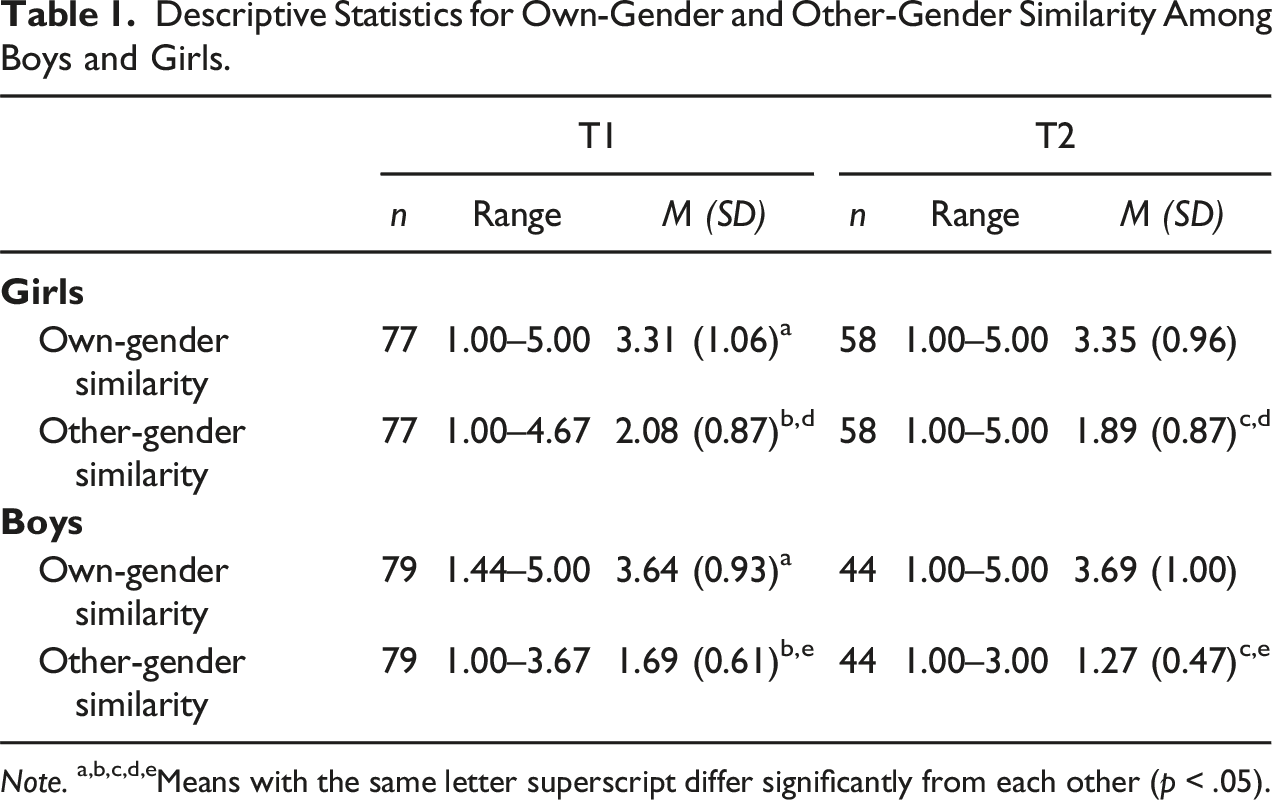
Note. a,b,c,d,eMeans with the same letter superscript differ significantly from each other (p < .05).
Zero-Order Correlations Split by Child Gender.
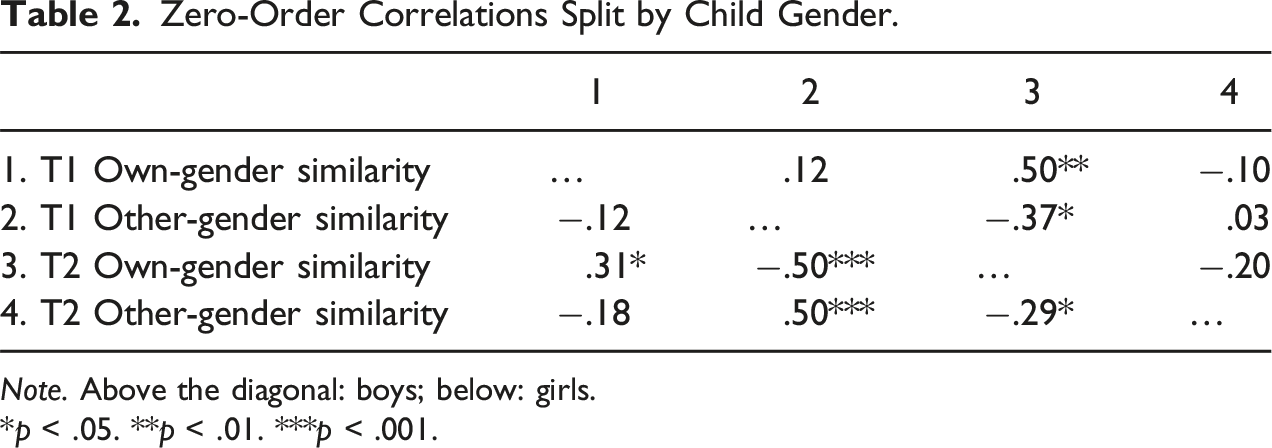
Note. Above the diagonal: boys; below: girls.
*p < .05. **p < .01. ***p < .001.
At both T1 and T2, no statistically significant associations were found between own-gender or other-gender similarity scores and parents’ age, education level, or ethnicity. Additionally, no associations were observed between the income-to-needs ratio and own-gender and other-gender similarity scores at T1. However, at T2, a small positive correlation emerged between the income-to-needs ratio and own-gender similarity (r = .21, p = .04), suggesting that children from more financially secure backgrounds reported higher levels of own-gender similarity at 14 years of age.
Main Analyses
Age-Related Differences in Mean Levels of Own-Gender and Other-Gender Similarity
With regards to own-gender similarity, the mean-level change from T1 to T2 (μΔ ) was not statistically significant in either gender group (girls: μΔ = 0.03, p = .86; boys: μΔ = 0.04, p = .78 ). Furthermore, with regards to between-gender differences on mean-level change, the non-significant Satorra-Bentler test between Models 1 and 1a suggested that the nested model was better fitted to the data (i.e., the equality constraint was tenable; Scaled χ2Δ (1) = 0.01, p = .95). Model 1a was well fitted to the data (see Figure 1 for fit indices). These results suggest that on average, own-gender similarity remains stable from 11 to 14 years of age for boys and girls alike. Model 1a: Two-Group Latent Change Score Model with Mean-Level Change in Own-Gender Similarity Constrained to Equality. Note. aCore assumptions of the analysis that were specified in the model. 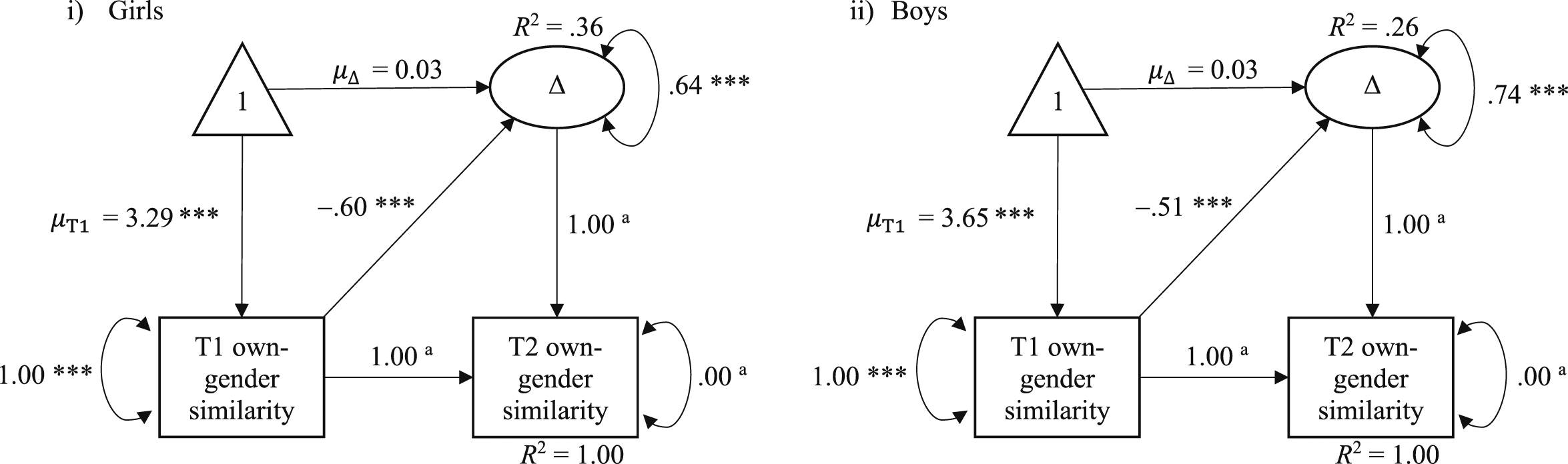
With regards to other-gender similarity, the mean-level change from T1 to T2 (μΔ ) was statistically significant in both gender groups (girls: μΔ = −0.24, p = .03; boys: μΔ = −0.42, p < .001). Thus, other-gender similarity decreased on average between 11 and 14 years of age. Regarding gender comparisons, however, the non-significant Satorra-Bentler test between Models 2 and 2a suggested that boys and girls did not significantly differ in their extent of other-gender similarity mean-level change (Scaled χ2Δ (1) = 1.52, p = .22). Model 2a was therefore better fitted to the data, suggesting that the mean-level change equality constraint was tenable (see Figure 2). Thus, on average, other-gender similarity equally decreased from 11 to 14 years of age among boys and girls. Model 2a: Two-Group Latent Change Score Model with Mean-Level Change in Other-Gender Similarity Constrained to Equality. Note. aCore assumptions of the analysis that were specified in the model. 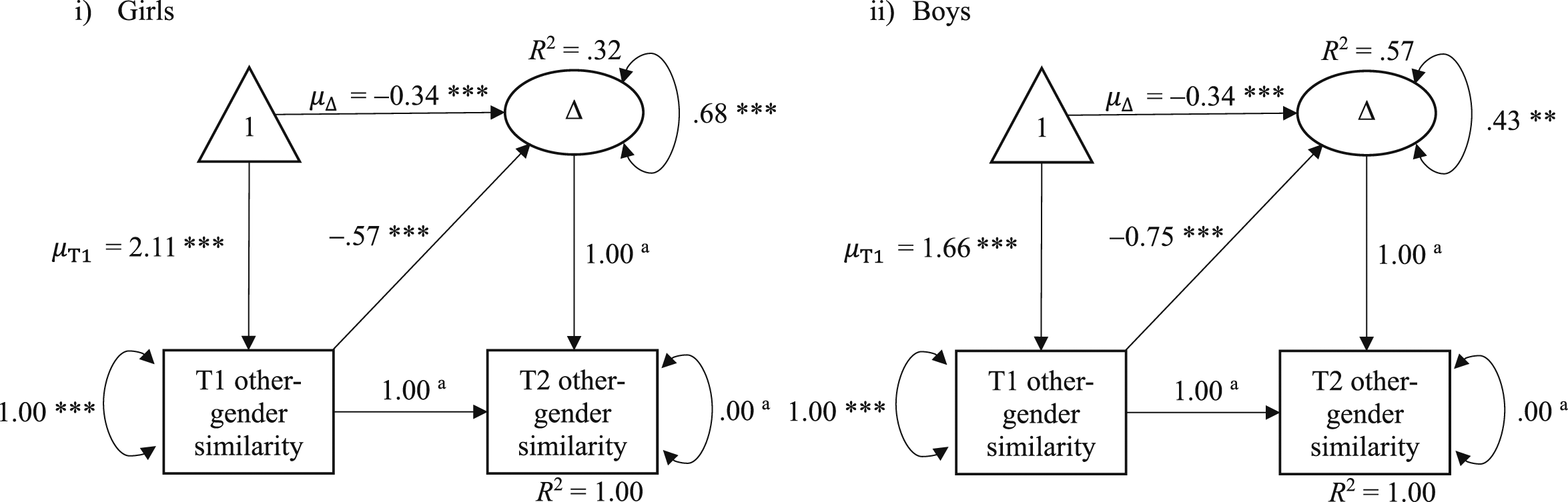
Temporal Associations Between Perceived Own- and Other-Gender Similarity
As displayed in Figure 3, no relation was found between T1 own-gender similarity and T2 other-gender similarity for either gender group (above and beyond the stability of other-gender similarity, which was moderate among girls). However, there was a significant negative link between T1 other-gender similarity and T2 own-gender similarity (controlling for T1 own-gender similarity) in both gender groups. At equal levels of own-gender similarity at T1, boys and girls who scored higher on other-gender similarity at T1 reported significantly lower levels of own-gender similarity at T2. Temporal associations and rank-order stability: Two-group autoregressive cross-lagged models. *p < .05. **p < .01. ***p < .001.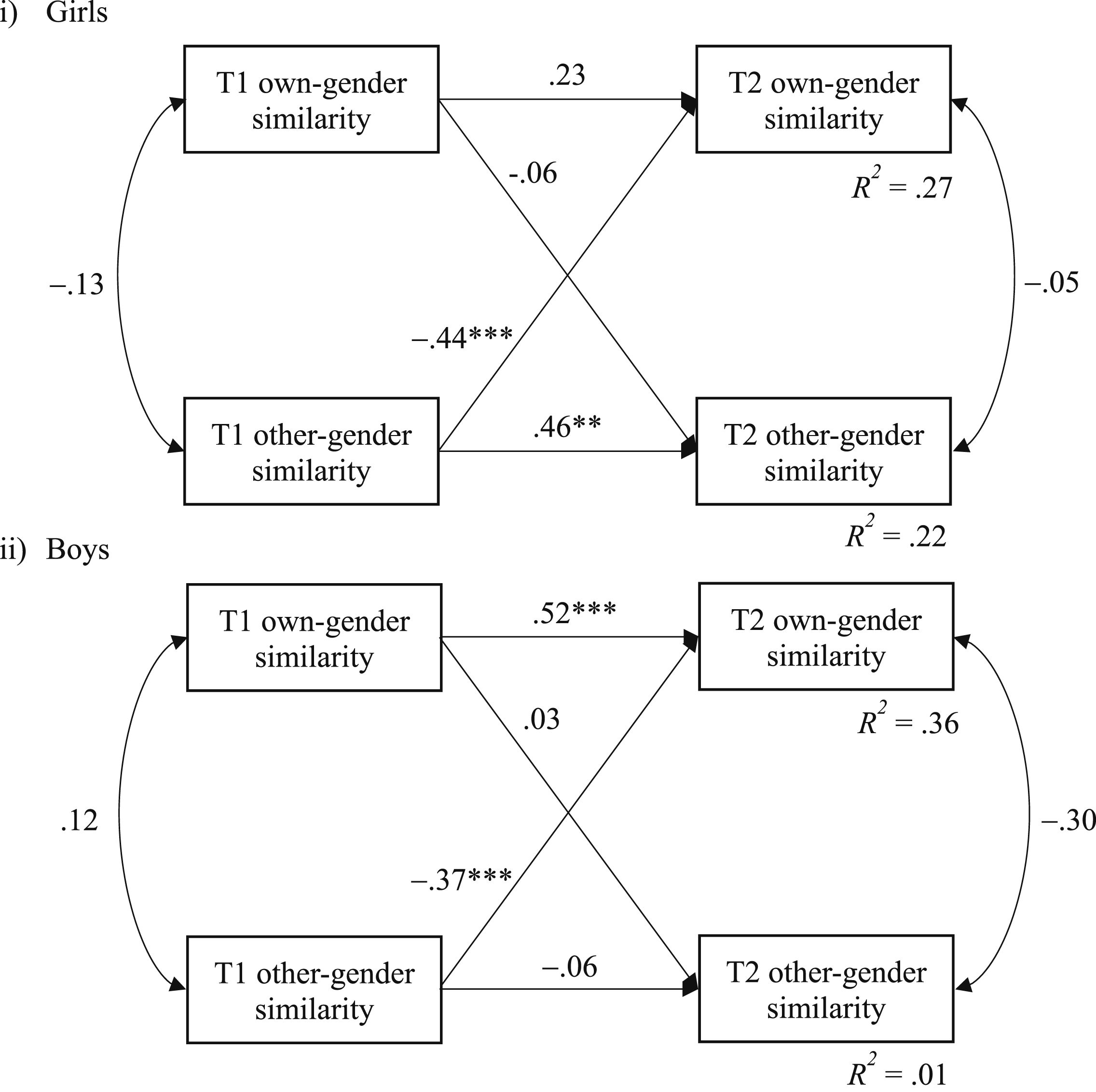
Discussion
Given the many social and physical changes that accompany the early teenage years, along with evidence for age-related differences in own- and other-gender similarity during childhood and early adolescence, it is surprising that studies have not yet examined these developmental patterns longitudinally as children transition from late childhood into early adolescence. The main purpose of this study was to document the developmental progression of perceived own-gender and other-gender similarity among boys and girls between the ages of 11 and 14 years. Our findings provide further evidence that both own-gender and other-gender similarity should be considered in developmental studies. In fact, from a developmental standpoint, the other-gender similarity dimension shows an especially interesting pattern of evolution.
Starting with the examination of own-gender and other-gender similarity mean levels, our results largely align with those found in cross-sectional studies. Specifically, own-gender similarity was higher than other-gender similarity at both timepoints across gender groups (Gülgöz et al., 2019; Martin et al., 2017; Nielson et al., 2024). Additionally, girls reported higher mean levels of other-gender similarity compared to boys at both 11 and 14 years of age (Nielson et al., 2024). However, boys reported higher levels of own-gender similarity at 11 years of age compared to girls, but equal levels at 14 years of age. These results contrast with Nielson et al. (2024), who found no significant differences between the gender groups in childhood, and higher levels of own-gender similarity among boys (compared to girls) in early adolescence. In addition to sampling differences, variation in study design (i.e., cross-sectional vs. longitudinal) might account for these differences. All in all, the current pattern of results is generally consistent with the existing gender similarity literature and suggests, as expected, that boys exhibit higher gender-related rigidity compared to girls (Egan & Perry, 2001; Gülgöz et al., 2019; Martin et al., 2017; Nielson et al., 2024; Trautner et al., 2005).
Continuing with mean-level changes at the group level, we observed that while own-gender similarity remained stable on average from late childhood to early adolescence, other-gender similarity decreased within both gender groups. Thus, on average, both boys and girls felt increasingly dissimilar to members of the other gender group as they progressed into early adolescence, while their perceived similarity to their own gender group remained stable across the same years. These findings, that contrast with those reported by Martin et al. (2017) in childhood and Nielson et al. (2024) in early adolescence (who found that age differences in own-gender and other-gender similarity were gender-specific), reiterate the importance of longitudinal research to directly test apparent developmental patterns that are suggested by cross-sectional designs. As average group trends often mask meaningful individual differences, though, we next examined how these average age-related trends played out at the individual level.
At the individual level, when examining the temporal associations between own-gender and other-gender similarity, we observed a cross-over effect for both gender groups. Specifically, we found moderate negative associations between other-gender similarity at 11 years and own-gender similarity at 14 years. In other words, the more a child (boy or girl) felt similar to members of the other gender group at age 11 years, the less they perceived themselves as similar to their own gender at 14 years (independent of initial levels). Interestingly, the cross-over effects were larger than the concurrent associations for both gender groups. This pattern of results suggests the presence of a directional developmental process, wherein other-gender similarity might influence the unfolding of own-gender similarity among boys and girls alike. As posited earlier, gender-similarity-dependent homophily and decreased exposure to own-gender peers may be mechanisms behind this developmental process. As youths tend to befriend peers with whom they share similarities (Nielson, Flannery, et al., 2020), those who initially reported higher levels of other-gender similarity may have had more other-gender friends and thus interacted less with members of their own gender category. The decreased exposure to members of their own gender group may have contributed to reduced feelings of similarity with their own-gender peers over time, as was reported in childhood (Martin et al., 2024). This explanation is speculative, though, and, more research is needed to elucidate the mechanisms behind this cross-over effect.
While the results suggest a directional developmental process from other-gender similarity to own-gender similarity, it is currently difficult to interpret why the reverse relationship was not found. Perhaps other factors may better account for variations in other-gender similarity development between 11 and 14 years of age, such as peer pressure, gendered parenting, pubertal development, and sexual orientation or romantic interests (Dittman et al., 2023; Nielson et al., 2020, 2022; Steensma et al., 2011). Moreover, rather than a direct cross-over effect, it may be that own-gender similarity at 11 years of age predicts other-gender similarity three years later only under conditions of initially low or high levels of other-gender similarity. In other words, other-gender similarity at 11 years of age may moderate the relation between own-gender similarity at 11 years and other-gender similarity three years later. Future research based on well-powered studies should examine how initial pairings of own-gender and other-gender similarity levels (i.e., gender similarity profiles; Martin et al., 2017) are longitudinally associated with own-gender and other-gender similarity development in early adolescence.
Aside from the main results pertaining to the research questions, other interesting patterns were observed in the data. Notably, in contrast to girls, almost none of the variance in boys’ other-gender similarity at 14 years was explained by the cross-lag model (R 2 = .01). The more restricted range and variability in boys’ compared to girls’ observed scores (Table 1)—perhaps due to social desirability as it is socially costly for boys to exhibit non-gender conforming behaviors (Kågesten et al., 2016; Nielson et al., 2022; Nielson, Schroeder, et al., 2020)—may partly explain these null findings. Yet, the factors mentioned above (peers, parenting, puberty) may also be more relevant in accounting for individual differences in other-gender similarity among early adolescent boys than girls (e.g., Amin et al., 2018; Blakemore & Hill, 2008; Kågesten et al., 2016; Thomsen et al., 2022; Yu et al., 2017).
Strengths and Limitations
The current study has several strengths, notably the longitudinal design and the use of state-of-the-art statistical models to assess own-gender and other-gender similarity development separately, both at the average and individual levels, and the characterization of these patterns by gender. To our knowledge, this is also the first longitudinal study to examine such questions during the early adolescent years.
As with all research, however, this study has some limitations. Our initial sample size was relatively small. Combined with the attrition rate of 34.6% between time points and the somewhat limited variability in responses among boys, statistical power may have been insufficient to detect small-size effects. However, this was mitigated by the use of the FIML methodology that allowed the analyses to return the most probable parameters given the assumption of multivariate normality and the proposed theoretical model (Tabachnick & Fidell, 2019). The sample was also primarily White and middle-class, precluding the examination of sociocultural differences. One study suggested that the repercussions of violating gender norms varied across different cultural settings (Yu et al., 2017); thus, future work should strive to identify differences in perceived own-gender and other-gender similarity development among young adolescents of diverse sociocultural backgrounds.
Moreover, while the current study documented the developmental progression of own-gender and other-gender similarity during early adolescence, the mechanisms behind these patterns were not examined. Future studies should focus on elucidating how social and biological factors, especially peer socialization and pubertal development, contribute to the variability and change in own-gender and other-gender similarity among early adolescent boys and girls.
Lastly, as mentioned previously, a shortened version of the PSGG measure was used. Although previous work using the same shortened version found comparable internal consistency indices to those of the complete scale (Lemelin et al., 2021; Martin et al., 2017), the validity of this shortened scale would benefit from psychometric work. In fact, the current findings provide initial validity data, in that the basic properties of the scores were consistent with those found by other studies using the original scale. Specifically, when combining both gender groups, own-gender and other-gender similarity were found to correlate moderately negatively, albeit only at Time 2 (r = −.29, p = .003). Moreover, at both time points, the participants reported higher levels of own-gender than other-gender similarity and boys reported significantly lower levels of other-gender similarity than girls. These results converge with those obtained with the full-length scale (see Gülgöz et al., 2019; Martin et al., 2017; Nielson, Flannery, et al., 2020; Nielson, Schroeder, et al., 2020) and thus provide confidence in the validity of observed scores and ensuing results. Nevertheless, it is important to note that the measure had a visually different format across both time points (though its content was identical). Given this visual discrepancy, caution may be warranted when interpreting the results.
Conclusion
In sum, the current study documents the developmental progression of boys’ and girls’ perceived own-gender and other-gender similarity at the average and individual levels during the early adolescent period. As own-gender and other-gender similarity follow different developmental patterns at both the intra- and inter-individual levels, the current findings underscore the relevance of assessing gender similarity using the dual identity approach. Indeed, both dimensions appear to be needed to capture a comprehensive picture of the development of early adolescents’ gender similarity. This study also constitutes a starting point for the exploration of developmental mechanisms and possible cross-over influences between own-gender and other-gender similarity and adds to the breadth of knowledge on gender identity development throughout the lifespan.
Supplemental Material
Supplemental Material - Developmental Progression of Perceived Gender Similarity in Early Adolescence
Supplemental Material for Developmental Progression of Perceived Gender Similarity in Early Adolescence by Gabrielle Leclerc, Annie Bernier, Carol L. Martin, and Fanny Dégeilh in The Journal of Early Adolescence
Footnotes
Declaration of Conflicting Interests
The author(s) declared no potential conflicts of interest with respect to the research, authorship, and/or publication of this article.
Funding
The author(s) disclosed receipt of the following financial support for the research, authorship, and/or publication of this article: This work was supported by the Natural Sciences and Engineering Research Council of Canada (RGPIN-2019-05084), Canadian Institutes of Health Research (MOP-119390), Social Sciences and Humanities Research Council of Canada (410-2010-1366, 435-2016-1396), and Fonds de Recherche du Québec-Société et Culture (2012-RP-144923).

Supplemental Material
Supplemental material for this article is available online.
Author Biographies
References
Supplementary Material
Please find the following supplemental material available below.
For Open Access articles published under a Creative Commons License, all supplemental material carries the same license as the article it is associated with.
For non-Open Access articles published, all supplemental material carries a non-exclusive license, and permission requests for re-use of supplemental material or any part of supplemental material shall be sent directly to the copyright owner as specified in the copyright notice associated with the article.
