




Abstract
This study examined whether social mistrust in early adolescence was general or referent-specific. We used a multi-trait multi-method approach to examine the validity of mistrust measures across social referents (mistrust toward people in general, toward peers, and toward teachers), using questionnaires and an online task. Sixth graders (N = 1243, ca. 11–13 years) in southern China reported about mistrust (i.e., general, teacher and peer), their social anxiety and aggression. Part of the students (N = 262) played an online trust game against a virtual, unfamiliar peer. Confirmatory factor analyses showed that mistrust was distinguishable across referents. All referents of mistrust were significantly associated with social anxiety and aggression, whereas only peer mistrust was associated with peer-trust behavior in the online game. As such, our findings may underscore the referent-specificity of mistrust in early adolescence. Insights for promoting healthy school adjustment were discussed.
Introduction
Mistrust refers to a tendency to see other people as selfish, unreliable, and having malevolent motives (Omodei & McLennan, 2000). Severe mistrust includes harm or threat appraisals that precede negative emotions and hostile behaviors, such as anxiety, fear, anger, less happiness, withdrawal, and aggression (Caballero et al., 2023; Campbell et al., 2013; Erhardt et al., 2021; LaMotte et al., 2016; Lazarus, 1991; Tokuda & Inoguchi, 2008). People who mistrust others tend to feel unsafe and have fears of novel situations or unknown people (Freeman et al., 2008). People with more severe mistrust display more vigilance for cues of hostility, social and physical threats, tend to be suspicious, and expect others to harm their well-being (Schniering & Rapee, 2002; Wong et al., 2014). Prospectively, mistrust in children predicts lower well-being and behavioral maladjustment over their life span, such as problems in social interaction and violent criminal behaviors (Dodge et al., 2022). Thus, excessive mistrust seems to be detrimental to individual well-being and functioning. Studying mistrust in early adolescence may therefore help to protect against aggression, anxiety, low self-esteem, less intimate friendships, and callous-unemotional traits (Levy-Tossman et al., 2007; Rotenberg & Fonseca, 2023; Verhoef et al., 2023; Wong et al., 2014), as well as enhance intervention effectiveness (Li et al., 2022) and more open-minded attitudes toward critical feedback from others (Yeager et al., 2014).
Social Mistrust in Early Adolescence
Mistrust has mostly been studied in adulthood (Breakwell, 2021; Freeman et al., 2005). However, to prevent the development of excessive forms of mistrust, studying mistrust in early adolescence may benefit prevention and provide cost-effective early interventions (Barkus et al., 2022). Social mistrust is a memory structure that develops during childhood and adolescence, and is proposed to have its origin in children’s social experiences (Young et al., 2003). Children’s social experiences coalesce into a memory database, within which their generalized affective, cognitive, and behavioral experiences form the basis for their overarching anticipation of others’ intentions. In turn, these generalized expectations then determine how children encode and appraise others’ motives by guiding their social information processing (Beck et al., 2004; Crick & Dodge, 1996; Verhoef et al., 2022). For example, when children have had negative social experiences, they may develop negative expectations that generalize into a mistrust schema. Consequently, this schema will make them hypervigilant and suspicious toward their surroundings, more likely to attribute hostile intent to other people, to have a hostile relationship orientation, and to display more aggressive behaviors (Burks et al., 1999; Calvete & Orue, 2012; Omodei & McLennan, 2000; Verhoef et al., 2023). Furthermore, mistrust triggers a hypervigilant and suspicious social information processing style that can activate a vicious cycle. In this cycle, the negative expectations, the resulting hostile behaviors, and the negative responses of the environment can strengthen each other over time (Dodge, 2006; Lansford et al., 2010).
It is widely recognized that (mis)trust schemata start to develop during the first years of life (Bowlby, 1962, 1973; Erikson, 1978). Later in life, early adolescence (i.e., around 10–15 years old, Sawyer et al., 2018) may be another critical phase for building trust or breeding mistrust (Blum et al., 2014). Early adolescents have a strong desire to satisfy social needs, and to form close and supportive relationships with others outside the family (Midgley & Urdan, 1992). They tend to be sensitive to others’ evaluations, are inclined to be more susceptible to peer pressure, and try to clarify what their roles are in society (Brown et al., 2008; Perry, 1995). Yet, as early adolescents’ cognitive capacities are still developing and they are susceptible to negative social experiences (Crone et al., 2020), they may unwittingly overgeneralize specific experiences to all social relations. Furthermore, early adolescents become more capable of using abstract reasoning to generalize specific social experiences to beliefs about unfamiliar others (Spears Brown & Bigler, 2005; Killen et al., 2007). As such, mistrust beliefs are considered to undergo rapid development during early adolescence.
It is not yet known, however, to what extent mistrust is generalized in early adolescence. Thus, in early adolescence, one important question is whether mistrust is a general or a referent-specific construct consisting of specific mistrust schemas for particular groups of people (e.g., teachers and peers). Previous studies mostly conceptualized and measured social mistrust as a more general construct, assuming one mistrust schema would fit all others (Calvete & Orue, 2012; Muris, 2006; Verhoef et al., 2023), rather than distinct schemata for specific groups of people. As far as we know, only a few studies have investigated social mistrust at a more specific level and distinguished one schema into distinct schemata for different contexts (Wong, 2014, 2017; Zhou et al., 2018). For example, in the study of Wong et al. (2014), 8- to 14-year-olds in the United Kingdom and Hong Kong reported about their general mistrust (i.e., “mistrust toward most people in general”), as well as mistrust at school and at home. Across these contexts, confirmative factor analyses showed that mistrust across contexts were clearly distinguishable, correlations ranged from .58 to .80, and the correlations between school and general mistrust were moderate.
Given that mistrust can be context-specific, children may also have different expectations about different groups of people in one context. On the one hand, early adolescents’ abstract thinking is rapidly developing, but it still may have its flaws and may result in overgeneralization, that is, thinking that if one person can’t be trusted, no one can be trusted. On the other hand, as early adolescents tend to become more focused on peers and adults outside the home context, they may begin to distinguish between different contexts (home vs. school) and between people with different social roles (adults vs. peers) in their mistrust schemata. In the present study, we focused on the school context, as school comprises an important part of early adolescents’ waking hours. At school, early adolescents come into contact with different groups of people (Roffey, 2012), of which teachers and peers are the two most important—teachers and peers tend to play different roles in the lives of early adolescents, and both groups of people have clearly distinguished roles and responsibilities in the school environment (Engels et al., 2016; Goodenow, 1993; Leflot et al., 2011; Roorda et al., 2017). It is likely that early adolescents have different ideas about what acceptable social behaviors are for peers versus teachers, and which kinds of interactions can be expected from these groups of people (Nesdale & Lawson, 2011; Pehar et al., 2020). Hence, early adolescence may develop distinct mistrust schemata for peers versus teachers.
Having negative social experiences with some others does not necessarily lead to mistrust of all others. Early adolescents’ reactions to others may be guided by group-specific mistrust, as they may project their negative experiences onto a particular group of others, but not onto everyone. As far as we know, however, the more specific level of mistrust in early adolescence, particularly in the school context, has not been empirically tested. Therefore, in the present study, we examined whether mistrust toward peers and mistrust toward teachers are distinct schemata, or rather common parts of one mistrust schema.
Hypotheses
The present study aimed to investigate whether mistrust in early adolescence is general (i.e., mistrust toward others) or referent-specific (i.e., mistrust specifically toward peers or teachers). Based on the schema theory and the hierarchy structure of mental representation (Sibley & Overall, 2008), as well as the study of Wong et al. (2014), we hypothesized that early adolescents’ mistrust schemata would be referent-specific, and exhibit a certain level of hierarchy at the same time. That is, early adolescence would show both context-specific and referent-specific mistrust. Within the school context, early adolescence may have different beliefs about their teachers versus peers. In addition to school mistrust, mistrust toward most people in general would also differ from school mistrust. To test this hypothesis, we compared four models, as depicted in Figure 1. These models were built up in complexity: Model 1 had all items loaded on one mistrust factor, Model 2 distinguished two factors were distinguished (general and school mistrust), Model 3 specified three factors (general, teacher, and peer mistrust). In line with the idea of hierarchy (Sibley & Overall, 2008), Model 4 distinguished general mistrust from school mistrust at a higher level, and distinguished teacher mistrust from peer mistrust at a lower level. Four hypothesized models. Note. Model 1: one factor model. Model. 2: two-factor model. Model 3: three-factor model. Model 4: hierarchical model. MG = general mistrust; MT = teacher mistrust; MP = peer mistrust.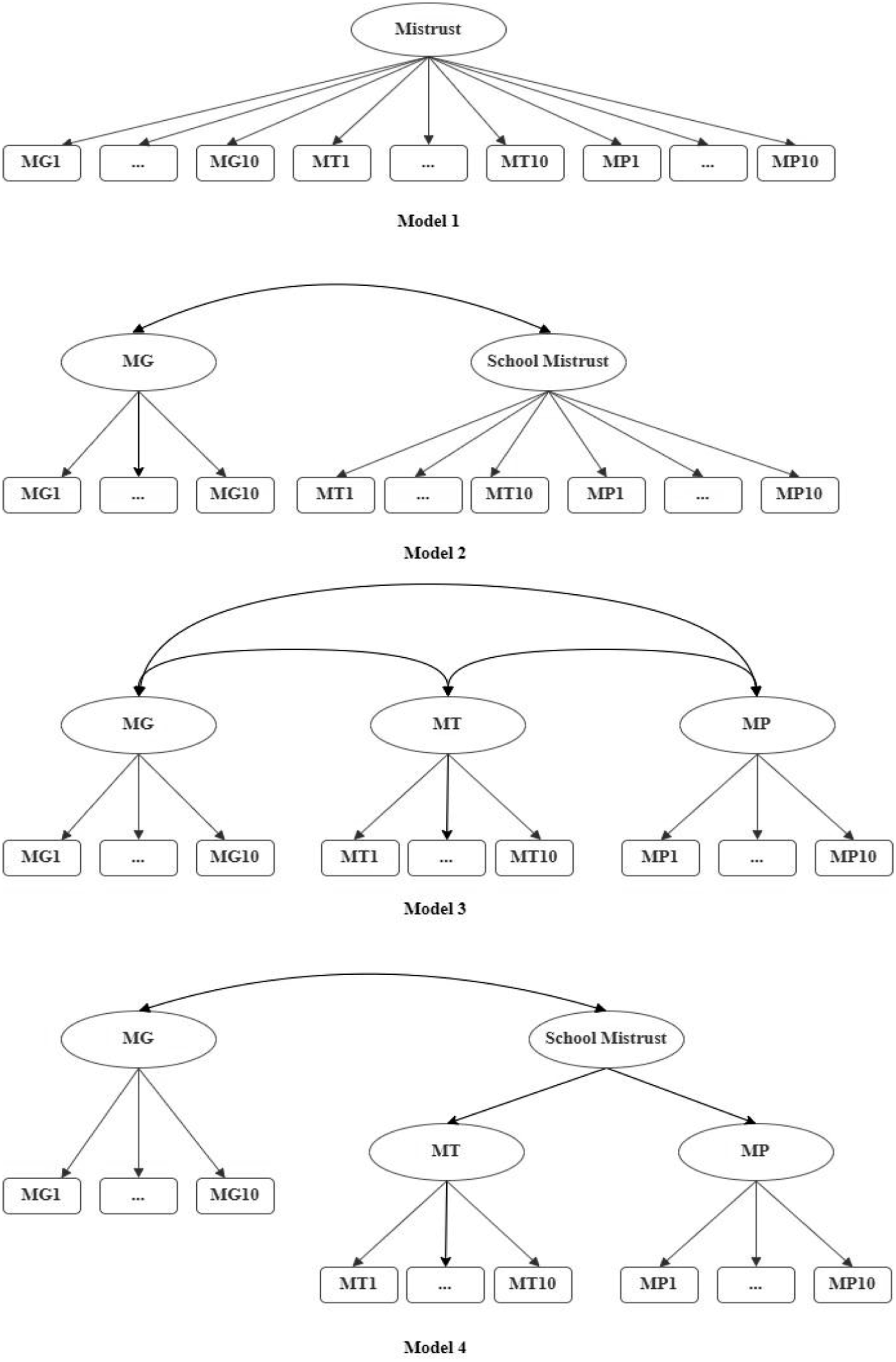
Second, in line with scale validation guidelines (Boateng et al., 2018), we tested the convergent and discriminant validity of general, teacher, and peer mistrust. In terms of convergent validity, we tested the associations of mistrust with aggression and social anxiety. Based on previous research (e.g., Tremblay & Dozois, 2009; Wong et al., 2014), we expected all referents of mistrust to be positively associated with aggression and social anxiety. Concerning discriminant validity, we tested the associations between early adolescents’ self-reported mistrust and their peer-trust behavior in an online trust game against a virtual unfamiliar peer, based on Berg et al.’s (1995) paradigm. We included this online game to ensure that our questionnaire assessments of mistrust validly correspond with actual real-life mistrust behavior toward peers. We expected that peer mistrust, but not teacher mistrust, would be negatively associated with the peer-trust behavior in this game.
Method
Participants
Participants in this cross-sectional study were 1243 sixth graders (50.7% girls, 48.6% boys, with 9 students identifying as “other”) aged 9–14 years (
Procedure
The study was approved by the Ethics Review Board of the University of Amsterdam. As there was no national official ethical committee in China at the time of data collection, we also asked an independent Chinese senior researcher to review and declare that the data collection procedure complied with the laws and rules in China. Data were collected in 2022 as a pilot and the spring of 2023 (65.7% of the participants) as the first wave of a longitudinal study by trained research assistants who were closely supervised by the first author. The schools were approached through personal networks. After schools agreed to participate in the study, students’ parents received an information letter and were given the opportunity to object to their child’s participation in this study. Participants completed a questionnaire once about their general, teacher, and peer mistrust, as well as their social anxiety and aggressive behaviors. Before completing the questionnaire, students first watched an instruction video, and research assistants were available to answer possible questions. The entire questionnaire took approximately 30 minutes to complete. Only the participants in the spring semester and in the schools that agreed to do online tasks (N = 262) played a trust game on the computer directly after completing the questionnaire.
Measures
Social Mistrust
Students reported about their mistrust toward people, teachers, and peers on a selection of items from the Social Mistrust Scale (Wong et al., 2014) and the Hostile Belief Scale (Verhoef et al., 2023). The Social Mistrust Scale measures generalized mistrust (suspiciousness) across three contexts (i.e., general mistrust, school mistrust, and home mistrust). Example items are “Do you think others try to harm you at home/school?” and “Do you ever think that someone is following you or spying on you at home/school?” A Chinese version of the Social Mistrust Scale is available, which has shown adequate reliability and validity in previous research (Zhou et al., 2018). The Hostile Belief Scale measures mistrust with more behavior-specific items that reflect hostility; example items are “Others are always trying to make me angry” and “Others are often unfair to me.” These items were translated from Dutch into Chinese with a back-translation procedure. Previous research supported the internal consistency of this questionnaire (Verhoef et al., 2023).
As participants had to complete the mistrust items three times (for others in general, teachers, and peers), we limited our selection of items to 10 items per referent. We transformed some questions from the Social Mistrust Scale into statements to make the format of the items the same (e.g., “Others try to harm me”). Furthermore, we made the statements specific for the three referents that were the focus of the present study. Example items are “Most people/teachers/peers are against me” and “Most people/teachers/peers are out to get at me” (see Appendix 1 for all items). Participants answered the items on a five-point Likert scale, varying from 1 (No, that is not true) to 5 (Yes, that is true). In the present study, Cronbach’s alphas were .87, .89, and .89 for mistrust toward people in general, teachers, and peers, respectively.
In the pilot in the spring semester (n = 281), students also answered which people they were thinking of when they reported mistrust. A majority of students thought about familiar people (90.3%) and some students thought about strangers (18.9%) in general mistrust. A majority of students thought about familiar teachers (88.1%) and some student thought about unknown teachers (18.9%) in teacher mistrust. A majority of students thought about peers at school (60%) in peer (child) mistrust. Some students thought about unknown peers (9.7%), 42.2% familiar peers, and 3.7% siblings. According to these answers, students mainly thought about teachers and peers at school, only a small amount of students also reported that they thought about teachers (0.9%) and peers (5.1%) outside school (e.g., piano teachers in interest classes, teachers in shadow education, peers in the neighborhood and siblings). Therefore, we described teacher and peer mistrust as mistrust toward two referents in the school context for clarity.
Social Anxiety
Students reported about their social anxiety on the Social Phobic Disorder dimension of the Screen for Child Anxiety Related Disorders (SCARED, Su et al., 2008). This scale consists of 7 items, for example, “I don’t like to be with people I don’t know well.” Students answered the items on a five-point scale, varying from 1 (No, that is not true) to 5 (Yes, that is true). The psychometric properties of the SCARED are supported by previous research (Birmaher et al., 1997; 1999; Su et al., 2008 in China). In the present study, Cronbach’s alpha for social anxiety was .84.
Aggressive Behavior
Students reported how often they behaved aggressively in the week prior to the data collection, using the teacher-report scale from the Instrument for Reactive and Proactive Aggression (Polman et al., 2009). We adapted the description of this scale from the teacher’s perspective to student’s perspective. Students indicated how often they conducted seven forms of aggressive behavior (e.g., kicking, hitting, gossiping) in the past week; for example, “I kicked others in the past week.” Students responded on a five-point scale, varying from 1 (Did not occur) to 5 (Daily). In the present study, Cronbach’s alpha for aggressive behavior was .85.
Peer-trust Behavior
To check the discriminant validity of the mistrust questionnaire, part of the students played an online trust game against an unfamiliar virtual player, who was introduced as a sixth grader from another school (based on Berg et al.’s paradigm, 1995). In this game, participants chose to give any amount of 10 digital coins to the other player. Next, the number of coins participants chose to give to the other player was tripled. The virtual player then returned none, half, or all of these tripled coins to the participant. Thus, if participants correctly trust the virtual player and give it many coins, their generosity is reciprocated with a profit. But if the participants give many coins and the virtual player does not return them, the participants lose many coins. The game had six rounds in total. In the first and second rounds, the virtual player first returned half and next returned all of the tripled coins to the participant; in the third and fourth rounds, the virtual player returned none of the coins to the participant; in the last two rounds, the virtual player returned all of the tripled coins to the participant (see Appendix 2 for a more detailed description). Participants’ decisions in this online game are considered indicative of their trust/mistrust behavior toward peers (Ashraf et al., 2006; James, 2002). In Berg’s paradigm, trust is reflected in behavior that depends on how much one trusts one’s (virtual) opponent in the game. If the opponent is trusted, it makes sense to invest, as in that case the participant will gain points. However, if the opponent is not trusted by the participant, (s)he will not invest any points. Thus, participant behavior directly reflects trust in the other. This assessment is refined further by letting the participant experience trustworthy cooperative and untrustworthy uncooperative behavior from the opponent in different rounds of the game. This allows for a direct assessment of the extent to which trust behavior is influenced by the opponent’s (un)cooperative behavior. Participants with higher levels of social mistrust are assumed to be less inclined to give coins to the virtual player, as they would not expect the virtual player to return the coins to them. We treated trust behavior as a latent variable that was indicated by each of the six rounds of coins that were given to the virtual player (ranging from zero to 10).
Data Analyses
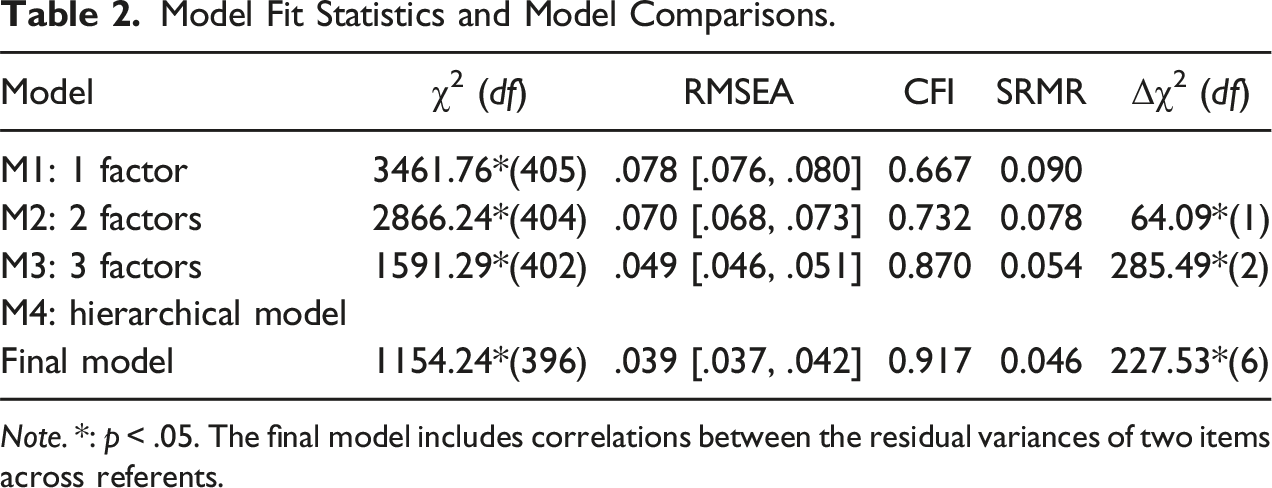
Analyses were performed in Mplus version 8.8 (Muthén & Muthén, 1998-2012). To investigate whether mistrust is referent-specific, we compared the fit indices of the models in Figure 1 step by step (i.e., Model 2 was compared with Model 1, Models 3 and 4 with Model 2). Models 3 and 4 had the same model fit (statistically equivalent) but Model 4 assumed a hierarchical structure (theoretically different). We used chi-squared difference tests to compare nested models, following the Satorra-Bentler correction (Satorra & Bentler, 2010). Additionally, the Root Mean Square Error of Approximation (RMSEA), the Comparative Fit Index (
Next, to investigate the convergent and discriminant validity of the mistrust questionnaire, we added the latent variables for social anxiety and aggressive behavior to the selected model from the previous step. We examined how these latent variables were correlated with the mistrust factors. Lastly, the correlations between the latent variable for peer-trust behavior and the mistrust variables from Step 1 were examined.
To deal with missing data (1.6%) and non-normally distributed variables, we used the Robust Full Information Maximum Likelihood estimation option in Mplus. The intraclass correlations for the mistrust variables were small (ranging from .018 to .095), we used TYPE = COMPLEX to take into account the nested effects in the classrooms. We did not include age as a control variable as it was not correlated with other study variables.
Results
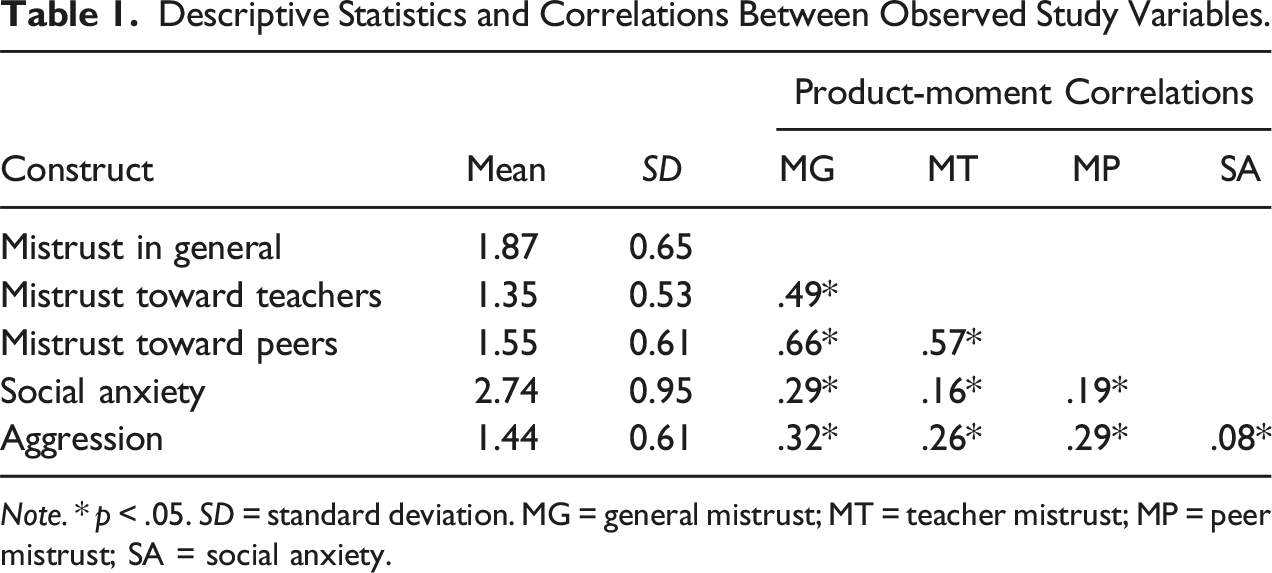
Descriptive Statistics and Correlations Between Observed Study Variables.
Note. *
Referent-specific Mistrust
Model Fit Statistics and Model Comparisons.
Note. *:
Convergent and Discriminant Validity of Referent-specific Mistrust
Figure 2 (a, upper panel) shows the standardized correlations between mistrust, social anxiety, and aggressive behavior (latent variables and standard errors). All three mistrust variables (i.e., general mistrust, teacher, and peer mistrust) were significantly and positively associated with social anxiety and aggressive behavior (small to medium effects, Cohen, 1988). This indicates that students who had a higher level of mistrust tended to be more socially withdrawn and to display aggressive behaviors more frequently. Standardized correlations (standard errors) between latent variables. Note. (a): mistrust with social anxiety and aggression (top). (b): mistrust with peer-trust behavior in the online game (bottom). MG = general mistrust, MT = teacher mistrust, MP = peer mistrust. The dotted lines are factor correlations. **: 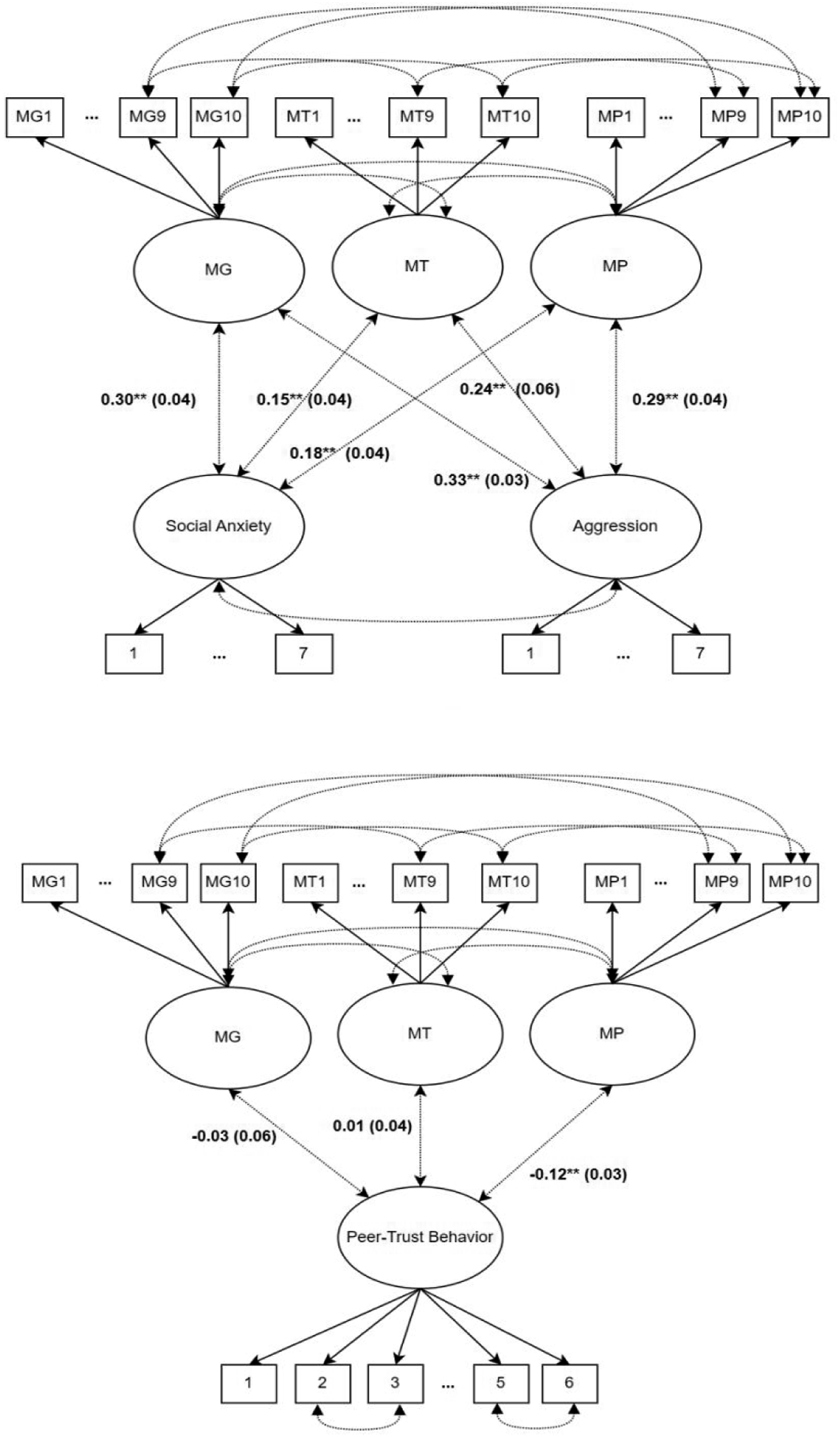
Figure 2 (b, lower panel) presents four latent variables, that is, three mistrust across referents and peer-trust behavior. The peer-trust behavior appeared to be significantly and negatively associated with mistrust toward peers (small effect), but not with teacher mistrust or general mistrust. This indicates that students who were less likely to display trust behavior toward a peer thus had a specifically higher level of mistrust toward most peers, but not toward teachers or others in general.
Discussion
This study examined whether mistrust is a general schema or referent-specific schemata with a certain hierarchy among Chinese early adolescents. This is the first study to demonstrate the context specificity of mistrust in early adolescents, as well as the first study to validate student-reported mistrust on questionnaires with a behavioral trust game. We found most evidence for the models 3 and 4, in which mistrust toward others in general, mistrust toward teachers, and mistrust toward peers formed clearly distinguishable factors. Furthermore, these three mistrust variables were associated with social anxiety, aggressive behavior, and the trust game in the expected directions. Thus, our results seem to offer preliminary support for the convergent and discriminant validity of referent-specific mistrust. These findings are in line with the schema theory and the mental representation theory that mistrust in early adolescence can be manifested by various schemata, and these schemata follow the hierarchy of the general-context-specific structure of the mental representations. As such, referent-specific mistrust seems to be highly relevant for understanding early adolescents’ social behavior with a specific group of people. Although more research on this topic is needed, the results seem to allow some preliminary conclusions.
First, we found support for our hypothesis that mistrust can be a referent-specific construct with a certain hierarchy. More specifically, the three-factor model (Model 3) and the hierarchical model (Model 4) fitted the data better than the one-factor model (single mistrust schema) and the two-factor model (only a distinction between general mistrust and school mistrust). There seems to be not only a difference between general mistrust and school mistrust (Wong et al., 2014). In other words, our results seem to indicate that early adolescents have qualitatively different mental schemata of mistrust toward specific groups or identities of people (Breakwell, 2021; Omodei & McLennan, 2000; Sibley & Overall, 2008), such as teachers and peers. It would be wise for future research to distinguish between different referents of mistrust, as they seemed to be structurally different. Moreover, our analyses showed that adding residual correlations between two items across referents that reflected suspiciousness improved the model fit substantially. Mistrust may be mainly manifested by both hostile beliefs and suspiciousness across referents, meaning that frequently having hostile thoughts with more suspiciousness may indicate more severe mistrust. Future larger-scale studies using more diverse samples within China and other countries may be helpful to test this preliminary conclusion. For practice, the findings suggest that adjustment prevention or intervention programs might be more effective when specific contexts are narrowed down, and specific referents of mistrust (groups of people) are targeted. For example, if students mistrust their teachers, it would be most cost-effective to focus prevention or intervention programs on hostile and suspicious thoughts about teachers rather than about peers or people in general.
Second, all three mistrust variables (general mistrust, teacher mistrust, and peer mistrust) were uniquely associated with both social anxiety and aggressive behavior. More specifically, participants with higher levels of mistrust also reported more social anxiety (Wong et al., 2014) and more aggressive behavior (Rotenberg & Fonseca, 2023; Verhoef et al., 2023; Wong & Raine, 2019). This did not only apply to mistrust about people in general but also to mistrust toward peers and teachers. These results seem to offer preliminary support for the convergent validity of the referent-specific mistrust items. For practice, our findings suggested that measuring early adolescents’ referent-specific mistrust might be useful to locate students who are at risk for emotional and behavioral maladjustment. More longitudinal research is needed, though, to find out whether referent-specific mistrust has long-term effects on students’ social anxiety and aggressive behavior.
Third, as expected (Gao, 2018; Naef & Schupp, 2009; Xin et al., 2013), the latent variable for peer-trust behavior was significantly associated with peer mistrust but not with teacher mistrust or general mistrust. Our finding supports the discriminant validity of the referent-specific mistrust questionnaire. Furthermore, this suggests that self-reported peer mistrust as a schema plays a role in students’ trust decision-making in a specific new situation (the game). Abstract schemata about referent-specific mistrust may play a role in early adolescents’ actual behaviors in situations toward specific groups of people. It would therefore be interesting for future research to further examine the link between mistrust schemata and actual trust behaviors, although weak correlations might be found due to certain discrepancies between individuals’ actual behavior and self-reports of their general impressions (Baumeister et al., 2007).
Our findings on the importance of peer mistrust and trust fit in well with our growing knowledge of the processes involved in the dynamics and quality of peer relations. For example, mistrust may play an important mediating role in the literature on relations between rejection by peers and consequent aggressive behavior. Likewise, trust in peers may be an important factor to consider when studying and intervening with group dynamics involved in bullying participant roles in the classroom.
Moreover, the distinction we found between trust toward peers and trust toward adults may provide inroads for a better understanding of how the central role of trust in parents gradually shifts to an additional emphasis on trust in peers and important non-parental others from early adolescence. For instance, exploring mistrust in general and social mistrust specifically toward significant non-parental adult referents (e.g., teachers) is encouraged, as they represent important avenues for further investigation of social adjustment outside the home context.
Two main features of the present study may limit the conclusions we can draw about the structure of social mistrust. First, this study was conducted in one province in southern China. As such, more research is needed to examine whether our findings will be able to generalize to other provinces of China (Zhang, 2012), and different countries. Second, this study was cross-sectional. To test mistrust construct stability and causality between mistrust, social adjustment and relationships, further longitudinal and experimental studies are needed to assess the development and malleability of mistrust over time.
Conclusion
This is the first study that attempted to disentangle early adolescents’ mistrust into different referents. The findings suggest that studying referent-specific mistrust in early adolescence provides more perspectives for us to understand mistrust. This measure of referent-specific mistrust allows us to explore further how these different referents of mistrust can relate to daily antisocial and prosocial behavior toward a specific group of people in a novel situation. In the school context, it can be valuable to explore how maladaptive behavior relates to more severe mistrust in different referents, and identify some key factors in the development of mistrust schemata. For example, future studies can investigate how these schemata and social aspects change when students develop over time (Wang et al., 2021). Based on such studies, we can contemplate targeted mistrust prevention or intervention strategies, which may be valuable in promoting healthy school adjustment in early adolescence.
Supplemental Material
Supplemental Material - Is Mistrust in Early Adolescence Referent-specific? Looking at the Validity of Different Mistrust Referents in Sixth Graders
Supplemental Material for Is Mistrust in Early Adolescence Referent-specific? Looking at the Validity of Different Mistrust Referents in Sixth Graders by Jiajun Mo, Debora L. Roorda, L. Andries van der Ark, and Bram Orobio de Castro in The Journal of Early Adolescence
Footnotes
Author Contributions
All authors contributed to the study conception and design. Jiajun Mo collected the data. Data analyses were performed by Jiajun Mo; Debora L. Roorda, Bram O. de Castro and L. Andries van der Ark provided useful advice in data analyses and interpretation. The first draft of the manuscript was written by Jiajun Mo and all authors commented on subsequent versions of the manuscript. All authors read and approved the final manuscript.
Declaration of Conflicting Interests
The author(s) declared no potential conflicts of interest with respect to the research, authorship, and/or publication of this article.
Funding
The author(s) disclosed receipt of the following financial support for the research, authorship, and/or publication of this article: This work was supported by the CSC scholarship offered by the China Scholarship Council in collaboration with the University of Amsterdam.
Ethical Statement

Supplemental Material
Supplemental material for this article is available online.
Author Biographies
References
Supplementary Material
Please find the following supplemental material available below.
For Open Access articles published under a Creative Commons License, all supplemental material carries the same license as the article it is associated with.
For non-Open Access articles published, all supplemental material carries a non-exclusive license, and permission requests for re-use of supplemental material or any part of supplemental material shall be sent directly to the copyright owner as specified in the copyright notice associated with the article.
