




Abstract
This study examines the role of perceptions of physical ability on collaboration networks in physical education through three distinct lenses: self-concept, peer assessments, and teacher ratings. The interplay of these perspectives on team partner nominations is analyzed using exponential random graph models, while taking into account variables such as liking networks and gender associations. Drawing upon a sample of 302 adolescents across 14 high-school classes, the results reveal that physical ability is significantly linked with choices for team partners, indicating that high and similar performing peers are more likely to be chosen as team partners. Furthermore, only peer perceived ability was found to be predictive of social relationships in physical education, while the self and teacher perspectives show no significant effects on collaboration choices in sports games. These findings highlight the important role of academic norms, such as physical ability, for peer relations in physical education.
Adolescents strive for attention, admiration, and respect from peers in order to reach a high social status (Coleman, 1961) - a characteristic tied to their placement in a hierarchy of esteem (Martin & Murphy, 2020). In school, lessons and extracurricular activities serve as environments where social status, whom students choose to associate with or avoid, is created and operationalized by peer networks (e.g., Cillessen & Marks, 2011; McFarland et al., 2014). Within these networks, the role of peer norms becomes increasingly apparent, shaping various aspects of academic behaviors, social dynamics, and even friendship selection processes (Laninga-Wijnen et al., 2017; Shin & Ryan, 2014). These norms serve as essential rules that guide adolescents in conforming to peer expectations and avoiding the stigma of being labeled a social outcast (Veenstra & Laninga-Wijnen, 2022). Against this backdrop, the importance of possessing high physical ability often emerges as a significant social norm within the realm of physical education (e.g., Dunn et al., 2007; Hollett et al., 2020). High social status in physical education is important not only for one’s well-being and enjoyment during play (Jiao et al., 2017), but also for overall health and engagement in physical activities beyond the school environment. Students hold a unique position to observe their peers’ academic performance and effort that might offer them insights that traditional measures like grade point averages or teacher ratings cannot identify (Gest et al., 2008).
To understand the role of physical ability on peer relationships in physical education, we conducted a cross-sectional social network study on 302 adolescents in 14 high-school classes. Specifically, we highlighted three perspectives of ability – physical self-concept, peer assessment and teacher rating – to separately analyze distinct effects on the sports game network while controlling for liking and gender associations. Before elaborating our research question, we first explore the emergence of academic norms within peer networks in physical education and then address the multifaceted operationalization of physical ability in the literature of sports research.
Academic Norms in School
When considering the dynamics of peer relationships in middle schools, it becomes evident that these relationships can profoundly influence the formulation of academic norms. These norms represent the collective agreement within a group regarding the frequency and perceived appropriateness of behaviors in an educational context, such as active participation in school activities and the attitude to excel academically (Fredricks et al., 2004; McCormick & Cappella, 2015). The social network approach underscores that the behaviors regarded as normative within this context are often a direct consequence of the interpersonal connections individuals establish (Wellman, 1988). The norms conveyed directly or indirectly by peers have the power to shape individual attitudes, thereby either fostering or hindering behaviors conducive to learning (e.g., Hamm et al., 2011). Typically, the influence of peer norms is channeled through the reward of social status, often referred to popularity or reputation, for those who adhere to these norms (Rubin et al., 2006). Conversely, deviating from these norms can lead to a loss of status or even social exclusion. We differentiate between two kinds of norms, because they dominate the psychological research (Borsari & Carey, 2003): On the one hand, descriptive norms encompass the degree of conformity within a group for specific behaviors, essentially reflecting what is commonly observed (Larimer et al., 2004). On the other hand, injunctive norms revolve around the approval or disapproval of behaviors held by individuals in the group (Cialdini et al., 1990). A descriptive norm among school children may be that the majority of them wear helmets when riding bicycles to and from school. However, these students perceive that not wearing helmets is viewed as “cool” and socially accepted by their peers, an injunctive norm. This situation highlights the contrast between the parental expectation (an injunctive norm) for helmet usage due to safety concerns and the perceived social norm among their friends, which opposes helmet-wearing. Recognizing that these two types of norms may not always align is essential in understanding the nuanced influence of peer norms on academic behaviors (Hamm et al., 2011). The transition to adolescence marks an important evolution in peer influence, with adolescents increasingly modeling their behaviors after in-group peers and becoming less receptive to the influence of parents or teachers (Cairns et al., 1988; Galván et al., 2011; Sumter et al., 2009).
Subject Specific Norms
Unlike other school subjects, physical education (PE) demands a unique set of abilities, skills, and behaviors from students. Sports lessons hold a special place in the eyes of peers. The importance of being skilled and highly engaged in sports extends beyond mere admiration (Coleman, 1961). Especially in sports games, the skills and dedication of individual teammates is essential for securing victories. Within the environment of PE, both teachers and fellow students play essential roles in directing subject specific as well as peer-cultural requirements and expectations towards each other. These expectations serve to not only facilitate subject-related learning processes, but also contribute significantly to the development of peer-cultural norms within the class. Consequently, as these expectations take root, they lead to the formation of specific norms and values that define the classroom’s unique context. If there is a divergence in expectations and values between teachers and peers, it can create challenges and tensions within the learning environment.
What becomes clear is that the context in which social relations emerge plays an essential role in shaping the expectations between individuals (Fuhse & Gondal, 2022). These expectations lead to the emergence of different types of ties between the same set of actors (Fuhse & Gondal, 2022; Heim et al., 2023).
Sporty and Popular: Defining and Measuring These Concepts
As early as 1961, James Coleman revealed that sporty adolescents tend to be more popular than those who are not. This observation raises the question: What exactly does “sportiness” entail within the realm of peer relations in physical education? Sportiness is oftentimes conceptualized with constructs like sports performance, physical ability or motor abilities and relates to a person’s attribute associated with qualities like speed or coordination that are linked with one’s bodily characteristics. There are many ways to operationalize these constructs such as through teacher assessments or sport motor tests that evaluate athletic performance at a specific instance using objective measures like time or height. It is questionable, however, that these measurements truly capture the essence of sportiness as perceived by peers and are used to establish peer norms.
Operationalization of Physical Ability
Grades
Many studies assess students’ competence by analyzing the school grades they achieved during a school year, providing a quick insight into their academic abilities and is used for numerous subjects. In PE, however, grades tend to be better than in other school subjects and mostly range from 1 (“very good”) to 3 (“satisfactory”) in the German 6-point grading system (Gerlach et al., 2006). This tendency is largely ascribed to the motivational role of grades and the teachers’ hesitance to demotivate less skilled students. Another factor that influences grades in PE is the consideration of students’ social behavior, because working and playing together fairly and helping each other is a big part of PE. Due to these confounding factors, grades are not an accurate measure of students’ physical abilities in the context of PE.
Standardized Tests
Standardized tests are often used to assess academic competence at a specific juncture and to minimize any subjectivity in the assessment of academic competence that may occur in grading. These tests are especially frequent for mathematics and are seen as an objective way to determine academic ability. For assessing physical performance, validated motor tests, such as the German Motor Skills Test 6–18 (Utesch et al., 2018), exist to evaluate the students’ basic motor abilities like their endurance, coordination or strength. These tests, however, are intended to measure basic, untrainable, and context-independent motor abilities, which contrasts with the competence-based approaches frequently employed in PE (Gerlach et al., 2014). Gerlach and colleagues (2014) compare motor tests for PE to intelligence tests for other school subjects: While basic motor skills are foundational for physical performance, they cannot describe how students use these skills to perform in PE. In summary, standardized tests are also not an appropriate way to assess ability in PE.
Teacher Assessments
Evaluating student’s abilities is one of the core tasks for teachers and meta-analytic evidence indicates a notable mean effect size of .65, showing that teachers can assess students’ actual academic achievement quite accurately (Südkamp et al., 2012). However, for PE teachers, results vary due to different operationalization of physical ability. Trouilloud et al. (2002) showed that PE teachers could accurately estimate the swimming performance of their students, attributing the correlation to judgement accuracy, rather than self-fulfilling prophecies or perceptual bias. On the contrary, Niederkofler et al. (2018) found only moderate accuracy in teachers’ assessment of basic motor competencies for secondary school children. Here, the same criticism as for standardized motor tests can be evoked, as basic motor competencies do not depict the complex skills needed to succeed in PE. Thus, the accuracy of basic motor skill assessments does not reflect the accuracy of assessing physical abilities in PE, which teachers can do more accurately (Trouilloud et al., 2002).
In light of the deficient state of valid and objective assessments of ability in PE, we view teacher ratings of physical ability shown in PE class as the best possible option, as they are formed by the same perception as grades but do not factor in motivational, pedagogical or social assessments. The teacher rating represents the school’s view of students’ abilities based on the school’s norms of what it means to be high-performing in PE. To contrast this view, two more perspectives of ability can be collected, the self and the peer perspective.
Self-Evaluation
How students view their own abilities has a big impact on their behavior in school. The academic self-concept, meaning the perception and knowledge of one’s own abilities (Conzelmann et al., 2023), can be viewed as a motivational variable, because feelings of competence are linked to intrinsic motivation as they are a basic psychological need (Deci & Ryan, 2000). Students that believe in their abilities are therefore more motivated and engaged in school, leading to better performance. Self-beliefs have been shown to be predictive of academic achievement in a meta-analysis by Valentine et al. (2004). Marsh et al. (2007) found a reciprocal relationship between self-concept and achievement for the sports domain and physical self-concept is significantly related to physical performance (Lohbeck et al., 2021).
Another well-recognized construct related to the self-beliefs of physical competence is physical literacy (Caldwell et al., 2020). It underscores the role of understanding, assessing, and valuing physical competence as a foundation for encouraging lifelong physical activity and aims to integrate physical competence with cognitive, emotional and behavioral aspects (Whitehead, 2010). As this is a very broad construct, we focus on the individuals’ self-evaluation of their abilities, e.g., their self-concept. Students’ self-concept originates from different sources, such as grades (Gerlach et al., 2007). For sports self-concept, it is moderately to highly correlated with grades, as Marsh et al. (2007) find correlations between r = 0.42 for a teacher rating and r = 0.60 for grades, Gerlach (2006) finding r = 0.53 for two different time points.
Academic self-concepts are not only impacted by grades or teacher assessments, but also influenced by social comparisons (Festinger, 1954) between their own abilities and the abilities of their peers, which is prominently displayed by the big-fish-little-pond-effect (BFLPE, Marsh et al., 2008). The BFLPE states that students with the same level of ability have a lower self-concept if they are in a class with a higher average ability level of classmates and, conversely, a higher self-concept in a class with lower average ability peers. This phenomenon has been empirically confirmed numerous times in different samples and contexts (Marsh et al., 2008), extending also for PE (Gerlach, 2006; Gerlach et al., 2007). Thus, in assessing their own ability, students also evaluate the ability of their peers, making this an important perspective to account for.
Peer Perspective
In comparison to the teacher’s and self-perspective on ability, the peer perspective is rarely illuminated, especially in physical education. In a broader academic context, Falchikov and Goldfinch (2000) examined the relationship between teacher marks and peer marks and found on average a correlation of r = 0.69, suggesting a high amount of agreement between those perspectives. However, they highlight that this indicates that less than half of the teachers’ marks variance can be explained by peer marks. Transferring this to PE could mean that a teacher rating of physical ability would correlate highly with peer assessments but might not be the most informative perspective of ability to assess its association on peer relationships.
In a study, Gest and colleagues (2008) compared three perspectives of ability: academic self-concept, peer academic reputation, and grade point average. While these measures assessed subject-independent perceptions of ability, they shed light on the important role of peers in assessing academic performance. Whereas self-concept and grades as well as self-concept and peer academic reputation had only moderate associations, peer academic reputation was highly correlated with grades and could predict academic competence more reliably than teacher ratings.
Peer Relations and Physical Ability
The role of academic abilities and achievements in peer relationships has been extensively studied, revealing a robust positive meta-analytic effect across various school domains, subjects, methods of measuring peer relationships, and operationalizations of achievement (Wentzel et al., 2021).
Self-concept facets have also been linked to peer acceptance in school settings. Jonkmann et al. (2009) found a small positive significant correlation between academic self-concept and self-esteem with peer acceptance and a small negative correlation with peer rejection, operationalizing peer acceptance and rejection as the standardized indegrees of networks of liking and disliking. Another sociometric study by Coplan and colleagues (2017) found a small correlation between self-esteem and peer preference, a compound score subtracting the negative from the positive liking nominations. All in all, there is a deficient state of research linking self-concepts to peer networks, especially in the realm of sports and PE. The studies only correlated the self-concept scales with aggregated network measures and solely looked at affective relationships, disregarding collaborative networks.
In the context of peer relations and physical ability, a recent study by Jackson et al. (2024) demonstrated that a diverse social network, featuring supportive and active peers and various relationship types, significantly boosts perceived skill competency. Numerous studies also looked at the impact of peer networks for physical activity in children and adolescence (systematic review: Prochnow et al., 2020), because the development of physical performance is contingent upon the engagement in physical activity (e.g., Eime et al., 2013). For example, Children with weak motor skills tend to participate less frequently in physical activities (Livesey et al., 2011). The results of these studies indicate that peers are more active when their friendship networks engage in higher levels of physical activity (Prochnow et al., 2020). A study by Livesey et al. (2011) explored the interplay between motor performance (Movement Assessment Battery for children) and collaborative networks in sports and schoolwork among 192 students, aged 9–12, in a school setting. The results demonstrate that children with weaker motor skills were less frequently nominated for collaborations in sports games and faced greater peer exclusion in classroom settings, as reported by teachers.
In contrast to motor performance measures, some studies have prioritized the exploration of peers’ perceptions of physical abilities linked to peer relations. Studies such as Chase and Dummer (1992), where boys predominantly valued sports ability in relation to popularity, while for girls physical appearance was more important, substantiate the notion that sports ability significantly impacts social standing among students. This is further established by Buchanan et al. (1976), illustrating that boys in elementary school regard athletic competence as a primary criterion for social acceptance. Evans (1985) explores team formation in playground games in an elementary school. Athletic ability was assessed through interviews with students. Overall, the results of the study showed that children prioritized forming balanced teams for fair competition, with captain selection centered on athletic competence over friendship. Skilled captains then chose teammates based on ability, sidelining girls and less skilled boys from leadership roles.
Some studies contrasted several perspectives of physical ability, such as Dunn and colleagues (2007), who studied the interplay between self-rated and peer-rated athletic competence, sociometric status and perceived loneliness. The study shows that popular peers reported less feelings of loneliness while also receiving higher peer ratings about their sports ability. For boys, the sociometric status predicted loneliness while for girls, both social standing and self-rated athletic competence were predictors for feelings of loneliness. Hollett et al. (2020), extending Dunn and colleagues (2007) research, also found positive associations between perceived skill ability and social status in a 4-week sport education hockey unit, while actual skill ability did not predict social status. While Hollett et al. (2020) unfortunately did not report the correlation between the perceived skill ability and the actual skill ability, it seems that there was a discrepancy that had an effect on peer relationships. The actual skill ability, which was calculated by experts reviewing video-recorded games, was either not perceived by the peers or there was a discrepancy in the injunctive norm of ability between the experts and the peers, e.g., some characteristics that peers showed was valued differently by peers than by experts. This difference in evaluation is meaningful, because it directly affected social status.
PE lessons are a key peer setting for assessing athletic competence from early childhood as students can observe physical abilities and skills during sports games or group work (Horn et al., 1993; Krieger, 2005). In this context, peers assume the role of expert observers of physical performance, they can keenly discern challenges their classmates face when completing assignments (Gest et al., 2008). Even though most studies underscore the importance of peer relationships for academic achievement in diverse contexts, the majority of these focus on liking or friendship ties, linking them to subject-specific measures of achievement (e.g., Laninga-Wijnen et al., 2017). Thereby, these examinations often overlook the context-specific nature of social relations. As recently discussed by Heim and colleagues (2023) for PE and mathematics, subject-specific peer relationships are indeed influenced by liking or friendship ties but differ from them depending on the context.
Concluding from these findings, we aim to highlight different perspectives of physical ability and employ context-specific network relations in our study.
Overview Over the Current Study
Drawing from the existing literature on (physical) ability in school and PE, firstly, it is evident that physical self-concept correlates moderately to highly with school grades and teacher ratings (e.g., Marsh et al., 2007). Secondly, research on the BFLPE (e.g., Marsh et al., 2008) implies students possess a fairly accurate self-awareness of their ability relative to peers. Hence, a moderate to high correlation between self-concept in PE and the peer perspective of ability is anticipated. Lastly, extending the results of the meta-analysis by Falchikov and Goldfinch (2000) to PE, we expect a high correlation between the peer perspective and the teacher rating. Based on these findings, we derive the following conjecture:
The three perspectives of ability correlate moderately to highly.
All three perspectives of ability have been shown to be associated with peer relationships (e.g., Coplan et al., 2017; Grimminger, 2014; Hollett et al., 2020; Wentzel et al., 2021). Based on these findings, we assume that a higher physical ability has a positive effect on peer relationships in PE. To address all three perspectives separately, the following conjectures were derived:
Being highly rated for physical ability by the teacher increases the likelihood to be chosen as a team partner in a sports game.
Having a high self-concept in physical education increases the likelihood to be chosen as a team partner in a sports game.
Being seen as high-performing by peers increases the likelihood to be chosen as a team partner in a sports game.
These conjectures will be addressed while controlling for covariates that are known to influence collaborative peer relations in adolescents, namely liking (e.g., Hartl et al., 2015) and gender (McPherson et al., 2001). Informed by research on achievement similarity influencing friendship selection (Shin & Ryan, 2014), we keep in mind that students might want to play together with teammates of comparable physical ability levels.
Methods
Participants
We collected data on 425 students in 20 high school classrooms in North Rhine-Westphalia, Germany, in the summer of 2022 using standardized questionnaires that used both validated psychological questionnaires as well as peer nominations to collect social network data. 1 To make sure the identity of the students is properly protected, a two-step pseudonymization approach was utilized. 4 classes were excluded from the analyses due to low participation rates. Because exponential random graph models (ERGM) do not allow for missing data, students with missing data for gender, self-concept or teacher rating had to be excluded from the analyses. The final sample consisted of 302 students from 14 5th to 9th grade classrooms. 75% of the classrooms surveyed included grades from 5th to 8th, where students usually are 11 to 14 years old. Participants per class varied from 16 to 28 students with a mean of 24.1, while participation rates were between 59.3% and 100% with an average of 85.4%.
Measures
Social Network Data
Although it might seem ideal to offer unlimited choices, we decided for a fixed-choice peer nomination procedure (Wasserman & Faust, 1994) with a maximum of 5 nominations per question. This was done to shorten the questionnaire and prevent fatigue among students from an excessive number of network-generating questions. The ERGMs were fitted including this constraint to control for the resulting restricted outdegree distribution. Students were asked to identify classmates they liked (liking), would like to be team partners with when playing a game in PE (sports game), and which classmates were particularly good (high-performing), and which were not so good (low-performing) in PE. Each network was collected and analyzed separately. Nominations were made by free recall, and network generating questions were distributed throughout the questionnaire to minimize repetitive nominations.
Self-Concept In Physical Education
PE self-concept (PESC) was assessed using the physical self-concept scale from Seiler (2019), which consisted of six items that needed to be answered on a 4-point Likert scale. To align the frame of reference for all perspectives, we adapted the measure to specifically assess self-concept in PE (e.g., “I am very good at physical education”, “I need more time than the others to learn skills in physical education.“). This minimizes the influence of sports clubs or leisure time activities and conceptualizes PESC as part of the academic instead of the non-academic self-concept (Conzelmann et al., 2023).
Teacher Rating of Physical Ability
Teachers were asked to rate the physical ability the students show in PE class (TR) on a 6-point Likert scale (“very low-performing” to “very high-performing”).
Peer Score
The peer nomination procedure of assessing performance was similar to Gest and colleagues’ (2008) approach of peer academic reputation but focused solely on performance in PE. Instead of using the positive and negative nominations separately, a Peer Score (PS) was calculated for each student to represent their classes accumulated opinion of their physical ability in PE. This was done by subtracting the standardized indegrees of the low-performing and high-performing networks. The resulting measure, ranging from −1 to 1, signifies the groups opinion on physical ability for every student. A score above zero indicates that a student is perceived as high-performing more frequently than as low-performing, while a score below zero shows that more students perceive them as low-performing. This procedure is analogous to Dunn and colleagues’ (2007) assessment of social acceptance in their study and creates a measure for peer reputation of performance in PE.
Gender
The student’s social gender was assessed in the questionnaire and included the option for students to identify as non-binary. The final sample consisted of 170 girls, 127 boys and 5 non-binary students. The small number of non-binary students poses a statistical problem, as the contribution of non-binary gender to network structure cannot be assessed via a single or a few students present in a single network. Non-binary students were still included in the ERGM analyses to avoid losing all their other data, but the coefficients for gender effects for non-binary students will be interpreted with caution.
Analytical Strategy
Overview of Descriptive Statistics of Individual and Network Measures.
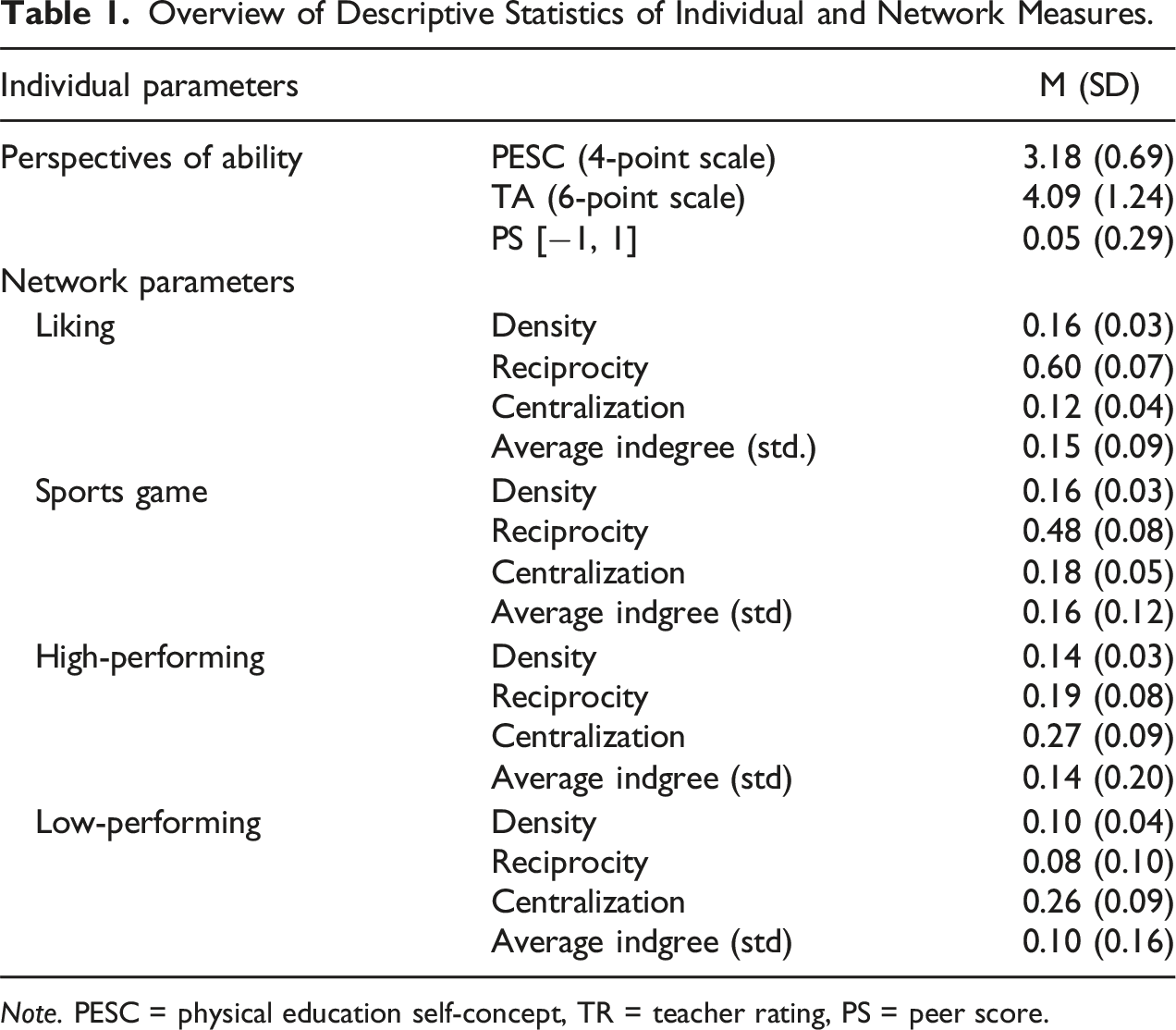
Note. PESC = physical education self-concept, TR = teacher rating, PS = peer score.
Correlations Between Perspectives of Ability and Indegrees in Liking and Game Networks.
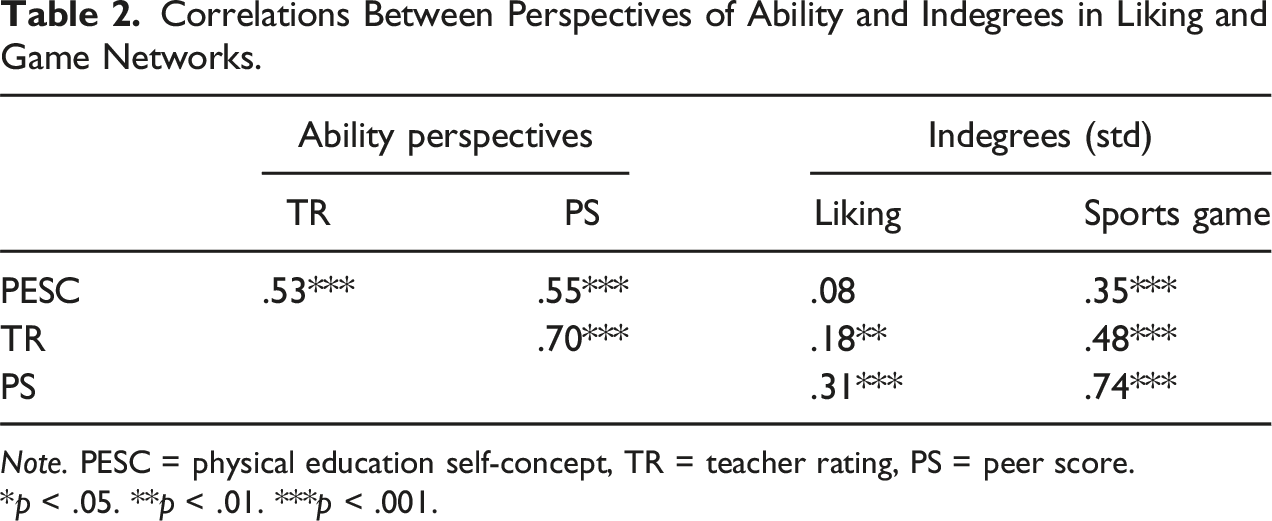
Note. PESC = physical education self-concept, TR = teacher rating, PS = peer score.
*p < .05. **p < .01. ***p < .001.
Secondly, to test our conjectures, we chose to conduct ERGMs which enable the analysis of both nodal (e.g., self-concept) and dyadic covariates (e.g., liking network) while controlling for network self-organization effects (e.g., reciprocity or triadic closure), as opposed to analyses such as quadratic assignment procedure linear regressions (Borgatti et al., 2022), which cannot do so. Adjusting for network self-organization effects is especially important to avoid biased interpretation of the effects of covariates. For example, in physical education, overlooking triadic closure might lead to inaccurately attributing students’ choices of team partners to perceived physical abilities, rather than to the influence of existing collaborative relationships within the network. Because of multiple classrooms we decided to adopt the approach by Rambaran et al. (2021) and modeled ERGMs for each classroom separately after which the parameter estimates were summarized using meta-analyses.
Two models were developed to test the conjectures. The first model includes structural parameters, the three perspectives of ability (attribute data) and the peer nominations in the high and low-performing network. This model was designed to assess the role of the perspectives of ability on network structure of the sports game network and compare the individual-level to the dyadic predictors, especially to contrast the group aggregated PS to the individuals’ nominations in the high and low-performing networks. It is important to note that the nominations for high and low performance are included in both dyadic covariates and individual characteristics via the PS. The second model additionally includes liking and gender to validate the findings from model 1 under the control of those known covariates. Students’ attributes were included as predictors in the models under three different assumptions of effect: receiver, sender and homophily (Lusher & Robins, 2013). The receiver effect, also known as the popularity effect, suggests that individuals with higher values of certain attributes are more likely to be chosen by others, e.g., students with better teacher ratings being more likely to be selected as team partners. Conversely, the sender effect, sometimes called the activity effect, indicates that individuals’ own attributes affect how they select others, e.g., students with a higher PESC being more active in nominating their peers as team partners. The concept of homophily describes the tendency for individuals who possess the same or a similar expression of an attribute to be more likely to form a tie. For categorical attributes, this can be analyzed through attribute matching, e.g., students of the same gender being more likely to nominate each other. For continuous attributes, however, a smaller absolute difference of attribute expression leading to a more likely tie formation, e.g., students with a similar PS being more likely to nominate each other, indicates the tendency for homophily. As a positive coefficient for the absolute difference effect in ERGM signifies that having different expressions of attribute leads to a more likely tie formation, this predictor is commonly called heterophily effect. In order to ensure the use of statistically accurate language, the term “heterophily” will be employed in tables and in the text to describe the effect of absolute difference used in the ERGM analyses, whereas “homophily” will be used when not directly referring to the coefficient of the effect, as it is the more common term for this phenomenon.
All analyses were conducted in R (Version 4.3.1) using the packages ergm and sna from the statnet suite (Krivitsky et al., 2003).
Results
Preliminary Analyses
Perspectives of Ability
The descriptive statistics are displayed in Table 1. Looking at the perspectives of ability, the distribution of PESC (M = 3.18, SD = 0.69, range = [1, 4]) is skewed to the right showing students’ positive self-evaluation of their own physical ability in PE. The TR (M = 4.09, SD = 1.24, range = [1, 6]) is slightly positively skewed but shows that teachers utilized the entire range of available values to rate their students which they usually do not do on school certificates. The distribution of PS in the sample (M = 0.05, SD = 0.29, range = [−0.80, 0.81]) is centered around zero and ranges similarly in both directions. This shows that some students receive a lot of positive or negative nominations while the majority of students only receive a few. Additionally, it reveals that the highest and lowest performing peers obtain similar amounts of nominations. This indicates that for the highest and lowest performers in their class, up to 80% of students nominated the respective students in the questionnaire.
Network Descriptives
Looking at the sample means of network parameters, descriptive differences can be observed. While the density and average indegree of liking and sports game networks are similar, the students seem to reciprocate liking ties (M = 0.60, SD = 0.07) more than sports game ties (M = 0.48, SD = 0.08). In contrast, ties in the sports game network seem to be more centralized (M = 0.18, SD = 0.05) than in the liking network (M = 0.12, SD = 0.04). The lower reciprocity and higher centralization of the sports game networks hint at a tendency for preferential attachment, presumably to high-performing peers, in these networks compared to liking networks. Although sample means provide a useful overview of the network descriptors, paired t-tests were computed to analyze the within-class differences between the two networks. The statistical tests show the significantly higher reciprocity (t (13) = −6.22, p < .001) and lower centralization (t (13) = 3.24, p = .006) of liking networks compared to the sports game networks.
Looking at the networks for high-performing and low-performing peers, sample means demonstrate very low reciprocity and high centralization, suggesting high amounts of agreement on high-performing and low-performing peers. The low-performing networks are on average the least dense networks, which could hint at the student’s hesitation to nominate their low-performing peers or at an unclear understanding what low-performance in PE means to them.
Correlations Between the Perspectives of Ability
To assess the relationship between physical ability and social integration on a basal level, correlations between the perspectives of ability and standardized indegrees in the liking and game network were calculated, as well as correlations between the different perspectives to assess their correspondence (Table 2). The analyses show strong significant correlations between the three perspectives of ability, especially between PS and TR. The observed correlations resemble those found in the literature, indicating that the measures used are comparable to those in previous studies. The high correlation between PS and TR is remarkable, highlighting how accurately students can assess the physical ability of their peers.
The relationship between physical ability and social acceptance in the two networks can be observed in the correlations as well. TR and PS significantly correlate with standardized indegrees in the liking networks with small and medium effect sizes respectively, while PESC does not correlate with indegrees. The associations are stronger in the game network with PESC and TR correlating moderately and PS correlating highly with indegree. These associations are congruent with the previous literature that we reviewed, but highlight the context-specificity of comparisons, as the correlations with the game network indegrees are considerably larger. Besides differences in correlations between network indegrees, the different perspectives of ability show varying associations with social integration with PESC showing the smallest and PS the highest correlations. While PS and TR correlate extraordinarily highly with each other, the associations with indegrees differ quite a bit, showing the relevance of the peer perspective on ability in PE.
To conclude, the three perspectives of ability correlate moderately to highly with each other, confirming conjecture 1. The correspondence of peer and teacher perspectives is especially high, illustrating the ability of students to assess the physical ability of their peers and highlighting the visibility of behavior in PE. Physical ability, especially as viewed by peers, also seems to be an important factor for social integration in liking and being chosen as a team partner in PE.
The Role of Physical Ability on the Structure of Collaboration Networks in Physical Education
Results of the ERGM Meta-Analyses to Analyze Network Structure of the Sports Game Network.
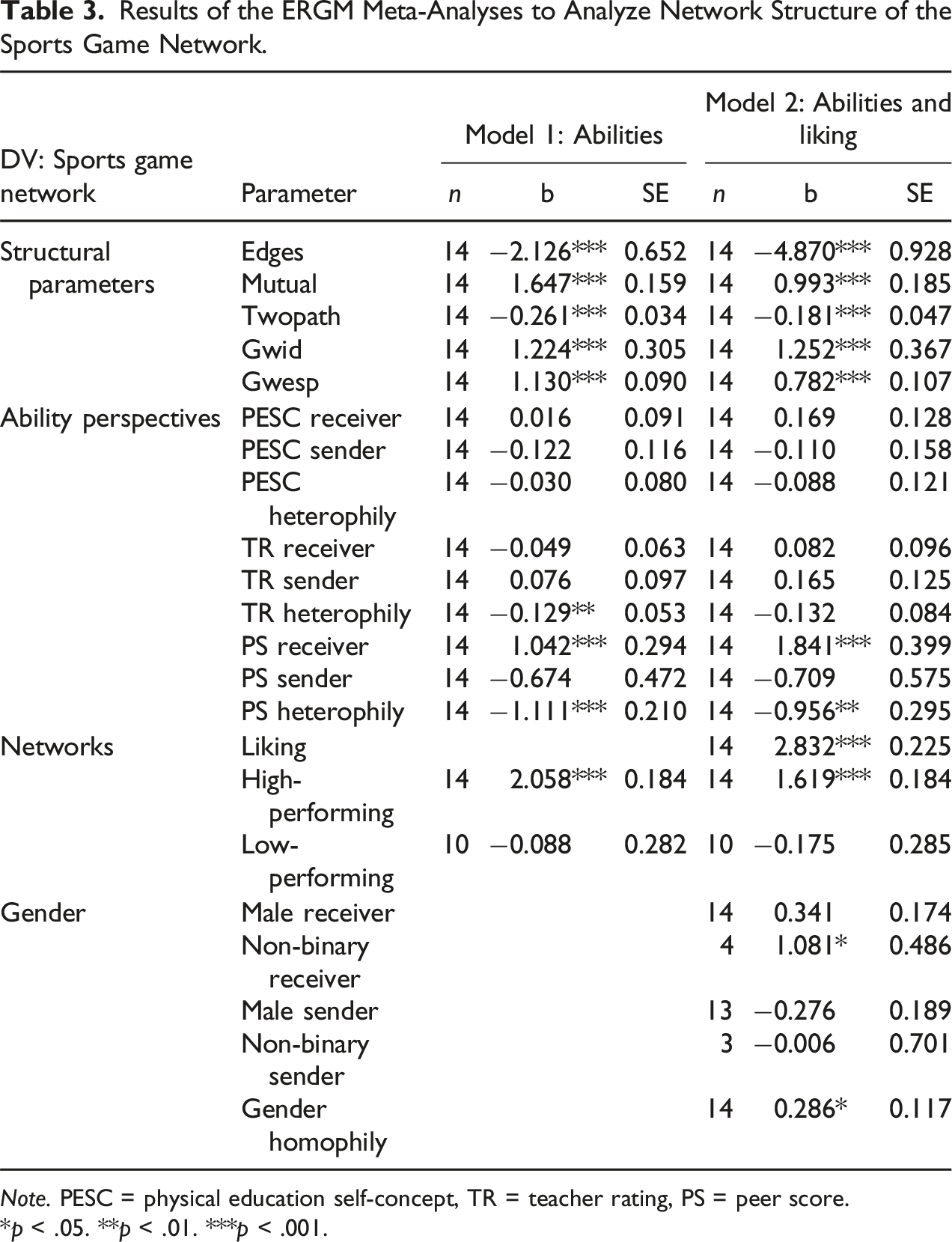
Note. PESC = physical education self-concept, TR = teacher rating, PS = peer score.
*p < .05. **p < .01. ***p < .001.
Model 1 shows that the game network is structured similarly to peer networks in school analyzed in different studies (Robins & Lusher, 2013). The students have a significant positive tendency to reciprocate ties, form triadic constellations while having a significant negative tendency towards two-paths. The positively significant geometrically weighed indegree (gwid) parameter signalizes a rather egalitarian degree distribution, indicating no general preferential attachments to nodes of high degree. Looking at the effects of the three perspectives of ability, it is apparent that neither high receiver or sender PESC nor having similar PESC affect network structure. There are no significant effects for TR indicating that students with a high TR neither send nor receive more ties than their peers, illustrating students with a high TR are not preferred in sports games. The heterophily effect for TR is significantly negative (b = −0.129, p = .014), meaning that students with a similar TR are more likely to play together in a sports team. For PS, however, the receiver (b = 1.042, p < .001) as well as the heterophily (b = −1.111, p < .001) effect are significant, indicating a positive preferential attachment effect for students having a high PS, but also that students are more likely to want to be in a team together when having a similar PS. The results from the attribute data suggest that the students want to associate with students that are regarded as high-performing by their peers but also want to team up with students on a similar level as they are as illustrated by the TR and PS homophily. Looking at the individual perceptions of others performance, included in the models as dyadic covariates, there is a significant relation between viewing peers as high-performing and nominations in the game network (b = 2.058, p < .001), showing that students not only want to work with students that are perceived very highly by the group, but also with peers that they themselves perceive as especially high-performing. In contrast to the significant effects of being perceived as high-performing in PE, students that are viewed as low performers are not less likely to be nominated.
To conclude the results of model 1, there is evidence that students prefer to play with high-performing students, both those that are highly regarded by the class and those that are personally seen as high-performing. The students also have the tendency to want to be in a team with students that are seen on a similar level by the group and the teacher. The results highlight the importance of physical ability on network structure in sports game networks, especially highlighting the peer perspective and individual perceptions of the physical ability of peers.
Model 2 additionally includes liking and gender as predictors, thus aiming to confirm the impact of physical ability perspectives on game network structure by controlling for known covariates. The structural parameters still show the same mechanisms structuring the network, even though reciprocity and triadic closure show lower values. This may be explained by the significant positive effect of liking (b = 2.932, p < .001) on network structure because affective networks typically show high levels of reciprocity and triadic closure (Robins & Lusher, 2013). In addition to the considerable effect of liking, gender also plays a meaningful role on network structure as there is a significant and positive gender homophily effect (b = 0.286, p = .014) on ties in the game network. Taking girls as a comparison group, boys neither are more popular to be nominated nor more active in nominating in the game network. For non-binary students, there is a significant and positive receiver effect, suggesting non-binary students to be more popular than their peers in the game network. No difference for the sender effect can be observed here. As mentioned before, interpreting and generalizing the effects of non-binary gender on peer relationships with only 5 non-binary students in the sample is not possible. In addition to the small sample, we cannot rule out the possibility that a highly popular cis-gendered student jokingly answered to be non-binary thus skewing the results.
Looking at the effects of the perspectives of ability after controlling for friendship ties and gender, we see that the PS receiver (b = 1.841, p < .001) and heterophily (b = −0.956, p = .001) effects are still significant, while the TR heterophily effect becomes nonsignificant. The effects of PS on network structure appear to be persistent and independent of liking ties, and students want to work with students with both similar and high PS even if they do not nominate them as being very likable. The individual perceptions of high-performers included in the model as a dyadic covariate also retain significance (b = 1.619, p < .001), indicating that the students want to work together with the students they perceive as high-performing even though they do not like them very much. The same as in model 1, we do not find a negative effect of being perceived as low-performing on relationships in the game network, which will be discussed below.
To conclude the results of the ERGM analyses, there is strong evidence for the importance of physical ability on network structure in sports game networks. While the self and teacher perspective don’t relate to network structure, the peer perspective offers a lot of insight on how students choose their game partners in PE, both the group level recognition of ability and the individual perspective. These findings persist when controlling for liking ties and gender effects, that also have a profound effect on game network ties. Students want to play in a team with other students they like and share the same gender with, while no robust sender or receiver effect of gender can be found. The results lead to the conclusion to reject conjectures 2 and 3. The zero order correlations observed before did not hold up in ERGMs being explained by the PS, confirming conjecture 4.
In the following section, we will further explore the effects of being perceived as low-performing on sports game network.
Being Viewed as Low-Performing by Peers
Class-wise ERGM Coefficients From Model 2 and Jaccard Indices of the Low-Performing Network and the Sports Game Network.
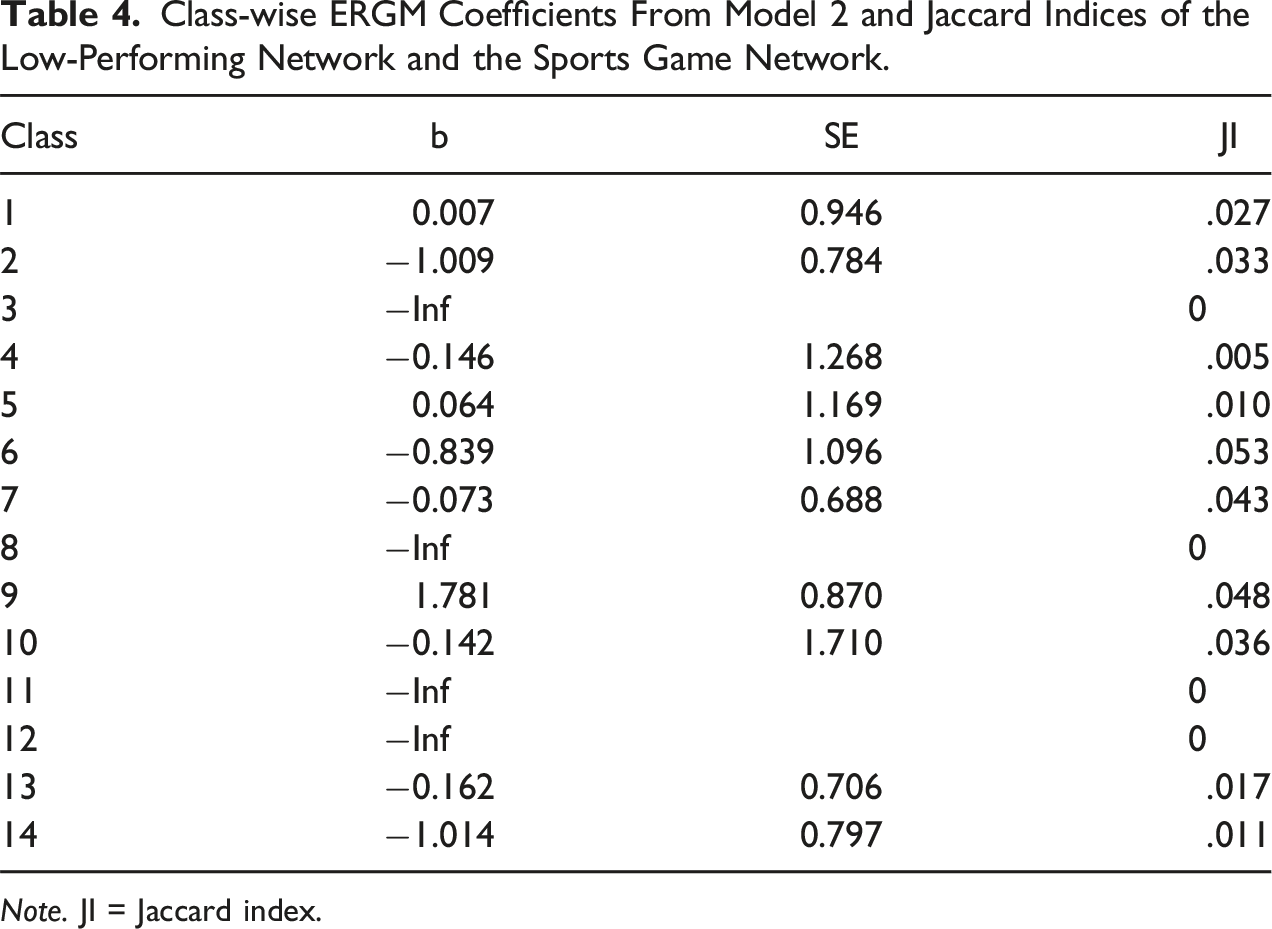
Note. JI = Jaccard index.
Discussion, Limitations and Future Directions
Within the realm of adolescent peer relationship research, a persistent question has revolved around the role of physical ability on peer status (e.g., Coleman, 1961). Previous investigations into this matter have collected a substantial body of evidence indicating that possessing exceptional athletic performance can lead to a high favorable position within the classroom (e.g., Dunn et al., 2007; Hollett et al., 2020). But the operationalization of physical abilities varies significantly across studies and it was unclear, which perspective matters the most for peer relations. Unfortunately, there is also a lack of studies that have addressed this research by utilizing the social network approach, especially in physical education. Moreover, within this context, the examination of context-specific networks remains notably underexplored. Many of these studies instead relied on generic networks, such as friendship or liking networks, within the classroom environment. This approach, however, overlooks a critical aspect of social dynamics. We recognize that social relations are inherently context-specific by nature, influenced by various environmental factors and thus differ between different domains (Fuhse, 2022). Consequently, it becomes essential to explore and measure these nuanced, subject-specific networks to gain a more comprehensive understanding of the intricate interplay between subject-specific attributes and their networks.
Therefore, the aim of the current study was, firstly, to explore how physical performance shapes team selection processes in sports games within PE. Secondly, we aimed to determine which perspective of athletic performance (self-, teacher-rating or peer-perspective) is relevant for team selection during PE. We applied exponential random graph models to evaluate these questions, accounting for network-self-organization, gender and the liking networks in our analysis. The ERGM analyses highlight the significant impact of physical ability for teammates choices in sports game networks. Notably, while the self- and teacher perspectives do not significantly affect the sports game networks, the peer perspective provides important insights into students’ choices of game partners in PE. This is akin to a study by Hollett et al. (2020), where the peer-perceived ability predicted social status whereas the actual ability did not. It could be that students have a more nuanced view of their peers’ abilities, or that the teacher and peer perspective differ based on diverging injunctive norms on physical ability. Teachers may value performance in a strictly skill-based way, where students that score more points or assist their peers in scoring points are assessed highly, whereas in Hollett and colleagues’ (2020) study, perceived performance was also linked to height, attractiveness, and popularity.
From a theoretical standpoint, this is not surprising, as social networks have a substantial influence on the establishment of normative behaviors (Wellman, 1988), such as having high physical ability is very important for being selected as a teammate in sports games. The divergence in norms between teachers and peers likely explains the differing implications for sports game networks. Teachers may hold differing opinions on physical ability and possess a unique set of norms and expectations regarding what aspects of physical ability are considered for their overall performance assessment. These distinctions might not align with the prevailing norms among students, because students might have other expectations towards their classmates regarding physical ability for sports games. These findings remain robust even when controlling for factors such as liking ties and gender effects, which also play a substantial role in shaping game network connections, emphasizing the unique role of peers mentioned by Gest and colleagues (2008). PESC did not predict ties in a sports game, possibly because beliefs are less salient than behavior (Shin, 2023) or because self-concept is a result of teacher and peer feedback, thus the effect could be mediated by the other perspectives. Additionally, it is important to emphasize that future research should place more emphasis on determining the perspective needed for specific social relationships. In this context, it is worth noting that context-specific networks should be collected, as they provide a much more precise understanding of what unfolds in social situations.
The role of being perceived as low-performing was highlighted in some classrooms, where it was apparent that it was an absolute exclusion criterion for the selection of team partners but did not show up consistently in ERGM analyses. These exclusion processes were described qualitatively by numerous studies (e.g., Grimminger, 2014), and should be further analyzed quantitatively in forthcoming research on peer relationships in PE.
Qualitative research also suggests that students with high academic self-concept might look for different kinds of support by their peers – mainly emotional support – than students with low self-concept – mainly content-related support (Bakadorova & Raufelder, 2015). Future research should delve deeper into ability-based differences in playing and support seeking to illustrate different mechanisms influencing peer relationships. To gain a deeper understanding of peer dynamics in PE, conducting longitudinal network studies is essential. These studies allow to differentiate selection from influence effects on peer relations, which is impossible in a cross-sectional design. In recent years, more and more publications have looked at these dynamics in the school setting (e.g., Laninga-Wijnen et al., 2017), but none of them particularly highlighted the context of PE. Future longitudinal research thus could expand our current knowledge of peer processes in PE.
Our research reveals that one of the most important determinants of social status in physical education is peer perceptions of physical ability. In this setting, performance is also critically linked and evaluated around students’ bodies (Hunger & Böhlke, 2017). The open layout of the PE setting, which allows for the constant observation of physical ability and student’s bodies, could facilitate social exclusion processes. Such an environment can provoke feelings of shame and embarrassment, which can lead to avoidance strategies and harm the motivation and fun to excel in sport practices (Partridge & Elison, 2010). Teachers have the responsibility to establish a safe and nurturing environment that encourages free development among students and actively prevents social conflicts such as bullying. Furthermore, fostering positive peer relationships can enhance motivation and well-being, promote ongoing engagement in physical education and set the foundation for lifelong physical activity (Prochnow et al., 2020).
Conclusion
Our study highlighted the importance of physical ability for peer relationships in PE. The ERGM results shed light on the social processes and norms influencing peer relationships in PE and the distinction between the three perspectives of ability allowed us to separate these contributions. We uncovered the unique importance of the peer perspective in choosing team partners in sports games, as it was the sole perspective to show a significant effect. This research can be foundational to a variety of studies exploring peer dynamics which in the long term can contribute to teacher education for the positive influence of student’s experiences in PE.
Supplemental Material
Supplemental Material - Gauging Acceptance: A Multifaceted Examination of Physical Ability and Its Role for Peer Networks in Adolescent Physical Education
Supplemental Material for Gauging Acceptance: A Multifaceted Examination of Physical Ability and Its Role for Peer Networks in Adolescent Physical Education by Cornelius Holler, and Annabell Schüßler in The Journal of Early Adolescence.
Footnotes
Declaration of Conflicting Interests
The author(s) declared no potential conflicts of interest with respect to the research, authorship, and/or publication of this article.
Funding
The author(s) received no financial support for the research, authorship, and/or publication of this article.
Ethical Statement

Supplemental Material
Supplemental material for this article is available online.
Note
Author Biographies
References
Supplementary Material
Please find the following supplemental material available below.
For Open Access articles published under a Creative Commons License, all supplemental material carries the same license as the article it is associated with.
For non-Open Access articles published, all supplemental material carries a non-exclusive license, and permission requests for re-use of supplemental material or any part of supplemental material shall be sent directly to the copyright owner as specified in the copyright notice associated with the article.
