




Abstract
The present mixed methods study explored perceived differences in social support across three immigrant generations of early adolescents residing in Canada. A total of 960 first-generation (n = 249, M age = 13.02, σ = .69, 54.2% girls), second-generation (n = 327, M age = 12.88, σ = .69, 57.5% girls) and third-plus-generation (n = 384, M age = 12.81, σ = .69, 57.3% girls) early adolescent immigrants completed the self-reported Child and Adolescent Social Support Scale, and 16 of them participated in individual interviews on social support. Multivariate analyses of covariance (MANCOVA), in which we controlled for sex, mother tongue, and socioeconomic status (SES), showed that second-generation early adolescents perceived significantly less social support from their mother, teachers, school personnel, and classmates compared to their first- and/or third-plus-generation counterparts. Our mixed methods analysis revealed that these second-generation youth perceived several barriers to social support, such as an unsatisfactory quality of their relationships with these sources, a negative attitude from these sources, their limited availability or involvement, and their ineffectiveness in providing certain types of support. These findings highlight the importance of better understanding the unique challenges facing second-generation early adolescents in order to provide social support adapted to their needs.
Keywords
Introduction
Youth with an immigrant background represent an increasing proportion of the population worldwide and particularly in Canada, where nearly one in three below the age of 15 years (29%) is second-generation (born in Canada, from at least one immigrant parent), and around 8% are first-generation (foreign-born) (Statistics Canada, 2017). In the region of Montreal (Quebec), more than two-thirds (68%) of elementary and high-school students have an immigrant background, 26% of them being classified as first-generation, 42% as second-generation, and 27% as third-plus-generation (born in Canada, to Canadian-born parents) (Lahaie, 2020).
In addition to the normative developmental tasks that all early adolescents face (e.g., social and cultural identity construction, physical changes, increased independence, academic pressure), those with an immigrant background may be exposed to several unique challenges. At the macro level, they may be exposed to structural and systemic social inequalities, increasing xenophobia, and anti-immigration sentiments (e.g., hate crimes, ethnic and racial discrimination) (Kaufmann, 2021; Marks et al., 2021). At the micro level, they may face various stressors related to acculturation, a process of cultural and psychological change that takes place at the contact of two or more cultural groups (Phinney et al., 2022).
To promote the resilience and well-being of these adolescents, social support is an essential resource, as it is associated with a multitude of indicators of positive adjustment, such as academic achievement, self-esteem, and psychological health, in both the general and immigrant populations (Cho & Haslam, 2010; Chu et al., 2010; Rueger et al., 2010; Rueger, Malecki, Pyun, et al., 2016). For adolescents with an immigrant background, social support not only has the power to influence positively their adjustment to the host society, but also represents a crucial protective factor against stress and more serious potential symptoms of depression and anxiety that might result from their integration challenges (Cho & Haslam, 2010; Sirin, Gupta, et al., 2013).
Immigrant Generational Status: Challenges and Adaptation Differences
Immigrant generation status can greatly influence the social and cultural adjustment of early adolescents, as those in the first generation may face different challenges from those in the second and third-plus generations. For first-generation adolescents, in addition to their active efforts to adapt to a new society (e.g., learning a new language, integrating into a different school system), the immigration process is characterized by a loss or transformation of several important social ties, such as those with friends, extended family, and often nuclear family members, including parents or siblings (Suárez-Orozco et al., 2011). Second-generation immigrant adolescents, although born in Canada and therefore well acquainted with its dominant value system, are often immersed from an early age in the norms and values of their cultural heritage, transmitted by their immigrant parents, which can also lead to adaptive challenges (Portes & Hao, 1998).
In Canada, both first- and second-generation immigrant youth are regularly exposed to various types of discrimination (e.g., ethnic, racial, linguistic) at multiple societal levels (e.g., in institutions such as schools and health care services, or from peers) (Kaufmann, 2021). Given the centrality of identity formation, social exposure (e.g., in schools), and the need for social belonging during adolescence, these youth may be particularly sensitive to discrimination, and the adverse psychological consequences may be amplified (e.g., anxiety, feelings of isolation, behavioral problems, limited social and educational aspirations and achievement) (Kaufmann, 2021; St-Pierre et al., 2022). Furthermore, despite the fact that both first- and second-generation Canadian immigrants generally have significantly higher levels of education than individuals without an immigrant background, which may be a result of selective immigration policies and their own strong values of educational success, they are at higher risk of presenting poor socioeconomic indicators (e.g., lower employment rates, higher risk of poverty) (Kaufmann, 2021; Statistics Canada, 2022, 2023).
On their end, third-plus-generation youth may be more exposed to different problematics prevailing in more individualistic Western nations, including Canada, such as higher divorce rates among their families, greater isolation, and higher rates of depression (Amato & Boyd, 2013; Li et al., 2021; Scott et al., 2004).
The differences between immigrant generations have attracted increased research interest in recent years, mainly regarding indicators of health and psychosocial outcomes. Studies focusing on youth with an immigrant background have generated conflicting results regarding generational differences in these adaptation outcomes. The risk perspective suggests that first-generation youth are at risk of presenting worse outcomes when compared to individuals born in the host country, which can be explained by the various migratory stressors to which they are exposed during the immigration process (Sirin, Ryce, et al., 2013). Conversely, the resilience perspective or immigrant paradox suggests that several factors, such as the resilience developed during that process and the selective immigration criteria in place (e.g., priority given to educated individuals) may explain the better adaptation outcomes observed among first-generation youth, compared to their second- and/or third-plus-generation counterparts (Marks et al., 2014; Organisation for Economic Co-operation and Development [OECD], 2018). Because of different contextual pre- and post-migration factors (e.g., country of origin, immigration status, immigration policies), the risk perspective generally seems to reflect the European immigration reality, whereas the resilience perspective is more present in North America, including Canada (OECD, 2018).
Studies on the adaptation outcomes of immigrant youth have provided significant knowledge on the differences between immigration generations. However, despite its many societal and practical implications (e.g., targeted social and mental health services), this research field is still in its embryonic stage and is far from systematically differentiating between generations. Furthermore, while an increasing number of studies are focusing on adaptation outcomes among immigrant adolescents, few have addressed the predictors of adaptation, such as social support, that may differ across generations and may help to explain the generational differences found.
Social Support: Theoretical Framework
Social support is a resource that can be understood in terms of both structural value, which refers to the number of relationships making up a person’s social network, and functional value, which refers to the specific functions these relationships fulfill, especially during times of stress (Rueger et al., 2016; Taylor, 2011). A distinction is also to be made between social support that is actually received and perceived social support, which refers to adolescents’ perception of having access to support when needed (Gottlieb & Bergen, 2010; Taylor, 2011). There is a consensus in the literature that the measures of functional and perceived social support are more closely associated with individuals’ well-being than are other measures of support (Chu et al., 2010; Taylor, 2011). In other words, it is neither the size of the social network nor the actual support received, but rather adolescents’ perception of having high quality social support available when needed, that offers a protective effect.
In line with these elements, in this study we retained the theoretical model developed by Malecki and Demaray (2002), who define social support as an individual’s perception of general support or specific supportive behaviors (available or enacted upon) from people in their social network, which enhances their functioning and/or may buffer them from adverse outcomes. These authors identified four main functions or types of social support: emotional (trust, love, and empathy), informative (information or advice), appraisal (feedback provided), and instrumental (resources provided, such as money and material goods).
Main Sources of Social Support in Adolescents’ Lives
Several social support sources appear to be central in adolescents’ lives, whether they have an immigrant background or not. Within the family, parental social support plays an essential role in early adolescents’ healthy development, contributing to their emotional regulation, autonomy, self-esteem, and empathy, among others (Calandri et al., 2019; Colarossi & Eccles, 2003; Keskin & Branje, 2022). Mothers are particularly recognized by adolescents for the emotional support they offer (e.g., affection, listening), whereas fathers appear to be more skilled in providing instrumental support (e.g., support in making an important decision) (Hombrados-Mendieta et al., 2012). Siblings, who are often close in age and tied by shared life experiences, also represent an important source of support for early adolescents, especially during major life events, such as immigration, when they can provide continuity following the uprooting that sometimes occurs (Maynard, 2004).
Outside the family, classmates and friends are often the most important source of emotional support and are particularly important for youth with an immigrant background, as they may represent a bridge to the host culture and/or a tie to the culture of origin, in the case of same-ethnicity friends (Lew, 2004). Teachers are seen as providing mainly informational support, thus having an essential role to play in adolescents’ academic success (Hombrados-Mendieta et al., 2012; Malecki & Demaray, 2003). Among adolescents with an immigrant background, social support from teachers is particularly important, as the latter can provide a safe context that is conducive to learning the dominant cultural norms, social practices, and customs of the host country (Roffman et al., 2003). Most studies, however, assess social support offered by teachers and do not consider other school personnel (e.g., supervisors, school principals), who may provide different types of social support.
Although findings are inconsistent, some studies have reported that youth with an immigration background (first- and/or second-generation) perceive less social support from their parents, peers, and teachers than do their non-immigrant counterparts (Leonardo, 2016; Oppedal & Røysamb, 2004). These findings may be influenced by the acculturation challenges experienced by some of these support sources (e.g., parents with poor fluency in the host country’s language or limited knowledge of its institutions), as well as by the unique adaptation needs of immigrant youth, which differ from those of their non-immigrant peers (e.g., needing help integrating into the host society, learning a new language).
Finally, although the influence of the ethnic or religious community is often overlooked in research, social support from this source is crucial for adolescents, especially during important life events, such as immigration, as it can contribute to (re)building a social network and offer them various types of support (e.g., help and information about host country norms) (Harker, 2001).
Generational Differences in Social Support
Currently, social support is almost exclusively included in studies as an independent variable or a mediator/moderator of different adaptation outcomes (e.g., mental health, school engagement), and its beneficial role is now well established in the literature (Chu et al., 2010; Rueger et al., 2016; Sirin, Gupta, et al., 2013). Considering that social support is rarely studied as a dependent variable, understanding the factors that influence and differentiate it among various population groups, such as individuals with an immigrant background, becomes essential. For this, a good starting point would be an evaluation of the effect of generational status, which may greatly influence their reality.
Very few studies, mainly carried out on adult American populations, have focused on generational differences in social support, and those have reported divergent results, suggesting either that first-generation immigrants perceive higher levels of social support than do individuals born in the receiving society or that the latter perceive more support (e.g., Almeida et al., 2009; Viruell-Fuentes et al., 2013). Among adolescents, we found only one study, conducted in Italy, where the authors focused on the effect of generational status on social support, reporting that first- and second-generation immigrant adolescents had an increased likelihood of receiving less social support from their teachers, classmates, family, and peers compared to the host population (Dalmasso et al., 2018).
An important issue often present in studies assessing generational differences is that, either by considering first- and second-generation individuals as a single group or by not differentiating between second- and third-plus-generations, they make it difficult to reach precise conclusions. Furthermore, studies on social support often fail to capture the multidimensionality of this concept (e.g., different types and sources of social support), thus limiting the richness of the findings (Rueger et al., 2016).
The Current Study
To fill the methodological gaps described above, the purpose of this mixed methods study was to compare perceived social support among Canadian early adolescents belonging to first-, second-, and third-plus immigrant generations. Four types of perceived social support (emotional, informative, appraisal, instrumental) and eight main sources of support relevant to the lives of adolescents (mother, father, siblings, classmates, friends, teachers, school personnel, community) were considered. Specifically, two research questions were explored: Do early adolescents’ perceptions of social support differ according to their immigrant generation status? And if so, what are the barriers and facilitators to social support that might explain these differences?
Given that social support represents an essential protective factor for all adolescents and especially for those with an immigrant background who may be exposed to particular challenges, understanding the generational differences related to social support, an alterable resource, is an important step toward implementing concrete and targeted actions to optimize it.
Method
The present study used a subset of data collected as part of a larger project designed to assess the psychological well-being of adolescents with an immigrant background. We used a mixed methods explanatory sequential design, which consisted of first conducting a quantitative phase to determine generational differences in social support, and then a qualitative phase to explain the quantitative results (quantitative → qualitative; Creswell & Plano Clark, 2017). Considering the lack of data on generational differences pertaining to social support in adolescents with an immigrant background, this study was exploratory in nature.
Sample and Procedure
This study was approved by the research ethics committees of the Université du Québec en Outaouais (UQO) and the participating school boards. It included participants from four high schools located in Montreal’s metropolitan region (Quebec, Canada) characterized by significant proportions of students with an immigrant background (25% in one school and more than 60% in the other three). The socioeconomic indicators of three schools suggested their students came from rather privileged backgrounds, while the indicators for the other school suggested their students originated from rather disadvantaged backgrounds.
Sociodemographic Characteristics of the Quantitative Sample (N = 960).
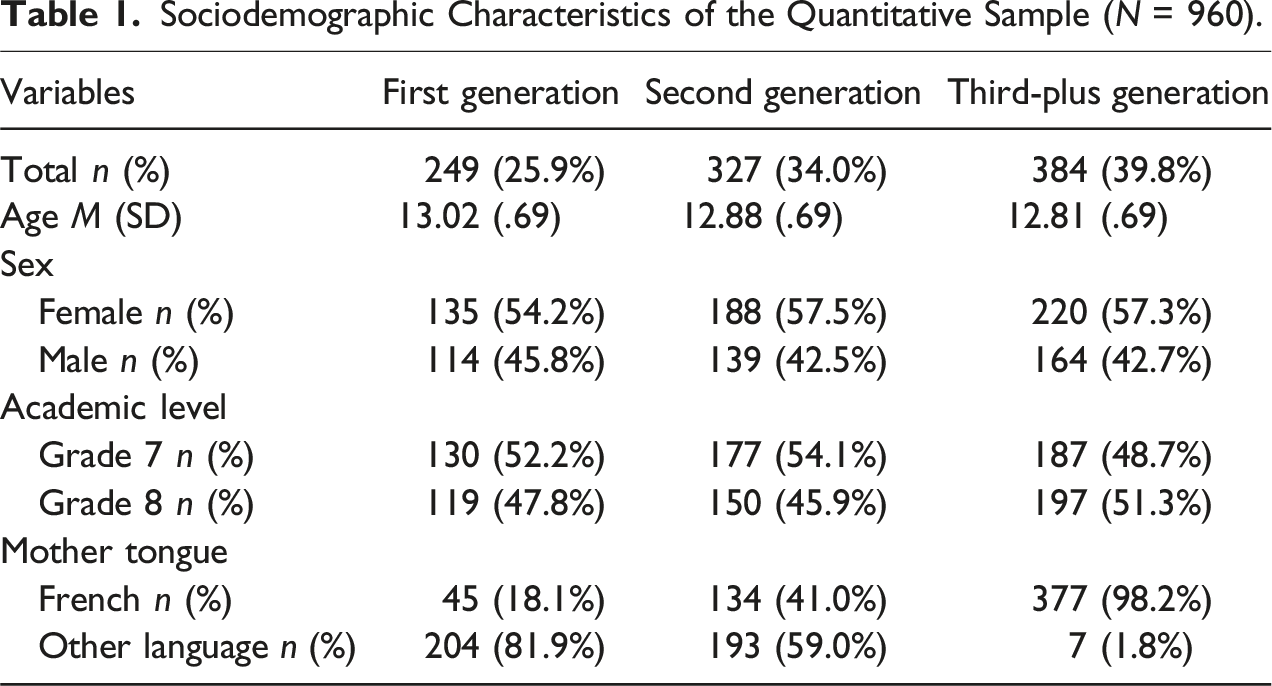
The participants’ origins were highly diverse, with over 70 different birth countries identified. Among first-generation adolescents, the most prevalent declared countries of origin were Algeria, Syria, and Haiti, accounting for about 23% of the participants in this group. The most frequently reported mother tongue was Arabic, followed by French and Spanish. Among second-generation adolescents, the most prevalent declared countries of origin of the parents were Algeria, Morocco, and India, accounting for approximately 25% of this group. The most frequently reported mother tongue was French, followed by English and Arabic.
Sociodemographic Characteristics of the Qualitative Sample (N = 16).
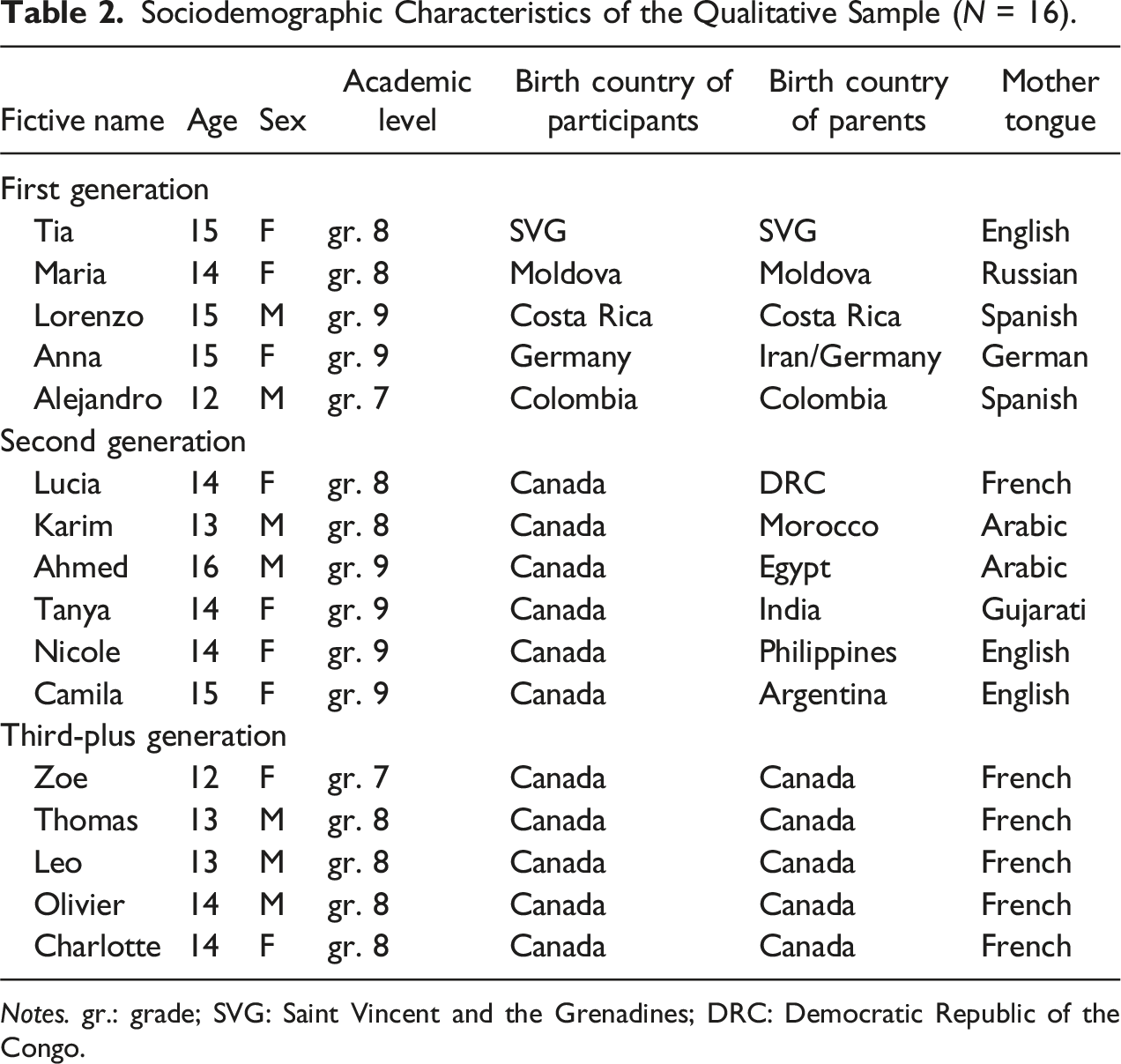
Notes. gr.: grade; SVG: Saint Vincent and the Grenadines; DRC: Democratic Republic of the Congo.
Measures
Sociodemographic Data
The sociodemographic data collected as part of the quantitative self-reported questionnaire to describe the sample of adolescents in the study included age, sex, and academic level. Sex was assessed by asking What sex are you? with the response choices: girl = 1; boy = 2; other = 3. None of the participants answered other.
Generational Status (Independent Variable)
Participants’ generational status was determined using questions about the countries they and their parents were born in (What country were you born in? What is your mother’s/father’s country of birth?). Participants’ responses were coded as follows: first-generation = 1 (foreign-born); second-generation = 2 (born in Canada, from at least one immigrant parent); third-plus-generation = 3 (born in Canada, from Canadian-born parents). Third-plus-generation included third or later generations of immigrants, as well as non-immigrant individuals.
Perceived Social Support (Dependent Variable)
Perceived social support was measured using the Child and Adolescent Social Support Scale (CASSS) (Malecki & Demaray, 2002), a tool designed to assess frequency of support from parents, teachers, classmates, and friends. For the purposes of the present study, the original instrument was translated into French and back-translated to ensure accuracy. It was then modified by creating separate scales for the mother and father and by adding scales to assess support from siblings, school personnel, and the ethnic/religious community. For school personnel, participants were asked to complete sentences related to perceived support from the adults in their school, a general formulation that aimed to include supervisors, mental health workers, school principals, etc. The final questionnaire incorporated 96 items divided into eight scales of overall social support (all subtypes combined) for each social support source. Each scale was then divided into four 3-item subscales that assessed emotional support (My mother listens to me when I talk), informative support (My brother(s) and/or sister(s) give me good advice), appraisal (My classmates notice when I have worked hard), and instrumental support (My teachers make sure I have the things I need for school). The frequency of support was measured using 7-point Likert-type scales ranging from never (0) to always (5), with an additional option of does not apply. The CASSS was validated by its authors with a sample of 263 ethnically diverse students aged between 11 and 18 years and showed good psychometric qualities (Malecki & Demaray, 2002, 2003). In the present study, the internal consistency of the overall support scales, assessed using the McDonald’s Omega (Kalkbrenner, 2021), varied between ω = .88 and ω = .98.
Control Variables
As studies have shown that female adolescents report more support than males (Chu et al., 2010; Malecki & Demaray, 2002, 2003; Yalcin-Siedentopf et al., 2021), we controlled for the effect of sex on social support. Moreover, since social support is often communicated verbally, the language barrier confronting some adolescents could affect their ability to understand others, to feel understood, and therefore to perceive that they have sufficient support when needed. Although all participants had sufficient knowledge of French to answer the questionnaire, we addressed the aforementioned aspect by controlling for mother tongue. This variable was assessed using the open question What is your mother tongue, meaning the first language you learned to speak? Responses were dichotomized between participants who indicated French as their (or one of their) mother tongue(s) (1) and those who did not indicate French as a mother tongue (2). Finally, as socioeconomic status (SES) has been shown to be positively correlated to perceived social support (e.g., Yan et al., 2021), we also controlled for this variable. SES was estimated using the government-produced socioeconomic deprivation index of the schools attended by participants (Ministère de l’Éducation et de l’Enseignement supérieur, 2020). This index, ranging from one to ten, is calculated from two indicators based on census data (mother’s level of education and parents’ non-employment status). The closer the score is to 10, the more disadvantaged the school is.
Qualitative Interviews
The interviews for the qualitative component were conducted using a semi-structured grid of open-ended questions constructed based on existing definitions and measures of perceived social support, as well as on preliminary findings from the quantitative component of this study that called for further explanation. Some questions in the quantitative questionnaire were repeated and reworded as open questions to allow for more detailed responses from participants. The final interview outline contained 23 open-ended questions, of which four were aimed at assessing sociodemographic information (i.e., age, academic level, country of origin) and facilitating contact between interviewer and participant (i.e., How do you like your school?). Four other questions assessed the participant’s perceptions regarding psychological well-being (i.e., How would you define well-being for a young person in high school?). These were followed by 15 questions, with sub-questions designed to assess perceived social support, such as the types of support available from different sources in the adolescents’ environment, the barriers to obtaining support, and the usefulness of the support obtained (i.e., Do you get support from the people around you? Who would you go to for support if you were going through something that was making you a little stressed or sad? Who would be the person least likely to be able to support you if you were going through something that was stressful or made you sad?). The complete question grid used in the qualitative phase is presented in the Supplemental Material.
Data Analyses
Quantitative Analysis
The quantitative data analysis strategy was divided into two main steps conducted with SPSS 28. First, a multivariate analysis of covariance (MANCOVA) was conducted to assess whether there were generational differences in the overall social support scales (all subtypes combined) provided by the eight sources of support under study. Second, MANCOVAs were conducted to assess whether there were generational differences in the scales of subtypes of support (emotional, informative, appraisal, instrumental) for those sources where a generational difference was identified in the first step. Post-hoc analyses using a Bonferroni adjustment were conducted to identify exactly which generational groups differed from each other. Sex, mother tongue, and SES of the participants were controlled for in both of the above steps. All MANCOVA assumptions were verified and were largely respected.
Mixed Methods Analysis
A thematic analysis was conducted to understand the main generational differences detected in the quantitative phase (Clarke & Braun, 2013; Creswell & Plano Clark, 2017). First, verbatim transcripts were grouped according to participants’ generation and classified by source and type of support, which allowed us to integrate and connect quantitative and qualitative results. Considering that the question grid was not specifically constructed for the purpose of explaining generational differences in social support and that the majority of questions were open-ended, the entirety of the qualitative material was considered for analysis, and relevant transcript excerpts were selected for coding. Second, to better understand the generational differences found in the quantitative results, two specific codes were created to detect the barriers and facilitators to social support mentioned by the participants. The transcript data were systematically organized using these codes, then grouped according to meaningful emerging subthemes constructed on the basis of the recurrence, convergence, or divergence of participants’ answers (Clarke & Braun, 2013). To obtain a clear picture of participants’ raw perceptions, a low level of inference was maintained throughout the analysis, which remained mainly descriptive. Themes were identified using an iterative approach, with multiple repetitions of the analysis procedure, to ensure the consistency and representativeness of their final classification. Equal value was attributed to unique and singular excerpts to avoid elite bias (i.e., emphasizing some statements at the expense of others; Morrow, 2005). Research team discussions were held regularly throughout the entire process to reach consensus on themes created, ensure their relevance to the research question, and detect eventual biases. NVivo 12 software was used for this analysis.
Results
Generational Differences in Perceived Social Support (Quantitative Analyses)
Overall Social Support
Multivariate Results of the MANCOVA Predicting the Frequency of Overall Social Support From Generation and Covariates (N = 960).
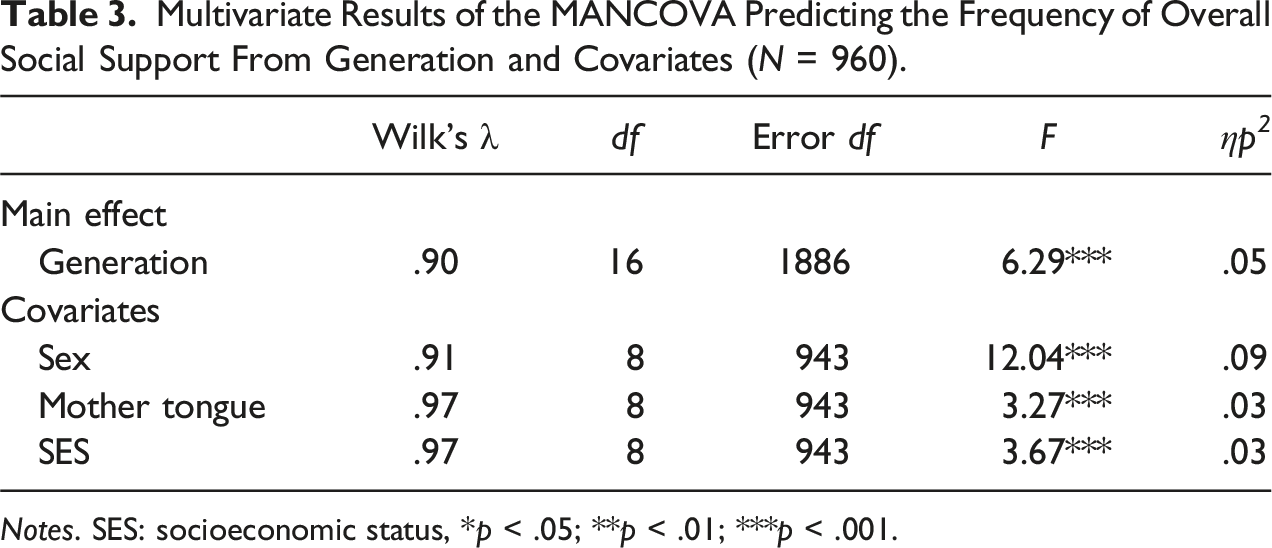
Notes. SES: socioeconomic status, *p < .05; **p < .01; ***p < .001.
Univariate Results of Generational Differences on the Overall Social Support When Controlling for Covariates.
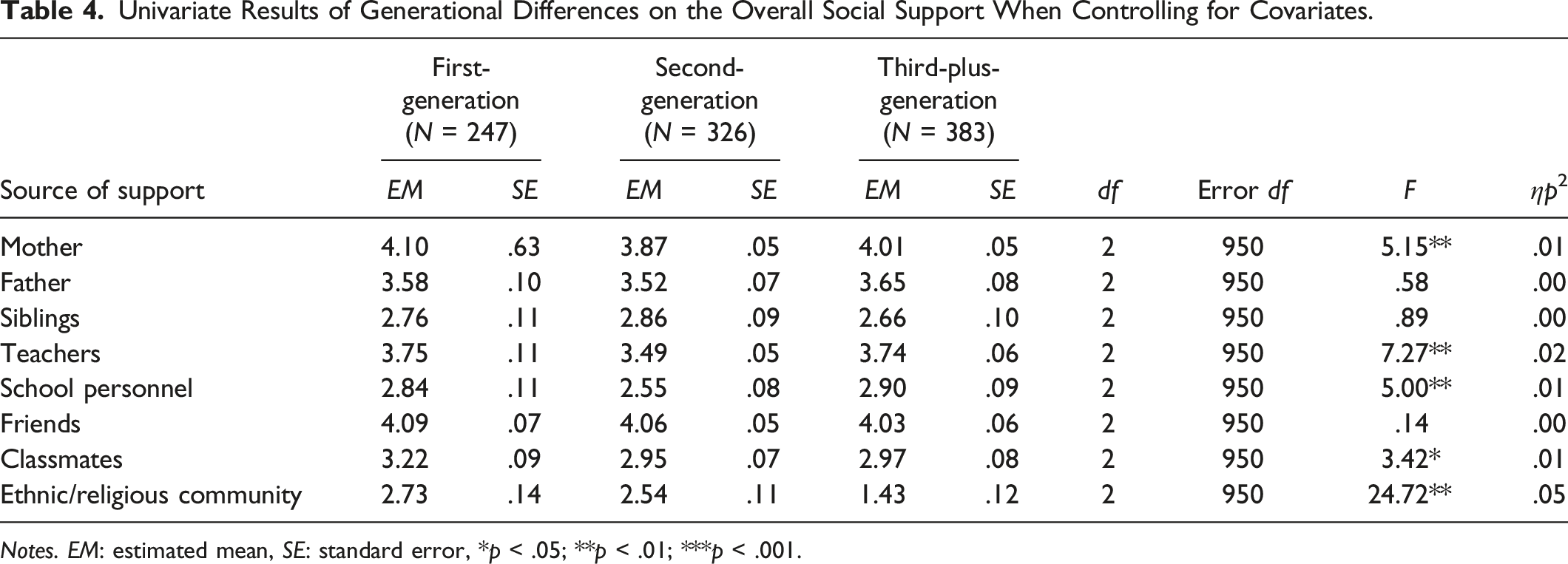
Notes. EM: estimated mean, SE: standard error, *p < .05; **p < .01; ***p < .001.
With regard to mothers and classmates, second-generation participants reported less social support than did first-generation participants. No significant differences were detected between first-/second- and third-plus generations. With regard to teachers, second-generation participants reported less social support than did both first- and third-plus-generation participants. No difference was detected between first- and third-plus generations. With regard to school personnel, second-generation participants reported less social support than did third-plus-generation participants. No differences were detected between first-/second- and third-plus-generations. Finally, for ethnic/religious community, both first- and second-generation participants reported more support than did third-plus-generation participants. No generational difference was detected between first- and second-generation participants in this respect. Effect size was modest for all sources of support.
All three variables controlled for in these analyses (sex, mother tongue, SES) had univariate and multivariate significant effects on the scales of overall social support.
Social Support Subtypes
Maternal Social Support
MANCOVA results revealed no significant multivariate effect of the immigration generation on the subtypes of maternal social support [F(8, 1904) = 1.65, p = .105, Wilks’ λ = .99].
Teacher Social Support
Univariate Generational Differences for Social Support Subtypes.
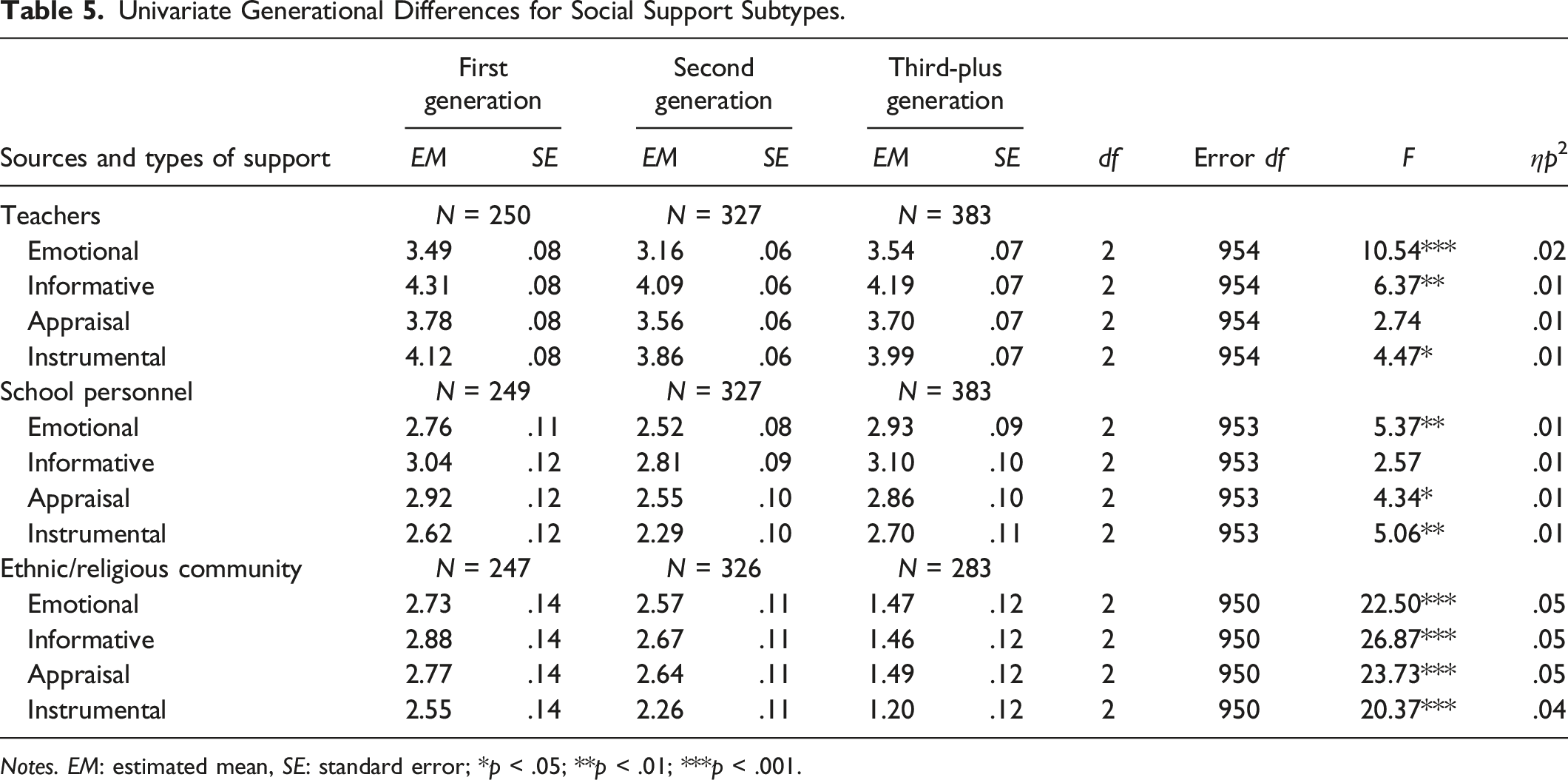
Notes. EM: estimated mean, SE: standard error; *p < .05; **p < .01; ***p < .001.
School Personnel Social Support
Results revealed a significant multivariate effect of immigration generation on all school personnel support subtypes combined [F(8, 1900) = 2.60, p = .029, Wilks’ λ = .98]. The effect size was modest (ηp2 = .01). For emotional and instrumental support, second-generation participants reported less social support than did third-plus-generation participants. No differences were detected between first- and second-/third-plus generations. In the case of appraisal support, second-generation participants reported less support than did first-generation participants. No differences were detected between first-/second- and third-plus generations. All effect sizes were modest. No generational difference was observed for informational support.
Classmates Social Support
Results revealed no significant multivariate effect of immigration generation on the subtypes of classmates social support [F(8, 1898) = 1.74, p = .09, Wilks’ λ = .99].
Ethnic/Religious Community Social Support
Results revealed a significant multivariate effect of immigration generation on all support subtypes combined [F(8, 8190) = 7.60, p < .001, Wilks’ λ = .94]. The effect size was modest (ηp2 = .03). The effect of generation on individual scales was significant for all support subtypes, and in all cases, first- and second-generation participants perceived more support from their community than did third-plus-generation participants. There was no difference between first- and second-generation participants. All effect sizes were modest.
Perceived Obstacles and Facilitators to Social Support (Mixed Methods Analyses)
Analysis of the qualitative data highlighted several elements that help explain the quantitative results showing that second-generation early adolescents perceived less support from their mothers, teachers, school personnel, and classmates compared to their first- and/or third-plus-generation peers. These elements were grouped into two categories (facilitators and barriers to support), as well as into several themes. Overall, second-generation participants reported a greater number and a broader range of barriers to social support than did their first- and third-plus-generation peers.
Maternal Social Support
Quality of the Relationship
Although participants of all generations revealed several indicators of a good relationship with their mother as facilitating the support received from her (e.g., trust, confidentiality, feeling that their mother knew them well), second-generation participants reported more barriers in this respect (e.g., feeling that they were not close to their mother, her undesired sharing of confidences with their father).
Availability/Involvement
Both first- and third-plus-generation participants noted as facilitators of support their mother’s constant availability, her care of them, and her encouragement to reach out to her. These aspects were in contrast with some of the examples given by second-generation participants, who emphasized their mother’s limited availability due to her being occupied with work or taking care of other siblings.
Attitude/Mentality
Second-generation participants reported several barriers to social support related to their mother’s attitude or mindset, such as a judgmental attitude, closed-mindedness, and an inability to understand them, as well as an impression of not being listened to or of being discredited in their attempts to seek support. For example, one participant stated: … if I have problems with boys or whatever, I’m not going to tell her [my mother]…. Because I think my mom, she’s not really open-minded with the fact that I date boys, so she’s more judgmental, so I’m like, obviously, if I say something, she’s going to tell my dad, and my dad is stricter with the boys.... When I tell her something, I ask her more discreetly.... Then she gives me advice, but, yeah, it would be better if I would tell her the story, like, the real story, then she could help me, yeah. (Nicole, 14 years old, second-generation)
The perceived negative attitude of their mother appeared to induce in them a need to censor their words, to fear the mother’s reaction, or to withdraw, as illustrated by this participant: “... at home, it’s really, I’m in my bubble, like when there’s a…, not a fight, but when there’s a fight that breaks out at my house, involving me or with my mom or something, I pull away from her and then I’m in my bubble” (Ahmed, 16 years old, second-generation).
While first-generation participants did not specifically report a negative attitude in their mother, some spoke of fearing her reaction and the severity of the consequences if their behavior or school performance was unsatisfactory. For their part, most third-plus-generation participants reported feeling that their mother understood them and did not judge them. In general, participants in these two generations reported feeling more comfortable opening up to their mothers on a wide variety of topics and reaching out to them, compared to their second-generation peers.
Variety and Effectiveness of Support
Both first- and third-plus-generation participants reported a wide array of effective support types received from their mothers (e.g., help to resolve problems, useful advice, emotional comfort), in contrast to second-generation participants, who revealed less diversified types of support, as well as several barriers in this regard (e.g., perception of receiving bad advice, discipline perceived as too strict, lack of appraisal support). For example, one second-generation adolescent spoke of a perceived lack of support from her mother, who discouraged her from joining a sports team (instrumental support): “She [my mother] was like, ‘Why are you going [in a sports team]? It’s just a waste of money.’ But I was like, ‘I want to go, and I’ll be working hard when I’m playing [basketball]” (Nicole, 14 years old).
Teachers’ Social Support
Quality of the Relationship
While participants in all generations reported few facilitators of support in their relationships with their teachers (e.g., trust, knowing each other well), most second-generation participants revealed a variety of barriers in this regard, namely a lack of trust in their teachers, breaches of confidentiality (e.g., spreading confidences among school personnel), the fact that they did not know their teachers well and vice versa, a lack of relational closeness, and the feeling that teachers were not interested in them: Interviewer: ... who would be the person least likely to help you, least able to offer you that support? Participant: Uh, well, a teacher; he’s good at explaining things, but it’s more difficult…. he doesn’t know you outside of school. So it’s more difficult for a teacher to help you with things that aren’t taught in school.... The teacher doesn’t seem very interested in me personally. He probably doesn’t know me at all. The only thing I do in his class is work and not talk, because in his class he gives us work and we just do that. (Camila, 15 years old, second-generation)
While first-generation participants expressed relational barriers to teachers’ social support similar to those of second-generation participants, third-plus-generation participants did not identify any barriers in this regard.
Availability/Involvement
In terms of teachers’ availability, first-generation participants were the only ones to name facilitators to social support (e.g., invitation from the teacher to talk about a problem), and they did not mention any barriers. Second-generation participants mentioned a variety of perceptions regarding teachers’ limited availability and willingness to support them on matters outside the academic program (e.g., perception that teachers did not take time to support students, frequent staff turnover).
Attitude/Mentality
Participants from all generations named several traits reflecting a positive, engaging, and caring attitude in their teachers (e.g., dynamic, calm and patient, pleasant, kind) as facilitators of the support received. Although such facilitators were also mentioned by most second-generation participants, indicators relating to negative attitudes predominated. For instance, these participants specifically mentioned perceiving a judgmental attitude in their teachers and an inability or unwillingness to understand their students.
Variety and Effectiveness of Support
Participants from all generations reported receiving from their teachers a variety of informative, instrumental, and appraisal support perceived as helpful (e.g., academic advice and assistance, conflict mediation, encouragement). No indicators of emotional support were mentioned by any participants. On the other hand, second-generation adolescents reported, more frequently than their first- and third-plus-generation peers, indicators of deficient support, mainly in terms of academic explanations, which they perceived as ineffective. For example, a second-generation participant stated: “It’s really a subject that I don’t really master well. And I find that the teacher that I have right now, she’s not a teacher that really helps me a lot” (Lucia, 14 years old, second-generation).
School Personnel Social Support
Quality of the Relationship
Although, on the whole, comments about school personnel (e.g., supervisors, school principals, psychosocial workers) were scarce compared to the other sources of support analyzed, participants from all generations reported indicators of a good quality of relationship as facilitating the social support obtained (e.g., trust, respect of confidentiality, relational proximity). In terms of relational barriers to support, breach of confidentiality was the main item mentioned by second-generation youth, as illustrated by this participant: “I don’t think that the school, they keep it confidential. You to talk to an SET [special-education technician] or anyone... that’s definitely not confidential. She’ll talk to other teachers, then it spreads to half of the personnel” (Ahmed, 16 years old, second-generation). Only one first-generation participant spoke about barriers to support, pointing out that school personnel did not know their students. No statements from third-plus-generation participants were identified in this regard.
Attitude
All participants, regardless of generation, mentioned elements reflecting positive attitudes in school personnel that facilitated social support, such as listening and understanding, non-judgmental attitude, honesty, kindness, and dynamism. However, second-generation participants reported the most indicators of negative attitudes in school personnel, including the impression that some of the latter did not understand them, did not listen to them, did not care about them, or were too strict. This appeared to have a negative effect on their perceptions of the quality of support provided by school personnel and on their willingness to reach out to this source for support (e.g., reluctance to ask for support unless the problem is severe, feeling that support personnel serve no purpose and cannot help).
School Personnel Practices
Second-generation adolescents were the only ones to point out several practices of school personnel, such as disciplinary rules implemented and means adopted to resolve certain situations, that they considered ineffective or inadequate. For example, they reported that school personnel did not take responsibility for certain situations or failed to consider them seriously (e.g., bullying), that they managed these situations poorly (e.g., not paying attention to warning signs, imposing excessively lenient or severe consequences on perpetrators), and placing too much importance on respecting school rules (e.g., dress code) to the detriment of more serious situations (e.g., bullying). On this last point, one participant stated, “... I thought her [the principal’s] job was really useless. The only thing she did was, if you didn’t have your uniform on or something, detention room. Or she’d send you home, she’s like, ‘Get out of the school territory.’ And she was really, really strict.” (Ahmed, 16 years old, second-generation)
Classmates’ Social Support
For all three generational groups, participants’ allusions to classmates specifically were scarce and sometimes difficult to distinguish from their references to friends or other students from the school in general. Several tendencies were nevertheless noted in the analyzed data. Compared to their second-generation counterparts, first- and third-plus-generation adolescents more frequently reported facilitators to social support with their peers (i.e., classmates), such as positive relational qualities (e.g., trust), availability (e.g., openness to talk and create new friendships), a positive attitude (e.g., accepting, nice, open-minded, complimenting, empathetic), as well as a variety of positively perceived social support types (e.g., joint participation in enjoyable school activities, mutual encouragement regarding school work). In both first- and third-plus-generation groups, some participants said their classmates were like friends or family. On the other hand, although second-generation youth also identified facilitators (e.g., perception that other peers were nice, having peers of the same ethnic group in their schools), not only did they identify obstacles to social support more frequently than did their other generation counterparts (e.g., judgment, mockery, propagating false rumors, being mean), but they also reported a general presence of recurrent and sometimes serious conflicts (e.g., bullying, physical fights requiring the intervention of school security and administration). One second-generation girl, referring to peers in her school, said: People’s judgments [stress me], like, what are they going to think of me or are they going to laugh at me or are they going to look at me badly, and that annoys me a lot too. When people look at me badly, I react quickly like this [snaps fingers]. I say: “Why are you looking at me like that?” That’s why, sometimes, when all eyes... when there are several eyes on me, like... I put my head down like this. (Lucia, 14 years old)
Discussion
The beneficial role of social support for the well-being of early adolescents, and particularly those with an immigrant background, who may face unique social adjustment challenges, is now well established in the literature. However, the factors that might influence the quality and quantity of perceived social support, or that differentiate it among various population groups, are rarely studied. Among youth with immigrant parents, while their generational status might greatly influence their reality, challenges, and outcomes, little is known about how it might influence their perceptions of social support. The purpose of this study was to address this research gap by exploring how perceived social support differs across three immigrant generations of early adolescents.
Our results showed that second-generation adolescents perceived less social support from their mothers, teachers, school personnel, and classmates than did first- and third-plus-generation adolescents. No generational differences were found in the case of fathers, siblings, and friends. While this absence of significant results may suggest the non-existence of such differences, it could also reflect a lack of sensitivity of the social support scales to capture the subtleties in which there could be generational differences. Our mixed methods analysis revealed that second-generation adolescents perceived more barriers to social support than did their counterparts in other generations, such as an unsatisfactory quality of relationships with these sources (e.g., relational distance, lack of trust, breach of confidentiality), perceived negative attitudes from them (e.g., judgmental attitude, closed-mindedness, lack of listening and understanding), their limited availability or involvement, and their ineffectiveness in providing certain types of support.
While there are commonalities between first- and second-generation early adolescents, as both have immigrant parents, our discussion will, in line with our study objective, focus on the differences between these groups. More specifically, while the qualitative results are useful to better understand second-generation adolescents’ perceived disadvantages in terms of social support, an interesting question that emerges from our findings is why this is the case.
Why Do Second-Generation Early Adolescent Immigrants Perceive Less Support From Their Mothers? The Perspective of Dissonant Acculturation
One possible explanation for the lower levels of maternal social support perceived by second-generation early adolescents arises from the concept of dissonant acculturation (or acculturation gap), which occurs when the acculturation process evolves at different paces within the same family, as youth adopt the host culture norms more quickly than their parents, who often remain more attached to their culture of origin (Choi et al., 2008). Because second-generation immigrant adolescents are born in the host country and may be more comfortable with its dominant cultural repertoire than with their culture of origin, the dissonant acculturation between them and their parents may be more pronounced than in first-generation youth, who carry more of their heritage culture (Wu & Chao, 2011).
In this context, the dissonant acculturation between mothers and children can lead to communication difficulties that affect social support provision on several levels. The language of communication can sometimes be an obstacle, as second-generation adolescents may not perfectly master their mother tongue (or not master it at all), while their mothers may not always master the language of the host country, mainly spoken by their adolescent children (Portes & Hao, 1998). Furthermore, as parents sometimes have a more limited understanding of the dominant culture, norms, and institutions of the host society, their adolescent may by necessity adopt a role of cultural broker (e.g., translator) to help them, thereby reversing the direction of social support (Kaufmann, 2021). Although this cultural broker role may be a source of pride and higher self-esteem (Kaufmann, 2021), the important need for social integration guidance that all early adolescents need during this phase of development may remain unfulfilled.
When mothers and children are open to understanding each other’s subjective perspectives (e.g., cultural values), a bridge can be created between them that facilitates the provision of social support. Conversely, a closed and judgmental attitude in the mother, as perceived by some participants in our study, may negatively affect the quality of the relationship and constitute an obstacle to social support, especially emotional support. Indeed, some studies have found that the wider acculturation gap between second-generation immigrant adolescents and their parents, compared to first-generation adolescents, may contribute to higher levels of relational conflict and thus negatively affect parent–child bonding and attachment patterns (Choi et al., 2008; Harris & Chen, 2022). Moreover, if immigrant parents fail to accept the parts of their children’s multicultural identity that do not match their own heritage values, this may engender in adolescents a need for self-censorship or withdrawal (as observed in our qualitative results) and hinder their ability to integrate multiple cultural components in a healthy and coherent manner (Mok & Morris, 2009). As a secure attachment pattern and a coherent identity are core elements of psychological and psychosocial development during early adolescence, deficiencies in these two crucial elements may have serious impacts on adolescents’ well-being, as well as a negative impact on their perceptions of available support in all spheres of their lives, including at school.
The Perceived Disadvantage of Second-Generation Early Adolescent Immigrants at School: Caught Between Two Worlds?
As with their perceptions of maternal support, second-generation participants noted several barriers to social support in the school setting provided by teachers, school personnel, and classmates. A perceived lack of availability, relational proximity, or trust, as well as a general feeling of being misunderstood and judged, were predominant in second-generation adolescents’ discourses regarding these sources of support. These perceptions may be partially explained by the presence of ethnic and racial discrimination from both the adults in the school (e.g., teachers) and their peers (for a systematic review of Canadian youth’s social integration experience, see Kaufmann, 2021). In relation to peers, as Kaufmann (2021) points out, the term “bullying”, mentioned several times by second-generation adolescents in our study, may be used instead of “discrimination” to refer to negative peer interactions motivated by ethnicity and immigrant status. Furthermore, several studies suggest that youth with dual cultural identities (i.e., identifying with both the heritage and mainstream cultures) are more negatively impacted by discrimination than those who have a separated identity (identifying mainly with their heritage culture) or an assimilated identity (identifying mainly with the mainstream culture) (Baysu et al., 2011). Low acceptance of multicultural identities by the mainstream majority groups and institutions (i.e., schools) is hypothesized as contributing to these negative impacts (see Baysu et al., 2011, for a detailed discussion), which adds to the complexity of second-generation adolescents’ adjustment and identity formation.
In the Quebec school context, despite formal initiatives (e.g., inclusion policies, training of personnel) and informal efforts to ensure respect for diversity, there appears to be persistent resistance to recognizing and appreciating other languages than French (e.g., prohibiting students’ use of their mother tongue in school) or the diversity of religious expression (e.g., prohibiting teachers’ wearing of religious symbols) (McAndrew et al., 2016). This negative school climate may contribute to creating divisions between immigrant youth and established Canadians, and in their relationships with both school personnel and peers. For example, Kaufmann (2021) points out that, while immigrant youth, and particularly those of the second generation, seek multicultural and ethnically diverse relationships with their peers, third-plus-generation settled Canadians tend to have more hermetic and non-ethnically diverse social circles.
Considering these possible social and cultural divisions, at an intrapsychic level, second-generation adolescents might find various elements of their identity rejected by school social actors, which could accentuate the risk, potentially already present in their family context, of generating conflicting cultural identities and developing an incoherent sense of self. In this context, these second-generation early adolescents seem to be trapped between two worlds, as they do not entirely fit within the cultural frames of either their family or the host society, both of which may be unaware of, or lack the openness to actively understand and accept, their pluricultural identity.
When exposed to such core identity issues, these adolescents might feel the need either to retreat or to affirm their identity in an oppositional way, sometimes through socially deviant behavior (e.g., conflicts, fights), as a natural effort to regain some control in their lives (Mok & Morris, 2009). Consequently, in a context where the unique reality of second-generation early adolescents often remains unacknowledged, their adaptation difficulties might instead be attributed solely to personal factors, such as social maladjustment. This, in turn, may hinder their relationships with teachers, school personnel, and classmates, undermine the empathy and caring attitude that these sources of support could offer, and ultimately deter their provision of social support. Furthermore, because these adolescents were born in the host country and most often speak its official language fluently, their adaptation challenges may be underestimated or undetected by school personnel, which may also affect the provision of support.
Implications for Policy and Practice
In light of this study’s results, it appears essential to raise awareness among social actors, and particularly families and schools, regarding the multicultural reality and unique needs of second-generation early adolescents and the disadvantages they may experience in terms of social support. An important focal point of interventions should be to recognize the specific challenges they face, accept and value their cultural identities, help them reconcile conflicting values, and provide appropriate social support.
Currently, most integration services for immigrant youth are geared toward first-generation individuals (e.g., language learning support), while second-generation adolescents’ unique needs appear to be poorly understood or unacknowledged. Thus, school personnel and psychosocial workers intervening with youth in community or governmental organizations should receive appropriate training on the challenges faced by second-generation adolescents. In school settings, active efforts and concrete actions should be implemented to reflect and value diverse ethnicities and cultures (e.g., ensuring ethnic representativeness among school personnel and in the academic program, promoting cultural activities, accepting the use of different languages). Encouraging pluricultural peer group formation, by creating public socialization spaces and multicultural activities, may help to raise multicultural awareness and lessen the divisions between immigrant and non-immigrant youth. Overall, such interventions reflect the bidirectional nature of integration and the responsibility of settled Canadians to offer second-generation adolescents an inclusive and accepting environment, in which they could integrate their multicultural identities in a coherent, non-conflictual way, without censoring or erasing parts of their identity (Kaufmann, 2021; Mok & Morris, 2009).
School settings can also be an ideal environment for dialogue among second-generation adolescents, their parents, teachers, and school personnel, who can have divergent perspectives regarding their expectations and the social support to be provided. For example, immigrant parents may be anxious to ensure that their children preserve their cultures of origin and may impose rules in this regard (Ghosh & Guzder, 2011), while teachers and school personnel may be unaware of the cultural rules imposed by parents and may even reprimand students for behaviors that are prescribed or encouraged at home. Both the parents and the school personnel might lack any understanding of the complex task that these adolescents face of navigating and reconciling multiple cultural repertoires. In this context, it would be helpful for second-generation youth that schools initiate reflections on their ability to offer a safe environment (e.g., organized and mediated workshops). In these encounters, each party could share their subjective perspectives regarding these students’ school integration (e.g., sense of belonging, expectations regarding rules, school practices), identify the students’ social support needs, and create a common ground where their multiple cultural identities can co-exist.
Finally, in line with our findings that the social support provided by the ethnic/religious community is perceived favorably by adolescents with an immigrant background, capitalizing on this strength becomes essential. As such, contrary to some widespread erroneous conceptions, the social actors involved should be informed that maintaining a link with the culture of origin through social support provided by the ethnic/religious community is beneficial for adolescents with an immigrant background, as it contributes to their optimal psychological adjustment and social integration (Harker, 2001; Kaufmann, 2021). Concretely, a good starting point would be to reflect on actions that facilitate links with the community, in both the informal sphere (e.g., extended family, friends with similar cultural referents) and the formal sphere (e.g., partnerships between schools and community organizations, community spaces created specifically for adolescents).
Limitations and Strengths
The present study has several limitations. With regard to the quantitative component, and more precisely its methodology, the fact that both parental and adolescent informed consent was required for participation in the study may have had an impact on the sample by inhibiting, for example, the participation of adolescents in conflict with their parents. Furthermore, since we only included participants who had a sufficient knowledge of the French language, participants who were not fluent enough, as may be the case with recent first-generation immigrants, were excluded. Regarding the instrument used to measure social support quantitatively (the CASSS), although it offers a comprehensive approach, has good psychometric proprieties, and has been tested with an ethnically diverse sample of adolescents (Malecki & Demaray, 2002, 2003), it was not designed to reflect the unique reality of adolescents with an immigrant background. As such, this tool may omit different types of social support that are unique to this population, such as implicit support (e.g., the simple companionship of others, without a specific issue being addressed), or other sources of support (e.g., extended family) (Kim et al., 2008). Additionally, the different results obtained for perceived maternal and paternal support (i.e., generational differences in maternal, but not paternal, support), led us to question our adaptation of the CASSS. In our study, we separated the original parents’ scales into one for each parent, to better capture the unique support provided by each of these sources, an aspect rarely present in other studies. However, we kept the same items for both sources, not adjusting them to the specificities of mothers’ and fathers’ social support, which could have influenced our results. This was also the case for our addition of the siblings’ scale, where we used the same items as those in the classmates’ scale. In future studies, a more thorough assessment of the support offered by each source and careful differentiation of items in this regard might help to better capture their unique attributes. It would also be crucial to involve parents and/or school adults (teachers, school personnel) to obtain a more comprehensive portrait of the types of social support provided to adolescents across the different immigration generations.
Regarding the quantitative analyses, we did not control for several variables that may have had an impact on the results. For example, while we controlled for the participants’ mother tongue, which is a cultural characteristic, we did not consider any other indicators pertaining to their culture (e.g., region of origin, ethnicity, religion) that could influence the expression, interpretation, and perception of social support (Kim et al., 2008). In future studies, in addition to considering these elements that relate to the culture of participants, it could also be helpful to apply a measure of acculturation attitudes to better understand the possible cultural discrepancies between adolescents and the social support actors around them (e.g., their parents). In this regard, the reliance on acculturation theory in some parts of this article should be interpreted with caution, not only because this measure was not included in the study, but also generally, as this theory may be less relevant to today’s globalized and interconnected social context than it was to the world configurations that existed at the time of its elaboration.
Another variable that we did not control for in this study, but which could have had an impact on the findings, was the length of residence in Canada (or age at immigration) of immigrant adolescents. As some authors suggest (e.g., Rumbaut, 2004), individuals who immigrated at a young age (e.g., before age six) have spent a considerable part of their socialization period in the host country by the time they reach adolescence and may have more in common with adolescents of the second generation, themselves socialized in the host country, than with first-generation adolescents who immigrated later in their lives. These observations, which led to the creation of subdivisions of immigration generations (e.g., generation 1.5 or 1.75), could be used in future studies to better reflect generational differences (Rumbaut, 2004).
Regarding the qualitative component, we should note that the interviews were conducted one or two years after the quantitative data collection, and the time lapse may have had an impact on the continuity and links between participants’ answers in the quantitative questionnaires and their answers in the qualitative interviews. We should also point out that, while the research professional who conducted the qualitative interviews had an immigration background, which may have facilitated her understanding of the topics discussed, we cannot exclude the possibility that her cultural identity was not necessarily a good fit with that of all the participants and may have therefore influenced their responses. Finally, we should note that, as the interview questions were not specifically created for this study, several aspects that could potentially better explain the quantitative results were missing or scarcely addressed by participants (e.g., social support from the ethnic/religious community and from classmates). Finally, our small qualitative sample for each generational group (n = 5 or 6) may have restricted the achievement of empirical saturation (Clarke & Braun, 2013). These elements may have limited the depth and complexity of our findings and should be considered in future studies.
Despite these limitations, the present exploratory study is, to our knowledge, the first to compare perceived social support across three early adolescent immigrant generations, using a multidimensional measure including different types and sources of support, as well as a mixed methods approach, to provide a rich portrait of how social support is perceived by early adolescents with or without an immigrant background. Moreover, studying social support as a dependent variable resulted in insightful knowledge on factors that might negatively affect this resource, especially among those who need it the most, such as second-generation early adolescents. Finally, as the participants in this study were recruited in schools with different socioeconomic indicators, our findings provide a rare perspective on the reality of immigrant populations, which are more often studied in underprivileged contexts.
Conclusion
The present study has revealed that second-generation early adolescent immigrants perceive a disadvantage in terms of the social support provided by their mothers, teachers, school personnel, and classmates compared to their first- and/or third-plus-generation counterparts. To explain these results, we focused our discussion on the hypothesis that second-generation adolescents may face particular social integration barriers, such as racial/ethnic discrimination, as well as a gap between the cultural expectations of their families and of their school. These barriers may impede their relationships with their parents, school personnel, and peers, triggering a feeling of being misunderstood and ultimately a perception of not receiving the social support they need. To remedy this perceived disadvantage in social support, we suggest several practical interventions, with an emphasis on the responsibility of settled Canadians, such as school personnel and peers, in fostering the successful integration of second-generation adolescents. Likewise, we highlight the essential role of ethnic/religious communities in providing social support to adolescents of immigrant origin.
Our findings serve to foreground the importance of further studying the unique and complex reality of second-generation early adolescent immigrants, whose challenges and needs are at risk of being unacknowledged and poorly understood compared to the sometimes more noticeable difficulties experienced by recent immigrants. Considering that social support is an essential resource for the well-being and thriving of adolescents in society, and that nearly one-third of Canadian adolescents are second-generation immigrants, reflecting on concrete actions to optimize the social support they receive becomes a pressing social matter.
Supplemental Material
Supplemental Material - Social Support Among Adolescents Across Immigrant Generations: A Mixed-Methods Study
Supplemental Material for Social Support Among Adolescents Across Immigrant Generations: A Mixed-Methods Study by Teodora Vigu, and Kristel Tardif-Grenier in The Journal of Early Adolescence.
Footnotes
Acknowledgements
The authors would like to thank Aude Villatte, PhD, Professor in the Department of Psychoeducation and Psychology at Université du Québec en Outaouais, for her collaboration in the conception of the study, the qualitative analyses, and the drafting of the first version of the manuscript.
Authors Contribution
Both authors contributed to the study conception and design. Material preparation and data collection were performed by Kristel Tardif-Grenier. Analyses were performed by Teodora Vigu. The first draft of the manuscript was written by Teodora Vigu and commented by Kristel Tardif-Grenier. Both authors read and approved the final manuscript.
Declaration of conflicting interests
The author(s) declared no potential conflicts of interest with respect to the research, authorship, and/or publication of this article.
Funding
This study was funded by the Social Sciences and Humanities Research Council (SSHRC) (n° 430-2018-00456) and by Fonds de recherche du Québec – Société et culture (FRQSC) (n° 018-NP-205005). It was also made possible thanks to the financial support of Institut universitaire Jeunes en difficulté (IUJD), Centre de recherche universitaire sur les jeunes et les familles (CRUJeF), as well as the School environment research group (SERG).
Ethics Statement

Data Availability Statement
The data that support the findings of this study are available from the corresponding author, T. Vigu, upon reasonable request
Supplemental Material
Supplemental material for this article is available online.
Author Biographies
References
Supplementary Material
Please find the following supplemental material available below.
For Open Access articles published under a Creative Commons License, all supplemental material carries the same license as the article it is associated with.
For non-Open Access articles published, all supplemental material carries a non-exclusive license, and permission requests for re-use of supplemental material or any part of supplemental material shall be sent directly to the copyright owner as specified in the copyright notice associated with the article.
