




Abstract
Discrepancies among family members’ ratings on aspects of family functioning are challenging both, methodological and interpretational. Family members’ perspectives and their discrepancies are indicators of family functioning, affecting adolescents’ psychological development. Previous research focused on linear effects, ignoring that rather extreme than the small differences in ratings might be associated with higher levels of problem behaviors, indicating a negative development. Based on 947 German mother-adolescent-dyads, this study examined how level and discrepant parenting ratings on parental warmth relate to early adolescents’ problem behaviors (3rd–6th), using LCSMs to assess the level as well as linear and quadratic discrepancy effects. This study showed that before secondary school-transition, high mother-adolescent levels in parental warmth negatively predicted emotional and social problems. After the transition, very high levels of discrepancies positively predicted problem behaviors, when modelled as quadratic effects. The study not only highlights the consideration of multiple perspectives but also the type of modeling.
Keywords
Introduction
Mothers and their offspring do not always agree when it comes to rating the quality of parenting, especially during early adolescence (e.g., Skinner et al., 2021). For example, mothers report fewer positive views of mother-adolescent relation than their children, especially in terms of the severity and negative long-term consequences of within-familial conflicts and support (e.g., Lippold et al., 2018; Mastrotheodoros et al., 2019).
The investigation of similarities and differences in perspectives on parent-adolescent interaction may provide meaningful insights into processes and functioning within mother-adolescent dyads. This is especially relevant for developmental research where the discrepancy between family members’ perspectives may indicate underlying problems in the parent-child relationship that, in turn, might be predictive for negative developmental outcomes in children and adolescents (e.g., Ksinan & Vazsonyi, 2016; Nelemans et al., 2022; De Haan et al., 2018).
Two aspects regarding multiple perspectives come into play: level and discrepancy. The level reflects the average or mean response of both members in a dyad (i.e., mother and adolescent), capturing the central tendency of their perspectives on a particular variable (i.e, warmth parenting), yet it does not signify the extent of agreement or congruence between their individual responses. When focusing, for instance, on positive parenting this level may indicate the quality in parent-adolescent relationship and therefore predicts adolescents’ psychological adjustment (e.g., Pinquart, 2017a; Pinquart, 2017b). The higher the mean-level, the more both raters perceive parenting as loving. From a developmental perspective, a high level in mother-adolescent ratings should help to buffer against stressful events as it may serve as a familial resource.
In addition to the level, the discrepancy between raters’ evaluations represents the degree of incongruence or of between-rater differences (e.g., Cheung, 2009) and refers to the overrating of one perspective to another perspective and may indicate mother-adolescent problems (Ksinan & Vazsonyi, 2016), subsequently influencing adolescent’s psychological adjustment (Ohannessian, 2012; van de Looij-Jansen et al., 2011). However, it can be assumed that not each degree of discrepancy between mothers and their children has an equally pronounced effect on adolescent’s problem behavior (as also suggested by van Heel et al., 2019). Instead, it is plausible to suggest that substantial discrepancies between mothers’ and adolescents’ ratings are associated with maladaptive adjustments, whereas minor discrepancies may reflect normative processes in the context of individuation (e.g., Keijsers & Poulin, 2013; Smetana & Rote, 2019).
Understanding Discrepancy Effects
There is a growing body of literature suggesting that discrepancies in perceptions and evaluations between adolescents and their parents are not entirely beneficial for the development of adolescents and their families (e.g., De Los Reyes et al., 2019; Nelemans et al., 2023; Gniewosz et al., 2023). At the same time, these discrepancy predictions were shown to differ depending on the developmental phase, such as school transitions (e.g., Gniewosz et al., 2023).
However, two aspects have not yet been considered in greater detail: First, discrepancy cannot be investigated independently of the direction of the discrepancy. The effect of adolescent over-reporting might affect the adolescent psychological adjustment differently than the maternal over-reporting. Thus, some discrepancies might serve as resource, e. g, they predict positive developmental trajectories, while other discrepancies constitute risk factors, e. g, they predict negative developmental trajectories. Methodological, discrepancy represents a continuous index of the disagreement between raters’ reports (see Gniewosz et al., 2023): Negative values indicate the degree of the adolescents (or rater A) overrating, i.e., the adolescents’ ratings exceed the maternal ratings. The midpoint “0” represents congruency or agreement between mothers and adolescents (rater A and B). Positive values capture the degree of the overrating of mothers (or rater B), i.e., the maternal ratings exceed the maternal ratings. Therefore, a positive effect of parental overrating at the same time means a negative effect of adolescent overrating. A negative effect of parental overrating at the same time means a positive effect of adolescent overrating. To our knowledge, literature does not allow for specific predictions in that regard.
Second, these kinds of discrepancy indices are usually investigated as independent variables in linear regressions. This limited focus on linear effects can be challenged, especially for discrepancy effects. The negative discrepancy effects as described above might be a result of extreme discrepancies, while smaller discrepancies might even be adaptive for adolescent development, e.g., in terms of a successful individuation (Leung & Shek, 2014). In other words, “more” discrepancy between maternal and child ratings on parenting does not necessarily have a negative effect on adolescent development. Only at a certain level of discrepancy, i.e., when the mothers’ and adolescents’ ratings deviate to a large extend, negative effects are plausible. Thus, specifying a quadratic term of discrepancy, for example, may provide additional information on the role of within-dyad discrepancies in adolescent’s psychological adjustment.
Present Study
This study aims to model level as well as linear and quadratic discrepancy effects of maternal parenting on adolescent’s psychological adjustment between 3rd and 6th grade. Higher mean-levels in positive mother-adolescent parenting ratings should be associated with lower levels in social and emotional problems. We further assume the discrepancy levels in mother-adolescent parenting to be associated with higher levels in emotional and social problems. However, this effect should rather result from large discrepancies and not small to moderate levels. Therefore, rather quadratic than linear discrepancy effects are expected. Using Latent Congruence Modeling (LCM; Cheung, 2009), we specified both the level and discrepancy in mother-adolescent ratings of positive parenting in the same model and thereby captures unique associations with adolescents’ problem behavior.
Methods
Sample
Sample Characteristics by Grades.
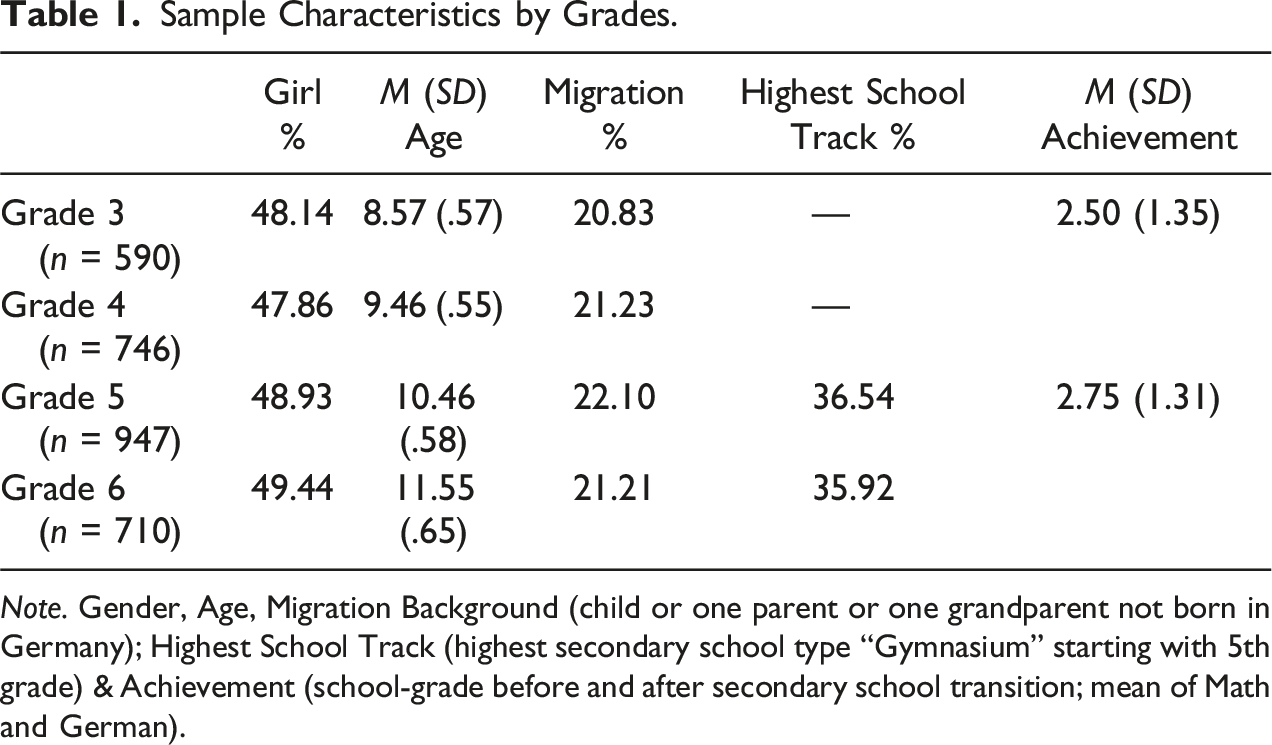
Note. Gender, Age, Migration Background (child or one parent or one grandparent not born in Germany); Highest School Track (highest secondary school type “Gymnasium” starting with 5th grade) & Achievement (school-grade before and after secondary school transition; mean of Math and German).
Measures
The variables on positive parenting are captured from both the maternal and the adolescent perspective, while the variables on emotional and social problems are only given from the adolescents’ perspective. Information on the exact item content and reliability can be found in Table S2 in the supplemental material.
Positive Maternal Parenting
Positive maternal parenting was captured by mother’s and adolescent’s perspective by using three items (mothers: Ω3rd = .84, Ω4th = .83, Ω5th = .86; Ω6th = .84; adolescents: Ω3rd = .74, Ω4th = .77, Ω5th = .78; Ω6th = .80), indicating the degree of affirmative and warm attention and care in maternal parenting (Jaursch, 2003). Mothers and children answered the questions on a 5-point Likert scale (1 = never to 5 = very often).
Social and Emotional Problems
Adolescents’ social and emotional problems were measured by two SDQ subscales (Woerner et al., 2002) comprising three items each: Social problems comprise information about difficulties in social interactions and integration within social groups (Ω3rd = .60, Ω4th = .63, Ω5th = .67; Ω6th = .61); emotional problems refer to feelings of being depressed and anxious (Ω3rd = .71, Ω4th = .74, Ω5th = .70; Ω6th = .75). The response format ranged from 0 (not true) to 2 (certainly true).
Control Variables
Control Variables are adolescents’ gender (1 = male, 2 = female), mothers’ highest education (years), school-grade before and after transition (mean of Math and German) and migration background (1 = no; 2 = child or one parent or one grandparent not born in Germany).
Analyses
Due to space constraints, the analytic plan is only briefly described here. Additional information (i.e., syntax) can be taken from the supplemental material (https://osf.io/gnm6f/). 1 All models were specified with “lavaan” (Rosseel, 2012) applying FIML-estimation with an MLR-estimator. Several steps had to be taken to prepare the data before the hypotheses of interest could be tested.
First, we tested whether missing values in all variables were random using Little’s (1988) MCAR–test. As the multi-wave data were restructured by students’ grade levels, systematic missing data occurred due to the design of the underlying data. Consequently, all constructs were tested within each grade level. Using the R–package MissMech (Jamshidian et al., 2014), missing values in all constructs proved to be completely random (p = .215).
Second, we applied Confirmatory Factor Analyses on all scales with multiple indicators. More precisely, we tested for longitudinal measurement invariance of emotional and social problems as well as invariance across time and perspective for positive parenting. All scales showed adequate reliability (Table S2, see supplemental material) and goodness of fit indices (Tables S3a and S3b, see supplemental material). Applying the ΔCFI criterion (criterion of a −.01 change in CFI) and the ΔRMSEA (criterion of a −.015 change in RMSEA), strong invariance could be shown over time (Chen, 2007; Cheung & Rensvold, 2002; Meade et al., 2008), allowing still conclusions on a structural level.
Third, after ensuring that the measurement properties of the items were acceptable and comparable across time and perspective, a Latent Congruency Model (LCM, Cheung, 2009, b) was specified to model level and discrepancy in maternal parenting for each grade level (3rd to 6th grade). In the context of Structural Equation Modeling (SEM), LCMs offer an advanced approach, overcoming limitations in terms of reliability and validity associated with observed difference scores (ODS, Edwards, 2002; Laird & De Los Reyes, 2013) and the limited flexibility of polynomial regression analysis (Cheung, 2009; de Haan et al., 2018; Nelemans et al., 2023). For instance, the LCM approach provides flexibility in studying the consequences of informant discrepancies over time, including the estimation of the mean, variance, and correlates of informant discrepancies within one model. Additionally, LCM accounted for measurement error and invariance in ratings of the mother-adolescent positive parenting across informants and over time, enabling us to draw valid conclusions regarding the impact of discrepancies on adolescents’ problem behavior.
The goal of LCM models is to examine the congruence between the raters – or, in other words, the degree to which different ratings agree or disagree (Cheung, 2009). Basically, the LCM model is a second–order CFA model with two higher–order latent variables referring to the level of the two raters’ scores (e.g., the grand mean or mean-level in the mothers-adolescents’ ratings for positive parenting) and to the discrepancy (e.g., the average discrepancy or difference in ratings between the mothers’ and adolescents’ evaluations of positive parenting). Each first–order variable is a simple latent variable based on the items answered by the different raters (e.g., the items rated by the mother vs. the items rated by adolescents). Level and discrepancy are modeled by the second–order variables (see, Figure 1, following Cheung, 2009). The predictive paths of the discrepancy variable to the first–order latent variables had fixed factor loadings of −0.5 and 0.5, respectively, while the paths from the level variable had fixed factor loadings of 1. Additionally, the residuals of the first–order factors were set to zero and the two second–order terms were allowed to covary. Furthermore, all intercepts and loadings of the first–order factors were set to be equal across each grade level (3rd – 6th grade) and each perspective (mother and adolescents). The level represents the mean - value of ratings within a dyad, where higher values represent a more positive level of mother-adolescent ratings in parental warmth. A discrepancy value of ‘0’ represents no discrepancy at all between raters within a dyad (=congruency); positive discrepancy values represent the extent to which the maternal rating exceeds the adolescent rating (parental overrating); and negative values represent the extent to which the adolescent’s rating exceeds the maternal rating (adolescent overrating). Schematic Model for LCM. Note. Schematic Model for LCM at one measurement point (T1). PPMC represents mother–child positive parenting from mothers’ perspective and PPCM represents mother–child positive parenting from child’s perspective (manifest item-level).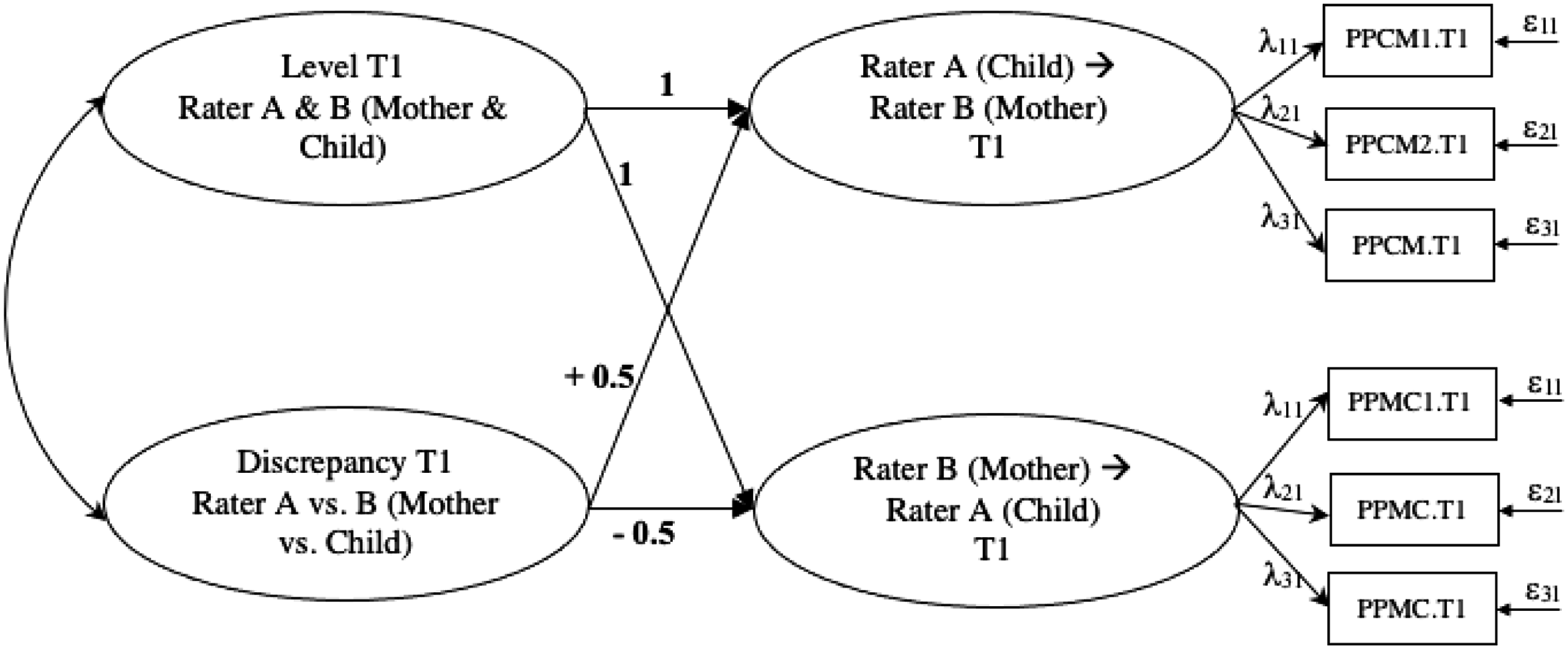
Fourth, the LCM model was then extended by including adolescents’ emotional and social problems without any regressive path or control variables. Emotional as well as social problems were modeled as latent first-order variables at each grade level, capturing the “state” of adolescents’ problem behavior. For the further analyses, the estimated factor scores of the latent variables of the extended LCM model were used.
Fifth, we specified two manifest path models, for each dependent variable. Within each model and at each grade level, the emotional or social problems were predicted by the control variables, the parenting level as well as the parenting discrepancy, the latter entered as linear and quadratic effect. For specifying the quadratic term, the discrepancy variable was squared. To improve the interpretation of the regression coefficients and to address the multicollinearity, all manifest variables (factor scores) were centered. Finally, the regression weight of the quadratic term was multiplied by 2 (c.f., Rawlings et al., 1998).
Results
Means, Grand Means & Discrepancy in Positive Parenting.
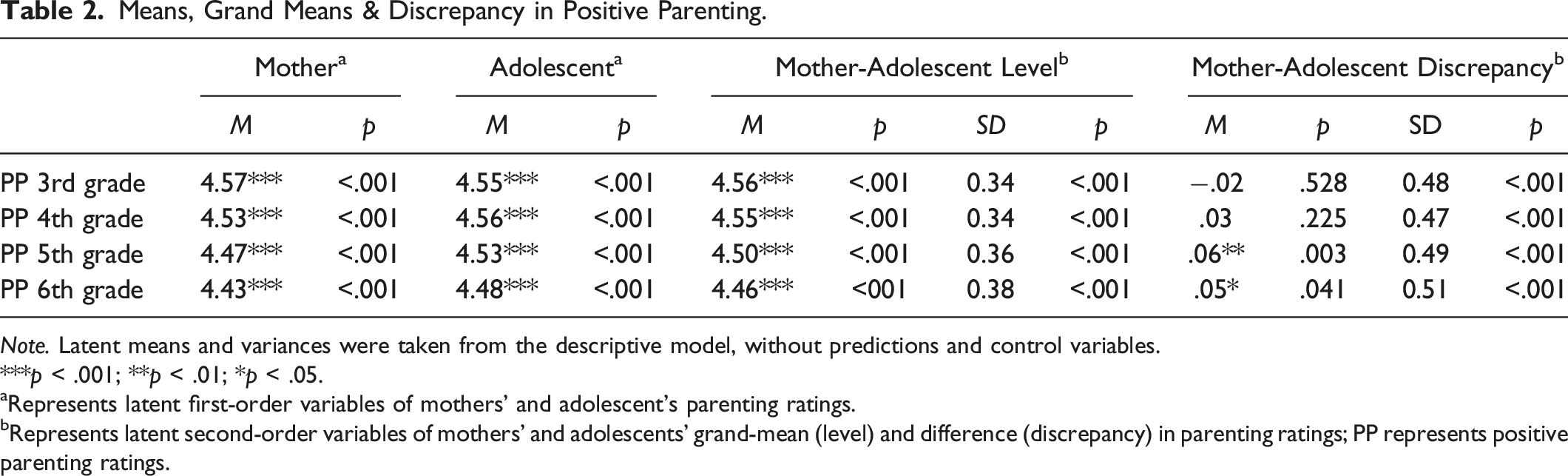
Note. Latent means and variances were taken from the descriptive model, without predictions and control variables. ***p < .001; **p < .01; *p < .05.
aRepresents latent first-order variables of mothers’ and adolescent’s parenting ratings.
bRepresents latent second-order variables of mothers’ and adolescents’ grand-mean (level) and difference (discrepancy) in parenting ratings; PP represents positive parenting ratings.
Second, the manifest path models obtained acceptable fit statistics for emotional problems, χ2 (107, n = 947) = 409.24, p < .001; RMSEA = .055; CFI = .903; TLI = .929 and social problems, χ2 (107, n = 947) = 576.722, p < .001; RMSEA = .068; CFI = .892; TLI = .921).
Mother-Adolescent Path Model for Emotional & Social Problems.
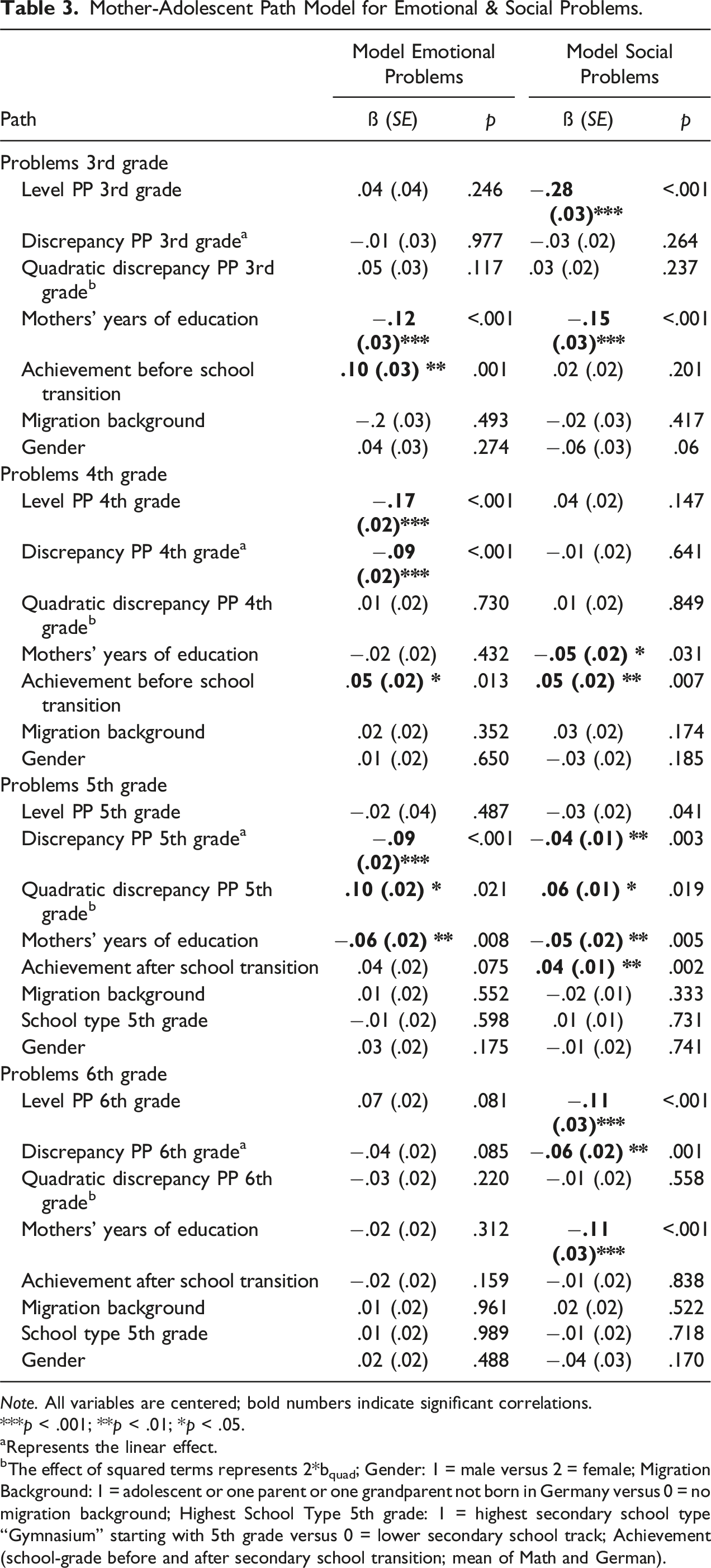
Note. All variables are centered; bold numbers indicate significant correlations.***p < .001; **p < .01; *p < .05.
aRepresents the linear effect.
bThe effect of squared terms represents 2*bquad; Gender: 1 = male versus 2 = female; Migration Background: 1 = adolescent or one parent or one grandparent not born in Germany versus 0 = no migration background; Highest School Type 5th grade: 1 = highest secondary school type “Gymnasium” starting with 5th grade versus 0 = lower secondary school track; Achievement (school-grade before and after secondary school transition; mean of Math and German).
Regarding level effects, while mother-child’s mean-level in parenting ratings negatively predicted adolescents’ emotional problems only at 4th grade (β = −.17, p < .001), the level negatively predicted social problems at 3rd grade (β = −.28, p < .001) and 6th grade (β = −.11, p < .001), suggesting that a high within dyad level of perceived parenting has a protective function.
Concerning linear discrepancy effects, discrepancy negatively predicted emotional problems at 4th (β = −.09, p < .001) grade and 5th (β = −.09, p < .001) grade as well as social problems at 5th (β = −.04, p = .003) grade and 6th grade (β = −.06, p = .001). The more the adolescents’ ratings exceed the mothers’ ratings, the lower the level of problem behavior.
Regarding quadratic effects, only at 5th grade, a positive quadratic effect of mother-adolescent parenting discrepancy was found for emotional (β = .10, p = .021) and social problems (β = .06, p = .019), showing that more extreme levels of adolescent over-reporting went along with higher levels in of emotional and social problems.
Discussion
Recent debates have highlighted the importance of mother-child discrepancy for adolescents’ psychological functioning (e.g., Ksinan & Vazsonyi, 2016). Although some research acknowledged the relevance of curvilinear associations between adolescent-mother reports and adolescents’ externalizing behavior (see van Heel et al., 2019), we provide additional support and suggest that, in addition to the mean-level and linear effects of the discrepancies, the specification of quadratic terms provide meaningful insights. A very interesting pattern emerged. Level effects were only at grade four, no linear discrepancy effects were found, and quadratic discrepancy effects were only found at grade five.
Level effects emerged at 4th grade: The average evaluation in parenting within the mothers-adolescent dyad may serve as a protective factor during times when it is necessary as indicated by the negative correlation between level in maternal warmth and adolescents’ problem behaviors (see also Nelemans et al., 2023). As a retrospective interpretation, the highly performance-oriented German school system, the 4th grade –the last grade before secondary school transition–, represents a time with higher levels of perceived school-related pressure, because school grades at the end of the 4th grade are crucial for determining the further educational path (higher vs. lower track) and subsequently post-school careers (Buchholz et al., 2016). In other word, during this challenging last pre-secondary school year, more adolescent-reported maternal warmth was associated with less behavioral problems only when mothers reported high levels of that same type of warmth parenting. These findings suggest that the impact of adolescent- and mother-report were conditional on each other (see Van Heel et al., 2019). However, there was no clear indication of the importance of within-dyad discrepancy during this pre-secondary school phase.
Discrepancy effects at 5th grade: Positive quadratic discrepancy effects in predicting emotional and social problems were found at 5th grade, the grade after the school transition. Although an adolescent overestimation is beneficial (indicated by the significant linear effect) the quadratic effect indicates that large discrepancies went along with higher levels of adolescents’ problem behaviors, irrespective of the directions of the deviation. The positive linear effect was cancelled out by the effect of the large overestimation.
These large discrepancies may indicate maladaptive processes within family that prevent the maternal parenting to serve as a resource during the post-transition time. After changing form elementary to secondary schools, adolescents have to readapt their social networks as well as learn to cope with the changed performance requirements in the new school as well as the stronger competitive orientation in secondary school (Klinger et al., 2015). At this developmental period, resources and consistent information about these resources are needed most for adolescents’ adaption (Gniewosz & Gniewosz, 2019; Ruble & Seidman, 1996). Thus, after secondary school transition, large, not small, or moderate, discrepancies seem to constitute a risk factor for adolescent’s psychological outcomes, challenging the idea of mothers as a secure base.
There are some limitations to be considered: These results focus especially on the mother-adolescent dyad. However, mothers and fathers differ in the parenting roles (Marceau et al., 2015), suggesting that the reported associations may vary across the different parent-adolescent dyads (De Haan et al., 2018; Nelemans et al., 2023). Further, only certain aspects of positive parenting and problem behavior were focused. Parenting includes several other aspects (e.g., control) that may affect adolescent psychological functioning as well (e.g., Baumrind, 2005). Moreover, the modeled relationships between variables are cross-sectional in nature, i.e., they do not allow causal conclusions about the directionality of the effects.
Future research will benefit from exploring development-specific changes related to parent-child discrepancies (e.g., Vrolijk et al., 2023). It’s important to consider that the discrepancy between parents and children can vary by age and the relevance of these discrepancies for the development of adolescents may change over time.
Taken together, this study provided insights into the role of positive parenting within mother-adolescent dyads and the association with psychological adjustment. The results point to the importance of considering quadratic effects in developmental research, because negative parenting discrepancy effects were only found, if the within-dyad differences were large.
Supplemental Material
Supplemental Material - Beyond Linear Effects: Multiple Perspectives of Mother–Adolescent Positive Parenting & Adolescent’s Problem Behavior
Supplemental Material for Beyond Linear Effects: Multiple Perspectives of Mother–Adolescent Positive Parenting & Adolescent’s Problem Behavior by Gabriela Gniewosz, and Burkhard Gniewosz in The Journal of Early Adolescence.
Footnotes
Acknowledgements
This article uses data from the German Family Panel pairfam, coordinated by Josef Brüderl, Sonja Drobnič, Karsten Hank, Franz Neyer, and Sabine Walper. We thank Michaela Katstaller for her theoretical input. Further, we thank the pairfam team ( ) for the collection and documentation of the data. Finally, we are grateful for the input of Urs Grob in regard to the Latent Congruency Models.
Author Contributions
Gabriela Gniewosz: Conceptualization, Statistical/Formal analysis, Writing - Original Draft & Editing, Visualization. Burkhard Gniewosz: Conceptualization, Supervision, Writing - Original Draft & Editing.
Declaration of Conflicting Interests
The author(s) declared no potential conflicts of interest with respect to the research, authorship, and/or publication of this article.
Funding
The author(s) disclosed receipt of the following financial support for the research, authorship, and/or publication of this article: Pairfam is funded as long-term project by the German Research Foundation (DFG; Project number: 165713635).
Ethical Statement
Open Science Statement
Data, code, and additional online materials are openly available at the project’s Open Science Framework page (https://osf.io/gnm6f/) https://osf.io/gnm6f/?view_only=3f998677ec8c450b87561ddddf096198. This article uses data from the German Family Panel pairfam, coordinated by Josef Brüderl, Sonja Drobnič, Karsten Hank, Franz Neyer, and Sabine Walper ().
Preregistration
The study was preregistered in the Open Science Framework (OSF) on October 12th, 2021 and comprised research questions and hypotheses, data description, planned analyses and variables as well as a description of prior knowledge of the data. The R-code for the tests and models (i.e., tests of longitudinal measurement invariance, LCS models) as well as additional material (i.e., supplemental material, item list) is also available in the Open Science Framework (https://osf.io/gnm6f/) .
Data Availability Statement
Supplemental Material
Supplemental material for this article is available online.
Note
Author Biographies
References
Supplementary Material
Please find the following supplemental material available below.
For Open Access articles published under a Creative Commons License, all supplemental material carries the same license as the article it is associated with.
For non-Open Access articles published, all supplemental material carries a non-exclusive license, and permission requests for re-use of supplemental material or any part of supplemental material shall be sent directly to the copyright owner as specified in the copyright notice associated with the article.
